
1 Office of Small and Disadvantaged Business
OM
Published · 45 slides · 0 views

1 / 1
Description
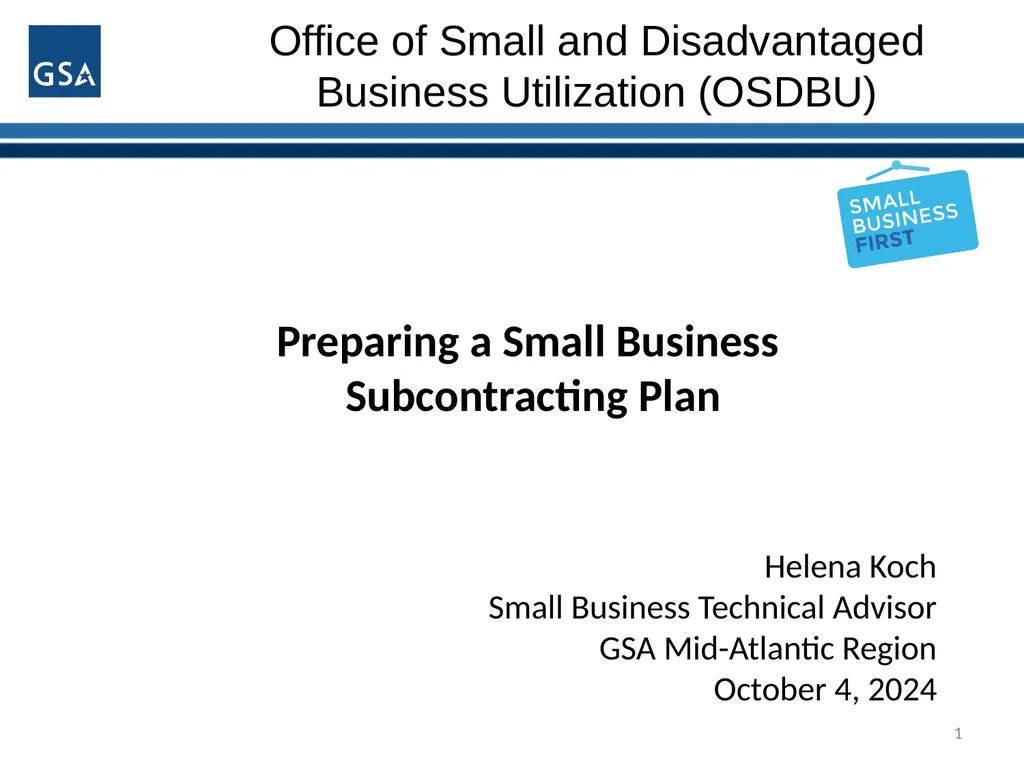
1 Office of Small and Disadvantaged Business Utilization (OSDBU) Preparing a Small Business Subcontracting Plan Helena Koch Small Business Technical Advisor GSA Mid-Atlantic Region October 4, 2024 Office of Small and Disadvantaged Business
Related Topics
Share
Embed code
Download this presentation From Below
"1 Office of Small and Disadvantaged Business" is the property of its rightful owner. Permission is granted to download and print the materials on this website for personal, non-commercial use only, and to display it on your personal computer provided you do not modify the materials and that you retain all copyright notices contained in the materials. By downloading content from our website, you accept the terms of this agreement.
Presentation Transcript
01
1 Office of Small and Disadvantaged Business Utilization (OSDBU) Preparing a Small Business
Subcontracting Plan
Helena Koch
Small Business Technical Advisor
GSA Mid-Atlantic Region
October 4, 2024<br>
Subcontracting Plan
Helena Koch
Small Business Technical Advisor
GSA Mid-Atlantic Region
October 4, 2024<br>
02
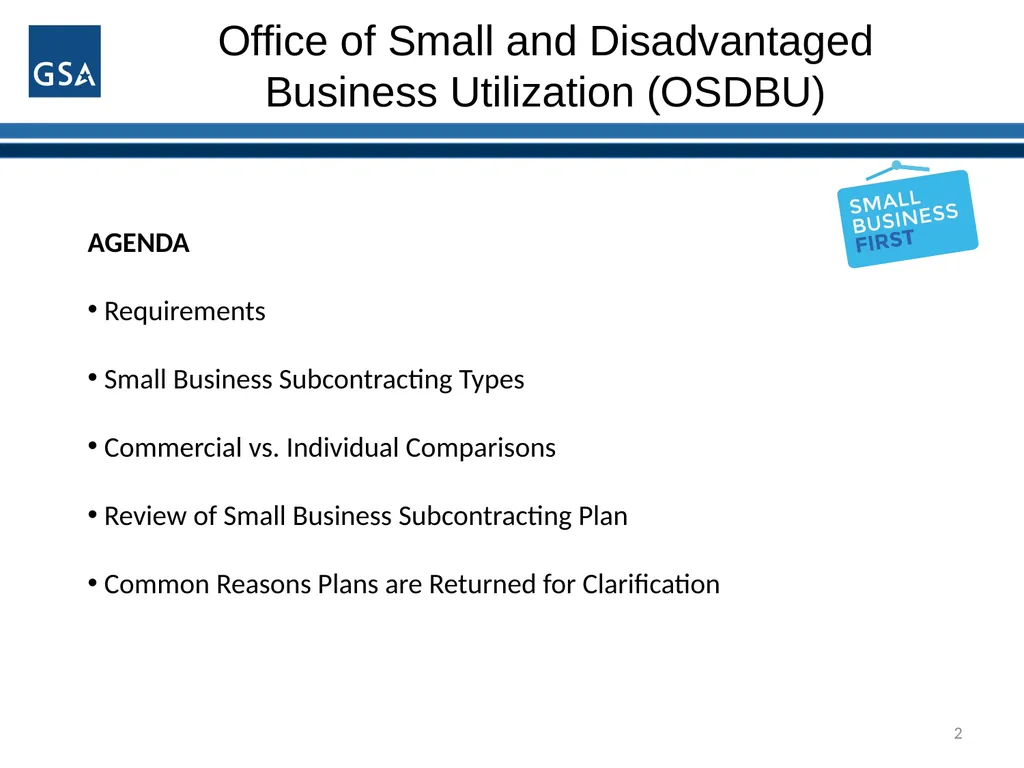
Office of Small and Disadvantaged Business Utilization (OSDBU) AGENDA
Requirements
Small Business Subcontracting Types
Commercial vs. Individual Comparisons
Review of Small Business Subcontracting Plan
Common Reasons Plans are Returned for Clarification 2<br>
Requirements
Small Business Subcontracting Types
Commercial vs. Individual Comparisons
Review of Small Business Subcontracting Plan
Common Reasons Plans are Returned for Clarification 2<br>
03
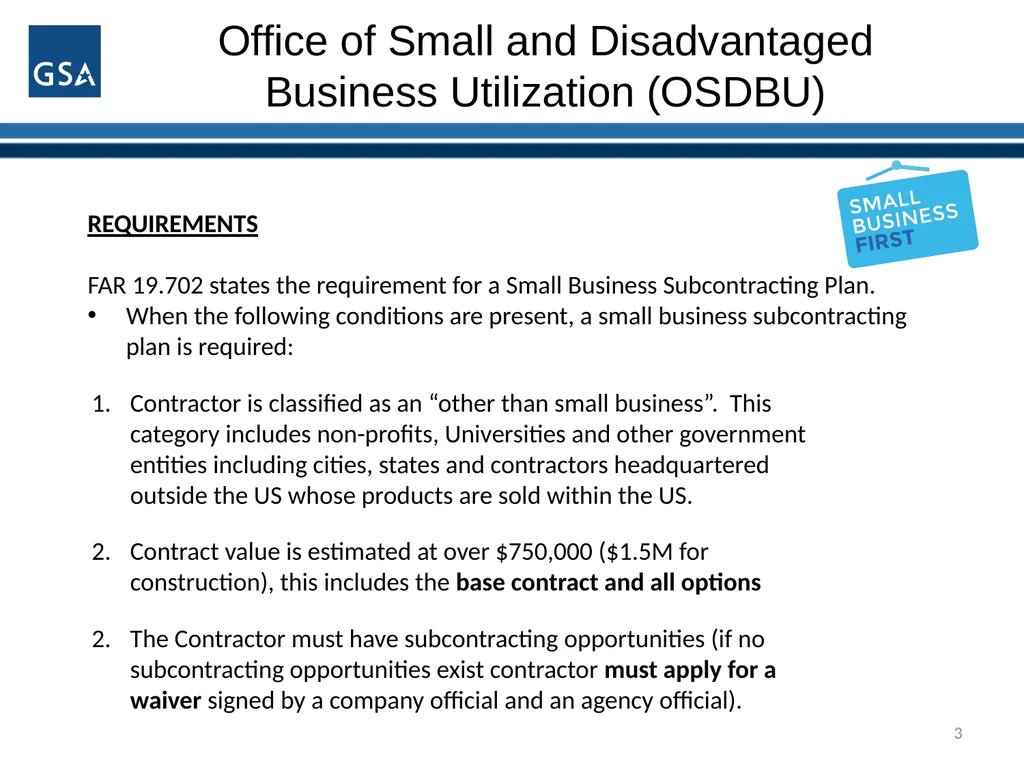
Office of Small and Disadvantaged Business Utilization (OSDBU) REQUIREMENTS
FAR 19.702 states the requirement for a Small Business Subcontracting Plan.
When the following conditions are present, a small business subcontracting plan is required:
Contractor is classified as an “other than small business”. This category includes non-profits, Universities and other government entities including cities, states and contractors headquartered outside the US whose products are sold within the US.
Contract value is estimated at over $750,000 ($1.5M for construction), this includes the base contract and all options
The Contractor must have subcontracting opportunities (if no subcontracting opportunities exist contractor must apply for a waiver signed by a company official and an agency official). 3<br>
04
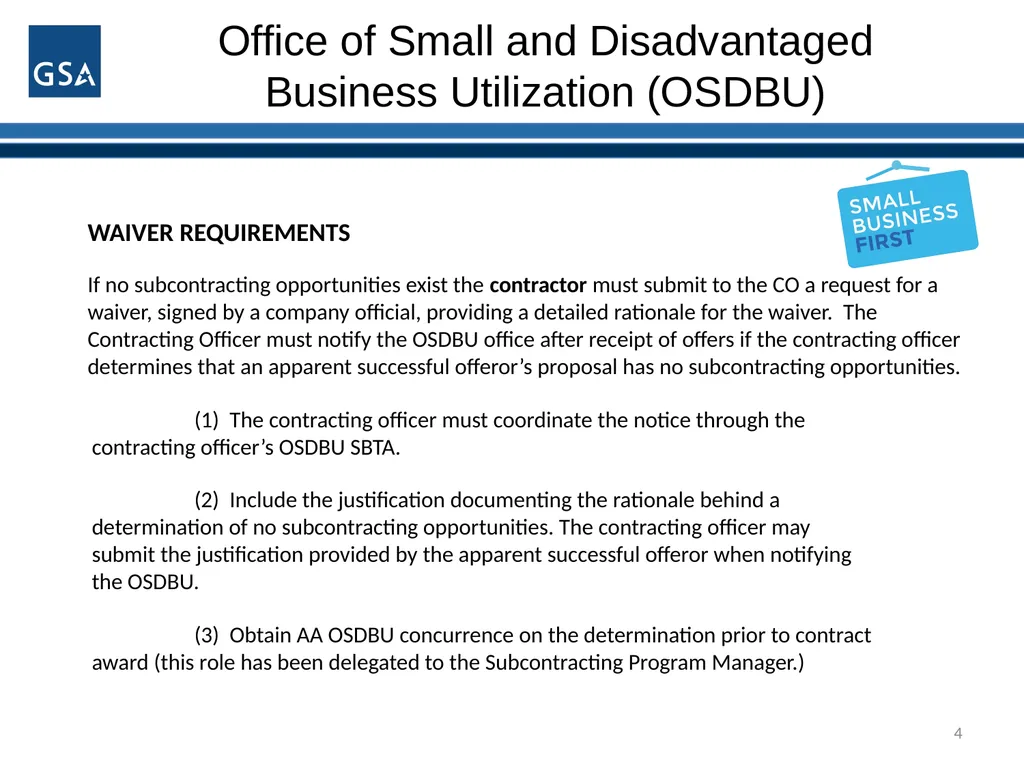
Office of Small and Disadvantaged Business Utilization (OSDBU) WAIVER REQUIREMENTS
If no subcontracting opportunities exist the contractor must submit to the CO a request for a waiver, signed by a company official, providing a detailed rationale for the waiver. The Contracting Officer must notify the OSDBU office after receipt of offers if the contracting officer determines that an apparent successful offeror’s proposal has no subcontracting opportunities.
(1) The contracting officer must coordinate the notice through the contracting officer’s OSDBU SBTA.
(2) Include the justification documenting the rationale behind a determination of no subcontracting opportunities. The contracting officer may submit the justification provided by the apparent successful offeror when notifying the OSDBU.
(3) Obtain AA OSDBU concurrence on the determination prior to contract award (this role has been delegated to the Subcontracting Program Manager.) 4<br>
05
Office of Small and Disadvantaged Business Utilization (OSDBU) A COMMERCIAL SUBCONTRATING PLAN
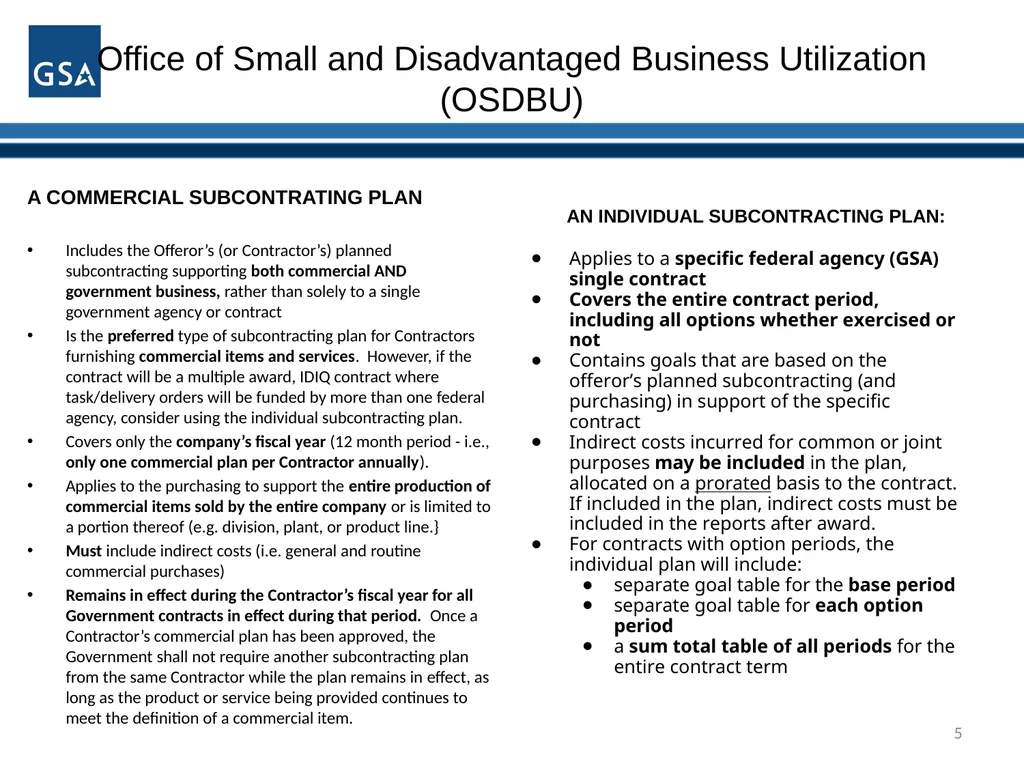
Includes the Offeror’s (or Contractor’s) planned subcontracting supporting both commercial AND government business, rather than solely to a single government agency or contract
Is the preferred type of subcontracting plan for Contractors furnishing commercial items and services. However, if the contract will be a multiple award, IDIQ contract where task/delivery orders will be funded by more than one federal agency, consider using the individual subcontracting plan.
Covers only the company’s fiscal year (12 month period - i.e., only one commercial plan per Contractor annually).
Applies to the purchasing to support the entire production of commercial items sold by the entire company or is limited to a portion thereof (e.g. division, plant, or product line.}
Must include indirect costs (i.e. general and routine commercial purchases)
Remains in effect during the Contractor’s fiscal year for all Government contracts in effect during that period. Once a Contractor’s commercial plan has been approved, the Government shall not require another subcontracting plan from the same Contractor while the plan remains in effect, as long as the product or service being provided continues to meet the definition of a commercial item. AN INDIVIDUAL SUBCONTRACTING PLAN:
Applies to a specific federal agency (GSA) single contract
Covers the entire contract period, including all options whether exercised or not
Contains goals that are based on the offeror’s planned subcontracting (and purchasing) in support of the specific contract
Indirect costs incurred for common or joint purposes may be included in the plan, allocated on a prorated basis to the contract. If included in the plan, indirect costs must be included in the reports after award.
For contracts with option periods, the individual plan will include:
separate goal table for the base period
separate goal table for each option period
a sum total table of all periods for the entire contract term 5<br>
06
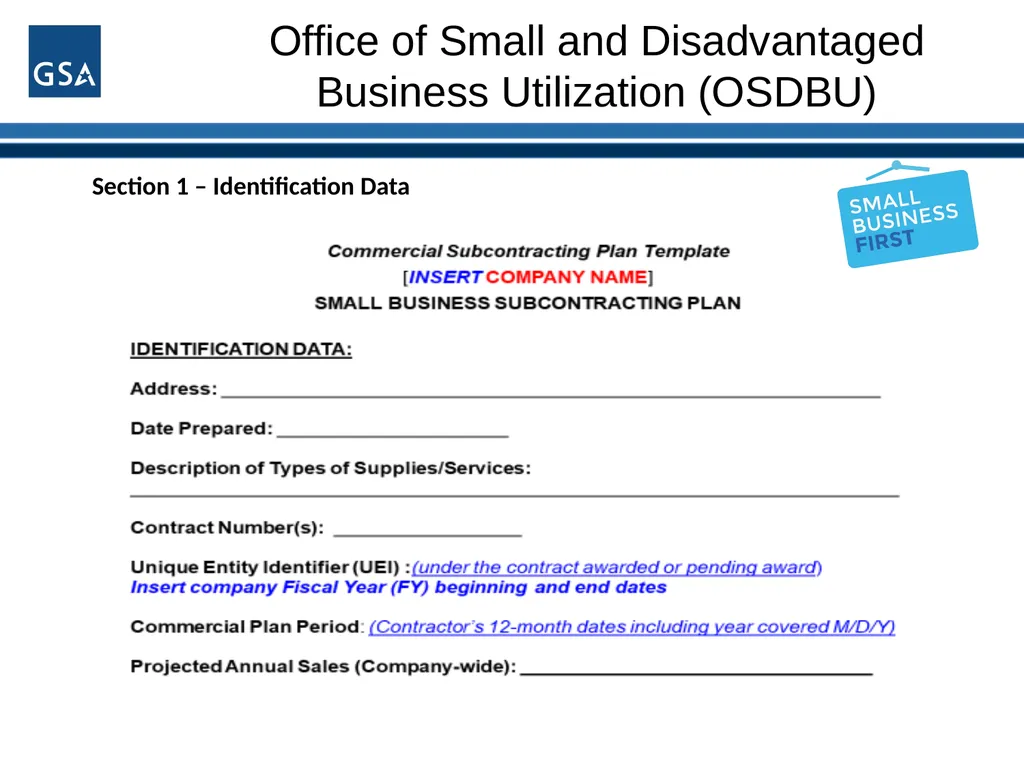
6 Office of Small and Disadvantaged Business Utilization (OSDBU) Section 1 – Identification Data<br>
07
Office of Small and Disadvantaged Business Utilization (OSDBU) COMMERCIAL SUBCONTRACTING PLAN
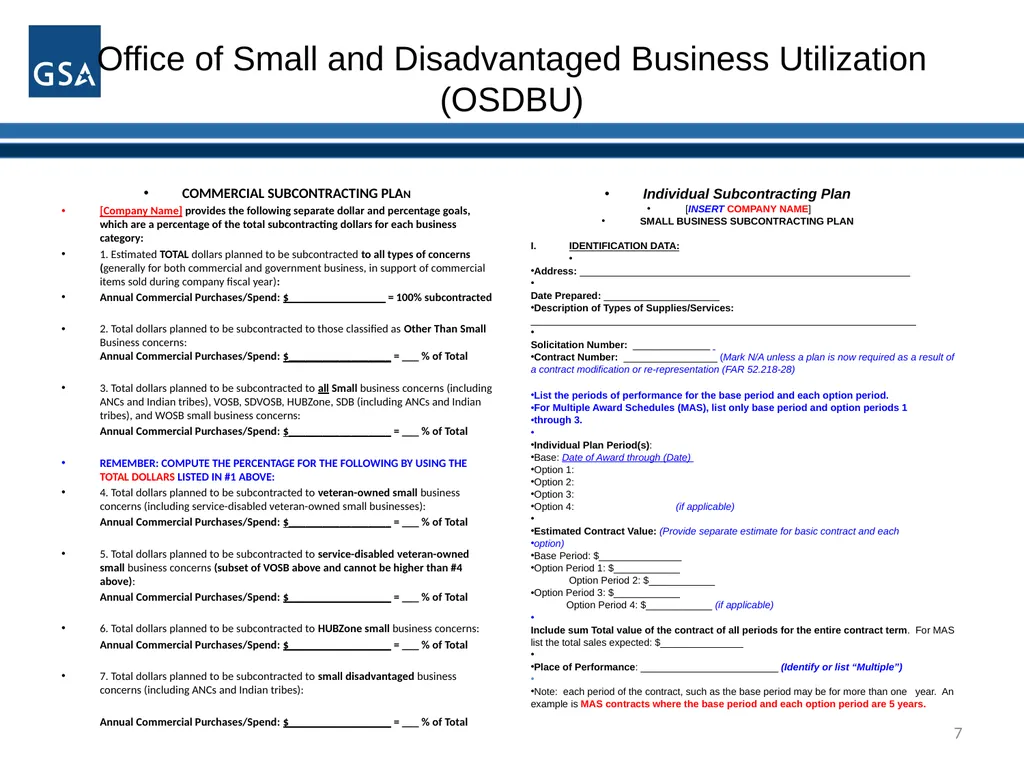
[Company Name] provides the following separate dollar and percentage goals, which are a percentage of the total subcontracting dollars for each business category:
1. Estimated TOTAL dollars planned to be subcontracted to all types of concerns (generally for both commercial and government business, in support of commercial items sold during company fiscal year):
Annual Commercial Purchases/Spend: $_________________ = 100% subcontracted
2. Total dollars planned to be subcontracted to those classified as Other Than Small Business concerns: Annual Commercial Purchases/Spend: $__________________ = ___ % of Total
3. Total dollars planned to be subcontracted to all Small business concerns (including ANCs and Indian tribes), VOSB, SDVOSB, HUBZone, SDB (including ANCs and Indian tribes), and WOSB small business concerns:
Annual Commercial Purchases/Spend: $__________________ = ___ % of Total
REMEMBER: COMPUTE THE PERCENTAGE FOR THE FOLLOWING BY USING THE TOTAL DOLLARS LISTED IN #1 ABOVE:
4. Total dollars planned to be subcontracted to veteran-owned small business concerns (including service-disabled veteran-owned small businesses):
Annual Commercial Purchases/Spend: $__________________ = ___ % of Total
5. Total dollars planned to be subcontracted to service-disabled veteran-owned small business concerns (subset of VOSB above and cannot be higher than #4 above):
Annual Commercial Purchases/Spend: $__________________ = ___ % of Total
6. Total dollars planned to be subcontracted to HUBZone small business concerns:
Annual Commercial Purchases/Spend: $__________________ = ___ % of Total
7. Total dollars planned to be subcontracted to small disadvantaged business concerns (including ANCs and Indian tribes):
Annual Commercial Purchases/Spend: $__________________ = ___ % of Total Individual Subcontracting Plan
[INSERT COMPANY NAME]
SMALL BUSINESS SUBCONTRACTING PLAN
IDENTIFICATION DATA:
Address: ____________________________________________________________
Date Prepared: _____________________
Description of Types of Supplies/Services: ______________________________________________________________________
Solicitation Number: ______________
Contract Number: _________________ (Mark N/A unless a plan is now required as a result of a contract modification or re-representation (FAR 52.218-28)
List the periods of performance for the base period and each option period.
For Multiple Award Schedules (MAS), list only base period and option periods 1
through 3.
Individual Plan Period(s):
Base: Date of Award through (Date)
Option 1:
Option 2:
Option 3:
Option 4: (if applicable)
Estimated Contract Value: (Provide separate estimate for basic contract and each
option)
Base Period: $_______________
Option Period 1: $____________ Option Period 2: $____________
Option Period 3: $____________ Option Period 4: $____________ (if applicable)
Include sum Total value of the contract of all periods for the entire contract term. For MAS list the total sales expected: $_______________
Place of Performance: _________________________ (Identify or list “Multiple”)
Note: each period of the contract, such as the base period may be for more than one year. An example is MAS contracts where the base period and each option period are 5 years. 7<br>
08
Office of Small and Disadvantaged
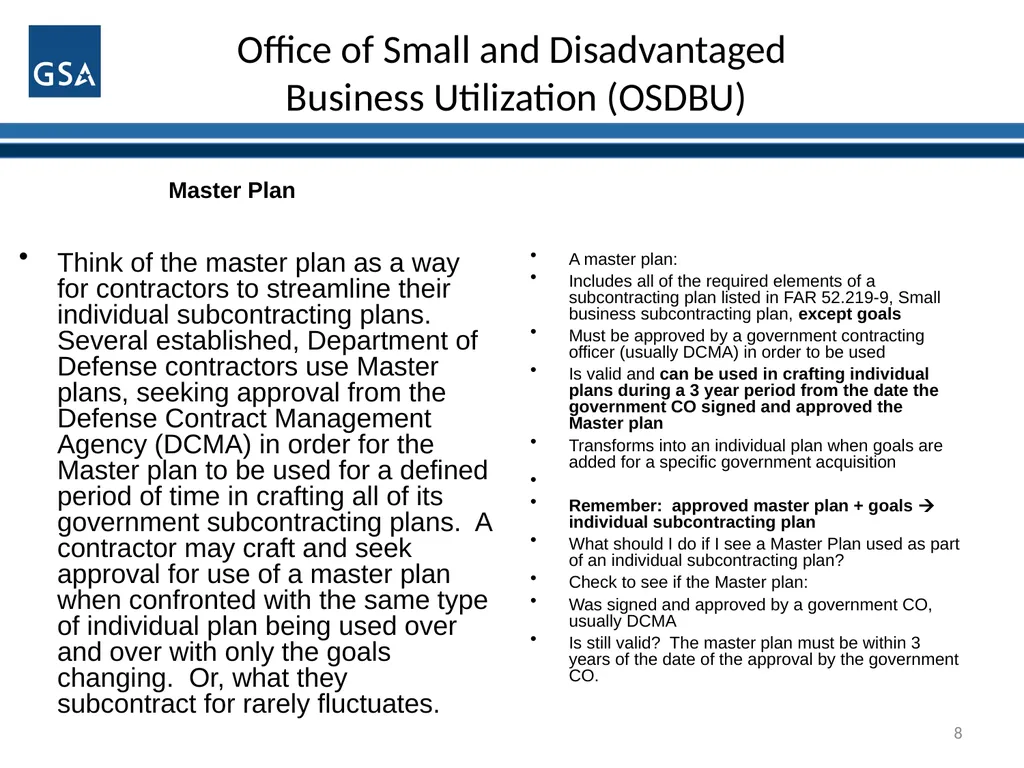
Business Utilization (OSDBU) Think of the master plan as a way for contractors to streamline their individual subcontracting plans. Several established, Department of Defense contractors use Master plans, seeking approval from the Defense Contract Management Agency (DCMA) in order for the Master plan to be used for a defined period of time in crafting all of its government subcontracting plans. A contractor may craft and seek approval for use of a master plan when confronted with the same type of individual plan being used over and over with only the goals changing. Or, what they subcontract for rarely fluctuates. 8 Master Plan A master plan:
Includes all of the required elements of a subcontracting plan listed in FAR 52.219-9, Small business subcontracting plan, except goals
Must be approved by a government contracting officer (usually DCMA) in order to be used
Is valid and can be used in crafting individual plans during a 3 year period from the date the government CO signed and approved the Master plan
Transforms into an individual plan when goals are added for a specific government acquisition
Remember: approved master plan + goals individual subcontracting plan
What should I do if I see a Master Plan used as part of an individual subcontracting plan?
Check to see if the Master plan:
Was signed and approved by a government CO, usually DCMA
Is still valid? The master plan must be within 3 years of the date of the approval by the government CO.<br>
09
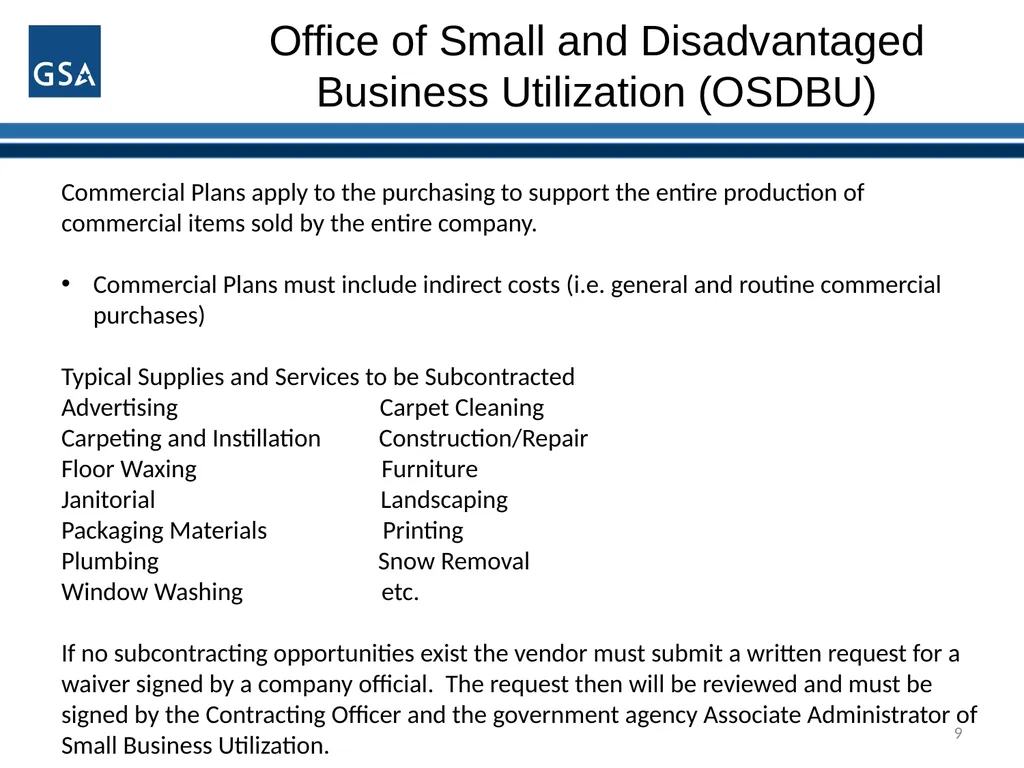
9 Office of Small and Disadvantaged Business Utilization (OSDBU) Commercial Plans apply to the purchasing to support the entire production of commercial items sold by the entire company.
Commercial Plans must include indirect costs (i.e. general and routine commercial purchases)
Typical Supplies and Services to be Subcontracted
Advertising Carpet Cleaning
Carpeting and Instillation Construction/Repair
Floor Waxing Furniture
Janitorial Landscaping
Packaging Materials Printing
Plumbing Snow Removal
Window Washing etc.
If no subcontracting opportunities exist the vendor must submit a written request for a waiver signed by a company official. The request then will be reviewed and must be signed by the Contracting Officer and the government agency Associate Administrator of Small Business Utilization.<br>
10
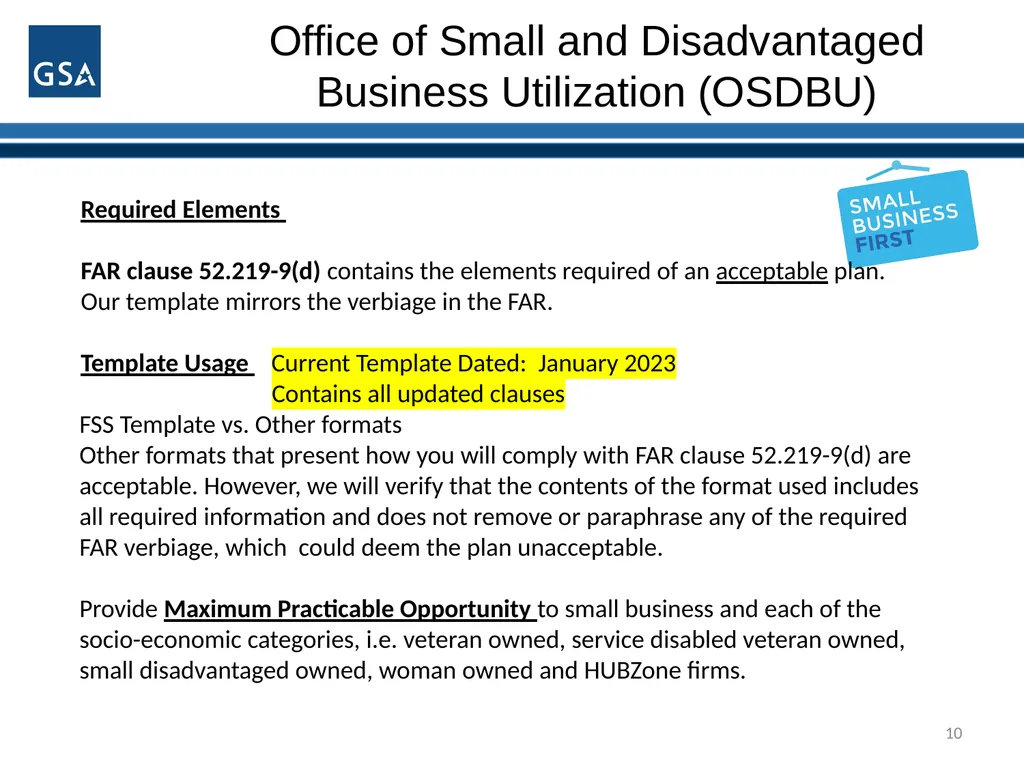
10 Office of Small and Disadvantaged Business Utilization (OSDBU) Required Elements
FAR clause 52.219-9(d) contains the elements required of an acceptable plan. Our template mirrors the verbiage in the FAR.
Template Usage RCurrent Template Dated: January 2023
Contains all updated clauses
FSS Template vs. Other formats
Other formats that present how you will comply with FAR clause 52.219-9(d) are acceptable. However, we will verify that the contents of the format used includes all required information and does not remove or paraphrase any of the required FAR verbiage, which could deem the plan unacceptable.
Provide Maximum Practicable Opportunity to small business and each of the socio-economic categories, i.e. veteran owned, service disabled veteran owned, small disadvantaged owned, woman owned and HUBZone firms.<br>
11
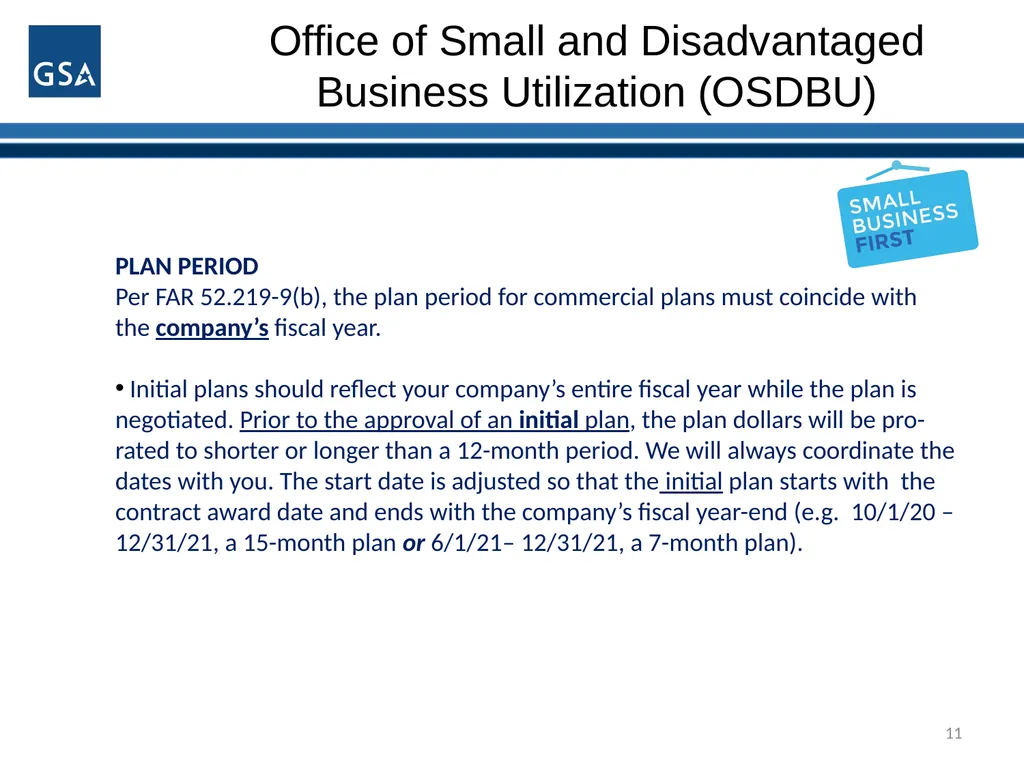
11 Office of Small and Disadvantaged Business Utilization (OSDBU) PLAN PERIOD
Per FAR 52.219-9(b), the plan period for commercial plans must coincide with the company’s fiscal year.
Initial plans should reflect your company’s entire fiscal year while the plan is negotiated. Prior to the approval of an initial plan, the plan dollars will be pro-rated to shorter or longer than a 12-month period. We will always coordinate the dates with you. The start date is adjusted so that the initial plan starts with the contract award date and ends with the company’s fiscal year-end (e.g. 10/1/20 – 12/31/21, a 15-month plan or 6/1/21– 12/31/21, a 7-month plan).<br>
12
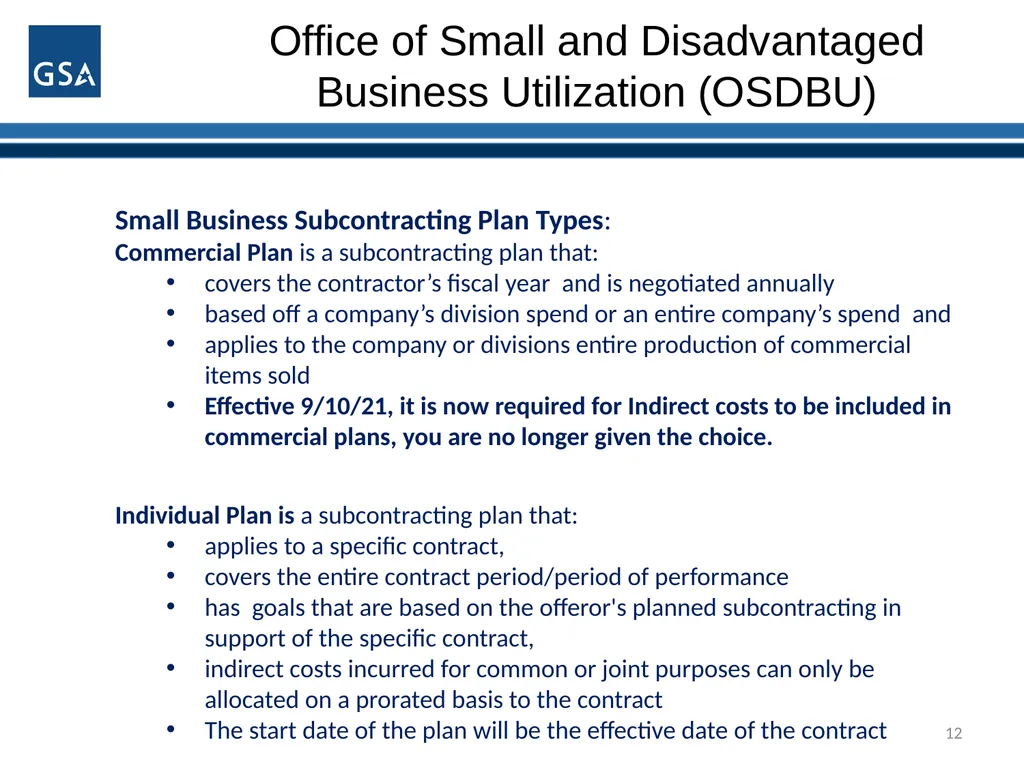
12 Office of Small and Disadvantaged Business Utilization (OSDBU) Small Business Subcontracting Plan Types:
Commercial Plan is a subcontracting plan that:
covers the contractor’s fiscal year and is negotiated annually
based off a company’s division spend or an entire company’s spend and
applies to the company or divisions entire production of commercial items sold
Effective 9/10/21, it is now required for Indirect costs to be included in commercial plans, you are no longer given the choice.
Individual Plan is a subcontracting plan that:
applies to a specific contract,
covers the entire contract period/period of performance
has goals that are based on the offeror's planned subcontracting in support of the specific contract,
indirect costs incurred for common or joint purposes can only be allocated on a prorated basis to the contract
The start date of the plan will be the effective date of the contract<br>
13
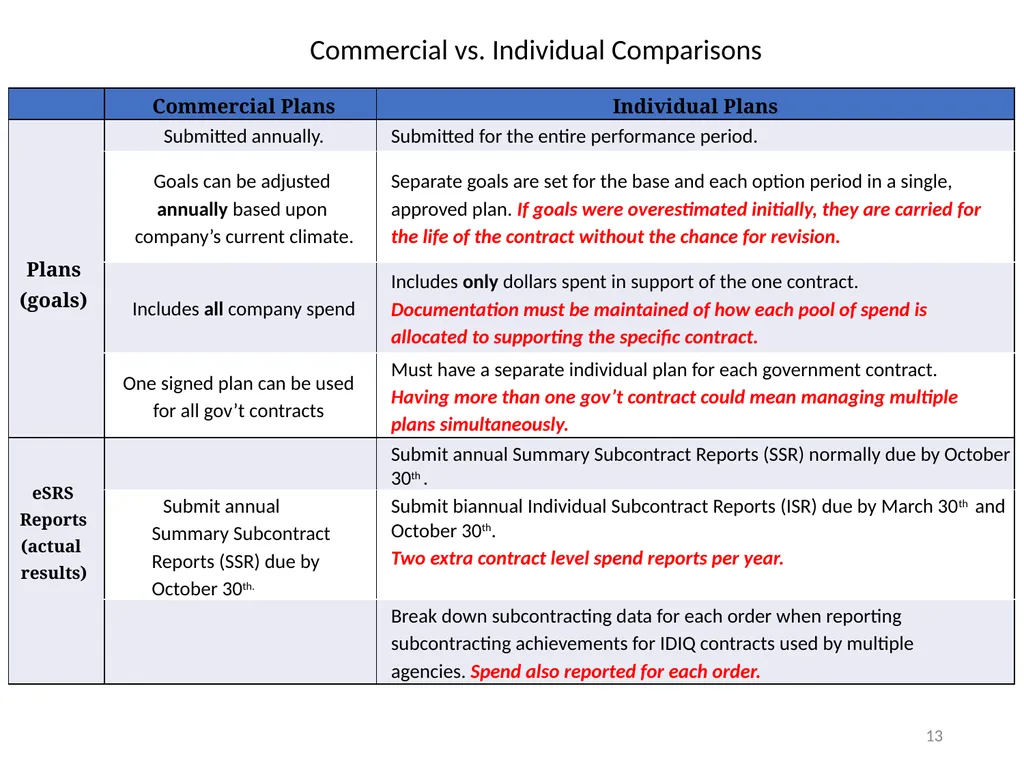
Commercial vs. Individual Comparisons 13<br>
14
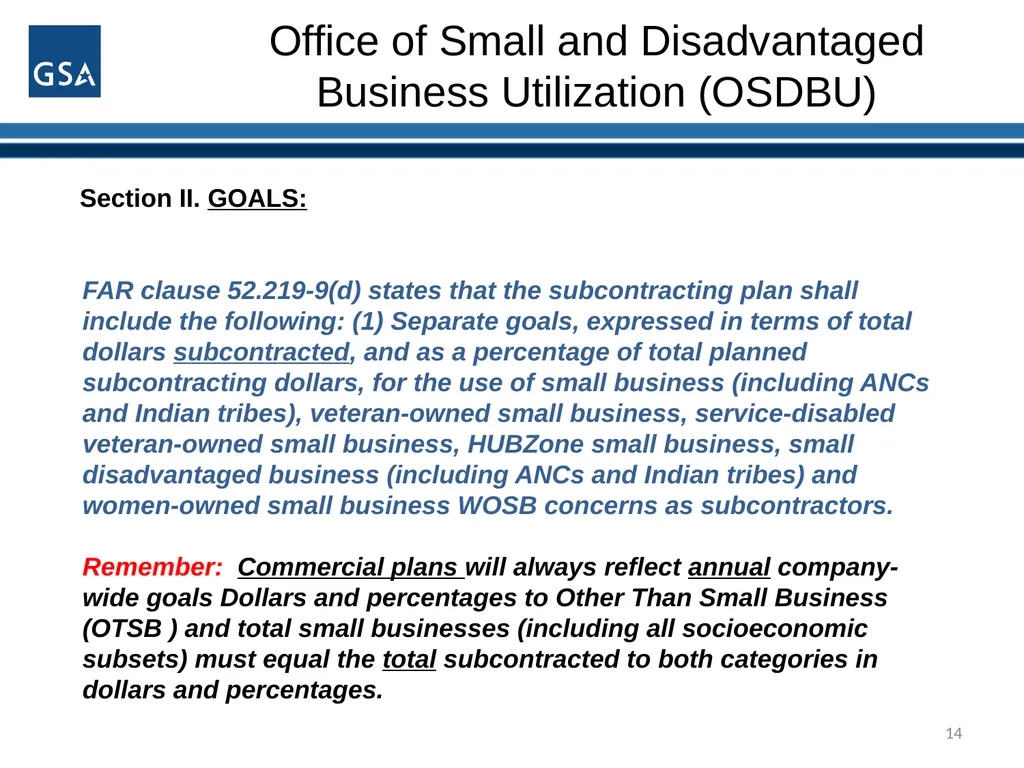
Section II. GOALS: 14 Office of Small and Disadvantaged Business Utilization (OSDBU) FAR clause 52.219-9(d) states that the subcontracting plan shall include the following: (1) Separate goals, expressed in terms of total dollars subcontracted, and as a percentage of total planned subcontracting dollars, for the use of small business (including ANCs and Indian tribes), veteran-owned small business, service-disabled veteran-owned small business, HUBZone small business, small disadvantaged business (including ANCs and Indian tribes) and women-owned small business WOSB concerns as subcontractors.
Remember: Commercial plans will always reflect annual company-wide goals Dollars and percentages to Other Than Small Business (OTSB ) and total small businesses (including all socioeconomic subsets) must equal the total subcontracted to both categories in dollars and percentages.<br>
Remember: Commercial plans will always reflect annual company-wide goals Dollars and percentages to Other Than Small Business (OTSB ) and total small businesses (including all socioeconomic subsets) must equal the total subcontracted to both categories in dollars and percentages.<br>
15
II. GOALS:
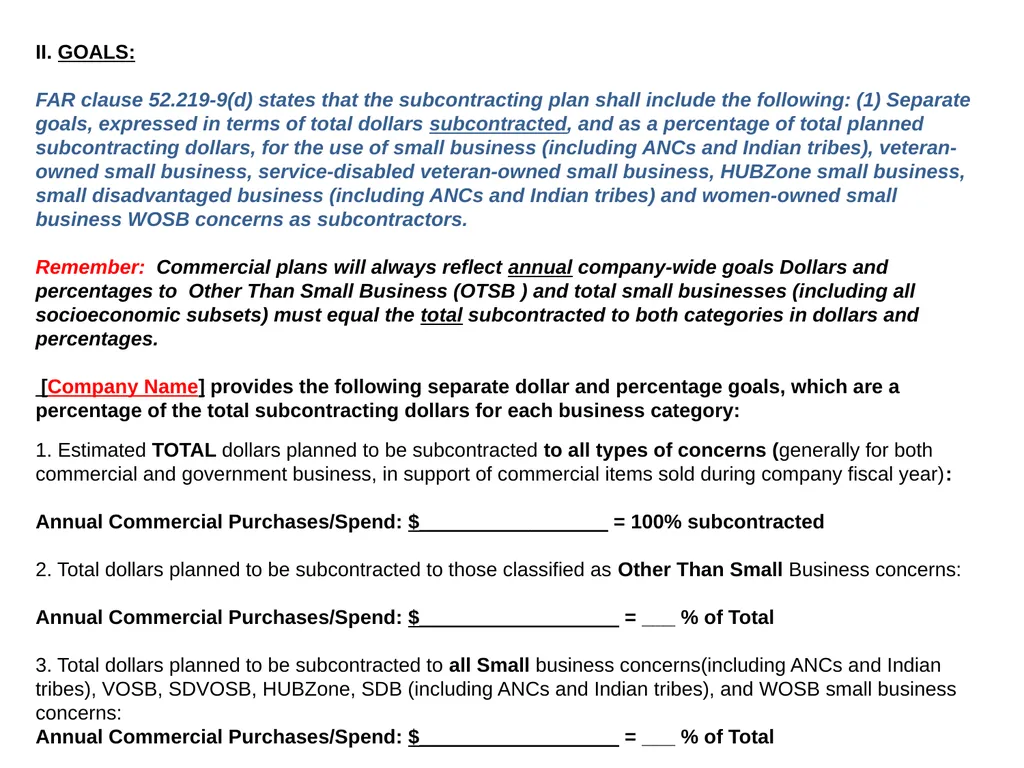
FAR clause 52.219-9(d) states that the subcontracting plan shall include the following: (1) Separate goals, expressed in terms of total dollars subcontracted, and as a percentage of total planned subcontracting dollars, for the use of small business (including ANCs and Indian tribes), veteran-owned small business, service-disabled veteran-owned small business, HUBZone small business, small disadvantaged business (including ANCs and Indian tribes) and women-owned small business WOSB concerns as subcontractors.
Remember: Commercial plans will always reflect annual company-wide goals Dollars and percentages to Other Than Small Business (OTSB ) and total small businesses (including all socioeconomic subsets) must equal the total subcontracted to both categories in dollars and percentages.
[Company Name] provides the following separate dollar and percentage goals, which are a percentage of the total subcontracting dollars for each business category:
1. Estimated TOTAL dollars planned to be subcontracted to all types of concerns (generally for both commercial and government business, in support of commercial items sold during company fiscal year):
Annual Commercial Purchases/Spend: $_________________ = 100% subcontracted
2. Total dollars planned to be subcontracted to those classified as Other Than Small Business concerns:
Annual Commercial Purchases/Spend: $__________________ = ___ % of Total
3. Total dollars planned to be subcontracted to all Small business concerns(including ANCs and Indian tribes), VOSB, SDVOSB, HUBZone, SDB (including ANCs and Indian tribes), and WOSB small business concerns:
Annual Commercial Purchases/Spend: $__________________ = ___ % of Total Office of Small and Disadvantaged Business Utilization (OSDBU)<br>
16
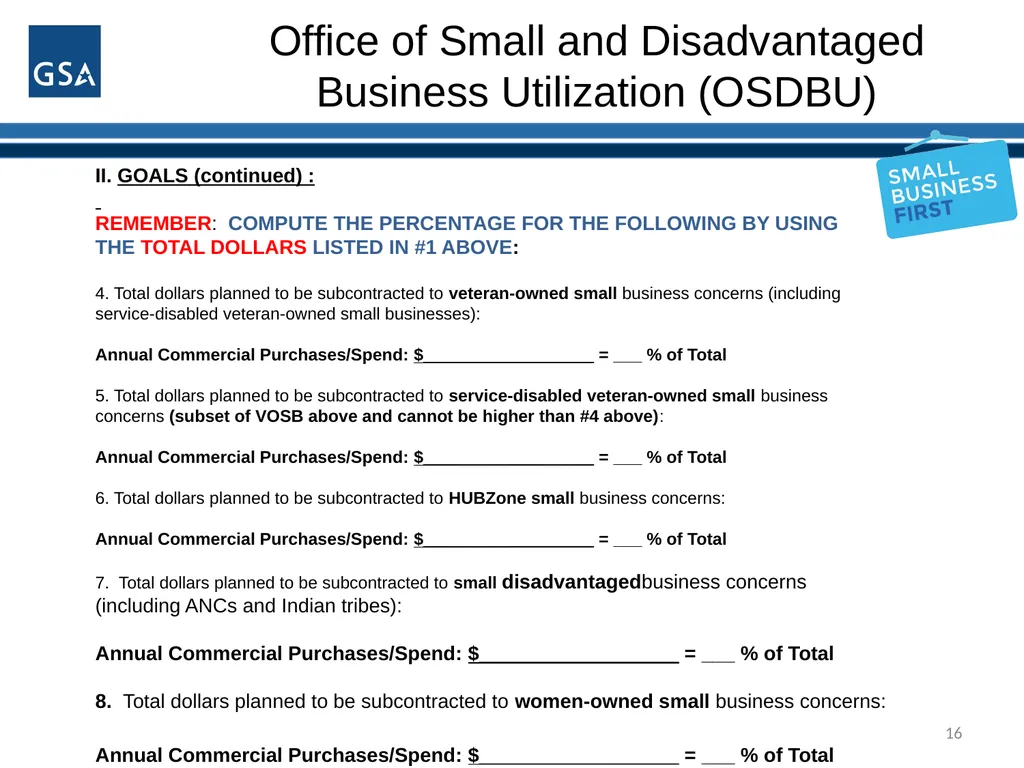
16 Office of Small and Disadvantaged Business Utilization (OSDBU) II. GOALS (continued) :
REMEMBER: COMPUTE THE PERCENTAGE FOR THE FOLLOWING BY USING
THE TOTAL DOLLARS LISTED IN #1 ABOVE:
4. Total dollars planned to be subcontracted to veteran-owned small business concerns (including service-disabled veteran-owned small businesses):
Annual Commercial Purchases/Spend: $__________________ = ___ % of Total
5. Total dollars planned to be subcontracted to service-disabled veteran-owned small business concerns (subset of VOSB above and cannot be higher than #4 above):
Annual Commercial Purchases/Spend: $__________________ = ___ % of Total
6. Total dollars planned to be subcontracted to HUBZone small business concerns:
Annual Commercial Purchases/Spend: $__________________ = ___ % of Total
7. Total dollars planned to be subcontracted to small disadvantagedbusiness concerns (including ANCs and Indian tribes):
Annual Commercial Purchases/Spend: $__________________ = ___ % of Total
8. Total dollars planned to be subcontracted to women-owned small business concerns:
Annual Commercial Purchases/Spend: $__________________ = ___ % of Total<br>
17
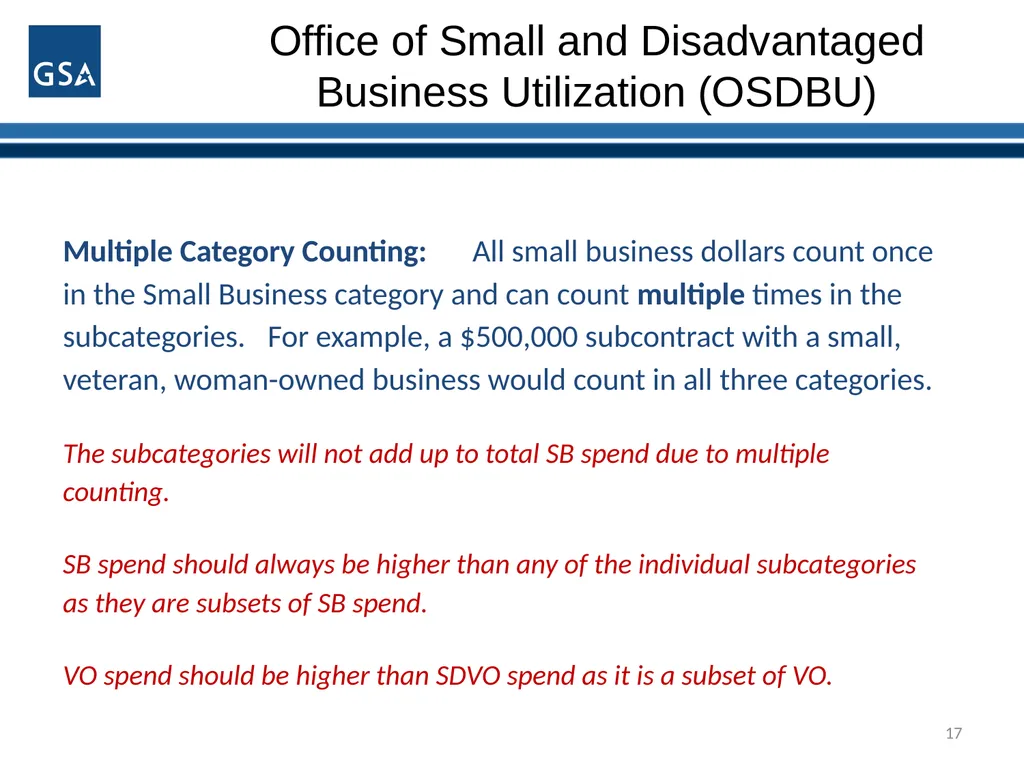
17 Office of Small and Disadvantaged Business Utilization (OSDBU) Multiple Category Counting: All small business dollars count once in the Small Business category and can count multiple times in the subcategories. For example, a $500,000 subcontract with a small, veteran, woman-owned business would count in all three categories.
The subcategories will not add up to total SB spend due to multiple counting.
SB spend should always be higher than any of the individual subcategories as they are subsets of SB spend.
VO spend should be higher than SDVO spend as it is a subset of VO.<br>
The subcategories will not add up to total SB spend due to multiple counting.
SB spend should always be higher than any of the individual subcategories as they are subsets of SB spend.
VO spend should be higher than SDVO spend as it is a subset of VO.<br>
18
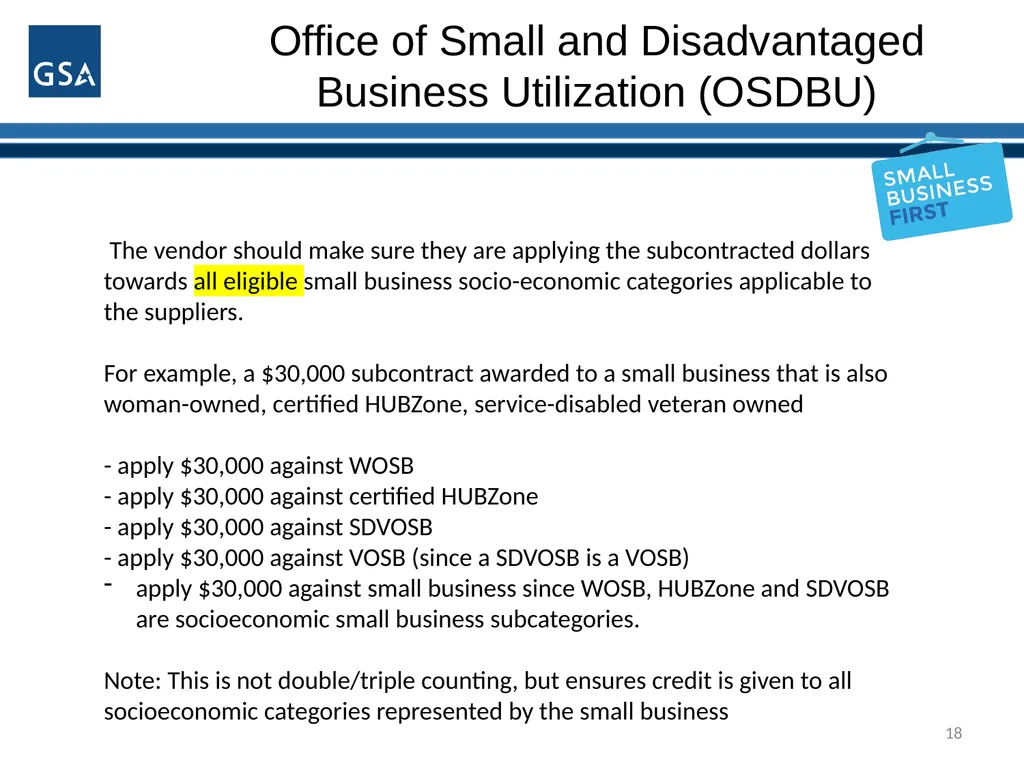
18 Office of Small and Disadvantaged Business Utilization (OSDBU) The vendor should make sure they are applying the subcontracted dollars towards all eligible small business socio-economic categories applicable to the suppliers.
For example, a $30,000 subcontract awarded to a small business that is also woman-owned, certified HUBZone, service-disabled veteran owned
- apply $30,000 against WOSB
- apply $30,000 against certified HUBZone
- apply $30,000 against SDVOSB
- apply $30,000 against VOSB (since a SDVOSB is a VOSB)
apply $30,000 against small business since WOSB, HUBZone and SDVOSB are socioeconomic small business subcategories.
Note: This is not double/triple counting, but ensures credit is given to all socioeconomic categories represented by the small business<br>
19
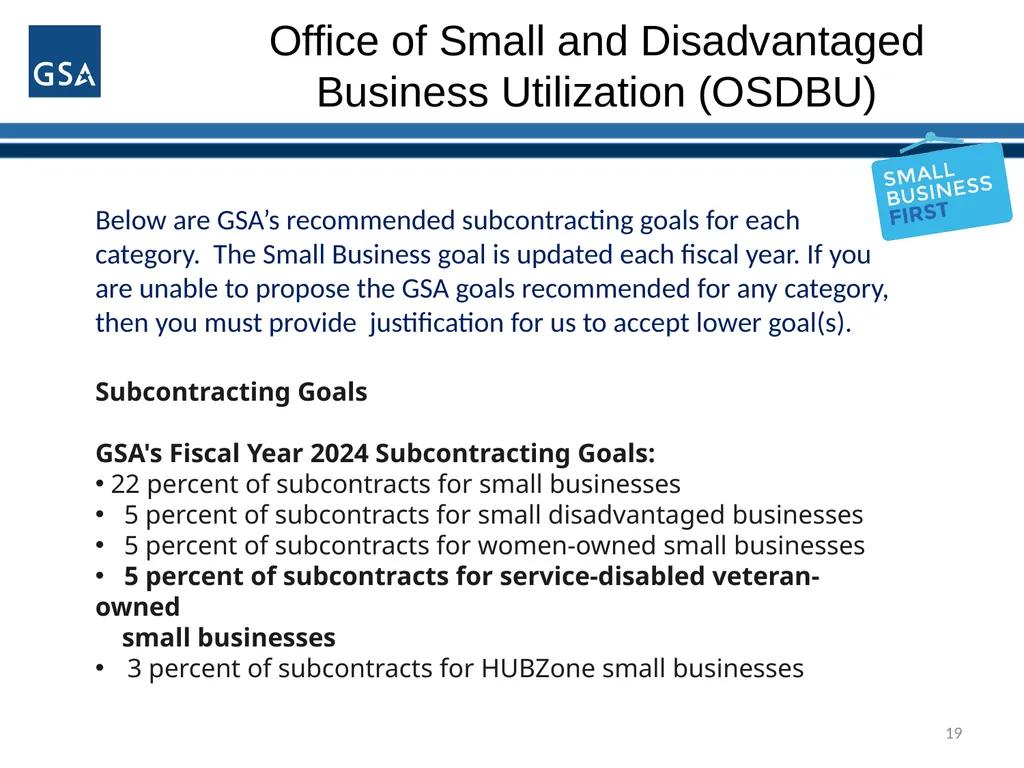
19 Office of Small and Disadvantaged Business Utilization (OSDBU) Below are GSA’s recommended subcontracting goals for each category. The Small Business goal is updated each fiscal year. If you are unable to propose the GSA goals recommended for any category, then you must provide justification for us to accept lower goal(s).
Subcontracting Goals
GSA's Fiscal Year 2024 Subcontracting Goals:
22 percent of subcontracts for small businesses
5 percent of subcontracts for small disadvantaged businesses
5 percent of subcontracts for women-owned small businesses
5 percent of subcontracts for service-disabled veteran-owned
small businesses
3 percent of subcontracts for HUBZone small businesses<br>
20
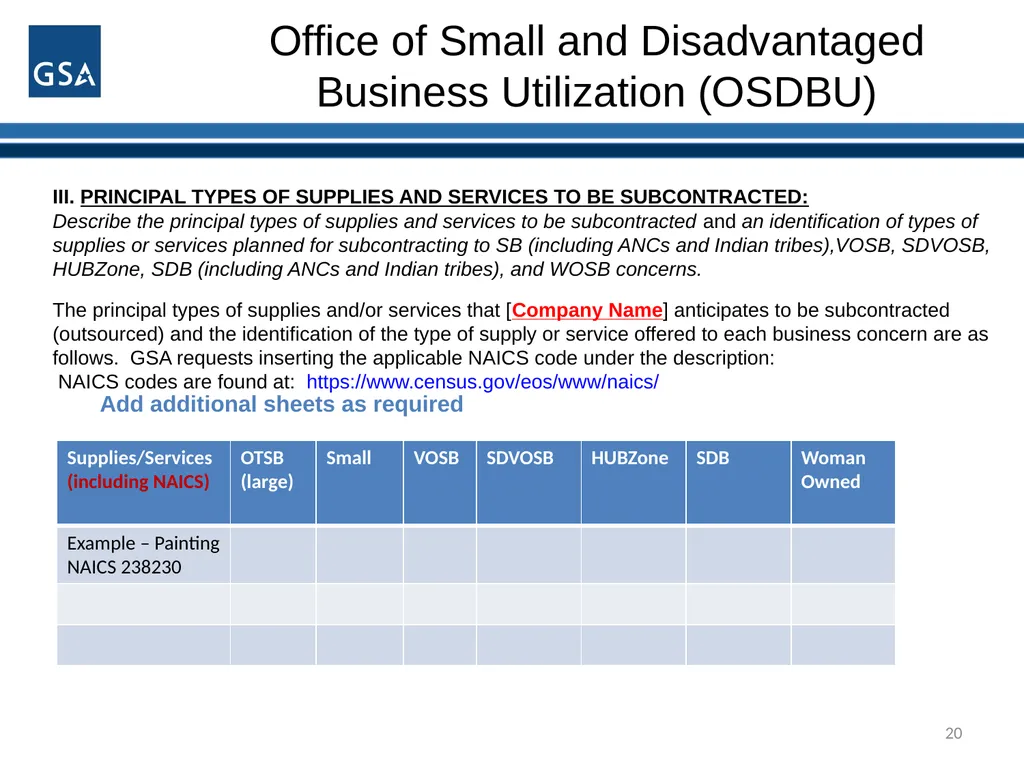
20 Office of Small and Disadvantaged Business Utilization (OSDBU) Add additional sheets as required III. PRINCIPAL TYPES OF SUPPLIES AND SERVICES TO BE SUBCONTRACTED:
Describe the principal types of supplies and services to be subcontracted and an identification of types of supplies or services planned for subcontracting to SB (including ANCs and Indian tribes),VOSB, SDVOSB, HUBZone, SDB (including ANCs and Indian tribes), and WOSB concerns.
The principal types of supplies and/or services that [Company Name] anticipates to be subcontracted (outsourced) and the identification of the type of supply or service offered to each business concern are as follows. GSA requests inserting the applicable NAICS code under the description:
NAICS codes are found at: https://www.census.gov/eos/www/naics/<br>
21
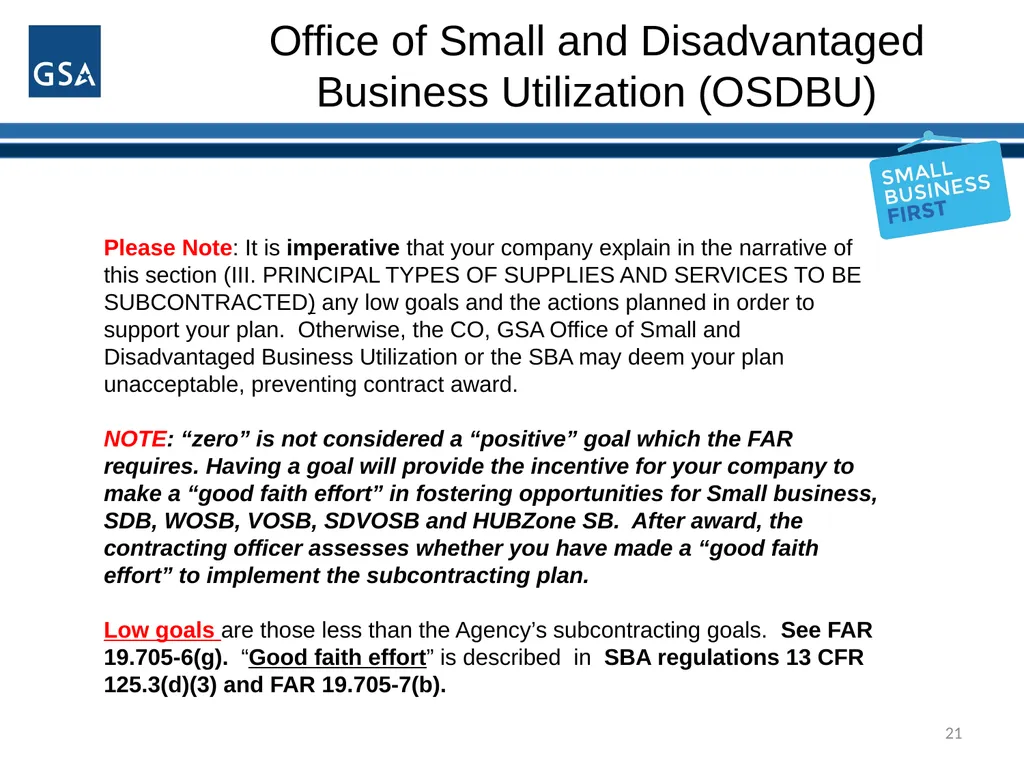
21 Office of Small and Disadvantaged Business Utilization (OSDBU) Please Note: It is imperative that your company explain in the narrative of this section (III. PRINCIPAL TYPES OF SUPPLIES AND SERVICES TO BE SUBCONTRACTED) any low goals and the actions planned in order to support your plan. Otherwise, the CO, GSA Office of Small and Disadvantaged Business Utilization or the SBA may deem your plan unacceptable, preventing contract award.
NOTE: “zero” is not considered a “positive” goal which the FAR requires. Having a goal will provide the incentive for your company to make a “good faith effort” in fostering opportunities for Small business, SDB, WOSB, VOSB, SDVOSB and HUBZone SB. After award, the contracting officer assesses whether you have made a “good faith effort” to implement the subcontracting plan.
Low goals are those less than the Agency’s subcontracting goals. See FAR 19.705-6(g). “Good faith effort” is described in SBA regulations 13 CFR 125.3(d)(3) and FAR 19.705-7(b).<br>
22
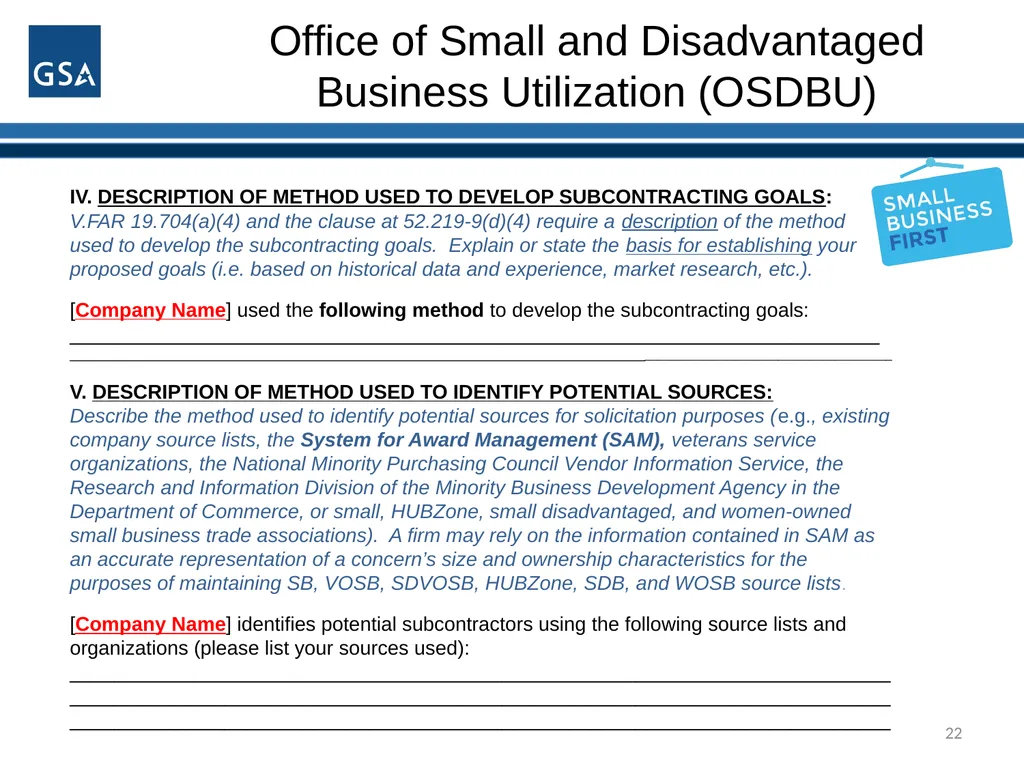
22 Office of Small and Disadvantaged Business Utilization (OSDBU) DESCRIPTION OF METHOD USED TO DEVELOP SUBCONTRACTING GOALS:
FAR 19.704(a)(4) and the clause at 52.219-9(d)(4) require a description of the method
used to develop the subcontracting goals. Explain or state the basis for establishing your proposed goals (i.e. based on historical data and experience, market research, etc.).
[Company Name] used the following method to develop the subcontracting goals:
_________________________________________________________________________
________________________________________________________________________________________________________________
V. DESCRIPTION OF METHOD USED TO IDENTIFY POTENTIAL SOURCES:
Describe the method used to identify potential sources for solicitation purposes (e.g., existing company source lists, the System for Award Management (SAM), veterans service organizations, the National Minority Purchasing Council Vendor Information Service, the Research and Information Division of the Minority Business Development Agency in the Department of Commerce, or small, HUBZone, small disadvantaged, and women-owned small business trade associations). A firm may rely on the information contained in SAM as an accurate representation of a concern’s size and ownership characteristics for the purposes of maintaining SB, VOSB, SDVOSB, HUBZone, SDB, and WOSB source lists.
[Company Name] identifies potential subcontractors using the following source lists and organizations (please list your sources used):
__________________________________________________________________________
__________________________________________________________________________
__________________________________________________________________________<br>
23
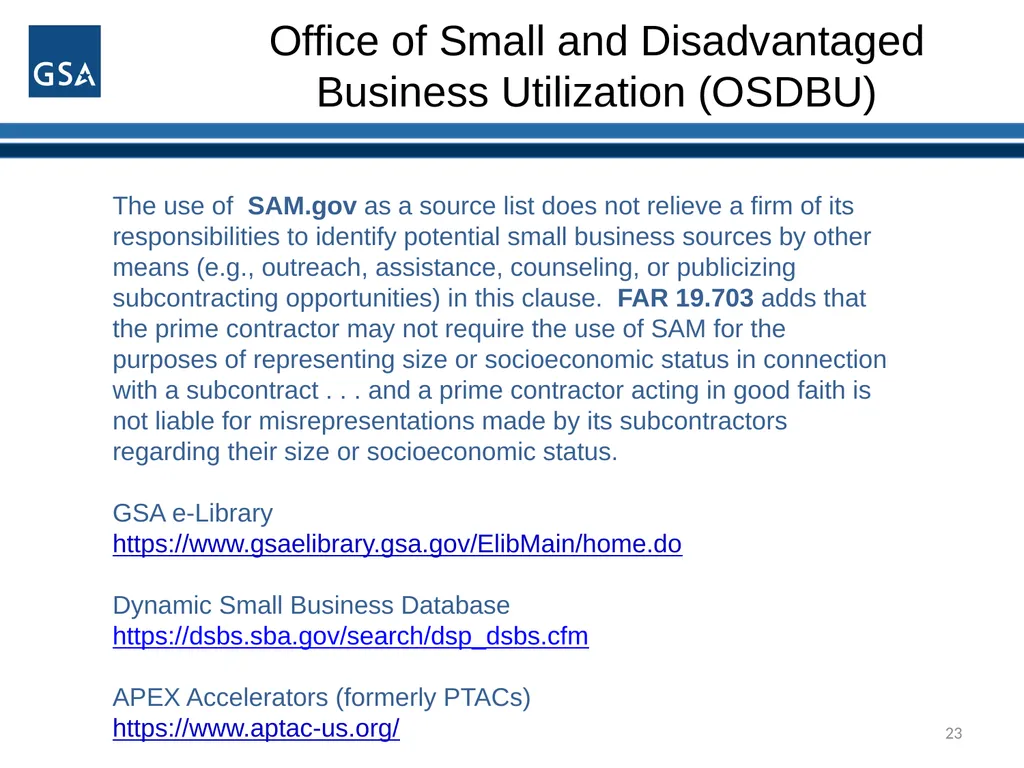
23 Office of Small and Disadvantaged Business Utilization (OSDBU) The use of SAM.gov as a source list does not relieve a firm of its responsibilities to identify potential small business sources by other means (e.g., outreach, assistance, counseling, or publicizing subcontracting opportunities) in this clause. FAR 19.703 adds that the prime contractor may not require the use of SAM for the purposes of representing size or socioeconomic status in connection with a subcontract . . . and a prime contractor acting in good faith is not liable for misrepresentations made by its subcontractors regarding their size or socioeconomic status.
GSA e-Library
https://www.gsaelibrary.gsa.gov/ElibMain/home.do
Dynamic Small Business Database
https://dsbs.sba.gov/search/dsp_dsbs.cfm
APEX Accelerators (formerly PTACs)
https://www.aptac-us.org/<br>
GSA e-Library
https://www.gsaelibrary.gsa.gov/ElibMain/home.do
Dynamic Small Business Database
https://dsbs.sba.gov/search/dsp_dsbs.cfm
APEX Accelerators (formerly PTACs)
https://www.aptac-us.org/<br>
24
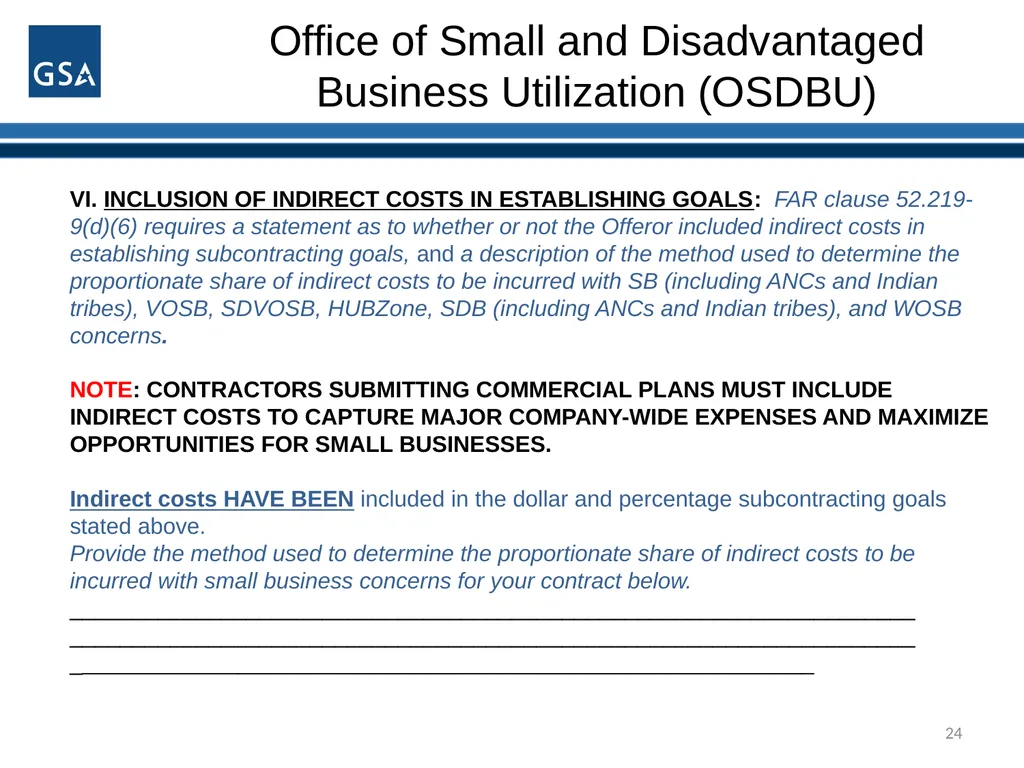
24 Office of Small and Disadvantaged Business Utilization (OSDBU) VI. INCLUSION OF INDIRECT COSTS IN ESTABLISHING GOALS: FAR clause 52.219-9(d)(6) requires a statement as to whether or not the Offeror included indirect costs in establishing subcontracting goals, and a description of the method used to determine the proportionate share of indirect costs to be incurred with SB (including ANCs and Indian tribes), VOSB, SDVOSB, HUBZone, SDB (including ANCs and Indian tribes), and WOSB concerns.
NOTE: CONTRACTORS SUBMITTING COMMERCIAL PLANS MUST INCLUDE INDIRECT COSTS TO CAPTURE MAJOR COMPANY-WIDE EXPENSES AND MAXIMIZE OPPORTUNITIES FOR SMALL BUSINESSES.
Indirect costs HAVE BEEN included in the dollar and percentage subcontracting goals stated above.
Provide the method used to determine the proportionate share of indirect costs to be incurred with small business concerns for your contract below.
___________________________________________________________________ ___________________________________________________________________ ___________________________________________________________________<br>
25
25 Office of Small and Disadvantaged Business Utilization (OSDBU) Indirect costs represent the expenses of doing business that are NOT easily identified with a specific project (i.e. contract or grant) but are generally recognized as ordinary and necessary for the general operation of the Contractor’s organization and the conduct of activities it performs. Types of indirect costs include routine supplies and general and administrative (G&A) expenses. However, fringe benefits (e.g. services or benefits provided to employees such as health insurance, payroll taxes, pension contribution, etc.), are NOT considered subcontracting and shall be excluded).<br>
26
26 Office of Small and Disadvantaged Business Utilization (OSDBU) VII. PROGRAM ADMINISTRATOR: FAR clause 52.219-9(d)(7) requires the name of the individual employed by the Offeror who will administer the Offeror’s subcontracting program, and a description of the duties of the individual. Please add the contact information for this person (telephone number and email address), in case of questions, and provide an alternate point of contact, if applicable.
Name: _____________________________________________________________
Title/Position: _______________________________________________________
Telephone number: __________________________________________________
Email Address: ______________________________________________________
Alternate POC with contact information: ___________________________________________________________________<br>
27
27 Office of Small and Disadvantaged Business Utilization (OSDBU) Duties: FAR clause 52.219-9(e) requires that in order to effectively implement this plan to the extent consistent with efficient contract performance, the Contractor shall perform the following functions. Include these in the subcontracting plan, indicating your compliance with FAR 52.219-9:
1. Assist SB, VOSB, SDVOSB, HUBZone, SDB and WOSB concerns by arranging solicitations, sufficient time for the preparation of bids, quantities, specifications, and delivery schedules so as to facilitate the participation by such concerns. Where the Contractor’s lists of potential SB, VOSB, SDVOSB, HUBZone, SDB and WOSB subcontractors are excessively long, reasonable effort shall be made to give all such small business concerns an opportunity to compete over a period of time.
2. Provide adequate and timely consideration of the potentialities of SB, VOSB, SDVOSB, HUBZone, SDB and WOSB concerns in all “make-or-buy” decisions.
Counsel and discuss subcontracting opportunities with representatives of SB, VOSB, SDVOSB, HUBZone, SDB and WOSB firms.<br>
28
28 Office of Small and Disadvantaged Business Utilization (OSDBU) Duties (continued): Per FAR clause 52.219-9 ( e):
4. Confirm that a subcontractor representing itself as a HUBZone small business concern is certified by SBA as a HUBZone small business concern in accordance with 52-219-8(d)(2).
5. Provide notice to subcontractors concerning penalties and remedies for misrepresentations of business status as SB, VOSB, SDVOSB, HUBZone, SDB and WOSB for the purpose of obtaining a subcontract that is to be included as part or all of a goal contained in the Contractor’s subcontracting plan.
6. For all competitive subcontracts over the simplified acquisition threshold in which a small business concern received a small business preference, upon determination of the successful subcontract offeror, prior to award of the subcontract the contractor must inform each unsuccessful small business subcontract offeror in writing of the name and location of the apparent successful offeror and if the successful subcontract offeror is a SB, VOSB, SDVOSB, HUBzone SB, SDB, or WOSB concern.
7. Assign each subcontract the NAICS code and corresponding size standard that best describes the principle purpose of the subcontract<br>
29
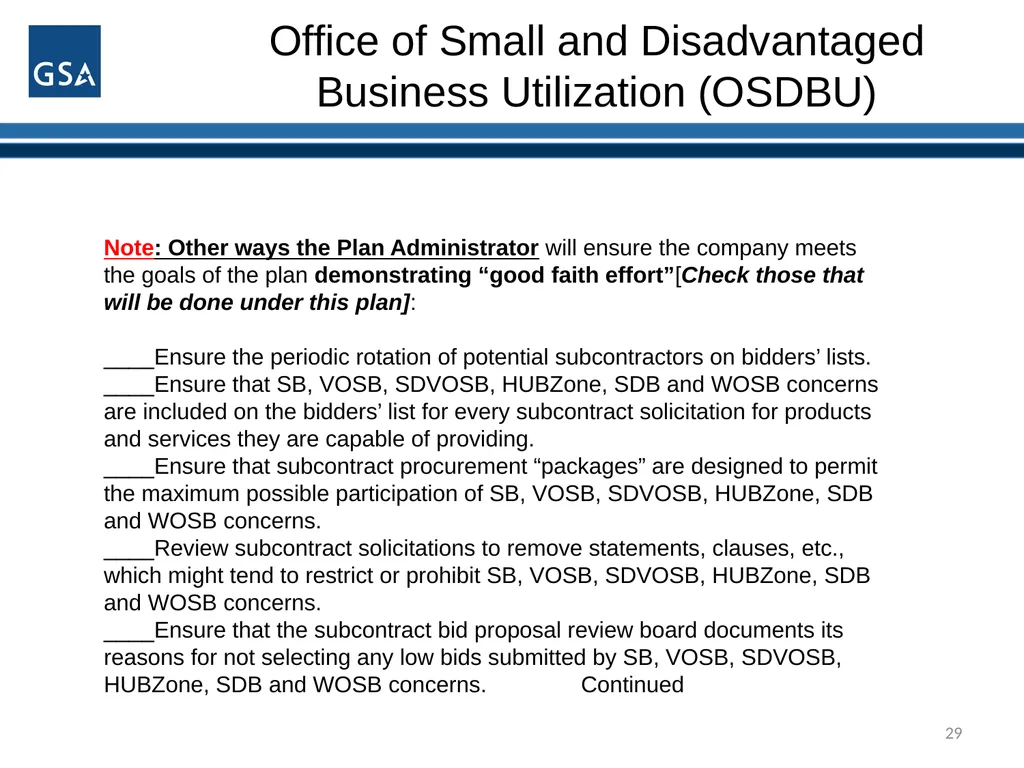
29 Office of Small and Disadvantaged Business Utilization (OSDBU) Note: Other ways the Plan Administrator will ensure the company meets the goals of the plan demonstrating “good faith effort”[Check those that will be done under this plan]:
____Ensure the periodic rotation of potential subcontractors on bidders’ lists.
____Ensure that SB, VOSB, SDVOSB, HUBZone, SDB and WOSB concerns are included on the bidders’ list for every subcontract solicitation for products and services they are capable of providing.
____Ensure that subcontract procurement “packages” are designed to permit the maximum possible participation of SB, VOSB, SDVOSB, HUBZone, SDB and WOSB concerns.
____Review subcontract solicitations to remove statements, clauses, etc., which might tend to restrict or prohibit SB, VOSB, SDVOSB, HUBZone, SDB and WOSB concerns.
____Ensure that the subcontract bid proposal review board documents its reasons for not selecting any low bids submitted by SB, VOSB, SDVOSB, HUBZone, SDB and WOSB concerns. Continued<br>
30
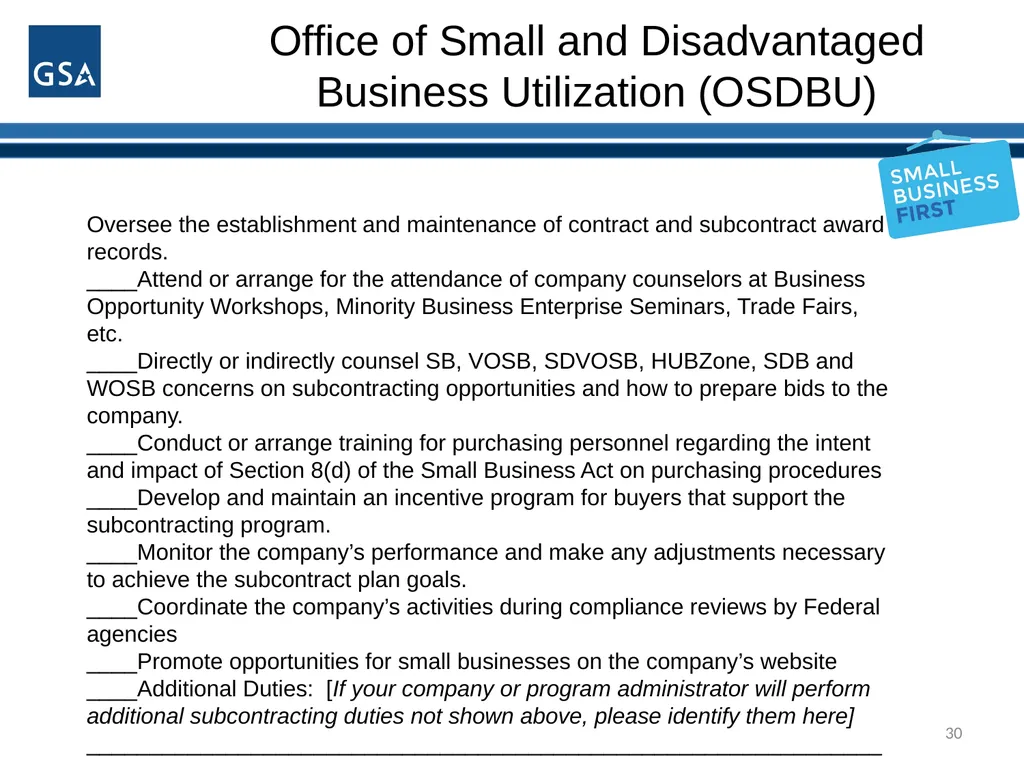
30 Office of Small and Disadvantaged Business Utilization (OSDBU) Oversee the establishment and maintenance of contract and subcontract award records.
____Attend or arrange for the attendance of company counselors at Business Opportunity Workshops, Minority Business Enterprise Seminars, Trade Fairs, etc.
____Directly or indirectly counsel SB, VOSB, SDVOSB, HUBZone, SDB and WOSB concerns on subcontracting opportunities and how to prepare bids to the company.
____Conduct or arrange training for purchasing personnel regarding the intent and impact of Section 8(d) of the Small Business Act on purchasing procedures
____Develop and maintain an incentive program for buyers that support the subcontracting program.
____Monitor the company’s performance and make any adjustments necessary to achieve the subcontract plan goals.
____Coordinate the company’s activities during compliance reviews by Federal agencies
____Promote opportunities for small businesses on the company’s website
____Additional Duties: [If your company or program administrator will perform additional subcontracting duties not shown above, please identify them here]
_______________________________________________________________
_____________________________________________________________________________________<br>
31
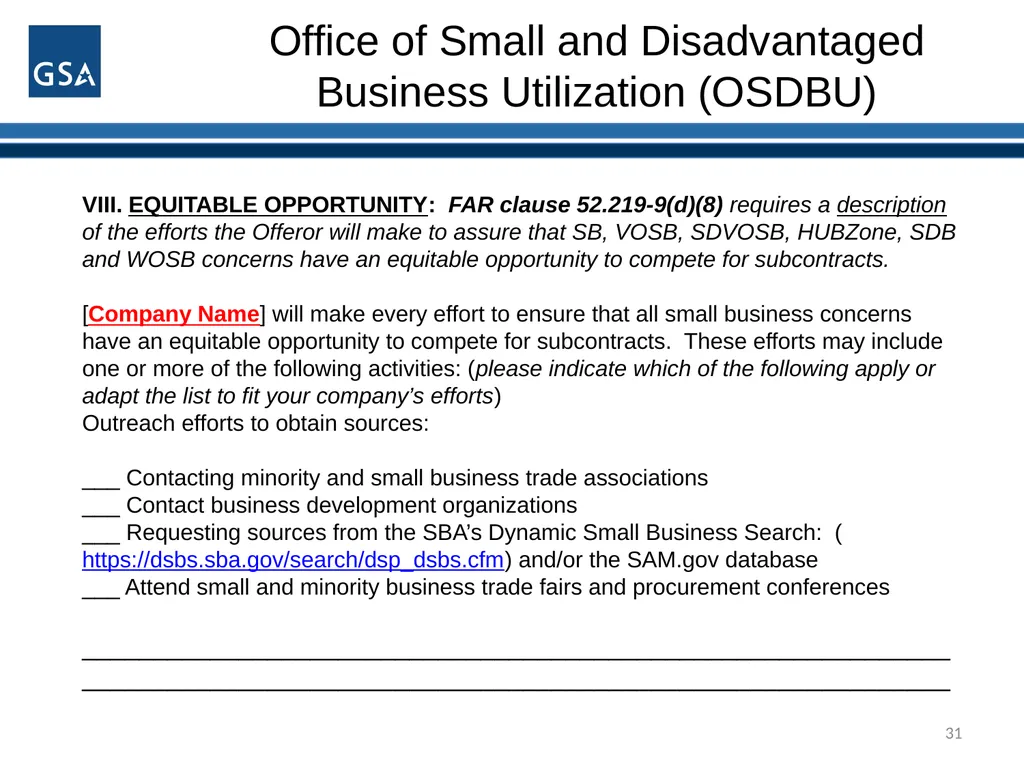
31 Office of Small and Disadvantaged Business Utilization (OSDBU) EQUITABLE OPPORTUNITY: FAR clause 52.219-9(d)(8) requires a description of the efforts the Offeror will make to assure that SB, VOSB, SDVOSB, HUBZone, SDB and WOSB concerns have an equitable opportunity to compete for subcontracts.
[Company Name] will make every effort to ensure that all small business concerns have an equitable opportunity to compete for subcontracts. These efforts may include one or more of the following activities: (please indicate which of the following apply or adapt the list to fit your company’s efforts)
Outreach efforts to obtain sources:
___ Contacting minority and small business trade associations
___ Contact business development organizations
___ Requesting sources from the SBA’s Dynamic Small Business Search: (https://dsbs.sba.gov/search/dsp_dsbs.cfm) and/or the SAM.gov database
___ Attend small and minority business trade fairs and procurement conferences
_____________________________________________________________
_____________________________________________________________<br>
32
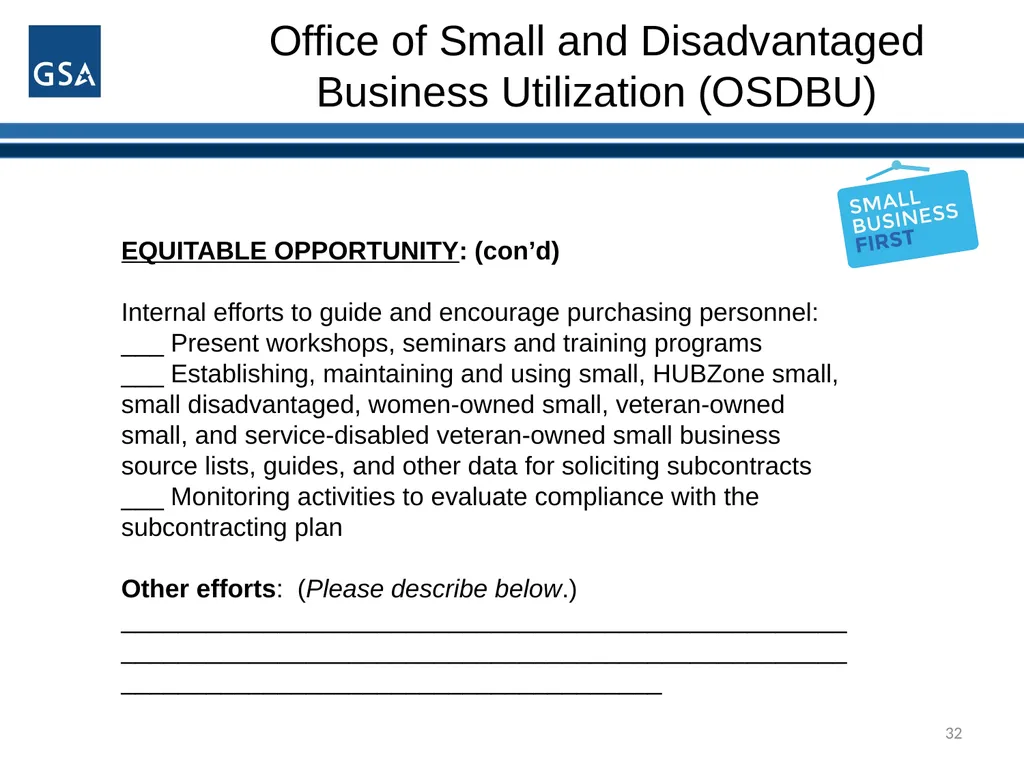
32 Office of Small and Disadvantaged Business Utilization (OSDBU) EQUITABLE OPPORTUNITY: (con’d)
Internal efforts to guide and encourage purchasing personnel:
___ Present workshops, seminars and training programs
___ Establishing, maintaining and using small, HUBZone small, small disadvantaged, women-owned small, veteran-owned small, and service-disabled veteran-owned small business source lists, guides, and other data for soliciting subcontracts
___ Monitoring activities to evaluate compliance with the subcontracting plan
Other efforts: (Please describe below.)
____________________________________________________________________________________________________________________________________________<br>
33
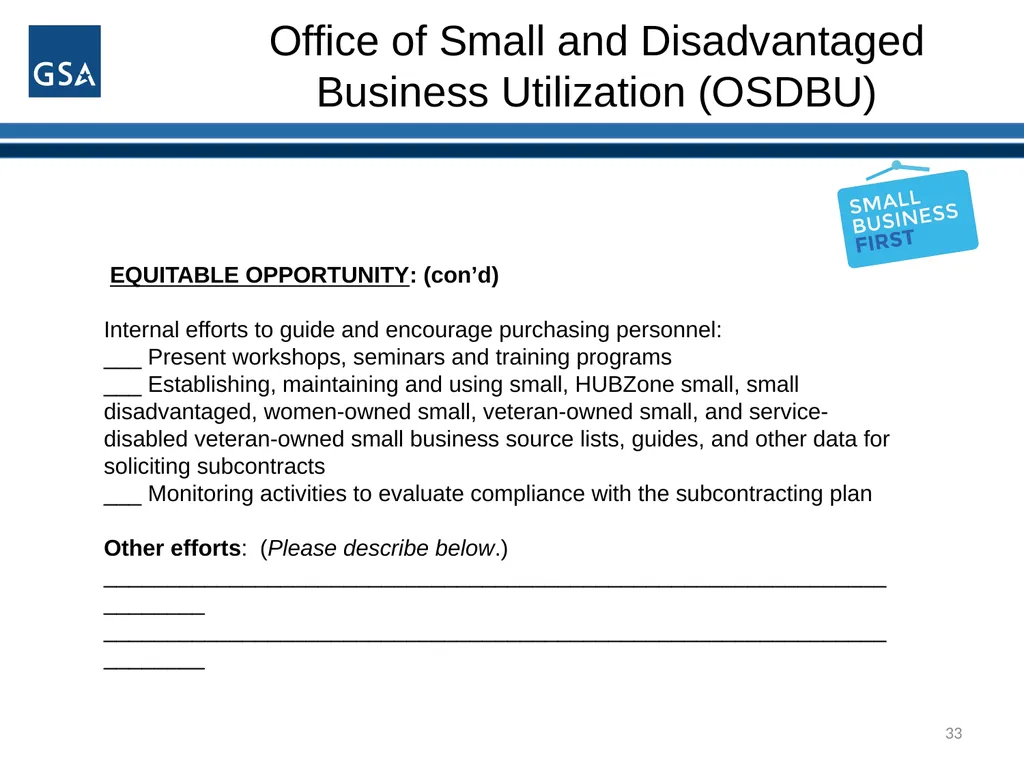
33 Office of Small and Disadvantaged Business Utilization (OSDBU) EQUITABLE OPPORTUNITY: (con’d)
Internal efforts to guide and encourage purchasing personnel:
___ Present workshops, seminars and training programs
___ Establishing, maintaining and using small, HUBZone small, small disadvantaged, women-owned small, veteran-owned small, and service-disabled veteran-owned small business source lists, guides, and other data for soliciting subcontracts
___ Monitoring activities to evaluate compliance with the subcontracting plan
Other efforts: (Please describe below.)
______________________________________________________________________
______________________________________________________________________<br>
34
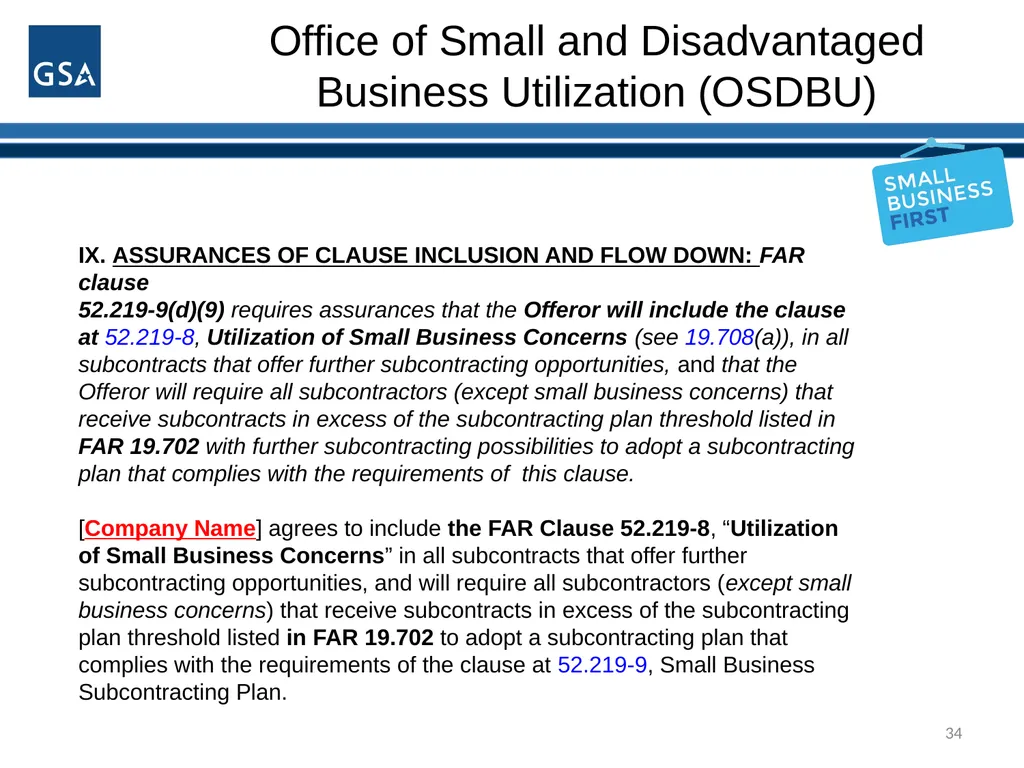
34 Office of Small and Disadvantaged Business Utilization (OSDBU) IX. ASSURANCES OF CLAUSE INCLUSION AND FLOW DOWN: FAR clause
52.219-9(d)(9) requires assurances that the Offeror will include the clause at 52.219-8, Utilization of Small Business Concerns (see 19.708(a)), in all subcontracts that offer further subcontracting opportunities, and that the Offeror will require all subcontractors (except small business concerns) that receive subcontracts in excess of the subcontracting plan threshold listed in FAR 19.702 with further subcontracting possibilities to adopt a subcontracting plan that complies with the requirements of this clause.
[Company Name] agrees to include the FAR Clause 52.219-8, “Utilization of Small Business Concerns” in all subcontracts that offer further subcontracting opportunities, and will require all subcontractors (except small business concerns) that receive subcontracts in excess of the subcontracting plan threshold listed in FAR 19.702 to adopt a subcontracting plan that complies with the requirements of the clause at 52.219-9, Small Business Subcontracting Plan.<br>
35
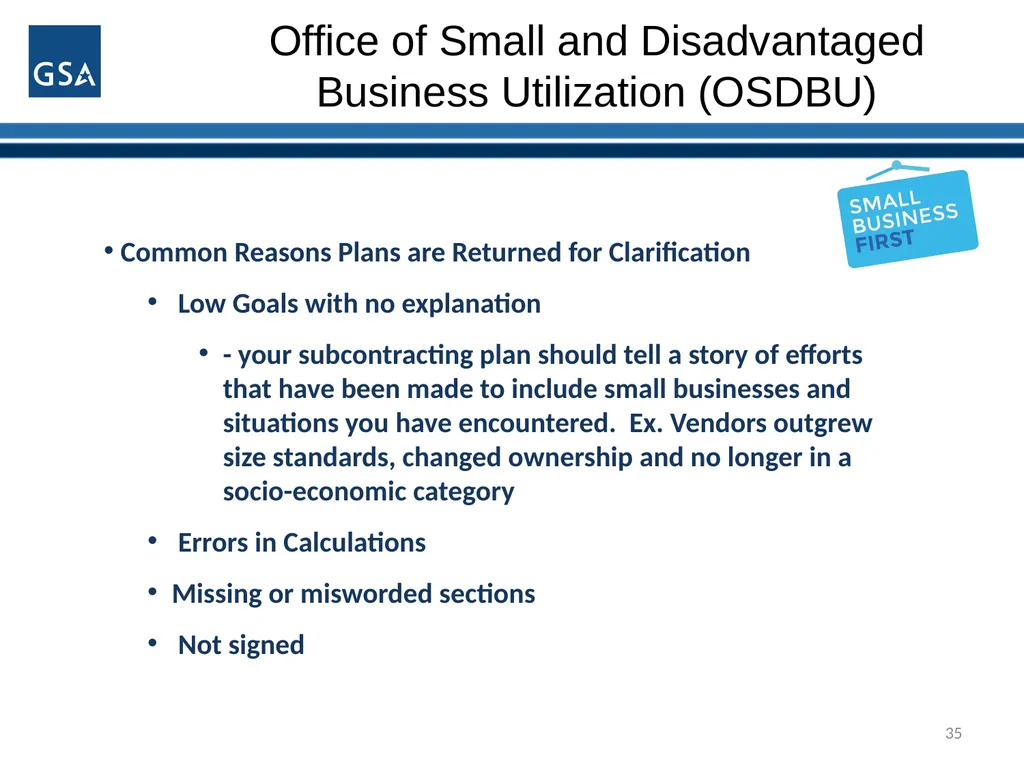
35 Office of Small and Disadvantaged Business Utilization (OSDBU) Common Reasons Plans are Returned for Clarification
Low Goals with no explanation
- your subcontracting plan should tell a story of efforts that have been made to include small businesses and situations you have encountered. Ex. Vendors outgrew size standards, changed ownership and no longer in a socio-economic category
Errors in Calculations
Missing or misworded sections
Not signed<br>
36
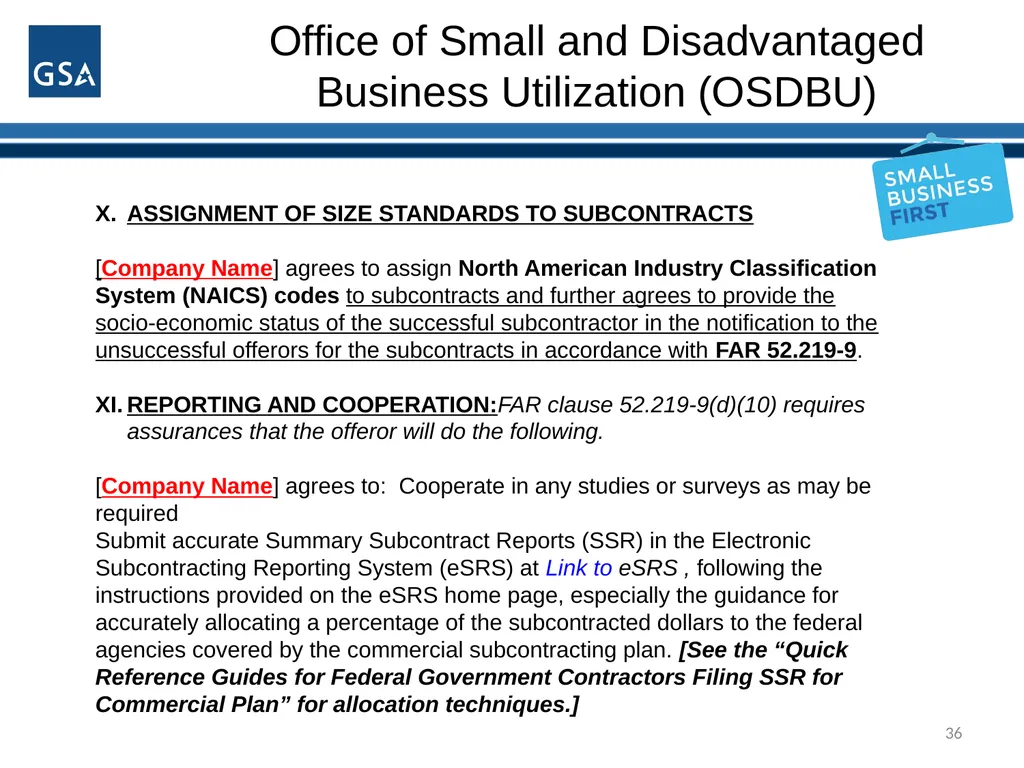
36 Office of Small and Disadvantaged Business Utilization (OSDBU) ASSIGNMENT OF SIZE STANDARDS TO SUBCONTRACTS
[Company Name] agrees to assign North American Industry Classification System (NAICS) codes to subcontracts and further agrees to provide the socio-economic status of the successful subcontractor in the notification to the unsuccessful offerors for the subcontracts in accordance with FAR 52.219-9.
REPORTING AND COOPERATION:FAR clause 52.219-9(d)(10) requires assurances that the offeror will do the following.
[Company Name] agrees to: Cooperate in any studies or surveys as may be required
Submit accurate Summary Subcontract Reports (SSR) in the Electronic Subcontracting Reporting System (eSRS) at Link to eSRS , following the instructions provided on the eSRS home page, especially the guidance for accurately allocating a percentage of the subcontracted dollars to the federal agencies covered by the commercial subcontracting plan. [See the “Quick Reference Guides for Federal Government Contractors Filing SSR for Commercial Plan” for allocation techniques.]<br>
37
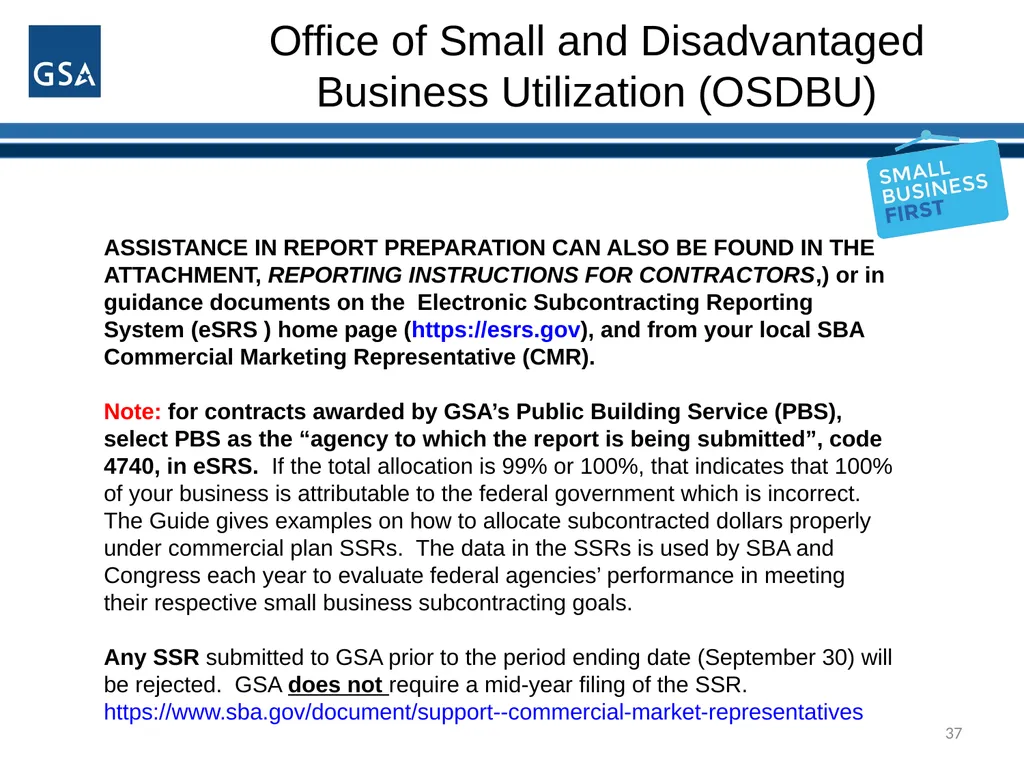
37 Office of Small and Disadvantaged Business Utilization (OSDBU) ASSISTANCE IN REPORT PREPARATION CAN ALSO BE FOUND IN THE ATTACHMENT, REPORTING INSTRUCTIONS FOR CONTRACTORS,) or in guidance documents on the Electronic Subcontracting Reporting System (eSRS ) home page (https://esrs.gov), and from your local SBA Commercial Marketing Representative (CMR).
Note: for contracts awarded by GSA’s Public Building Service (PBS), select PBS as the “agency to which the report is being submitted”, code 4740, in eSRS. If the total allocation is 99% or 100%, that indicates that 100% of your business is attributable to the federal government which is incorrect. The Guide gives examples on how to allocate subcontracted dollars properly under commercial plan SSRs. The data in the SSRs is used by SBA and Congress each year to evaluate federal agencies’ performance in meeting their respective small business subcontracting goals.
Any SSR submitted to GSA prior to the period ending date (September 30) will be rejected. GSA does not require a mid-year filing of the SSR.
https://www.sba.gov/document/support--commercial-market-representatives<br>
38
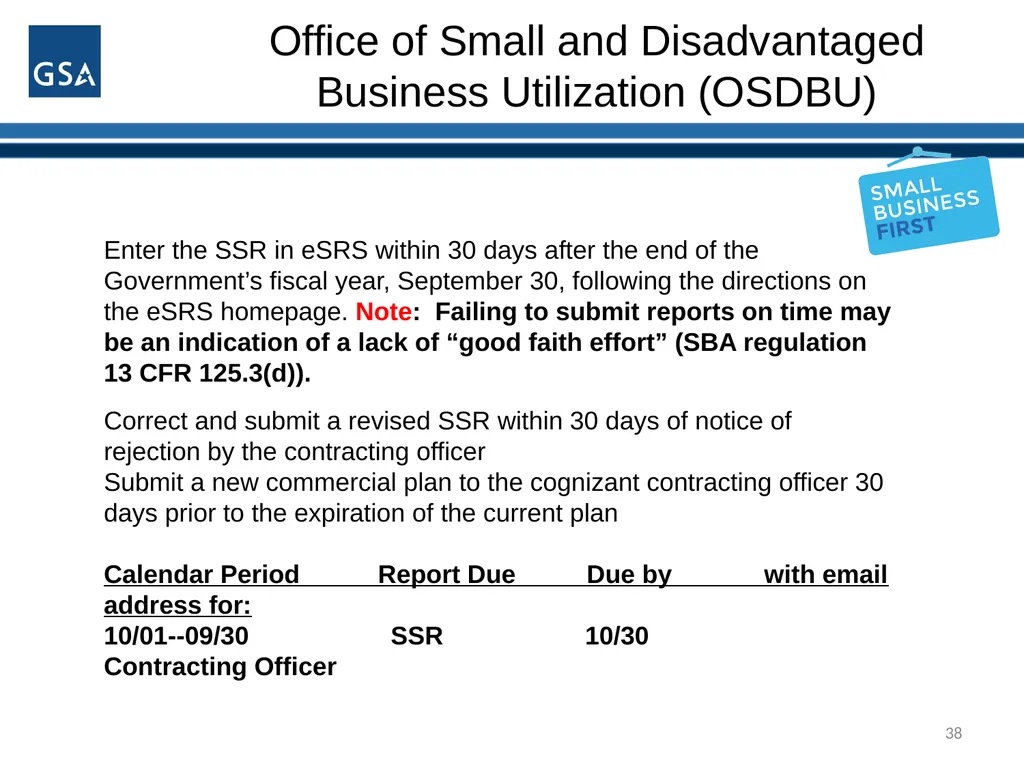
38 Office of Small and Disadvantaged Business Utilization (OSDBU) Enter the SSR in eSRS within 30 days after the end of the Government’s fiscal year, September 30, following the directions on the eSRS homepage. Note: Failing to submit reports on time may be an indication of a lack of “good faith effort” (SBA regulation 13 CFR 125.3(d)).
Correct and submit a revised SSR within 30 days of notice of rejection by the contracting officer
Submit a new commercial plan to the cognizant contracting officer 30 days prior to the expiration of the current plan
Calendar Period Report Due Due by with email address for: 10/01--09/30 SSR 10/30 Contracting Officer<br>
39
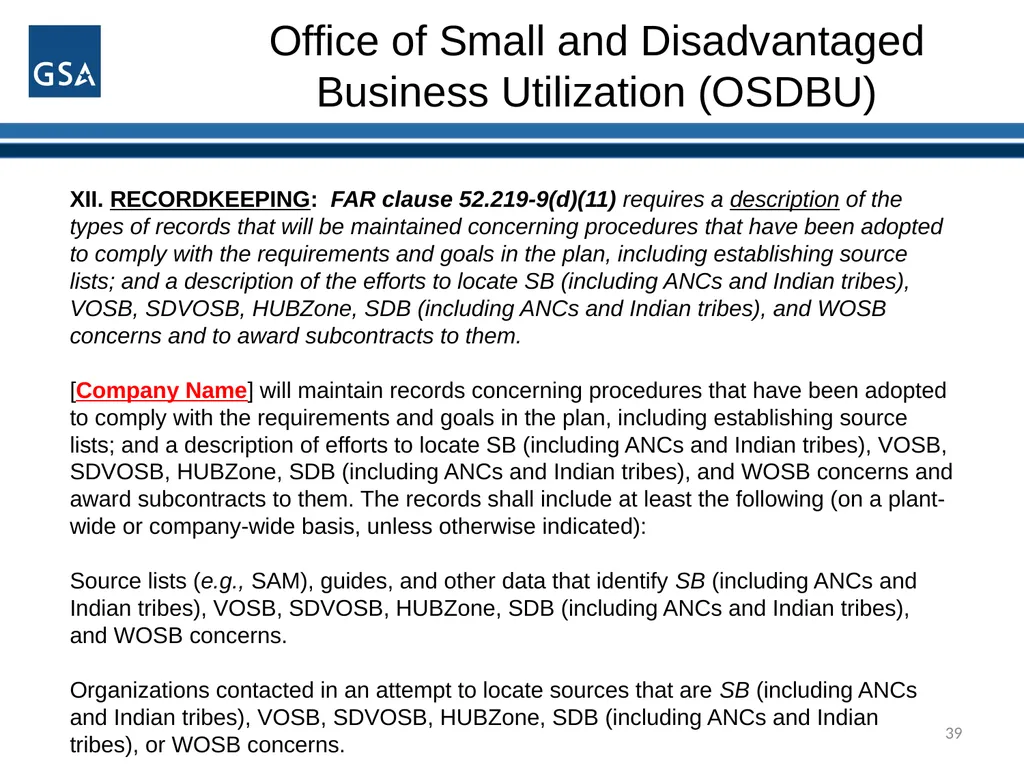
39 Office of Small and Disadvantaged Business Utilization (OSDBU) XII. RECORDKEEPING: FAR clause 52.219-9(d)(11) requires a description of the types of records that will be maintained concerning procedures that have been adopted to comply with the requirements and goals in the plan, including establishing source lists; and a description of the efforts to locate SB (including ANCs and Indian tribes), VOSB, SDVOSB, HUBZone, SDB (including ANCs and Indian tribes), and WOSB concerns and to award subcontracts to them.
[Company Name] will maintain records concerning procedures that have been adopted to comply with the requirements and goals in the plan, including establishing source lists; and a description of efforts to locate SB (including ANCs and Indian tribes), VOSB, SDVOSB, HUBZone, SDB (including ANCs and Indian tribes), and WOSB concerns and award subcontracts to them. The records shall include at least the following (on a plant-wide or company-wide basis, unless otherwise indicated):
Source lists (e.g., SAM), guides, and other data that identify SB (including ANCs and Indian tribes), VOSB, SDVOSB, HUBZone, SDB (including ANCs and Indian tribes), and WOSB concerns.
Organizations contacted in an attempt to locate sources that are SB (including ANCs and Indian tribes), VOSB, SDVOSB, HUBZone, SDB (including ANCs and Indian tribes), or WOSB concerns.<br>
40
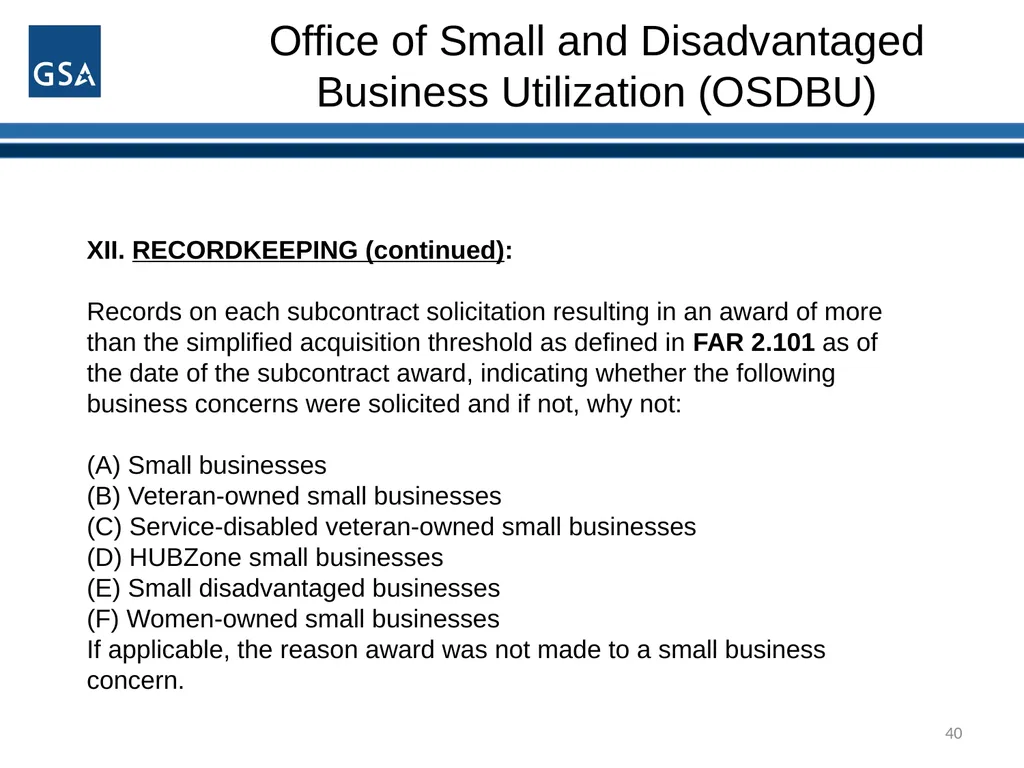
40 Office of Small and Disadvantaged Business Utilization (OSDBU) XII. RECORDKEEPING (continued):
Records on each subcontract solicitation resulting in an award of more than the simplified acquisition threshold as defined in FAR 2.101 as of the date of the subcontract award, indicating whether the following business concerns were solicited and if not, why not:
(A) Small businesses
(B) Veteran-owned small businesses
(C) Service-disabled veteran-owned small businesses
(D) HUBZone small businesses
(E) Small disadvantaged businesses
(F) Women-owned small businesses
If applicable, the reason award was not made to a small business concern.<br>
41
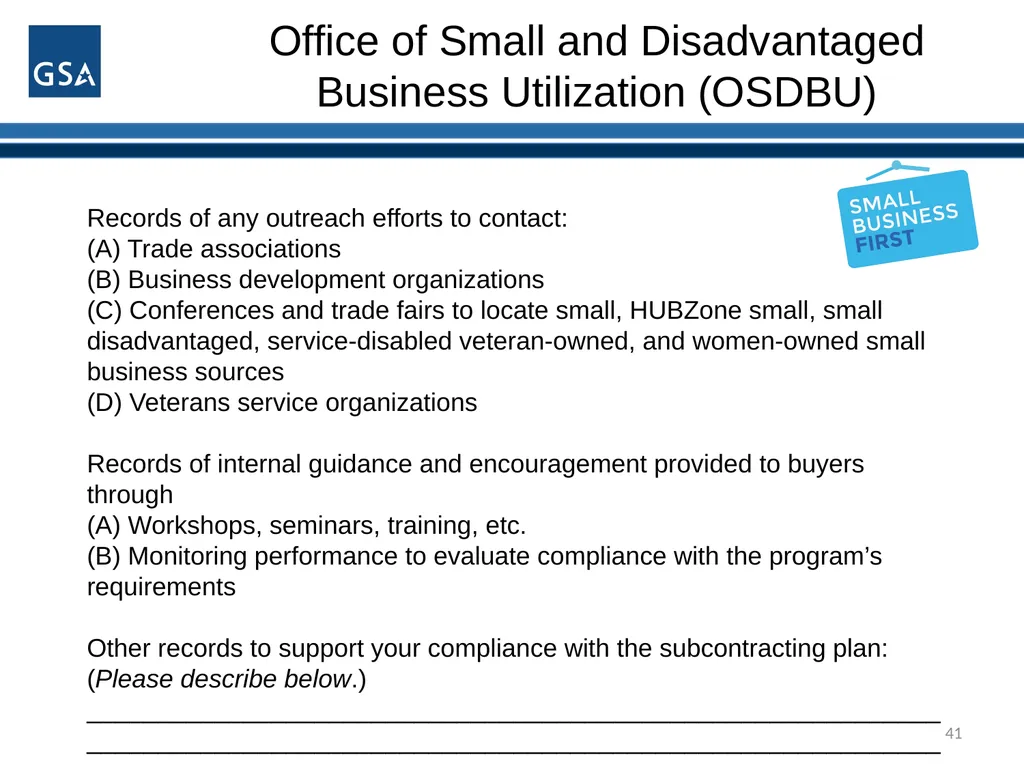
41 Office of Small and Disadvantaged Business Utilization (OSDBU) Records of any outreach efforts to contact:
(A) Trade associations
(B) Business development organizations
(C) Conferences and trade fairs to locate small, HUBZone small, small disadvantaged, service-disabled veteran-owned, and women-owned small business sources
(D) Veterans service organizations
Records of internal guidance and encouragement provided to buyers through
(A) Workshops, seminars, training, etc.
(B) Monitoring performance to evaluate compliance with the program’s requirements
Other records to support your compliance with the subcontracting plan: (Please describe below.)
________________________________________________________________________________________________________________________<br>
42
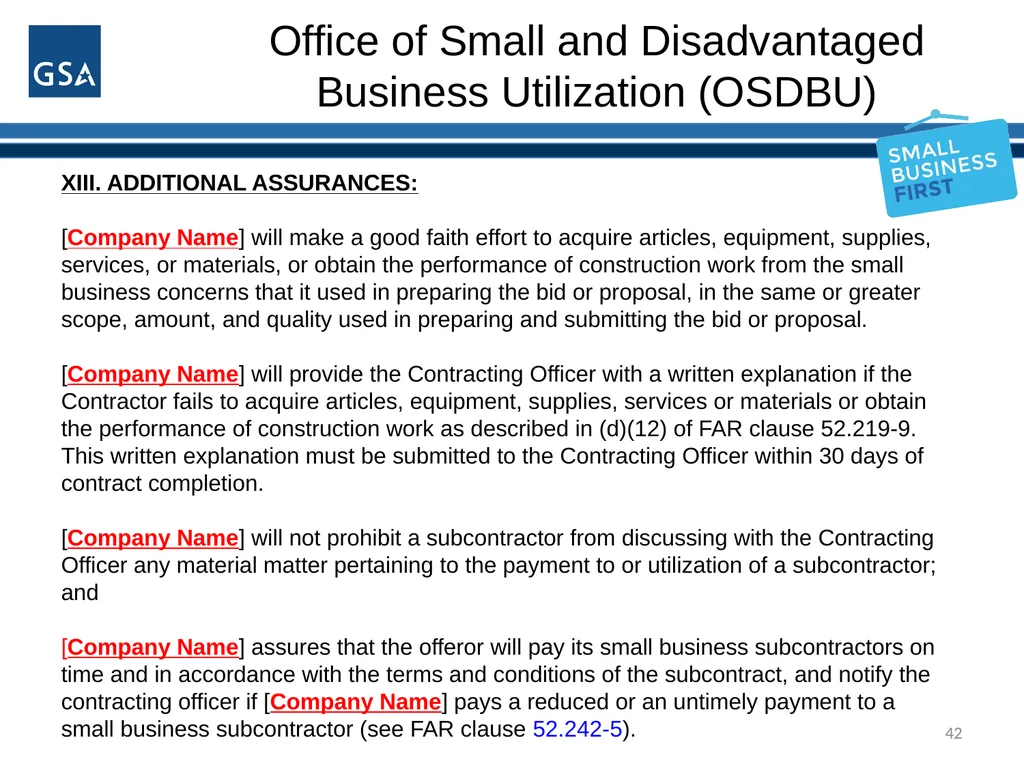
42 Office of Small and Disadvantaged Business Utilization (OSDBU) XIII. ADDITIONAL ASSURANCES:
[Company Name] will make a good faith effort to acquire articles, equipment, supplies, services, or materials, or obtain the performance of construction work from the small business concerns that it used in preparing the bid or proposal, in the same or greater scope, amount, and quality used in preparing and submitting the bid or proposal.
[Company Name] will provide the Contracting Officer with a written explanation if the Contractor fails to acquire articles, equipment, supplies, services or materials or obtain the performance of construction work as described in (d)(12) of FAR clause 52.219-9. This written explanation must be submitted to the Contracting Officer within 30 days of contract completion.
[Company Name] will not prohibit a subcontractor from discussing with the Contracting Officer any material matter pertaining to the payment to or utilization of a subcontractor; and
[Company Name] assures that the offeror will pay its small business subcontractors on time and in accordance with the terms and conditions of the subcontract, and notify the contracting officer if [Company Name] pays a reduced or an untimely payment to a small business subcontractor (see FAR clause 52.242-5).<br>
43
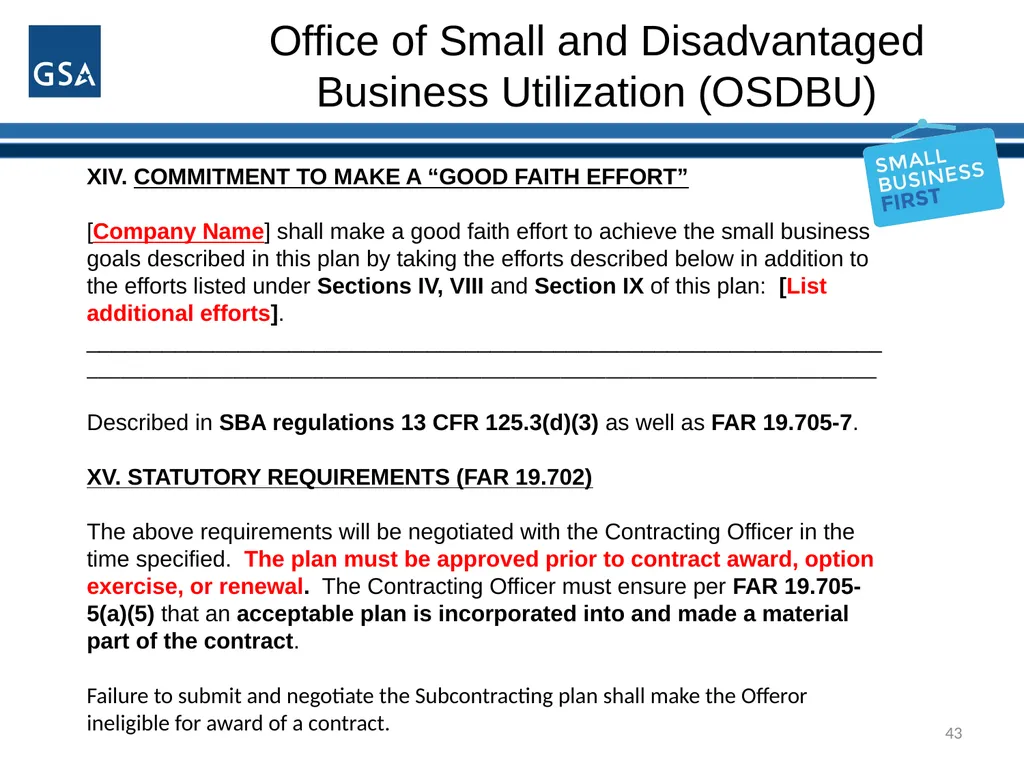
43 Office of Small and Disadvantaged Business Utilization (OSDBU) XIV. COMMITMENT TO MAKE A “GOOD FAITH EFFORT”
[Company Name] shall make a good faith effort to achieve the small business goals described in this plan by taking the efforts described below in addition to the efforts listed under Sections IV, VIII and Section IX of this plan: [List additional efforts].
_______________________________________________________________
______________________________________________________________________
Described in SBA regulations 13 CFR 125.3(d)(3) as well as FAR 19.705-7.
XV. STATUTORY REQUIREMENTS (FAR 19.702)
The above requirements will be negotiated with the Contracting Officer in the time specified. The plan must be approved prior to contract award, option exercise, or renewal. The Contracting Officer must ensure per FAR 19.705-5(a)(5) that an acceptable plan is incorporated into and made a material part of the contract.
Failure to submit and negotiate the Subcontracting plan shall make the Offeror ineligible for award of a contract.<br>
44
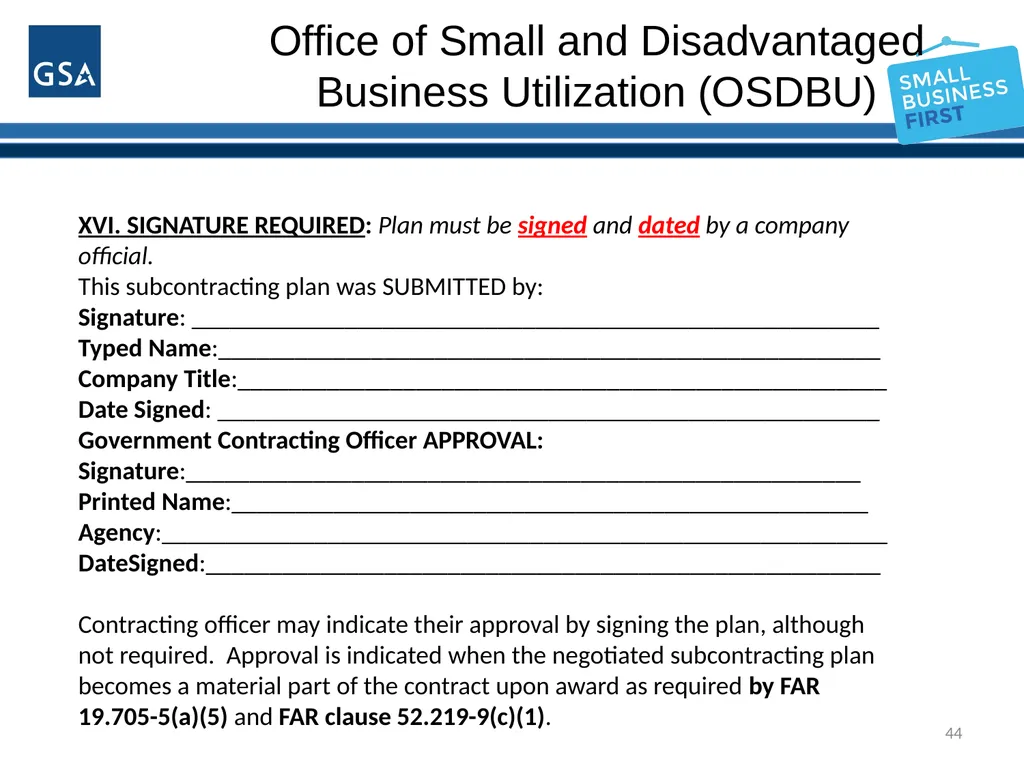
44 Office of Small and Disadvantaged Business Utilization (OSDBU) XVI. SIGNATURE REQUIRED: Plan must be signed and dated by a company official.
This subcontracting plan was SUBMITTED by:
Signature: ______________________________________________________
Typed Name:____________________________________________________
Company Title:___________________________________________________
Date Signed: ____________________________________________________
Government Contracting Officer APPROVAL:
Signature:_____________________________________________________
Printed Name:__________________________________________________
Agency:_________________________________________________________
DateSigned:_____________________________________________________
Contracting officer may indicate their approval by signing the plan, although not required. Approval is indicated when the negotiated subcontracting plan becomes a material part of the contract upon award as required by FAR 19.705-5(a)(5) and FAR clause 52.219-9(c)(1).<br>
45
45 Office of Small and Disadvantaged Business Utilization (OSDBU) QUESTIONS ?
Helena Koch
Small Business Technical Advisor
Mid-Atlantic Office of Small Business Utilization
Helena.Koch@gsa.gov<br>
Helena Koch
Small Business Technical Advisor
Mid-Atlantic Office of Small Business Utilization
Helena.Koch@gsa.gov<br>