
13 September 2023 by Karl Tomm MD University of
DP
Published · 124 slides · 0 views

1 / 1







Description
13 September 2023 by Karl Tomm MD University of Calgary Family Assessment Part II The IPscope Framework for Systemic Assessment Questions Where are moods located? Interpersonal space? Personal space? Household space? Community space? If
Related Topics
Share
Embed code
Download this presentation From Below
"13 September 2023 by Karl Tomm MD University of" is the property of its rightful owner. Permission is granted to download and print the materials on this website for personal, non-commercial use only, and to display it on your personal computer provided you do not modify the materials and that you retain all copyright notices contained in the materials. By downloading content from our website, you accept the terms of this agreement.
Presentation Transcript
01
13 September 2023
by Karl Tomm MD
University of Calgary Family Assessment Part II The IPscope Framework for Systemic Assessment<br>
by Karl Tomm MD
University of Calgary Family Assessment Part II The IPscope Framework for Systemic Assessment<br>
02
Questions Where are moods located? Interpersonal space? Personal space? Household space? Community space? If moods are dynamic limbic generations of each person’s affective experiences, then we need to locate the dynamics of affective experiences.<br>
03
Why use models or theories? Most therapists draw heavily upon their intuitive personal knowledge about relationships in doing therapy.
However, a good theory helps to organize ourselves more carefully in relation to any particular phenomenon or situation.
As family therapists, we benefit from various theories that help orient us in our efforts to be helpful with families in crisis.
There are many, many theories and models in our field; and some are more useful than others.
At the Calgary Family Therapy Centre we have found a model of an 'IPscope' to be especially helpful for students and professionals learning to become more systemic in their understandings and in their work doing family therapy.<br>
04
In day-to-day talk, people occasionally refer to a family as 'dysfunctional' (which implies a colloquial assumption that other families are 'functional').
Salvador Minuchin distinguished between enmeshed vs disengaged families.
The MRI distinguished between schizophrenogenic vs depressogenic families.
David Reiss contrasted environment sensitive vs consensus sensitive families.
Bob Beavers’ systems model entailed centripetal, centrifugal, and mixed patterns.
David Olson developed a circumplex model of family assessment with two dimensions: closeness vs distance, and flexibility vs rigidity.
The Calgary IPscope framework focusses on interpersonal patterns of interaction. A sampling of models to assess families<br>
05
What exactly is the ‘IPscope’? The ‘IPscope’ is a cognitive instrument, for distinguishing and describing specific Interpersonal Patterns of interaction for systemic assessment. It draws upon both perceptual and conceptual skills in the observer.
By definition, Interpersonal Patterns, or ‘IPs’ are repetitive or recurrent interactions between two or more persons, that constitute a transient but important component of the overall relationship between those persons.
IPs may be distinguished by a systemic observer or systemic therapist by highlighting the coupling between two classes of behaviors, cognitions or emotions, that tend to be mutually enabling and/or mutually reinforcing.
The suffix ‘scope’ in the IPscope is intended to draw an analogy with other human-made instruments which "help observers see" that which is ordinarily hard for the naked eye to see (cf. a microscope or a telescope).<br>
06
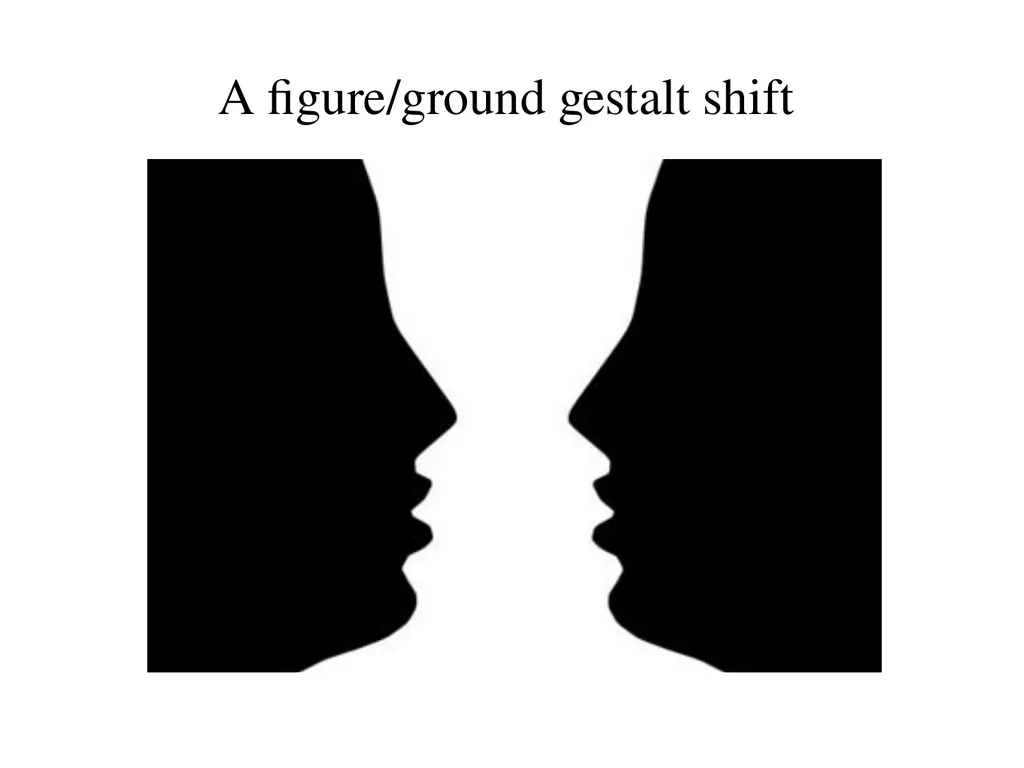
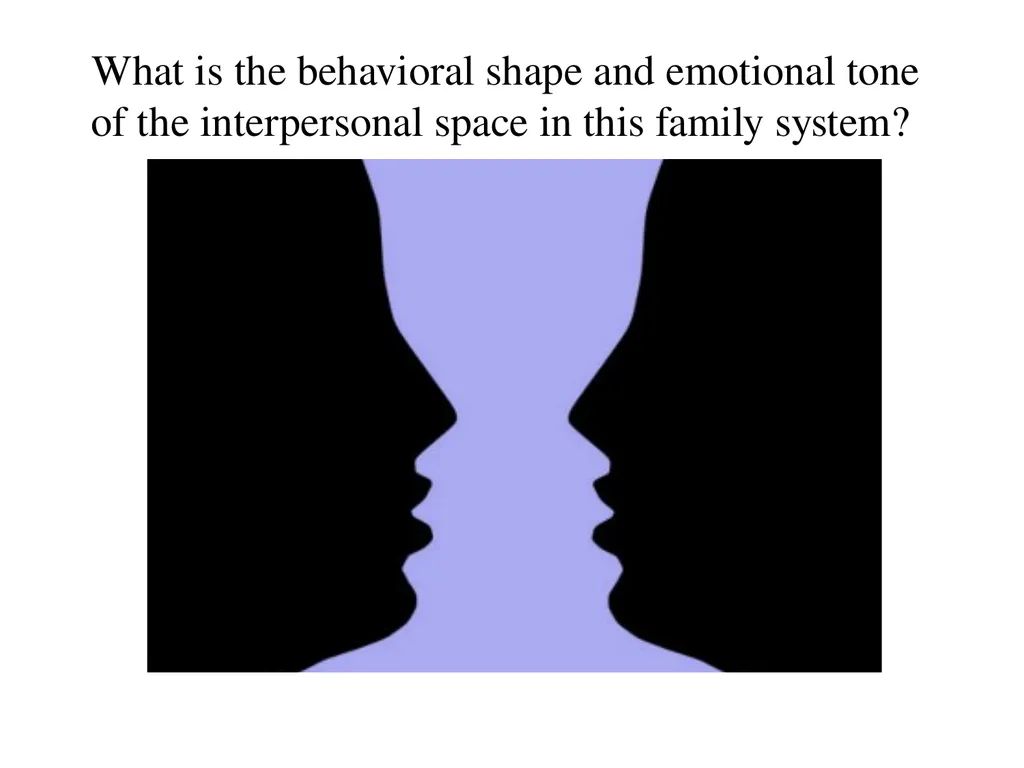
A figure/ground gestalt shift<br>
07
What is the behavioral shape and emotional tone of the interpersonal space in this family system?<br>
08
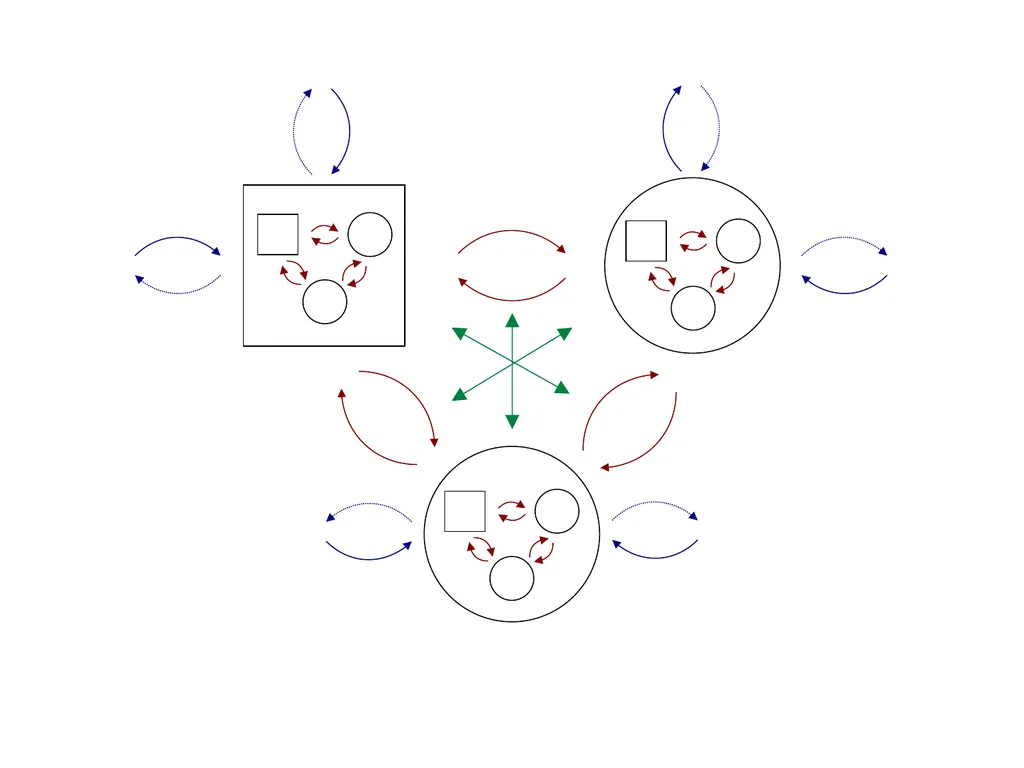
Some relevant concepts from Systems Theory Systems are composites, that is, they are always made up of component parts.
“A change in any one part triggers change in every other part” of the system.
“The whole (system) is greater than the sum of its parts.”
Systems may be analyzed at different levels and in different domains where different phenomena arise.
Living organisms as systems are characterized by homeostasis and autonomy.
Human relationship systems are characterized by recurrent, reciprocal, or ‘circular’ interactions.<br>
09
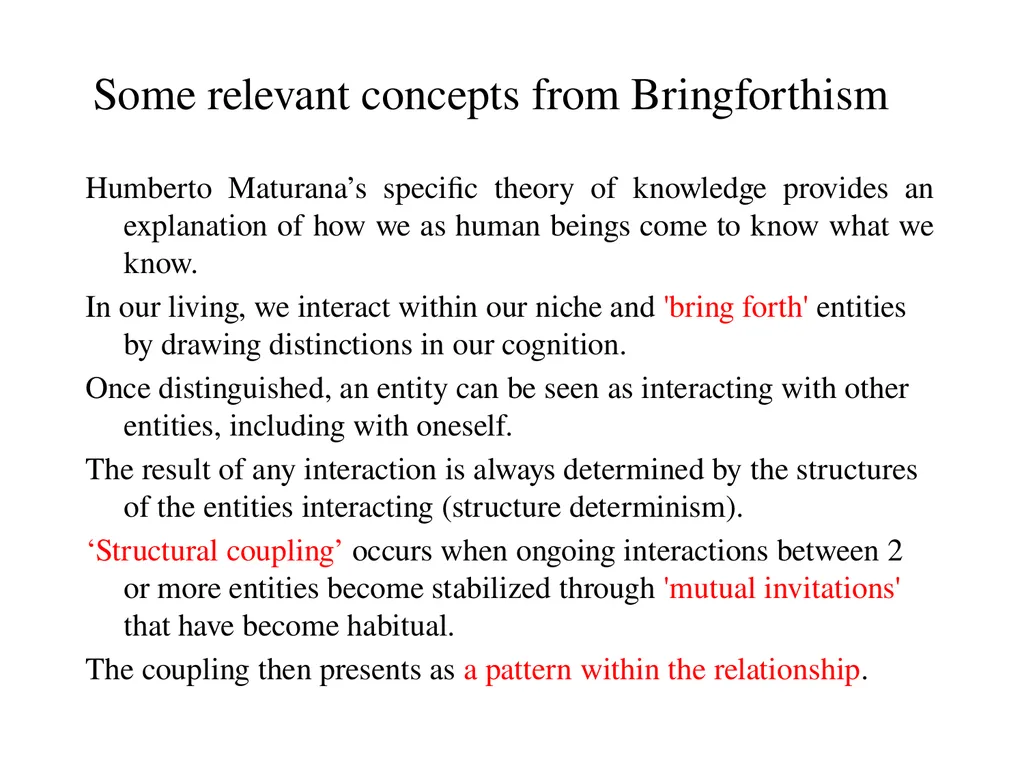
Some relevant concepts from Bringforthism Humberto Maturana’s specific theory of knowledge provides an explanation of how we as human beings come to know what we know.
In our living, we interact within our niche and 'bring forth' entities by drawing distinctions in our cognition.
Once distinguished, an entity can be seen as interacting with other entities, including with oneself.
The result of any interaction is always determined by the structures of the entities interacting (structure determinism).
‘Structural coupling’ occurs when ongoing interactions between 2 or more entities become stabilized through 'mutual invitations' that have become habitual.
The coupling then presents as a pattern within the relationship.<br>
10
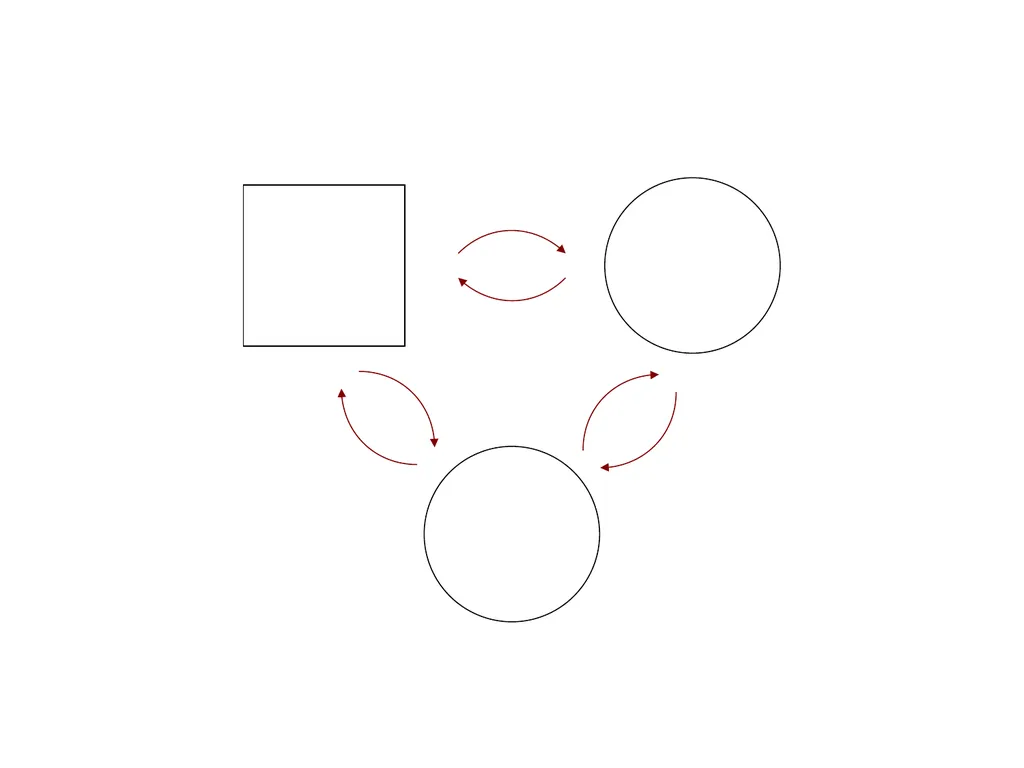
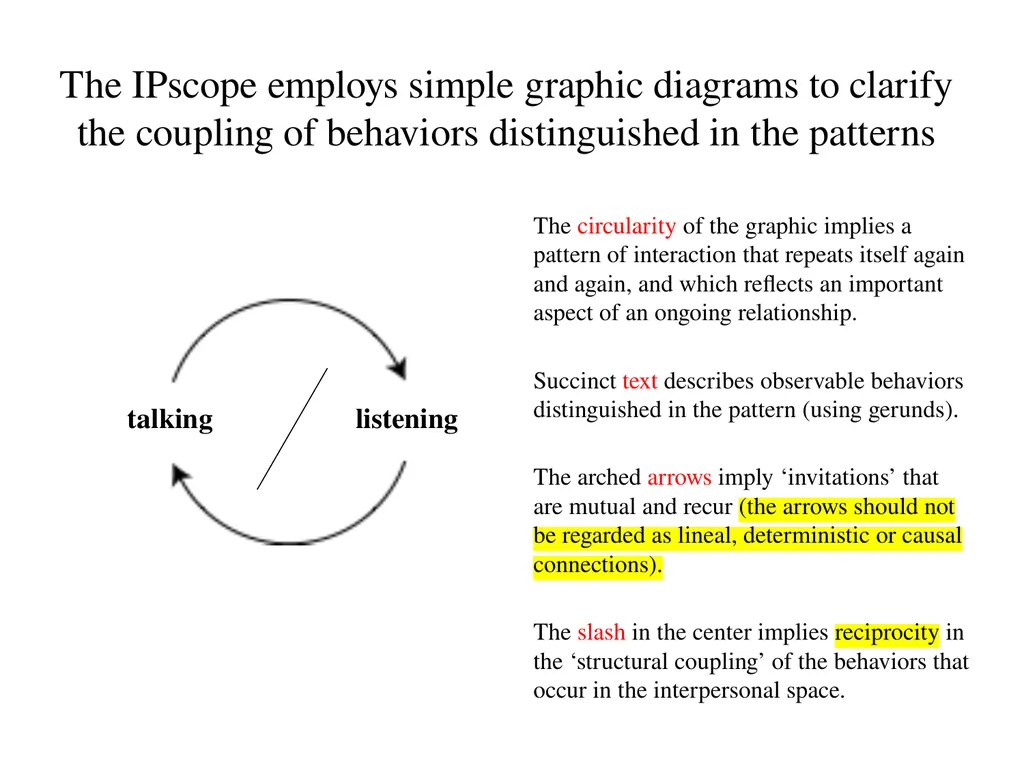
The IPscope employs simple graphic diagrams to clarify the coupling of behaviors distinguished in the patterns talking listening The circularity of the graphic implies a pattern of interaction that repeats itself again and again, and which reflects an important aspect of an ongoing relationship.
Succinct text describes observable behaviors distinguished in the pattern (using gerunds).
The arched arrows imply ‘invitations’ that are mutual and recur (the arrows should not be regarded as lineal, deterministic or causal connections).
The slash in the center implies reciprocity in the ‘structural coupling’ of the behaviors that occur in the interpersonal space.<br>
11
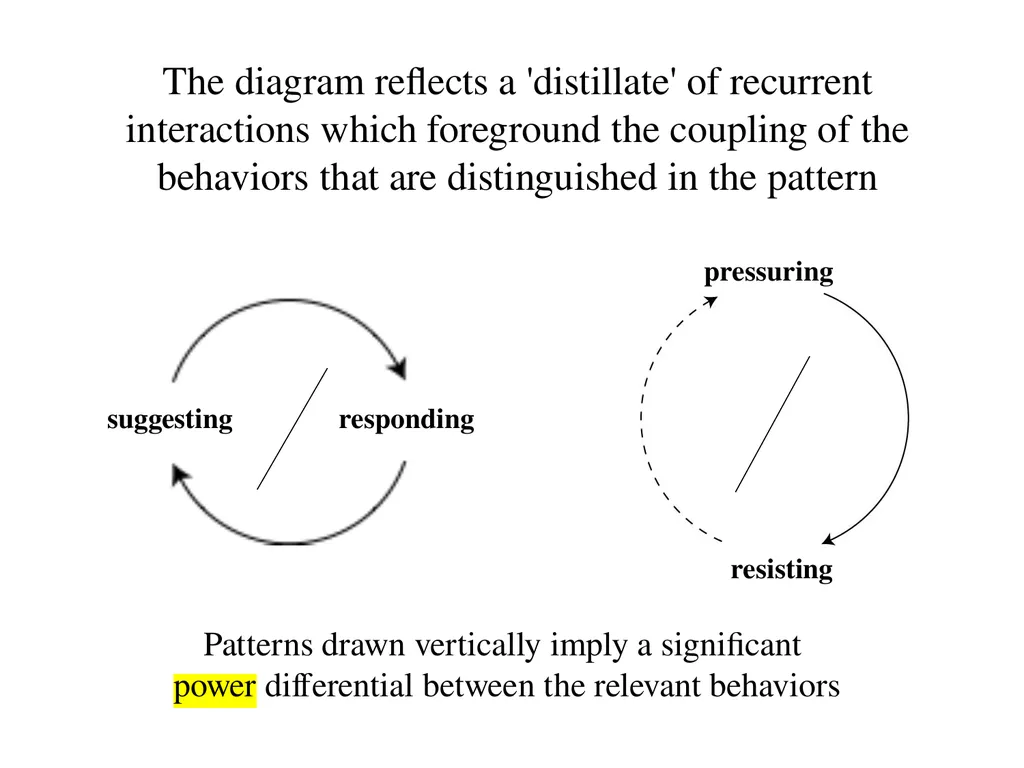
suggesting responding pressuring resisting Patterns drawn vertically imply a significant
power differential between the relevant behaviors The diagram reflects a 'distillate' of recurrent interactions which foreground the coupling of the behaviors that are distinguished in the pattern<br>
power differential between the relevant behaviors The diagram reflects a 'distillate' of recurrent interactions which foreground the coupling of the behaviors that are distinguished in the pattern<br>
12
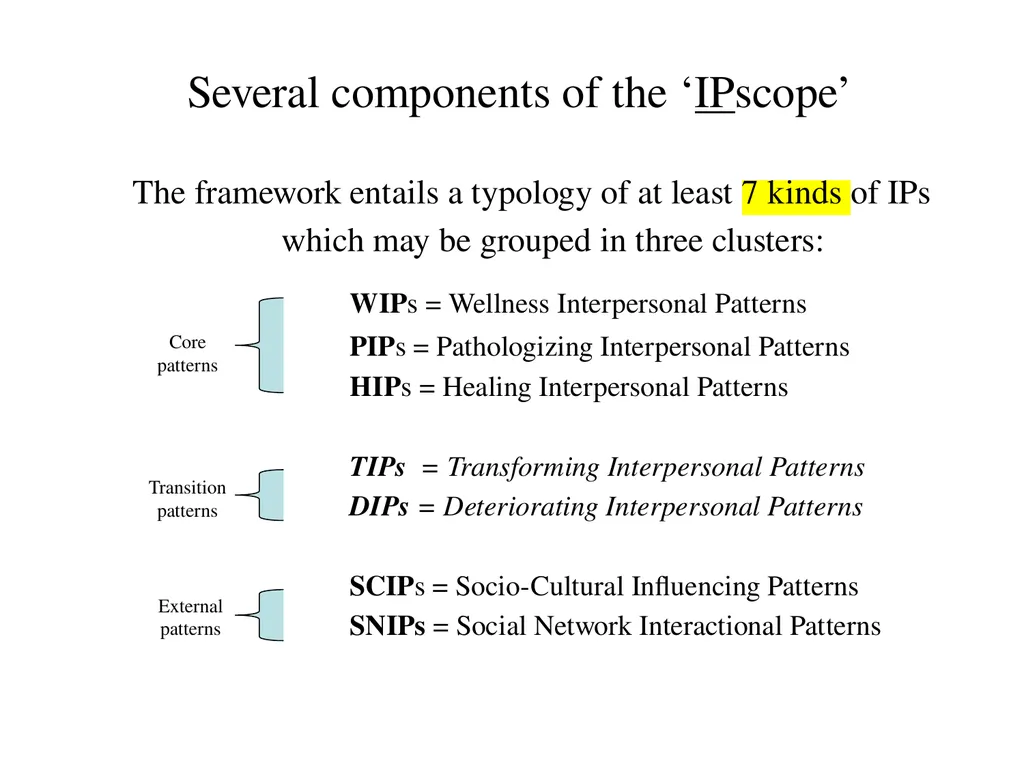
Several components of the ‘IPscope’ The framework entails a typology of at least 7 kinds of IPs
which may be grouped in three clusters:
WIPs = Wellness Interpersonal Patterns
PIPs = Pathologizing Interpersonal Patterns
HIPs = Healing Interpersonal Patterns
TIPs = Transforming Interpersonal Patterns
DIPs = Deteriorating Interpersonal Patterns
SCIPs = Socio-Cultural Influencing Patterns
SNIPs = Social Network Interactional Patterns Core
patterns Transition
patterns External
patterns<br>
13
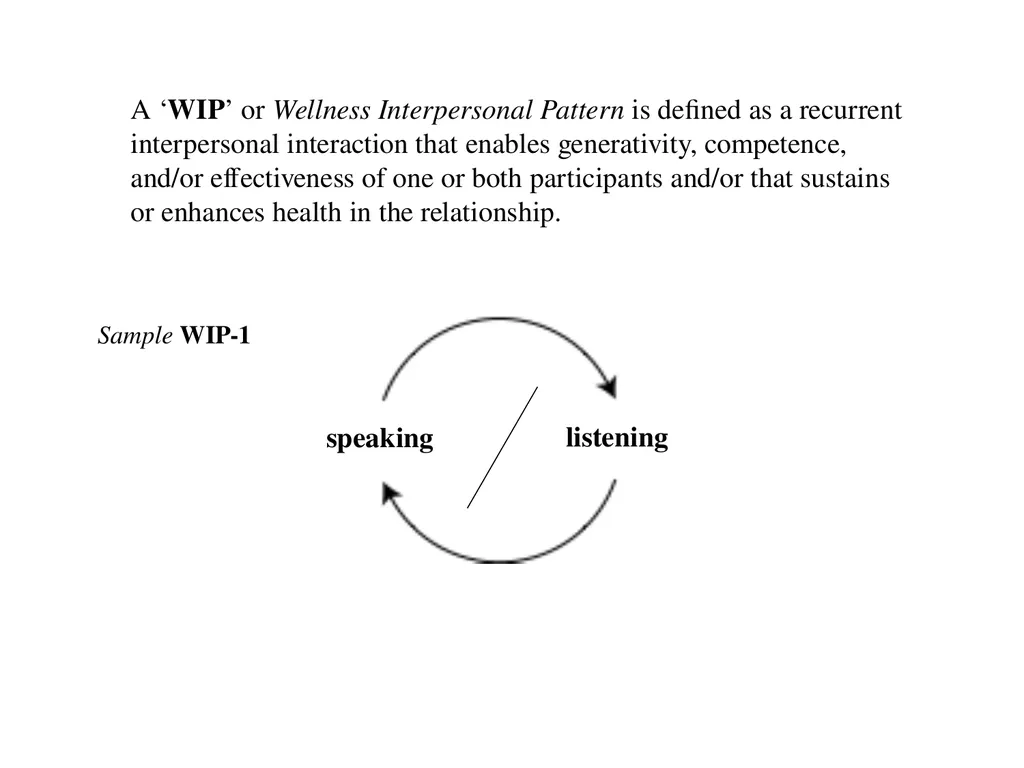
A ‘WIP’ or Wellness Interpersonal Pattern is defined as a recurrent interpersonal interaction that enables generativity, competence, and/or effectiveness of one or both participants and/or that sustains or enhances health in the relationship. Sample WIP-1 speaking listening<br>
14
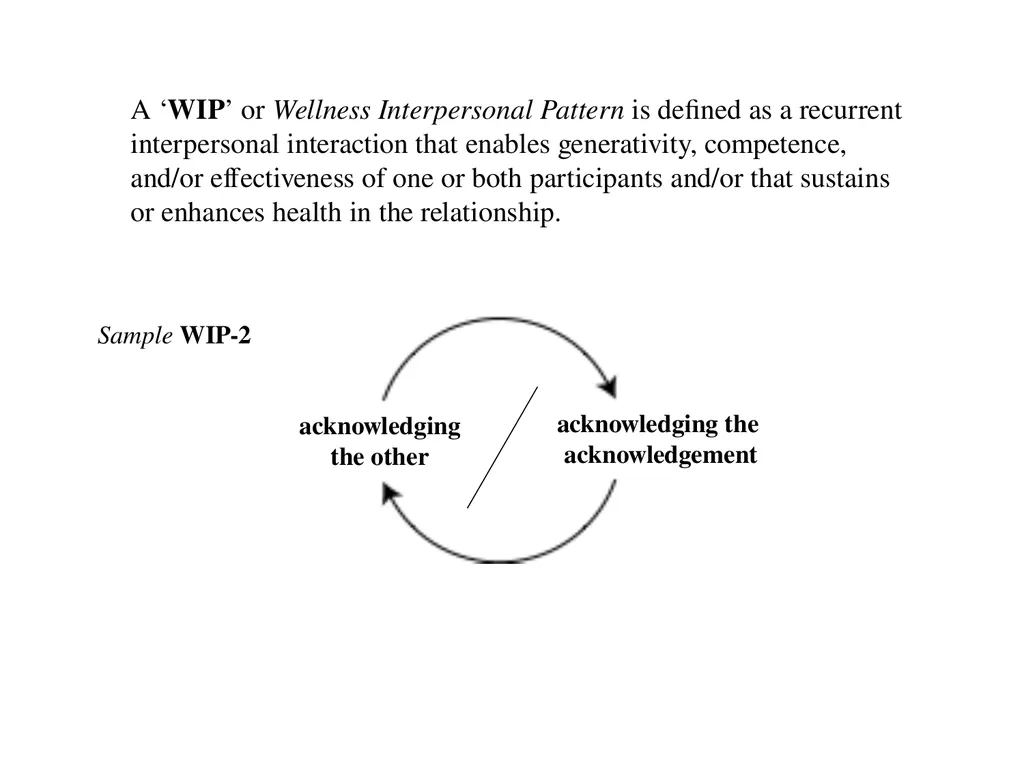
A ‘WIP’ or Wellness Interpersonal Pattern is defined as a recurrent interpersonal interaction that enables generativity, competence, and/or effectiveness of one or both participants and/or that sustains or enhances health in the relationship. Sample WIP-2 acknowledging
the other acknowledging the
acknowledgement<br>
the other acknowledging the
acknowledgement<br>
15
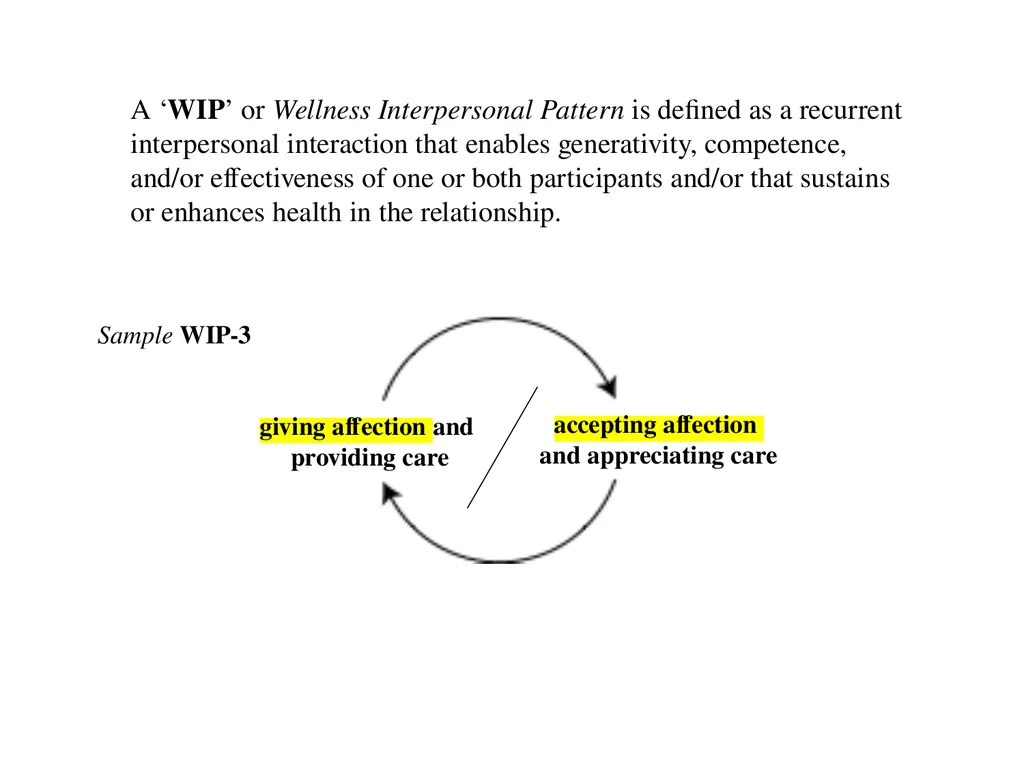
A ‘WIP’ or Wellness Interpersonal Pattern is defined as a recurrent interpersonal interaction that enables generativity, competence, and/or effectiveness of one or both participants and/or that sustains or enhances health in the relationship. Sample WIP-3 giving affection and
providing care accepting affection
and appreciating care<br>
providing care accepting affection
and appreciating care<br>
16
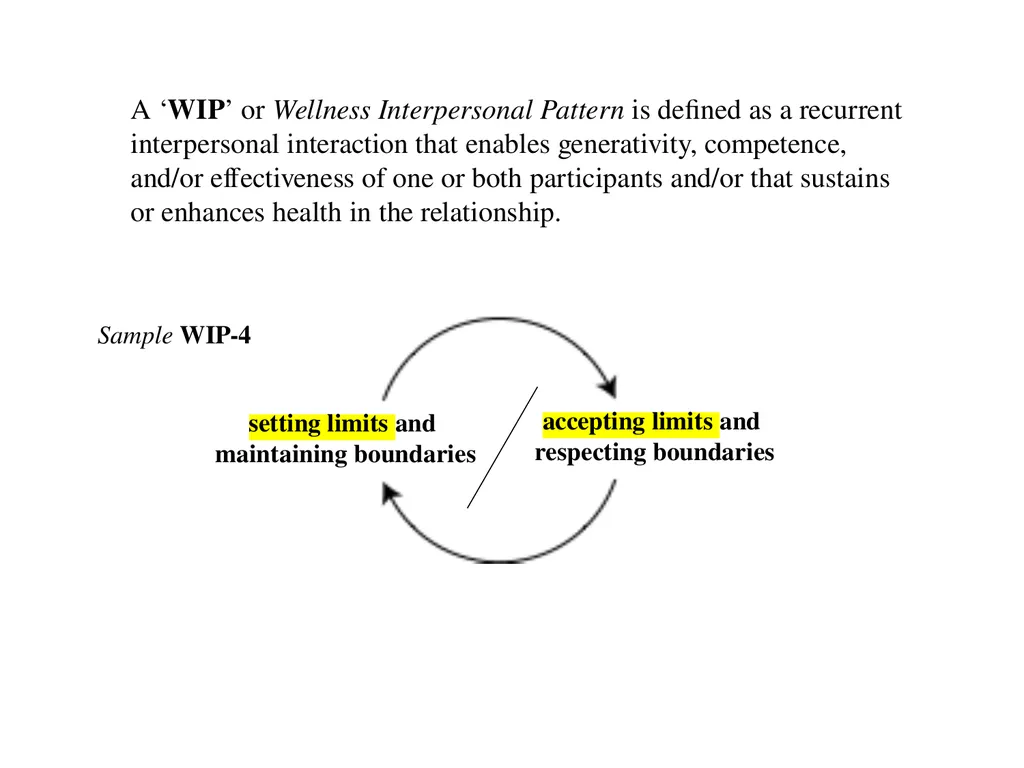
A ‘WIP’ or Wellness Interpersonal Pattern is defined as a recurrent interpersonal interaction that enables generativity, competence, and/or effectiveness of one or both participants and/or that sustains or enhances health in the relationship. Sample WIP-4 setting limits and
maintaining boundaries accepting limits and
respecting boundaries<br>
maintaining boundaries accepting limits and
respecting boundaries<br>
17
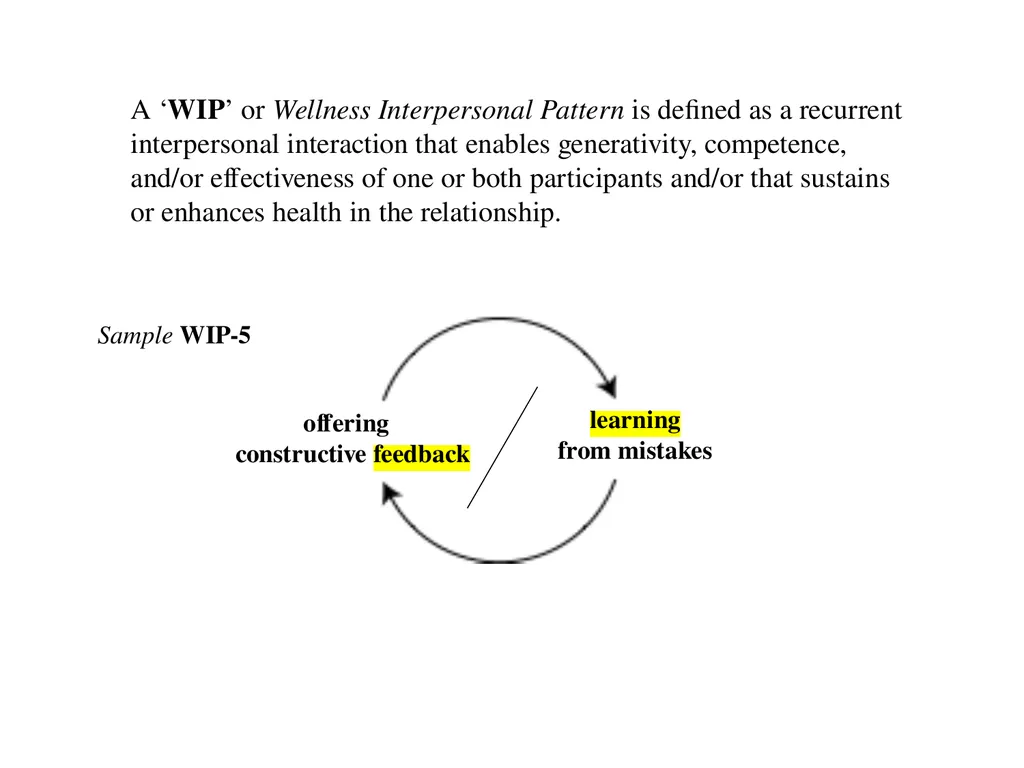
A ‘WIP’ or Wellness Interpersonal Pattern is defined as a recurrent interpersonal interaction that enables generativity, competence, and/or effectiveness of one or both participants and/or that sustains or enhances health in the relationship. Sample WIP-5 offering
constructive feedback learning
from mistakes<br>
constructive feedback learning
from mistakes<br>
18
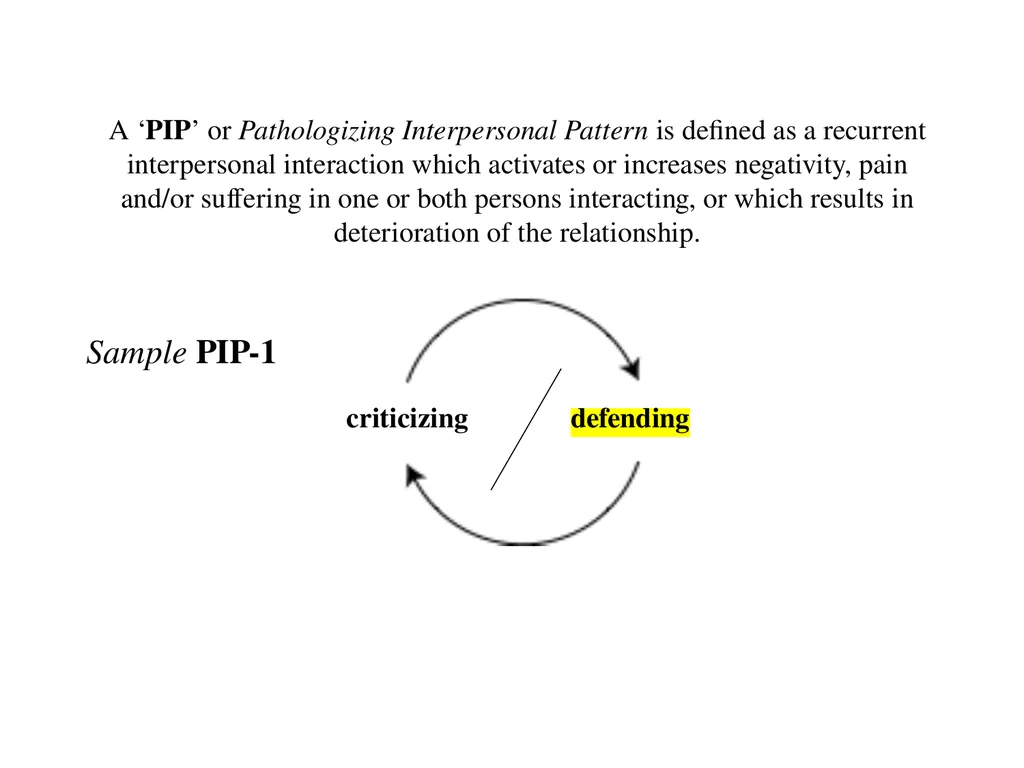
A ‘PIP’ or Pathologizing Interpersonal Pattern is defined as a recurrent interpersonal interaction which activates or increases negativity, pain and/or suffering in one or both persons interacting, or which results in deterioration of the relationship. Sample PIP-1 criticizing defending<br>
19
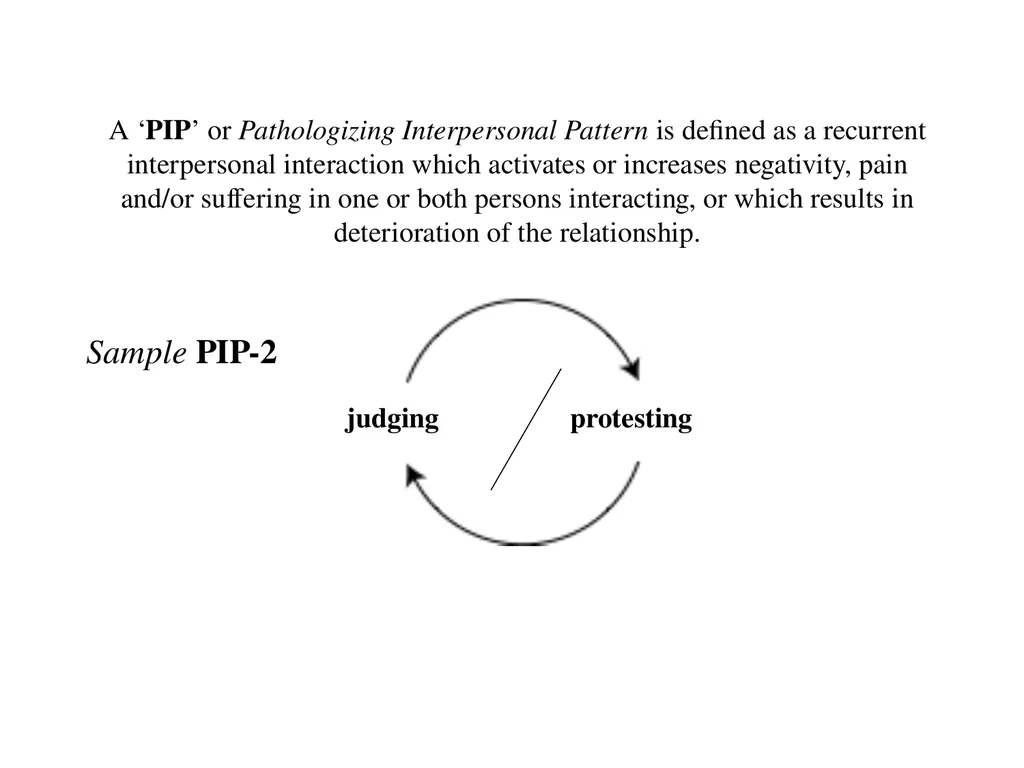
Sample PIP-2 judging protesting A ‘PIP’ or Pathologizing Interpersonal Pattern is defined as a recurrent interpersonal interaction which activates or increases negativity, pain and/or suffering in one or both persons interacting, or which results in deterioration of the relationship.<br>
20
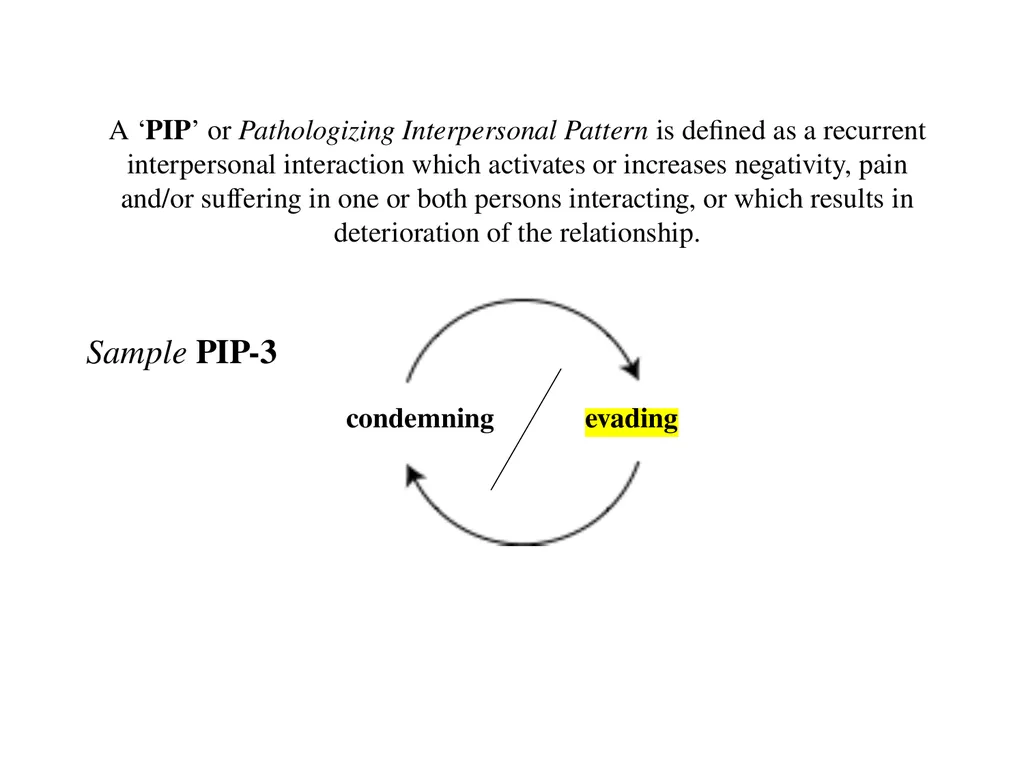
Sample PIP-3 condemning evading A ‘PIP’ or Pathologizing Interpersonal Pattern is defined as a recurrent interpersonal interaction which activates or increases negativity, pain and/or suffering in one or both persons interacting, or which results in deterioration of the relationship.<br>
21
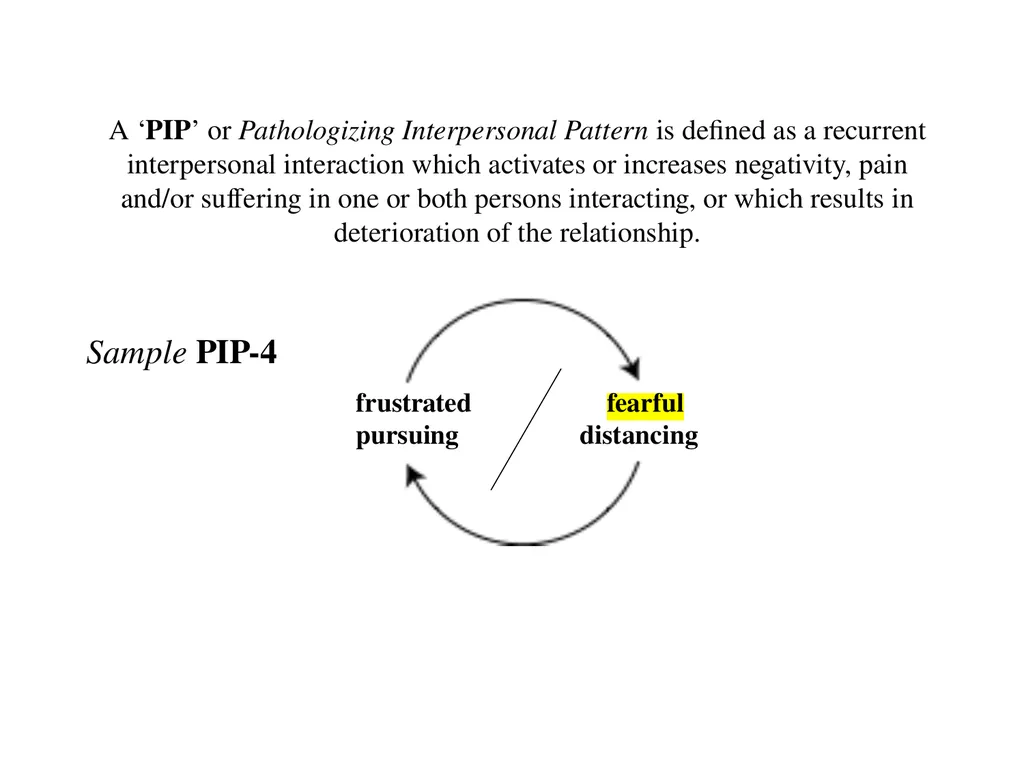
Sample PIP-4 frustrated
pursuing fearful
distancing A ‘PIP’ or Pathologizing Interpersonal Pattern is defined as a recurrent interpersonal interaction which activates or increases negativity, pain and/or suffering in one or both persons interacting, or which results in deterioration of the relationship.<br>
pursuing fearful
distancing A ‘PIP’ or Pathologizing Interpersonal Pattern is defined as a recurrent interpersonal interaction which activates or increases negativity, pain and/or suffering in one or both persons interacting, or which results in deterioration of the relationship.<br>
22
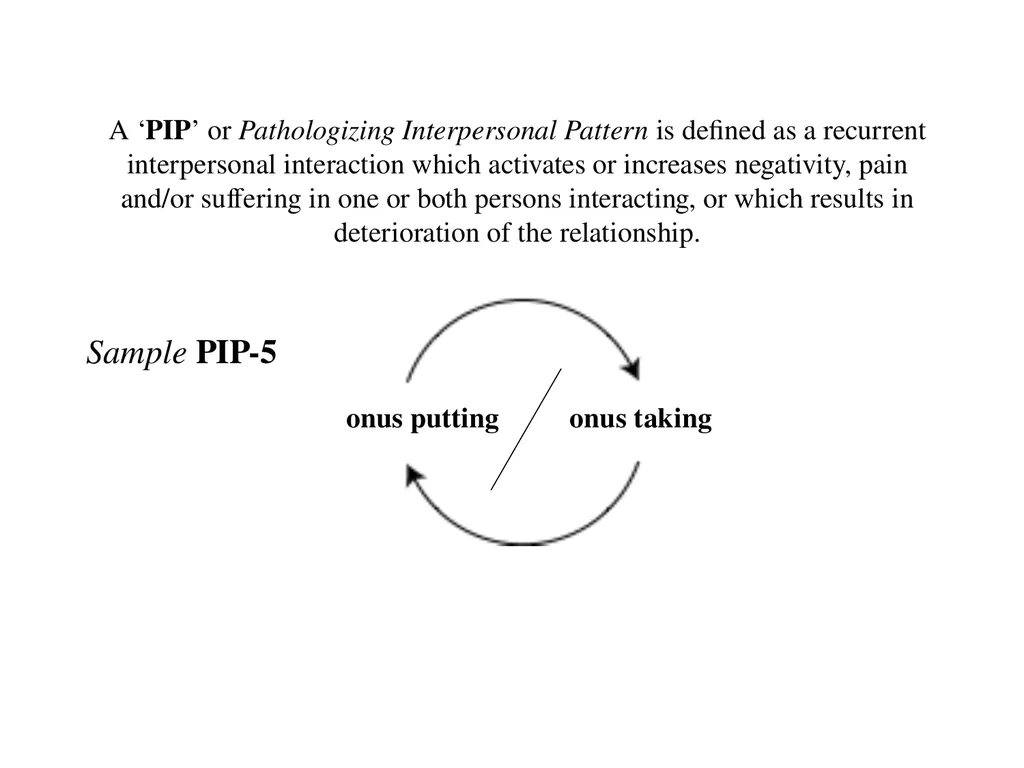
Sample PIP-5 onus putting onus taking A ‘PIP’ or Pathologizing Interpersonal Pattern is defined as a recurrent interpersonal interaction which activates or increases negativity, pain and/or suffering in one or both persons interacting, or which results in deterioration of the relationship.<br>
23
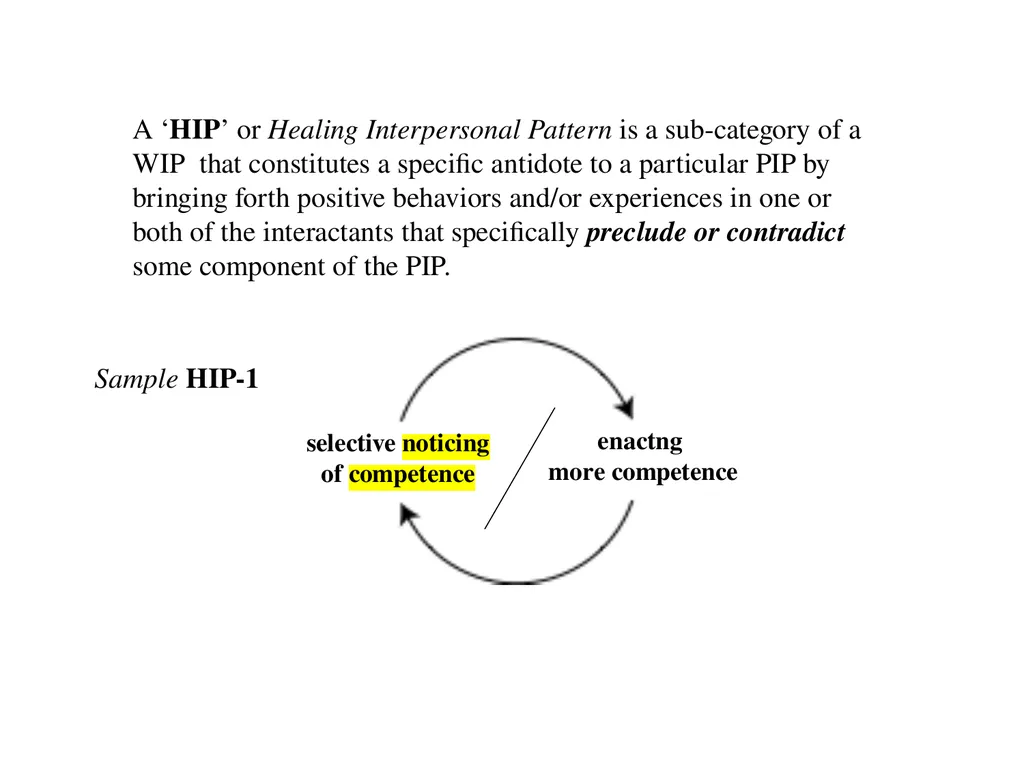
A ‘HIP’ or Healing Interpersonal Pattern is a sub-category of a WIP that constitutes a specific antidote to a particular PIP by bringing forth positive behaviors and/or experiences in one or both of the interactants that specifically preclude or contradict some component of the PIP. Sample HIP-1 selective noticing
of competence enactng
more competence<br>
of competence enactng
more competence<br>
24
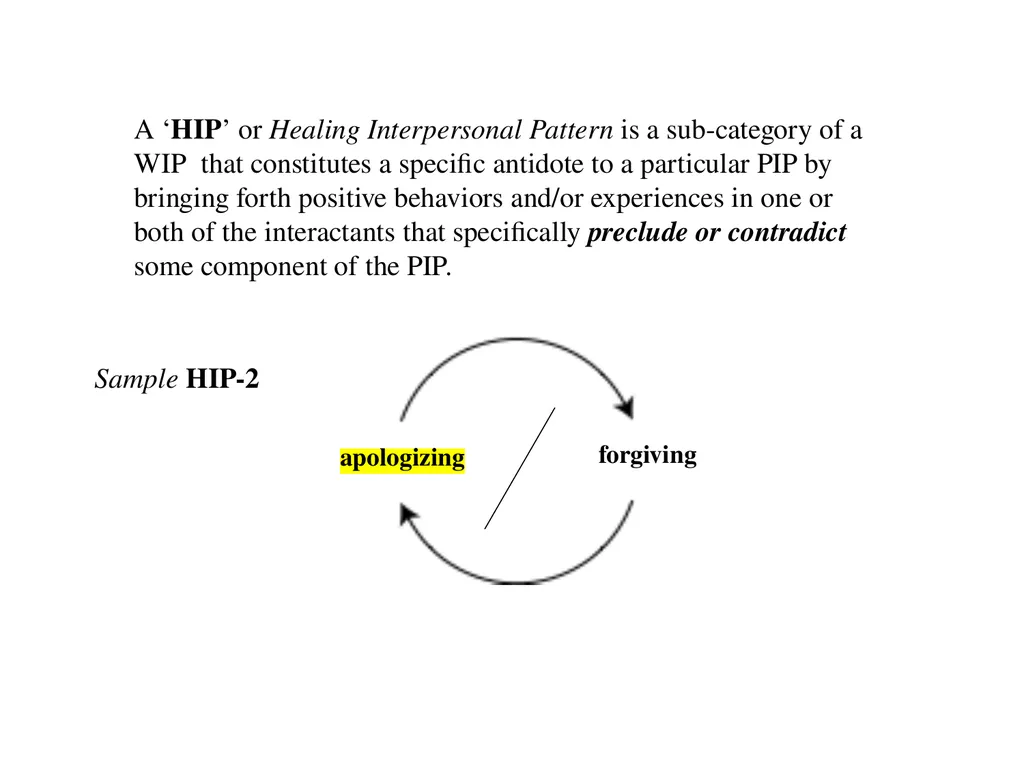
A ‘HIP’ or Healing Interpersonal Pattern is a sub-category of a WIP that constitutes a specific antidote to a particular PIP by bringing forth positive behaviors and/or experiences in one or both of the interactants that specifically preclude or contradict some component of the PIP. Sample HIP-2 apologizing forgiving<br>
25
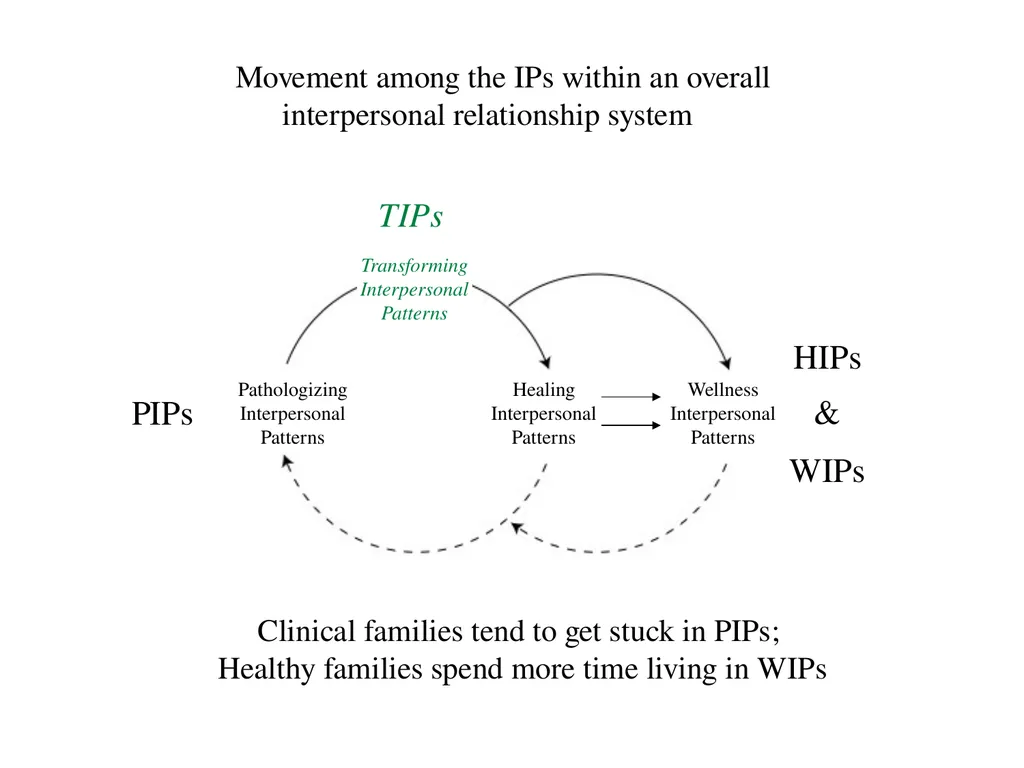
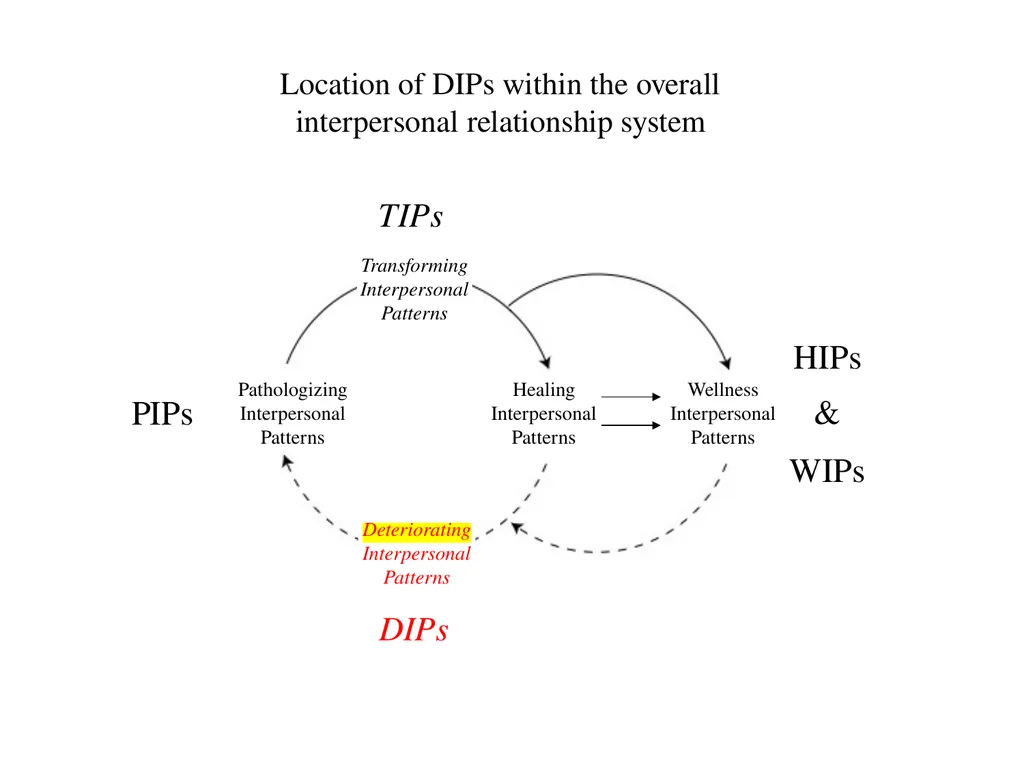
Pathologizing
Interpersonal
Patterns Wellness
Interpersonal
Patterns Healing
Interpersonal
Patterns PIPs HIPs
&
WIPs Movement among the IPs within an overall
interpersonal relationship system Clinical families tend to get stuck in PIPs;
Healthy families spend more time living in WIPs Transforming
Interpersonal
Patterns TIPs<br>
Interpersonal
Patterns Wellness
Interpersonal
Patterns Healing
Interpersonal
Patterns PIPs HIPs
&
WIPs Movement among the IPs within an overall
interpersonal relationship system Clinical families tend to get stuck in PIPs;
Healthy families spend more time living in WIPs Transforming
Interpersonal
Patterns TIPs<br>
26
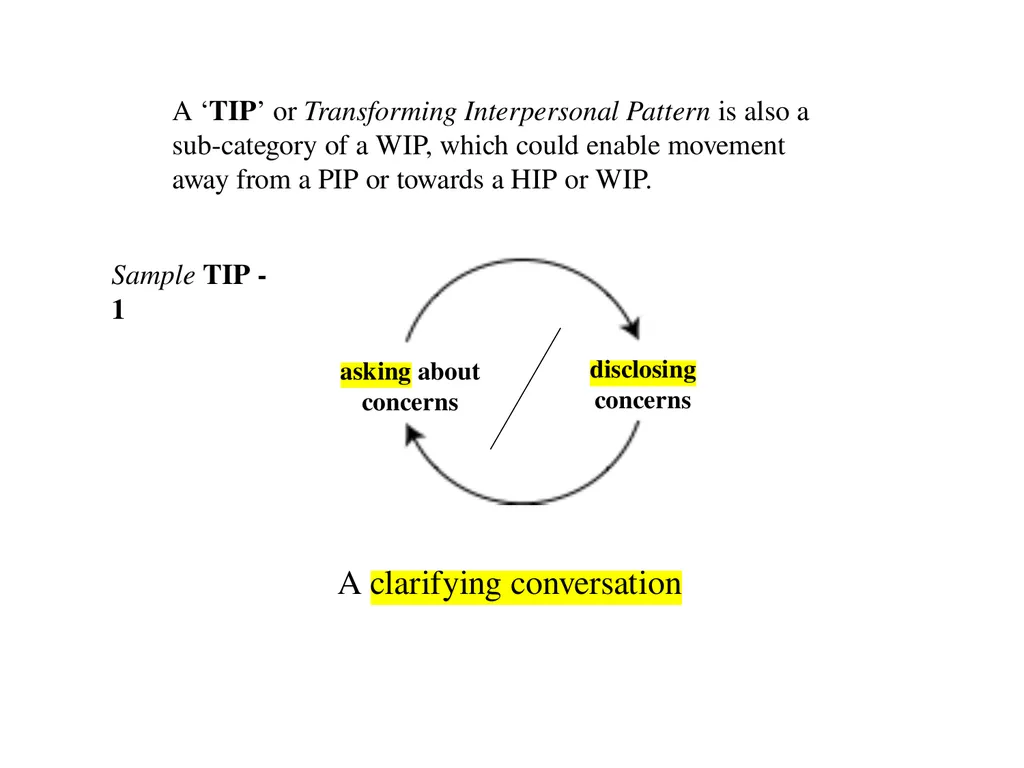
A ‘TIP’ or Transforming Interpersonal Pattern is also a sub-category of a WIP, which could enable movement away from a PIP or towards a HIP or WIP. asking about
concerns disclosing
concerns A clarifying conversation Sample TIP - 1<br>
concerns disclosing
concerns A clarifying conversation Sample TIP - 1<br>
27
Enquiring about the systemic nature and origin of problems Disclosing the relational
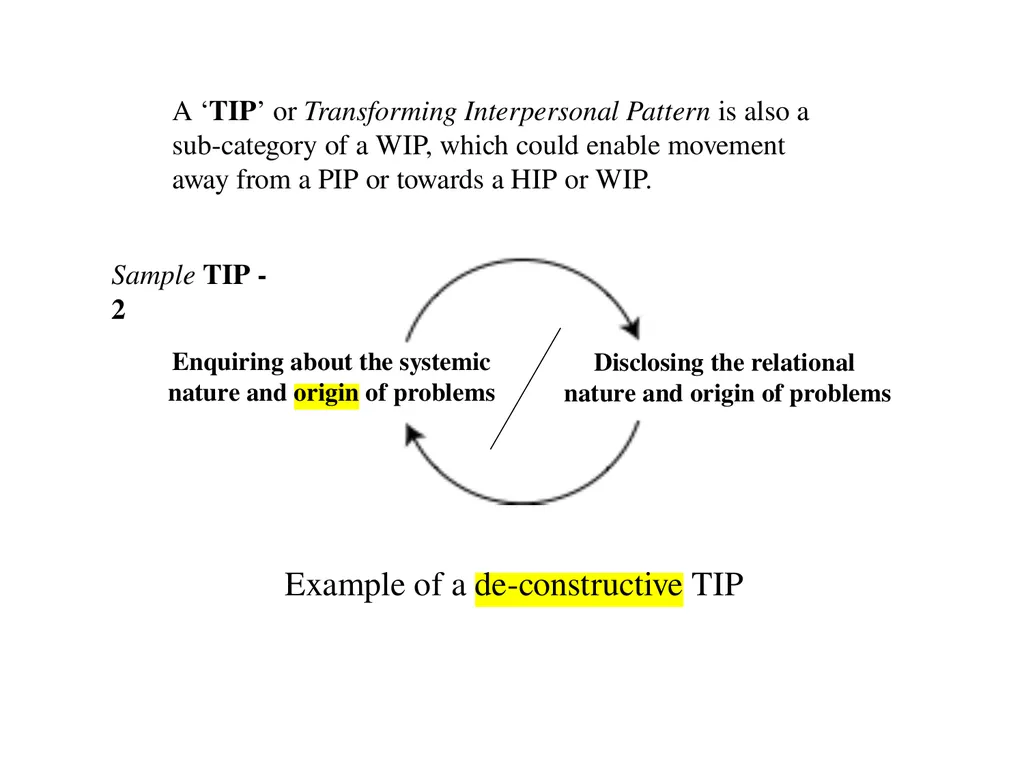
nature and origin of problems Example of a de-constructive TIP A ‘TIP’ or Transforming Interpersonal Pattern is also a sub-category of a WIP, which could enable movement away from a PIP or towards a HIP or WIP. Sample TIP - 2<br>
nature and origin of problems Example of a de-constructive TIP A ‘TIP’ or Transforming Interpersonal Pattern is also a sub-category of a WIP, which could enable movement away from a PIP or towards a HIP or WIP. Sample TIP - 2<br>
28
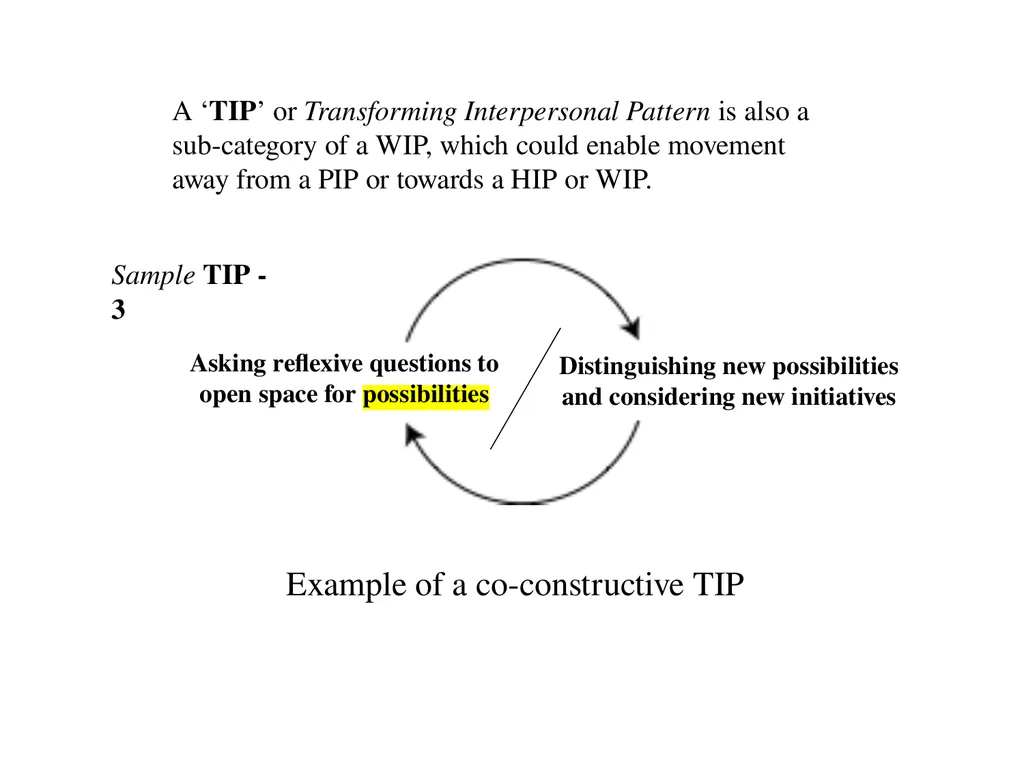
Example of a co-constructive TIP A ‘TIP’ or Transforming Interpersonal Pattern is also a sub-category of a WIP, which could enable movement away from a PIP or towards a HIP or WIP. Distinguishing new possibilities and considering new initiatives Asking reflexive questions to
open space for possibilities Sample TIP - 3<br>
open space for possibilities Sample TIP - 3<br>
29
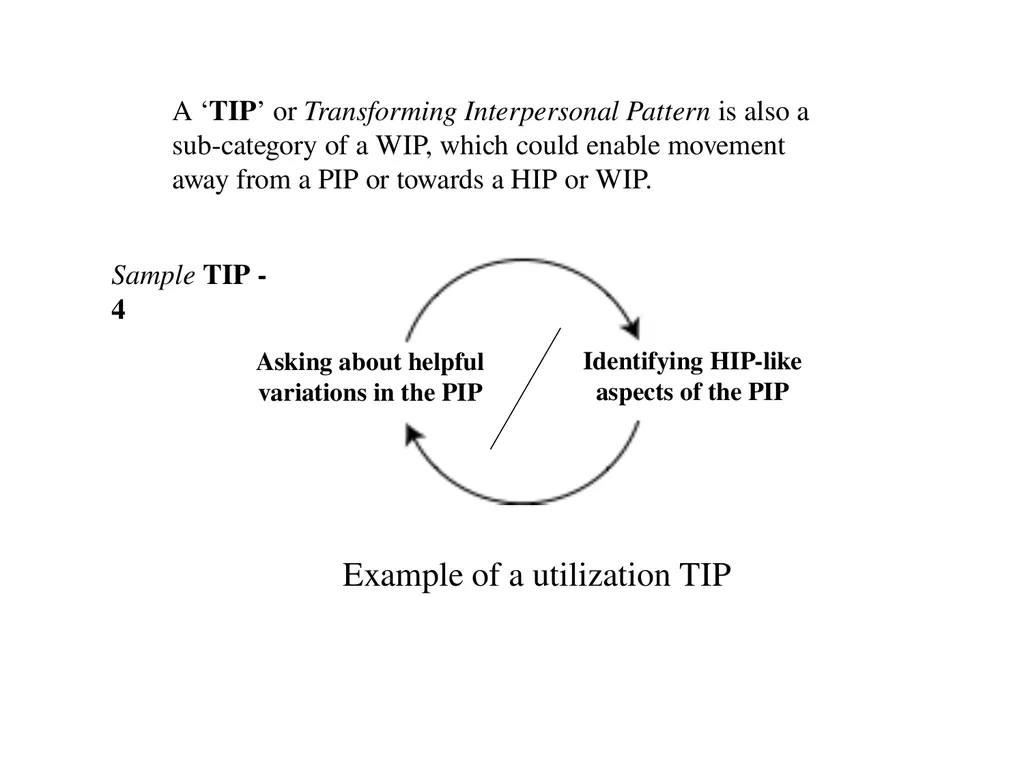
A ‘TIP’ or Transforming Interpersonal Pattern is also a sub-category of a WIP, which could enable movement away from a PIP or towards a HIP or WIP. Asking about helpful
variations in the PIP Identifying HIP-like aspects of the PIP Example of a utilization TIP Sample TIP - 4<br>
variations in the PIP Identifying HIP-like aspects of the PIP Example of a utilization TIP Sample TIP - 4<br>
30
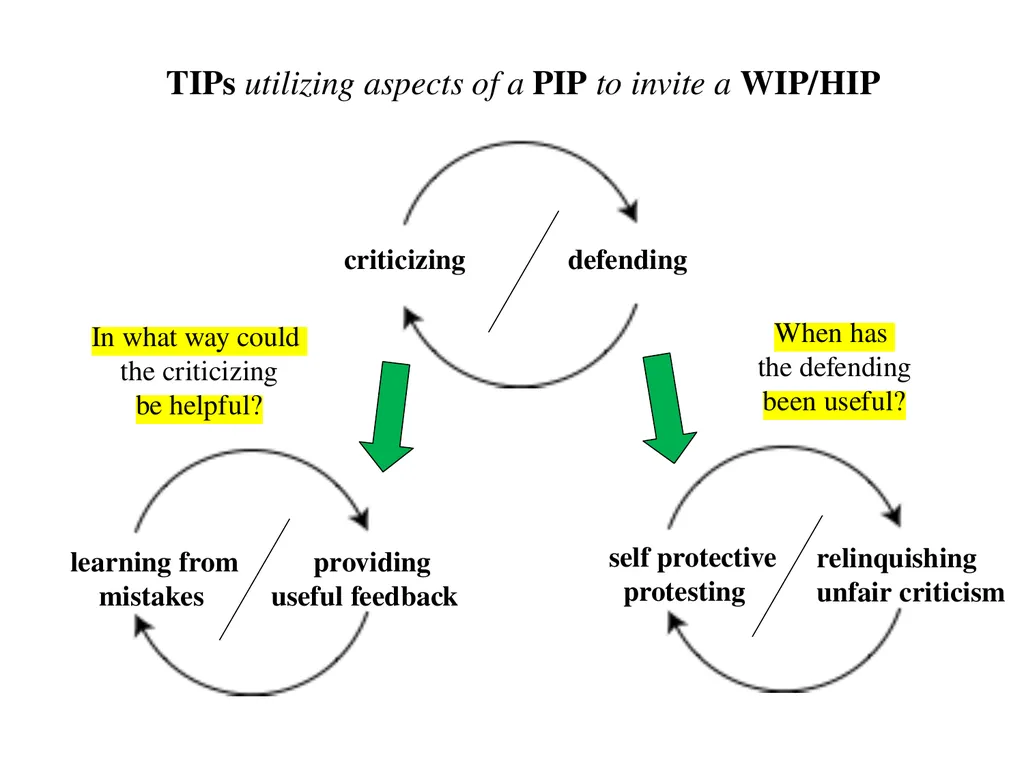
TIPs utilizing aspects of a PIP to invite a WIP/HIP criticizing defending providing
useful feedback learning from
mistakes relinquishing
unfair criticism self protective
protesting In what way could
the criticizing
be helpful? When has
the defending
been useful?<br>
useful feedback learning from
mistakes relinquishing
unfair criticism self protective
protesting In what way could
the criticizing
be helpful? When has
the defending
been useful?<br>
31
Transforming
Interpersonal
Patterns Deteriorating
Interpersonal
Patterns Pathologizing
Interpersonal
Patterns Wellness
Interpersonal
Patterns Healing
Interpersonal
Patterns DIPs TIPs PIPs HIPs
&
WIPs Location of DIPs within the overall
interpersonal relationship system<br>
Interpersonal
Patterns Deteriorating
Interpersonal
Patterns Pathologizing
Interpersonal
Patterns Wellness
Interpersonal
Patterns Healing
Interpersonal
Patterns DIPs TIPs PIPs HIPs
&
WIPs Location of DIPs within the overall
interpersonal relationship system<br>
32
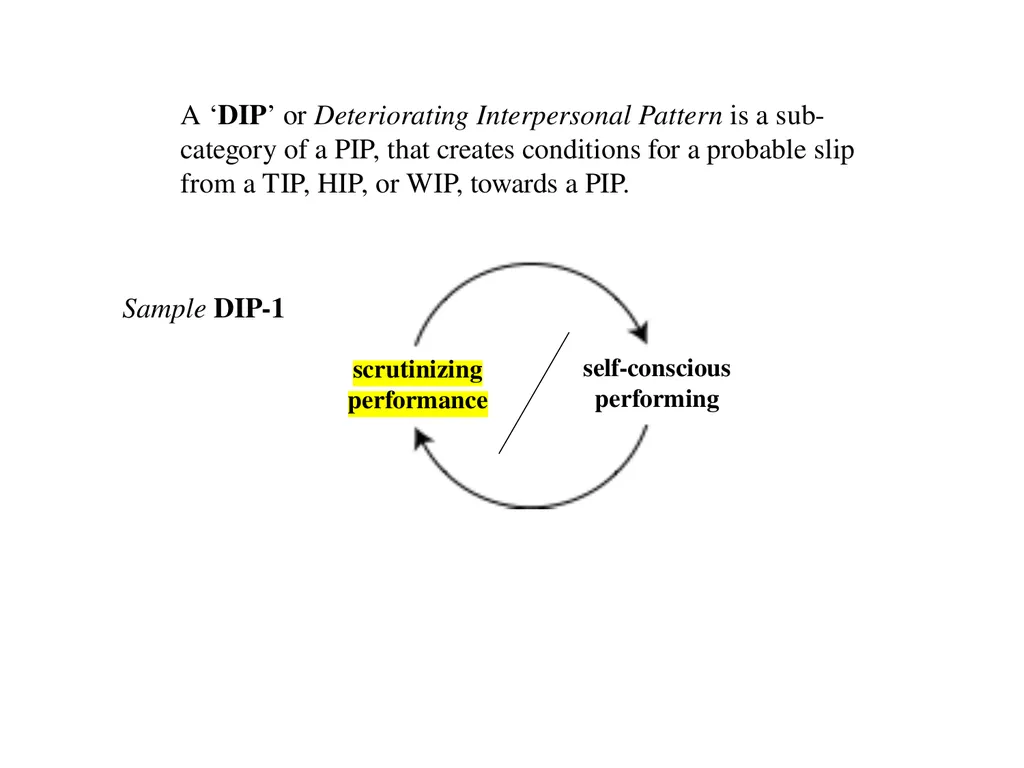
A ‘DIP’ or Deteriorating Interpersonal Pattern is a sub-category of a PIP, that creates conditions for a probable slip from a TIP, HIP, or WIP, towards a PIP. Sample DIP-1 scrutinizing
performance self-conscious
performing<br>
performance self-conscious
performing<br>
33
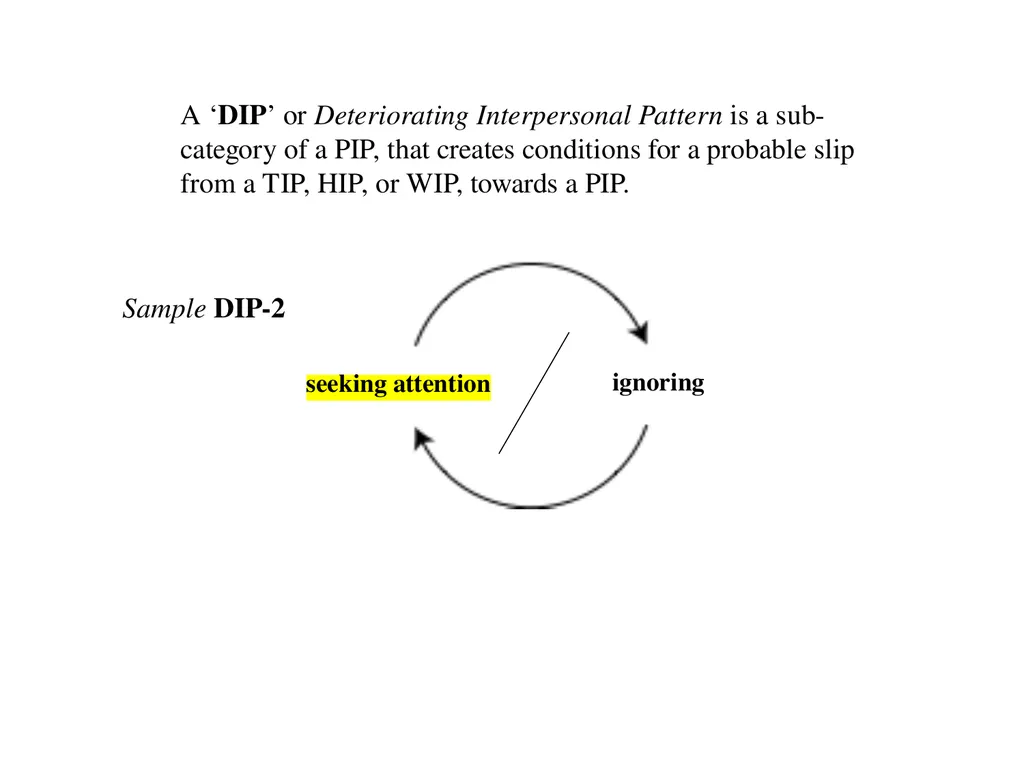
A ‘DIP’ or Deteriorating Interpersonal Pattern is a sub-category of a PIP, that creates conditions for a probable slip from a TIP, HIP, or WIP, towards a PIP. Sample DIP-2 seeking attention ignoring<br>
34
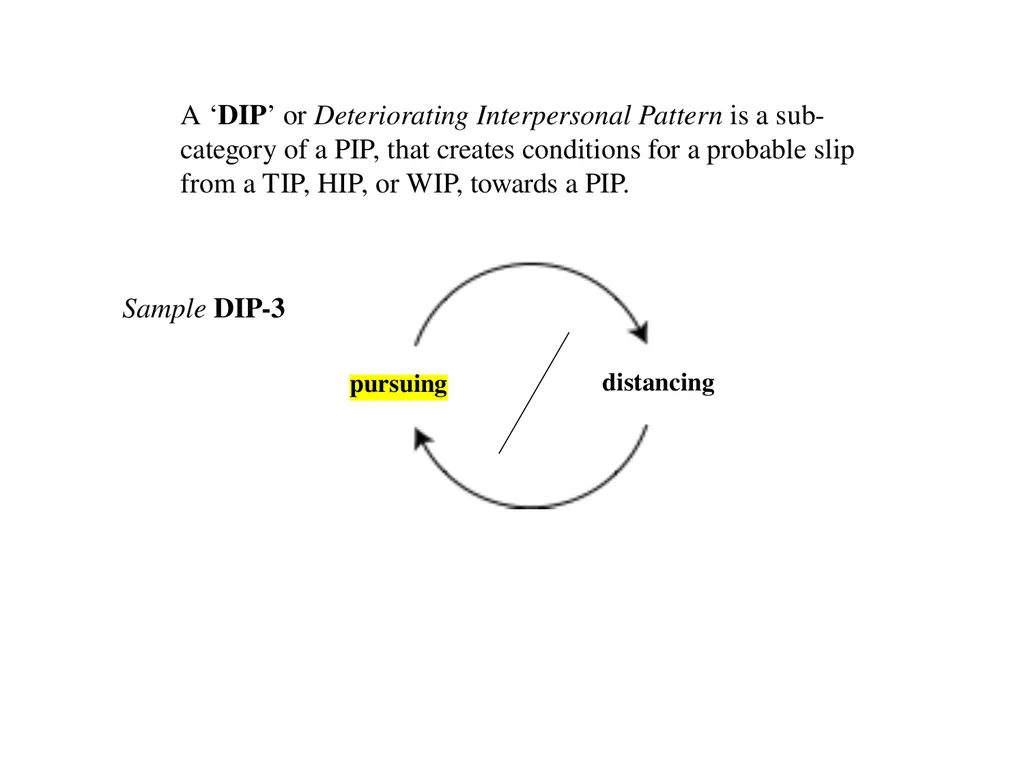
A ‘DIP’ or Deteriorating Interpersonal Pattern is a sub-category of a PIP, that creates conditions for a probable slip from a TIP, HIP, or WIP, towards a PIP. Sample DIP-3 pursuing distancing<br>
35
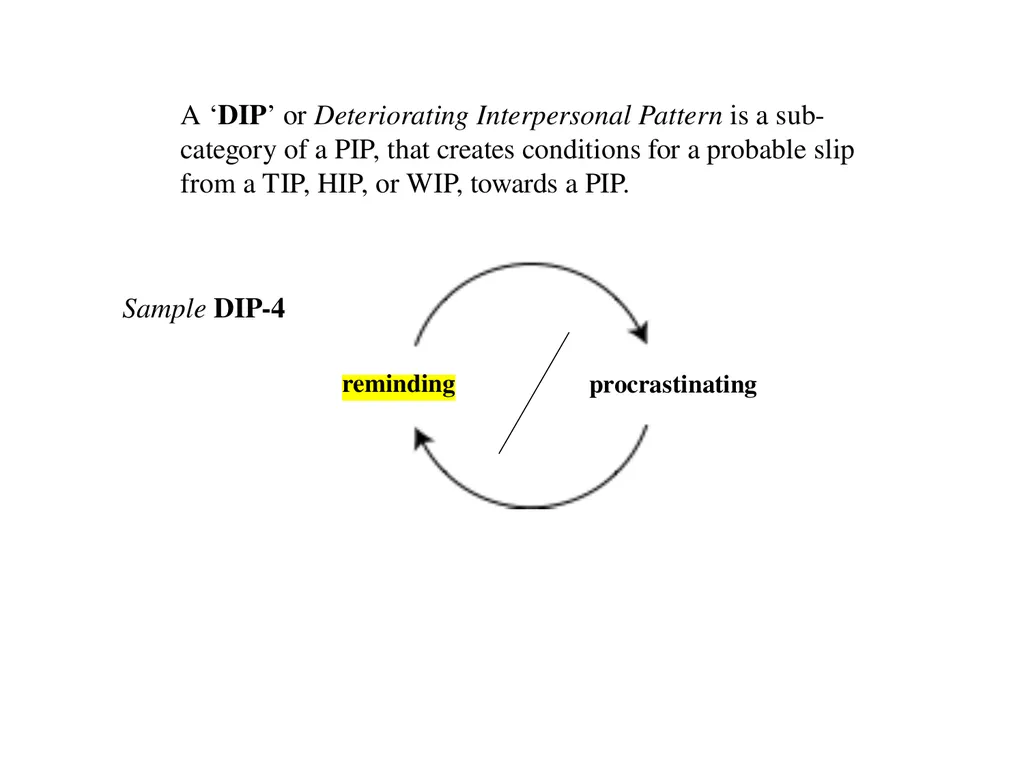
A ‘DIP’ or Deteriorating Interpersonal Pattern is a sub-category of a PIP, that creates conditions for a probable slip from a TIP, HIP, or WIP, towards a PIP. Sample DIP-4 reminding procrastinating<br>
36
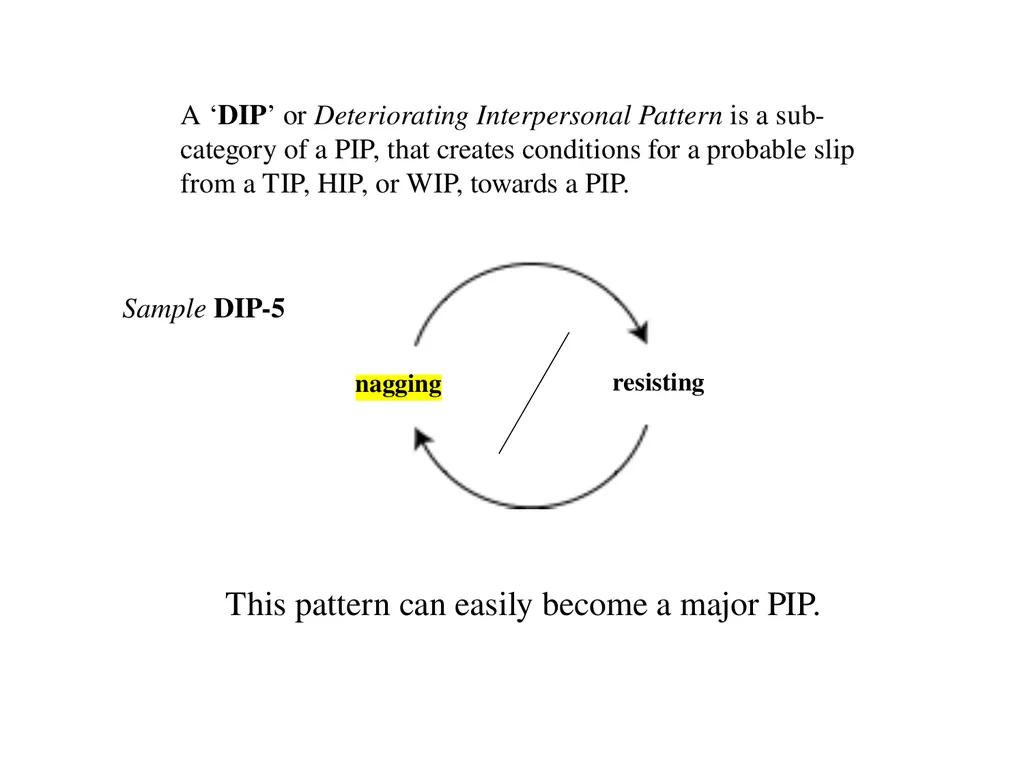
A ‘DIP’ or Deteriorating Interpersonal Pattern is a sub-category of a PIP, that creates conditions for a probable slip from a TIP, HIP, or WIP, towards a PIP. Sample DIP-5 nagging resisting This pattern can easily become a major PIP.<br>
37
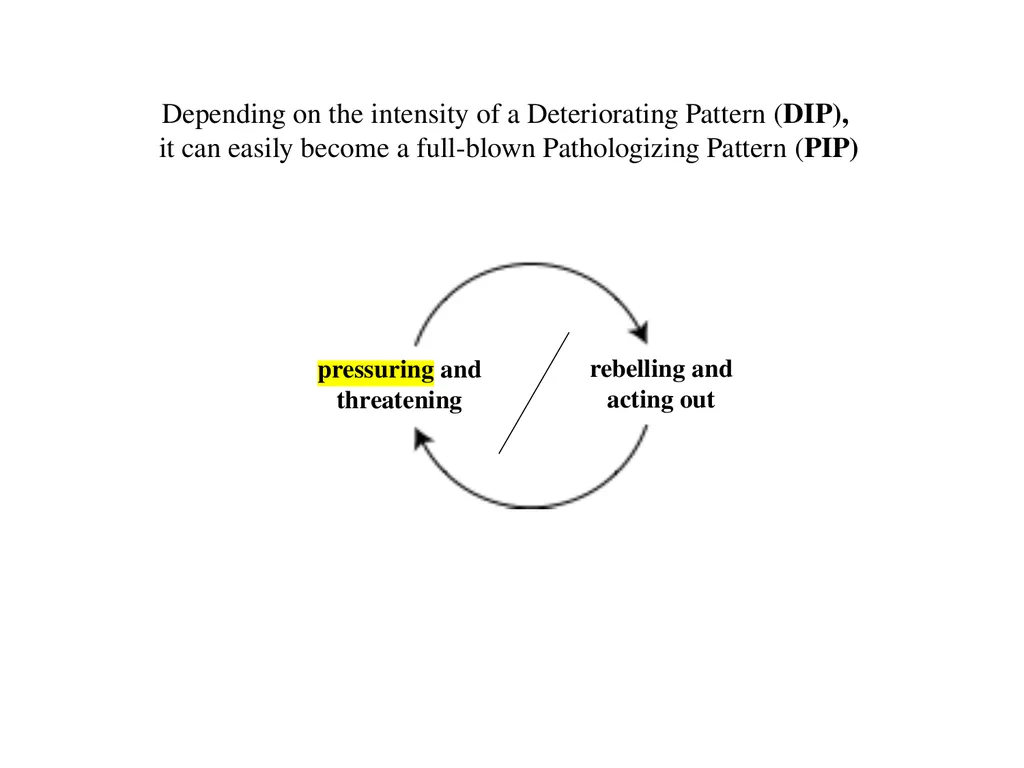
Depending on the intensity of a Deteriorating Pattern (DIP),
it can easily become a full-blown Pathologizing Pattern (PIP) pressuring and
threatening rebelling and
acting out<br>
it can easily become a full-blown Pathologizing Pattern (PIP) pressuring and
threatening rebelling and
acting out<br>
38
Transforming
Interpersonal
Patterns Deteriorating
Interpersonal
Patterns Pathologizing
Interpersonal
Patterns Wellness
Interpersonal
Patterns Healing
Interpersonal
Patterns DIPs TIPs PIPs HIPs
&
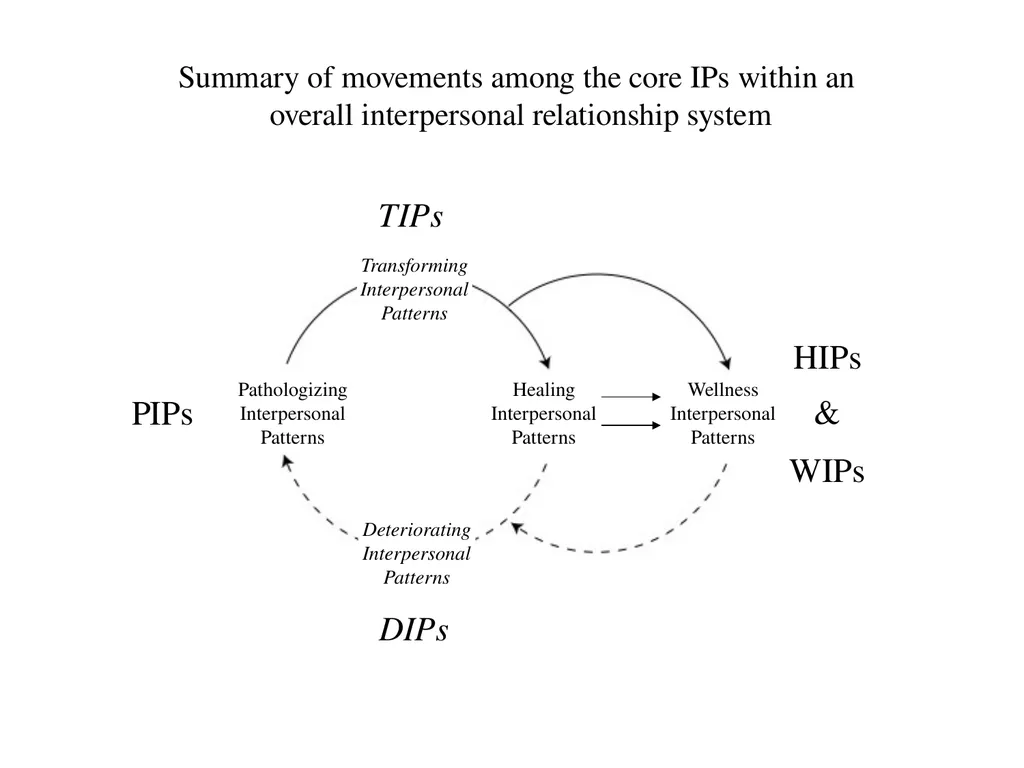
WIPs Summary of movements among the core IPs within an
overall interpersonal relationship system<br>
Interpersonal
Patterns Deteriorating
Interpersonal
Patterns Pathologizing
Interpersonal
Patterns Wellness
Interpersonal
Patterns Healing
Interpersonal
Patterns DIPs TIPs PIPs HIPs
&
WIPs Summary of movements among the core IPs within an
overall interpersonal relationship system<br>
39
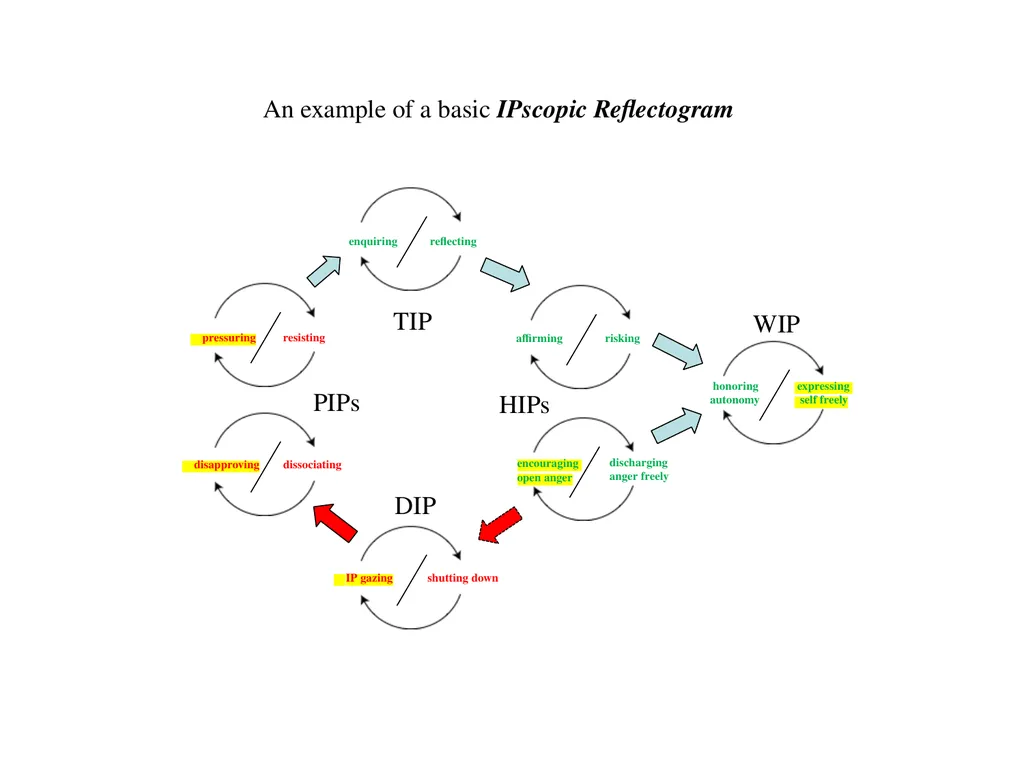
dissociating disapproving resisting pressuring shutting down IP gazing reflecting enquiring affirming risking encouraging
open anger discharging
anger freely honoring
autonomy expressing
self freely PIPs DIP HIPs TIP WIP An example of a basic IPscopic Reflectogram<br>
open anger discharging
anger freely honoring
autonomy expressing
self freely PIPs DIP HIPs TIP WIP An example of a basic IPscopic Reflectogram<br>
40
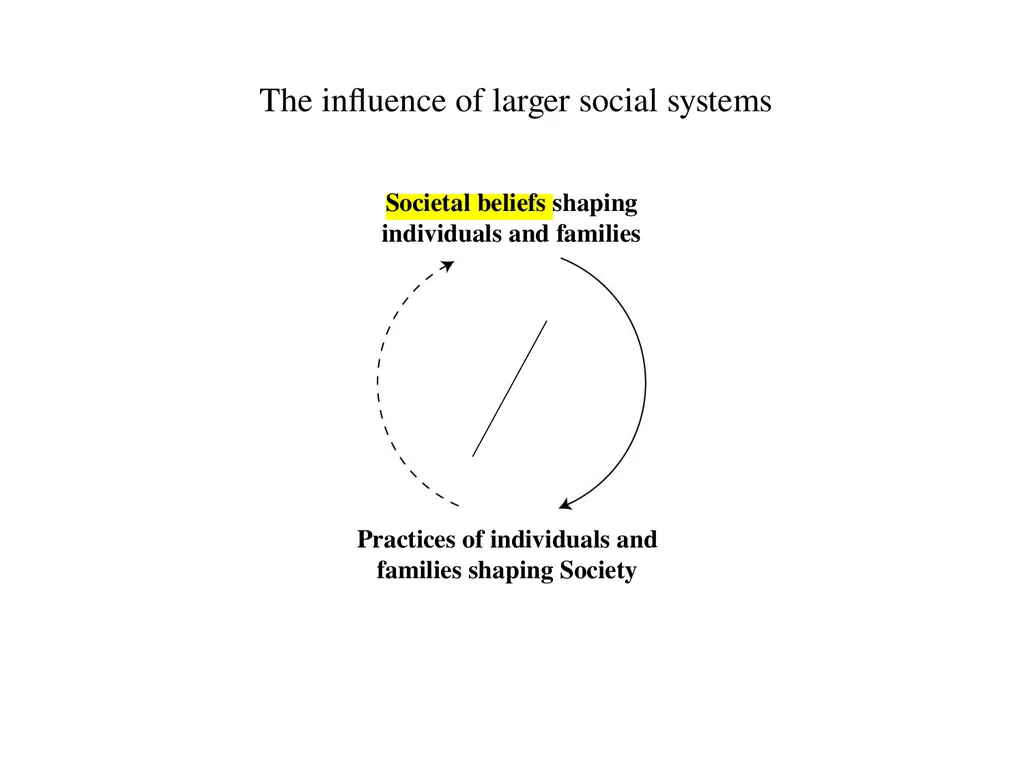
Societal beliefs shaping individuals and families The influence of larger social systems Practices of individuals and families shaping Society<br>
41
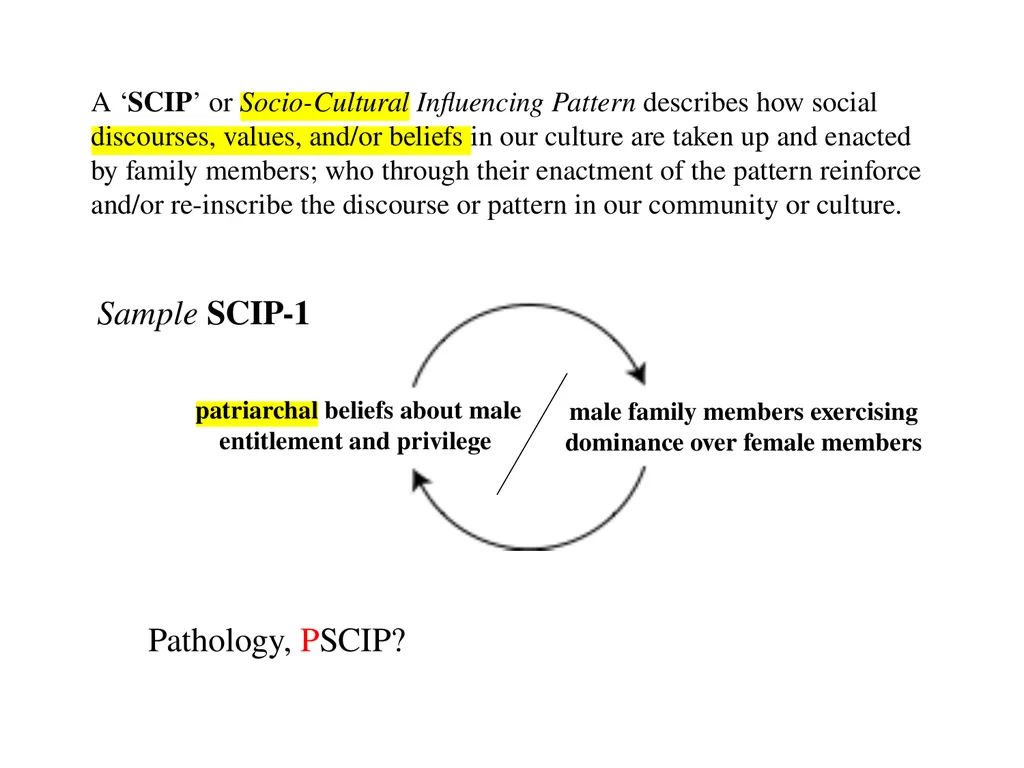
A ‘SCIP’ or Socio-Cultural Influencing Pattern describes how social discourses, values, and/or beliefs in our culture are taken up and enacted by family members; who through their enactment of the pattern reinforce and/or re-inscribe the discourse or pattern in our community or culture. Sample SCIP-1 patriarchal beliefs about male entitlement and privilege male family members exercising dominance over female members Pathology, PSCIP?<br>
42
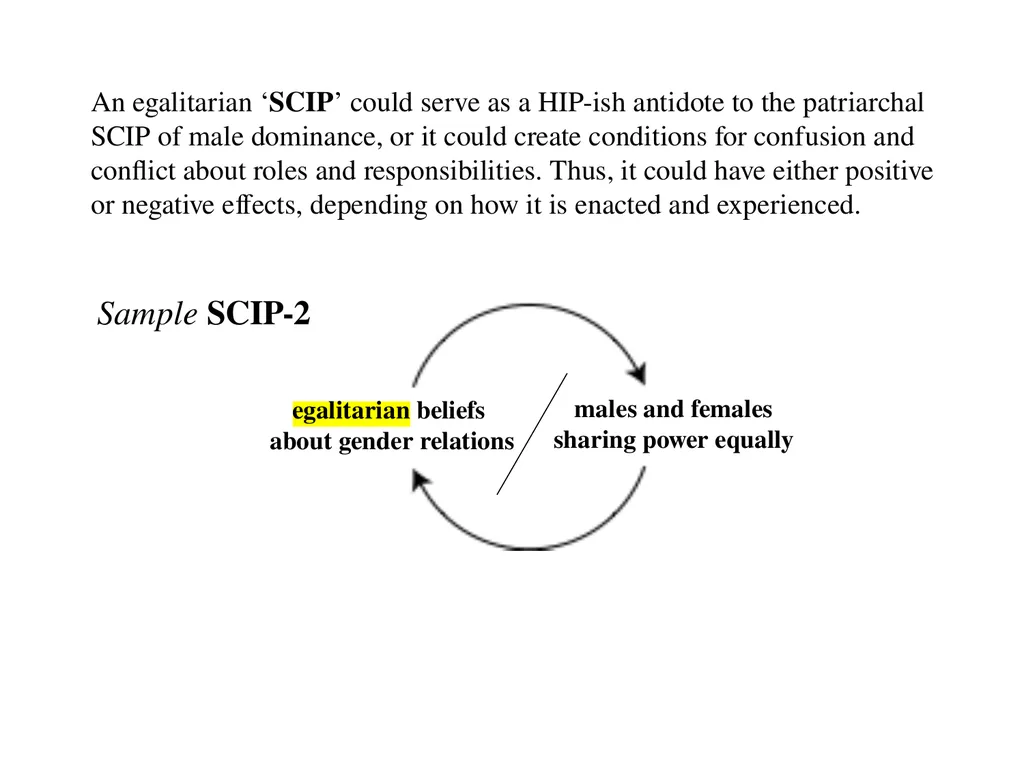
An egalitarian ‘SCIP’ could serve as a HIP-ish antidote to the patriarchal SCIP of male dominance, or it could create conditions for confusion and conflict about roles and responsibilities. Thus, it could have either positive or negative effects, depending on how it is enacted and experienced. Sample SCIP-2 egalitarian beliefs
about gender relations males and females sharing power equally<br>
about gender relations males and females sharing power equally<br>
43
Transforming
Interpersonal
Patterns Deteriorating
Interpersonal
Patterns Pathologizing
Interpersonal
Patterns Wellness
Interpersonal
Patterns Healing
Interpersonal
Patterns DIPs TIPs PIPs HIPs
&
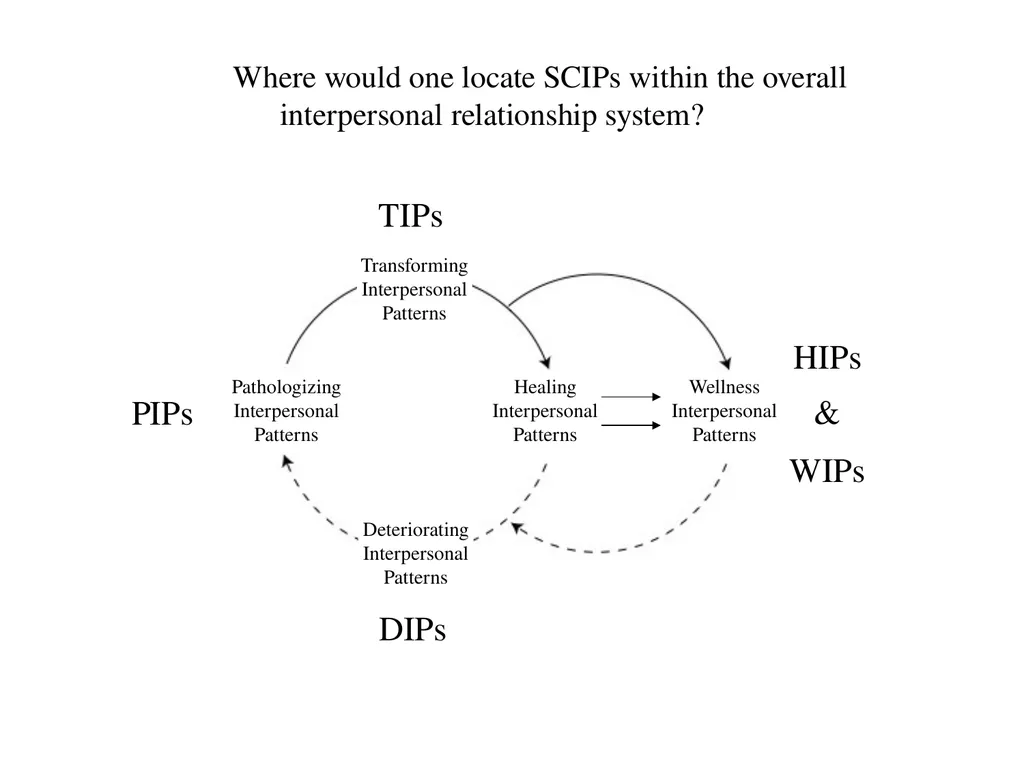
WIPs Where would one locate SCIPs within the overall
interpersonal relationship system?<br>
Interpersonal
Patterns Deteriorating
Interpersonal
Patterns Pathologizing
Interpersonal
Patterns Wellness
Interpersonal
Patterns Healing
Interpersonal
Patterns DIPs TIPs PIPs HIPs
&
WIPs Where would one locate SCIPs within the overall
interpersonal relationship system?<br>
44
Transforming
Interpersonal
Patterns Deteriorating
Interpersonal
Patterns Pathologizing
Interpersonal
Patterns Wellness
Interpersonal
Patterns Healing
Interpersonal
Patterns DIPs TIPs PIPs HIPs
&
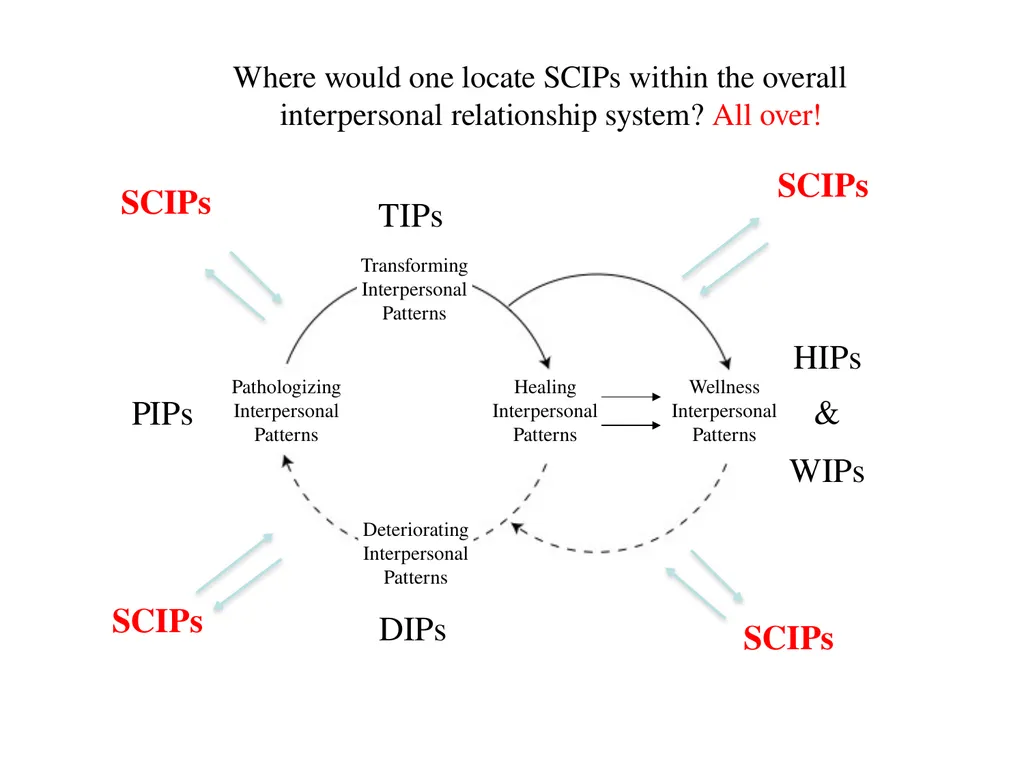
WIPs SCIPs SCIPs SCIPs SCIPs Where would one locate SCIPs within the overall
interpersonal relationship system? All over!<br>
Interpersonal
Patterns Deteriorating
Interpersonal
Patterns Pathologizing
Interpersonal
Patterns Wellness
Interpersonal
Patterns Healing
Interpersonal
Patterns DIPs TIPs PIPs HIPs
&
WIPs SCIPs SCIPs SCIPs SCIPs Where would one locate SCIPs within the overall
interpersonal relationship system? All over!<br>
45
Transforming
Interpersonal
Patterns Deteriorating
Interpersonal
Patterns Pathologizing
Interpersonal
Patterns Wellness
Interpersonal
Patterns Healing
Interpersonal
Patterns DIPs TIPs PIPs HIPs
&
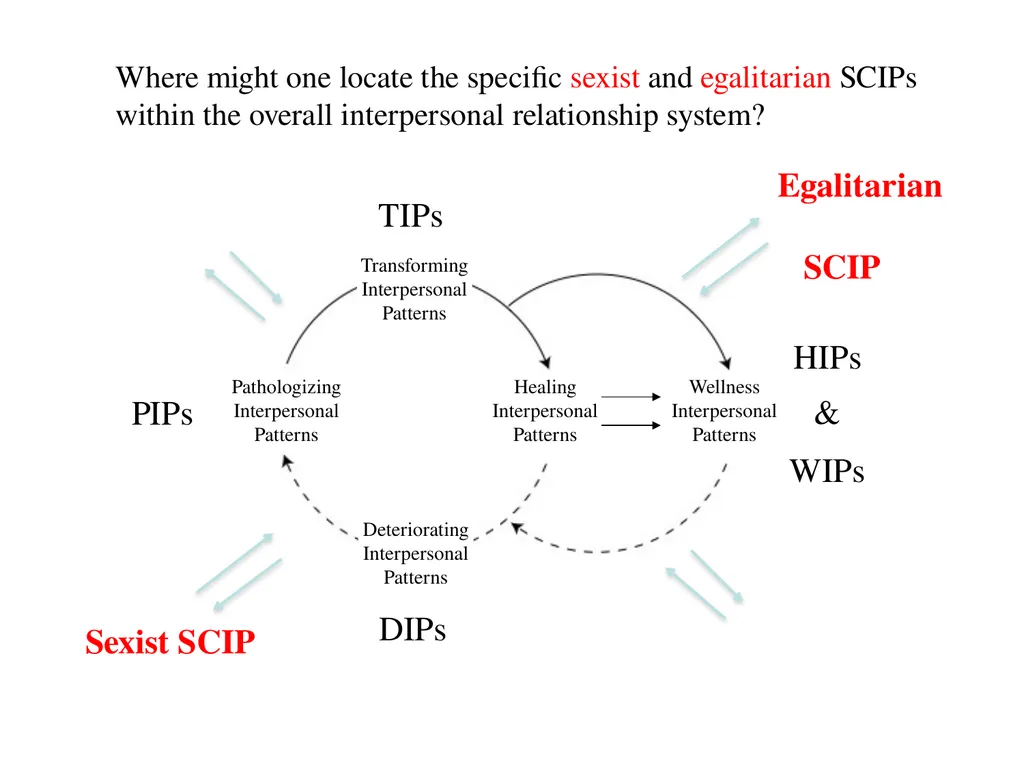
WIPs Sexist SCIP Egalitarian
SCIP Where might one locate the specific sexist and egalitarian SCIPs
within the overall interpersonal relationship system?<br>
Interpersonal
Patterns Deteriorating
Interpersonal
Patterns Pathologizing
Interpersonal
Patterns Wellness
Interpersonal
Patterns Healing
Interpersonal
Patterns DIPs TIPs PIPs HIPs
&
WIPs Sexist SCIP Egalitarian
SCIP Where might one locate the specific sexist and egalitarian SCIPs
within the overall interpersonal relationship system?<br>
46
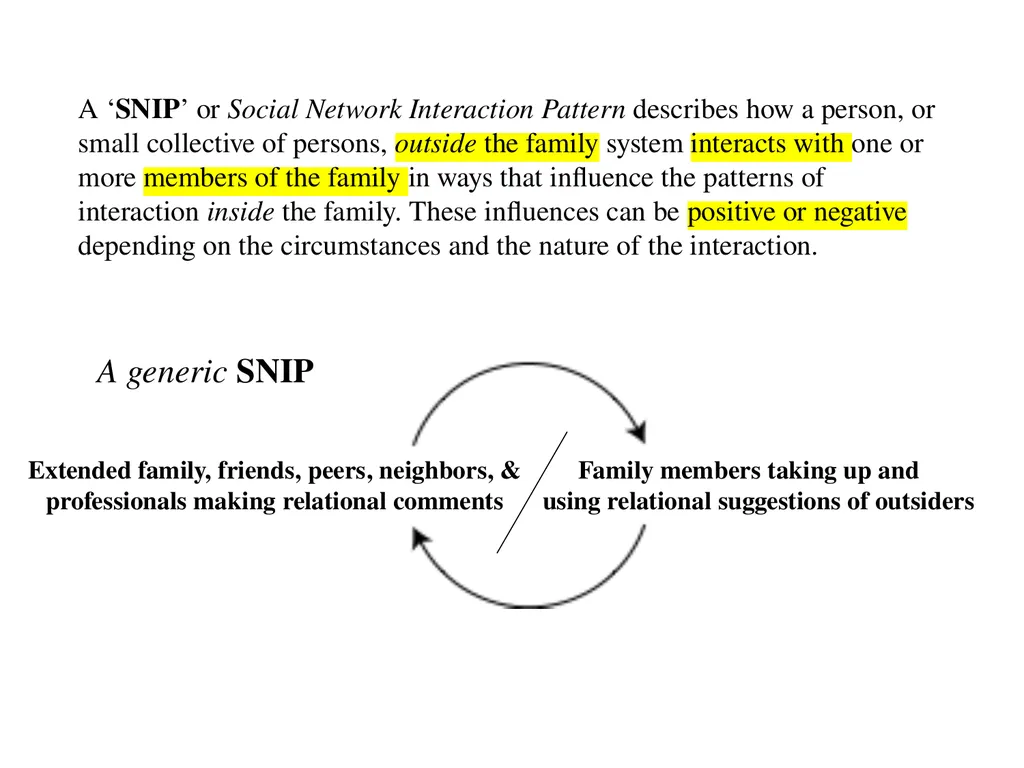
A ‘SNIP’ or Social Network Interaction Pattern describes how a person, or small collective of persons, outside the family system interacts with one or more members of the family in ways that influence the patterns of interaction inside the family. These influences can be positive or negative depending on the circumstances and the nature of the interaction. A generic SNIP Extended family, friends, peers, neighbors, & professionals making relational comments Family members taking up and
using relational suggestions of outsiders<br>
using relational suggestions of outsiders<br>
47
WIPish SNIP Friends and peers offering support and encouraging respectful relations Families embracing helpful comments
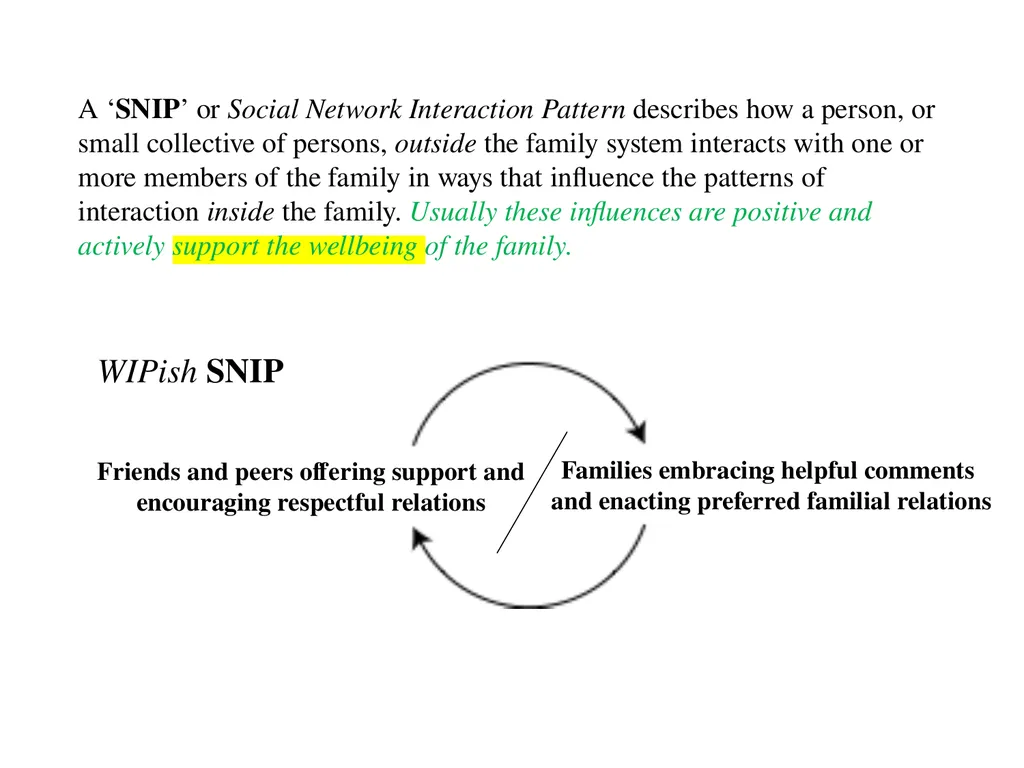
and enacting preferred familial relations A ‘SNIP’ or Social Network Interaction Pattern describes how a person, or small collective of persons, outside the family system interacts with one or more members of the family in ways that influence the patterns of interaction inside the family. Usually these influences are positive and actively support the wellbeing of the family.<br>
and enacting preferred familial relations A ‘SNIP’ or Social Network Interaction Pattern describes how a person, or small collective of persons, outside the family system interacts with one or more members of the family in ways that influence the patterns of interaction inside the family. Usually these influences are positive and actively support the wellbeing of the family.<br>
48
HIPish SNIP Therapist encouraging parents to
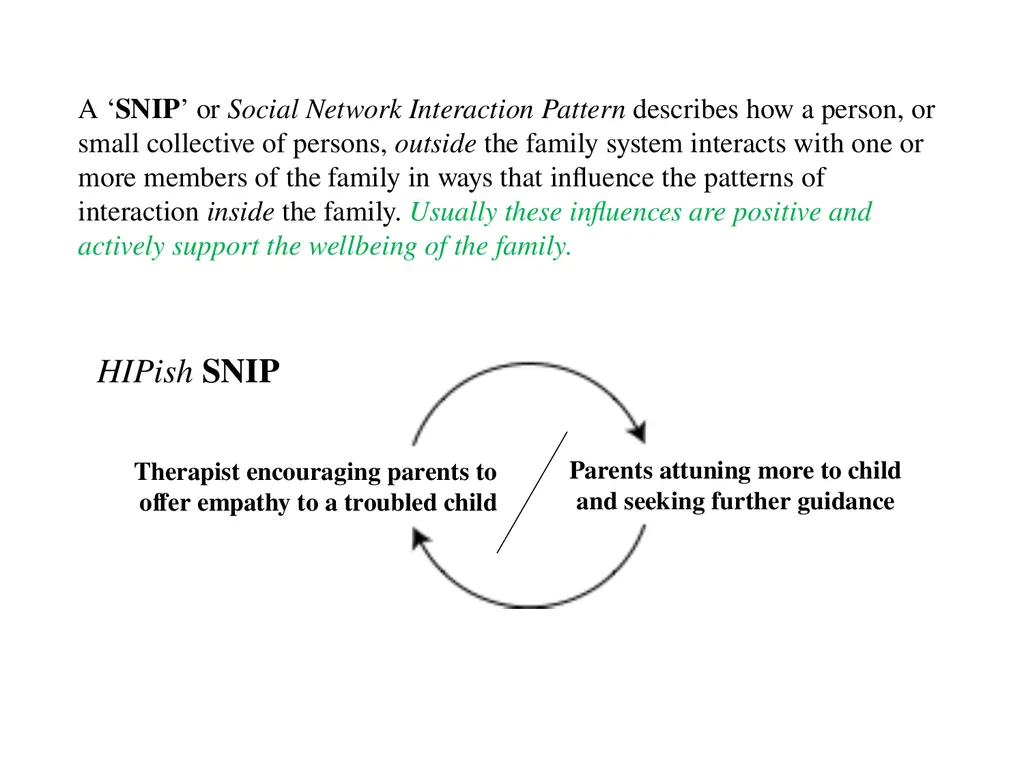
offer empathy to a troubled child Parents attuning more to child and seeking further guidance A ‘SNIP’ or Social Network Interaction Pattern describes how a person, or small collective of persons, outside the family system interacts with one or more members of the family in ways that influence the patterns of interaction inside the family. Usually these influences are positive and actively support the wellbeing of the family.<br>
offer empathy to a troubled child Parents attuning more to child and seeking further guidance A ‘SNIP’ or Social Network Interaction Pattern describes how a person, or small collective of persons, outside the family system interacts with one or more members of the family in ways that influence the patterns of interaction inside the family. Usually these influences are positive and actively support the wellbeing of the family.<br>
49
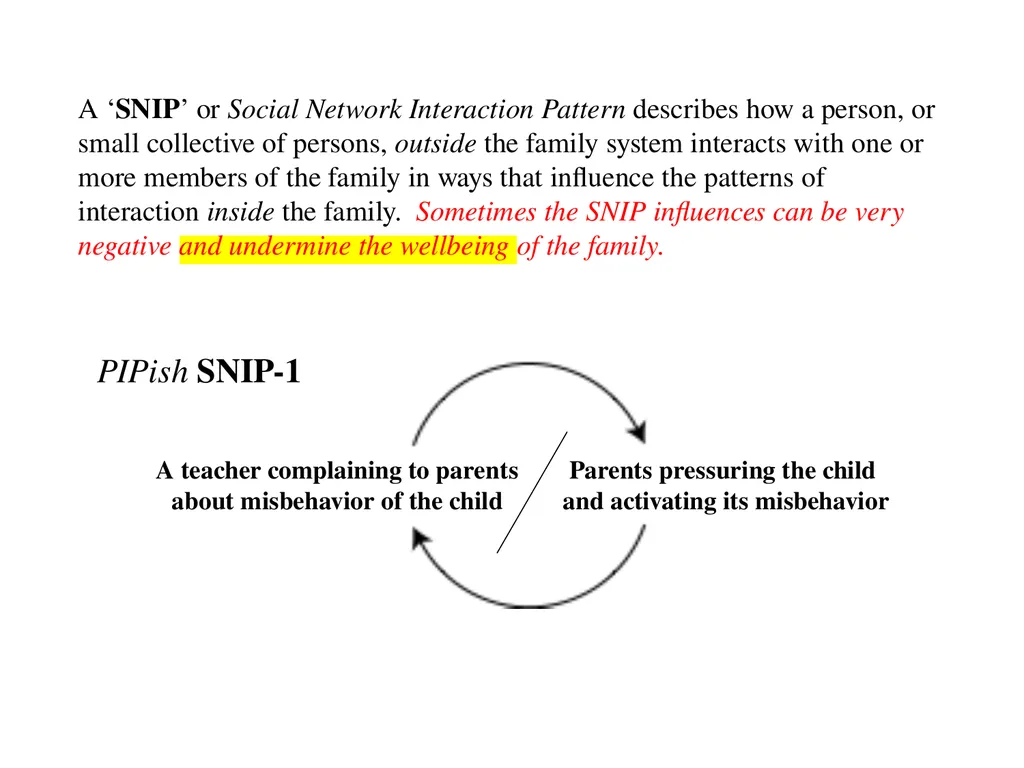
A ‘SNIP’ or Social Network Interaction Pattern describes how a person, or small collective of persons, outside the family system interacts with one or more members of the family in ways that influence the patterns of interaction inside the family. Sometimes the SNIP influences can be very negative and undermine the wellbeing of the family. PIPish SNIP-1 A teacher complaining to parents about misbehavior of the child Parents pressuring the child
and activating its misbehavior<br>
and activating its misbehavior<br>
50
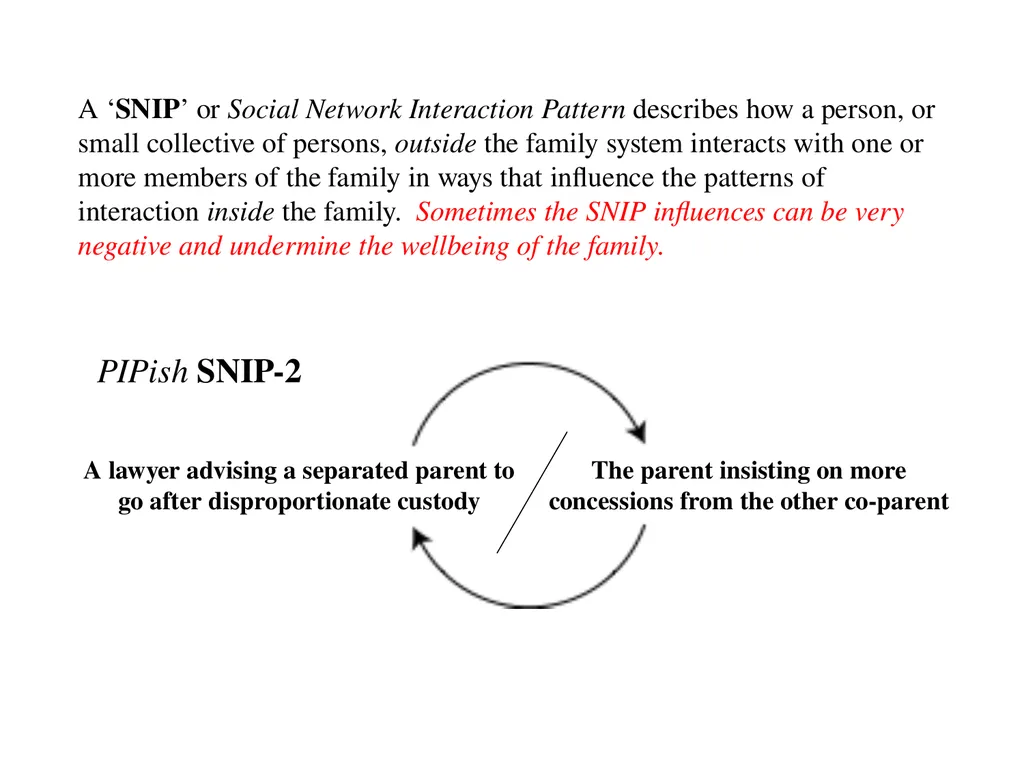
PIPish SNIP-2 A lawyer advising a separated parent to go after disproportionate custody The parent insisting on more concessions from the other co-parent A ‘SNIP’ or Social Network Interaction Pattern describes how a person, or small collective of persons, outside the family system interacts with one or more members of the family in ways that influence the patterns of interaction inside the family. Sometimes the SNIP influences can be very negative and undermine the wellbeing of the family.<br>
51
Transforming
Interpersonal
Patterns Deteriorating
Interpersonal
Patterns Pathologizing
Interpersonal
Patterns Wellness
Interpersonal
Patterns Healing
Interpersonal
Patterns DIPs TIPs PIPs HIPs
&
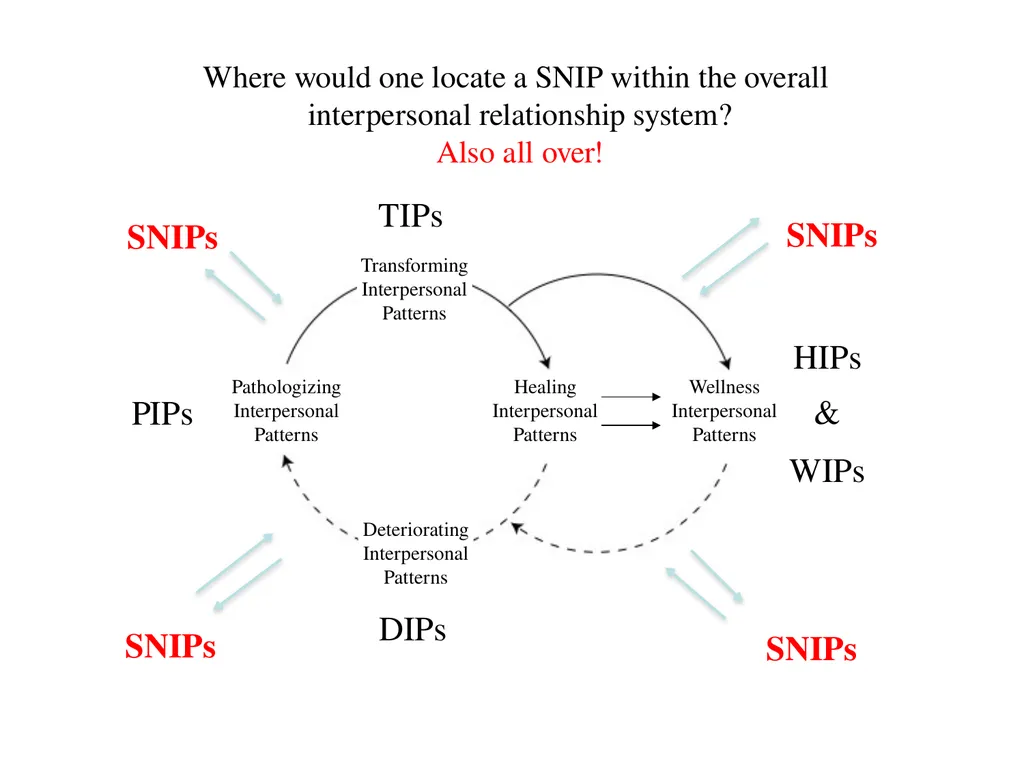
WIPs SNIPs SNIPs SNIPs SNIPs Where would one locate a SNIP within the overall
interpersonal relationship system?
Also all over!<br>
Interpersonal
Patterns Deteriorating
Interpersonal
Patterns Pathologizing
Interpersonal
Patterns Wellness
Interpersonal
Patterns Healing
Interpersonal
Patterns DIPs TIPs PIPs HIPs
&
WIPs SNIPs SNIPs SNIPs SNIPs Where would one locate a SNIP within the overall
interpersonal relationship system?
Also all over!<br>
52
Transforming
Interpersonal
Patterns Deteriorating
Interpersonal
Patterns Pathologizing
Interpersonal
Patterns Wellness
Interpersonal
Patterns Healing
Interpersonal
Patterns DIPs TIPs PIPs HIPs
&
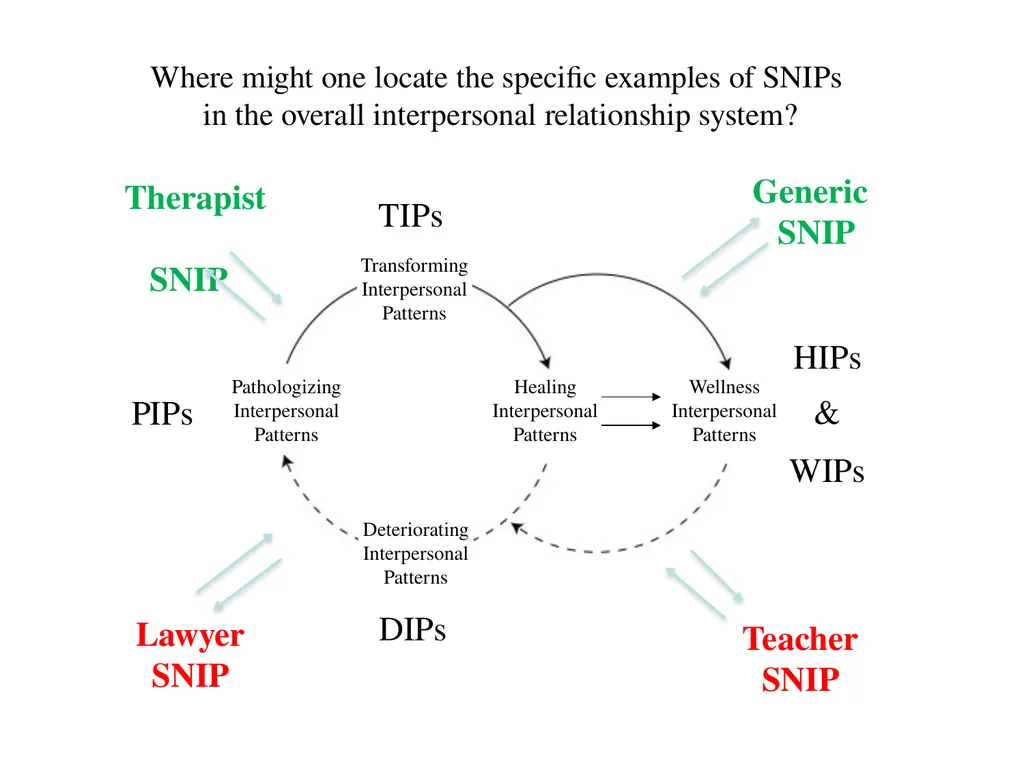
WIPs Teacher SNIP Therapist
SNIP Where might one locate the specific examples of SNIPs
in the overall interpersonal relationship system? Lawyer SNIP Generic
SNIP<br>
Interpersonal
Patterns Deteriorating
Interpersonal
Patterns Pathologizing
Interpersonal
Patterns Wellness
Interpersonal
Patterns Healing
Interpersonal
Patterns DIPs TIPs PIPs HIPs
&
WIPs Teacher SNIP Therapist
SNIP Where might one locate the specific examples of SNIPs
in the overall interpersonal relationship system? Lawyer SNIP Generic
SNIP<br>
53
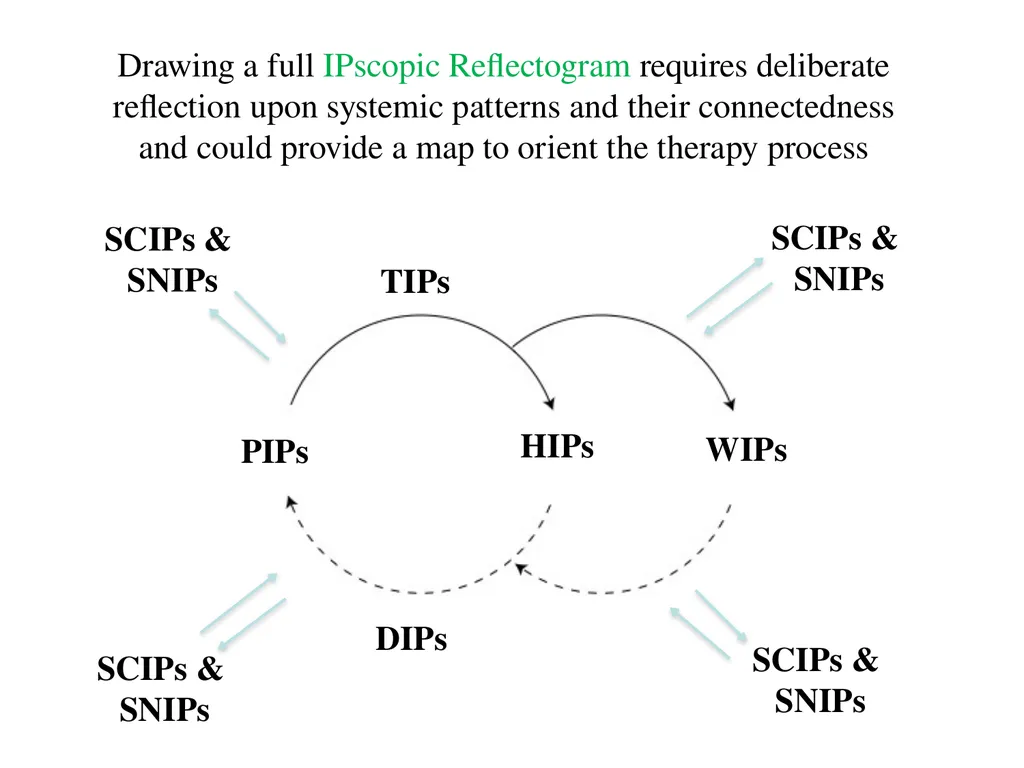
DIPs TIPs PIPs WIPs Drawing a full IPscopic Reflectogram requires deliberate reflection upon systemic patterns and their connectedness
and could provide a map to orient the therapy process HIPs SCIPs &
SNIPs SCIPs &
SNIPs SCIPs &
SNIPs SCIPs &
SNIPs<br>
and could provide a map to orient the therapy process HIPs SCIPs &
SNIPs SCIPs &
SNIPs SCIPs &
SNIPs SCIPs &
SNIPs<br>
54
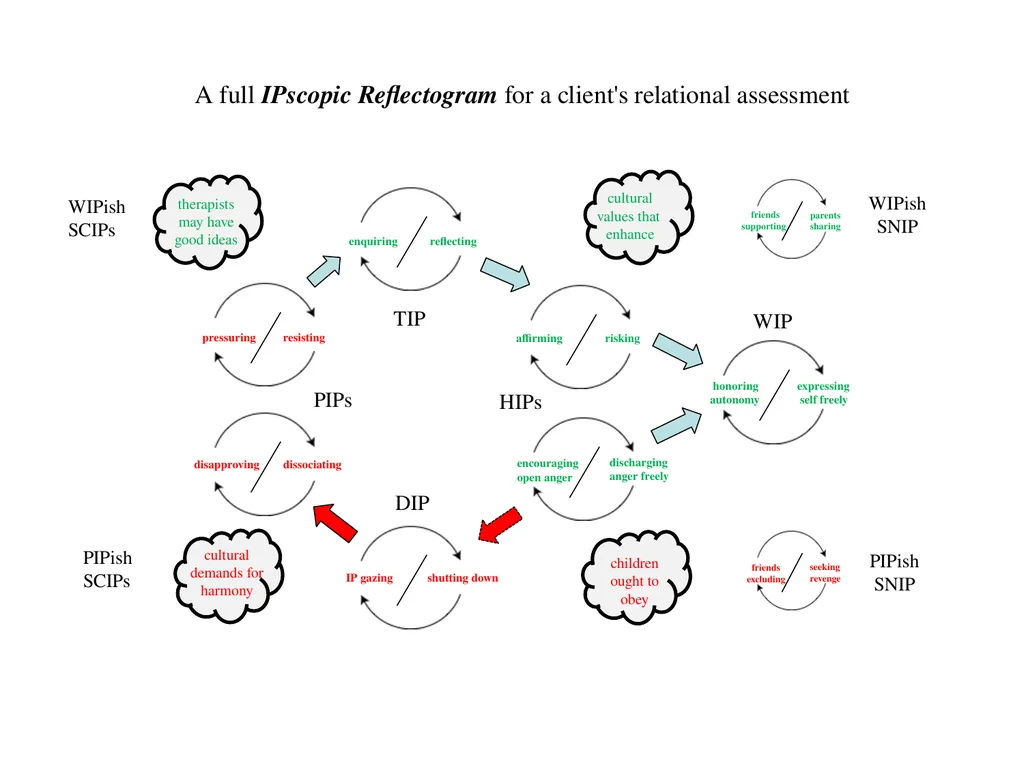
A full IPscopic Reflectogram for a client's relational assessment PIPish
SCIPs cultural
demands for
harmony children
ought to
obey WIPish
SCIPs therapists
may have
good ideas cultural
values that
enhance friends
excluding seeking
revenge PIPish
SNIP friends
supporting parents
sharing WIPish
SNIP<br>
SCIPs cultural
demands for
harmony children
ought to
obey WIPish
SCIPs therapists
may have
good ideas cultural
values that
enhance friends
excluding seeking
revenge PIPish
SNIP friends
supporting parents
sharing WIPish
SNIP<br>
55
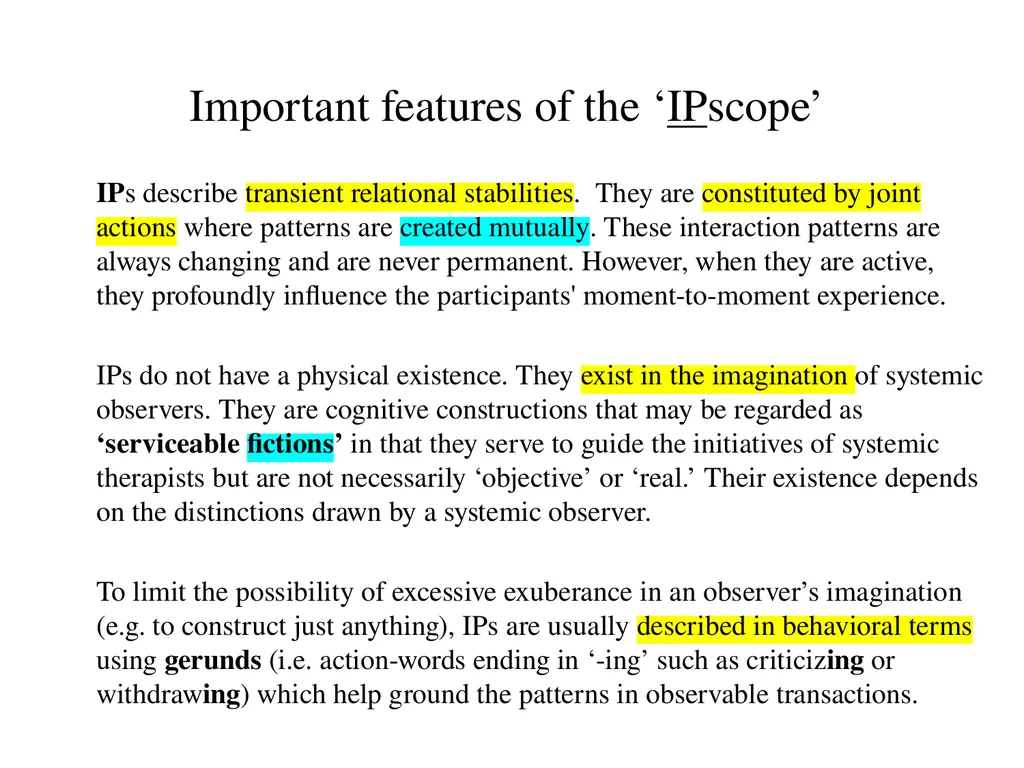
Important features of the ‘IPscope’ IPs describe transient relational stabilities. They are constituted by joint actions where patterns are created mutually. These interaction patterns are always changing and are never permanent. However, when they are active, they profoundly influence the participants' moment-to-moment experience.
IPs do not have a physical existence. They exist in the imagination of systemic observers. They are cognitive constructions that may be regarded as ‘serviceable fictions’ in that they serve to guide the initiatives of systemic therapists but are not necessarily ‘objective’ or ‘real.’ Their existence depends on the distinctions drawn by a systemic observer.
To limit the possibility of excessive exuberance in an observer’s imagination (e.g. to construct just anything), IPs are usually described in behavioral terms using gerunds (i.e. action-words ending in ‘-ing’ such as criticizing or withdrawing) which help ground the patterns in observable transactions.<br>
56
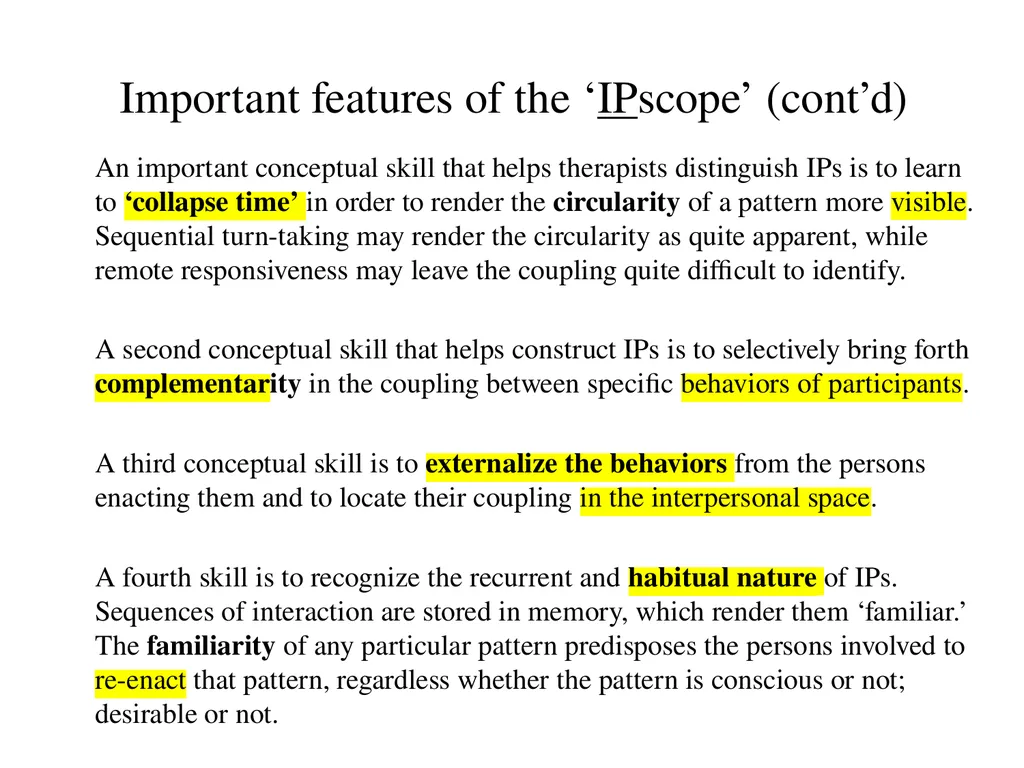
Important features of the ‘IPscope’ (cont’d) An important conceptual skill that helps therapists distinguish IPs is to learn to ‘collapse time’ in order to render the circularity of a pattern more visible. Sequential turn-taking may render the circularity as quite apparent, while remote responsiveness may leave the coupling quite difficult to identify.
A second conceptual skill that helps construct IPs is to selectively bring forth complementarity in the coupling between specific behaviors of participants.
A third conceptual skill is to externalize the behaviors from the persons enacting them and to locate their coupling in the interpersonal space.
A fourth skill is to recognize the recurrent and habitual nature of IPs. Sequences of interaction are stored in memory, which render them ‘familiar.’ The familiarity of any particular pattern predisposes the persons involved to re-enact that pattern, regardless whether the pattern is conscious or not; desirable or not.<br>
57
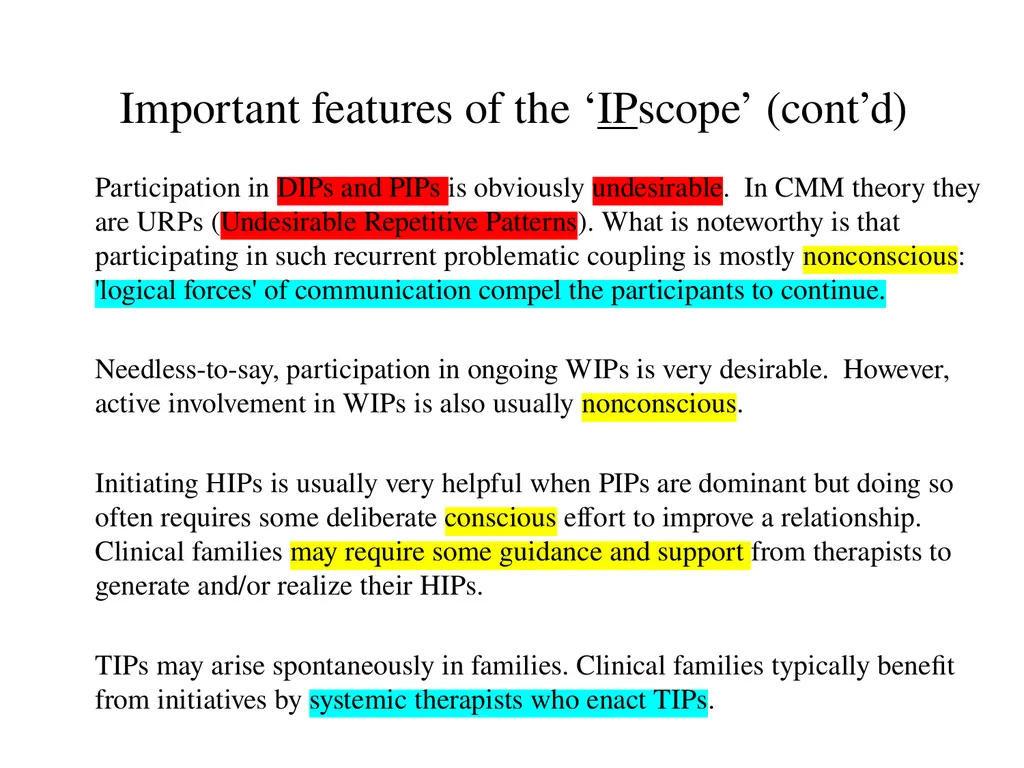
Important features of the ‘IPscope’ (cont’d) Participation in DIPs and PIPs is obviously undesirable. In CMM theory they are URPs (Undesirable Repetitive Patterns). What is noteworthy is that participating in such recurrent problematic coupling is mostly nonconscious: 'logical forces' of communication compel the participants to continue.
Needless-to-say, participation in ongoing WIPs is very desirable. However, active involvement in WIPs is also usually nonconscious.
Initiating HIPs is usually very helpful when PIPs are dominant but doing so often requires some deliberate conscious effort to improve a relationship. Clinical families may require some guidance and support from therapists to generate and/or realize their HIPs.
TIPs may arise spontaneously in families. Clinical families typically benefit from initiatives by systemic therapists who enact TIPs.<br>
58
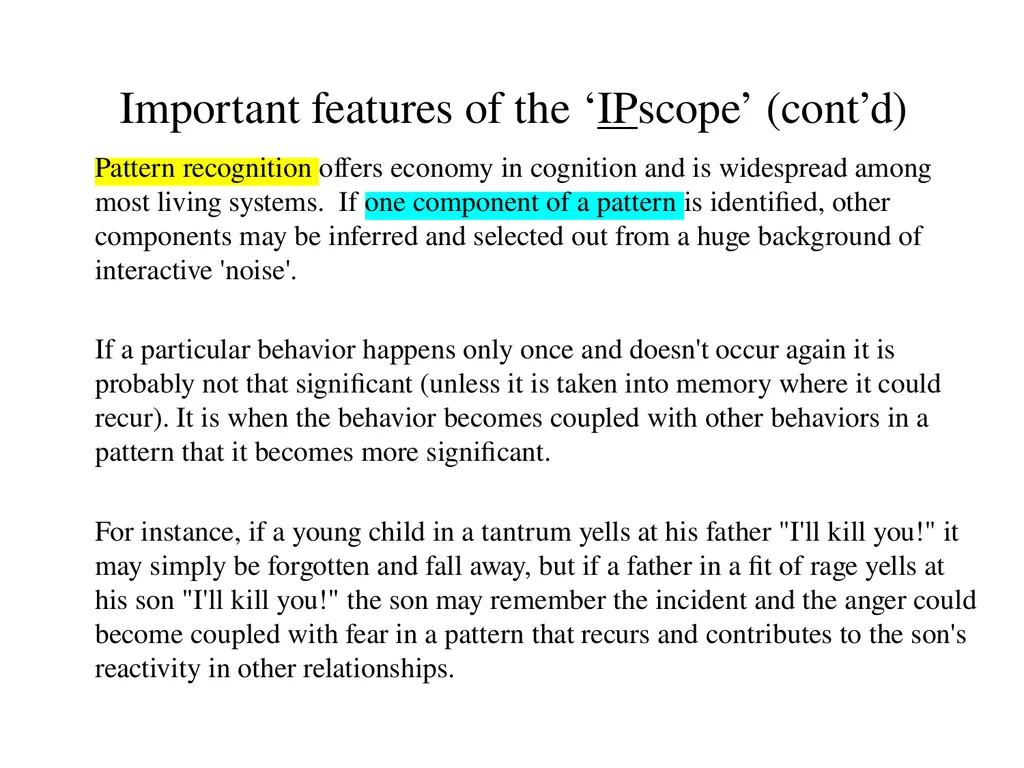
Important features of the ‘IPscope’ (cont’d) Pattern recognition offers economy in cognition and is widespread among most living systems. If one component of a pattern is identified, other components may be inferred and selected out from a huge background of interactive 'noise'.
If a particular behavior happens only once and doesn't occur again it is probably not that significant (unless it is taken into memory where it could recur). It is when the behavior becomes coupled with other behaviors in a pattern that it becomes more significant.
For instance, if a young child in a tantrum yells at his father "I'll kill you!" it may simply be forgotten and fall away, but if a father in a fit of rage yells at his son "I'll kill you!" the son may remember the incident and the anger could become coupled with fear in a pattern that recurs and contributes to the son's reactivity in other relationships.<br>
59
Important features of the ‘IPscope’ (cont’d) It is usually possible to distinguish 2 or 3 core PIPs in a clinical family where the patterns become 'rutted', and the family slips into them again and again.
I sometimes draw one or more of these PIPs on a chalkboard to help the family recognize them more clearly.
I then often engage family members to collaborate in identifying possible wellness patterns (HIPs and WIPs) that could displace the core PIPs.
In this way family members' conscious awareness of the different patterns could become a potential resource in their deliberate efforts to move towards more healing and wellness.<br>
60
Deconstructing DSM diagnoses into PIPs Human mental phenomena, including thoughts, feelings, intentions, actions, and consciousness itself, may be seen to arise through processes of social interaction.
Both Gregory Bateson and Humberto Maturana made the claim that “the Mind is first and foremost social, and secondarily psychological”
For instance, language is not in the brain (even though it depends on the neuroplasticity of the brain); language is among us, we are immersed in it, internalize it, and use it to give meaning to experience.
If this notion of the social origination of mental phenomena is valid, then it should be possible (theoretically at least) to deconstruct an individual 'mental illness’ into patterns of social interaction.
My colleagues and I have tried to identify specific interaction patterns or IPs that generate and/or aggravate particular mental disorders.
In doing so, we appear to be 'going against the grain' with respect to contemporary developments in psychiatry and mental health.<br>
61
What are some common PIPs associated with
clinical ‘depression’
and some possible social antidotes?<br>
clinical ‘depression’
and some possible social antidotes?<br>
62
blaming and
diminishing the other PIP HIP blaming and
diminishing the self affirming and
crediting the other affirming and
crediting the self<br>
diminishing the other PIP HIP blaming and
diminishing the self affirming and
crediting the other affirming and
crediting the self<br>
63
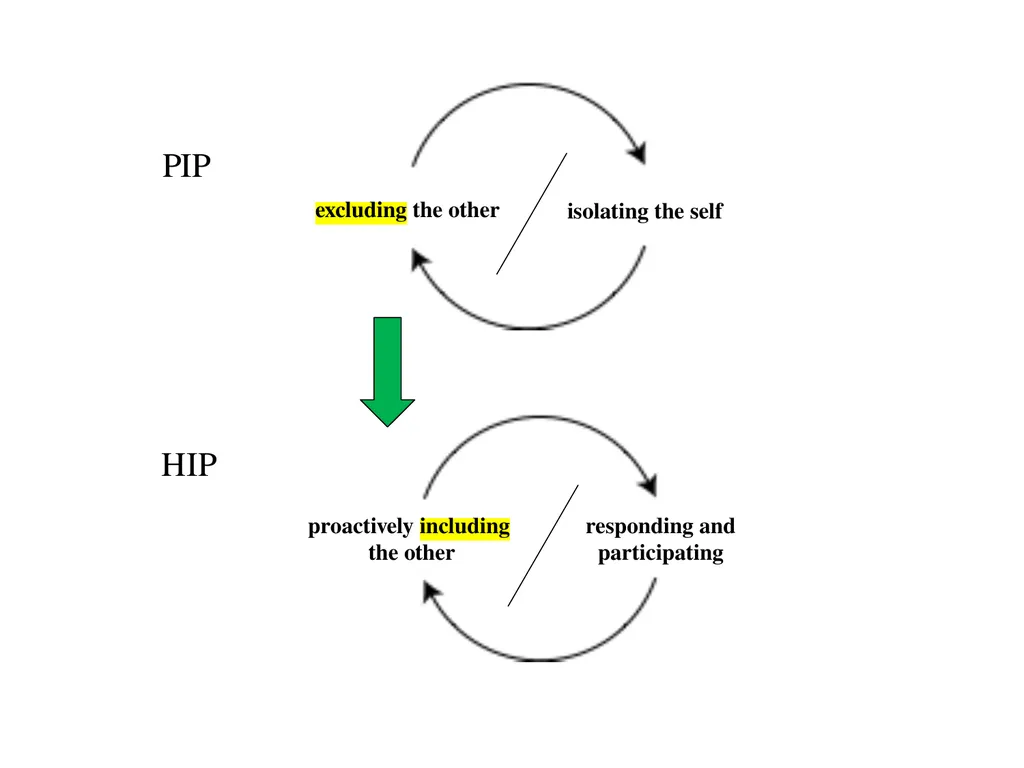
excluding the other PIP HIP isolating the self proactively including
the other responding and
participating<br>
the other responding and
participating<br>
64
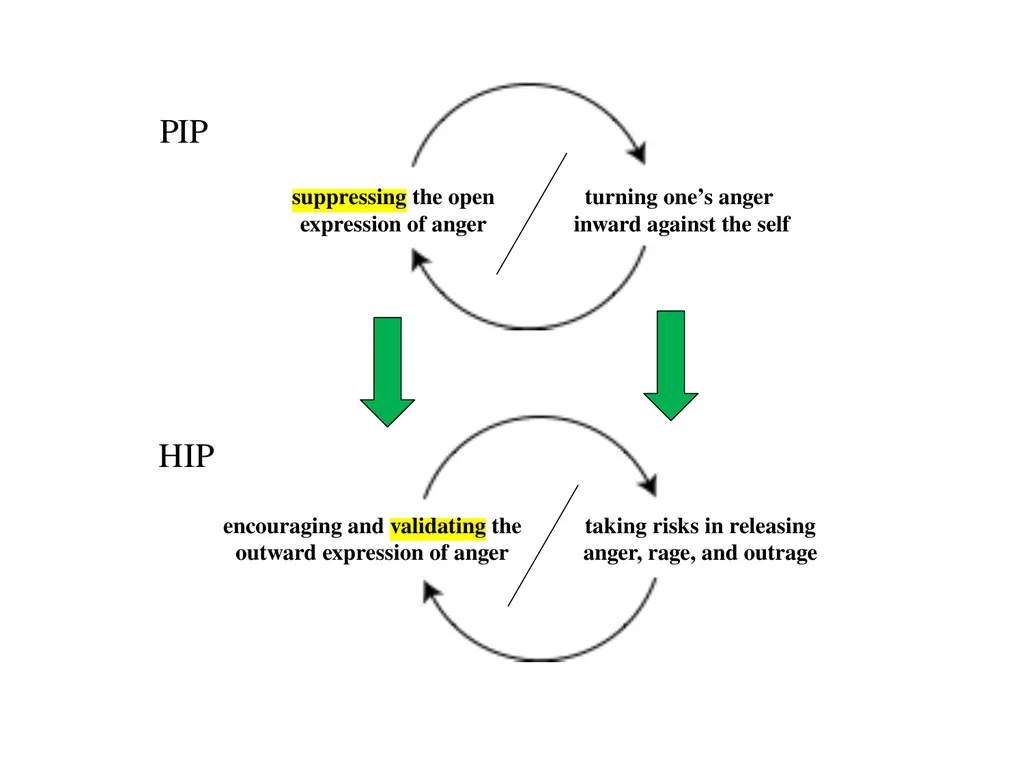
suppressing the open expression of anger PIP HIP turning one’s anger
inward against the self encouraging and validating the outward expression of anger taking risks in releasing anger, rage, and outrage<br>
inward against the self encouraging and validating the outward expression of anger taking risks in releasing anger, rage, and outrage<br>
65
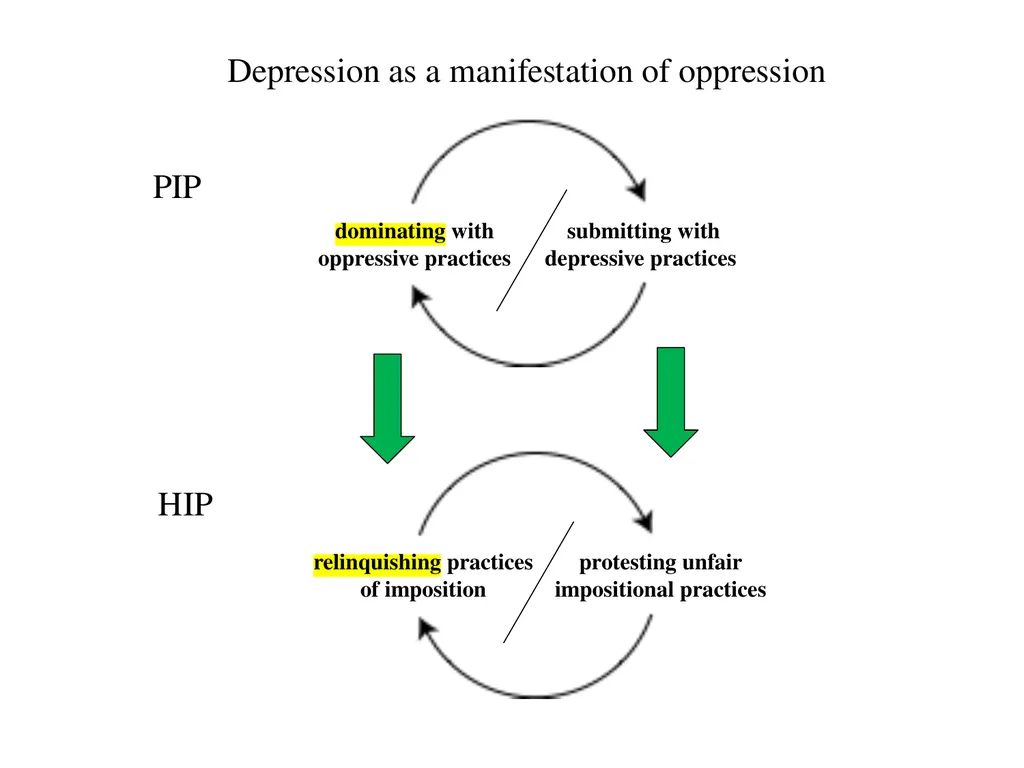
dominating with
oppressive practices PIP HIP submitting with
depressive practices relinquishing practices of imposition protesting unfair
impositional practices Depression as a manifestation of oppression<br>
oppressive practices PIP HIP submitting with
depressive practices relinquishing practices of imposition protesting unfair
impositional practices Depression as a manifestation of oppression<br>
66
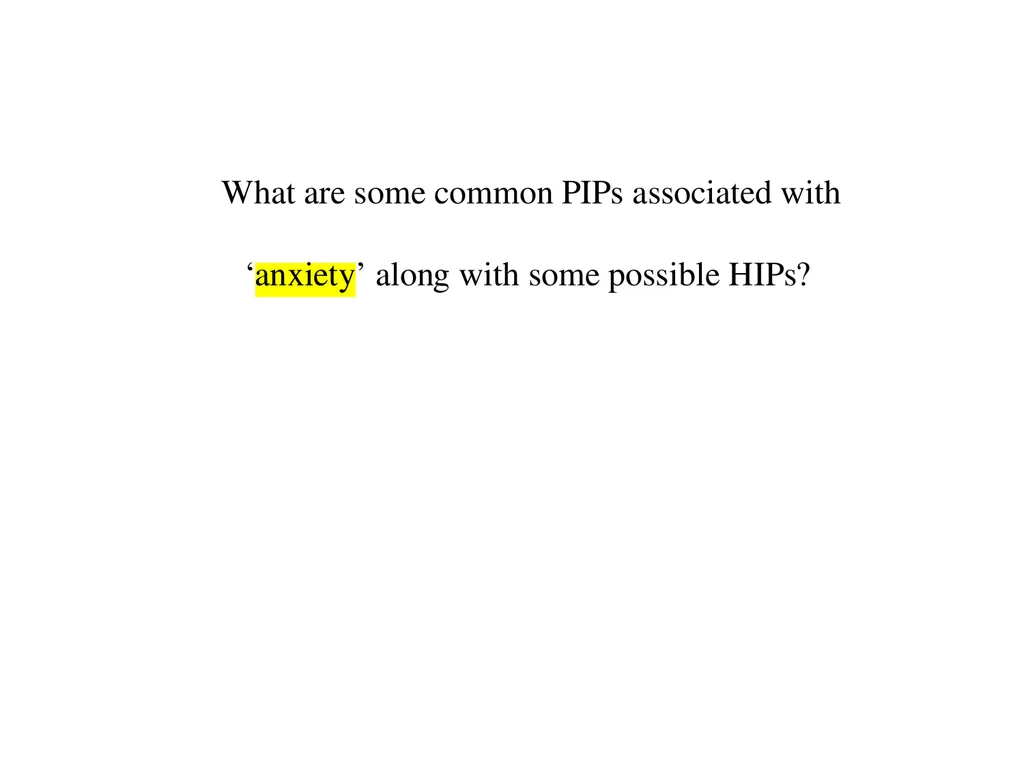
What are some common PIPs associated with
‘anxiety’ along with some possible HIPs?<br>
‘anxiety’ along with some possible HIPs?<br>
67
Threatening and/or demeaning the other PIP HIP Withdrawing and avoiding the abuse Acknowledging unfairness and expressing regret Collecting support and holding others accountable<br>
68
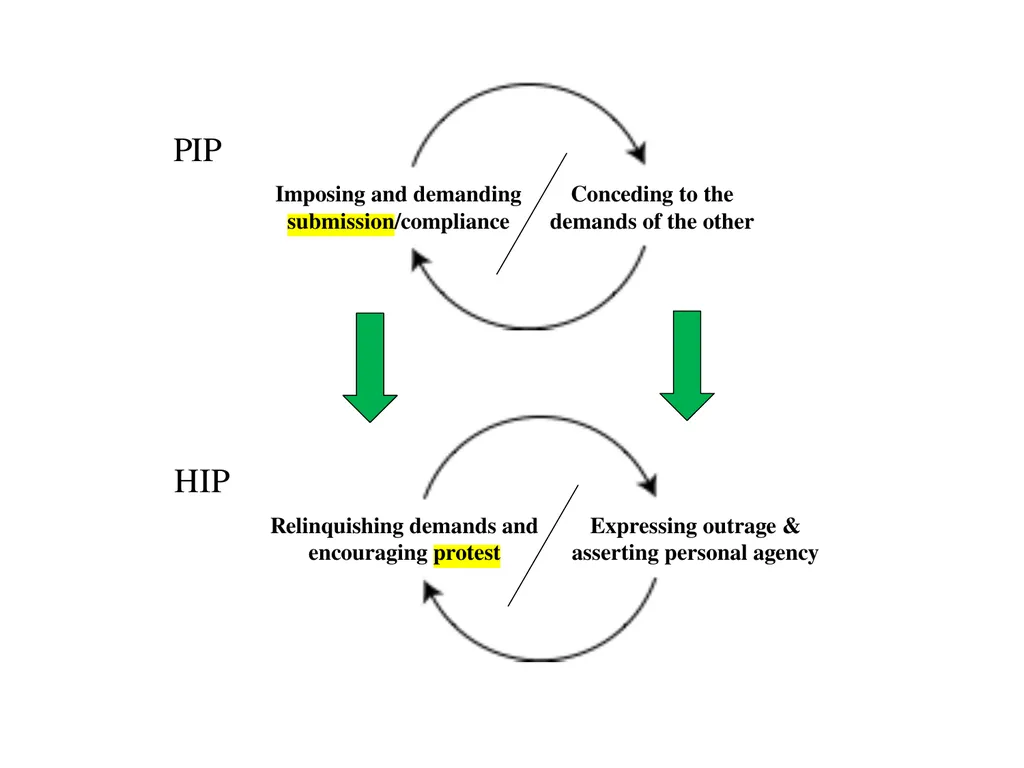
Imposing and demanding submission/compliance PIP HIP Conceding to the demands of the other Relinquishing demands and encouraging protest Expressing outrage & asserting personal agency<br>
69
What are some common PIPs associated with
‘psychosis’ and some possible social antidotes?<br>
‘psychosis’ and some possible social antidotes?<br>
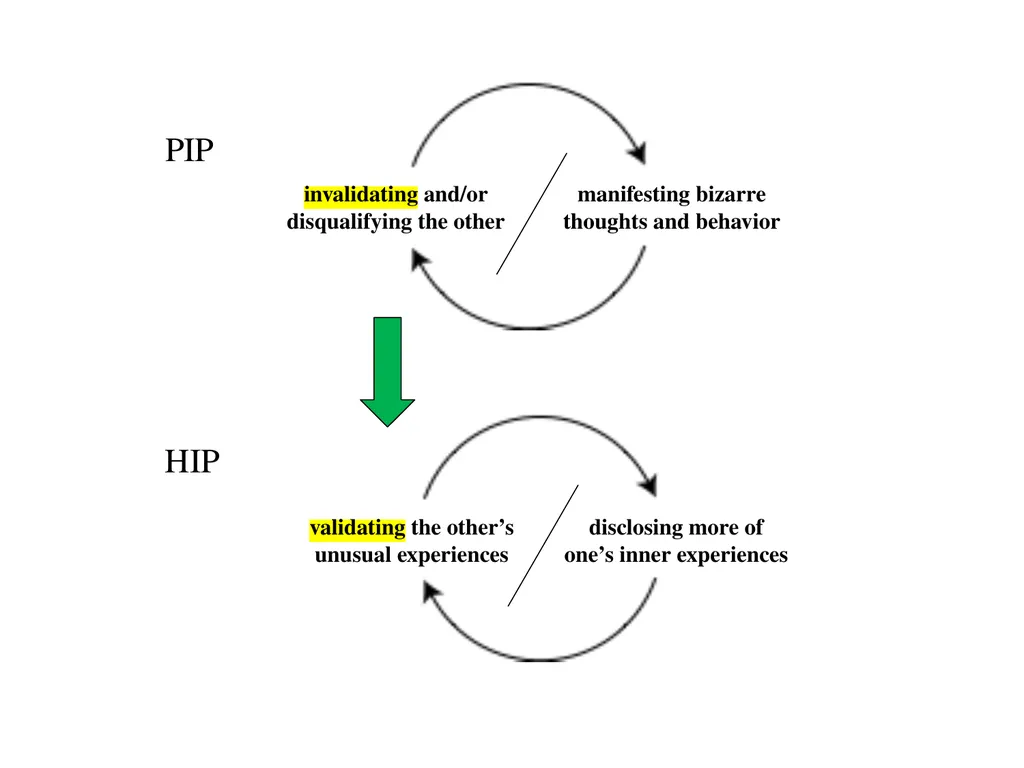
70
invalidating and/or
disqualifying the other PIP HIP manifesting bizarre
thoughts and behavior validating the other’s unusual experiences disclosing more of
one’s inner experiences<br>
disqualifying the other PIP HIP manifesting bizarre
thoughts and behavior validating the other’s unusual experiences disclosing more of
one’s inner experiences<br>
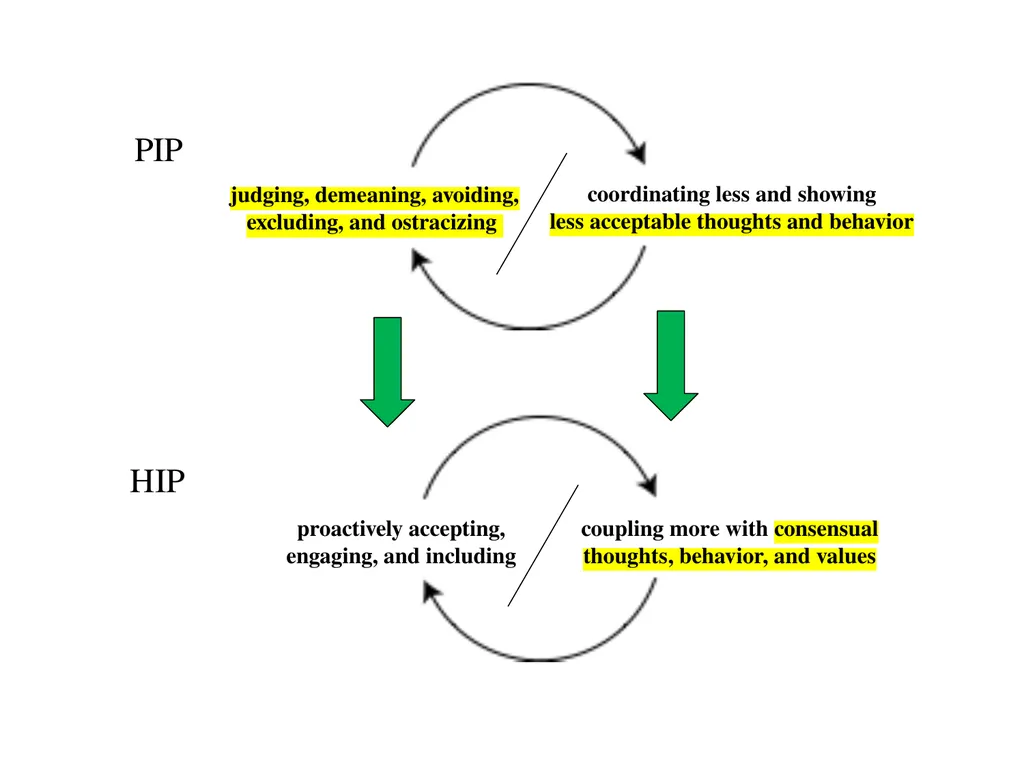
71
PIP HIP proactively accepting,
engaging, and including coupling more with consensual thoughts, behavior, and values judging, demeaning, avoiding, excluding, and ostracizing coordinating less and showing
less acceptable thoughts and behavior<br>
engaging, and including coupling more with consensual thoughts, behavior, and values judging, demeaning, avoiding, excluding, and ostracizing coordinating less and showing
less acceptable thoughts and behavior<br>
72
What is a common PIP often found with
‘paranoia’
and a possible healing antidote?<br>
‘paranoia’
and a possible healing antidote?<br>
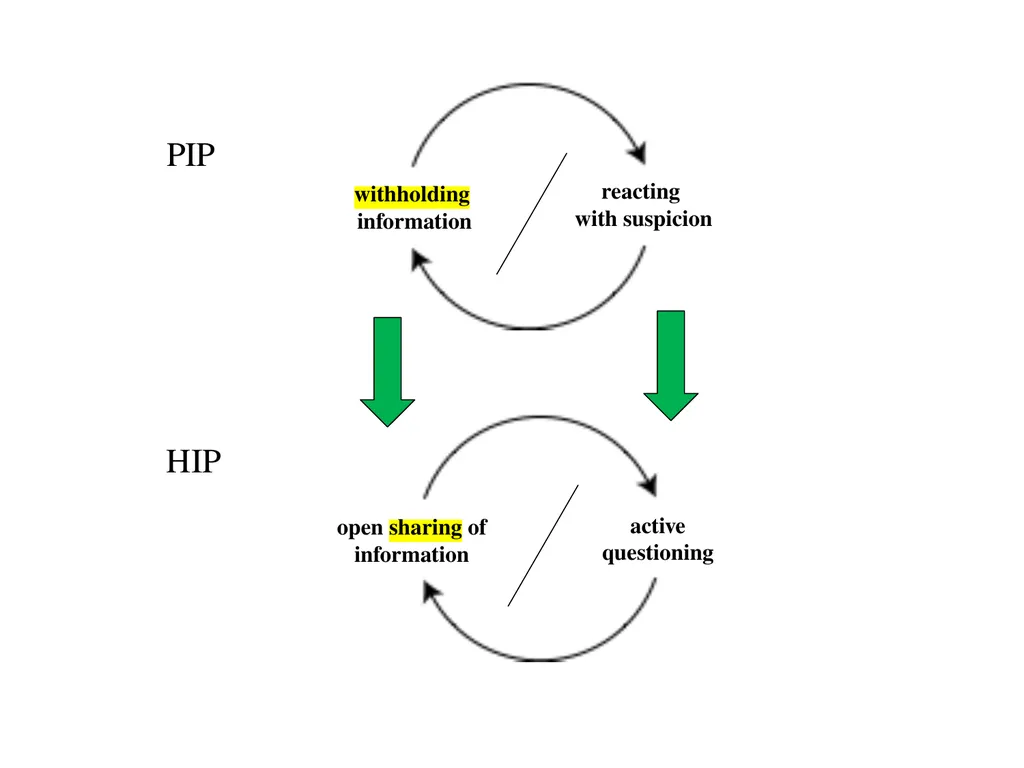
73
withholding
information PIP HIP open sharing of
information active
questioning reacting
with suspicion<br>
information PIP HIP open sharing of
information active
questioning reacting
with suspicion<br>
74
What are some common PIPs associated with
‘lying and stealing’
along with some healing antidotes?<br>
‘lying and stealing’
along with some healing antidotes?<br>
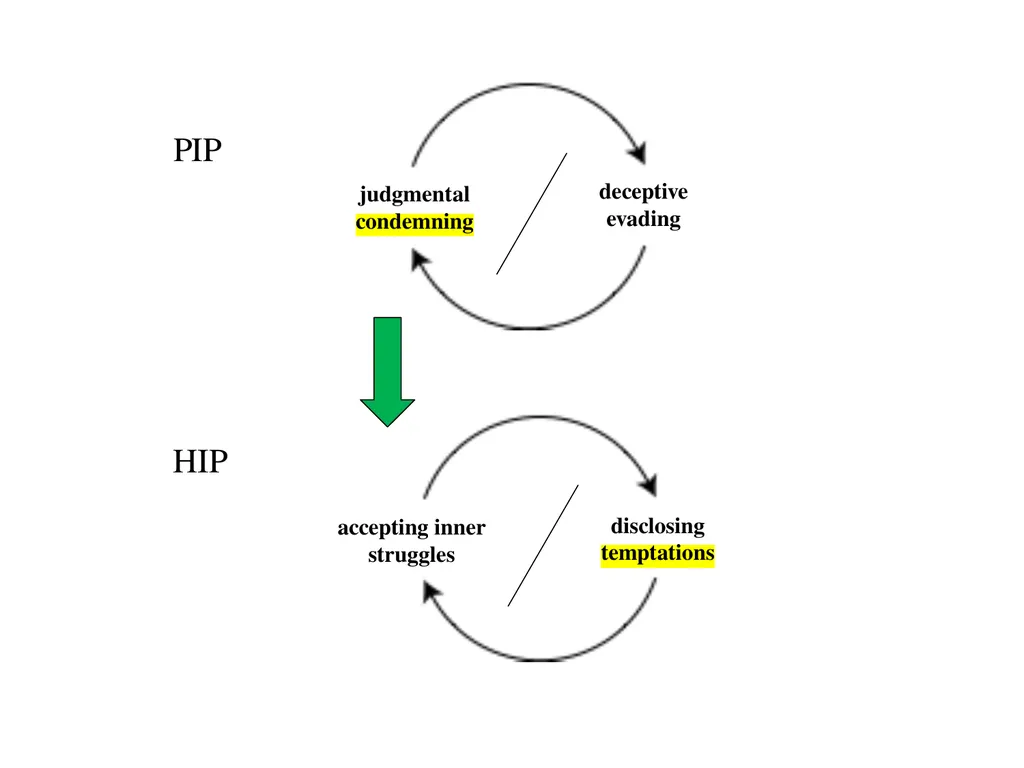
75
judgmental
condemning PIP HIP accepting inner
struggles disclosing
temptations deceptive
evading<br>
condemning PIP HIP accepting inner
struggles disclosing
temptations deceptive
evading<br>
76
demanding honest disclosure
and threatening punishment PIP HIP selectively noticing and
honoring honest admissions admitting to mistakes and/or lies and expressing regret withholding the truth
and telling plausible stories<br>
and threatening punishment PIP HIP selectively noticing and
honoring honest admissions admitting to mistakes and/or lies and expressing regret withholding the truth
and telling plausible stories<br>
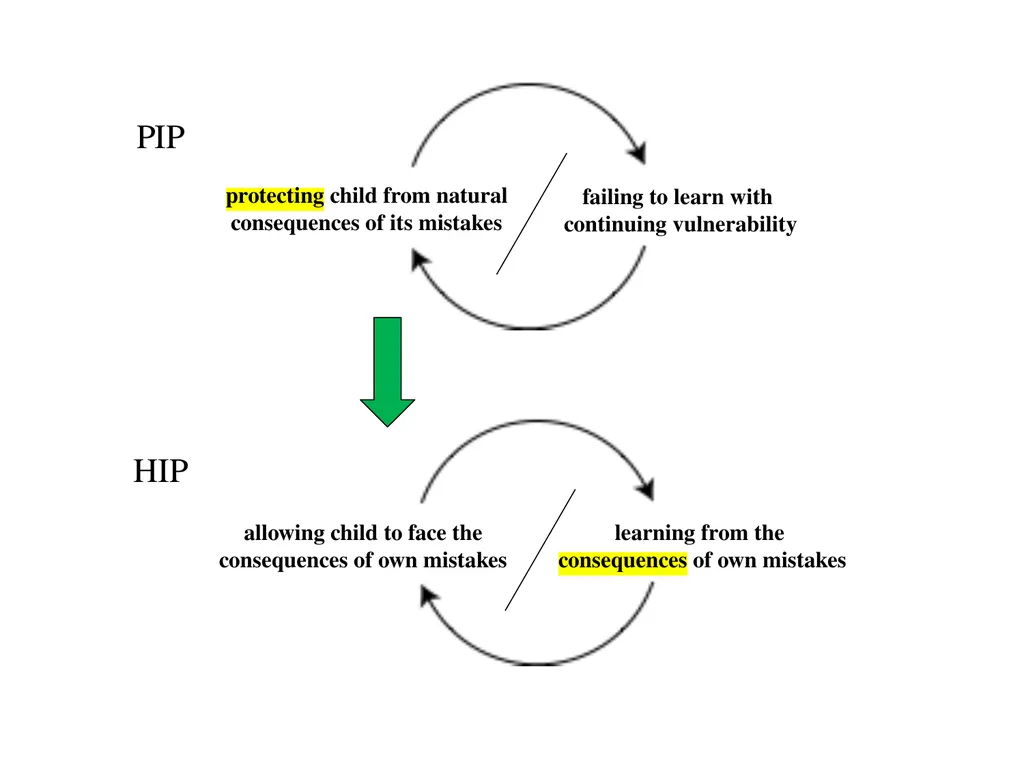
77
Do parents inadvertently limit their
children's learning from their mistakes?
If so, what might the pathologizing
interaction pattern (PIP) look like?<br>
children's learning from their mistakes?
If so, what might the pathologizing
interaction pattern (PIP) look like?<br>
78
PIP HIP allowing child to face the consequences of own mistakes learning from the
consequences of own mistakes protecting child from natural consequences of its mistakes failing to learn with
continuing vulnerability<br>
consequences of own mistakes protecting child from natural consequences of its mistakes failing to learn with
continuing vulnerability<br>
79
Do parents inadvertently teach
their children sibling rivalry?
If so, what might the pathologizing
interaction pattern (PIP) look like?<br>
their children sibling rivalry?
If so, what might the pathologizing
interaction pattern (PIP) look like?<br>
80
parents claiming to treat the
children exactly the same PIP HIP parents treating each child as
different, unique, and special children feeling more confidence in enacting their uniqueness children searching for differences
and complaining about unfairness<br>
children exactly the same PIP HIP parents treating each child as
different, unique, and special children feeling more confidence in enacting their uniqueness children searching for differences
and complaining about unfairness<br>
81
Do parents inadvertently aggravate their
adolescent's oppositionality?
If so, what might the pathologizing
interaction pattern (PIP) look like?<br>
adolescent's oppositionality?
If so, what might the pathologizing
interaction pattern (PIP) look like?<br>
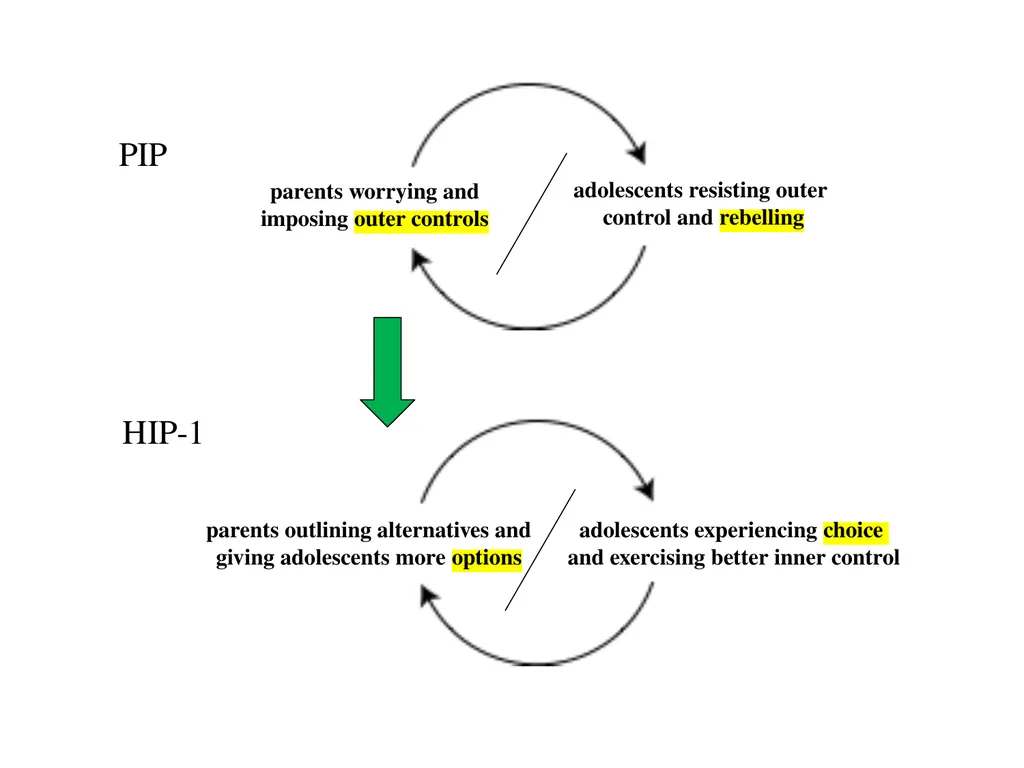
82
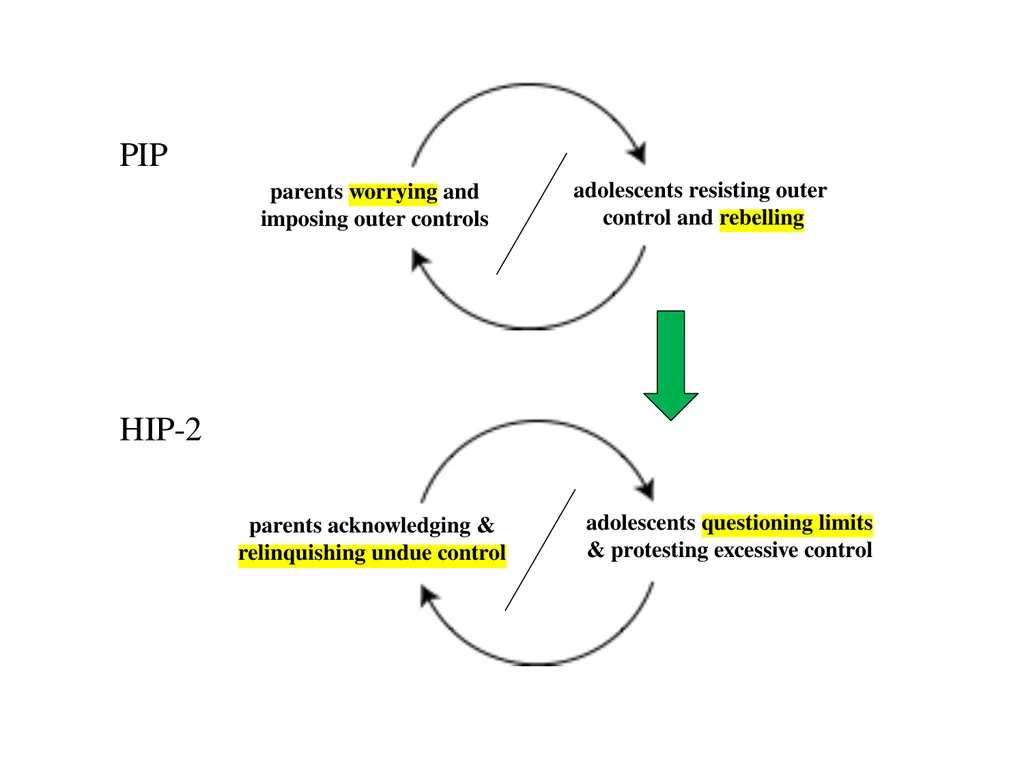
parents worrying and
imposing outer controls PIP adolescents resisting outer
control and rebelling parents outlining alternatives and giving adolescents more options adolescents experiencing choice
and exercising better inner control HIP-1<br>
imposing outer controls PIP adolescents resisting outer
control and rebelling parents outlining alternatives and giving adolescents more options adolescents experiencing choice
and exercising better inner control HIP-1<br>
83
parents worrying and
imposing outer controls PIP HIP-2 adolescents resisting outer
control and rebelling adolescents questioning limits
& protesting excessive control parents acknowledging & relinquishing undue control<br>
imposing outer controls PIP HIP-2 adolescents resisting outer
control and rebelling adolescents questioning limits
& protesting excessive control parents acknowledging & relinquishing undue control<br>
84
What is a common PIP associated with
‘young adult entitlement syndrome’
along with a healing antidote?<br>
‘young adult entitlement syndrome’
along with a healing antidote?<br>
85
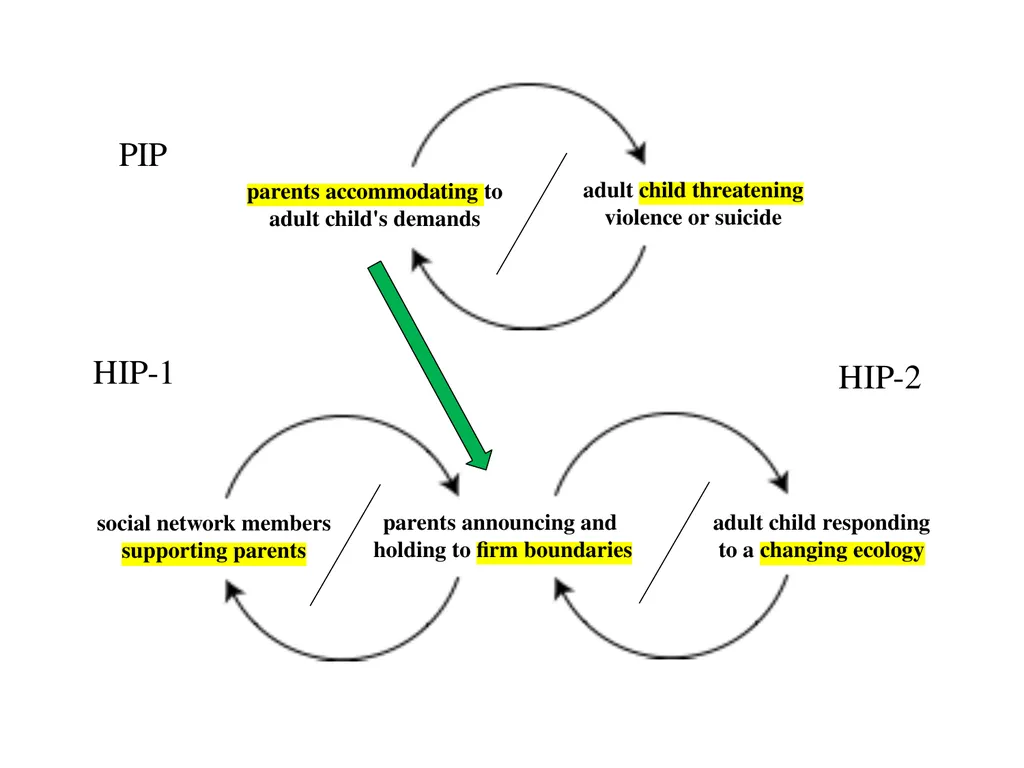
parents accommodating to
adult child's demands PIP adult child threatening
violence or suicide parents announcing and
holding to firm boundaries social network members supporting parents HIP-1 adult child responding to a changing ecology HIP-2<br>
adult child's demands PIP adult child threatening
violence or suicide parents announcing and
holding to firm boundaries social network members supporting parents HIP-1 adult child responding to a changing ecology HIP-2<br>
86
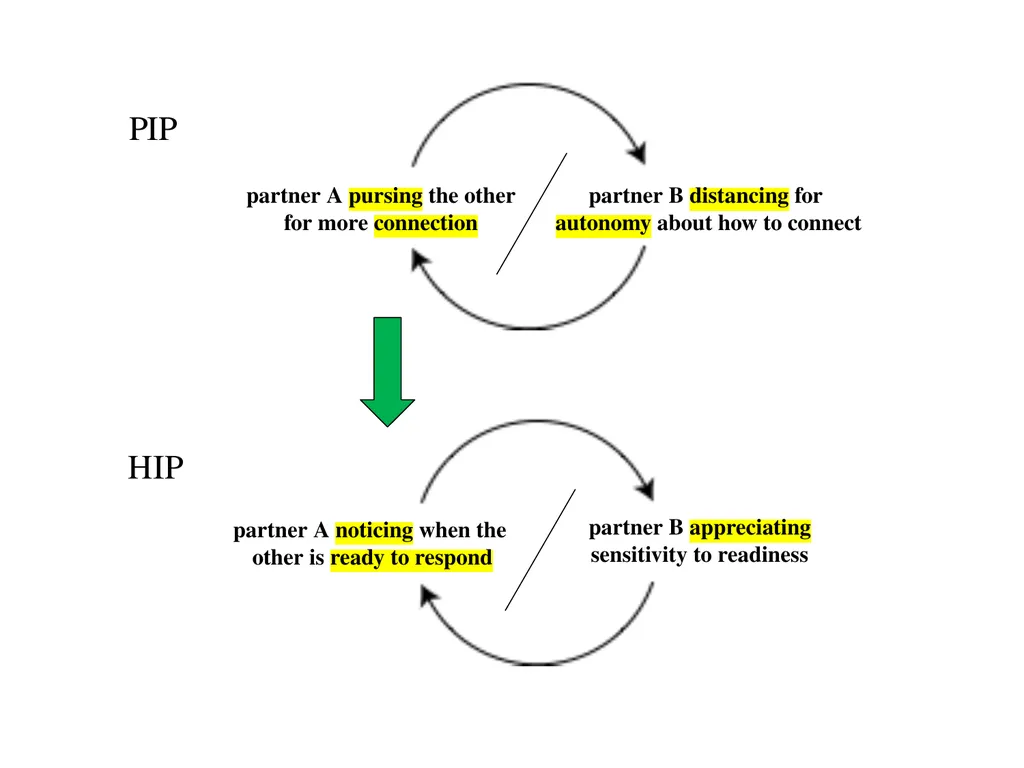
Do couples inadvertently make it
more difficult to achieve intimacy?
If so, what might the pathologizing
interaction pattern (PIP) look like?<br>
more difficult to achieve intimacy?
If so, what might the pathologizing
interaction pattern (PIP) look like?<br>
87
partner A pursing the other for more connection PIP HIP partner A noticing when the
other is ready to respond partner B appreciating sensitivity to readiness partner B distancing for
autonomy about how to connect<br>
other is ready to respond partner B appreciating sensitivity to readiness partner B distancing for
autonomy about how to connect<br>
88
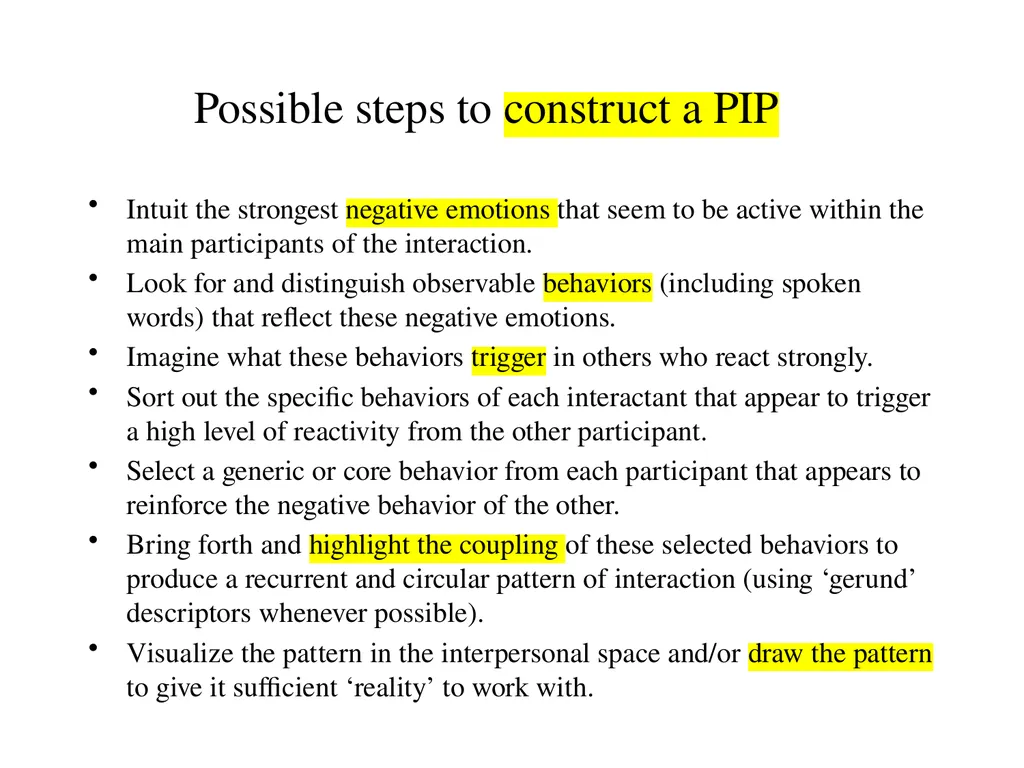
Possible steps to construct a PIP Intuit the strongest negative emotions that seem to be active within the main participants of the interaction.
Look for and distinguish observable behaviors (including spoken words) that reflect these negative emotions.
Imagine what these behaviors trigger in others who react strongly.
Sort out the specific behaviors of each interactant that appear to trigger a high level of reactivity from the other participant.
Select a generic or core behavior from each participant that appears to reinforce the negative behavior of the other.
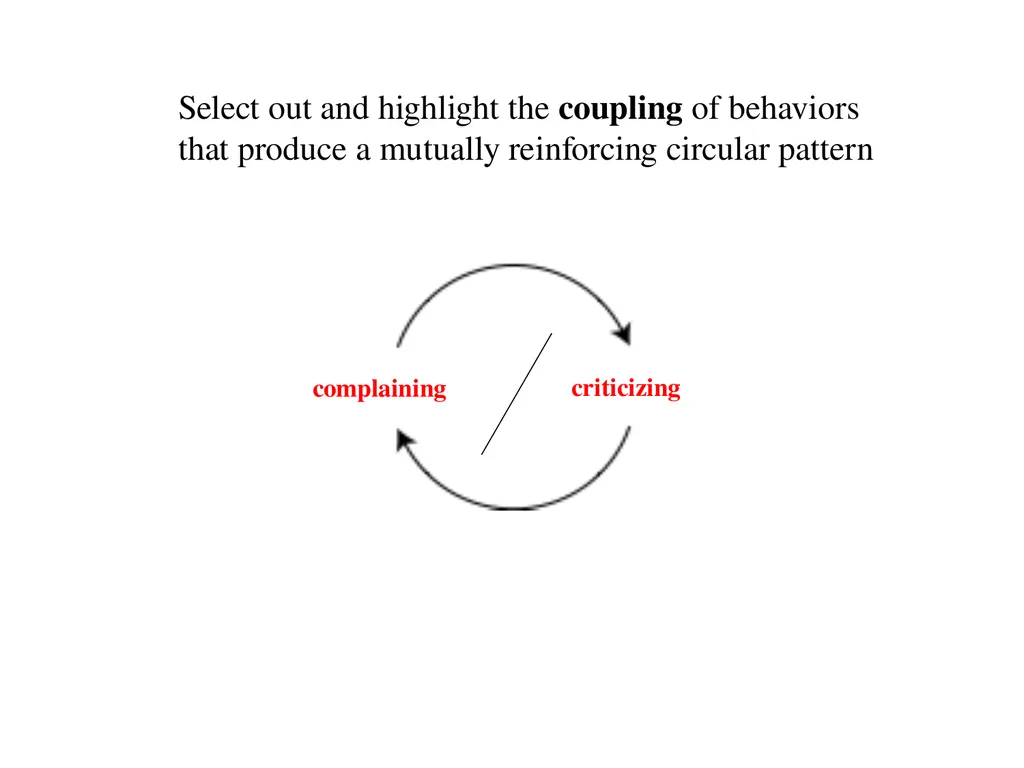
Bring forth and highlight the coupling of these selected behaviors to produce a recurrent and circular pattern of interaction (using ‘gerund’ descriptors whenever possible).
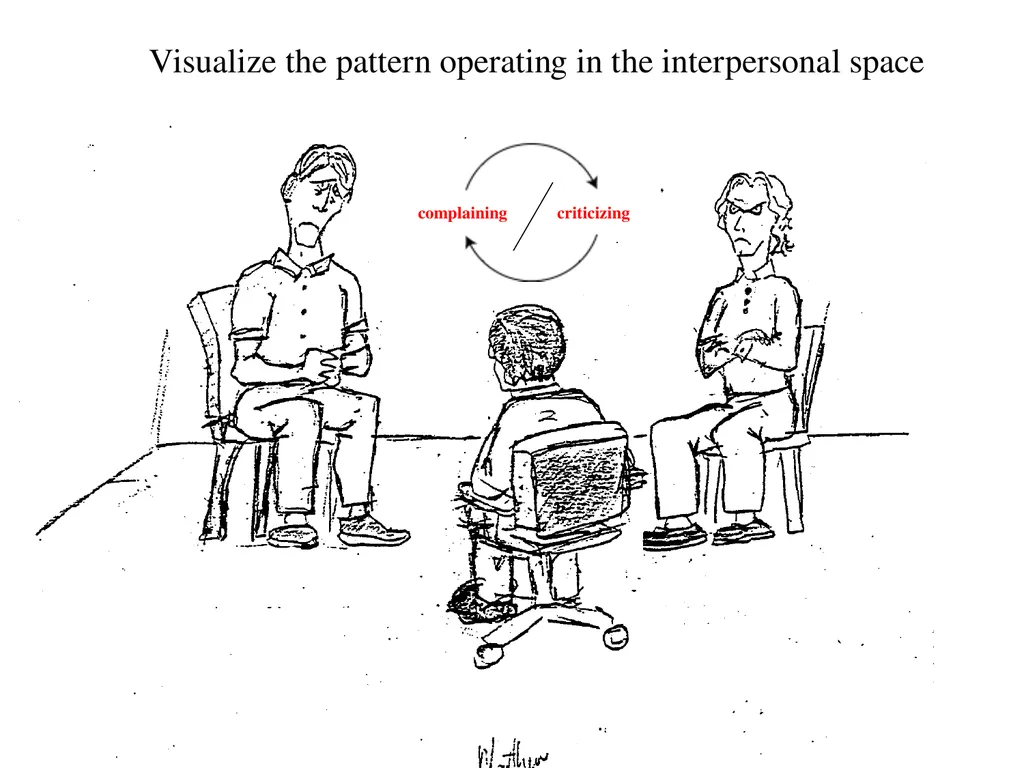
Visualize the pattern in the interpersonal space and/or draw the pattern to give it sufficient ‘reality’ to work with.<br>
89
Let’s apply the process:
Imagine a couple in conflict seeking therapy<br>
90
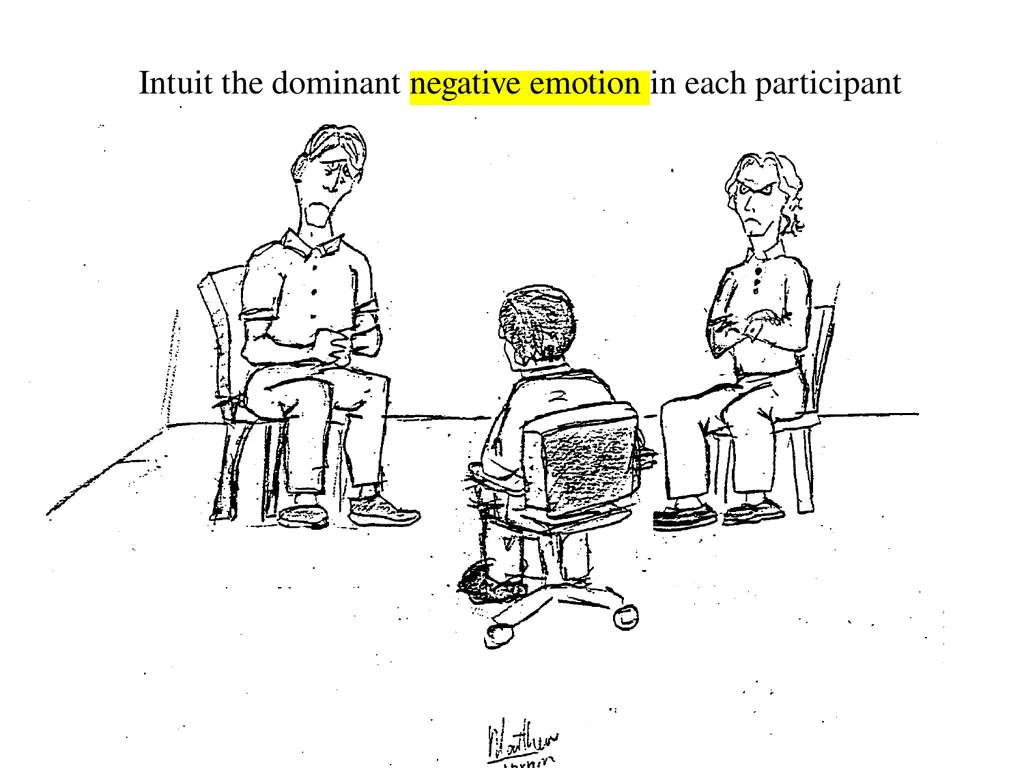
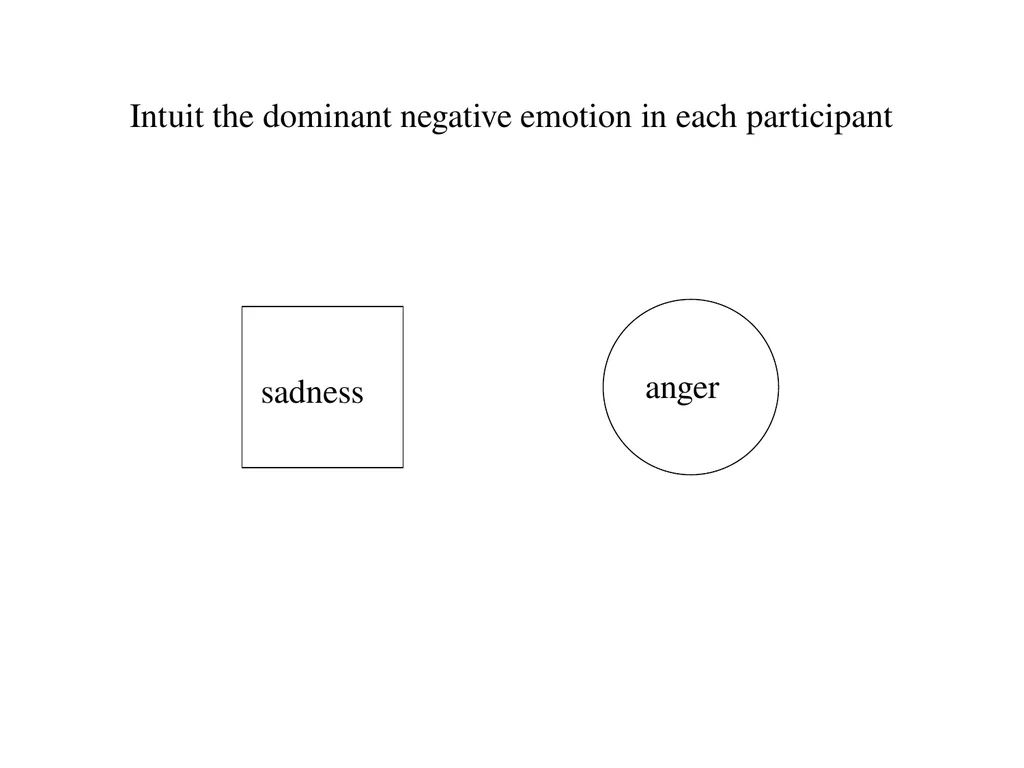
Intuit the dominant negative emotion in each participant<br>
91
sadness anger Intuit the dominant negative emotion in each participant<br>
92
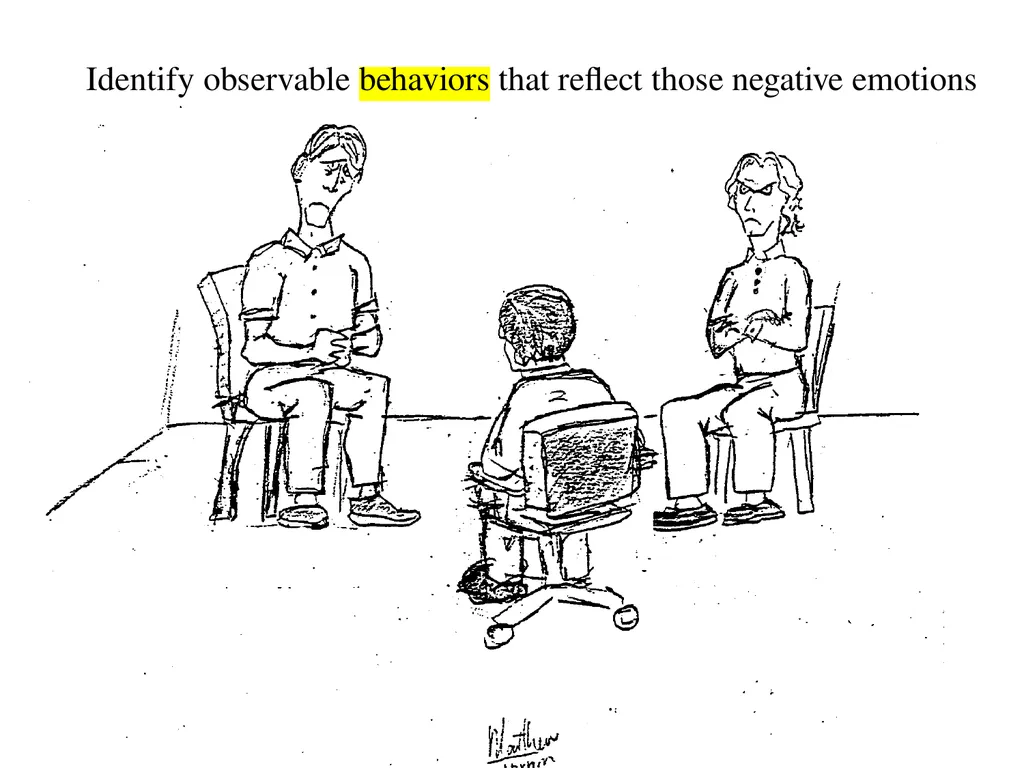
Identify observable behaviors that reflect those negative emotions<br>
93
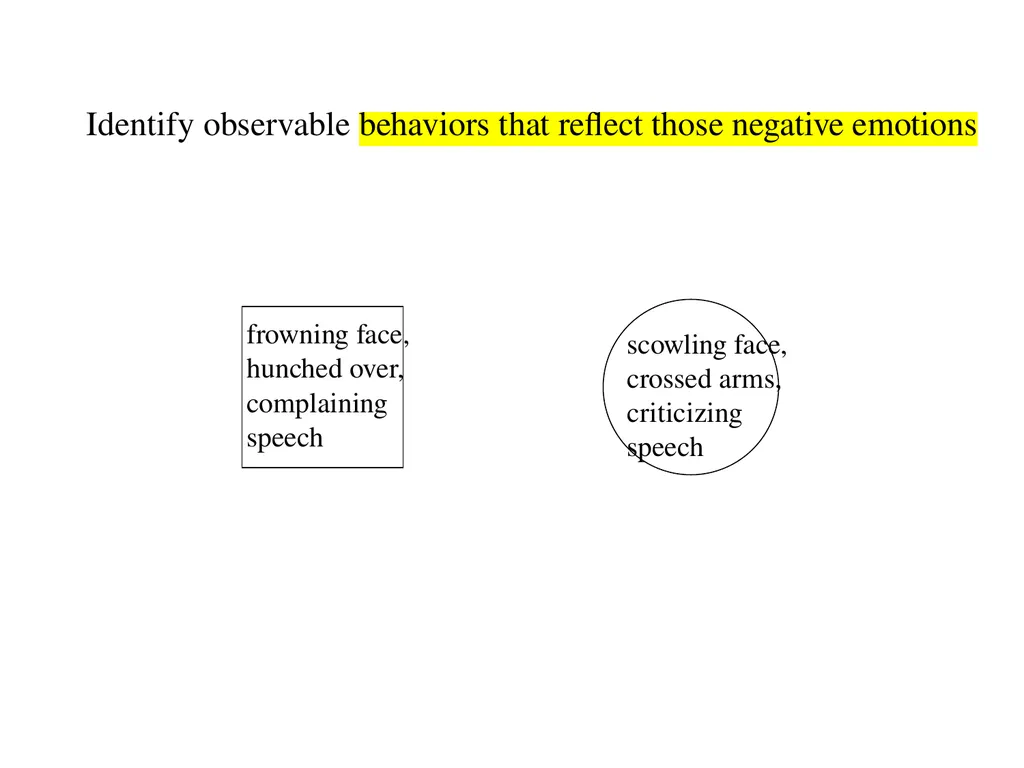
frowning face,
hunched over,
complaining
speech scowling face,
crossed arms,
criticizing
speech Identify observable behaviors that reflect those negative emotions<br>
hunched over,
complaining
speech scowling face,
crossed arms,
criticizing
speech Identify observable behaviors that reflect those negative emotions<br>
94
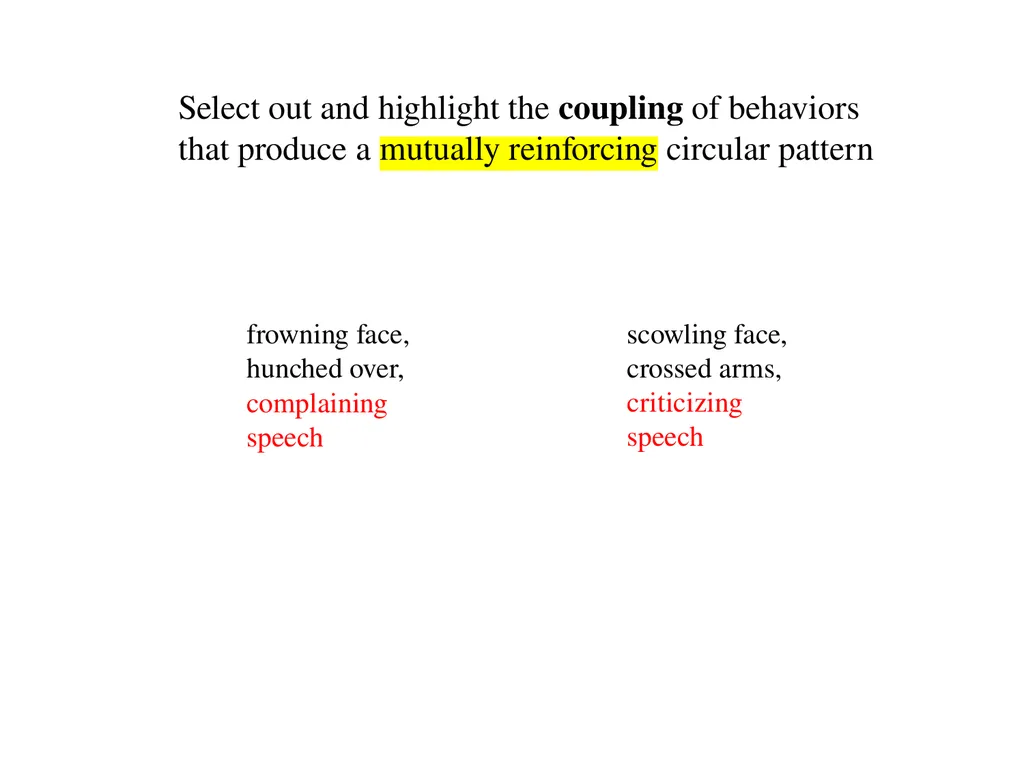
Select out and highlight the coupling of behaviors
that produce a mutually reinforcing circular pattern frowning face,
hunched over,
complaining
speech scowling face,
crossed arms,
criticizing
speech<br>
that produce a mutually reinforcing circular pattern frowning face,
hunched over,
complaining
speech scowling face,
crossed arms,
criticizing
speech<br>
95
complaining criticizing Select out and highlight the coupling of behaviors
that produce a mutually reinforcing circular pattern<br>
that produce a mutually reinforcing circular pattern<br>
96
complaining criticizing Visualize the pattern operating in the interpersonal space<br>
97
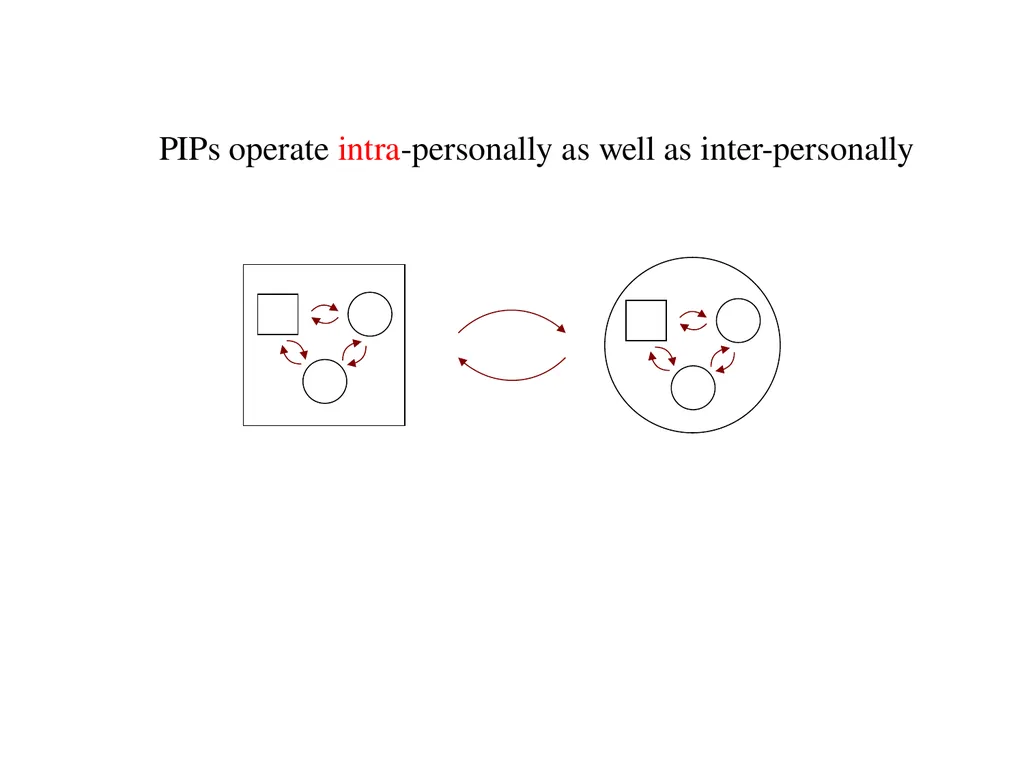
PIPs operate intra-personally as well as inter-personally<br>
98
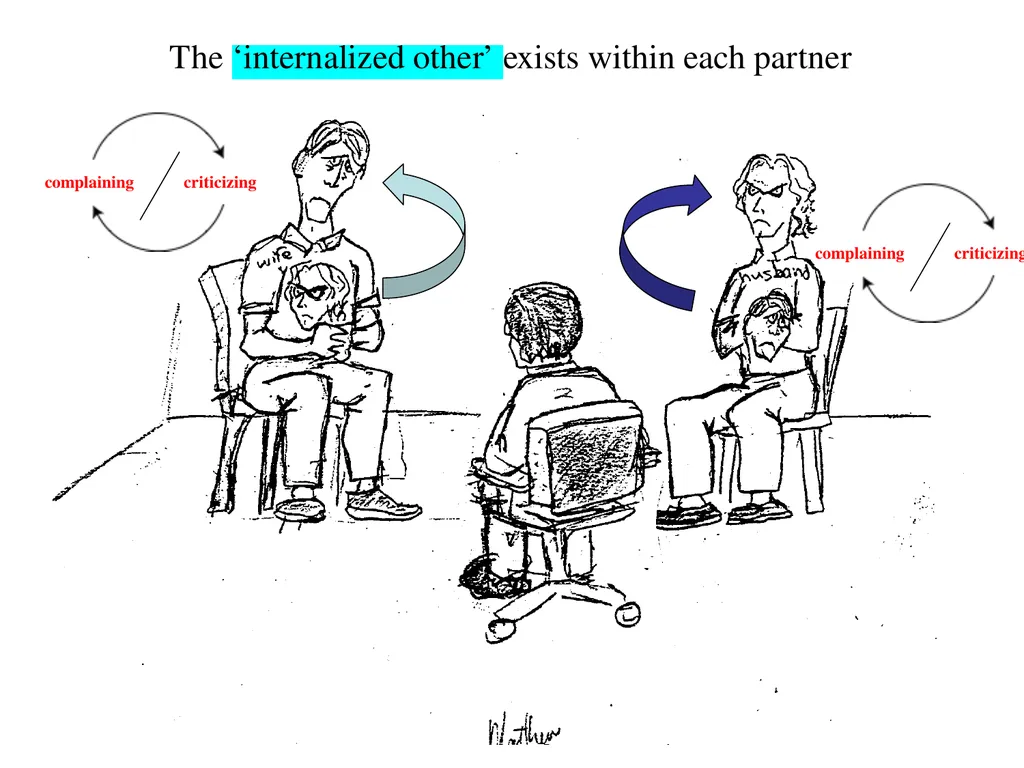
The ‘internalized other’ exists within each partner complaining criticizing complaining criticizing<br>
99
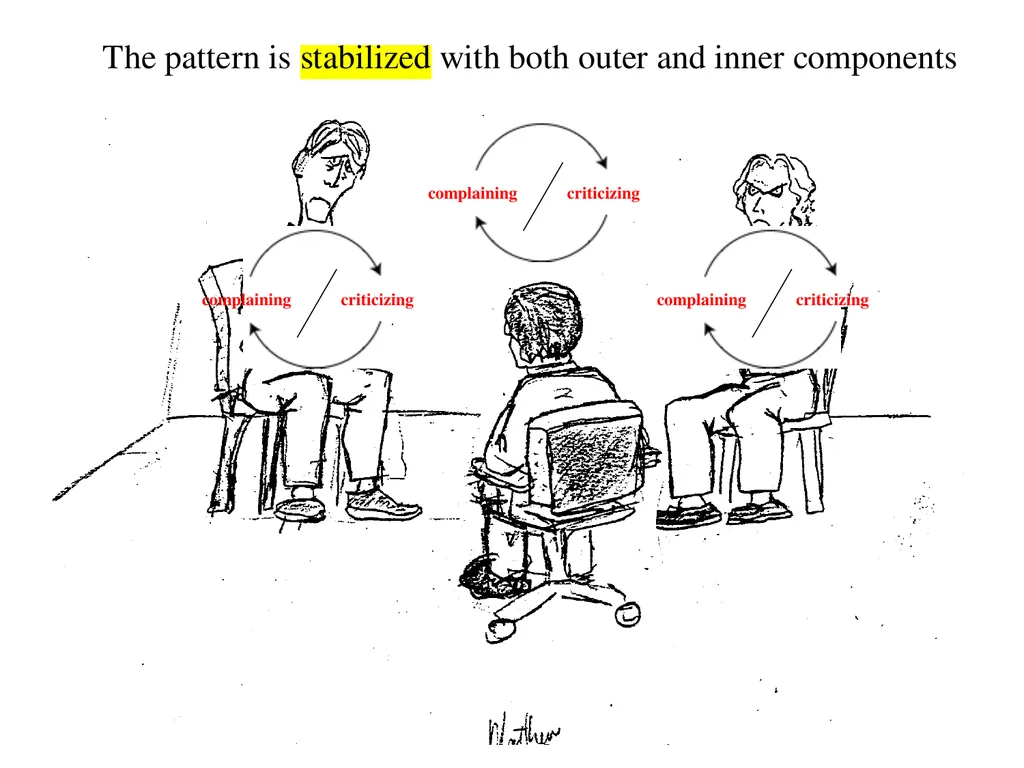
complaining criticizing complaining criticizing complaining criticizing The pattern is stabilized with both outer and inner components<br>
100
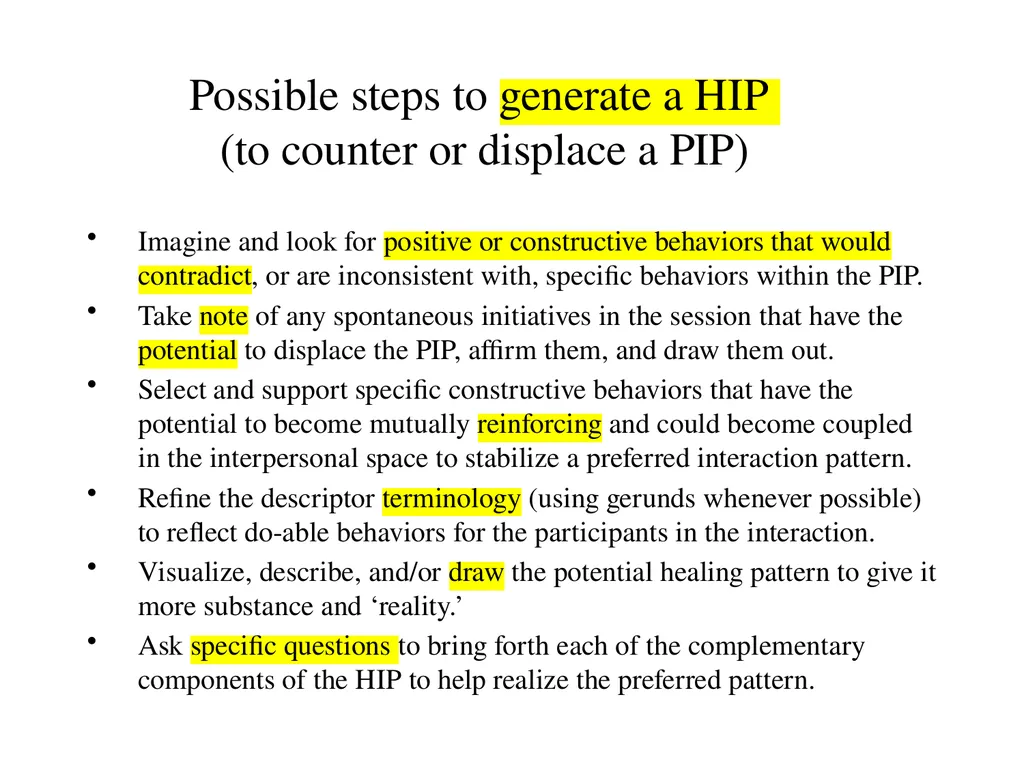
Possible steps to generate a HIP
(to counter or displace a PIP) Imagine and look for positive or constructive behaviors that would contradict, or are inconsistent with, specific behaviors within the PIP.
Take note of any spontaneous initiatives in the session that have the potential to displace the PIP, affirm them, and draw them out.
Select and support specific constructive behaviors that have the potential to become mutually reinforcing and could become coupled in the interpersonal space to stabilize a preferred interaction pattern.
Refine the descriptor terminology (using gerunds whenever possible) to reflect do-able behaviors for the participants in the interaction.
Visualize, describe, and/or draw the potential healing pattern to give it more substance and ‘reality.’
Ask specific questions to bring forth each of the complementary components of the HIP to help realize the preferred pattern.<br>
101
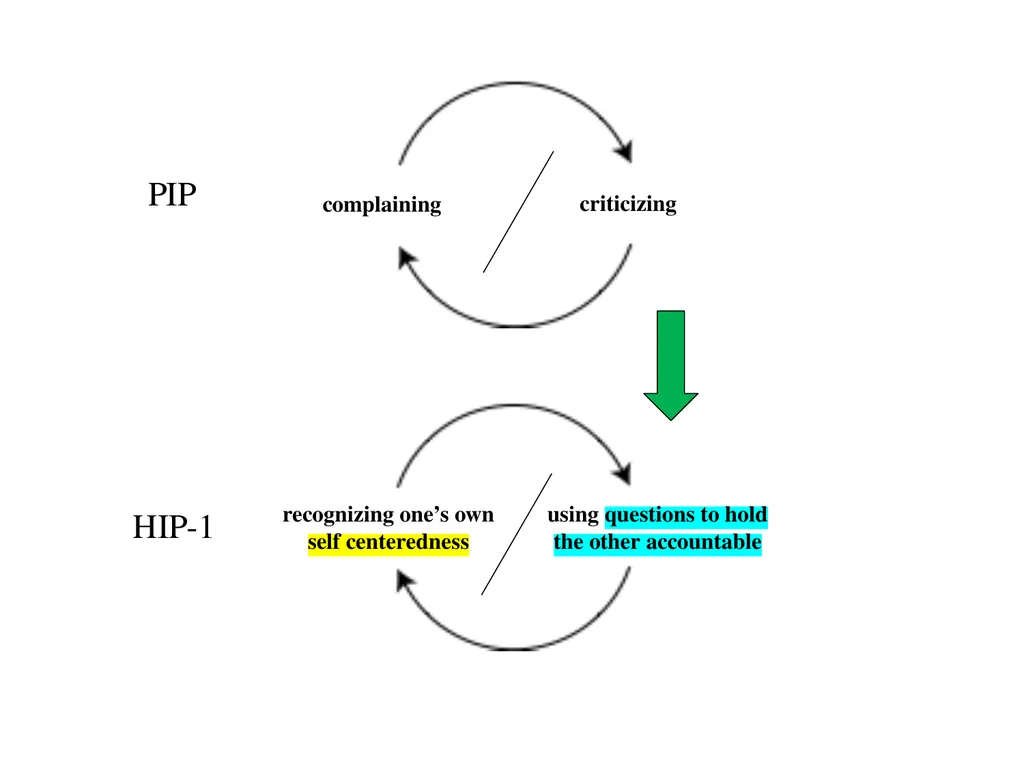
complaining criticizing PIP HIP-1 recognizing one’s own
self centeredness using questions to hold the other accountable<br>
self centeredness using questions to hold the other accountable<br>
102
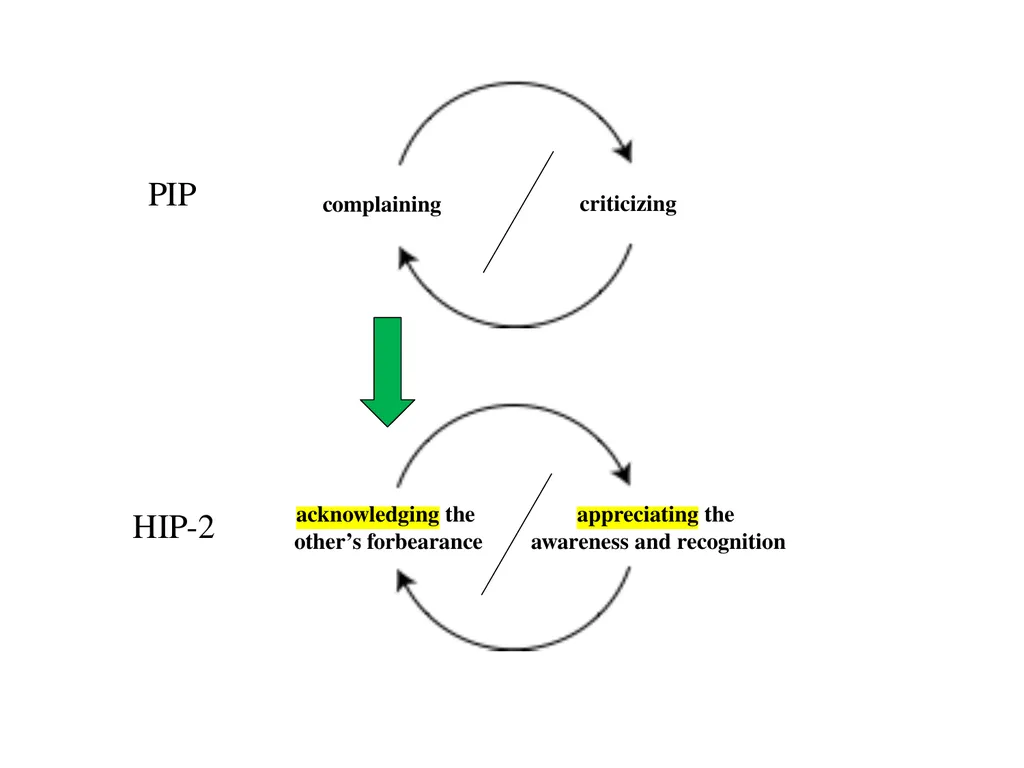
complaining criticizing PIP HIP-2 acknowledging the
other’s forbearance appreciating the
awareness and recognition<br>
other’s forbearance appreciating the
awareness and recognition<br>
103
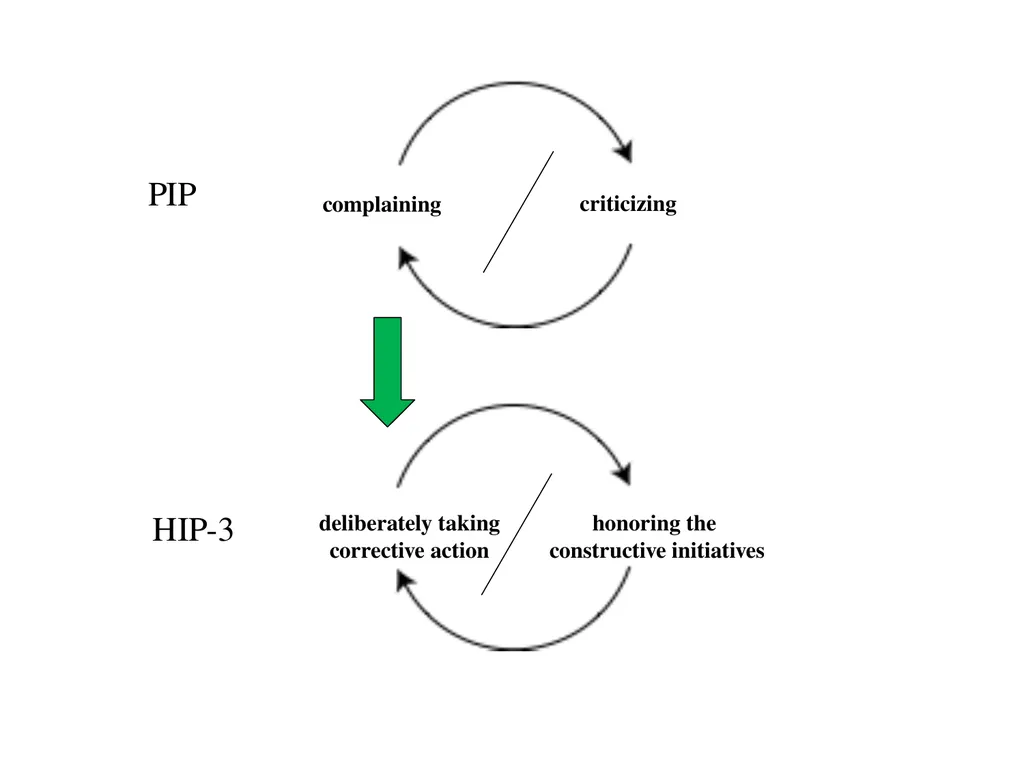
complaining criticizing PIP HIP-3 deliberately taking corrective action honoring the
constructive initiatives<br>
constructive initiatives<br>
104
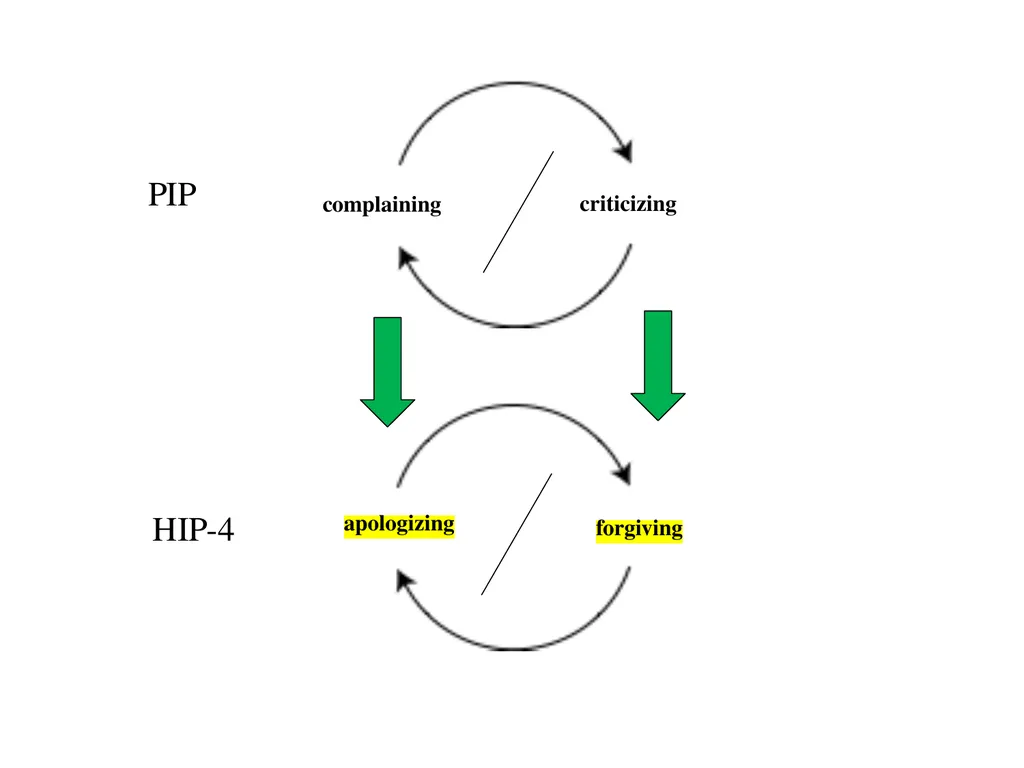
complaining criticizing PIP HIP-4 apologizing forgiving<br>
105
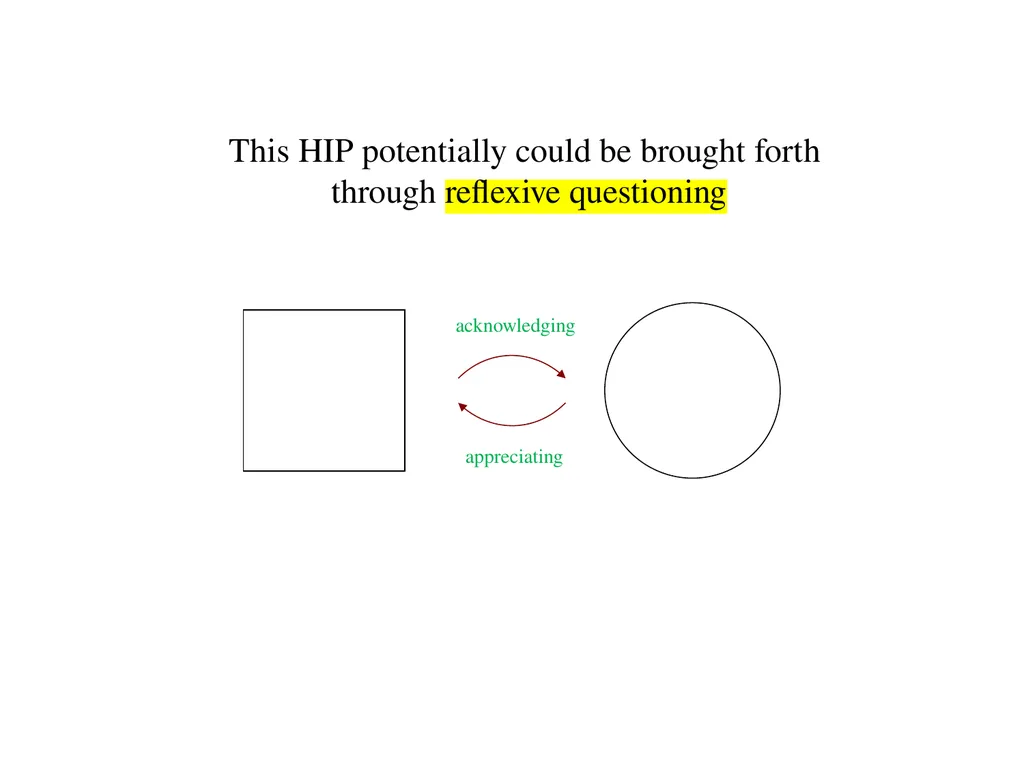
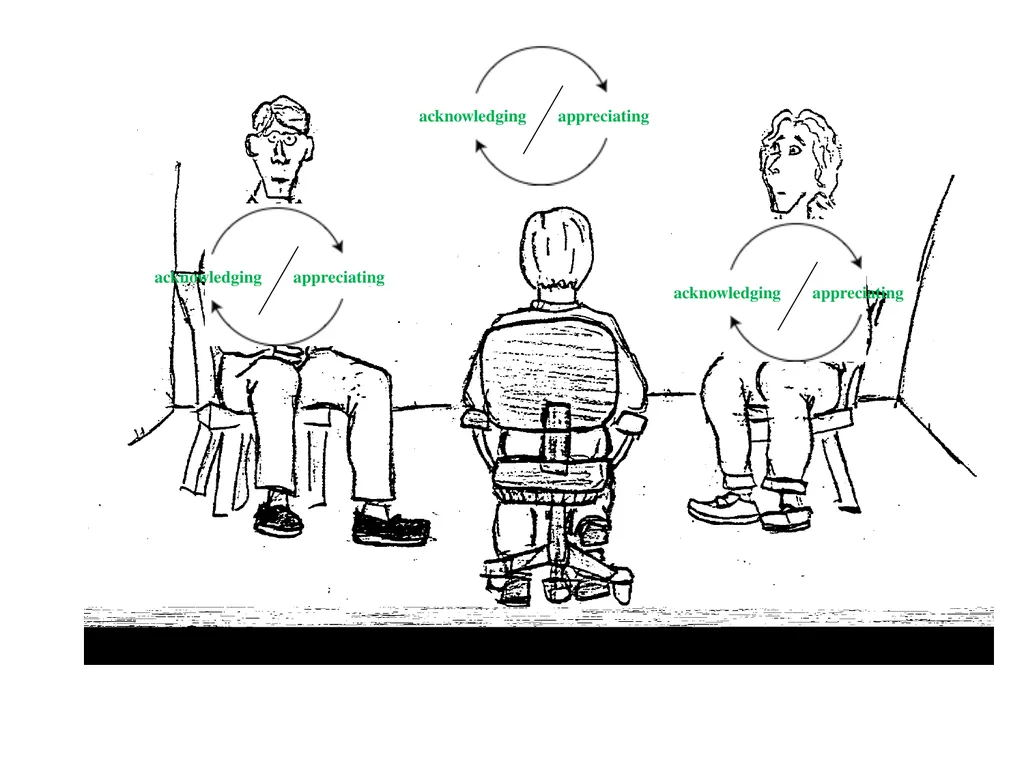
This HIP potentially could be brought forth
through reflexive questioning acknowledging appreciating<br>
through reflexive questioning acknowledging appreciating<br>
106
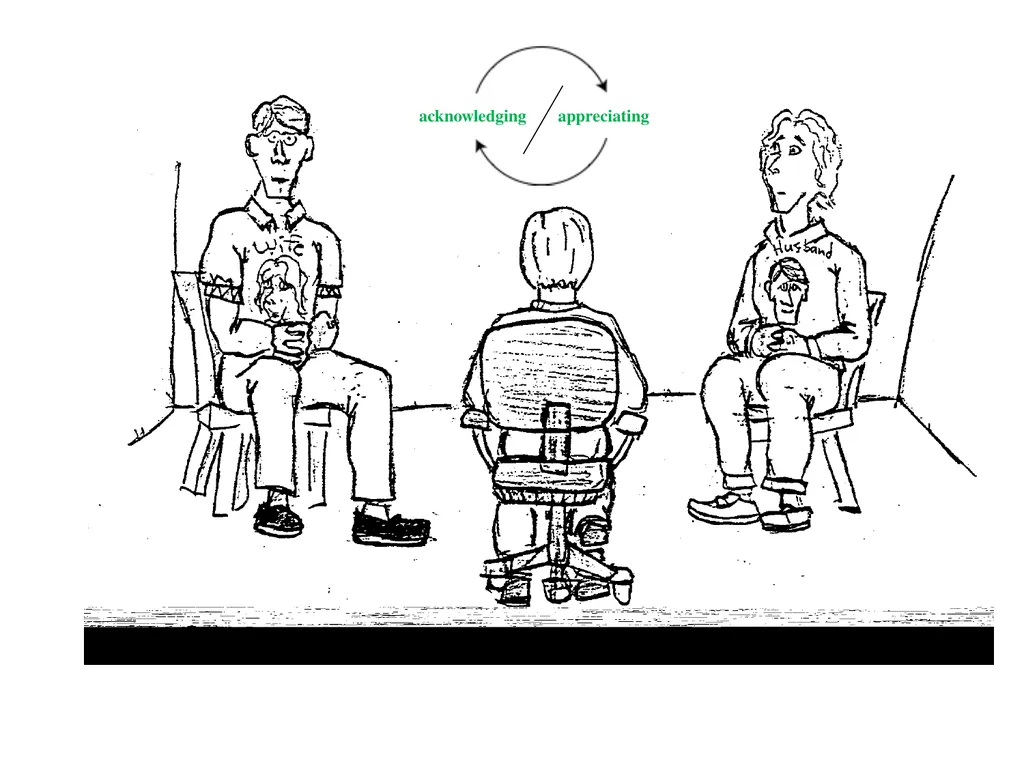
acknowledging appreciating<br>
107
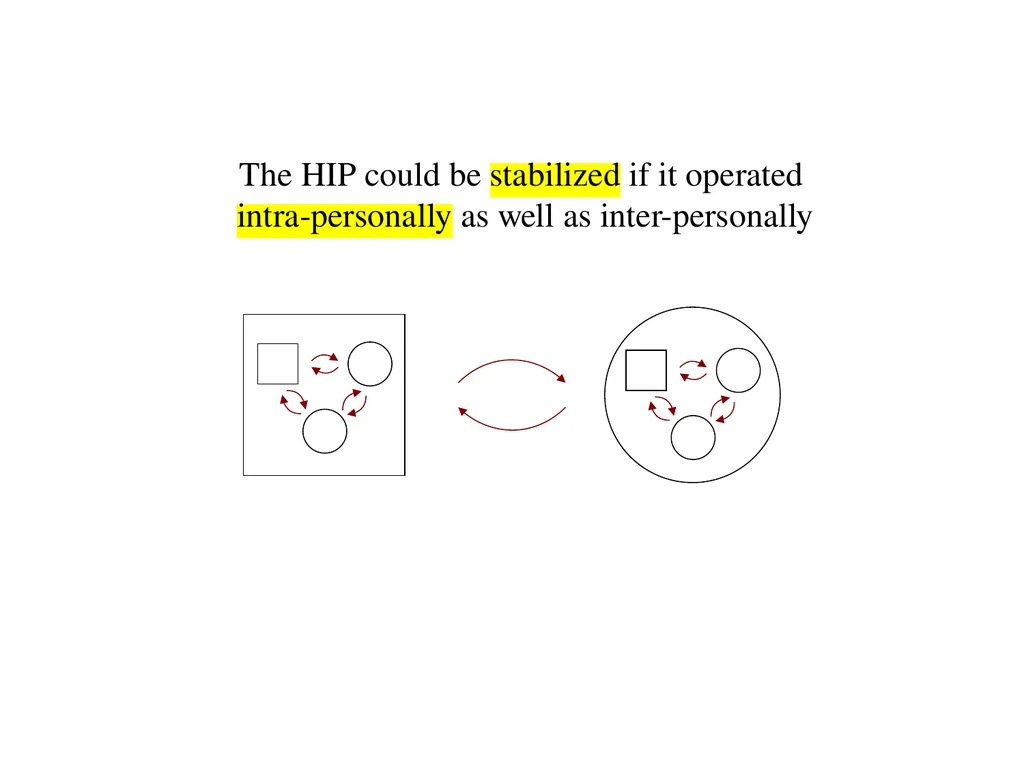
The HIP could be stabilized if it operated
intra-personally as well as inter-personally<br>
intra-personally as well as inter-personally<br>
108
acknowledging appreciating acknowledging appreciating acknowledging appreciating<br>
109
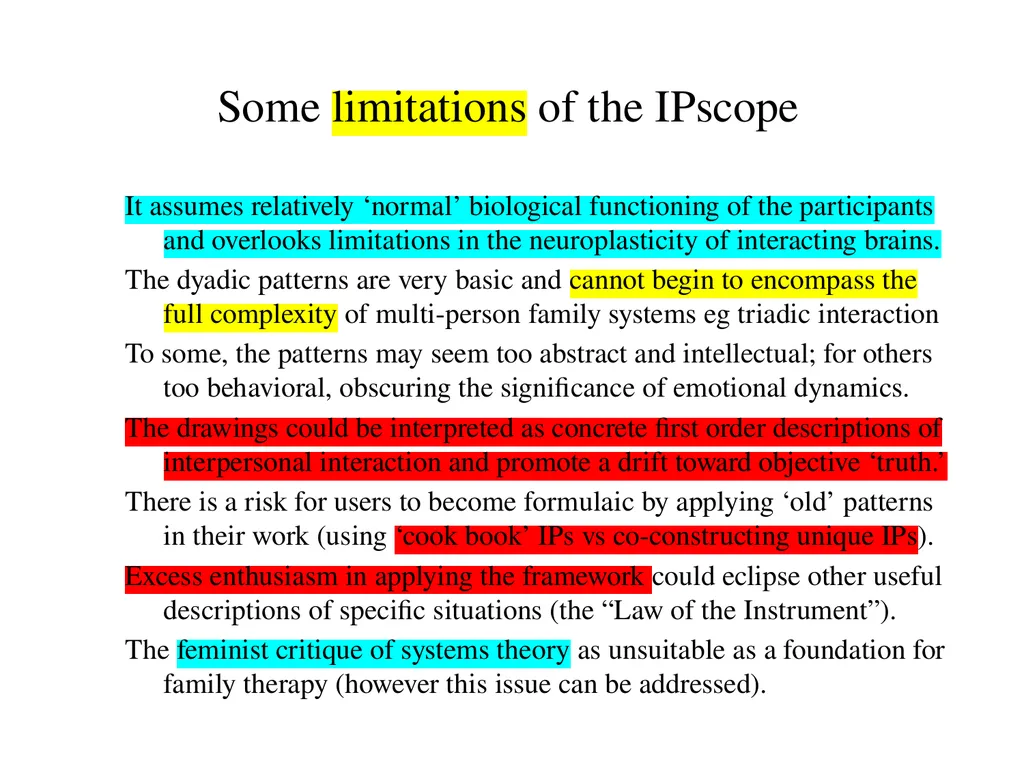
It assumes relatively ‘normal’ biological functioning of the participants and overlooks limitations in the neuroplasticity of interacting brains.
The dyadic patterns are very basic and cannot begin to encompass the full complexity of multi-person family systems eg triadic interaction
To some, the patterns may seem too abstract and intellectual; for others too behavioral, obscuring the significance of emotional dynamics.
The drawings could be interpreted as concrete first order descriptions of interpersonal interaction and promote a drift toward objective ‘truth.’
There is a risk for users to become formulaic by applying ‘old’ patterns in their work (using ‘cook book’ IPs vs co-constructing unique IPs).
Excess enthusiasm in applying the framework could eclipse other useful descriptions of specific situations (the “Law of the Instrument”).
The feminist critique of systems theory as unsuitable as a foundation for family therapy (however this issue can be addressed). Some limitations of the IPscope<br>
110
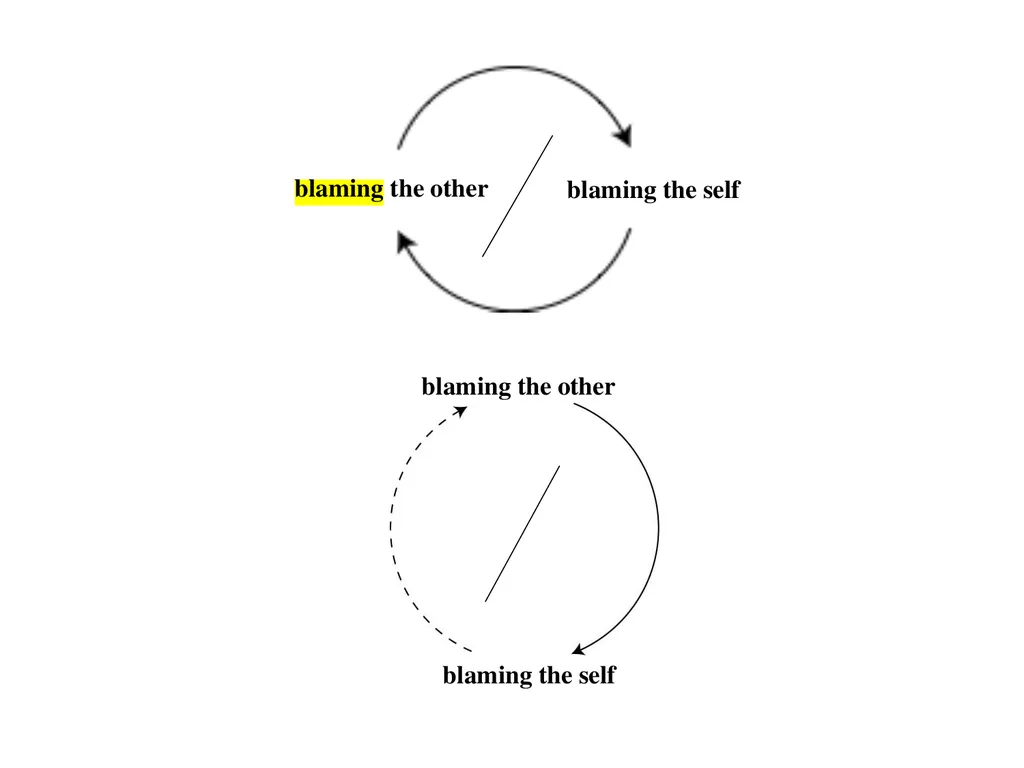
What is the feminist critique of systems theory? The circularity at the core of systemic descriptions of interaction implies equal influence and responsibility of the participants in generating and maintaining pathologizing patterns of interaction.
The assumption of equal influence obscures real differences in power between males and females that perpetuates conditions for the gender injustices that arise from such power differentials.
Thus, the use of systems theory to explain relationships in family systems could support this assumption of equal power and inadvertently enable continuing gender injustices.<br>
111
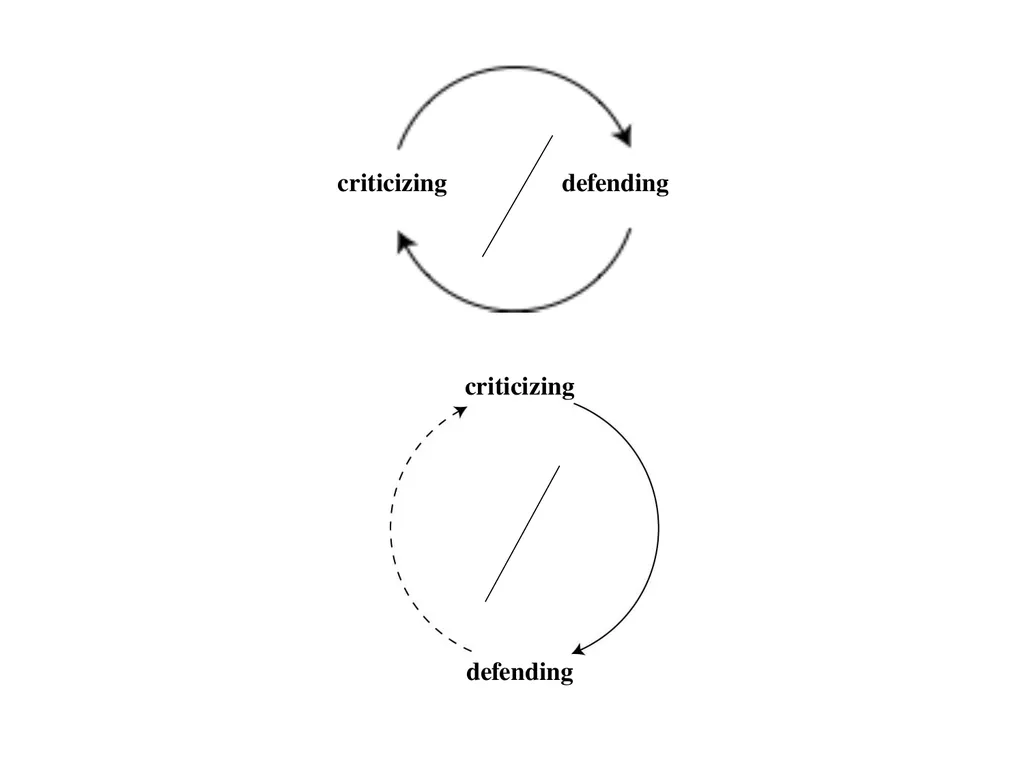
criticizing defending criticizing defending<br>
112
blaming the other blaming the self blaming the other blaming the self<br>
113
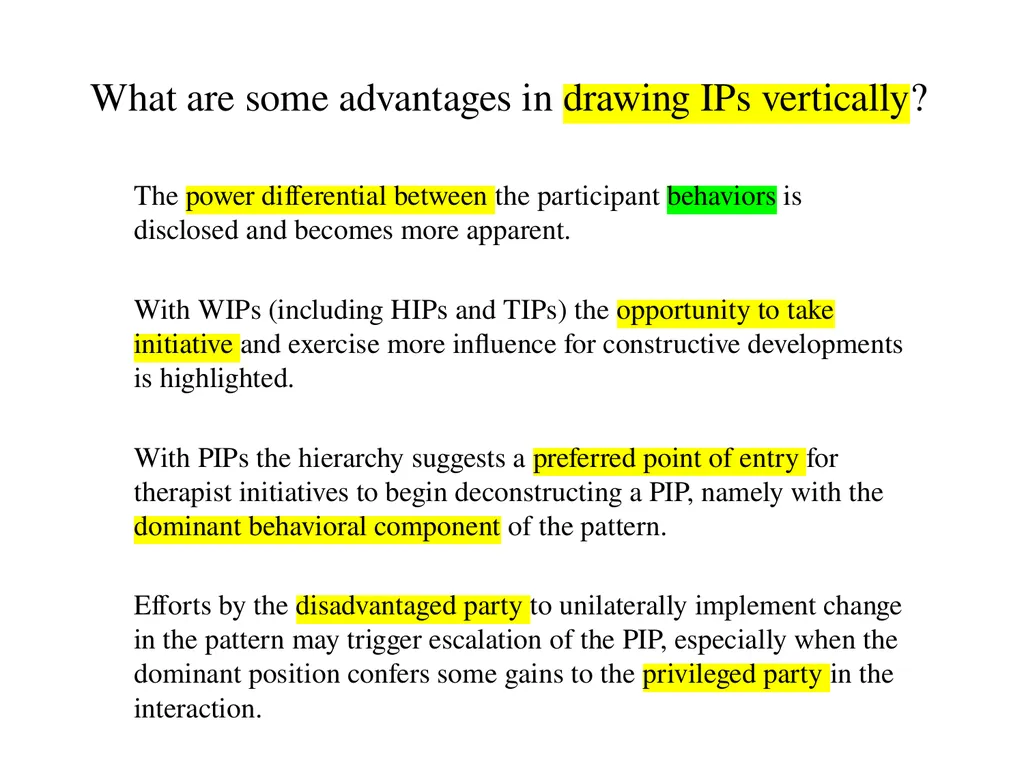
What are some advantages in drawing IPs vertically? The power differential between the participant behaviors is disclosed and becomes more apparent.
With WIPs (including HIPs and TIPs) the opportunity to take initiative and exercise more influence for constructive developments is highlighted.
With PIPs the hierarchy suggests a preferred point of entry for therapist initiatives to begin deconstructing a PIP, namely with the dominant behavioral component of the pattern.
Efforts by the disadvantaged party to unilaterally implement change in the pattern may trigger escalation of the PIP, especially when the dominant position confers some gains to the privileged party in the interaction.<br>
114
male
dominating female
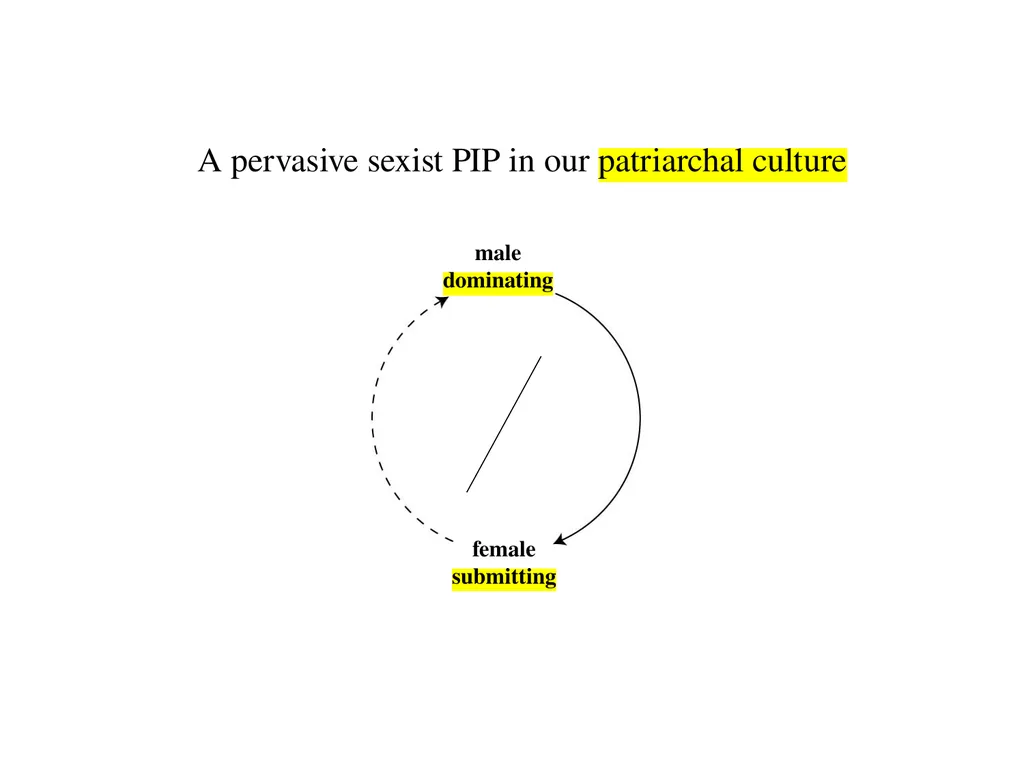
submitting A pervasive sexist PIP in our patriarchal culture<br>
dominating female
submitting A pervasive sexist PIP in our patriarchal culture<br>
115
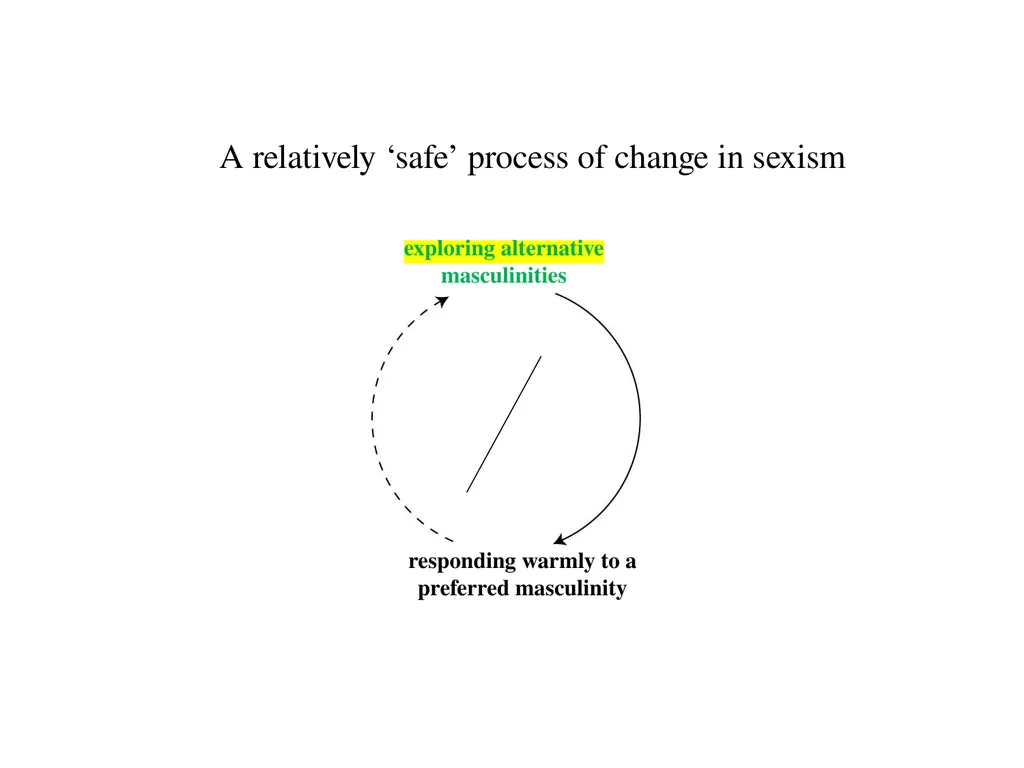
exploring alternative masculinities A relatively ‘safe’ process of change in sexism responding warmly to a preferred masculinity<br>
116
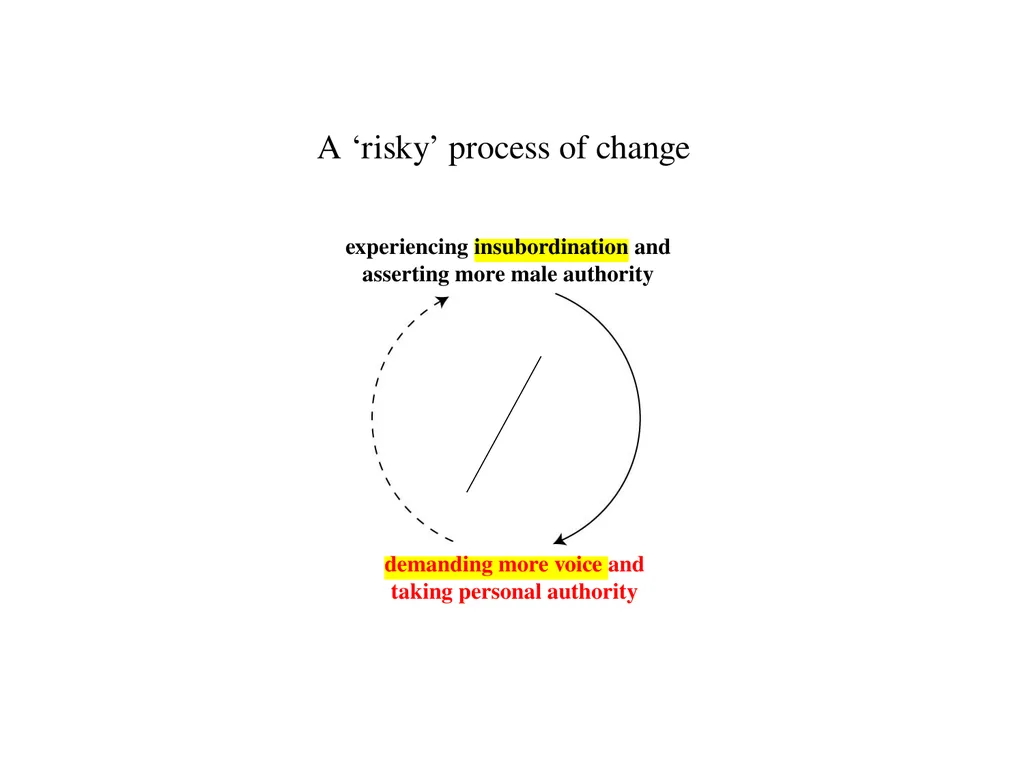
experiencing insubordination and asserting more male authority A ‘risky’ process of change demanding more voice and taking personal authority<br>
117
female
dominating male
submitting Males are not always dominant: females are
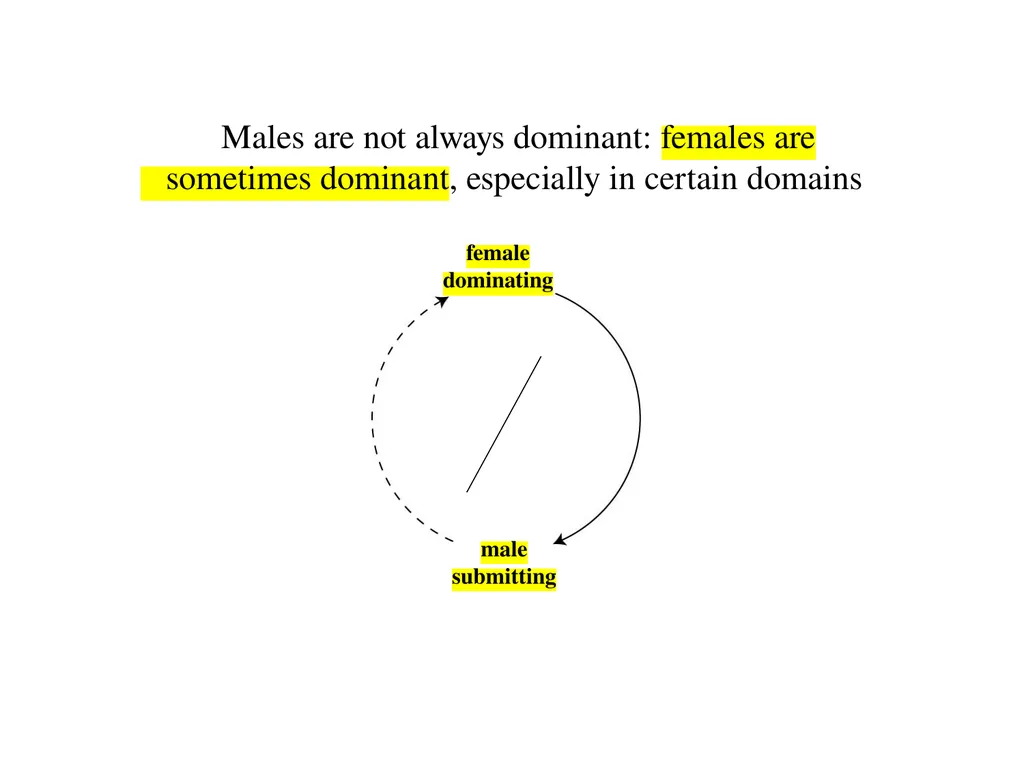
sometimes dominant, especially in certain domains<br>
dominating male
submitting Males are not always dominant: females are
sometimes dominant, especially in certain domains<br>
118
dominating submitting The dominating/submitting pattern
is ubiquitous in human relations When this pattern is pervasive and persistent
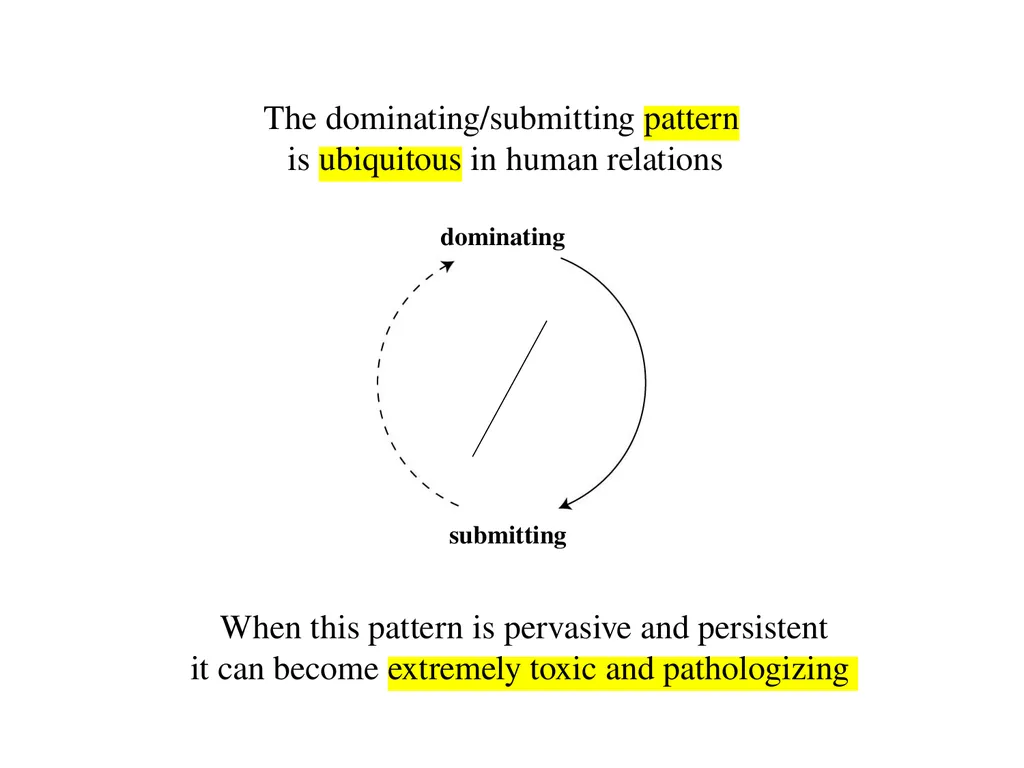
it can become extremely toxic and pathologizing<br>
is ubiquitous in human relations When this pattern is pervasive and persistent
it can become extremely toxic and pathologizing<br>
119
acknowledging one’s own privilege,
listening to the experiences of the other,
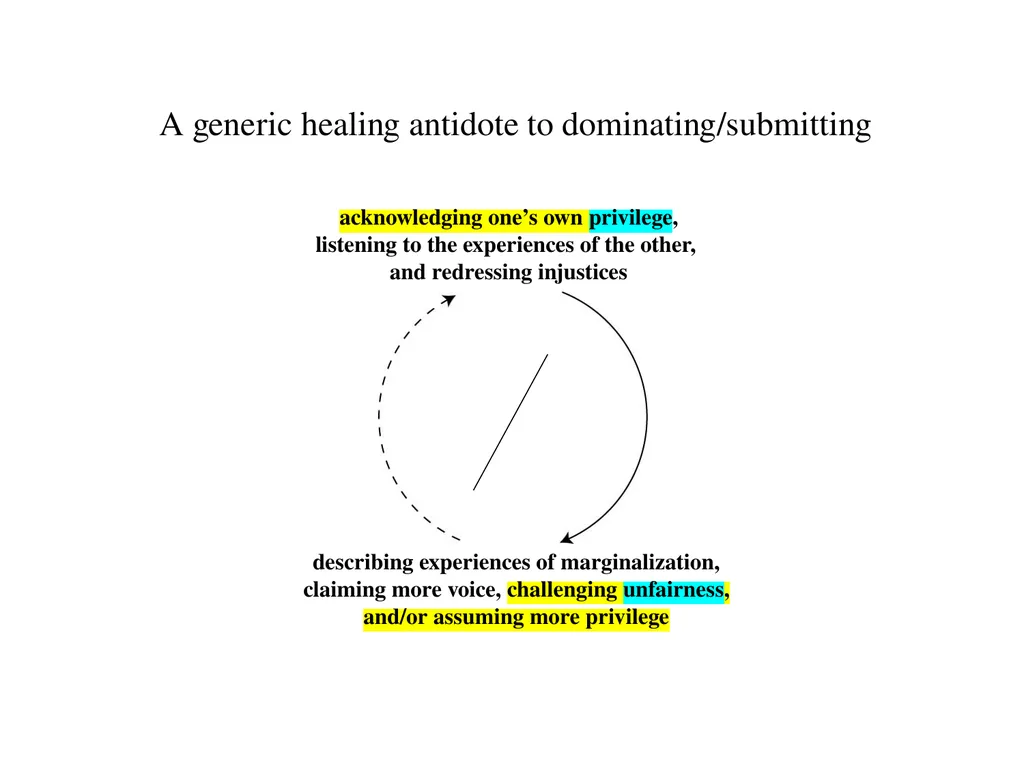
and redressing injustices describing experiences of marginalization, claiming more voice, challenging unfairness, and/or assuming more privilege A generic healing antidote to dominating/submitting<br>
listening to the experiences of the other,
and redressing injustices describing experiences of marginalization, claiming more voice, challenging unfairness, and/or assuming more privilege A generic healing antidote to dominating/submitting<br>
120
References Tomm, K. “Beginnings of a HIPs and PIPs Approach to Psychiatric Assessment” The Calgary Participator, p21-24, 1991
Tomm, K., St. George, S., Wulff, D., & Strong, T., Chapter 1 in Patterns in Interpersonal Interactions: Inviting Relational Understandings for Therapeutic Change, 2014 Routledge Press NY<br>
Tomm, K., St. George, S., Wulff, D., & Strong, T., Chapter 1 in Patterns in Interpersonal Interactions: Inviting Relational Understandings for Therapeutic Change, 2014 Routledge Press NY<br>