
1910.213 Woodworking Machinery Requirements Main
CM
Published · 60 slides · 0 views

1 / 1







Description
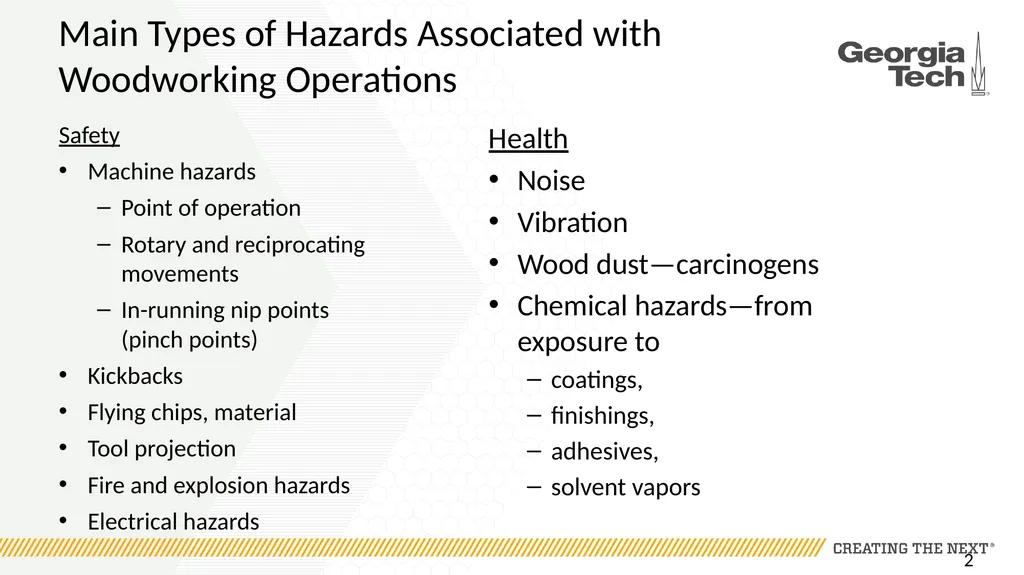
1910.213 Woodworking Machinery Requirements Main Types of Hazards Associated with Woodworking Operations Safety Machine hazards Point of operation Rotary and reciprocating movements In-running nip points (pinch points) Kickbacks Flying
Related Topics
Share
Embed code
Download this presentation From Below
"1910.213 Woodworking Machinery Requirements Main" is the property of its rightful owner. Permission is granted to download and print the materials on this website for personal, non-commercial use only, and to display it on your personal computer provided you do not modify the materials and that you retain all copyright notices contained in the materials. By downloading content from our website, you accept the terms of this agreement.
Presentation Transcript
01
1910.213 Woodworking Machinery Requirements<br>
02
Main Types of Hazards Associated with
Woodworking Operations Safety
Machine hazards
Point of operation
Rotary and reciprocating movements
In-running nip points (pinch points)
Kickbacks
Flying chips, material
Tool projection
Fire and explosion hazards
Electrical hazards Health
Noise
Vibration
Wood dust—carcinogens
Chemical hazards—from exposure to
coatings,
finishings,
adhesives,
solvent vapors<br>
03
Machines shall be constructed to be free from vibration when largest tool is mounted and run at full speed
“Run idle at full speed”?
This means the tool is on and running at maximum speed without being under load (cutting) 1910.213(a) – Machine Construction General 3<br>
“Run idle at full speed”?
This means the tool is on and running at maximum speed without being under load (cutting) 1910.213(a) – Machine Construction General 3<br>
04
All belts, pulleys, gears, shafts, and moving parts shall be guarded in accordance with the specific requirements of 1910.219. 1910.213(a) – Power Transmission Apparatus 4<br>
05
It is recommended that each power-driven woodworking machine be provided with a disconnect switch that can be locked in the off position. 1910.213(a) – Disconnect Switch 5<br>
06
All tools operating at more than 90v must have their metal parts grounded
Separate ground wire and polarized plug
Cutting heads must be machined to fit specific types of arbors 1910.213(a) 6<br>
Separate ground wire and polarized plug
Cutting heads must be machined to fit specific types of arbors 1910.213(a) 6<br>
07
Combs (featherboards) shall be provided at the workplace for use when a standard guard cannot be used. 1910.213(a) – Combs/Featherboards 7<br>
08
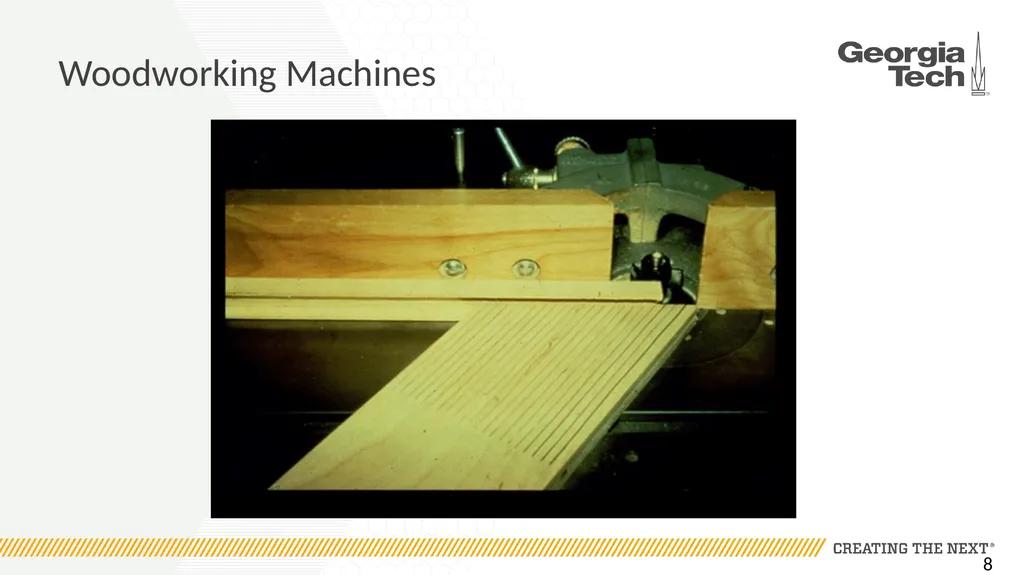
Woodworking Machines 8<br>
09
A mechanical or electrical power control shall be provided on each machine to make it possible for the operator to cut off the power from each machine without leaving his position at the point of operation. 1910.213(b) – Machine Controls and Equipment 9<br>
10
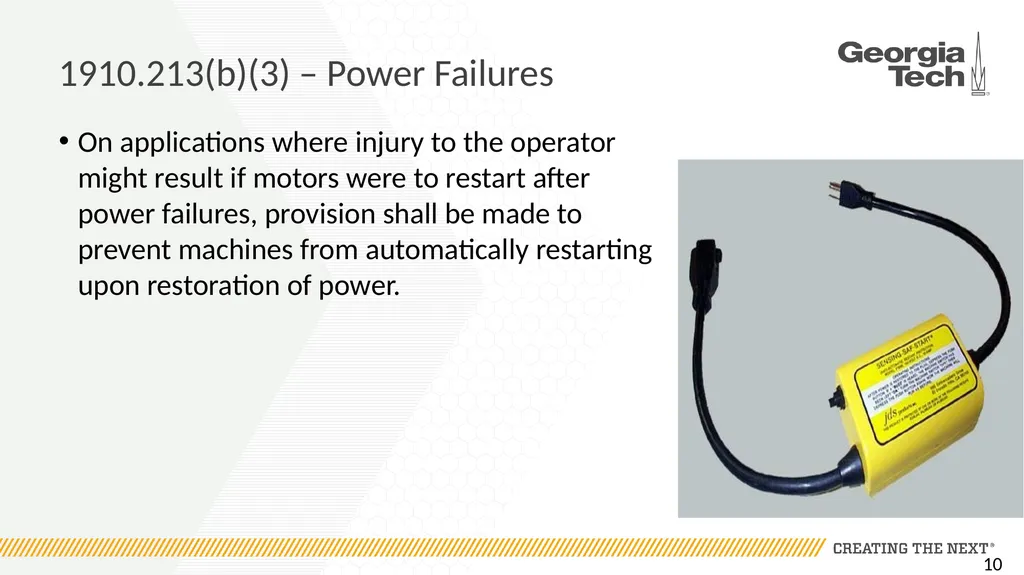
On applications where injury to the operator might result if motors were to restart after power failures, provision shall be made to prevent machines from automatically restarting upon restoration of power. 1910.213(b)(3) – Power Failures 10<br>
11
Operating controls must be placed so the operator has access to them without reaching over the cutting blade
Must be placed within reach of their regular work station
Machines operated by electrical motors must have controls capable of being rendered inoperative
For maintenance, repairs, adjustments, etc. 1910.213(b) – Operating Controls 11<br>
Must be placed within reach of their regular work station
Machines operated by electrical motors must have controls capable of being rendered inoperative
For maintenance, repairs, adjustments, etc. 1910.213(b) – Operating Controls 11<br>
12
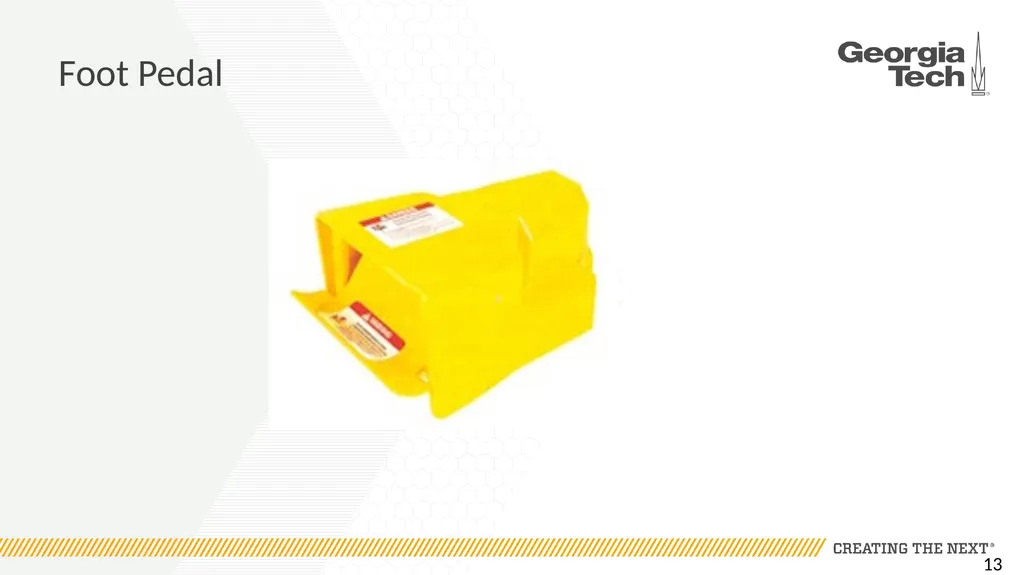
Operating treadles must be protected from unintended operation.
Feeder attachments must have feed rolls or other moving parts covered to protect operator from pinch points 1910.213(b) – Foot Pedals and Feeder Attachments 12<br>
Feeder attachments must have feed rolls or other moving parts covered to protect operator from pinch points 1910.213(b) – Foot Pedals and Feeder Attachments 12<br>
13
Foot Pedal 13<br>
14
Each circular hand-fed ripsaw shall be guarded by a hood which shall completely enclose that portion of the saw above the table and that portion of the saw above the material being cut. The hood and mounting shall be arranged so that the hood will automatically adjust itself to the thickness of and remain in contact with the material being cut without considerable resistance. 1910.213(c) – Hand-Fed Ripsaws 14<br>
15
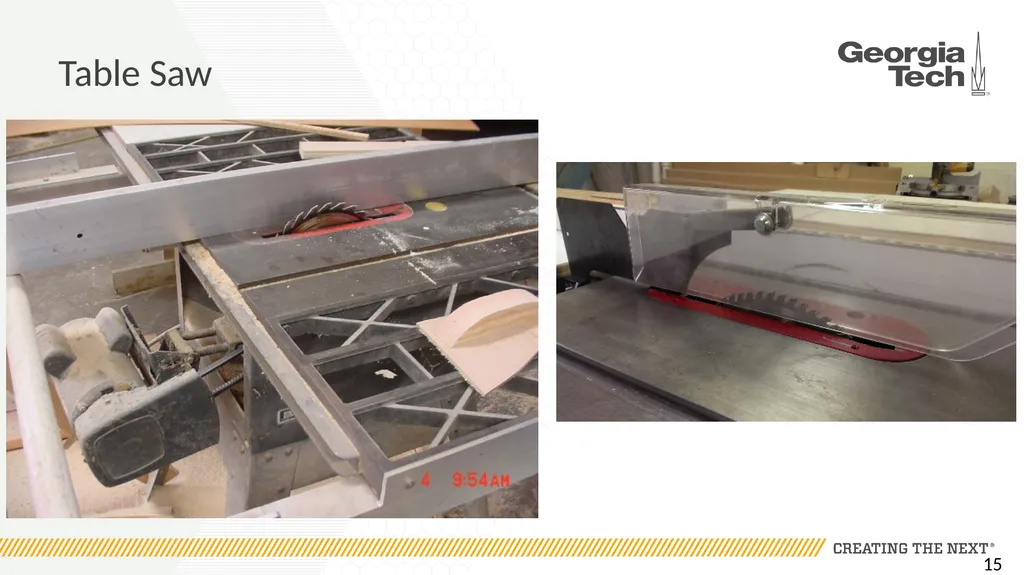
Table Saw 15<br>
16
Each hand-fed circular ripsaw shall be furnished with a spreader to prevent material from squeezing the saw or being thrown back on the operator. 1910.213(c) 16<br>
17
Kickbacks occur when a saw seizes the stock and hurls it back at the operator. This can happen when the stock twists and binds against the side of the blades or is caught in the teeth. A blade that is not sharpened, or that is set at an incorrect height, can cause kickbacks.
This can happen with many operations, but primarily with RIP cuts where the wood is being cut with the grain. The wood wants to bind back on the blade and project the scrap piece of wood back at the operator. Kickback 17<br>
This can happen with many operations, but primarily with RIP cuts where the wood is being cut with the grain. The wood wants to bind back on the blade and project the scrap piece of wood back at the operator. Kickback 17<br>
18
1910.213(c)
Each hand-fed circular ripsaw shall be provided with non-kickback fingers or dogs so located as to oppose the thrust or tendency of the saw to pick up the material or throw it back toward the operator. Avoiding Kickback 18<br>
Each hand-fed circular ripsaw shall be provided with non-kickback fingers or dogs so located as to oppose the thrust or tendency of the saw to pick up the material or throw it back toward the operator. Avoiding Kickback 18<br>
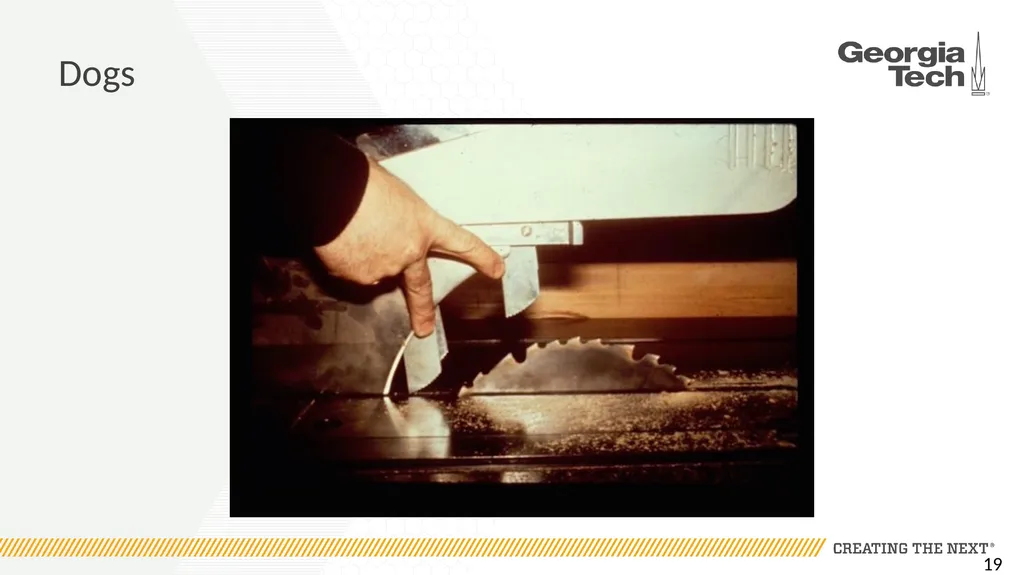
19
Dogs 19<br>
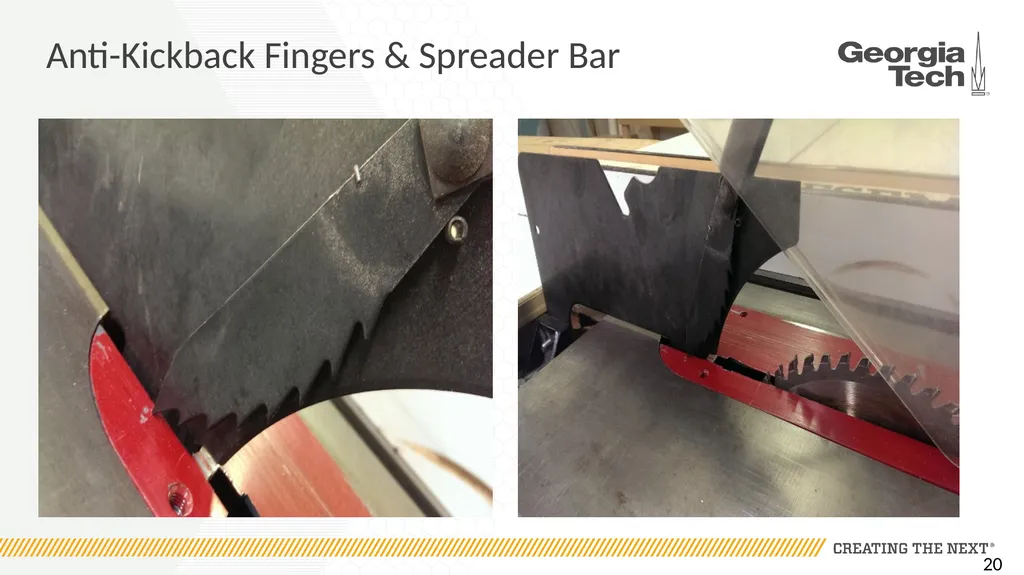
20
Anti-Kickback Fingers & Spreader Bar 20<br>
21
Each circular crosscut table saw shall be guarded by a hood which shall meet all the requirements of 1910.213(c)(1) for hoods for circular re-saws. 1910.213(d) – Hand-Fed Crosscut Table Saws 21<br>
22
Self-feed circular saws
Guarded by a hood or guard to prevent hands of operators from coming in contact with the in-running rolls.
If self-fed saws are used for ripping, they must be equipped with anti-kickback devices (dogs). 1910.213(f) - Self-Feed Circular Saws 22<br>
Guarded by a hood or guard to prevent hands of operators from coming in contact with the in-running rolls.
If self-fed saws are used for ripping, they must be equipped with anti-kickback devices (dogs). 1910.213(f) - Self-Feed Circular Saws 22<br>
23
Swing Cut Off Saws
Provided with a hood that completely covers the upper half of the blade and the arbor.
Provided with a guard that will protect the point of operation.
Must be provided with a means to return to it’s resting position
Limit chain to limit the travel beyond or behind the working table 1910.213(g) – Swing Cut Off Saws 23<br>
24
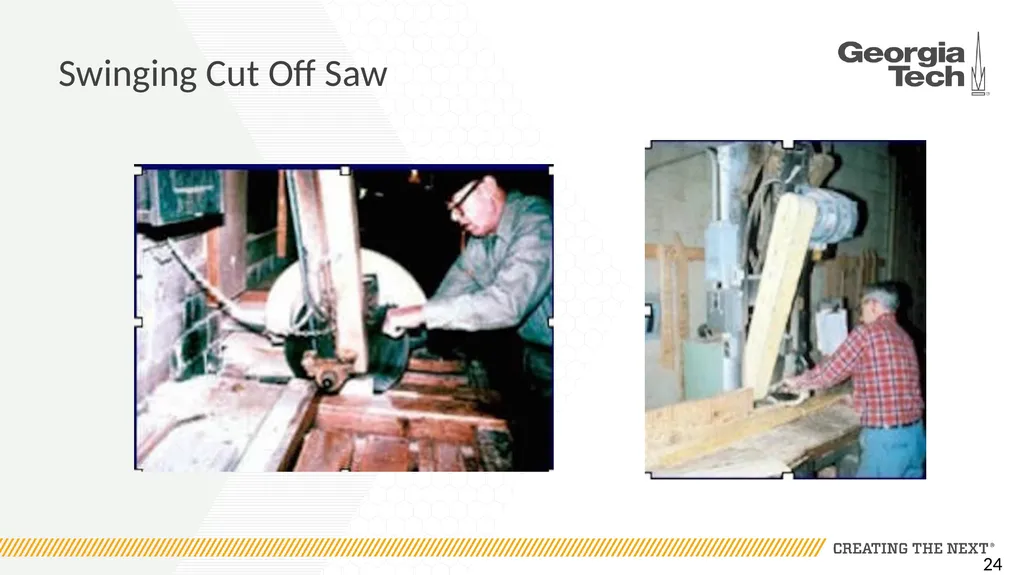
Swinging Cut Off Saw 24<br>
25
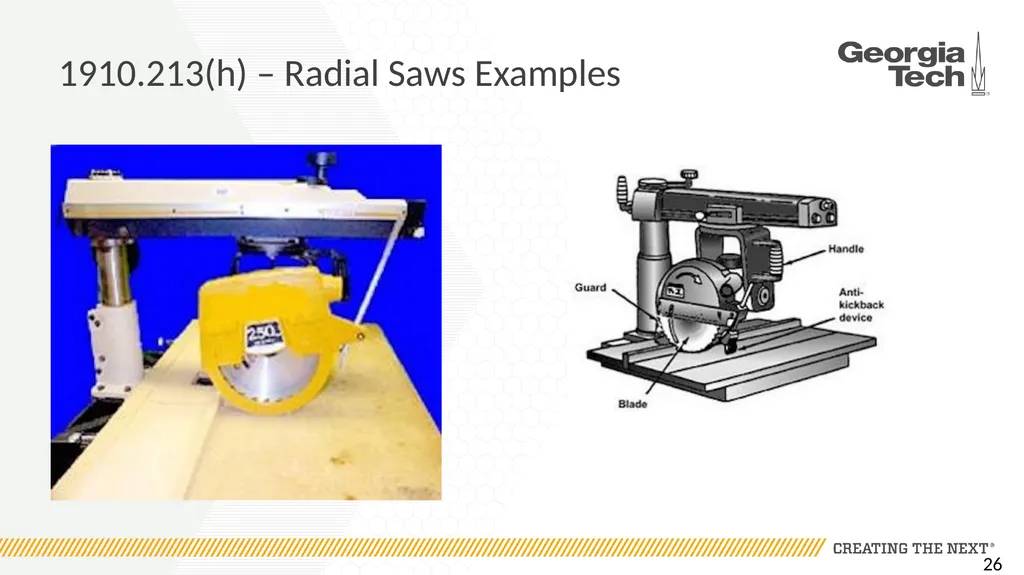
The upper hood shall completely enclose the upper portion of the blade down to a point that will include the end of the saw arbor
The sides of the lower exposed portion of the blade shall be guarded to the full diameter of the blade by a device that will automatically adjust itself of the thickness of the stock and remain in contact with the stock. 1910.213(h) – Radial Saws 25<br>
The sides of the lower exposed portion of the blade shall be guarded to the full diameter of the blade by a device that will automatically adjust itself of the thickness of the stock and remain in contact with the stock. 1910.213(h) – Radial Saws 25<br>
26
1910.213(h) – Radial Saws Examples 26<br>
27
Each radial saw used for ripping shall be provided with non-kickback fingers or dogs located on both sides of the saw. 1910.213(h) - Kickbacks 27<br>
28
An adjustable stop shall be provided to prevent the forward travel of the blade beyond the position necessary to complete the cut in repetitive operations. 1910.213(h) – Adjustable Stop 28<br>
29
Installation shall be in such a manner that the front end of the unit will be slightly higher than the rear, so as to cause the cutting head to return gently to the starting position when released by the operator. 1910.213(h) – Automatic Return 29<br>
30
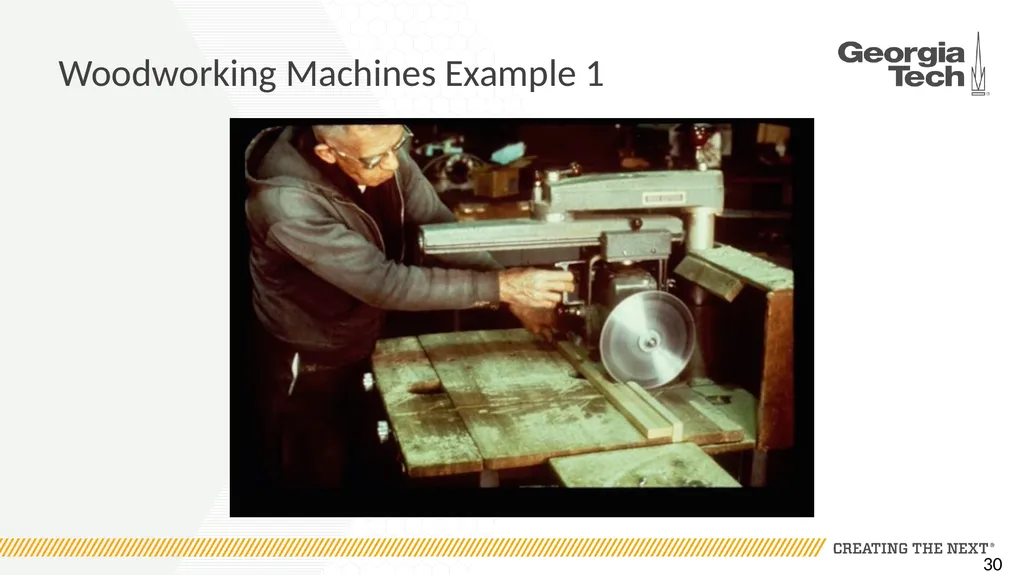
Woodworking Machines Example 1 30<br>
31
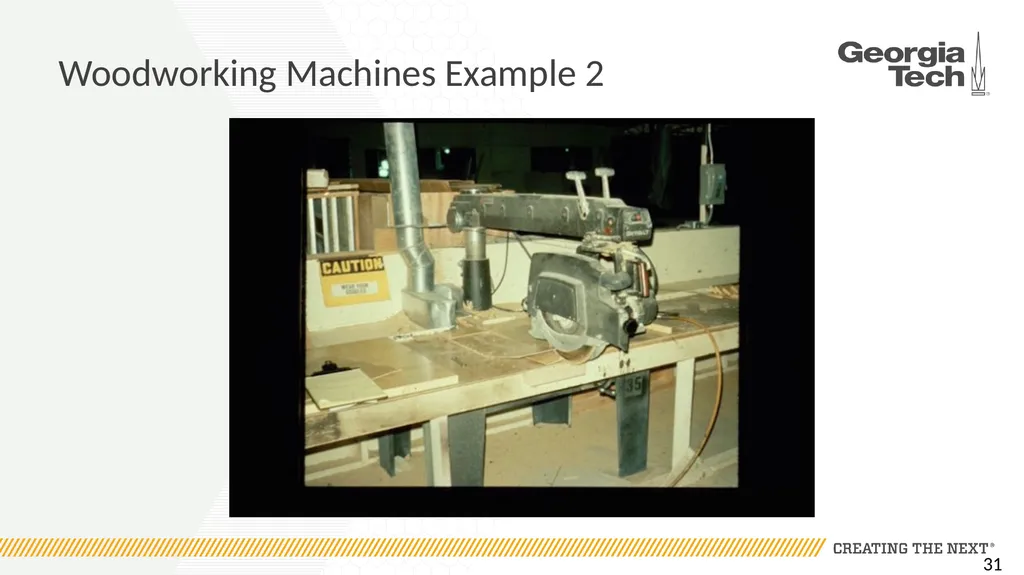
Woodworking Machines Example 2 31<br>
32
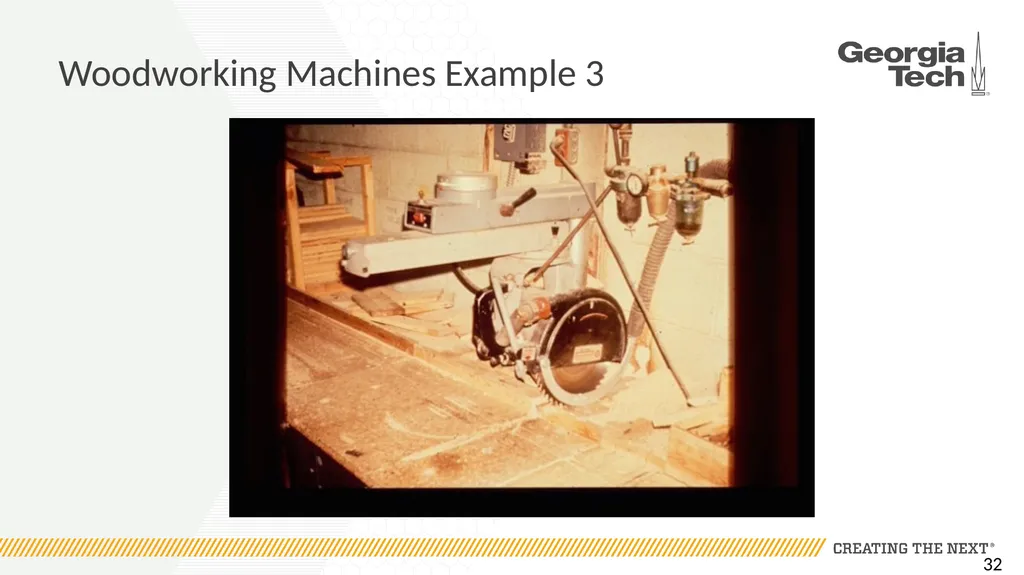
Woodworking Machines Example 3 32<br>
33
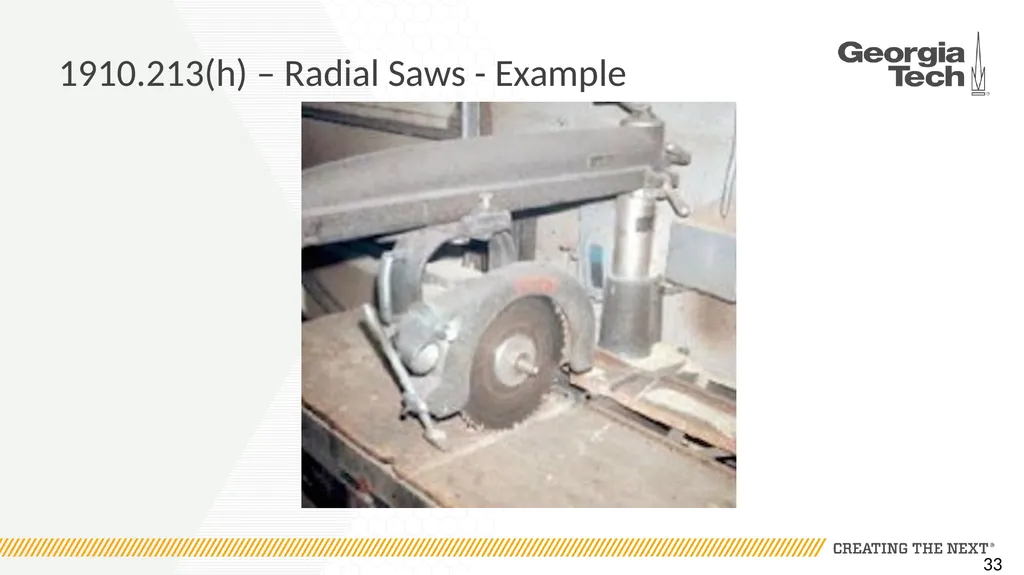
1910.213(h) – Radial Saws - Example 33<br>
34
Ripping and ploughing shall be against the direction in which the saw turns.
The direction of the saw rotation shall be conspicuously marked on the hood. 1910.213(h) – Radial Saws Requirements 34<br>
The direction of the saw rotation shall be conspicuously marked on the hood. 1910.213(h) – Radial Saws Requirements 34<br>
35
All portions of the saw blade (band saws) shall be enclosed or guarded, except for the working portion of the blade between the bottom of the guide rolls and the table. 1910.213(i) – Band saws and Band Resaws 35<br>
36
1910.213(i) - Band saws 36<br>
37
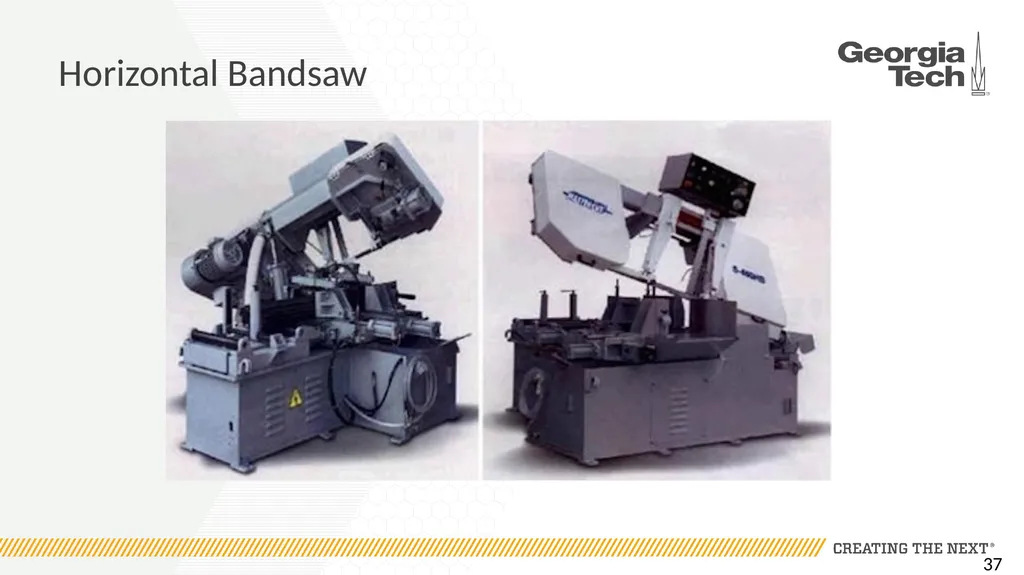
Horizontal Bandsaw 37<br>
38
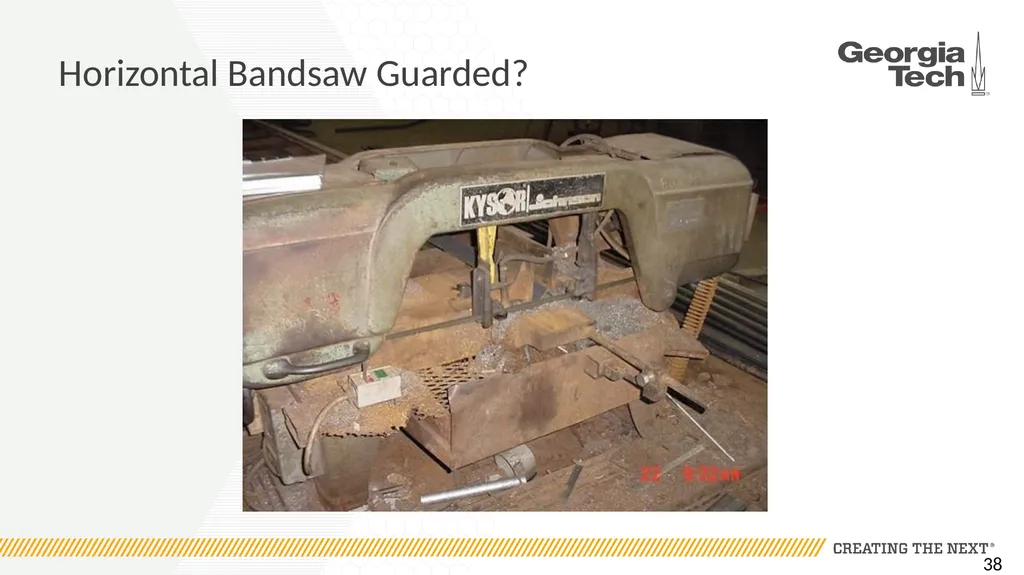
Horizontal Bandsaw Guarded? 38<br>
39
Jointers
Cylinder cutting head that doesn’t extend more than 1/8” from the head.
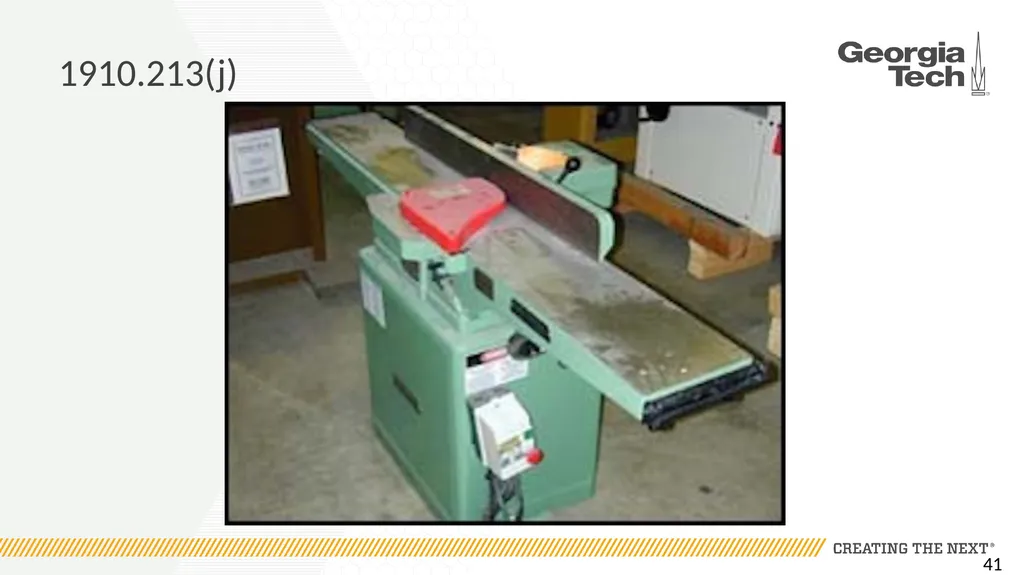
Each hand-fed jointer with a horizontal cutting head shall have an automatic guard which will cover all the section of the head on the working side of the fence or gage. 1910.213(j) - Jointers 39<br>
Cylinder cutting head that doesn’t extend more than 1/8” from the head.
Each hand-fed jointer with a horizontal cutting head shall have an automatic guard which will cover all the section of the head on the working side of the fence or gage. 1910.213(j) - Jointers 39<br>
40
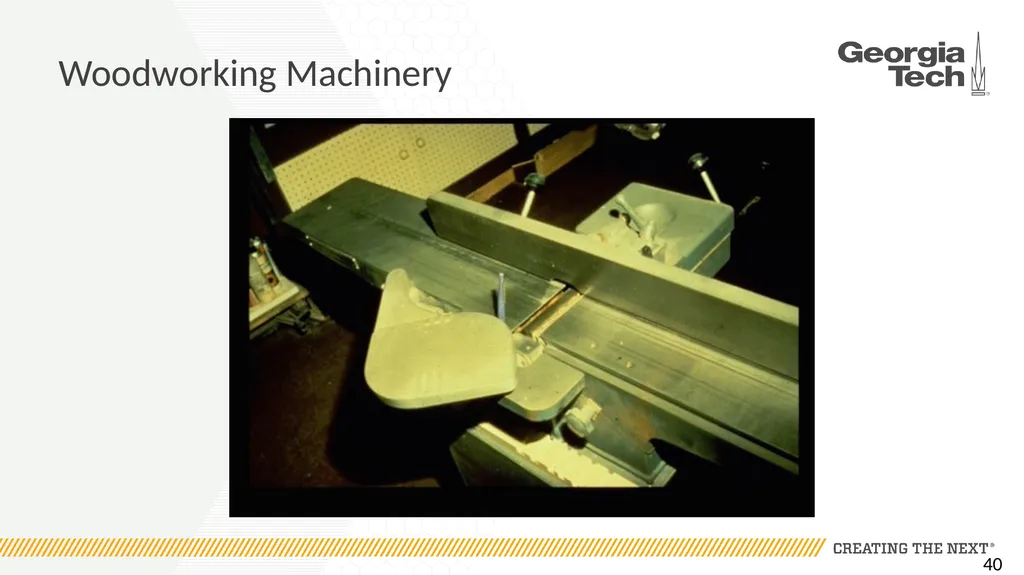
Woodworking Machinery 40<br>
41
1910.213(j) 41<br>
42
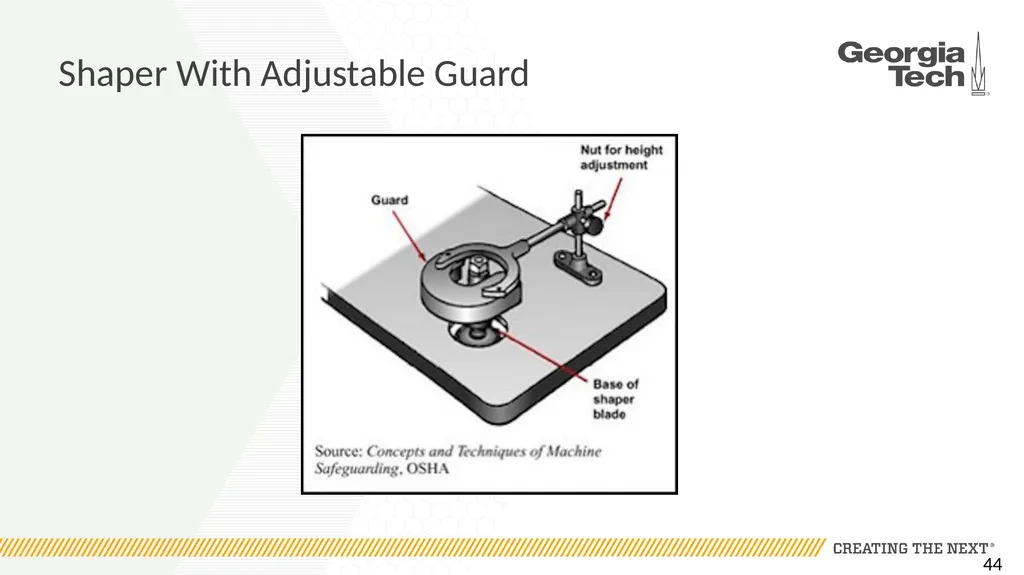
The cutting heads of each wood shaper, hand-fed panel raiser, or other similar machine not automatically fed, shall be enclosed with a cage or adjustable guard so designed as to keep the operator’s hand away from the cutting edge. 1910.213(m) – Wood Shapers and Similar Equipment 42<br>
43
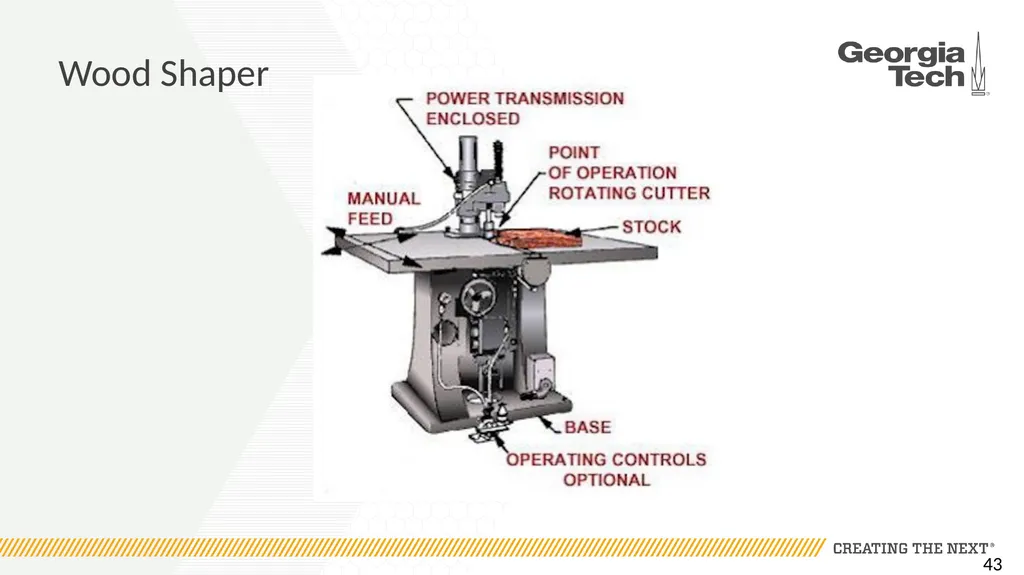
Wood Shaper 43<br>
44
Shaper With Adjustable Guard 44<br>
45
Double-spindle shapers
Starting and stopping device for each spindle 1910.213(m) 45<br>
Starting and stopping device for each spindle 1910.213(m) 45<br>
46
Planers
Guard covering the cutting heads
If exhaust hood used, must be integral to the guard
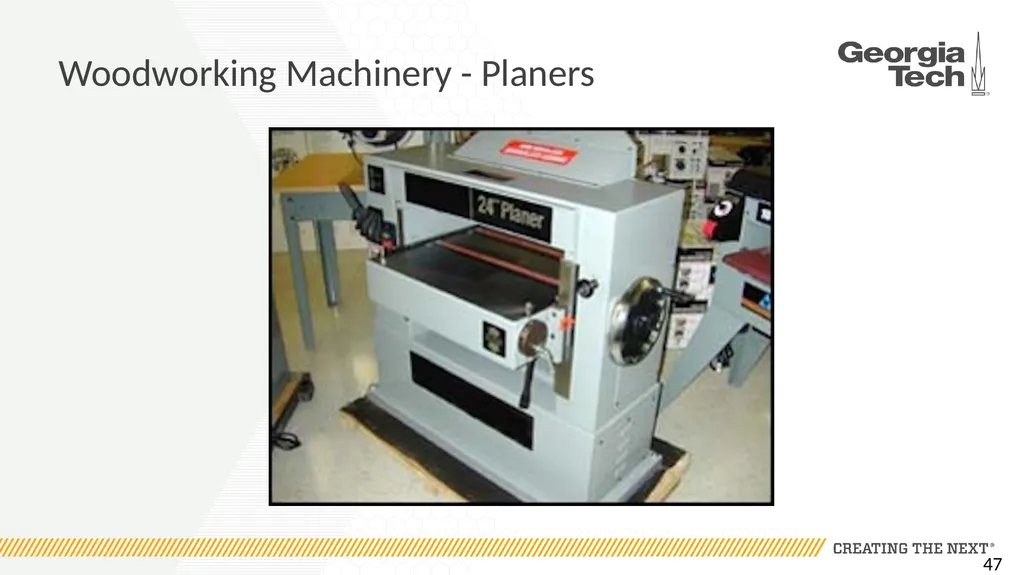
Guard/hood must protect the feed rolls/in-running nip points 1910.213(n) – Planing 46<br>
Guard covering the cutting heads
If exhaust hood used, must be integral to the guard
Guard/hood must protect the feed rolls/in-running nip points 1910.213(n) – Planing 46<br>
47
Woodworking Machinery - Planers 47<br>
48
Cutting heads on wood-turning lathes, whether rotating or not, shall be covered as completely as possible by hoods or shields. 1910.213(o) – Wood-Turning Lathes 48<br>
49
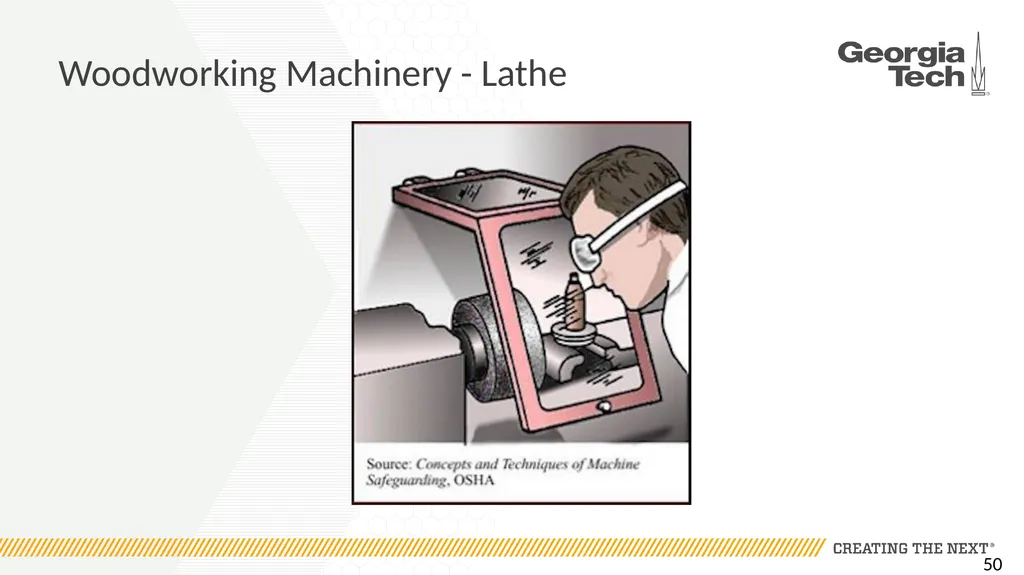
Wood stock held between two centers on a lathe must be protected (as much as possible) with a long curved guard extending over the top of the lathe to prevent the work from being thrown out.
If an exhaust system is used it must form an integral part of the guard. 1910.213(o) 49<br>
If an exhaust system is used it must form an integral part of the guard. 1910.213(o) 49<br>
50
Woodworking Machinery - Lathe 50<br>
51
Sanding Machines
Where the sanding belt runs over rollers a guard must prevent the operator from coming into contact with the in-running nip points.
Drum sanders must be protected above the table by a guard or exhaust hood except for that portion of the sander which is necessary for the stock. 1910.213(p) – Sanding Machines 51<br>
52
Disk sanders must have a guard or exhaust hood enclosing the revolving disk. Allowing only enough exposure that is necessary for the application. 1910.213(p) – Disk Sanders 52<br>
53
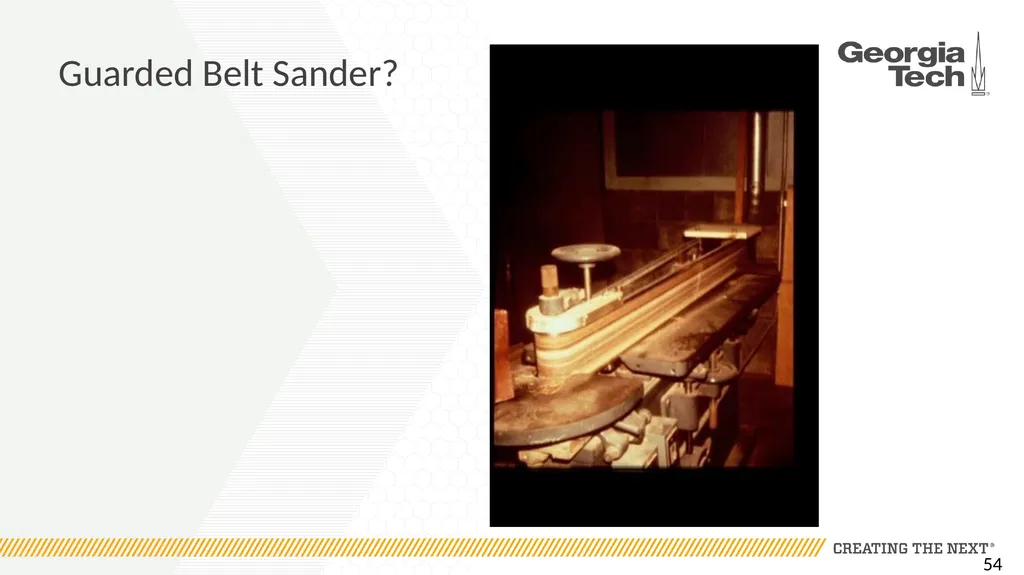
Belt sanding machines shall be provided with guards at each nip point where the sanding belt runs onto the pulley.
The unused run of the sanding belt shall be guarded against accidental contact. 1910.213(p) – Belt Sanders 53<br>
The unused run of the sanding belt shall be guarded against accidental contact. 1910.213(p) – Belt Sanders 53<br>
54
Guarded Belt Sander? 54<br>
55
The mention of specific machines in paragraphs (a) thru (q) and this paragraph (r) of this section, inclusive, is not intended to exclude other woodworking machines from the requirements that suitable guards and exhaust hoods be provided to reduce to a minimum the hazard due to the point of operation of such machines. 1910.213(r) – Miscellaneous Woodworking Machines 55<br>
56
All knives and cutting heads of woodworking machines shall be kept sharp, properly adjusted, and firmly secured. Where two or more knives are used, they shall be properly balanced. 1910.213(s) – Inspection Maintenance of Woodworking Machinery 56<br>
57
Arbors of all circular saws shall be free from play
Sharpening or tension of saw blades or cutters shall be done by persons of demonstrated skill
Emphasis shall be placed on the importance of cleanliness of the woodworking area. 1910.213(s) – Woodworking Requirements 57<br>
Sharpening or tension of saw blades or cutters shall be done by persons of demonstrated skill
Emphasis shall be placed on the importance of cleanliness of the woodworking area. 1910.213(s) – Woodworking Requirements 57<br>
58
All cracked saws shall be removed from service.
The practice of inserting wedges between the saw disk and the collar to form a “wobble saw” shall be prohibited. 1910.213(s) – Woodworking Requirements Continued 58<br>
The practice of inserting wedges between the saw disk and the collar to form a “wobble saw” shall be prohibited. 1910.213(s) – Woodworking Requirements Continued 58<br>
59
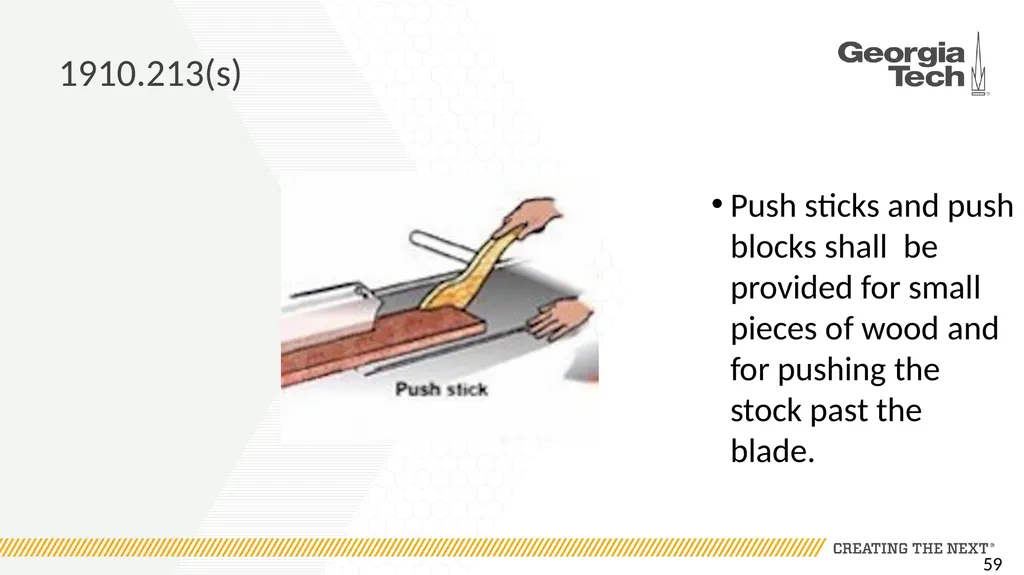
1910.213(s) 59 Push sticks and push blocks shall be provided for small pieces of wood and for pushing the stock past the blade.<br>
60
Questions? 60<br>