2. Tropical storms Global distribution of tropical storms The relationship between tropical storms and general atmospheric circulation Causes of tropical storms and the sequence of their formation and development. The structure and features
"2. Tropical storms Global distribution of tropical" is the property of its rightful owner. Permission is granted to
download and print the materials on this website for personal, non-commercial use only, and to display it
on your personal computer provided you do not modify the materials and that you retain all copyright
notices contained in the materials. By downloading content from our website, you accept the terms of this
agreement.
Presentation Transcript
01
2. Tropical storms Global distribution of tropical storms
The relationship between tropical storms and general atmospheric circulation
Causes of tropical storms and the sequence of their formation and development.
The structure and features of a tropical storm.
How climate change might affect distribution, frequency and intensity of tropical storms<br>
02
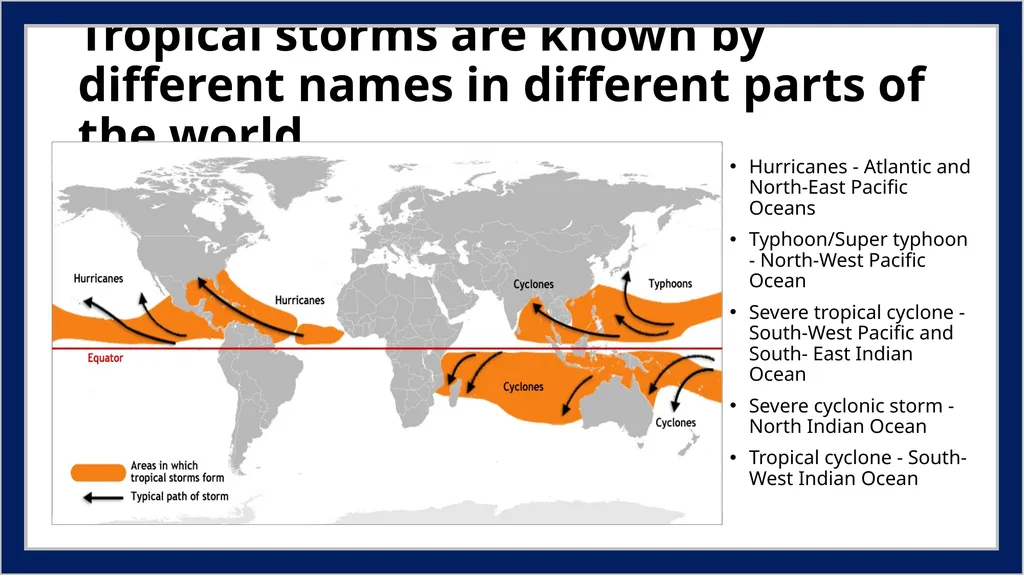
Tropical storms are known by different names in different parts of the world. Hurricanes - Atlantic and North-East Pacific Oceans
Typhoon/Super typhoon - North-West Pacific Ocean
Severe tropical cyclone - South-West Pacific and South- East Indian Ocean
Severe cyclonic storm - North Indian Ocean
Tropical cyclone - South-West Indian Ocean<br>
03
The relationship between tropical storms and general atmospheric circulation In tropical storms winds rotate in an anticlockwise/cyclonic direction in the northern hemisphere and clockwise/anti-cyclonic direction in the southern hemisphere around the low pressure,
This is because of the Coriolis Effect (which deflects the wind direction to the right side of the actual movement of the wind in the northern hemisphere and left side in the southern hemisphere) due to the earth’s rotation.
They form within the Hadley cell of the GAC model.<br>
04
Causes of tropical storms Conditions needed for tropical storm formation
Warm water (sea temperatures at least 26.5oC or higher)
(Late summer and autumn when sea temperatures are the highest.)
Low air pressure
(A thunderstorm is needed to begin with as warm moist air rises)
Tropical winds – Not too strong!
(These spin away from the equator due to the Earth’s spin – the Coriolis effect)
Where are all of these conditions found?
THE TROPICS! (Between 5o and 30o)<br>
05
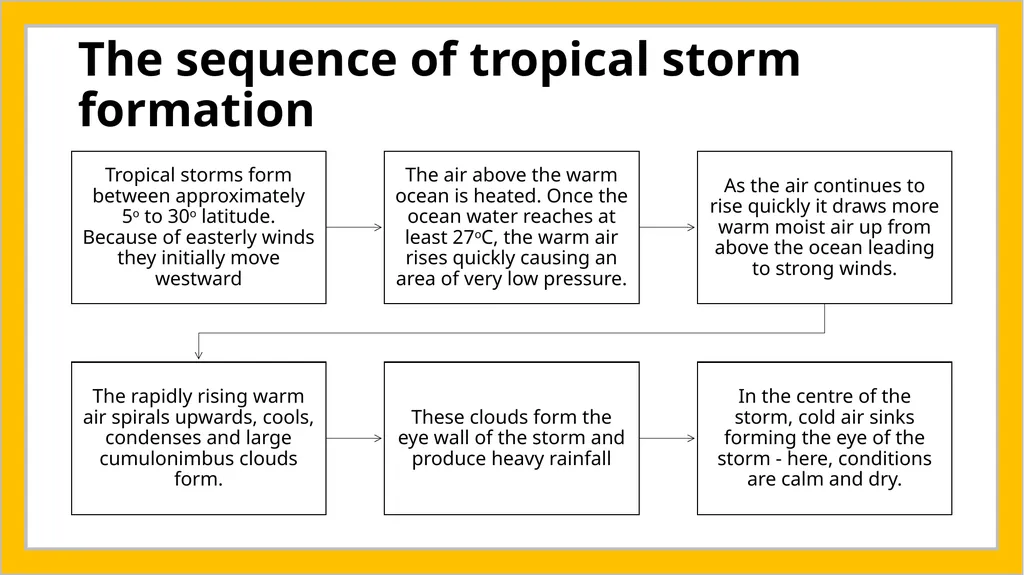
The sequence of tropical storm formation<br>
06
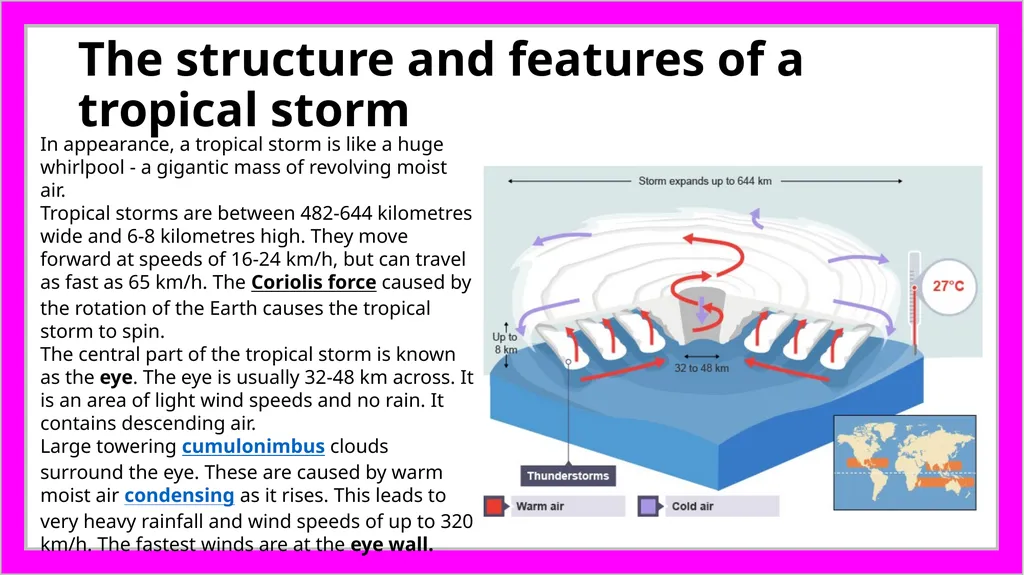
The structure and features of a tropical storm In appearance, a tropical storm is like a huge whirlpool - a gigantic mass of revolving moist air.
Tropical storms are between 482-644 kilometres wide and 6-8 kilometres high. They move forward at speeds of 16-24 km/h, but can travel as fast as 65 km/h. The Coriolis force caused by the rotation of the Earth causes the tropical storm to spin.
The central part of the tropical storm is known as the eye. The eye is usually 32-48 km across. It is an area of light wind speeds and no rain. It contains descending air.
Large towering cumulonimbus clouds surround the eye. These are caused by warm moist air condensing as it rises. This leads to very heavy rainfall and wind speeds of up to 320 km/h. The fastest winds are at the eye wall.<br>
07
The impacts of climate change Climate change could lead to more locations being affected by tropical storms. Warmer seas could cause the source areas (the areas where the storms would form) to extend further north and south of the equator.
It's unclear whether climate change will increase or decrease the number of hurricanes, but climate models predict that their intensity may increase. The following factors may play a part in increasing their impact:
warmer ocean surface temperatures and higher sea levels
wind speeds potentially increasing 2-11 per cent
rainfall rates during these storms are projected to increase by about 20 per cent
In addition, sea level rise is likely to make tropical storms more damaging with increases in coastal flooding and subsequent storm damage along coasts. Low-lying coastal communities where the population density is high and the income level low are most at risk. More people living in coastal communities in the future will mean that more people will be affected.<br>