504s and IEPs Reviewed 12025 AAllison, RNC Upon completion of this presentation learners will Be able to identify differences in a 504 and an IEP (Individual Education Program) in a school setting. Understand how the different programs
"504’s and IEP’s Reviewed 1/2025 AAllison, RNC Upon" is the property of its rightful owner. Permission is granted to
download and print the materials on this website for personal, non-commercial use only, and to display it
on your personal computer provided you do not modify the materials and that you retain all copyright
notices contained in the materials. By downloading content from our website, you accept the terms of this
agreement.
Presentation Transcript
01
504’s and IEP’s Reviewed 1/2025 AAllison, RNC<br>
02
Upon completion of this presentation learners will~
Be able to identify differences in a 504 and an IEP (Individual Education Program) in a school setting.
Understand how the different programs are funded.
Understand their role in the Section 504 evaluation process. Objectives<br>
03
A federal law used to protect the rights of students with disabilities in programs that get financial assistance from the Department of Education.
Requires schools to provide “free appropriate public education” (FAPE) to students with a disability, regardless of the severity or nature of the disability.
FAPE can consist of regular or special education and any related aids or services needed by the student to meet their educational needs to the same level of nondisabled students.
Section 504 is funded through the Americans with Disabilities Act, it is not federally funded. Section 504<br>
04
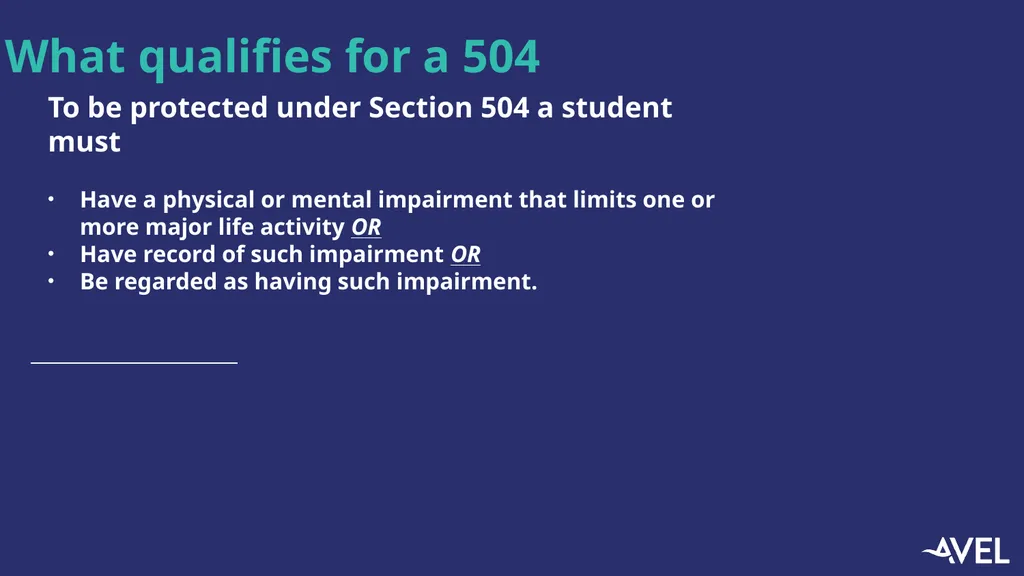
To be protected under Section 504 a student must
Have a physical or mental impairment that limits one or more major life activity OR
Have record of such impairment OR
Be regarded as having such impairment. What qualifies for a 504<br>
05
Physical or Mental Impairment(s) Any disorder or condition, cosmetic disfigurement, or anatomical loss affection one or more body system:
Neurological
Musculoskeletal
Special sense organs
Respiratory
Cardiovascular Reproductive
Digestion
Genito-urinary
Hemic and Lymphatic
Skin
Endocrine
Mental or psychologic disorder<br>
06
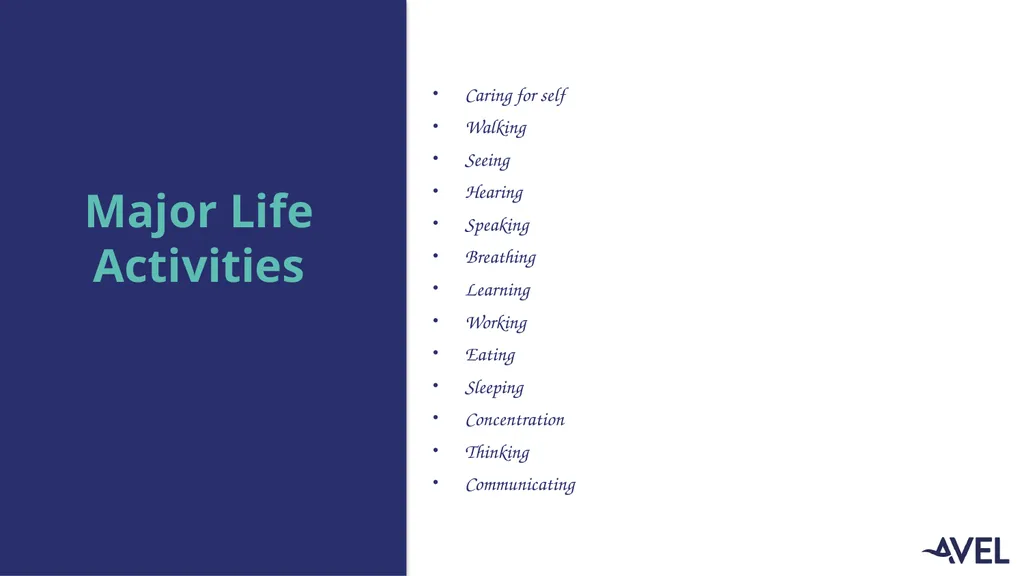
Caring for self
Walking
Seeing
Hearing
Speaking
Breathing
Learning
Working
Eating
Sleeping
Concentration
Thinking
Communicating Major Life Activities<br>
07
Each school has a multi-disciplinary team that determines who is eligible for a 504 evaluation and if they are eligible for services.
The team often includes a nurse (if available), an administrator and additional school staff.
Evaluation requests can be made by a nurse, school staff member or a parent.
Once implemented a 504 should be re-evaluated at least every 3 years to determine continued coverage and to update any condition(s) or accommodations as needed. General Guidelines for Section 504<br>
08
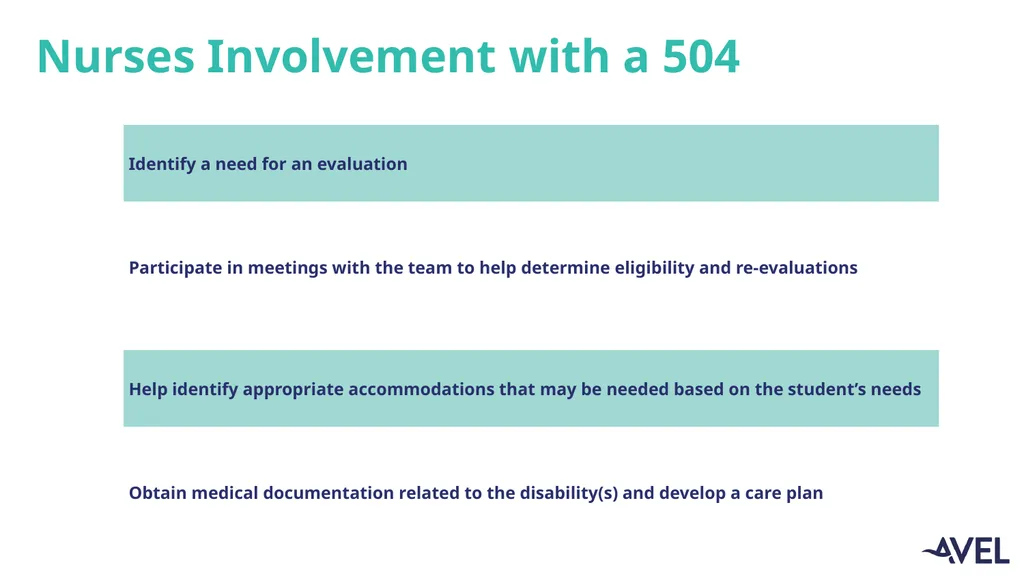
Nurses Involvement with a 504 Identify a need for an evaluation Participate in meetings with the team to help determine eligibility and re-evaluations Help identify appropriate accommodations that may be needed based on the student’s needs Obtain medical documentation related to the disability(s) and develop a care plan<br>
09
Bobby has a history of asthma indicated on his registration form.
The Nurse calls and speaks to mom who confirms he has severe asthma and will have a nebulizer and an inhaler at school.
Mom also shares that he has an asthma action plan from his doctor that indicates he needs to remain indoors for recess if it is below 15 degrees F.
She has a medication form she will bring on the first day of school that states he is to use his inhaler prior to activity and his nebulizer in between if needed.
Due to his asthma, he is eligible for an evaluation for a 504.
Physical impairment: Respiratory
Major Bodily Function: Breathing
The Nurse will obtain the medical documentation from mom and write the care plan and accommodations will be made. Example<br>
10
Individual Education Program (IEP) An IEP can be used for students who have challenges in school that do not have to be related to a disability.
It is a map that lays out a special education program including special instruction, support and services.
IEP’s are funded by the Federal Government, they are part of Special Education Services.<br>
11
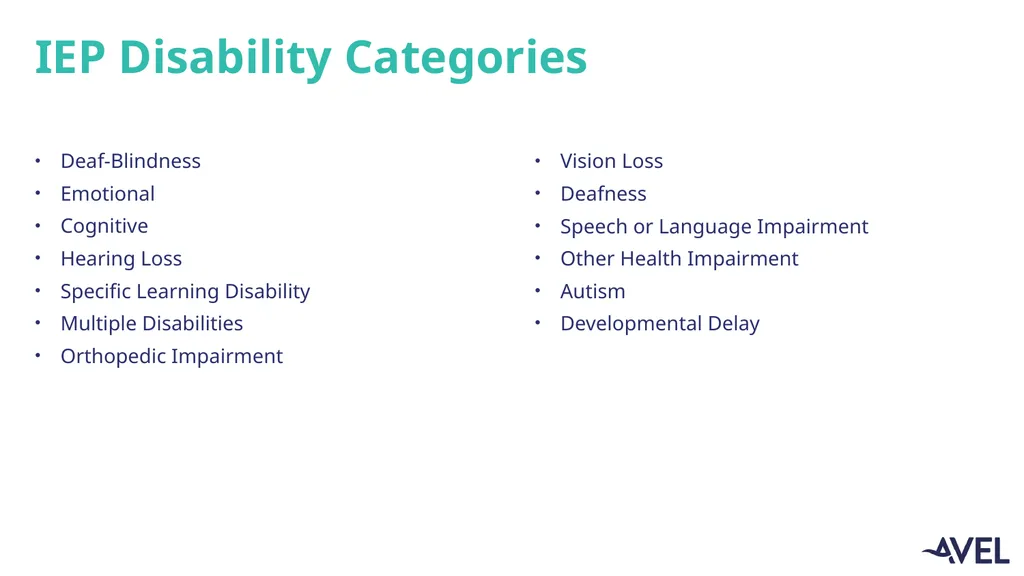
IEP Disability Categories Deaf-Blindness
Emotional
Cognitive
Hearing Loss
Specific Learning Disability
Multiple Disabilities
Orthopedic Impairment Vision Loss
Deafness
Speech or Language Impairment
Other Health Impairment
Autism
Developmental Delay<br>
12
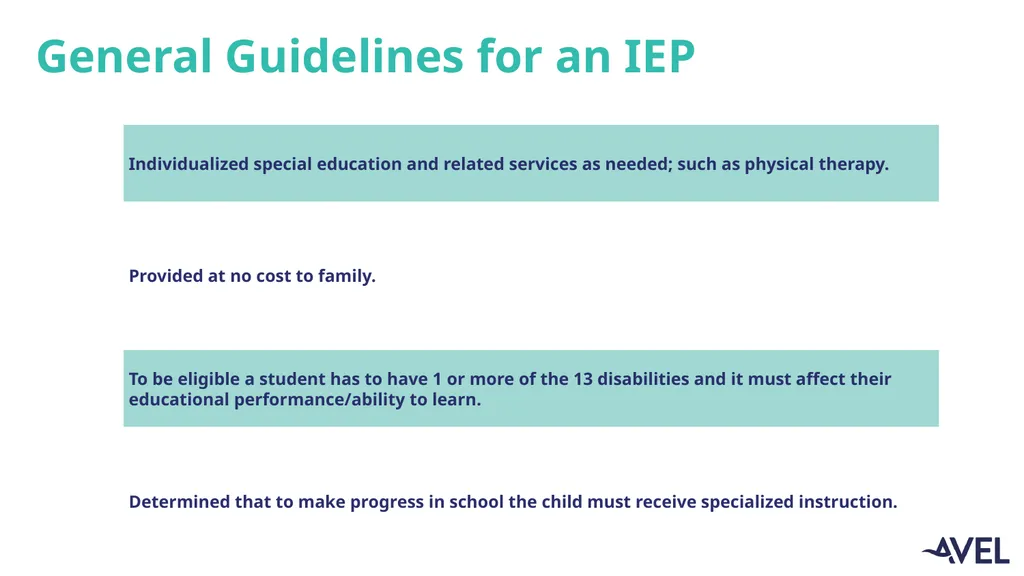
General Guidelines for an IEP Individualized special education and related services as needed; such as physical therapy. Provided at no cost to family. To be eligible a student has to have 1 or more of the 13 disabilities and it must affect their educational performance/ability to learn. Determined that to make progress in school the child must receive specialized instruction.<br>
13
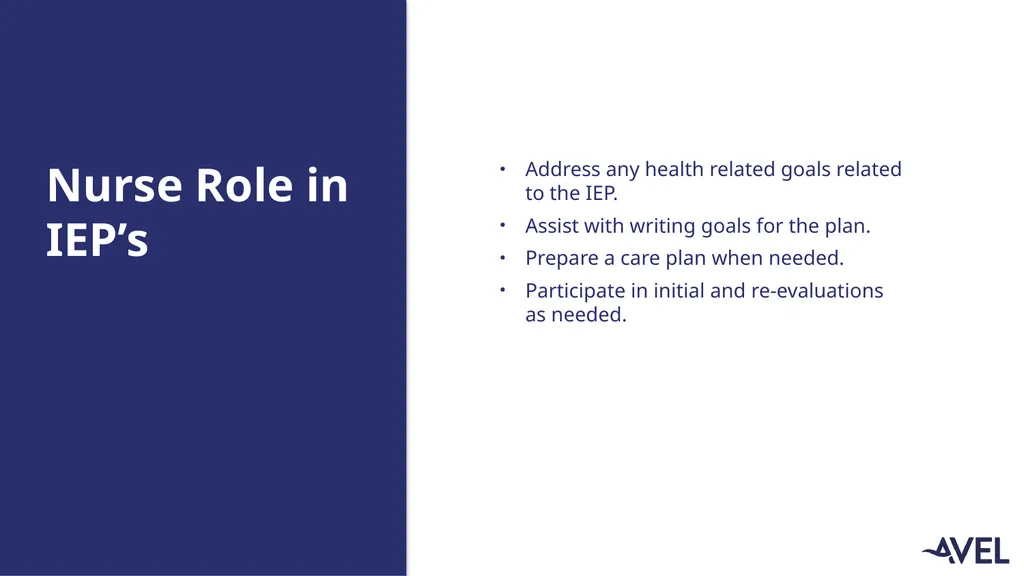
Nurse Role in IEP’s Address any health related goals related to the IEP.
Assist with writing goals for the plan.
Prepare a care plan when needed.
Participate in initial and re-evaluations as needed.<br>
14
Protecting Students With Disabilities: Frequently Asked Questions About Section 504 and the Education of Children with Disabilities. Website: https://www2.ed.gov/about/offices/list/ocr/504faq.html
South Dakota Department of Education: Eligibility Guide. August 2022. Website: https://doe.sd.gov/sped/documents/Eligibility.pdf
What is an IEP? Understood.org. Website: https://www.understood.org/en/articles/what-is-an-iep References<br>