
A youth voice and participation resource pack for
MS
Published · 49 slides · 0 views

1 / 1



Description
A youth voice and participation resource pack for practitioners working with children and young people across school and community settings Empowering Youth Voices This resource has been developed from the original Social Justice
Related Topics
Share
Embed code
Download this presentation From Below
"A youth voice and participation resource pack for" is the property of its rightful owner. Permission is granted to download and print the materials on this website for personal, non-commercial use only, and to display it on your personal computer provided you do not modify the materials and that you retain all copyright notices contained in the materials. By downloading content from our website, you accept the terms of this agreement.
Presentation Transcript
01
A youth voice and participation resource pack for practitioners working with children and young people across school and community settings Empowering Youth Voices<br>
02
This resource has been developed from the original Social Justice Ambassadors Toolkit created by Stirling Youth Participation Team over a number of years.
This was developed and co-designed over time, with previous young people from Stirling Youth Forum, alongside a whole council approach that was crucial to its success.
The original Toolkit then shaped the successful Social Justice Ambassadors programme within Stirling Council.
This resource builds upon the original core concepts of peer-research, empowerment and skills development.
Thank you to the Stirling Youth Participation staff and young people for their guidance, support and challenge throughout. Acknowledgements
with thanks to Stirling Council For Practitioners<br>
03
Forth Valley and West Lothian
Regional Journey The Toolkit approach and accompanying implementation guidance have been developed from the Forth Valley and West Lothian Regional Youth Voice model.
This model demonstrated that meaningful youth voice can be facilitated across a wide range of settings, with the creation of the charter allowing children and young people to outline the principles and methods adults should employ when consulting with them.
Thank you to the children, young people and staff involved in the Forth Valley and West Lothian Regional Youth Voice Development Group. For Practitioners<br>
04
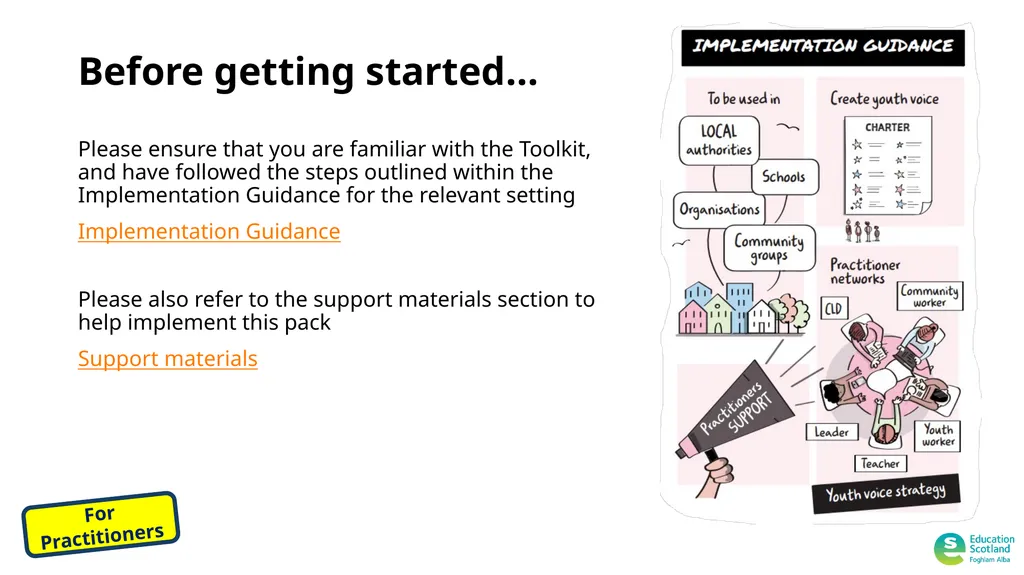
Before getting started… Please ensure that you are familiar with the Toolkit, and have followed the steps outlined within the Implementation Guidance for the relevant setting
Implementation Guidance
Please also refer to the support materials section to help implement this pack
Support materials For Practitioners<br>
Implementation Guidance
Please also refer to the support materials section to help implement this pack
Support materials For Practitioners<br>
05
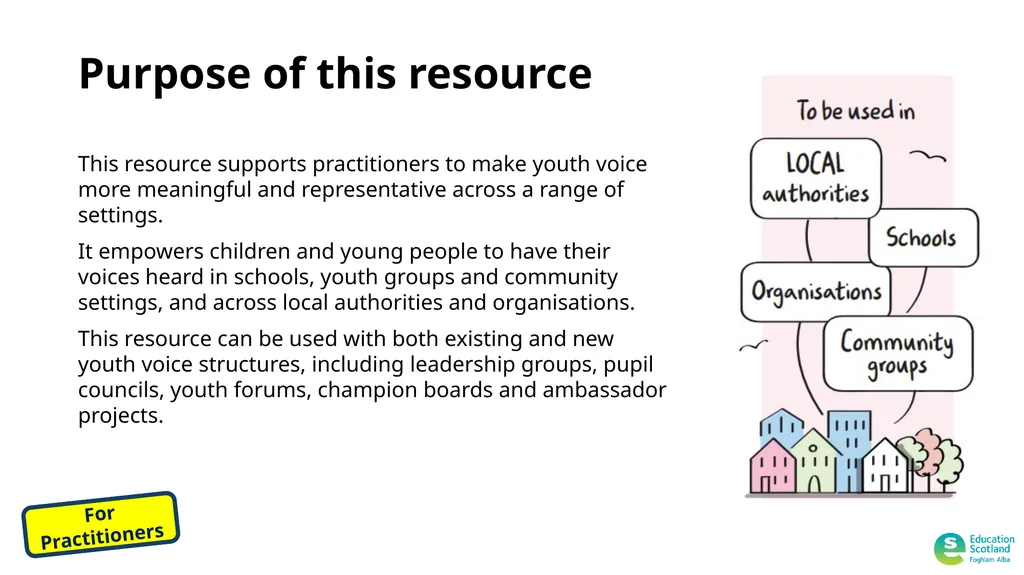
Purpose of this resource This resource supports practitioners to make youth voice more meaningful and representative across a range of settings.
It empowers children and young people to have their voices heard in schools, youth groups and community settings, and across local authorities and organisations.
This resource can be used with both existing and new youth voice structures, including leadership groups, pupil councils, youth forums, champion boards and ambassador projects. For Practitioners<br>
06
Using this resource Practitioners can adapt this resource as required, as some slides may not suit all groups. Facilitator guidance and activity notes are included in the notes section of each slide.
This resource supports children and young people to learn about youth voice and children's rights then undertake peer research on any theme.
Themes could include learning and teaching, attendance, outdoor learning, mental health and wellbeing etc.
If the theme is already chosen, please ensure children are well informed to participate fully when it comes to that part of the resource. There is additional guidance on this in the Support Materials. For Practitioners<br>
07
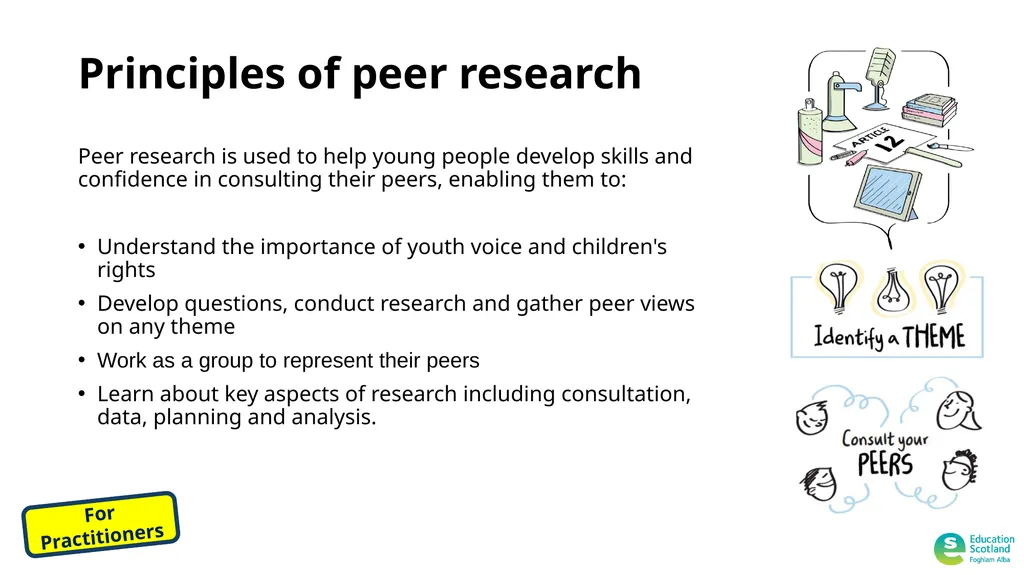
Principles of peer research Peer research is used to help young people develop skills and confidence in consulting their peers, enabling them to:
Understand the importance of youth voice and children's rights
Develop questions, conduct research and gather peer views on any theme
Work as a group to represent their peers
Learn about key aspects of research including consultation, data, planning and analysis. For Practitioners<br>
Understand the importance of youth voice and children's rights
Develop questions, conduct research and gather peer views on any theme
Work as a group to represent their peers
Learn about key aspects of research including consultation, data, planning and analysis. For Practitioners<br>
08
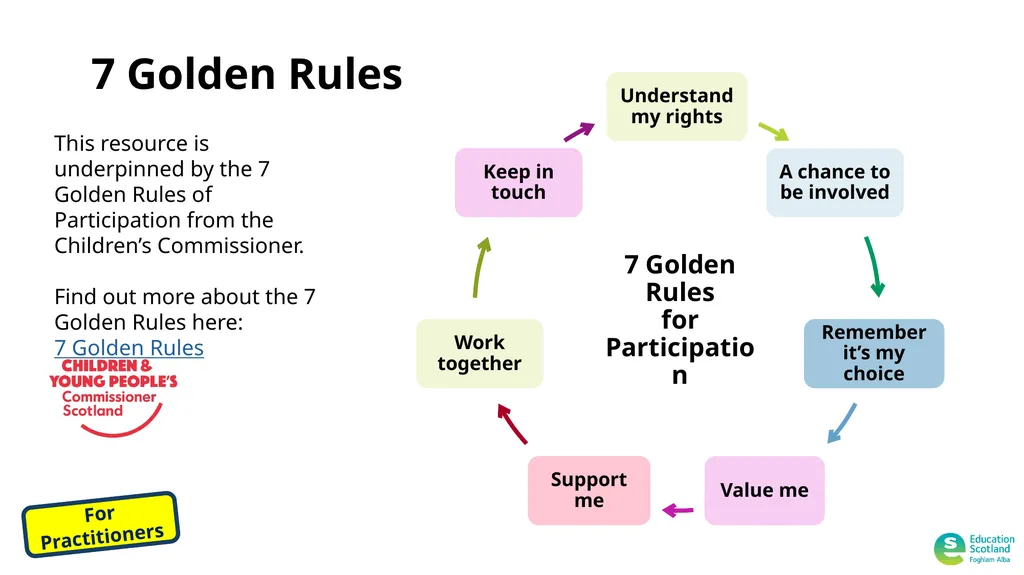
7 Golden Rules
for Participation This resource is underpinned by the 7 Golden Rules of Participation from the Children’s Commissioner.
Find out more about the 7 Golden Rules here:
7 Golden Rules 7 Golden Rules For Practitioners<br>
Find out more about the 7 Golden Rules here:
7 Golden Rules 7 Golden Rules For Practitioners<br>
09
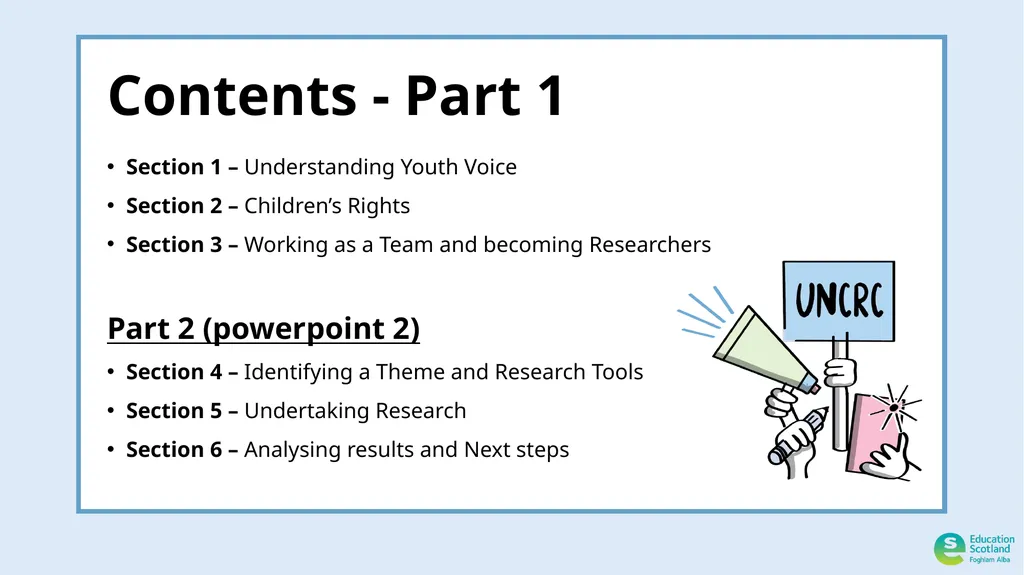
Contents - Part 1 Section 1 – Understanding Youth Voice
Section 2 – Children’s Rights
Section 3 – Working as a Team and becoming Researchers
Part 2 (powerpoint 2)
Section 4 – Identifying a Theme and Research Tools
Section 5 – Undertaking Research
Section 6 – Analysing results and Next steps<br>
Section 2 – Children’s Rights
Section 3 – Working as a Team and becoming Researchers
Part 2 (powerpoint 2)
Section 4 – Identifying a Theme and Research Tools
Section 5 – Undertaking Research
Section 6 – Analysing results and Next steps<br>
10
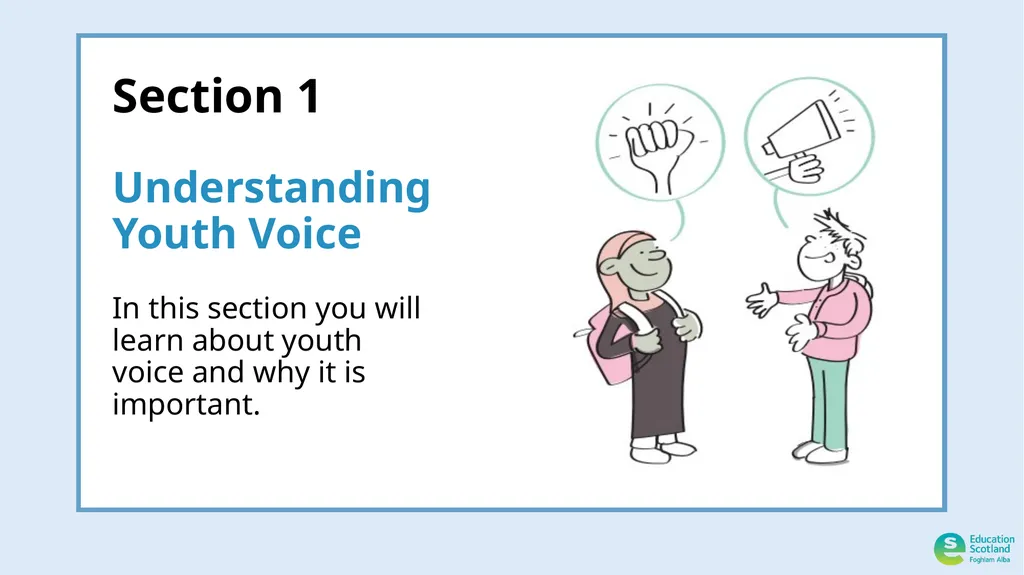
Understanding Youth Voice In this section you will learn about youth voice and why it is important. Section 1<br>
11
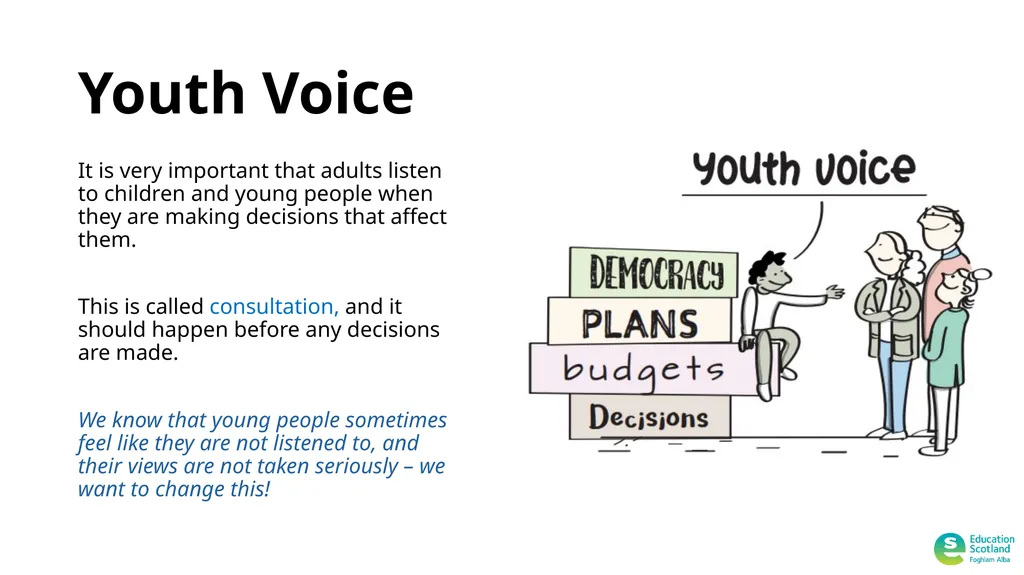
Youth Voice It is very important that adults listen to children and young people when they are making decisions that affect them.
This is called consultation, and it should happen before any decisions are made.
We know that young people sometimes feel like they are not listened to, and their views are not taken seriously – we want to change this!<br>
This is called consultation, and it should happen before any decisions are made.
We know that young people sometimes feel like they are not listened to, and their views are not taken seriously – we want to change this!<br>
12
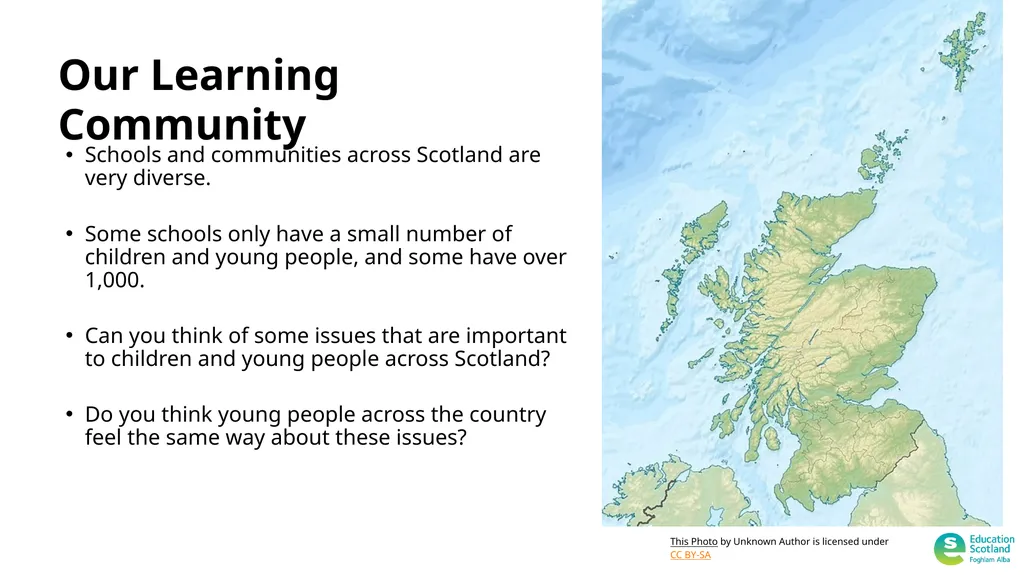
Our Learning Community Schools and communities across Scotland are very diverse.
Some schools only have a small number of children and young people, and some have over 1,000.
Can you think of some issues that are important to children and young people across Scotland?
Do you think young people across the country feel the same way about these issues? This Photo by Unknown Author is licensed under CC BY-SA<br>
13
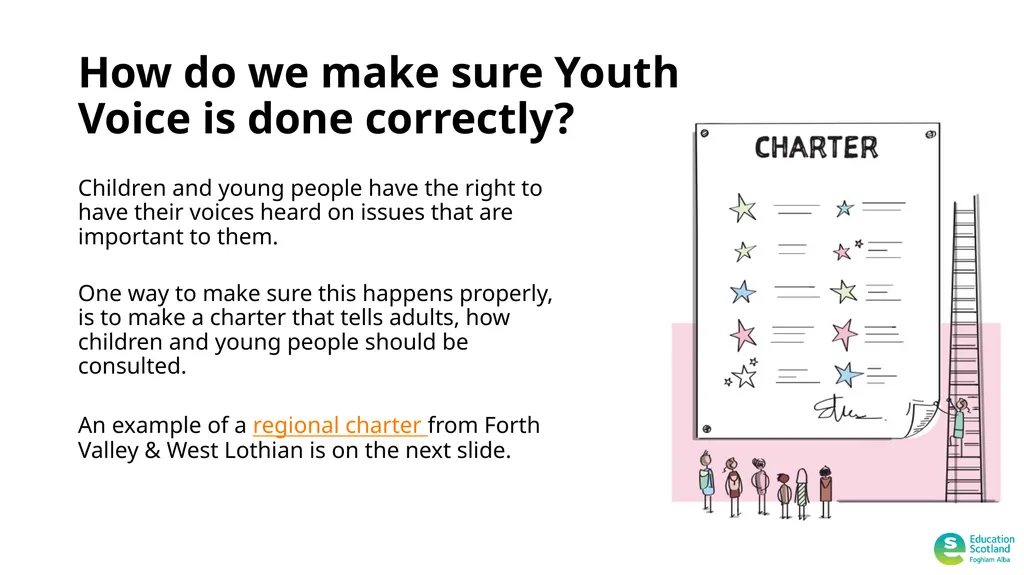
How do we make sure Youth Voice is done correctly? Children and young people have the right to have their voices heard on issues that are important to them.
One way to make sure this happens properly, is to make a charter that tells adults, how children and young people should be consulted.
An example of a regional charter from Forth Valley & West Lothian is on the next slide.<br>
One way to make sure this happens properly, is to make a charter that tells adults, how children and young people should be consulted.
An example of a regional charter from Forth Valley & West Lothian is on the next slide.<br>
14
Forth Valley and West Lothian Youth Voice Charter<br>
15
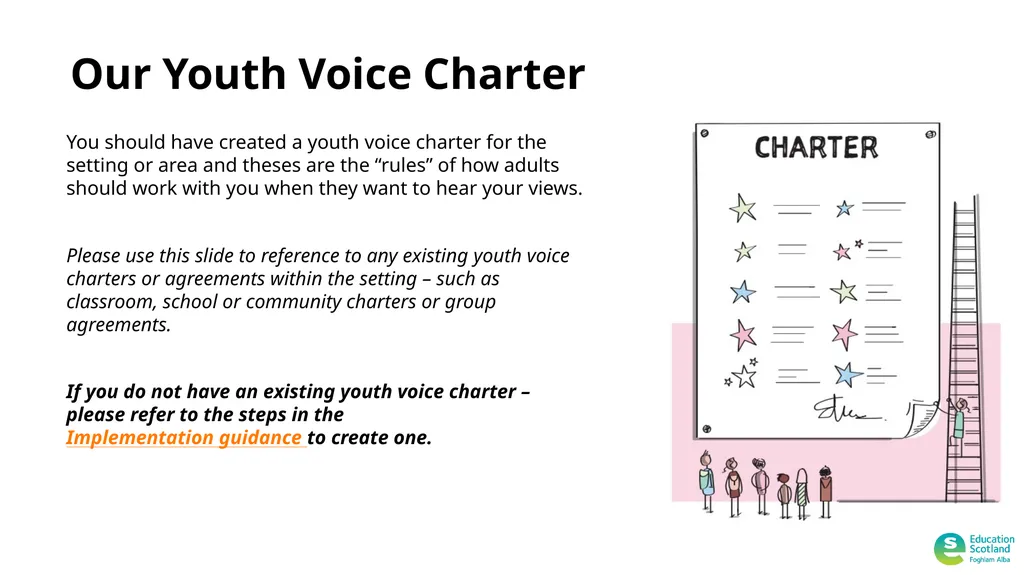
Our Youth Voice Charter You should have created a youth voice charter for the setting or area and theses are the “rules” of how adults should work with you when they want to hear your views.
Please use this slide to reference to any existing youth voice charters or agreements within the setting – such as classroom, school or community charters or group agreements.
If you do not have an existing youth voice charter – please refer to the steps in the Implementation guidance to create one.<br>
16
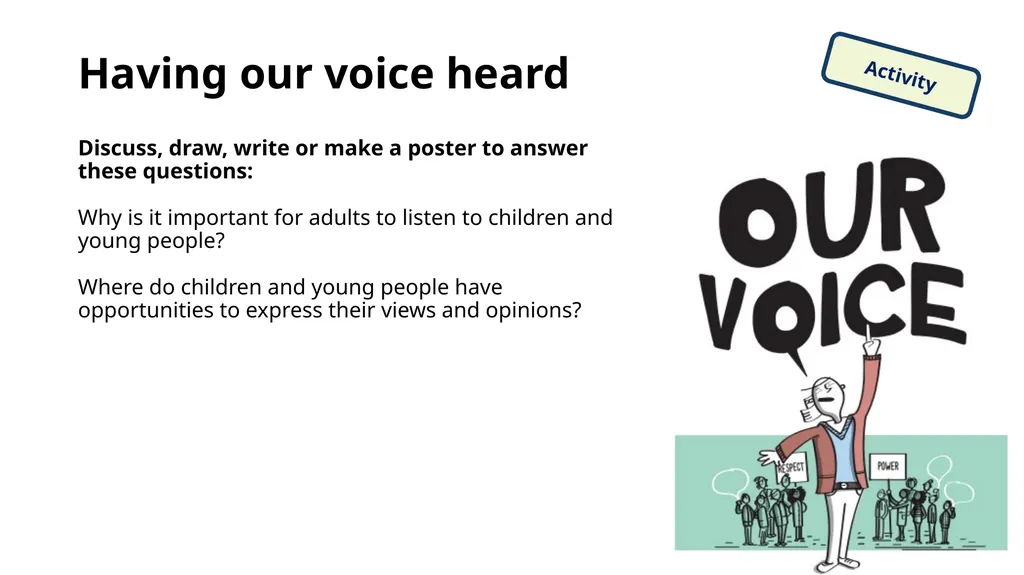
Having our voice heard Discuss, draw, write or make a poster to answer these questions:
Why is it important for adults to listen to children and young people?
Where do children and young people have opportunities to express their views and opinions? Activity<br>
Why is it important for adults to listen to children and young people?
Where do children and young people have opportunities to express their views and opinions? Activity<br>
17
Dear Decision Makers Video… Video from Scottish Youth Parliament<br>
18
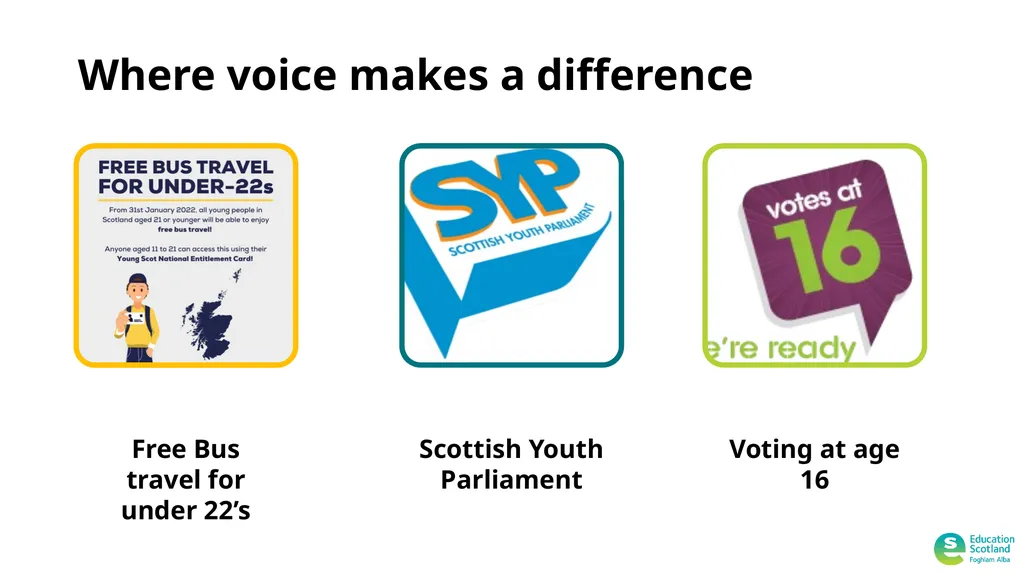
Where voice makes a difference Free Bus travel for under 22’s Scottish Youth Parliament Voting at age 16<br>
19
Further Resources for Section 1 ‘The Right Way’ is a project run by the Scottish Youth Parliament (SYP) and funded by the Scottish Government’s Children’s Rights Unit.
It aims to support and challenge officials and decision-makers, as duty bearers, to work to ensure young people’s Article 12 right is respected. For Practitioners<br>
It aims to support and challenge officials and decision-makers, as duty bearers, to work to ensure young people’s Article 12 right is respected. For Practitioners<br>
20
Section 2
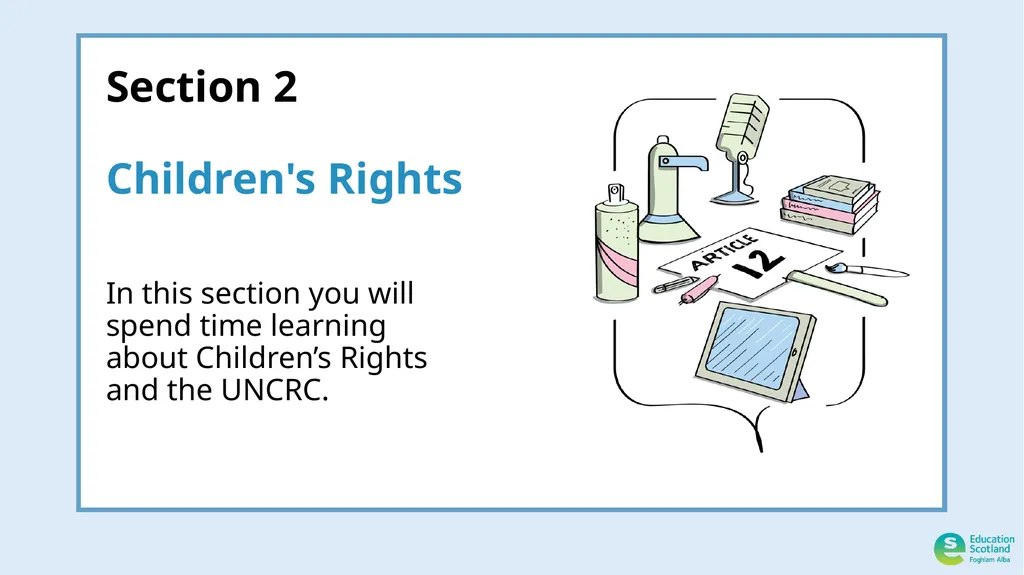
Children's Rights In this section you will spend time learning about Children’s Rights and the UNCRC.<br>
21
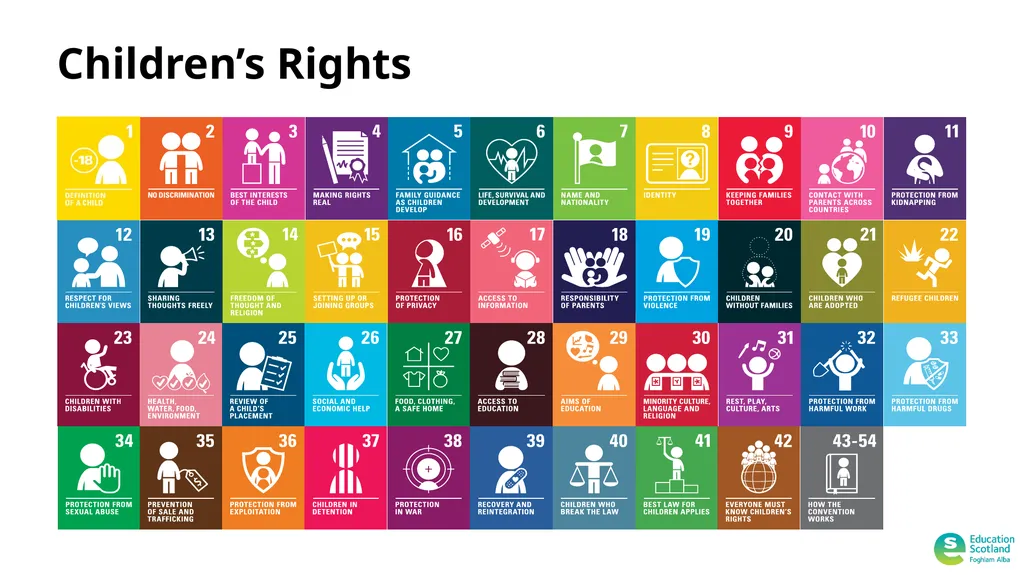
Children’s Rights<br>
22
Children’s Rights We want all adults to make sure that your views and opinions are considered and taken seriously. It is very important that young people are listened to in all matters that affect them – it is your right! Video from Scottish Government - Children’s Rights and the UNCRC in Scotland<br>
23
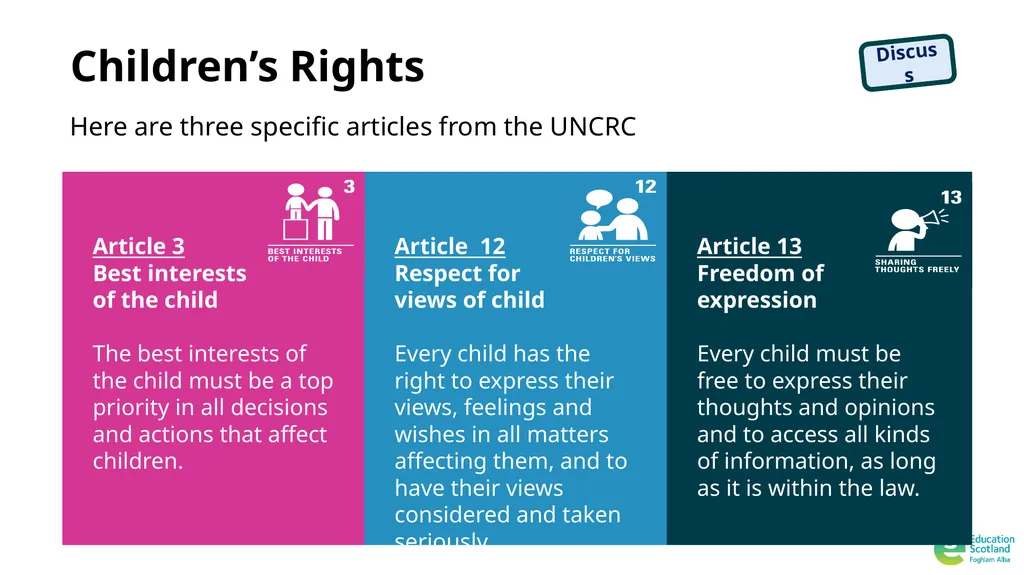
Article 3
Best interests
of the child
The best interests of the child must be a top priority in all decisions and actions that affect children. Article 12
Respect for
views of child
Every child has the right to express their views, feelings and wishes in all matters affecting them, and to have their views considered and taken seriously. Article 13
Freedom of
expression
Every child must be free to express their thoughts and opinions and to access all kinds of information, as long as it is within the law. Here are three specific articles from the UNCRC Children’s Rights Discuss<br>
24
Why are rights important? Discuss, draw, write or make a poster to answer this question:
Why are rights important? Activity<br>
Why are rights important? Activity<br>
25
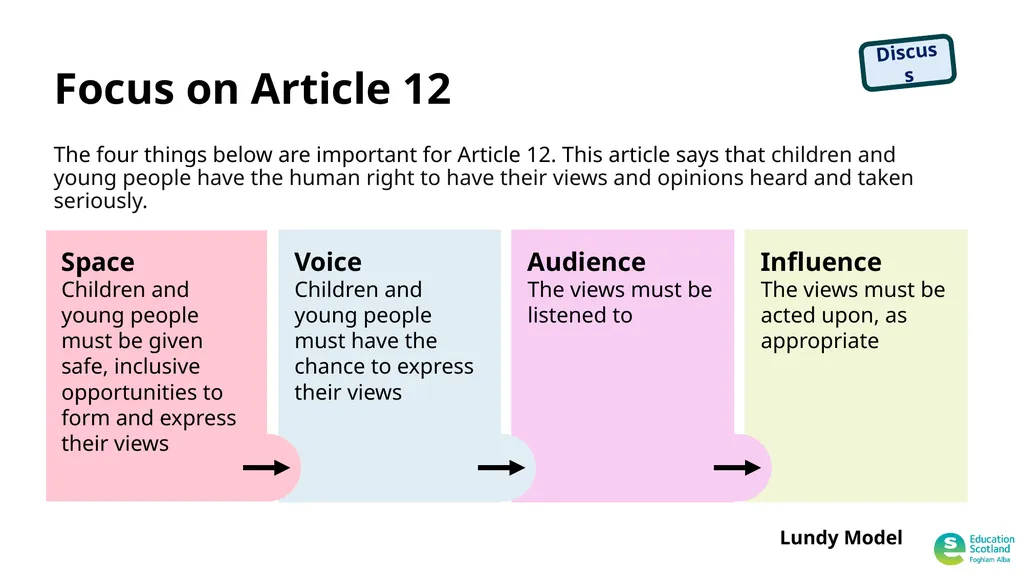
Focus on Article 12 The four things below are important for Article 12. This article says that children and young people have the human right to have their views and opinions heard and taken seriously. Lundy Model Space
Children and young people must be given safe, inclusive opportunities to form and express their views Voice
Children and young people must have the chance to express their views Audience
The views must be listened to Influence
The views must be acted upon, as appropriate Discuss<br>
Children and young people must be given safe, inclusive opportunities to form and express their views Voice
Children and young people must have the chance to express their views Audience
The views must be listened to Influence
The views must be acted upon, as appropriate Discuss<br>
26
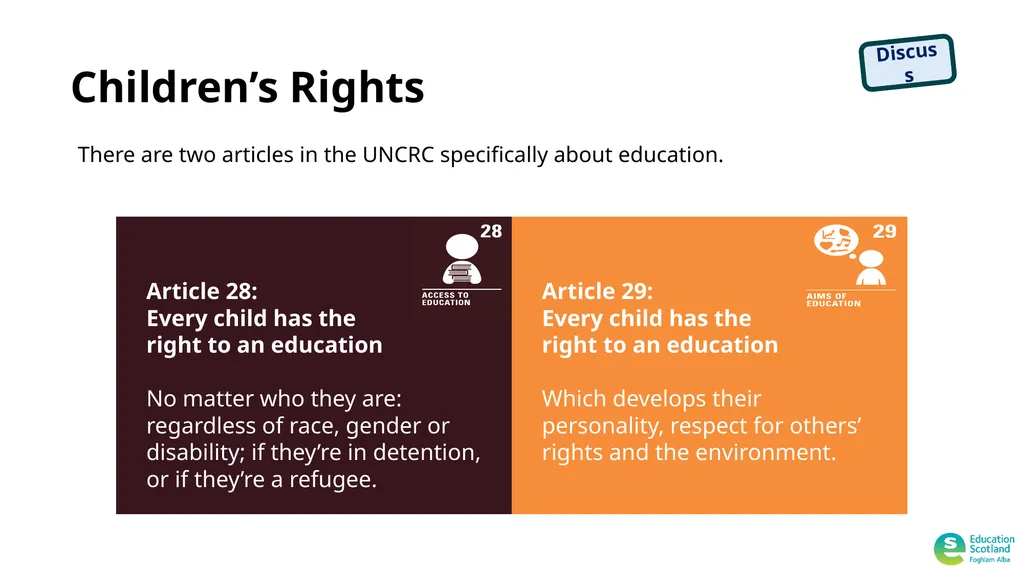
Children’s Rights There are two articles in the UNCRC specifically about education. Article 28:
Every child has the
right to an education
No matter who they are: regardless of race, gender or disability; if they’re in detention, or if they’re a refugee. Article 29:
Every child has the
right to an education
Which develops their personality, respect for others’ rights and the environment. Discuss<br>
Every child has the
right to an education
No matter who they are: regardless of race, gender or disability; if they’re in detention, or if they’re a refugee. Article 29:
Every child has the
right to an education
Which develops their personality, respect for others’ rights and the environment. Discuss<br>
27
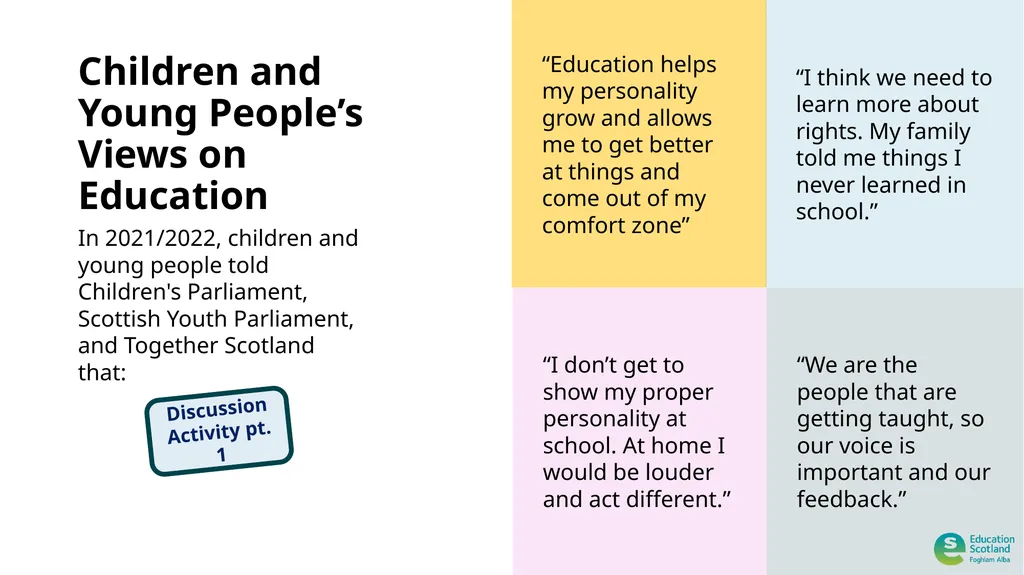
Children and Young People’s Views on Education In 2021/2022, children and young people told Children's Parliament, Scottish Youth Parliament, and Together Scotland that: Discussion Activity pt. 1 “Education helps my personality grow and allows me to get better at things and come out of my comfort zone” “We are the people that are getting taught, so our voice is important and our feedback.” “I don’t get to show my proper personality at school. At home I would be louder and act different.” “I think we need to learn more about rights. My family told me things I never learned in school.”<br>
28
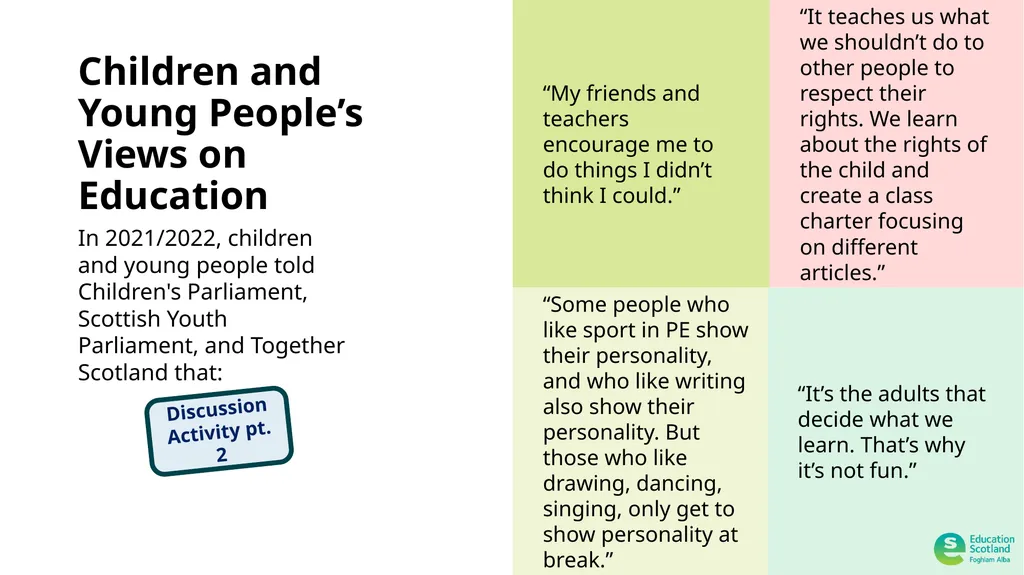
Children and Young People’s Views on Education In 2021/2022, children and young people told Children's Parliament, Scottish Youth Parliament, and Together Scotland that: “My friends and teachers encourage me to do things I didn’t think I could.” “It’s the adults that decide what we learn. That’s why it’s not fun.” “Some people who like sport in PE show their personality, and who like writing also show their personality. But those who like drawing, dancing, singing, only get to show personality at break.” “It teaches us what we shouldn’t do to other people to respect their rights. We learn about the rights of the child and create a class charter focusing on different articles.” Discussion Activity pt. 2<br>
29
Children's Rights: what (not) to do Watch this video from Children's Parliament Investigates…
How Professionals Make Rights Real<br>
How Professionals Make Rights Real<br>
30
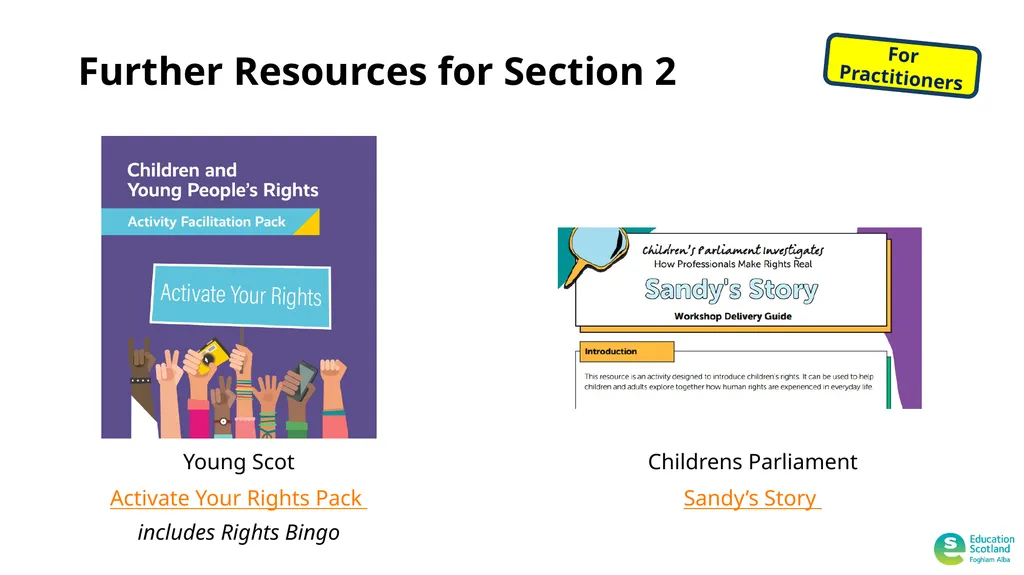
Further Resources for Section 2 Young Scot
Activate Your Rights Pack
includes Rights Bingo Childrens Parliament
Sandy’s Story For Practitioners<br>
Activate Your Rights Pack
includes Rights Bingo Childrens Parliament
Sandy’s Story For Practitioners<br>
31
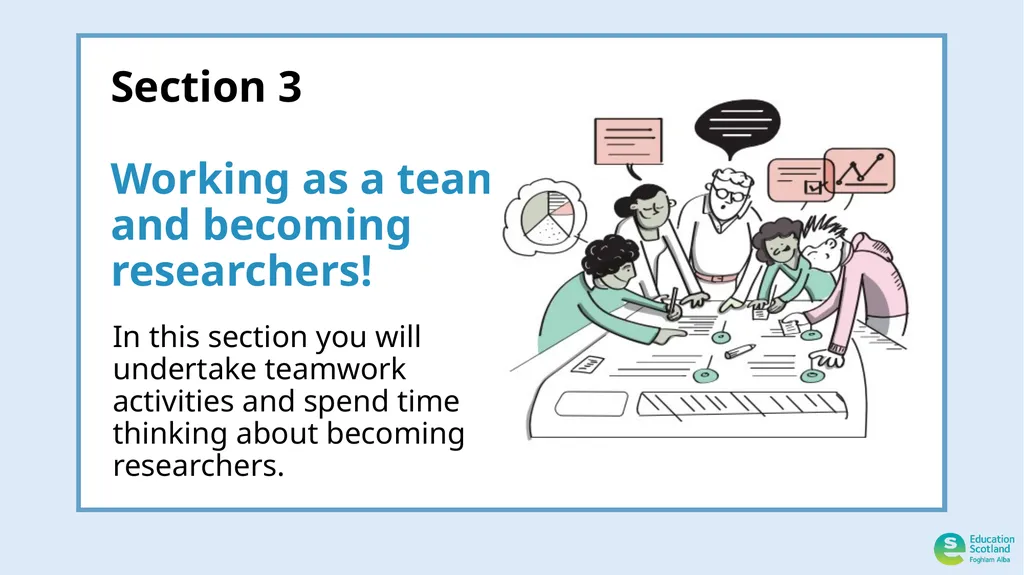
Section 3
Working as a team and becoming researchers! In this section you will undertake teamwork activities and spend time thinking about becoming researchers.<br>
32
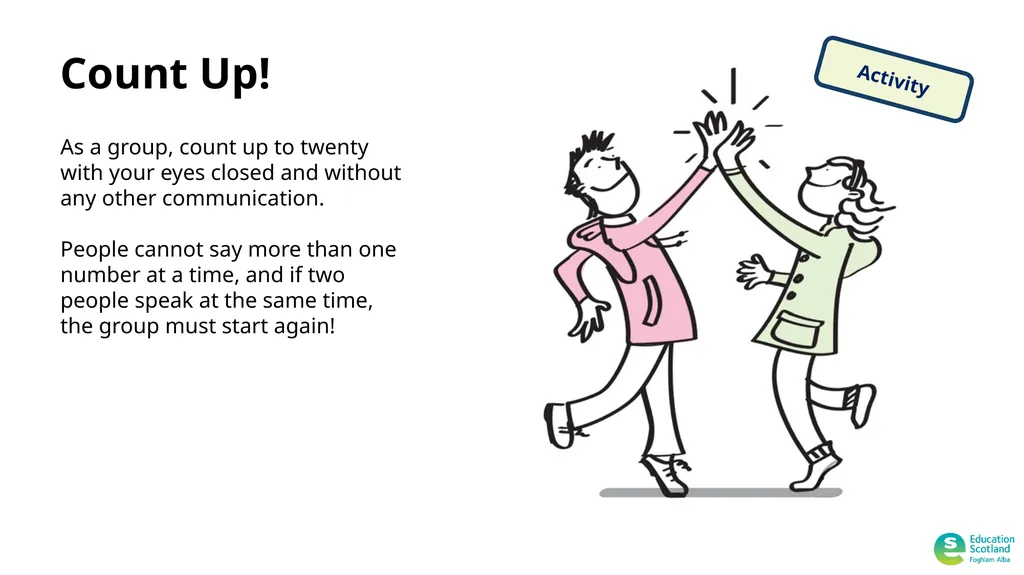
Count Up! As a group, count up to twenty with your eyes closed and without any other communication.
People cannot say more than one number at a time, and if two people speak at the same time, the group must start again! Activity<br>
People cannot say more than one number at a time, and if two people speak at the same time, the group must start again! Activity<br>
33
Would you rather? Activity<br>
34
Open Fist Activity Finding things that we have in common as a group! Activity<br>
35
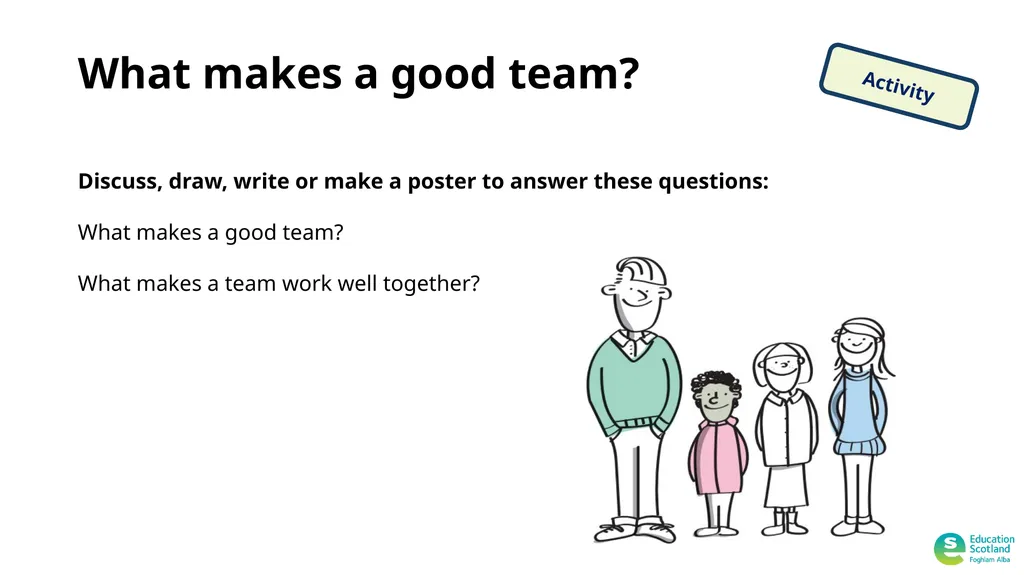
What makes a good team? Discuss, draw, write or make a poster to answer these questions:
What makes a good team?
What makes a team work well together? Activity<br>
What makes a good team?
What makes a team work well together? Activity<br>
36
Recycle Towers Work in teams to build the tallest tower possible, using only the recycled materials. Activity<br>
37
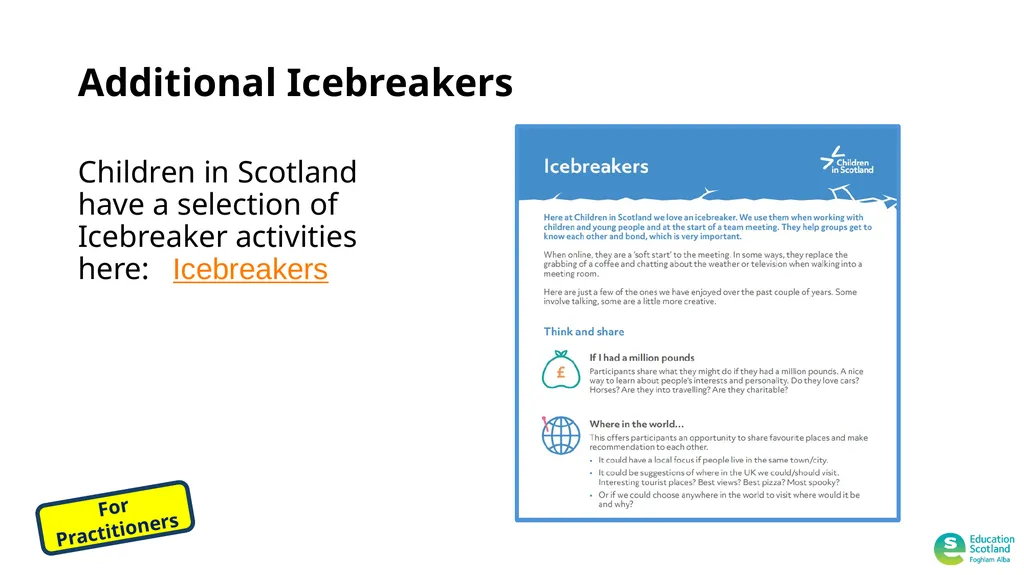
Additional Icebreakers Children in Scotland have a selection of Icebreaker activities here: Icebreakers For Practitioners<br>
38
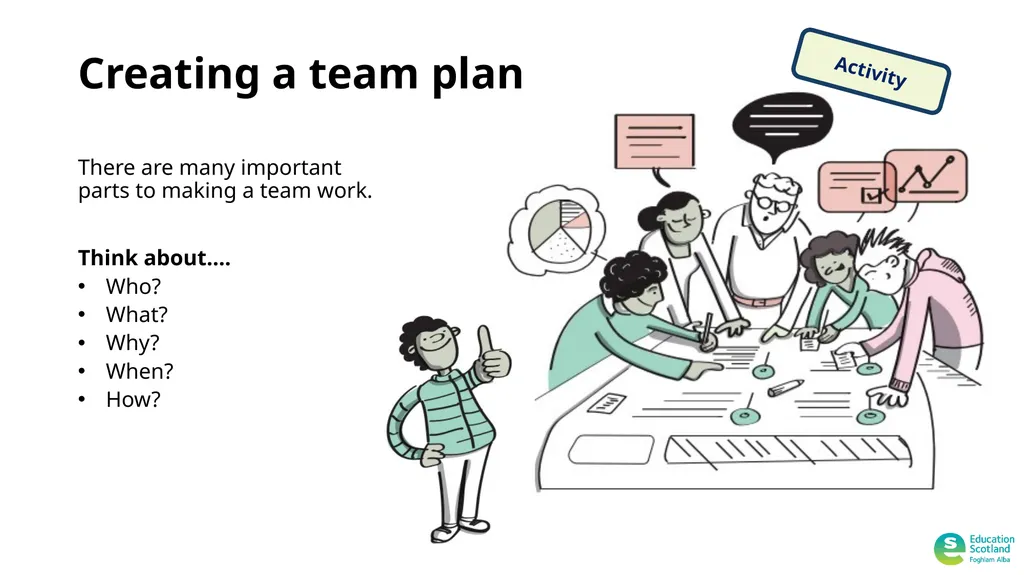
Creating a team plan There are many important parts to making a team work.
Think about….
Who?
What?
Why?
When?
How? Activity<br>
Think about….
Who?
What?
Why?
When?
How? Activity<br>
39
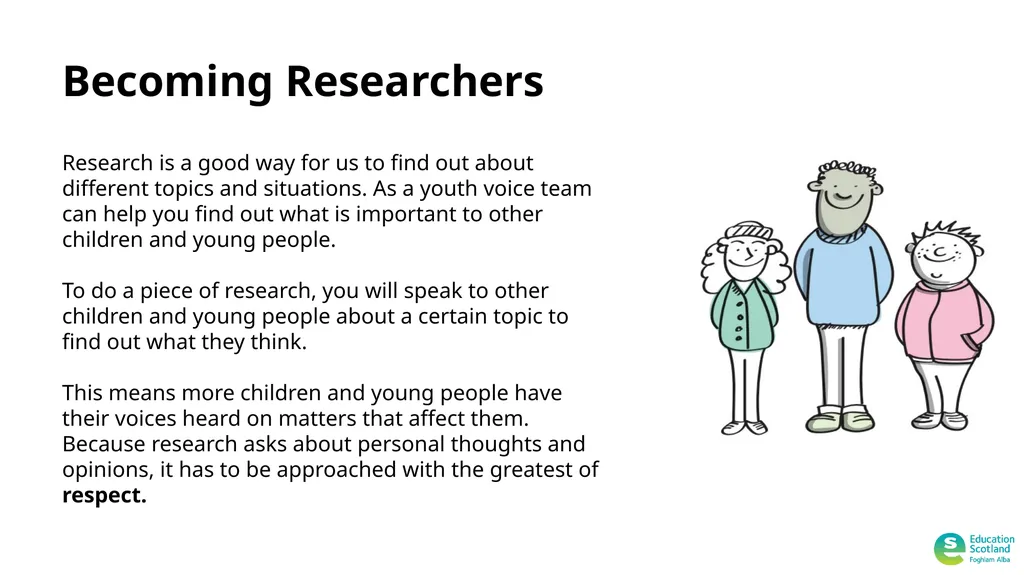
Becoming Researchers Research is a good way for us to find out about different topics and situations. As a youth voice team can help you find out what is important to other children and young people.
To do a piece of research, you will speak to other children and young people about a certain topic to find out what they think.
This means more children and young people have their voices heard on matters that affect them. Because research asks about personal thoughts and opinions, it has to be approached with the greatest of respect.<br>
40
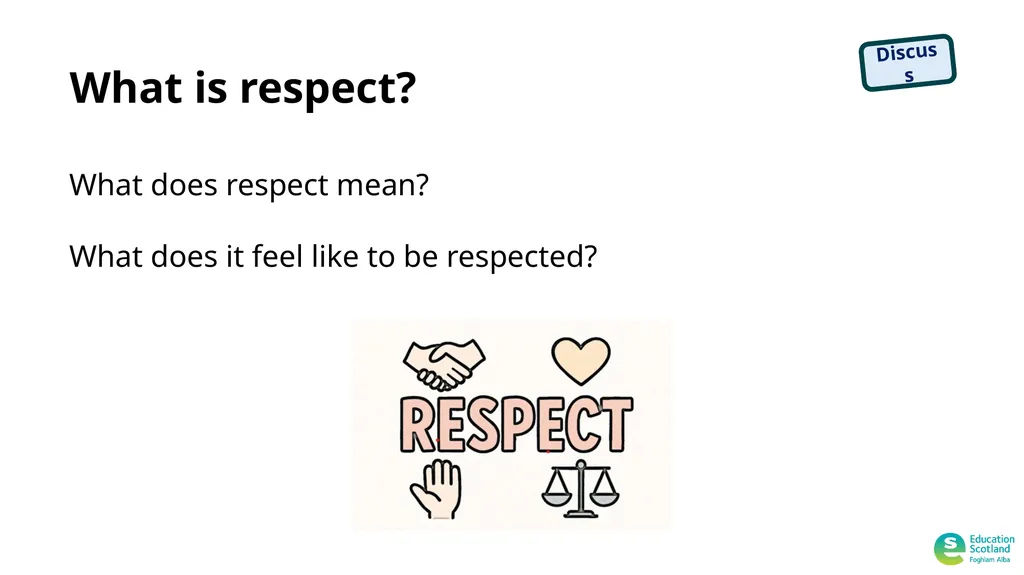
What is respect? What does respect mean?
What does it feel like to be respected? Discuss<br>
What does it feel like to be respected? Discuss<br>
41
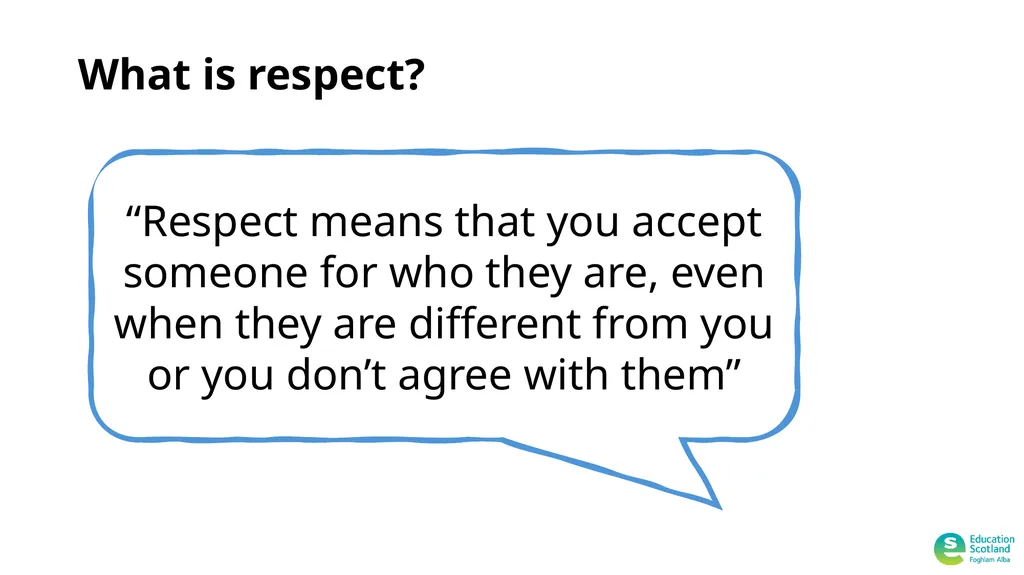
What is respect? “Respect means that you accept someone for who they are, even when they are different from you or you don’t agree with them”<br>
42
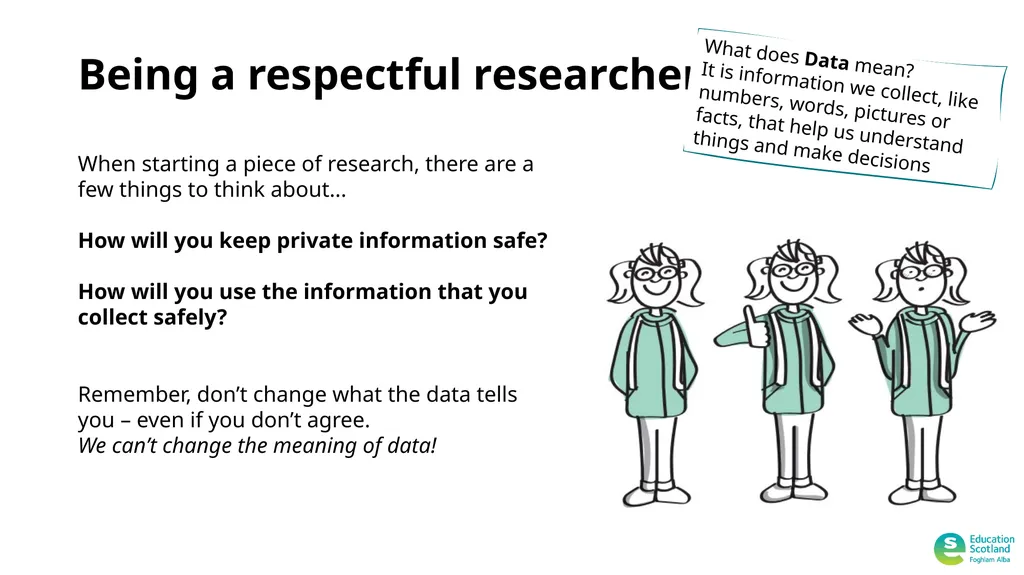
Being a respectful researcher When starting a piece of research, there are a few things to think about...
How will you keep private information safe?
How will you use the information that you collect safely?
Remember, don’t change what the data tells you – even if you don’t agree.
We can’t change the meaning of data! What does Data mean?
It is information we collect, like numbers, words, pictures or facts, that help us understand things and make decisions<br>
43
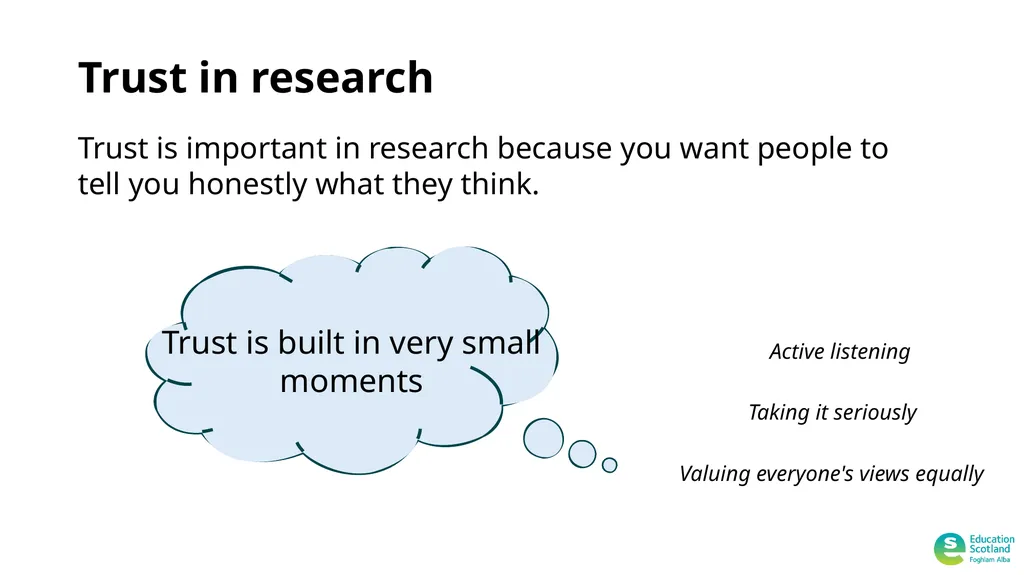
Trust in research Trust is important in research because you want people to tell you honestly what they think. Active listening Taking it seriously Valuing everyone's views equally Trust is built in very small moments<br>
44
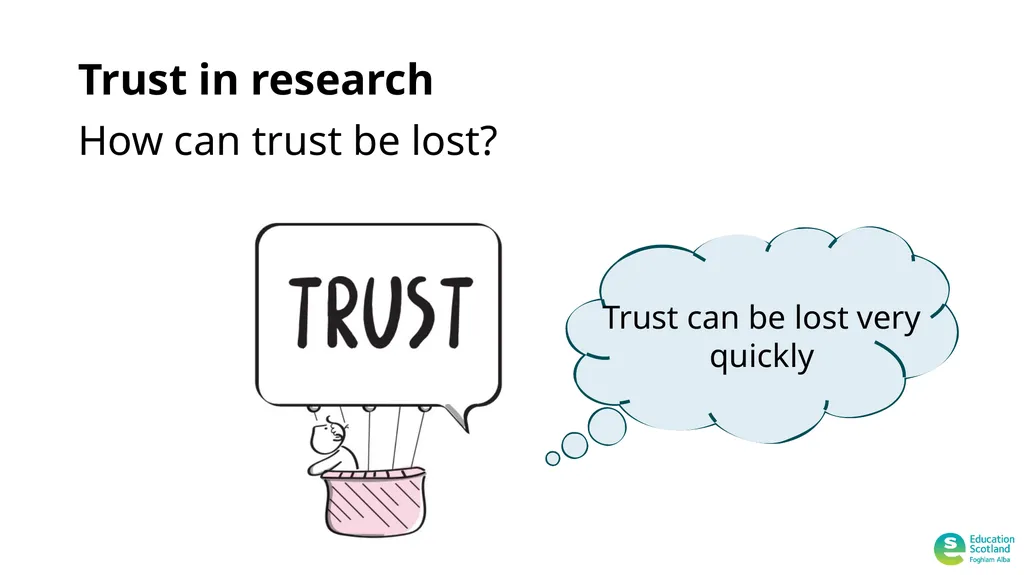
Trust in research How can trust be lost? Trust can be lost very quickly<br>
45
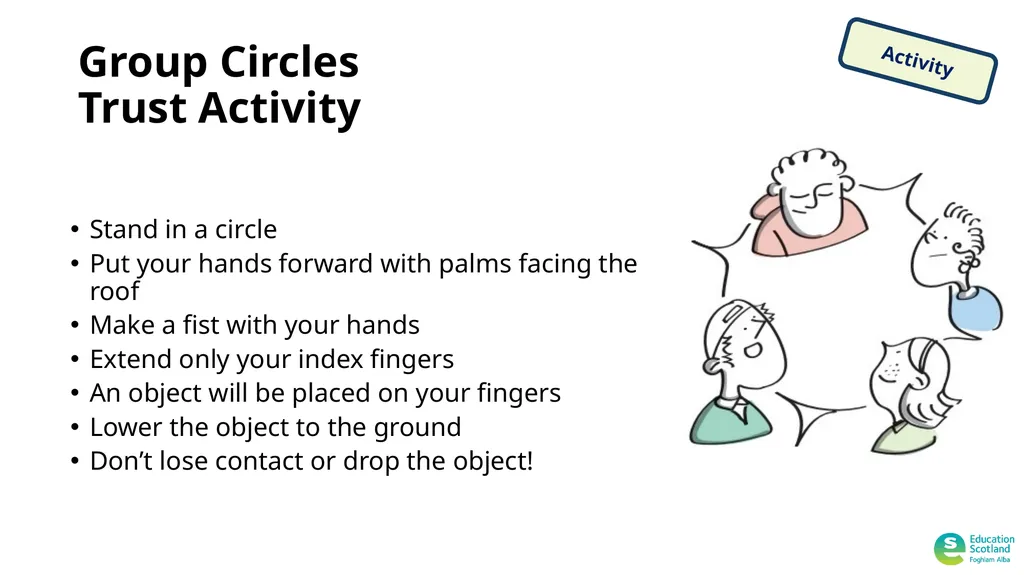
Group Circles
Trust Activity Stand in a circle
Put your hands forward with palms facing the roof
Make a fist with your hands
Extend only your index fingers
An object will be placed on your fingers
Lower the object to the ground
Don’t lose contact or drop the object! Activity<br>
Put your hands forward with palms facing the roof
Make a fist with your hands
Extend only your index fingers
An object will be placed on your fingers
Lower the object to the ground
Don’t lose contact or drop the object! Activity<br>
46
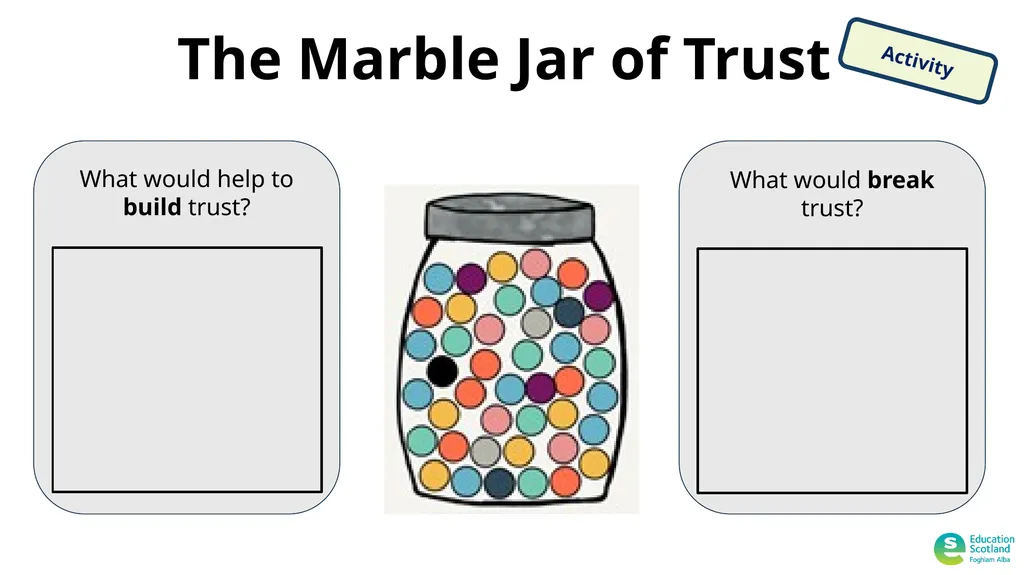
The Marble Jar of Trust Activity<br>
47
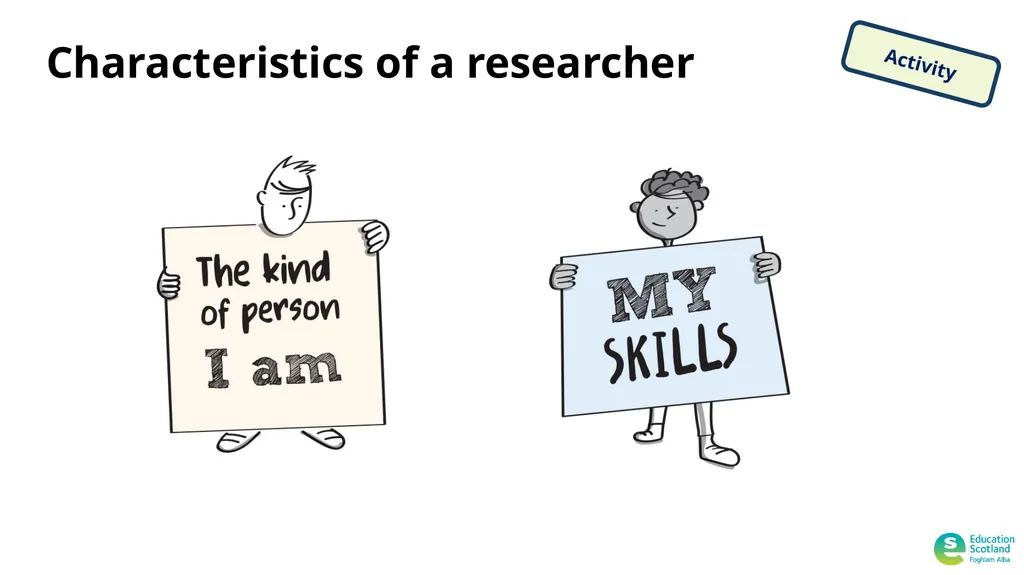
Characteristics of a researcher Activity<br>
48
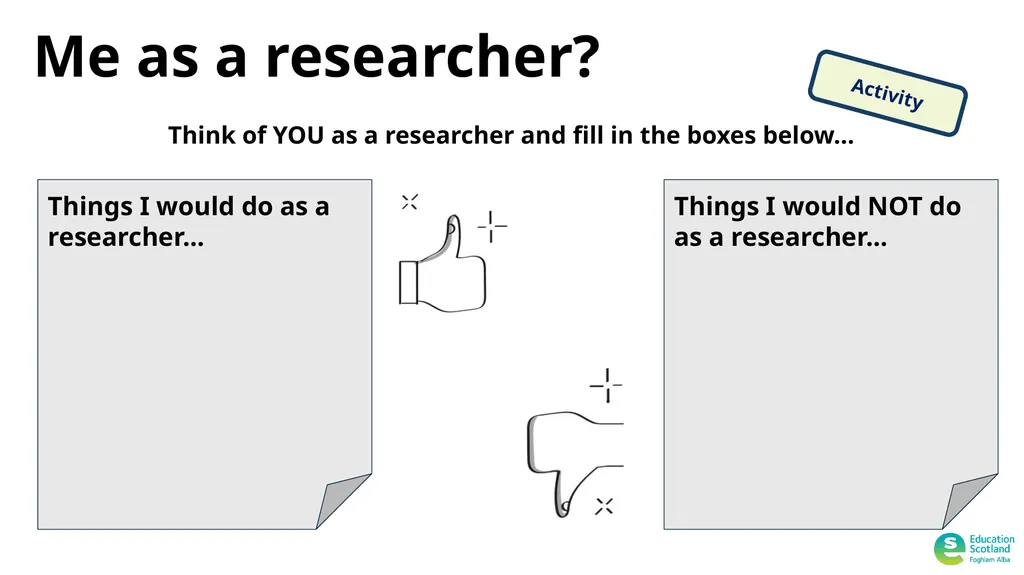
Me as a researcher? Think of YOU as a researcher and fill in the boxes below... Things I would do as a researcher... Things I would NOT do as a researcher... Activity<br>
49
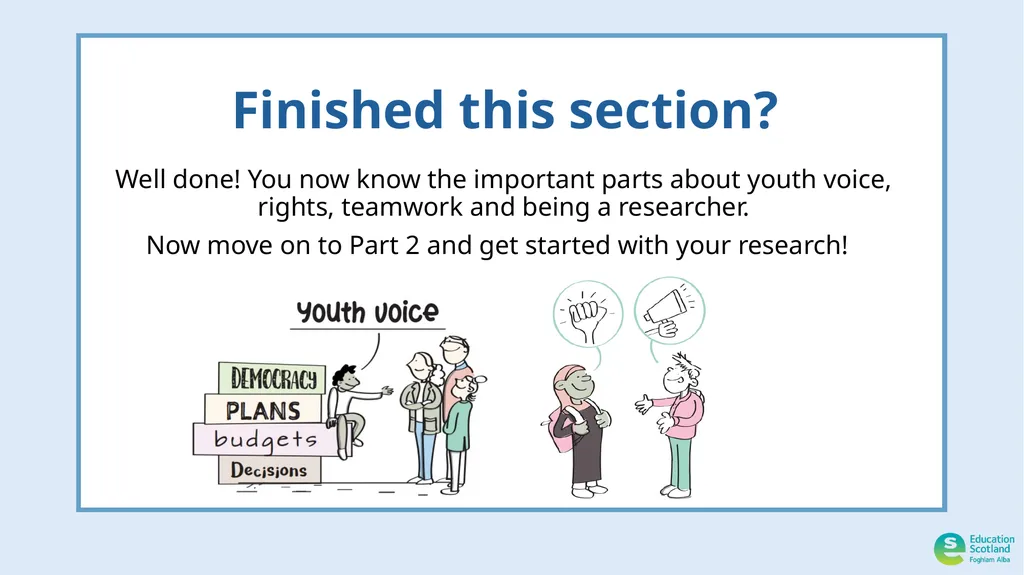
Well done! You now know the important parts about youth voice, rights, teamwork and being a researcher.
Now move on to Part 2 and get started with your research! Finished this section?<br>
Now move on to Part 2 and get started with your research! Finished this section?<br>