
ADJUSTMENT AND DEFENCE MECHANISMS IN PSYCHOLOGY
LD
Published · 18 slides · 0 views

1 / 1
Description
ADJUSTMENT AND DEFENCE MECHANISMS IN PSYCHOLOGY 29-07-2020 University of Kerala Sameer Babu M, Ph D 1 02-08-2020 University of Kerala 2 Learning Outcomes The learner will be able to - Explain the meaning of adjustment mechanism - List out
Related Topics
Share
Embed code
Download this presentation From Below
"ADJUSTMENT AND DEFENCE MECHANISMS IN PSYCHOLOGY" is the property of its rightful owner. Permission is granted to download and print the materials on this website for personal, non-commercial use only, and to display it on your personal computer provided you do not modify the materials and that you retain all copyright notices contained in the materials. By downloading content from our website, you accept the terms of this agreement.
Presentation Transcript
01
ADJUSTMENT AND DEFENCE MECHANISMS IN PSYCHOLOGY 29-07-2020 University of Kerala Sameer Babu M, Ph D 1<br>
02
02-08-2020 University of Kerala 2 Learning Outcomes The learner will be able to
- Explain the meaning of adjustment mechanism
- List out various adjustment/ defense mechanisms
- Differentiate between sublimation and rationalization
- Illustrate the displacement with practical example<br>
- Explain the meaning of adjustment mechanism
- List out various adjustment/ defense mechanisms
- Differentiate between sublimation and rationalization
- Illustrate the displacement with practical example<br>
03
02-08-2020 University of Kerala 3 Learning Outcomes The learner will be able to
Discuss the significance of adjustment mechanisms in maintaining a balanced personality
Lists out the characteristics of various mechanisms of adjustment, and
Develops a table based on unique characteristics of various defense mechanisms.<br>
Discuss the significance of adjustment mechanisms in maintaining a balanced personality
Lists out the characteristics of various mechanisms of adjustment, and
Develops a table based on unique characteristics of various defense mechanisms.<br>
04
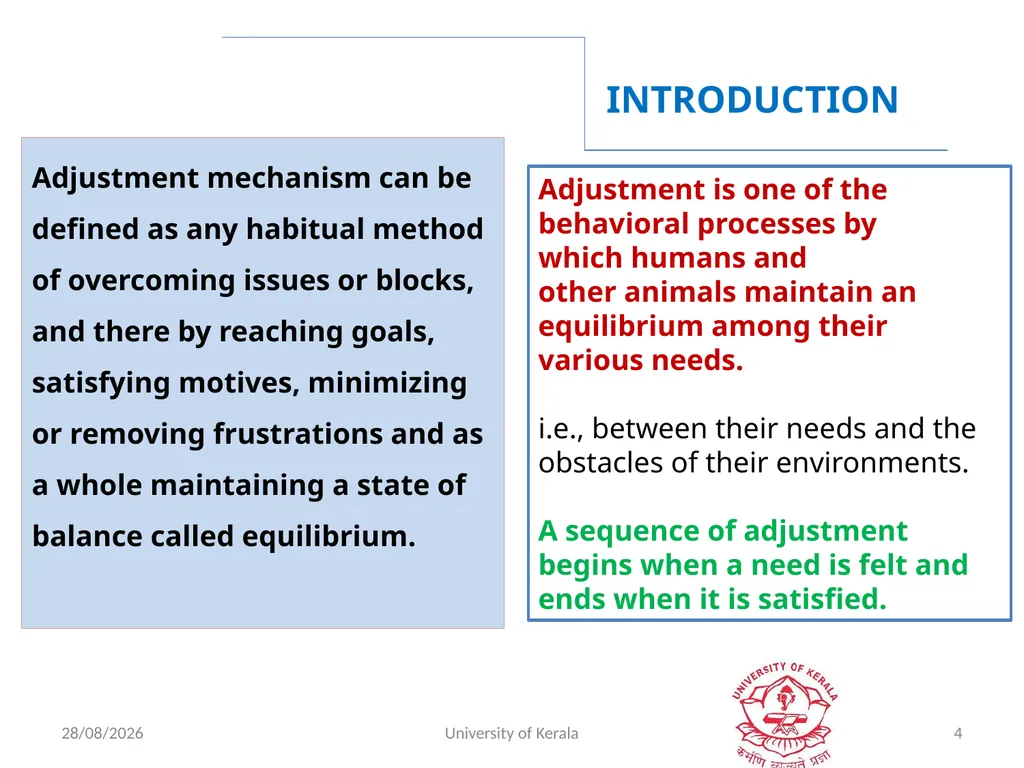
02-08-2020 University of Kerala 4 Adjustment is one of the behavioral processes by which humans and other animals maintain an equilibrium among their various needs.
i.e., between their needs and the obstacles of their environments.
A sequence of adjustment begins when a need is felt and ends when it is satisfied. INTRODUCTION Adjustment mechanism can be defined as any habitual method of overcoming issues or blocks, and there by reaching goals, satisfying motives, minimizing or removing frustrations and as a whole maintaining a state of balance called equilibrium.<br>
05
02-08-2020 University of Kerala 5 Significance of Defence Mechanisms Sigmund Freud in his psychoanalytic theory mentions Defence mechanism as a method developed by the ego state to protect against anxiety.
Ego is based on reality.<br>
Ego is based on reality.<br>
06
02-08-2020 University of Kerala 6 Characteristics - Defence Mechanisms are unconscious activities
- They are not directly known to the person
- They are considered to be normal, and only if exaggerated beyond limit they give rise to abnormality
- Personality defences (coping techniques, defense mechanisms) are important things in that they strongly influence the ease with which people are able to form and maintain healthy relationships
- Defence mechanisms are thought to safeguard the mind against feelings and thoughts that are too difficult for the conscious mind to deal with<br>
07
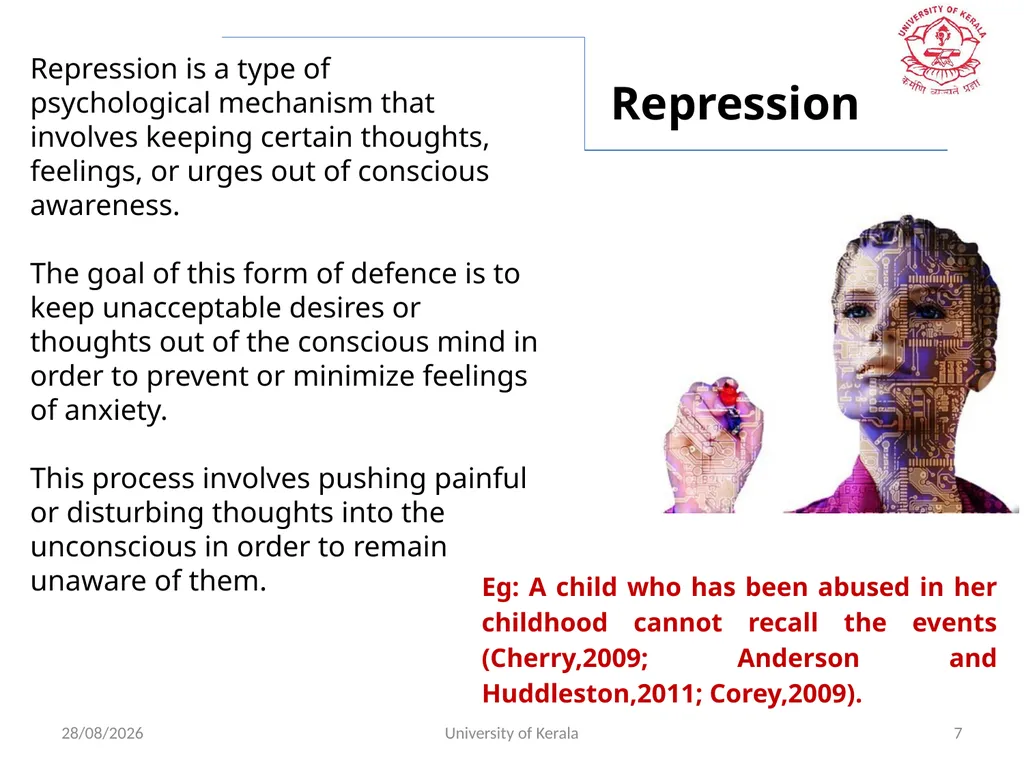
02-08-2020 University of Kerala 7 Repression Repression is a type of psychological mechanism that involves keeping certain thoughts, feelings, or urges out of conscious awareness.
The goal of this form of defence is to keep unacceptable desires or thoughts out of the conscious mind in order to prevent or minimize feelings of anxiety.
This process involves pushing painful or disturbing thoughts into the unconscious in order to remain unaware of them. Eg: A child who has been abused in her childhood cannot recall the events (Cherry,2009; Anderson and Huddleston,2011; Corey,2009).<br>
08
02-08-2020 University of Kerala 8 Displacement Displacement is a psychological defence mechanism in which a person redirects a negative emotions from its original source to a less threatening recipient that is less likely to come with repercussions.
Displacement, like many other psychological defence mechanisms, often occurs subconsciously—the person is not aware they are doing it.
Unwanted impulses are shifted from the original source of our anxiety to something that poses less of a threat.
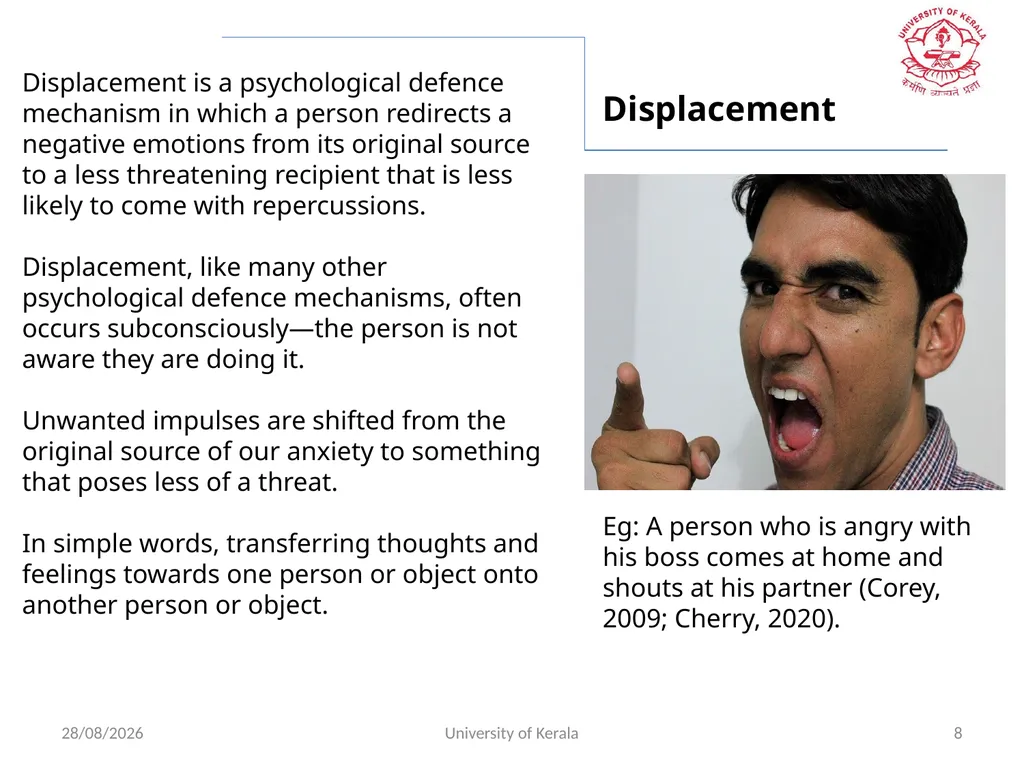
In simple words, transferring thoughts and feelings towards one person or object onto another person or object. Eg: A person who is angry with his boss comes at home and shouts at his partner (Corey, 2009; Cherry, 2020).<br>
09
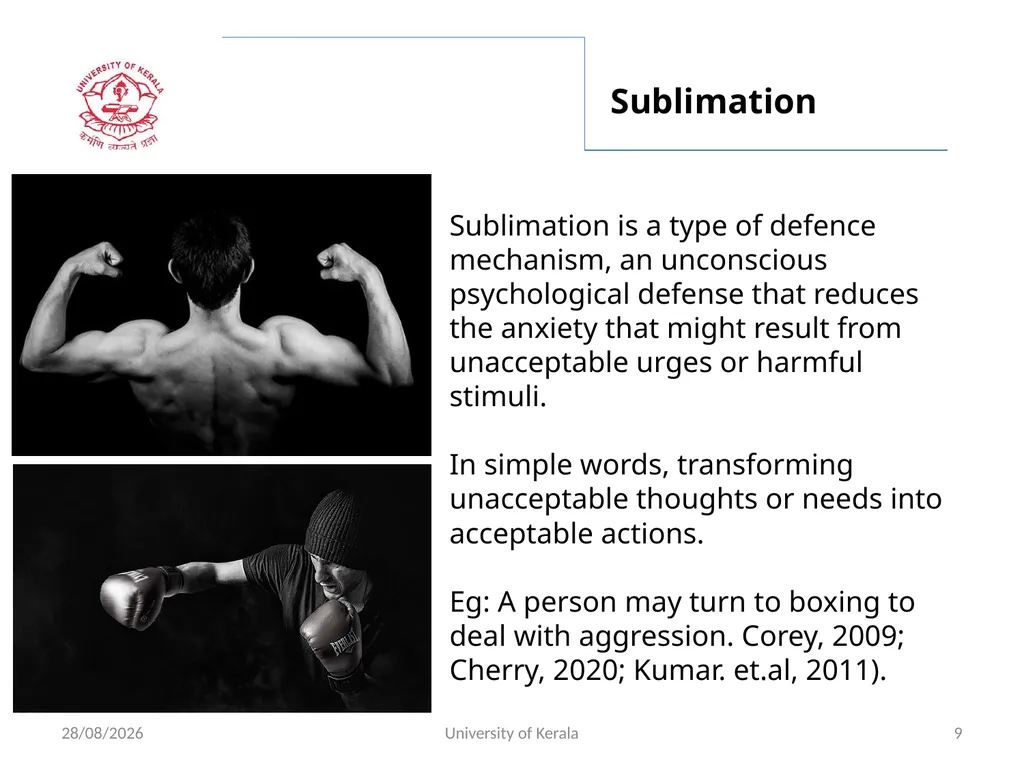
02-08-2020 University of Kerala 9 Sublimation Sublimation is a type of defence mechanism, an unconscious psychological defense that reduces the anxiety that might result from unacceptable urges or harmful stimuli.
In simple words, transforming unacceptable thoughts or needs into acceptable actions.
Eg: A person may turn to boxing to deal with aggression. Corey, 2009; Cherry, 2020; Kumar. et.al, 2011).<br>
In simple words, transforming unacceptable thoughts or needs into acceptable actions.
Eg: A person may turn to boxing to deal with aggression. Corey, 2009; Cherry, 2020; Kumar. et.al, 2011).<br>
10
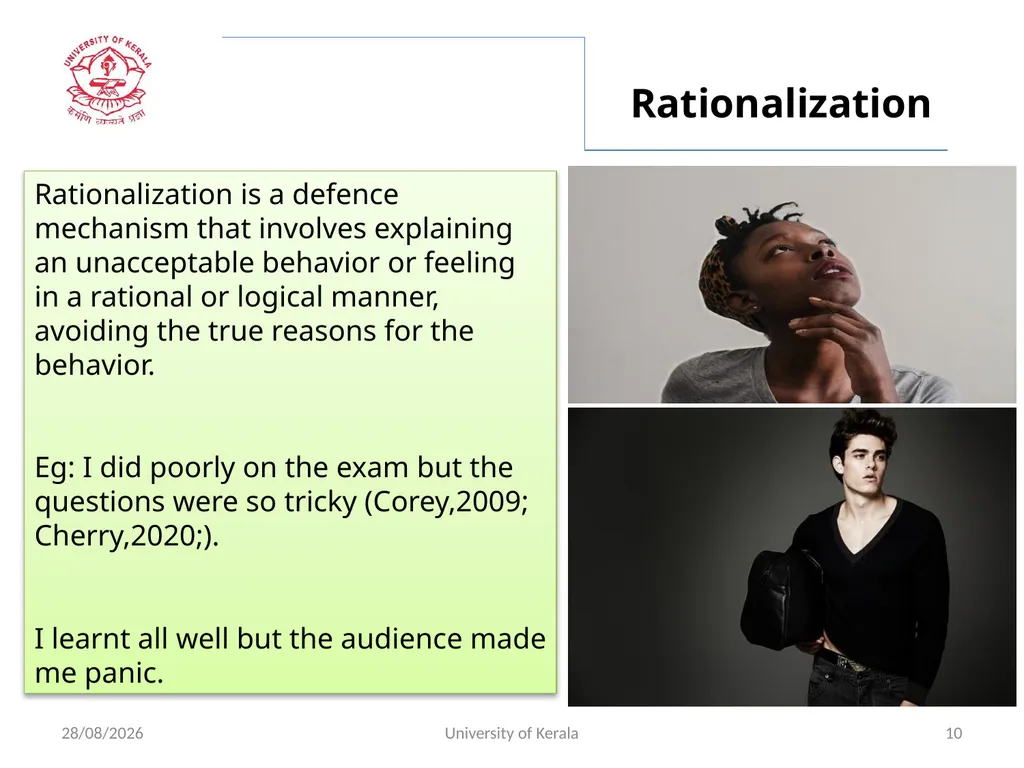
02-08-2020 University of Kerala 10 Rationalization is a defence mechanism that involves explaining an unacceptable behavior or feeling in a rational or logical manner, avoiding the true reasons for the behavior.
Eg: I did poorly on the exam but the questions were so tricky (Corey,2009; Cherry,2020;).
I learnt all well but the audience made me panic. Rationalization<br>
Eg: I did poorly on the exam but the questions were so tricky (Corey,2009; Cherry,2020;).
I learnt all well but the audience made me panic. Rationalization<br>
11
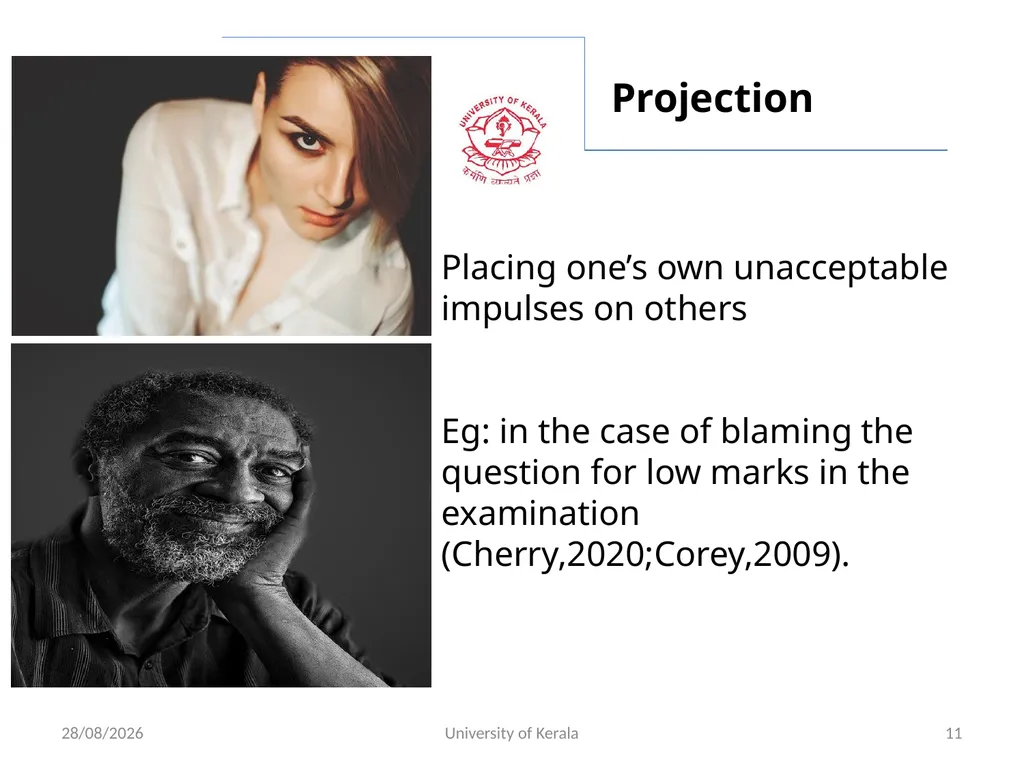
02-08-2020 University of Kerala 11 Projection Placing one’s own unacceptable impulses on others
Eg: in the case of blaming the question for low marks in the examination (Cherry,2020;Corey,2009).<br>
Eg: in the case of blaming the question for low marks in the examination (Cherry,2020;Corey,2009).<br>
12
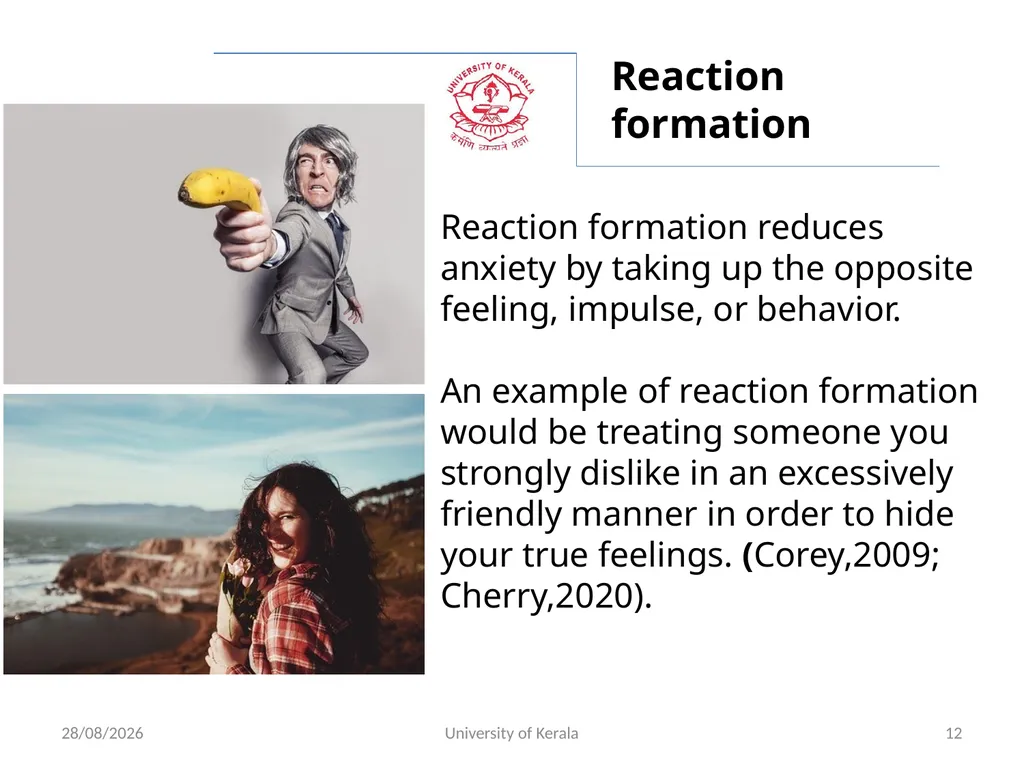
02-08-2020 University of Kerala 12 Reaction formation Reaction formation reduces anxiety by taking up the opposite feeling, impulse, or behavior.
An example of reaction formation would be treating someone you strongly dislike in an excessively friendly manner in order to hide your true feelings. (Corey,2009; Cherry,2020).<br>
An example of reaction formation would be treating someone you strongly dislike in an excessively friendly manner in order to hide your true feelings. (Corey,2009; Cherry,2020).<br>
13
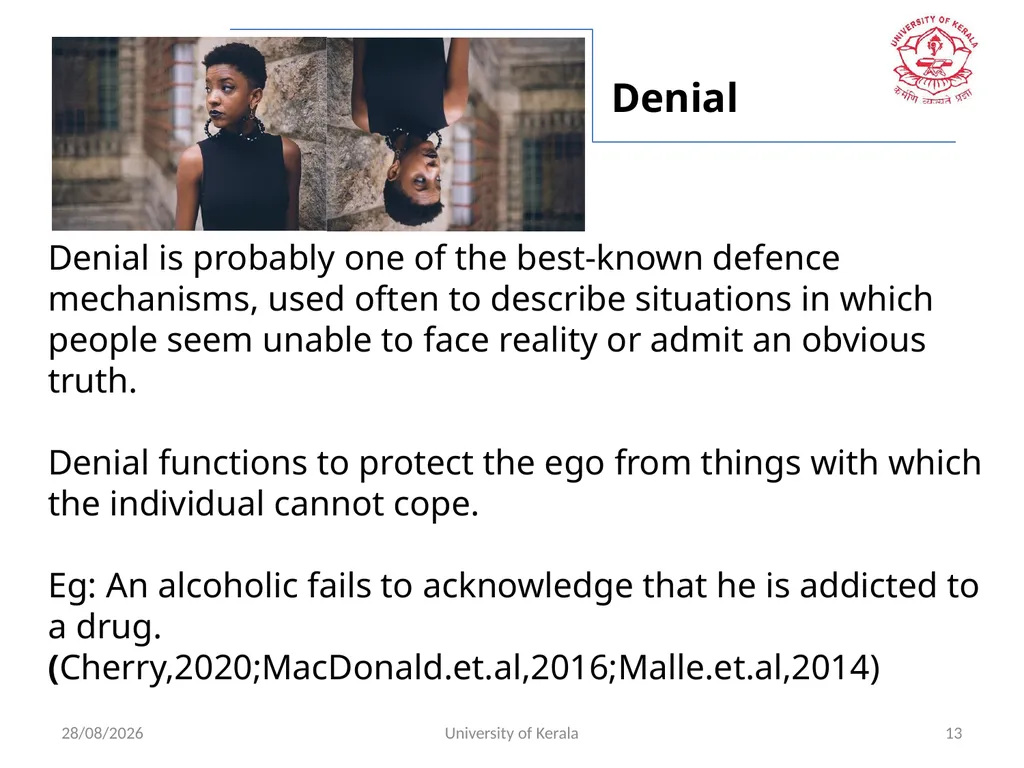
02-08-2020 University of Kerala 13 Denial Denial is probably one of the best-known defence mechanisms, used often to describe situations in which people seem unable to face reality or admit an obvious truth.
Denial functions to protect the ego from things with which the individual cannot cope.
Eg: An alcoholic fails to acknowledge that he is addicted to a drug. (Cherry,2020;MacDonald.et.al,2016;Malle.et.al,2014)<br>
Denial functions to protect the ego from things with which the individual cannot cope.
Eg: An alcoholic fails to acknowledge that he is addicted to a drug. (Cherry,2020;MacDonald.et.al,2016;Malle.et.al,2014)<br>
14
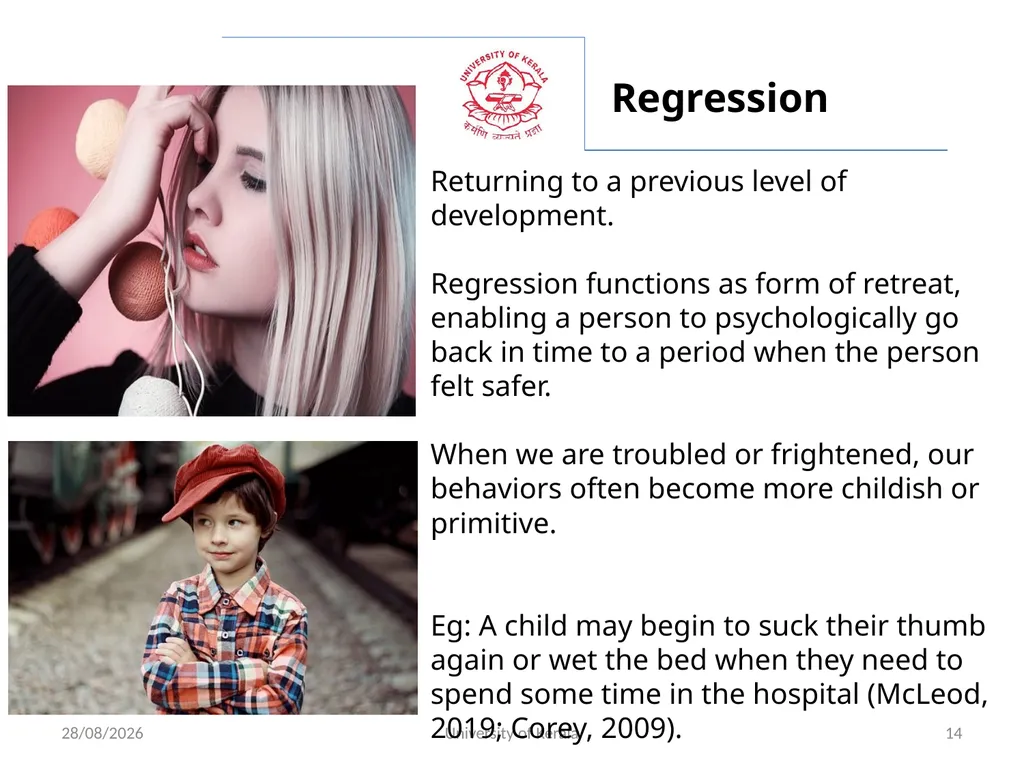
02-08-2020 University of Kerala 14 Regression Returning to a previous level of development.
Regression functions as form of retreat, enabling a person to psychologically go back in time to a period when the person felt safer.
When we are troubled or frightened, our behaviors often become more childish or primitive.
Eg: A child may begin to suck their thumb again or wet the bed when they need to spend some time in the hospital (McLeod, 2019; Corey, 2009).<br>
15
02-08-2020 University of Kerala 15 Acting Out: In this type of defence, the individual copes with stress by engaging in actions rather than acknowledging and bearing certain feelings.
Avoidance: Refusing to deal with or encounter unpleasant objects or situations.
Compensation: A deficit in a particular area is compensated using the skill in a different area as in the case of student who is poor in studies performs well in sport.
Humor: Pointing out the funny or ironic aspects of a situation.
Fantasy: It is the conjuring of an imagined scenario to replace a real one. It is done in all day dreaming. Other Defence Mechanisms (Corey,2009;Cherry,2020)<br>
16
02-08-2020 University of Kerala 16 References REFERENCES:
Anderson, M. C., & Huddleston, E. (2011). Towards a Cognitive and Neurobiological Model of Motivated Forgetting. Nebraska Symposium on Motivation, 53–120. doi:10.1007/978-1-4614-1195-6_3
Burgo, J. why Do I Do That? Psychological Defence Mechanisms and the Hidden Ways They Shape Our Lives. Chapel Hill, NC: New Rise Press; 2012.
Cherry, K. (2019). Retrieved from Defence mechanism, very well mind.com
Cherry, K. (2020)a. Retrieved from 20 Common Defence Mechanisms Used for Anxiety, very well mind.com
Corey, G. (2009). Theory and Practice of Counseling and Psychotherapy (8th ed.).
Belmont, CA: Thomson Brooks/Cole. Kumar, S. S., Krishnan, V. T., Joseph, T., & Binoy, N.J. (2011). Introduction to psychology. Bina Publishers Private Limited. Malappuram.<br>
17
02-08-2020 University of Kerala 17 References… Macdonald K., Thomas ML., & Sciolla, A. F. (2016). Minimization of Childhood Maltreatment Is Common and Consequential: Results from a Large, Multinational Sample Using the Childhood Trauma Questionnaire. PLoS ONE.;11(1):e0146058. doi:10.1371/journal.pone.0146058
Malle, B. F., Guglielmo, S., & Monroe, A. E. (2014). A Theory of Blame. Psychological Inquiry, 25(2), 147–186. doi:10.1080/1047840x.2014.877340
Mc Leod. (2019).Retrieved from Defence Mechanisms,Simple psychology.com.
Waqas A, Rehman A, Malik A, Muhammad U, Khan S, Mahmood N. (2015). Association of Ego Defence Mechanisms with Academic Performance, Anxiety and Depression in Medical Students: A Mixed Methods Study. Cureus,7(9):e337. doi:10.7759/cureus.337<br>
18
02-08-2020 University of Kerala 18 HAVE A NICE TIME Thank you for your time! Sameer Babu, Ph D
Assistant Professor of Education
University of Kerala
sameer@keralauniversity.ac.in<br>
Assistant Professor of Education
University of Kerala
sameer@keralauniversity.ac.in<br>