
Adult Crisis Telephone Intervention and Options
FD
Published · 25 slides · 0 views

1 / 1
Description
Adult Crisis Telephone Intervention and Options Network Presented by: CT Department of Mental Health and Addiction Services and the United Way of CT, 2-1-1 Overview Description of Mobile
Related Topics
Share
Embed code
Download this presentation From Below
"Adult Crisis Telephone Intervention and Options" is the property of its rightful owner. Permission is granted to download and print the materials on this website for personal, non-commercial use only, and to display it on your personal computer provided you do not modify the materials and that you retain all copyright notices contained in the materials. By downloading content from our website, you accept the terms of this agreement.
Presentation Transcript
01
Adult Crisis Telephone Intervention and Options Network
________________________________________________ Presented by:
CT Department of Mental Health and Addiction
Services and the United Way of CT, 2-1-1<br>
CT Department of Mental Health and Addiction
Services and the United Way of CT, 2-1-1<br>
02
Overview
Description of Mobile Crisis Teams and Crisis Intervention Teams
Overview of Mobile Crisis Redesign
The development of CT’s centralized adult crisis call center
What it is the ACTION line?
ACTION line Implementation
Call Data
Marketing Materials
Satisfaction Survey
Additional Resources and Contacts<br>
03
Mobile Crisis Teams Adults ages 18+
Telephone support
Mobile, in-person response
Multidisciplinary team
Licensed social workers, licensed counselors, nurses, mental health workers, case managers, individuals with lived experience with mental health and/or substance use/addiction, psychologists, psychiatrists, etc.
Extensive training
Suicide risk assessments, Prevention and Postventon, Recovery and Community Supports, etc.
Collaboration with local and state law enforcement<br>
04
Crisis Intervention Team (CIT) CIT is a best practice model originated in Memphis, TN.
Intended to divert individuals from incarceration, arrest and hospitalization and promote safety for persons in crisis, the community, and police who respond to crisis calls.
DMHAS has contracted with The Connecticut Alliance to Benefit Law Enforcement (CABLE) Inc. to provide Crisis Intervention Team Training to law enforcement personnel and behavioral health clinicians.
Every Mobile Crisis Team in the state has CIT trained clinicians who work collaboratively with police departments.
When needed, CIT clinicians will respond to crisis calls along with the police.
State operated Mobile Crisis Teams (MCTs) as well as some Private Non-Profit MCTs have designated CIT clinicians .<br>
05
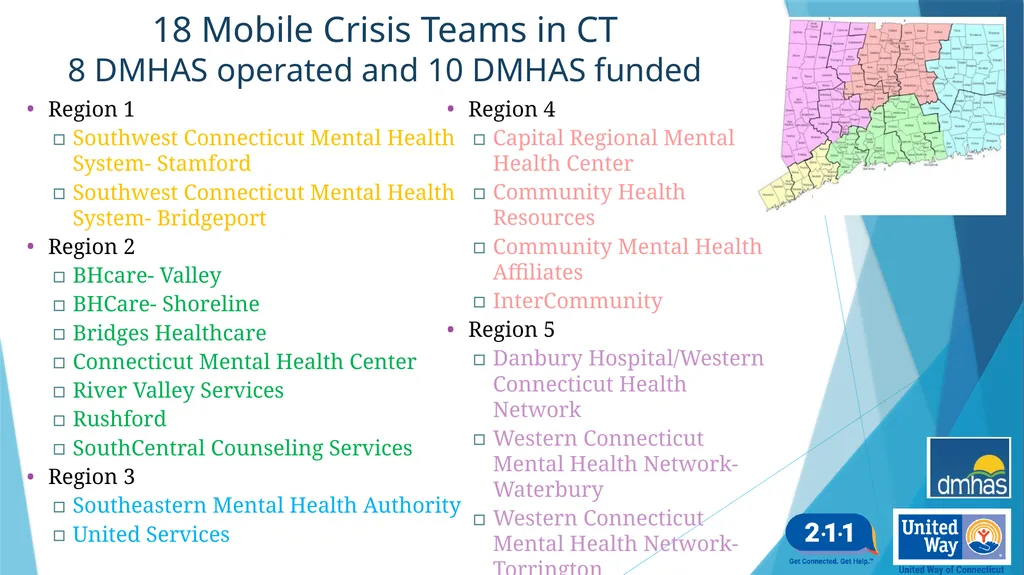
18 Mobile Crisis Teams in CT
8 DMHAS operated and 10 DMHAS funded Region 1
Southwest Connecticut Mental Health System- Stamford
Southwest Connecticut Mental Health System- Bridgeport
Region 2
BHcare- Valley
BHCare- Shoreline
Bridges Healthcare
Connecticut Mental Health Center
River Valley Services
Rushford
SouthCentral Counseling Services
Region 3
Southeastern Mental Health Authority
United Services Region 4
Capital Regional Mental Health Center
Community Health Resources
Community Mental Health Affiliates
InterCommunity
Region 5
Danbury Hospital/Western Connecticut Health Network
Western Connecticut Mental Health Network- Waterbury
Western Connecticut Mental Health Network- Torrington<br>
06
Mobile Crisis Team
Mission To provide persons in distress (crisis) immediate access to a continuum of crisis response services of their choice including, mobile clinical services, peer support services and community supports; to promote the prevention of crises among persons and families; and to provide postvention activities that support persons in developing a meaningful sense of belonging in their communities.<br>
07
Mobile Crisis Teams
Services and Supports Outreach & Education
Risk Assessment and Evaluation of Needs
Telephone Support
Critical Incident Debriefing
Information & Referral
Follow up services
Peer Support
Crisis/Safety Planning
Prevention and Postvention<br>
Risk Assessment and Evaluation of Needs
Telephone Support
Critical Incident Debriefing
Information & Referral
Follow up services
Peer Support
Crisis/Safety Planning
Prevention and Postvention<br>
08
Mobile Crisis Redesign Stakeholder Survey
Community Wellness & Recovery Coalition (CWRC)
DMHAS Workgroup Development
Consultation from the CT Department of Children and Families (DCF)
Technical Assistance
Meetings with CEOs
Agency site visits<br>
Community Wellness & Recovery Coalition (CWRC)
DMHAS Workgroup Development
Consultation from the CT Department of Children and Families (DCF)
Technical Assistance
Meetings with CEOs
Agency site visits<br>
09
DMHAS Mobile Crisis Workgroup Formed in October 2017
DMHAS- Office of the Commissioner (OOC) workgroup including the EBP unit, Statewide Services division, Forensics division, Prevention and Health Promotion division, Medical Director’s office, Fiscal division, a state-operated CEO, the Yale Program for Recovery and Community Health (PRCH), and the DMHAS Assistant Director of Recovery Community Affairs.
Purpose: To examine current mobile crisis services and make recommendations for enhancements.<br>
10
CT Wellness and Recovery Coalition A CT Team of multiple stakeholders was developed including representatives from
CT Community for Addiction Recovery (CCAR)
Advocacy Unlimited (AU)
Leaders of the faith-based community
Community organizers/educators
Deputy Police Chief of Danbury PD
CT Chapter-National Alliance on Mental Illness (NAMI)
North Central Regional Mental Health Board (NCRMHB), now known as Amplify, Inc.
Private non-profit (PNP) and state-operated (SO) mobile crisis team
Focus on creating a community of care such that people in distress have quick access to the types of services and/or support of their choice (clinical services, peer services, community supports) that will foster optimal post-traumatic healing and growth wherever they may be in the recovery process.<br>
11
DMHAS Stakeholder Survey In early 2019 DMHAS, in partnership with Yale PRCH, conducted a statewide survey of stakeholders regarding DMHAS mobile crisis services.
Providers, Persons in Recovery, Law Enforcement, Family members and Others
883 individuals responded across all five DMHAS regions<br>
Providers, Persons in Recovery, Law Enforcement, Family members and Others
883 individuals responded across all five DMHAS regions<br>
12
Stakeholder Survey: Recommendations Increase Education & Training
Implement Statewide Call Center
Establish Minimum Hours of Operation
Enhance Data Collection/Outcome Measures
Advance CIT integration into MCT
Enhance Prevention/ Postvention Components
Add Recovery Support Specialists
Enhance Technology<br>
Implement Statewide Call Center
Establish Minimum Hours of Operation
Enhance Data Collection/Outcome Measures
Advance CIT integration into MCT
Enhance Prevention/ Postvention Components
Add Recovery Support Specialists
Enhance Technology<br>
13
Development of the Adult Crisis Call Center November 2019- RFP released
December 2019- RFP application deadline
January 2020- United Way of CT selected as the provider of the CT centralized call center for adults in crisis
April 2020- Call center name selection process
Surveyed the CT Suicide Advisory Board Lived Experience Committee (membership includes individuals from PRCH, NAMI-CT, AU, veterans, higher education, business marketing). Additional representatives from Amplify and CCAR provided feedback.
May 2020-present- Weekly implementation meetings between DMHAS and United Way of CT<br>
14
ACTION line
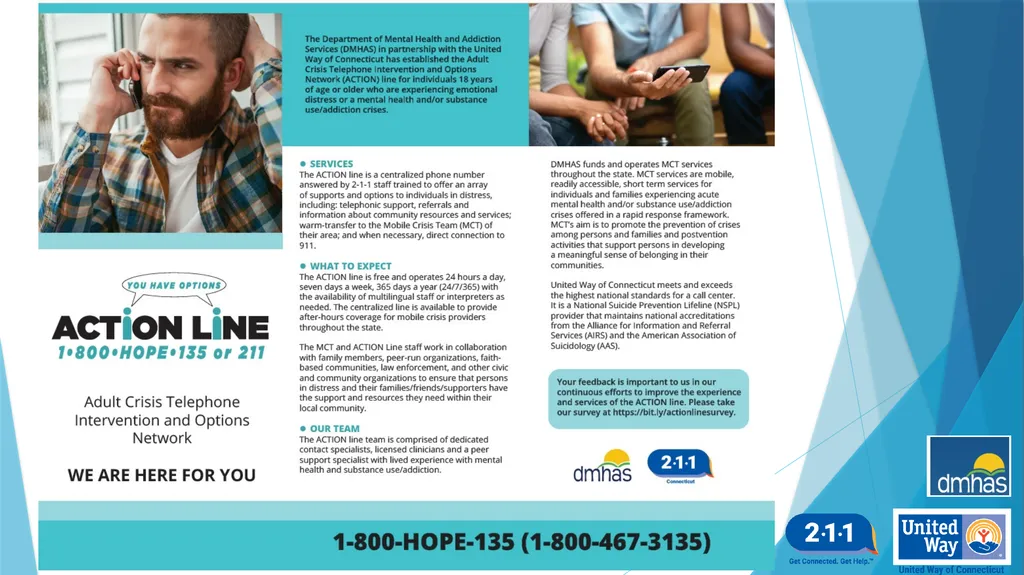
Adult Crisis Telephone Intervention and Options Network Centralized Adult Crisis Call Center
Available 24/7, 365 days a year
Ability to provide after hours, weekend and holiday coverage for mobile crisis teams
Staff include a combination of licensed clinicians, paraprofessionals, an individual with lived experience navigating distress and multilingual staff<br>
Available 24/7, 365 days a year
Ability to provide after hours, weekend and holiday coverage for mobile crisis teams
Staff include a combination of licensed clinicians, paraprofessionals, an individual with lived experience navigating distress and multilingual staff<br>
15
ACTION line
United Way of CT 2-1-1 CT’s Statewide National Suicide Prevention Lifeline provider as of October 1st, 2020
Provider of Mobile Crisis Intervention Services (MCIS) for Youth (formerly known as EMPS)
Coordinate Access Network (CAN) provider
Extensive database of local resources
United Way of CT is accredited by the American Association of Suicidality. The ACTION LINE call center follows AAS/SAMSHA approved crisis intervention protocols for non-clinical risk assessment and intervention, referral, and safety planning.<br>
16
ACTION line
Supports and Resources By contacting the ACTION Line through 1-800-HOPE-135 or by dialing 2-1-1, ACTION line staff can facilitate direct contact with the closest adult Mobile Crisis Team (MCT) in the State.
ACTION line staff will assist callers by:
Building rapport with the individual caller
Determining the nature of the caller’s distress through a non-clinical assessment of their concerns and needs
Ensuring safety planning right at the point of contact for the individual in distress
Connecting the individual in distress with the adult MCT provider in their area for intervention during MCT hours
Informing MCT provider of need to provide follow up services
If needed, direct connection to 911<br>
17
ACTION Line
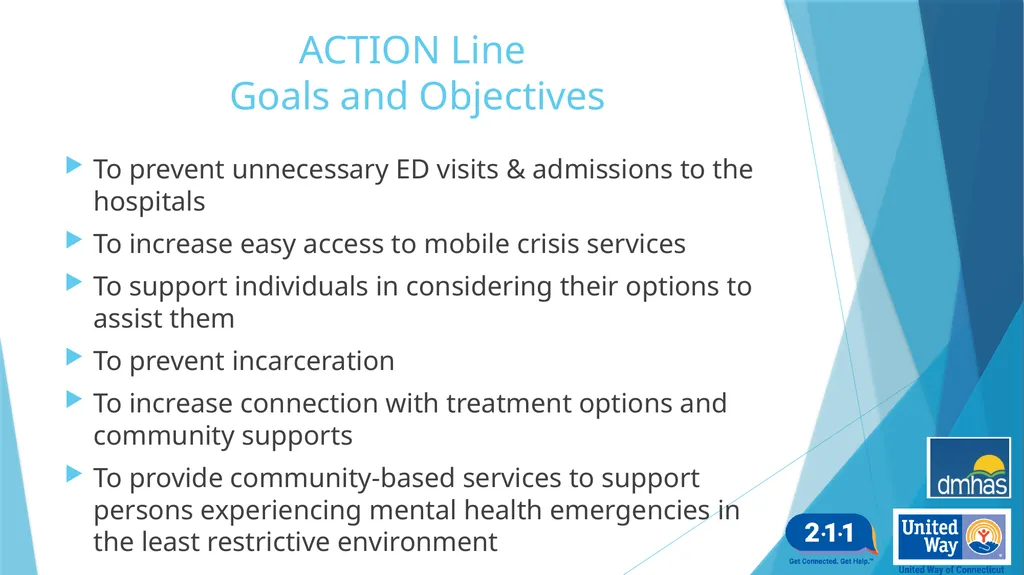
Goals and Objectives To prevent unnecessary ED visits & admissions to the hospitals
To increase easy access to mobile crisis services
To support individuals in considering their options to assist them
To prevent incarceration
To increase connection with treatment options and community supports
To provide community-based services to support persons experiencing mental health emergencies in the least restrictive environment<br>
18
ACTION line
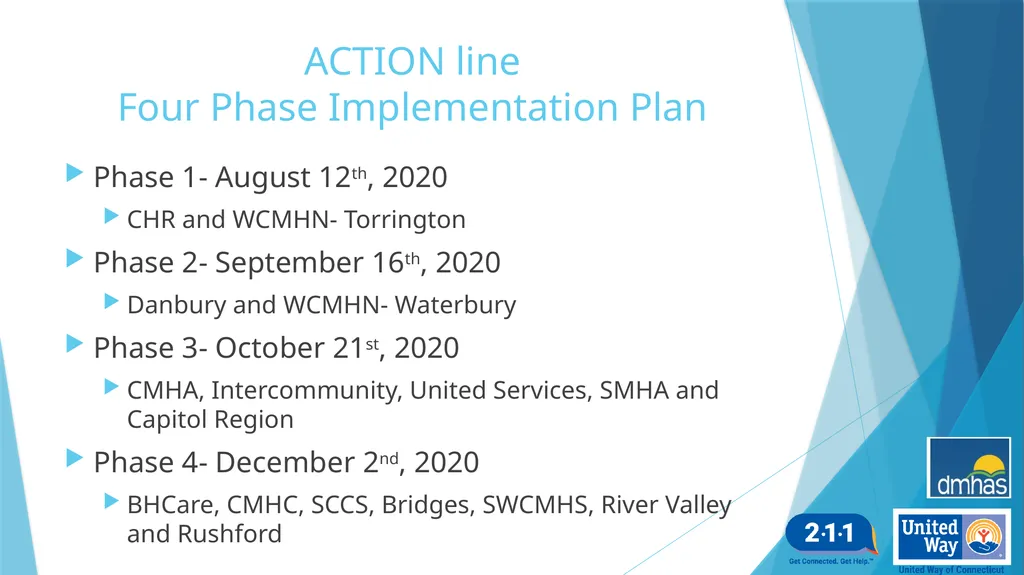
Four Phase Implementation Plan Phase 1- August 12th, 2020
CHR and WCMHN- Torrington
Phase 2- September 16th, 2020
Danbury and WCMHN- Waterbury
Phase 3- October 21st, 2020
CMHA, Intercommunity, United Services, SMHA and Capitol Region
Phase 4- December 2nd, 2020
BHCare, CMHC, SCCS, Bridges, SWCMHS, River Valley and Rushford<br>
CHR and WCMHN- Torrington
Phase 2- September 16th, 2020
Danbury and WCMHN- Waterbury
Phase 3- October 21st, 2020
CMHA, Intercommunity, United Services, SMHA and Capitol Region
Phase 4- December 2nd, 2020
BHCare, CMHC, SCCS, Bridges, SWCMHS, River Valley and Rushford<br>
19
ACTION line
Key Data Collection
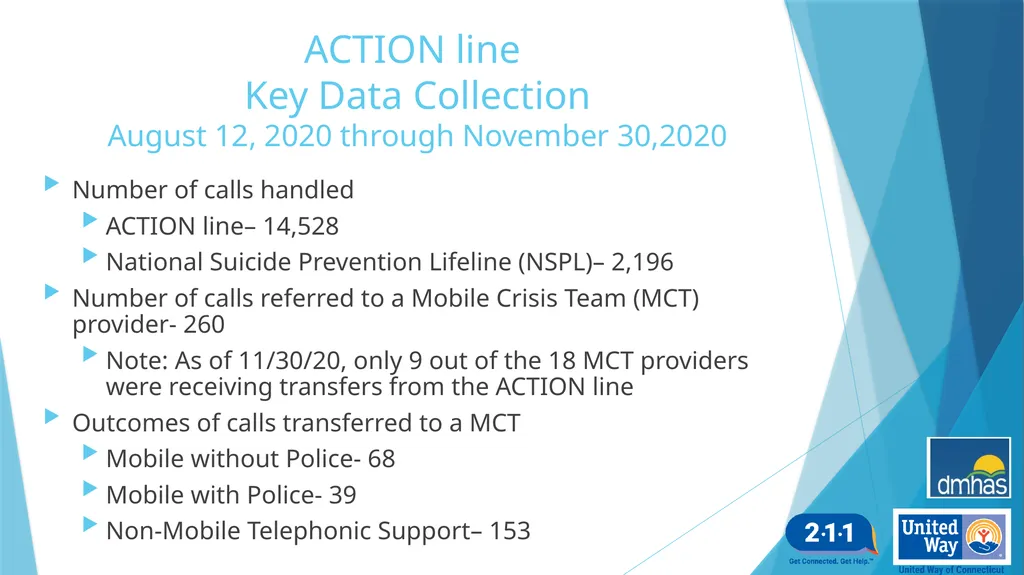
August 12, 2020 through November 30,2020 Number of calls handled
ACTION line– 14,528
National Suicide Prevention Lifeline (NSPL)– 2,196
Number of calls referred to a Mobile Crisis Team (MCT) provider- 260
Note: As of 11/30/20, only 9 out of the 18 MCT providers were receiving transfers from the ACTION line
Outcomes of calls transferred to a MCT
Mobile without Police- 68
Mobile with Police- 39
Non-Mobile Telephonic Support– 153<br>
20
ACTION line
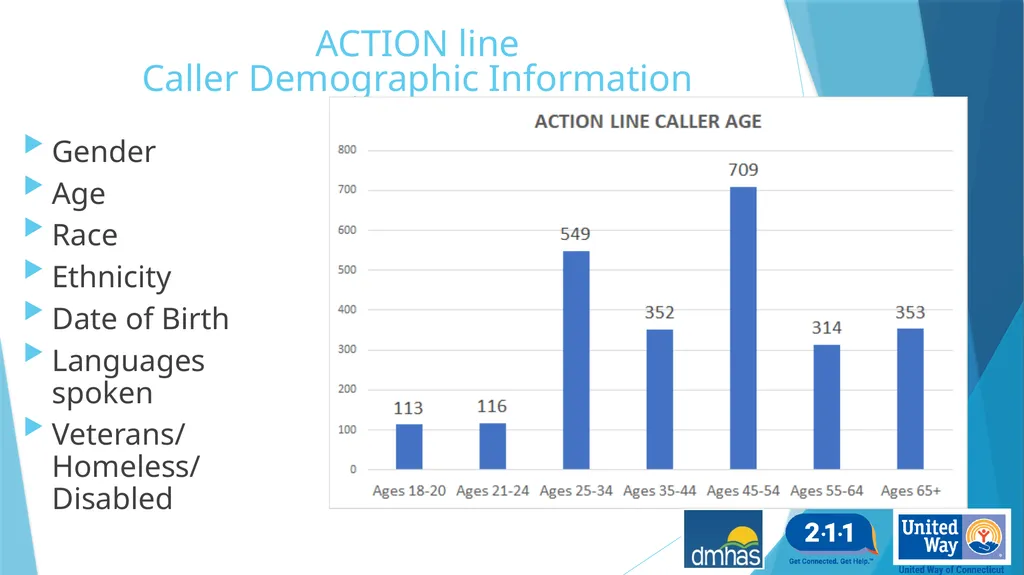
Caller Demographic Information Collected Gender
Age
Race
Ethnicity
Date of Birth
Languages spoken
Veterans/Homeless/Disabled<br>
Age
Race
Ethnicity
Date of Birth
Languages spoken
Veterans/Homeless/Disabled<br>
21
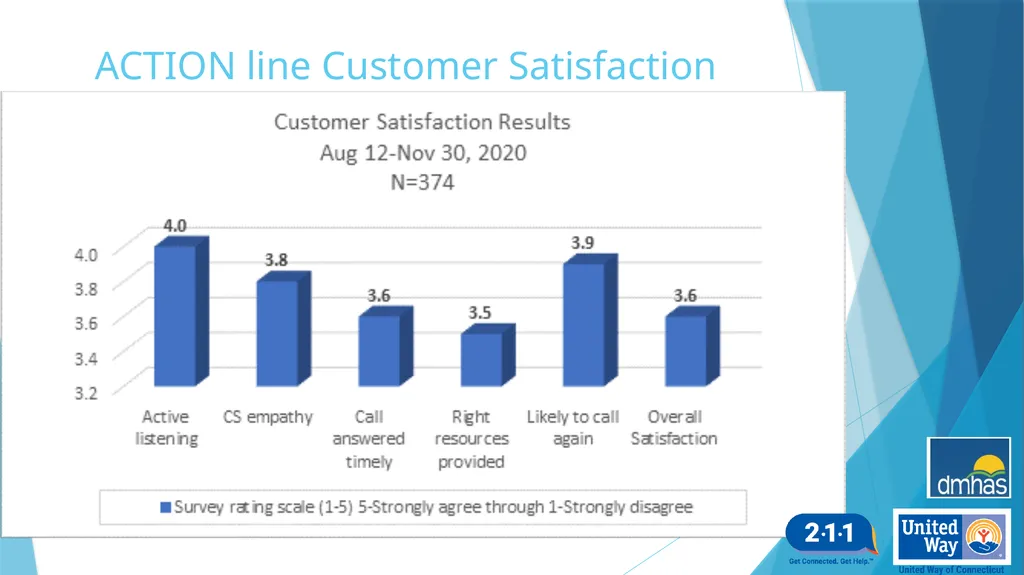
ACTION line Customer Satisfaction Survey<br>
22
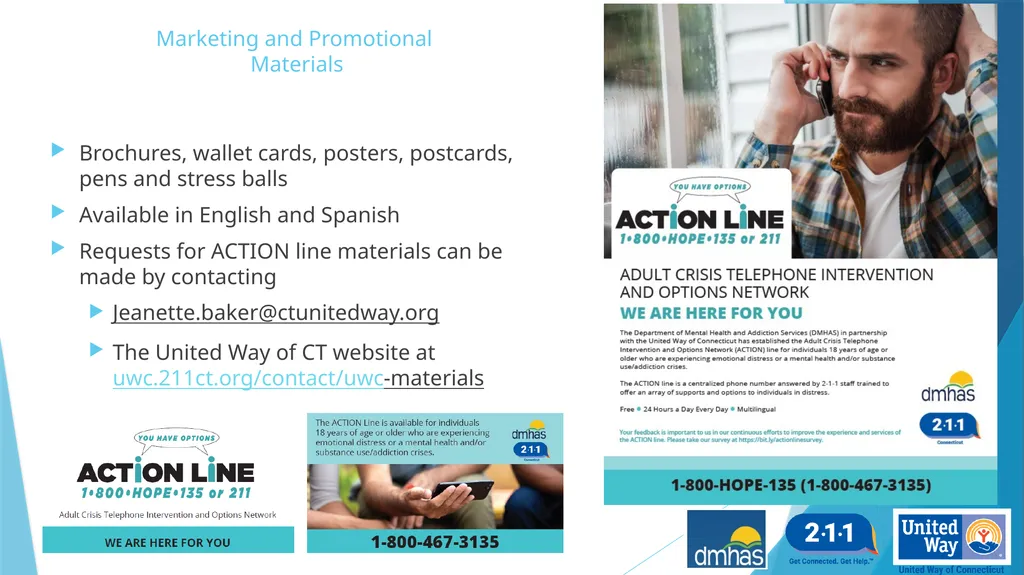
Marketing and Promotional
Materials Brochures, wallet cards, posters, postcards, pens and stress balls
Available in English and Spanish
Requests for ACTION line materials can be made by contacting
Jeanette.baker@ctunitedway.org
The United Way of CT website at uwc.211ct.org/contact/uwc-materials<br>
Available in English and Spanish
Requests for ACTION line materials can be made by contacting
Jeanette.baker@ctunitedway.org
The United Way of CT website at uwc.211ct.org/contact/uwc-materials<br>
23
Additional Resources CT Mobile Crisis Services
https://portal.ct.gov/DMHAS/Programs-and-Services/Finding-Services/Crisis-Services
The National Suicide Prevention Lifeline
Available 24/7 at 1-800-273-TALK (8255)
DMHAS website warm line listing:
https://portal.ct.gov/DMHAS/Programs-and-Services/Advocacy/Warm-Lines
Parent/caregiver support:
1-833-258-5011
www.TalkItOutCT.com
CTSafeConnect (Domestic Violence/Intimate Partner violence support)
Website: https://ctsafeconnect.com/
Available 24/7, 365 days a year via:
Voice Call/Text: 1-888-774-2900
Email: safeconnect@ctcadv.org
Web Chat 1-888-217-HERO
CHR’s HERO HOTLINE provides immediate assistance to anyone who is struggling with acute stress during the ongoing coronavirus crisis
CT Alliance To Benefit Law Enforcement
http://cableweb.wpengine.com/
CT Suicide Advisory Board
https://www.preventsuicidect.org/
NAMI Navigating a Mental Health Crisis
https://www.nami.org/Support-Education/Publications-Reports/Guides/Navigating-a-Mental-Health-Crisis/Navigating-A-Mental-Health-Crisis<br>
24
Contact Information Department Mental Health and Addiction Services
Nydia Rios-Benitez, Director DMHAS OOC Evidence Based Practices and Grants Division
nydia.rios-benitez@ct.gov
Erika Cruz, Clinical Manager DMHAS OOC Evidence Based Practices and Grants Division
erika.cruz@ct.gov
Dana Begin, Program Manager DMHAS OOC Evidence Based Practices and Grants Division
dana.begin@ct.gov
United Way of Connecticut, 2-1-1
Wendy Caruso, Director 2-1-1 Contact Center Operations
wendy.caruso@ctunitedway.org
Sarah Camerota, Crisis Program Manager
sarah.camerota@ctunitedway.org<br>