
African Perspectives PYC2601 Which of the
KL
Published · 64 slides · 0 views

1 / 1











Description
African Perspectives PYC2601 Which of the following most accurately explain why an indigenous African psychology did not develop? Most of the studies undertaken with African people have been done from a Western-oriented framework, which has
Related Topics
Share
Embed code
Download this presentation From Below
"African Perspectives PYC2601 Which of the" is the property of its rightful owner. Permission is granted to download and print the materials on this website for personal, non-commercial use only, and to display it on your personal computer provided you do not modify the materials and that you retain all copyright notices contained in the materials. By downloading content from our website, you accept the terms of this agreement.
Presentation Transcript
01
African Perspectives PYC2601<br>
02
Which of the following most accurately explain why an indigenous African psychology did not develop? Most of the studies undertaken with African people have been done from a Western-oriented framework, which has resulted in understandings that are not always applicable to African people
Mainstream psychology is predominantly a Euro-Americocentric science, which was exported to Africa and the East, with the result that to date a specific personality theory from a purely African perspective has not been developed.
According to Nsemang most African people have neither heard nor know the meaning of the term psychology? Thereby reducing the likelihood of research on an indigenous African psychology being conducted.
The theories and methods of psychology are still Eurocentric, resulting in its primary focus being on topics that exclude indigenous African knowledge and ways of being.
The correct answer is:
(1) All of the above
(2) (a) & (b)
(3) (b), (c) & (d)
(4) None of the above 1<br>
03
Thandi is very ill and goes to see her local doctor. After two weeks she has still not recovered and on the advice of her mother goes to visit the local sangoma. Which one of the following statements most accurately reflects the different understandings of Thandi’s illness arrived at by the Western doctor and traditional African sangoma? According to the doctor, Thandi is personally responsible for her illness as she eats too much unhealthy food, while the sangoma understood the cause of Thandi’s illness as resulting from her neighbour having bewitched her.
Thandi’s doctor believed that the cause of her illness resulted from the stress she was under as her work environment is very competitive. The sangoma agreed with this diagnosis and believed that Thandi did not recover after two weeks because she failed to take the doctor’s advice.
The doctor believed that the cause of Thandi’s illness could be explained in terms of her interpersonal dynamics, whereas the sangoma tended to emphasise her intrapsychic dynamics in his causal explanation.
According to the doctor, Thandi is not personally responsible for her illness or how it has progressed, as she cannot control the germs in the air. The sangoma however viewed Thandi as personally responsible as she must have upset the ancestors in order to develop the type of illness that she did. 1<br>
04
Betty uses a logical approach to plan her work activities and moves systematically through the 10 items she has prioritised, while Veronica prefers to select a task to focus on, in terms of the time of day and her available energy levels. Which one of the following statements about this story’s reflection on the cognitive functioning and conception of time favoured by traditional Africans and Westerners is the most correct? Betty’s logical systematic approach reflects the Western view of time as a mathematical construct and is better than the more haphazard traditional African approach to planning exemplified by Veronica.
Veronica’s approach is more in keeping with the traditional African view of being in time rather than on time’ and will ensure a better quality of work output than Betty’s Western approach, which forces her to work against her own natural rhythms.
Betty’s logical approach to planning exemplifies the Western preference for intuitive rationality in cognitive functioning, while Veronica’s approach may be said to reflect the traditional African preference for pure rationality.
Betty’s logical and systematic approach reflects the Western preference for ‘the logic of reason’ while Veronica’s more intuitive approach better reflects the traditional African preference for the logic of the heart’ in cognitive functioning. 4<br>
05
Solomon, who holds traditional African beliefs, has recently begun to feel very ill. Within the context of his belief system, which one of the following most accurately explains his understanding of the cause of his ill health and the appropriate medium for healing? Solomon feels that he is
Responsible for the cause of his behaviour and is dependent on a sangoma to heal him.
Responsible for the cause of his behaviour and is dependent on God to heal him.
Not responsible for the cause of his behaviour and is dependent on a psychiatrist’s medication to reverse the power of the spell in his own mind in order to be healed.
Not responsible for the cause of his behaviour and is dependent on the good will of his ancestors to heal him. 4<br>
06
Simphiwe is referred to you for psychotherapy. As you are practising within the framework of the traditional African worldview, what would you consider to be an optimal outcome for Simphiwe’s therapy? Therapy will be successful when Simphiwe is able to function as an autonomous, independent human being.
Your aim will be to increase his analysis of the circumstances surrounding his mental health difficulties
The aim of therapy should be to break Simphiwe’s withdrawal so that he can draw strength from his collective existence.
You believe Simphiwe will be cured when his right brain capacity for synchrony and harmony has been increased over his left brain tendency to seek answers for his mental health difficulties. 3<br>
07
According to traditional African Perspectives, human behaviour is the outcome of …….. Interpersonal dynamics
Intrapsychic dynamics
External agents outside the person
Internal as well as external agents 3<br>
Intrapsychic dynamics
External agents outside the person
Internal as well as external agents 3<br>
08
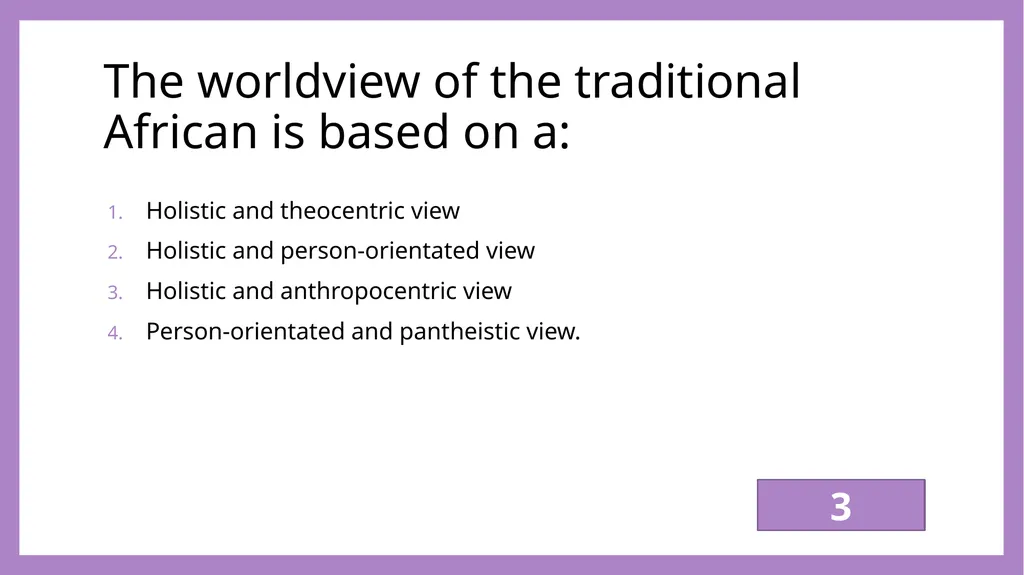
The worldview of the traditional African is based on a: Holistic and theocentric view
Holistic and person-orientated view
Holistic and anthropocentric view
Person-orientated and pantheistic view. 3<br>
Holistic and person-orientated view
Holistic and anthropocentric view
Person-orientated and pantheistic view. 3<br>
09
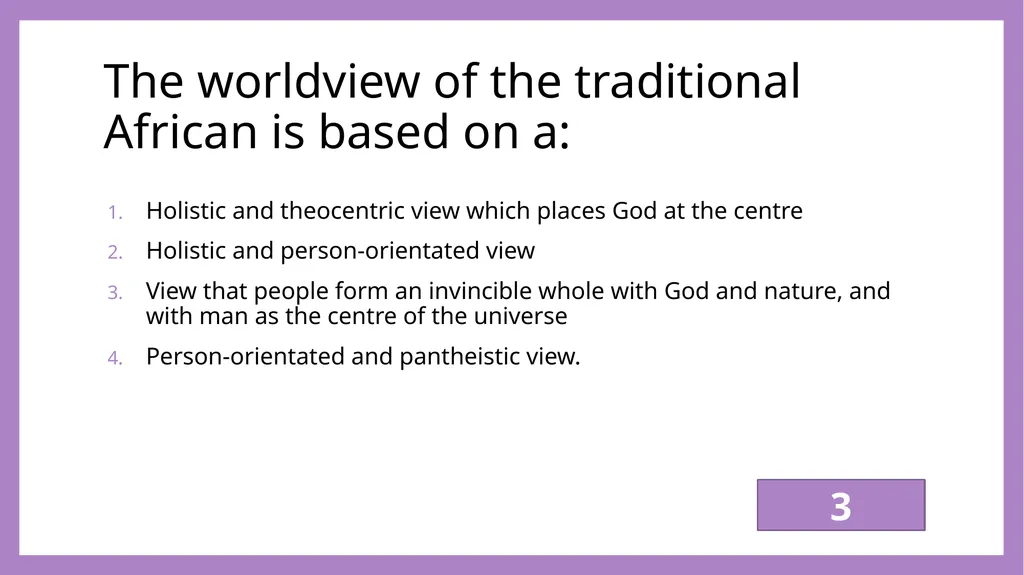
The worldview of the traditional African is based on a: Holistic and theocentric view which places God at the centre
Holistic and person-orientated view
View that people form an invincible whole with God and nature, and with man as the centre of the universe
Person-orientated and pantheistic view. 3<br>
Holistic and person-orientated view
View that people form an invincible whole with God and nature, and with man as the centre of the universe
Person-orientated and pantheistic view. 3<br>
10
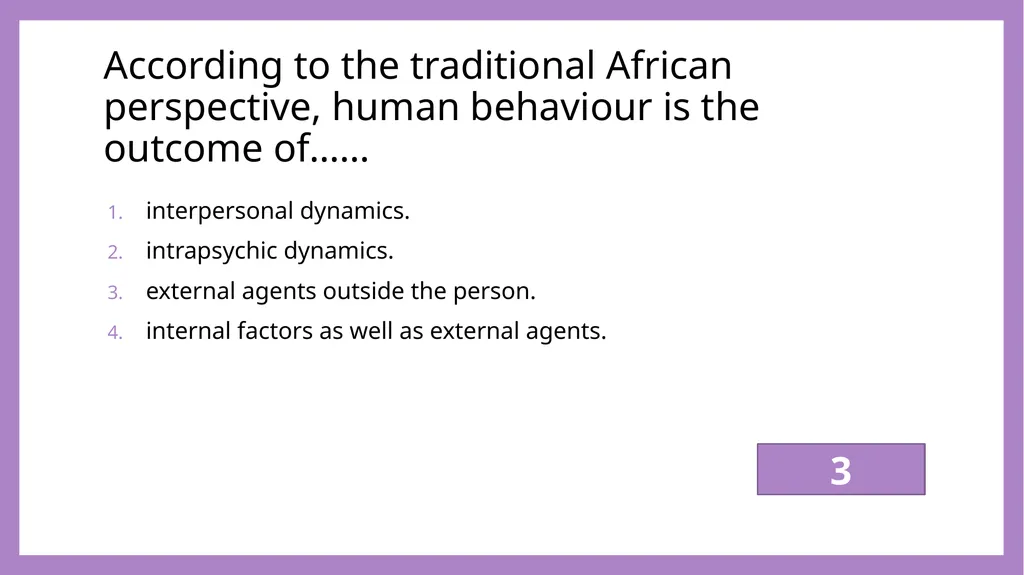
According to the traditional African perspective, human behaviour is the outcome of…… interpersonal dynamics.
intrapsychic dynamics.
external agents outside the person.
internal factors as well as external agents. 3<br>
intrapsychic dynamics.
external agents outside the person.
internal factors as well as external agents. 3<br>
11
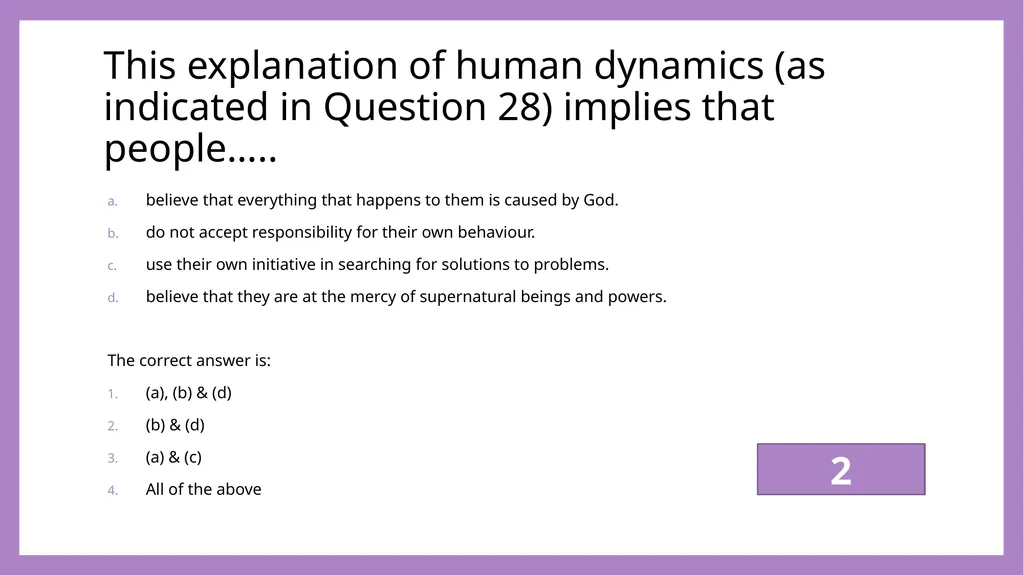
This explanation of human dynamics (as indicated in Question 28) implies that people….. believe that everything that happens to them is caused by God.
do not accept responsibility for their own behaviour.
use their own initiative in searching for solutions to problems.
believe that they are at the mercy of supernatural beings and powers.
The correct answer is:
(a), (b) & (d)
(b) & (d)
(a) & (c)
All of the above 2<br>
do not accept responsibility for their own behaviour.
use their own initiative in searching for solutions to problems.
believe that they are at the mercy of supernatural beings and powers.
The correct answer is:
(a), (b) & (d)
(b) & (d)
(a) & (c)
All of the above 2<br>
12
The rituals to fortify African babies against evil, refer to the , as explained by Sow. micro-cosmos
meso-cosmos
macro-cosmos 2<br>
meso-cosmos
macro-cosmos 2<br>
13
It is very important for traditional Africans to honour their ancestors. This refers to the _____, as explained by Sow. micro-cosmos
meso-cosmos
macro-cosmos 3<br>
meso-cosmos
macro-cosmos 3<br>
14
Children are very important in the everyday, collective life of traditional Africans. This refers to the _____, as explained by Sow. micro-cosmos
meso-cosmos
macro-cosmos 1<br>
meso-cosmos
macro-cosmos 1<br>
15
You are a nurse in a rural clinic and you have to explain to a traditional African mother, who lives in a very remote part of rural South Africa, that she should give her child his medication three times a day. How would you explain this to the mother to make sure that she understands you? Use your knowledge on the African concept of time to answer the question. Give your child’s medication three times per day.
Give your child’s medication at 06:00, 12:00 and again at 18:00.
Give your child’s medication at mealtimes.
Give your child’s medication when the sun comes up in the morning, in the middle of the day when you throw no shadow, and again when the sun goes to bed. 4<br>
Give your child’s medication at 06:00, 12:00 and again at 18:00.
Give your child’s medication at mealtimes.
Give your child’s medication when the sun comes up in the morning, in the middle of the day when you throw no shadow, and again when the sun goes to bed. 4<br>
16
A friend asks you the following question: Is it really necessary to study an African perspective in Personology? What is your answer? Yes, it is necessary. The existing Euro-American perspectives are one-sided and sometimes unsuitable for the understanding of people from other cultures.
No, it is not necessary. If the people of Africa want to be part of the First World, they should incorporate Western psychology into their thinking.
Yes, it is necessary, because there is basically no difference between African and Western theories of personality.
No, it is not necessary, because an African perspective can make no contributions to an understanding of human functioning in general. 1<br>
17
According to Sogolo, which one of the following statements best explains the cognitive functioning of traditional Africans and Westerners? Westerners have a three-dimensional concept of time, while traditional Africans have a linear concept of time.
the Westerner’s functioning is dominated by the left hemisphere of the brain, while the traditional African’s functioning is dominated by the right hemisphere of the brain.
Westerners believe only in the macro-cosmic functioning of the universe, while traditional Africans believe in the micro-, meso- and macro-cosmic functioning of the universe.
Westerners’ cognitive functioning is anchored in rationality, while traditional Africans rely more on intuition and emotion than on pure rationality. 4<br>
18
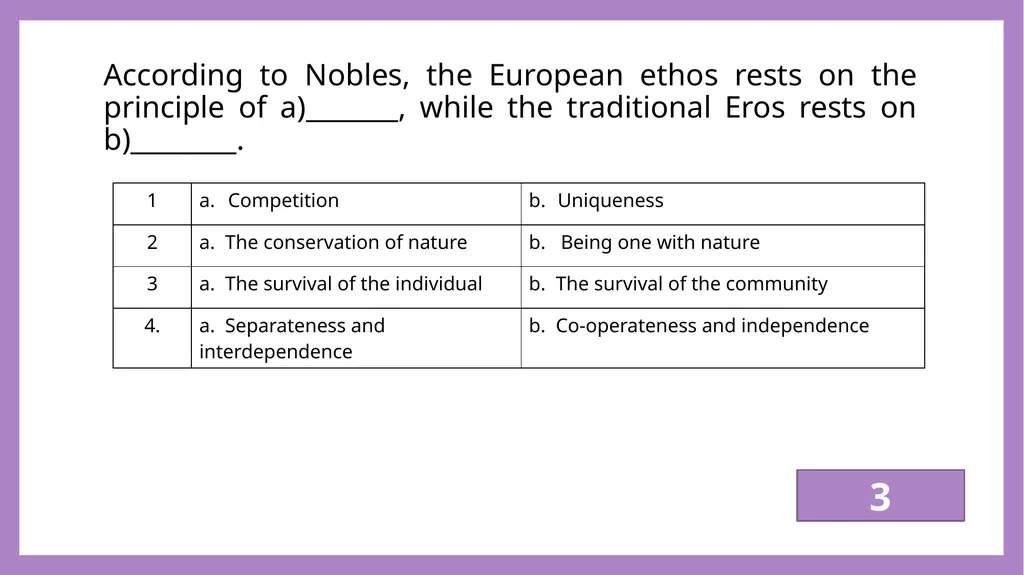
According to Nobles, the European ethos rests on the principle of a)_______, while the traditional Eros rests on b)________. 3<br>
19
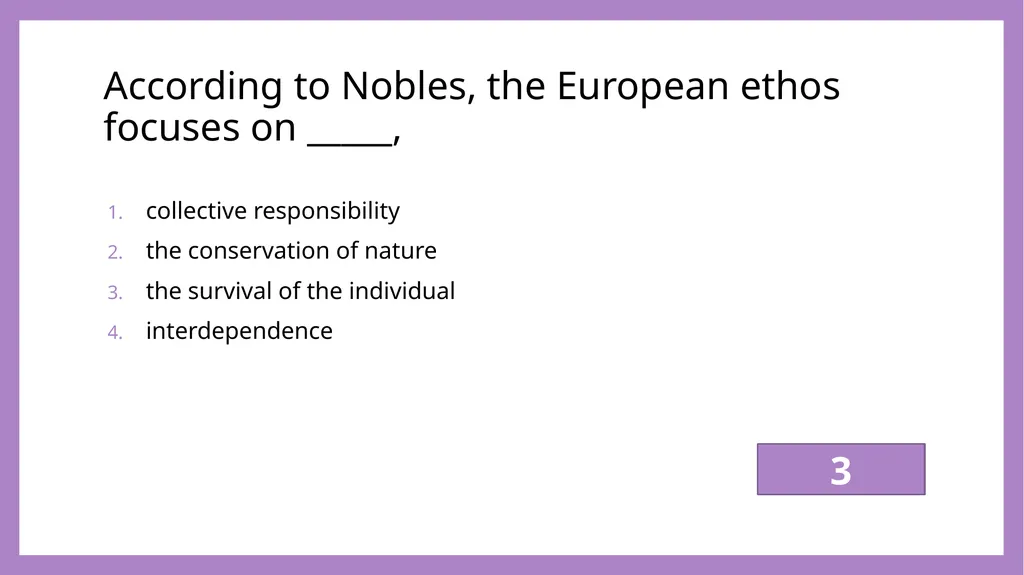
According to Nobles, the European ethos focuses on _____, collective responsibility
the conservation of nature
the survival of the individual
interdependence 3<br>
the conservation of nature
the survival of the individual
interdependence 3<br>
20
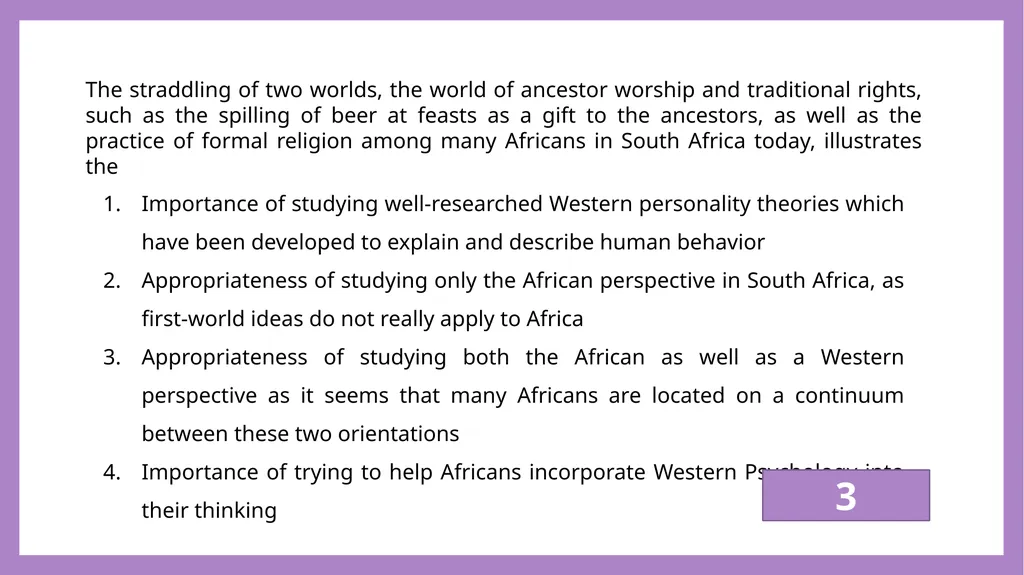
The straddling of two worlds, the world of ancestor worship and traditional rights, such as the spilling of beer at feasts as a gift to the ancestors, as well as the practice of formal religion among many Africans in South Africa today, illustrates the Importance of studying well-researched Western personality theories which have been developed to explain and describe human behavior
Appropriateness of studying only the African perspective in South Africa, as first-world ideas do not really apply to Africa
Appropriateness of studying both the African as well as a Western perspective as it seems that many Africans are located on a continuum between these two orientations
Importance of trying to help Africans incorporate Western Psychology into their thinking 3<br>
21
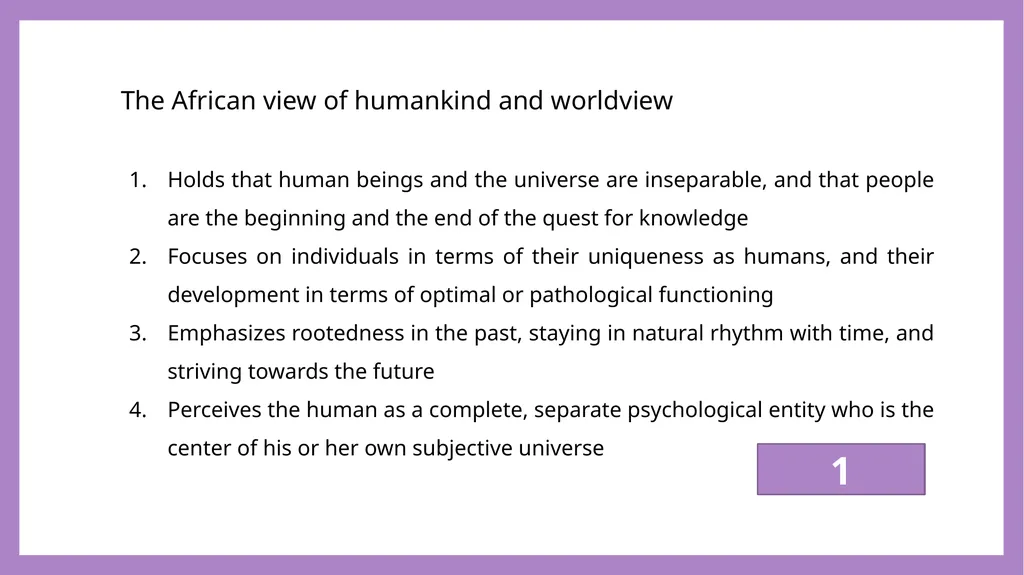
The African view of humankind and worldview Holds that human beings and the universe are inseparable, and that people are the beginning and the end of the quest for knowledge
Focuses on individuals in terms of their uniqueness as humans, and their development in terms of optimal or pathological functioning
Emphasizes rootedness in the past, staying in natural rhythm with time, and striving towards the future
Perceives the human as a complete, separate psychological entity who is the center of his or her own subjective universe 1<br>
22
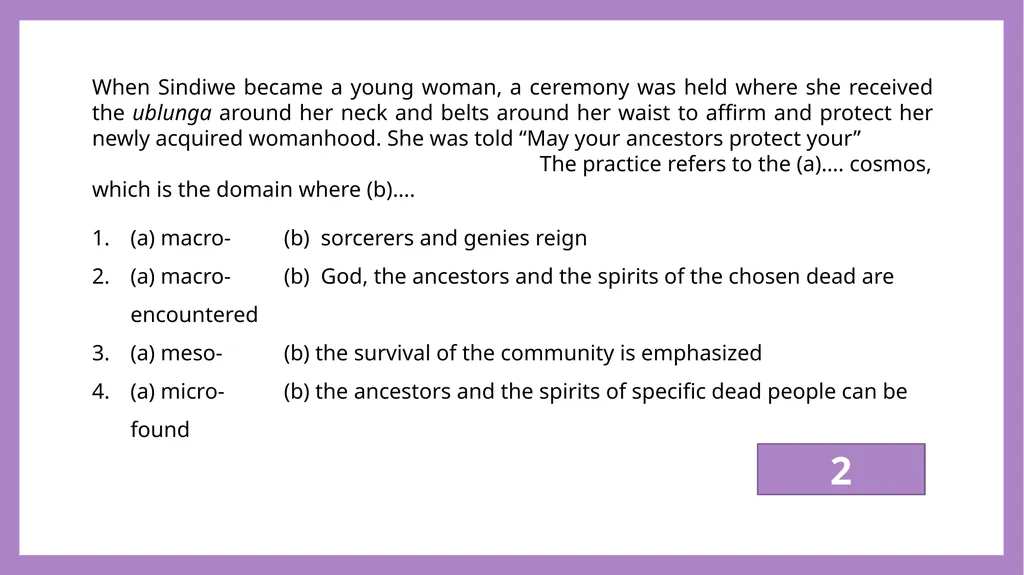
When Sindiwe became a young woman, a ceremony was held where she received the ublunga around her neck and belts around her waist to affirm and protect her newly acquired womanhood. She was told “May your ancestors protect your” The practice refers to the (a)…. cosmos, which is the domain where (b)…. (a) macro- (b) sorcerers and genies reign
(a) macro- (b) God, the ancestors and the spirits of the chosen dead are encountered
(a) meso- (b) the survival of the community is emphasized
(a) micro- (b) the ancestors and the spirits of specific dead people can be found 2<br>
(a) macro- (b) God, the ancestors and the spirits of the chosen dead are encountered
(a) meso- (b) the survival of the community is emphasized
(a) micro- (b) the ancestors and the spirits of specific dead people can be found 2<br>
23
A traditional African named Xolile drowns in the river. It is believed that Mamlambo, the River woman, lured him to his death. In term of the African perspective, this example illustrates the domain of the micro-cosmos
Macro-cosmos
Indivisible-cosmos
Meso-cosmos 4<br>
Macro-cosmos
Indivisible-cosmos
Meso-cosmos 4<br>
24
Lucky was abandoned as a baby and was taken into a family who looked after him as if he was one of their own. When he was in his teens, he caused hi family a lot of heartache by claiming that his adoptive mother had abducted him as a baby from his birth mother. During this time his adoptive mother died. He began to drink heavily, picked fights with his friends and became suicidal. One night during one of his drinking binges, Lucky nearly lost his life when he was hit by a car while staggering across the road. After he recovered, he went to see a healer/sangoma. In terms of the traditional African Perspective, Lucky needs to
Listen to the voice of the ancestors who warned him that he must change his behavior
Re-establish the broken connection between his adoptive mother and himself
Enter a rehabilitation home to help him overcome his drinking and aggressive behavior
Take some muti to protect him against bewitchment by malignant spirits and sorcerers
The correct answer is
A and B
C and D
B, C and D
All of the above 3<br>
25
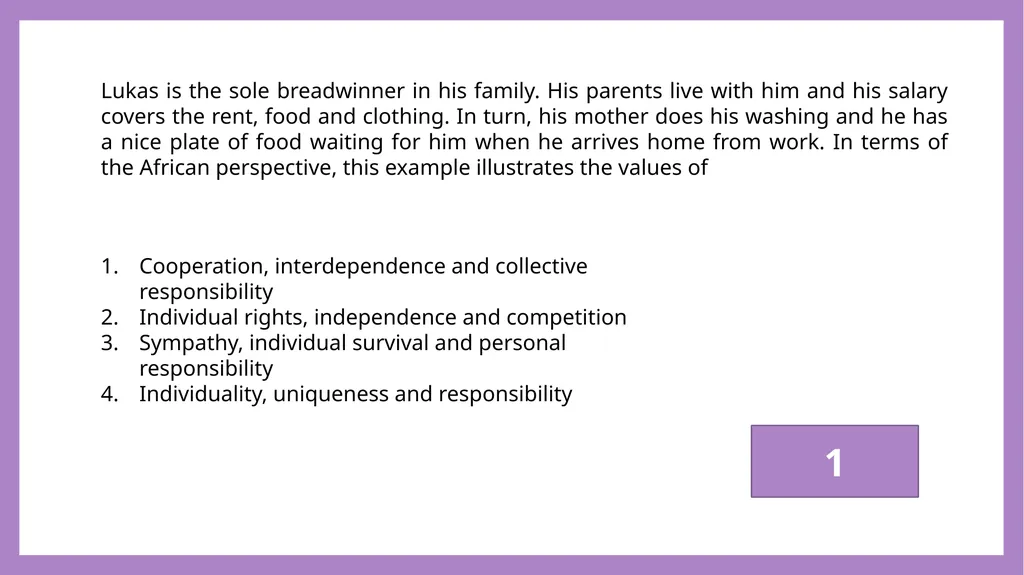
Lukas is the sole breadwinner in his family. His parents live with him and his salary covers the rent, food and clothing. In turn, his mother does his washing and he has a nice plate of food waiting for him when he arrives home from work. In terms of the African perspective, this example illustrates the values of Cooperation, interdependence and collective responsibility
Individual rights, independence and competition
Sympathy, individual survival and personal responsibility
Individuality, uniqueness and responsibility 1<br>
Individual rights, independence and competition
Sympathy, individual survival and personal responsibility
Individuality, uniqueness and responsibility 1<br>
26
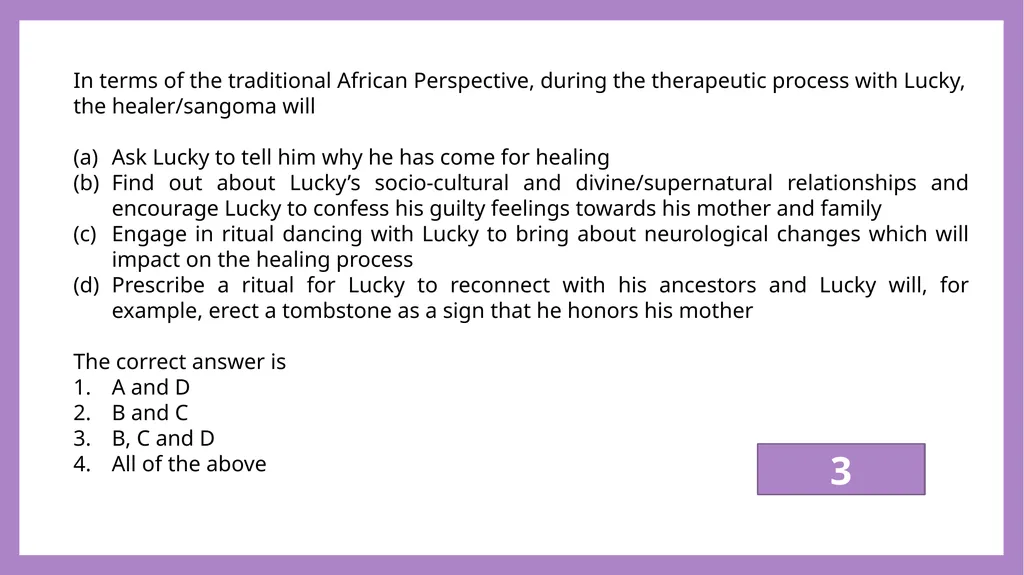
In terms of the traditional African Perspective, during the therapeutic process with Lucky, the healer/sangoma will
Ask Lucky to tell him why he has come for healing
Find out about Lucky’s socio-cultural and divine/supernatural relationships and encourage Lucky to confess his guilty feelings towards his mother and family
Engage in ritual dancing with Lucky to bring about neurological changes which will impact on the healing process
Prescribe a ritual for Lucky to reconnect with his ancestors and Lucky will, for example, erect a tombstone as a sign that he honors his mother
The correct answer is
A and D
B and C
B, C and D
All of the above 3<br>
27
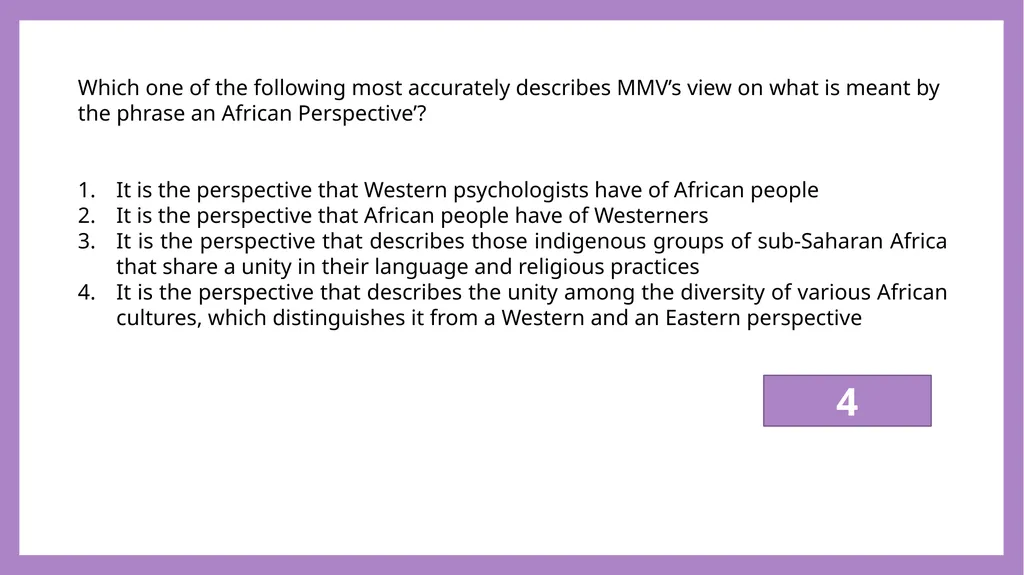
Which one of the following most accurately describes MMV’s view on what is meant by the phrase an African Perspective’?
It is the perspective that Western psychologists have of African people
It is the perspective that African people have of Westerners
It is the perspective that describes those indigenous groups of sub-Saharan Africa that share a unity in their language and religious practices
It is the perspective that describes the unity among the diversity of various African cultures, which distinguishes it from a Western and an Eastern perspective 4<br>
28
The African view of humankind and worldview is based on
A holistic sense of interconnectedness between humans, God and nature, where humans are the center of the universe from which all can b understood and explained
The focus on individuals in terms of their uniqueness as humans, and their development in terms of optimal or pathological functioning
Rootedness in the past, staying in natural rhythm with time, and striving towards the future
The human as a complete, separate psychological entity who is the center of his or her own subjective universe 1<br>
29
Which one of the following sequences most accurately depicts the traditional African worldview?
co-operation, differences, one with nature
Interdependence, commonality, survival of the tribe
Survival of the fittest, separateness, uniqueness
Collective responsibility, sameness, competition 2<br>
co-operation, differences, one with nature
Interdependence, commonality, survival of the tribe
Survival of the fittest, separateness, uniqueness
Collective responsibility, sameness, competition 2<br>
30
Thako is very sick. According to her mother who holds traditional African beliefs
Thoko’s illness is a sign that the ancestors are dissatisfied
Thoko should get a lot of rest in order to strengthen her immune system
Thoko’s ill health is the result of her daughter’s failure to take proper care of herself
Thoko’s condition is the result of not only intrapsychic, but also interpersonal dynamics 1<br>
31
In Tracey’s school the traditional African cognitive approach of intuitive rationality underpins the manner in which students are taught, while in Thandeka’s school the Western emphasis on the logical and rational aspects of cognition are emphasized. Based on your appreciation of the accuracy and/or inaccuracy of the following statements, select the most correct alternative/s below
The syllabus at Thandeka’s school is more demanding than at Tracey’s school, as the rational approach of Western cognition requires more concentration than the intuitive functioning of traditional African cognition
The approach favored in Thandeka’s school is associated with Pascal’s view on the ‘logic of the heart’, while the approach favored in Tracey’s school is associated Descartes logic of reason
The approach to cognitive functioning favored in Tracey’s school allows for an understanding of the wholeness of reality
The approach favored by each school clearly expresses the accepted fact that all Africans are without reason and all Westerners’ without emotion in their cognitive functioning
The correct answer is
C
None of the above
Only C and D, but not A and B
All of the above 1<br>
32
Sandy’s manager, Lebo, lives in accordance with traditional African worldview, while Sandy understands life through a Western framework. This leads to differences at times in how Lebo and Sandy plan work activities. Which one of the following most accurately captures the differences between the traditional African and Western conception of time?
Sandy’s manager, Lebo, tends to focus her planning of work activities around future events, while Sandy prefers to focus on the past and present scenarios
Sandy is often late for the meetings her manager, Lebo schedules, as it is more important for her ‘to be in time than on time’
Lebo asks Sandy to diarize her work priorities. In order to meet her deadlines, Sandy divides each week up into separate time units and lists which aspect of work she will priorities for completion by a certain date
Sandy has a sound understanding of time and how it works, whereas her manager, Lebo, completely ignores the value of time and the importance of being punctual, 3<br>
33
Which of the following statements about the optimal development of traditional Africans and Westerners are correct according to the view proposed by Pasteur and Toldson?
The traditional African’s use of the right hemisphere of the brain versus the Westeners’ tendency to favor the left hemisphere enables traditional Africans to be more connected with their physical and spiritual environments
The collective existence favored by traditional Africans provides them with an essential security and selflessness that protects them from much of the stress and tension experienced by the individualistic and competitive existence of Westerners
Traditional Africans have easier access to their defense mechanisms and are able to protect themselves from stressful experiences by making use of denial and projection more readily than their Western counterparts
The Western focus on analysis and logic leads to the dominance in their use of the left hemisphere of the brain, causing tension and stress
The correct answer is
A, C and D
B and D
A and C
C and D 2<br>
34
Simphiwe has not been feeling well lately. His vision is blurred, he hears voices and his body feels sore all over. He eventually decides to consult with the sangoma about his condition. Which one of the following would most accurately describe the sangoma’s traditional African view of Simphiwe’s experience.
The sangoma understands Simphiwe’s symptoms as the result of a disharmony between Simphiwe and his ancestors
According to the sangoma, Simphiwe’s physical condition is having a negative impact on his mental well-being
Due to the traditional African belief in the reciprocity between mind and body, the sangoma understands Simphiwe’s mental illness to be affecting his physical well-being
In order to understand Simphiwe’s symptoms the sangoma begins by conducting a physical examination of Simphiwe’s body 1<br>
35
According to the sangoma, what must Simphiwe do in order to recover?
The sangoma advises Simphiwe to break the connection with his ancestors in order to reconnect more fully with life on earth
According to the sangoma Simphiwe should consult with a Western psychiatrist, as he required Western medication to treat his symptoms
The sangoma recommends that Simphiwe should listen to the voices of his ancestors in order to understand how he has displeased them and to ask for their protection from malignant spirits
According to the sangoma it is more important for Simphiwe to understand what caused his illness, as opposed to who brought it about 3<br>
36
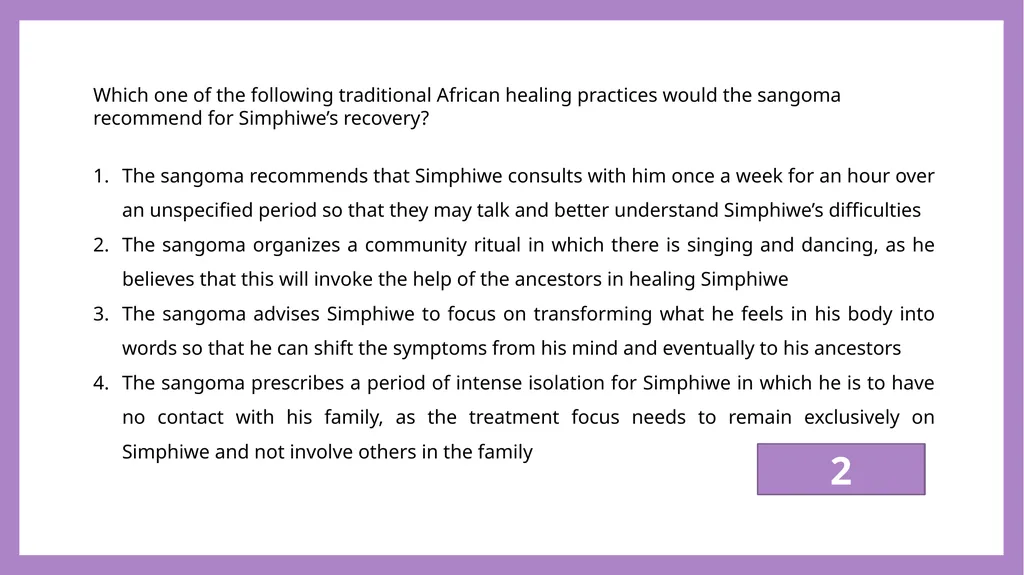
Which one of the following traditional African healing practices would the sangoma recommend for Simphiwe’s recovery?
The sangoma recommends that Simphiwe consults with him once a week for an hour over an unspecified period so that they may talk and better understand Simphiwe’s difficulties
The sangoma organizes a community ritual in which there is singing and dancing, as he believes that this will invoke the help of the ancestors in healing Simphiwe
The sangoma advises Simphiwe to focus on transforming what he feels in his body into words so that he can shift the symptoms from his mind and eventually to his ancestors
The sangoma prescribes a period of intense isolation for Simphiwe in which he is to have no contact with his family, as the treatment focus needs to remain exclusively on Simphiwe and not involve others in the family 2<br>
37
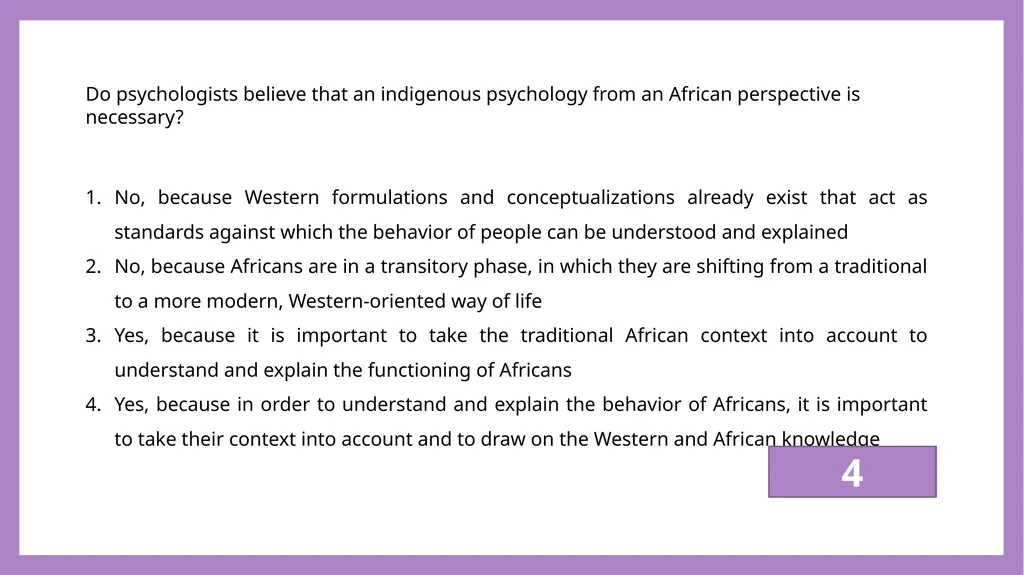
Do psychologists believe that an indigenous psychology from an African perspective is necessary?
No, because Western formulations and conceptualizations already exist that act as standards against which the behavior of people can be understood and explained
No, because Africans are in a transitory phase, in which they are shifting from a traditional to a more modern, Western-oriented way of life
Yes, because it is important to take the traditional African context into account to understand and explain the functioning of Africans
Yes, because in order to understand and explain the behavior of Africans, it is important to take their context into account and to draw on the Western and African knowledge 4<br>
38
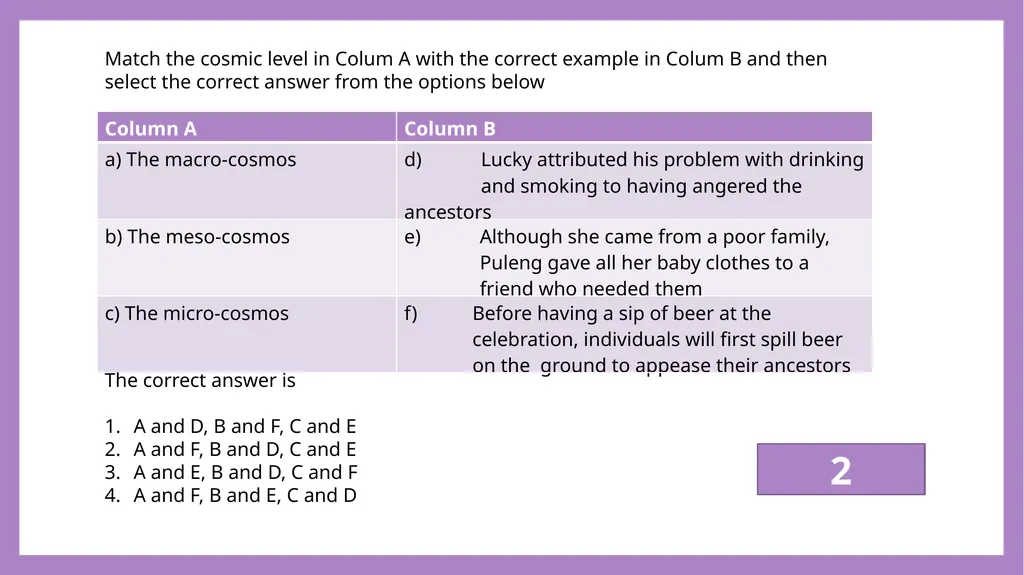
Match the cosmic level in Colum A with the correct example in Colum B and then select the correct answer from the options below The correct answer is
A and D, B and F, C and E
A and F, B and D, C and E
A and E, B and D, C and F
A and F, B and E, C and D 2<br>
A and D, B and F, C and E
A and F, B and D, C and E
A and E, B and D, C and F
A and F, B and E, C and D 2<br>
39
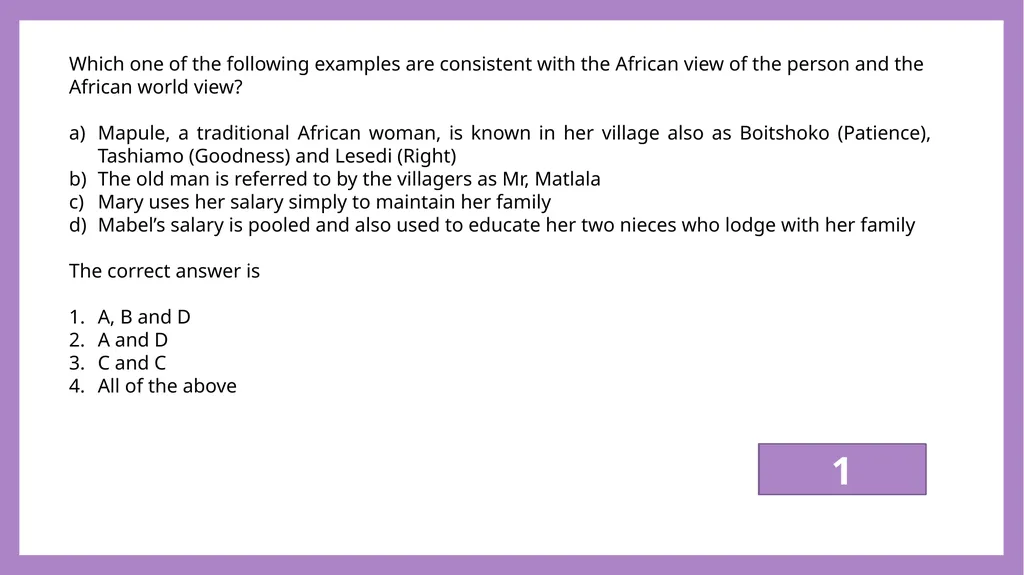
Which one of the following examples are consistent with the African view of the person and the African world view?
Mapule, a traditional African woman, is known in her village also as Boitshoko (Patience), Tashiamo (Goodness) and Lesedi (Right)
The old man is referred to by the villagers as Mr, Matlala
Mary uses her salary simply to maintain her family
Mabel’s salary is pooled and also used to educate her two nieces who lodge with her family
The correct answer is
A, B and D
A and D
C and C
All of the above 1<br>
40
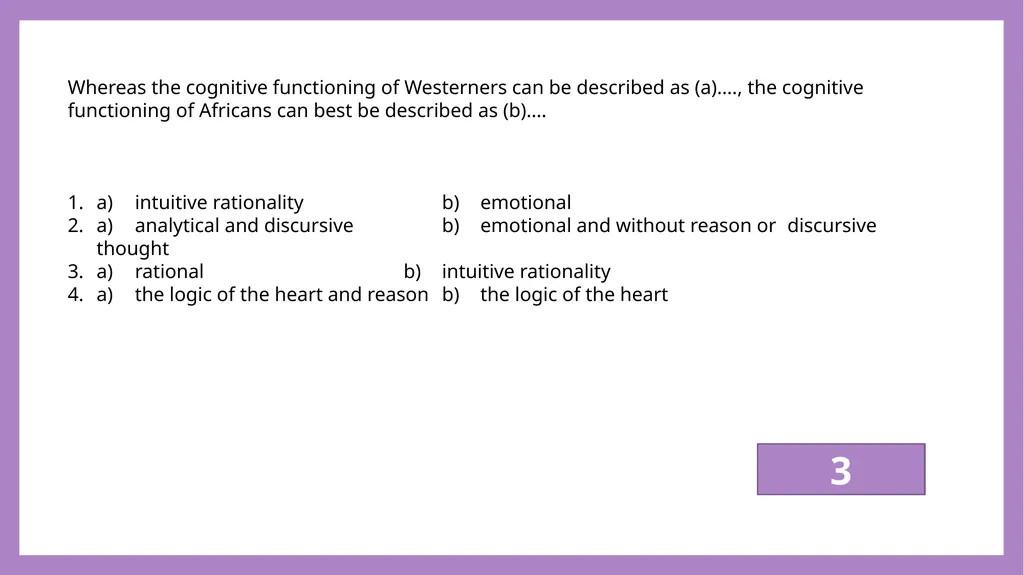
Whereas the cognitive functioning of Westerners can be described as (a)…., the cognitive functioning of Africans can best be described as (b)….
a) intuitive rationality b) emotional
a) analytical and discursive b) emotional and without reason or discursive thought
a) rational b) intuitive rationality
a) the logic of the heart and reason b) the logic of the heart 3<br>
a) intuitive rationality b) emotional
a) analytical and discursive b) emotional and without reason or discursive thought
a) rational b) intuitive rationality
a) the logic of the heart and reason b) the logic of the heart 3<br>
41
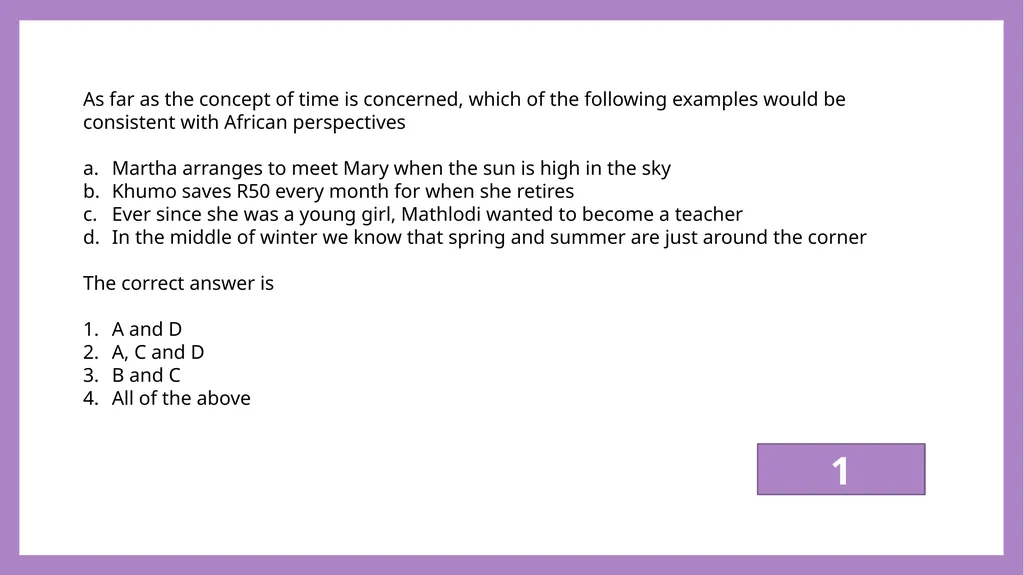
As far as the concept of time is concerned, which of the following examples would be consistent with African perspectives
Martha arranges to meet Mary when the sun is high in the sky
Khumo saves R50 every month for when she retires
Ever since she was a young girl, Mathlodi wanted to become a teacher
In the middle of winter we know that spring and summer are just around the corner
The correct answer is
A and D
A, C and D
B and C
All of the above 1<br>
42
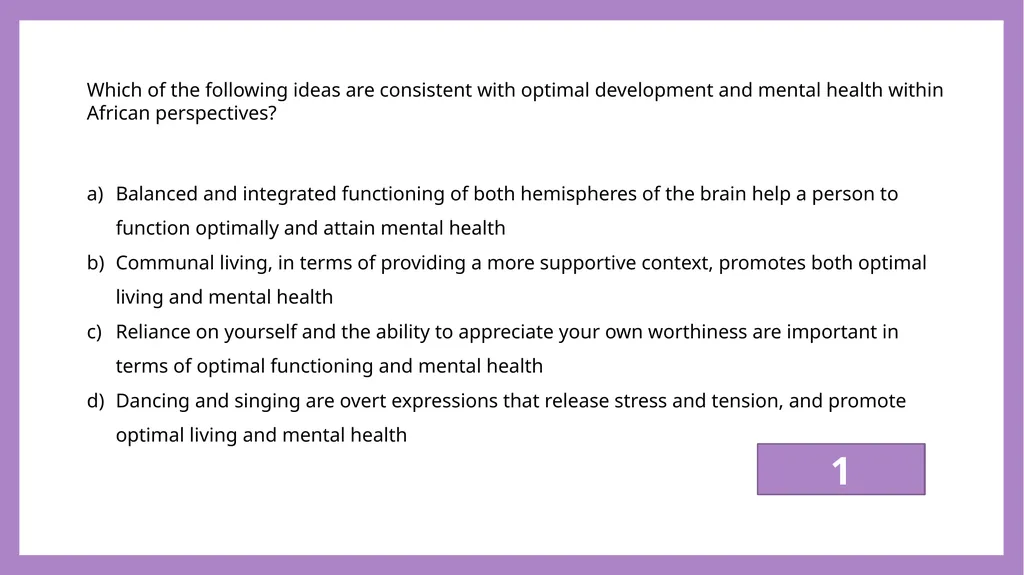
Which of the following ideas are consistent with optimal development and mental health within African perspectives?
Balanced and integrated functioning of both hemispheres of the brain help a person to function optimally and attain mental health
Communal living, in terms of providing a more supportive context, promotes both optimal living and mental health
Reliance on yourself and the ability to appreciate your own worthiness are important in terms of optimal functioning and mental health
Dancing and singing are overt expressions that release stress and tension, and promote optimal living and mental health 1<br>
43
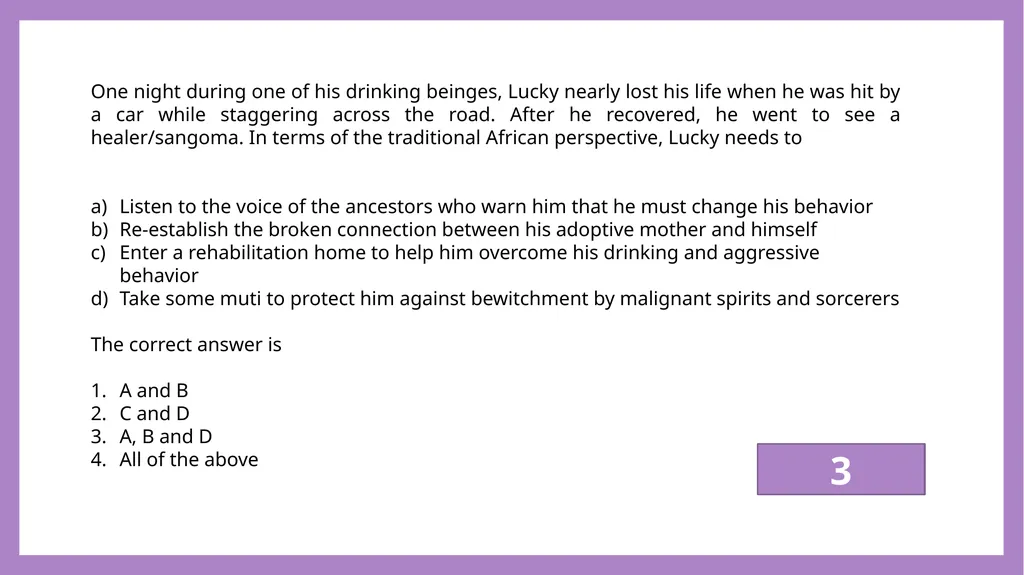
One night during one of his drinking beinges, Lucky nearly lost his life when he was hit by a car while staggering across the road. After he recovered, he went to see a healer/sangoma. In terms of the traditional African perspective, Lucky needs to
Listen to the voice of the ancestors who warn him that he must change his behavior
Re-establish the broken connection between his adoptive mother and himself
Enter a rehabilitation home to help him overcome his drinking and aggressive behavior
Take some muti to protect him against bewitchment by malignant spirits and sorcerers
The correct answer is
A and B
C and D
A, B and D
All of the above 3<br>
44
Maggy does not believe in traditional African belief systems. Her family is not happy with her attitude because they believe that she is ignoring her culture. She is not having odd experiences like dreaming of her late great-grand mother (whom she did not know), asking her to become a sangoma. She made it clear to her family that she would not consider becoming a sangoma. In addition to the dream, she is experiencing headaches that do not seem to respond to treatment.
In line with the traditional African beliefs, how would you expect Maggy’s family to react to her dream? They might
Interpret her dream on a symbolic level
Look at it more as a reflection of concrete reality
View it tentatively since the person she dreamt of is not known to her
Ignore her dream since interpretation of dreams is more a Western concept Answer:2<br>
45
If someone ignores the demands of the ancestors like Maggy does, what would be the possible outcome in line with traditional African beliefs?
The ancestors might push her to change her attitude
She might not recover from her illness unless she responds to their call of becoming a sangoma
The ancestors will try and use her parents to change her mind
There will be no effect on Maggy’s life because she does not believe in traditional systems Answer:2<br>
46
Based on the above story, Maggy’s illness could be viewed by traditional Africans as
A reflection of disharmony between herself and the ancestors
A psychosomatic disorder
An invasion of evil spirits caused by sorcerers
The outcome of witchcraft Answer:1<br>
A reflection of disharmony between herself and the ancestors
A psychosomatic disorder
An invasion of evil spirits caused by sorcerers
The outcome of witchcraft Answer:1<br>
47
The practice of spilling beer as a gift to the ancestors by traditional Africans at feasts to ensure that the ancestors will intercede on their behalf, refers to the (a) cosmos, which domain is where (b) Answer:2 a) macro b) sorcerers and genies reign
a) macro b) one reaches God through ancestors who are intermediaries
a) meso b) the survival of the community is emphasised
a) micro b) ancestors and spirits of specific people can be found<br>
a) macro b) one reaches God through ancestors who are intermediaries
a) meso b) the survival of the community is emphasised
a) micro b) ancestors and spirits of specific people can be found<br>
48
If Maggy was to consult a traditional African healer, he or she would probably
Ask her to relate in detail the problem she is experiencing
Focus on the causal links of her illness
Help to restore and balance the power of the universe
Focus less on her socio-cultural background and rather on her symptoms Answer:3<br>
Ask her to relate in detail the problem she is experiencing
Focus on the causal links of her illness
Help to restore and balance the power of the universe
Focus less on her socio-cultural background and rather on her symptoms Answer:3<br>
49
How is the concept of time understood from an African perspective?
The focus is on the things that are currently happening or that have already happened and there is no reliance on the things that are still to happen
The focus is on something that will happen in the natural rhythm of phenomena
Traditional Africans do not believe in an infinite future but they emphasize rather long-term events
Traditional Africans believe in the present and an infinite future 1<br>
50
For most of Gadifele’s life she has preferred to keep to herself and actively avoids social interactions. She seems indifferent and emotionally cold towards others. She also has a tendency of talking to herself, as if she is conversion with imaginary people. People in her community are deeply touched and very emotional about her problem. They think that she has been invaded by evil spirits.
The meaning that the community has attached to Gadifele’s problem could be explained by which of the following cosmic order/s?
Meso-cosmos
Macro-cosmos
Micro-cosmos
Macro and meso-cosmos Answer:1<br>
The meaning that the community has attached to Gadifele’s problem could be explained by which of the following cosmic order/s?
Meso-cosmos
Macro-cosmos
Micro-cosmos
Macro and meso-cosmos Answer:1<br>
51
Which one of the following most accurately reflects the cognitive functioning displayed by the community in the story?
Intuitive rationality
Logic of the reason
Analytical thinking
Analytical and intuitive thinking Answer:1<br>
Intuitive rationality
Logic of the reason
Analytical thinking
Analytical and intuitive thinking Answer:1<br>
52
If you were practicing within the framework of the traditional African worldview, which one of the following aims would fit with your therapeutic process during your intervention with Gadifele?
To help Gadifele to function as an autonomous, independent being
To have an understanding of the limitations that her belief system imposes on her
To provide an avenue to see herself as an integral part of her community and to understand the link between her behavior and her belief system without necessarily avoiding responsibility for her behavior
To assist her, within her cultural context, to understand the cause of her behavior without her necessarily taking responsibility for it Answer:4<br>
53
Which of the following statements about the traditional African view on illness and psychopathology is/are correct?
Mental illness is accompanied by physical symptoms
The emphasis is placed on the importance of harmony between the person’s mind and the universe
Mental disorders are seen as psychosomatic disorders
The ancestors play an important role in the causation of mental illness
The correct answer is
All of the above
A
B and D
C Answer:1<br>
54
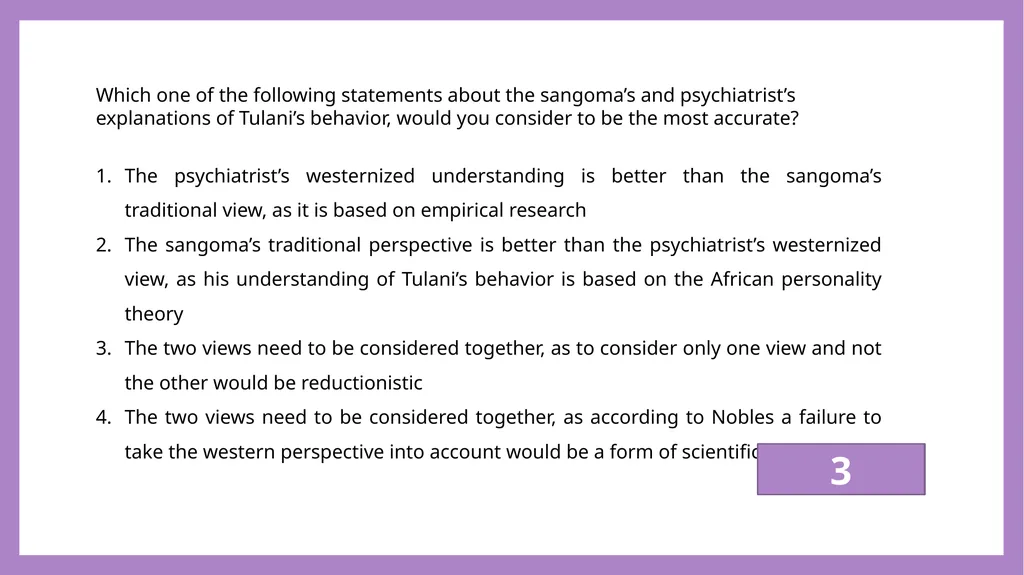
Which one of the following statements about the sangoma’s and psychiatrist’s explanations of Tulani’s behavior, would you consider to be the most accurate?
The psychiatrist’s westernized understanding is better than the sangoma’s traditional view, as it is based on empirical research
The sangoma’s traditional perspective is better than the psychiatrist’s westernized view, as his understanding of Tulani’s behavior is based on the African personality theory
The two views need to be considered together, as to consider only one view and not the other would be reductionistic
The two views need to be considered together, as according to Nobles a failure to take the western perspective into account would be a form of scientific colonialism 3<br>
55
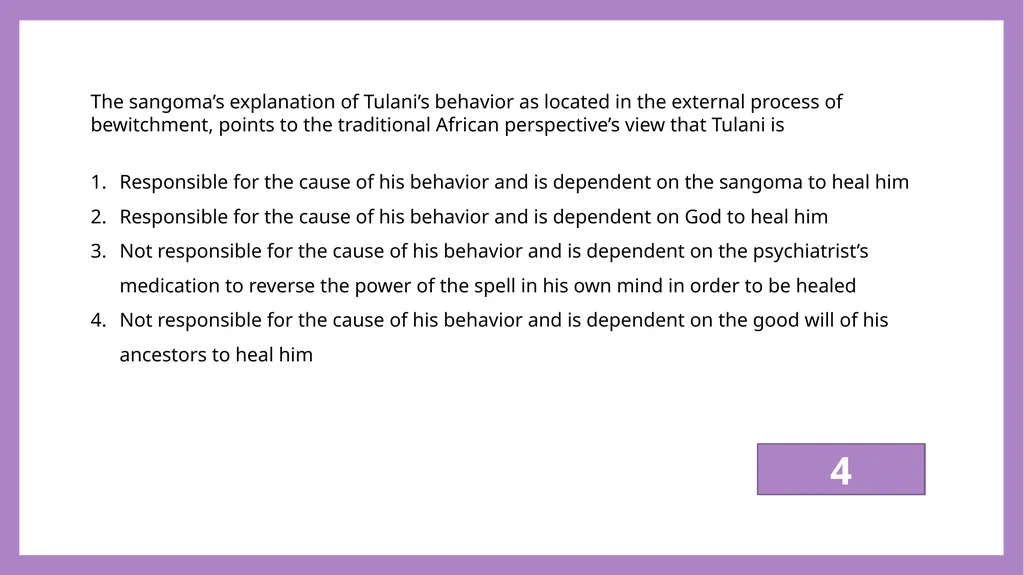
The sangoma’s explanation of Tulani’s behavior as located in the external process of bewitchment, points to the traditional African perspective’s view that Tulani is
Responsible for the cause of his behavior and is dependent on the sangoma to heal him
Responsible for the cause of his behavior and is dependent on God to heal him
Not responsible for the cause of his behavior and is dependent on the psychiatrist’s medication to reverse the power of the spell in his own mind in order to be healed
Not responsible for the cause of his behavior and is dependent on the good will of his ancestors to heal him 4<br>
56
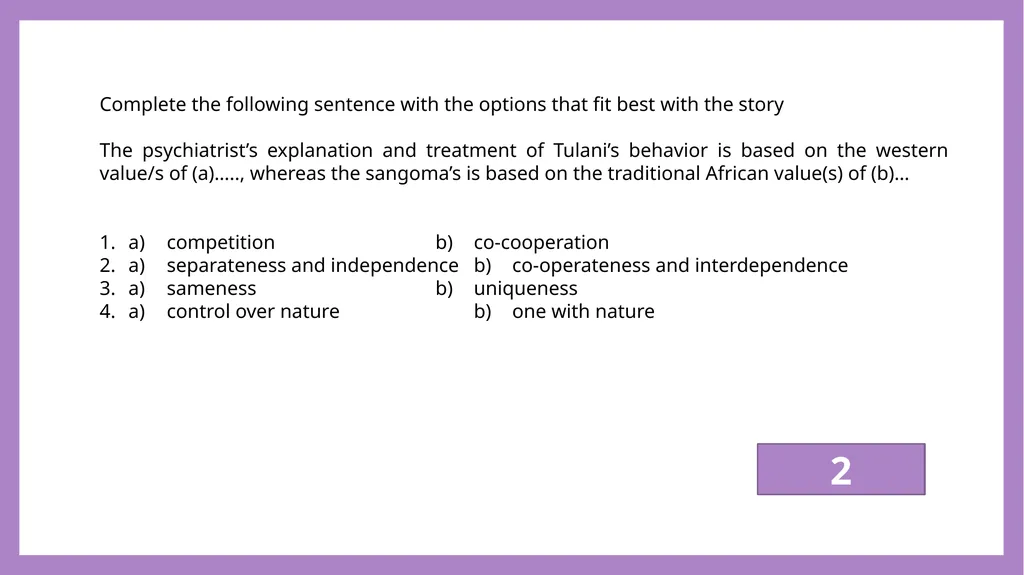
Complete the following sentence with the options that fit best with the story
The psychiatrist’s explanation and treatment of Tulani’s behavior is based on the western value/s of (a)….., whereas the sangoma’s is based on the traditional African value(s) of (b)…
a) competition b) co-cooperation
a) separateness and independence b) co-operateness and interdependence
a) sameness b) uniqueness
a) control over nature b) one with nature 2<br>
57
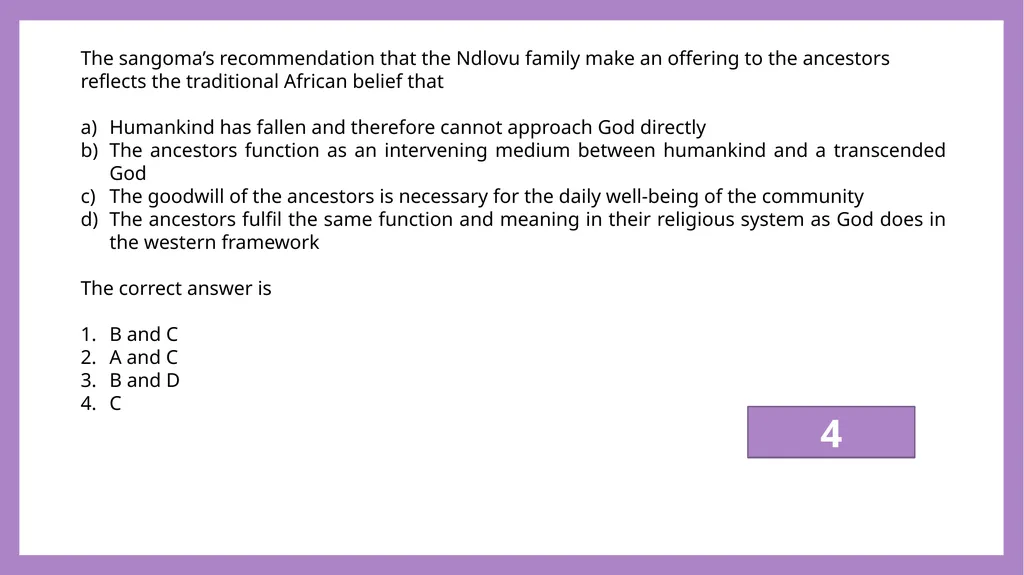
The sangoma’s recommendation that the Ndlovu family make an offering to the ancestors reflects the traditional African belief that
Humankind has fallen and therefore cannot approach God directly
The ancestors function as an intervening medium between humankind and a transcended God
The goodwill of the ancestors is necessary for the daily well-being of the community
The ancestors fulfil the same function and meaning in their religious system as God does in the western framework
The correct answer is
B and C
A and C
B and D
C 4<br>
58
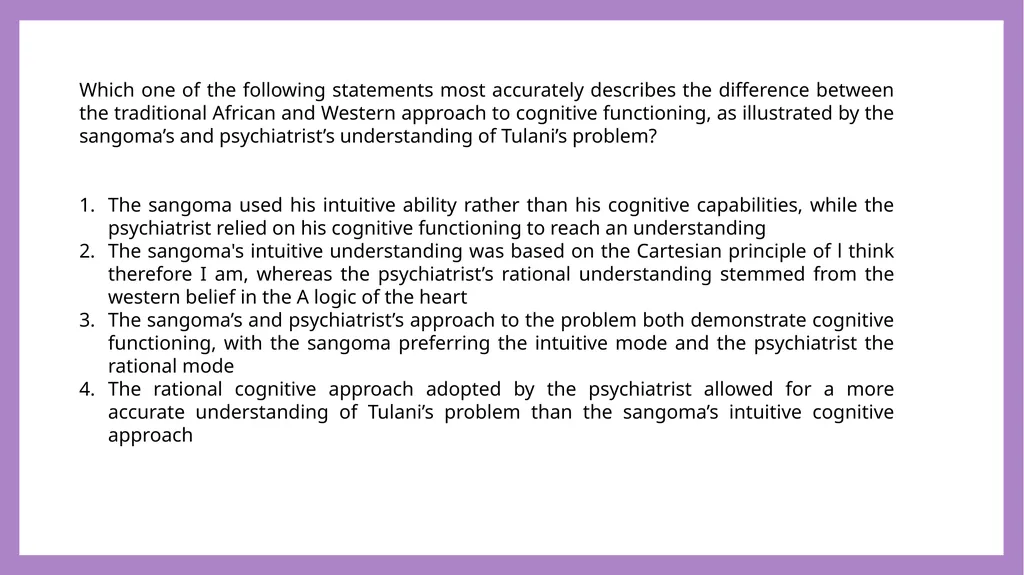
Which one of the following statements most accurately describes the difference between the traditional African and Western approach to cognitive functioning, as illustrated by the sangoma’s and psychiatrist’s understanding of Tulani’s problem?
The sangoma used his intuitive ability rather than his cognitive capabilities, while the psychiatrist relied on his cognitive functioning to reach an understanding
The sangoma's intuitive understanding was based on the Cartesian principle of l think therefore I am, whereas the psychiatrist’s rational understanding stemmed from the western belief in the A logic of the heart
The sangoma’s and psychiatrist’s approach to the problem both demonstrate cognitive functioning, with the sangoma preferring the intuitive mode and the psychiatrist the rational mode
The rational cognitive approach adopted by the psychiatrist allowed for a more accurate understanding of Tulani’s problem than the sangoma’s intuitive cognitive approach<br>
59
The way the sangoma instructed Tulani is to take his muti, portrays an understanding of time as (a)… which is characteristic of traditional African’s; whereas the psychiatrist/s prescription on how Tulani should take his medication demonstrates and understanding of time as (b)… which is characteristic of Westerners
1. a) determined by the natural rhythm of the universe b) a mathematical construct
a) future orientated b) present focused
a) linear b) two dimensional
a) A commodity that needs to be created b) future focused 1<br>
1. a) determined by the natural rhythm of the universe b) a mathematical construct
a) future orientated b) present focused
a) linear b) two dimensional
a) A commodity that needs to be created b) future focused 1<br>
60
If the sangoma were to adopt Pasteur and Toldson’s understanding of mental health and optimal functioning, he may explain the reason for Tulani’s difficulties as stemming from
The balanced use of his right and left brain hemispheres, leading to an increase in his need to find logical reasons for his brother’s death
His withdrawal from collective existence, leaving him unable to control is weaknesses as an individual
His inability to repress the memory of his brother in his unconscious
His failure to give direct and immediate expression to his grief at the time of his brother’s death
The correct answer is
A and D
B, C and D
A, B and C
B and D 3<br>
61
Tulani is referred to you for psychotherapy, as you are practicing within the framework of the traditional African world view. What would you consider to be an optimal outcome for Tulani in therapy?
Therapy will be successful when Tulani is able to function as an autonomous, independent human being
Your aim will be to increase his analysis of the circumstances surrounding hi brother’s death
The aim of therapy should be to break Tulani’s withdrawal so that he can draw strength from his collective existence
You believe Tulani will be cured when his right brain capacity for synchrony and harmony has ben increased over his left brain tendency to seek answers for his brother’s death 3<br>
62
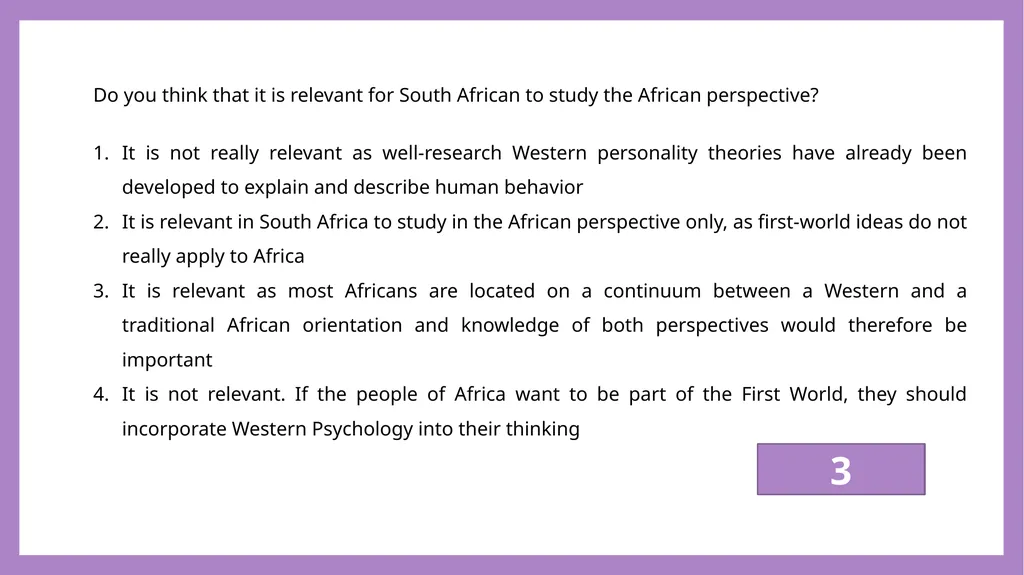
Do you think that it is relevant for South African to study the African perspective?
It is not really relevant as well-research Western personality theories have already been developed to explain and describe human behavior
It is relevant in South Africa to study in the African perspective only, as first-world ideas do not really apply to Africa
It is relevant as most Africans are located on a continuum between a Western and a traditional African orientation and knowledge of both perspectives would therefore be important
It is not relevant. If the people of Africa want to be part of the First World, they should incorporate Western Psychology into their thinking 3<br>
63
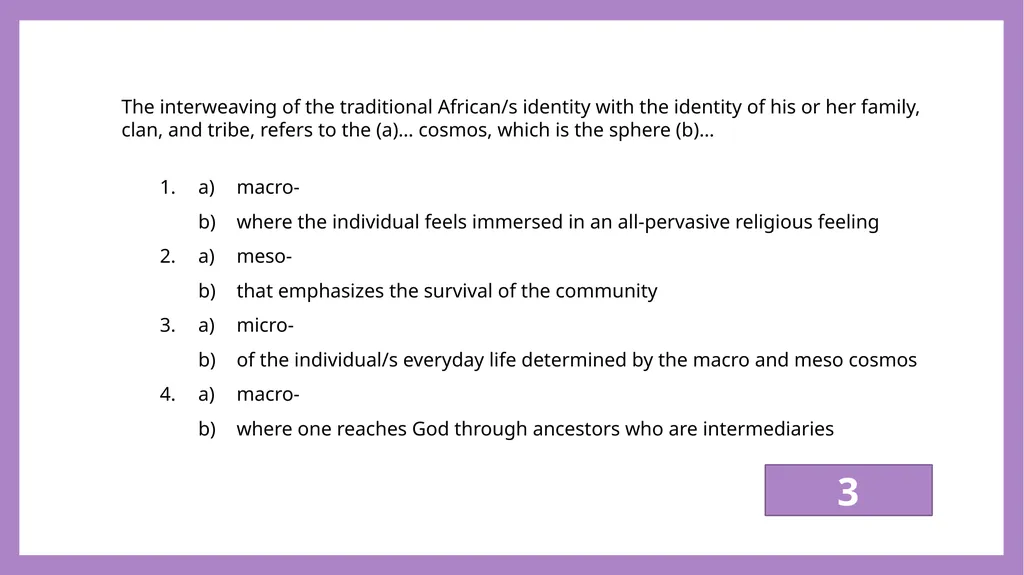
The interweaving of the traditional African/s identity with the identity of his or her family, clan, and tribe, refers to the (a)… cosmos, which is the sphere (b)…
1. a) macro-
b) where the individual feels immersed in an all-pervasive religious feeling
2. a) meso-
b) that emphasizes the survival of the community
3. a) micro-
b) of the individual/s everyday life determined by the macro and meso cosmos
4. a) macro-
b) where one reaches God through ancestors who are intermediaries 3<br>
64
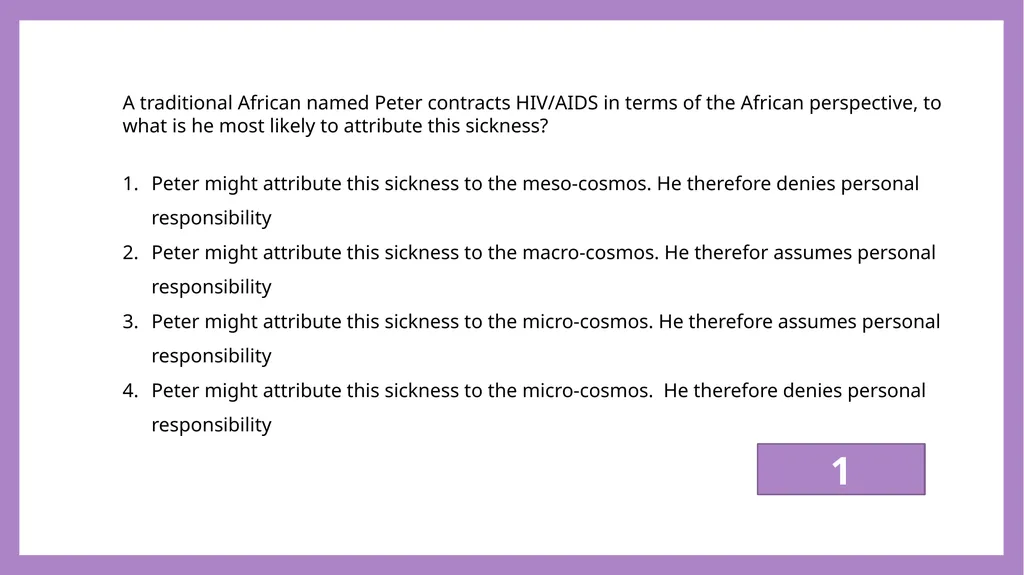
A traditional African named Peter contracts HIV/AIDS in terms of the African perspective, to what is he most likely to attribute this sickness?
Peter might attribute this sickness to the meso-cosmos. He therefore denies personal responsibility
Peter might attribute this sickness to the macro-cosmos. He therefor assumes personal responsibility
Peter might attribute this sickness to the micro-cosmos. He therefore assumes personal responsibility
Peter might attribute this sickness to the micro-cosmos. He therefore denies personal responsibility 1<br>