04
Lesson Overview What is Community-oriented Policing?
Main Guiding Documents
The Benefits of CoP
Four Essential Elements of CoP
Problem Solving
Implementing CoP
Constraints, Risks and Challenges 4<br>
05
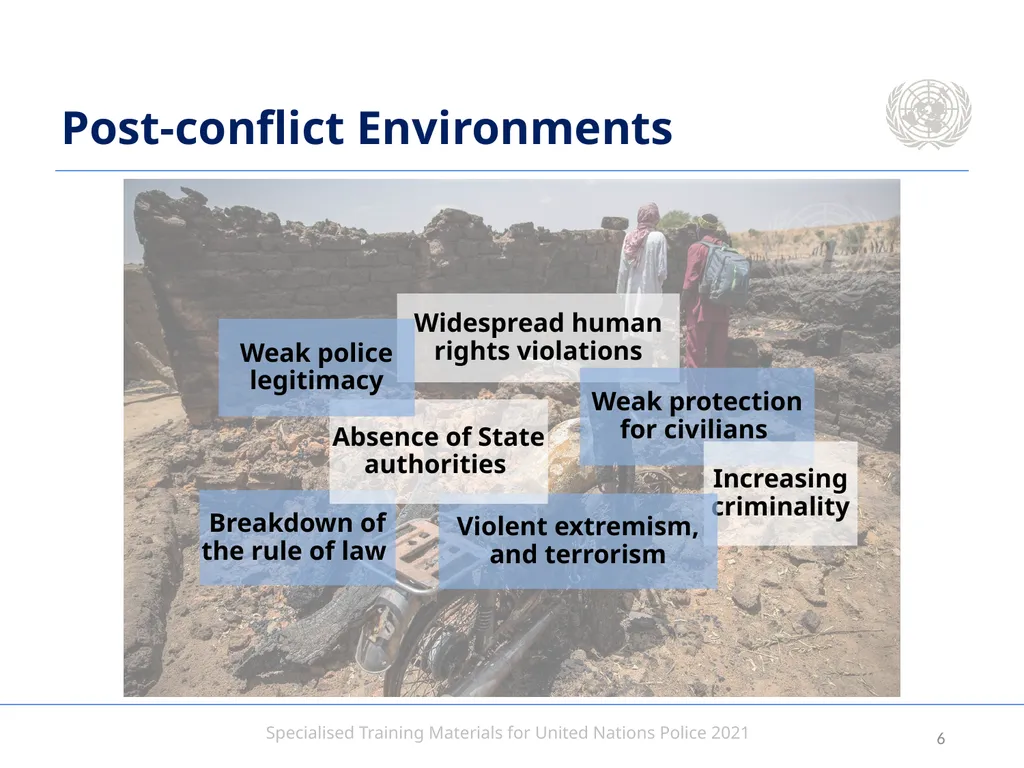
Post-conflict Environments 5 Widespread human rights violations Weak protection for civilians Increasing criminality Violent extremism, and terrorism Breakdown of the rule of law Absence of State authorities Weak police legitimacy<br>
06
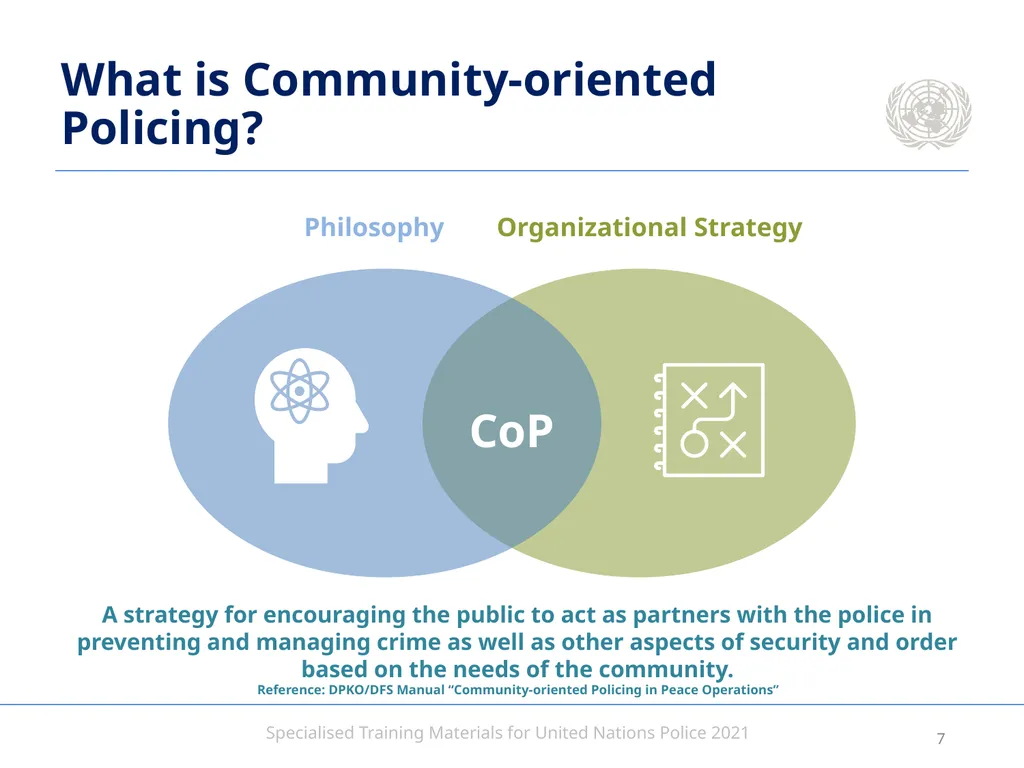
What is Community-oriented Policing? 6 A strategy for encouraging the public to act as partners with the police in preventing and managing crime as well as other aspects of security and order based on the needs of the community.
Reference: DPKO/DFS Manual “Community-oriented Policing in Peace Operations” Philosophy Organizational Strategy CoP<br>
07
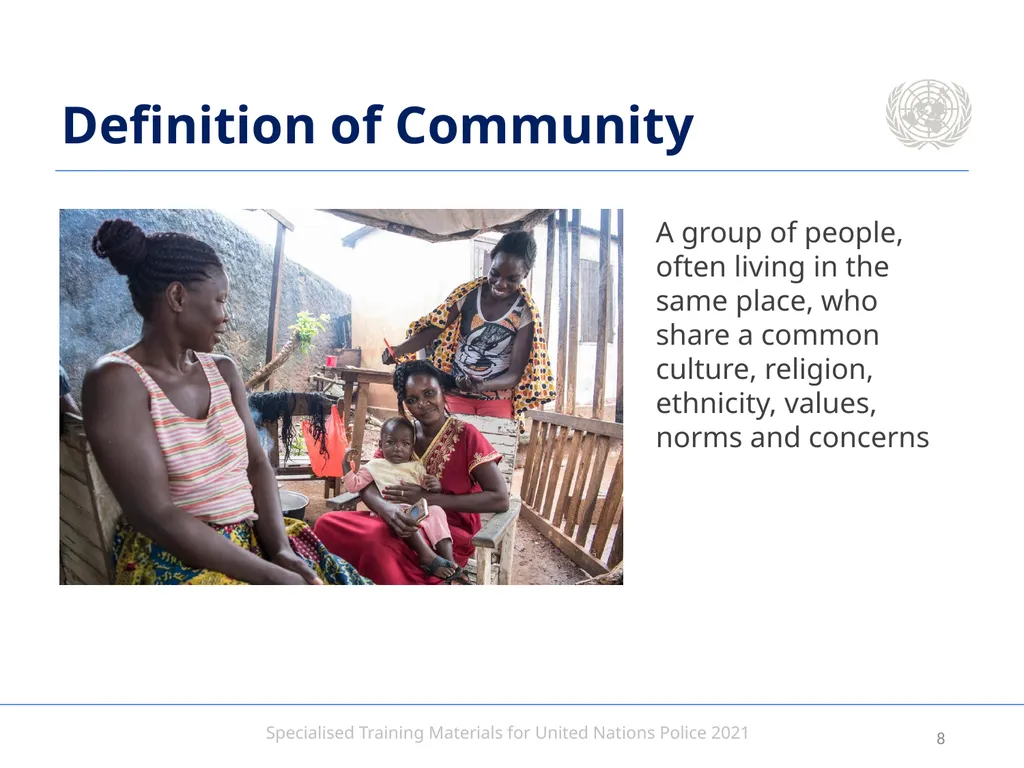
Definition of Community A group of people, often living in the same place, who share a common culture, religion, ethnicity, values, norms and concerns 7<br>
08
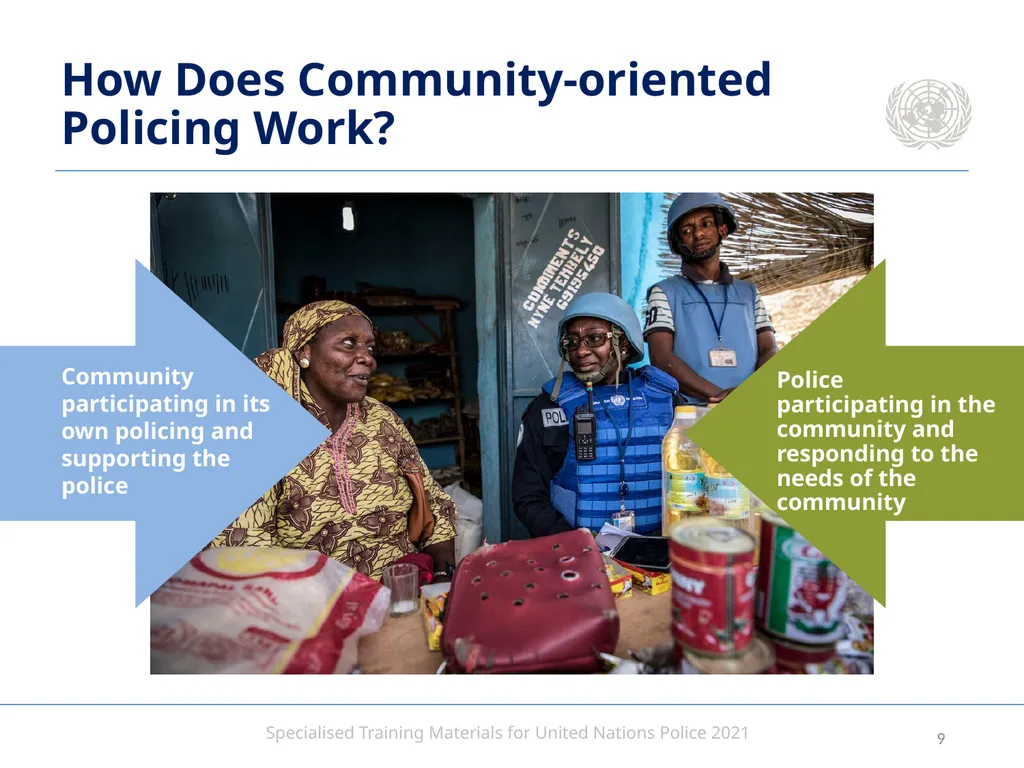
How Does Community-oriented Policing Work? Police participating in the community and responding to the needs of the community 8<br>
09
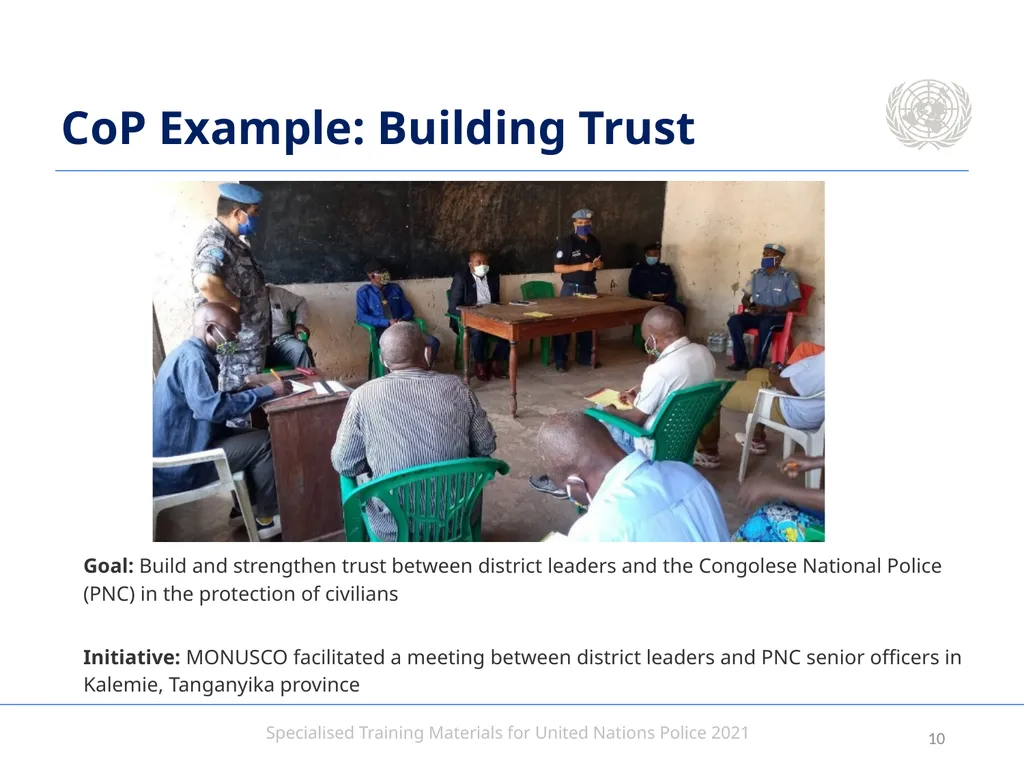
CoP Example: Building Trust 9 Goal: Build and strengthen trust between district leaders and the Congolese National Police (PNC) in the protection of civilians
�Initiative: MONUSCO facilitated a meeting between district leaders and PNC senior officers in Kalemie, Tanganyika province<br>
10
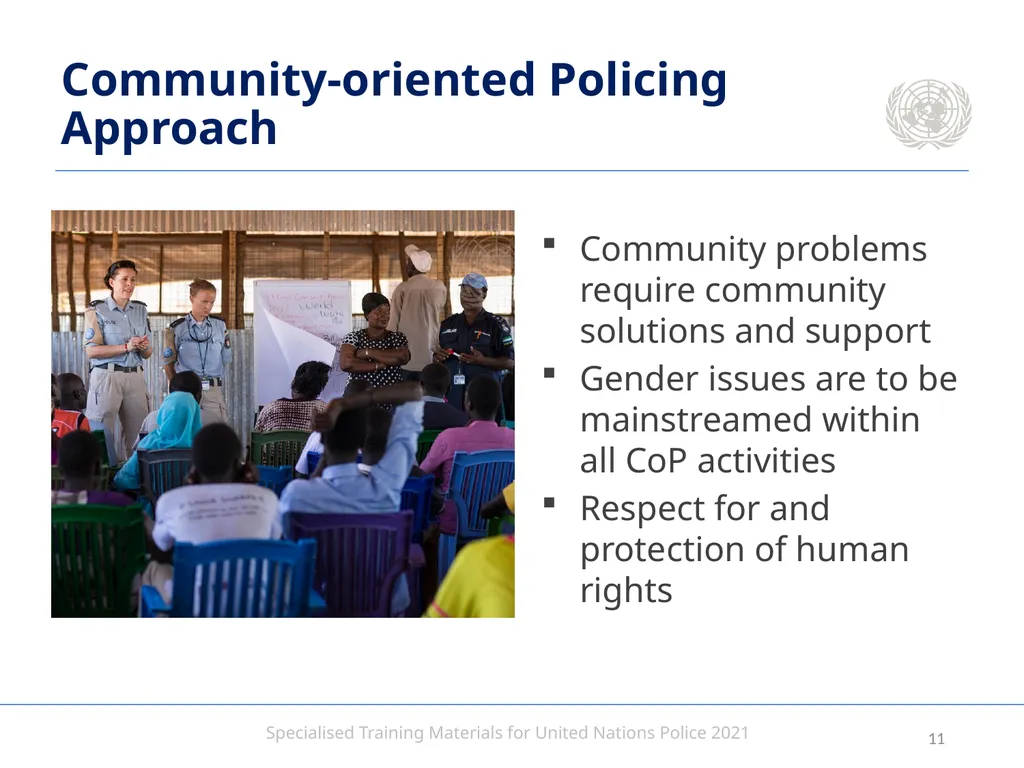
Community-oriented Policing Approach 10 Community problems require community solutions and support
Gender issues are to be mainstreamed within all CoP activities
Respect for and protection of human rights<br>
11
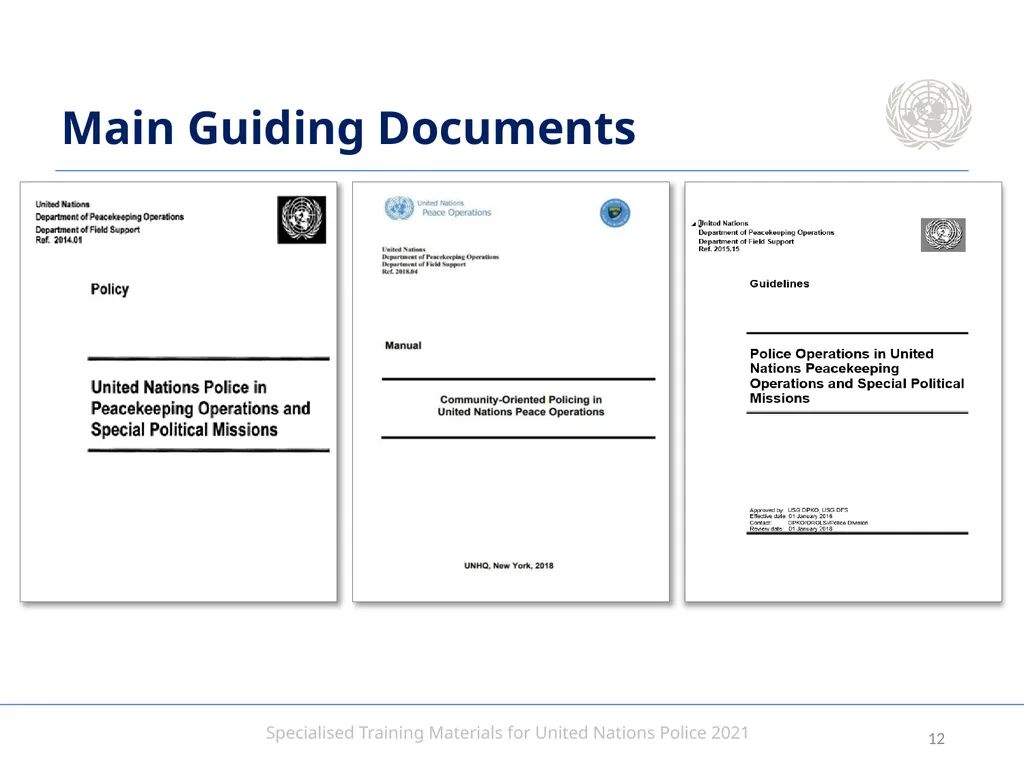
Main Guiding Documents 11<br>
12
Learning Activity 5.1 12 Discuss in your groups: Why is it important to enlist the community in crime prevention and control?
Time: 15 minutes
Discussion: 5 minutes
Presenting: 10 minutes<br>
13
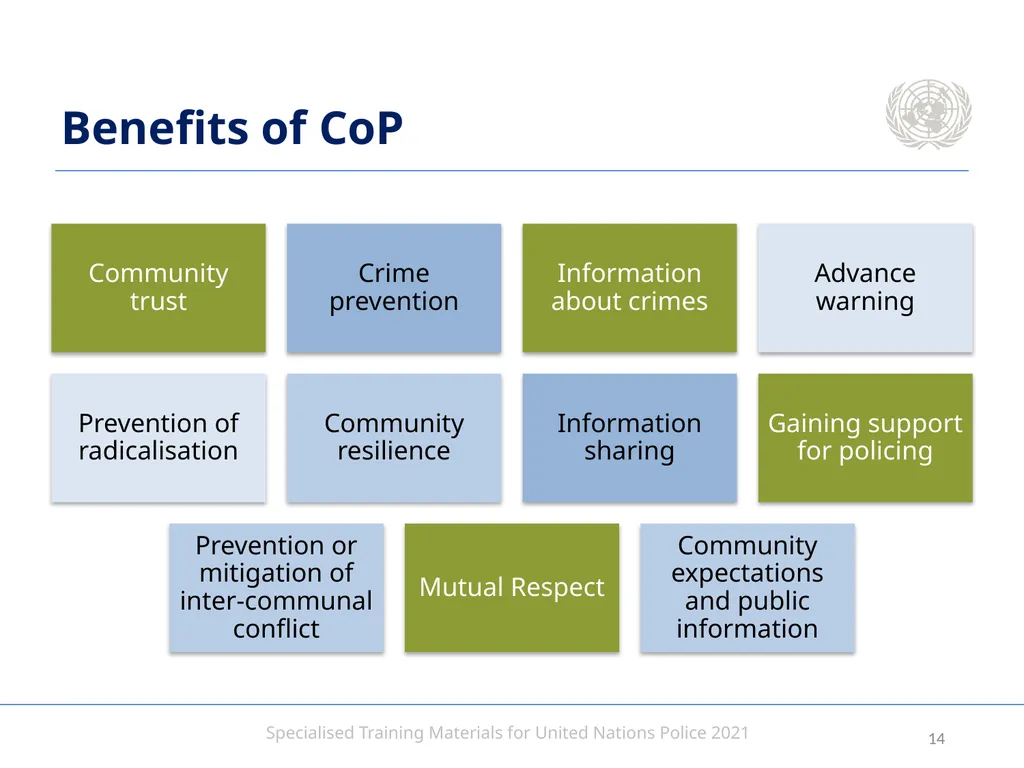
Benefits of CoP 13<br>
14
Learning Activity 5.2 14 Discuss in your groups: Compare traditional policing with Community-oriented Policing
Time: 20 minutes
Discussion: 10 minutes
Presenting: 10 minutes<br>
15
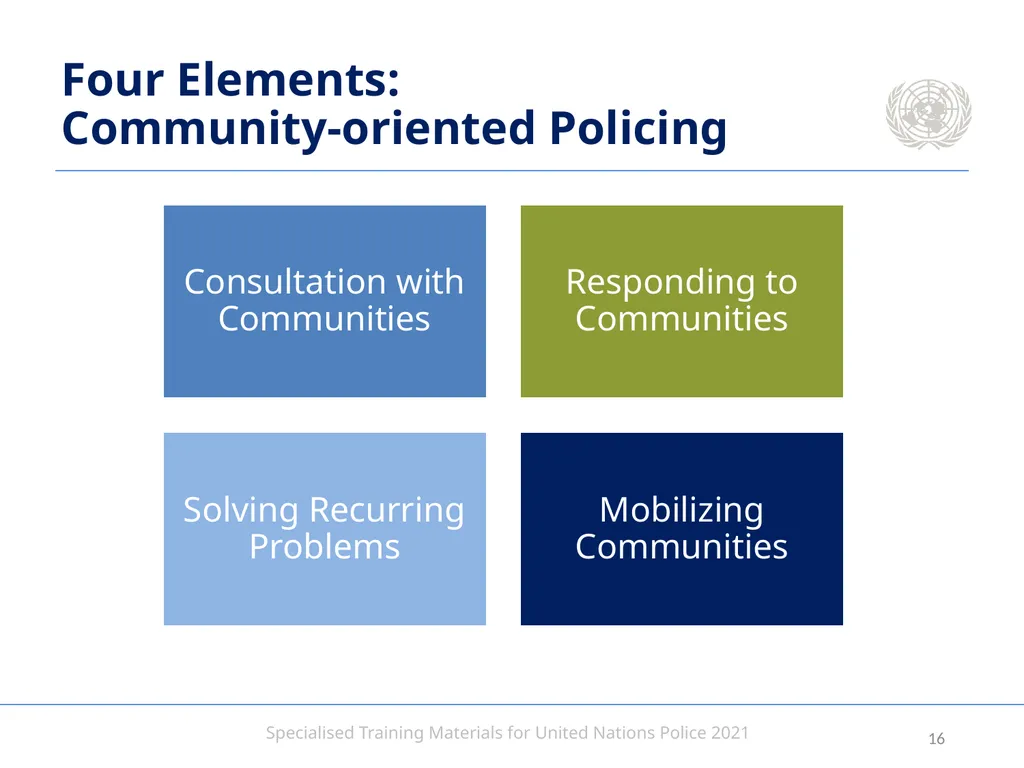
Four Elements:�Community-oriented Policing 15<br>
16
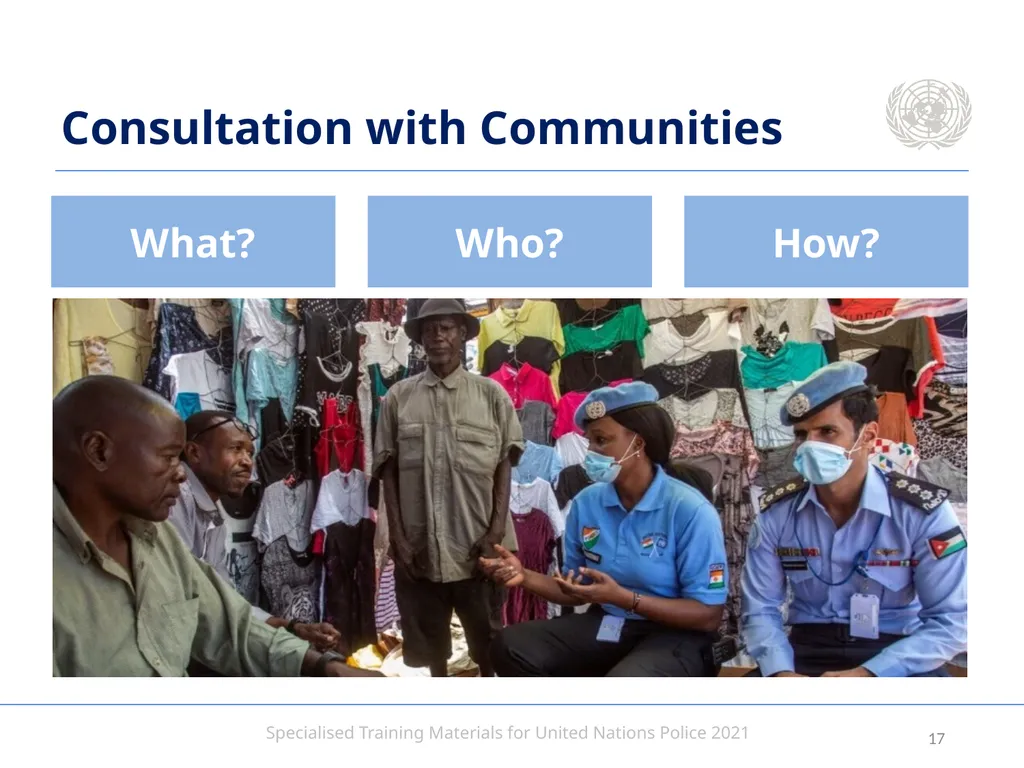
Consultation with Communities What? Who? How? 16<br>
17
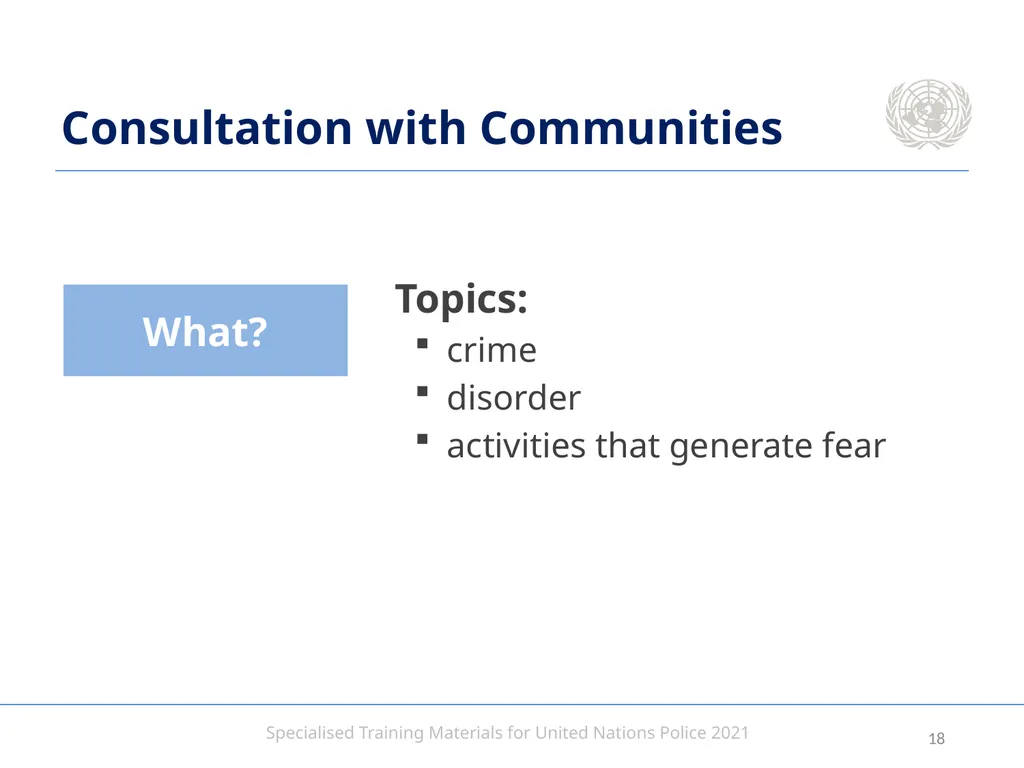
Consultation with Communities Topics:
crime
disorder
activities that generate fear What? 17<br>
18
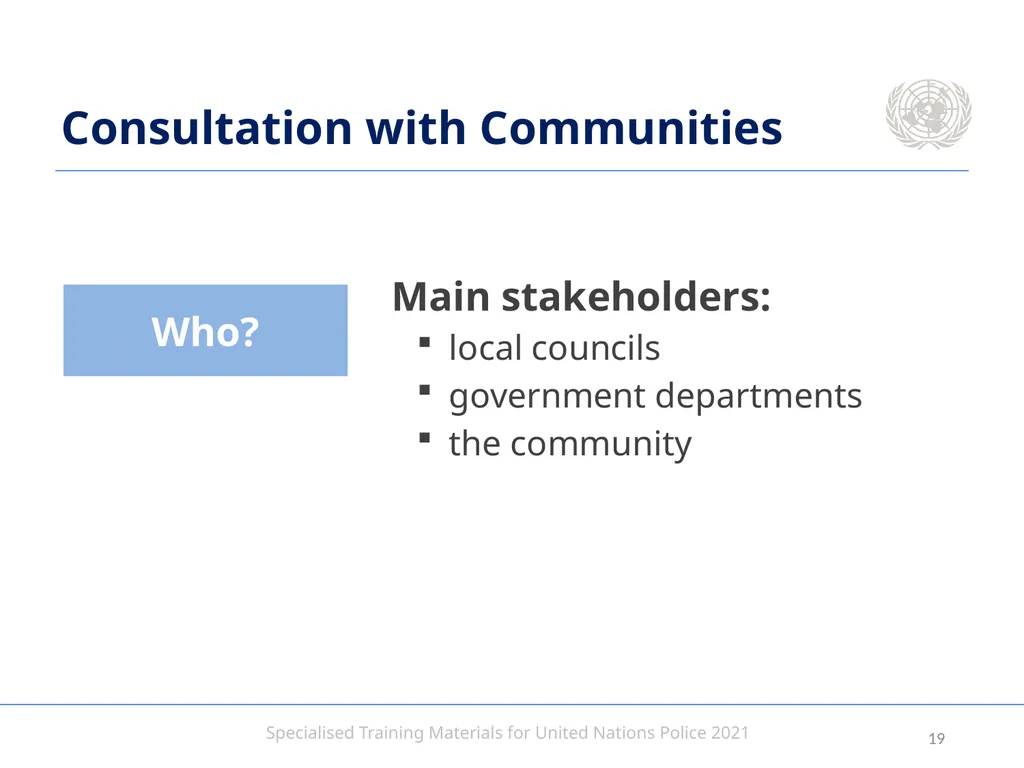
Consultation with Communities Main stakeholders:
local councils
government departments
the community Who? 18<br>
19
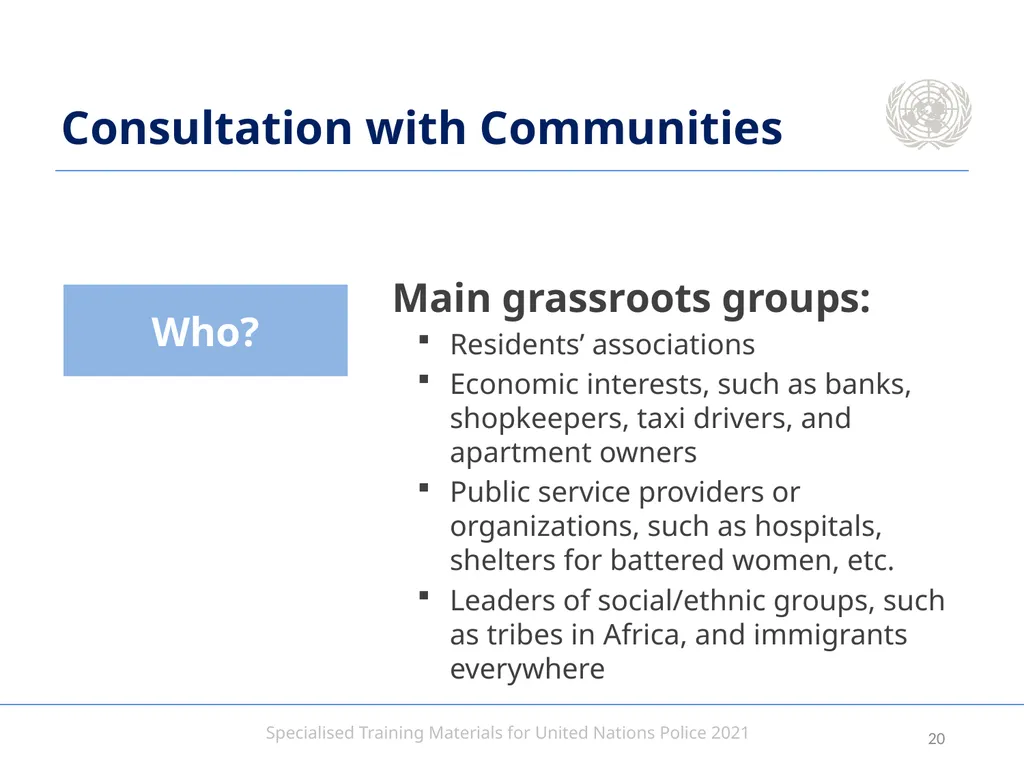
Consultation with Communities Main grassroots groups:
Residents’ associations
Economic interests, such as banks, shopkeepers, taxi drivers, and apartment owners
Public service providers or organizations, such as hospitals, shelters for battered women, etc.
Leaders of social/ethnic groups, such as tribes in Africa, and immigrants everywhere Who? 19<br>
20
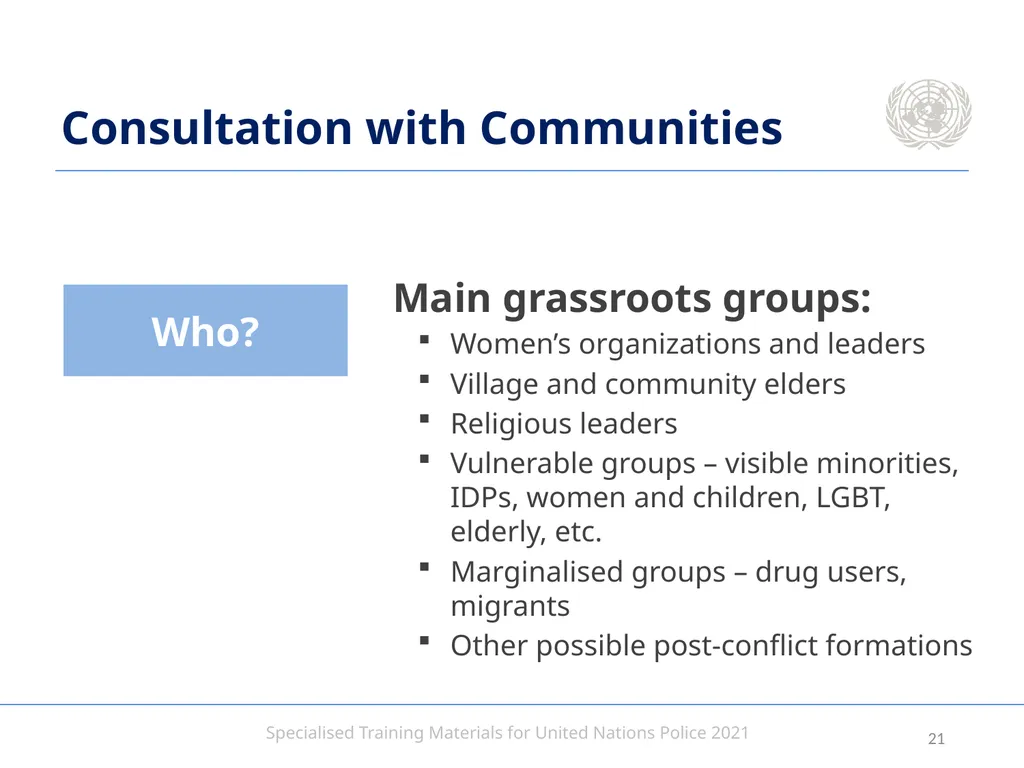
Consultation with Communities Main grassroots groups:
Women’s organizations and leaders
Village and community elders
Religious leaders
Vulnerable groups – visible minorities, IDPs, women and children, LGBT, elderly, etc.
Marginalised groups – drug users, migrants
Other possible post-conflict formations Who? 20<br>
21
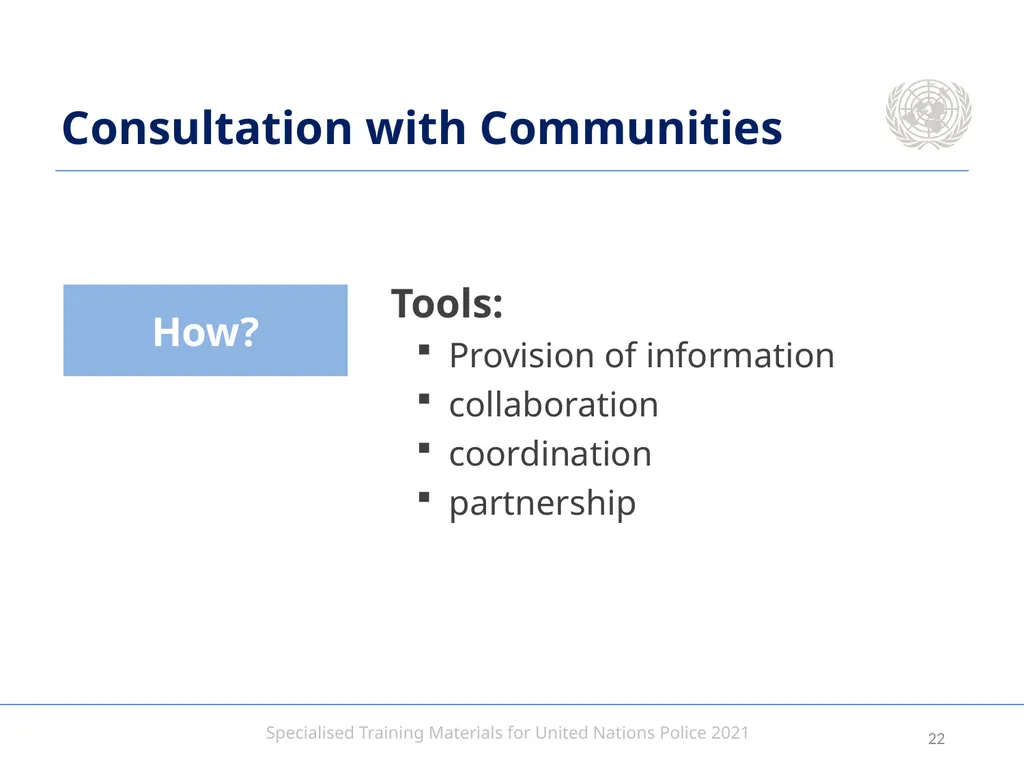
Consultation with Communities Tools:
Provision of information
collaboration
coordination
partnership How? 21<br>
22
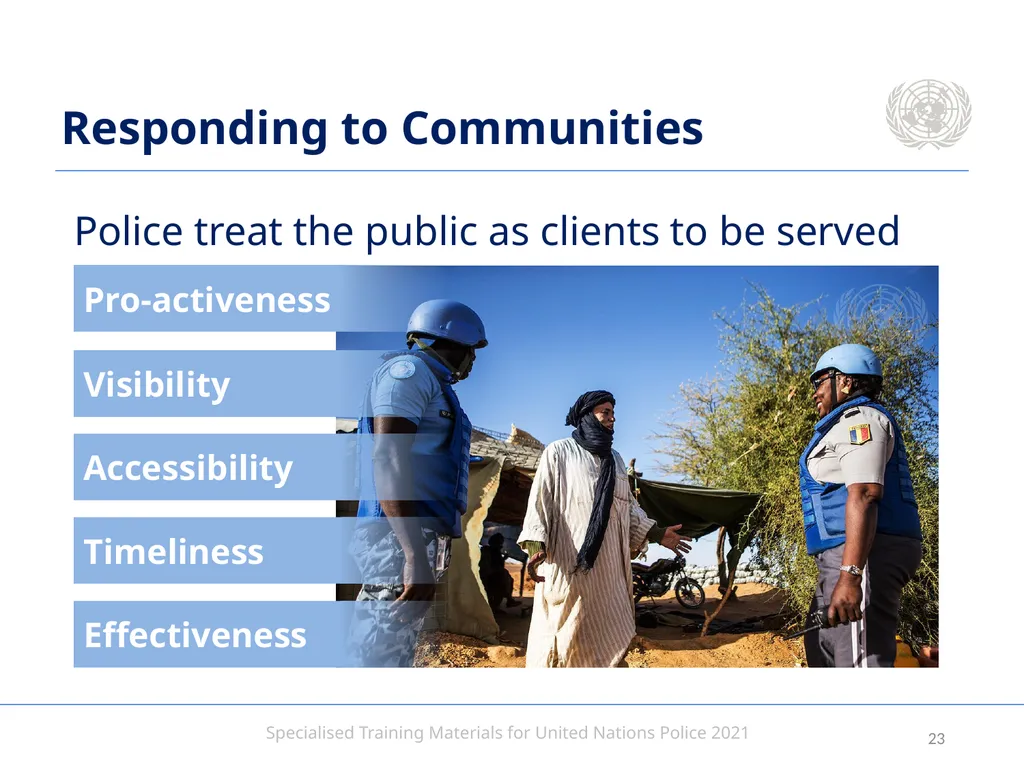
Police treat the public as clients to be served Responding to Communities Visibility Accessibility Timeliness Effectiveness Pro-activeness 22<br>
23
The police must always retain the authority and control for policing Mobilizing Communities Crime prevention advice
Training local police, local leaders etc. to solve problems at the local level
Activate community participation; e.g., neighbourhood watch 23<br>
24
Learning Activity 5.3 24 Discuss in your groups: What activities and programs can police use for mobilizing communities in their own defense?
Time: 15 minutes
Discussion: 5 minutes
Presenting: 10 minutes<br>
25
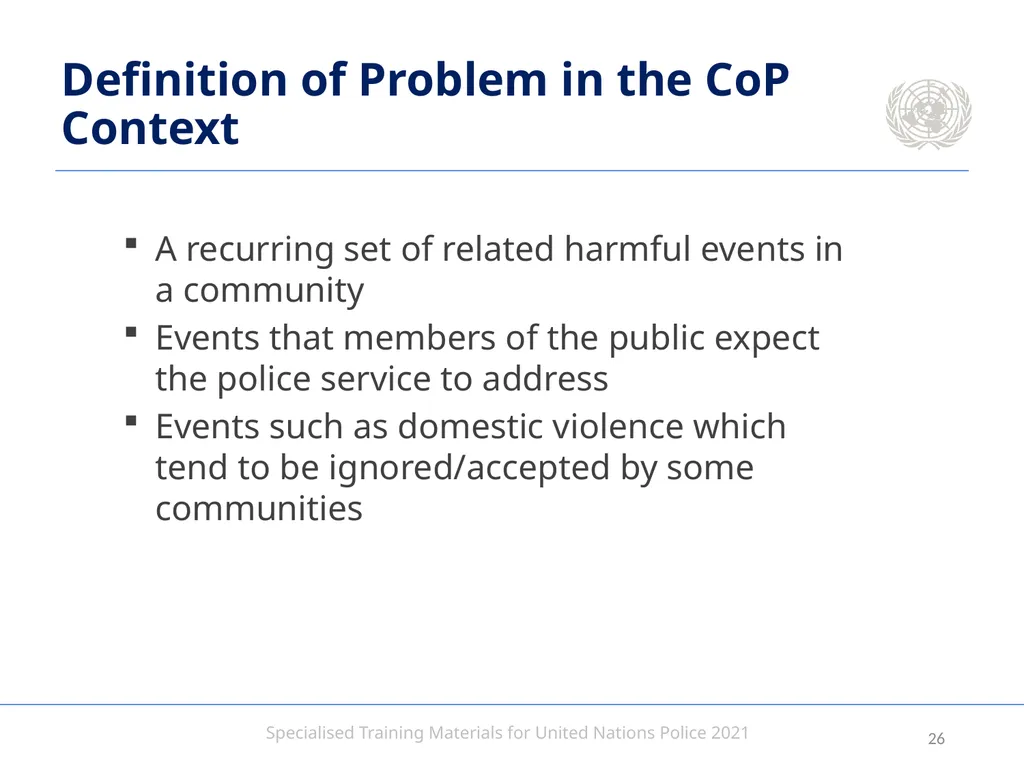
Definition of Problem in the CoP Context A recurring set of related harmful events in a community
Events that members of the public expect the police service to address
Events such as domestic violence which tend to be ignored/accepted by some communities 25<br>
26
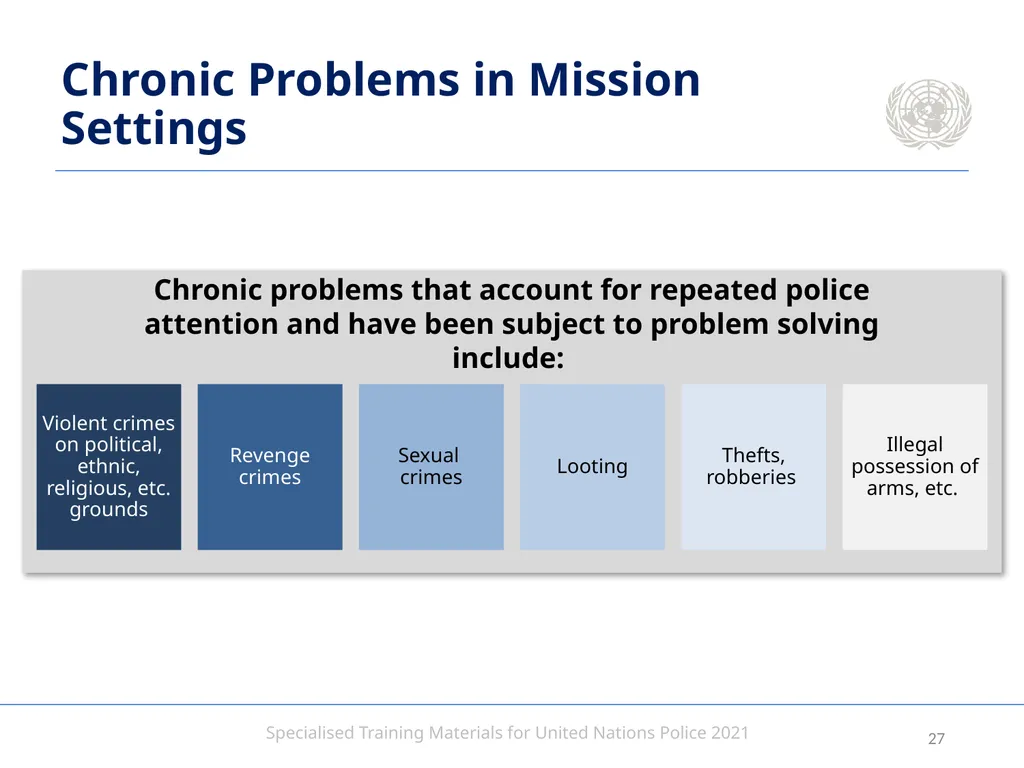
Chronic Problems in Mission Settings 26<br>
27
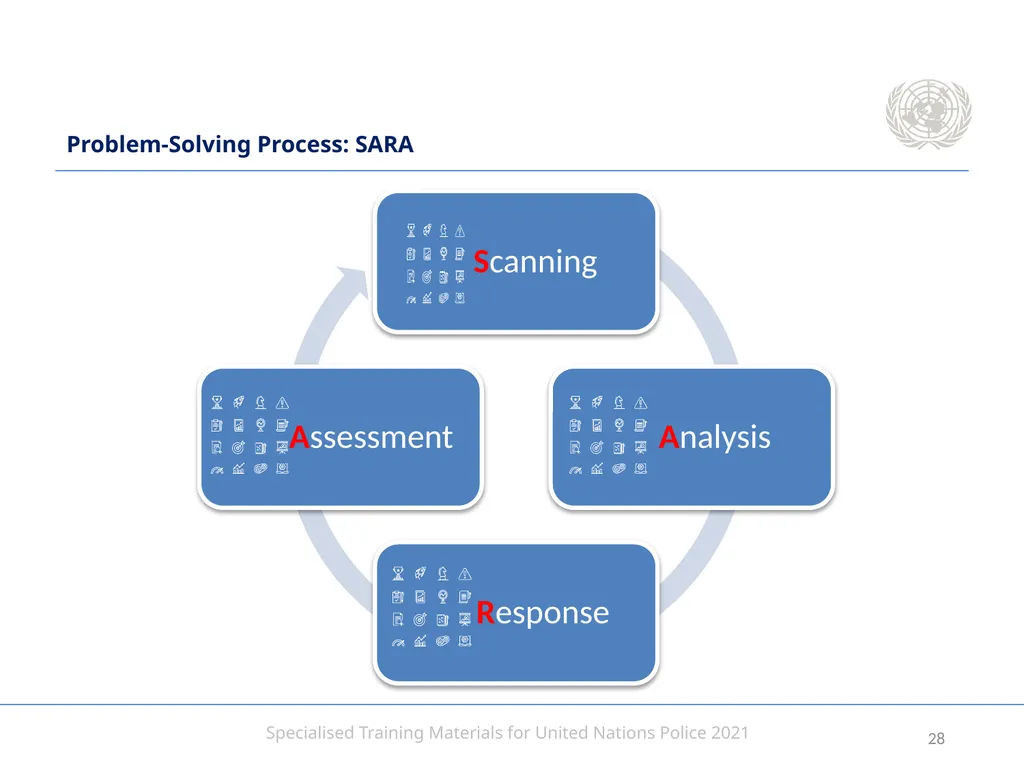
27 Problem-Solving Process: SARA<br>
28
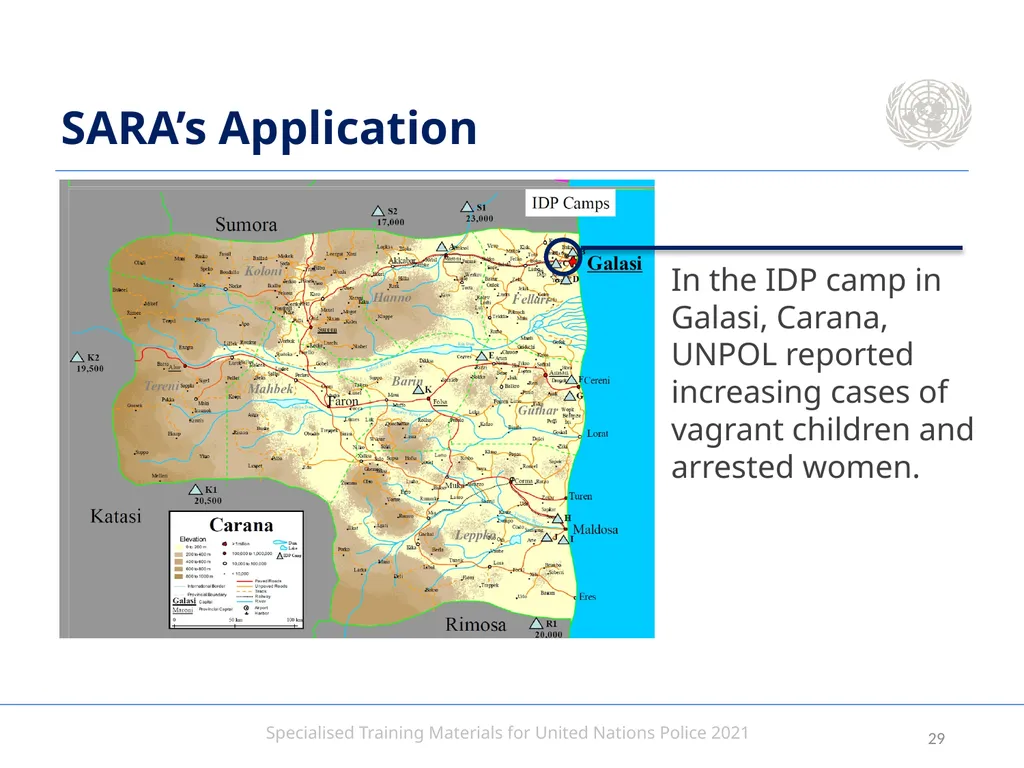
SARA’s Application In the IDP camp in Galasi, Carana, UNPOL reported increasing cases of vagrant children and arrested women. 28<br>
29
SARA’s Application Scanning
Problems identified: Women in the camps were brewing beer to provide a source of income. This was illegal and women were arrested which led to other problems such as unattended children. This caused problems with vagrant children. Analysis
These women had limited skills to provide other ways of income within the IDP camp. Response
Based on abilities and resources in the camp, Women trained in dyeing skills to make and sell clothing. 29<br>
30
SARA’s Application: Assessment The cases of women being prosecuted brewing local beer have been reduced.
The numbers of unattended children who caused problems due to vagrancy and boredom have also been reduced, and children were able to go to school.
The relationship between the host-State police and the IDP community has significantly improved. 30<br>
31
Goals of CoP Implementation Community resilience
Support for law enforcement
Advance warning
Calm a disenfranchised society and contribute to the restoration of peace
Mutual respect 31<br>
32
Basic Requirements to Implement CoP Minimum degree of law and order in the country
Commitment to implement CoP
Basic management skills within the police
Opportunities for civil society engagement
Adequate resources & donor support and coordination 32<br>
33
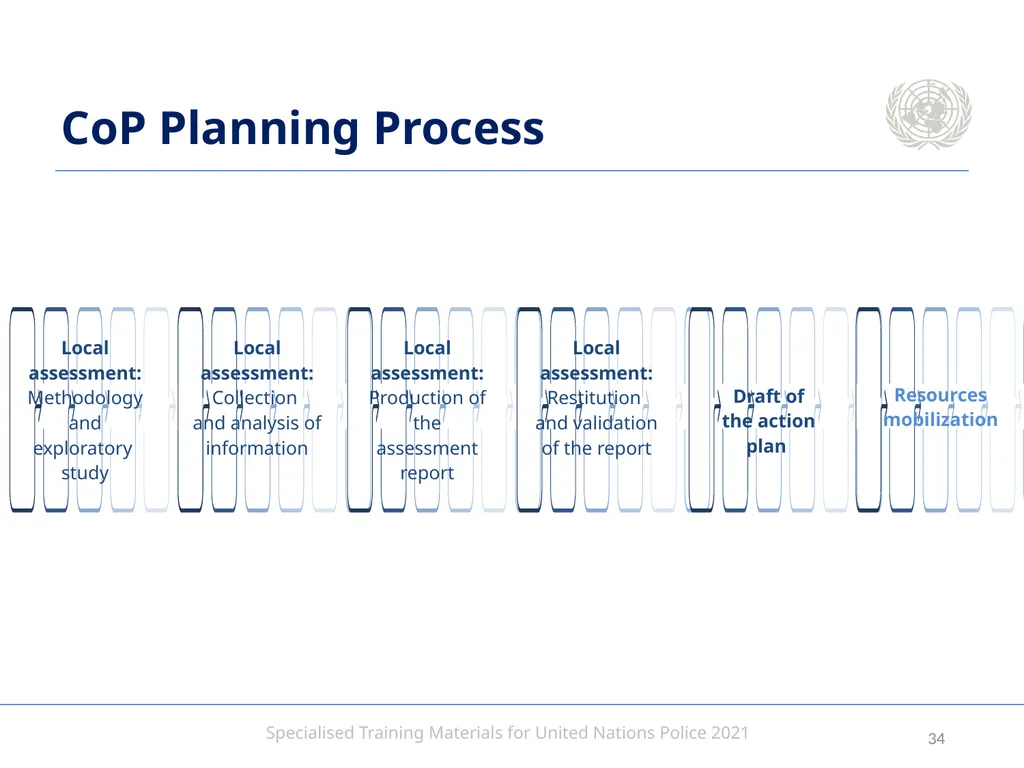
CoP Planning Process 33<br>
34
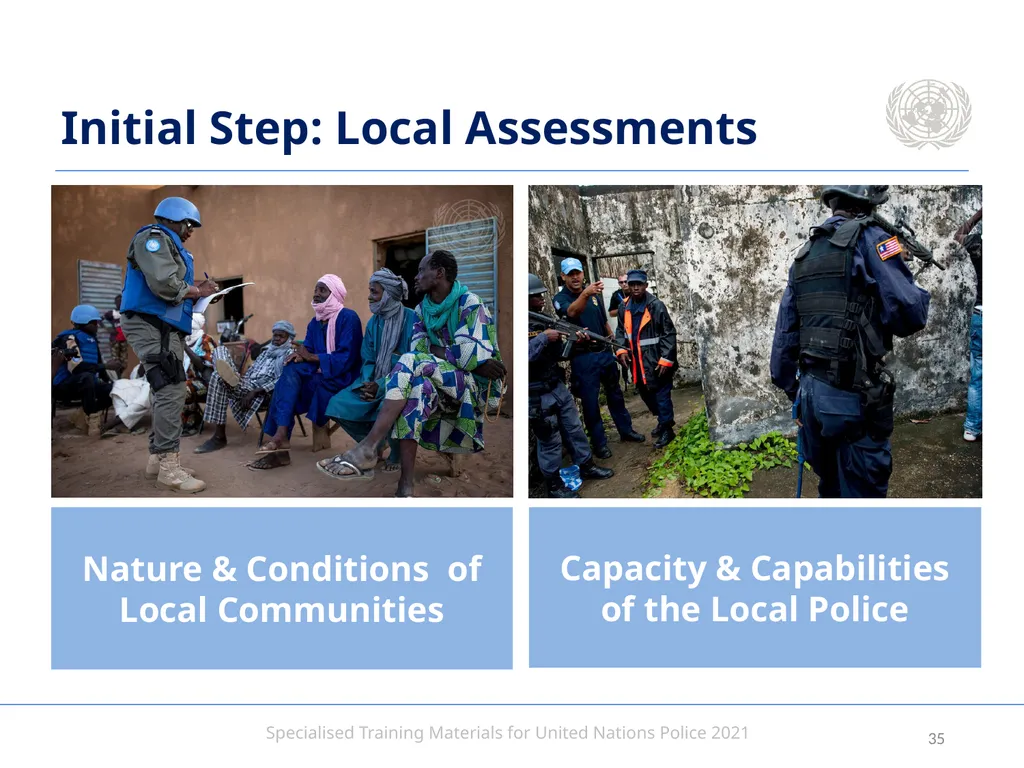
Initial Step: Local Assessments 34<br>
35
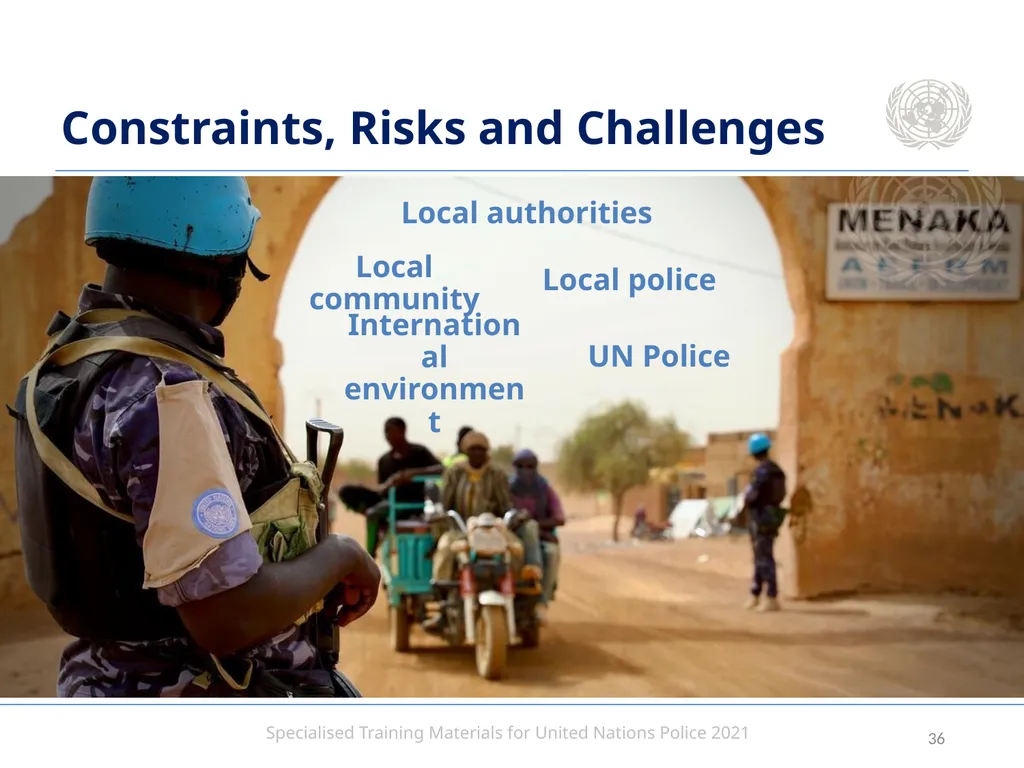
Constraints, Risks and Challenges 35 Local authorities Local community Local police UN Police International environment<br>