01
All elements of this scheme are copyright © The Spelling Shed Ltd and may not be redistributed without permission. Year 3 Spelling Scheme of Work 19/06/19<br>
02
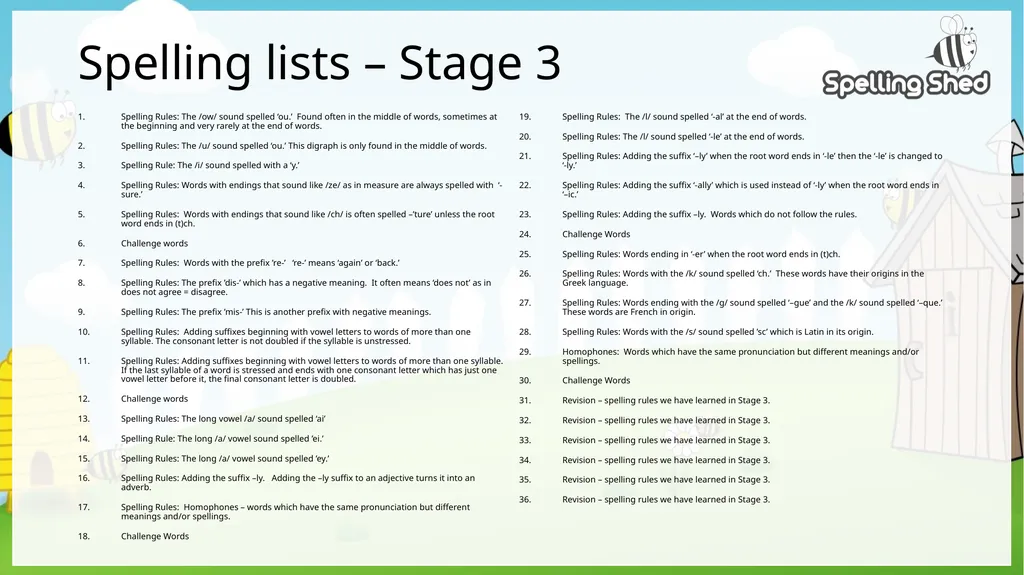
Spelling lists – Stage 3 Spelling Rules: The /ow/ sound spelled ‘ou.’ Found often in the middle of words, sometimes at the beginning and very rarely at the end of words.
Spelling Rules: The /u/ sound spelled ‘ou.’ This digraph is only found in the middle of words.
Spelling Rule: The /i/ sound spelled with a ‘y.’
Spelling Rules: Words with endings that sound like /ze/ as in measure are always spelled with ‘-sure.’
Spelling Rules: Words with endings that sound like /ch/ is often spelled –’ture’ unless the root word ends in (t)ch.
Challenge words
Spelling Rules: Words with the prefix ’re-’ ‘re-’ means ‘again’ or ‘back.’
Spelling Rules: The prefix ’dis-’ which has a negative meaning. It often means ‘does not’ as in does not agree = disagree.
Spelling Rules: The prefix ’mis-’ This is another prefix with negative meanings.
Spelling Rules: Adding suffixes beginning with vowel letters to words of more than one syllable. The consonant letter is not doubled if the syllable is unstressed.
Spelling Rules: Adding suffixes beginning with vowel letters to words of more than one syllable. If the last syllable of a word is stressed and ends with one consonant letter which has just one vowel letter before it, the final consonant letter is doubled.
Challenge words
Spelling Rules: The long vowel /a/ sound spelled ‘ai’
Spelling Rule: The long /a/ vowel sound spelled ’ei.’
Spelling Rules: The long /a/ vowel sound spelled ’ey.’
Spelling Rules: Adding the suffix –ly. Adding the –ly suffix to an adjective turns it into an adverb.
Spelling Rules: Homophones – words which have the same pronunciation but different meanings and/or spellings.
Challenge Words
Spelling Rules: The /l/ sound spelled ‘-al’ at the end of words.
Spelling Rules: The /l/ sound spelled ‘-le’ at the end of words.
Spelling Rules: Adding the suffix ‘–ly’ when the root word ends in ‘-le’ then the ‘-le’ is changed to ‘-ly.’
Spelling Rules: Adding the suffix ‘-ally’ which is used instead of ‘-ly’ when the root word ends in ‘–ic.’
Spelling Rules: Adding the suffix –ly. Words which do not follow the rules.
Challenge Words
Spelling Rules: Words ending in ‘-er’ when the root word ends in (t)ch.
Spelling Rules: Words with the /k/ sound spelled ‘ch.’ These words have their origins in the Greek language.
Spelling Rules: Words ending with the /g/ sound spelled ‘–gue’ and the /k/ sound spelled ‘–que.’ These words are French in origin.
Spelling Rules: Words with the /s/ sound spelled ’sc’ which is Latin in its origin.
Homophones: Words which have the same pronunciation but different meanings and/or spellings.
Challenge Words
Revision – spelling rules we have learned in Stage 3.
Revision – spelling rules we have learned in Stage 3.
Revision – spelling rules we have learned in Stage 3.
Revision – spelling rules we have learned in Stage 3.
Revision – spelling rules we have learned in Stage 3.
Revision – spelling rules we have learned in Stage 3.<br>