ALL TO THE GLORY OF GOD Lesson 5 for August 1, 2026 Therefore, whether you eat or drink, or whatever you do, do all to the glory of God (1 Corinthians 10:31, NKJV) Starting with 1 Corinthians 7, Paul dedicates himself to answering a
"ALL TO THE GLORY OF GOD Lesson 5 for August" is the property of its rightful owner. Permission is granted to
download and print the materials on this website for personal, non-commercial use only, and to display it
on your personal computer provided you do not modify the materials and that you retain all copyright
notices contained in the materials. By downloading content from our website, you accept the terms of this
agreement.
Presentation Transcript
01
ALL TO THE GLORY OF GOD Lesson 5 for August 1, 2026<br>
02
“Therefore, whether you eat or drink, or whatever you do, do all to the glory of God” (1 Corinthians 10:31, NKJV)<br>
03
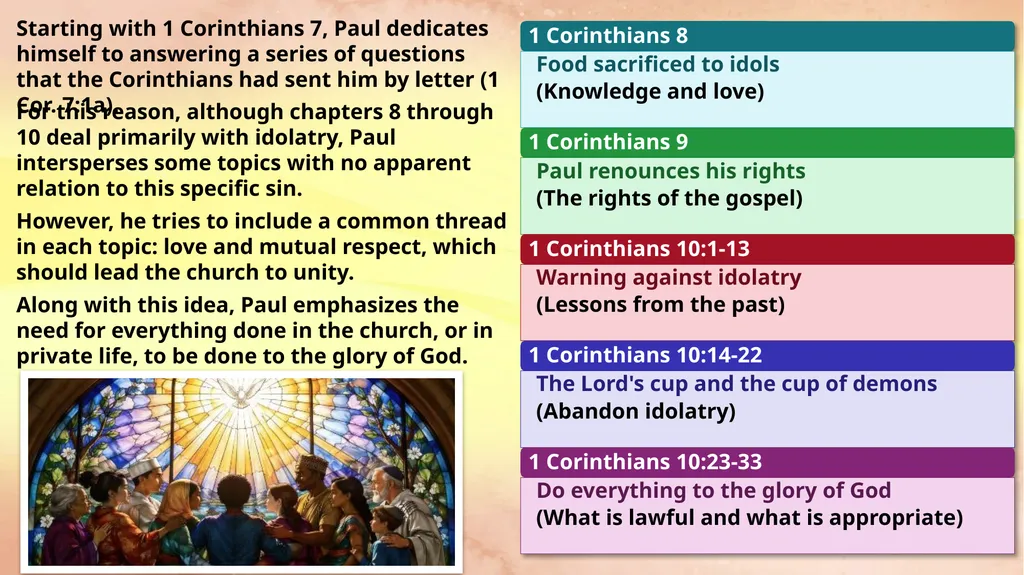
Starting with 1 Corinthians 7, Paul dedicates himself to answering a series of questions that the Corinthians had sent him by letter (1 Cor. 7:1a). Along with this idea, Paul emphasizes the need for everything done in the church, or in private life, to be done to the glory of God. However, he tries to include a common thread in each topic: love and mutual respect, which should lead the church to unity. For this reason, although chapters 8 through 10 deal primarily with idolatry, Paul intersperses some topics with no apparent relation to this specific sin.<br>
04
KNOWLEDGE AND LOVE
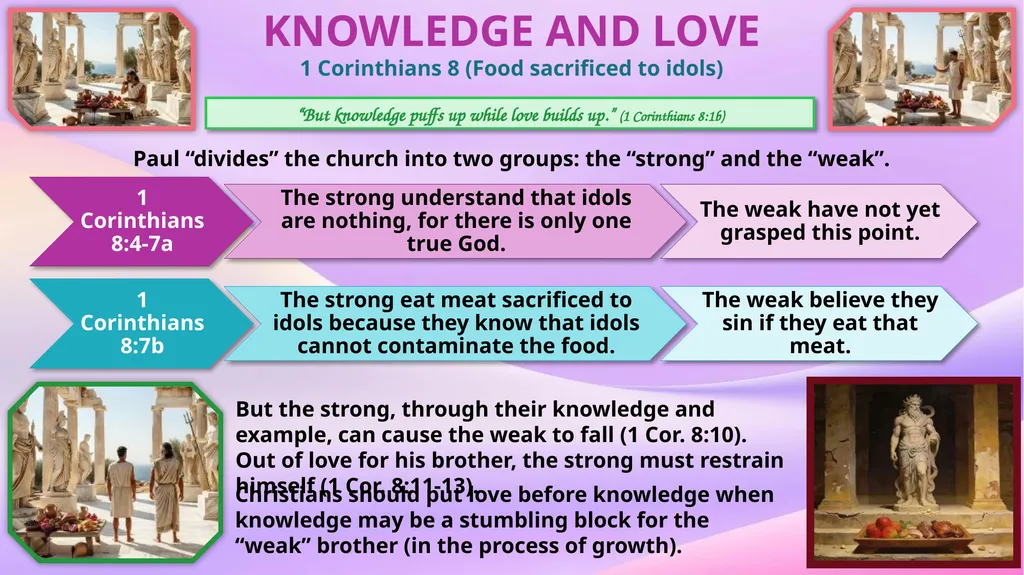
1 Corinthians 8 (Food sacrificed to idols) “But knowledge puffs up while love builds up.” (1 Corinthians 8:1b) Paul “divides” the church into two groups: the “strong” and the “weak”. But the strong, through their knowledge and example, can cause the weak to fall (1 Cor. 8:10). Out of love for his brother, the strong must restrain himself (1 Cor. 8:11-13). Christians should put love before knowledge when knowledge may be a stumbling block for the “weak” brother (in the process of growth).<br>
05
THE RIGHTS OF THE GOSPEL
1 Corinthians 9 (Paul renounces his rights) “In the same way, the Lord has commanded that those who preach the gospel should receive their living from the gospel.” (1 Corinthians 9:14) Paul renounced at least three rights out of love for the weak: Although Jesus made it clear that those who preach the gospel should live from the gospel, both Paul and Barnabas voluntarily renounced this so as not to hinder believers (1 Cor. 9:12-14; Lk. 10:7).<br>
06
LESSONS FROM THE PAST
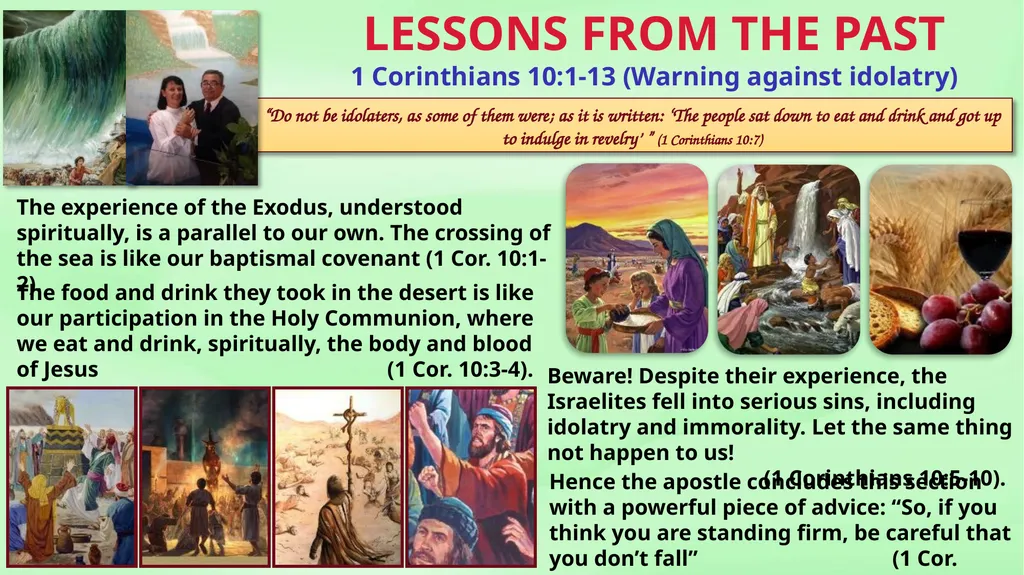
1 Corinthians 10:1-13 (Warning against idolatry) “Do not be idolaters, as some of them were; as it is written: ‘The people sat down to eat and drink and got up to indulge in revelry’ ” (1 Corinthians 10:7) The experience of the Exodus, understood spiritually, is a parallel to our own. The crossing of the sea is like our baptismal covenant (1 Cor. 10:1-2). Beware! Despite their experience, the Israelites fell into serious sins, including idolatry and immorality. Let the same thing not happen to us! (1 Corinthians 10:5-10). The food and drink they took in the desert is like our participation in the Holy Communion, where we eat and drink, spiritually, the body and blood of Jesus (1 Cor. 10:3-4). Hence the apostle concludes this section with a powerful piece of advice: “So, if you think you are standing firm, be careful that you don’t fall” (1 Cor. 10:12).<br>
07
ABANDON IDOLATRY
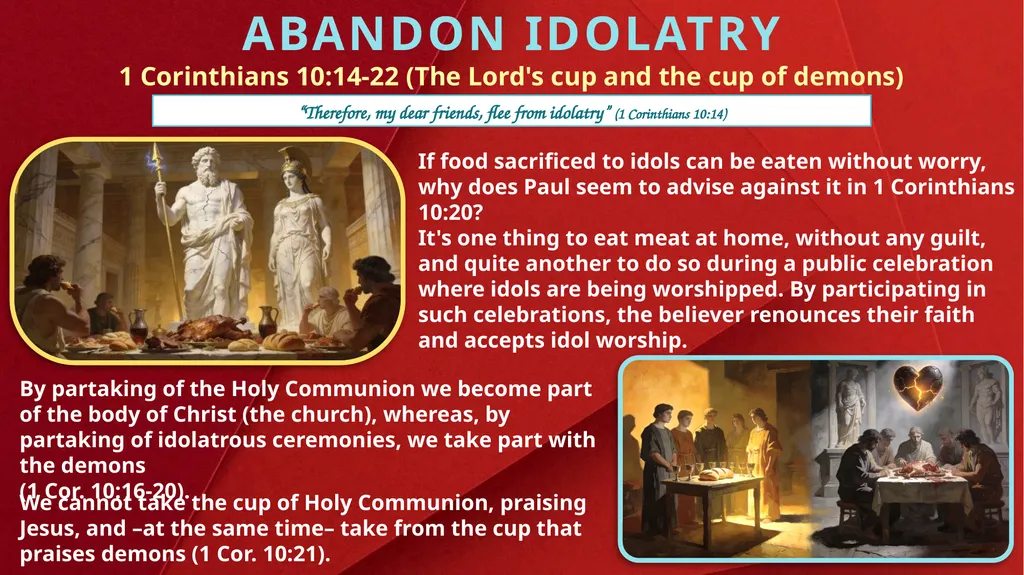
1 Corinthians 10:14-22 (The Lord's cup and the cup of demons) “Therefore, my dear friends, flee from idolatry” (1 Corinthians 10:14) If food sacrificed to idols can be eaten without worry, why does Paul seem to advise against it in 1 Corinthians 10:20? By partaking of the Holy Communion we become part of the body of Christ (the church), whereas, by partaking of idolatrous ceremonies, we take part with the demons (1 Cor. 10:16-20). It's one thing to eat meat at home, without any guilt, and quite another to do so during a public celebration where idols are being worshipped. By participating in such celebrations, the believer renounces their faith and accepts idol worship. We cannot take the cup of Holy Communion, praising Jesus, and –at the same time– take from the cup that praises demons (1 Cor. 10:21).<br>
08
WHAT IS LAWFUL AND WHAT IS APPROPRIATE
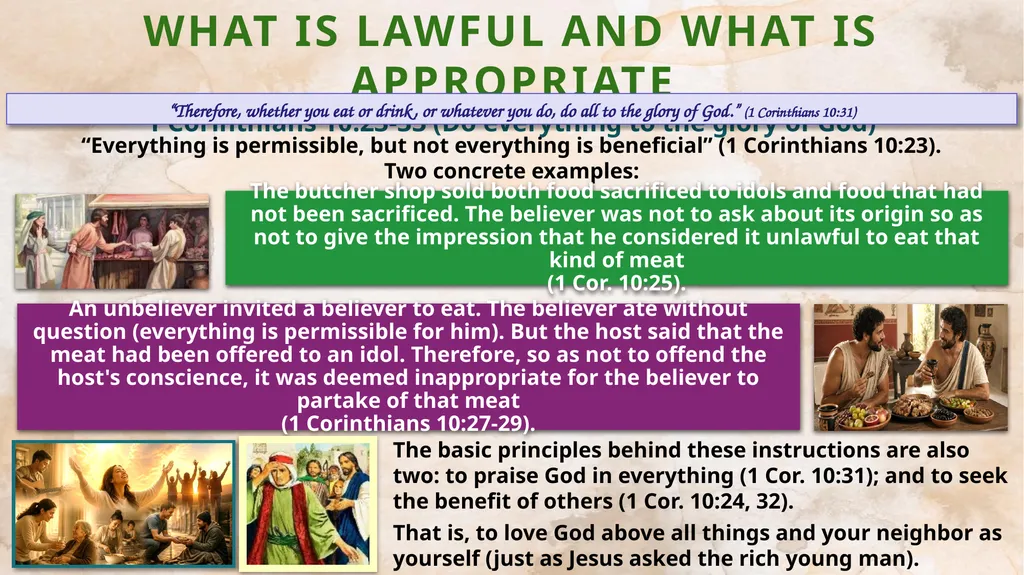
1 Corinthians 10:23-33 (Do everything to the glory of God) “Therefore, whether you eat or drink, or whatever you do, do all to the glory of God.” (1 Corinthians 10:31) “Everything is permissible, but not everything is beneficial” (1 Corinthians 10:23). Two concrete examples: The basic principles behind these instructions are also two: to praise God in everything (1 Cor. 10:31); and to seek the benefit of others (1 Cor. 10:24, 32). That is, to love God above all things and your neighbor as yourself (just as Jesus asked the rich young man).<br>
09
“The apostle adjured the Corinthians, "Let him that thinketh he standeth take heed lest he fall." Should they become boastful and self-confident, neglecting to watch and pray, they would fall into grievous sin, calling down upon themselves the wrath of God. […]
Paul urged his brethren to ask themselves what influence their words and deeds would have upon others and to do nothing, however innocent in itself, that would seem to sanction idolatry or offend the scruples of those who might be weak in the faith. "Whether therefore ye eat, or drink, or whatsoever ye do, do all to the glory of God. Give none offense, neither to the Jews, nor to the Gentiles, nor to the church of God." EGW (The Acts of the Apostles, p. 316)<br>