
An insider’s critique of the dominant
A
Published · 30 slides · 0 views

1 / 1


Description
An insiders critique of the dominant psychological models of autism Damian Milton MA, PGCert, BA (Hons), Dip (conv), PGCE, Mifl, MBPsS PhD Researcher, University of Birmingham Introduction Critique of current psychological models regarding
Related Topics
Share
Embed code
Download this presentation From Below
"An insider’s critique of the dominant" is the property of its rightful owner. Permission is granted to download and print the materials on this website for personal, non-commercial use only, and to display it on your personal computer provided you do not modify the materials and that you retain all copyright notices contained in the materials. By downloading content from our website, you accept the terms of this agreement.
Presentation Transcript
01
An insider’s critique of the
dominant psychological models
of autism Damian Milton
MA, PGCert, BA (Hons), Dip (conv), PGCE, Mifl, MBPsS
PhD Researcher, University of Birmingham<br>
dominant psychological models
of autism Damian Milton
MA, PGCert, BA (Hons), Dip (conv), PGCE, Mifl, MBPsS
PhD Researcher, University of Birmingham<br>
02
Introduction Critique of current psychological models regarding autism.
Theory of mind deficit, executive dysfunction, and weak coherence theory.
Empathising-systemising theory (Baron-Cohen, 2008) and monotropism theory (Murray, Lesser and Lawson, 2005).
A central core ‘deficit’ or ‘difference’ is postulated by each.
How accurate are they when viewed by an ‘insider’ who has been so diagnosed?
The inconsistencies of these models need to be critiqued in order to subvert the dominance they enjoy in defining what it is to be autistic.<br>
03
Theory of mind deficit The ability to empathise with others and imagine their thoughts and feelings, in order to comprehend and predict the behaviour of others (also called ‘mind-reading’ and ‘mentalising’).
This was postulated as a key feature of autism due its distinctiveness, in terms of not being found with other syndromes.
Baron-Cohen et al. (1985) found that 80% of autistic children between the ages of 6-16 failed at false belief tasks.
These findings were also repeated in subsequent studies using people rather than dolls like in the Sally-Ann test (Leslie and Frith, 1988).<br>
04
Critique Eisenmajer and Prior (1991) suggested that task failure could be due to difficulties with language or memory.
DeGelder (1987) - failure to complete such tasks could be due to a lack of motivation to deceive.
Nazeer (2006) – failure may be due to test anxiety and second guessing examiners, having already given an ‘incorrect response’ to the initial part of the experiment.
Rogers et al. (2003) – difference between the ability to ascertain the feelings of others and the development of empathy once these feelings are known about.
Happe (1994a) - 20% of autistic children consistently pass theory of mind tests, questioning the universality of this ‘deficit’ and thus its role as a ‘core feature’.<br>
05
Critique (2) The theory does not give an explanatory account of other autistic behaviour patterns, such as an insistence on sameness or ‘stereotypies’.
Nazeer (2006) – Everyone can make mistakes, something that is relied upon by actors, liars, spies and salespeople.
Lawson (2010) – Theory of mind built up by different means, and through interests being developed.
Difficulties with understanding self and other have also been cited regarding those who are deaf, blind, or those with a diagnosis of schizophrenia (Dahlgren et al., 2003 and Peterson et al., 2000, cited in Lawson, 2010; Sprong et al. 2007).
For me, people are essentially unpredictable and full ‘empathy’ is a ‘convenient’ illusion.
Essentially, the theory of mind explanation of autism is neither able to show universality or causal precedence.<br>
06
Ethnomethodology and autism Garfinkel (1967) - the fragile nature of perceived social reality.
When the ‘natural attitude’ (the belief that everything is how one thinks it is and others perceive things in much the same way) is ‘breached’, people are put under a state of stress and do everything in their power to repair the breach.
Everyday interaction involves the work of ‘skilled social actors’ - easily broken down if individuals do not share a common ‘ethno’ (or shared cultural understanding) of the methods of communicating these understandings.<br>
07
The double-empathy problem If autistic people are not socialised into the same shared ‘ethno’ as ‘neurotypical’ people - ‘breaches’ in understanding would happen all the time, leaving both in a state of confusion.
There exists a ‘double-empathy’ problem, in the sense of both autistic and neurotypical people having a severe difficulty in understanding the ‘other’.
McGeer (2004) – Theories based upon the notion of a ‘lack of empathy’ are based on a one-sided asymmetrical view of two people failing to understand one another.
Lack of awareness of self and others shown to be untrue when looking at the personal accounts of those diagnosed.<br>
08
Executive dysfunction Disrupted development of central executive processing.
Linked to the behavioural observations of ‘rigidity’ of thought.
Executive dysfunction refers to the ability to maintain an appropriate problem-solving strategy in order to attain a future goal.
Hughes (2001), disruption to the central executive would lead to difficulties in pretend play and maintaining joint attention with others.<br>
09
Critique Lawson (2010) suggests that difficulties with executive functioning is common amongst autistic people, yet not a causal factor.
When interested and focused, autistic people can display similar executive functioning to neuro-typical people.
Rather than utilising a standard ‘functionalist’ cognitive psychological view of executive processing, I would suggest there may be a difference within the way autistic executive processing operates, rather than an impairment or deficiency.<br>
10
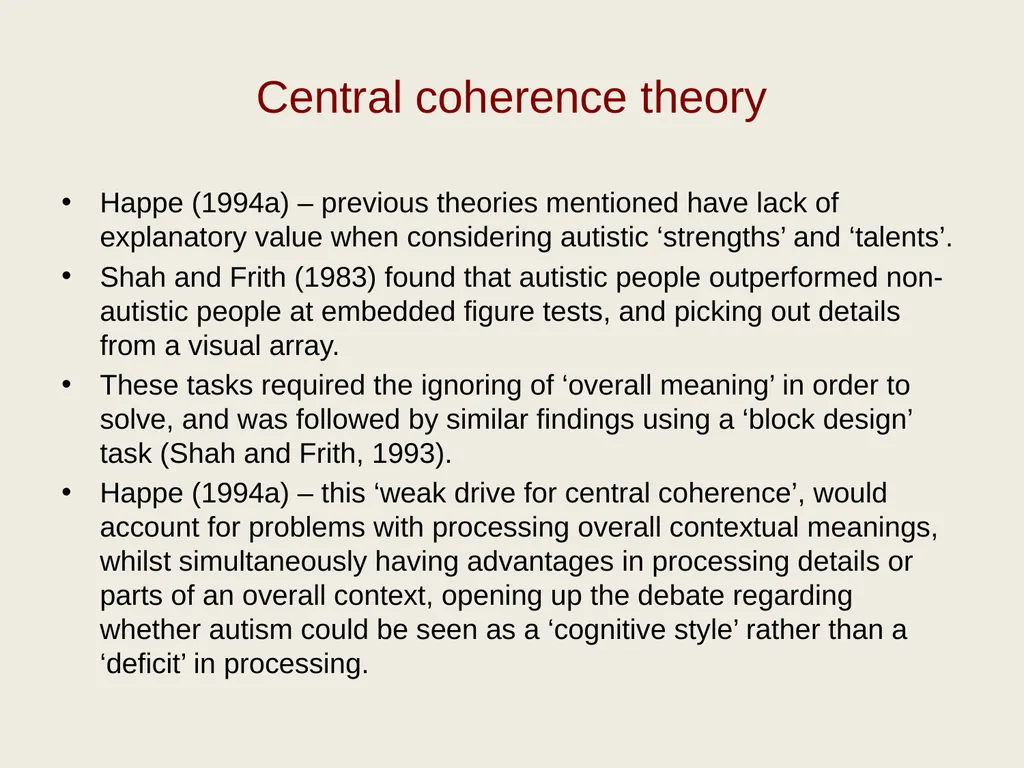
Central coherence theory Happe (1994a) – previous theories mentioned have lack of explanatory value when considering autistic ‘strengths’ and ‘talents’.
Shah and Frith (1983) found that autistic people outperformed non-autistic people at embedded figure tests, and picking out details from a visual array.
These tasks required the ignoring of ‘overall meaning’ in order to solve, and was followed by similar findings using a ‘block design’ task (Shah and Frith, 1993).
Happe (1994a) – this ‘weak drive for central coherence’, would account for problems with processing overall contextual meanings, whilst simultaneously having advantages in processing details or parts of an overall context, opening up the debate regarding whether autism could be seen as a ‘cognitive style’ rather than a ‘deficit’ in processing.<br>
11
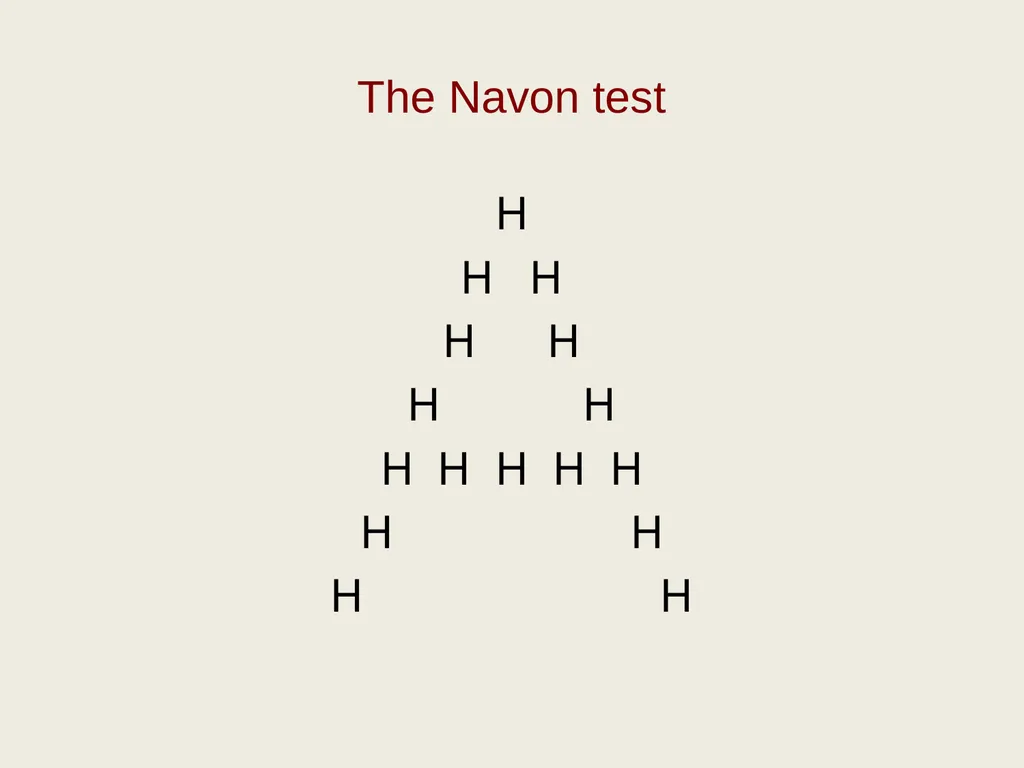
The Navon test H
H H
H H
H H
H H H H H
H H
H H<br>
H H
H H
H H
H H H H H
H H
H H<br>
12
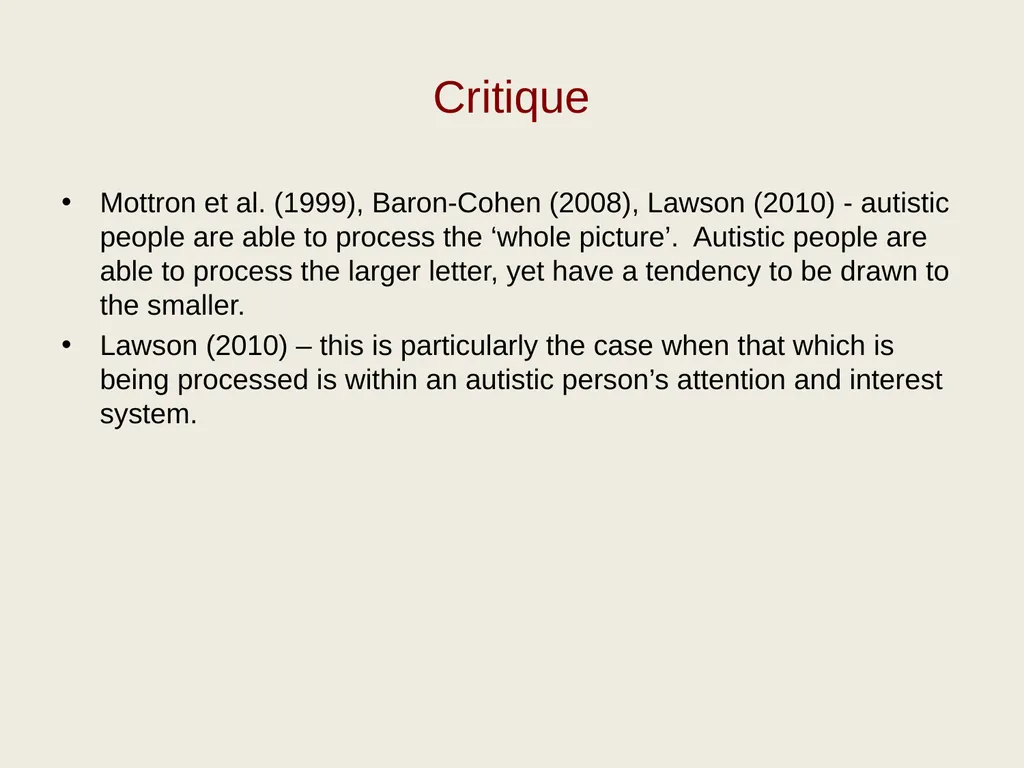
Critique Mottron et al. (1999), Baron-Cohen (2008), Lawson (2010) - autistic people are able to process the ‘whole picture’. Autistic people are able to process the larger letter, yet have a tendency to be drawn to the smaller.
Lawson (2010) – this is particularly the case when that which is being processed is within an autistic person’s attention and interest system.<br>
Lawson (2010) – this is particularly the case when that which is being processed is within an autistic person’s attention and interest system.<br>
13
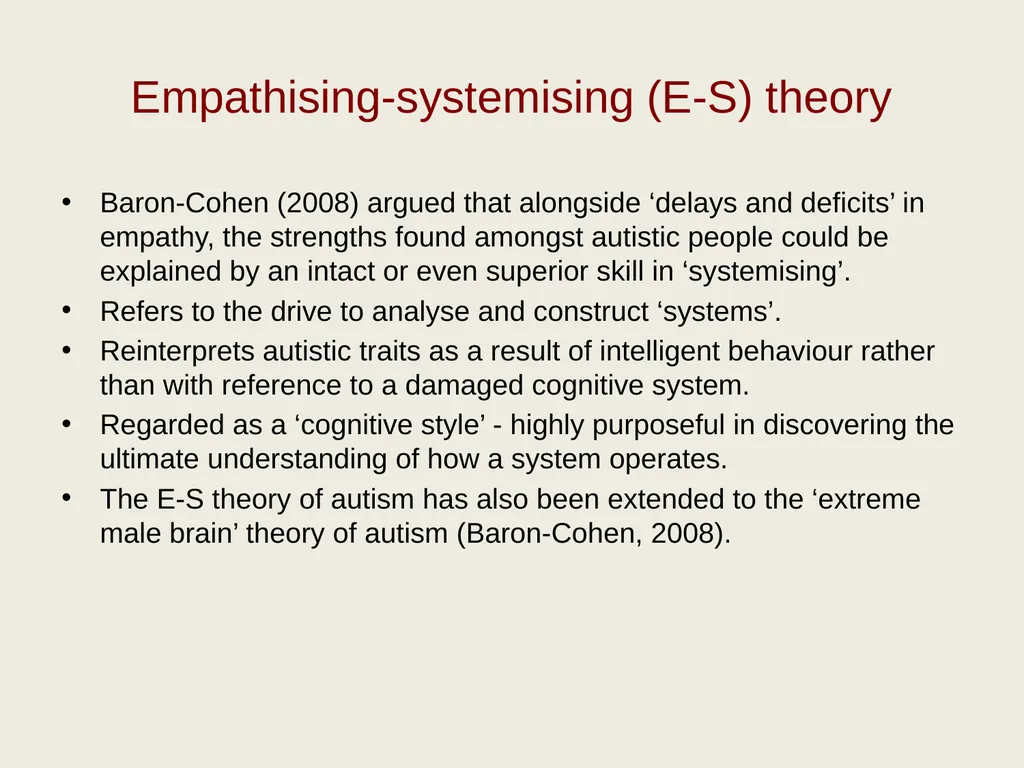
Empathising-systemising (E-S) theory Baron-Cohen (2008) argued that alongside ‘delays and deficits’ in empathy, the strengths found amongst autistic people could be explained by an intact or even superior skill in ‘systemising’.
Refers to the drive to analyse and construct ‘systems’.
Reinterprets autistic traits as a result of intelligent behaviour rather than with reference to a damaged cognitive system.
Regarded as a ‘cognitive style’ - highly purposeful in discovering the ultimate understanding of how a system operates.
The E-S theory of autism has also been extended to the ‘extreme male brain’ theory of autism (Baron-Cohen, 2008).<br>
14
Critique Circularity of logic - the diagnostic tests utilised to define autism already operate within a framework of deficient empathy and features described by Baron-Cohen (2008) as ‘systematic’, therefore those diagnosed will inevitably score in a predictable fashion on these quotients.
“What we need to appreciate is that they [psychometric questionnaires] are maps and not the territory, metaphor and not the thing itself.” (Timini et al. 2011: 83).
Use of quotient questionnaires to measure personality are very reminiscent of psychometric personality testing, exemplified in the work of Eysenck and Rachman’s (1965).
Like Eysenck and Rachman (1965), Baron-Cohen (2008) suggests an underlying biological cause for differences on the empathising-systemising continuum.<br>
15
Critique (2) Richards (2002) - trait theory rests upon the assumption that a consistent structure of personality resides in each individual person, yet Richards (2002) argues that traits are nothing more than constructions in the ‘eye of the beholder’ that reflect a world view of the perceiver, rooted within cultural ideologies, and not a reflection of inner psychological dispositions of those being rated.
Mischel (1968, cited in Butt, 2007) also criticised the questionnaires used in psychometric testing, with words such as ‘often’ being construed to mean different things to different people and are thus an invalid indicator of some ‘underlying trait’, accordingly, behaviour is theorised as much more context specific and socially situated.<br>
Mischel (1968, cited in Butt, 2007) also criticised the questionnaires used in psychometric testing, with words such as ‘often’ being construed to mean different things to different people and are thus an invalid indicator of some ‘underlying trait’, accordingly, behaviour is theorised as much more context specific and socially situated.<br>
16
Monotropism Murray et al. (2005) argue that the central core feature in autism refers to an atypical strategy being employed in the distribution of attention.
Monotropism suggests that the amount of attention available to an individual at any one time is necessarily limited, as can be found amongst numerous cognitive studies.
Murray et al. (2005) propose that strategies for the way attention is used is normally distributed, and to a large degree genetically determined, between those with a broad use of attention, and those who concentrate attention on a small number of ‘interests’ (likened to the difference between a dissipated ‘diffused light’ and a ‘torch beam’).<br>
17
Critique This theory suggests a number of features found in autistic subjective accounts that are not attended to by the other psychological theories. For instance, how individuals on the autism spectrum show a tendency toward either being passionately interested in a task or phenomena, or not interested at all.
Monotropism also suggests a reason for the sensory integration difficulties found in the accounts of autistic people, as they suggest there is a ‘hyper-awareness’ of phenomena within the attentional tunnel, but hypo-sensitivity to phenomena outside of it.
‘We suggest that the uneven skills profile in autism depends on which interests have been fired into monotropic superdrive and which have been left unstimulated by any felt experience.’ (Murray et al. 2005: 143).<br>
18
Criticisms raised by others on the spectrum Ian Ford - what constitutes the essential ‘autistic difference’ is not distinguished from initial diagnostic procedures – reifying the existing criteria, rather than critiquing it.
Amanda Baggs - the definition of ‘mono’ or ‘one’ being an inaccurate description of autistic thought processes.
No ‘pure’ description of autistic experience, as mediated through cultural discourse and the views of non-autistic people:
‘Monotropism may be rooted in autistic people being constantly told by others we have a one track mind without sufficient reflection on what one track means’.<br>
19
The legacy of psychological theories Grayson (2006) argues that psychological theory has contributed to the well-being of autistic children, socially, educationally and clinically.
It is questionable however, as to how the positioning of autistic people as cognitively deficient, has helped the well-being of autistic people in society.
Happe (1994a) suggests that a psychological theory of autism must be able to explain the co-occurrence of the three core impairments as described in diagnostic criteria. However, by taking such a position, she reifies the existing behavioural system of classification as unproblematic, a view not necessarily shared by those diagnosed as such.<br>
20
The legacy of psychological theories (2) An often reported autistic ‘difference’ is that of sensitivity to sensory stimuli (Rodgers et al. 2003). Yet, as this characteristic was not initially observable in outward behaviour, coupled with its lack of specificity to those diagnosed as autistic, it has acquired little attention until fairly recently.
A major criticism of these models, is that they are formed (with the exception of monotropism theory) from a perspective of a cognitive paradigm overly restricted by its total adherence to scientific positivistic method.
Dawson et al. (2008) and Lawson (2010) – critical of the normative view of development and the ‘disordered other’.<br>
21
The legacy of psychological theories (3) ‘An explicit disavowal of the psychoanalytic formulation of autism as rooted in the mother-child relationship motivated the project of defining autism strictly as an organic disorder.’ (Nadesan, 2005: 148).
The victory spared the mother, yet lay the blame at the autistic person themselves.<br>
The victory spared the mother, yet lay the blame at the autistic person themselves.<br>
22
Psychological theories and ownership These psychological accounts actively socially construct what it is to be ‘autistic’.
This has a massive impact on the social lives of autistic people, in terms of how they are regarded by both professionals and the general public (in a diluted and distorted form).
A lack of ‘theory of mind’ has often been cited as an essential difference between humans and other animals, potentially constructing the autistic person as somewhat ‘less than human’ (Lawson, 2010).
Increasing danger from theories that suggest a ‘lack of empathy’ can be linked to violence and criminality (Baron-Cohen, 2011).
The dominant psychological models have reduced the power of autistic people to speak for themselves, and thus ‘owning’ their own self-determination.<br>
23
Concluding remarks The theory of monotropism is a welcome departure from the theoretical dominance of positivism, yet is also not without its critics.
Finally, whatever the biological cause of the ‘autistic difference’ may be in noumenal reality, the way in which autism is socially constructed and constituted through discourse, is an academic research area which has been woefully subsumed under the weight of cognitive and biomedical frames of reference.<br>
Finally, whatever the biological cause of the ‘autistic difference’ may be in noumenal reality, the way in which autism is socially constructed and constituted through discourse, is an academic research area which has been woefully subsumed under the weight of cognitive and biomedical frames of reference.<br>
24
Damian Milton
MA, PGCert, BA (Hons), Dip (conv), PGCE, Mifl, MBPsS
PhD Researcher, University of Birmingham Any questions?<br>
MA, PGCert, BA (Hons), Dip (conv), PGCE, Mifl, MBPsS
PhD Researcher, University of Birmingham Any questions?<br>
25
References American Psychiatric Association (1994) Diagnostic and Statistical Manual of Mental Disorders, 4th edition (DSM-IV). Washington: APA.
Baron-Cohen, S. (1992) ‘Out of sight or out of mind? Another look at deception in autism.’ Journal of Child Psychology and Psychiatry. Vol. 33, pp. 1141-1155.
Baron-Cohen, S. (2008) Autism and Asperger Syndrome: the facts. Oxford: Oxford University Press.
Baron-Cohen, S. (2011) Zero Degrees of Empathy: A New Theory of Human Cruelty. London: Allen Lane.
Baron-Cohen, S., Leslie, A. and Frith, U. (1985) ‘Does the Autistic Child Have a “Theory of Mind”?’ Cognition. Vol. 21, pp. 37-46.
Bowler, D. (1992) ‘”Theory of Mind” in Asperger’s syndrome.’ Journal of Child Psychology and Psychiatry. Vol. 33, pp. 877-893.
Butt, T. (2004) Understanding People. Basingstoke: Palsgrave.<br>
26
References (2) Butt, T. (2007) Individual differences. In D. Langbridge and S. Taylor (ed’s) Critical Readings in Social Psychology. Milton Keynes: Open University.
Dawson, M., Mottron, L., and Gernsbacher, M. (2008) ‘Learning in Autism’. In J. H. Byrne and H. Roediger (ed’s) Learning and Memory: A Comprehensive Reference: Cognitive Psychology (pp. 759-772). New York: Elsevier.
DeGelder, B. (1987) ‘On not having a theory of mind.’ Cognition. Vol. 27, pp. 285-290.
Eisenmajer, R. and Prior, M. (1991) ‘Cognitive linguistic correlates of “theory of mind” ability in autistic children.’ British Journal of Developmental Psychology. Vol. 9, pp. 351-364.
Eysenck, H. and Rachman, S. (1965/2007) ‘Dimensions of Personality’. In D. Langbridge and S. Taylor (ed’s) Critical Readings in Social Psychology. Milton Keynes: Open University.<br>
27
References (3) Frith, U. (1989) Autism: explaining the enigma. Oxford: Blackwell.
Frith, U., Morton, J., and Leslie, A. (1991) ‘The cognitive basis of a biological disorder: autism.’ Trends in Neuroscience. Vol. 14, pp. 433-438.
Garfinkel, H. (1967) Studies in Ethnomethodology. New York: The Free Press.
Grayson, A. (2006) ‘Autism and developmental psychology’. In C. Wood, K. Littleton and K. Sheehy (Ed’s) Developmental Psychology in Action. Milton Keynes: Open University Press, pp. 143-192.
Happe, F. (1994a) Autism: an introduction to psychological theory. London: UCL Press.
Happe (1994b) ‘Annotation: psychological theories of autism: the ‘theory of mind’ account and rival theories.’ Journal of Child Psychology and Psychiatry. Vol. 35, pp. 215-229.
Hughes, C. and Russell, J. (1993) ‘Autistic children’s difficulty with disengagement from an object: its implications for theories of autism.’ Developmental Psychology. Vol. 29, pp. 498-510.<br>
28
References (4) Lawson, W. (2010) The Passionate Mind: how people with autism learn. London: Jessica Kingsley.
Leslie, A. and Frith, U. (1988) ‘Autistic children’s understanding of seeing, knowing and believing.’ British Journal of Developmental Psychology. Vol. 6, pp. 315-324.
McGeer, V. (2004) ‘Autistic Self-awareness’. Philosophy, Psychiatry and Psychology. Vol. 11, pp. 235-251.
Mottron, L., Burack, J., Stauder, J. and Robaey, P. (1999) ‘Perceptual processing among high-functioning persons with autism.’ Journal of Child Psychology and Psychiatry. Vol. 40(2), pp. 203-212.
Murray, D., Lesser, M. and Lawson, W. (2005) ‘Attention, monotropism and the diagnostic criteria for autism.’ Autism. Vol. 9(2), pp. 136-156.<br>
29
References (5) Nadesan, M. (2005) Constructing Autism: Unravelling the ‘truth’ and understanding the social. Abingdon: Routledge.
Nazeer, K. (2006) Send in the Idiots: stories from the other side of autism. London: Bloomsbury.
Richards, G. (2002) Putting Psychology in its Place: A Critical Historical Overview (2nd ed.). Hove: Routledge.
Rogers, S., Hepburn, S. and Wehner, E. (2003) ‘Parent reports of sensory symptoms in toddlers with autism and those with other developmental disorders.’ Journal of Autism and Developmental Disorders. Vol. 33, pp. 631-642.
Shah, A. and Frith, U. (1983) ‘An islet of ability in autistic children: a research note. Journal of Child Psychology and Psychiatry. Vol. 24, pp. 613-620.
Shah, A. and Frith, U. (1993) ‘Why do autistic individuals show superior performance on the Block Design task?’ Journal of Child Psychology and Psychiatry. Vol. 34, pp. 1351-1364.<br>
30
References (6) Sprong, M., Schothorst, P., Vos, E., Hox, J. and Van Engeland, H. (2007) ‘Theory of Mind in Schizophrenia: Meta-analysis’. British Journal of Psychiatry. Vol. 191, pp. 5-13.
Timini, S., Gardner, N. and McCabe, B. (2011) The Myth of Autism. Basingstoke: Palgrave.
World Health Organisation (1992) The International Classification of Mental and Behavioural Disorders: Clinical Descriptions and Diagnostic Guidelines, 10th edition (ICD-10). Geneva: WHO.<br>
Timini, S., Gardner, N. and McCabe, B. (2011) The Myth of Autism. Basingstoke: Palgrave.
World Health Organisation (1992) The International Classification of Mental and Behavioural Disorders: Clinical Descriptions and Diagnostic Guidelines, 10th edition (ICD-10). Geneva: WHO.<br>