
An introduction to geoarchaeology Living with
T
Published · 27 slides · 0 views

1 / 1
Description
An introduction to geoarchaeology Living with volcanoes Pompeii 2 Then the flames and smell of sulphur which gave warning of the approaching fire drove the others to take flight and roused him to stand up. He stood leaning on two slaves
Related Topics
Share
Embed code
Download this presentation From Below
"An introduction to geoarchaeology Living with" is the property of its rightful owner. Permission is granted to download and print the materials on this website for personal, non-commercial use only, and to display it on your personal computer provided you do not modify the materials and that you retain all copyright notices contained in the materials. By downloading content from our website, you accept the terms of this agreement.
Presentation Transcript
01
An introduction to geoarchaeology Living with volcanoes<br>
02
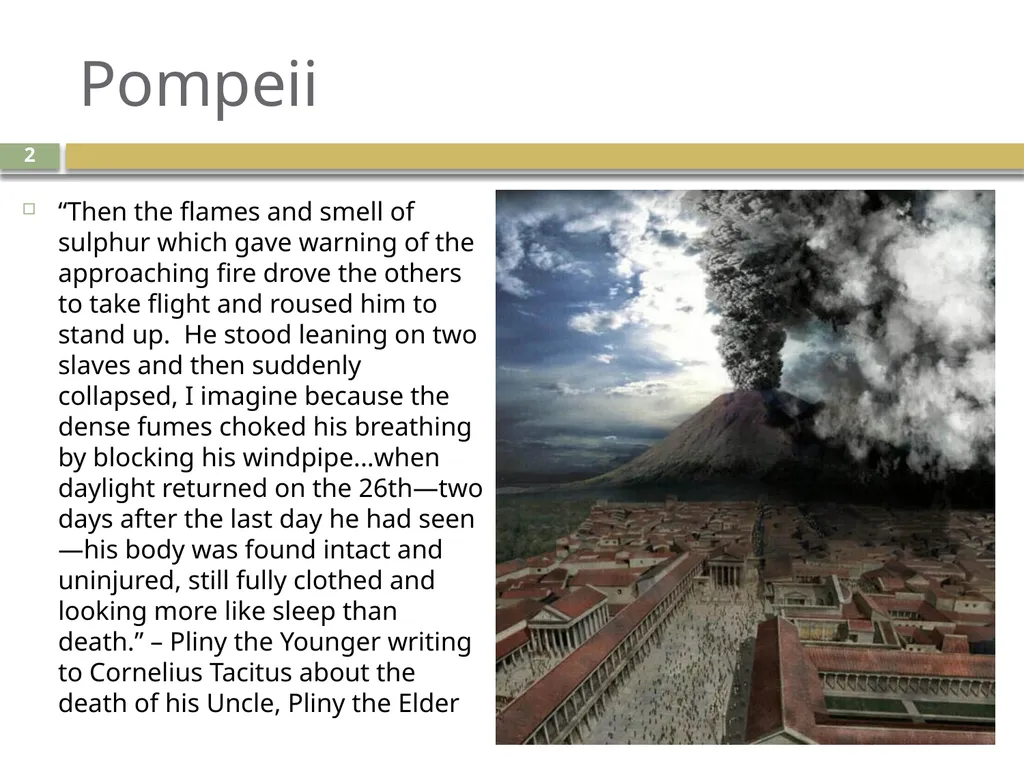
Pompeii 2 “Then the flames and smell of sulphur which gave warning of the approaching fire drove the others to take flight and roused him to stand up. He stood leaning on two slaves and then suddenly collapsed, I imagine because the dense fumes choked his breathing by blocking his windpipe...when daylight returned on the 26th—two days after the last day he had seen—his body was found intact and uninjured, still fully clothed and looking more like sleep than death.” – Pliny the Younger writing to Cornelius Tacitus about the death of his Uncle, Pliny the Elder<br>
03
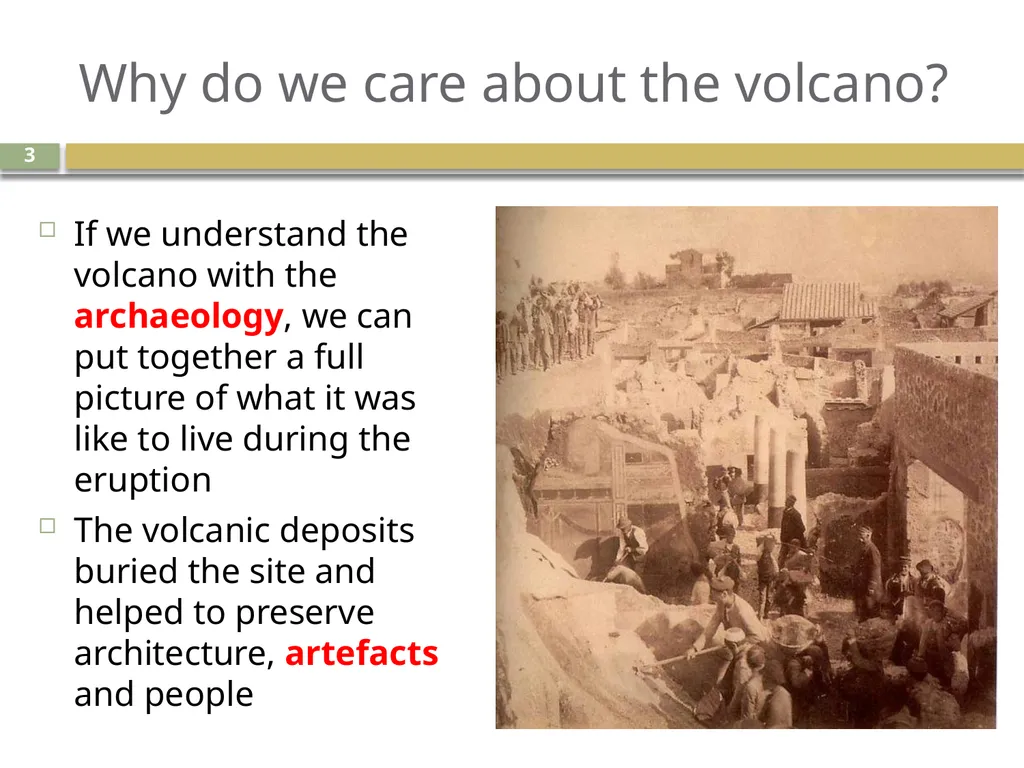
Why do we care about the volcano? 3 If we understand the volcano with the archaeology, we can put together a full picture of what it was like to live during the eruption
The volcanic deposits buried the site and helped to preserve architecture, artefacts and people<br>
The volcanic deposits buried the site and helped to preserve architecture, artefacts and people<br>
04
Objectives 4 By the end of this lesson, you should be able to:
Describe some archaeological approaches and how geoarchaeology builds on them.
Describe the two major types of volcanoes and some related volcanic deposits.
Interpret geoarchaeological materials.
Use these interpretations to help you explain what it was like before and during the eruption at Pompeii.<br>
05
What is geoarchaeology? Geoarchaeology uses geographical and archaeological approaches to understand a landscape or site.
It is interdisciplinary, requiring a wide range of knowledge and the ability to connect it.
Today we’ll learn about volcanic geography and archaeology and combine them in order to understand a case study: the eruption of Mt. Vesuvius in 79 AD. 5<br>
It is interdisciplinary, requiring a wide range of knowledge and the ability to connect it.
Today we’ll learn about volcanic geography and archaeology and combine them in order to understand a case study: the eruption of Mt. Vesuvius in 79 AD. 5<br>
06
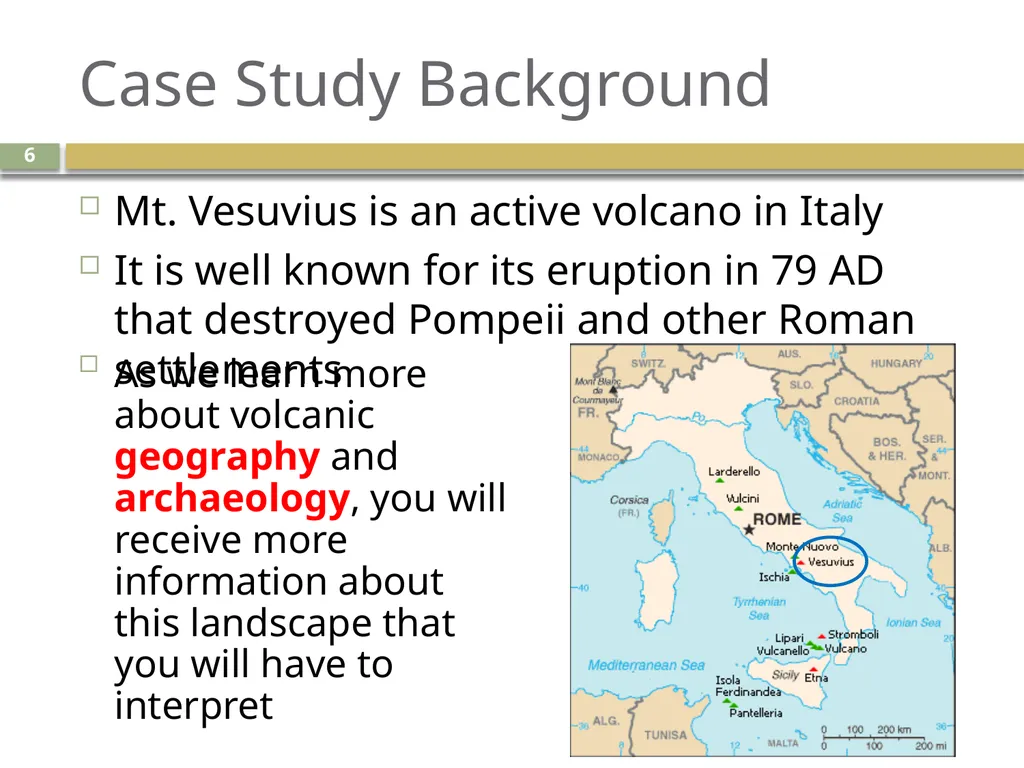
Case Study Background 6 Mt. Vesuvius is an active volcano in Italy
It is well known for its eruption in 79 AD that destroyed Pompeii and other Roman settlements As we learn more about volcanic geography and archaeology, you will receive more information about this landscape that you will have to interpret<br>
It is well known for its eruption in 79 AD that destroyed Pompeii and other Roman settlements As we learn more about volcanic geography and archaeology, you will receive more information about this landscape that you will have to interpret<br>
07
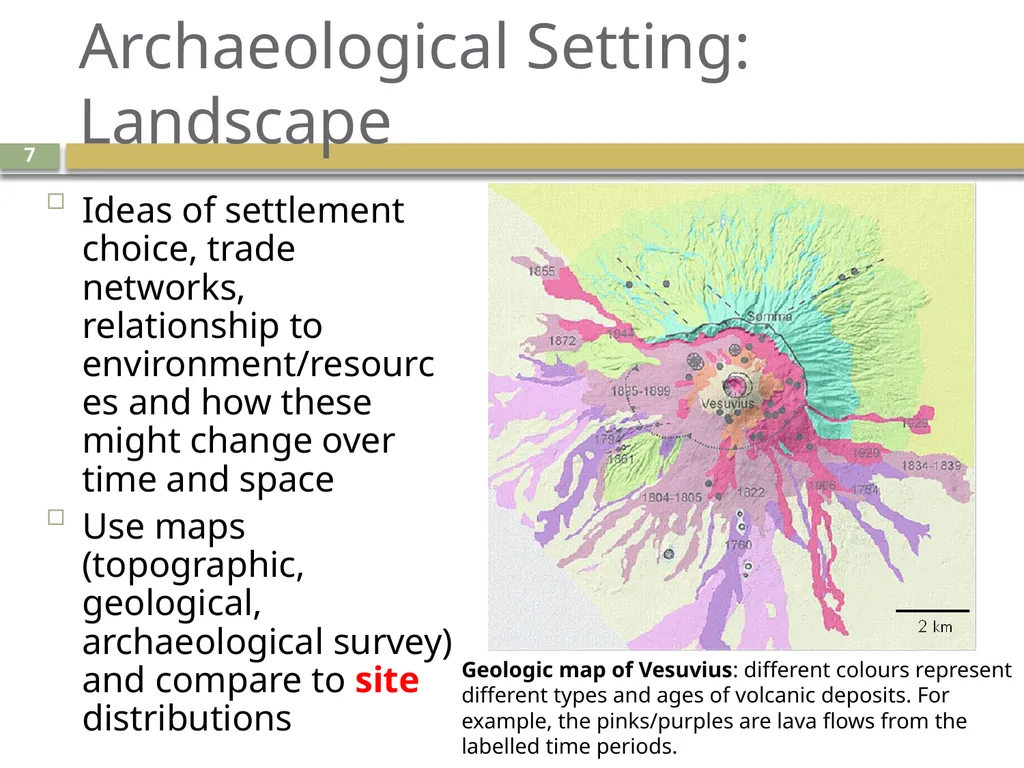
Archaeological Setting: Landscape 7 Ideas of settlement choice, trade networks, relationship to environment/resources and how these might change over time and space
Use maps (topographic, geological, archaeological survey) and compare to site distributions Geologic map of Vesuvius: different colours represent different types and ages of volcanic deposits. For example, the pinks/purples are lava flows from the labelled time periods.<br>
Use maps (topographic, geological, archaeological survey) and compare to site distributions Geologic map of Vesuvius: different colours represent different types and ages of volcanic deposits. For example, the pinks/purples are lava flows from the labelled time periods.<br>
08
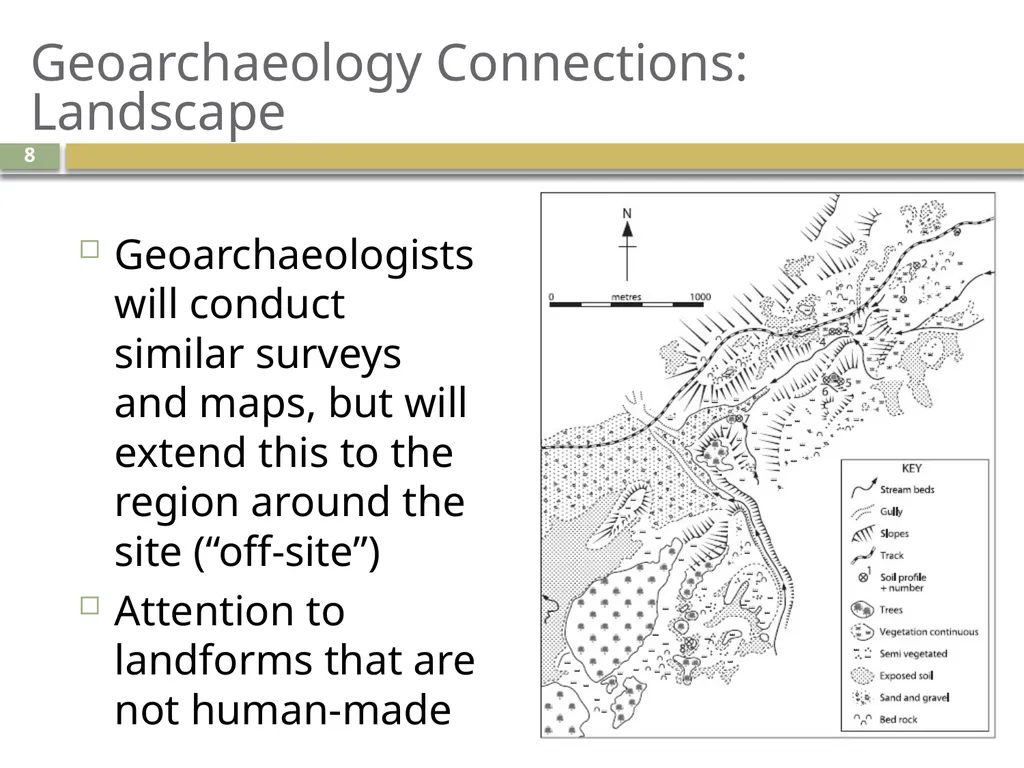
Geoarchaeology Connections: Landscape 8 Geoarchaeologists will conduct similar surveys and maps, but will extend this to the region around the site (“off-site”)
Attention to landforms that are not human-made<br>
Attention to landforms that are not human-made<br>
09
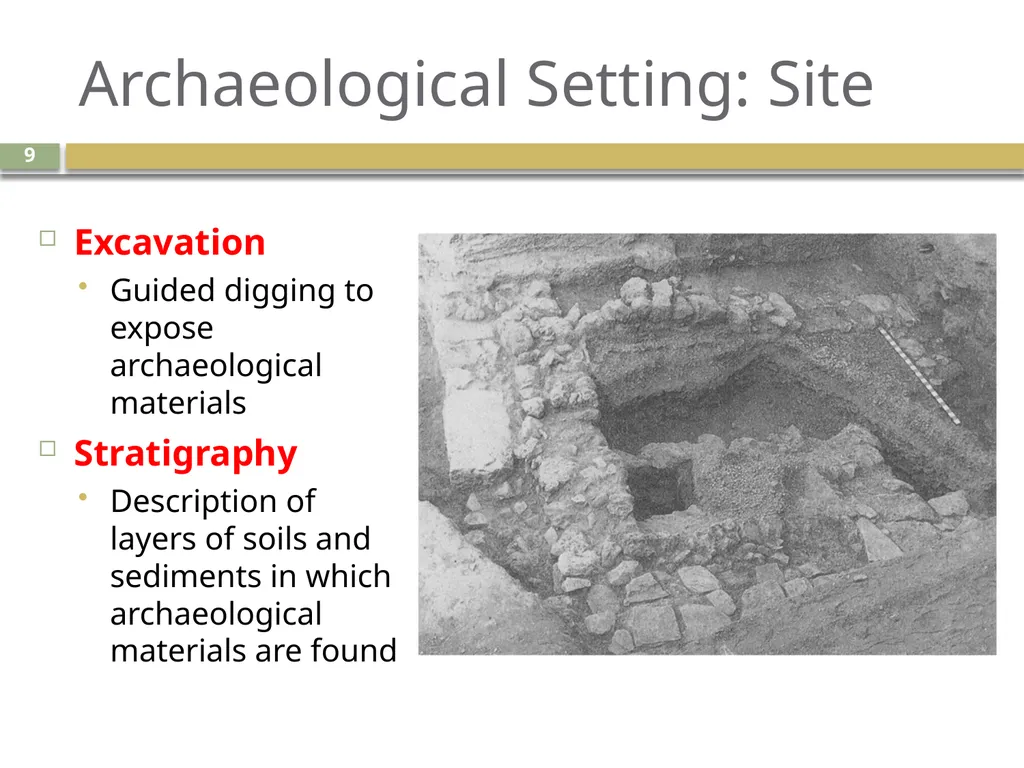
Archaeological Setting: Site 9 Excavation
Guided digging to expose archaeological materials
Stratigraphy
Description of layers of soils and sediments in which archaeological materials are found<br>
Guided digging to expose archaeological materials
Stratigraphy
Description of layers of soils and sediments in which archaeological materials are found<br>
10
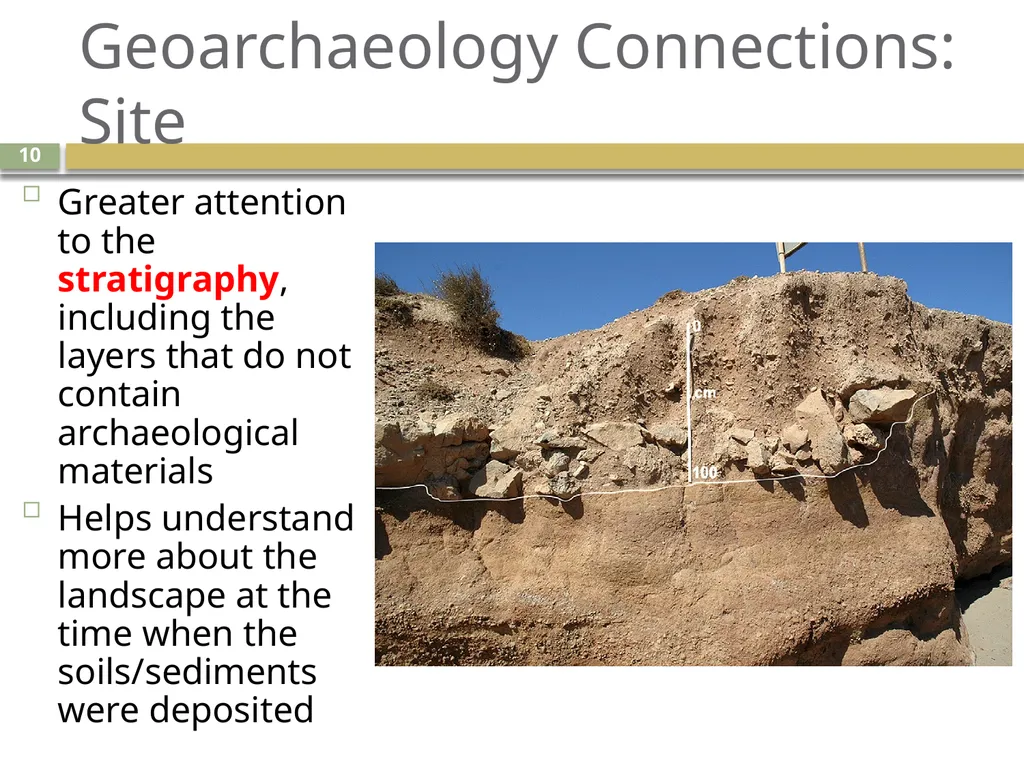
Geoarchaeology Connections: Site 10 Greater attention to the stratigraphy, including the layers that do not contain archaeological materials
Helps understand more about the landscape at the time when the soils/sediments were deposited<br>
Helps understand more about the landscape at the time when the soils/sediments were deposited<br>
11
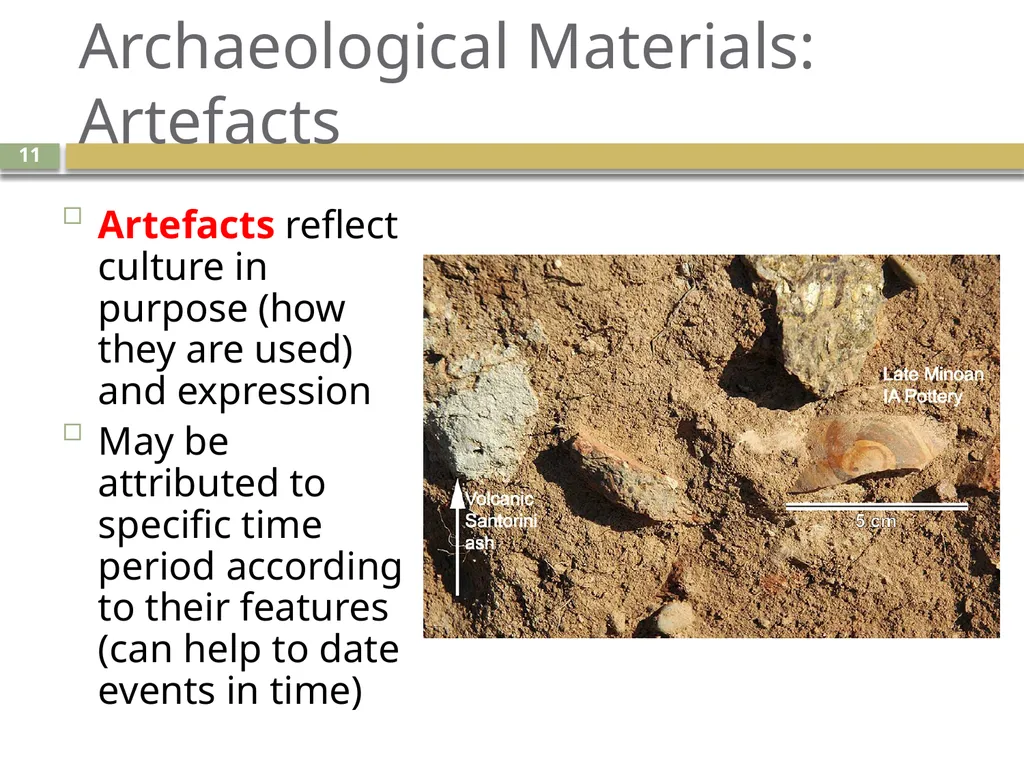
Archaeological Materials: Artefacts 11 Artefacts reflect culture in purpose (how they are used) and expression
May be attributed to specific time period according to their features (can help to date events in time)<br>
May be attributed to specific time period according to their features (can help to date events in time)<br>
12
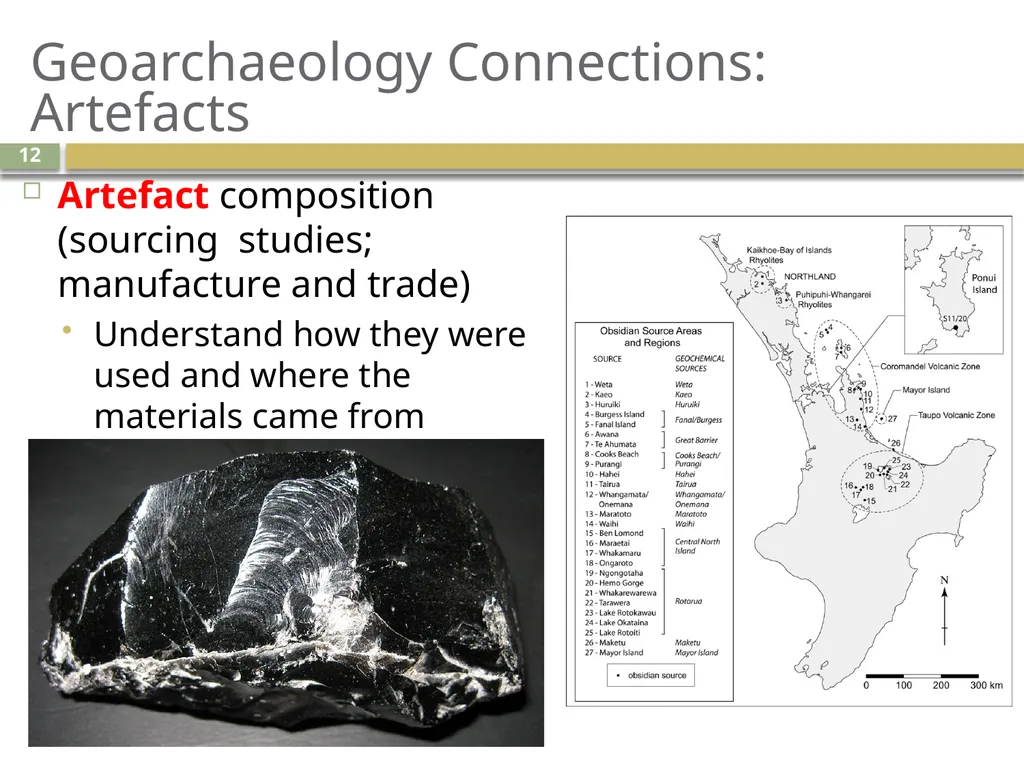
Geoarchaeology Connections: Artefacts 12 Artefact composition (sourcing studies; manufacture and trade)
Understand how they were used and where the materials came from<br>
Understand how they were used and where the materials came from<br>
13
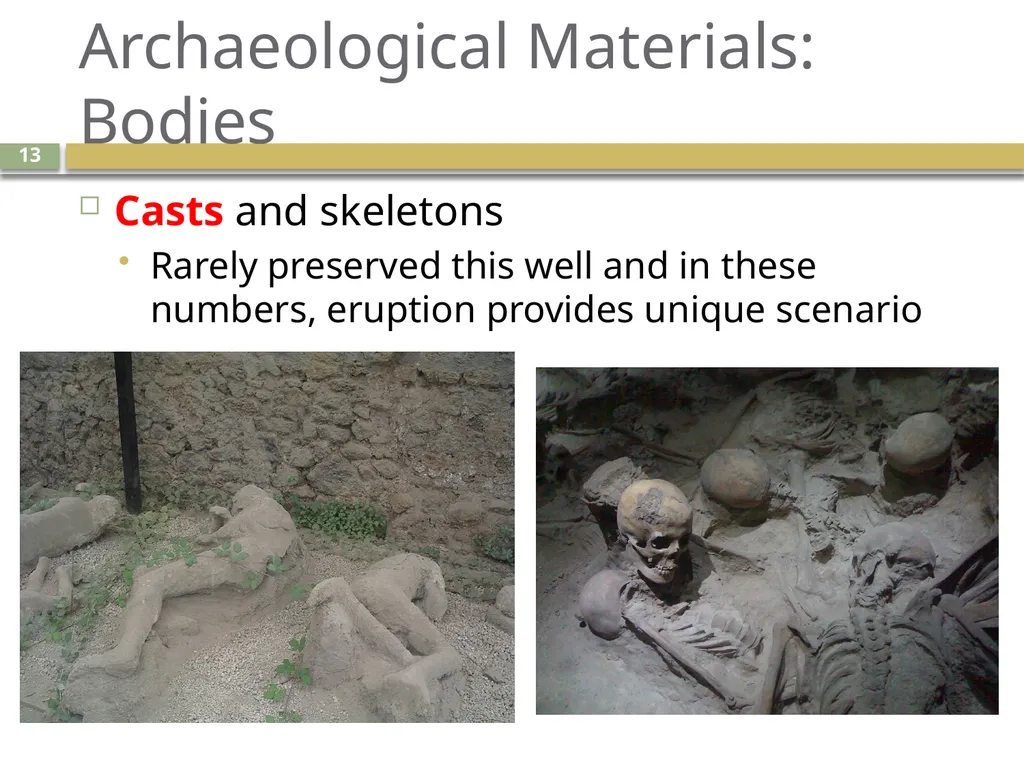
Archaeological Materials: Bodies 13 Casts and skeletons
Rarely preserved this well and in these numbers, eruption provides unique scenario<br>
Rarely preserved this well and in these numbers, eruption provides unique scenario<br>
14
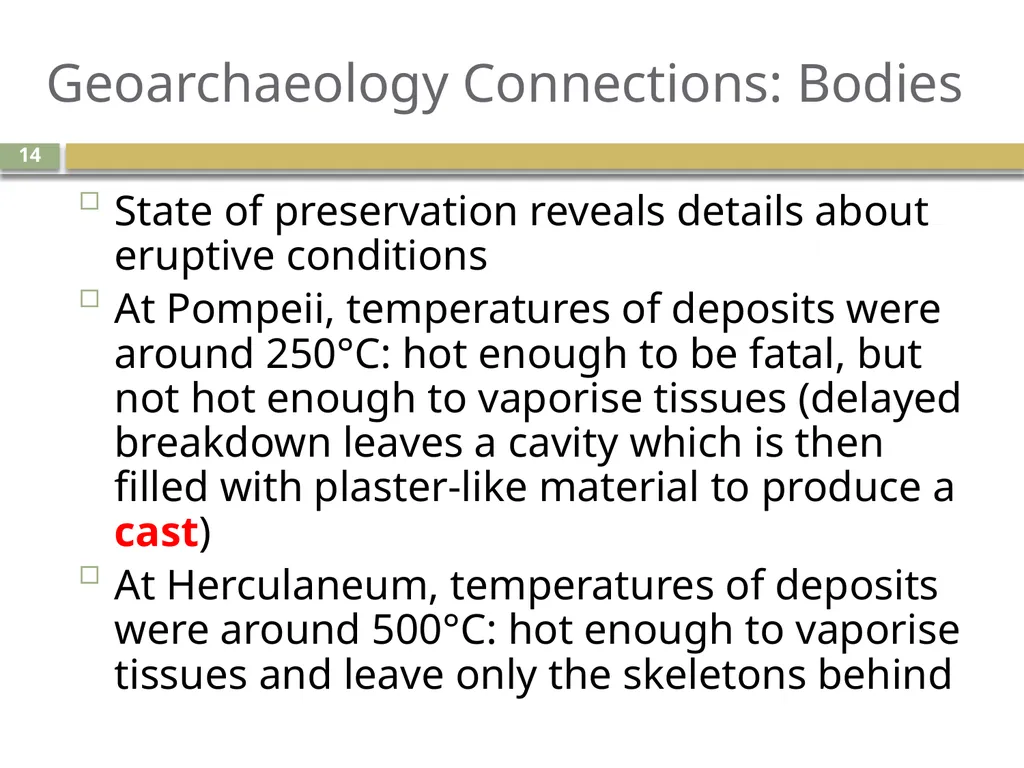
Geoarchaeology Connections: Bodies 14 State of preservation reveals details about eruptive conditions
At Pompeii, temperatures of deposits were around 250°C: hot enough to be fatal, but not hot enough to vaporise tissues (delayed breakdown leaves a cavity which is then filled with plaster-like material to produce a cast)
At Herculaneum, temperatures of deposits were around 500°C: hot enough to vaporise tissues and leave only the skeletons behind<br>
15
Case Study: Part 1 15 Now you will interpret some of the archaeology and geoarchaeology from Pompeii and the landscape around Vesuvius.<br>
16
Volcanic Deposits in Action 16<br>
17
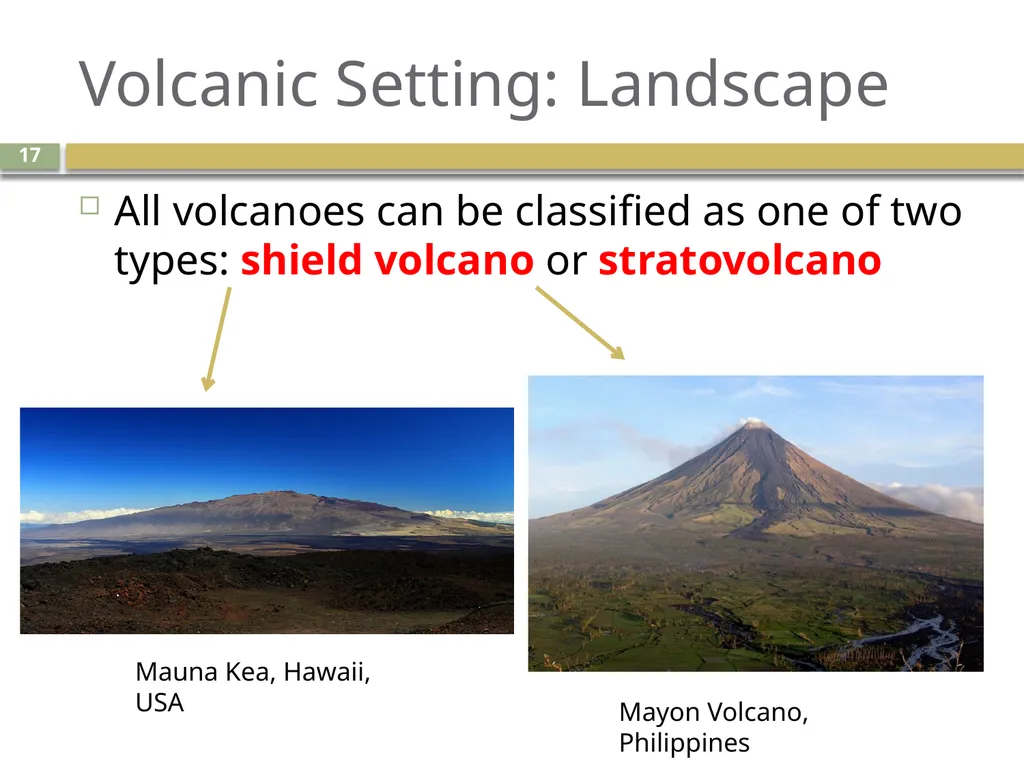
Volcanic Setting: Landscape 17 All volcanoes can be classified as one of two types: shield volcano or stratovolcano Mauna Kea, Hawaii, USA Mayon Volcano, Philippines<br>
18
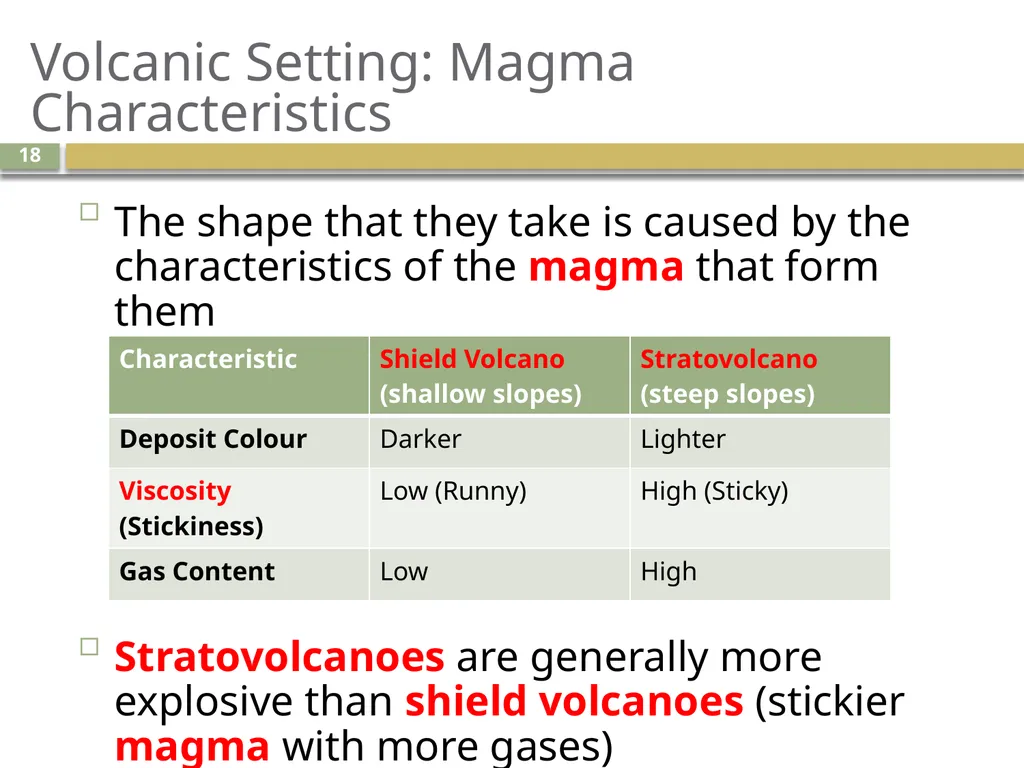
Volcanic Setting: Magma Characteristics 18 The shape that they take is caused by the characteristics of the magma that form them
Stratovolcanoes are generally more explosive than shield volcanoes (stickier magma with more gases)<br>
Stratovolcanoes are generally more explosive than shield volcanoes (stickier magma with more gases)<br>
19
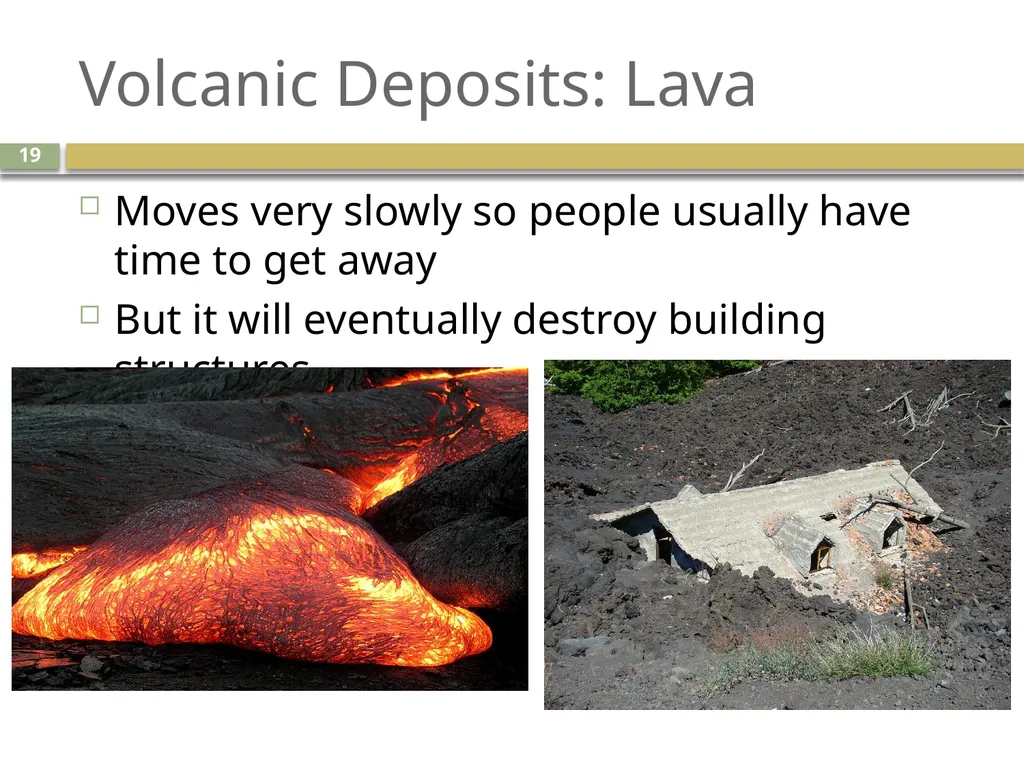
Volcanic Deposits: Lava 19 Moves very slowly so people usually have time to get away
But it will eventually destroy building structures<br>
But it will eventually destroy building structures<br>
20
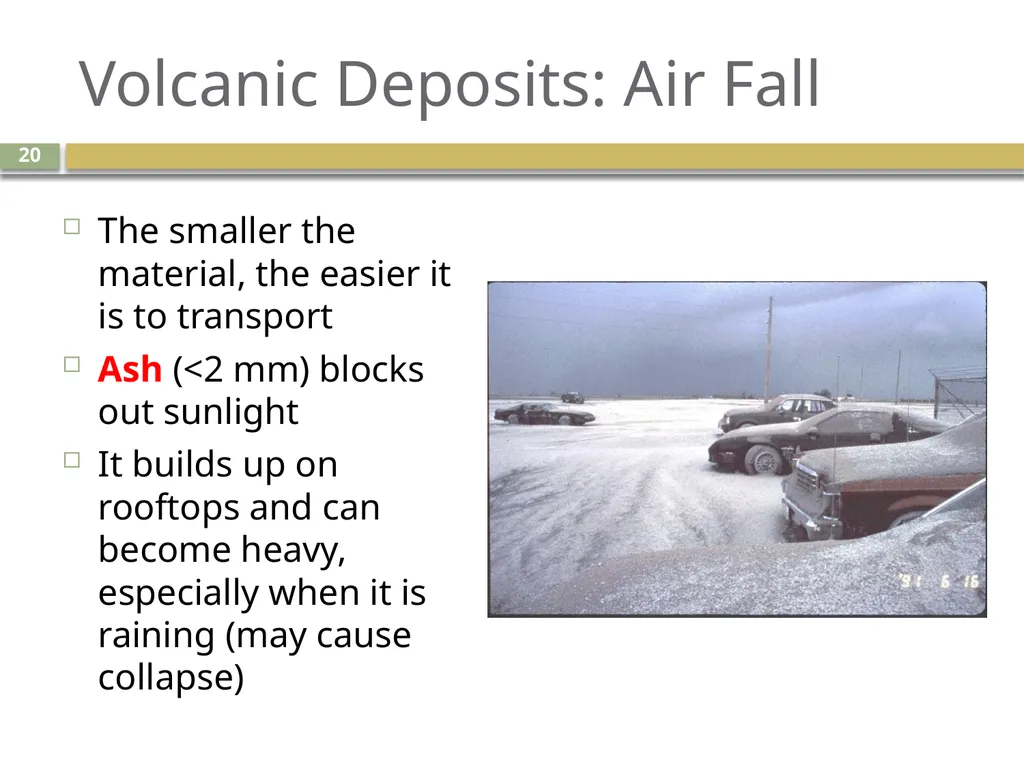
Volcanic Deposits: Air Fall 20 The smaller the material, the easier it is to transport
Ash (<2 mm) blocks out sunlight
It builds up on rooftops and can become heavy, especially when it is raining (may cause collapse)<br>
Ash (<2 mm) blocks out sunlight
It builds up on rooftops and can become heavy, especially when it is raining (may cause collapse)<br>
21
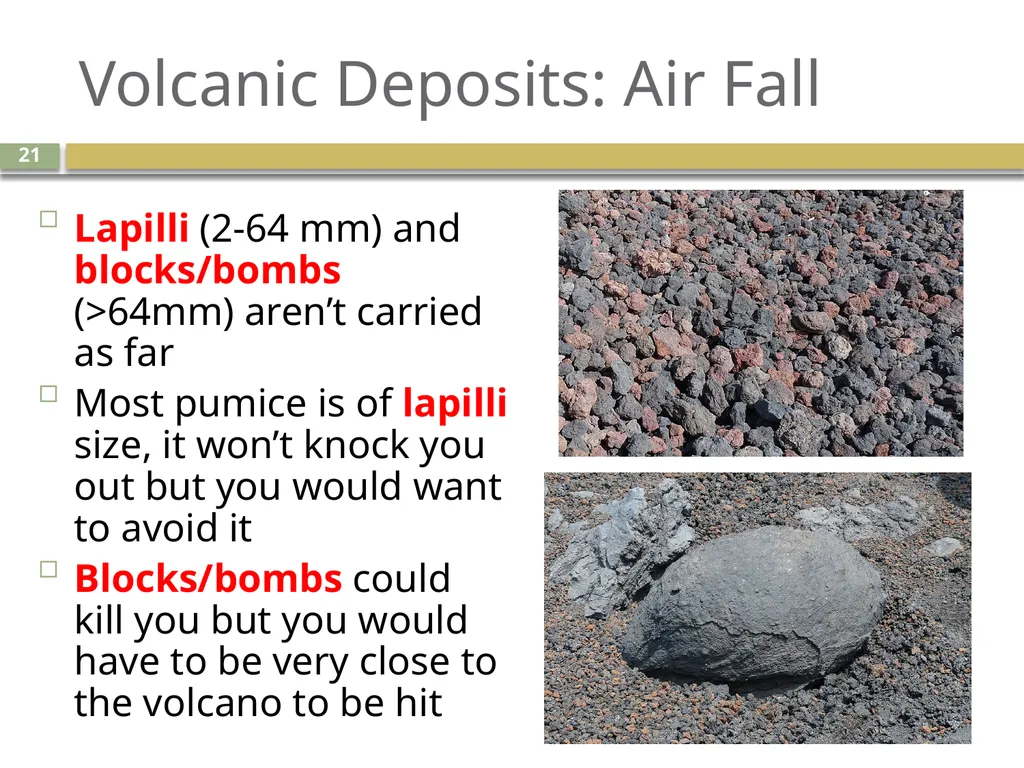
Volcanic Deposits: Air Fall 21 Lapilli (2-64 mm) and blocks/bombs (>64mm) aren’t carried as far
Most pumice is of lapilli size, it won’t knock you out but you would want to avoid it
Blocks/bombs could kill you but you would have to be very close to the volcano to be hit<br>
Most pumice is of lapilli size, it won’t knock you out but you would want to avoid it
Blocks/bombs could kill you but you would have to be very close to the volcano to be hit<br>
22
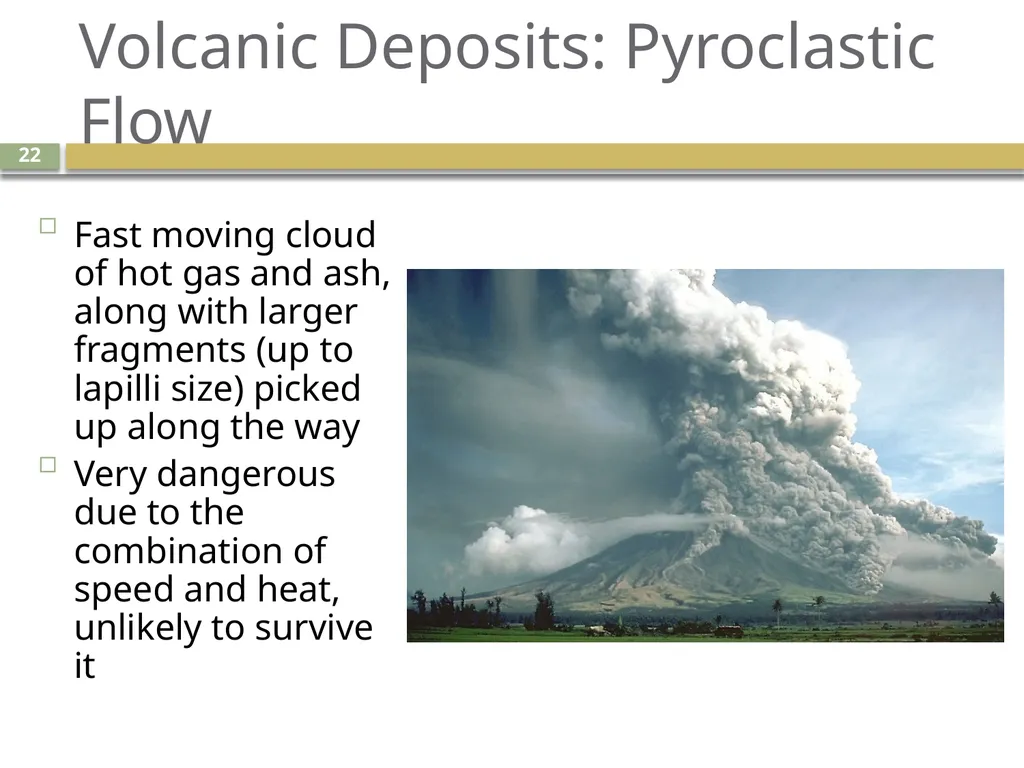
Volcanic Deposits: Pyroclastic Flow 22 Fast moving cloud of hot gas and ash, along with larger fragments (up to lapilli size) picked up along the way
Very dangerous due to the combination of speed and heat, unlikely to survive it<br>
Very dangerous due to the combination of speed and heat, unlikely to survive it<br>
23
Case Study: Parts 2 and 3 23 Now you will interpret the final details of the volcanic geoarchaeology of Pompeii and put together all of your findings from today.<br>
24
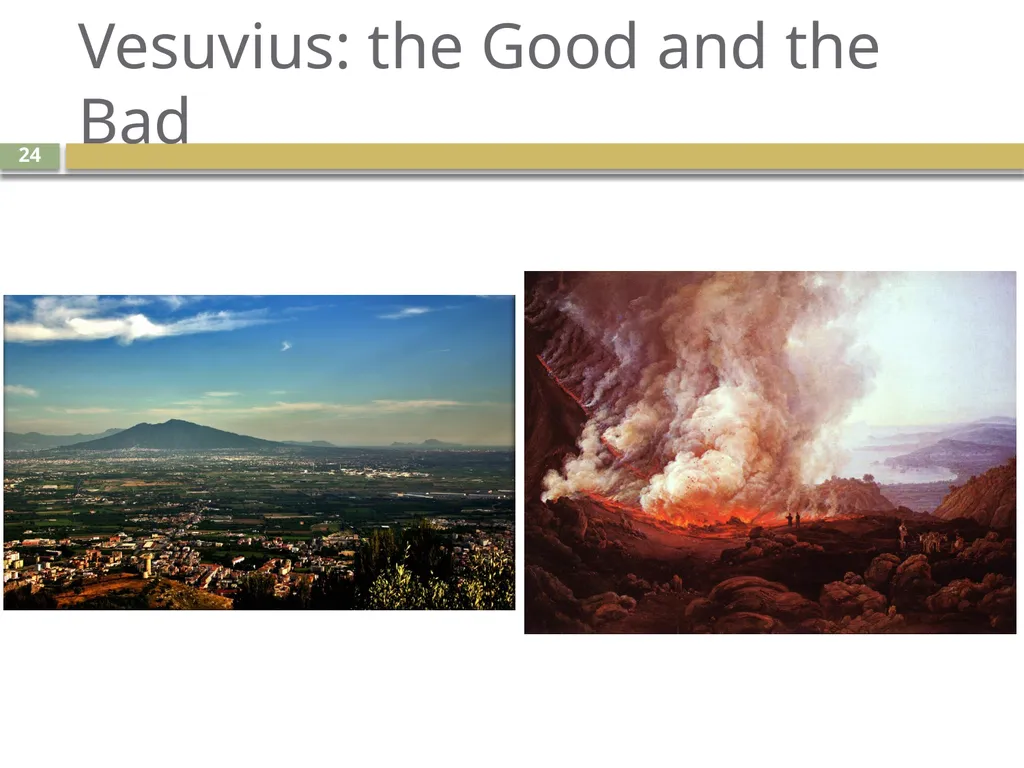
Vesuvius: the Good and the Bad 24<br>
25
Case Study: Before the Eruption 25 The landscape around Vesuvius was relatively flat and the volcano would have been the central feature (map evidence)
The land around Pompeii was farmed in order to provide resources for its people (artefact evidence)
Pompeii was a wealthy town where arts, culture and religion were important (artefact evidence)<br>
The land around Pompeii was farmed in order to provide resources for its people (artefact evidence)
Pompeii was a wealthy town where arts, culture and religion were important (artefact evidence)<br>
26
Case Study: During the Eruption 26 Before most of the deaths at Pompeii, there was a substantial air fall of lapilli-sized material (stratigraphic evidence)
Ash in the air blocked out the sunlight, making it appear dark even though it was daytime (literary evidence)
People were frantic, had to decide whether or not to leave family members behind and some even questioned the existence of the gods (literary evidence)
Then the pyroclastic flow hit, killing people with its intense heat and rapidly burying them, their possessions and the structures of the town in a mass of sediment (stratigraphic evidence)<br>
27
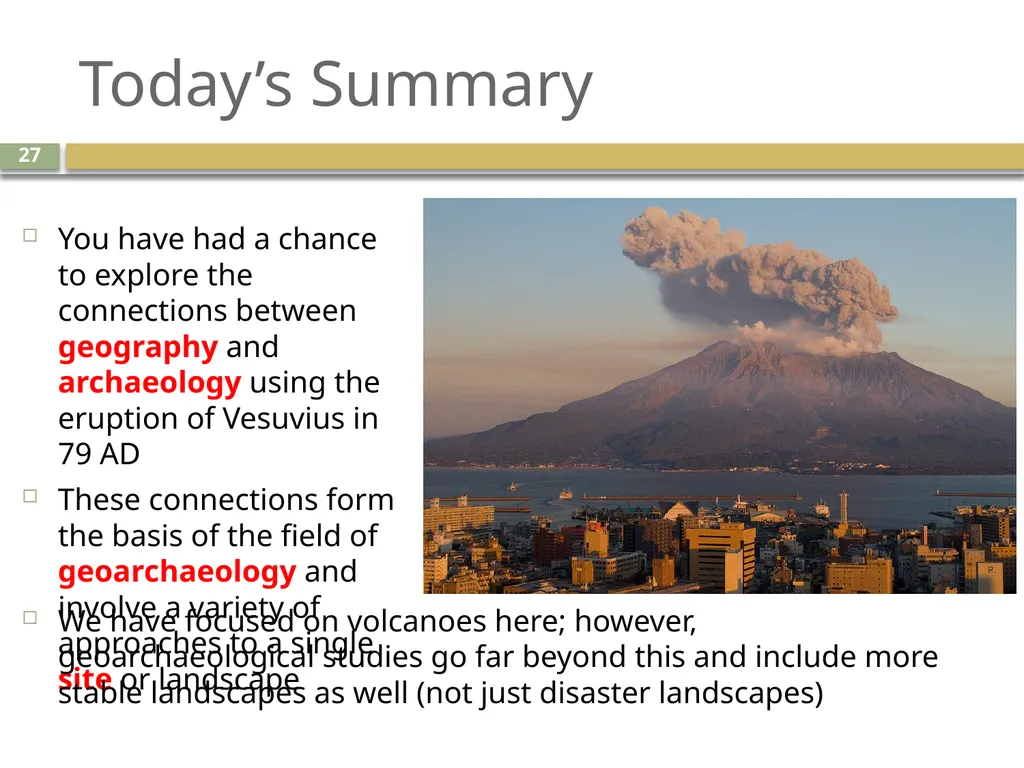
Today’s Summary 27 You have had a chance to explore the connections between geography and archaeology using the eruption of Vesuvius in 79 AD
These connections form the basis of the field of geoarchaeology and involve a variety of approaches to a single site or landscape We have focused on volcanoes here; however, geoarchaeological studies go far beyond this and include more stable landscapes as well (not just disaster landscapes)<br>
These connections form the basis of the field of geoarchaeology and involve a variety of approaches to a single site or landscape We have focused on volcanoes here; however, geoarchaeological studies go far beyond this and include more stable landscapes as well (not just disaster landscapes)<br>
28
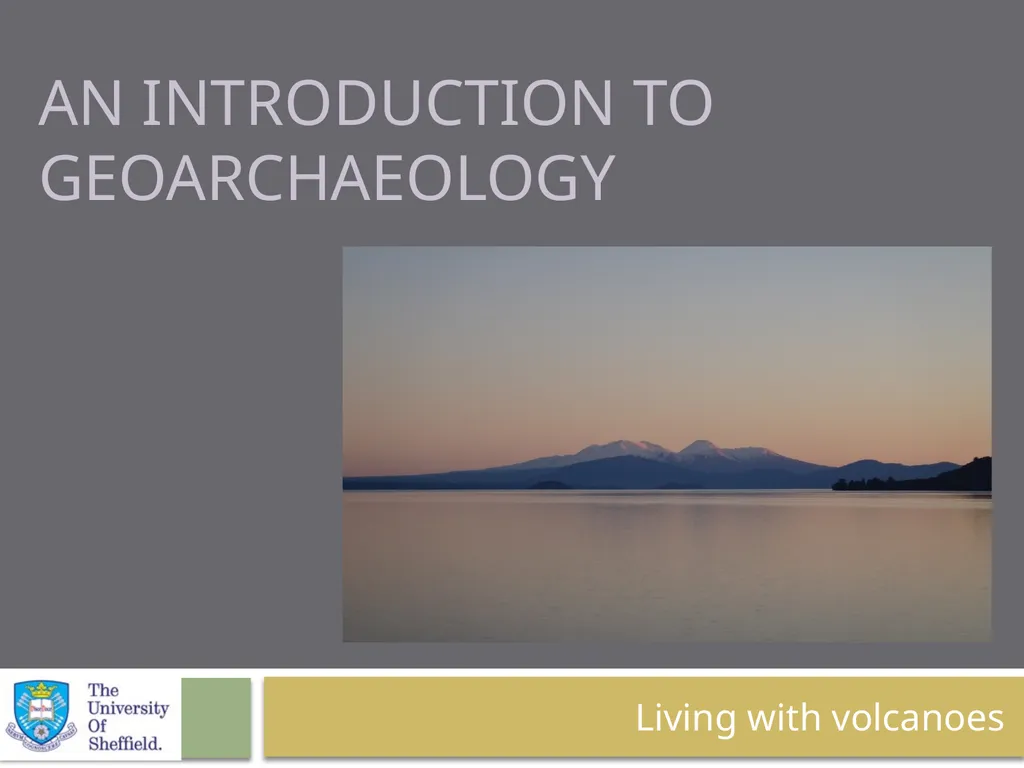
References: Images 28 Tongariro Volcanic Zone across Lake Taupo, New Zealand: copyright Alison Jolley
Pompeii eruption simulation: Wikimedia Commons, copyright The Discovery Channel [http://commons.wikimedia.org/wiki/File:Pompeii_the_last_day_1.jpg]
Historic excavation at Pompeii: Wikimedia Commons, Public Domain (expired copyright) [http://commons.wikimedia.org/wiki/File:Freilegung_eines_Hauses_in_Pompeji.jpg]
Map of Italian volcanoes (modified): Wikimedia Commons, Public Domain (CIA World Factbook) [http://commons.wikimedia.org/wiki/File:Italy_volcano_map.png]
Geologic map of Vesuvius (modified): Ventura, G., Vilardo, G., Bronzino, G., Gabriele, G., Nappi, R., and Terranova, C. (2005). Geomorphological map of the Somma-Vesuvius volcanic complex (Italy). Journal of Maps, 1(1), pp.30-37.
Geomorphologic map near Hekla, Iceland: Dugmore, A.J., Church, M.J., Mairs, K., McGovern, T.H., Perdikaris, S., and Vésteinsson, O. (2007). Abandoned farms, volcanic impacts, and woodland management: revisiting Þjórsárdalur, the “Pompeii Of Iceland”. Arctic Anthropology, 44(1), pp.1-11.
Pumice on floor of Minoan structure: Antonopoulos, J. (1992). The great Minoan eruption of Thera volcano and the ensuing tsunami in the Greek Archipelago. Natural Hazards, 5, pp.153-168.
Santorini eruption stratigraphy, Crete: Bruins, H.J., MacGillivray, J.A., Synolakis, C.E., Benjamini, C., Keller, J., Kisch, H.J., Klügel, A., and van der Plicht, J. (2008). Geoarchaeological tsunami deposits at Palaikastro (Crete) and the Late Minoan 1A eruption of Santorini. Journal of Archaeological Science, 35, pp.191-212.
Ash clast and pot sherd from Late Minoan 1A eruption, Crete: Bruins, H.J., MacGillivray, J.A., Synolakis, C.E., Benjamini, C., Keller, J., Kisch, H.J., Klügel, A., and van der Plicht, J. (2008). Geoarchaeological tsunami deposits at Palaikastro (Crete) and the Late Minoan 1A eruption of Santorini. Journal of Archaeological Science, 35, pp.191-212.<br>
29
References: Images (2) 29 Vesuvian obsidian: Wikimedia Commons, author Pogány Péter [http://commons.wikimedia.org/wiki/File:Obszidi%C3%A1n%28Vezuv%29005.jpg]
Obsidian sourcing map, New Zealand: Sheppard, P.J., Irwin, G.J., Lin, S.C., and McCaffrey, C.P. (2011). Characterization of New Zealand obsidian using PXRF. Journal of Archaeological Science, 38, pp.45-56.
Casts at the Garden of the Fugitives, Pompeii: Wikimedia Commons, author Sören Bleikertz [http://commons.wikimedia.org/wiki/File:Pompeji_schlafende_SaE.jpg]
Skeletons at Herculaneum: Wikimedia Commons, author Roberto Fogliardi Descrizione [http://commons.wikimedia.org/wiki/File:Scheletri-ercolano-dettaglio.jpg]
Mauna Kea, Hawaii, USA: Wikimedia Commons, author Nula666 [http://commons.wikimedia.org/wiki/File:Mauna_Kea_from_Mauna_Loa_Observatory,_Hawaii_-_20100913.jpg]
Mayon Volcano, Philippines: Wikimedia Commons, copyright Tomas Tam [http://commons.wikimedia.org/wiki/File:Mt.Mayon_tam3rd.jpg]
Kilauea lava flow: Wikimedia Commons, public domain (USGS-Hawaii Volcano Observatory) [http://commons.wikimedia.org/wiki/File:Pahoehoe_toe.jpg]
Buried house near Etna, Italy: Wikimedia Commons, author Hajotthu [http://commons.wikimedia.org/wiki/File:EtnaHaus.JPG]
Ash fall near Pinatubo, Philippines: Wikimedia Commons, public domain (USGS-R.P. Hoblitt) [http://commons.wikimedia.org/wiki/File:Ashfall_from_Pinatubo,_1991.jpg]<br>
30
References: Images (3) 30 Lapilli near Etna, Italy: Wikimedia Commons, author Ji-Elle [http://commons.wikimedia.org/wiki/File:Etna-Lapilli_(2).jpg]
Volcanic bomb near Etna, Italy: Wikimedia Commons, author Ji-Elle [http://commons.wikimedia.org/wiki/File:Etna-Bombe_volcanique_en_fuseau_%283%29.jpg]
Pyroclastic flow at Mayon volcano, Philippines: Wikimedia Commons, public domain (USGS) [http://commons.wikimedia.org/wiki/File:Pyroclastic_flows_at_Mayon_Volcano-2010-20-08.jpg]
Video of pyroclastic flow at Mt. Unzen, Japan: YouTube, author DrChristopherGomez [http://www.youtube.com/watch?v=Cvjwt9nnwXY]
Mt. Vesuvius viewed from Maddaloni: Wikimedia Commons, author Kris de Curtis [http://commons.wikimedia.org/wiki/File:Mount_Vesuvius,_Capri_and_Maddaloni.jpg]
J.C. Dahl painting of Vesuvius Eruption, 1820’s: Wikimedia Commons, public domain (The Yorck Project) [http://commons.wikimedia.org/wiki/File:Johan_Christian_Claussen_Dahl_001.jpg]
Mt. Sakurajima, Japan: Wikimedia Commons, author Kimon Berlin [http://commons.wikimedia.org/wiki/File:Sakurajima_at_Sunset.jpg]<br>
31
References: Content 31 Pompeii pyroclastic flow conditions: Mastrolorenzo, G., Petrone, P., Pappalardo, L., and Guarino, F.M. (2010). Lethal thermal impact at periphery of pyroclastic surges: evidences at Pompeii. PLoS ONE, 5(6), e11127.
Herculaneum pyroclastic flow conditions: Mastrolorenzo, G., Petrone, P.P., Pagano, M., Incoronato, A., Baxter, P.J., Canzanella, A., and Fattore, L. (2001). Herculaneum victims of Vesuvius in AD 79. Nature, 410, pp.769-770.<br>
Herculaneum pyroclastic flow conditions: Mastrolorenzo, G., Petrone, P.P., Pagano, M., Incoronato, A., Baxter, P.J., Canzanella, A., and Fattore, L. (2001). Herculaneum victims of Vesuvius in AD 79. Nature, 410, pp.769-770.<br>