Analytical Chemistry By Dr. Jamal Ahmed Abdel Barry Professor in Clinical Biochemistry Advanced Analytical Chemistry Solutions, Molarity, Percent Solutions, Molality And Normality Solution : A homogeneous mixture of 2 or more substances.
"Analytical Chemistry By Dr. Jamal Ahmed Abdel" is the property of its rightful owner. Permission is granted to
download and print the materials on this website for personal, non-commercial use only, and to display it
on your personal computer provided you do not modify the materials and that you retain all copyright
notices contained in the materials. By downloading content from our website, you accept the terms of this
agreement.
Presentation Transcript
01
Analytical Chemistry By
Dr. Jamal Ahmed Abdel Barry
Professor in Clinical Biochemistry<br>
02
Advanced Analytical Chemistry
Solutions, Molarity, Percent Solutions, Molality
And
Normality<br>
03
Solution : A homogeneous mixture of 2 or more substances. Examples: Salt water, Orange juice. All solutions are a mixture of the solute(s) and the solvent. They are always listed with the lesser constituent (the solute) first.<br>
04
Solute: The substance that is dissolved.
It is the lesser constituent by volume. (Ex: The Salt in the Saltwater.) Solvent : The substance that does the dissolving.
It is the greater constituent by volume. (Ex: The Water in the Saltwater.)<br>
05
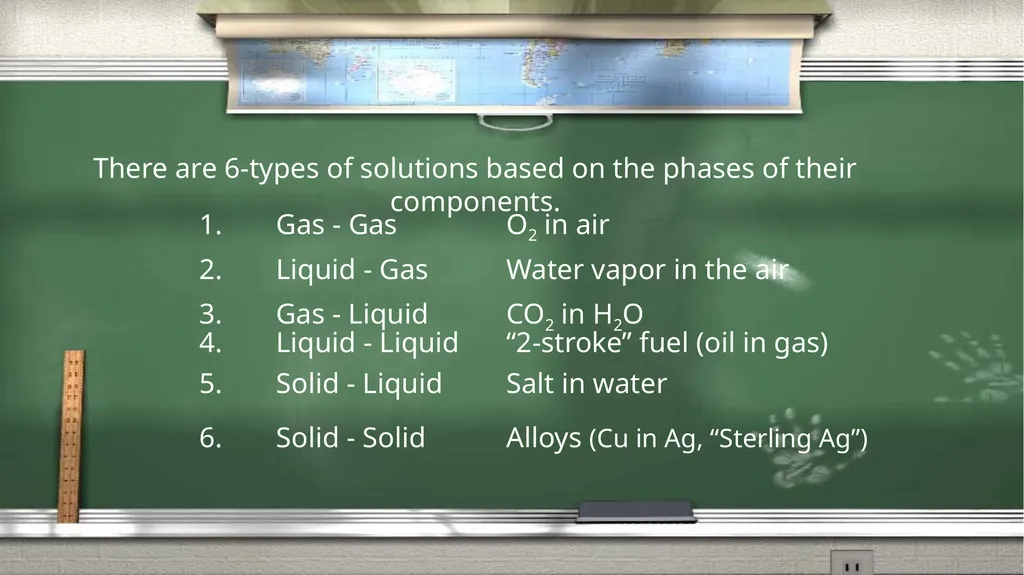
There are 6-types of solutions based on the phases of their components. 1. Gas - Gas O2 in air 2. Liquid - Gas Water vapor in the air 3. Gas - Liquid CO2 in H2O 4. Liquid - Liquid “2-stroke” fuel (oil in gas) 5. Solid - Liquid Salt in water 6. Solid - Solid Alloys (Cu in Ag, “Sterling Ag”)<br>
06
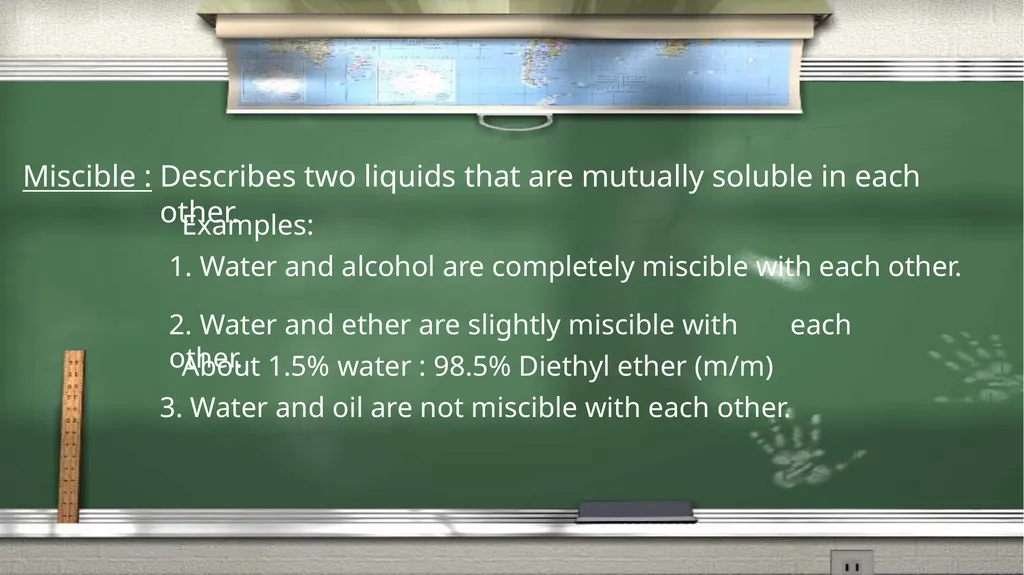
Miscible : Describes two liquids that are mutually soluble in each other. Examples: 1. Water and alcohol are completely miscible with each other. 2. Water and ether are slightly miscible with each other. 3. Water and oil are not miscible with each other. About 1.5% water : 98.5% Diethyl ether (m/m)<br>
07
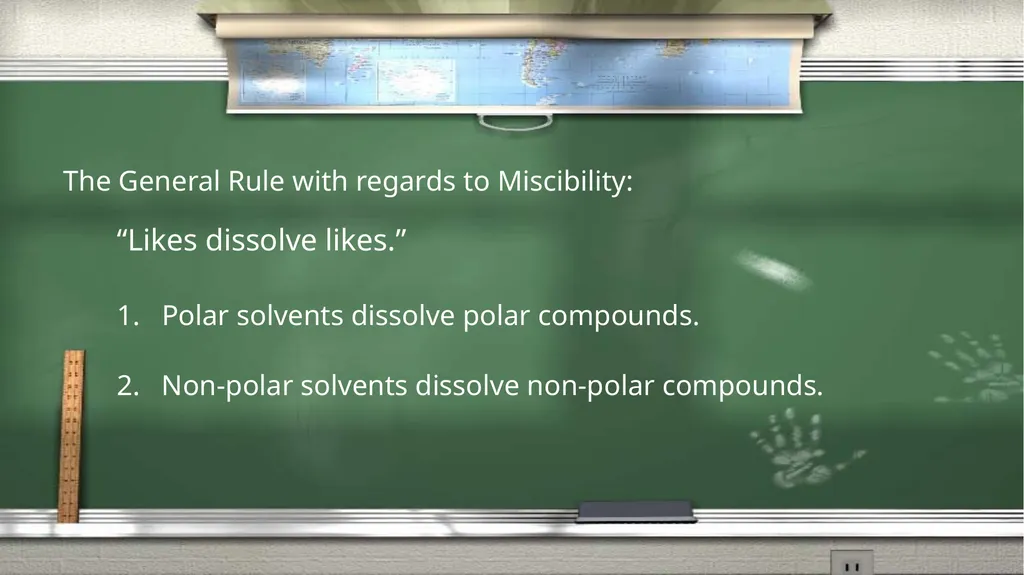
The General Rule with regards to Miscibility: “Likes dissolve likes.” 1. Polar solvents dissolve polar compounds. 2. Non-polar solvents dissolve non-polar compounds.<br>
08
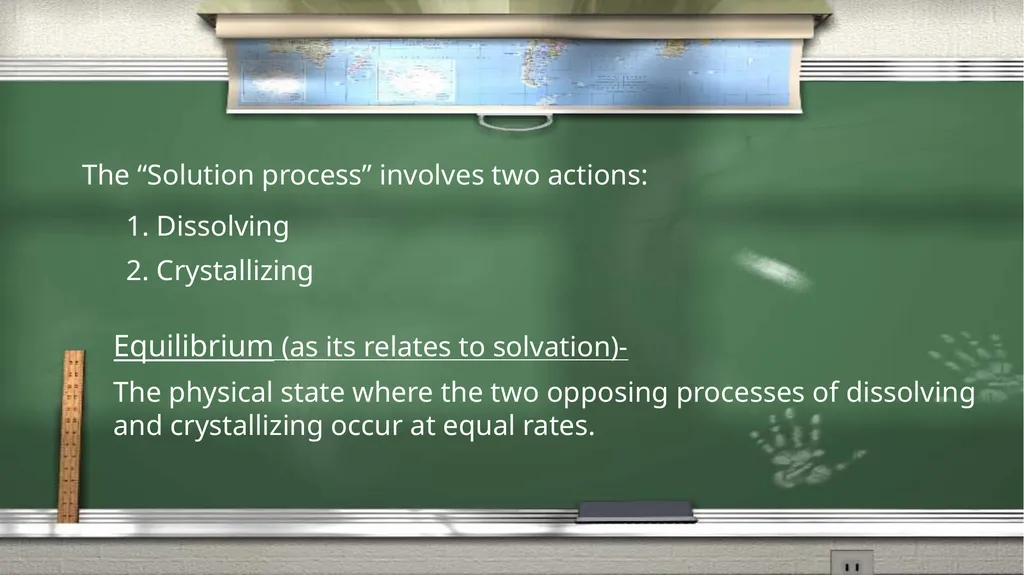
The “Solution process” involves two actions: 1. Dissolving 2. Crystallizing Equilibrium (as its relates to solvation)- The physical state where the two opposing processes of dissolving and crystallizing occur at equal rates.<br>
09
Le Châtelier’s principle - When stress is applied to a system at equilibrium, the system shifts to relieve the stress. Example: As you add salt to water, it dissolves. However, as the concentration of salt approaches saturation, the rate of solvation slows.<br>
10
Saturated solution - A solution in which the dissolved and un-dissolved substances are at equilibrium. (The solvent can no longer dissolve any additional solute. It will simply fall to the bottom of the solution.) The “solubility” of a substance determines when a solution will become saturated.<br>
11
Solubility : The maximum amount of a solute that can dissolve in a given amount of solvent under specified conditions. Examples at 20˚C : 1. 222 g of Silver nitrate / 100 g of water 2. 3.89 g of Barium hydroxide / 100 g of water 3. 0.169 g of CO2 / 100 g of water (at SP) 4. 0.0043 g of O2 / 100 g of water (at SP)<br>
12
Factors that affect the rate of solution: 1. Particle size 2. Agitation 3. Temperature (aka: the Heat of Solution) 4. Polarities of solute and solvent 5. Concentration of solution (solvation slows as it nears saturation)<br>
13
Heat of Solution: The difference between the heat content of a solution and it’s components. Heats of solution are either positive or negative.<br>
14
Positive Heat of Solution : Solute + solvent + heat solution (endothermic) “Heating helps solvation” Heat has a positive effect on solvation.<br>
15
Negative Heat of Solution: “Heating hinders solvation” Heat has a negative effect on solvation. Solute + solvent solution + heat (exothermic)<br>
16
Concentration units for solutions: 1. Molarity - 2. Molality - The number of moles of solute per liter of solution The number of moles of solute per kilogram of solvent. 4. Percent solutions - 3. Normality - The number of equivalents of a substance dissolved in a liter of solution. (m/m), (v/v), (m/v)<br>