Ancient Sino-Japanese connectivity Yayoi Period and the first connections with China (300 BCE 250 CE) A new culture suddenly emerges in the isle of Honshu (beginning of the Japanese Bronze Age). Archaeological evidence of the
"Ancient Sino-Japanese connectivity Yayoi Period" is the property of its rightful owner. Permission is granted to
download and print the materials on this website for personal, non-commercial use only, and to display it
on your personal computer provided you do not modify the materials and that you retain all copyright
notices contained in the materials. By downloading content from our website, you accept the terms of this
agreement.
Presentation Transcript
01
Ancient Sino-Japanese connectivity<br>
02
Yayoi Period and the first connections with China (300 BCE – 250 CE) A new culture suddenly emerges in the isle of Honshu (beginning of the Japanese Bronze Age).
Archaeological evidence of the manufacture of bronze, pottery and fine textiles.
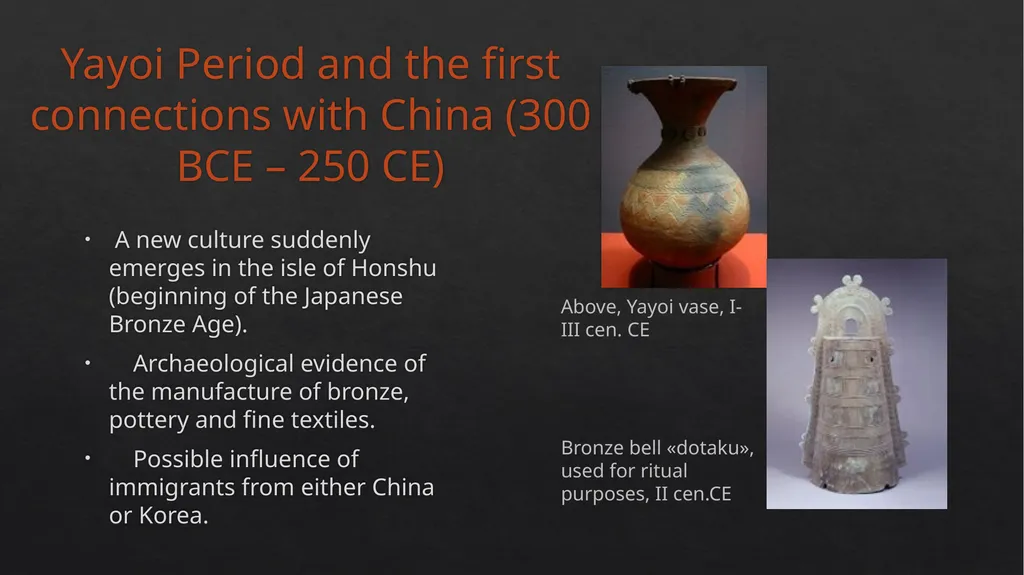
Possible influence of immigrants from either China or Korea. Above, Yayoi vase, I-III cen. CE Bronze bell «dotaku», used for ritual purposes, II cen.CE<br>
03
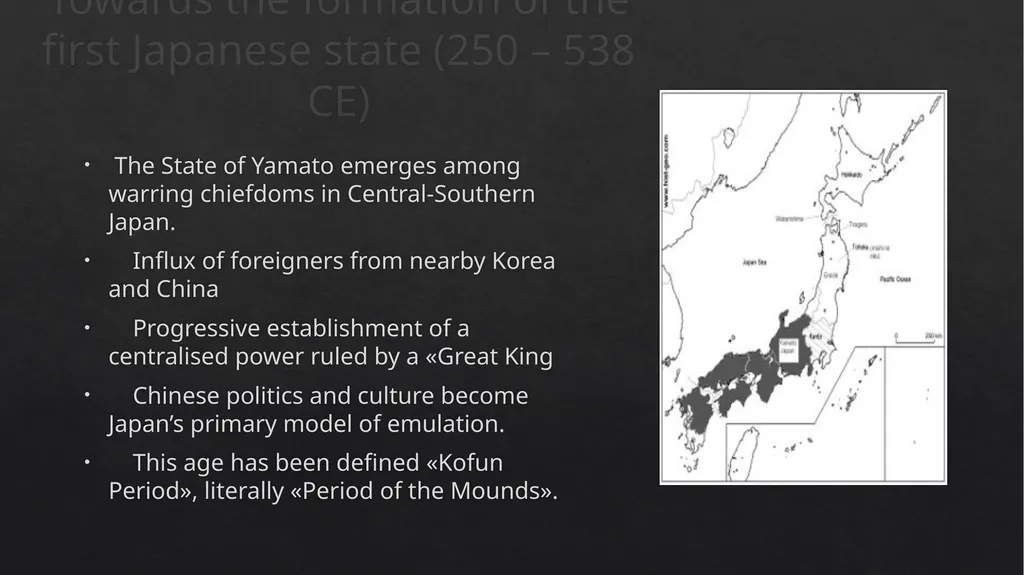
Towards the formation of the first Japanese state (250 – 538 CE) The State of Yamato emerges among warring chiefdoms in Central-Southern Japan.
Influx of foreigners from nearby Korea and China
Progressive establishment of a centralised power ruled by a «Great King
Chinese politics and culture become Japan’s primary model of emulation.
This age has been defined «Kofun Period», literally «Period of the Mounds».<br>
04
Japanese reception of Chinese idea of rulership As the Yamato state emerged, rulers needed to legiptimise and display their own power (earliest hint of social stratification).
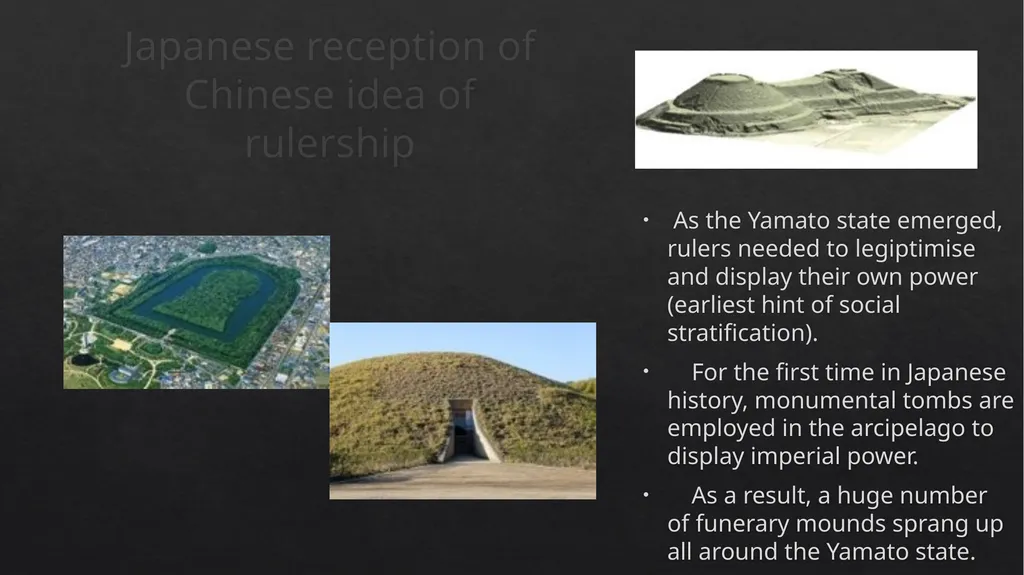
For the first time in Japanese history, monumental tombs are employed in the arcipelago to display imperial power.
As a result, a huge number of funerary mounds sprang up all around the Yamato state.<br>
05
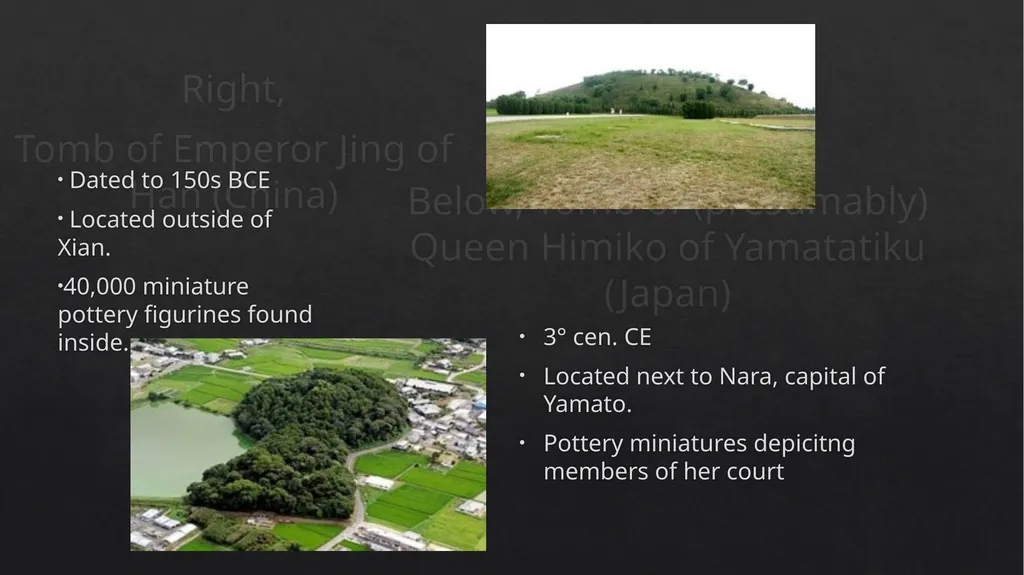
Right,
Tomb of Emperor Jing of Han (China) Dated to 150s BCE
Located outside of Xian.
40,000 miniature pottery figurines found inside. Below, Tomb of (presumably) Queen Himiko of Yamatatiku (Japan)
3° cen. CE
Located next to Nara, capital of Yamato.
Pottery miniatures depicitng members of her court<br>
06
What factors contributed to the centralisation of Yamato imperial power? Gradual introduction of Buddhism alongside local Shinto
Emphasis on the divine authority of the emperor, supreme guarantor of peace and harmony within the state
Later on, the emperor Temmu (631-686 CE) will commission a chronicle to legiptimise the imperial line by claiming a divine heritage. Sino-Japanese agonism:
China represented not only a model to imitate but also a rival to outdo<br>
07
Chinese perception of the Japanese culture and state: the Kingdom of Wa, a focus on the Wei Zhi What is the Wei Zhi (c. 297 CE)?
What is the Kingdom of Wa?
What does this say about early Sino-Japanese relations?<br>
08
The Wei Zhi Also known as the ‘Records of Wei’ and written as a dynastic history
The period of the Three Kingdoms (c. 220-280CE)
Most reliable literary source on Japan at the time<br>
09
The Wa Kingdom ‘Wa’ here means ‘dwarf’ and refers to the island of Japan
First japanese centralised state: Yamato, under the rule of Queen Himiko (c. 170–248 CE)
Other ancient source: the Hou Hanshu, the Book of the Later Han (5th century CE)<br>
10
Sino-japanese relations Japanese first perceived as primitive and inferior
Later Yayoi Japan was very deeply agricultural
Clear evolution of attitude and approach to foreign politics under Queen Himiko<br>
11
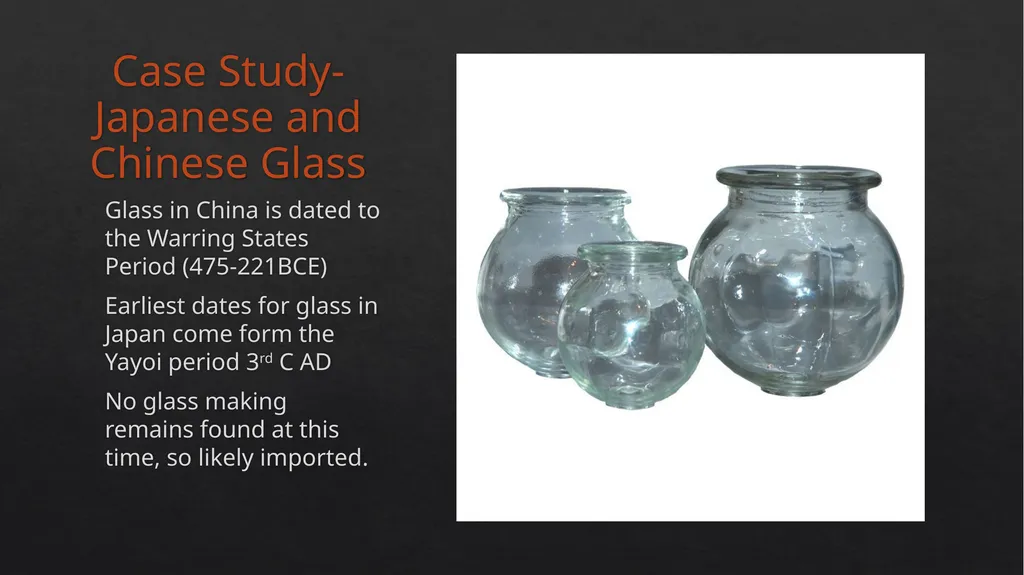
Case Study- Japanese and Chinese Glass Glass in China is dated to the Warring States Period (475-221BCE)
Earliest dates for glass in Japan come form the Yayoi period 3rd C AD
No glass making remains found at this time, so likely imported.<br>
12
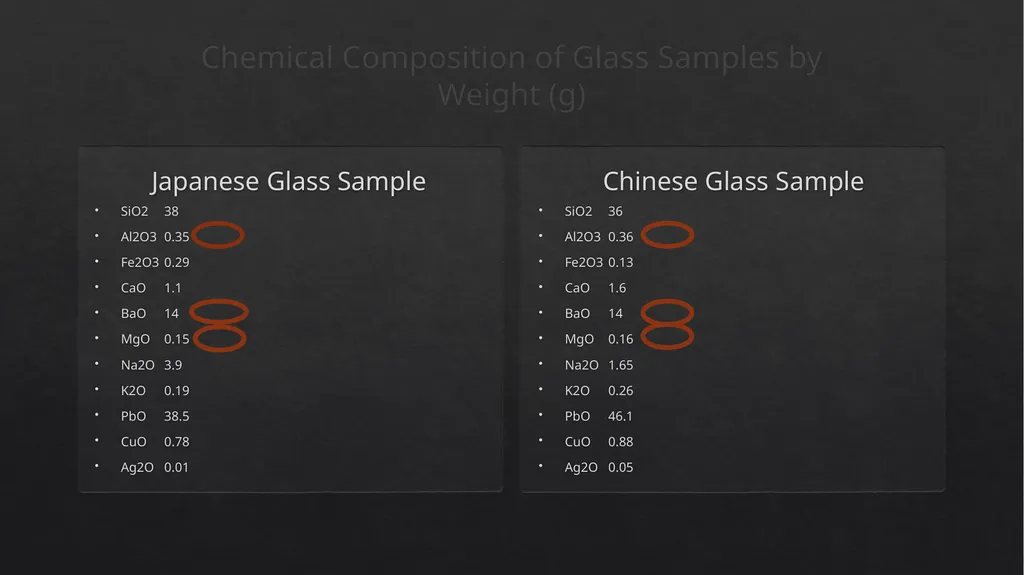
Early Chinese Glass contained very high levels of Barium Oxide
Similar levels were found in Japanese glass from slightly later periods
Roman and Parthian glass in the same period does not have a similar Barium Oxide Content
The Content of certain chemicals hints towards both the location of the extraction of the ore and the method in which the glass is produces
Main pointer is Barium Oxide
Subsidiary chemical markers are Magnesium Oxide and Aluminium Oxide.<br>
13
Chemical Composition of Glass Samples by Weight (g) Japanese Glass Sample SiO2 38
Al2O3 0.35
Fe2O3 0.29
CaO 1.1
BaO 14
MgO 0.15
Na2O 3.9
K2O 0.19
PbO 38.5
CuO 0.78
Ag2O 0.01 Chinese Glass Sample SiO2 36
Al2O3 0.36
Fe2O3 0.13
CaO 1.6
BaO 14
MgO 0.16
Na2O 1.65
K2O 0.26
PbO 46.1
CuO 0.88
Ag2O 0.05<br>
14
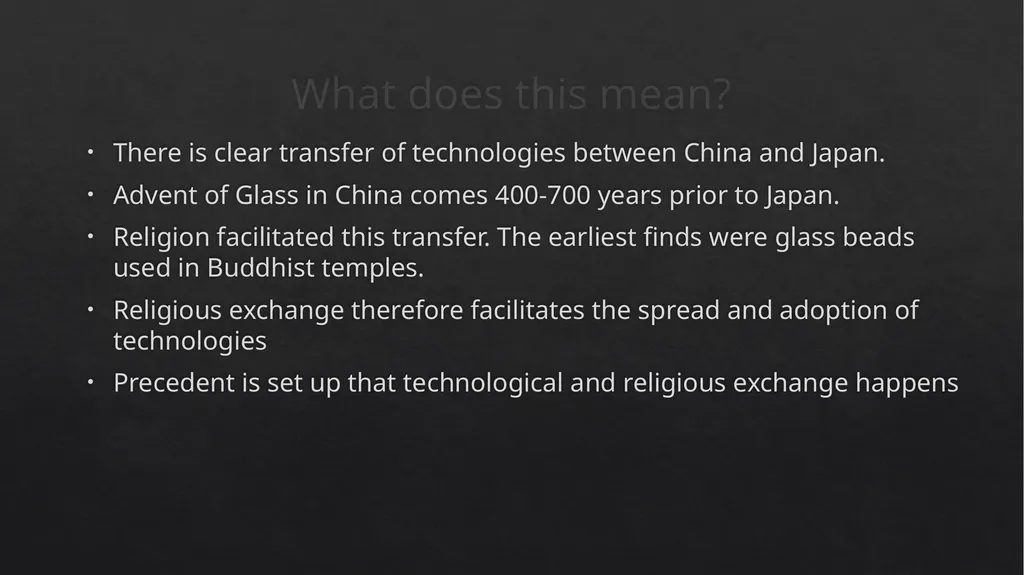
What does this mean? There is clear transfer of technologies between China and Japan.
Advent of Glass in China comes 400-700 years prior to Japan.
Religion facilitated this transfer. The earliest finds were glass beads used in Buddhist temples.
Religious exchange therefore facilitates the spread and adoption of technologies
Precedent is set up that technological and religious exchange happens<br>