
Annual Meeting of ITSA- 2022 by Shailesh Kumar
CM
Published · 34 slides · 0 views

1 / 1

Description
Annual Meeting of ITSA- 2022 by Shailesh Kumar Pathak Chief Commissioner of Railway Safety Ministry of Civil Aviation (Government of India) Commission of Railway Safety, INDIA In British Era, the construction and operation of the first
Related Topics
Share
Embed code
Download this presentation From Below
"Annual Meeting of ITSA- 2022 by Shailesh Kumar" is the property of its rightful owner. Permission is granted to download and print the materials on this website for personal, non-commercial use only, and to display it on your personal computer provided you do not modify the materials and that you retain all copyright notices contained in the materials. By downloading content from our website, you accept the terms of this agreement.
Presentation Transcript
01
Annual Meeting of ITSA- 2022
by
Shailesh Kumar Pathak Chief Commissioner of Railway Safety
Ministry of Civil Aviation (Government of India) Commission of Railway Safety, INDIA<br>
by
Shailesh Kumar Pathak Chief Commissioner of Railway Safety
Ministry of Civil Aviation (Government of India) Commission of Railway Safety, INDIA<br>
02
In British Era, the construction and operation of the first railways in India, were entrusted to private companies.
Consulting Engineers appointed under the Government of India to exercise effective control over Private Companies.
When the Government undertook the construction of railways, the Consulting Engineers were designated as Government Inspectors.
In 1883, their position was statutorily recognised.
The power of safety controlling authority under the Indian Railway Act 1890 remained with Railway Board. 2 Commission of Railway Safety: History<br>
03
In 1939, the Pacific locomotive Committee, set up in connection with the Bihta disaster, recommended that Railway Inspectorate should be separated from the Railway Board
It was based on the principle that those responsible for the inspection of Railways should be independent of the Authority administering the Railways.
This recommendation was approved by the Legislative Assembly in 1939, the Council of State in 1940 and accepted by the Government.
Accordingly, in May 1941, Railway Inspectorate was separated from the Railway Board.
Post of Chief Government Inspector of Railways, through whom Government Inspectors would report, was created. 3 Commission of Railway Safety: History<br>
04
Inspectorate was placed under the Department of Communication.
From 9th July 1942, Inspectorate was transferred to Post and Air department and thereafter under whichever Ministry that held the portfolio of Civil Aviation.
From June, 1979 designation was changed to Chief Commissioner of Railway Safety (CCRS) and Commissioner of Railway Safety (CRS).
Commissioners of Railway Safety are recruited from amongst officers of Indian Railways, but they do not revert to Railways and are absorbed in Inspectorate cadre. 4 Commission of Railway Safety: History<br>
05
Organization Structure Commission of Railway Safety is under administrative control of Ministry of Civil Aviation
Chief Commissioner of Railway Safety (CCRS) who is also one of the Commissioners, acts as Principal Technical Advisor to Central Government in all matters with which the Commission is concerned.
There are 9 circle offices, headed by Commissioner, spread across India to cater to 17 Zonal Railways.
There is one Commissioner of Metro Railway Safety at New Delhi for some of the Metro Railways. 5<br>
06
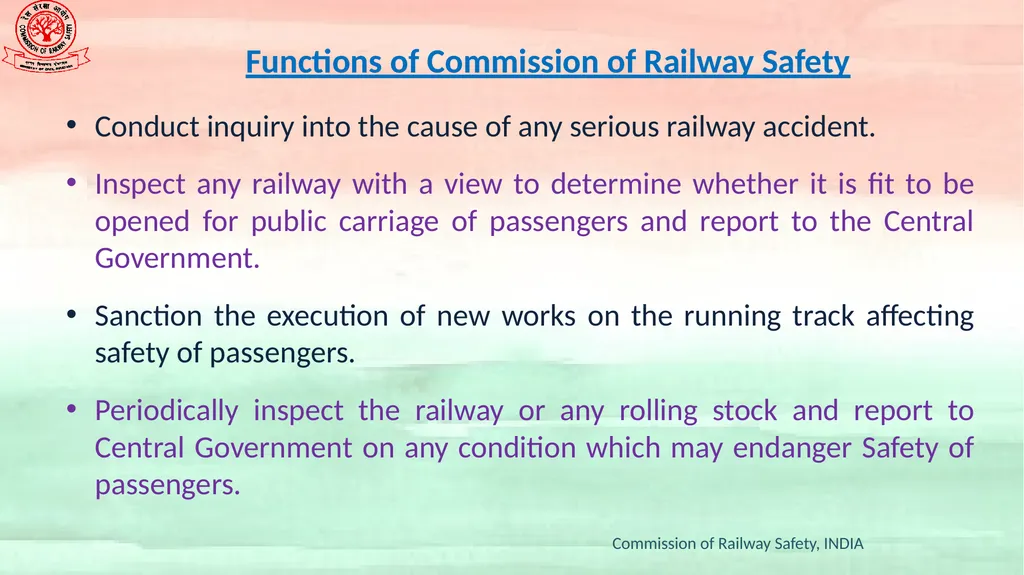
Functions of Commission of Railway Safety Conduct inquiry into the cause of any serious railway accident.
Inspect any railway with a view to determine whether it is fit to be opened for public carriage of passengers and report to the Central Government.
Sanction the execution of new works on the running track affecting safety of passengers.
Periodically inspect the railway or any rolling stock and report to Central Government on any condition which may endanger Safety of passengers. Commission of Railway Safety, INDIA<br>
07
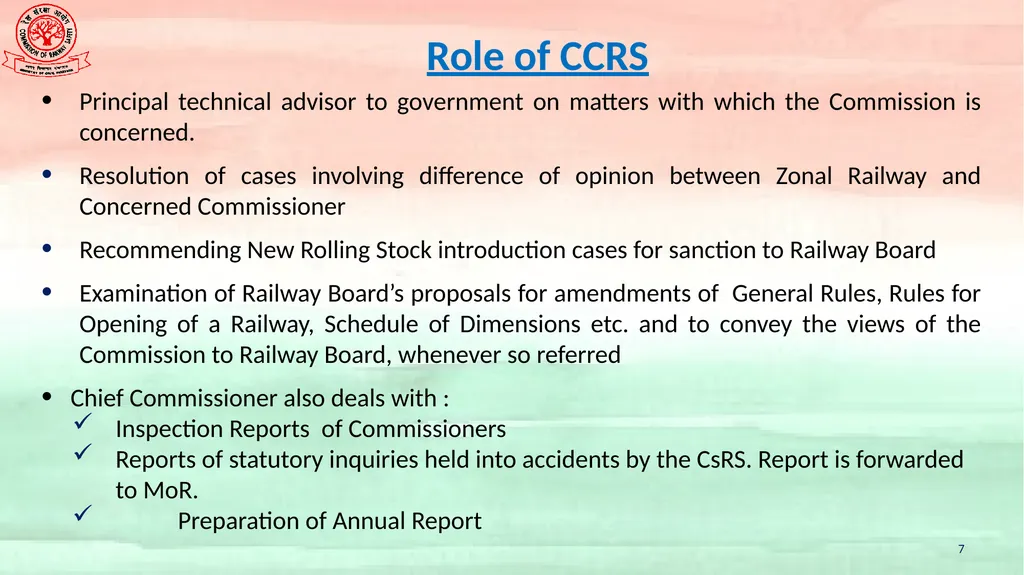
7 Principal technical advisor to government on matters with which the Commission is concerned.
Resolution of cases involving difference of opinion between Zonal Railway and Concerned Commissioner
Recommending New Rolling Stock introduction cases for sanction to Railway Board
Examination of Railway Board’s proposals for amendments of General Rules, Rules for Opening of a Railway, Schedule of Dimensions etc. and to convey the views of the Commission to Railway Board, whenever so referred
Chief Commissioner also deals with :
Inspection Reports of Commissioners
Reports of statutory inquiries held into accidents by the CsRS. Report is forwarded to MoR.
Preparation of Annual Report Role of CCRS<br>
08
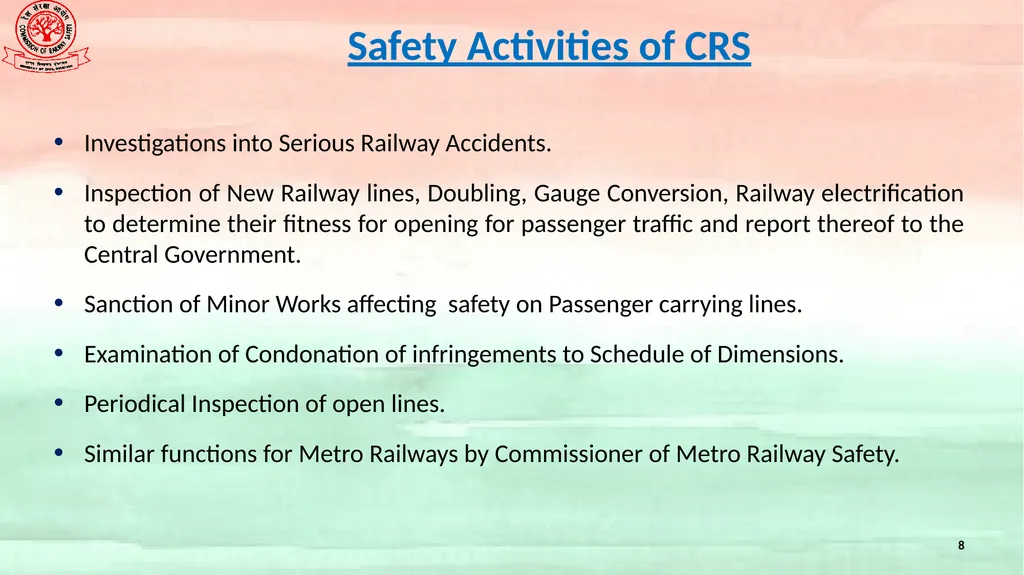
8 Safety Activities of CRS Investigations into Serious Railway Accidents.
Inspection of New Railway lines, Doubling, Gauge Conversion, Railway electrification to determine their fitness for opening for passenger traffic and report thereof to the Central Government.
Sanction of Minor Works affecting safety on Passenger carrying lines.
Examination of Condonation of infringements to Schedule of Dimensions.
Periodical Inspection of open lines.
Similar functions for Metro Railways by Commissioner of Metro Railway Safety.<br>
09
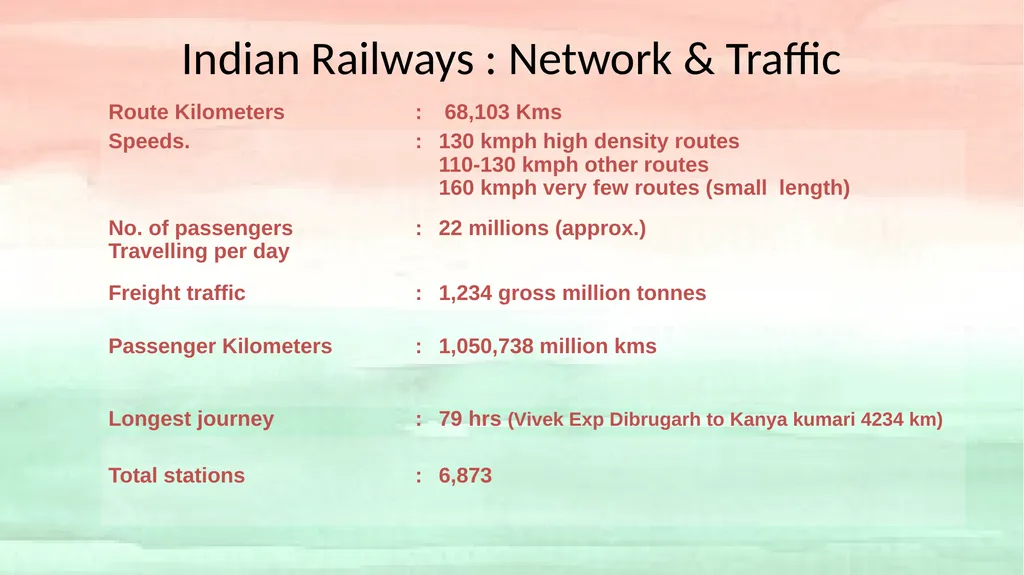
Indian Railways : Network & Traffic<br>
10
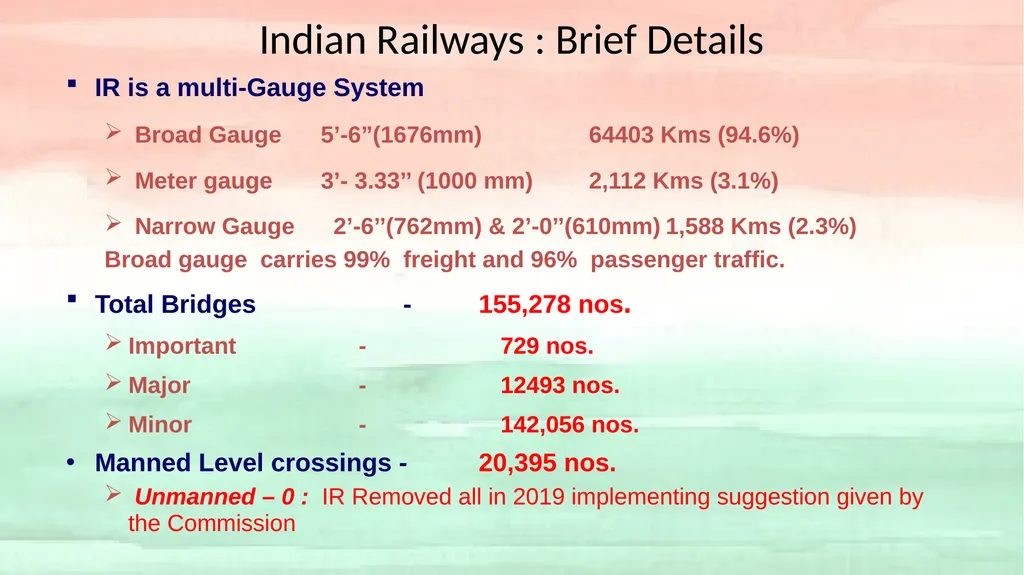
Indian Railways : Brief Details IR is a multi-Gauge System
Broad Gauge 5’-6”(1676mm) 64403 Kms (94.6%)
Meter gauge 3’- 3.33’’ (1000 mm) 2,112 Kms (3.1%)
Narrow Gauge 2’-6’’(762mm) & 2’-0’’(610mm) 1,588 Kms (2.3%)
Broad gauge carries 99% freight and 96% passenger traffic.
Total Bridges - 155,278 nos.
Important - 729 nos.
Major - 12493 nos.
Minor - 142,056 nos.
Manned Level crossings - 20,395 nos.
Unmanned – 0 : IR Removed all in 2019 implementing suggestion given by the Commission<br>
11
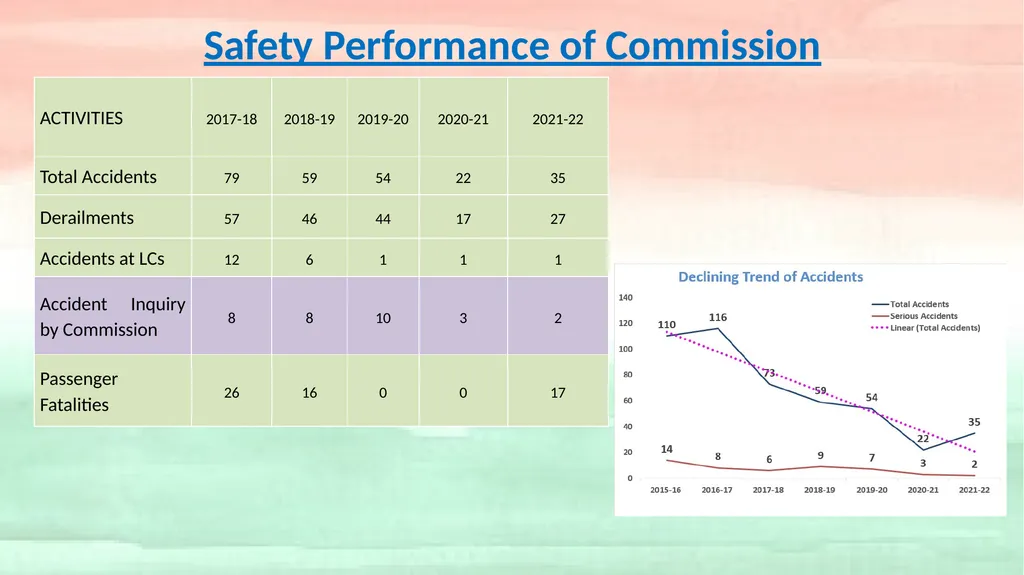
Safety Performance of Commission<br>
12
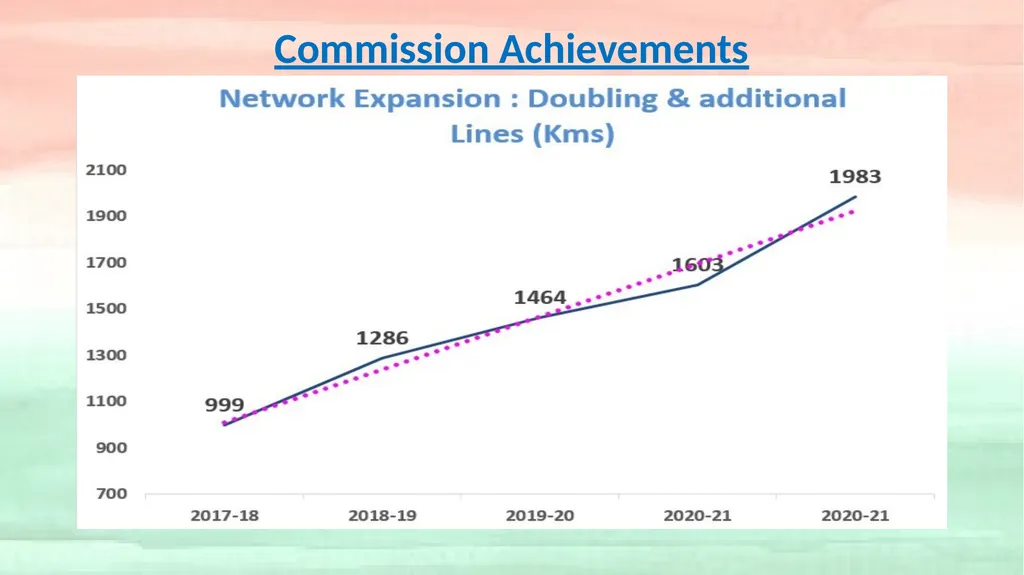
Commission Achievements<br>
13
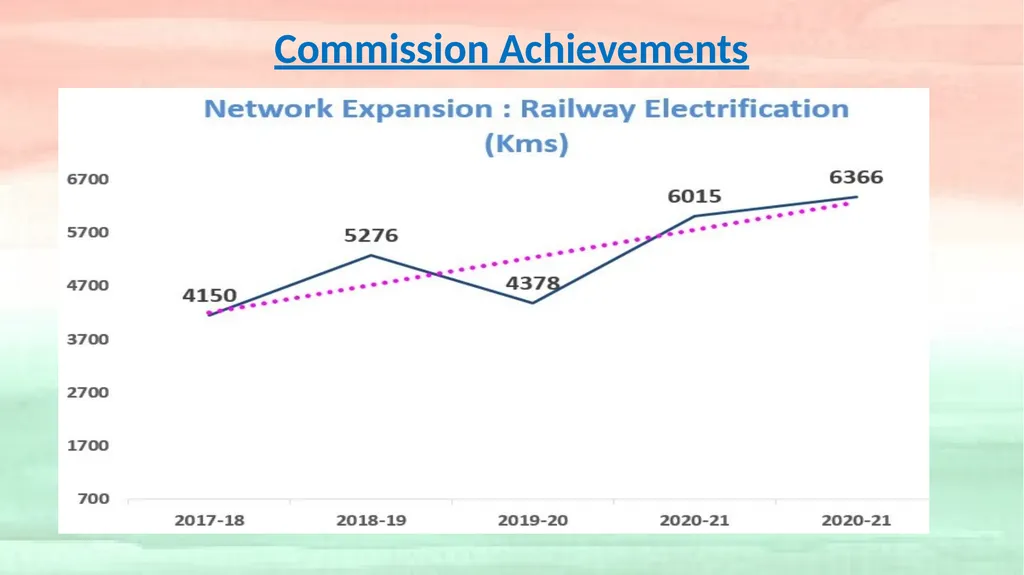
Commission Achievements<br>
14
Railway Accidents Serious Accidents – Inquired by the Commissioners
which is attended with loss of human life, or
with grievous hurt as defined in the Indian Penal Code, to a passenger or passengers in the train or
with damage to railway property of the value exceeding Rs. 20 Million.
Consequential Accidents : Train accidents having serious repercussion in terms of- (a) loss of human life, (b) human injury, (c) loss to railway property, or (d) interruption to rail traffic. Accidents which do not come under the purview of CRS inquiry are inquired by Railways. 14<br>
15
Observations
on
Recent Accidents 15<br>
on
Recent Accidents 15<br>
16
Recent years Serious Accidents There were three cases of Collision between trains,
One in East-Coast, One in Eastern & One in South Central Railway
One accident in Southern Railway was due to an infringing structure causing falling off passengers from the train. 16<br>
One in East-Coast, One in Eastern & One in South Central Railway
One accident in Southern Railway was due to an infringing structure causing falling off passengers from the train. 16<br>
17
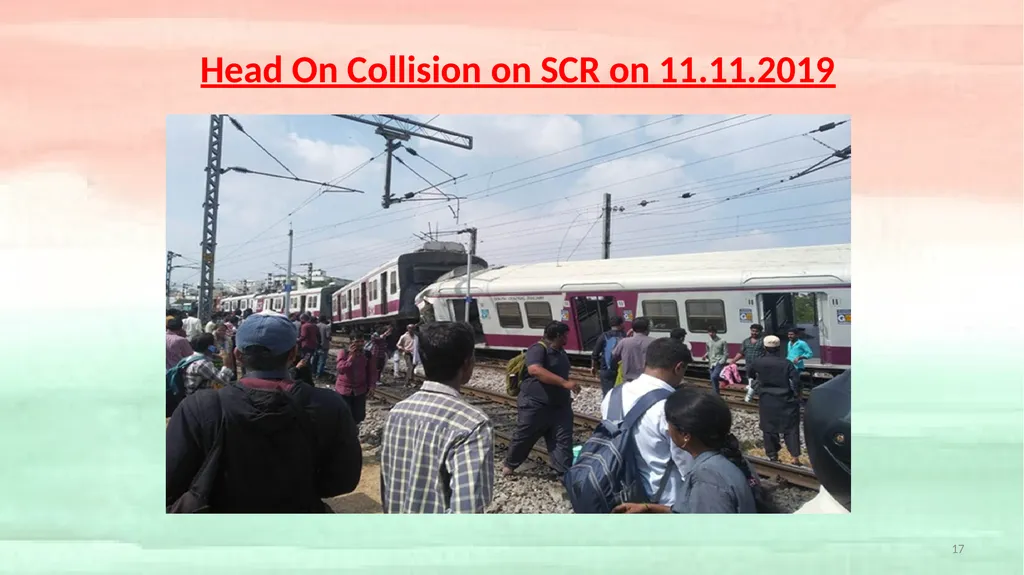
Head On Collision on SCR on 11.11.2019 17<br>
18
Head On Collision on SCR on 11.11.2019 Head on collision of Train No. 47178 with Train no. 17028 Exp at Kacheguda station of Hyderabad Division of SCR at 10.40hrs on 11.11.2019 in which motorman died.
Provision of GR and SEM were not followed in the design of interlocking. Overlap of the signal was released immediately after receipt of the train instead of delay of 2 min as specified.
Section was not notified as suburban section as per GR para 4.35(2) and detailed instructions were not issued for dispatch of train.
As per GR 3.16(5), Guard repeating signal to be provided in big yard if starter signal not visible to guard. 18<br>
19
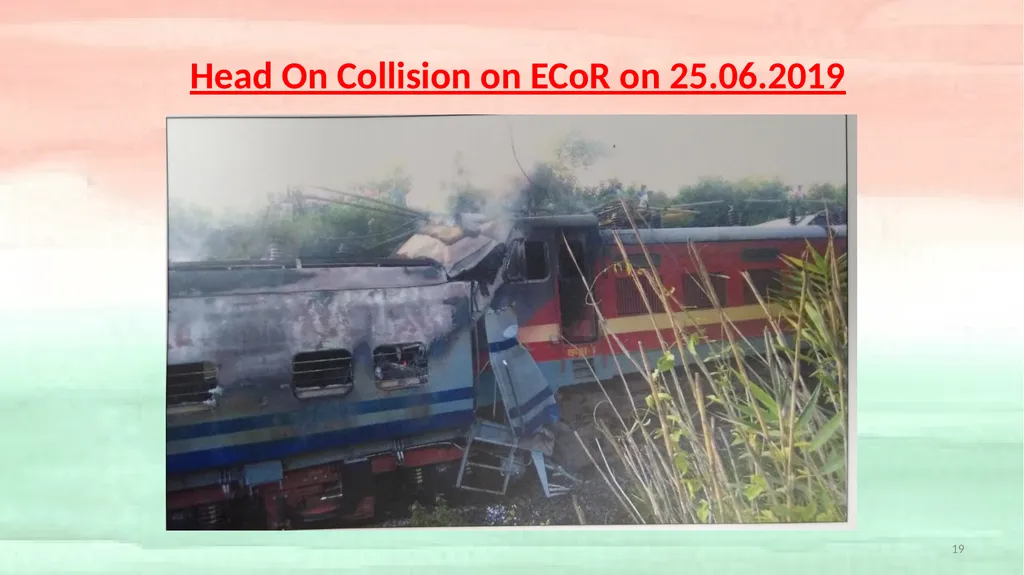
Head On Collision on ECoR on 25.06.2019 19<br>
20
Head On Collision on ECoR on 25.06.2019 Head on collision between Train No. 18005 andTower Wagon between Singapur Road ‘A’ Cabin - Keutuda (KTGA) single Line section of Waltair Division of ECoR in which 3 Railway staff died including SSE/TRD.
SIP and SWR were not matching with site condition. Last Vehicle Checking Device was not provided despite its mention in SWR from 2009.
LVCD works in tandem with block instruments and failure of LVCD should result in block failure
Power block cancellation was not clearly defined
Block instruments was not sealed. It was manually normalized by station master 20<br>
21
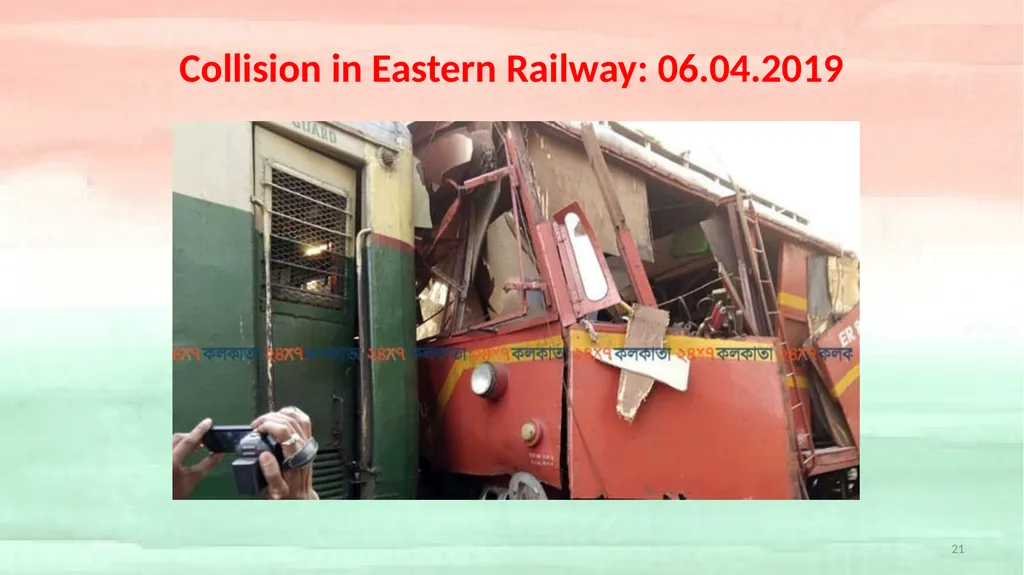
Collision in Eastern Railway: 06.04.2019 21<br>
22
Collision in Eastern Railway: 06.04.2019 Collision of EMU with OHE Tower Car at Shrirampur station in Howrah-Bandel section of Howrah Division on 06.04.2019.
Major issue was placement of signal. In this triple line section, the middle line is bi-direction having less track centre distance due to which the home and the distant signal of the middle line at Srirampur station were placed on the left of the adjoining line. This impaired the clear visibility of the signal when the train was travelling on the adjoining line which was also highlighted by Signal sighting Committee but no action was taken.
Moreover, Inter-signal distance was also less than the specified and signal aspect was not repeated.
Gantry type signalling as per GR must be designed and provided as more and more number of 3rd and 4th lines will be commissioned in near future. 22<br>
23
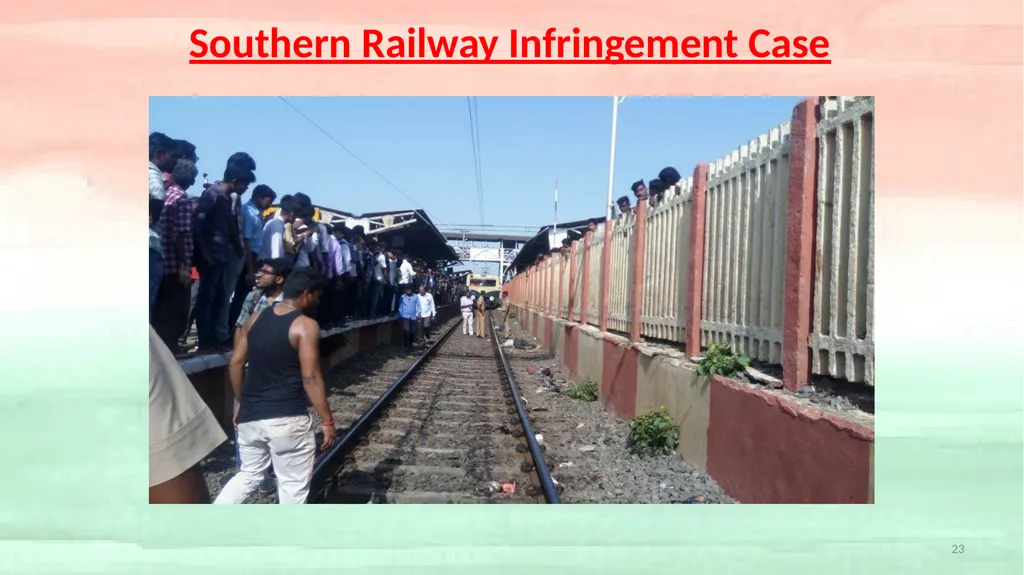
23 Southern Railway Infringement Case<br>
24
Southern Railway Infringement Case Incident of falling of passengers from train no. 40701 EMU at Thomas Mount stn in Chennai Division, SR.
5 dead and 5 injured.
Chennai Egmore- Chengalpattu is Automatic section.
Quadruple lines - UP/DN and two twin single lines .
Fencing on A line and FOB on P/F is infringing to SOD.
EMU is wide bodied stock of 3660mm.
As per IRSOD, Min. horizontal clearance without condonation is 2360mm & With condonation, upto 2211mm.
Curve on line so curve allowance to be added.
At site, horizontal clearance from centre line to
edge of P/F was 2100mm
- fencing at one meter height was 2240mm and at 2.70 meter height was 2290mm.
In the plan, FOB is shown as conforming to SOD but at the time of construction the Parameter was not maintained. 24<br>
25
Proactive Role
&
Important Recommendations/ Suggestions 25<br>
&
Important Recommendations/ Suggestions 25<br>
26
Proactive Role by Commission Khatauli derailment was a watershed accident. After this Ministry of Railways has accepted all the recommendations of commission.
Commission insisted on following:
Integrated Maintenance Blocks
Completion of backlog in Track renewal
Use of long rail panels to reduce the AT welds
Deep Screening of overdue patches more than 15/20 years old.
Paradigm shift in giving priority to maintenance and track renewal over operations. 26<br>
27
Measures to reduce derailments Important suggestions are :
Yard geometry correction
Standard layout
In-situ glued joint
Use of long rail panels
Clamp type axle counter
It is suggested that survey should be done on priority to identify crossovers which are seldom used in last 2 years. Such crossover should be planned for immediate removal.
This will not only reduce derailments but also increase the average speed and throughput. 27<br>
28
Commission worked 24 x 7 to clear about 8000 proposals of removal of Unmanned Level Crossing (UMLC) gates in a very short span of time
This has substantially helped to reduce accidents at LCs and derailments.
Further, Commission has emphasized that :
All Level Crossings in yard should be replaced with suitable grade separators in a time bound manner
Removal of manned Level Crossings by replacing with ROB/RUB/LHS in following priority:
Interlocked LCs on High Density Network Routes
Interlocked LCs on other routes
LCs having Train Vehicle Unit between 20000 and 50000
This had direct impact on safety of road users and train operation. 28 Improved Safety at LC Gates<br>
29
Fire Safety Recommendations Use of Fire retardant material in coaches
Comprehensive fire load study, based on all the components of the coach as whole, for all type of coaches should be carried out and material specification should be fixed accordingly
Provision of Smoke detector in coaches and pantry car
Use of fire survival cables in EMU, MEMU, Trainsets
Provision of Emergency light and its proper maintenance in coaches
Provision of spark free fans in coaches
Installing water mist type fire extinguisher of better capacity
Fire detection and prevention system in Electrical panels<br>
30
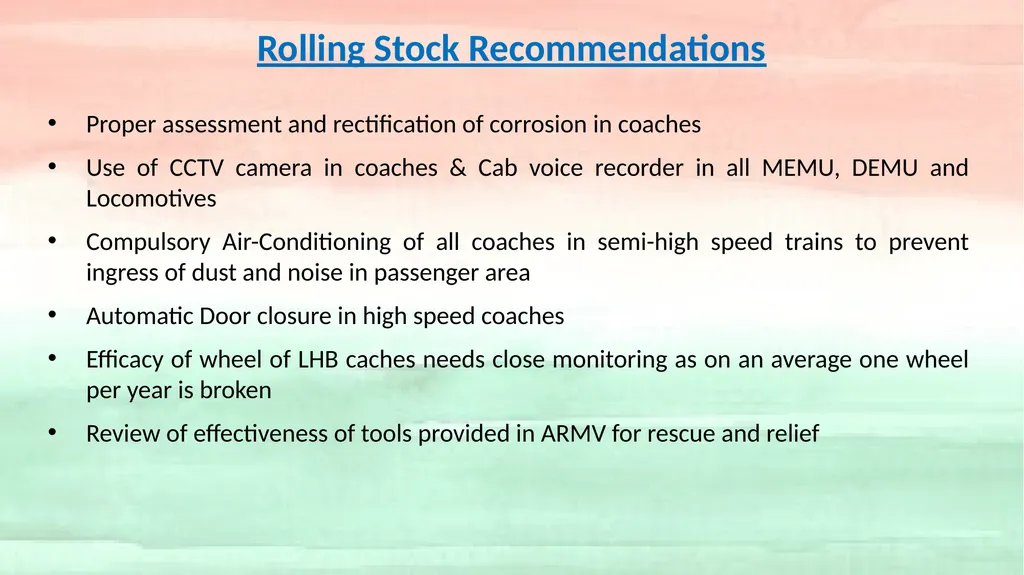
Rolling Stock Recommendations Proper assessment and rectification of corrosion in coaches
Use of CCTV camera in coaches & Cab voice recorder in all MEMU, DEMU and Locomotives
Compulsory Air-Conditioning of all coaches in semi-high speed trains to prevent ingress of dust and noise in passenger area
Automatic Door closure in high speed coaches
Efficacy of wheel of LHB caches needs close monitoring as on an average one wheel per year is broken
Review of effectiveness of tools provided in ARMV for rescue and relief<br>
31
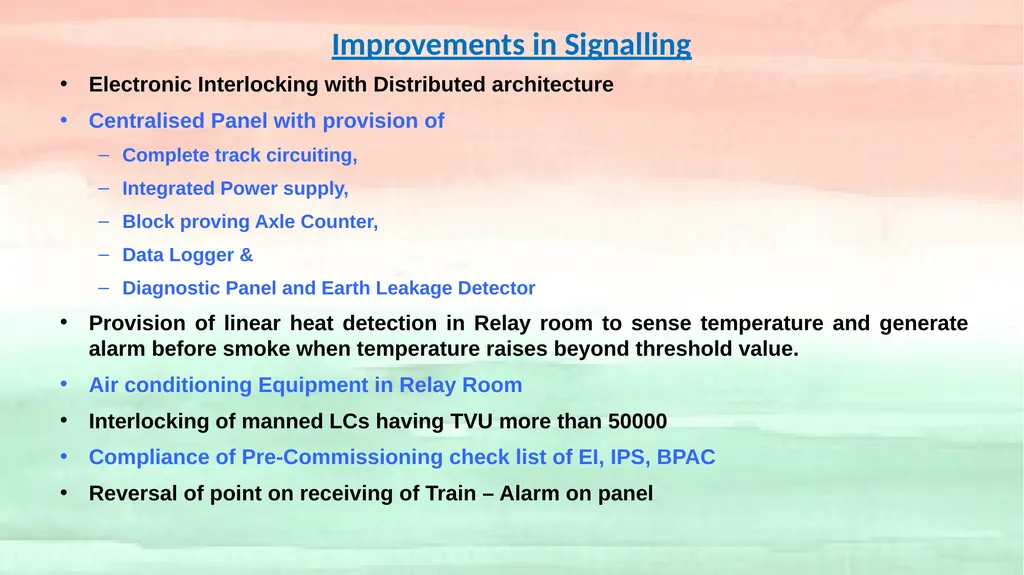
Electronic Interlocking with Distributed architecture
Centralised Panel with provision of
Complete track circuiting,
Integrated Power supply,
Block proving Axle Counter,
Data Logger &
Diagnostic Panel and Earth Leakage Detector
Provision of linear heat detection in Relay room to sense temperature and generate alarm before smoke when temperature raises beyond threshold value.
Air conditioning Equipment in Relay Room
Interlocking of manned LCs having TVU more than 50000
Compliance of Pre-Commissioning check list of EI, IPS, BPAC
Reversal of point on receiving of Train – Alarm on panel Improvements in Signalling<br>
32
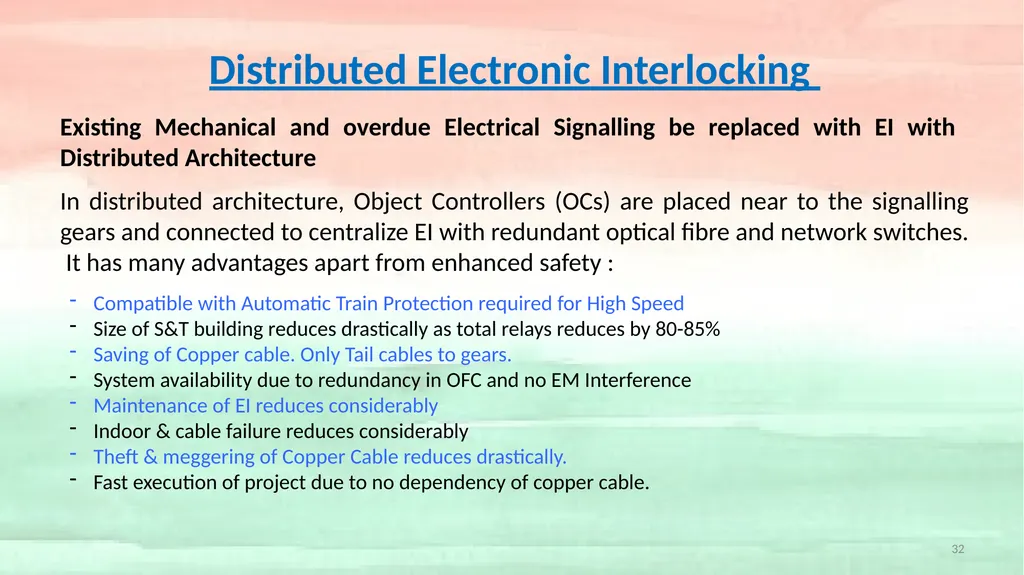
Distributed Electronic Interlocking Existing Mechanical and overdue Electrical Signalling be replaced with EI with Distributed Architecture
In distributed architecture, Object Controllers (OCs) are placed near to the signalling gears and connected to centralize EI with redundant optical fibre and network switches. It has many advantages apart from enhanced safety :
Compatible with Automatic Train Protection required for High Speed
Size of S&T building reduces drastically as total relays reduces by 80-85%
Saving of Copper cable. Only Tail cables to gears.
System availability due to redundancy in OFC and no EM Interference
Maintenance of EI reduces considerably
Indoor & cable failure reduces considerably
Theft & meggering of Copper Cable reduces drastically.
Fast execution of project due to no dependency of copper cable. 32<br>
33
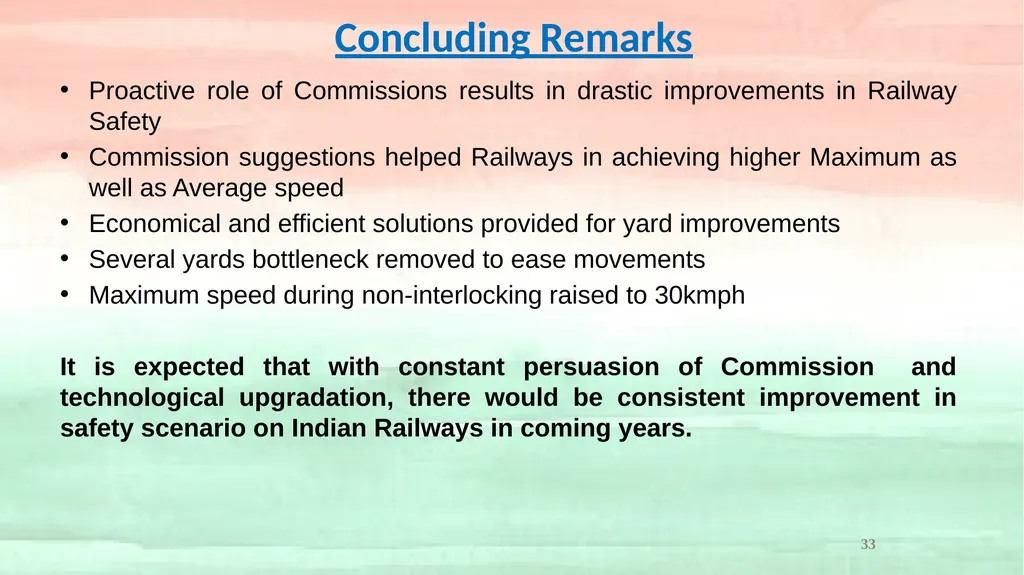
Concluding Remarks Proactive role of Commissions results in drastic improvements in Railway Safety
Commission suggestions helped Railways in achieving higher Maximum as well as Average speed
Economical and efficient solutions provided for yard improvements
Several yards bottleneck removed to ease movements
Maximum speed during non-interlocking raised to 30kmph
It is expected that with constant persuasion of Commission and technological upgradation, there would be consistent improvement in safety scenario on Indian Railways in coming years. 33<br>
34
Commission of Railway Safety, INDIA THANK YOU…<br>