
Assessing the Woman in Labor One of the most
TD
Published · 36 slides · 0 views

1 / 1








Description
Assessing the Woman in Labor One of the most critical assessments you have to make in Labor and Delivery Care is at the time when you first attend a labor. Rapid early assessment is required so that you can decide on the care needed for the
Related Topics
Share
Embed code
Download this presentation From Below
"Assessing the Woman in Labor One of the most" is the property of its rightful owner. Permission is granted to download and print the materials on this website for personal, non-commercial use only, and to display it on your personal computer provided you do not modify the materials and that you retain all copyright notices contained in the materials. By downloading content from our website, you accept the terms of this agreement.
Presentation Transcript
01
Assessing the Woman in Labor One of the most critical assessments you have to make in Labor and Delivery Care is at the time when you first attend a labor.
Rapid early assessment is required so that you can decide on the care needed for the laboring mother, in case immediate referral or emergency measures are required. If all is well, you need to take the woman’s history in detail and conduct a physical examination in order identify the stage of labor that she has reached, and discover any information from her history that may affect the progress or outcome of her labor.<br>
Rapid early assessment is required so that you can decide on the care needed for the laboring mother, in case immediate referral or emergency measures are required. If all is well, you need to take the woman’s history in detail and conduct a physical examination in order identify the stage of labor that she has reached, and discover any information from her history that may affect the progress or outcome of her labor.<br>
02
Learning Outcomes
When you have studied this session, you should be able to:
1. Define and use correctly all of the key words printed in bold.
2. Describe how you would conduct a rapid assessment of a woman in labor.
3. Describe the features of woman — friendly care during labor and delivery.
4. Describe the steps in history taking of a woman in the first stage of a normal labor.
5. Explain how you would palpate the abdomen of a woman in labor to assess the size, lie and presentation of the baby.
6 . Explain how you would conduct a vaginal examination of a woman in labor to assess the progress of labor.
7 . Differentiate between normal and abnormal findings during the assessment of a woman in labor.<br>
03
1. Rapid evaluation of a woman in labor
On first seeing a woman who is already in labor, your immediate task is to make a rapid assessment of whether there is any cause for concern.
Does she need an urgent referral for emergency care, or is her labor progressing normally at this stage?
1.1 What you must do for a rapid assessment<br>
On first seeing a woman who is already in labor, your immediate task is to make a rapid assessment of whether there is any cause for concern.
Does she need an urgent referral for emergency care, or is her labor progressing normally at this stage?
1.1 What you must do for a rapid assessment<br>
04
Things you need to have
-Her Antenatal Care Card (if she has been in your care previously); if she has come to you for the first time and she is already in labor, start a new health record for her
- Partograph for recording the progress of labor (you will learn how to use the partograph
- Sterile gloves
- Feto-scope to listen to the baby’s heart beat
- Thermometer to take the mother’s temperature
- Watch or other timer to help you measure the fetal heart rate and the mother’s pulse rate<br>
05
- Blood pressure measuring cuff with stethoscope
Swabs (3-4 balls of gauze soaked with antiseptic solution such as savlon (chlorhexidene 2-4%) to clean the perineum before doing a vaginal examination. You can prepare warm water and soap if you have no antiseptic solution.
- Never use alcohol to swab the genital area!
- Sometimes a woman may come already in the second stage of labor. In this case, take her to the delivery couch immediately and make her as comfortable as possible.
- It is important to prepare in advance the equipment you will need for attending a delivery and keep it packed and ready at all times.<br>
06
Check her vital signs
Blood pressure: normal values range between 90/60 mmHg to below 140/90 mmHg.
Maternal pulse rate: normal range is 80-100 beats/minute, but should not be greater than 110 beats/minute in a woman in labor.
Temperature: average 37oC; if it is between 37.5-38.4oC the woman has a low grade fever; if it is 38.5oC or above, she has a high grade fever.
If one or more of these vitals signs is outside of the normal range, you should refer her immediately .
If the values deviate a long way outside the normal range (and you have been trained to do so), refer her after you have begun an infusion of intravenous (IV) fluids.<br>
07
Look at and listen to the woman
- Did someone carry her into the Health Post?
- Is there blood on her clothing or on the floor beneath her (Figure 1)?
- Is she grunting, moaning, or bearing down?<br>
- Did someone carry her into the Health Post?
- Is there blood on her clothing or on the floor beneath her (Figure 1)?
- Is she grunting, moaning, or bearing down?<br>
08
Ask her, or someone who is with her, whether she has now or has recently had:
-Vaginal bleeding
-Severe headache/blurred vision
-Convulsions or loss of consciousness
-Difficulty breathing
-Fever
-Severe abdominal pain
-Premature leakage of amniotic fluid (waters breaking early).<br>
-Vaginal bleeding
-Severe headache/blurred vision
-Convulsions or loss of consciousness
-Difficulty breathing
-Fever
-Severe abdominal pain
-Premature leakage of amniotic fluid (waters breaking early).<br>
09
If the woman currently has any of these symptoms, immediately:
- Shout for help
- Stay calm and focus on the woman
- Stay with her — do not leave her alone
- Take immediate action to give the necessary pre-referral treatments and refer her urgently to the nearest hospital or health centre.<br>
- Shout for help
- Stay calm and focus on the woman
- Stay with her — do not leave her alone
- Take immediate action to give the necessary pre-referral treatments and refer her urgently to the nearest hospital or health centre.<br>
10
2. History-taking in labor
The best way to learn about a woman’s history is to ask her, but you must do this sensitively.
At first, she may not be comfortable talking with you. If she feels shy about her body or about sex, it may be difficult for her to tell you things that you need to know about her health.
Try to help her feel comfortable by listening carefully, answering her questions, keeping what she tells you private, and treating her with respect.<br>
11
2.1 The importance of woman-friendly care
The principles of woman-friendly care are
1- It provides a service that is acceptable to the woman, which:
Respects her beliefs, traditions and culture
Considers the emotional, psychological, and social well-being of the woman
Provides relevant and feasible advice.
2- It empowers the woman, and whoever she wants to be with her during the labor, so that they can become active participants in her care. Your role is then to teach them how to care for her and keep them all informed about what is happening.<br>
12
3-It considers and respects the rights of the woman:
- Her right to information about her health and that of her baby
- Her right to be informed about the process of labor and deliver and what to expect as it progresses
- Her right to give or withhold her permission/consent for all examinations and procedures.
4- It requires all healthcare staff to use good interpersonal skills and communicate clearly in language the woman can understand.<br>
13
2.2 Recording socio-demographic data
- Record her name and her age: this is particularly important if she is a very young first-time mother, below 18 years of age.
- Also record her height if possible, or estimate it; this will help you to evaluate whether she is ‘small’ for the size of the baby, which may mean that she could have problems giving birth if the baby’s head cannot fit through her small pelvis.
- Next ask her address, religion , and occupation.
- Write down what is her main presenting symptom (her complaint), which in this case is usually labor pain (contractions), and a bearing-down sensation if she is already in second stage of labor.<br>
14
2.3 History of past and present pregnancy
Ask about the number of previous pregnancies and births (if any) the woman has had, and about the current pregnancy.
How to record the number of pregnancies and/or the number of births, using the traditional terminology.
Gestational age is the number of weeks the fetus has been in the uterus; the average number of weeks at full term is 40, calculated from the date when the woman’s last normal menstrual period (LNMP) began.<br>
15
Gravidity and parity status
Gravidity is the total number of previous pregnancies, regardless of the outcome, including spontaneous miscarriage or abortion before 28 weeks of gestation.
Gravida 1 or primigravida: first pregnancy
Gravida 2: second pregnancy, etc.
Multigravida: pregnant two or more times (number not specified)
Parity is the number of babies delivered either alive or dead after 28 weeks of gestation.
For women who can’t tell you the exact number of gestational weeks, any delivery they think was after about 7 months (30 weeks) counts in the parity number.
Nullipara or Para 0: no pregnancy reached 28 weeks
Primipara or Para 1: one birth after 28 weeks
Para 2: two births after 28 weeks
Multipara: two or more births after 28 weeks
Grand multipara: five or more births after 28 weeks.<br>
16
A woman comes to your Health Post in labor at full term.
She tells you that she has previously given birth to two live babies (both at the gestational age of 40 weeks), and one dead baby (stillbirth) at 32 weeks. She also had a spontaneous miscarriage at 26 weeks. Record the gravidity and parity of this woman.
She will be Gravida 5: she has had 2 live babies + 1 dead baby at 32 weeks + 1 miscarriage at 26 weeks + 1 current pregnancy. She will be Para 3: she has given birth to 2 live babies + 1 dead baby after 28 weeks.<br>
17
Estimating the expected date of delivery
You should also ask when was the first day of her last normal menstrual period (LNMP). This will help you to calculate the expected date of delivery (EDD) and the gestational age of the fetus. Calculating the EDD and gestational age will help you to identify whether the labor is preterm, term or post-term.
Often women do not recall their LNMP; in such cases it is useful to ask her when she first felt her baby’s movement inside her (quickening or fetal kick). This occurs at approximately 18-20 weeks in primigravida mothers and 16-18 weeks in multigravidas.<br>
18
2.4 Danger signs and symptoms
Ask her about any danger symptoms that she has noticed. (A symptom is something that a person experiences and can tell you about; a sign is something that only a trained health worker will notice, or can discover from an examination or test.)
Danger symptoms include vaginal bleeding (heavier than show), persistent headache, blurring of vision, convulsions, loss of consciousness, epigastric or severe abdominal pain, fever, leakage of amniotic fluid before the onset of labor, and abnormal vaginal discharge. If she reports any of the above danger symptoms, refer the mother to the nearest health facility as soon as possible.<br>
19
3. Physical examination in labor
When you physically examine a woman in labor, your focus will be on her abdomen, vagina and cervix, so remember to:
- Maintain her privacy
- Examine her comprehensively (head to toe)
- Look for signs of anemia (paleness inside the eyelids, pale fingernails and gums)
- Look for yellowish discoloration of the eyes (jaundice), which indicates liver disease.<br>
20
3.1 Inspection of the abdomen
In order to memorize what aspects to inspect on the abdomen of a woman in labor, you can take the initial ‘S’ letters of the three points to look out for: size, shape and scars.
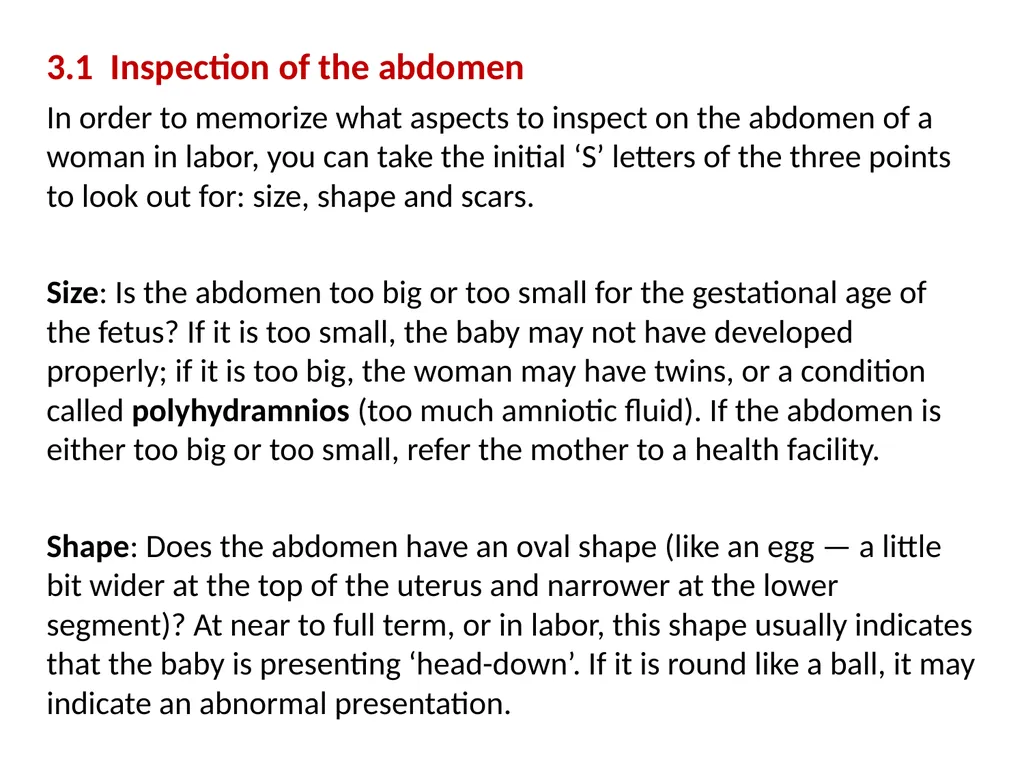
Size: Is the abdomen too big or too small for the gestational age of the fetus? If it is too small, the baby may not have developed properly; if it is too big, the woman may have twins, or a condition called polyhydramnios (too much amniotic fluid). If the abdomen is either too big or too small, refer the mother to a health facility.
Shape: Does the abdomen have an oval shape (like an egg — a little bit wider at the top of the uterus and narrower at the lower segment)? At near to full term, or in labor, this shape usually indicates that the baby is presenting ‘head-down’. If it is round like a ball, it may indicate an abnormal presentation.<br>
21
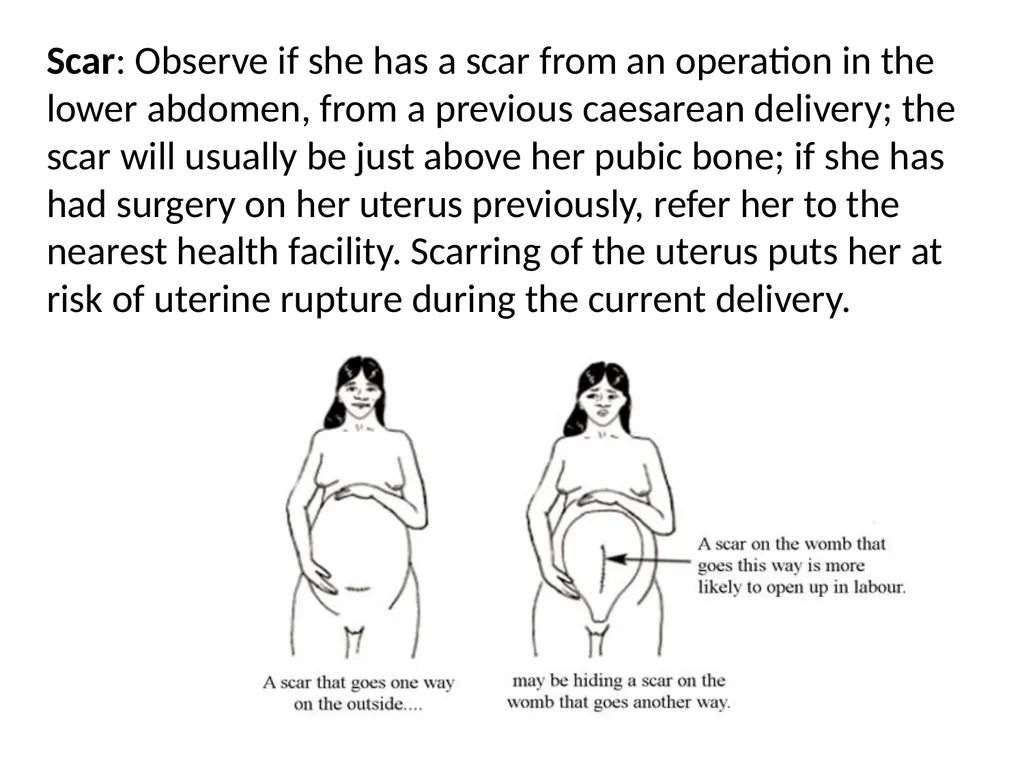
Scar: Observe if she has a scar from an operation in the lower abdomen, from a previous caesarean delivery; the scar will usually be just above her pubic bone; if she has had surgery on her uterus previously, refer her to the nearest health facility. Scarring of the uterus puts her at risk of uterine rupture during the current delivery.<br>
22
3.2 Palpation of the abdomen
Palpation means feeling the abdomen with hands in specific positions, or moving them in particular ways, using certain levels of pressure.
Ask the mother to lie down on her back and bend her legs at the knees, with her feet flat on the bed. You need to be able to move around her: sometimes you will be palpating her abdomen while standing at her feet and looking up her body towards her head; sometimes you will be standing behind her and facing her feet; and sometimes you will stand beside her.
Palpation helps you to assess the size of the fetus, its presentation (which part of the baby will ‘present’ at the cervix during delivery), and its position relative to the mother’s body (e.g. is it facing towards her front or her back).<br>
23
There are four palpations of the abdomen, which are commonly referred to by midwives and doctors as Leopold’s maneuvers. You need to do them in the correct sequence.
First Leopold’s maneuver: fundal palpation
Fundal palpitation means palpating the dome-shaped upper part of the uterus, called the fundus. During antenatal care, you should have been measuring the length of the uterus from the mother’s pubic bone to the fundus, and comparing this with the baby’s gestational age to see if it was growing normally. The purpose of palpating the fundus in a woman in labor is to discover how the baby is lying in the uterus.<br>
24
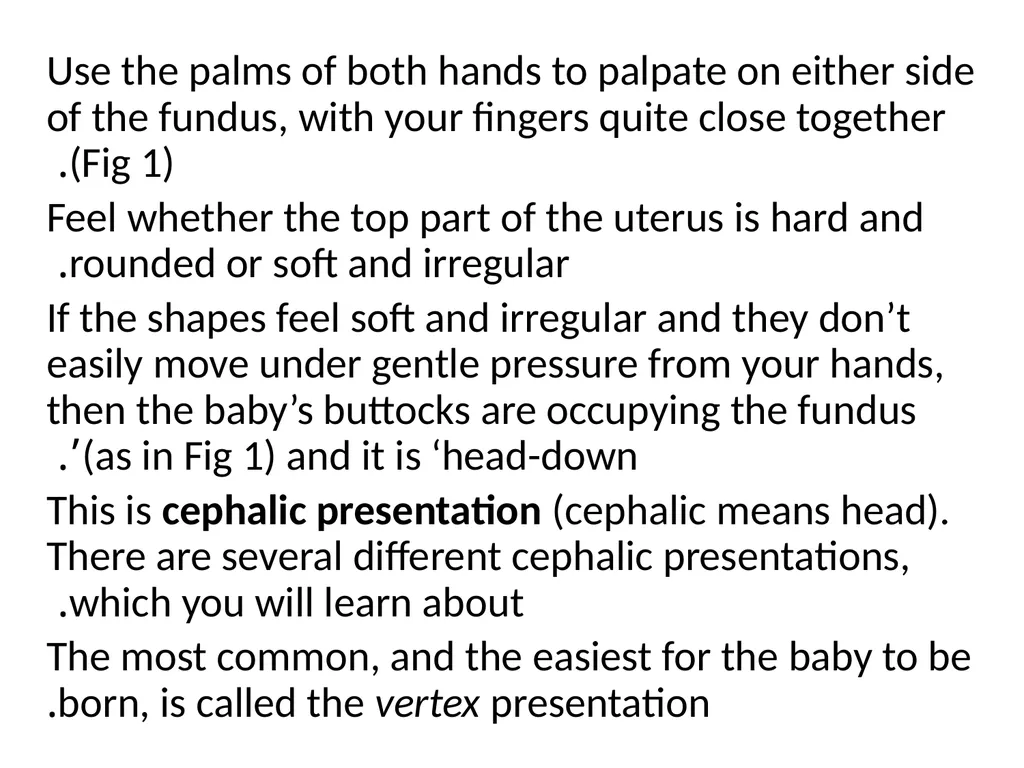
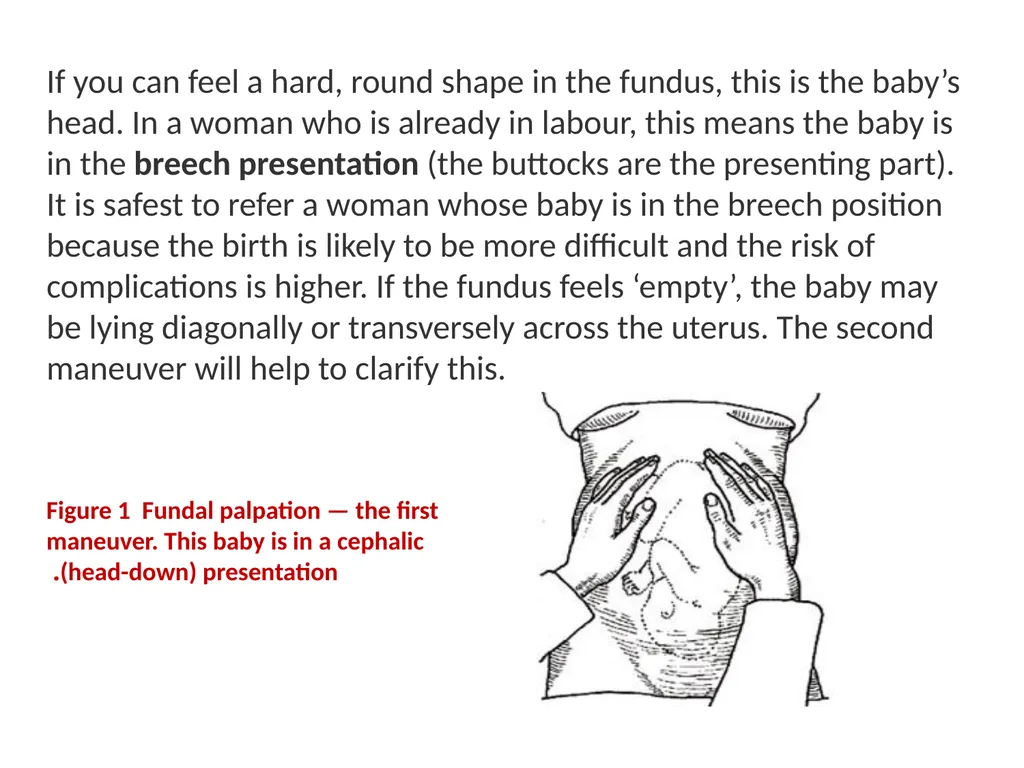
Use the palms of both hands to palpate on either side of the fundus, with your fingers quite close together (Fig 1).
Feel whether the top part of the uterus is hard and rounded or soft and irregular.
If the shapes feel soft and irregular and they don’t easily move under gentle pressure from your hands, then the baby’s buttocks are occupying the fundus (as in Fig 1) and it is ‘head-down’.
This is cephalic presentation (cephalic means head). There are several different cephalic presentations, which you will learn about.
The most common, and the easiest for the baby to be born, is called the vertex presentation.<br>
25
If you can feel a hard, round shape in the fundus, this is the baby’s head. In a woman who is already in labour, this means the baby is in the breech presentation (the buttocks are the presenting part). It is safest to refer a woman whose baby is in the breech position because the birth is likely to be more difficult and the risk of complications is higher. If the fundus feels ‘empty’, the baby may be lying diagonally or transversely across the uterus. The second maneuver will help to clarify this. Figure 1 Fundal palpation — the first maneuver. This baby is in a cephalic (head-down) presentation.<br>
26
Second Leopold’s maneuver: lateral palpation
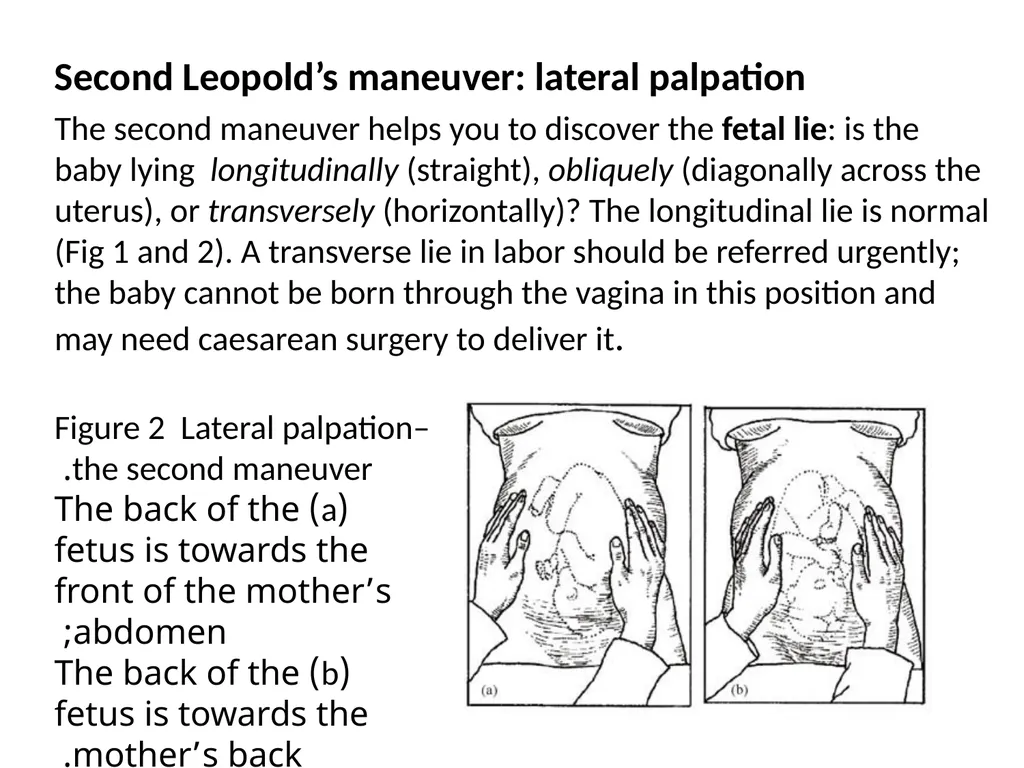
The second maneuver helps you to discover the fetal lie: is the baby lying longitudinally (straight), obliquely (diagonally across the uterus), or transversely (horizontally)? The longitudinal lie is normal (Fig 1 and 2). A transverse lie in labor should be referred urgently; the baby cannot be born through the vagina in this position and may need caesarean surgery to deliver it. Figure 2 Lateral palpation–the second maneuver.
(a) The back of the fetus is towards the front of the mother’s abdomen;
(b) The back of the fetus is towards the mother’s back.<br>
27
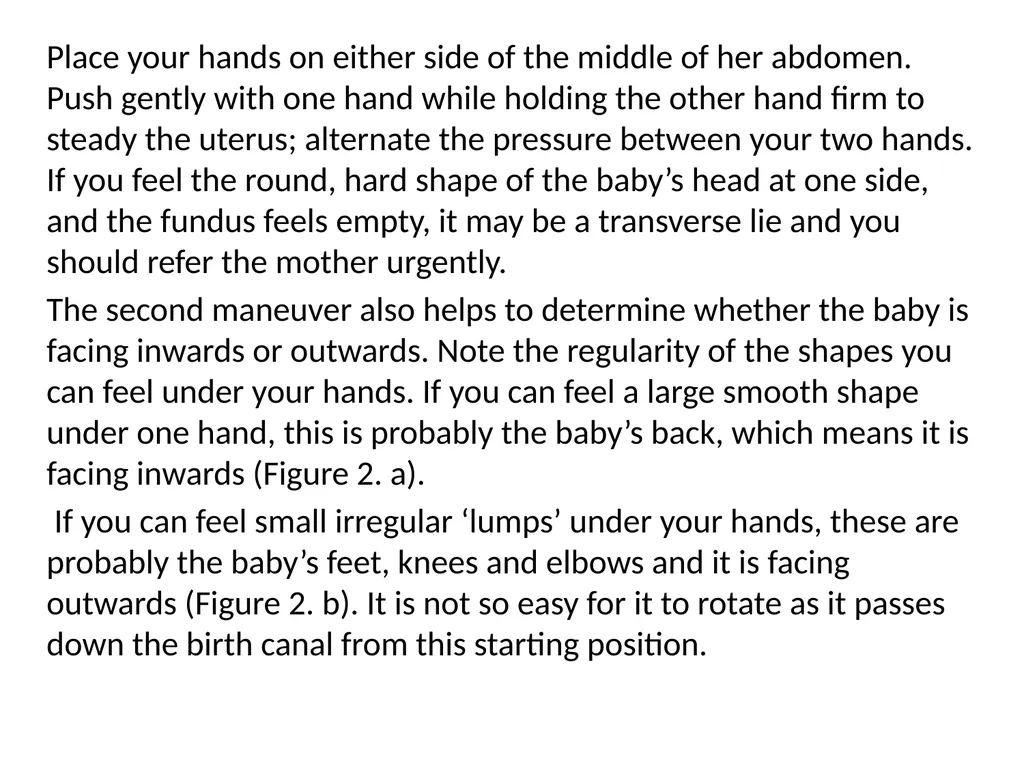
Place your hands on either side of the middle of her abdomen. Push gently with one hand while holding the other hand firm to steady the uterus; alternate the pressure between your two hands. If you feel the round, hard shape of the baby’s head at one side, and the fundus feels empty, it may be a transverse lie and you should refer the mother urgently.
The second maneuver also helps to determine whether the baby is facing inwards or outwards. Note the regularity of the shapes you can feel under your hands. If you can feel a large smooth shape under one hand, this is probably the baby’s back, which means it is facing inwards (Figure 2. a).
If you can feel small irregular ‘lumps’ under your hands, these are probably the baby’s feet, knees and elbows and it is facing outwards (Figure 2. b). It is not so easy for it to rotate as it passes down the birth canal from this starting position.<br>
28
Third Leopold’s maneuver: deep pelvic palpation
The third maneuver helps to confirm your earlier findings about the fetal presentation—is it cephalic or breech?
What is cephalic presentation?
The fetus is head down with its buttocks occupying the fundus (the upper part of the uterus).
Face the woman’s feet and place your hands on the lower part of her abdomen, with your fingers gently pressing inwards just above her pubic bone (Fig 3). You are feeling for the presenting part of the fetus as it engages with the cervix. If it is hard and round, the presentation is cephalic; if it is softer and irregular, suspect a breech presentation.<br>
29
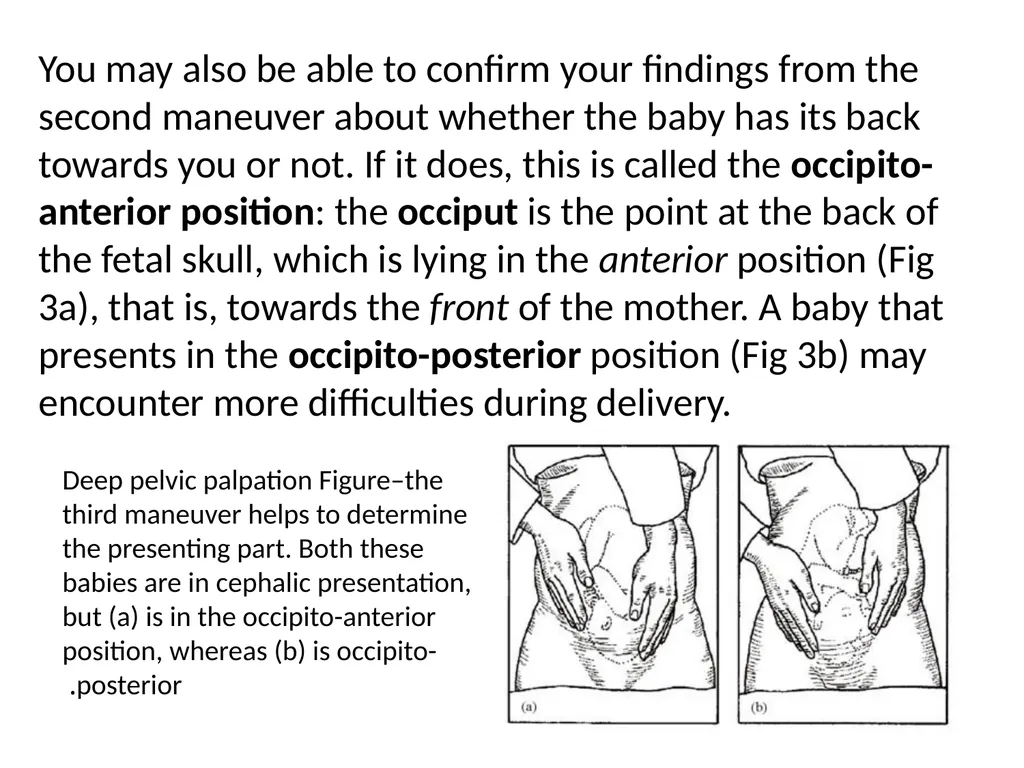
You may also be able to confirm your findings from the second maneuver about whether the baby has its back towards you or not. If it does, this is called the occipito-anterior position: the occiput is the point at the back of the fetal skull, which is lying in the anterior position (Fig 3a), that is, towards the front of the mother. A baby that presents in the occipito-posterior position (Fig 3b) may encounter more difficulties during delivery. Deep pelvic palpation Figure–the third maneuver helps to determine the presenting part. Both these babies are in cephalic presentation, but (a) is in the occipito-anterior position, whereas (b) is occipito-posterior.<br>
30
Fourth Leopold’s maneuver: Pawlick's grip
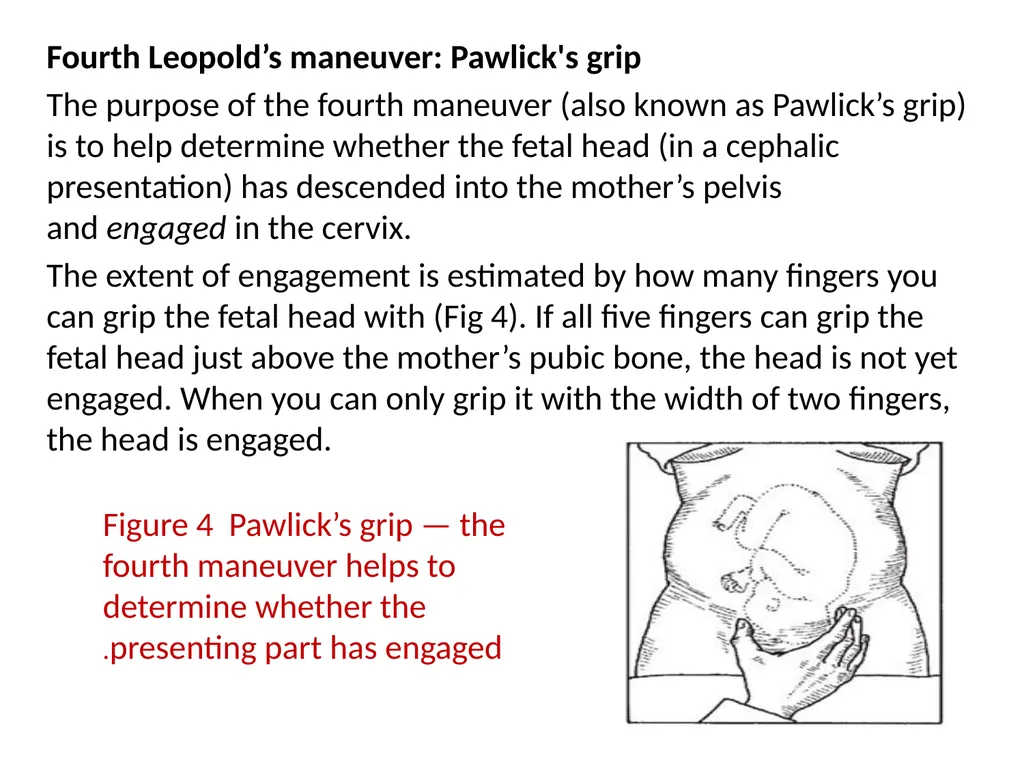
The purpose of the fourth maneuver (also known as Pawlick’s grip) is to help determine whether the fetal head (in a cephalic presentation) has descended into the mother’s pelvis and engaged in the cervix.
The extent of engagement is estimated by how many fingers you can grip the fetal head with (Fig 4). If all five fingers can grip the fetal head just above the mother’s pubic bone, the head is not yet engaged. When you can only grip it with the width of two fingers, the head is engaged. Figure 4 Pawlick’s grip — the fourth maneuver helps to determine whether the presenting part has engaged.<br>
31
3.3 Measuring fetal heart rate
Use a fetoscope or stethoscope to listen to the fetal heart rate immediately after a contraction. Listening to sounds inside the abdomen is called auscultation. Count the number of fetal heartbeats for a full minute at least once every 30 minutes during the active phase first stage of labor and every 5 minutes during the second stage.
If there are fetal heart rate abnormalities (less than 120 or more than 160 beats per minute, sustained for 10 minutes), suspect fetal distress and refer urgently to a health facility, unless the labor is progressing fast and the baby is about to be born.
Auscultation is pronounced ‘oss-kool-tay-shun’.<br>
32
3.4 Measuring contractions
To assess the frequency and duration of contractions, put your hand over the mother’s abdomen, around the fundus.
You will sense the abdomen starting to tighten and become hard. The mother may make ‘pain’ sounds with the contraction.
Count the frequency, i.e. number of contractions in 10 minutes, and the duration (the time elapsed during each contraction in seconds).
You will learn how to record these measurements, the mother’s vital signs and your measurements of the fetal heart rate on a chart called a partograph<br>
33
3.5 Vaginal examination
The functions of a vaginal examination are to:
- Determine if true labor has begun and the stage it has reached, based on measuring the dilatation of the cervix
- Assess the progress of labor in terms of the rate of increase in cervical dilatation and the descent of the fetus down the birth canal
- Identify the fetal presentation and position
- Detect any molding of the fetal skull bones (the extent to which they overlap under pressure from the birth canal)
- Assess the size of the mother’s pelvis and its adequacy for the passage of the fetus
- Check the color of the amniotic fluid.
- assessing the stage of labor by measuring the dilatation of the cervix.<br>
34
Assessing cervical dilatation
Wash your hands thoroughly with soap and clean water for two full minutes.
Then put on new sterile gloves.
Tell the mother what you are going to do. Vaginal examination is done using two gloved fingers.
Try to collect all the information you need before withdrawing from the vagina, because once you have withdrawn your fingers you should not put them back in again.
Can you explain why not?
Putting your examining fingers back into the vagina could introduce infection.
In particular repeated vaginal examination causes infection: it should not be done more often than every 4 hours, unless there is a justifiable need (e.g. to confirm second stage of labor).<br>
35
-The woman should lie down on her back, bend her legs and open her knees.
- Gently swab the external genitalia with sterile gauze dipped in antiseptic solution.
- Separate the labia with two fingers on your non-dominant hand (the dominant hand is the one you write with).
Dip your examining fingers (index and middle fingers) into an antiseptic lubricating cream and insert them very gently into the vagina, following the direction of the vagina, upwards and backwards.
Ask the woman to take deep breaths and try to relax, as this will help to decrease the discomfort of the procedure.
Cervical dilatation is the increase in diameter of the cervical opening, estimated in centimeters. Dilatation happens after the cervix has effaced (the 3 cm length of the cervix has been drawn up into the uterus.<br>
36
3.6 Assess the external genitalia and vagina
The final assessment we will describe is to check the mother’s external genitalia and the inner surface of her vagina for warning signs. Look carefully to see if there is:
Any abnormal discharge (thick yellowish or white and foul smelling) from the vagina, or inflamed sores on the external genitalia, which may be due to a urinary tract infection or sexually transmitted infection.
Vaginal scarring due to injury during a previous birth, or from female genital mutilation (circumcision). This increases the risk of a fistula occurring during labor (a torn opening between the vagina and other organs).
Is there swelling in the vagina, and if there is, could it obstruct the passage of the baby?
If you see any of the signs above, you should refer the mother to a health facility, unless the labor is advanced and the baby is about to be born.<br>