
Asset Recovery and Forfeiture in Africa Hermione
MJ
Published · 39 slides · 0 views

1 / 1








Description
Asset Recovery and Forfeiture in Africa Hermione Cronje Lusaka Kenya, September 2024 Objectives of this Presentation Some disclaimers Difficult to make generalizations about the whole Continent, instead my remarks focus on developments in
Related Topics
Share
Embed code
Download this presentation From Below
"Asset Recovery and Forfeiture in Africa Hermione" is the property of its rightful owner. Permission is granted to download and print the materials on this website for personal, non-commercial use only, and to display it on your personal computer provided you do not modify the materials and that you retain all copyright notices contained in the materials. By downloading content from our website, you accept the terms of this agreement.
Presentation Transcript
01
Asset Recovery and Forfeiture in Africa Hermione Cronje
Lusaka
Kenya, September 2024<br>
Lusaka
Kenya, September 2024<br>
02
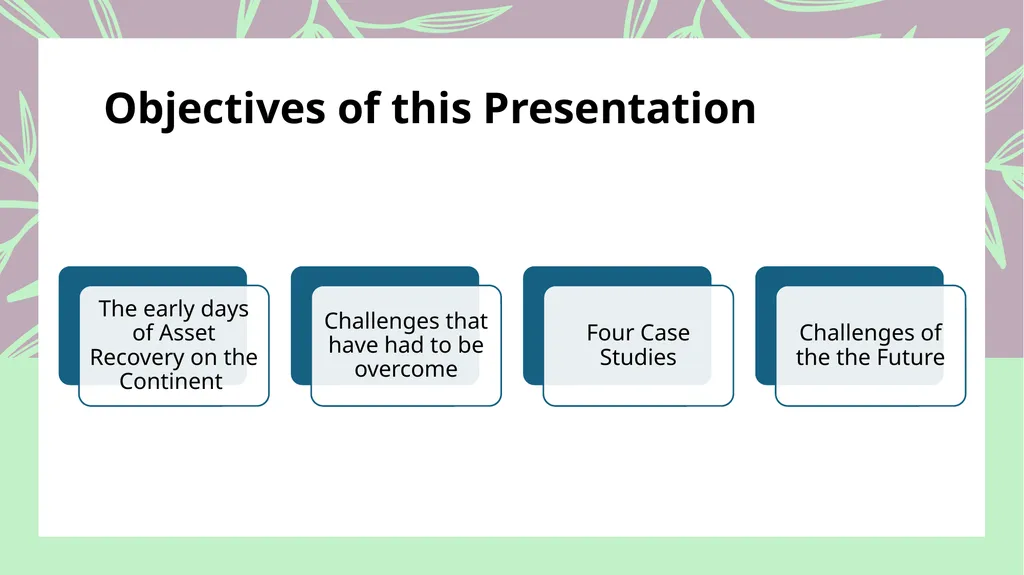
Objectives of this Presentation<br>
03
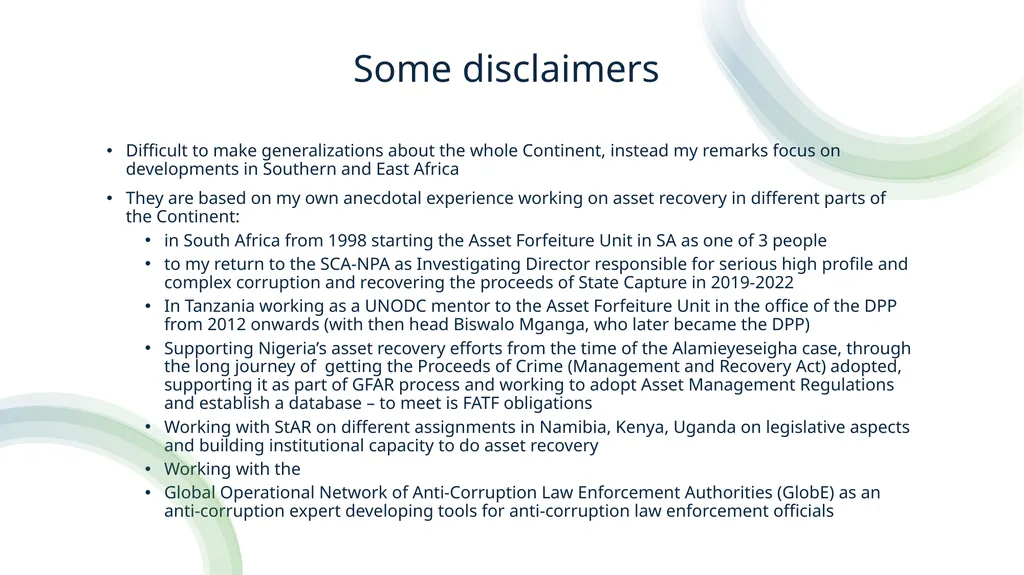
Some disclaimers Difficult to make generalizations about the whole Continent, instead my remarks focus on developments in Southern and East Africa
They are based on my own anecdotal experience working on asset recovery in different parts of the Continent:
in South Africa from 1998 starting the Asset Forfeiture Unit in SA as one of 3 people
to my return to the SCA-NPA as Investigating Director responsible for serious high profile and complex corruption and recovering the proceeds of State Capture in 2019-2022
In Tanzania working as a UNODC mentor to the Asset Forfeiture Unit in the office of the DPP from 2012 onwards (with then head Biswalo Mganga, who later became the DPP)
Supporting Nigeria’s asset recovery efforts from the time of the Alamieyeseigha case, through the long journey of getting the Proceeds of Crime (Management and Recovery Act) adopted, supporting it as part of GFAR process and working to adopt Asset Management Regulations and establish a database – to meet is FATF obligations
Working with StAR on different assignments in Namibia, Kenya, Uganda on legislative aspects and building institutional capacity to do asset recovery
Working with the
Global Operational Network of Anti-Corruption Law Enforcement Authorities (GlobE) as an anti-corruption expert developing tools for anti-corruption law enforcement officials<br>
04
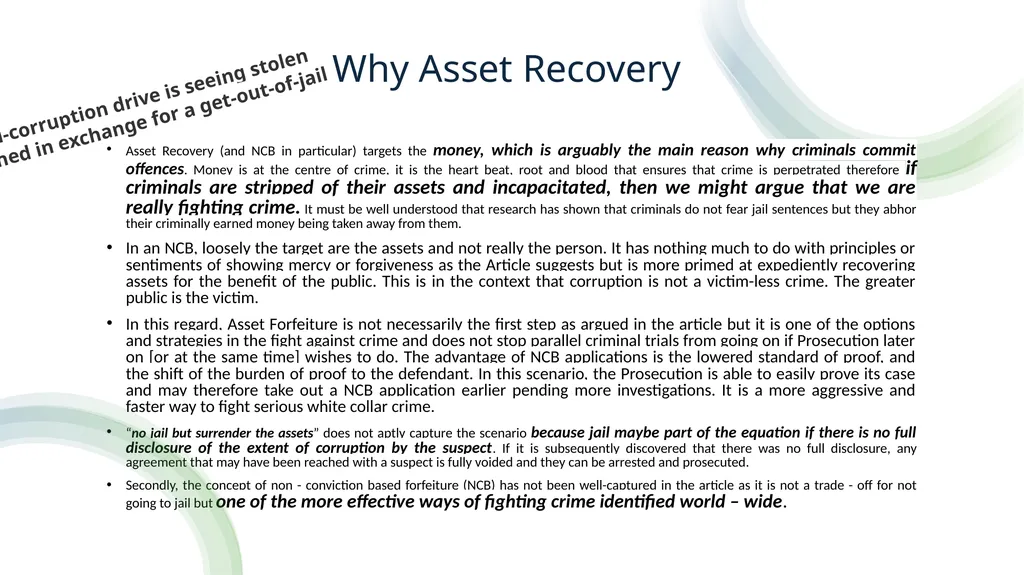
Why Asset Recovery Asset Recovery (and NCB in particular) targets the money, which is arguably the main reason why criminals commit offences. Money is at the centre of crime, it is the heart beat, root and blood that ensures that crime is perpetrated therefore if criminals are stripped of their assets and incapacitated, then we might argue that we are really fighting crime. It must be well understood that research has shown that criminals do not fear jail sentences but they abhor their criminally earned money being taken away from them.
In an NCB, loosely the target are the assets and not really the person. It has nothing much to do with principles or sentiments of showing mercy or forgiveness as the Article suggests but is more primed at expediently recovering assets for the benefit of the public. This is in the context that corruption is not a victim-less crime. The greater public is the victim.
In this regard, Asset Forfeiture is not necessarily the first step as argued in the article but it is one of the options and strategies in the fight against crime and does not stop parallel criminal trials from going on if Prosecution later on [or at the same time] wishes to do. The advantage of NCB applications is the lowered standard of proof, and the shift of the burden of proof to the defendant. In this scenario, the Prosecution is able to easily prove its case and may therefore take out a NCB application earlier pending more investigations. It is a more aggressive and faster way to fight serious white collar crime.
“no jail but surrender the assets” does not aptly capture the scenario because jail maybe part of the equation if there is no full disclosure of the extent of corruption by the suspect. If it is subsequently discovered that there was no full disclosure, any agreement that may have been reached with a suspect is fully voided and they can be arrested and prosecuted.
Secondly, the concept of non - conviction based forfeiture (NCB) has not been well-captured in the article as it is not a trade - off for not going to jail but one of the more effective ways of fighting crime identified world – wide. Zambia’s anti-corruption drive is seeing stolen assets returned in exchange for a get-out-of-jail card<br>
05
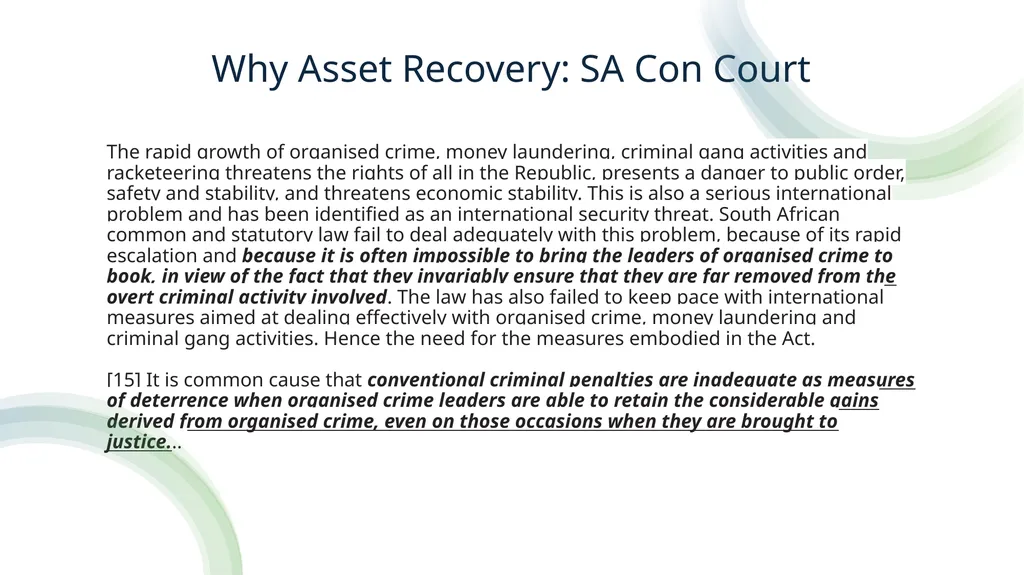
Why Asset Recovery: SA Con Court The rapid growth of organised crime, money laundering, criminal gang activities and racketeering threatens the rights of all in the Republic, presents a danger to public order, safety and stability, and threatens economic stability. This is also a serious international problem and has been identified as an international security threat. South African common and statutory law fail to deal adequately with this problem, because of its rapid escalation and because it is often impossible to bring the leaders of organised crime to book, in view of the fact that they invariably ensure that they are far removed from the overt criminal activity involved. The law has also failed to keep pace with international measures aimed at dealing effectively with organised crime, money laundering and criminal gang activities. Hence the need for the measures embodied in the Act.
[15] It is common cause that conventional criminal penalties are inadequate as measures of deterrence when organised crime leaders are able to retain the considerable gains derived from organised crime, even on those occasions when they are brought to justice...<br>
06
Why Asset Recovery Learning Lessons from Abroad
Gilligan and Murphy v. Ireland, Attorney General, Criminal Assets Bureau:
“forfeiture proceedings are civil, not criminal, in nature. There is no provision for the arrest or detention of any person, the admission of persons to bail, for the imprisonment of a person for the non-payment of a penalty, for a form of Criminal Trial initiated by summons or indictment, for the recording of a conviction of any form or the entering of a nolle prosequi at any stage, all elements which would indicate that the Act creates a criminal offense.”
“ the Act does provide onerous and far-reaching penalties and forfeitures but these are directly connected with the establishment to the satisfaction of the court that the property concerned is either directly or indirectly the proceeds of crime. The state has a legitimate interest in the forfeiture of the proceeds of crime. The right to private ownership cannot hold a place so high in the hierarchy of rights that it protects the position of assets illegally acquired or held”.
NDPP/ Philips WLD:
“Whether a confiscation order constitutes punishment depends on its purpose. It constitutes punishment only if its purpose is to punish the defendant for his crime. But that is not the purpose of a confiscation order. Its purpose is to deprive him of the ill- gotten gains of his criminal conduct. That much is clear from the provisions of chapter 5.”<br>
07
Early Years of Asset Recovery
Building Capacity Set goals for all role-players involved in AR process e.g.:
Run test cases to develop sound jurisprudence that will simplify asset litigation from being extremely complex to becoming routine, means taking less complex cases to settle the law
do a significant volume of cases of a significant value to ensure that AR makes a significant contribution in the fight against crime
Ensure that investigators and prosecutors become SPECIALISTS in “following the money” which is different from chasing the culprits
Dedicate prosecutors and police to work full-time and exclusively on asset recovery. Often forfeiture is not used effectively- the focus remains convictions
Lessons from around the world - Unless you have clear goals, which help to prioritise and motivate resources, nothing will happen.<br>
08
Early Years of Asset Recovery
Building Capacity Civil litigation expertise seldom expertise available in the prosecution
Skilled investigators and prosecutors often already have a heavy workload and have little time to learn complicated new procedures
Forfeiture law raises very complex issues and tends to be heavily litigated by criminals who can often afford to employ the best counsel
The risk of losing early cases are significantly higher than normal, and prosecutors are often reluctant to take the risk since it may reflect negatively on them
It is important to create additional capacity to deal with forfeiture without reducing the already limited prosecutions and investigations capacity
Recruit lawyers with private/commercial law background and investigator with accounting background
Forfeiture work often requires a considerable amount of administrative work to ensure that papers are filed on time, court dates are met, seized assets are properly supervised, orders are enforced and accounted for, etc<br>
09
Early Years of Asset Recovery
Building Capacity It is vital to ensure that the initial cases to test the law should be done very carefully to minimise the risk of losing
There will be much litigation on the interpretation of the law, the applicability of civil law procedures and the constitutionality of the law
The consequences of losing cases in the initial period can be devastating to the future use of the law, and can sometimes make the use of the law almost impossible until the decision is overturned
Relatively few cases should be undertaken with excellent preparation
Cases should be carefully selected to ensure that the facts are suitable for the development of good law – there is a great deal of truth in the adage that bad facts make bad law
Judges will often not understand the complexities of the law and the stature of person presenting the case is often as important as quality of argument<br>
10
Early Years of Asset Recovery
Carefully Select Test Cases Careful consideration should be given to how many big complex cases are taken on:
They usually consume large amounts of prosecution and investigative resources
Judges in major cases tend to be more cautious since the amounts of money are very great, and they know that their decisions will be subject to appeal
The stakes are very high in such cases since they become the focus of media attention – any losses result in a significant loss of public confidence in forfeiture
Big criminals can afford the best lawyers which increases the risks of losing
Such cases will often take a long time to finalise as delaying tactics will be used
However, bear in mind that it is difficult to justify the legislation on the basis that it is, amongst other things, required to fight organised crime, and then not use it against grand corruption and organised crime
Often there is public pressure for a significant impact to be made fairly quickly, and it is not possible to wait the 3 or 4 years it will take to complete test cases<br>
11
Lessons Learnt during the early years Those who benefit from crime will fight back, the more politically connected the more intense the fight back and they will not spare any institution or individual in their way
The Scorpions in South Africa was demolished
Our colleague Martha Chizuma in Malawi found herself arrested in front of her children by heavily armed police officers on trumped up charges and put in jail.
Accused persons and some unscrupulous lawyers will use all and any means to avoid accountability (Stalingrad Tactics)
Attacks on social media and on threats to the life of prosecutors<br>
12
The importance of political and public support for forfeiture Forfeiture is potentially a politically sensitive issue, and it is important to have a communication strategy that ensures that the government, legislators and the public understand the importance of forfeiture
This is particularly so as forfeiture is a rapidly evolving area, and regular changes to the legislation are likely to be required to deal with unforeseen legal issues or new international requirements
Information is key – good record keeping critical
Professionalism, Excellence and Integrity is key!!!<br>
13
Lessons Learnt during the early years Cannot assume that the prosecution will be immune to corruption – (the corrupt have every reason to target prosecutors – they have a lot to lose)
Need to put in place specific strategies to insulate the asset recovery process from corruption – cannot take it for granted that prosecutors will resist corruption or be immune to extortion
As a fundamental principle, individuals responsible for seizing and confiscating assets must be prohibited from receiving any personal financial gain related to such role and from using any seized assets for personal purposes.
To prevent fraud and mismanagement, the financial records of the asset management body should be certified and its operations should be reviewed regularly by external auditors.
Failing to subject the asset management function to rigorous standards of accountability can have significant consequences. In Ukraine allegations of corruption destroyed public trust and confidence in the asset management function and led lawmakers to consider revoking its status as an independent government agency.
The failure to deal transparently with assets in the care of the asset management office can breed mistrust or, worse, raise suspicions of corruption<br>
14
Lessons Learnt during the early years SERAP, a nongovernmental organization working to promote transparency and accountability in Nigeria, requested that the Nigerian government disclose to it details of spending of about US$5 billion in stolen public funds recovered from former military head of state General Sani Abacha since 1999. SERAP also requested details of specific projects carried out with the recovered proceeds, including the location and details of companies and contractors involved in the execution of the projects. In addition, SERAP sought copies of all international agreements reached in relation to the Abacha recoveries and details of the role played by World Bank and other similar actors in the disbursement of the funds.
The Federal High Court of Nigeria in Abuja ordered the federal government of Nigeria to provide SERAP with access to records relating to proceeds recovered from former military head of state General Sani Abacha and records on how these funds were allocated upon their return.
Nigeria, and many other asset recovery and management offices are now working hard on ensuring accurate and transparent record keeping.<br>
15
Four Case Studies<br>
16
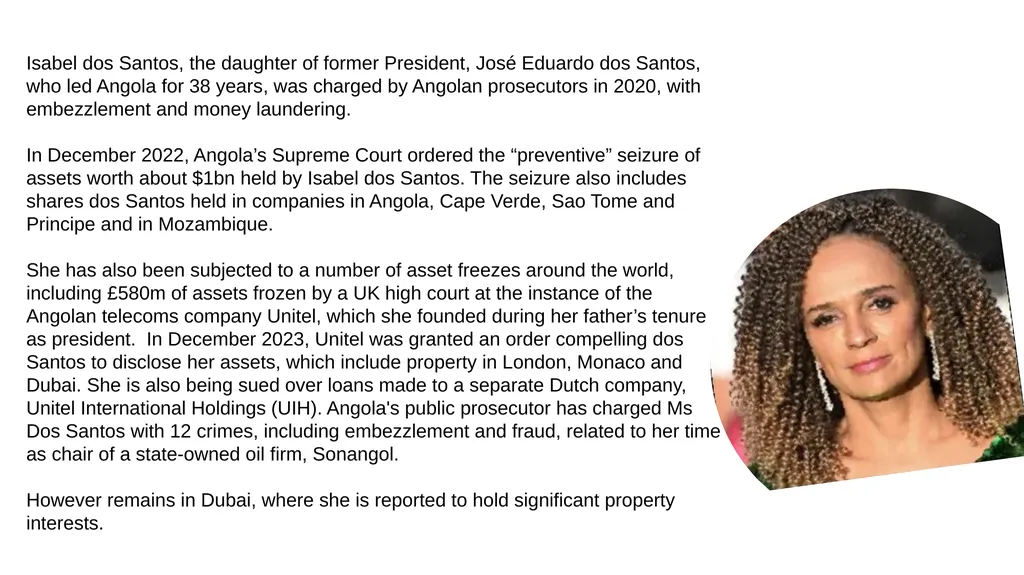
Isabel dos Santos, the daughter of former President, José Eduardo dos Santos, who led Angola for 38 years, was charged by Angolan prosecutors in 2020, with embezzlement and money laundering.
In December 2022, Angola’s Supreme Court ordered the “preventive” seizure of assets worth about $1bn held by Isabel dos Santos. The seizure also includes shares dos Santos held in companies in Angola, Cape Verde, Sao Tome and Principe and in Mozambique.
She has also been subjected to a number of asset freezes around the world, including £580m of assets frozen by a UK high court at the instance of the Angolan telecoms company Unitel, which she founded during her father’s tenure as president. In December 2023, Unitel was granted an order compelling dos Santos to disclose her assets, which include property in London, Monaco and Dubai. She is also being sued over loans made to a separate Dutch company, Unitel International Holdings (UIH). Angola's public prosecutor has charged Ms Dos Santos with 12 crimes, including embezzlement and fraud, related to her time as chair of a state-owned oil firm, Sonangol.
However remains in Dubai, where she is reported to hold significant property interests.
.<br>
17
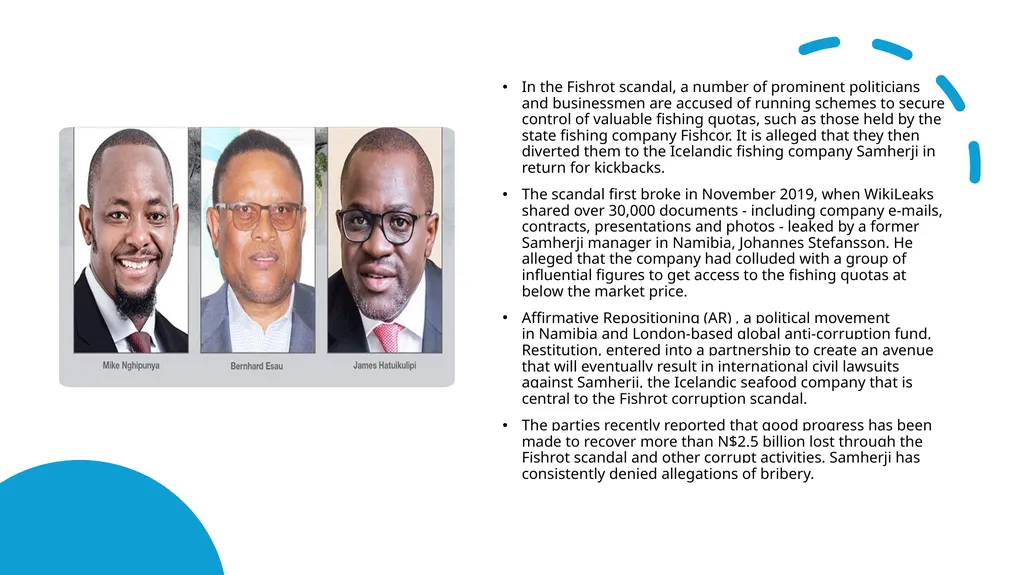
In the Fishrot scandal, a number of prominent politicians and businessmen are accused of running schemes to secure control of valuable fishing quotas, such as those held by the state fishing company Fishcor. It is alleged that they then diverted them to the Icelandic fishing company Samherji in return for kickbacks.
The scandal first broke in November 2019, when WikiLeaks shared over 30,000 documents - including company e-mails, contracts, presentations and photos - leaked by a former Samherji manager in Namibia, Johannes Stefansson. He alleged that the company had colluded with a group of influential figures to get access to the fishing quotas at below the market price.
Affirmative Repositioning (AR) , a political movement in Namibia and London-based global anti-corruption fund, Restitution, entered into a partnership to create an avenue that will eventually result in international civil lawsuits against Samherji, the Icelandic seafood company that is central to the Fishrot corruption scandal.
The parties recently reported that good progress has been made to recover more than N$2.5 billion lost through the Fishrot scandal and other corrupt activities. Samherji has consistently denied allegations of bribery.<br>
18
Malanji Helicopters
Zambia has recovered two helicopters bought illicitly in South Africa by former Zambian foreign affairs minister Joseph Malanji with $5 million of laundered money.
The two aircraft, were in 2021 sold to Malanji by two South African companies.
In December 2021 Malanji was arrested and jointly charged with former Secretary to the Treasury Fredson Yamba over an irregular transfer of over 154 million kwacha to the Zambian mission in Turkey.
Malanji is accused of laundering $5 million in Zambian state funds earmarked for the purchase of a property for Zambia’s embassy in Turkey.<br>
19
Zambia approached the NPA in SA through ARINSA contact points in February 2023 to assist in the recovery of both aircraft.
The two helicopters were registered to Gibson Power Systems Ltd and Gibson Properties Development Ltd. Malanji is the director and sole signatory.
The AFU obtained a preservation order for the helicopters on 16 February 2023 in the amount of R38 145 240,00.
The AFU subsequently requested Zimbabwe to register the preservation order as one of the helicopters was used for fly tourists to Victoria Falls in Zimbabwe. The second helicopter is in custody at Lanseria Airport while the forfeiture application is in progress following due process.<br>
20
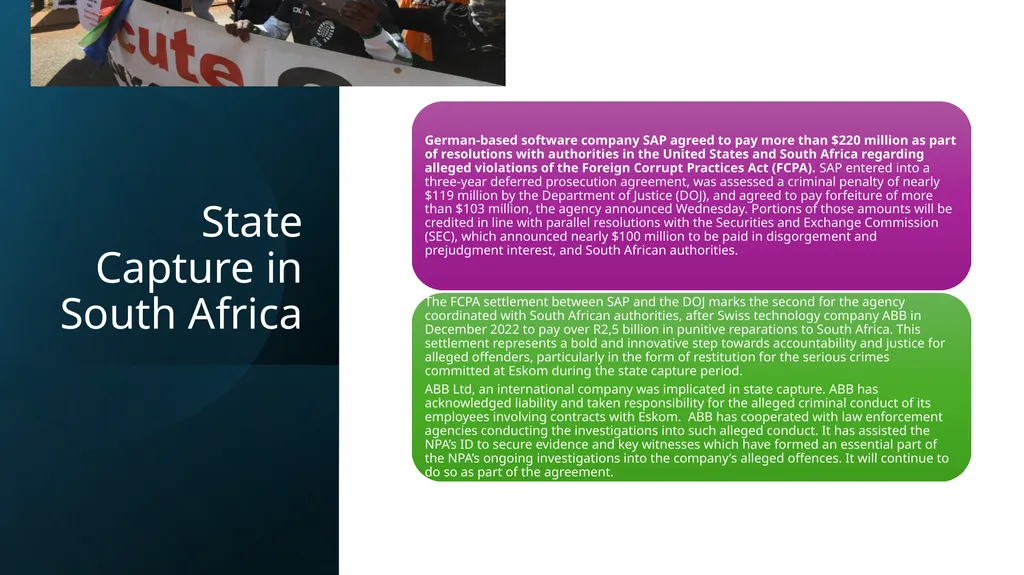
State Capture in South Africa<br>
21
New Challenges Cross border cooperation is critical
Asset forfeiture cannot be effective without excellent international cooperation
Ensure a solid legal basis for international cooperation, bi and multi-lateral treaties
Ensure that spontaneous sharing of information is permitted. Make use of police to police co-operation and obtain informal advice from prosecution and judicial authorities. Develop MoUs to facilitate sharing of information and assistance.
Participate in international networks to make contacts and understand requirements for cooperation.<br>
22
Recognition of forfeiture and confiscation orders abroad Need for domestic legislation that allows for recognition of foreign orders
Ideally permit registration in the domestic court and recognised as an order of that court
It also has the advantage that evidence from the foreign state need not be placed before court, the underlying case can only be litigated in the state where the order was obtained
Any challenges to the evidence must be brought in the foreign state
Thus only compliance with the registration process can be litigated and not the merits of the case<br>
23
MLA: costs of looking after assets If the MLA is not successful, states pay their own costs
If the MLA is successful: the requested state deducts the actual expenses incurred in litigating and looking after the assets, though this can be waived
The net proceeds can be shared equally between the states if there is no victim, eg in drug cases
All the net proceeds will be returned to the requesting state if there are innocent victims, eg in fraud cases, or where the state was the victim of corruption
Costs of looking after some assets is a major issue, especially in cases that take a long time to be finalised, for example:
Businesses, such as a hotel, may be profitable, but the running expenses are high. They may also be difficult to run because they may be used for criminal purposes such as prostitution or drug dealing<br>
24
MLA: costs of looking after assets Houses may appreciate over time, but are expensive to maintain. Try to rent it out to generate income
Assets that eat are very expensive to maintain, or may die: eg race horses, exotic animals, etc
It is important to plan properly and make a careful assessment of the value of the assets, and the costs of maintaining them during the freezing order period
If the asset may lose value over time, or the costs of maintaining them are high:
Try to agree with the owner that the asset is sold and the cash kept in an interest bearing investment,
If he does not agree, it may be possible to persuade the court to order that this be done on the basis that it will be damaging to the victim state<br>
25
This book offers an in-depth analysis of the concept of the direct enforcement of foreign restraint and confiscation orders, a crucial step in the process of asset recovery, including existing legal approaches and related challenges.<br>
26
New Challenges Cross border cooperation is critical
Asset forfeiture cannot be effective without excellent international cooperation
Ensure a solid legal basis for international cooperation, bi and multi-lateral treaties
Ensure that spontaneous sharing of information is permitted. Make use of police to police co-operation and obtain informal advice from prosecution and judicial authorities. Develop MoUs to facilitate sharing of information and assistance.
Participate in international networks to make contacts and understand requirements for cooperation.<br>
Asset forfeiture cannot be effective without excellent international cooperation
Ensure a solid legal basis for international cooperation, bi and multi-lateral treaties
Ensure that spontaneous sharing of information is permitted. Make use of police to police co-operation and obtain informal advice from prosecution and judicial authorities. Develop MoUs to facilitate sharing of information and assistance.
Participate in international networks to make contacts and understand requirements for cooperation.<br>
27
ARINSA key initiatives In addition to exchanging information, model legislation and country laws in asset forfeiture, confiscation and money laundering, ARINSA has also developed:
a mentor placement programme to deepen institutional change and collaborative practices among relevant institutions at a national level;
the Prosecutor Placement Programme (PPP) to build regional capacity in asset forfeiture and recovery prosecutions;
utilised financial investigation experts to sharpen investigation techniques among law enforcement agents through several regional and national training courses and workshops;
identified contact points in each country to facilitate operational requests between countries, to assess and report the country’s training and support needs, and to act as national-level champions for the network;
the ARINSA website, a forum for open learning and exchange between countries, to highlight successes, and to allow countries to liaise directly on case information;<br>
28
ASSET RECOVERY INTER-AGENCY NETWORK SOUTHERN AFRICA ARINSA was established in 2009 in Pretoria by delegates from law enforcement and prosecution agencies from nine countries in the Eastern and Southern African region as a multi-agency informal network
Botswana, Lesotho, Mauritius, Namibia, South Africa, Swaziland, Tanzania, Zambia and Zimbabwe formed part of the initial group
By 2019, seven new members had joined, increasing membership to 16 namely; Angola, Kenya, Madagascar, Malawi, Mozambique, Seychelles and Uganda<br>
Botswana, Lesotho, Mauritius, Namibia, South Africa, Swaziland, Tanzania, Zambia and Zimbabwe formed part of the initial group
By 2019, seven new members had joined, increasing membership to 16 namely; Angola, Kenya, Madagascar, Malawi, Mozambique, Seychelles and Uganda<br>
29
Global Operational Network of Anti-Corruption Law Enforcement Authorities Globenetwork.unodc.org<br>
30
GlobE Network The GlobE Network was established under the auspices of UNODC and was officially launched on 3 June 2021, at a high-level side event on the margins of the special session of the General Assembly against corruption.
The GlobE Network aims to facilitate informal cooperation and address the lack of a truly global network for anti-corruption law enforcement authorities.
The proposal for the GlobE Network was originally conceived under the presidency of Saudi Arabia of the Group of 20 in 2020, in the form of the Riyadh initiative.<br>
31
GlobE Network Membership of the Network is open to specialized authorities falling under article 36 of the UN Convention against Corruption from the Member States of the United Nations and States parties to UNCAC. UNODC has invited anti-corruption law enforcement authorities to join the GlobE Network through submitting such requests via their Permanent Missions.
The GlobE Network membership, as of April 2023, includes 142 anti-corruption law enforcement authorities from 79 countries.<br>
The GlobE Network membership, as of April 2023, includes 142 anti-corruption law enforcement authorities from 79 countries.<br>
32
Conclusion
The “club” of states that are pursuing cross-border asset recovery cases involving proceeds of crime is growing
The number and value of returns is increasing, but nowhere near where it needs to be
The networks between law enforcers are growing and needs to be supported
The No-Havens for Corrupt Proceeds Campaign is growing
Focusing on ensuring that returned assets benefit the community and are not again subjected to re-looting.<br>
33
2015 AU Commission High Level Review Panel Report on Illicit Financial Flows from Africa The report found that African countries lose on average $50 billion annually through illicit financial flows (i.e. the movement of money across borders that is illegal in its source (e.g. corruption, smuggling), its transfer (e.g. tax evasion), or its use (e.g. terrorist financing).
Commercial activities by the private sector are by far the largest contributor to IFFs, followed by organized crime, then public sector activities.
Corrupt practices play a key role in facilitating these outflows.
Multinational corporations shift profits to subsidiaries in low-tax or secrecy jurisdictions where in many cases, those subsidiaries exist on paper only, mostly with one or two employees, while the bulk of the activities of the company occur in another country.<br>
34
Key Findings of the Panel on Illicit Financial Flows from Africa New and more efforts are needed in asset recovery and repatriation
Money laundering continues to require attention
Weak national and regional capacities impede efforts to curb illicit financial flows
Incomplete global architecture for tackling illicit financial flows
Financial secrecy jurisdictions must come under closer scrutiny
Development partners have an important role in curbing illicit financial flows from Africa and Illicit financial flow issues should be incorporated and better coordinated across United Nations processes and frameworks<br>
35
The Financial Action Task Force (FATF) FATF was established in 1989 by the G7 the European Commission and eight other countrie to examine money laundering techniques and trends, review the action already taken at a national or international level, and to set out measures needed to combat money laundering. examine and develop measures to combat money laundering. It originally included the G7 countries, s.
A year later the FATF issued a report containing a set of Forty Recommendations. These aimed to provide a comprehensive plan of action to fight money laundering. In 2001, the FATF expanded its mandate to also combat terrorist financing.<br>
A year later the FATF issued a report containing a set of Forty Recommendations. These aimed to provide a comprehensive plan of action to fight money laundering. In 2001, the FATF expanded its mandate to also combat terrorist financing.<br>
36
The Financial Action Task Force (FATF) At its 2022 Meeting, FATF Ministers expressed concern that efforts to confiscate the proceeds of crime remain insufficient compared to the volume of criminal assets flowing through the global financial system and infiltrating national economies.
FATF has made it a strategic priority to improve asset recovery outcomes.
FATF assessments highlighted that globally, countries are only recovering a fraction of proceeds of crime. This allows criminals to benefit from their ill-gotten gains, strengthens and emboldens criminal organisations’ operations and erodes trust in government and the rule of law.
“There needs to be a major mindset and culture shift to focus on asset recovery as a national law enforcement priority. This takes time, but it is essential for countries to start now. Asset recovery is not a secondary or ancillary aspect of investigations and prosecution. It should be a key crime prevention strategy to remove the primary incentive for financial crime – money. If done well, it will prevent and reduce further crime.”, said FATF President T. Raja Kumar during his opening remarks.<br>
37
Delays, delays, delays A major issue in cooperation in asset recovery is the length of time required to finalise criminal cases, especially where it is dependent on the completion of the criminal case
NCB can expedite matters, State governor in Nigeria was arrested in UK but escape back to Nigeria where he had immunity from prosecution as state governor. At request of Nigeria, his property in SA was frozen in Dec 2005 - Used evidence from UK and Nigeria to show that property was proceeds of crime
Obtained forfeiture in July 2006 – not opposed Assets were sold and returned within 15 months of request<br>
38
Problems going forward Safe Havens a serious problems - In two of the case studies, the Guptas and the dos Santos family members have found safe haven in Dubai and have not been extradited.
This issue highlights the very difficult issue of working with the executive and using the executive authority to international relations to put pressure to ensure accountability.
Complex corruption cases – where multiple states have jurisdiction, as yet there are no rules of engagement governing “global settlements.<br>