
Auction Theory 1 Selling a single good Seller has
MT
Published · 36 slides · 0 views

1 / 1
Description
Auction Theory 1 Selling a single good Seller has a single good that she wants to sell how can she identify the right buyer and the right price? Why an auction why not just set a price? Seller may not know what price to set. Might set
Related Topics
Share
Embed code
Download this presentation From Below
"Auction Theory 1 Selling a single good Seller has" is the property of its rightful owner. Permission is granted to download and print the materials on this website for personal, non-commercial use only, and to display it on your personal computer provided you do not modify the materials and that you retain all copyright notices contained in the materials. By downloading content from our website, you accept the terms of this agreement.
Presentation Transcript
01
Auction Theory 1<br>
02
Selling a single good Seller has a single good that she wants to sell – how can she identify the right buyer and the right price?
Why an auction – why not just set a price?
Seller may not know what price to set. Might set it too high and not sell, or too low and have excess demand.
Potential buyers know what they’d pay, but aren’t telling.
Auction serves as a mechanism for price discovery, and also as a way to induce competition among buyers.
Today: different ways to run an auction, the strategic response of buyers to rules, and the Revenue Equivalence Theorem. 2<br>
03
Auction methods Sealed bidding
Seller asks for single round of bids, high bidder wins and pays their bid.
Common in selling real estate, timber, commodities, construction or service contracts (where “low bid” wins!)
Variant: high bidder wins but pays second highest bid – not common, a little like an eBay “proxy” auction with sniping. 3<br>
04
Auction methods Ascending auction
Price starts low, bidders (or auctioneer) raise price until only one bidder is left.
Common for art, antiques, cars, charity auctions, real estate, company “take-overs”, job market (if you’re lucky!).
Variant: price starts high and slowly drops until someone buys – used in Dutch flower auctions, “clearance” sales. 4<br>
05
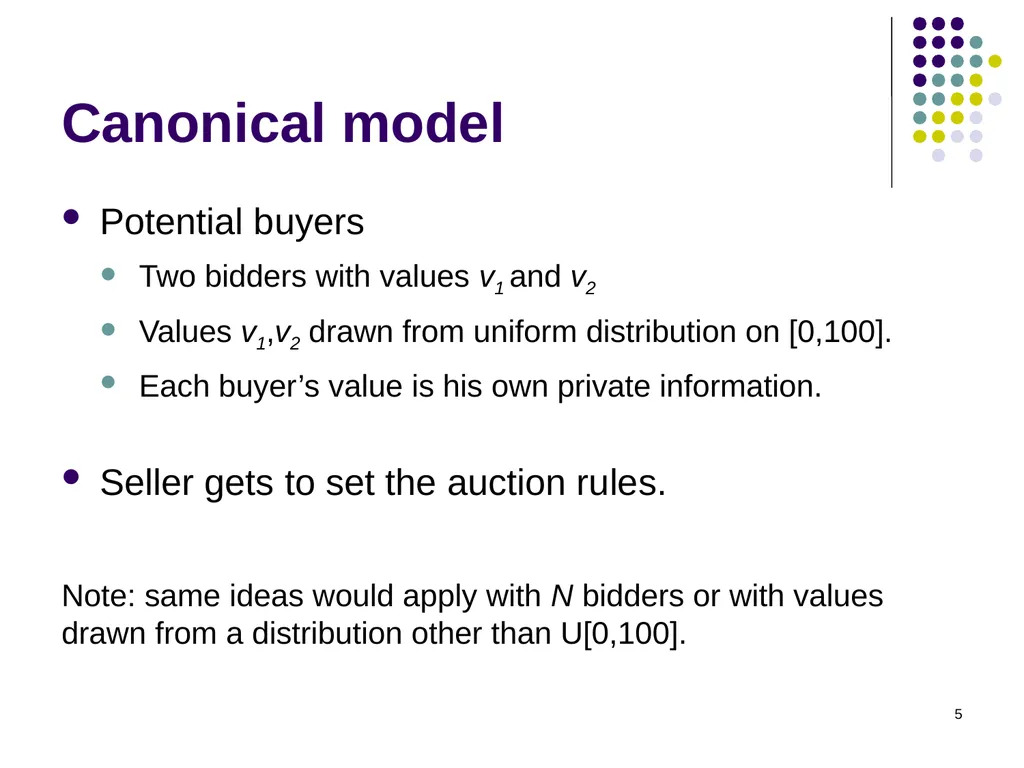
Canonical model Potential buyers
Two bidders with values v1 and v2
Values v1,v2 drawn from uniform distribution on [0,100].
Each buyer’s value is his own private information.
Seller gets to set the auction rules.
Note: same ideas would apply with N bidders or with values drawn from a distribution other than U[0,100]. 5<br>
Two bidders with values v1 and v2
Values v1,v2 drawn from uniform distribution on [0,100].
Each buyer’s value is his own private information.
Seller gets to set the auction rules.
Note: same ideas would apply with N bidders or with values drawn from a distribution other than U[0,100]. 5<br>
06
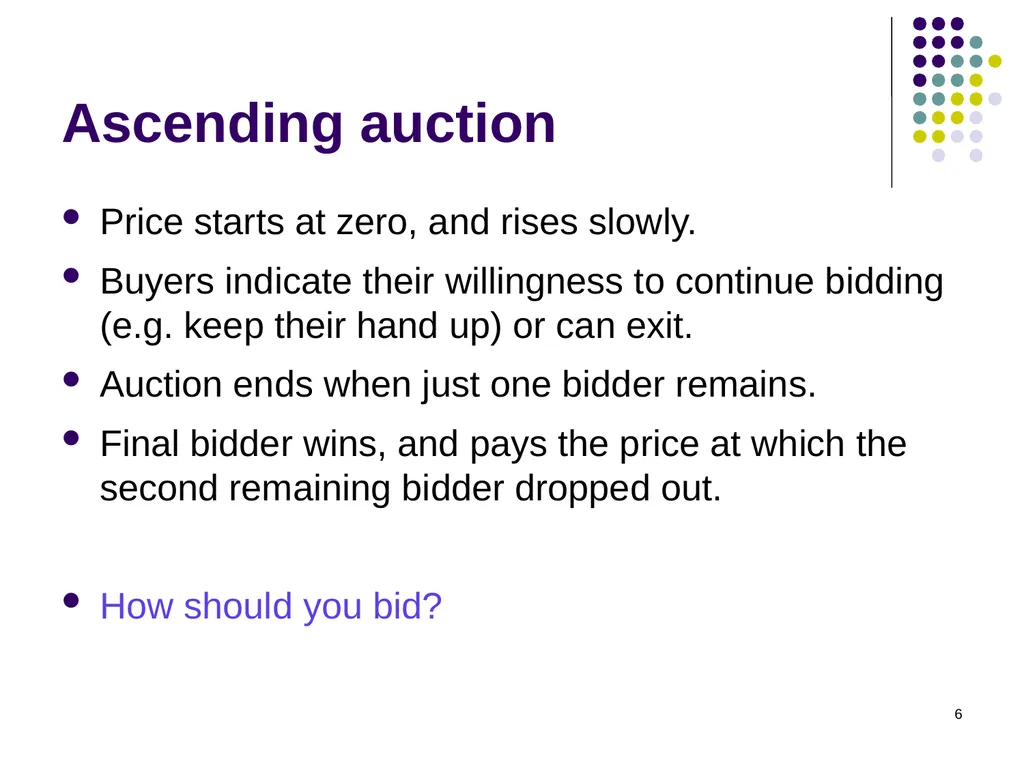
Ascending auction Price starts at zero, and rises slowly.
Buyers indicate their willingness to continue bidding (e.g. keep their hand up) or can exit.
Auction ends when just one bidder remains.
Final bidder wins, and pays the price at which the second remaining bidder dropped out.
How should you bid? 6<br>
Buyers indicate their willingness to continue bidding (e.g. keep their hand up) or can exit.
Auction ends when just one bidder remains.
Final bidder wins, and pays the price at which the second remaining bidder dropped out.
How should you bid? 6<br>
07
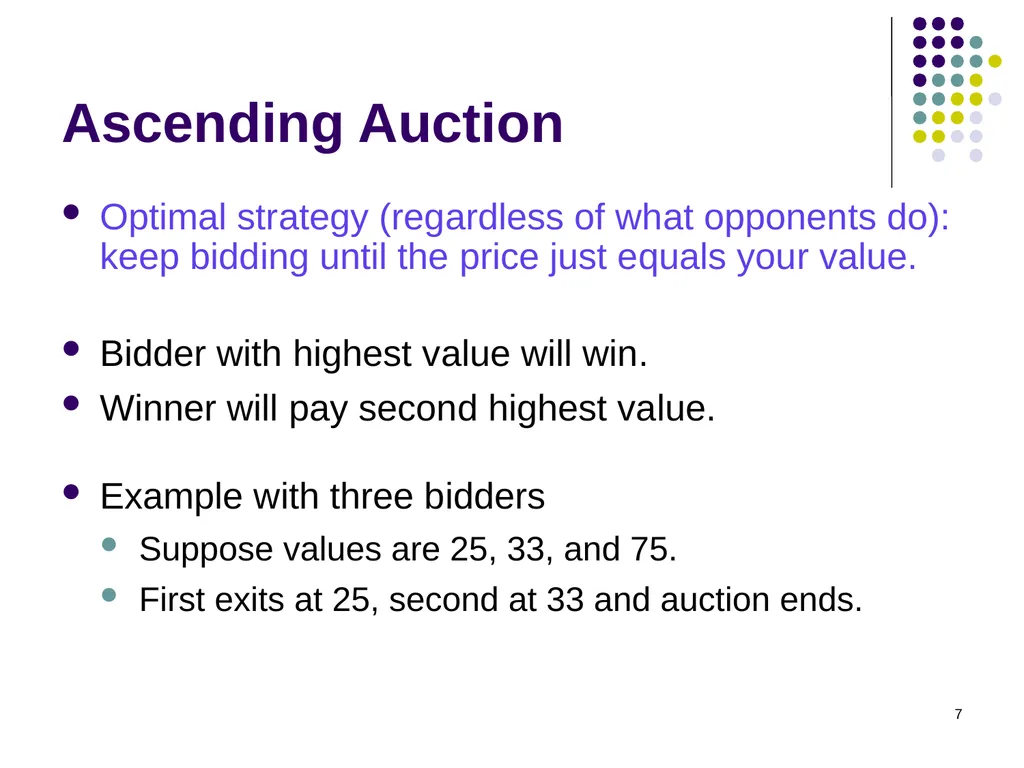
Ascending Auction Optimal strategy (regardless of what opponents do): keep bidding until the price just equals your value.
Bidder with highest value will win.
Winner will pay second highest value.
Example with three bidders
Suppose values are 25, 33, and 75.
First exits at 25, second at 33 and auction ends. 7<br>
Bidder with highest value will win.
Winner will pay second highest value.
Example with three bidders
Suppose values are 25, 33, and 75.
First exits at 25, second at 33 and auction ends. 7<br>
08
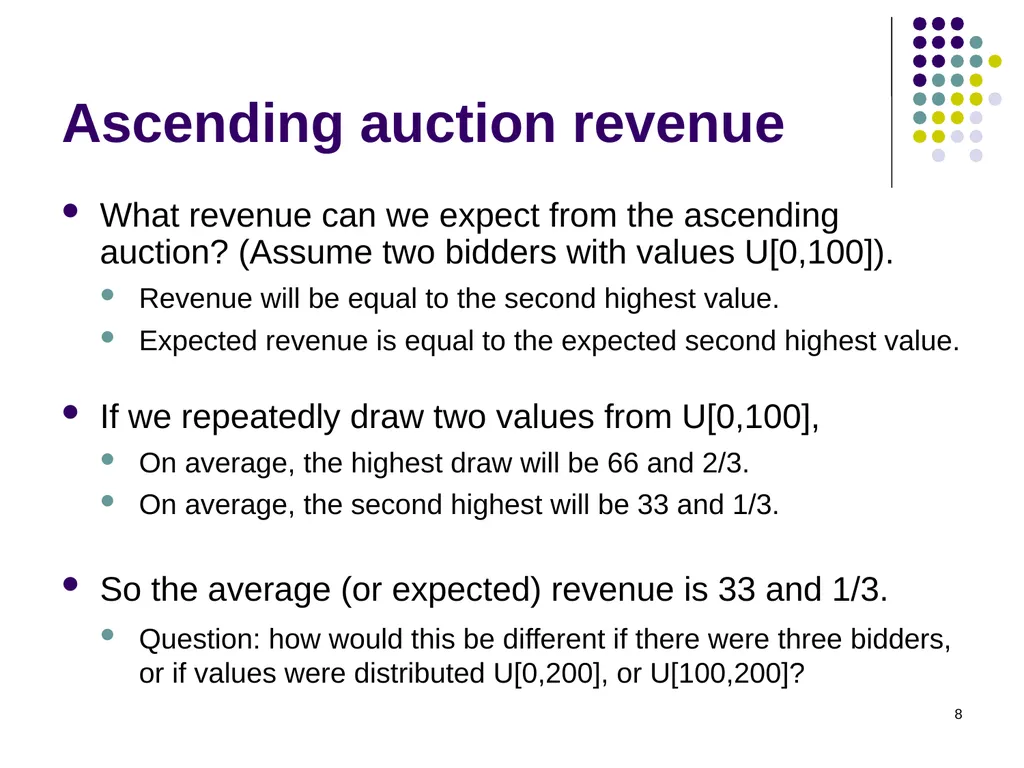
Ascending auction revenue What revenue can we expect from the ascending auction? (Assume two bidders with values U[0,100]).
Revenue will be equal to the second highest value.
Expected revenue is equal to the expected second highest value.
If we repeatedly draw two values from U[0,100],
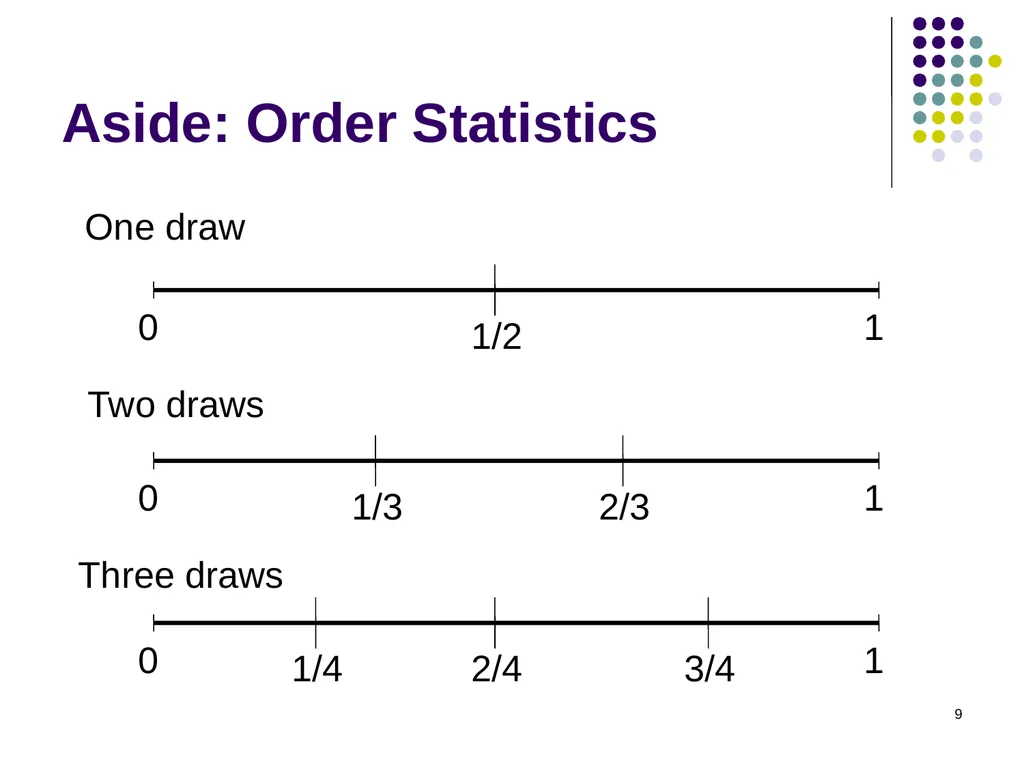
On average, the highest draw will be 66 and 2/3.
On average, the second highest will be 33 and 1/3.
So the average (or expected) revenue is 33 and 1/3.
Question: how would this be different if there were three bidders, or if values were distributed U[0,200], or U[100,200]? 8<br>
09
Aside: Order Statistics 0 1 0 1 0 1 1/2 1/3 2/3 2/4 1/4 3/4 One draw Two draws Three draws 9<br>
10
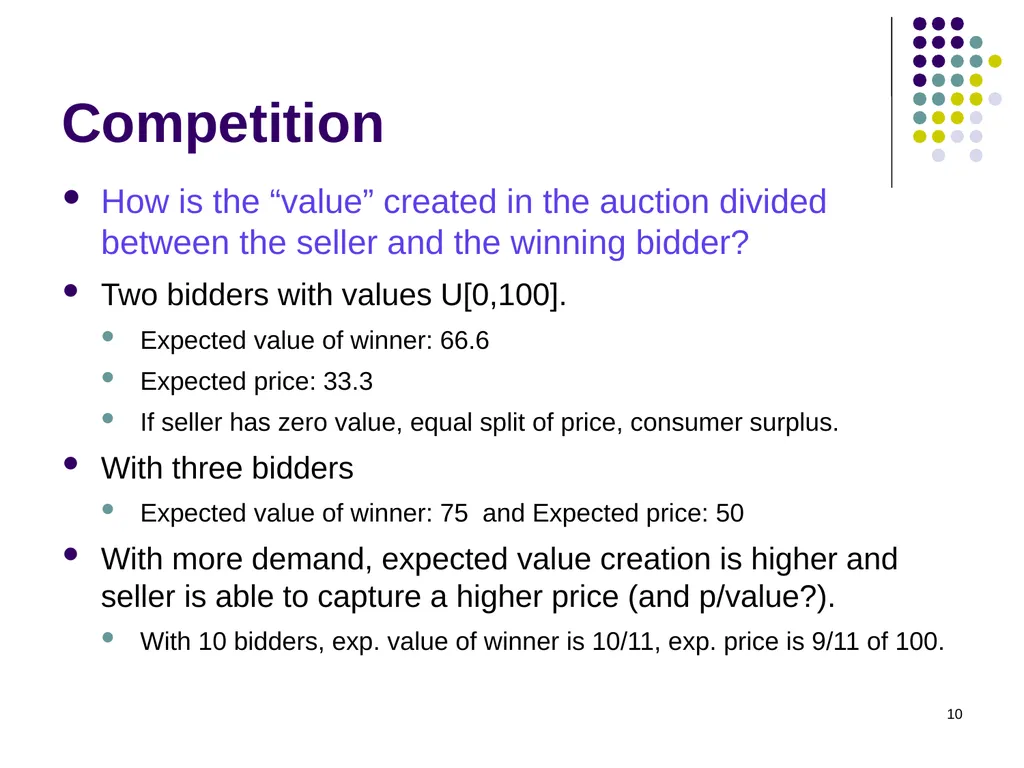
Competition How is the “value” created in the auction divided between the seller and the winning bidder?
Two bidders with values U[0,100].
Expected value of winner: 66.6
Expected price: 33.3
If seller has zero value, equal split of price, consumer surplus.
With three bidders
Expected value of winner: 75 and Expected price: 50
With more demand, expected value creation is higher and seller is able to capture a higher price (and p/value?).
With 10 bidders, exp. value of winner is 10/11, exp. price is 9/11 of 100. 10<br>
11
Second price auction Bidders submit sealed bids.
Seller opens the bids.
Bidder who submitted the highest bid wins.
Winner pays the second highest bid.
How should you bid? 11<br>
Seller opens the bids.
Bidder who submitted the highest bid wins.
Winner pays the second highest bid.
How should you bid? 11<br>
12
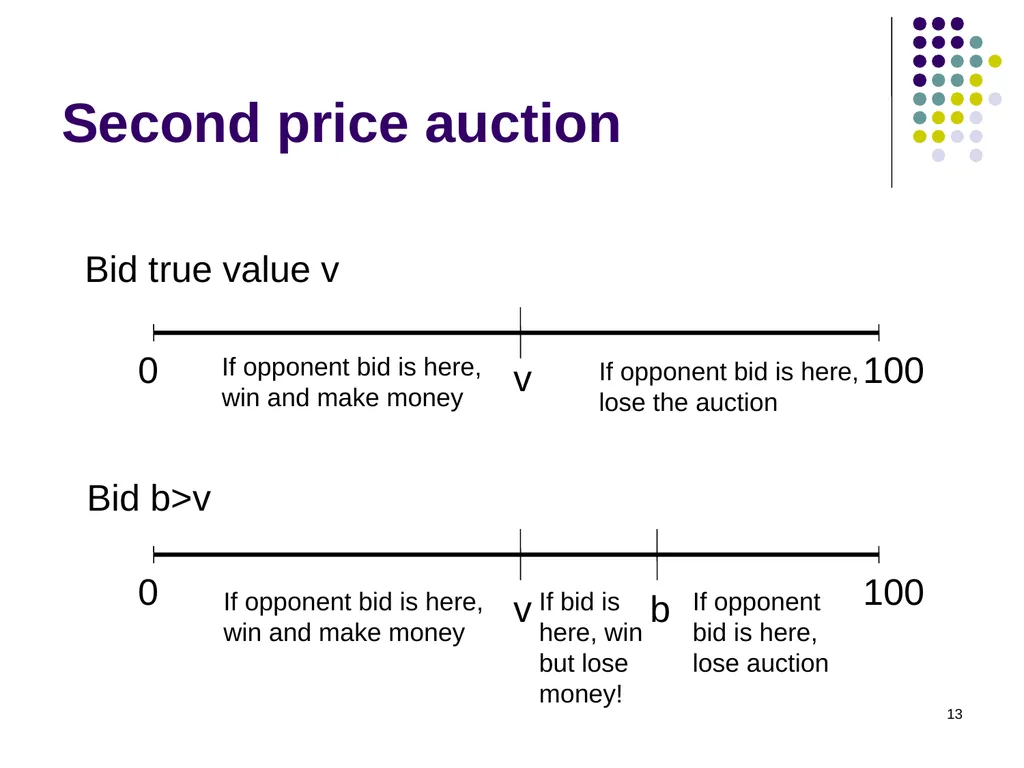
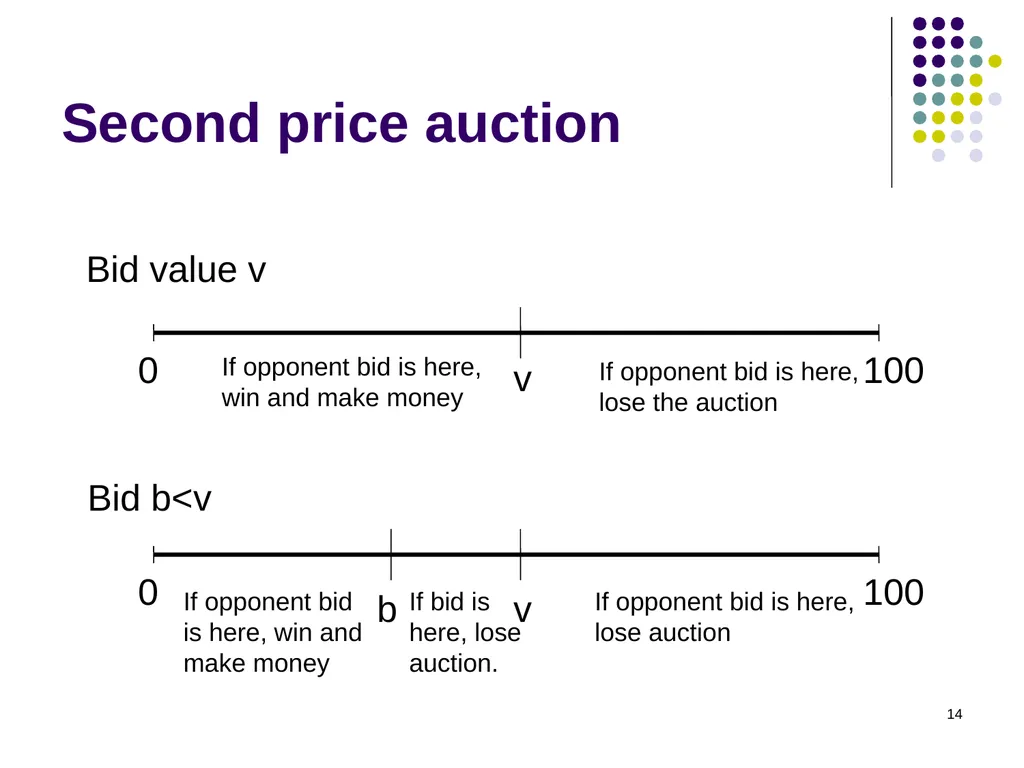
Second price auction Claim. An optimal strategy in the second price auction (regardless of what opponents do) is to bid your value.
Proof
Compare bidding v to bidding some b>v.
Only way the higher bid matters is if opponent bid is above v but less than b. Then you lose if you bid v and win if you bid b, but you pay above your value. So better to have bid v.
Compare bidding v to bidding some b<v.
Only way the lower bid matters is if opponent bid is above b but less than v. Then you lose if you bid b and win if you bid v. So bidding v is better – you win and pay less than your value. 12<br>
13
Second price auction 0 100 0 100 v b v Bid true value v Bid b>v If opponent bid is here,
win and make money If opponent bid is here,
lose the auction If opponent bid is here,
win and make money If opponent bid is here,
lose auction If bid is here, win but lose money! 13<br>
win and make money If opponent bid is here,
lose the auction If opponent bid is here,
win and make money If opponent bid is here,
lose auction If bid is here, win but lose money! 13<br>
14
Second price auction 0 100 0 100 v b v Bid value v Bid b<v If opponent bid is here,
win and make money If opponent bid is here,
lose the auction If opponent bid is here, win and make money If opponent bid is here,
lose auction If bid is here, lose auction. 14<br>
win and make money If opponent bid is here,
lose the auction If opponent bid is here, win and make money If opponent bid is here,
lose auction If bid is here, lose auction. 14<br>
15
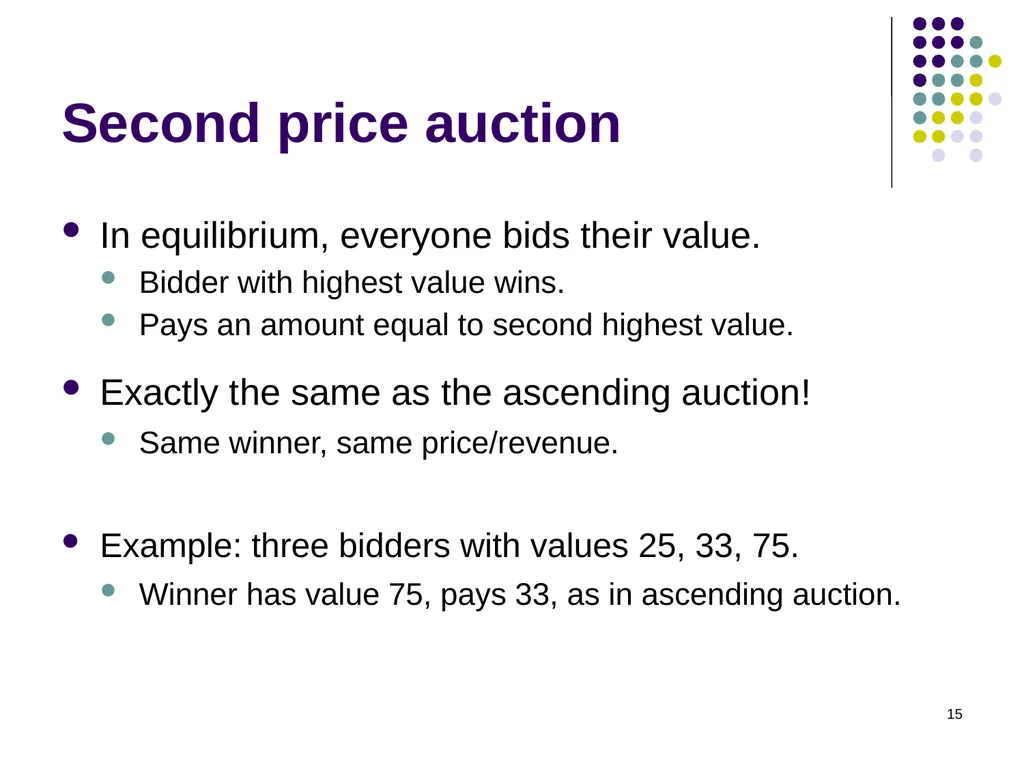
Second price auction In equilibrium, everyone bids their value.
Bidder with highest value wins.
Pays an amount equal to second highest value.
Exactly the same as the ascending auction!
Same winner, same price/revenue.
Example: three bidders with values 25, 33, 75.
Winner has value 75, pays 33, as in ascending auction. 15<br>
Bidder with highest value wins.
Pays an amount equal to second highest value.
Exactly the same as the ascending auction!
Same winner, same price/revenue.
Example: three bidders with values 25, 33, 75.
Winner has value 75, pays 33, as in ascending auction. 15<br>
16
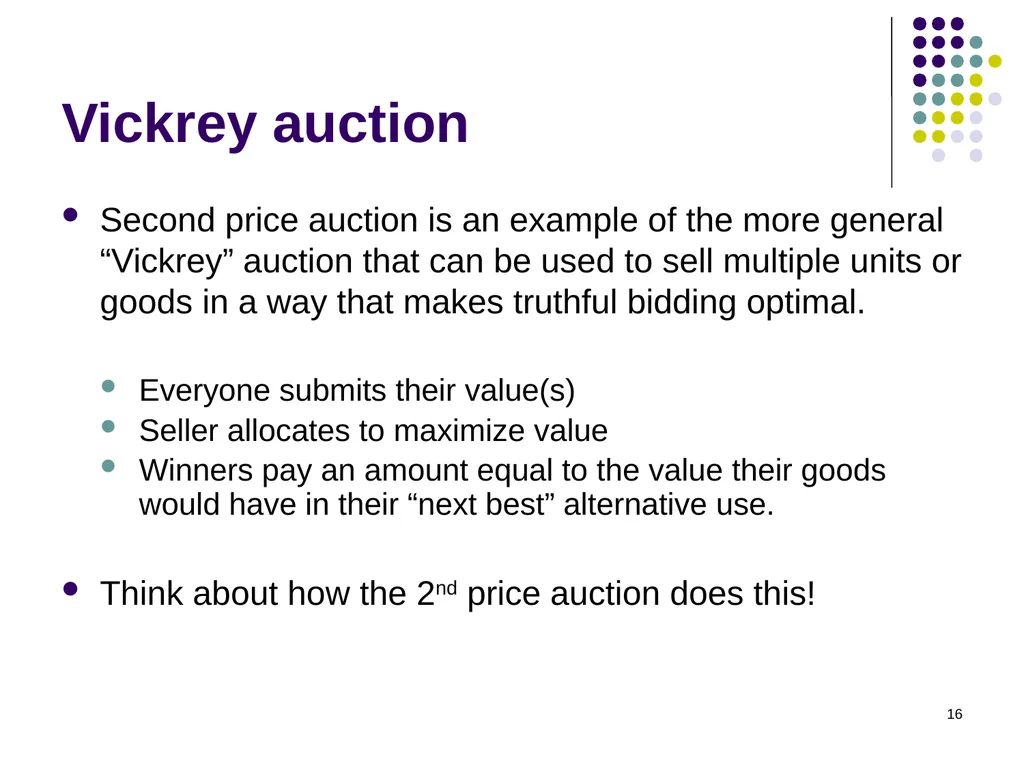
Vickrey auction Second price auction is an example of the more general “Vickrey” auction that can be used to sell multiple units or goods in a way that makes truthful bidding optimal.
Everyone submits their value(s)
Seller allocates to maximize value
Winners pay an amount equal to the value their goods would have in their “next best” alternative use.
Think about how the 2nd price auction does this! 16<br>
Everyone submits their value(s)
Seller allocates to maximize value
Winners pay an amount equal to the value their goods would have in their “next best” alternative use.
Think about how the 2nd price auction does this! 16<br>
17
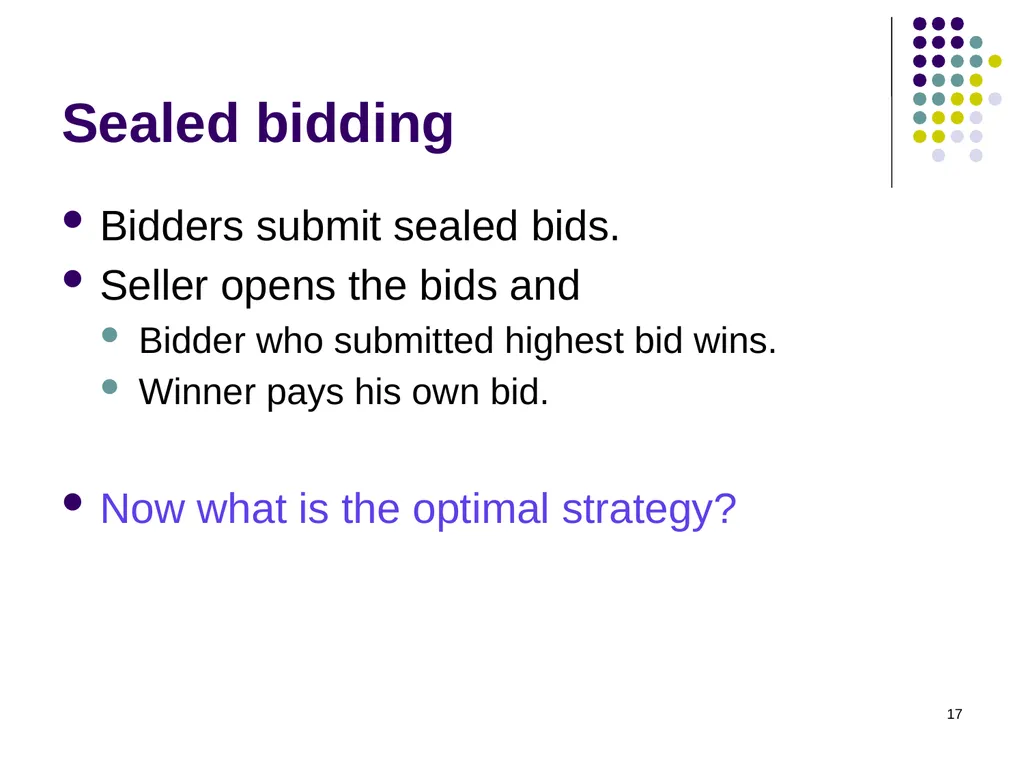
Sealed bidding Bidders submit sealed bids.
Seller opens the bids and
Bidder who submitted highest bid wins.
Winner pays his own bid.
Now what is the optimal strategy? 17<br>
Seller opens the bids and
Bidder who submitted highest bid wins.
Winner pays his own bid.
Now what is the optimal strategy? 17<br>
18
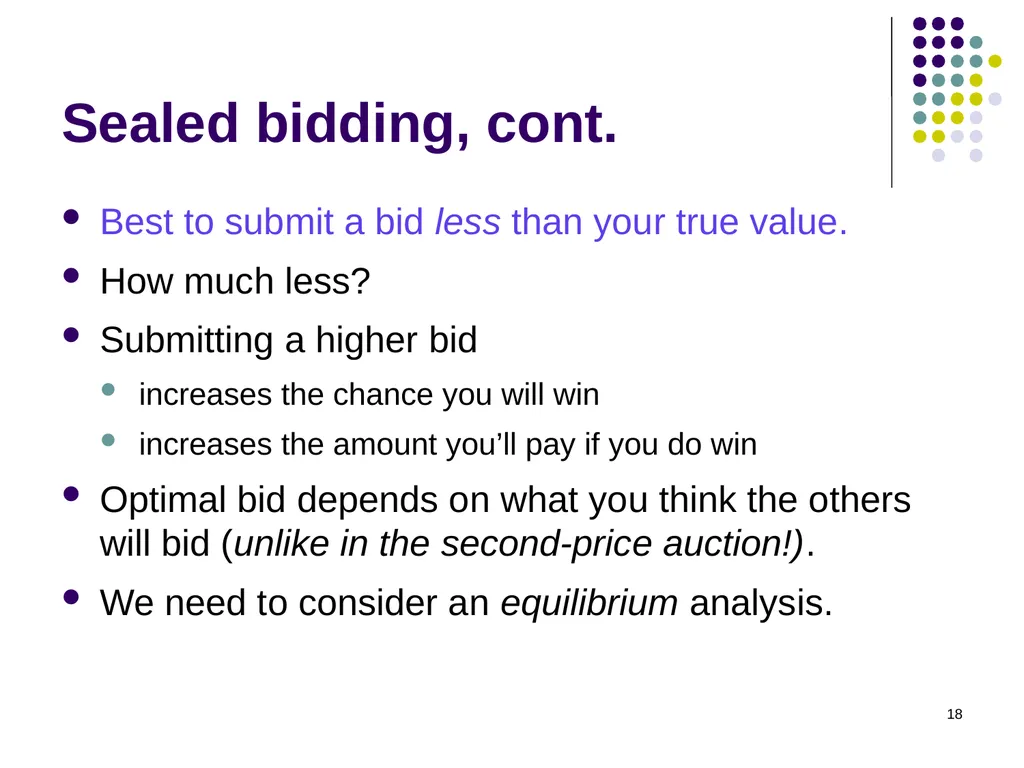
Sealed bidding, cont. Best to submit a bid less than your true value.
How much less?
Submitting a higher bid
increases the chance you will win
increases the amount you’ll pay if you do win
Optimal bid depends on what you think the others will bid (unlike in the second-price auction!).
We need to consider an equilibrium analysis. 18<br>
How much less?
Submitting a higher bid
increases the chance you will win
increases the amount you’ll pay if you do win
Optimal bid depends on what you think the others will bid (unlike in the second-price auction!).
We need to consider an equilibrium analysis. 18<br>
19
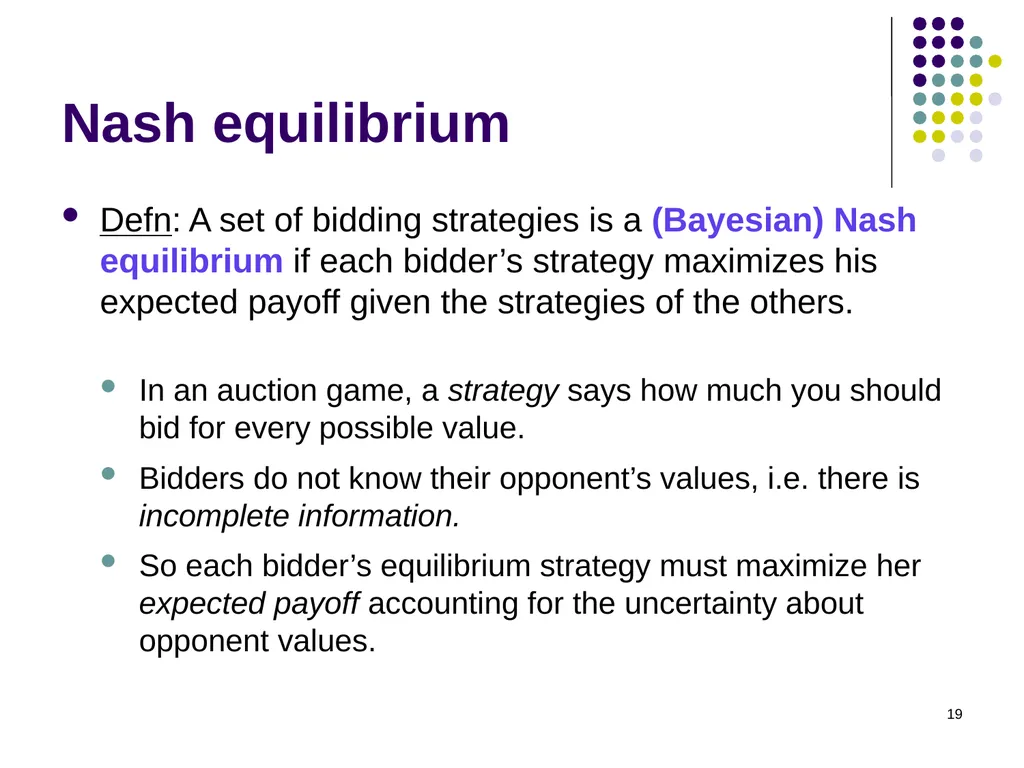
Nash equilibrium Defn: A set of bidding strategies is a (Bayesian) Nash equilibrium if each bidder’s strategy maximizes his expected payoff given the strategies of the others.
In an auction game, a strategy says how much you should bid for every possible value.
Bidders do not know their opponent’s values, i.e. there is incomplete information.
So each bidder’s equilibrium strategy must maximize her expected payoff accounting for the uncertainty about opponent values. 19<br>
20
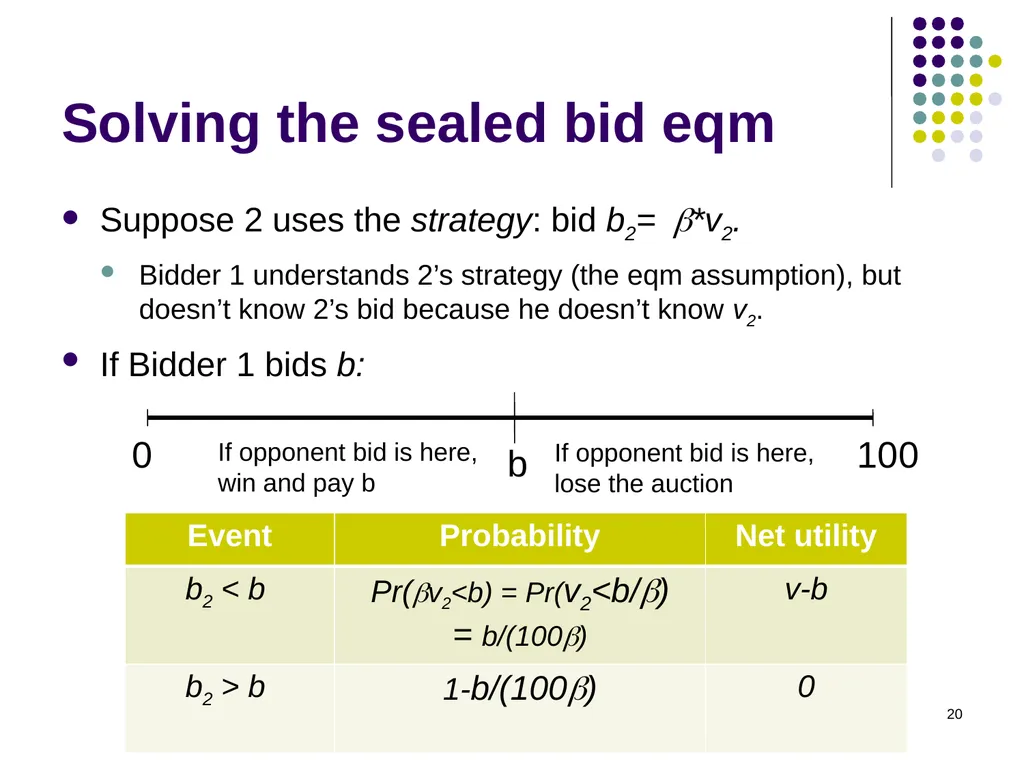
Solving the sealed bid eqm Suppose 2 uses the strategy: bid b2=*v2.
Bidder 1 understands 2’s strategy (the eqm assumption), but doesn’t know 2’s bid because he doesn’t know v2.
If Bidder 1 bids b: 20 0 100 b If opponent bid is here,
win and pay b If opponent bid is here,
lose the auction<br>
Bidder 1 understands 2’s strategy (the eqm assumption), but doesn’t know 2’s bid because he doesn’t know v2.
If Bidder 1 bids b: 20 0 100 b If opponent bid is here,
win and pay b If opponent bid is here,
lose the auction<br>
21
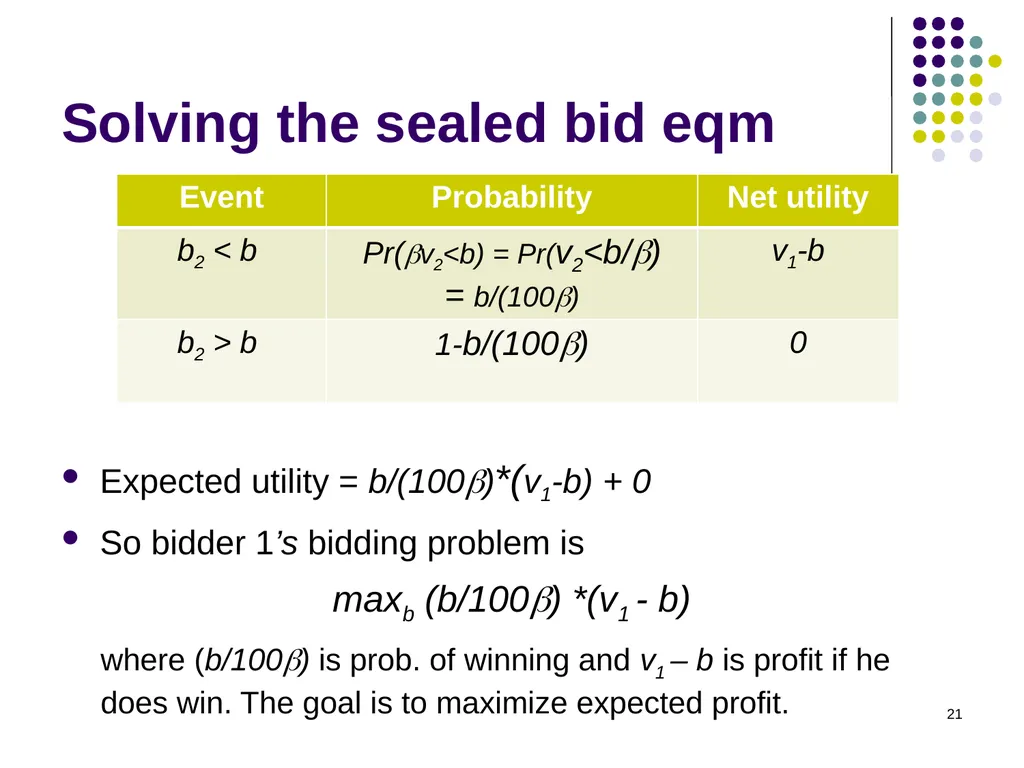
Solving the sealed bid eqm Expected utility = b/(100)*(v1-b) + 0
So bidder 1’s bidding problem is
maxb (b/100) *(v1 - b)
where (b/100) is prob. of winning and v1 – b is profit if he does win. The goal is to maximize expected profit. 21<br>
So bidder 1’s bidding problem is
maxb (b/100) *(v1 - b)
where (b/100) is prob. of winning and v1 – b is profit if he does win. The goal is to maximize expected profit. 21<br>
22
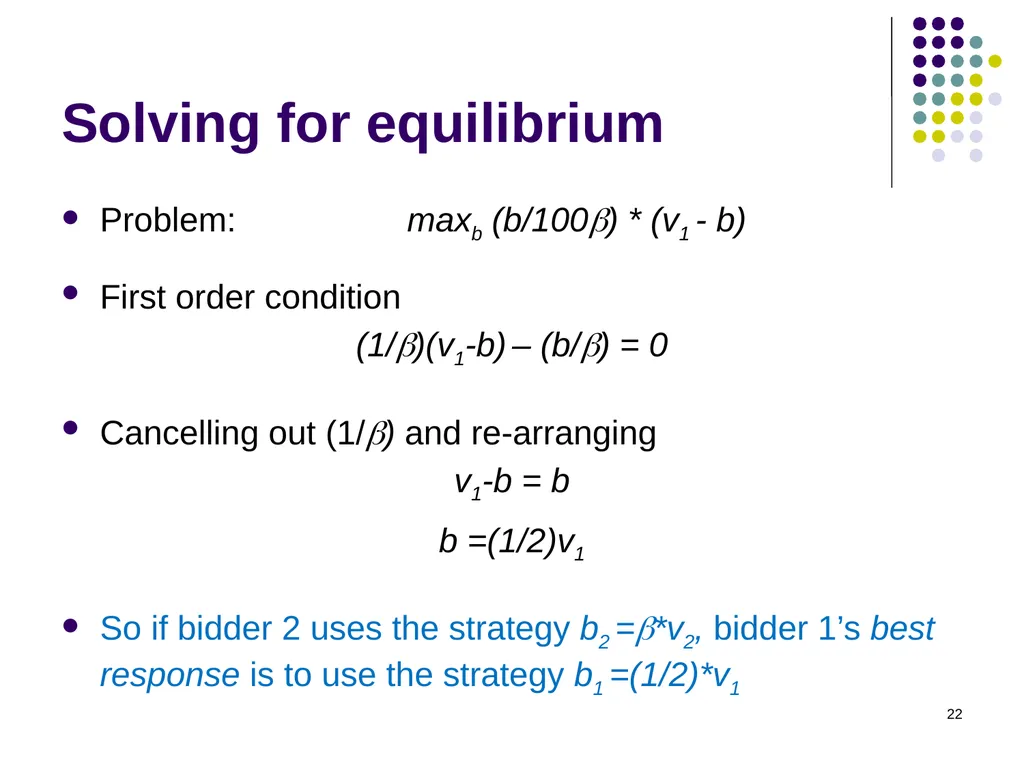
Solving for equilibrium Problem: maxb (b/100) * (v1 - b)
First order condition
(1/)(v1-b) – (b/) = 0
Cancelling out (1/) and re-arranging
v1-b = b
b =(1/2)v1
So if bidder 2 uses the strategy b2 =*v2, bidder 1’s best response is to use the strategy b1 =(1/2)*v1 22<br>
First order condition
(1/)(v1-b) – (b/) = 0
Cancelling out (1/) and re-arranging
v1-b = b
b =(1/2)v1
So if bidder 2 uses the strategy b2 =*v2, bidder 1’s best response is to use the strategy b1 =(1/2)*v1 22<br>
23
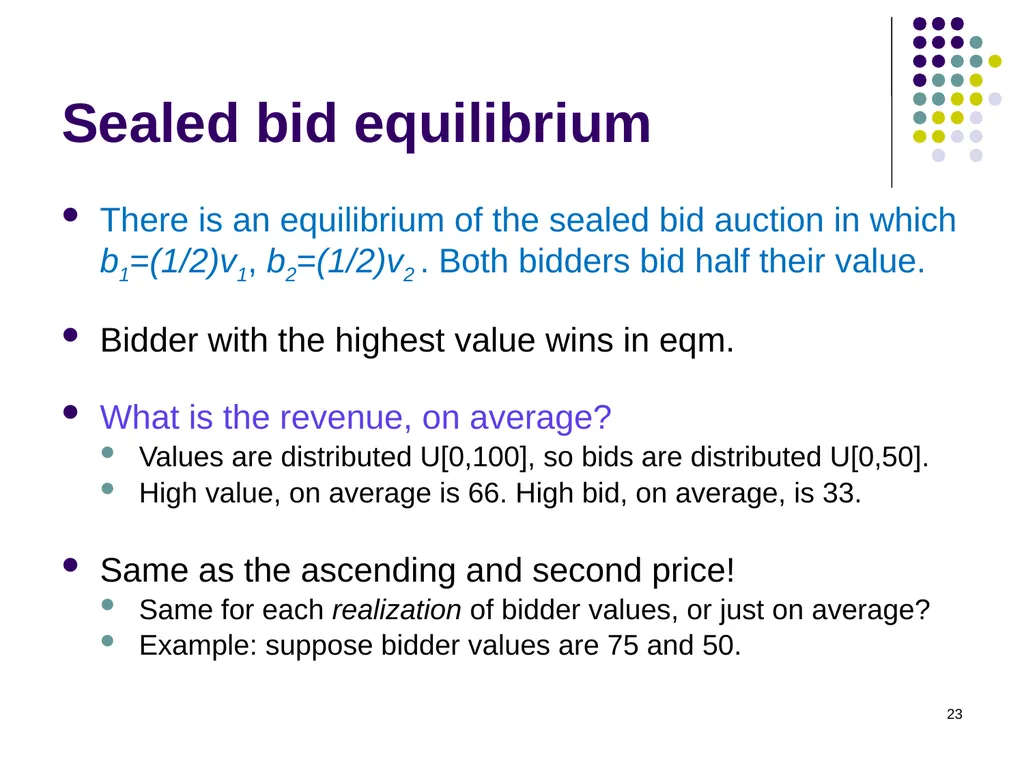
Sealed bid equilibrium There is an equilibrium of the sealed bid auction in which b1=(1/2)v1, b2=(1/2)v2 . Both bidders bid half their value.
Bidder with the highest value wins in eqm.
What is the revenue, on average?
Values are distributed U[0,100], so bids are distributed U[0,50].
High value, on average is 66. High bid, on average, is 33.
Same as the ascending and second price!
Same for each realization of bidder values, or just on average?
Example: suppose bidder values are 75 and 50. 23<br>
24
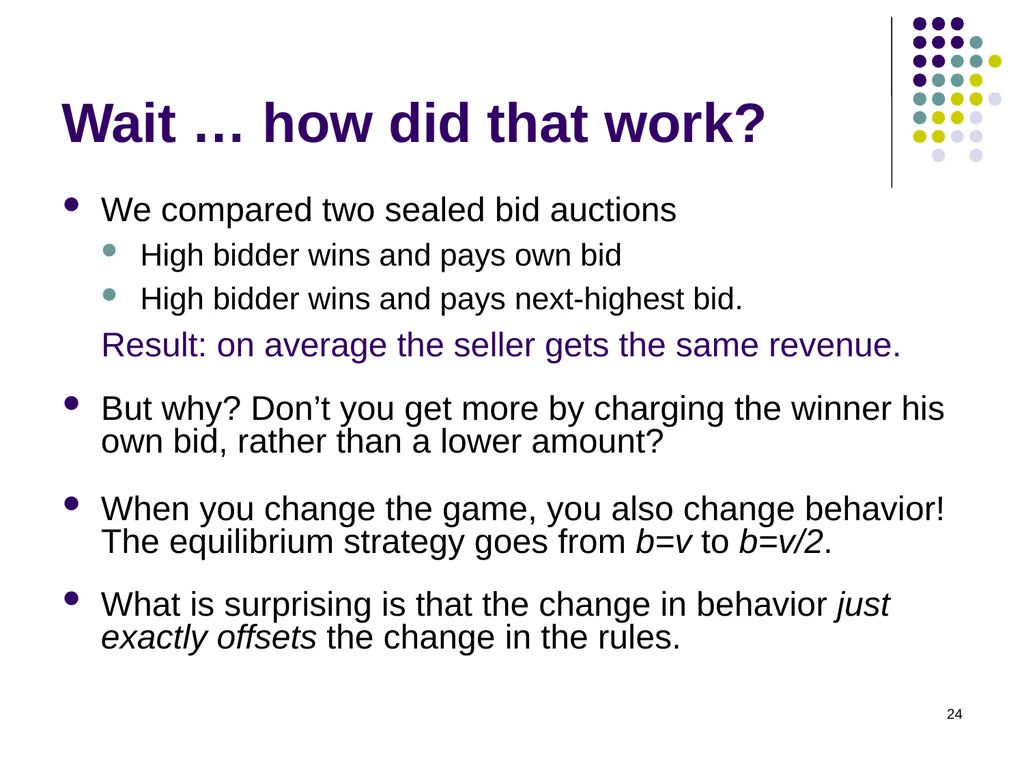
Wait … how did that work? We compared two sealed bid auctions
High bidder wins and pays own bid
High bidder wins and pays next-highest bid.
Result: on average the seller gets the same revenue.
But why? Don’t you get more by charging the winner his own bid, rather than a lower amount?
When you change the game, you also change behavior! The equilibrium strategy goes from b=v to b=v/2.
What is surprising is that the change in behavior just exactly offsets the change in the rules. 24<br>
25
The Equivalence Theorem We’ve seen that several standard auctions share the following properties if bidders play according to Nash equilibrium:
The high value bidder wins.
The expected auction price equals the expected value of the second highest bidder.
The result that “efficient” auctions (where the high value bidder wins) are “revenue equivalent” (yield the same price on average) is quite general (see RET handout).
It actually has been the source of two Nobel Prizes: William Vickrey in 1996 for the first version of the result, and Roger Myerson in 2007 for using a generalization of it to describe “optimal” auctions. 25<br>
26
Other forms of auction Descending price (Dutch) auction
Price starts high, drops continuously until someone buys.
Strategically “equivalent” to a first price auction.
“All pay” auction
Bidders submit bids, high bidder wins, and everyone has to pay their bid.
Not commonly seen, but sometimes used as a stylized model of political lobbying donations, or contests where money is spent to win.
“Penny auctions”
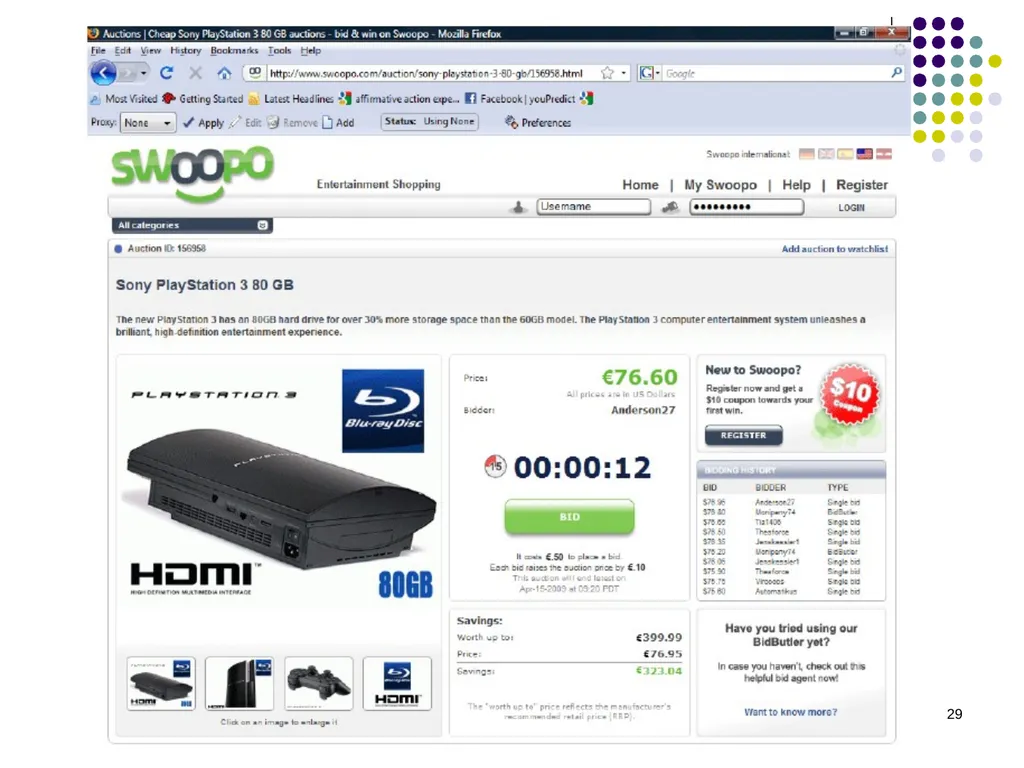
Ascending auction, with the twist that you pay for every bid along the way. Popular on-line, e.g. Swoopo. 26<br>
27
Elements of Auction Design Sellers have a variety of ways to modify the basic auction forms and try to increase their revenue, or achieve other objectives.
Attracting bidders to participate in the auction.
Setting a reserve price (or “minimum bid).
Subsidizing weak bidders to create competition.
In many settings, such as procurement, there is also the challenge of making sure bidders compete (i.e. don’t collude). The Klemperer paper on the reading list emphasizes this. 27<br>
28
Are bidders really strategic? Game theory models we’ve looked at assume that bidders understand the environment and behave strategically. A good assumption?
No simple answer to this question
Lots of evidence against the assumption when looking at bidders in novel environments with little feedback.
But potentially a reasonable assumption for experienced and sophisticated bidders in familiar environments.
Consider a few examples 28<br>
No simple answer to this question
Lots of evidence against the assumption when looking at bidders in novel environments with little feedback.
But potentially a reasonable assumption for experienced and sophisticated bidders in familiar environments.
Consider a few examples 28<br>
29
29<br>
30
Swoopo Auction Auction rules
Price starts at $0, and clock starts to run down.
Placing a bid costs $0.50.
A bid re-starts the clock, price increases by $0.10.
If clock expires, auction ends. Standing high bidder is the winner and pays the current price.
Swoopo sells common items (electronics, sometimes even cash). 30<br>
Price starts at $0, and clock starts to run down.
Placing a bid costs $0.50.
A bid re-starts the clock, price increases by $0.10.
If clock expires, auction ends. Standing high bidder is the winner and pays the current price.
Swoopo sells common items (electronics, sometimes even cash). 30<br>
31
Excess bidding on Swoopo? Ned Augenblick’s Stanford dissertation
Data from 650 auctions of $50 bills: average revenue: $104!
More general data from over 100,000 Swoopo auctions in 2008: revenue was 52% above Amazon price; Swoopo making millions.
Maybe bidders in auctions just get carried away?
However, in March 2011, Swoopo filed for bankruptcy.
Maybe the bidders caught on? Google trends 31<br>
32
32<br>
33
Excess bidding on eBay? Lee and Malmendier (2011)
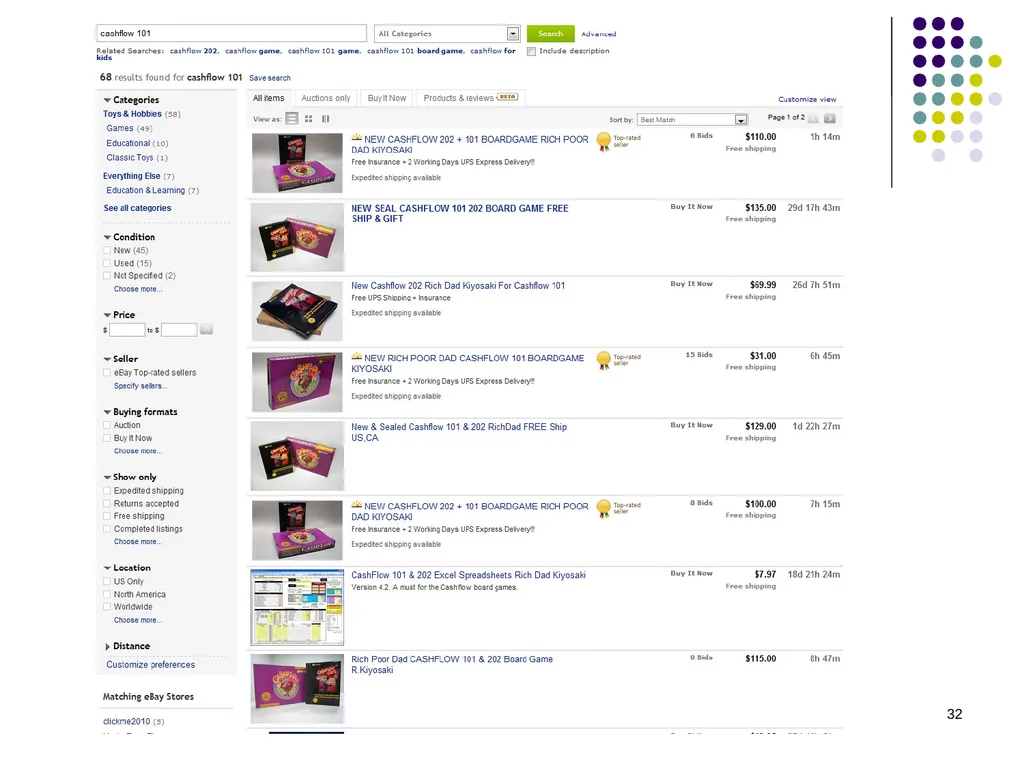
Auctions for Cashflow 101 – in 2004.
Available from two eBay sellers at posted price: $129.95.
Price went higher in 42% of the auctions!
But …. Einav, Kuchler, Levin & Sundaresan (2012)
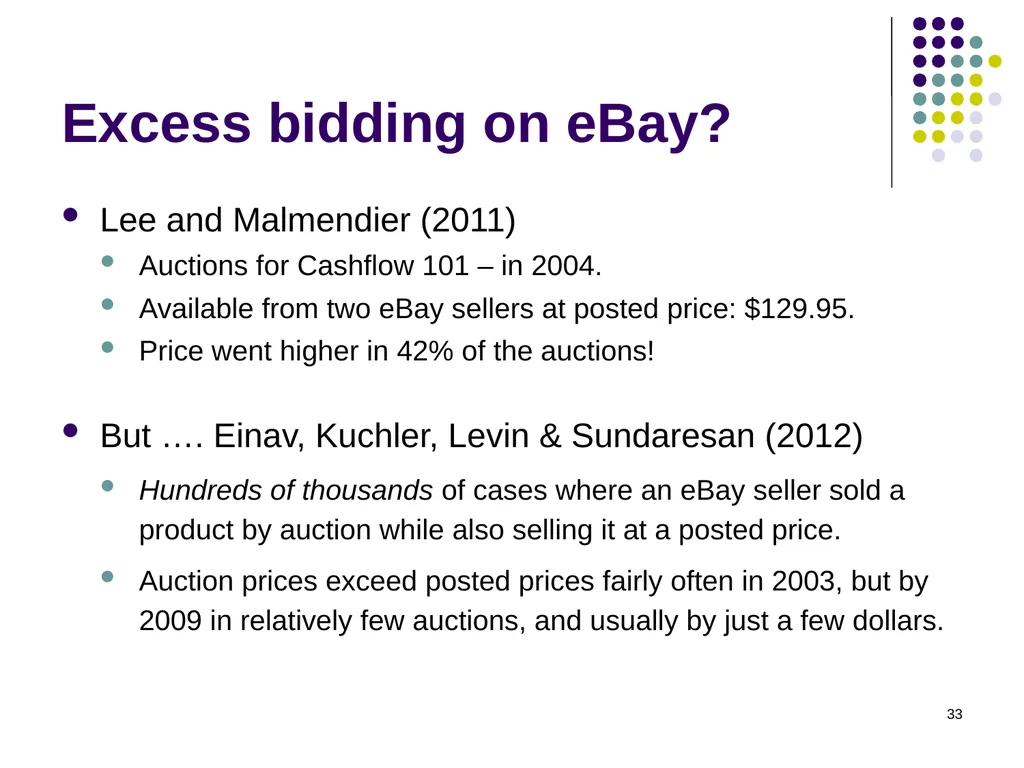
Hundreds of thousands of cases where an eBay seller sold a product by auction while also selling it at a posted price.
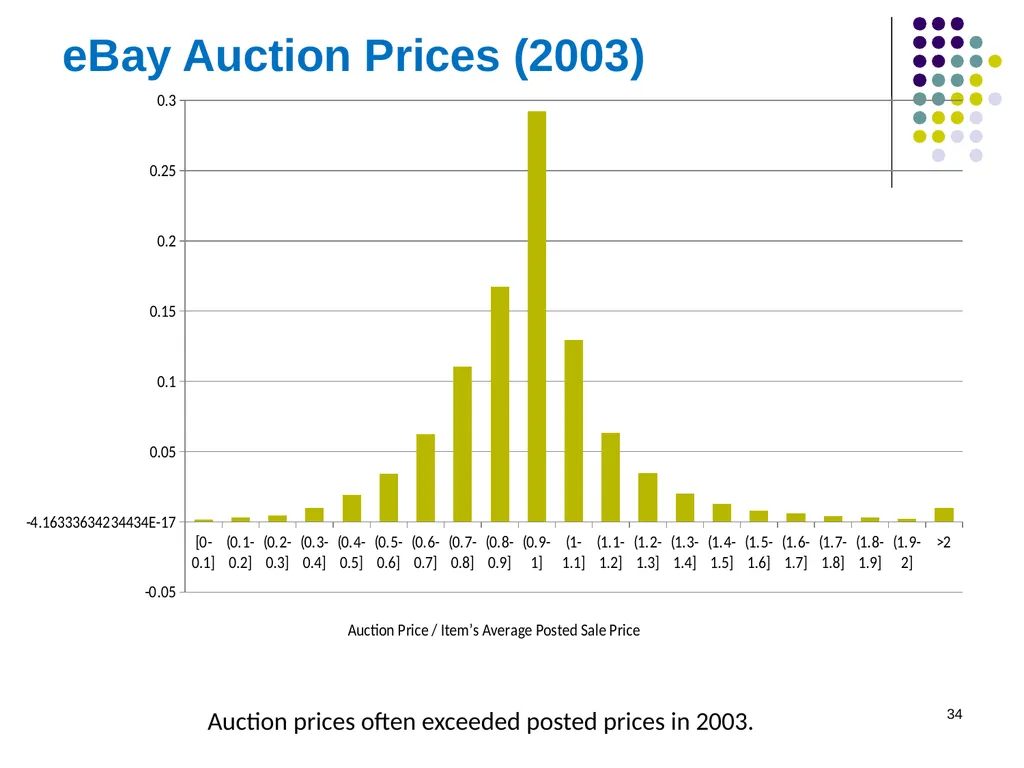
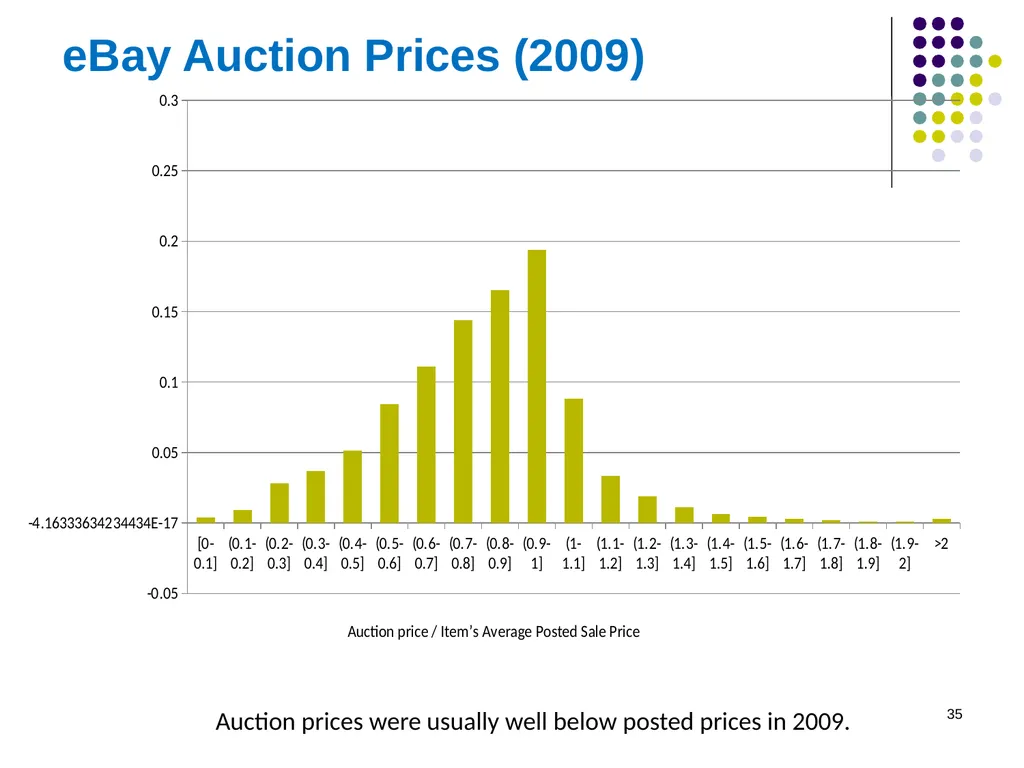
Auction prices exceed posted prices fairly often in 2003, but by 2009 in relatively few auctions, and usually by just a few dollars. 33<br>
34
eBay Auction Prices (2003) 34 Auction prices often exceeded posted prices in 2003.<br>
35
eBay Auction Prices (2009) 35 Auction prices were usually well below posted prices in 2009.<br>
36
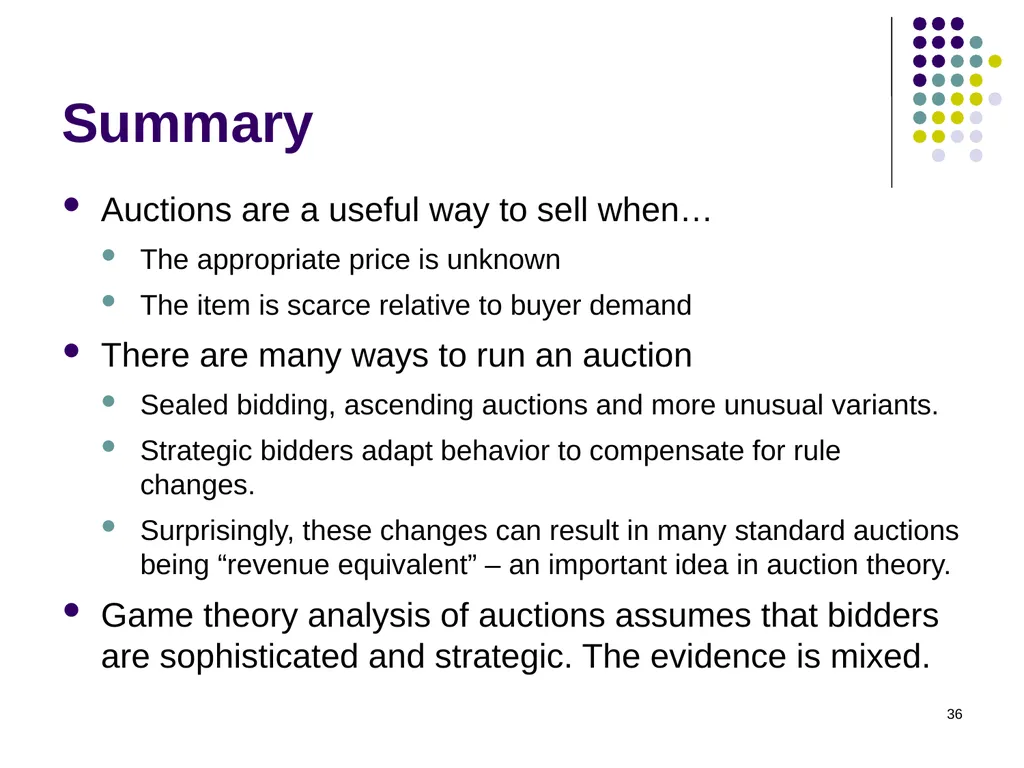
Summary Auctions are a useful way to sell when…
The appropriate price is unknown
The item is scarce relative to buyer demand
There are many ways to run an auction
Sealed bidding, ascending auctions and more unusual variants.
Strategic bidders adapt behavior to compensate for rule changes.
Surprisingly, these changes can result in many standard auctions being “revenue equivalent” – an important idea in auction theory.
Game theory analysis of auctions assumes that bidders are sophisticated and strategic. The evidence is mixed. 36<br>