BackDoor: Making Microphones Hear Inaudible Sounds Nirupam Roy, Haitham Hassanieh, Romit Roy Choudhury University of Illinois at Urbana-Champaign Presented by: Chen Shi 02222018 Overview BackDoor System RF Receiver Record high frequency
"BackDoor: Making Microphones Hear Inaudible Sounds" is the property of its rightful owner. Permission is granted to
download and print the materials on this website for personal, non-commercial use only, and to display it
on your personal computer provided you do not modify the materials and that you retain all copyright
notices contained in the materials. By downloading content from our website, you accept the terms of this
agreement.
Presentation Transcript
01
BackDoor: Making Microphones Hear Inaudible Sounds Nirupam Roy, Haitham Hassanieh, Romit Roy Choudhury University of Illinois at Urbana-Champaign Presented by: Chen Shi
02/22/2018<br>
02
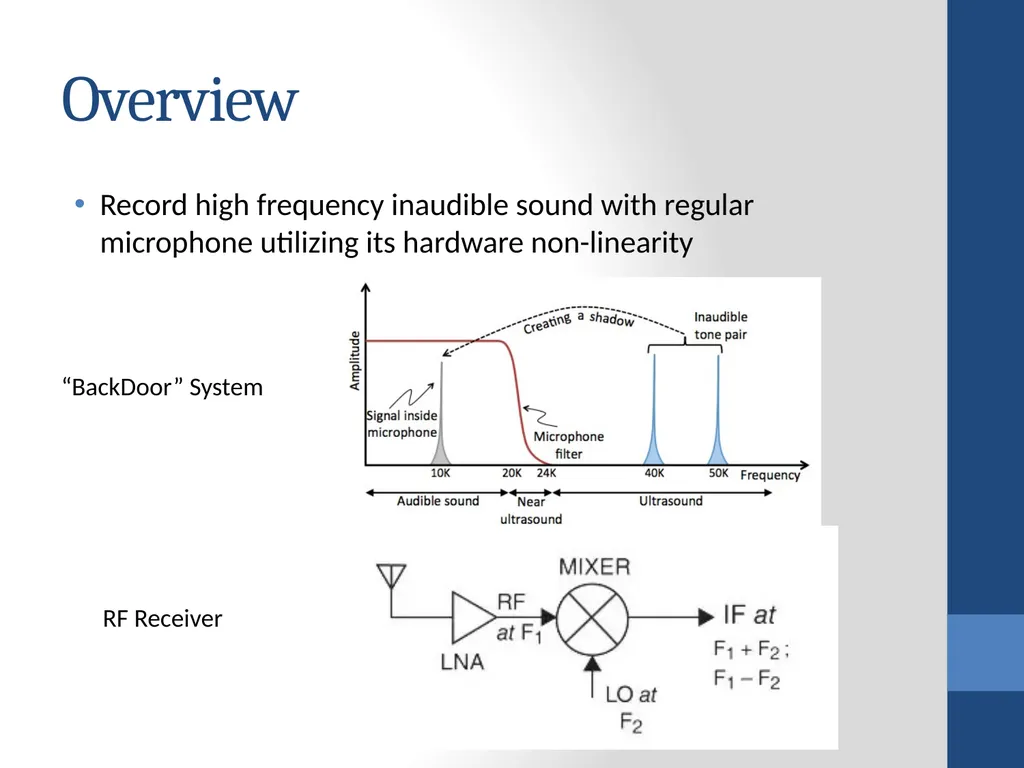
Overview “BackDoor” System RF Receiver Record high frequency inaudible sound with regular microphone utilizing its hardware non-linearity<br>
03
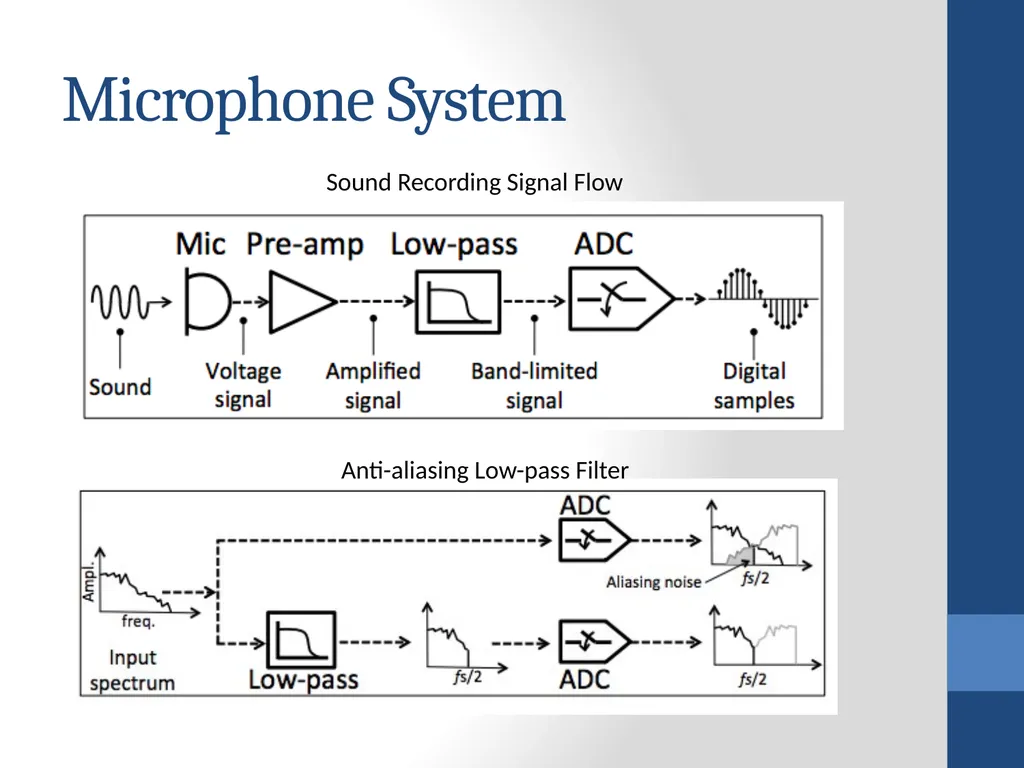
Microphone System Sound Recording Signal Flow Anti-aliasing Low-pass Filter<br>
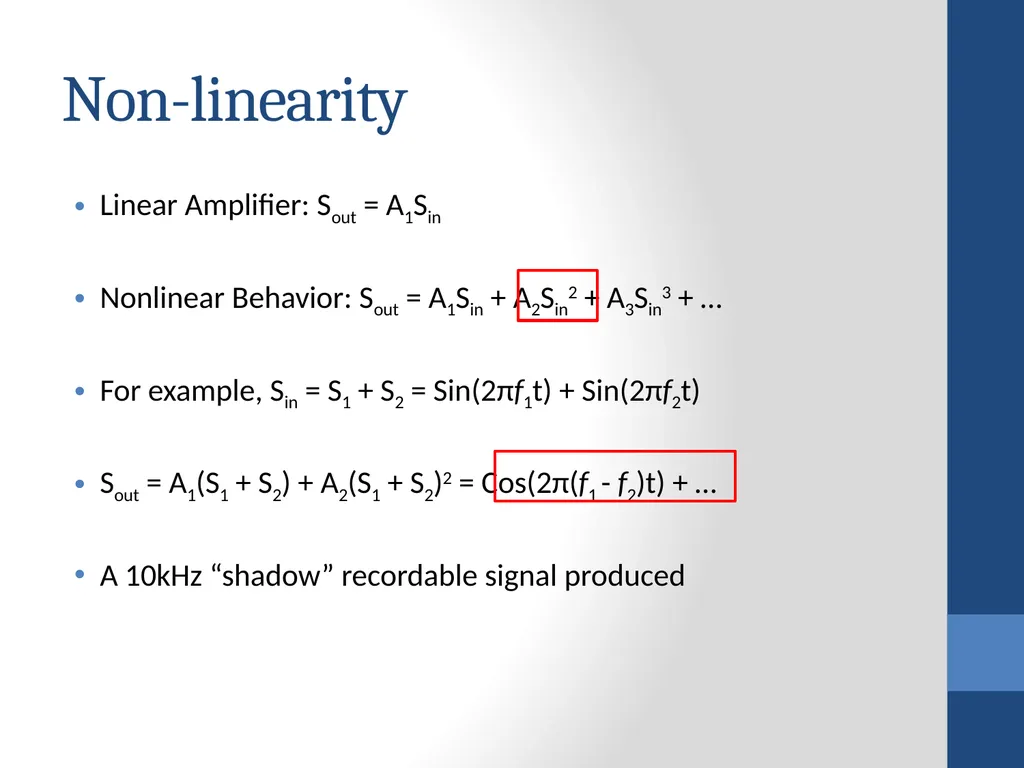
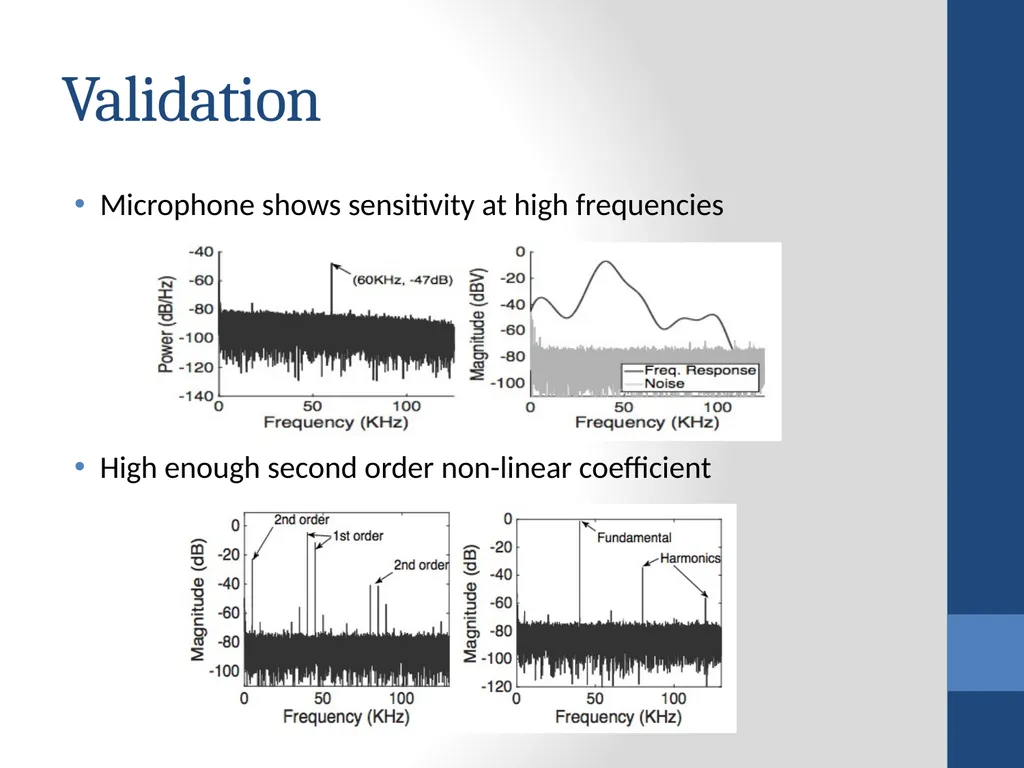
Validation Microphone shows sensitivity at high frequencies
High enough second order non-linear coefficient<br>
06
System Design - Data Communication Transmitter – Speaker | Receiver – Microphone
Transmitter Design
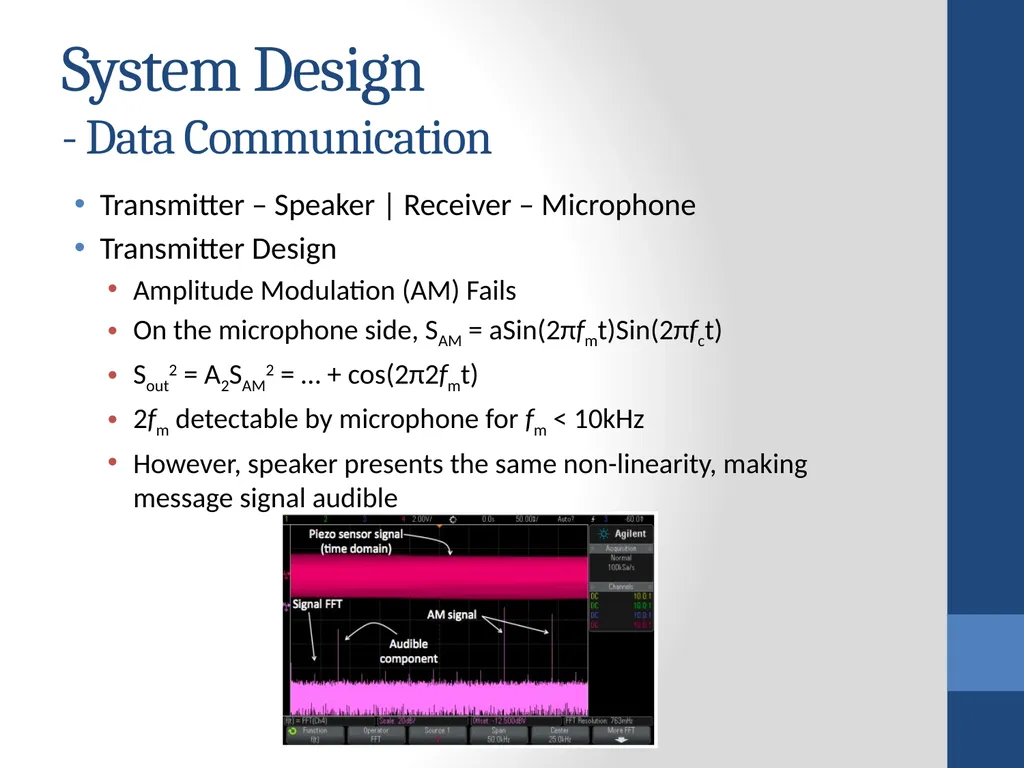
Amplitude Modulation (AM) Fails
On the microphone side, SAM = aSin(2πfmt)Sin(2πfct)
Sout2 = A2SAM2 = … + cos(2π2fmt)
2fm detectable by microphone for fm < 10kHz
However, speaker presents the same non-linearity, making message signal audible<br>
07
System Design - Data Communication Transmitter Design
Frequency Modulation (FM)
SFM = Sin(2πfct + bSin(2πfmt))
Sout2 = … + (1 + Cos(2π2fc) + …), speaker output not audible
However, microphone cannot record 2fc
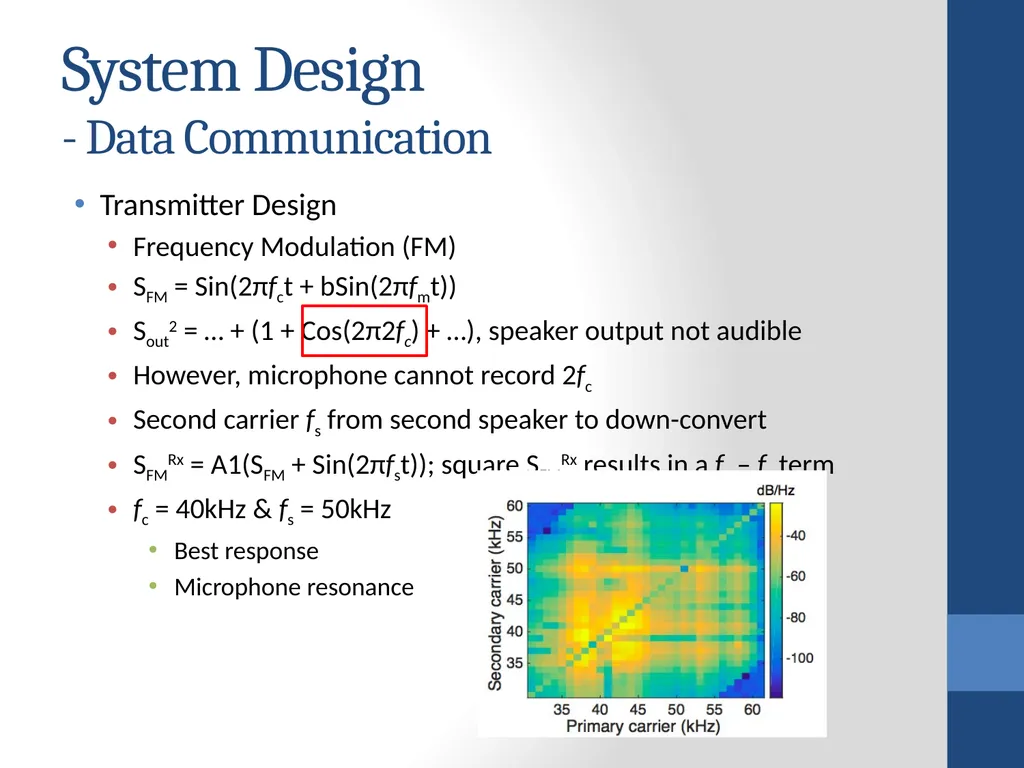
Second carrier fs from second speaker to down-convert
SFMRx = A1(SFM + Sin(2πfst)); square SFMRx results in a fc – fs term
fc = 40kHz & fs = 50kHz
Best response
Microphone resonance<br>
08
System Design - Data Communication Transmitter Design
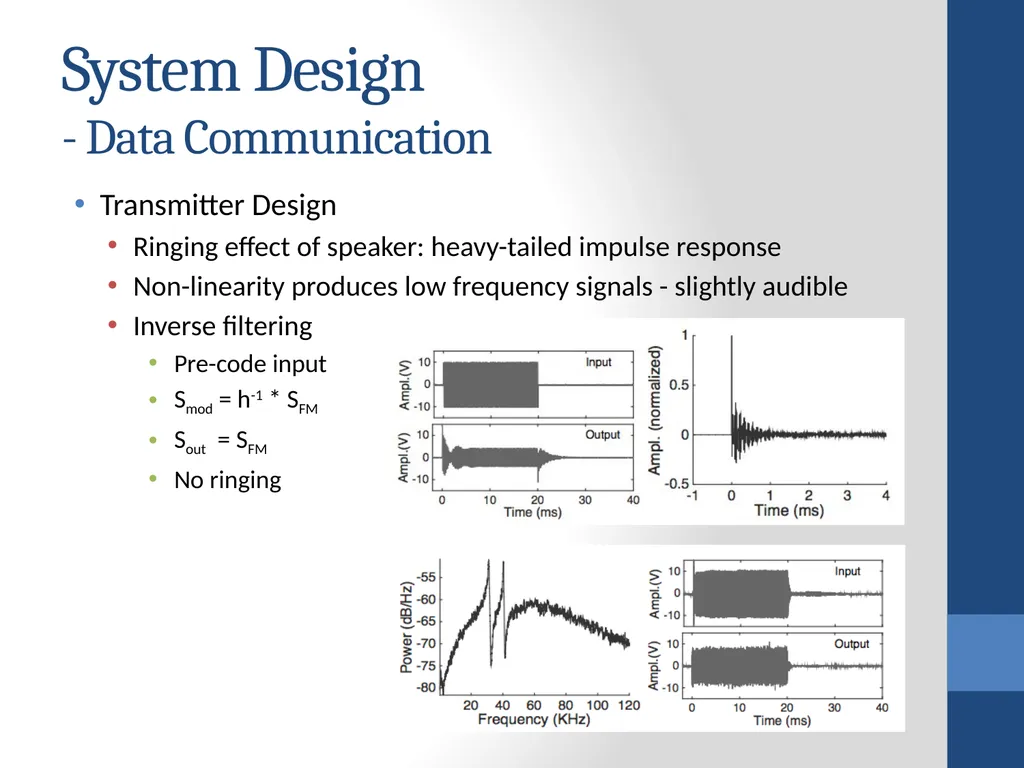
Ringing effect of speaker: heavy-tailed impulse response
Non-linearity produces low frequency signals - slightly audible
Inverse filtering
Pre-code input
Smod = h-1 * SFM
Sout = SFM
No ringing<br>
09
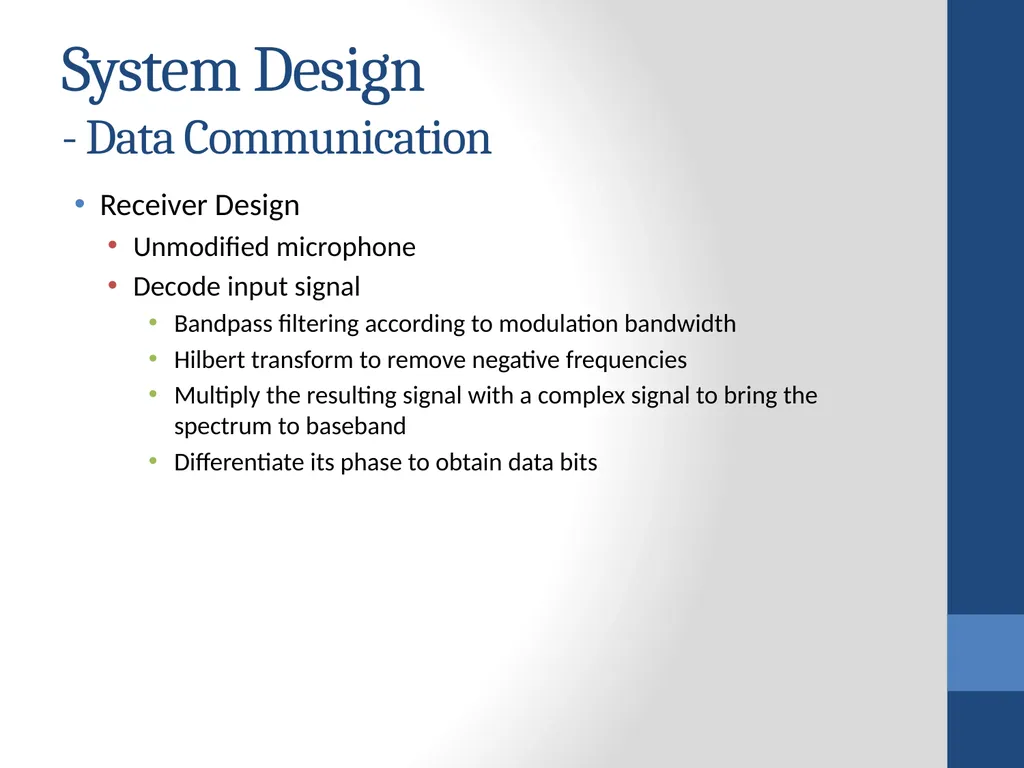
System Design - Data Communication Receiver Design
Unmodified microphone
Decode input signal
Bandpass filtering according to modulation bandwidth
Hilbert transform to remove negative frequencies
Multiply the resulting signal with a complex signal to bring the spectrum to baseband
Differentiate its phase to obtain data bits<br>
10
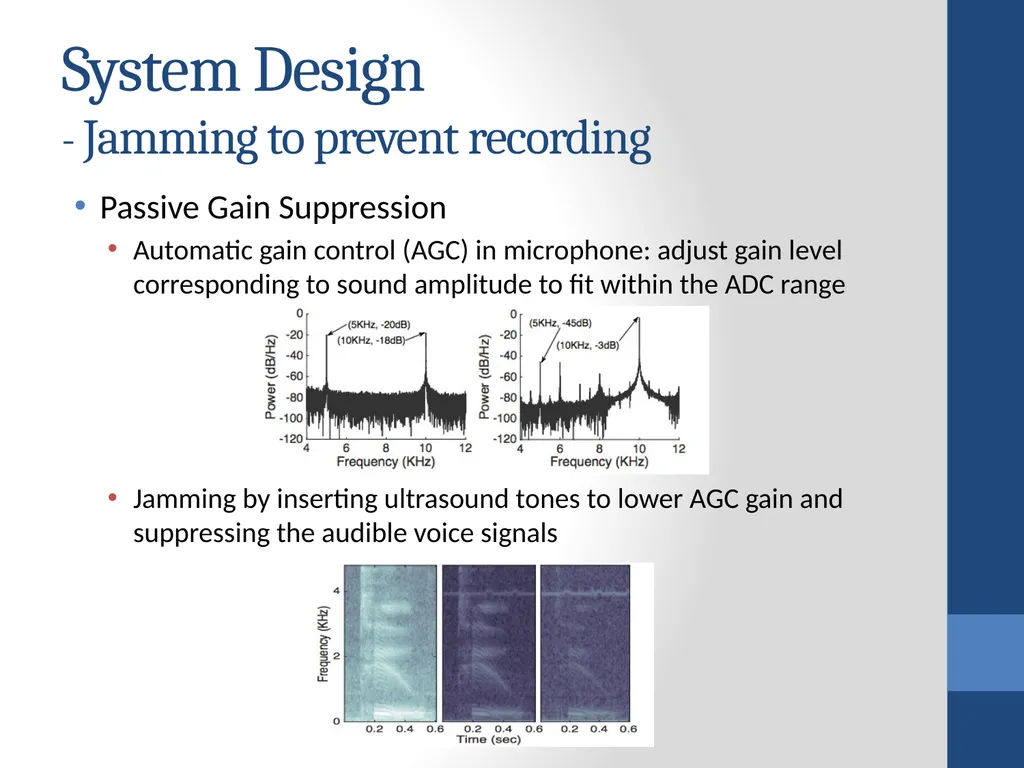
System Design - Jamming to prevent recording Passive Gain Suppression
Automatic gain control (AGC) in microphone: adjust gain level corresponding to sound amplitude to fit within the ADC range
Jamming by inserting ultrasound tones to lower AGC gain and suppressing the audible voice signals<br>
11
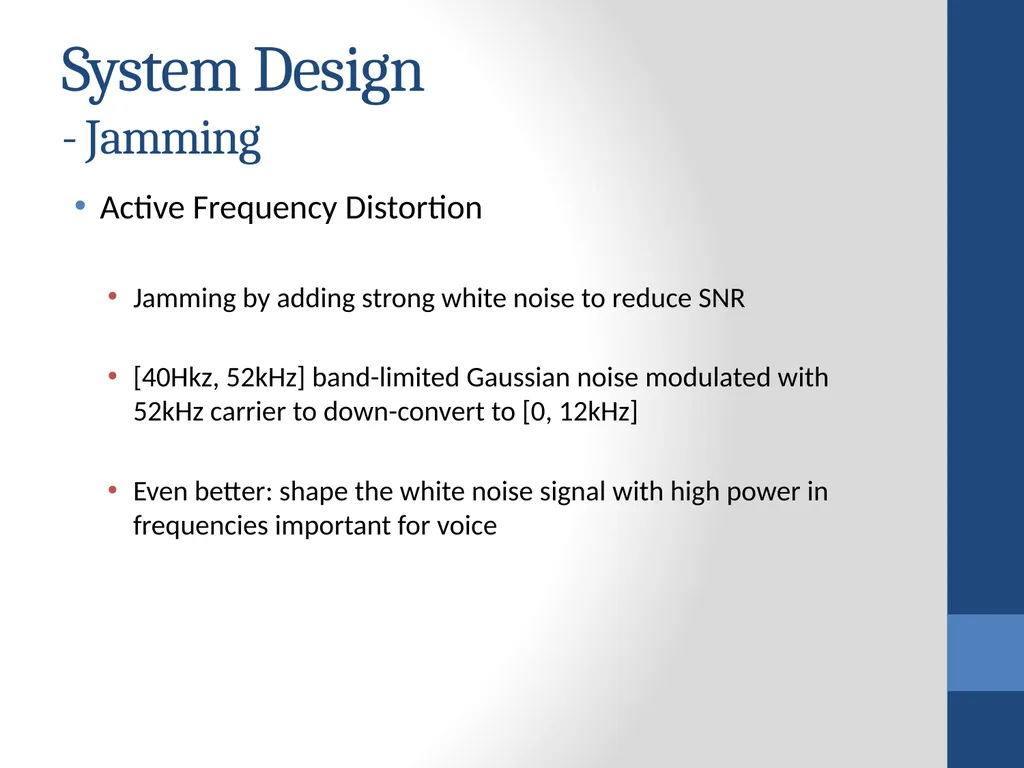
System Design - Jamming Active Frequency Distortion
Jamming by adding strong white noise to reduce SNR
[40Hkz, 52kHz] band-limited Gaussian noise modulated with 52kHz carrier to down-convert to [0, 12kHz]
Even better: shape the white noise signal with high power in frequencies important for voice<br>
12
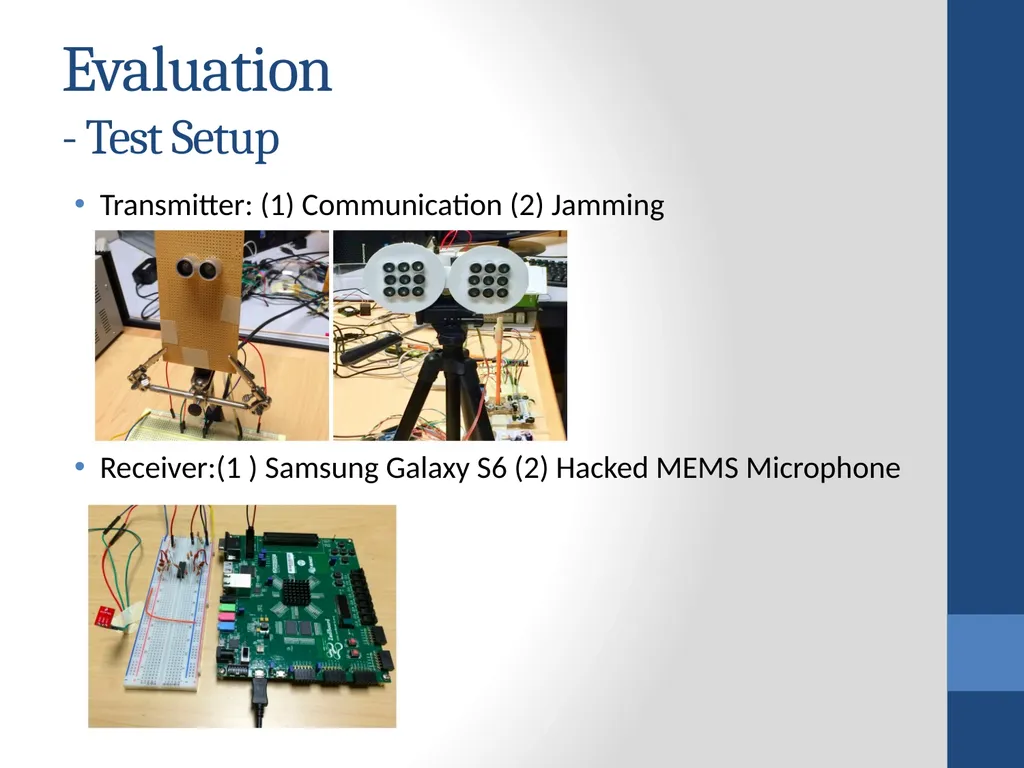
Evaluation - Test Setup Transmitter: (1) Communication (2) Jamming
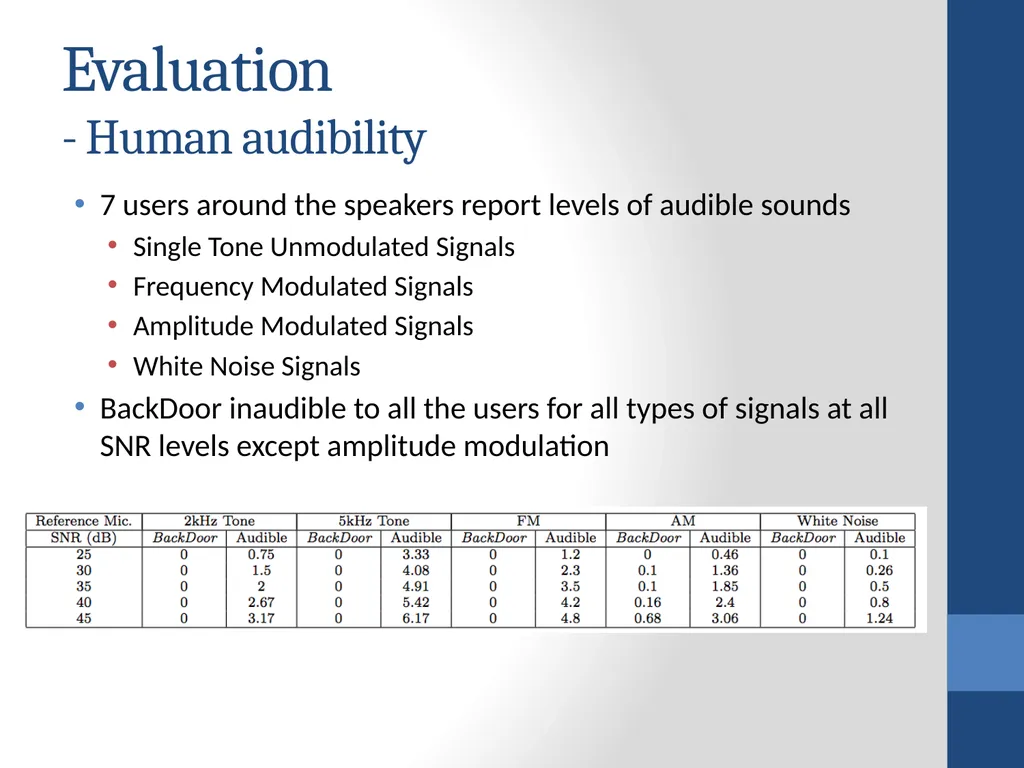
Evaluation - Human audibility 7 users around the speakers report levels of audible sounds
Single Tone Unmodulated Signals
Frequency Modulated Signals
Amplitude Modulated Signals
White Noise Signals
BackDoor inaudible to all the users for all types of signals at all SNR levels except amplitude modulation<br>
14
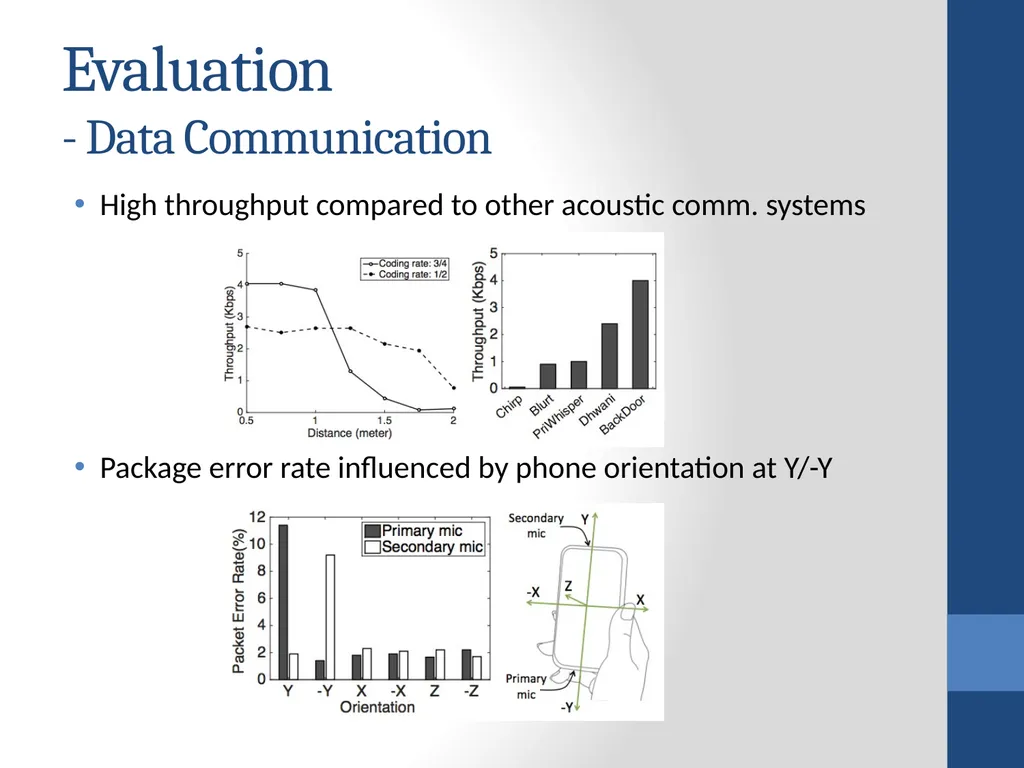
Evaluation - Data Communication High throughput compared to other acoustic comm. systems
Package error rate influenced by phone orientation at Y/-Y<br>
15
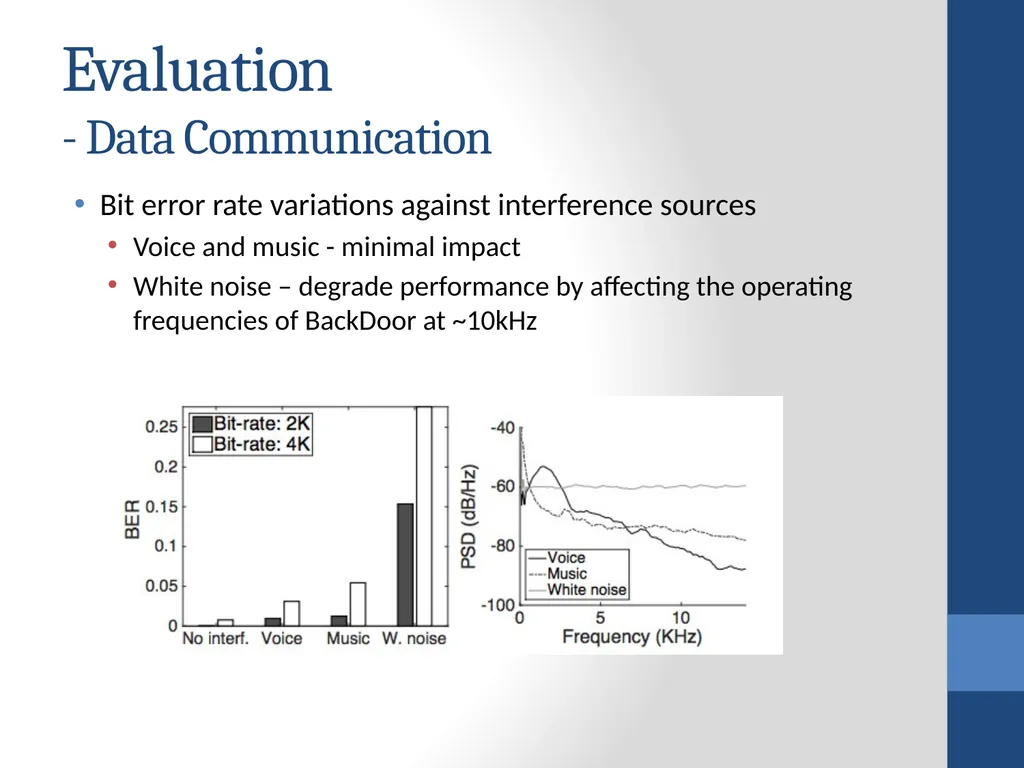
Evaluation - Data Communication Bit error rate variations against interference sources
Voice and music - minimal impact
White noise – degrade performance by affecting the operating frequencies of BackDoor at ~10kHz<br>
16
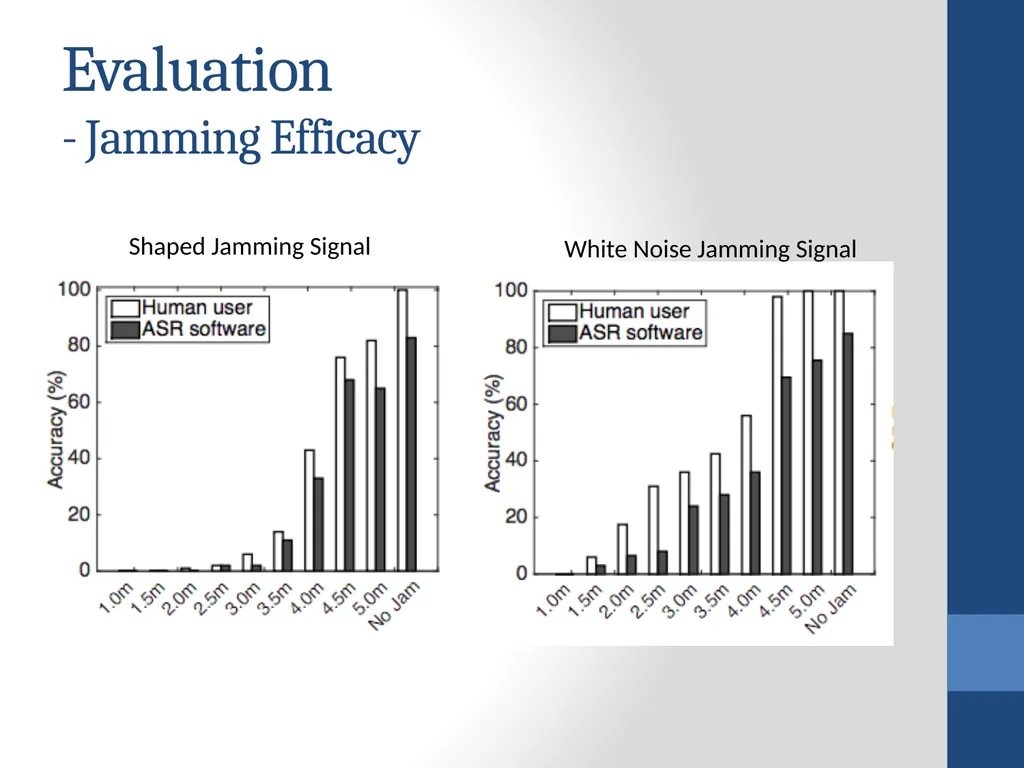
Evaluation - Jamming Efficacy Shaped Jamming Signal White Noise Jamming Signal<br>
17
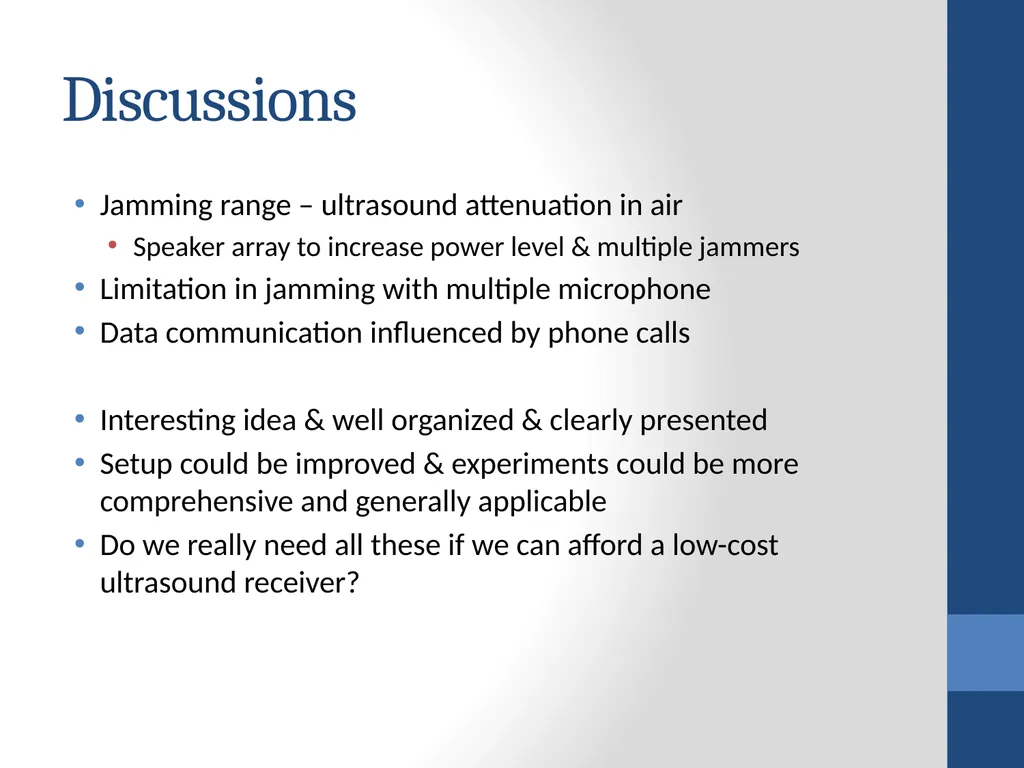
Discussions Jamming range – ultrasound attenuation in air
Speaker array to increase power level & multiple jammers
Limitation in jamming with multiple microphone
Data communication influenced by phone calls
Interesting idea & well organized & clearly presented
Setup could be improved & experiments could be more comprehensive and generally applicable
Do we really need all these if we can afford a low-cost ultrasound receiver?<br>