
BALANCED OCCLUSION DEPARTMENT OF PROSTHODONTICS,
JO
Published · 41 slides · 0 views

1 / 1



Description
BALANCED OCCLUSION DEPARTMENT OF PROSTHODONTICS, GDC, NAGPUR SPECIAL LEARNING OBJECTIVES The learner should be able to Define balanced occlusion Rationale of balanced occlusion Prerequisites of balanced occlusion Factors affecting balanced
Related Topics
Share
Embed code
Download this presentation From Below
"BALANCED OCCLUSION DEPARTMENT OF PROSTHODONTICS," is the property of its rightful owner. Permission is granted to download and print the materials on this website for personal, non-commercial use only, and to display it on your personal computer provided you do not modify the materials and that you retain all copyright notices contained in the materials. By downloading content from our website, you accept the terms of this agreement.
Presentation Transcript
01
BALANCED OCCLUSION DEPARTMENT OF PROSTHODONTICS,
GDC, NAGPUR<br>
GDC, NAGPUR<br>
02
SPECIAL LEARNING OBJECTIVES The learner should be able to
Define balanced occlusion
Rationale of balanced occlusion
Prerequisites of balanced occlusion
Factors affecting balanced occlusion
Advantages of balanced occlusion<br>
Define balanced occlusion
Rationale of balanced occlusion
Prerequisites of balanced occlusion
Factors affecting balanced occlusion
Advantages of balanced occlusion<br>
03
INTRODUCTION Functions served by teeth – Mastication
Esthetics
Phonetics
Desirable qualities in denture – Adequate retention
Stability
Harmony in occlusion
Preservation of the foundation
Comfort<br>
Esthetics
Phonetics
Desirable qualities in denture – Adequate retention
Stability
Harmony in occlusion
Preservation of the foundation
Comfort<br>
04
DEFINITION To occlude = to shut off or to close tightly
Occlusion:
is defined as the static relationship between the incising or masticating surfaces of the maxillary and mandibular teeth.
Balanced Occlusion
The bilateral, simultaneous, anterior and posterior occlusal contact of teeth in centric and eccentric position.<br>
Occlusion:
is defined as the static relationship between the incising or masticating surfaces of the maxillary and mandibular teeth.
Balanced Occlusion
The bilateral, simultaneous, anterior and posterior occlusal contact of teeth in centric and eccentric position.<br>
05
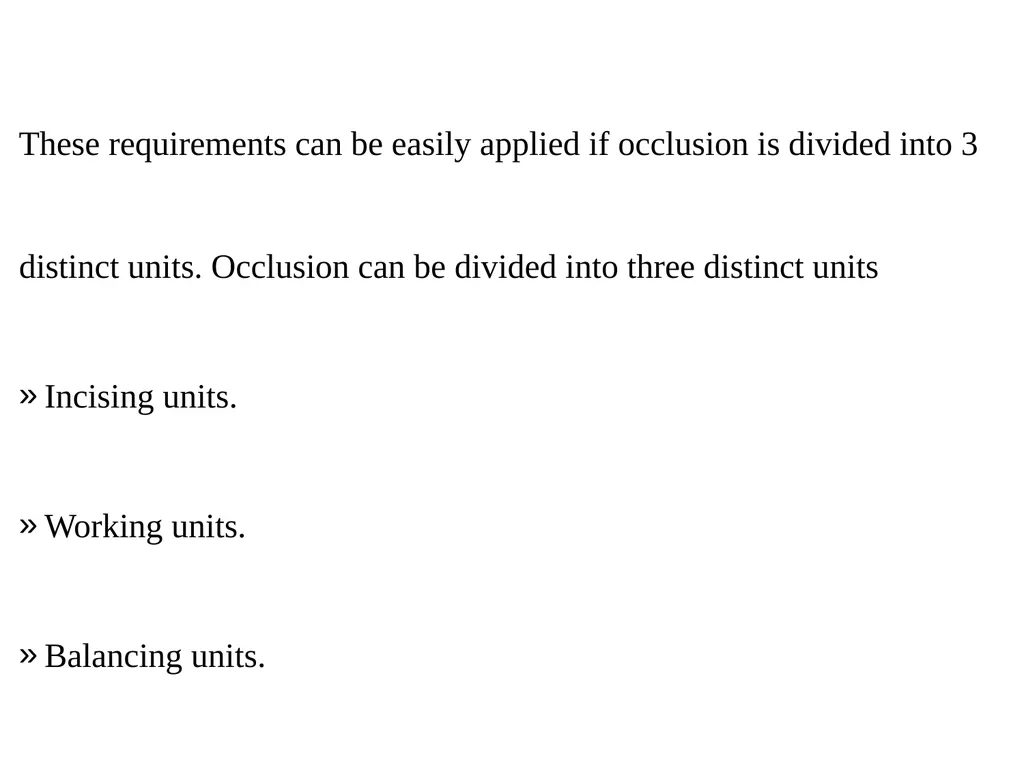
These requirements can be easily applied if occlusion is divided into 3 distinct units. Occlusion can be divided into three distinct units
Incising units.
Working units.
Balancing units.<br>
Incising units.
Working units.
Balancing units.<br>
06
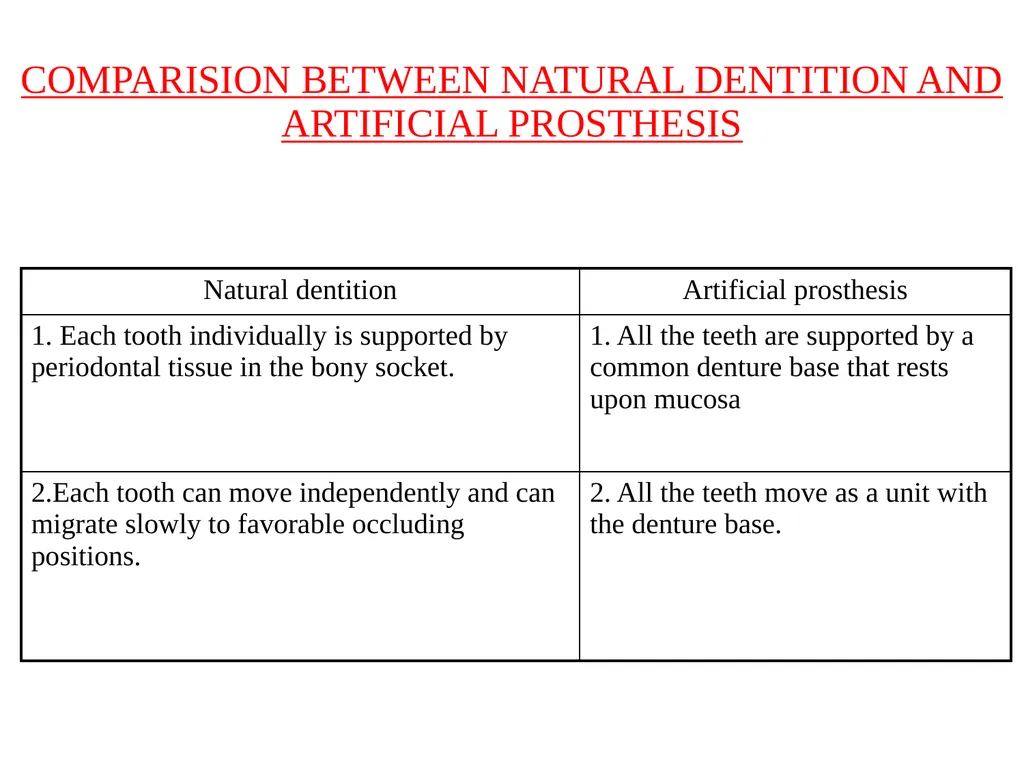
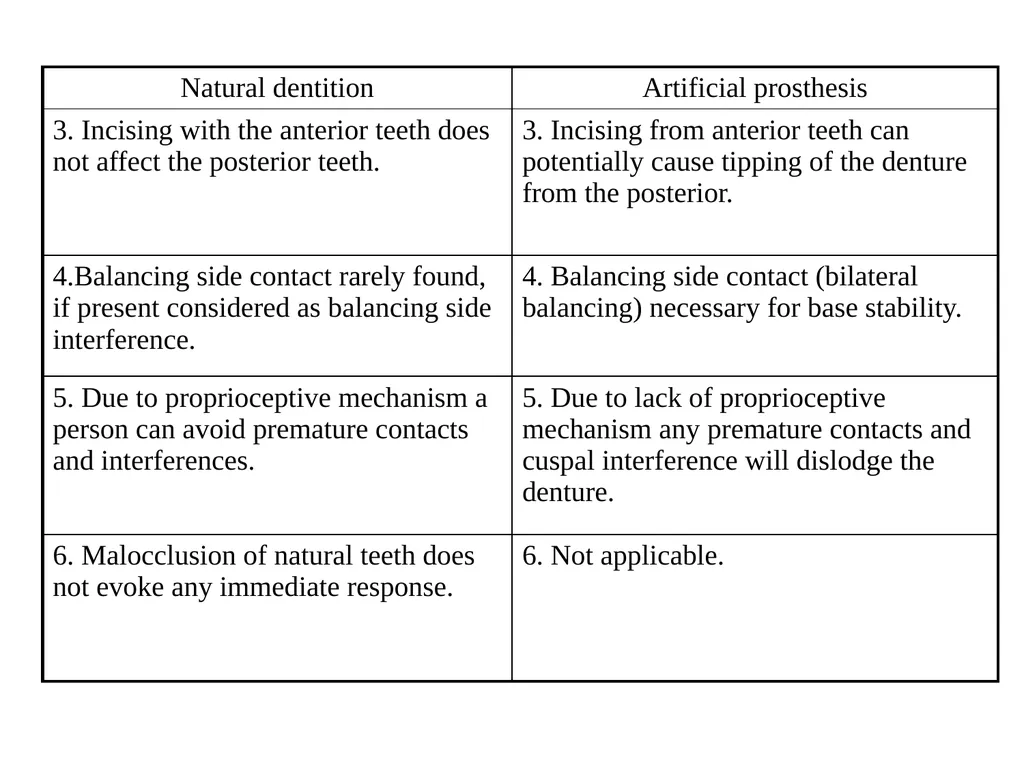
COMPARISION BETWEEN NATURAL DENTITION AND ARTIFICIAL PROSTHESIS<br>
07
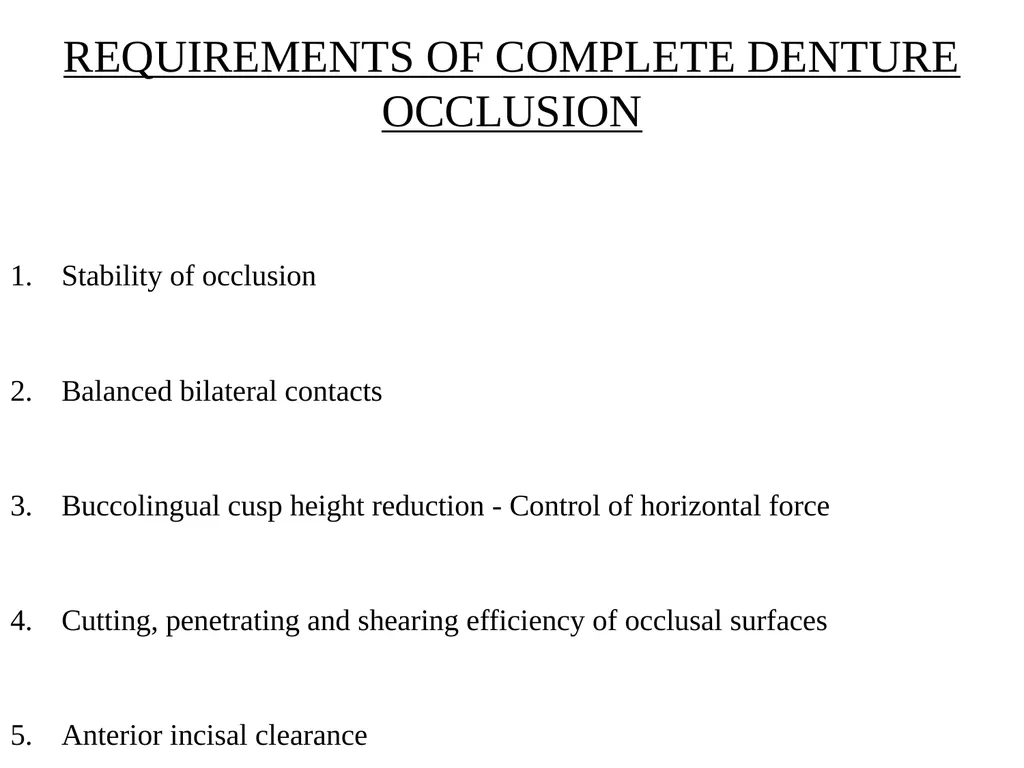
REQUIREMENTS OF COMPLETE DENTURE OCCLUSION Stability of occlusion
Balanced bilateral contacts
Buccolingual cusp height reduction - Control of horizontal force
Cutting, penetrating and shearing efficiency of occlusal surfaces
Anterior incisal clearance<br>
Balanced bilateral contacts
Buccolingual cusp height reduction - Control of horizontal force
Cutting, penetrating and shearing efficiency of occlusal surfaces
Anterior incisal clearance<br>
08
These requirements can be most easily applied
if the occlusion is divided into three distinct
units:
Incising,
Working, and
Balancing.
It is possible to establish requirements
for these units that will favor function stability
and phonetics.<br>
if the occlusion is divided into three distinct
units:
Incising,
Working, and
Balancing.
It is possible to establish requirements
for these units that will favor function stability
and phonetics.<br>
09
Requirements for Incising Units:
These units should be sharp in order to cut efficiently.
They should not contact during mastication.
They should have as flat an incisal guidance as possible considering esthetics and phonetics<br>
These units should be sharp in order to cut efficiently.
They should not contact during mastication.
They should have as flat an incisal guidance as possible considering esthetics and phonetics<br>
10
They should have horizontal overlap to allow for base setting without interference.
They should contact only during protrusive incising function.
Requirements for Working Occlusal Units:
They should be efficient in cutting and grinding.
They should have decreased buccal-lingual width to minimize the work force directed to the denture foundation.<br>
They should contact only during protrusive incising function.
Requirements for Working Occlusal Units:
They should be efficient in cutting and grinding.
They should have decreased buccal-lingual width to minimize the work force directed to the denture foundation.<br>
11
They should function as a group with simultaneous harmonious contact at the end of the chewing cycle and during eccentric excursions.
They should be over the ridge crest in the masticating area for lever balance.
They should have a surface to receive and transmit the force of occlusion essentially vertically.<br>
They should be over the ridge crest in the masticating area for lever balance.
They should have a surface to receive and transmit the force of occlusion essentially vertically.<br>
12
They should center the work load near the anteroposterior center of the denture.
They should present a plane of occlusion as parallel as possible to the mean foundation plane.<br>
They should present a plane of occlusion as parallel as possible to the mean foundation plane.<br>
13
Requirements for Balancing Occlusal Units:
They should contact on the second molars when the incising units contact in function.
They should contact at the end of the chewing cycle when the working units contact.
They should have smooth gliding contacts for lateral and protrusive excursions.<br>
They should contact on the second molars when the incising units contact in function.
They should contact at the end of the chewing cycle when the working units contact.
They should have smooth gliding contacts for lateral and protrusive excursions.<br>
14
The five basic factors that determine the balance of an occlusion are
Inclination of condylar guidance
Incisal guidance
Orientation of occlusal plane
Inclination of cusp angle
Prominence of compensating curves FACTORS INFLUENCING BALANCED
OCCLUSION<br>
Inclination of condylar guidance
Incisal guidance
Orientation of occlusal plane
Inclination of cusp angle
Prominence of compensating curves FACTORS INFLUENCING BALANCED
OCCLUSION<br>
15
CONDYLAR GUIDANCE The angle formed between horizontal plane and a line formed by joining two positions of condyles – (centric relation and protrusive relation position)
It is anatomical factor . Angulation depends upon the curvature of condylar path and head of condyle and the condition of joint ligaments and muscles
Operator has no control – posterior end controlling factor<br>
It is anatomical factor . Angulation depends upon the curvature of condylar path and head of condyle and the condition of joint ligaments and muscles
Operator has no control – posterior end controlling factor<br>
16
CONDYLAR GUIDANCE “ The condylar path should be determined on the patient and set on the instrument so that the patients TMJ is in harmony with the occlusion as programmed on the articulator”. This will help in creating balance in occlusion during antero-posterior movements. The value is transferred on articulator by using plaster wafer made at protrusive relation recorded by gothic arch method<br>
17
INCISAL GUIDANCE This is defined as “The influence of the contacting surfaces of the mandibular and maxillary anterior teeth on mandibular movements”-GPT.<br>
18
INCISAL GUIDANCE Arrangement of anterior teeth is done by following general and specific principles of teeth arrangement keeping in mind the desired vertical overlap (overbite) and horizontal overlap (overjet) of maxillary anteriors with mandibular.
By joining tips of maxillary and mandibular central incisor at centric relation position a line making angle with horizontal plane is referred as incisal guidance<br>
By joining tips of maxillary and mandibular central incisor at centric relation position a line making angle with horizontal plane is referred as incisal guidance<br>
19
The incisal guidance should be always less than horizontal condylar guidance. Thus minimum vertical overlap to be provided
The incisal guide table is adjusted in anterio posterior direction as per the incisal guidance
The incisal pin has to be in contact during centric relation position as well as protrusive relation position.
After approval of anterior try-in, this factor is not changeable – anterior end controlling factor<br>
20
ORIENTATION OF THE OCCLUSAL PLANE It is the average plane established by incisal and occlusal surfaces of teeth. –GPT
A plane formed after joining contact point of maxillary central incisors with distobuccal cusp tips of maxillary second molars of both sides.<br>
A plane formed after joining contact point of maxillary central incisors with distobuccal cusp tips of maxillary second molars of both sides.<br>
21
Occlusal plane = parallel with interpupilllary
line in anterior segment
= parallel with ala tragus line
in posterior segment
However operator may modify the plane as per functional , stability and esthetic requirement
Hence it is factor in the hands of operator while creating balance in occlusion
It is incorporated during jaw relation<br>
line in anterior segment
= parallel with ala tragus line
in posterior segment
However operator may modify the plane as per functional , stability and esthetic requirement
Hence it is factor in the hands of operator while creating balance in occlusion
It is incorporated during jaw relation<br>
22
INCLINATION OF CUSP The angle between the total occlusal surface of the tooth and the inclination of the cusp in relation to that surface.
Selection of posterior tooth form in relation to the cusp angle should match the requirement of condylar and incisal guidances Necessary modification of cusp angle/cusp height can be done by grinding the cusp or changing the angulation of the tooth – effective cusp angle<br>
Selection of posterior tooth form in relation to the cusp angle should match the requirement of condylar and incisal guidances Necessary modification of cusp angle/cusp height can be done by grinding the cusp or changing the angulation of the tooth – effective cusp angle<br>
23
Usually anatomic teeth are used for balanced occlusion
However by changing the individual tooth angulations of non anatomic teeth (Zero degree) compensating curve is generated for balance
This factor is in total control of operator to develop balance in occlusion<br>
However by changing the individual tooth angulations of non anatomic teeth (Zero degree) compensating curve is generated for balance
This factor is in total control of operator to develop balance in occlusion<br>
24
COMPENSATING CURVE It is defined as “The anteroposterior and lateral curvatures in the alignment of the occluding surfaces and incisal edges of artificial teeth which are used to develop balanced occlusion”.-GPT
Determined by the inclination of the posterior teeth and their vertical relationship to occlusal plane so that occlusal surface results in a curve that is in harmony with the movement of the mandible as guided by the condylar path.<br>
Determined by the inclination of the posterior teeth and their vertical relationship to occlusal plane so that occlusal surface results in a curve that is in harmony with the movement of the mandible as guided by the condylar path.<br>
25
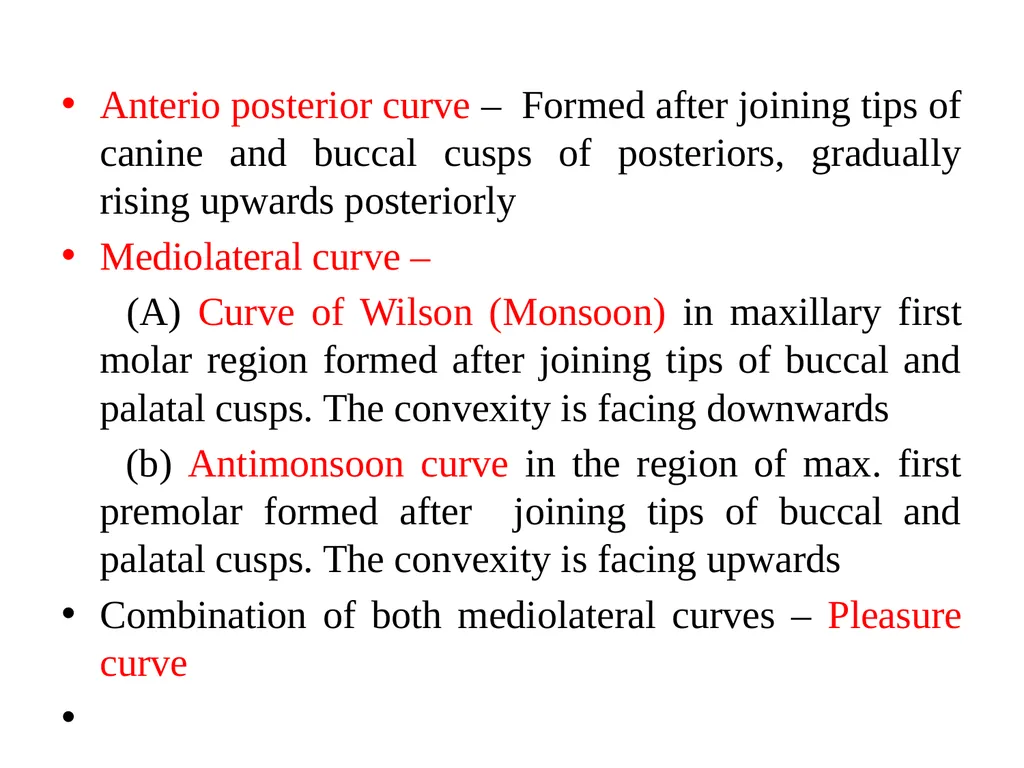
Anterio posterior curve – Formed after joining tips of canine and buccal cusps of posteriors, gradually rising upwards posteriorly
Mediolateral curve –
(A) Curve of Wilson (Monsoon) in maxillary first molar region formed after joining tips of buccal and palatal cusps. The convexity is facing downwards
(b) Antimonsoon curve in the region of max. first premolar formed after joining tips of buccal and palatal cusps. The convexity is facing upwards
Combination of both mediolateral curves – Pleasure curve<br>
26
By peculiar fashion of posterior teeth arrangement by giving buccolingual and mesiodistal inclination to the teeth, these curves are generated in anterioposterior and mediolateral direction
The compensating curves should match the requirement of condylar and incisal guidances already set on articulator
The plane of occlusion is now replaced by compensating curve
This factor is in total control of operator to develop balance in occlusion<br>
The compensating curves should match the requirement of condylar and incisal guidances already set on articulator
The plane of occlusion is now replaced by compensating curve
This factor is in total control of operator to develop balance in occlusion<br>
27
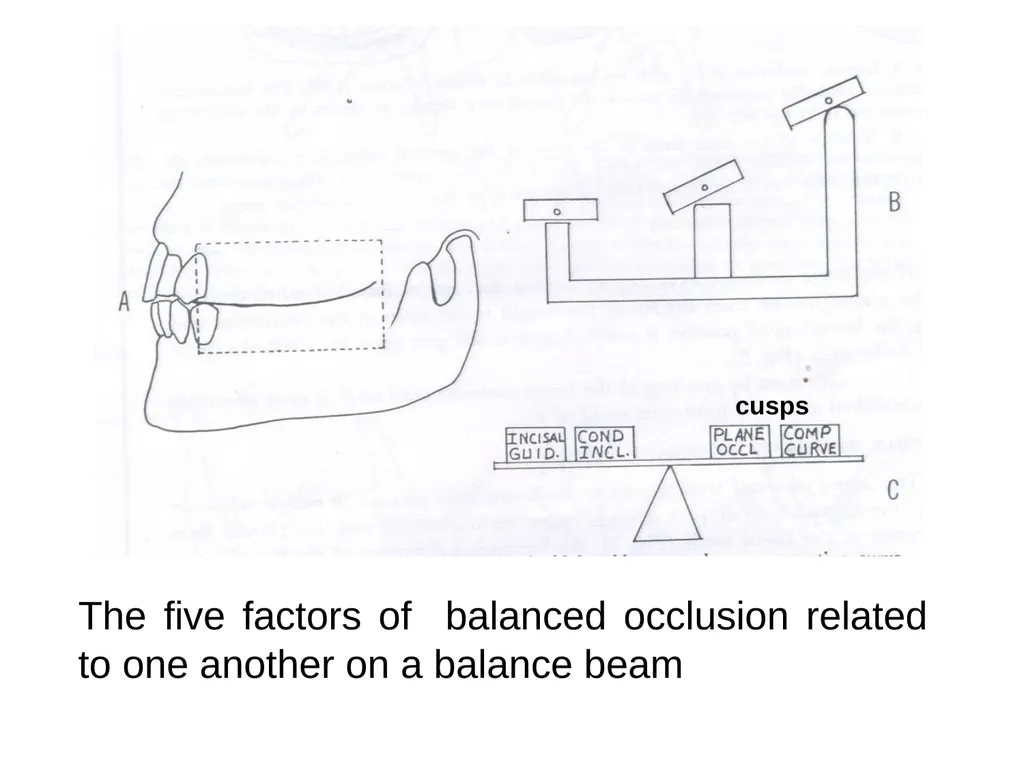
The five factors of balanced occlusion related to one another on a balance beam<br>
28
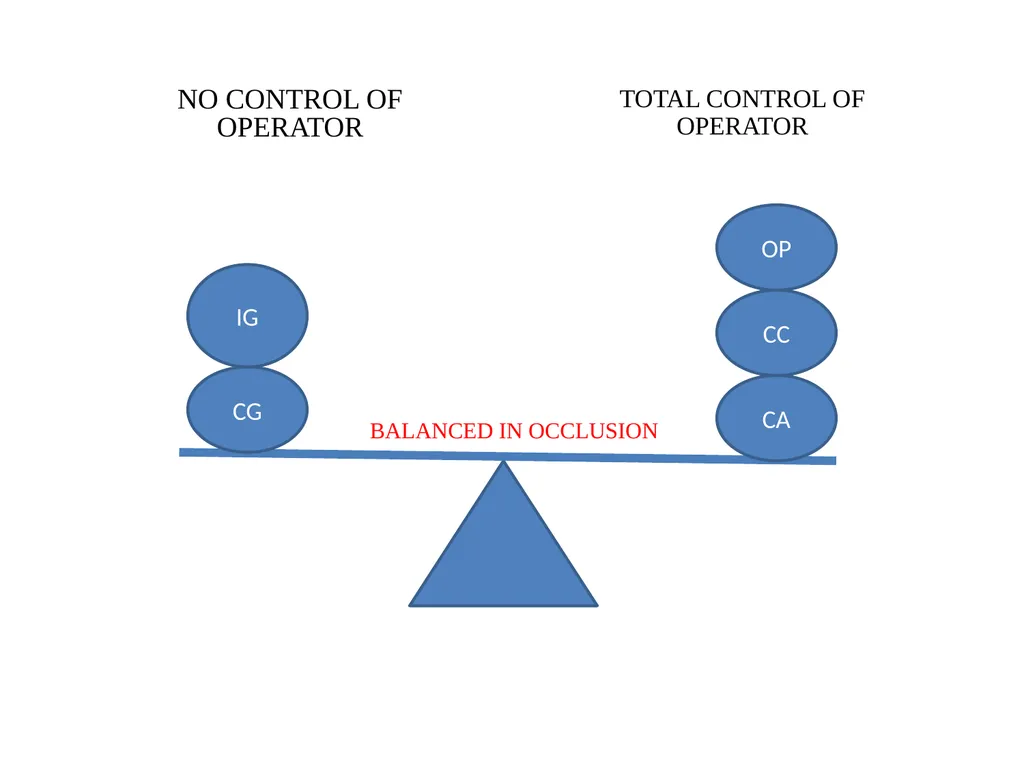
NO CONTROL OF OPERATOR CG IG CA CC OP TOTAL CONTROL OF OPERATOR BALANCED IN OCCLUSION<br>
29
Steps involved in balancing -The teeth have to be inclined to develop a balanced occlusion.
-The upper and lower incisal units meet only when the mandibular teeth are protruded and protrusive balancing unit functions only when upper and lower units contact.
-To develop a balanced occlusion one needs an adjustable articulator which should:
-Receive a face-bow transfer.
-Adjust to individual inter condylar guidance.
-Have an adjustable incisal guide table.<br>
30
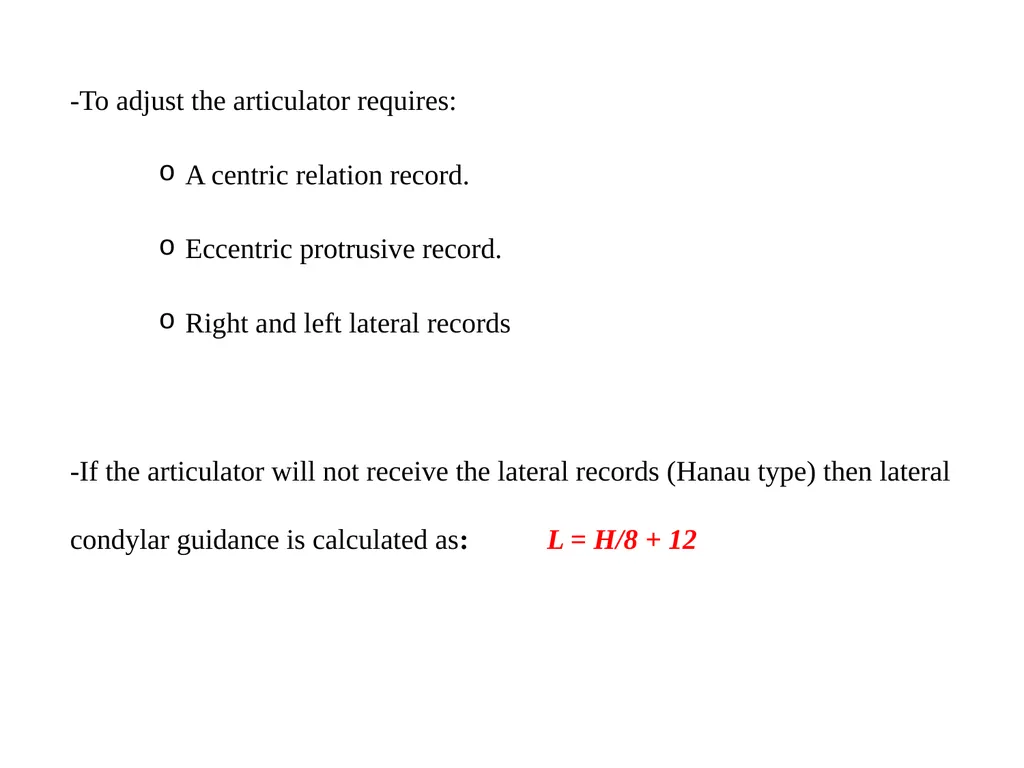
-To adjust the articulator requires:
A centric relation record.
Eccentric protrusive record.
Right and left lateral records
-If the articulator will not receive the lateral records (Hanau type) then lateral condylar guidance is calculated as: L = H/8 + 12<br>
A centric relation record.
Eccentric protrusive record.
Right and left lateral records
-If the articulator will not receive the lateral records (Hanau type) then lateral condylar guidance is calculated as: L = H/8 + 12<br>
31
Advantages of Bilateral Occlusal Balance:
Esthetic
Bilateral simultaneous contact help to seat the denture in a stable position during mastication, swallowing and maintain retention and stability of the denture and the health of the oral tissues.<br>
Esthetic
Bilateral simultaneous contact help to seat the denture in a stable position during mastication, swallowing and maintain retention and stability of the denture and the health of the oral tissues.<br>
32
Due to cross-arch balance, as the bolus is chewed on one side, the balancing cusps will come close or will contact on the other.
Denture bases are stable even during bruxing activity
Anatomic teeth used in balanced occlusion penetrate bolus better requiring less chewing force and therefore decreasing the vertical force on the ridges<br>
Denture bases are stable even during bruxing activity
Anatomic teeth used in balanced occlusion penetrate bolus better requiring less chewing force and therefore decreasing the vertical force on the ridges<br>
33
The ability of the cusped teeth to arranged in harmony with the temporomandibular joint and muscles of mastication during speech swallowing and chewing supposedly will improve the occlusion which is mechanically and physiologically balanced and therefore more acceptable to the oral environment<br>
34
The interdigitation of the denture teeth is believed to resist rotation movement of the denture thus encouraging a more vertical chewing pattern and greater denture stability<br>
35
Disadvantages of Balanced Occlusion
Precise exact reproducible records are required to generate this occlusion on a semi or fully adjustable articulator there by requiring a more careful and time consuming technique.
A semi adjustable or fully adjustable articulator is required.<br>
Precise exact reproducible records are required to generate this occlusion on a semi or fully adjustable articulator there by requiring a more careful and time consuming technique.
A semi adjustable or fully adjustable articulator is required.<br>
36
It is argued that this occlusion which functions against the inclines generates greater lateral force against the residual ridges. these lateral forces are more destructive then the vertical forces and that they might speed resorption of the residual ridges
Anatomic occlusion is challenged on the grounds that in addition to being more technically challenging and more time consuming the results are short lived,<br>
Anatomic occlusion is challenged on the grounds that in addition to being more technically challenging and more time consuming the results are short lived,<br>
37
Cont. The denture remains in good occlusal position until slight resorption occurs at which time the denture will be more difficult to adjust and keep in adjustment than one with an occlusion of simpler nature.
While balanced occlusion can be used for crossbite situations and for class II and class III relationships. The limitations placed on the tooth positions by the tight interdigitation of the cusps makes the use of this occlusal scheme difficult.<br>
While balanced occlusion can be used for crossbite situations and for class II and class III relationships. The limitations placed on the tooth positions by the tight interdigitation of the cusps makes the use of this occlusal scheme difficult.<br>
38
Occlusal balance achieved is totally mechanical and exists only on the articulator. Its is a well known that most articulators used in removable prosthodontics do not reproduce the exact movements of the mandible and therefore will not produce the same areas of occlusal contact as they exist in the mouth. The resulting occlusion is not a duplication of nature but an approximation.<br>
39
The antirotational element of the anotomic occlusion may be effiective in the young healthy edentulous patients with good ridges and healthy oral mucosa, it is not at all effective in the patients with poor ridges and friable unhealthy oral mucosa<br>
40
Thank you…..<br>