Basic Emergency Care Approach to the acutely ill and injured Conflict Related Injury module Penetrating Injuries Objectives By the end of this presentation, you will be able to: Describe the trauma primary survey approach for
"Basic Emergency Care Approach to the acutely ill" is the property of its rightful owner. Permission is granted to
download and print the materials on this website for personal, non-commercial use only, and to display it
on your personal computer provided you do not modify the materials and that you retain all copyright
notices contained in the materials. By downloading content from our website, you accept the terms of this
agreement.
Presentation Transcript
01
Basic Emergency Care Approach to the acutely ill and injured Conflict Related Injury module
Penetrating Injuries<br>
02
Objectives By the end of this presentation, you will be able to:
Describe the trauma primary survey approach for conflict-related injury
Identify signs and symptoms of acute life-threatening conditions
Identify critical CABCDE actions for penetrating injuries<br>
03
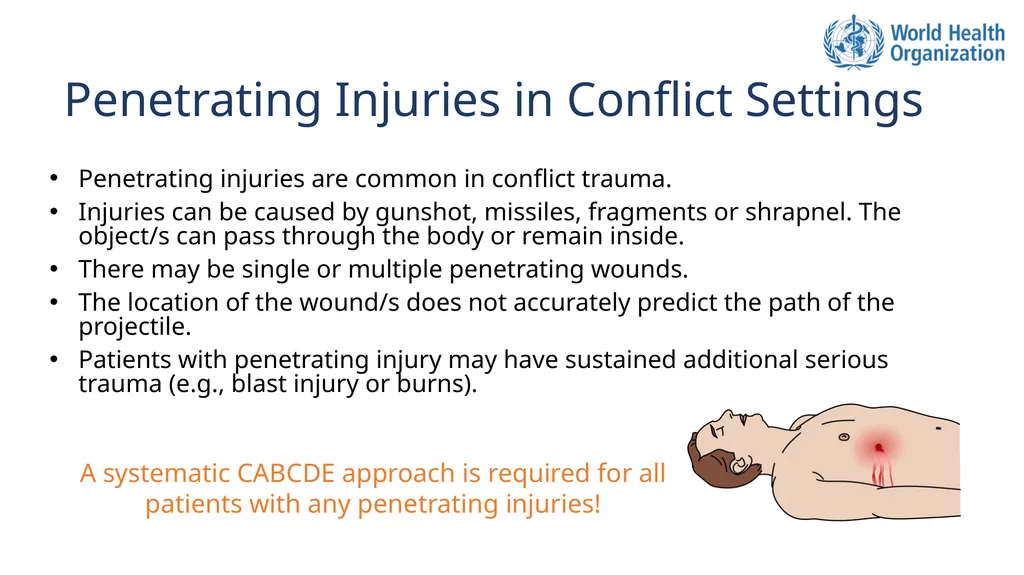
Penetrating Injuries in Conflict Settings Penetrating injuries are common in conflict trauma.
Injuries can be caused by gunshot, missiles, fragments or shrapnel. The object/s can pass through the body or remain inside.
There may be single or multiple penetrating wounds.
The location of the wound/s does not accurately predict the path of the projectile.
Patients with penetrating injury may have sustained additional serious trauma (e.g., blast injury or burns). A systematic CABCDE approach is required for all patients with any penetrating injuries!<br>
04
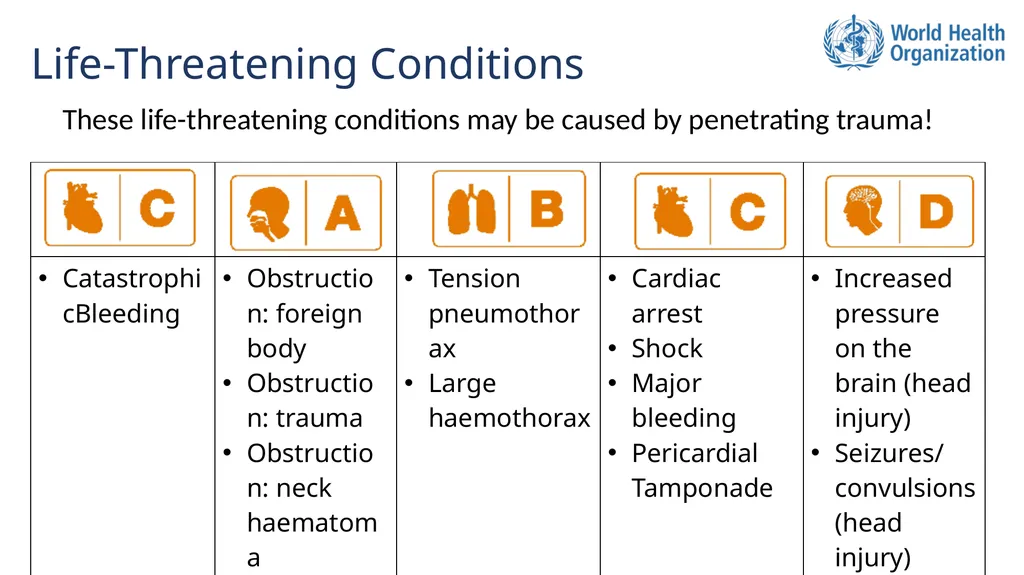
Life-Threatening Conditions These life-threatening conditions may be caused by penetrating trauma!<br>
05
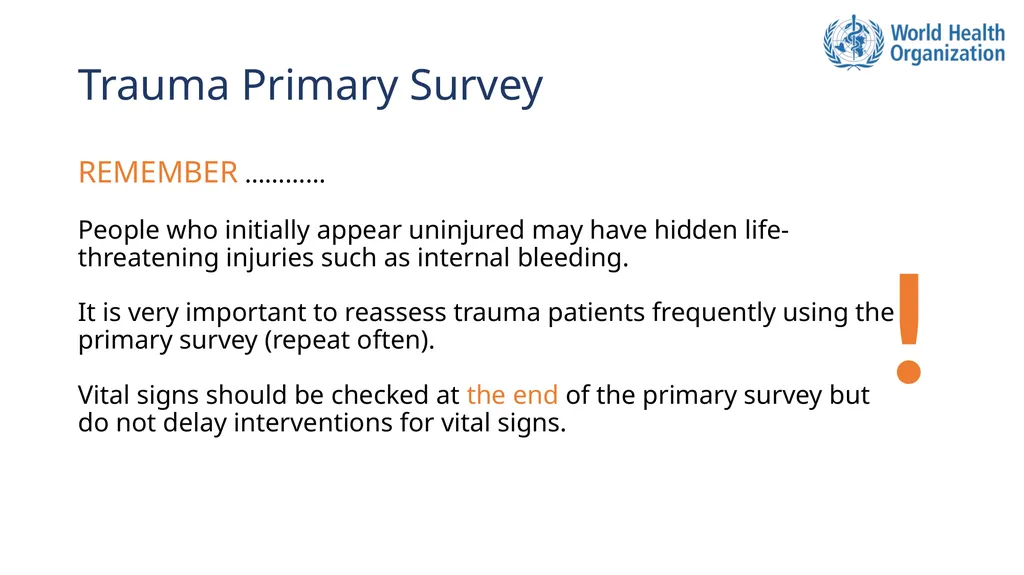
Trauma Primary Survey REMEMBER …………
People who initially appear uninjured may have hidden life-threatening injuries such as internal bleeding.
It is very important to reassess trauma patients frequently using the primary survey (repeat often).
Vital signs should be checked at the end of the primary survey but do not delay interventions for vital signs. !<br>
06
Injury Patterns and Conditions<br>
07
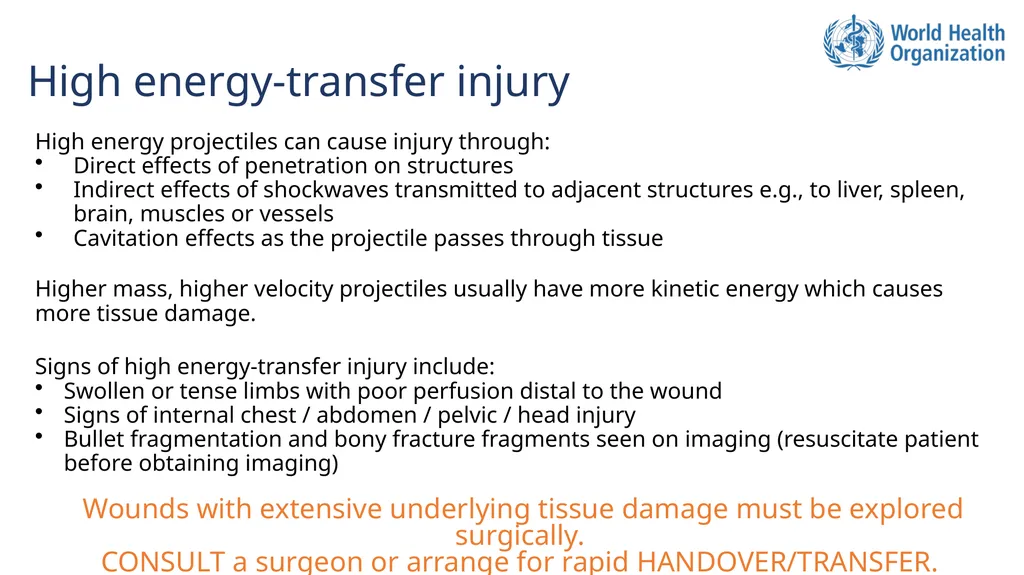
High energy-transfer injury Wounds with extensive underlying tissue damage must be explored surgically.
CONSULT a surgeon or arrange for rapid HANDOVER/TRANSFER. High energy projectiles can cause injury through:
Direct effects of penetration on structures
Indirect effects of shockwaves transmitted to adjacent structures e.g., to liver, spleen, brain, muscles or vessels
Cavitation effects as the projectile passes through tissue
Higher mass, higher velocity projectiles usually have more kinetic energy which causes more tissue damage.
Signs of high energy-transfer injury include:
Swollen or tense limbs with poor perfusion distal to the wound
Signs of internal chest / abdomen / pelvic / head injury
Bullet fragmentation and bony fracture fragments seen on imaging (resuscitate patient before obtaining imaging)<br>
08
Low energy-transfer injury Discuss management with a surgeon or arrange for HANDOVER/TRANSFER. Low energy projectiles cause injury through:
Direct effects of penetration on structures e.g., open fracture
Lower mass, lower velocity projectiles e.g., knives or shotgun pellets, usually have less kinetic energy and so generally cause less tissue damage.
This depends on factors including the location of the wound and the type of penetrating object.
Check carefully for any signs of tissue damage away from the main path of the projectile.<br>
09
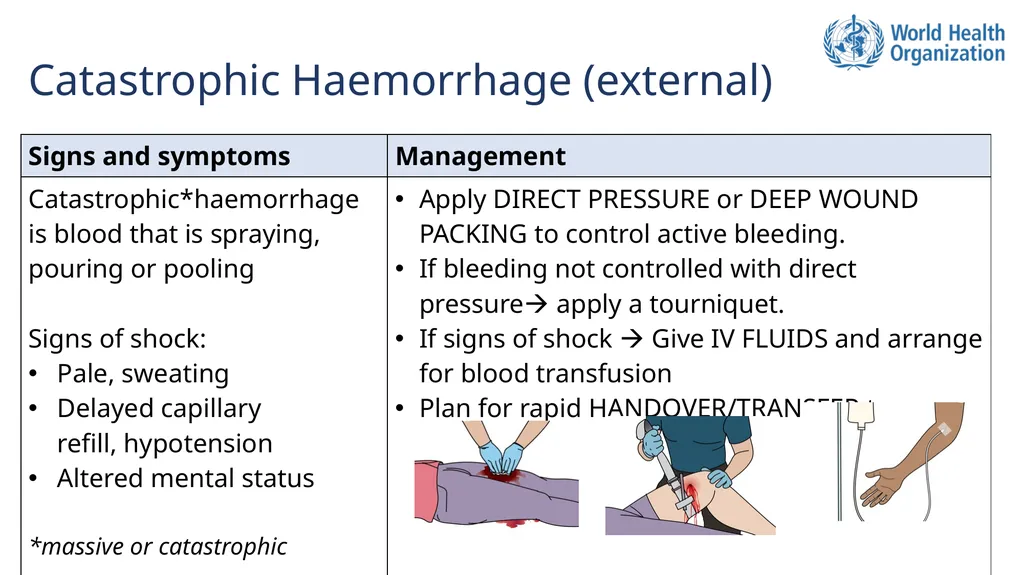
Catastrophic Haemorrhage (external)<br>
10
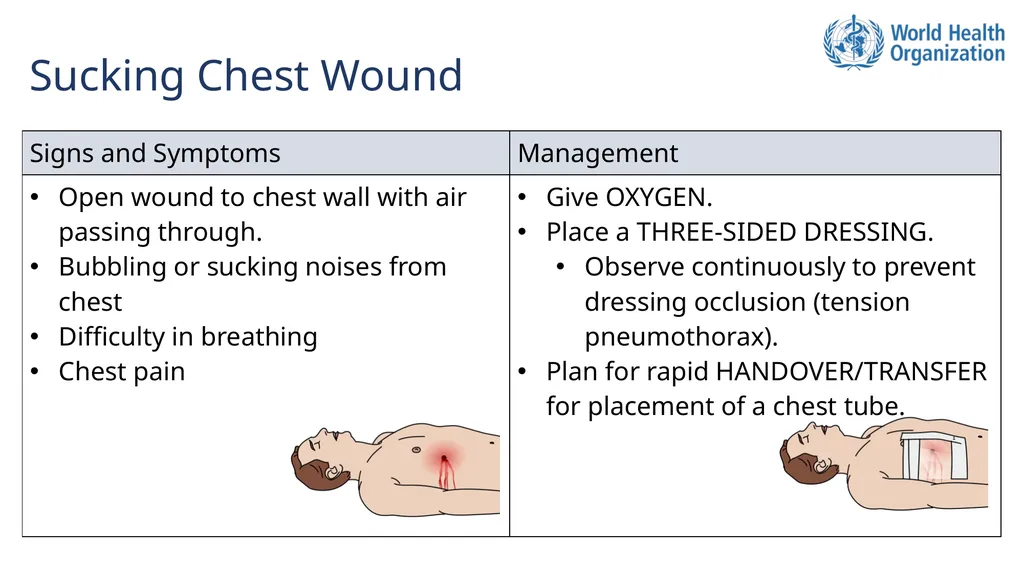
Sucking Chest Wound<br>
11
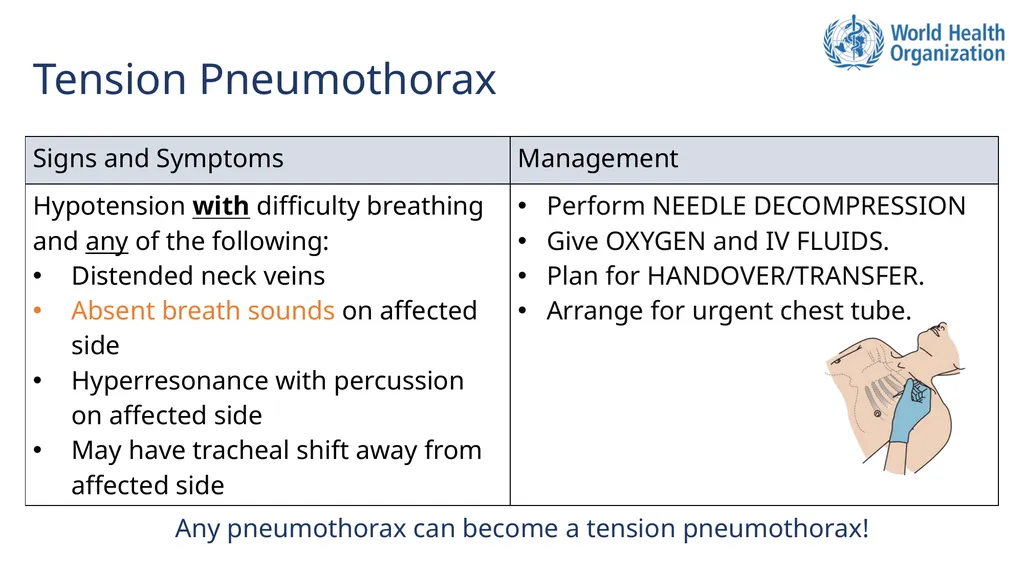
Tension Pneumothorax Any pneumothorax can become a tension pneumothorax!<br>
12
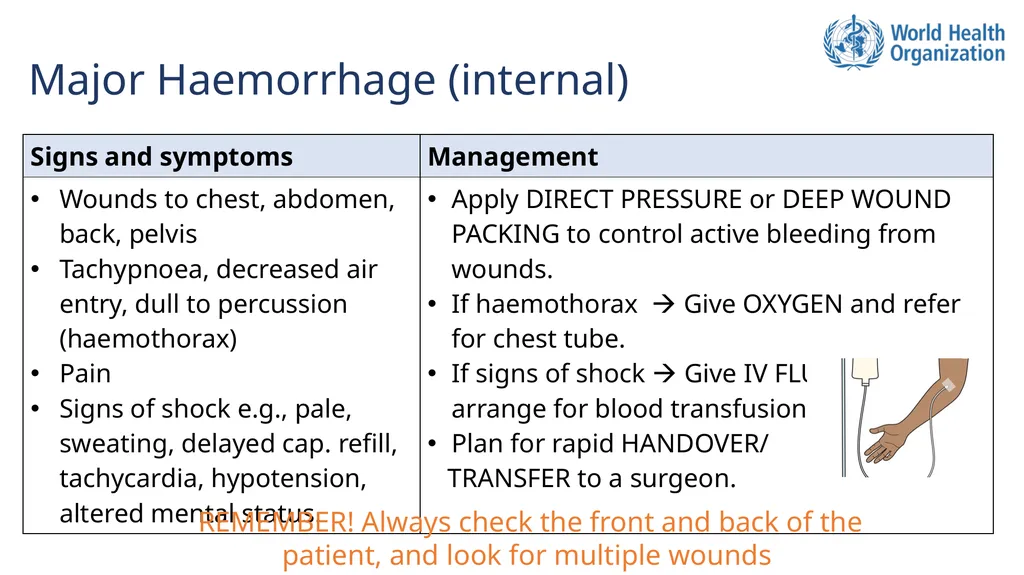
Major Haemorrhage (internal) REMEMBER! Always check the front and back of the patient, and look for multiple wounds<br>
13
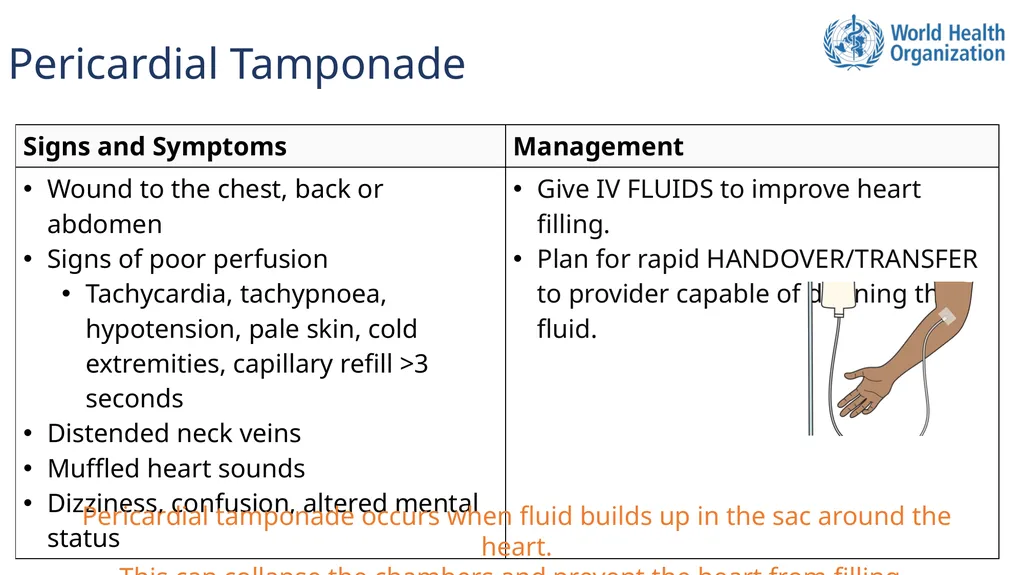
Pericardial Tamponade Pericardial tamponade occurs when fluid builds up in the sac around the heart.
This can collapse the chambers and prevent the heart from filling. <br>
14
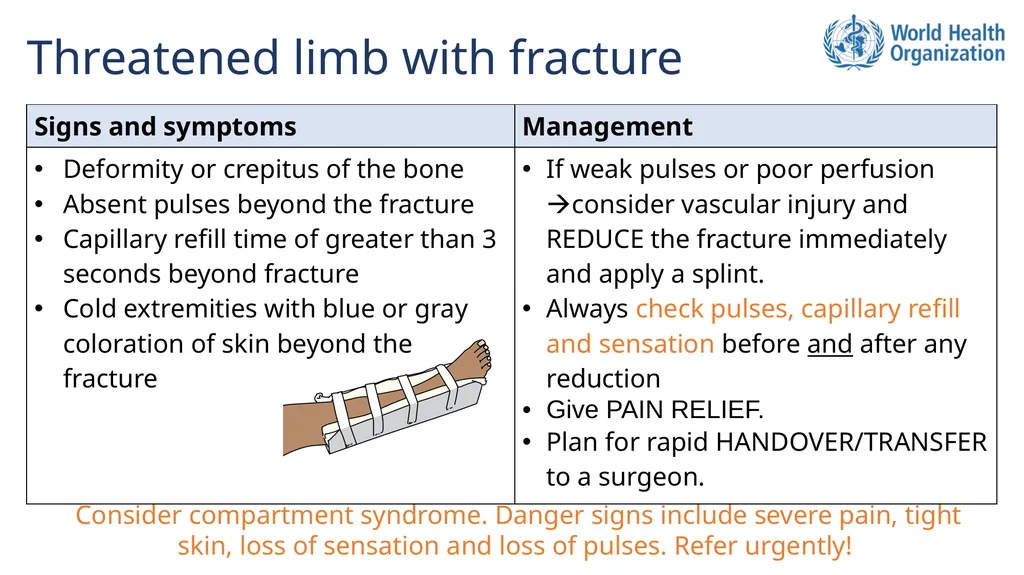
Threatened limb with fracture Consider compartment syndrome. Danger signs include severe pain, tight skin, loss of sensation and loss of pulses. Refer urgently!<br>
15
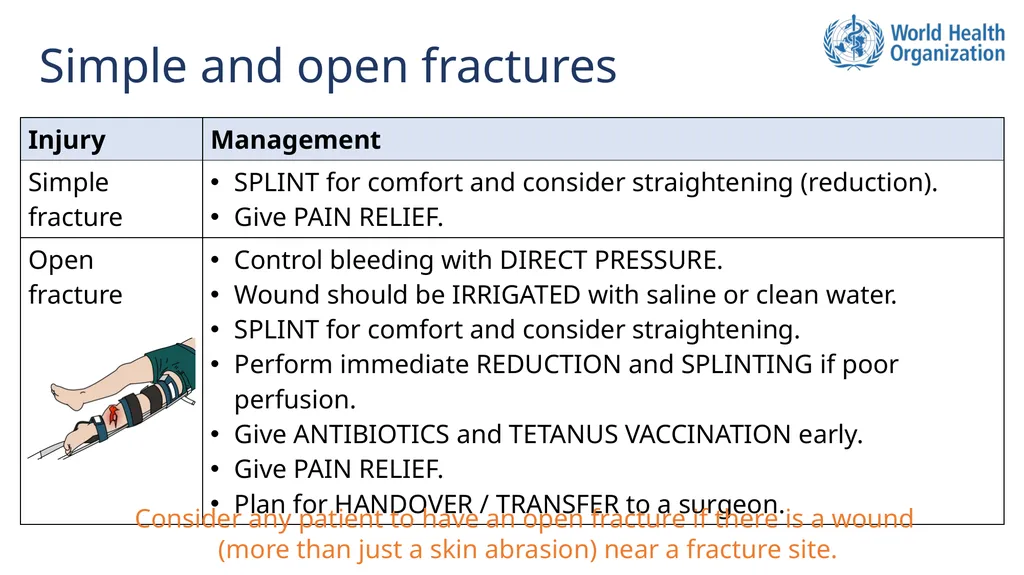
Simple and open fractures Consider any patient to have an open fracture if there is a wound
(more than just a skin abrasion) near a fracture site.<br>
16
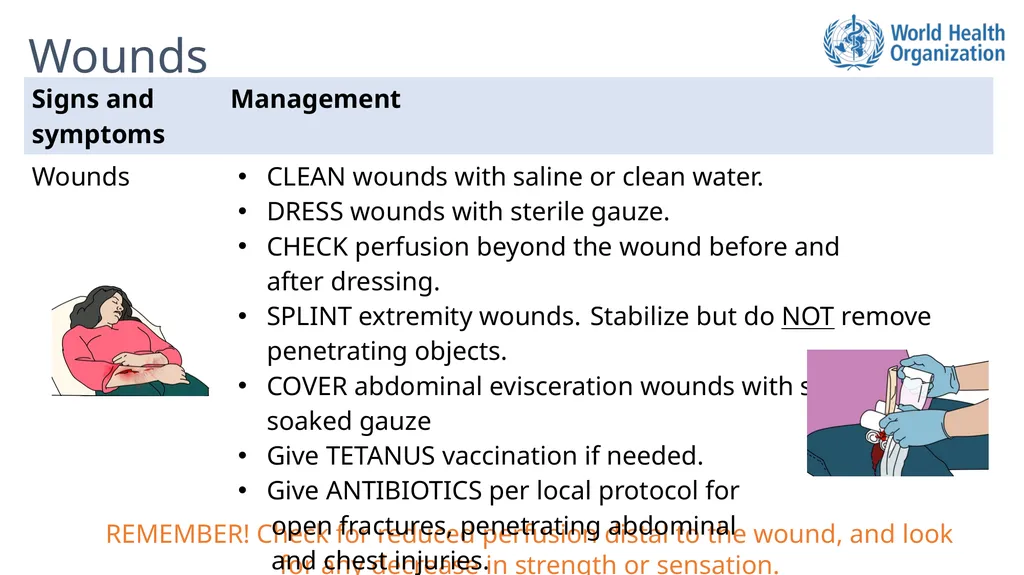
Wounds REMEMBER! Check for reduced perfusion distal to the wound, and look for any decrease in strength or sensation.<br>
17
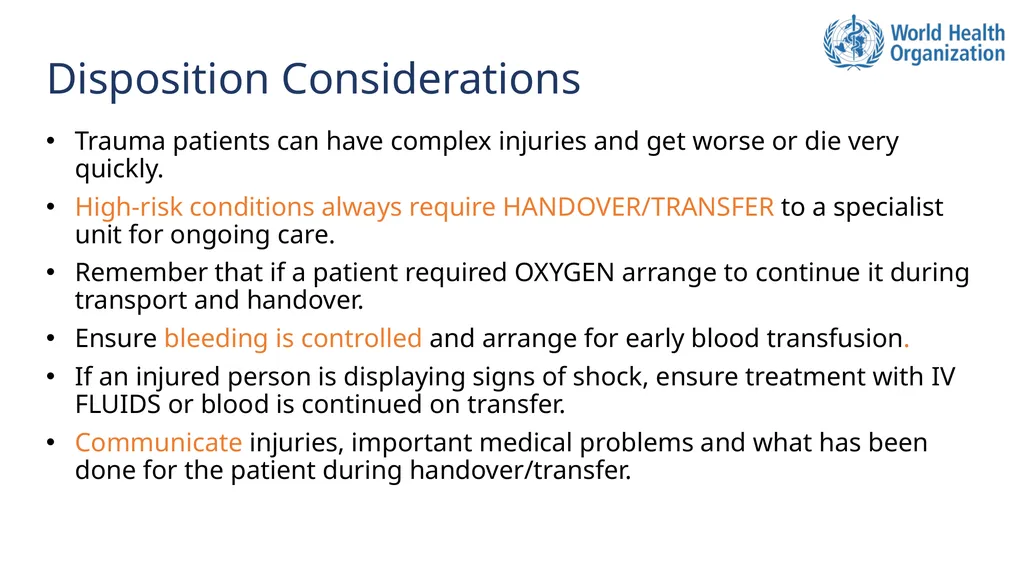
Disposition Considerations Trauma patients can have complex injuries and get worse or die very quickly.
High-risk conditions always require HANDOVER/TRANSFER to a specialist unit for ongoing care.
Remember that if a patient required OXYGEN arrange to continue it during transport and handover.
Ensure bleeding is controlled and arrange for early blood transfusion.
If an injured person is displaying signs of shock, ensure treatment with IV FLUIDS or blood is continued on transfer.
Communicate injuries, important medical problems and what has been done for the patient during handover/transfer.<br>
18
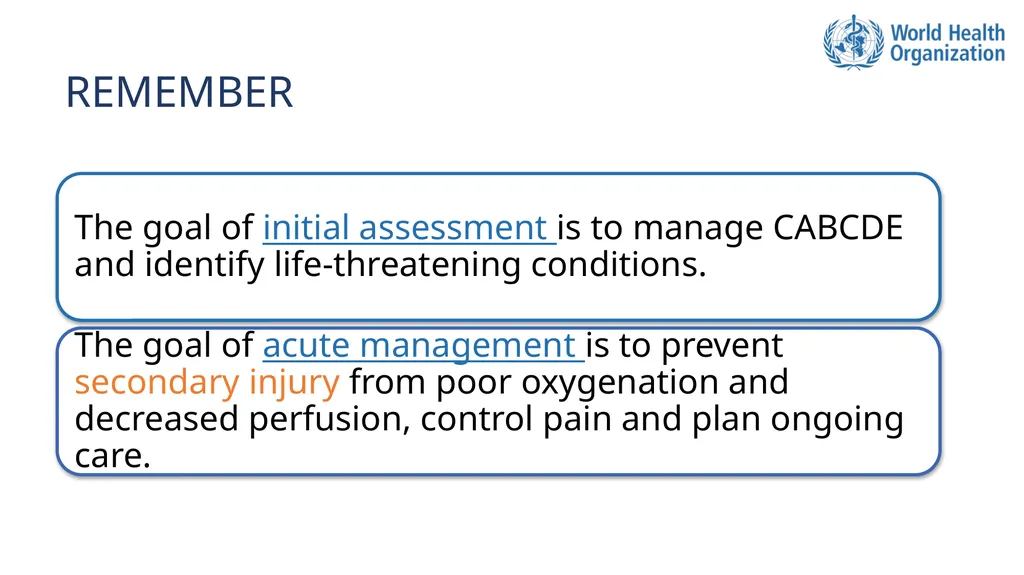
REMEMBER<br>
19
Summary In this presentation, we have covered:
The trauma primary survey approach for conflict-related injury
The signs and symptoms of acute life-threatening conditions caused by penetrating trauma
Critical CABCDE actions for acute life-threatening conditions caused by penetrating trauma<br>