BEYOND THE APEC YEAR The Role of the Judiciary in Papua New Guineas Democratic Project PNG Update 2018, UPNG Bal Kama PhD Candidate, College of Law Australian National University Sessional Lecturer Faculty of Business, Government and
"BEYOND THE APEC YEAR The Role of the Judiciary in" is the property of its rightful owner. Permission is granted to
download and print the materials on this website for personal, non-commercial use only, and to display it
on your personal computer provided you do not modify the materials and that you retain all copyright
notices contained in the materials. By downloading content from our website, you accept the terms of this
agreement.
Presentation Transcript
01
BEYOND THE APEC YEAR The Role of the Judiciary in Papua New Guinea’s Democratic Project PNG Update 2018, UPNG Bal Kama
PhD Candidate, College of Law| Australian National University
Sessional Lecturer| Faculty of Business, Government and Law| University of Canberra
bal.kama@anu.edu.au| Twitter @BalKama5<br>
02
Outline What is the environment in which the courts are operating?
Key court cases in the last five years
How has the role of the courts been defined within this environment?
Some reflection on:
Election petition cases
Judicial intervention in royalty payments to landowners
Conclusion<br>
03
What is the socio-political environment in which the courts are operating?
Social environment
Resource-rich, culturally diverse and resilient
Fragmented, highly litigious environment – frustrations, disputes and institutional inefficiencies constantly collide to produce both positive and negative outcomes for justice
Political environment
Visionary and assertive leadership
Predatory political culture undermines institutions of good governance<br>
04
Some observations in the last five years:
A weak parliament and an assertive executive (‘rubber stamp parliament’)
Institutional weakness (‘sleeping at the wheel’)
Highly complicated corruption allegations levelled against public office holders
Institutional interferences/lack of independence<br>
05
2. Five key court cases in the last five years
i. Constitutional Crisis – 2011-2012
Direct confrontation between arms of government
ii. Manus Island Detention Centre – Australia-PNG
Weaknesses in parliament
Belden Namah in defence of the Constitution
iii. UBS Loan: Prime Minister Peter O’Neill, Ombudsman Commission and Public Prosecutor
Institutional lethargy
iv. 30 months grace period: Ila Geno
A citizen’s response to institutional weaknesses
v. High level corruption allegations & Task Force Sweep (2014-2017)
Were they exonerated?<br>
06
3. How has the role of the courts been defined within this political environment?
“The courts tend to be formalistic and legalistic…they sacrifice the spirit for the letter of the Constitution… often introduced unnecessary rigidities. We cannot afford to have our courts take a narrowly legalistic approach if the law is to be justly applied. (CPC Report, 1974, Chap 8]
Liberal and expansive function
Interventionist and transformative role<br>
07
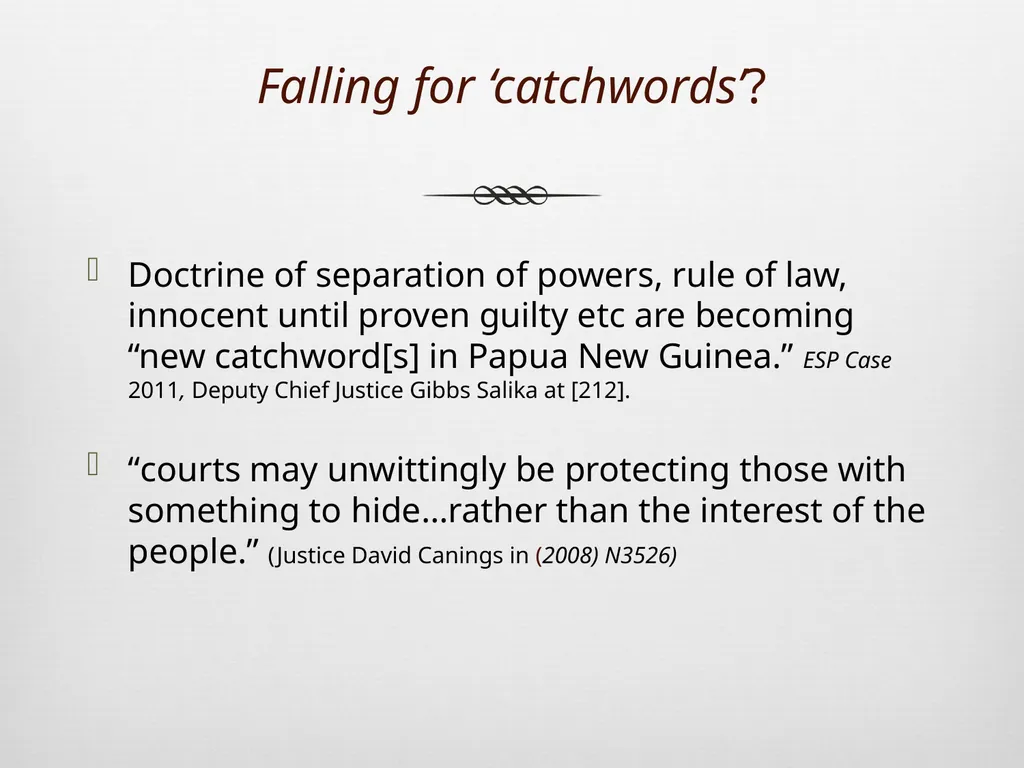
Falling for ‘catchwords’? Doctrine of separation of powers, rule of law, innocent until proven guilty etc are becoming “new catchword[s] in Papua New Guinea.” ESP Case 2011, Deputy Chief Justice Gibbs Salika at [212].
“courts may unwittingly be protecting those with something to hide…rather than the interest of the people.” (Justice David Canings in (2008) N3526)<br>
08
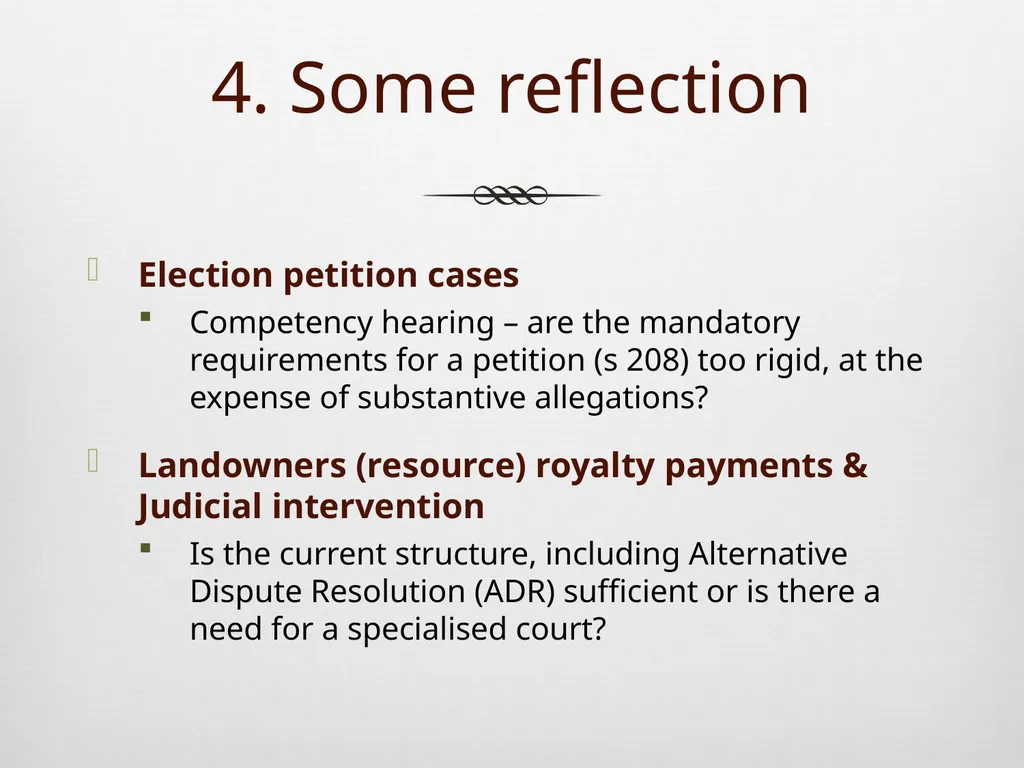
4. Some reflection Election petition cases
Competency hearing – are the mandatory requirements for a petition (s 208) too rigid, at the expense of substantive allegations?
Landowners (resource) royalty payments & Judicial intervention
Is the current structure, including Alternative Dispute Resolution (ADR) sufficient or is there a need for a specialised court?<br>
09
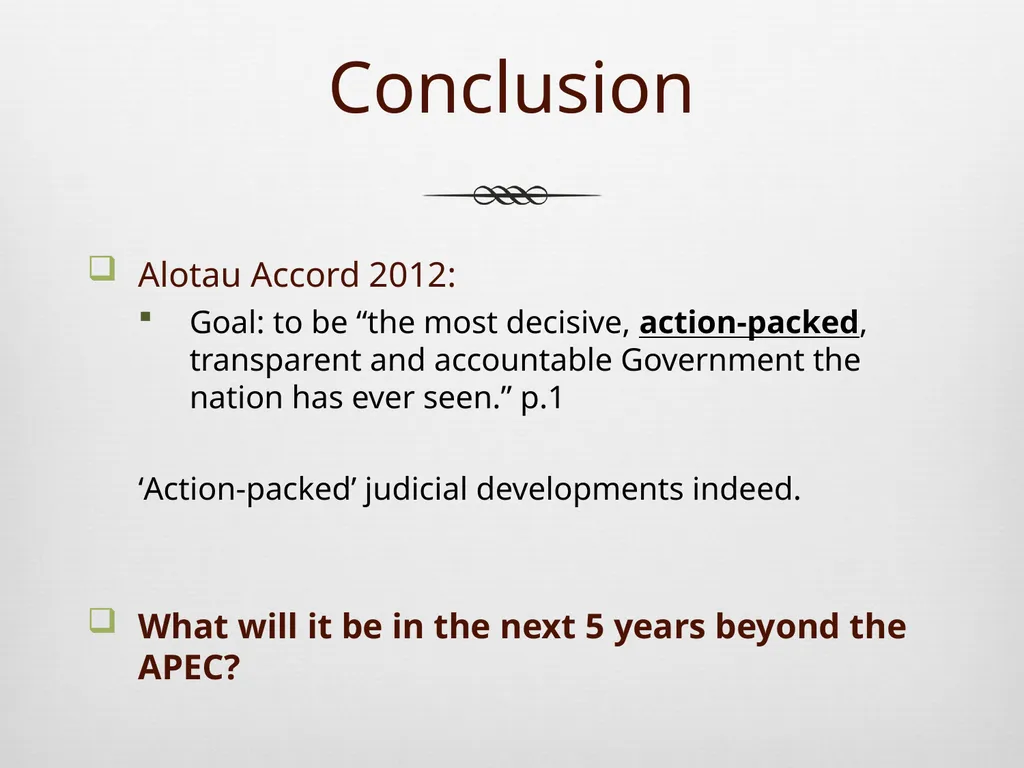
Conclusion Alotau Accord 2012:
Goal: to be “the most decisive, action-packed, transparent and accountable Government the nation has ever seen.” p.1
‘Action-packed’ judicial developments indeed.
What will it be in the next 5 years beyond the APEC?<br>