BY Dr. J. Badshah University Professor-cum-Chief Scientist, Dairy Engineering Department Dairy Waste Management Waste Management in Dairy Industry Introduction Types of Waste water in Dairy and Food Processing Plants Depending on the Forms
"BY Dr. J. Badshah University Professor-cum-Chief" is the property of its rightful owner. Permission is granted to
download and print the materials on this website for personal, non-commercial use only, and to display it
on your personal computer provided you do not modify the materials and that you retain all copyright
notices contained in the materials. By downloading content from our website, you accept the terms of this
agreement.
Presentation Transcript
01
BY
Dr. J. Badshah
University Professor-cum-Chief Scientist, Dairy Engineering Department Dairy Waste Management<br>
02
Waste Management in Dairy Industry Introduction
Types of Waste water in Dairy and Food Processing Plants
Depending on the Forms of wastes
Solid Waste
Liquid Waste
Oily Waste
Gaseous Wastes/Water Vapours<br>
03
Waste Depending on the sources Depending on the Sources
Manual Cleaning of storage tanks and equipments
Floor/drainage cleaning
CIP Cleaning of Equipments
Wastes from utilities like water tanks, Boilers & Refrigeration systems
Wastes from workshops, offices and gardens etc.
Wastes from laboratories and packaging sections
Unavoidable wastes from Heat exchnagers, drum dryers, spray dryers, condensers, compressors etc.<br>
04
Waste Management in Dairy Industry: Avoidable Losses Depending on Avoidable or Unavoidable Losses
Avoidable Losses : Deliberate discharge of unwanted materials such as milk, whey, waste water, solid powders etc.
Leaking valves, pipes and joints etc.
Overflows and spills
Leakages and spills during processing, handling and storage
Losses due to not using hot water (<65°C) for viscous and sticky products such as cream, butter, ghee etc. for cleaning and recovery.<br>
05
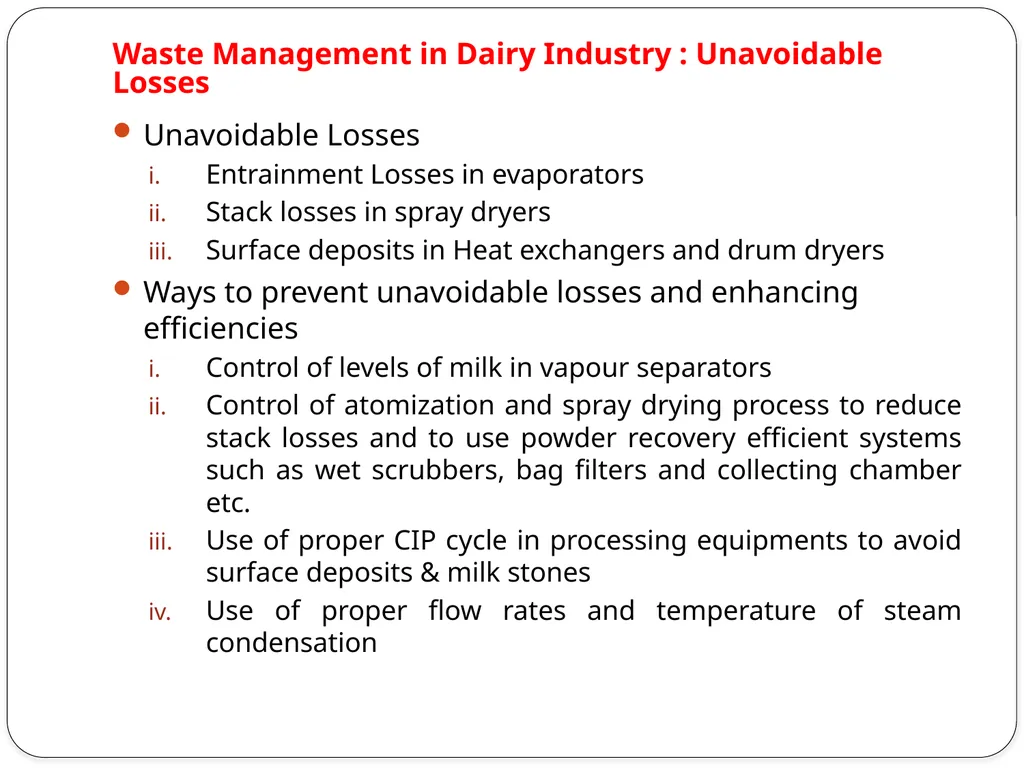
Waste Management in Dairy Industry : Unavoidable Losses Unavoidable Losses
Entrainment Losses in evaporators
Stack losses in spray dryers
Surface deposits in Heat exchangers and drum dryers
Ways to prevent unavoidable losses and enhancing efficiencies
Control of levels of milk in vapour separators
Control of atomization and spray drying process to reduce stack losses and to use powder recovery efficient systems such as wet scrubbers, bag filters and collecting chamber etc.
Use of proper CIP cycle in processing equipments to avoid surface deposits & milk stones
Use of proper flow rates and temperature of steam condensation<br>
06
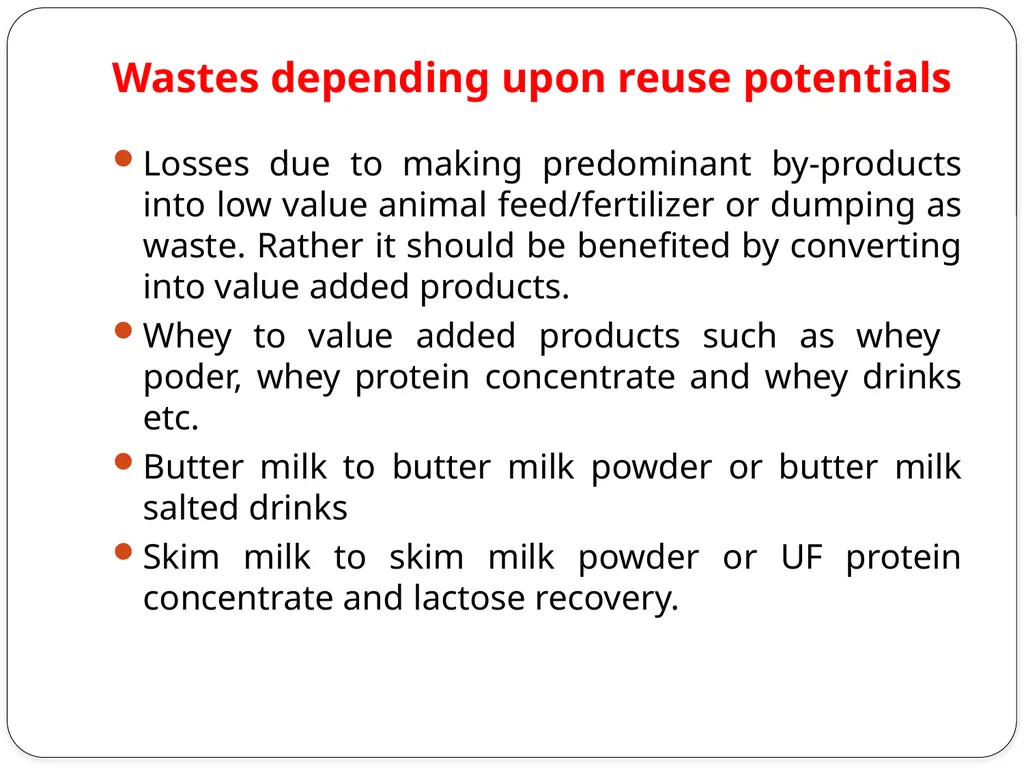
Wastes depending upon reuse potentials Losses due to making predominant by-products into low value animal feed/fertilizer or dumping as waste. Rather it should be benefited by converting into value added products.
Whey to value added products such as whey poder, whey protein concentrate and whey drinks etc.
Butter milk to butter milk powder or butter milk salted drinks
Skim milk to skim milk powder or UF protein concentrate and lactose recovery.<br>
07
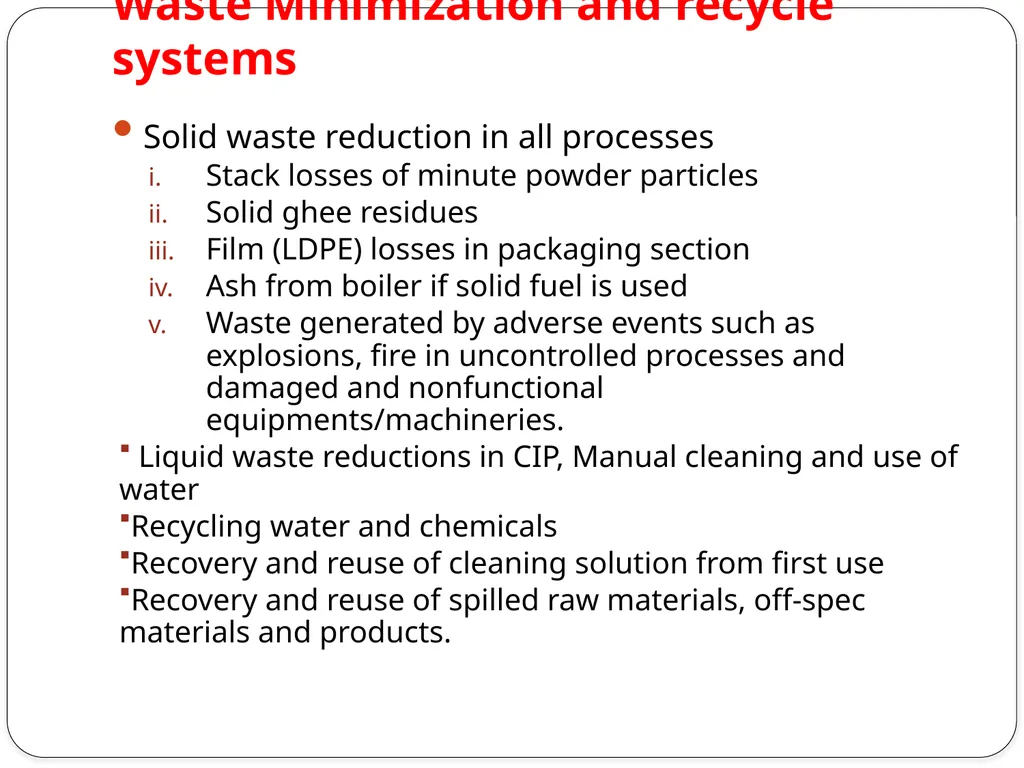
Waste Minimization and recycle systems Solid waste reduction in all processes
Stack losses of minute powder particles
Solid ghee residues
Film (LDPE) losses in packaging section
Ash from boiler if solid fuel is used
Waste generated by adverse events such as explosions, fire in uncontrolled processes and damaged and nonfunctional equipments/machineries.
Liquid waste reductions in CIP, Manual cleaning and use of water
Recycling water and chemicals
Recovery and reuse of cleaning solution from first use
Recovery and reuse of spilled raw materials, off-spec materials and products.<br>
08
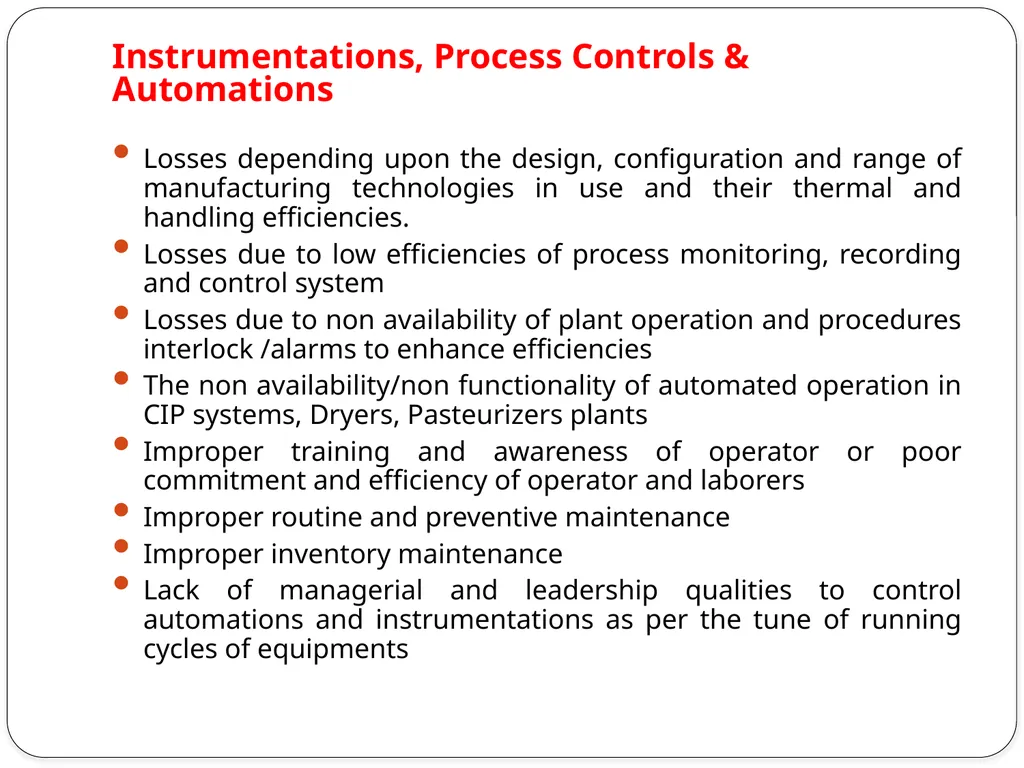
Instrumentations, Process Controls & Automations Losses depending upon the design, configuration and range of manufacturing technologies in use and their thermal and handling efficiencies.
Losses due to low efficiencies of process monitoring, recording and control system
Losses due to non availability of plant operation and procedures interlock /alarms to enhance efficiencies
The non availability/non functionality of automated operation in CIP systems, Dryers, Pasteurizers plants
Improper training and awareness of operator or poor commitment and efficiency of operator and laborers
Improper routine and preventive maintenance
Improper inventory maintenance
Lack of managerial and leadership qualities to control automations and instrumentations as per the tune of running cycles of equipments<br>