
CANCER IN LOS ANGELES COUNTY: Prostate Cancer
LD
Published · 23 slides · 0 views

1 / 1

Description
CANCER IN LOS ANGELES COUNTY: Prostate Cancer 2000-2017 CANCER IN LOS ANGELES COUNTY: Prostate Cancer 2000-2017 Ann S. Hamilton, PhD Amie Eunah Hwang, PhD Kai-Ya Tsai, MSPH James Huynh Lihua Liu, PhD Giovanni Cacciamani, MD Inderbir Gill,
Related Topics
Share
Embed code
Download this presentation From Below
"CANCER IN LOS ANGELES COUNTY: Prostate Cancer" is the property of its rightful owner. Permission is granted to download and print the materials on this website for personal, non-commercial use only, and to display it on your personal computer provided you do not modify the materials and that you retain all copyright notices contained in the materials. By downloading content from our website, you accept the terms of this agreement.
Presentation Transcript
01
CANCER IN LOS ANGELES COUNTY: Prostate Cancer 2000-2017<br>
02
CANCER IN LOS ANGELES COUNTY: Prostate Cancer 2000-2017 Ann S. Hamilton, PhD
Amie Eunah Hwang, PhD
Kai-Ya Tsai, MSPH
James Huynh
Lihua Liu, PhD
Giovanni Cacciamani, MD
Inderbir Gill, MD, M.Ch
Dennis Deapen, DrPH
2021 Los Angeles Cancer Surveillance Program
USC/Norris Comprehensive Center
The Keck School of Medicine of the University of Southern California Suggested Citation:
Hamilton AS, Hwang AE, Tsai KY, Huynh J, Liu L, Cacciamani G, Gill I, Deapen D. Cancer in Los Angeles County: Prostate Cancer Incidence, Mortality and Survival 2000-2017. Los Angeles Cancer Surveillance Program, Norris Comprehensive Cancer Center, University of Southern California, 2021. Copyright© 2021 by the University of Southern California.
All rights reserved.
This document, or parts thereof, may be reproduced in any form with citation.<br>
03
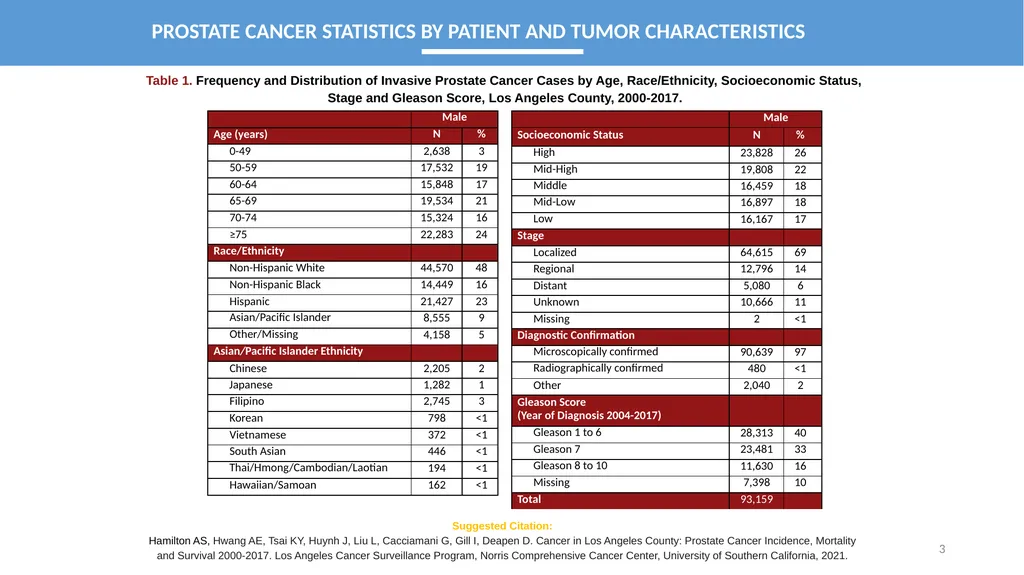
PROSTATE CANCER STATISTICS BY PATIENT AND TUMOR CHARACTERISTICS Table 1. Frequency and Distribution of Invasive Prostate Cancer Cases by Age, Race/Ethnicity, Socioeconomic Status, Stage and Gleason Score, Los Angeles County, 2000-2017. 3 Suggested Citation:
Hamilton AS, Hwang AE, Tsai KY, Huynh J, Liu L, Cacciamani G, Gill I, Deapen D. Cancer in Los Angeles County: Prostate Cancer Incidence, Mortality and Survival 2000-2017. Los Angeles Cancer Surveillance Program, Norris Comprehensive Cancer Center, University of Southern California, 2021.<br>
Hamilton AS, Hwang AE, Tsai KY, Huynh J, Liu L, Cacciamani G, Gill I, Deapen D. Cancer in Los Angeles County: Prostate Cancer Incidence, Mortality and Survival 2000-2017. Los Angeles Cancer Surveillance Program, Norris Comprehensive Cancer Center, University of Southern California, 2021.<br>
04
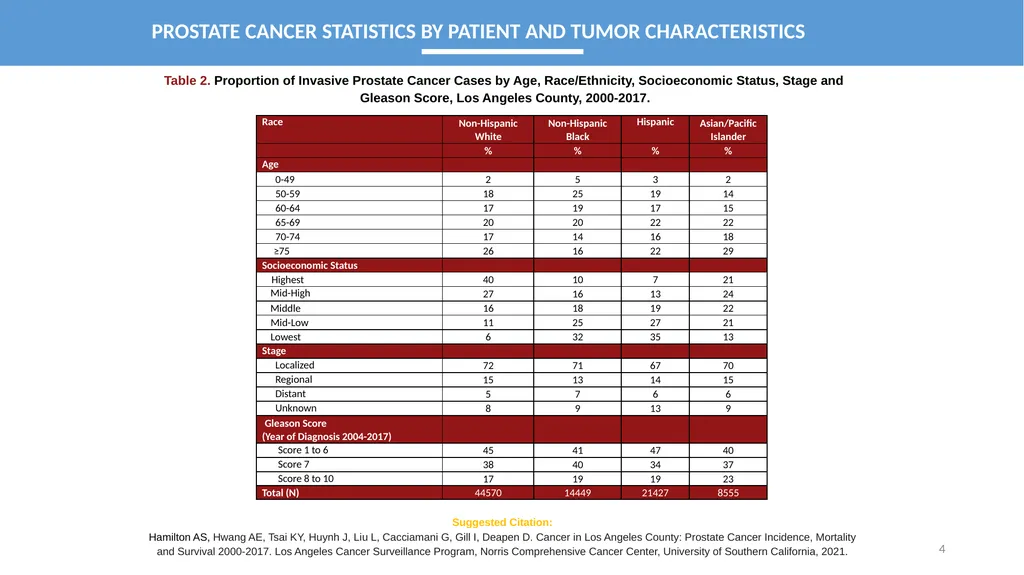
PROSTATE CANCER STATISTICS BY PATIENT AND TUMOR CHARACTERISTICS Table 2. Proportion of Invasive Prostate Cancer Cases by Age, Race/Ethnicity, Socioeconomic Status, Stage and Gleason Score, Los Angeles County, 2000-2017. 4 Suggested Citation:
Hamilton AS, Hwang AE, Tsai KY, Huynh J, Liu L, Cacciamani G, Gill I, Deapen D. Cancer in Los Angeles County: Prostate Cancer Incidence, Mortality and Survival 2000-2017. Los Angeles Cancer Surveillance Program, Norris Comprehensive Cancer Center, University of Southern California, 2021.<br>
Hamilton AS, Hwang AE, Tsai KY, Huynh J, Liu L, Cacciamani G, Gill I, Deapen D. Cancer in Los Angeles County: Prostate Cancer Incidence, Mortality and Survival 2000-2017. Los Angeles Cancer Surveillance Program, Norris Comprehensive Cancer Center, University of Southern California, 2021.<br>
05
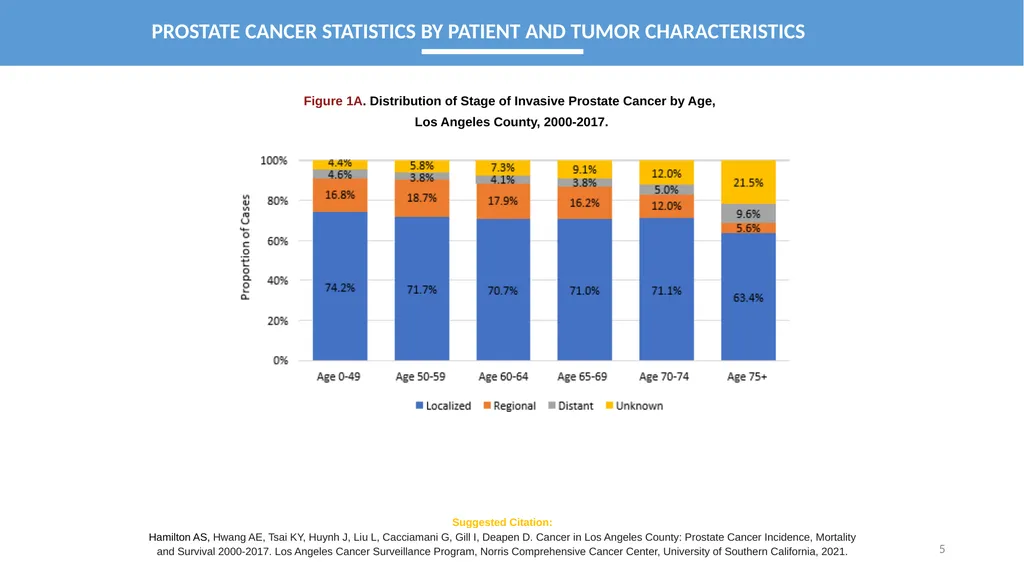
PROSTATE CANCER STATISTICS BY PATIENT AND TUMOR CHARACTERISTICS Figure 1A. Distribution of Stage of Invasive Prostate Cancer by Age,
Los Angeles County, 2000-2017. 5 Suggested Citation:
Hamilton AS, Hwang AE, Tsai KY, Huynh J, Liu L, Cacciamani G, Gill I, Deapen D. Cancer in Los Angeles County: Prostate Cancer Incidence, Mortality and Survival 2000-2017. Los Angeles Cancer Surveillance Program, Norris Comprehensive Cancer Center, University of Southern California, 2021.<br>
06
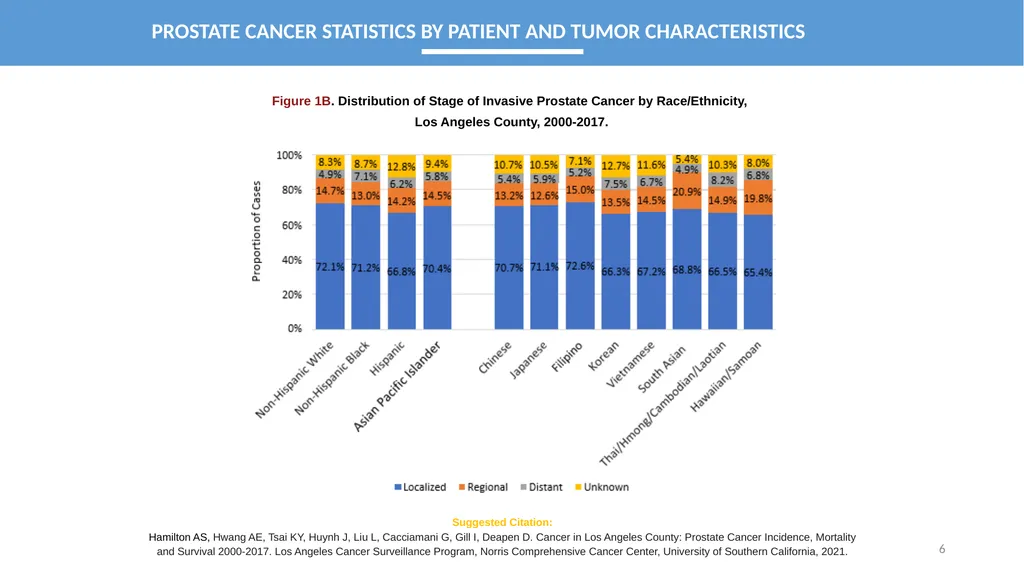
PROSTATE CANCER STATISTICS BY PATIENT AND TUMOR CHARACTERISTICS Figure 1B. Distribution of Stage of Invasive Prostate Cancer by Race/Ethnicity,
Los Angeles County, 2000-2017. 6 Suggested Citation:
Hamilton AS, Hwang AE, Tsai KY, Huynh J, Liu L, Cacciamani G, Gill I, Deapen D. Cancer in Los Angeles County: Prostate Cancer Incidence, Mortality and Survival 2000-2017. Los Angeles Cancer Surveillance Program, Norris Comprehensive Cancer Center, University of Southern California, 2021.<br>
07
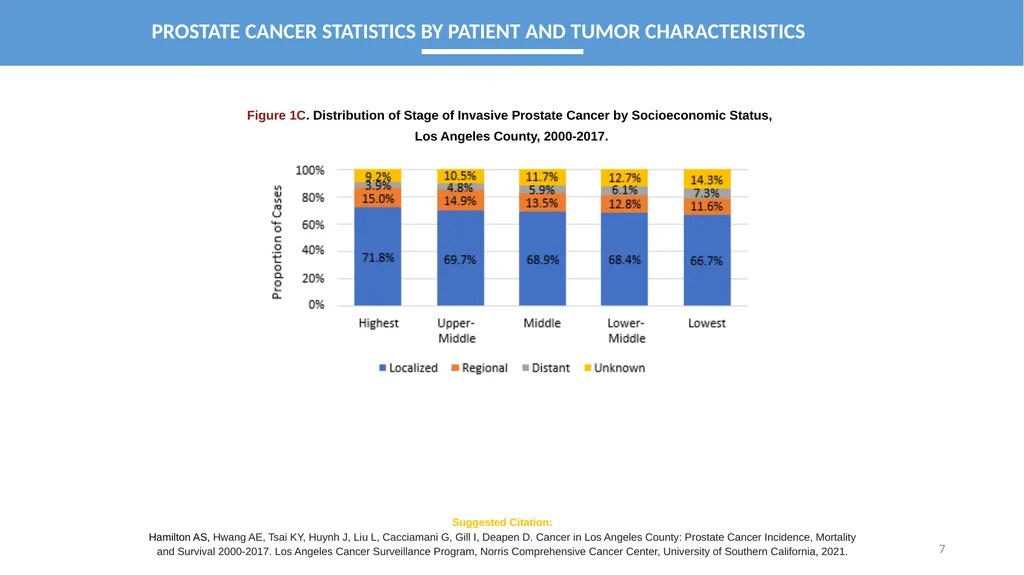
PROSTATE CANCER STATISTICS BY PATIENT AND TUMOR CHARACTERISTICS Figure 1C. Distribution of Stage of Invasive Prostate Cancer by Socioeconomic Status,
Los Angeles County, 2000-2017. 7 Suggested Citation:
Hamilton AS, Hwang AE, Tsai KY, Huynh J, Liu L, Cacciamani G, Gill I, Deapen D. Cancer in Los Angeles County: Prostate Cancer Incidence, Mortality and Survival 2000-2017. Los Angeles Cancer Surveillance Program, Norris Comprehensive Cancer Center, University of Southern California, 2021.<br>
08
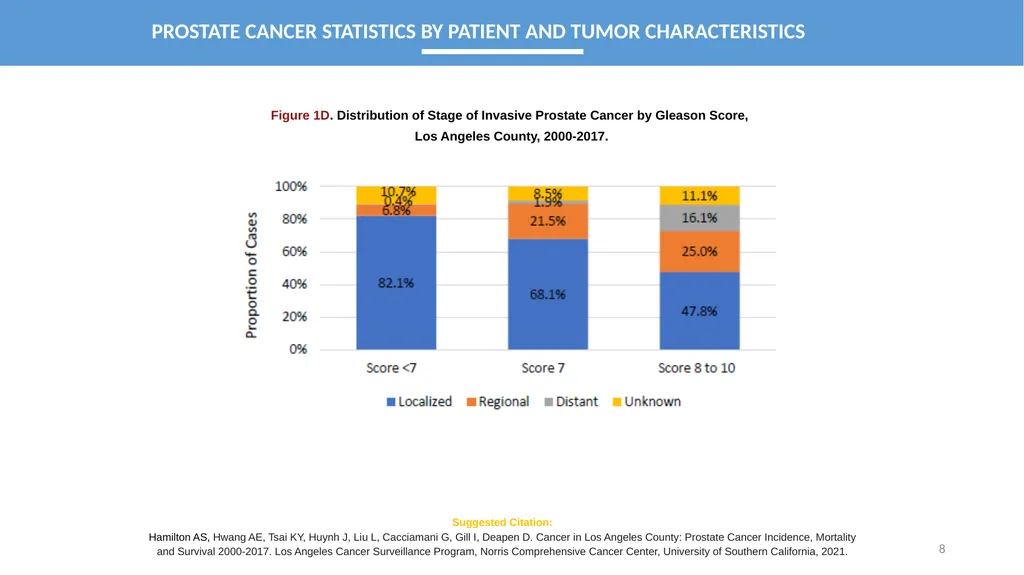
PROSTATE CANCER STATISTICS BY PATIENT AND TUMOR CHARACTERISTICS Figure 1D. Distribution of Stage of Invasive Prostate Cancer by Gleason Score,
Los Angeles County, 2000-2017. 8 Suggested Citation:
Hamilton AS, Hwang AE, Tsai KY, Huynh J, Liu L, Cacciamani G, Gill I, Deapen D. Cancer in Los Angeles County: Prostate Cancer Incidence, Mortality and Survival 2000-2017. Los Angeles Cancer Surveillance Program, Norris Comprehensive Cancer Center, University of Southern California, 2021.<br>
09
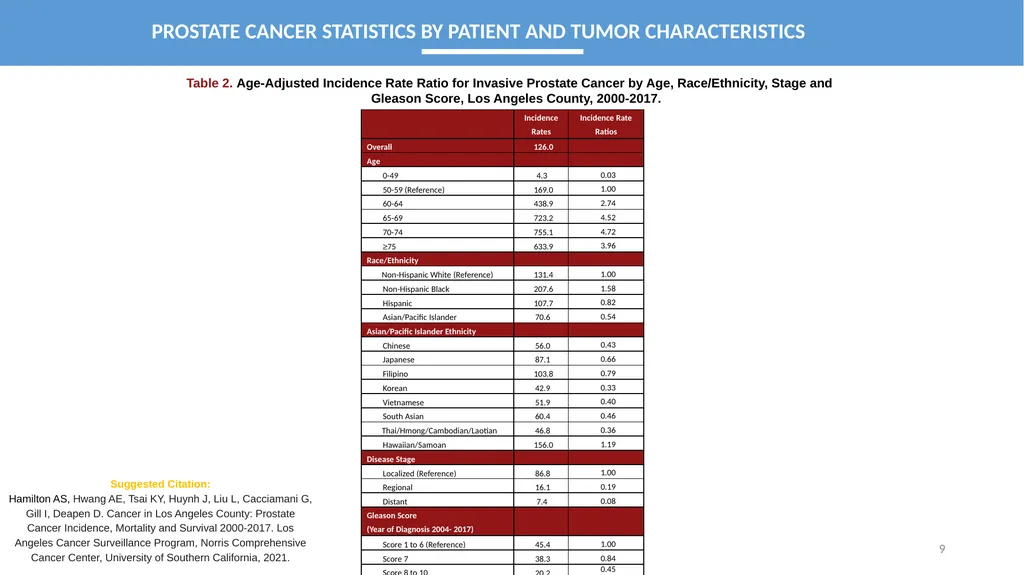
PROSTATE CANCER STATISTICS BY PATIENT AND TUMOR CHARACTERISTICS Table 2. Age-Adjusted Incidence Rate Ratio for Invasive Prostate Cancer by Age, Race/Ethnicity, Stage and
Gleason Score, Los Angeles County, 2000-2017. 9 Suggested Citation:
Hamilton AS, Hwang AE, Tsai KY, Huynh J, Liu L, Cacciamani G, Gill I, Deapen D. Cancer in Los Angeles County: Prostate Cancer Incidence, Mortality and Survival 2000-2017. Los Angeles Cancer Surveillance Program, Norris Comprehensive Cancer Center, University of Southern California, 2021.<br>
Hamilton AS, Hwang AE, Tsai KY, Huynh J, Liu L, Cacciamani G, Gill I, Deapen D. Cancer in Los Angeles County: Prostate Cancer Incidence, Mortality and Survival 2000-2017. Los Angeles Cancer Surveillance Program, Norris Comprehensive Cancer Center, University of Southern California, 2021.<br>
10
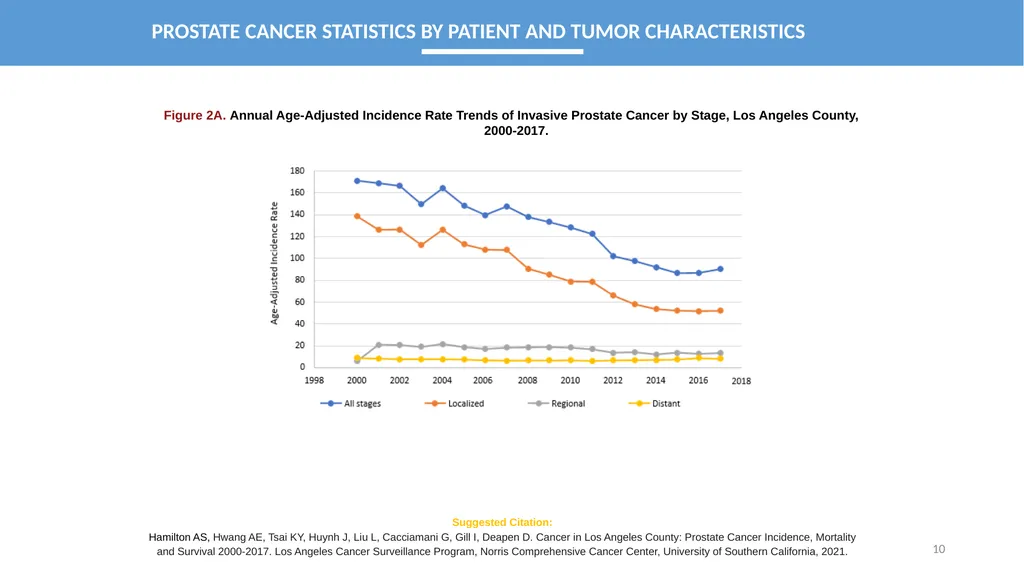
PROSTATE CANCER STATISTICS BY PATIENT AND TUMOR CHARACTERISTICS Figure 2A. Annual Age-Adjusted Incidence Rate Trends of Invasive Prostate Cancer by Stage, Los Angeles County, 2000-2017. 10 Suggested Citation:
Hamilton AS, Hwang AE, Tsai KY, Huynh J, Liu L, Cacciamani G, Gill I, Deapen D. Cancer in Los Angeles County: Prostate Cancer Incidence, Mortality and Survival 2000-2017. Los Angeles Cancer Surveillance Program, Norris Comprehensive Cancer Center, University of Southern California, 2021.<br>
Hamilton AS, Hwang AE, Tsai KY, Huynh J, Liu L, Cacciamani G, Gill I, Deapen D. Cancer in Los Angeles County: Prostate Cancer Incidence, Mortality and Survival 2000-2017. Los Angeles Cancer Surveillance Program, Norris Comprehensive Cancer Center, University of Southern California, 2021.<br>
11
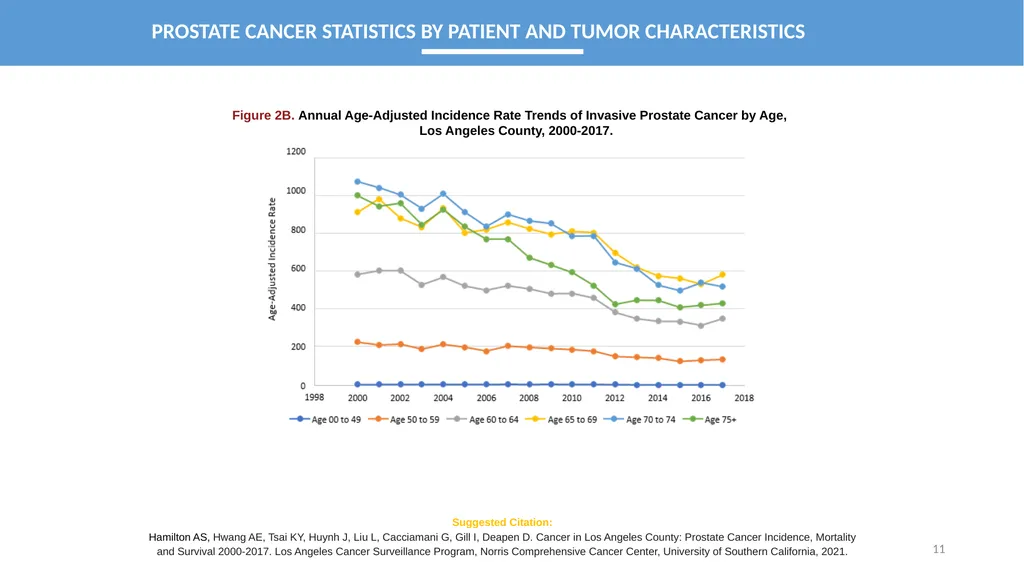
PROSTATE CANCER STATISTICS BY PATIENT AND TUMOR CHARACTERISTICS Figure 2B. Annual Age-Adjusted Incidence Rate Trends of Invasive Prostate Cancer by Age,
Los Angeles County, 2000-2017. 11 Suggested Citation:
Hamilton AS, Hwang AE, Tsai KY, Huynh J, Liu L, Cacciamani G, Gill I, Deapen D. Cancer in Los Angeles County: Prostate Cancer Incidence, Mortality and Survival 2000-2017. Los Angeles Cancer Surveillance Program, Norris Comprehensive Cancer Center, University of Southern California, 2021.<br>
Hamilton AS, Hwang AE, Tsai KY, Huynh J, Liu L, Cacciamani G, Gill I, Deapen D. Cancer in Los Angeles County: Prostate Cancer Incidence, Mortality and Survival 2000-2017. Los Angeles Cancer Surveillance Program, Norris Comprehensive Cancer Center, University of Southern California, 2021.<br>
12
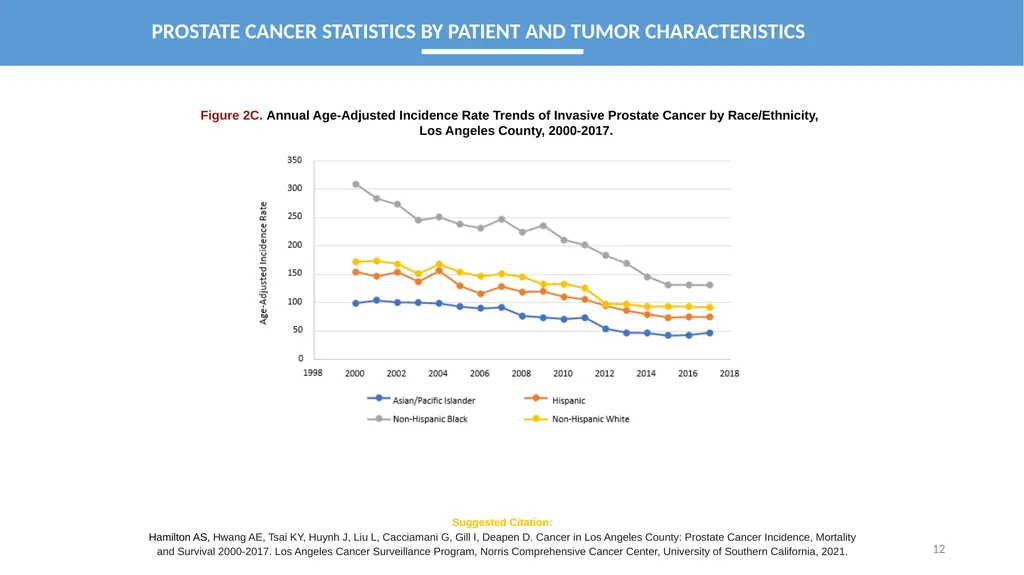
PROSTATE CANCER STATISTICS BY PATIENT AND TUMOR CHARACTERISTICS Figure 2C. Annual Age-Adjusted Incidence Rate Trends of Invasive Prostate Cancer by Race/Ethnicity,
Los Angeles County, 2000-2017. 12 Suggested Citation:
Hamilton AS, Hwang AE, Tsai KY, Huynh J, Liu L, Cacciamani G, Gill I, Deapen D. Cancer in Los Angeles County: Prostate Cancer Incidence, Mortality and Survival 2000-2017. Los Angeles Cancer Surveillance Program, Norris Comprehensive Cancer Center, University of Southern California, 2021.<br>
Hamilton AS, Hwang AE, Tsai KY, Huynh J, Liu L, Cacciamani G, Gill I, Deapen D. Cancer in Los Angeles County: Prostate Cancer Incidence, Mortality and Survival 2000-2017. Los Angeles Cancer Surveillance Program, Norris Comprehensive Cancer Center, University of Southern California, 2021.<br>
13
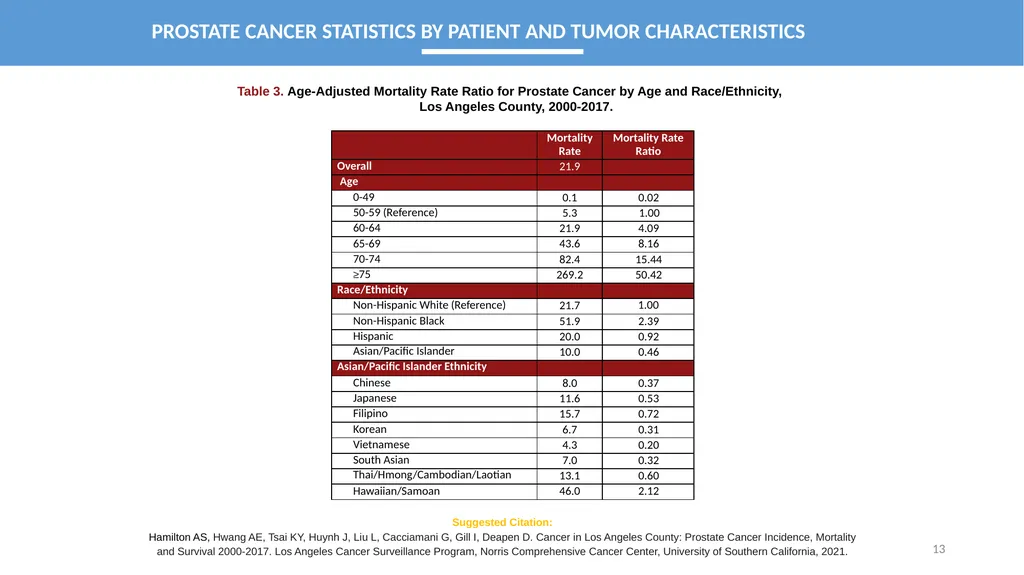
PROSTATE CANCER STATISTICS BY PATIENT AND TUMOR CHARACTERISTICS Table 3. Age-Adjusted Mortality Rate Ratio for Prostate Cancer by Age and Race/Ethnicity,
Los Angeles County, 2000-2017. 13 Suggested Citation:
Hamilton AS, Hwang AE, Tsai KY, Huynh J, Liu L, Cacciamani G, Gill I, Deapen D. Cancer in Los Angeles County: Prostate Cancer Incidence, Mortality and Survival 2000-2017. Los Angeles Cancer Surveillance Program, Norris Comprehensive Cancer Center, University of Southern California, 2021.<br>
Hamilton AS, Hwang AE, Tsai KY, Huynh J, Liu L, Cacciamani G, Gill I, Deapen D. Cancer in Los Angeles County: Prostate Cancer Incidence, Mortality and Survival 2000-2017. Los Angeles Cancer Surveillance Program, Norris Comprehensive Cancer Center, University of Southern California, 2021.<br>
14
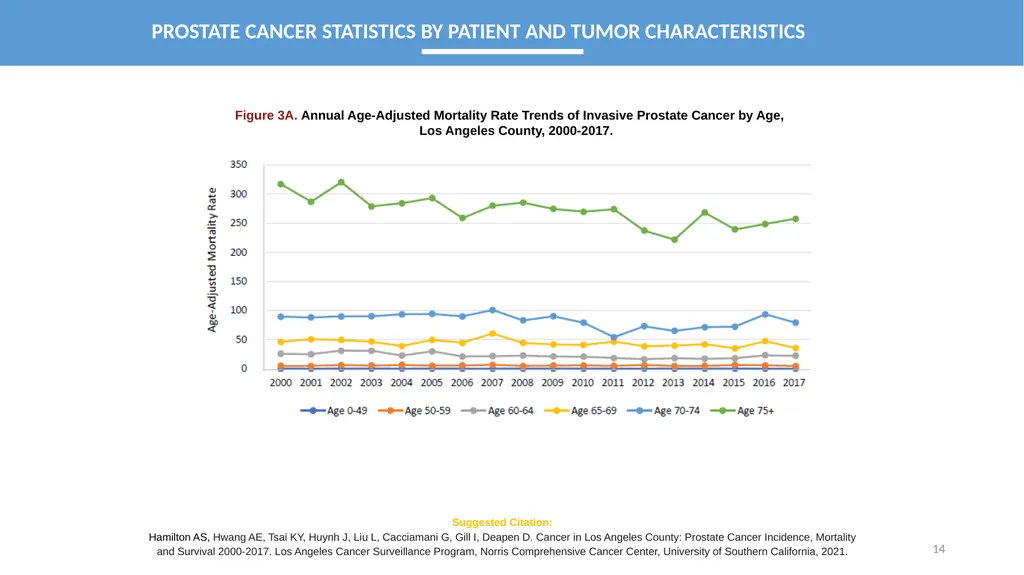
PROSTATE CANCER STATISTICS BY PATIENT AND TUMOR CHARACTERISTICS Figure 3A. Annual Age-Adjusted Mortality Rate Trends of Invasive Prostate Cancer by Age,
Los Angeles County, 2000-2017. 14 Suggested Citation:
Hamilton AS, Hwang AE, Tsai KY, Huynh J, Liu L, Cacciamani G, Gill I, Deapen D. Cancer in Los Angeles County: Prostate Cancer Incidence, Mortality and Survival 2000-2017. Los Angeles Cancer Surveillance Program, Norris Comprehensive Cancer Center, University of Southern California, 2021.<br>
Hamilton AS, Hwang AE, Tsai KY, Huynh J, Liu L, Cacciamani G, Gill I, Deapen D. Cancer in Los Angeles County: Prostate Cancer Incidence, Mortality and Survival 2000-2017. Los Angeles Cancer Surveillance Program, Norris Comprehensive Cancer Center, University of Southern California, 2021.<br>
15
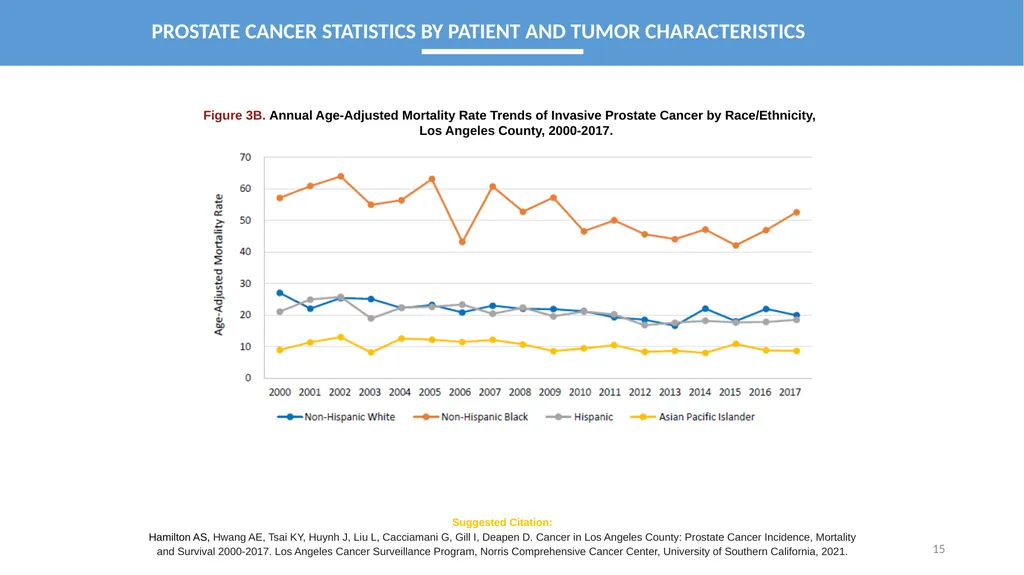
PROSTATE CANCER STATISTICS BY PATIENT AND TUMOR CHARACTERISTICS Figure 3B. Annual Age-Adjusted Mortality Rate Trends of Invasive Prostate Cancer by Race/Ethnicity,
Los Angeles County, 2000-2017. 15 Suggested Citation:
Hamilton AS, Hwang AE, Tsai KY, Huynh J, Liu L, Cacciamani G, Gill I, Deapen D. Cancer in Los Angeles County: Prostate Cancer Incidence, Mortality and Survival 2000-2017. Los Angeles Cancer Surveillance Program, Norris Comprehensive Cancer Center, University of Southern California, 2021.<br>
Hamilton AS, Hwang AE, Tsai KY, Huynh J, Liu L, Cacciamani G, Gill I, Deapen D. Cancer in Los Angeles County: Prostate Cancer Incidence, Mortality and Survival 2000-2017. Los Angeles Cancer Surveillance Program, Norris Comprehensive Cancer Center, University of Southern California, 2021.<br>
16
PROSTATE CANCER STATISTICS BY PATIENT AND TUMOR CHARACTERISTICS 16 Suggested Citation:
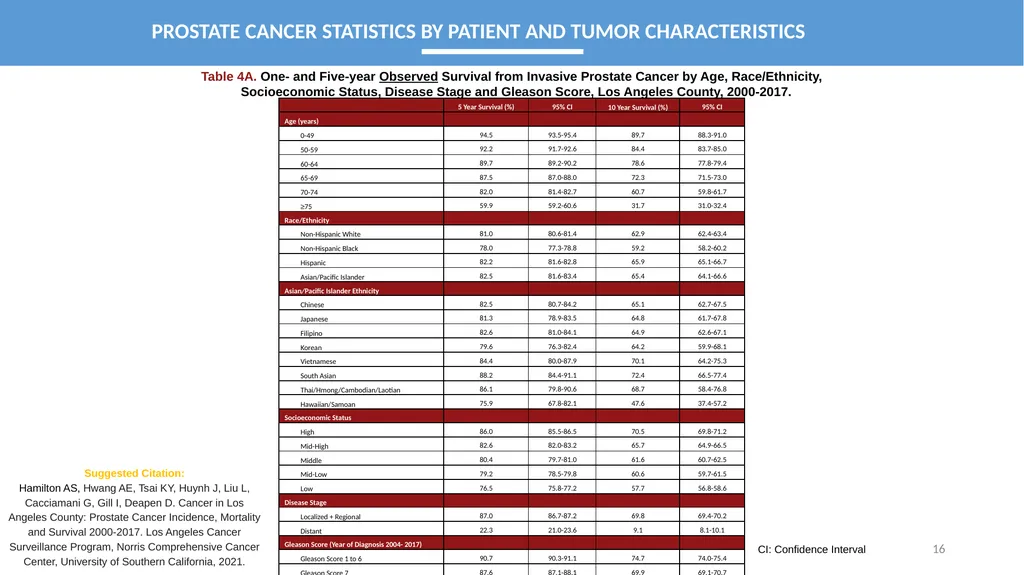
Hamilton AS, Hwang AE, Tsai KY, Huynh J, Liu L, Cacciamani G, Gill I, Deapen D. Cancer in Los Angeles County: Prostate Cancer Incidence, Mortality and Survival 2000-2017. Los Angeles Cancer Surveillance Program, Norris Comprehensive Cancer Center, University of Southern California, 2021. Table 4A. One- and Five-year Observed Survival from Invasive Prostate Cancer by Age, Race/Ethnicity, Socioeconomic Status, Disease Stage and Gleason Score, Los Angeles County, 2000-2017. CI: Confidence Interval<br>
Hamilton AS, Hwang AE, Tsai KY, Huynh J, Liu L, Cacciamani G, Gill I, Deapen D. Cancer in Los Angeles County: Prostate Cancer Incidence, Mortality and Survival 2000-2017. Los Angeles Cancer Surveillance Program, Norris Comprehensive Cancer Center, University of Southern California, 2021. Table 4A. One- and Five-year Observed Survival from Invasive Prostate Cancer by Age, Race/Ethnicity, Socioeconomic Status, Disease Stage and Gleason Score, Los Angeles County, 2000-2017. CI: Confidence Interval<br>
17
PROSTATE CANCER STATISTICS BY PATIENT AND TUMOR CHARACTERISTICS 17 Suggested Citation:
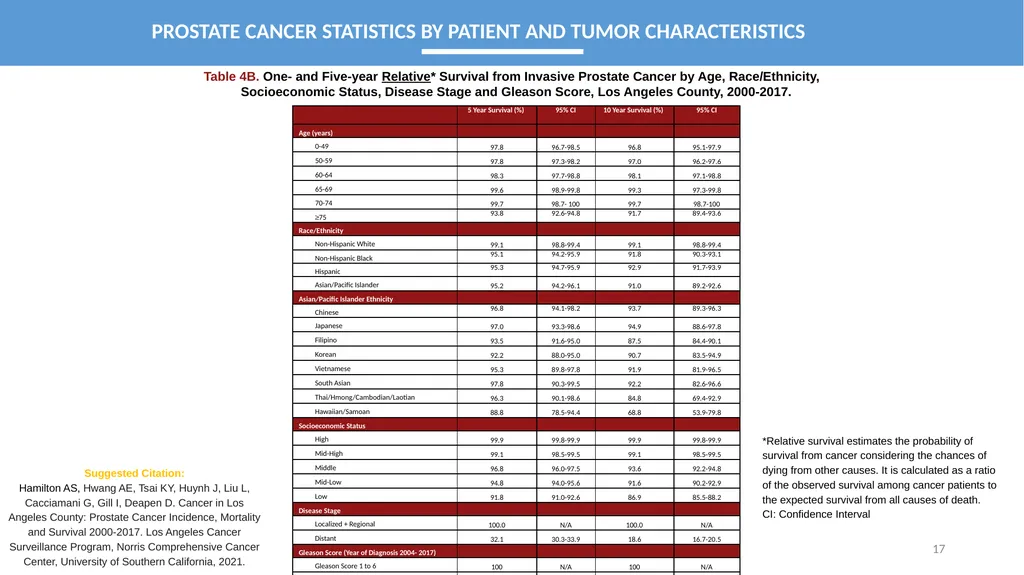
Hamilton AS, Hwang AE, Tsai KY, Huynh J, Liu L, Cacciamani G, Gill I, Deapen D. Cancer in Los Angeles County: Prostate Cancer Incidence, Mortality and Survival 2000-2017. Los Angeles Cancer Surveillance Program, Norris Comprehensive Cancer Center, University of Southern California, 2021. Table 4B. One- and Five-year Relative* Survival from Invasive Prostate Cancer by Age, Race/Ethnicity, Socioeconomic Status, Disease Stage and Gleason Score, Los Angeles County, 2000-2017. *Relative survival estimates the probability of survival from cancer considering the chances of dying from other causes. It is calculated as a ratio of the observed survival among cancer patients to the expected survival from all causes of death. CI: Confidence Interval<br>
Hamilton AS, Hwang AE, Tsai KY, Huynh J, Liu L, Cacciamani G, Gill I, Deapen D. Cancer in Los Angeles County: Prostate Cancer Incidence, Mortality and Survival 2000-2017. Los Angeles Cancer Surveillance Program, Norris Comprehensive Cancer Center, University of Southern California, 2021. Table 4B. One- and Five-year Relative* Survival from Invasive Prostate Cancer by Age, Race/Ethnicity, Socioeconomic Status, Disease Stage and Gleason Score, Los Angeles County, 2000-2017. *Relative survival estimates the probability of survival from cancer considering the chances of dying from other causes. It is calculated as a ratio of the observed survival among cancer patients to the expected survival from all causes of death. CI: Confidence Interval<br>
18
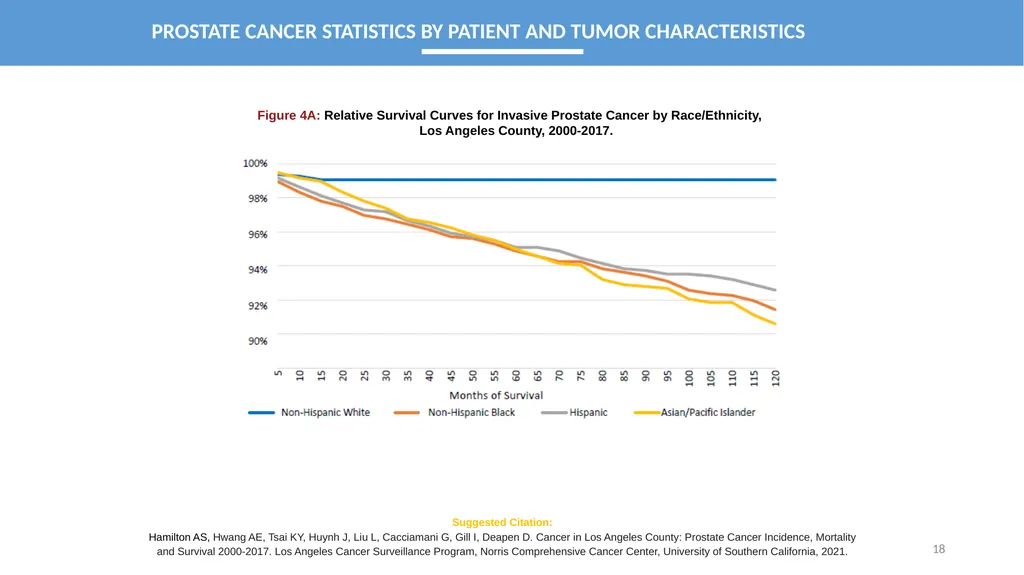
PROSTATE CANCER STATISTICS BY PATIENT AND TUMOR CHARACTERISTICS Figure 4A: Relative Survival Curves for Invasive Prostate Cancer by Race/Ethnicity,
Los Angeles County, 2000-2017. 18 Suggested Citation:
Hamilton AS, Hwang AE, Tsai KY, Huynh J, Liu L, Cacciamani G, Gill I, Deapen D. Cancer in Los Angeles County: Prostate Cancer Incidence, Mortality and Survival 2000-2017. Los Angeles Cancer Surveillance Program, Norris Comprehensive Cancer Center, University of Southern California, 2021.<br>
Hamilton AS, Hwang AE, Tsai KY, Huynh J, Liu L, Cacciamani G, Gill I, Deapen D. Cancer in Los Angeles County: Prostate Cancer Incidence, Mortality and Survival 2000-2017. Los Angeles Cancer Surveillance Program, Norris Comprehensive Cancer Center, University of Southern California, 2021.<br>
19
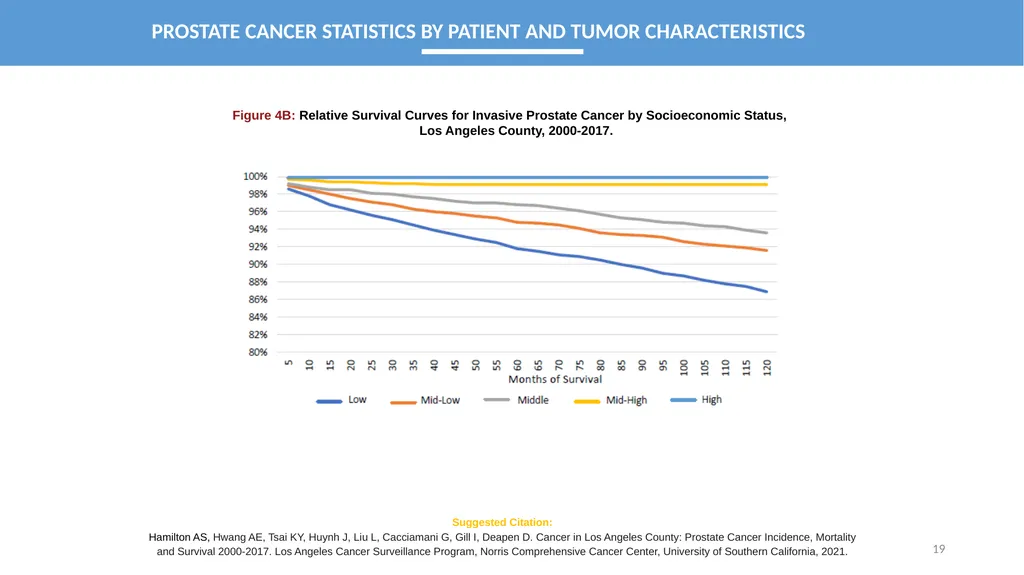
PROSTATE CANCER STATISTICS BY PATIENT AND TUMOR CHARACTERISTICS Figure 4B: Relative Survival Curves for Invasive Prostate Cancer by Socioeconomic Status,
Los Angeles County, 2000-2017. 19 Suggested Citation:
Hamilton AS, Hwang AE, Tsai KY, Huynh J, Liu L, Cacciamani G, Gill I, Deapen D. Cancer in Los Angeles County: Prostate Cancer Incidence, Mortality and Survival 2000-2017. Los Angeles Cancer Surveillance Program, Norris Comprehensive Cancer Center, University of Southern California, 2021.<br>
Hamilton AS, Hwang AE, Tsai KY, Huynh J, Liu L, Cacciamani G, Gill I, Deapen D. Cancer in Los Angeles County: Prostate Cancer Incidence, Mortality and Survival 2000-2017. Los Angeles Cancer Surveillance Program, Norris Comprehensive Cancer Center, University of Southern California, 2021.<br>
20
PROSTATE CANCER STATISTICS BY PATIENT AND TUMOR CHARACTERISTICS 20 Suggested Citation:
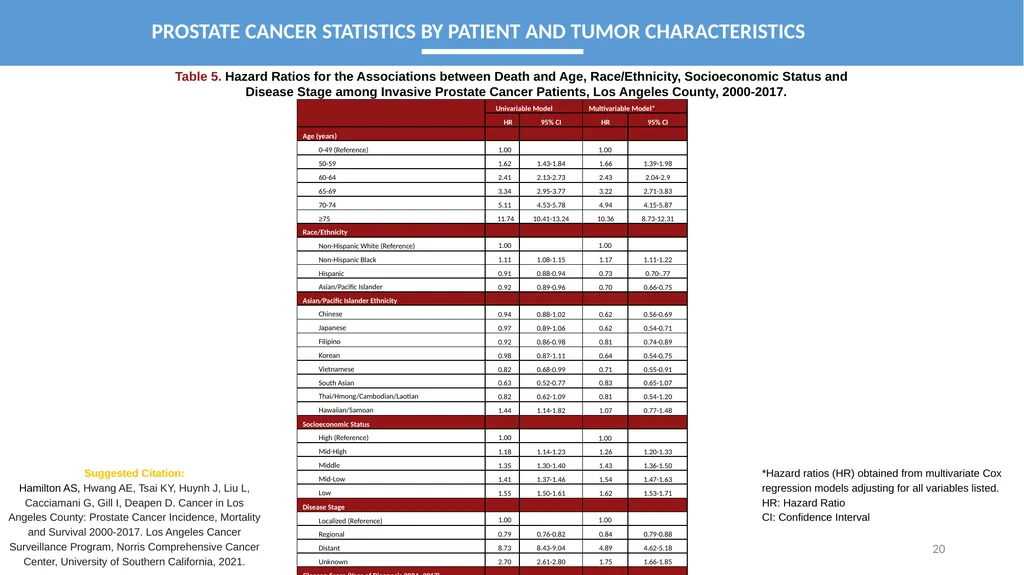
Hamilton AS, Hwang AE, Tsai KY, Huynh J, Liu L, Cacciamani G, Gill I, Deapen D. Cancer in Los Angeles County: Prostate Cancer Incidence, Mortality and Survival 2000-2017. Los Angeles Cancer Surveillance Program, Norris Comprehensive Cancer Center, University of Southern California, 2021. Table 5. Hazard Ratios for the Associations between Death and Age, Race/Ethnicity, Socioeconomic Status and Disease Stage among Invasive Prostate Cancer Patients, Los Angeles County, 2000-2017. *Hazard ratios (HR) obtained from multivariate Cox regression models adjusting for all variables listed. HR: Hazard Ratio
CI: Confidence Interval<br>
21
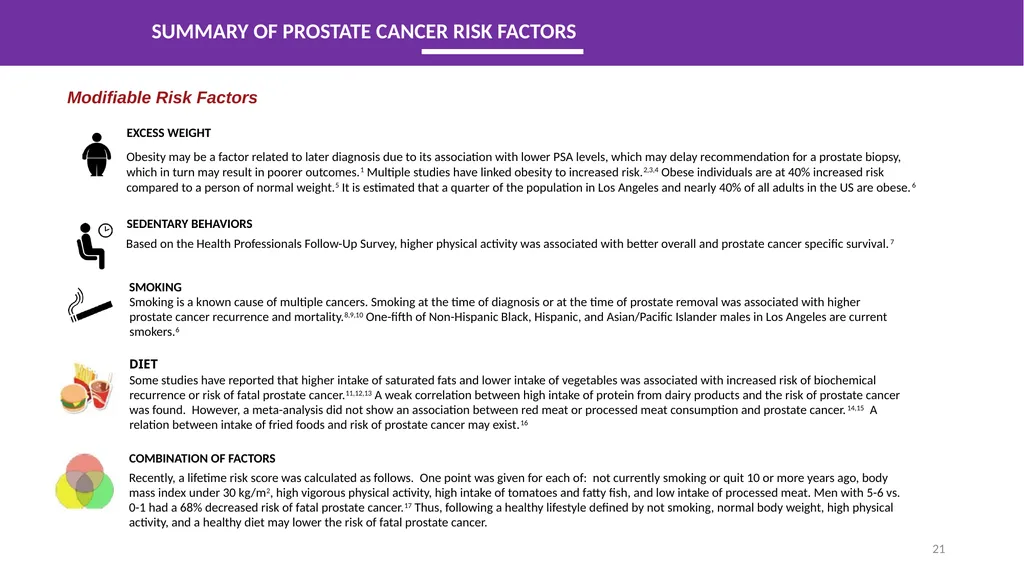
SUMMARY OF PROSTATE CANCER RISK FACTORS Modifiable Risk Factors Obesity may be a factor related to later diagnosis due to its association with lower PSA levels, which may delay recommendation for a prostate biopsy, which in turn may result in poorer outcomes.1 Multiple studies have linked obesity to increased risk.2,3,4 Obese individuals are at 40% increased risk compared to a person of normal weight.5 It is estimated that a quarter of the population in Los Angeles and nearly 40% of all adults in the US are obese.6 EXCESS WEIGHT Based on the Health Professionals Follow-Up Survey, higher physical activity was associated with better overall and prostate cancer specific survival.7 SEDENTARY BEHAVIORS Smoking is a known cause of multiple cancers. Smoking at the time of diagnosis or at the time of prostate removal was associated with higher prostate cancer recurrence and mortality.8,9,10 One-fifth of Non-Hispanic Black, Hispanic, and Asian/Pacific Islander males in Los Angeles are current smokers.6 SMOKING Recently, a lifetime risk score was calculated as follows. One point was given for each of: not currently smoking or quit 10 or more years ago, body mass index under 30 kg/m2, high vigorous physical activity, high intake of tomatoes and fatty fish, and low intake of processed meat. Men with 5-6 vs. 0-1 had a 68% decreased risk of fatal prostate cancer.17 Thus, following a healthy lifestyle defined by not smoking, normal body weight, high physical activity, and a healthy diet may lower the risk of fatal prostate cancer. COMBINATION OF FACTORS 21 DIET Some studies have reported that higher intake of saturated fats and lower intake of vegetables was associated with increased risk of biochemical recurrence or risk of fatal prostate cancer.11,12,13 A weak correlation between high intake of protein from dairy products and the risk of prostate cancer was found. However, a meta-analysis did not show an association between red meat or processed meat consumption and prostate cancer.14,15 A relation between intake of fried foods and risk of prostate cancer may exist.16<br>
22
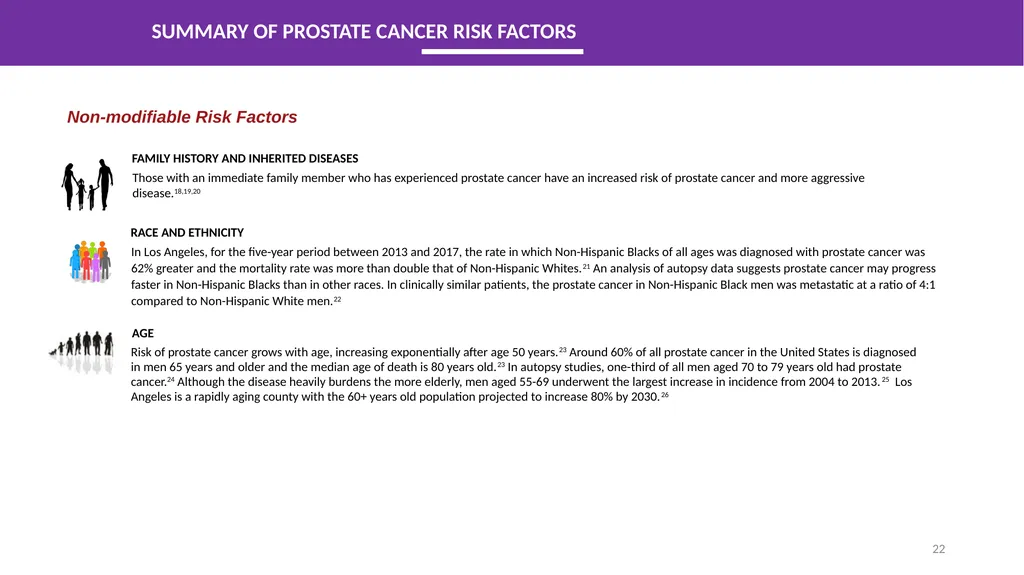
SUMMARY OF PROSTATE CANCER RISK FACTORS Non-modifiable Risk Factors Those with an immediate family member who has experienced prostate cancer have an increased risk of prostate cancer and more aggressive disease.18,19,20 FAMILY HISTORY AND INHERITED DISEASES Risk of prostate cancer grows with age, increasing exponentially after age 50 years.23 Around 60% of all prostate cancer in the United States is diagnosed in men 65 years and older and the median age of death is 80 years old.23 In autopsy studies, one-third of all men aged 70 to 79 years old had prostate cancer.24 Although the disease heavily burdens the more elderly, men aged 55-69 underwent the largest increase in incidence from 2004 to 2013.25 Los Angeles is a rapidly aging county with the 60+ years old population projected to increase 80% by 2030.26 AGE In Los Angeles, for the five-year period between 2013 and 2017, the rate in which Non-Hispanic Blacks of all ages was diagnosed with prostate cancer was 62% greater and the mortality rate was more than double that of Non-Hispanic Whites.21 An analysis of autopsy data suggests prostate cancer may progress faster in Non-Hispanic Blacks than in other races. In clinically similar patients, the prostate cancer in Non-Hispanic Black men was metastatic at a ratio of 4:1 compared to Non-Hispanic White men.22 RACE AND ETHNICITY 22<br>
23
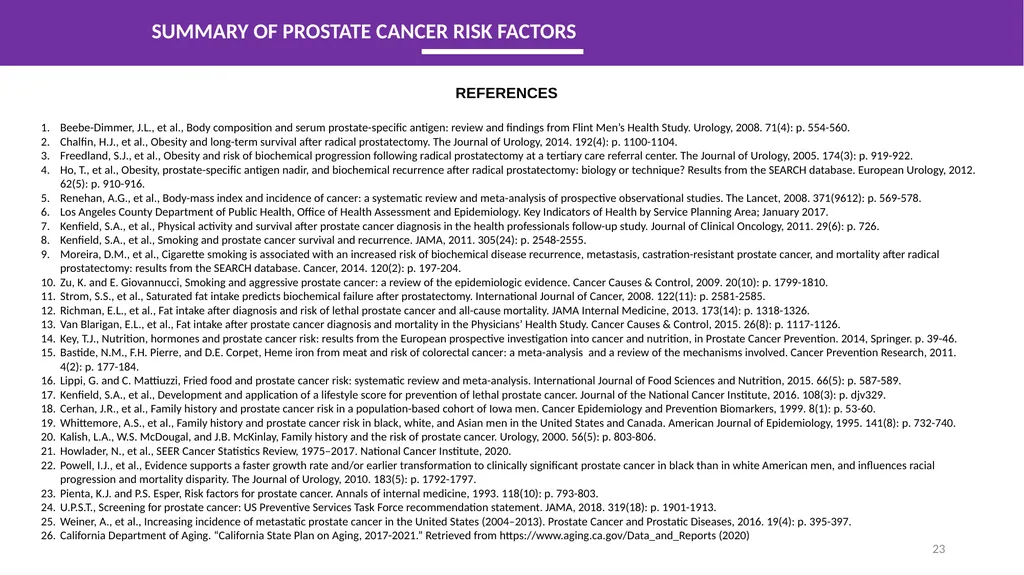
SUMMARY OF PROSTATE CANCER RISK FACTORS 23 Beebe-Dimmer, J.L., et al., Body composition and serum prostate-specific antigen: review and findings from Flint Men’s Health Study. Urology, 2008. 71(4): p. 554-560.
Chalfin, H.J., et al., Obesity and long-term survival after radical prostatectomy. The Journal of Urology, 2014. 192(4): p. 1100-1104.
Freedland, S.J., et al., Obesity and risk of biochemical progression following radical prostatectomy at a tertiary care referral center. The Journal of Urology, 2005. 174(3): p. 919-922.
Ho, T., et al., Obesity, prostate-specific antigen nadir, and biochemical recurrence after radical prostatectomy: biology or technique? Results from the SEARCH database. European Urology, 2012. 62(5): p. 910-916.
Renehan, A.G., et al., Body-mass index and incidence of cancer: a systematic review and meta-analysis of prospective observational studies. The Lancet, 2008. 371(9612): p. 569-578.
Los Angeles County Department of Public Health, Office of Health Assessment and Epidemiology. Key Indicators of Health by Service Planning Area; January 2017.
Kenfield, S.A., et al., Physical activity and survival after prostate cancer diagnosis in the health professionals follow-up study. Journal of Clinical Oncology, 2011. 29(6): p. 726.
Kenfield, S.A., et al., Smoking and prostate cancer survival and recurrence. JAMA, 2011. 305(24): p. 2548-2555.
Moreira, D.M., et al., Cigarette smoking is associated with an increased risk of biochemical disease recurrence, metastasis, castration-resistant prostate cancer, and mortality after radical prostatectomy: results from the SEARCH database. Cancer, 2014. 120(2): p. 197-204.
Zu, K. and E. Giovannucci, Smoking and aggressive prostate cancer: a review of the epidemiologic evidence. Cancer Causes & Control, 2009. 20(10): p. 1799-1810.
Strom, S.S., et al., Saturated fat intake predicts biochemical failure after prostatectomy. International Journal of Cancer, 2008. 122(11): p. 2581-2585.
Richman, E.L., et al., Fat intake after diagnosis and risk of lethal prostate cancer and all-cause mortality. JAMA Internal Medicine, 2013. 173(14): p. 1318-1326.
Van Blarigan, E.L., et al., Fat intake after prostate cancer diagnosis and mortality in the Physicians’ Health Study. Cancer Causes & Control, 2015. 26(8): p. 1117-1126.
Key, T.J., Nutrition, hormones and prostate cancer risk: results from the European prospective investigation into cancer and nutrition, in Prostate Cancer Prevention. 2014, Springer. p. 39-46.
Bastide, N.M., F.H. Pierre, and D.E. Corpet, Heme iron from meat and risk of colorectal cancer: a meta-analysis and a review of the mechanisms involved. Cancer Prevention Research, 2011. 4(2): p. 177-184.
Lippi, G. and C. Mattiuzzi, Fried food and prostate cancer risk: systematic review and meta-analysis. International Journal of Food Sciences and Nutrition, 2015. 66(5): p. 587-589.
Kenfield, S.A., et al., Development and application of a lifestyle score for prevention of lethal prostate cancer. Journal of the National Cancer Institute, 2016. 108(3): p. djv329.
Cerhan, J.R., et al., Family history and prostate cancer risk in a population-based cohort of Iowa men. Cancer Epidemiology and Prevention Biomarkers, 1999. 8(1): p. 53-60.
Whittemore, A.S., et al., Family history and prostate cancer risk in black, white, and Asian men in the United States and Canada. American Journal of Epidemiology, 1995. 141(8): p. 732-740.
Kalish, L.A., W.S. McDougal, and J.B. McKinlay, Family history and the risk of prostate cancer. Urology, 2000. 56(5): p. 803-806.
Howlader, N., et al., SEER Cancer Statistics Review, 1975–2017. National Cancer Institute, 2020.
Powell, I.J., et al., Evidence supports a faster growth rate and/or earlier transformation to clinically significant prostate cancer in black than in white American men, and influences racial progression and mortality disparity. The Journal of Urology, 2010. 183(5): p. 1792-1797.
Pienta, K.J. and P.S. Esper, Risk factors for prostate cancer. Annals of internal medicine, 1993. 118(10): p. 793-803.
U.P.S.T., Screening for prostate cancer: US Preventive Services Task Force recommendation statement. JAMA, 2018. 319(18): p. 1901-1913.
Weiner, A., et al., Increasing incidence of metastatic prostate cancer in the United States (2004–2013). Prostate Cancer and Prostatic Diseases, 2016. 19(4): p. 395-397.
California Department of Aging. “California State Plan on Aging, 2017-2021.” Retrieved from https://www.aging.ca.gov/Data_and_Reports (2020) REFERENCES<br>