"Carbamate Insecticides Dr. Kumari Anjana Assistant" is the property of its rightful owner. Permission is granted to
download and print the materials on this website for personal, non-commercial use only, and to display it
on your personal computer provided you do not modify the materials and that you retain all copyright
notices contained in the materials. By downloading content from our website, you accept the terms of this
agreement.
Presentation Transcript
01
Carbamate Insecticides Dr. Kumari Anjana
Assistant Professor
Deptt. of Veterinary Pharmacology & Toxicology
Bihar Veterinary College, Bihar Animal Sciences University, Patna<br>
02
Content of the chapter Introduction
Classification
Similarities with organophosphate compounds
Differences from OP compounds
Mechanism of action
Clinical signs
Diagnosis
Treatment<br>
03
Carbamate Insecticides The carbamate insecticides represent the third major group of synthetic organic insecticides developed after World War II.
Carbamate Insecticides are widely used in agricultural, veterinary and household practices by virtue of their properties like;
broad-spectrum of activity,
low mammalian toxicity and
rapid environmental inactivation.<br>
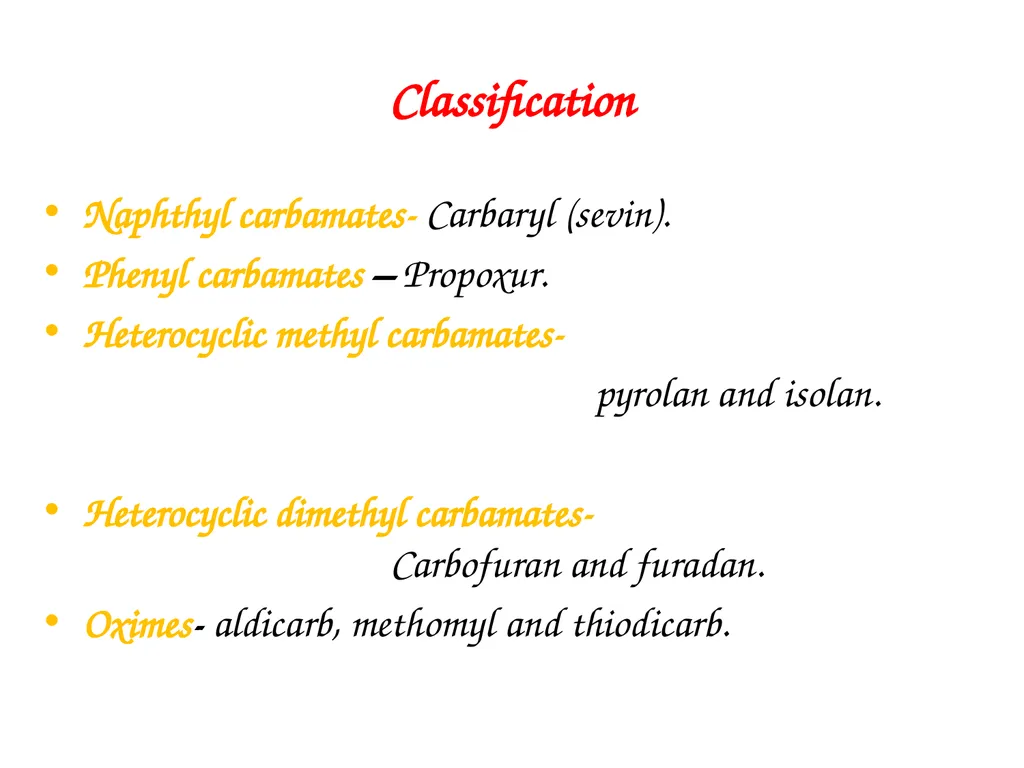
Heterocyclic dimethyl carbamates- Carbofuran and furadan.
Oximes- aldicarb, methomyl and thiodicarb.<br>
05
Similarities with organophosphate compounds Carbamate insecticides are similar to organophosphorus insecticides in most of their properties like:
mode of action,
range of toxicity,
lack of environmental persistence and
lack of safety for beneficial insects and non- target species.
Similar to OP compounds, they do not have cumulative properties.<br>
06
Differences from OP compounds Carbamates differ from OP compounds in following aspects:
--They are reversible inhibitors of cholinesterase (ChE) enzyme.
They inhibit cholinesterase at both anionic and esteratic sites.
They are selective inhibitors of cholinesterase enzyme and do not inhibit carboxylesterase enzyme.
Decarbamoylation (reactivation) of inhibited ChE enzyme is easier.
Cholinesterase enzyme reactivators like 2-PAM are ineffective (contraindicated) in the carbamate intoxication.<br>
07
Mechanism of action Carbamate inhibit acetylcholinesterase enzyme, but these insecticides occupy both anionic and esteratic sites of AChE.
The inhibition in case of Carbamate results from a chemical reaction between the carbamoyl moiety of carbamate compound and the active site serine hydroxyl group of AChE to form carbamoylated enzyme rather than phosphorylated as with the organophosphate.
The carbamoylated enzyme is relatively less stable and susceptible to hydrolysis, although rate of hydrolysis is not very fast as with acetylcholine.<br>
08
Therefore, the decarbamoylation is easier in comparison to dephosporylation (OPs).
Because of relatively rapid reactivation of carbamoylated AChE, the carbamate insecticides are often called reversible anticholinesterase agents.
Toxicosis develops when the amount of carbamate pesticide in the body is so large that the rate of carbamoylation of AChE exceeds the rate of hydrolysis of pesticide by the enzyme.<br>
09
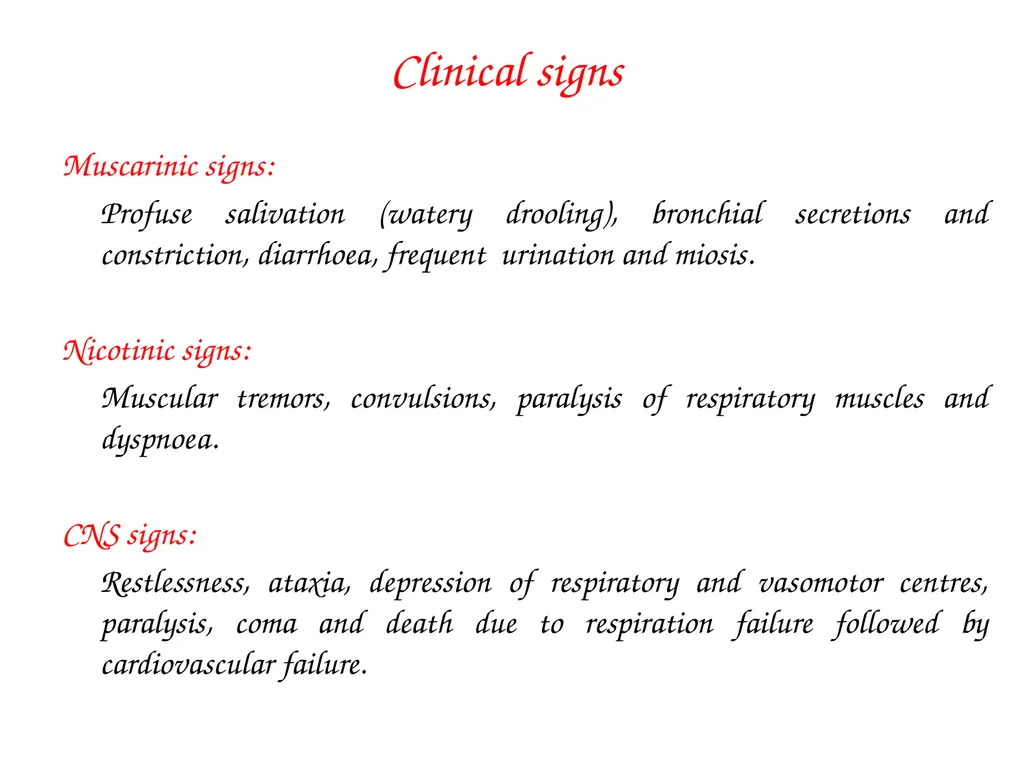
Clinical signs Muscarinic signs:
Profuse salivation (watery drooling), bronchial secretions and constriction, diarrhoea, frequent urination and miosis.
Nicotinic signs:
Muscular tremors, convulsions, paralysis of respiratory muscles and dyspnoea.
CNS signs:
Restlessness, ataxia, depression of respiratory and vasomotor centres, paralysis, coma and death due to respiration failure followed by cardiovascular failure.<br>
10
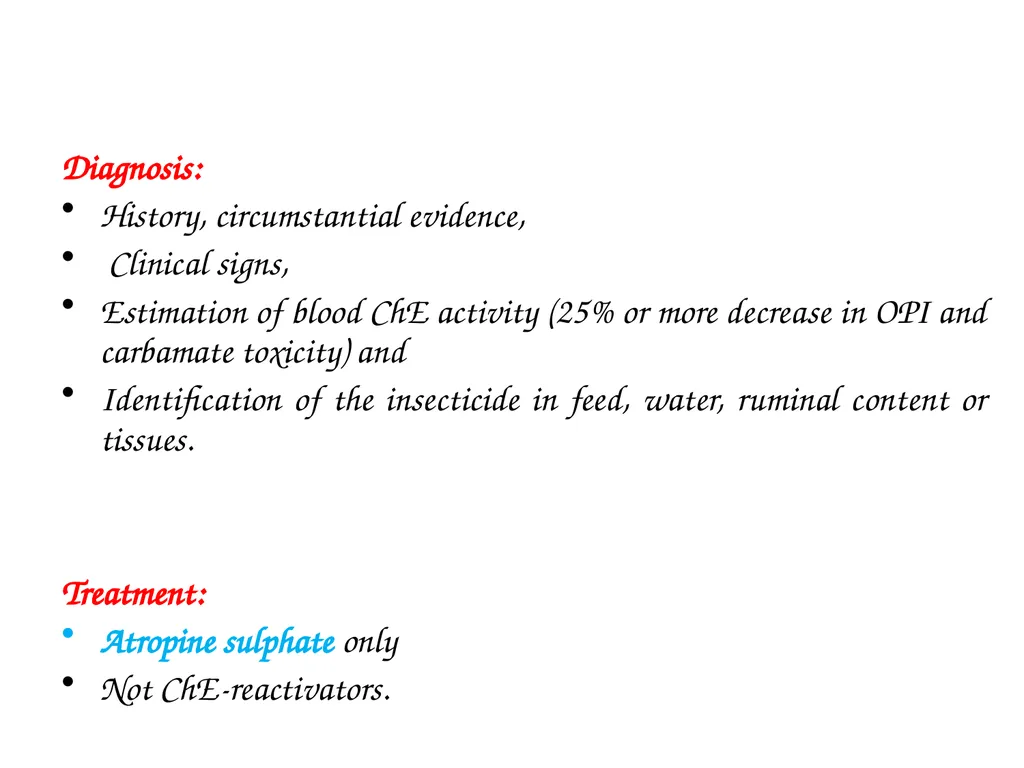
Diagnosis:
History, circumstantial evidence,
Clinical signs,
Estimation of blood ChE activity (25% or more decrease in OPI and carbamate toxicity) and
Identification of the insecticide in feed, water, ruminal content or tissues.
Treatment:
Atropine sulphate only
Not ChE-reactivators.<br>
11
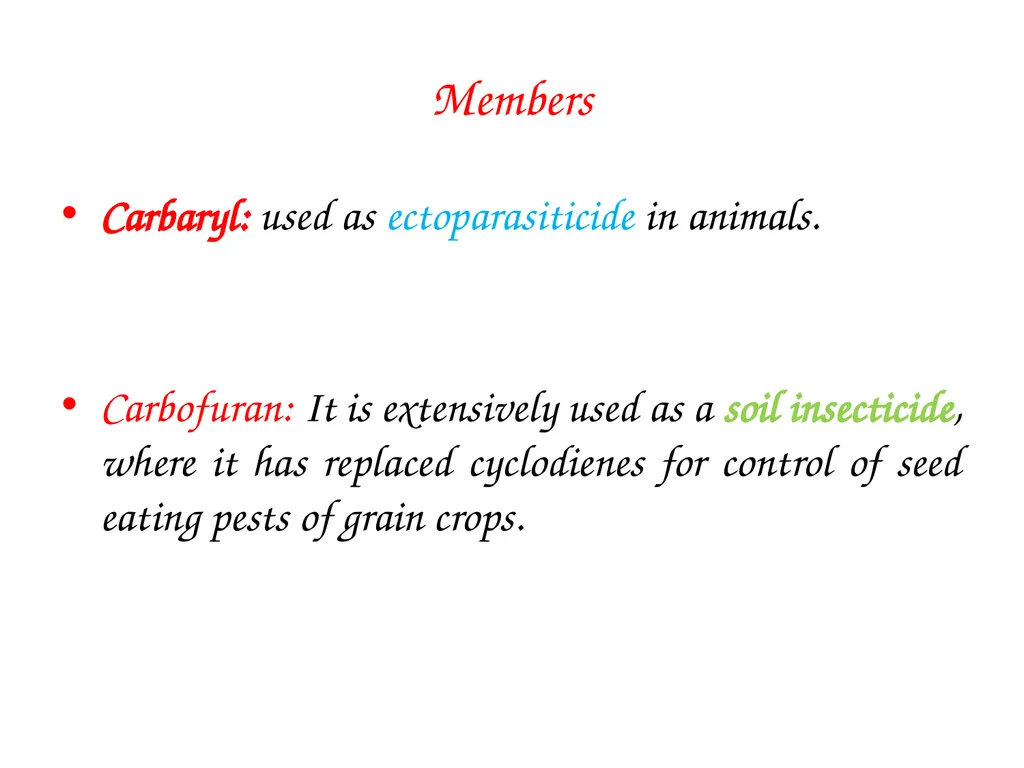
Members Carbaryl: used as ectoparasiticide in animals.
Carbofuran: It is extensively used as a soil insecticide, where it has replaced cyclodienes for control of seed eating pests of grain crops.<br>
12
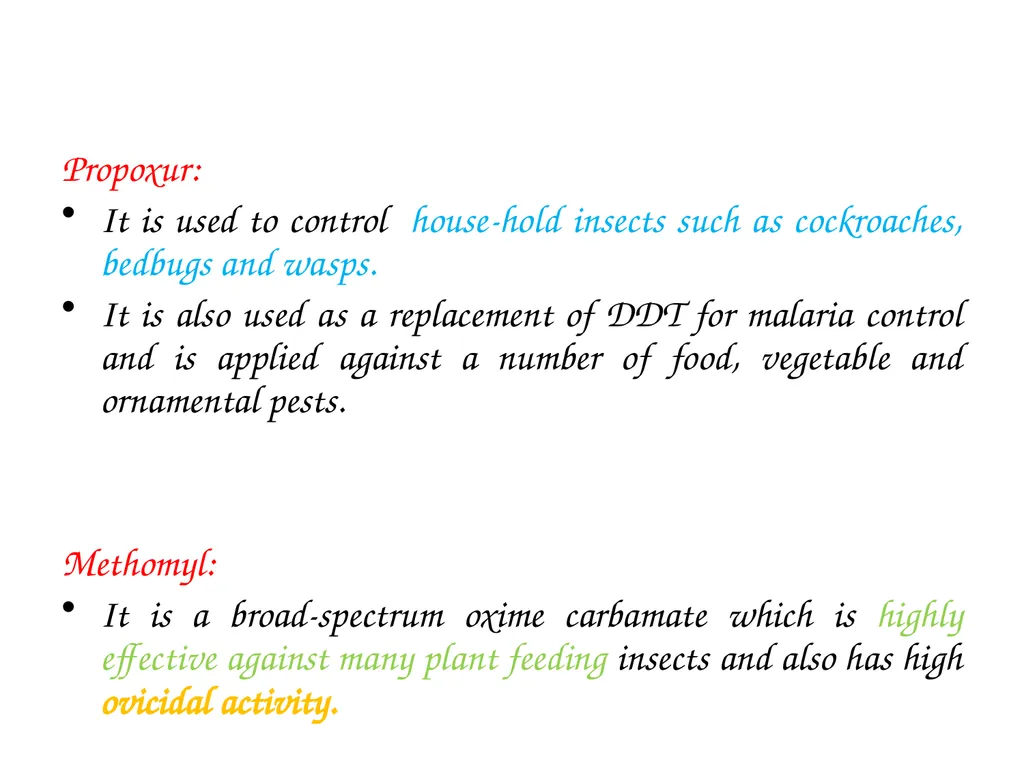
Propoxur:
It is used to control house-hold insects such as cockroaches, bedbugs and wasps.
It is also used as a replacement of DDT for malaria control and is applied against a number of food, vegetable and ornamental pests.
Methomyl:
It is a broad-spectrum oxime carbamate which is highly effective against many plant feeding insects and also has high ovicidal activity.<br>