Care England workshop The relevance of the MCA to good safeguarding practice Elaine Cass Exercise MCA Quiz All adults must be assumed to have capacity to make decisions unless it is established that they do not Following an assessment it
"Care England workshop The relevance of the MCA to" is the property of its rightful owner. Permission is granted to
download and print the materials on this website for personal, non-commercial use only, and to display it
on your personal computer provided you do not modify the materials and that you retain all copyright
notices contained in the materials. By downloading content from our website, you accept the terms of this
agreement.
Presentation Transcript
01
Care England workshop
The relevance of the MCA to good safeguarding practice
Elaine Cass<br>
02
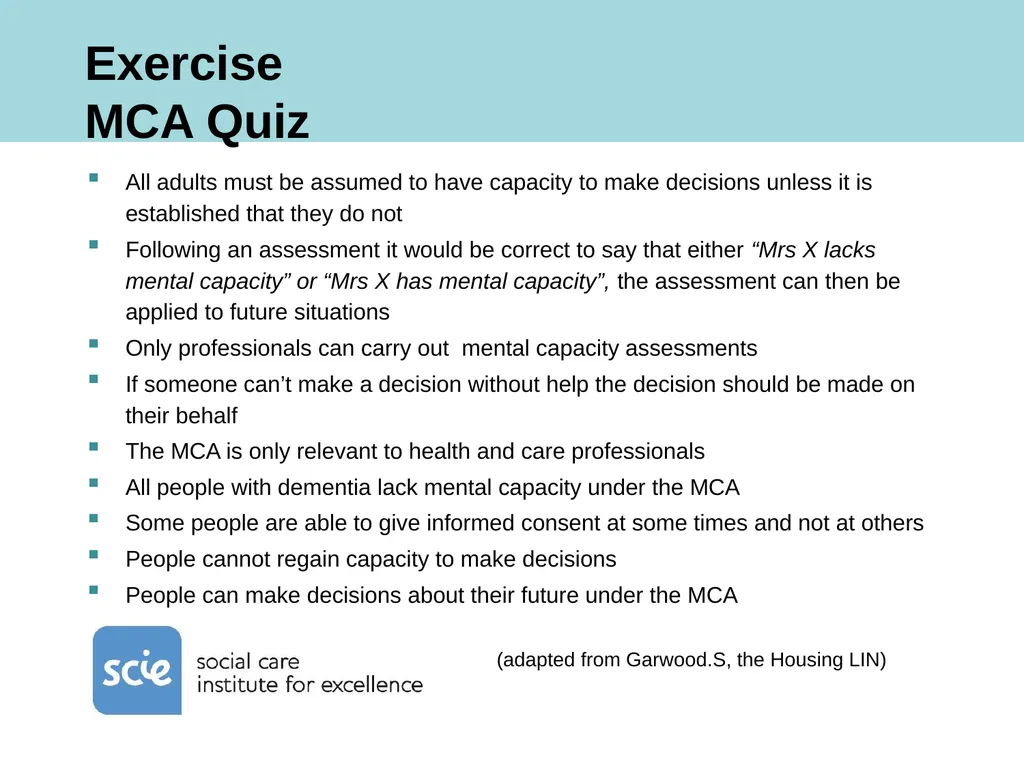
Exercise MCA Quiz All adults must be assumed to have capacity to make decisions unless it is established that they do not
Following an assessment it would be correct to say that either “Mrs X lacks mental capacity” or “Mrs X has mental capacity”, the assessment can then be applied to future situations
Only professionals can carry out mental capacity assessments
If someone can’t make a decision without help the decision should be made on their behalf
The MCA is only relevant to health and care professionals
All people with dementia lack mental capacity under the MCA
Some people are able to give informed consent at some times and not at others
People cannot regain capacity to make decisions
People can make decisions about their future under the MCA
(adapted from Garwood.S, the Housing LIN)<br>
03
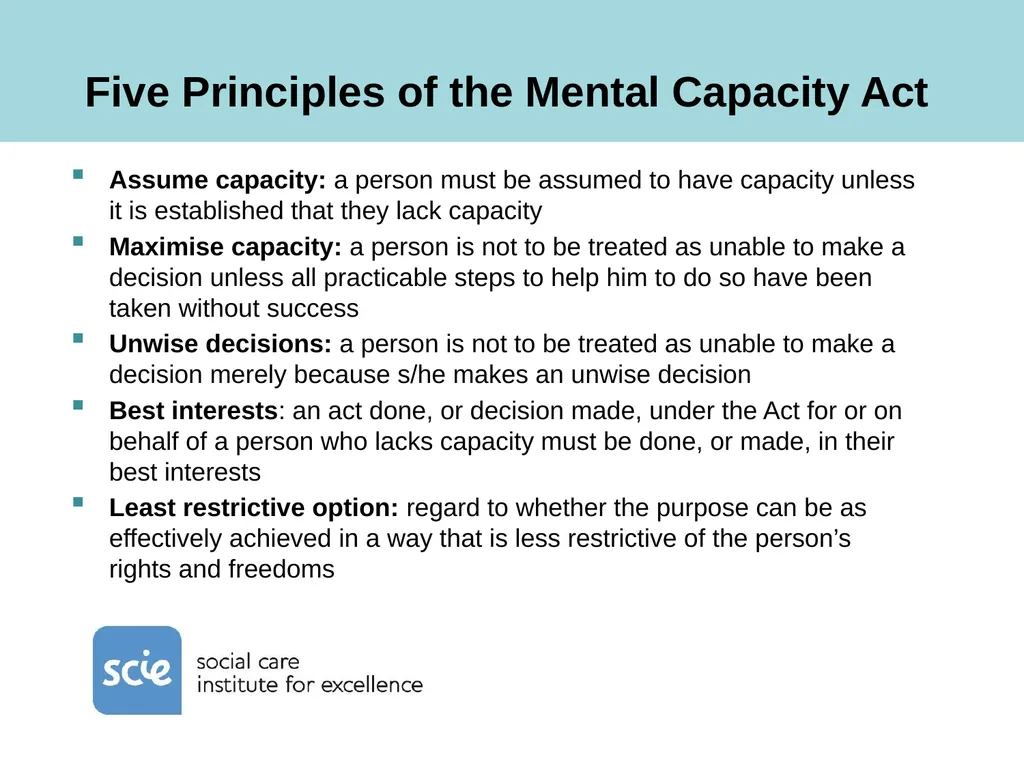
Five Principles of the Mental Capacity Act Assume capacity: a person must be assumed to have capacity unless it is established that they lack capacity
Maximise capacity: a person is not to be treated as unable to make a decision unless all practicable steps to help him to do so have been taken without success
Unwise decisions: a person is not to be treated as unable to make a decision merely because s/he makes an unwise decision
Best interests: an act done, or decision made, under the Act for or on behalf of a person who lacks capacity must be done, or made, in their best interests
Least restrictive option: regard to whether the purpose can be as effectively achieved in a way that is less restrictive of the person’s rights and freedoms<br>
04
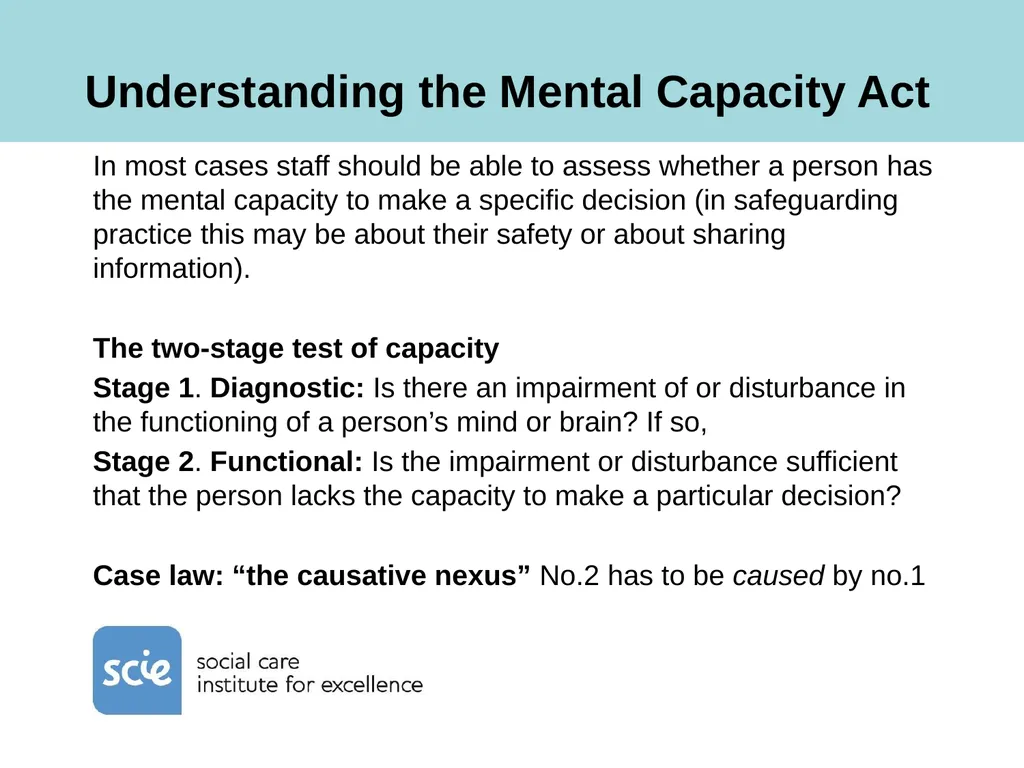
Understanding the Mental Capacity Act In most cases staff should be able to assess whether a person has the mental capacity to make a specific decision (in safeguarding practice this may be about their safety or about sharing information).
The two-stage test of capacity
Stage 1. Diagnostic: Is there an impairment of or disturbance in the functioning of a person’s mind or brain? If so,
Stage 2. Functional: Is the impairment or disturbance sufficient that the person lacks the capacity to make a particular decision?
Case law: “the causative nexus” No.2 has to be caused by no.1<br>
05
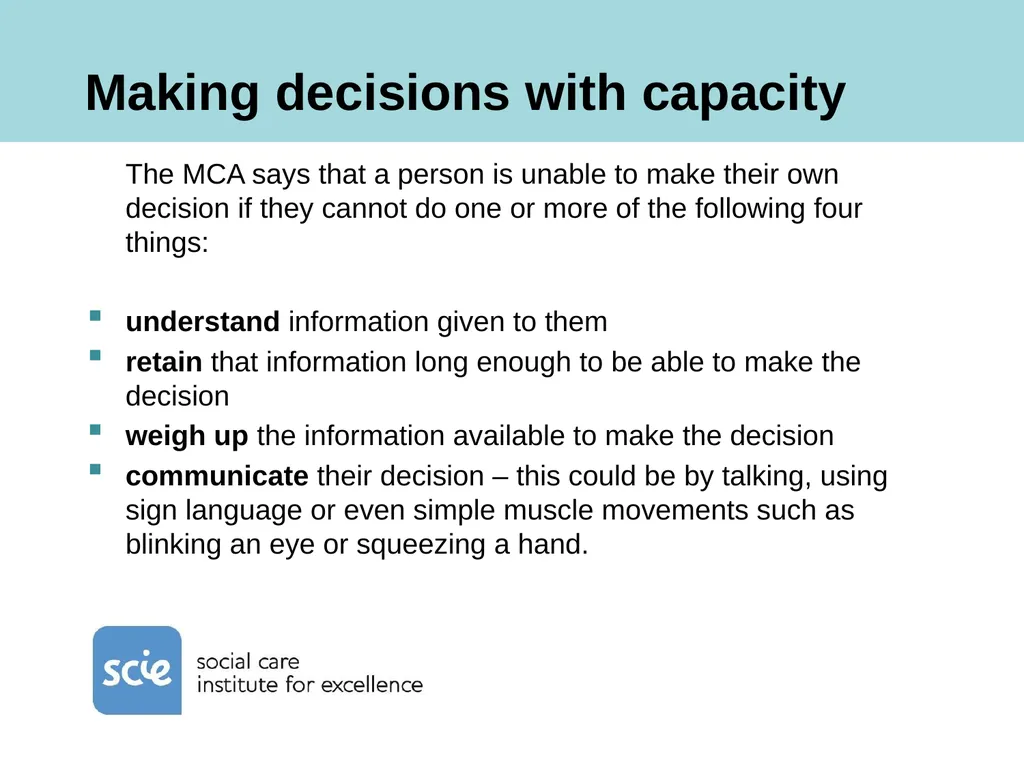
Making decisions with capacity The MCA says that a person is unable to make their own decision if they cannot do one or more of the following four things:
understand information given to them
retain that information long enough to be able to make the decision
weigh up the information available to make the decision
communicate their decision – this could be by talking, using sign language or even simple muscle movements such as blinking an eye or squeezing a hand.<br>
06
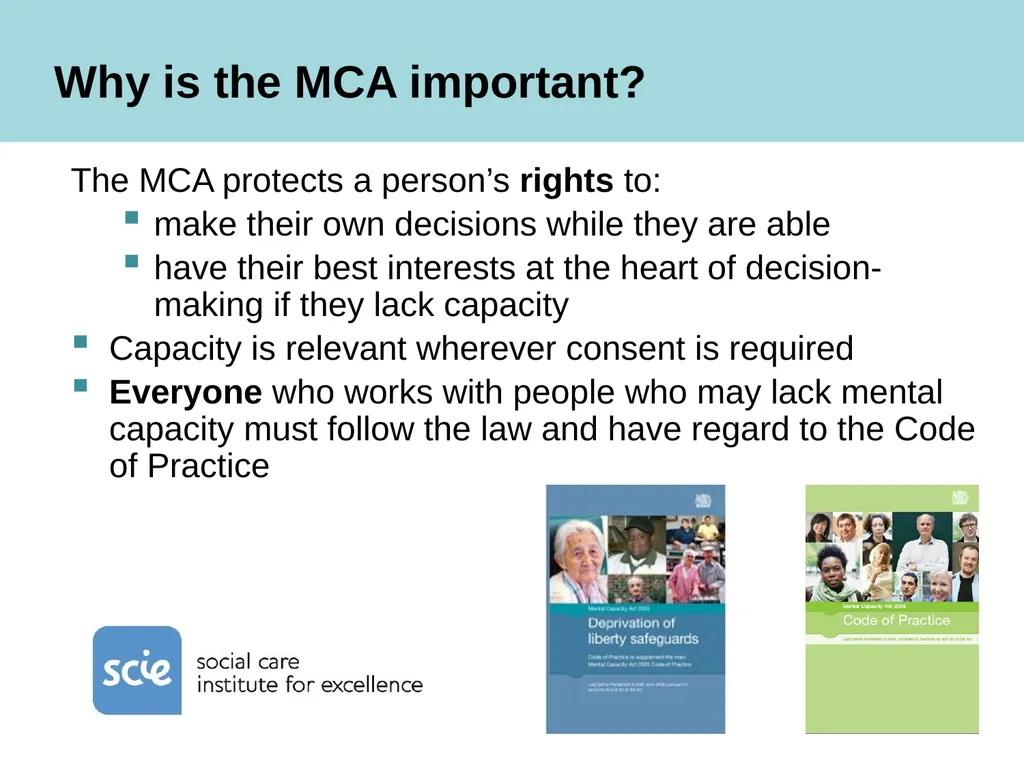
Why is the MCA important? The MCA protects a person’s rights to:
make their own decisions while they are able
have their best interests at the heart of decision- making if they lack capacity
Capacity is relevant wherever consent is required
Everyone who works with people who may lack mental capacity must follow the law and have regard to the Code of Practice
We all might loose capacity sometime<br>
07
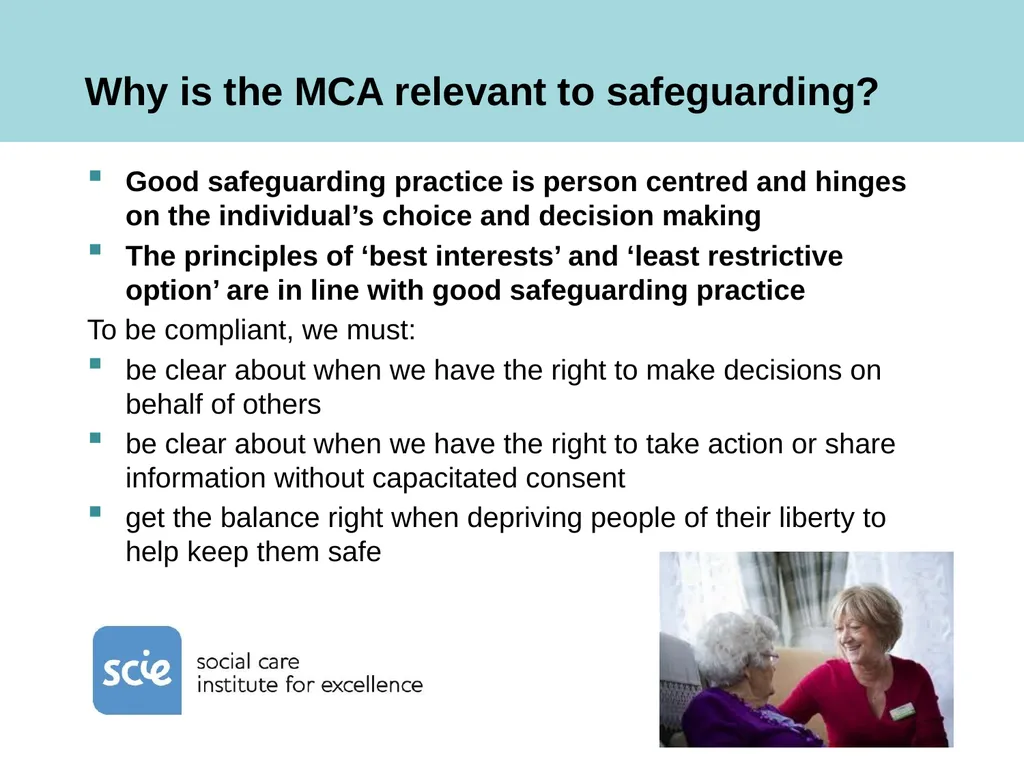
Why is the MCA relevant to safeguarding? Good safeguarding practice is person centred and hinges on the individual’s choice and decision making
The principles of ‘best interests’ and ‘least restrictive option’ are in line with good safeguarding practice
To be compliant, we must:
be clear about when we have the right to make decisions on behalf of others
be clear about when we have the right to take action or share information without capacitated consent
get the balance right when depriving people of their liberty to help keep them safe<br>
08
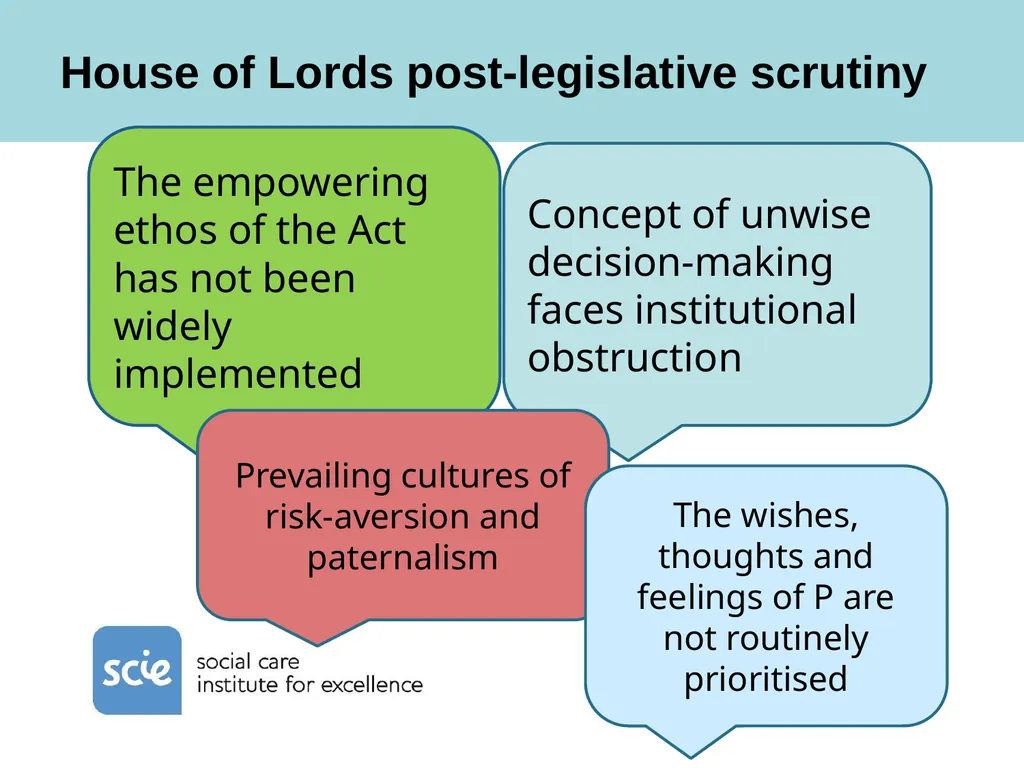
House of Lords post-legislative scrutiny The empowering ethos of the Act has not been widely implemented Concept of unwise decision-making faces institutional obstruction Prevailing cultures of risk-aversion and paternalism The wishes, thoughts and feelings of P are not routinely prioritised<br>
09
The Care Act: six safeguarding principles Empowerment
Protection
Prevention
Proportionate responses
Partnership
Accountability
They apply to all sectors and settings
They should inform the ways in which professionals and other staff work with people at risk of abuse or neglect
(Care and support statutory guidance)<br>
10
Making Safeguarding Personal Start with the person (advocate/ representative) – what do they want?
Not process driven, no set timescales
Enable staff to use skills, knowledge and judgement
Proportionate responses
Focus on outcomes
Inclusive – meetings / discussions
Reflective practice / supervision
Evaluate intervention<br>
11
Best interests decisions Encourage participation
Consider everything they would consider if they were making the decision themselves
The person’s reasonably ascertainable past and present wishes/statements; their beliefs and values
Consult others – family, friends, care providers, attorneys, deputies
Consider less restrictive options - can the same result be achieved in a less restrictive way?<br>
12
Questions and discussion<br>
13
xxxxxxxxx @SCIE_socialcare
Social Care Institute for Excellence Elaine.Cass@scie.org.uk