04
At the end of this session/presentation you will be able to:
State and plan preop interventions to minimize complications
Name intra op interventions that can minimize complications
Plan post op care to minimize and address complications Learning objectives<br>
05
Goals for Cleft Repair Surgery Excellent cosmetic and functional repair for each child.
Child and Family feel prepared, supported and safe through all phases of treatment.
Pre op, Intra op, and Post op care impact results. 5<br>
06
Possible Complications- in no particular order Bleeding
Infection
Dehydration
Allergic reaction to medication/malignant hyperthermia
Pain
Vomiting
Anxiety/Fear
Poor Wound Healing
Intra op surgical or anesthesia complications
Financial hardship for family Dec 2025 6<br>
07
Pre Op: Screening Questions Medical, Social and Family History:
- Prior surgeries for patient or family?
- Bleeding problems in patient or family?
- Bad reactions to anesthesia for patient or family members?
Medications taken now? In recent past?
Heart problems or murmur? Treated?
Any recent illness? Cough? Asthma?
Chronic Illnesses?
Can they keep up with other kids?
Development and school performance? Date updated 7<br>
08
Pre op: Physical Exam General appearance: looks Healthy? Acutely Ill? Syndromic? Delayed? Tone?
Vital Signs normal for age and situation?
Size for age/ Z score greater than -2.
Abnormal lung or cardiac exam?
Developmental status
Specific cleft deformity
Small jaw/ large tongue?
Other deformities? Syndromes? Date updated 8<br>
09
Pre op: Surgical Eligibility Requirements Lip Repair: 3 months and 5 Kg
Palate Repair: 12 months
Hemoglobin 10 for all palate or fistula repairs, exceptions can be made for simple lip repair or other minor cosmetic procedures
No acute upper respiratory illness
Abnormal physical findings: kids with heart, lung, neuromuscular or metabolic disease have a higher chance of complications with anesthesia- review these kids on a case by case basis with anesthesia. Date updated 9<br>
10
Pre Op: Feeding Teach families the importance of following pre op feeding orders
No solids 8-12 hours pre op, usually after midnight
No milk/formula 4-6 hours pre op
No Breast milk 2-4 hours pre op
Clear liquids until 2 hours pre op ( water, electrolyte solutions, apple juice)
Prevent dehydration: monitor schedule and make sure kids drink clear liquids until 2 hours pre-op
Surgery will be cancelled or rescheduled if parents feed at the wrong time. Dec 2025 10<br>
11
Pre Op Teaching for Families Being prepared and supported means knowing what to expect!
What your child may look like after surgery: stitches, swelling, oozing, sleepy, fussy, no no’s, tongue stitch.
Comfort measures and positioning- head up, holding, singing, rocking, distraction, feeding.
Pain: comfort measures and medication around the clock for the first day
Some bleeding OK
Vomit 1-2 times possible Dec 2025 11<br>
12
Intra Operative Complication Prevention Pain, in addition to anesthesia:
- Local medication at incision site
Regional blocks
IV or IR acetaminophen
Opioid towards end of case
Airway: IV decadron given to minimize chances of post op stridor, bronchospasm or obstruction
Dehydration: Fluids given intra operatively to prevent dehydration. Dec 2025 12<br>
13
Post Op: Airway Possible complications- stridor, obstruction, bronchospasm- prevention and treatment.
Head elevated and side lying in parent arms or on bed
Racemic epi
Only gentle suctioning
Tongue suture
Check for retained sponge
Nebulized bronchodilator
Be prepared for emergency intubation- anesthesia to be involved Dec 2025 13<br>
14
Post Op: Bleeding Oozing small amounts of blood from nose or mouth OK
Vomiting some blood 1-2 times after surgery is common
Head elevated and side lying in bed or parent’s arms if sleeping
Avoid coughing and crying as possible- strains stitches- use comfort, feeding and pain meds
For larger bleeding apply pressure- use oxymetazoline (=afrin) soaked gauze if surgery MD agrees. Check before surgery start.
Make sure emergency blood is available before 1st OR day
Notify surgeon/anesthesia for possible return to OR Dec 2025 14<br>
15
Post Op: Pain Undertreated pain is common in children
Untreated pain negatively impacts the immune, cardiovascular and gastrointestinal systems which impairs wound healing
Inadequate analgesia during a procedure decreases the effectiveness of analgesia n subsequent procedures.
Poorly treated pain makes all subsequent pain harder to treat!
There is increasing evidence of permanent long term effectsfrom inadequately treated pain. =>PTSD Date updated 15<br>
16
Post Op Pain Management on the Ward Goal is pain control that allows sleeping, eating, quiet play and social interaction, not a complete absence of pain.
Goal was taught pre op.
Always consider fear, hunger, need for a diaper change or other discomforts as well as pain
Always use comfort measure with pain medications. Date updated 16<br>
17
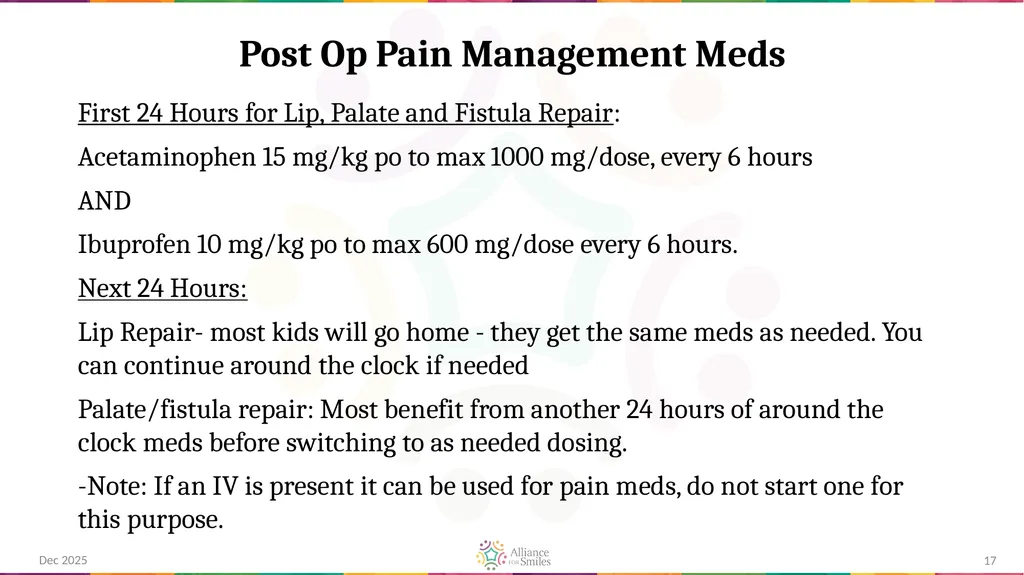
Post Op Pain Management Meds First 24 Hours for Lip, Palate and Fistula Repair:
Acetaminophen 15 mg/kg po to max 1000 mg/dose, every 6 hours
AND
Ibuprofen 10 mg/kg po to max 600 mg/dose every 6 hours.
Next 24 Hours:
Lip Repair- most kids will go home - they get the same meds as needed. You can continue around the clock if needed
Palate/fistula repair: Most benefit from another 24 hours of around the clock meds before switching to as needed dosing.
-Note: If an IV is present it can be used for pain meds, do not start one for this purpose. Dec 2025 17<br>
18
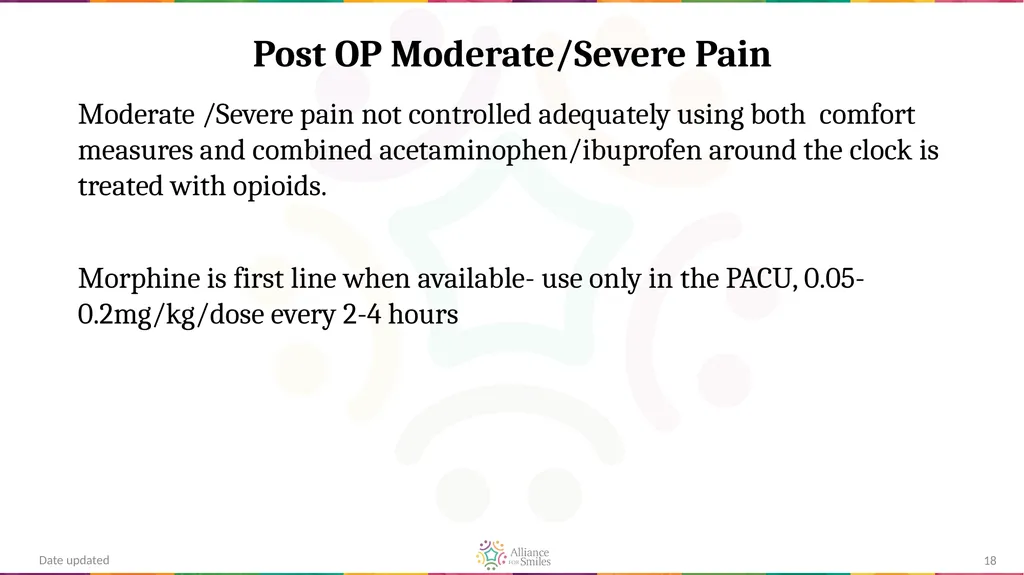
Post OP Moderate/Severe Pain Moderate /Severe pain not controlled adequately using both comfort measures and combined acetaminophen/ibuprofen around the clock is treated with opioids.
Morphine is first line when available- use only in the PACU, 0.05- 0.2mg/kg/dose every 2-4 hours Date updated 18<br>
19
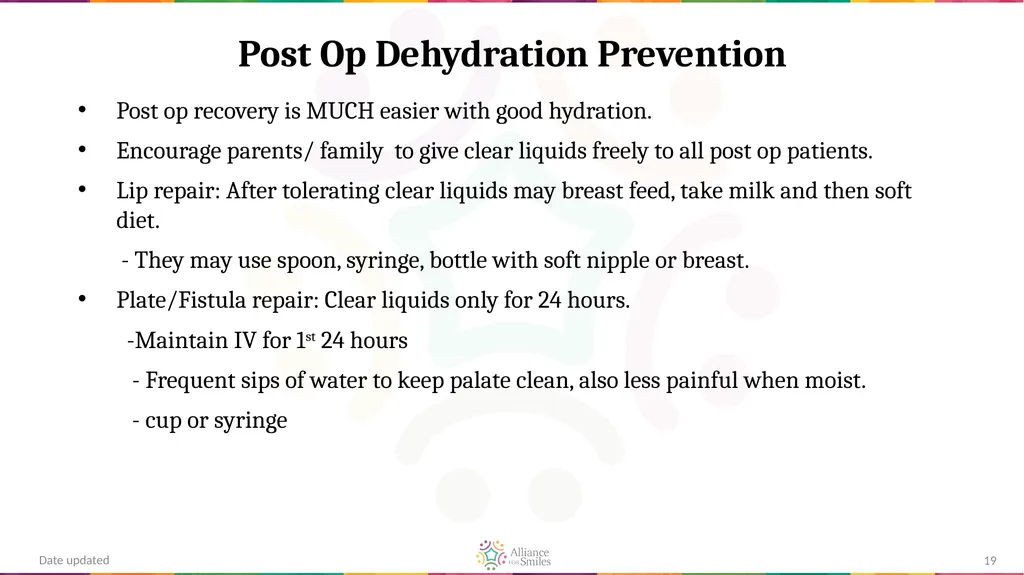
Post Op Dehydration Prevention Post op recovery is MUCH easier with good hydration.
Encourage parents/ family to give clear liquids freely to all post op patients.
Lip repair: After tolerating clear liquids may breast feed, take milk and then soft diet.
- They may use spoon, syringe, bottle with soft nipple or breast.
Plate/Fistula repair: Clear liquids only for 24 hours.
-Maintain IV for 1st 24 hours
- Frequent sips of water to keep palate clean, also less painful when moist.
- cup or syringe Date updated 19<br>
20
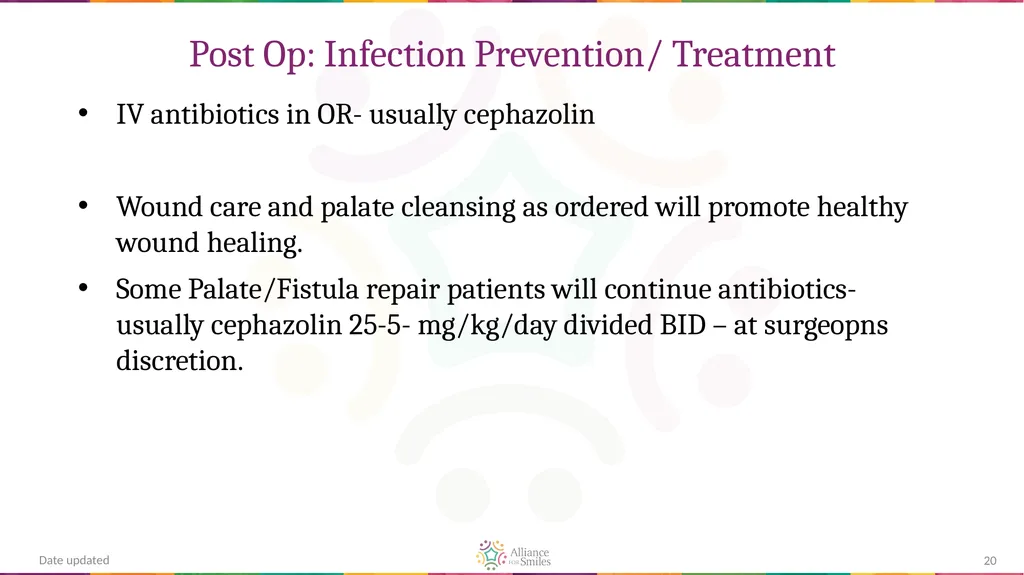
Post Op: Infection Prevention/ Treatment IV antibiotics in OR- usually cephazolin
Wound care and palate cleansing as ordered will promote healthy wound healing.
Some Palate/Fistula repair patients will continue antibiotics- usually cephazolin 25-5- mg/kg/day divided BID – at surgeopns discretion. Date updated 20<br>
21
Care of Pediatric Cleft Lip and Palate Repair Patients: Complications Minimized We have great outcomes with careful planning and execution including family teaching, great nursing care and careful pediatrician attention.
Thank you! Dec 2025 21<br>