
Church History A History of People and Ideas Key
AM
Published · 90 slides · 0 views

1 / 1







Description
Church History A History of People and Ideas Key Questions Major events in the world? What doctrines were in focus? Design of the building for worship? How was the Church led? What prayers were used for Mass? How often did people take
Related Topics
Share
Embed code
Download this presentation From Below
"Church History A History of People and Ideas Key" is the property of its rightful owner. Permission is granted to download and print the materials on this website for personal, non-commercial use only, and to display it on your personal computer provided you do not modify the materials and that you retain all copyright notices contained in the materials. By downloading content from our website, you accept the terms of this agreement.
Presentation Transcript
01
Church History A History of People and Ideas<br>
02
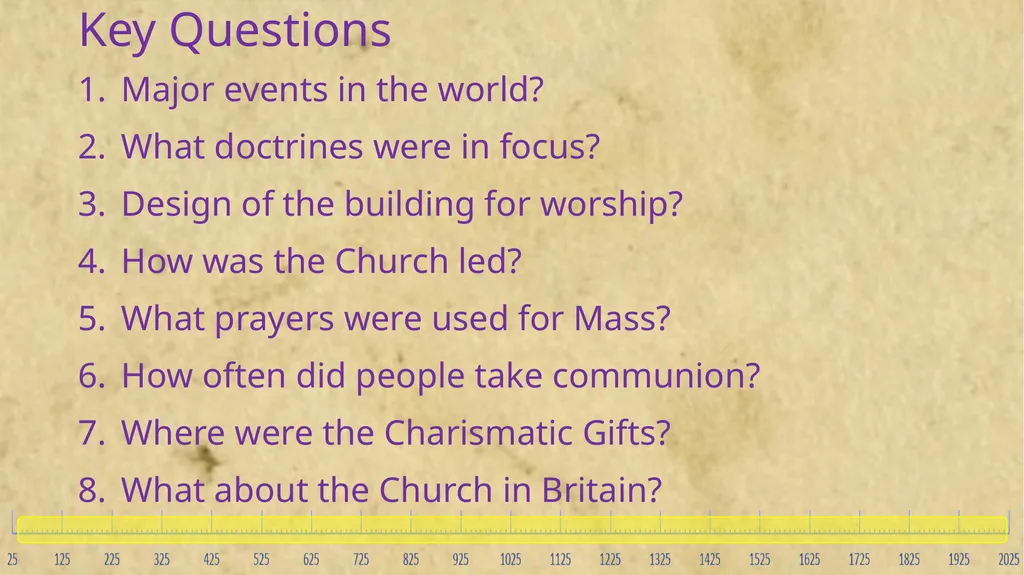
Key Questions Major events in the world?
What doctrines were in focus?
Design of the building for worship?
How was the Church led?
What prayers were used for Mass?
How often did people take communion?
Where were the Charismatic Gifts?
What about the Church in Britain?<br>
What doctrines were in focus?
Design of the building for worship?
How was the Church led?
What prayers were used for Mass?
How often did people take communion?
Where were the Charismatic Gifts?
What about the Church in Britain?<br>
03
Church History Part One: The Apostles and the Persecuted Church<br>
04
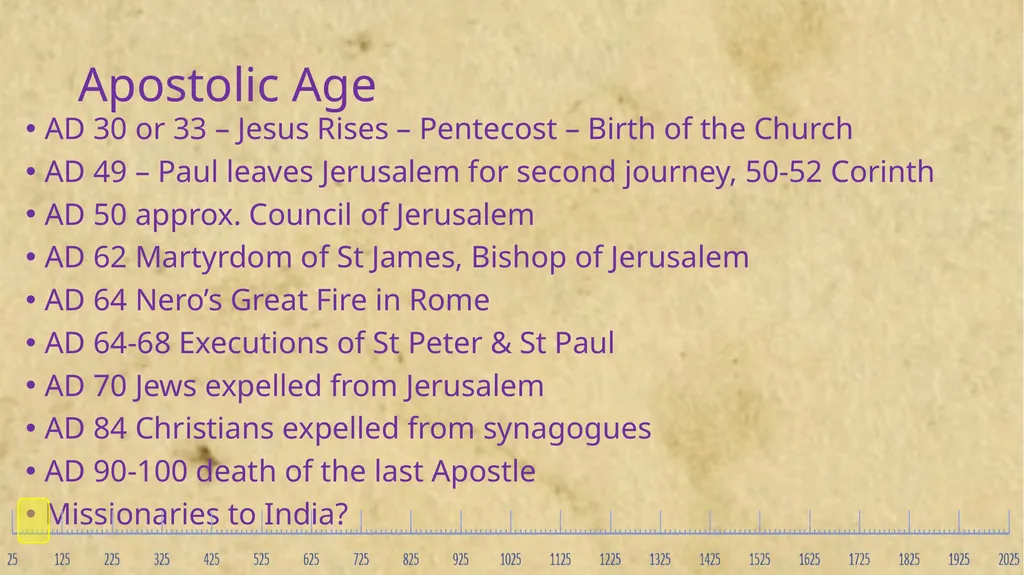
AD 30 or 33 – Jesus Rises – Pentecost – Birth of the Church
AD 49 – Paul leaves Jerusalem for second journey, 50-52 Corinth
AD 50 approx. Council of Jerusalem
AD 62 Martyrdom of St James, Bishop of Jerusalem
AD 64 Nero’s Great Fire in Rome
AD 64-68 Executions of St Peter & St Paul
AD 70 Jews expelled from Jerusalem
AD 84 Christians expelled from synagogues
AD 90-100 death of the last Apostle
Missionaries to India? Apostolic Age<br>
05
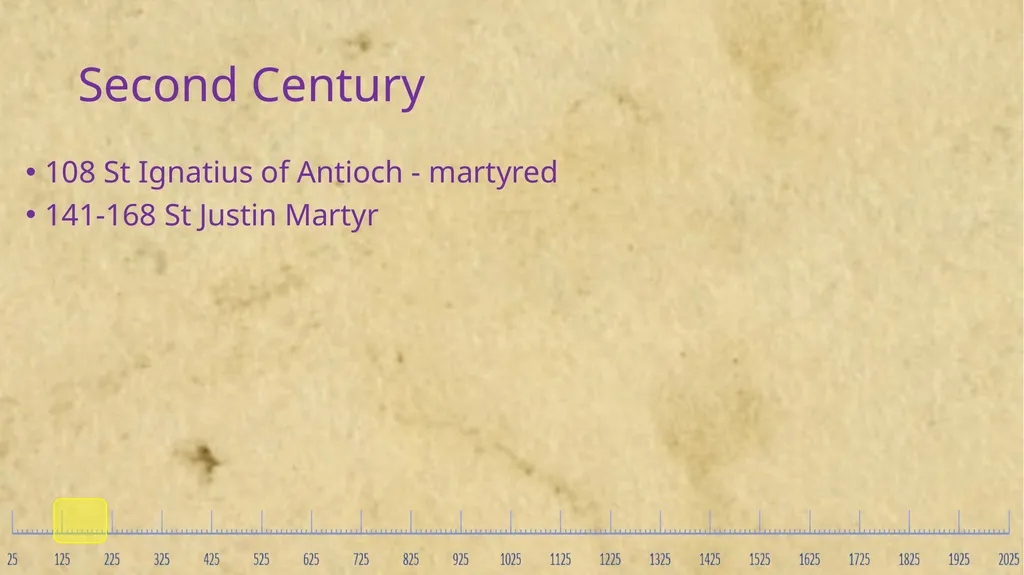
108 St Ignatius of Antioch - martyred
141-168 St Justin Martyr Second Century<br>
141-168 St Justin Martyr Second Century<br>
06
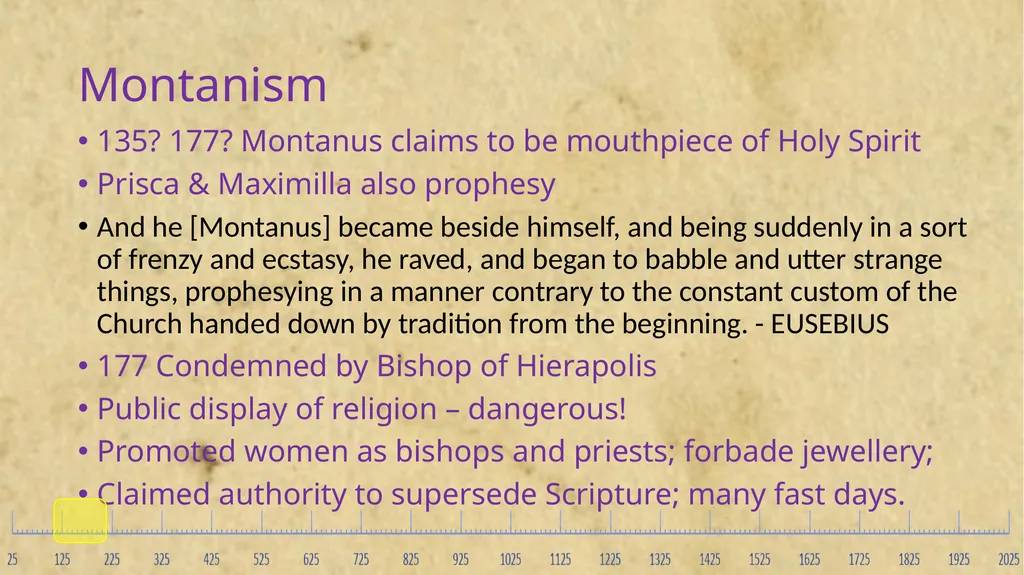
Montanism 135? 177? Montanus claims to be mouthpiece of Holy Spirit
Prisca & Maximilla also prophesy
And he [Montanus] became beside himself, and being suddenly in a sort of frenzy and ecstasy, he raved, and began to babble and utter strange things, prophesying in a manner contrary to the constant custom of the Church handed down by tradition from the beginning. - EUSEBIUS
177 Condemned by Bishop of Hierapolis
Public display of religion – dangerous!
Promoted women as bishops and priests; forbade jewellery;
Claimed authority to supersede Scripture; many fast days.<br>
07
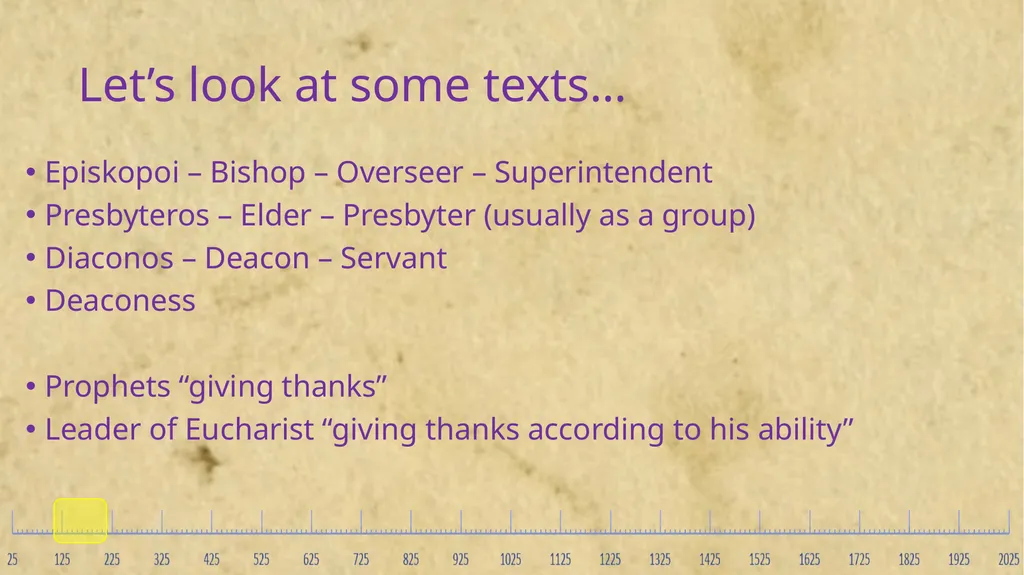
Episkopoi – Bishop – Overseer – Superintendent
Presbyteros – Elder – Presbyter (usually as a group)
Diaconos – Deacon – Servant
Deaconess
Prophets “giving thanks”
Leader of Eucharist “giving thanks according to his ability” Let’s look at some texts…<br>
Presbyteros – Elder – Presbyter (usually as a group)
Diaconos – Deacon – Servant
Deaconess
Prophets “giving thanks”
Leader of Eucharist “giving thanks according to his ability” Let’s look at some texts…<br>
08
203 Martyrdom of St Perpetua and St Felicity
250 Persecution by Emperor Decius
251 What to do with those who ‘lapsed?’
Novatus of Carthage – welcome all with little penance
St Cyprian, Bishop of Carthage – public penance (Pope Cornelius agrees)
Novatian of Rome – no re-admittance (but was excommunicated)
250s Pope Cornelius and Pope Stephen have written in Latin
???? Sts Alban, Julius & Aaron martyred in Britain (209 – 304 ?)
269 approx – St Antony becomes hermit in Egyptian Desert Third Century<br>
09
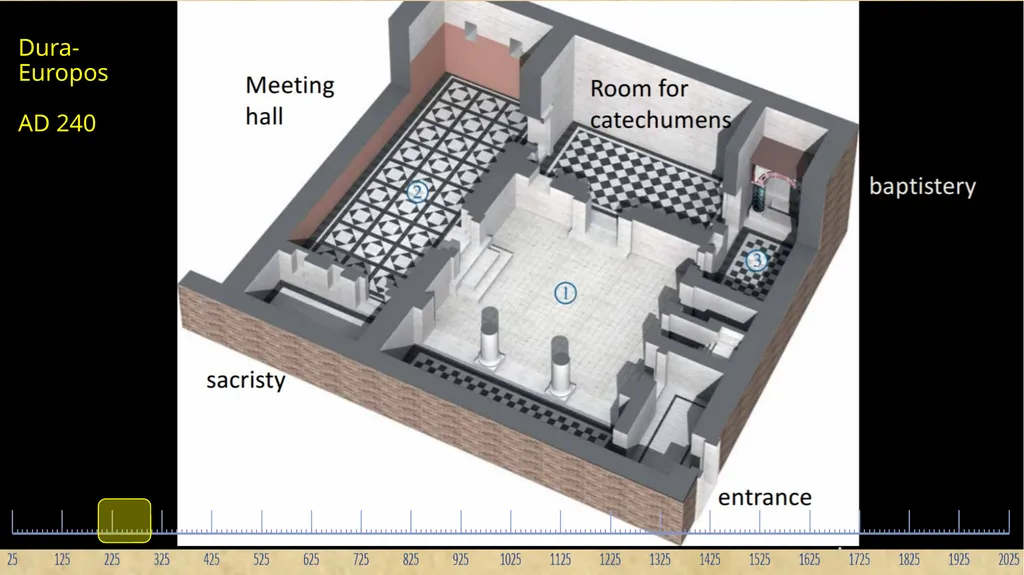
Dura-
Europos
AD 240<br>
Europos
AD 240<br>
10
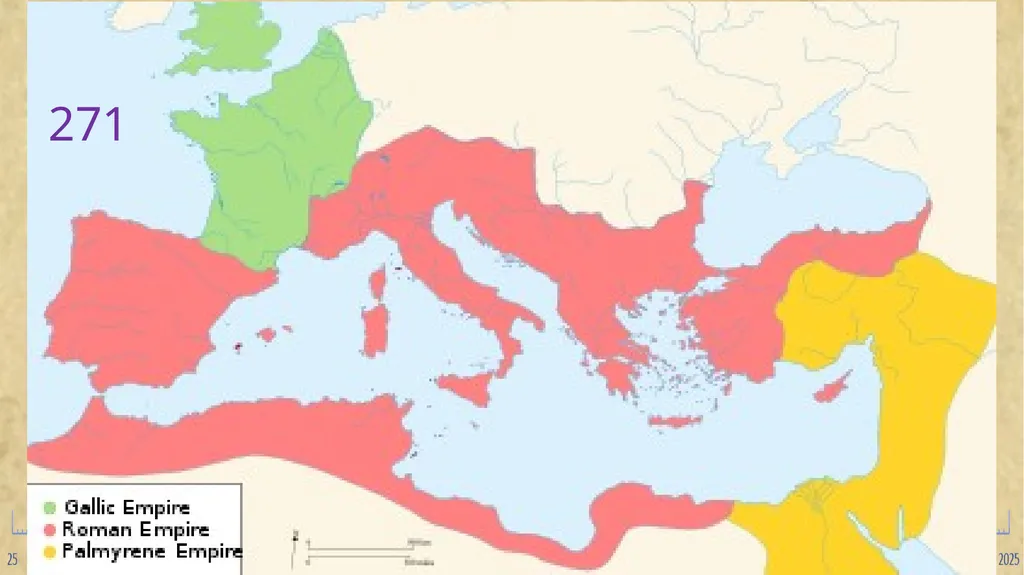
271<br>
11
301-314 Christianity made State Religion in Armenia
313 Toleration by Rome Early Fourth Century<br>
313 Toleration by Rome Early Fourth Century<br>
12
Key Questions Major events in the world?
What doctrines were in focus?
Design of the building for worship?
How was the Church led?
What prayers were used for Mass?
How often did people take communion?
Where were the Charismatic Gifts?
What about the Church in Britain?<br>
What doctrines were in focus?
Design of the building for worship?
How was the Church led?
What prayers were used for Mass?
How often did people take communion?
Where were the Charismatic Gifts?
What about the Church in Britain?<br>
13
Church History Part Two: Roman Christendom<br>
14
313 Edict of Milan – Christianity Tolerated Fourth Century<br>
15
Jesus is the Son of God… but…
“There was a time when the Son Was Not!”
Emperor Constantine hijacks a planned Council in 325
We believe in one God, the Father, the Almighty, maker of all things seen and unseen.
And in one Lord, Jesus Christ, the Son of God, begotten of the Father, Light from Light, true God from true God, begotten, not made, of one Being with the Father. Through him all things were made.
Who for us men and for our salvation he came down and was incarnate and was made man. He suffered, and the third day he rose again, ascended into heaven: from there he will come to judge the living and the dead.
And in the Holy Spirit. The Arian Heresy Is Jesus everything that God-the-Father is?<br>
16
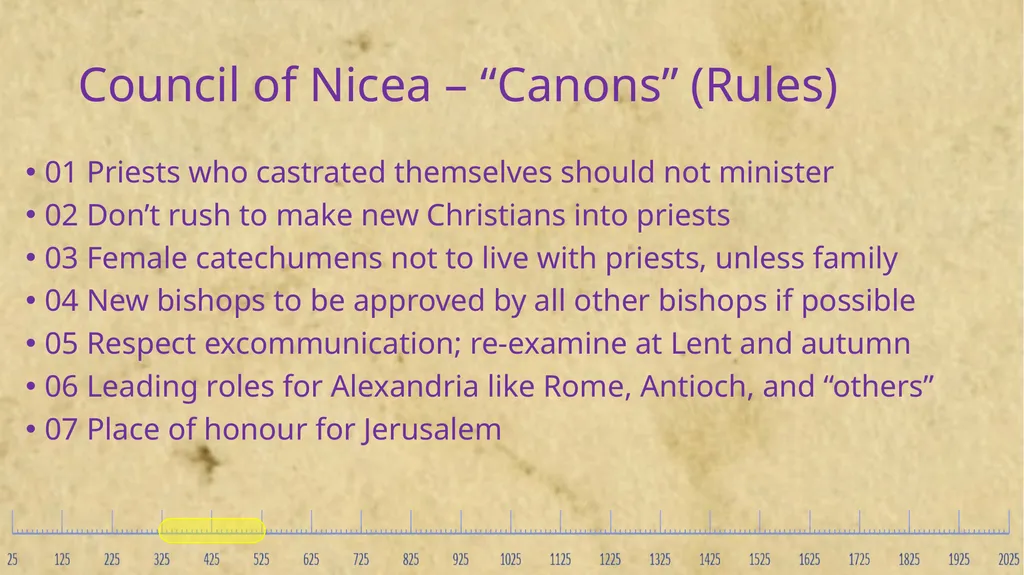
01 Priests who castrated themselves should not minister
02 Don’t rush to make new Christians into priests
03 Female catechumens not to live with priests, unless family
04 New bishops to be approved by all other bishops if possible
05 Respect excommunication; re-examine at Lent and autumn
06 Leading roles for Alexandria like Rome, Antioch, and “others”
07 Place of honour for Jerusalem Council of Nicea – “Canons” (Rules)<br>
17
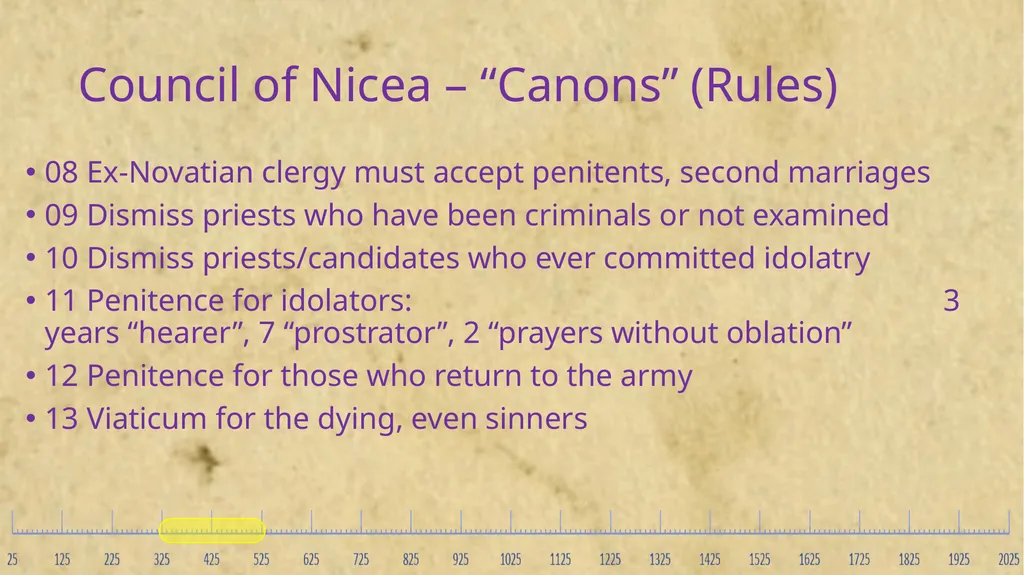
08 Ex-Novatian clergy must accept penitents, second marriages
09 Dismiss priests who have been criminals or not examined
10 Dismiss priests/candidates who ever committed idolatry
11 Penitence for idolators: 3 years “hearer”, 7 “prostrator”, 2 “prayers without oblation”
12 Penitence for those who return to the army
13 Viaticum for the dying, even sinners Council of Nicea – “Canons” (Rules)<br>
18
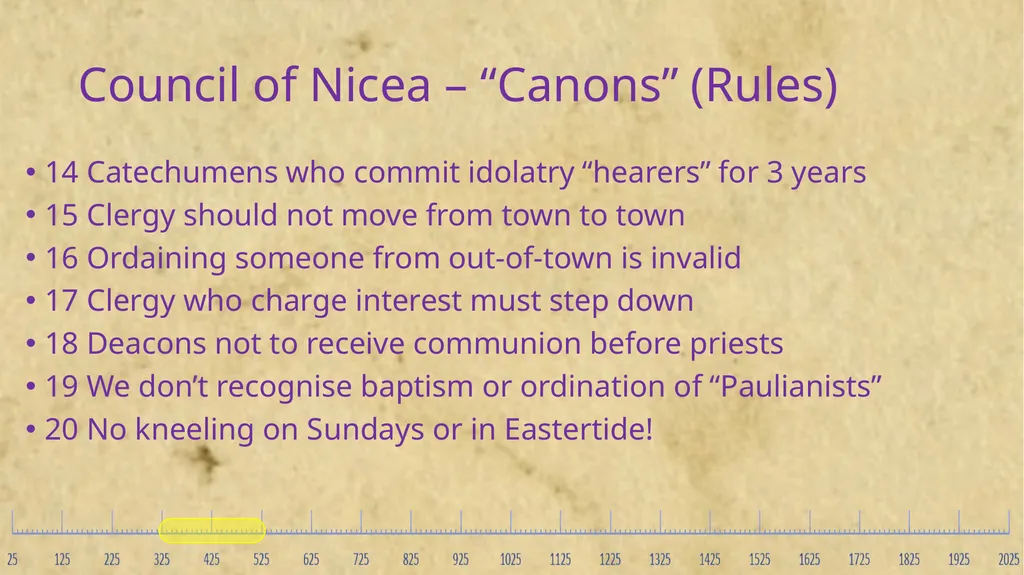
14 Catechumens who commit idolatry “hearers” for 3 years
15 Clergy should not move from town to town
16 Ordaining someone from out-of-town is invalid
17 Clergy who charge interest must step down
18 Deacons not to receive communion before priests
19 We don’t recognise baptism or ordination of “Paulianists”
20 No kneeling on Sundays or in Eastertide! Council of Nicea – “Canons” (Rules)<br>
19
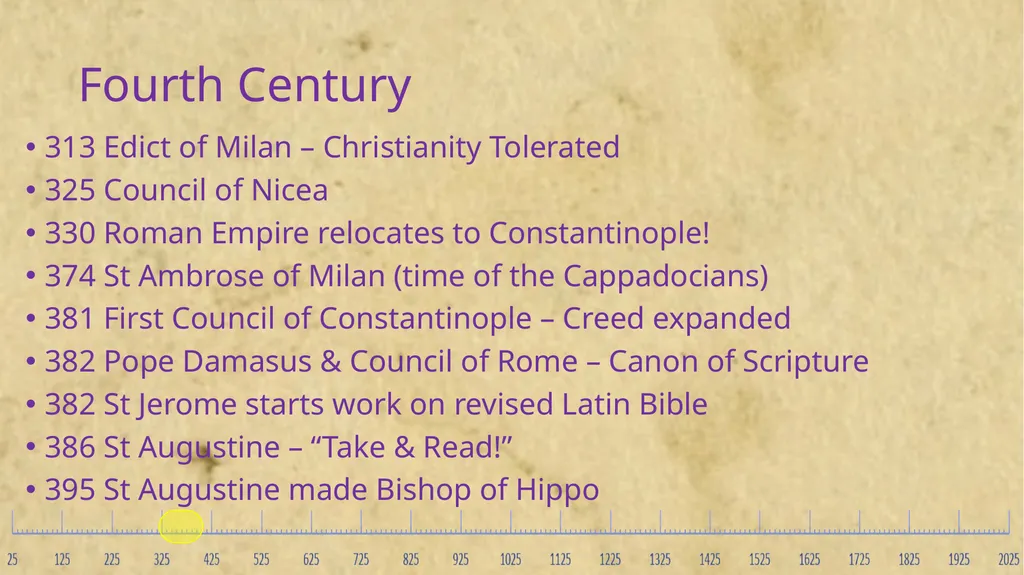
313 Edict of Milan – Christianity Tolerated
325 Council of Nicea
330 Roman Empire relocates to Constantinople!
374 St Ambrose of Milan (time of the Cappadocians)
381 First Council of Constantinople – Creed expanded
382 Pope Damasus & Council of Rome – Canon of Scripture
382 St Jerome starts work on revised Latin Bible
386 St Augustine – “Take & Read!”
395 St Augustine made Bishop of Hippo Fourth Century<br>
20
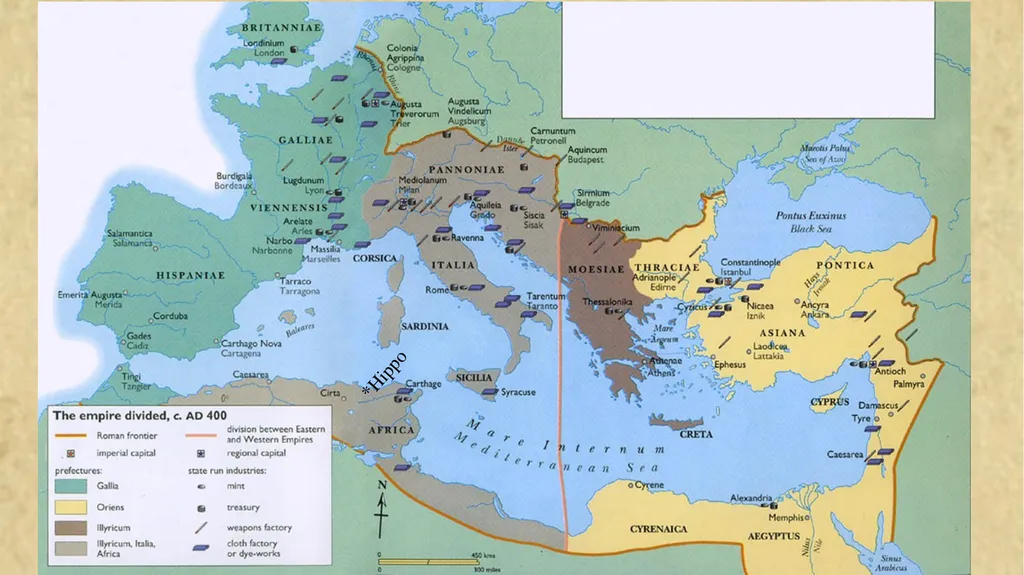
*Hippo<br>
21
Christians took the Eucharist home – communion at will
Any Mass needed a “reason”
Sunday;
a great feast, such as Epiphany;
a wedding or funeral;
the “birthday” of a saint
Eastern Churches never developed everyday Mass
Innocent I (401-17) refers to the Roman Canon (Eucharistic Prayer) as being a matter he ought not to describe and says it is ended with the kiss of peace: "After all the things that I may not reveal the Peace is given, by which it is shown that the people have consented to all that was done in the holy mysteries and was celebrated in the church." He also says that at Rome the names of persons for whom the celebrant prays are read in the Canon: "first the offertory should be made, and after that the names of the givers read out, so that they should be named during the holy mysteries, not during the parts that precede". Communion<br>
22
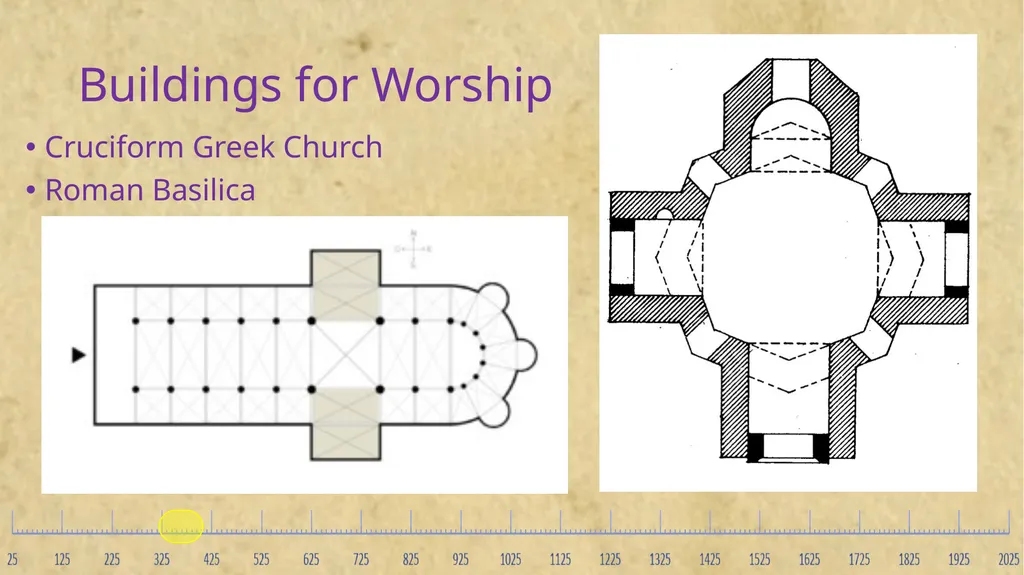
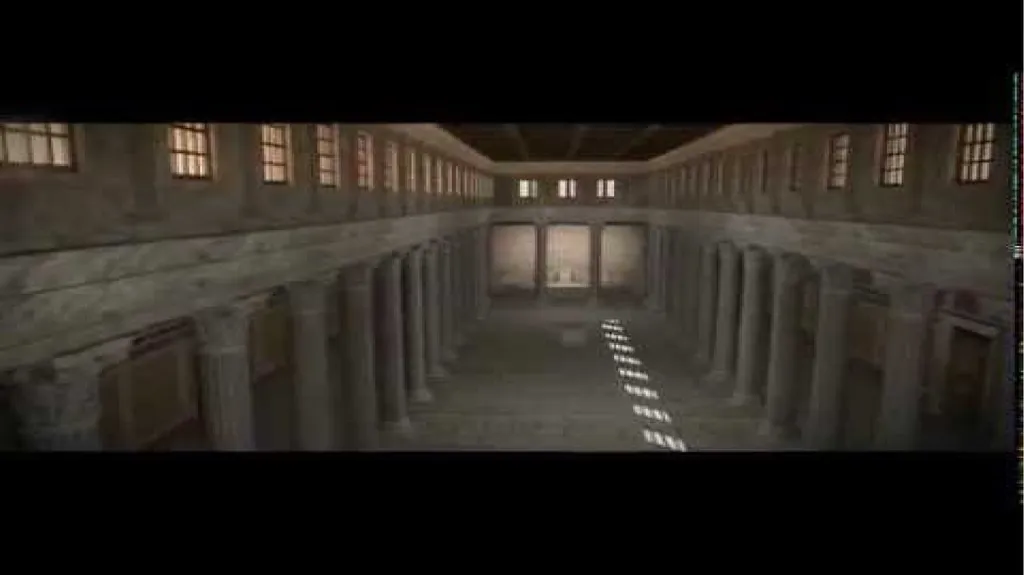
Cruciform Greek Church
Roman Basilica Buildings for Worship<br>
Roman Basilica Buildings for Worship<br>
23
410 Goths sack Rome
416 Council in Carthage opposes Pelagius
429 St Germanus from Auxerre travels in Britain
431 Council of Ephesus – Mary is Mother of God
451 Council of Chalcedon – true God, true man
Breakaway of the “Oriental Orthodox”
460 St Patrick active in Ireland (died 462? 493?) Fifth Century Can we make the first move towards God? Is Jesus everything that God-the-Father is?<br>
24
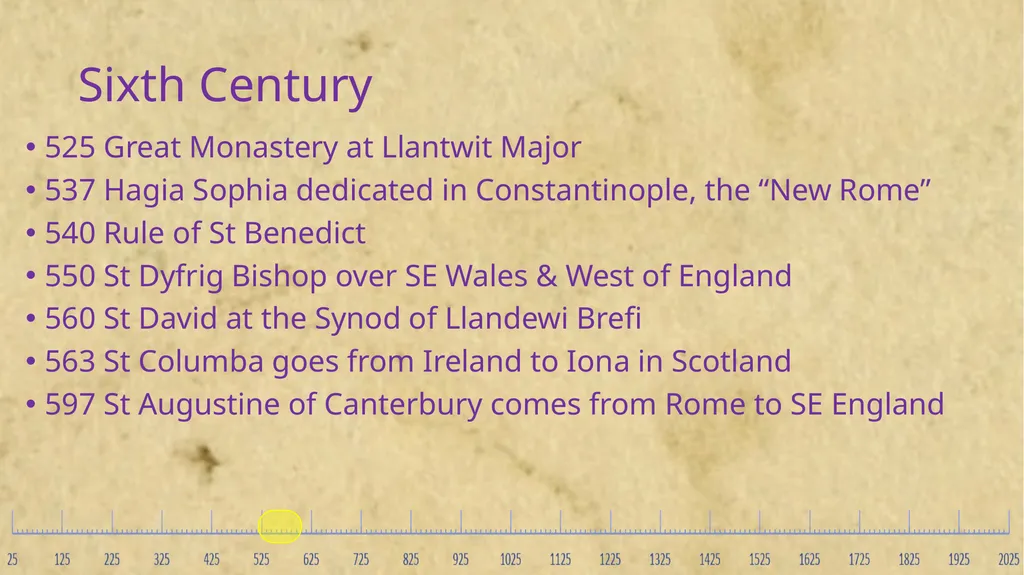
525 Great Monastery at Llantwit Major
537 Hagia Sophia dedicated in Constantinople, the “New Rome”
540 Rule of St Benedict
550 St Dyfrig Bishop over SE Wales & West of England
560 St David at the Synod of Llandewi Brefi
563 St Columba goes from Ireland to Iona in Scotland
597 St Augustine of Canterbury comes from Rome to SE England Sixth Century<br>
25
Key Questions Major events in the world?
What doctrines were in focus?
Design of the building for worship?
How was the Church led?
What prayers were used for Mass?
How often did people take communion?
Where were the Charismatic Gifts?
What about the Church in Britain?<br>
What doctrines were in focus?
Design of the building for worship?
How was the Church led?
What prayers were used for Mass?
How often did people take communion?
Where were the Charismatic Gifts?
What about the Church in Britain?<br>
26
Church History Part Three: The Dark Ages<br>
27
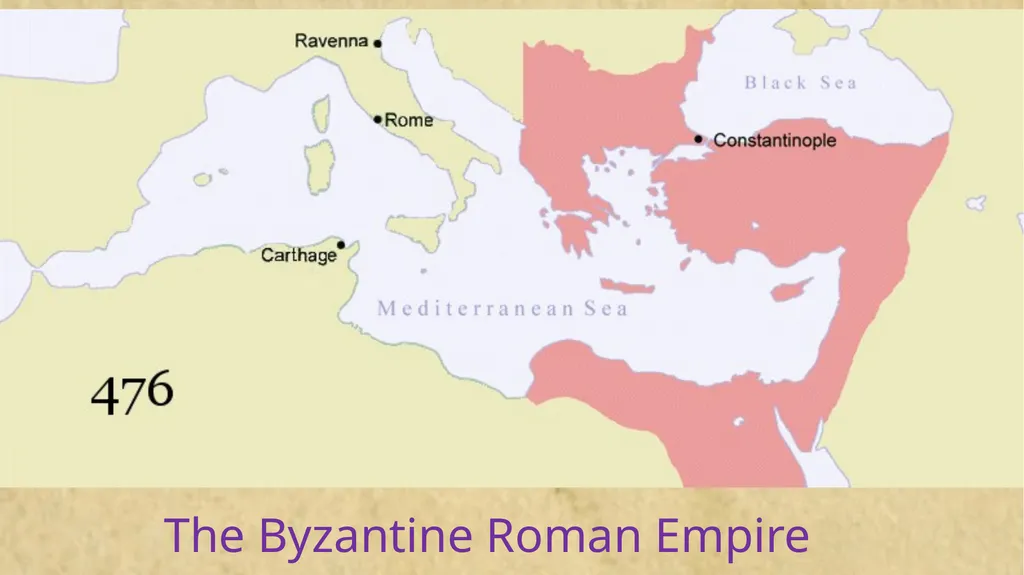
The Byzantine Roman Empire<br>
28
604 St Gregory the Great – fixed form of the “Roman Canon”
632 Death of Mohammed, completion of the Qu’ran
638 Muslim Arabs conquer Jerusalem
644-655 Council of Chalon-sur-Saône recognises Celtic Penance
664 The Synod at Whitby – Britain adopts Roman Easter Seventh Century<br>
632 Death of Mohammed, completion of the Qu’ran
638 Muslim Arabs conquer Jerusalem
644-655 Council of Chalon-sur-Saône recognises Celtic Penance
664 The Synod at Whitby – Britain adopts Roman Easter Seventh Century<br>
29
726 The Iconoclast Controversy Eighth Century<br>
30
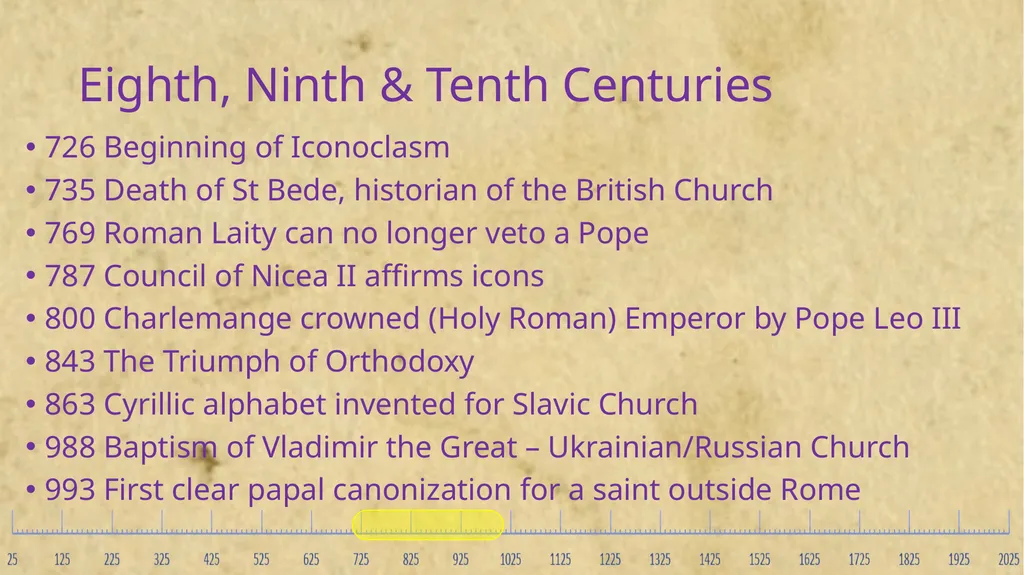
726 Beginning of Iconoclasm
735 Death of St Bede, historian of the British Church
769 Roman Laity can no longer veto a Pope
787 Council of Nicea II affirms icons
800 Charlemange crowned (Holy Roman) Emperor by Pope Leo III
843 The Triumph of Orthodoxy
863 Cyrillic alphabet invented for Slavic Church
988 Baptism of Vladimir the Great – Ukrainian/Russian Church
993 First clear papal canonization for a saint outside Rome Eighth, Ninth & Tenth Centuries<br>
31
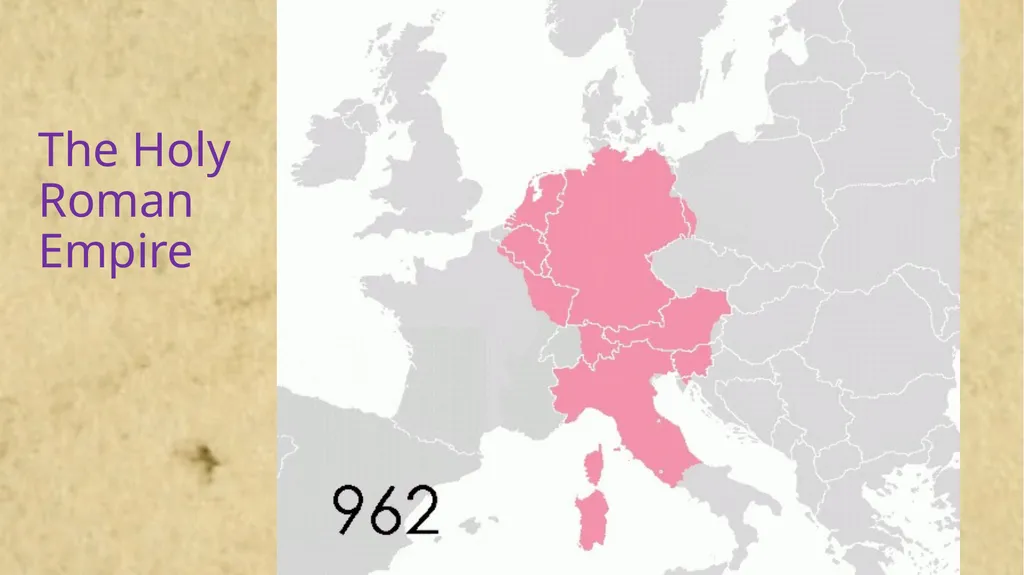
The Holy Roman Empire<br>
32
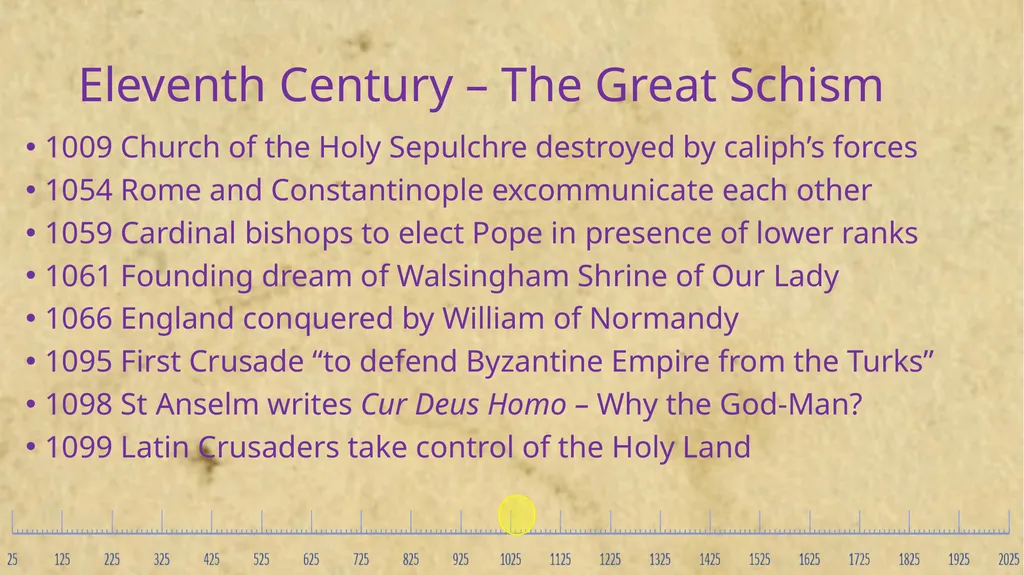
1009 Church of the Holy Sepulchre destroyed by caliph’s forces
1054 Rome and Constantinople excommunicate each other
1059 Cardinal bishops to elect Pope in presence of lower ranks
1061 Founding dream of Walsingham Shrine of Our Lady
1066 England conquered by William of Normandy
1095 First Crusade “to defend Byzantine Empire from the Turks”
1098 St Anselm writes Cur Deus Homo – Why the God-Man?
1099 Latin Crusaders take control of the Holy Land Eleventh Century – The Great Schism<br>
33
Eleventh Century – The Great Schism<br>
34
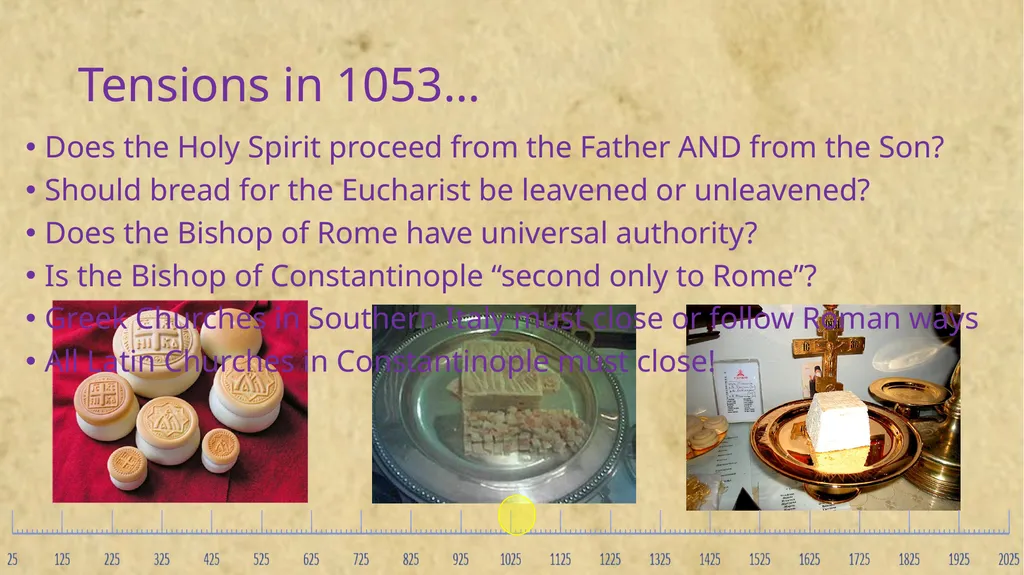
Does the Holy Spirit proceed from the Father AND from the Son?
Should bread for the Eucharist be leavened or unleavened?
Does the Bishop of Rome have universal authority?
Is the Bishop of Constantinople “second only to Rome”?
Greek Churches in Southern Italy must close or follow Roman ways
All Latin Churches in Constantinople must close! Tensions in 1053…<br>
Should bread for the Eucharist be leavened or unleavened?
Does the Bishop of Rome have universal authority?
Is the Bishop of Constantinople “second only to Rome”?
Greek Churches in Southern Italy must close or follow Roman ways
All Latin Churches in Constantinople must close! Tensions in 1053…<br>
35
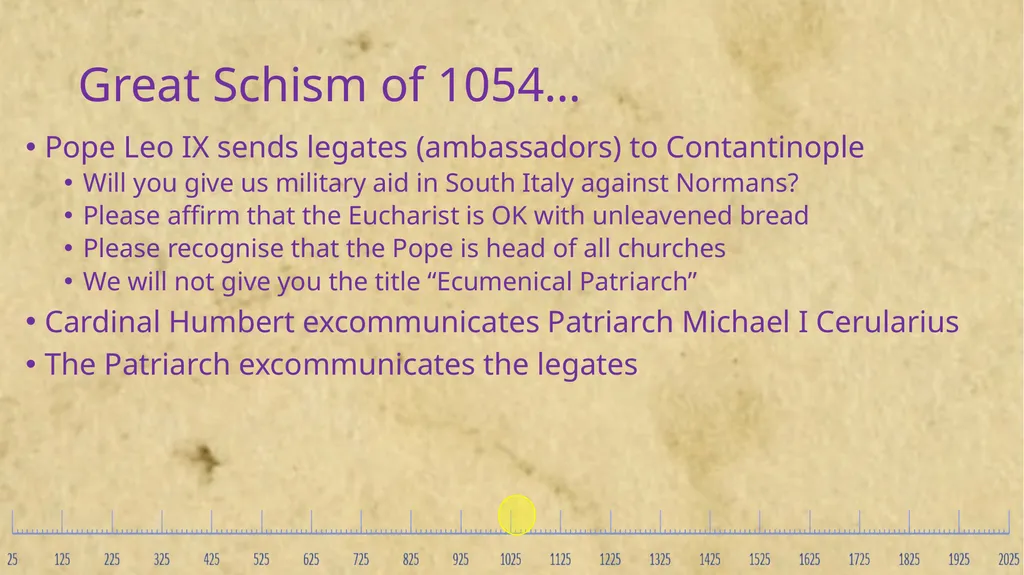
Pope Leo IX sends legates (ambassadors) to Contantinople
Will you give us military aid in South Italy against Normans?
Please affirm that the Eucharist is OK with unleavened bread
Please recognise that the Pope is head of all churches
We will not give you the title “Ecumenical Patriarch”
Cardinal Humbert excommunicates Patriarch Michael I Cerularius
The Patriarch excommunicates the legates Great Schism of 1054…<br>
36
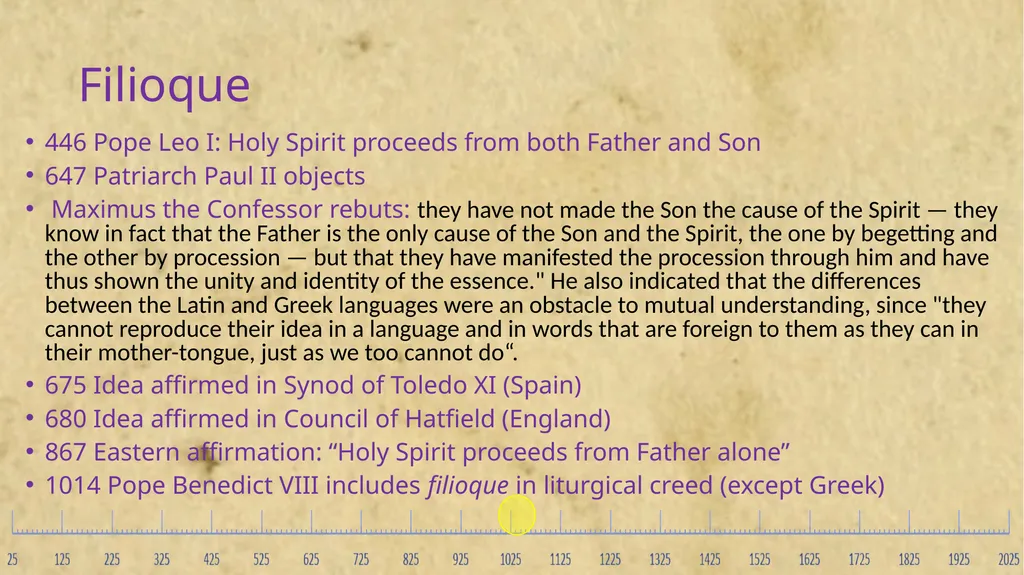
446 Pope Leo I: Holy Spirit proceeds from both Father and Son
647 Patriarch Paul II objects
Maximus the Confessor rebuts: they have not made the Son the cause of the Spirit — they know in fact that the Father is the only cause of the Son and the Spirit, the one by begetting and the other by procession — but that they have manifested the procession through him and have thus shown the unity and identity of the essence." He also indicated that the differences between the Latin and Greek languages were an obstacle to mutual understanding, since "they cannot reproduce their idea in a language and in words that are foreign to them as they can in their mother-tongue, just as we too cannot do“.
675 Idea affirmed in Synod of Toledo XI (Spain)
680 Idea affirmed in Council of Hatfield (England)
867 Eastern affirmation: “Holy Spirit proceeds from Father alone”
1014 Pope Benedict VIII includes filioque in liturgical creed (except Greek) Filioque<br>
37
Key Questions Major events in the world?
What doctrines were in focus?
Design of the building for worship?
How was the Church led?
What prayers were used for Mass?
How often did people take communion?
Where were the Charismatic Gifts?
What about the Church in Britain?<br>
What doctrines were in focus?
Design of the building for worship?
How was the Church led?
What prayers were used for Mass?
How often did people take communion?
Where were the Charismatic Gifts?
What about the Church in Britain?<br>
38
Church History Part Four: The Mendicant Friars<br>
39
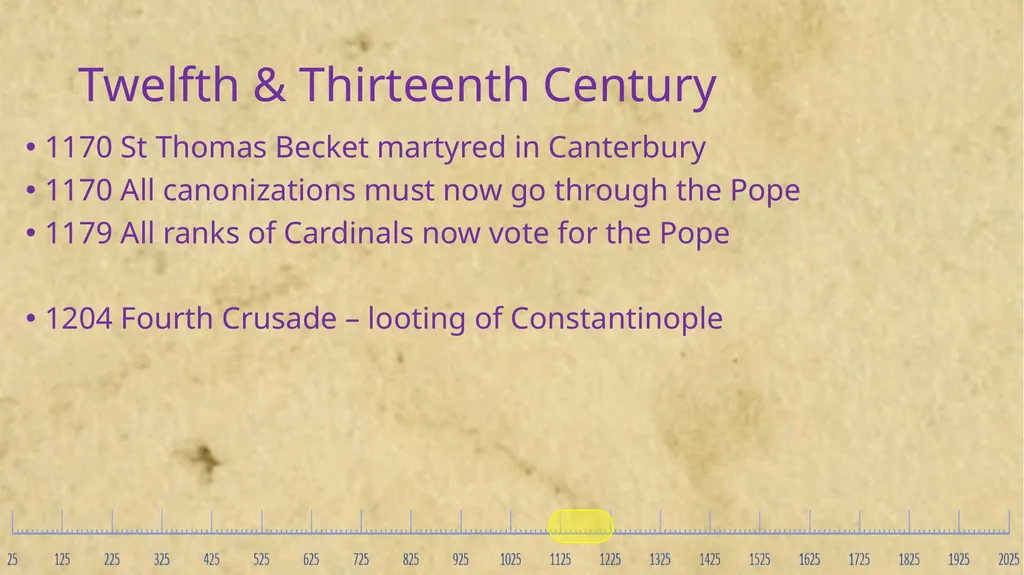
1170 St Thomas Becket martyred in Canterbury
1170 All canonizations must now go through the Pope
1179 All ranks of Cardinals now vote for the Pope
1204 Fourth Crusade – looting of Constantinople Twelfth & Thirteenth Century<br>
1170 All canonizations must now go through the Pope
1179 All ranks of Cardinals now vote for the Pope
1204 Fourth Crusade – looting of Constantinople Twelfth & Thirteenth Century<br>
40
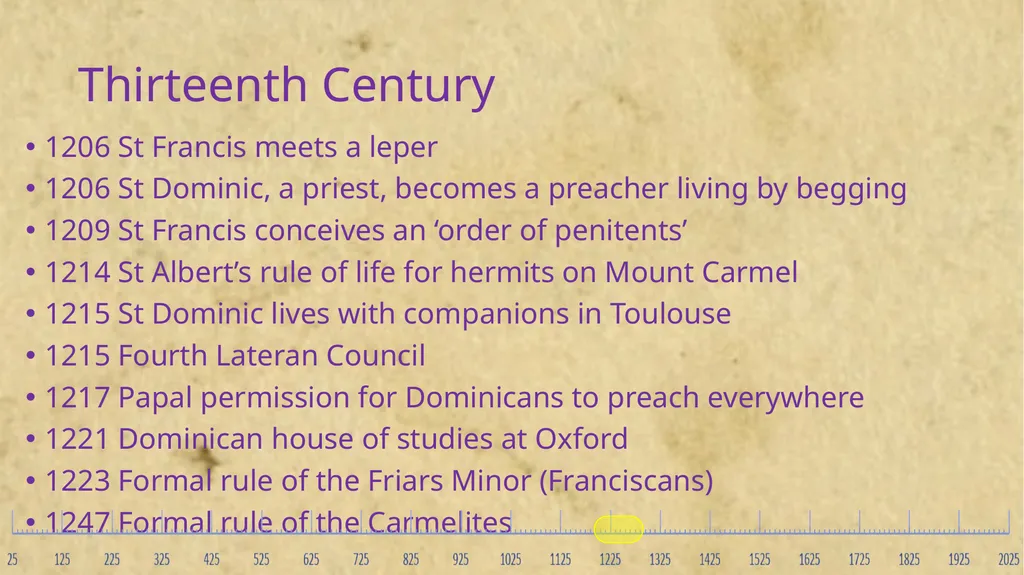
1206 St Francis meets a leper
1206 St Dominic, a priest, becomes a preacher living by begging
1209 St Francis conceives an ‘order of penitents’
1214 St Albert’s rule of life for hermits on Mount Carmel
1215 St Dominic lives with companions in Toulouse
1215 Fourth Lateran Council
1217 Papal permission for Dominicans to preach everywhere
1221 Dominican house of studies at Oxford
1223 Formal rule of the Friars Minor (Franciscans)
1247 Formal rule of the Carmelites Thirteenth Century<br>
41
04 Greeks must not re-baptise those with Latin baptism
05 Rome, Constantinople, Alexandria, Antioch, Jerusalem
13 No new religious orders or rules; monks must stay in one place
14 Punishment for unchaste clerics, including married clerics
15 Punishment for drunk clerics
16 Clerics not to gamble or visit taverns; must dress soberly Fourth Lateran Council<br>
42
Canon 17
It is a matter for regret that there are some minor clerics and even prelates who spend half of the night in banqueting and in unlawful gossip, not to mention other abuses, and in giving the remainder to sleep. They are scarcely awakened by the diurnal concerts of the birds. Then they hasten through matins in a hurried and careless manner. There are others who say mass scarcely four times a year and, what is worse, do not even attend mass, and when they are present they are engaged outside in conversation with lay people to escape the silence of the choir; so that, while they readily lend their ears to unbecoming talk, they regard with utter indifference things that are divine. These and all similar things, therefore, we absolutely forbid under penalty of suspension, and strictly command in virtue of obedience that they celebrate diligently and devoutly the diurnal and nocturnal offices so far as God gives them strength. Fourth Lateran Council<br>
It is a matter for regret that there are some minor clerics and even prelates who spend half of the night in banqueting and in unlawful gossip, not to mention other abuses, and in giving the remainder to sleep. They are scarcely awakened by the diurnal concerts of the birds. Then they hasten through matins in a hurried and careless manner. There are others who say mass scarcely four times a year and, what is worse, do not even attend mass, and when they are present they are engaged outside in conversation with lay people to escape the silence of the choir; so that, while they readily lend their ears to unbecoming talk, they regard with utter indifference things that are divine. These and all similar things, therefore, we absolutely forbid under penalty of suspension, and strictly command in virtue of obedience that they celebrate diligently and devoutly the diurnal and nocturnal offices so far as God gives them strength. Fourth Lateran Council<br>
43
19 Churches not to be used as storehouses
20 The Blessed Sacrament and Chrism to be locked away safely
21 Annual confession and Easter Communion
51 Marriages may not take place in secret
62 Relics may not be sold
68 Jews and Saracens (pagans) must wear distinctive dress and may not go out in public when Christians wear penitential dress
69 Jews not to hold secular office over Christians Fourth Lateran Council<br>
44
1208 St Juliana of Liège – vision requesting Corpus Christi feast
1246 First observance in Liège
1250-65 St Thomas Aquinas – Eucharistic hymns
1263 POSSIBLY miracle of the bleeding host at Bolseno
1264 Pope Urban IV makes Corpus Christi universal in Latin Church
HAIL MARY (up to “fruit of thy womb”) now in use (Aquinas) – no evidence of it before 1050.
1268 Latin Patriarch flees the Holy Land – Muslim re-conquest Devotion to the Blessed Sacrament<br>
45
1268 Latin Patriarch flees the Holy Land – Muslim re-conquest
1296 England & France tax clerics to fund mutual war
1301 Pope Boniface calls King Philip of France to submission
1302 Unum Sanctum – “no salvation outside the church”?
1305 Pope flees to Avignon
1337 Hesychast controvercy
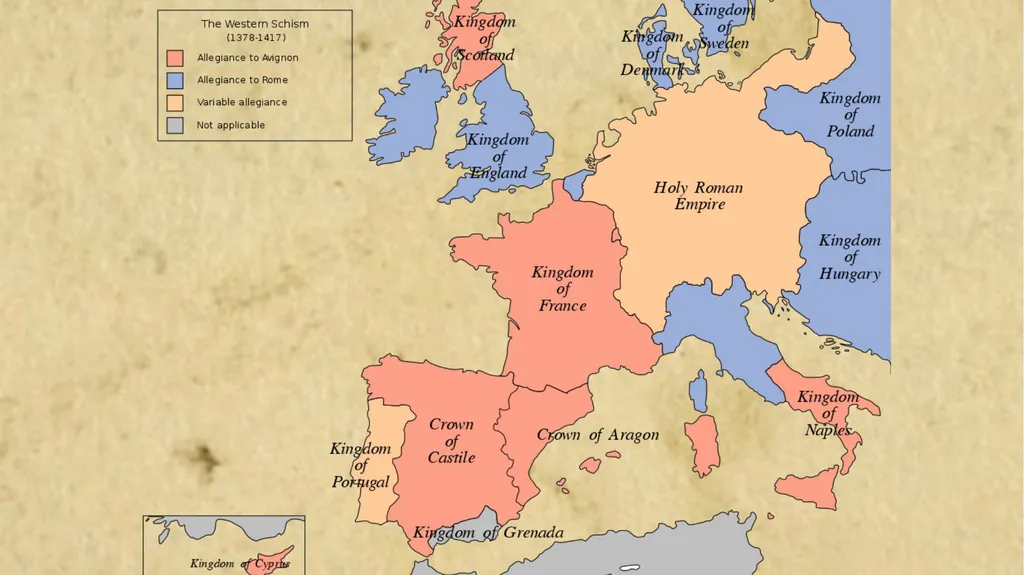
1378 Two Popes!
1382 Wycliffe’s Bible in Middle English Late 13th, 14th Century<br>
46
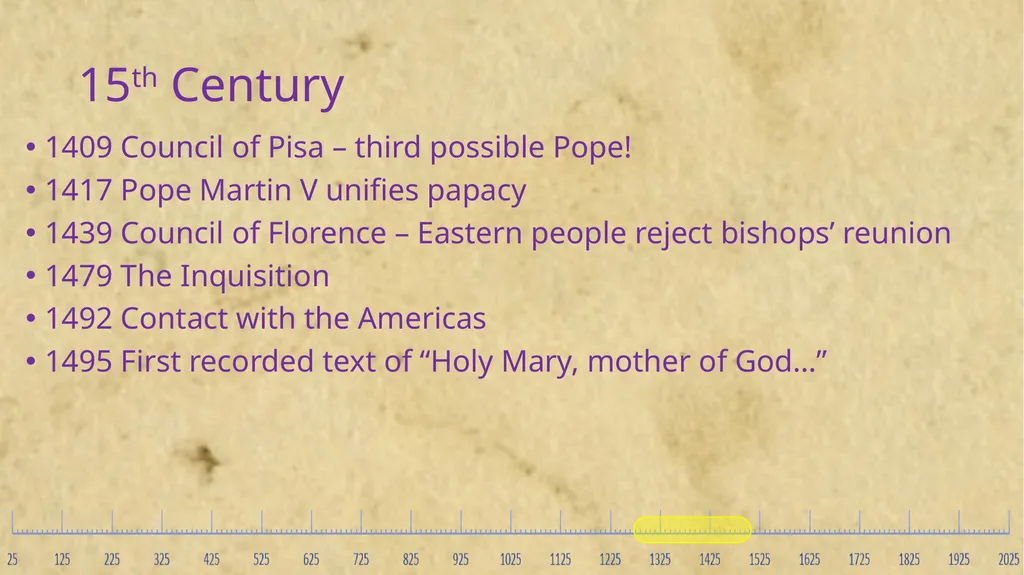
1409 Council of Pisa – third possible Pope!
1417 Pope Martin V unifies papacy
1439 Council of Florence – Eastern people reject bishops’ reunion
1479 The Inquisition
1492 Contact with the Americas
1495 First recorded text of “Holy Mary, mother of God…” 15th Century<br>
1417 Pope Martin V unifies papacy
1439 Council of Florence – Eastern people reject bishops’ reunion
1479 The Inquisition
1492 Contact with the Americas
1495 First recorded text of “Holy Mary, mother of God…” 15th Century<br>
47
Key Questions Major events in the world?
What doctrines were in focus?
Design of the building for worship?
How was the Church led?
What prayers were used for Mass?
How often did people take communion?
Where were the Charismatic Gifts?
What about the Church in Britain?<br>
What doctrines were in focus?
Design of the building for worship?
How was the Church led?
What prayers were used for Mass?
How often did people take communion?
Where were the Charismatic Gifts?
What about the Church in Britain?<br>
48
Church History Part Five: The Council of Trent and the Reformation<br>
49
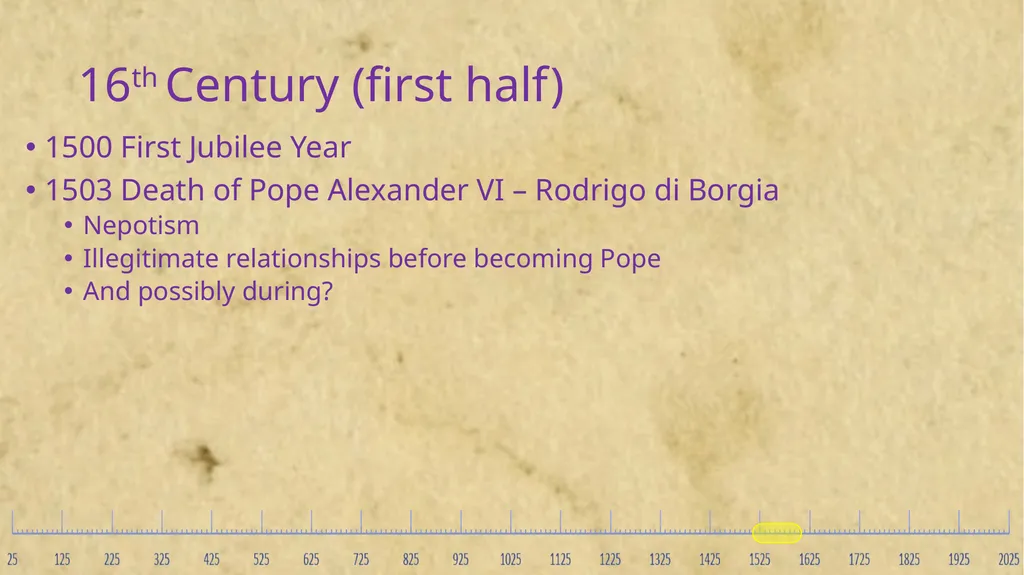
1500 First Jubilee Year
1503 Death of Pope Alexander VI – Rodrigo di Borgia
Nepotism
Illegitimate relationships before becoming Pope
And possibly during? 16th Century (first half)<br>
1503 Death of Pope Alexander VI – Rodrigo di Borgia
Nepotism
Illegitimate relationships before becoming Pope
And possibly during? 16th Century (first half)<br>
50
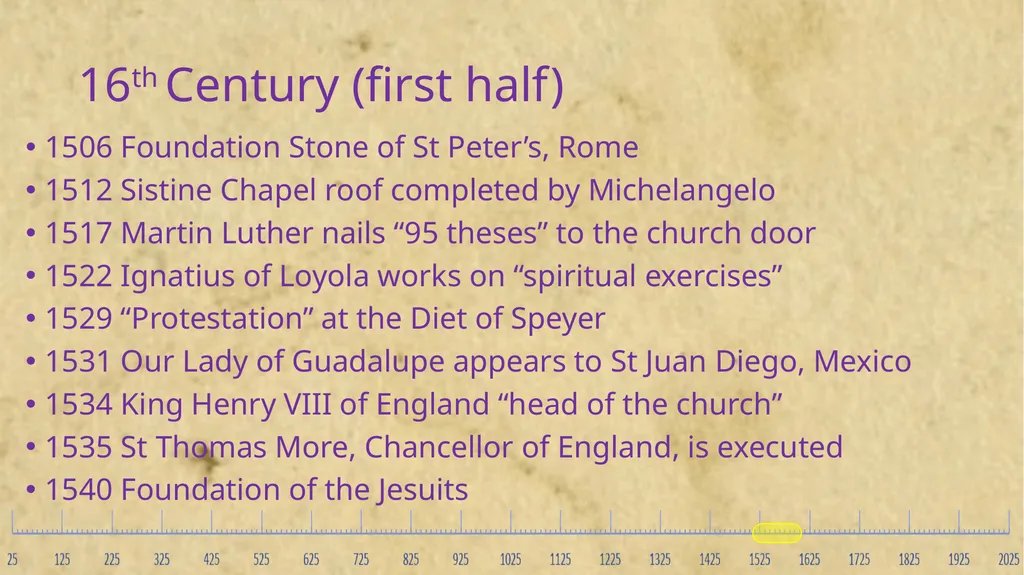
1506 Foundation Stone of St Peter’s, Rome
1512 Sistine Chapel roof completed by Michelangelo
1517 Martin Luther nails “95 theses” to the church door
1522 Ignatius of Loyola works on “spiritual exercises”
1529 “Protestation” at the Diet of Speyer
1531 Our Lady of Guadalupe appears to St Juan Diego, Mexico
1534 King Henry VIII of England “head of the church”
1535 St Thomas More, Chancellor of England, is executed
1540 Foundation of the Jesuits 16th Century (first half)<br>
51
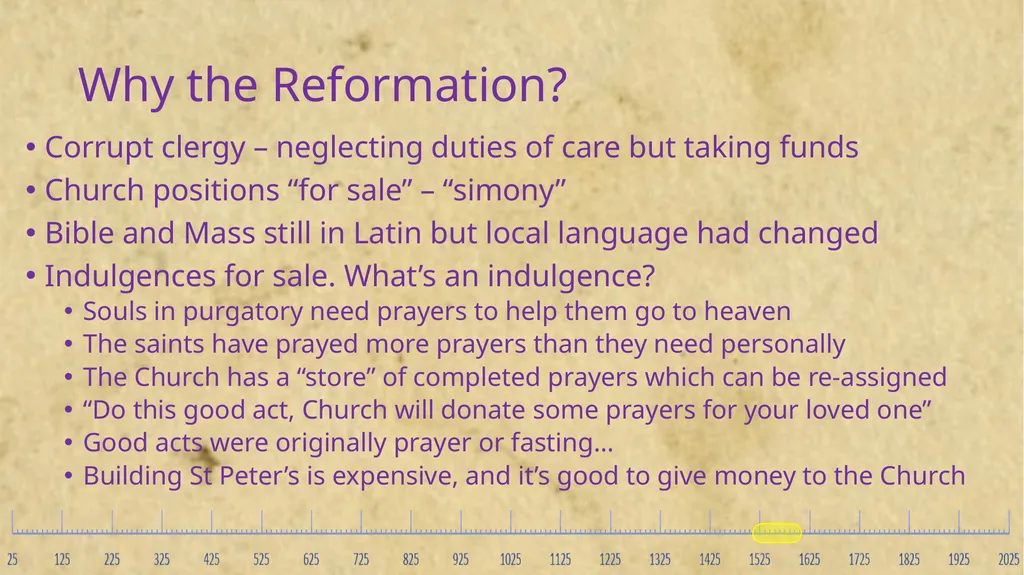
Corrupt clergy – neglecting duties of care but taking funds
Church positions “for sale” – “simony”
Bible and Mass still in Latin but local language had changed
Indulgences for sale. What’s an indulgence?
Souls in purgatory need prayers to help them go to heaven
The saints have prayed more prayers than they need personally
The Church has a “store” of completed prayers which can be re-assigned
“Do this good act, Church will donate some prayers for your loved one”
Good acts were originally prayer or fasting…
Building St Peter’s is expensive, and it’s good to give money to the Church Why the Reformation?<br>
52
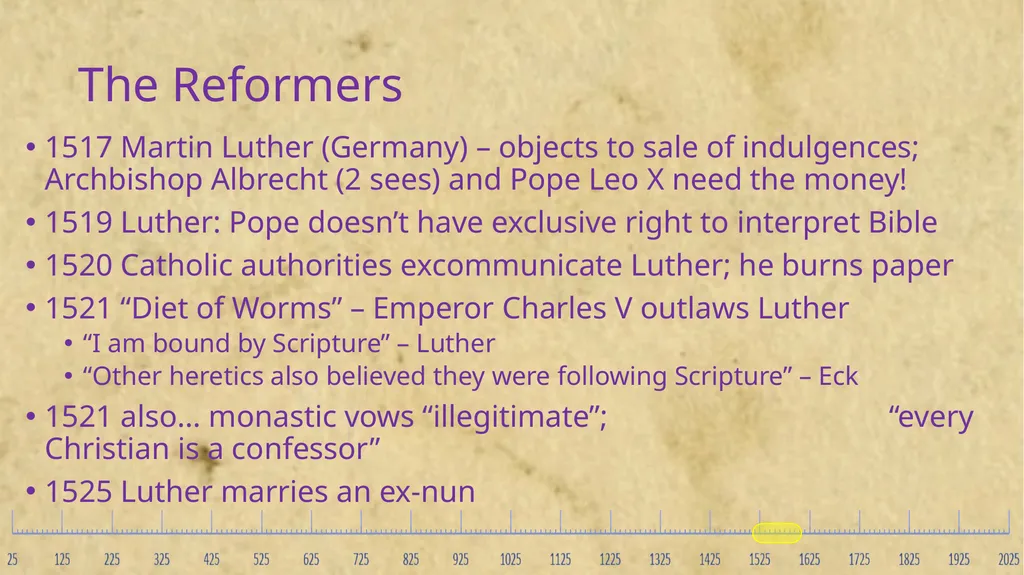
1517 Martin Luther (Germany) – objects to sale of indulgences; Archbishop Albrecht (2 sees) and Pope Leo X need the money!
1519 Luther: Pope doesn’t have exclusive right to interpret Bible
1520 Catholic authorities excommunicate Luther; he burns paper
1521 “Diet of Worms” – Emperor Charles V outlaws Luther
“I am bound by Scripture” – Luther
“Other heretics also believed they were following Scripture” – Eck
1521 also… monastic vows “illegitimate”; “every Christian is a confessor”
1525 Luther marries an ex-nun The Reformers<br>
53
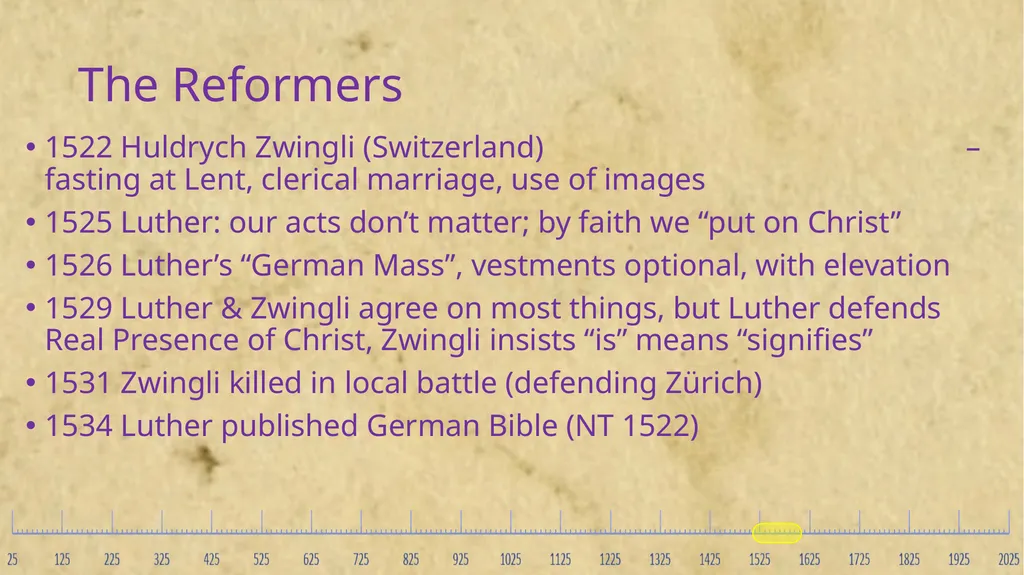
1522 Huldrych Zwingli (Switzerland) – fasting at Lent, clerical marriage, use of images
1525 Luther: our acts don’t matter; by faith we “put on Christ”
1526 Luther’s “German Mass”, vestments optional, with elevation
1529 Luther & Zwingli agree on most things, but Luther defends Real Presence of Christ, Zwingli insists “is” means “signifies”
1531 Zwingli killed in local battle (defending Zürich)
1534 Luther published German Bible (NT 1522) The Reformers<br>
54
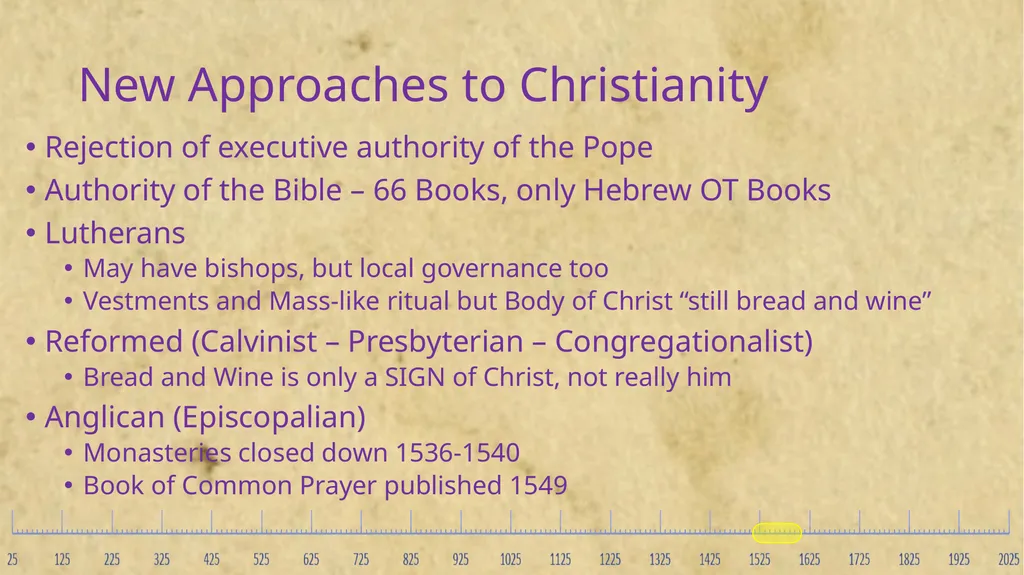
Rejection of executive authority of the Pope
Authority of the Bible – 66 Books, only Hebrew OT Books
Lutherans
May have bishops, but local governance too
Vestments and Mass-like ritual but Body of Christ “still bread and wine”
Reformed (Calvinist – Presbyterian – Congregationalist)
Bread and Wine is only a SIGN of Christ, not really him
Anglican (Episcopalian)
Monasteries closed down 1536-1540
Book of Common Prayer published 1549 New Approaches to Christianity<br>
55
London Carthusians 4 May 1535 (Tyburn)
St Richard Gwyn (schoolteacher)15 Oct 1584
Bl Margaret Ball (priest protector) 1584
St Margaret Clitherow (priest protector) 25 March 1586
St Margaret Ward (priest protector) 30 Aug 1588
St Anne Line (priest smuggler) 27 Feb 1601
St John Ogilvie 10 March 1615
Ss Philip Evans & John Lloyd 22 July 1679 (after Oates Plot)
St Oliver Plunkett 1 July 1681 (Tyburn, from Ireland) Reformation Martyrs of the British Isles<br>
56
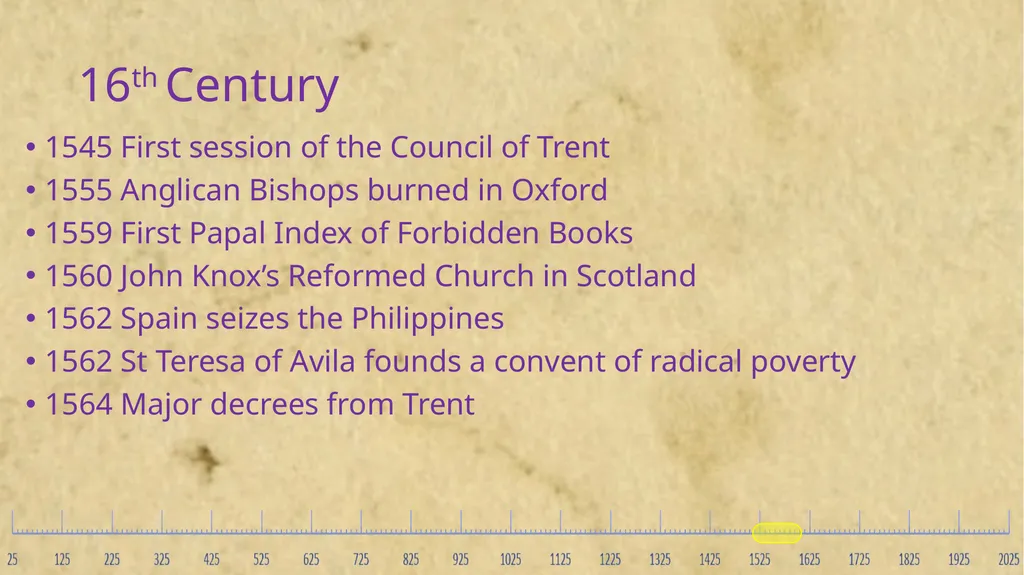
1545 First session of the Council of Trent
1555 Anglican Bishops burned in Oxford
1559 First Papal Index of Forbidden Books
1560 John Knox’s Reformed Church in Scotland
1562 Spain seizes the Philippines
1562 St Teresa of Avila founds a convent of radical poverty
1564 Major decrees from Trent 16th Century<br>
1555 Anglican Bishops burned in Oxford
1559 First Papal Index of Forbidden Books
1560 John Knox’s Reformed Church in Scotland
1562 Spain seizes the Philippines
1562 St Teresa of Avila founds a convent of radical poverty
1564 Major decrees from Trent 16th Century<br>
57
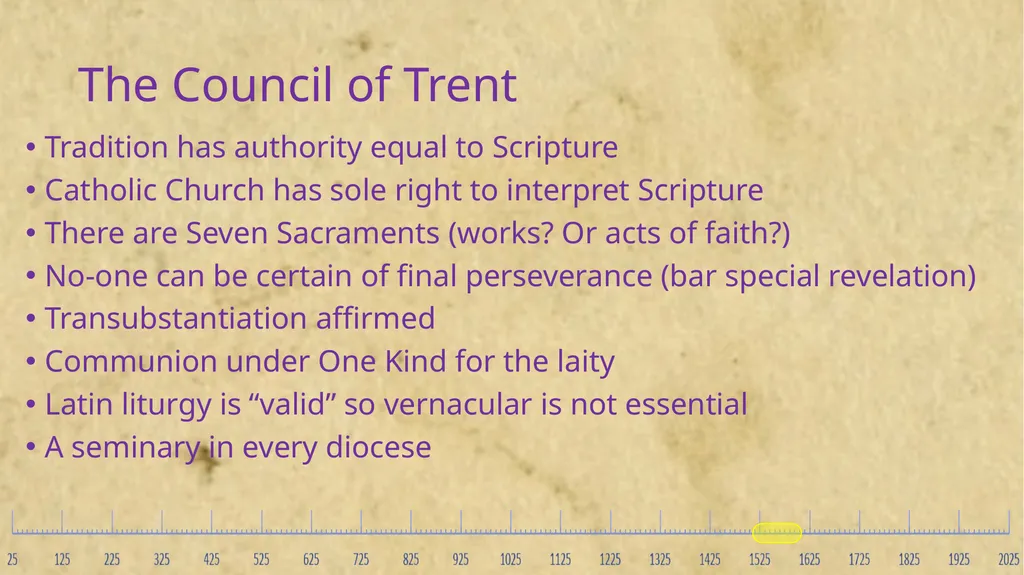
Tradition has authority equal to Scripture
Catholic Church has sole right to interpret Scripture
There are Seven Sacraments (works? Or acts of faith?)
No-one can be certain of final perseverance (bar special revelation)
Transubstantiation affirmed
Communion under One Kind for the laity
Latin liturgy is “valid” so vernacular is not essential
A seminary in every diocese The Council of Trent<br>
58
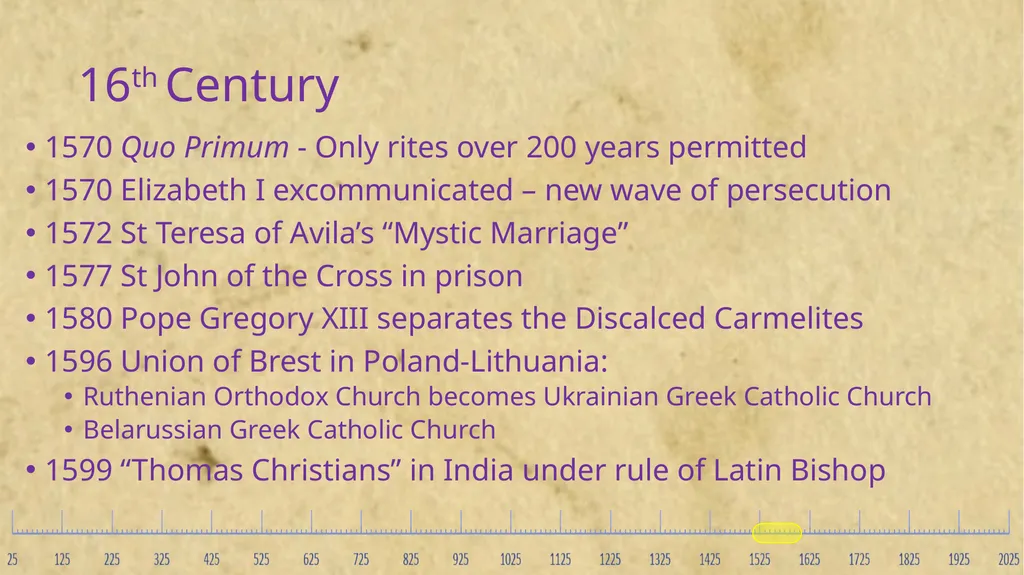
1570 Quo Primum - Only rites over 200 years permitted
1570 Elizabeth I excommunicated – new wave of persecution
1572 St Teresa of Avila’s “Mystic Marriage”
1577 St John of the Cross in prison
1580 Pope Gregory XIII separates the Discalced Carmelites
1596 Union of Brest in Poland-Lithuania:
Ruthenian Orthodox Church becomes Ukrainian Greek Catholic Church
Belarussian Greek Catholic Church
1599 “Thomas Christians” in India under rule of Latin Bishop 16th Century<br>
59
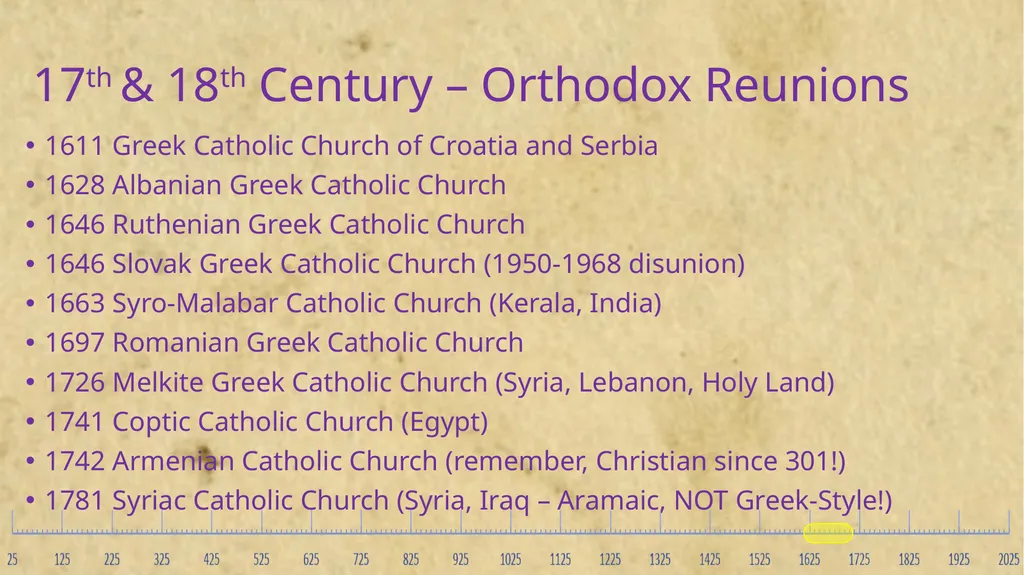
1611 Greek Catholic Church of Croatia and Serbia
1628 Albanian Greek Catholic Church
1646 Ruthenian Greek Catholic Church
1646 Slovak Greek Catholic Church (1950-1968 disunion)
1663 Syro-Malabar Catholic Church (Kerala, India)
1697 Romanian Greek Catholic Church
1726 Melkite Greek Catholic Church (Syria, Lebanon, Holy Land)
1741 Coptic Catholic Church (Egypt)
1742 Armenian Catholic Church (remember, Christian since 301!)
1781 Syriac Catholic Church (Syria, Iraq – Aramaic, NOT Greek-Style!) 17th & 18th Century – Orthodox Reunions<br>
60
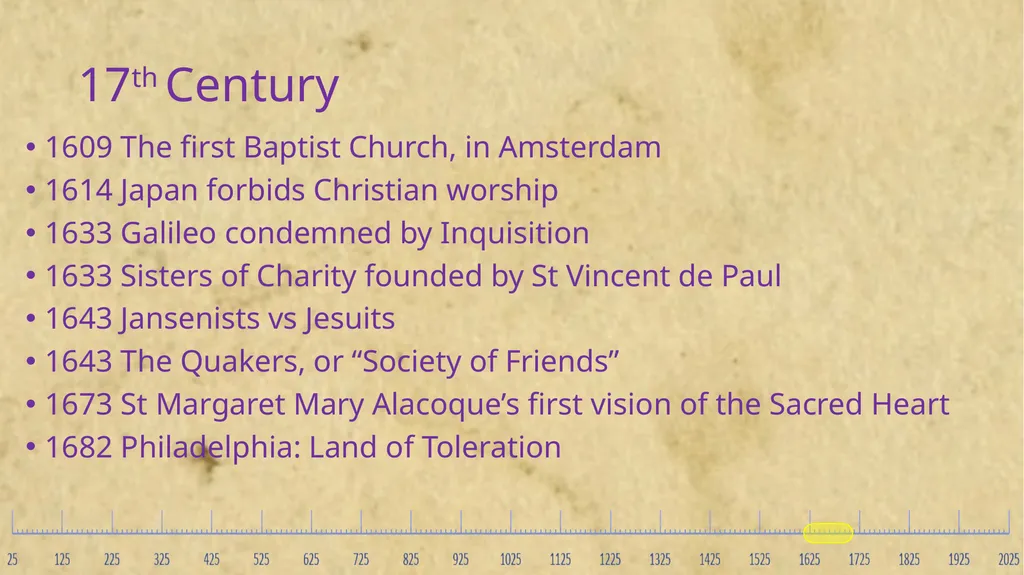
1609 The first Baptist Church, in Amsterdam
1614 Japan forbids Christian worship
1633 Galileo condemned by Inquisition
1633 Sisters of Charity founded by St Vincent de Paul
1643 Jansenists vs Jesuits
1643 The Quakers, or “Society of Friends”
1673 St Margaret Mary Alacoque’s first vision of the Sacred Heart
1682 Philadelphia: Land of Toleration 17th Century<br>
61
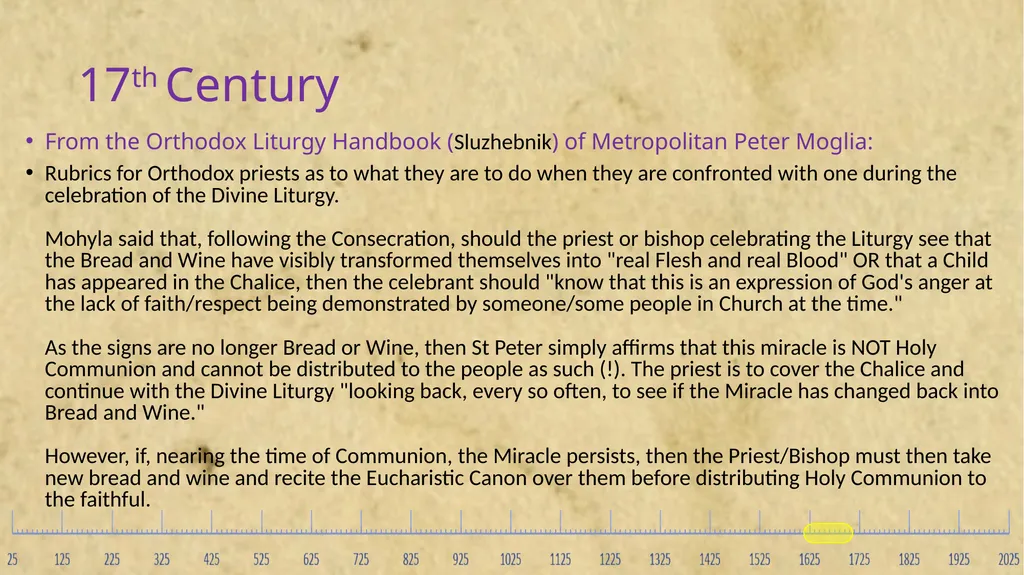
From the Orthodox Liturgy Handbook (Sluzhebnik) of Metropolitan Peter Moglia:
Rubrics for Orthodox priests as to what they are to do when they are confronted with one during the celebration of the Divine Liturgy. Mohyla said that, following the Consecration, should the priest or bishop celebrating the Liturgy see that the Bread and Wine have visibly transformed themselves into "real Flesh and real Blood" OR that a Child has appeared in the Chalice, then the celebrant should "know that this is an expression of God's anger at the lack of faith/respect being demonstrated by someone/some people in Church at the time." As the signs are no longer Bread or Wine, then St Peter simply affirms that this miracle is NOT Holy Communion and cannot be distributed to the people as such (!). The priest is to cover the Chalice and continue with the Divine Liturgy "looking back, every so often, to see if the Miracle has changed back into Bread and Wine." However, if, nearing the time of Communion, the Miracle persists, then the Priest/Bishop must then take new bread and wine and recite the Eucharistic Canon over them before distributing Holy Communion to the faithful. 17th Century<br>
Rubrics for Orthodox priests as to what they are to do when they are confronted with one during the celebration of the Divine Liturgy. Mohyla said that, following the Consecration, should the priest or bishop celebrating the Liturgy see that the Bread and Wine have visibly transformed themselves into "real Flesh and real Blood" OR that a Child has appeared in the Chalice, then the celebrant should "know that this is an expression of God's anger at the lack of faith/respect being demonstrated by someone/some people in Church at the time." As the signs are no longer Bread or Wine, then St Peter simply affirms that this miracle is NOT Holy Communion and cannot be distributed to the people as such (!). The priest is to cover the Chalice and continue with the Divine Liturgy "looking back, every so often, to see if the Miracle has changed back into Bread and Wine." However, if, nearing the time of Communion, the Miracle persists, then the Priest/Bishop must then take new bread and wine and recite the Eucharistic Canon over them before distributing Holy Communion to the faithful. 17th Century<br>
62
Key Questions Major events in the world?
What doctrines were in focus?
Design of the building for worship?
How was the Church led?
What prayers were used for Mass?
How often did people take communion?
Where were the Charismatic Gifts?
What about the Church in Britain?<br>
What doctrines were in focus?
Design of the building for worship?
How was the Church led?
What prayers were used for Mass?
How often did people take communion?
Where were the Charismatic Gifts?
What about the Church in Britain?<br>
63
Church History Part Six: The Age of Enlightenment<br>
64
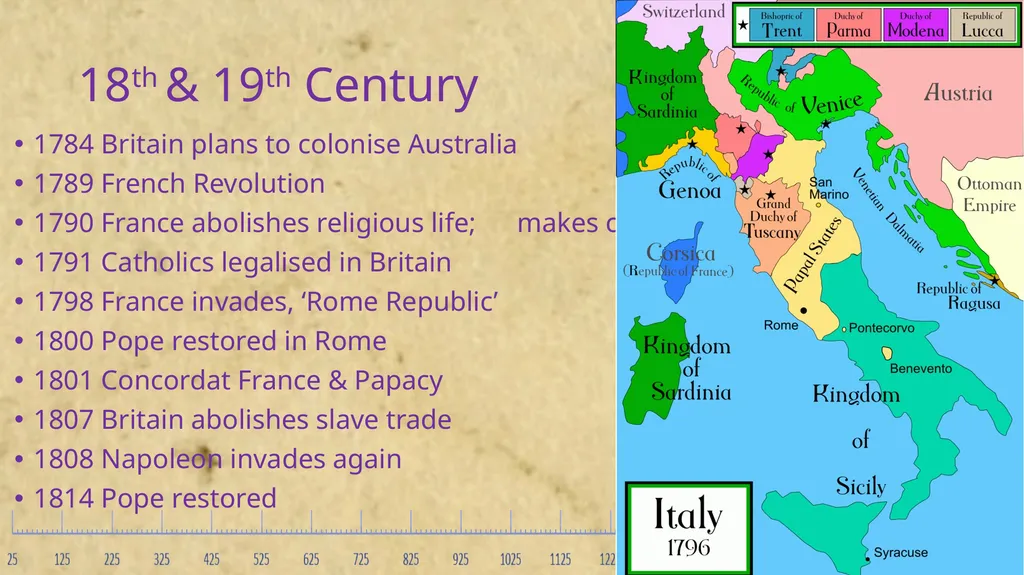
1784 Britain plans to colonise Australia
1789 French Revolution
1790 France abolishes religious life; makes clergy state employees
1791 Catholics legalised in Britain
1798 France invades, ‘Rome Republic’
1800 Pope restored in Rome
1801 Concordat France & Papacy
1807 Britain abolishes slave trade
1808 Napoleon invades again
1814 Pope restored 18th & 19th Century<br>
65
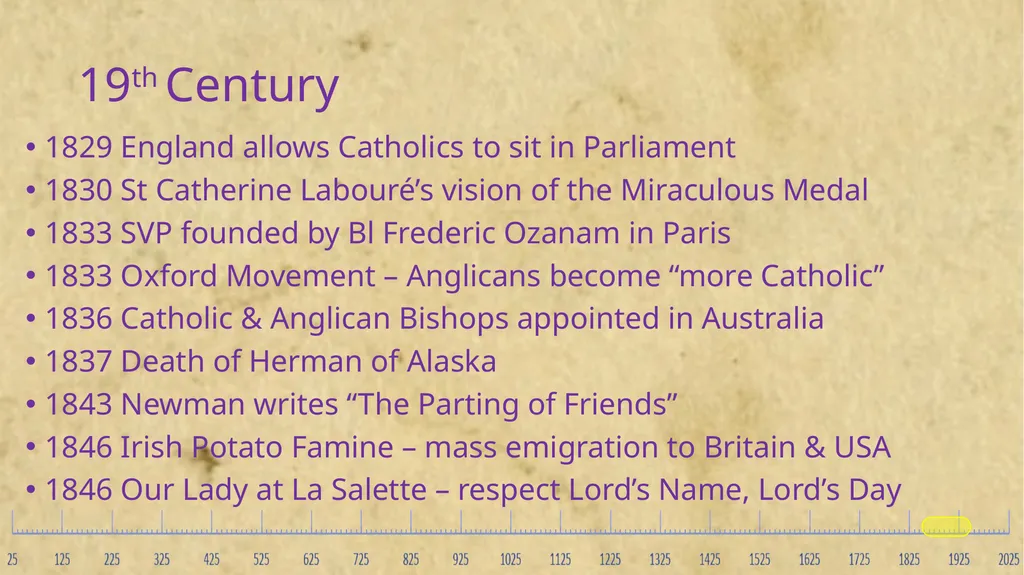
1829 England allows Catholics to sit in Parliament
1830 St Catherine Labouré’s vision of the Miraculous Medal
1833 SVP founded by Bl Frederic Ozanam in Paris
1833 Oxford Movement – Anglicans become “more Catholic”
1836 Catholic & Anglican Bishops appointed in Australia
1837 Death of Herman of Alaska
1843 Newman writes “The Parting of Friends”
1846 Irish Potato Famine – mass emigration to Britain & USA
1846 Our Lady at La Salette – respect Lord’s Name, Lord’s Day 19th Century<br>
66
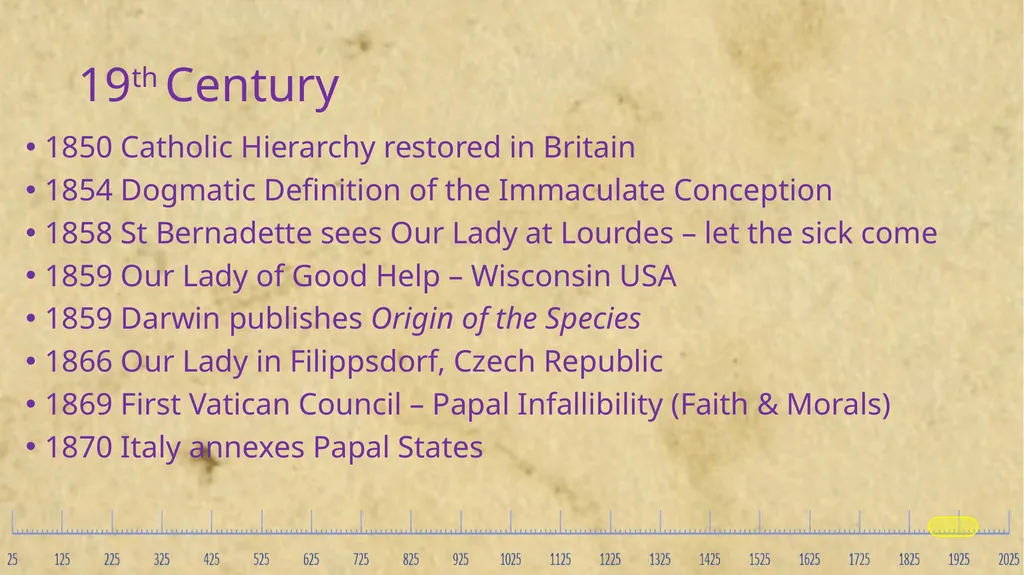
1850 Catholic Hierarchy restored in Britain
1854 Dogmatic Definition of the Immaculate Conception
1858 St Bernadette sees Our Lady at Lourdes – let the sick come
1859 Our Lady of Good Help – Wisconsin USA
1859 Darwin publishes Origin of the Species
1866 Our Lady in Filippsdorf, Czech Republic
1869 First Vatican Council – Papal Infallibility (Faith & Morals)
1870 Italy annexes Papal States 19th Century<br>
67
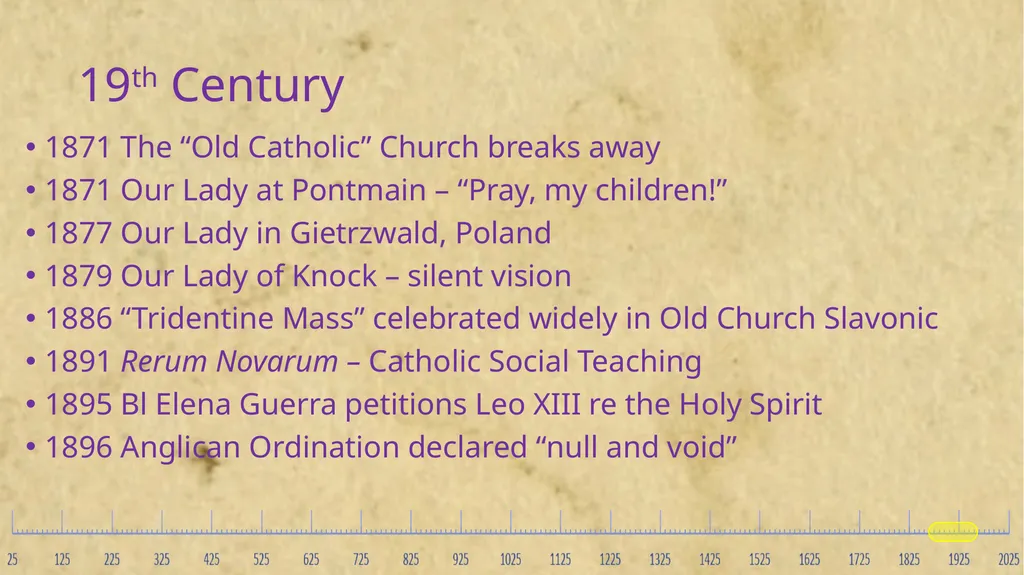
1871 The “Old Catholic” Church breaks away
1871 Our Lady at Pontmain – “Pray, my children!”
1877 Our Lady in Gietrzwald, Poland
1879 Our Lady of Knock – silent vision
1886 “Tridentine Mass” celebrated widely in Old Church Slavonic
1891 Rerum Novarum – Catholic Social Teaching
1895 Bl Elena Guerra petitions Leo XIII re the Holy Spirit
1896 Anglican Ordination declared “null and void” 19th Century<br>
68
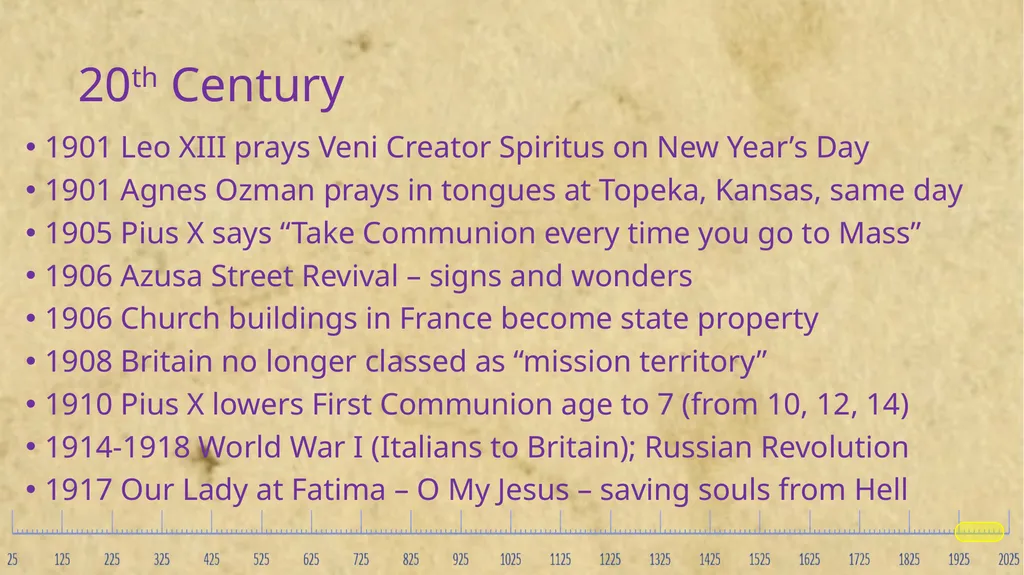
1901 Leo XIII prays Veni Creator Spiritus on New Year’s Day
1901 Agnes Ozman prays in tongues at Topeka, Kansas, same day
1905 Pius X says “Take Communion every time you go to Mass”
1906 Azusa Street Revival – signs and wonders
1906 Church buildings in France become state property
1908 Britain no longer classed as “mission territory”
1910 Pius X lowers First Communion age to 7 (from 10, 12, 14)
1914-1918 World War I (Italians to Britain); Russian Revolution
1917 Our Lady at Fatima – O My Jesus – saving souls from Hell 20th Century<br>
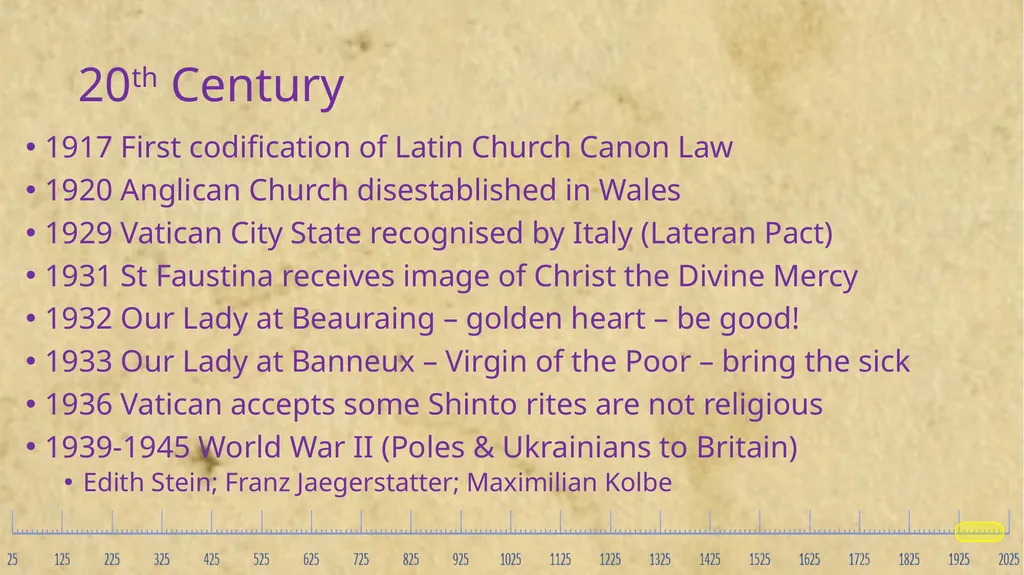
69
1917 First codification of Latin Church Canon Law
1920 Anglican Church disestablished in Wales
1929 Vatican City State recognised by Italy (Lateran Pact)
1931 St Faustina receives image of Christ the Divine Mercy
1932 Our Lady at Beauraing – golden heart – be good!
1933 Our Lady at Banneux – Virgin of the Poor – bring the sick
1936 Vatican accepts some Shinto rites are not religious
1939-1945 World War II (Poles & Ukrainians to Britain)
Edith Stein; Franz Jaegerstatter; Maximilian Kolbe 20th Century<br>
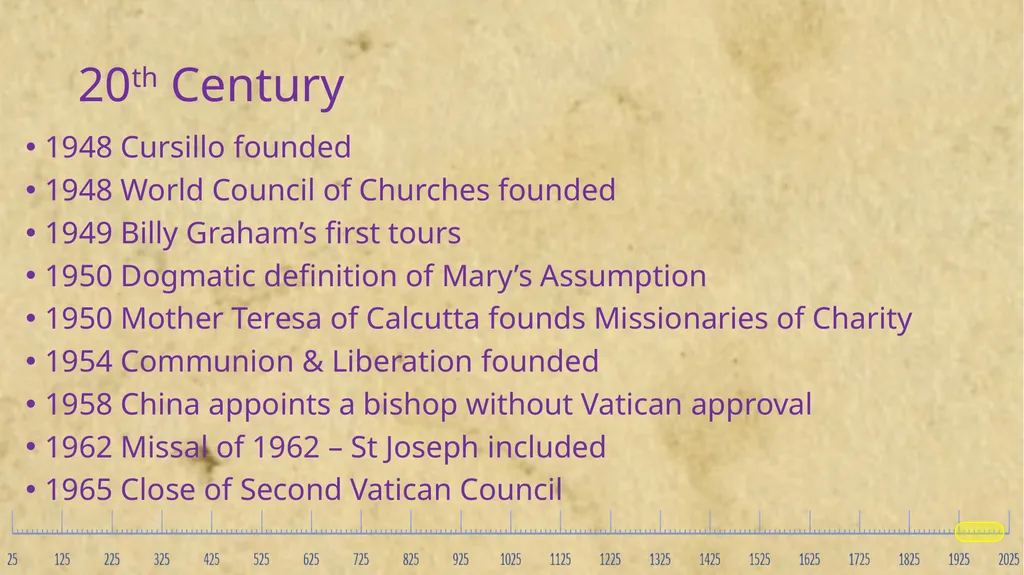
70
1948 Cursillo founded
1948 World Council of Churches founded
1949 Billy Graham’s first tours
1950 Dogmatic definition of Mary’s Assumption
1950 Mother Teresa of Calcutta founds Missionaries of Charity
1954 Communion & Liberation founded
1958 China appoints a bishop without Vatican approval
1962 Missal of 1962 – St Joseph included
1965 Close of Second Vatican Council 20th Century<br>
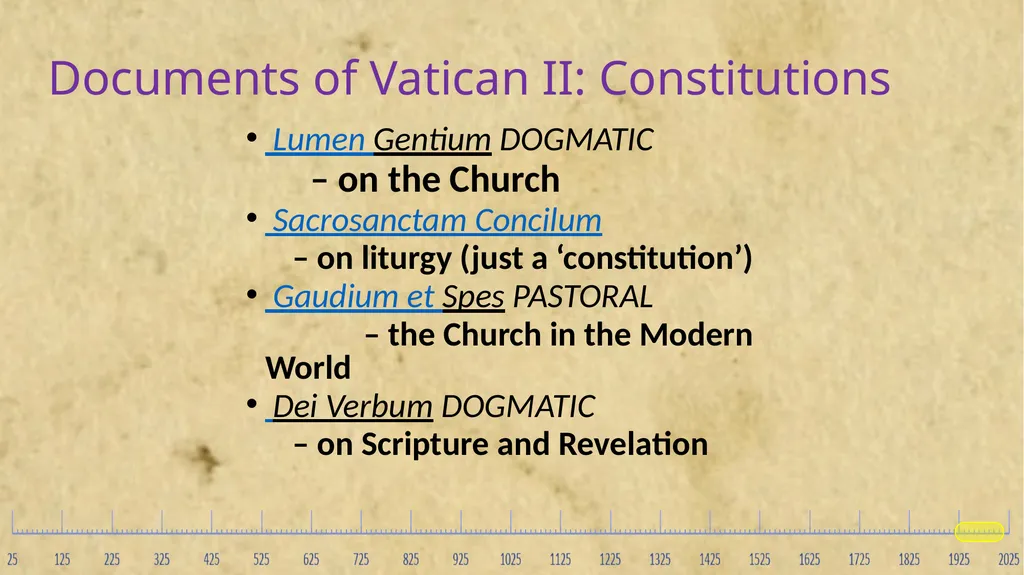
71
Lumen Gentium DOGMATIC
– on the Church
Sacrosanctam Concilum
– on liturgy (just a ‘constitution’)
Gaudium et Spes PASTORAL
– the Church in the Modern World
Dei Verbum DOGMATIC
– on Scripture and Revelation Documents of Vatican II: Constitutions<br>
– on the Church
Sacrosanctam Concilum
– on liturgy (just a ‘constitution’)
Gaudium et Spes PASTORAL
– the Church in the Modern World
Dei Verbum DOGMATIC
– on Scripture and Revelation Documents of Vatican II: Constitutions<br>
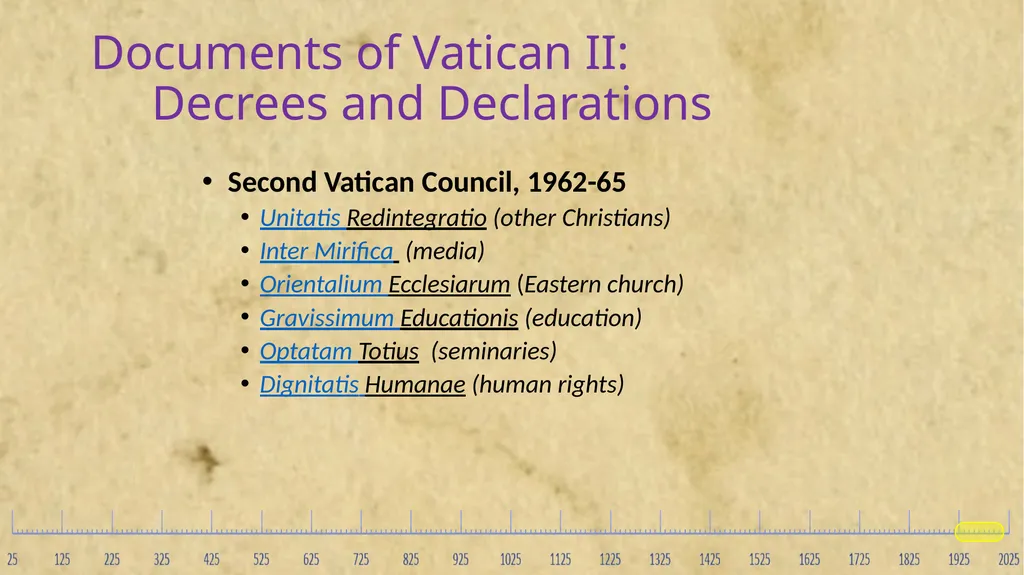
72
Second Vatican Council, 1962-65
Unitatis Redintegratio (other Christians)
Inter Mirifica (media)
Orientalium Ecclesiarum (Eastern church)
Gravissimum Educationis (education)
Optatam Totius (seminaries)
Dignitatis Humanae (human rights) Documents of Vatican II:
Decrees and Declarations<br>
Unitatis Redintegratio (other Christians)
Inter Mirifica (media)
Orientalium Ecclesiarum (Eastern church)
Gravissimum Educationis (education)
Optatam Totius (seminaries)
Dignitatis Humanae (human rights) Documents of Vatican II:
Decrees and Declarations<br>
73
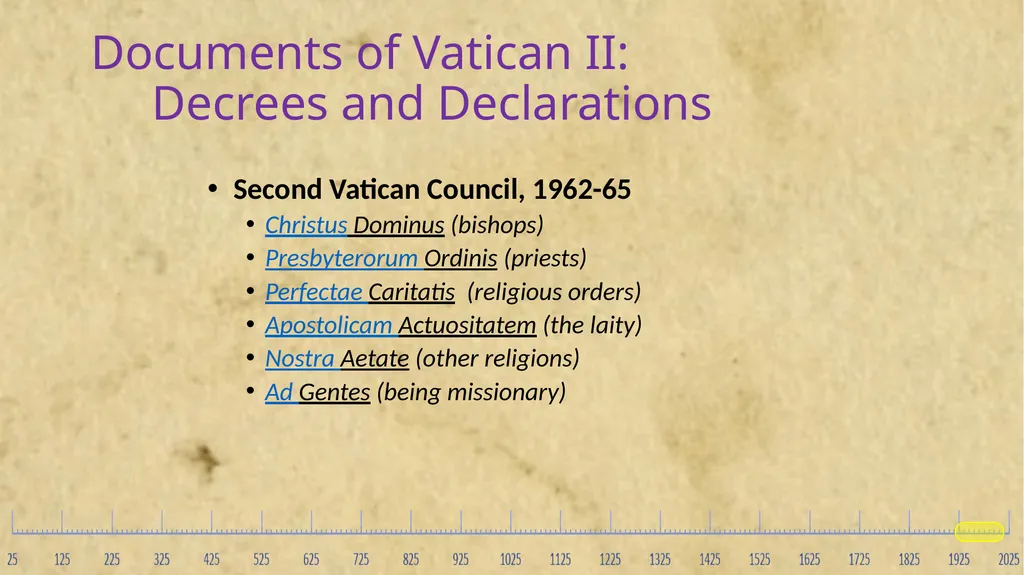
Second Vatican Council, 1962-65
Christus Dominus (bishops)
Presbyterorum Ordinis (priests)
Perfectae Caritatis (religious orders)
Apostolicam Actuositatem (the laity)
Nostra Aetate (other religions)
Ad Gentes (being missionary) Documents of Vatican II:
Decrees and Declarations<br>
Christus Dominus (bishops)
Presbyterorum Ordinis (priests)
Perfectae Caritatis (religious orders)
Apostolicam Actuositatem (the laity)
Nostra Aetate (other religions)
Ad Gentes (being missionary) Documents of Vatican II:
Decrees and Declarations<br>
74
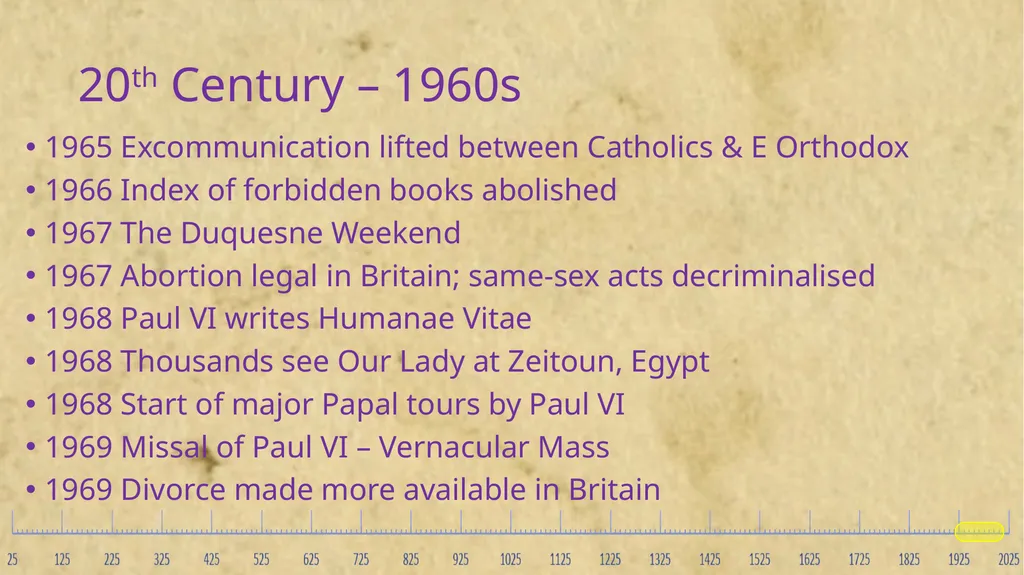
1965 Excommunication lifted between Catholics & E Orthodox
1966 Index of forbidden books abolished
1967 The Duquesne Weekend
1967 Abortion legal in Britain; same-sex acts decriminalised
1968 Paul VI writes Humanae Vitae
1968 Thousands see Our Lady at Zeitoun, Egypt
1968 Start of major Papal tours by Paul VI
1969 Missal of Paul VI – Vernacular Mass
1969 Divorce made more available in Britain 20th Century – 1960s<br>
75
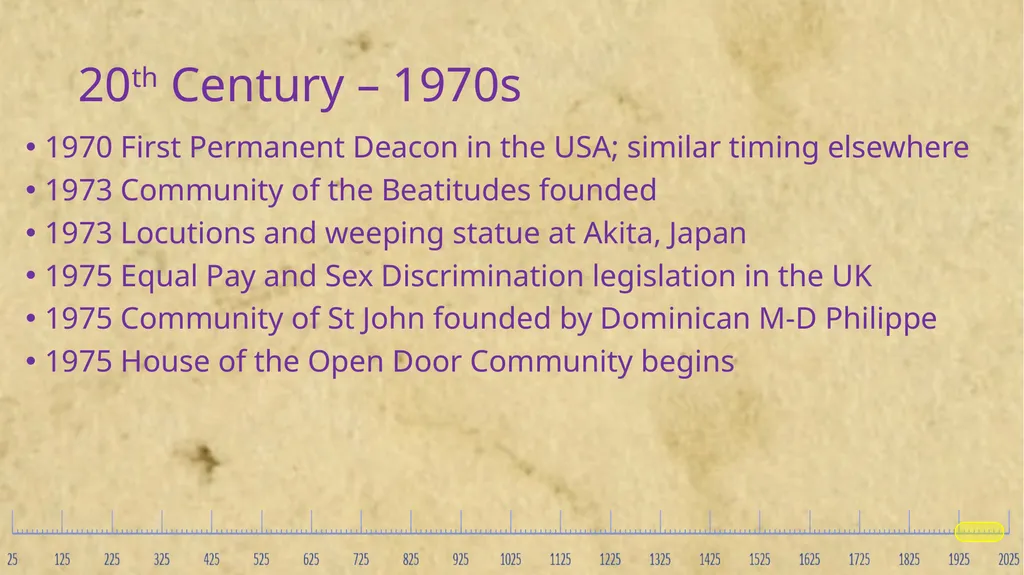
1970 First Permanent Deacon in the USA; similar timing elsewhere
1973 Community of the Beatitudes founded
1973 Locutions and weeping statue at Akita, Japan
1975 Equal Pay and Sex Discrimination legislation in the UK
1975 Community of St John founded by Dominican M-D Philippe
1975 House of the Open Door Community begins 20th Century – 1970s<br>
1973 Community of the Beatitudes founded
1973 Locutions and weeping statue at Akita, Japan
1975 Equal Pay and Sex Discrimination legislation in the UK
1975 Community of St John founded by Dominican M-D Philippe
1975 House of the Open Door Community begins 20th Century – 1970s<br>
76
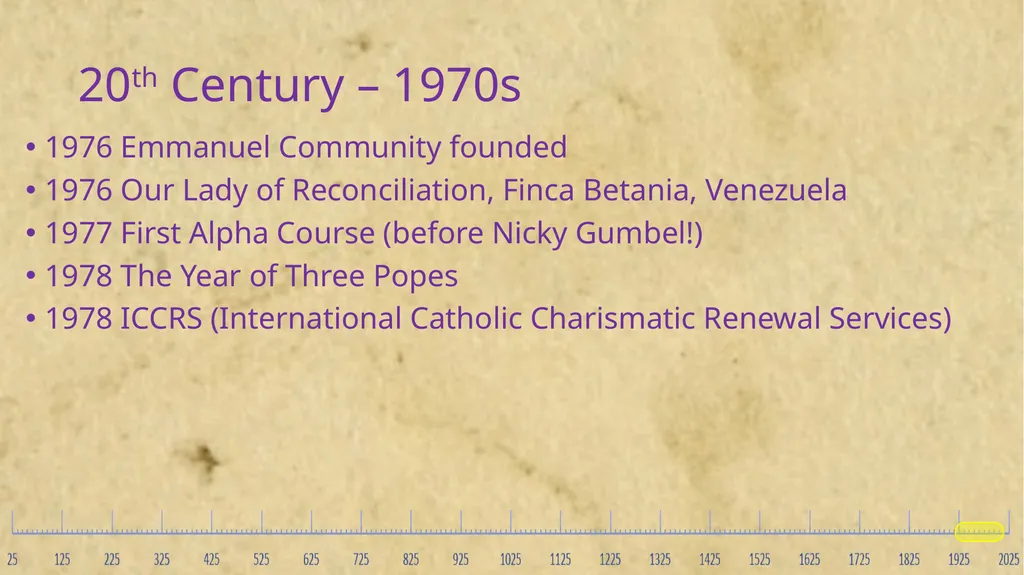
1976 Emmanuel Community founded
1976 Our Lady of Reconciliation, Finca Betania, Venezuela
1977 First Alpha Course (before Nicky Gumbel!)
1978 The Year of Three Popes
1978 ICCRS (International Catholic Charismatic Renewal Services) 20th Century – 1970s<br>
1976 Our Lady of Reconciliation, Finca Betania, Venezuela
1977 First Alpha Course (before Nicky Gumbel!)
1978 The Year of Three Popes
1978 ICCRS (International Catholic Charismatic Renewal Services) 20th Century – 1970s<br>
77
1980 Our Lady Mother of Sinners, Cuapa, Nicaragua
1981 Our Lady in Kibeho, Rwanda
1981 Start of alleged apparitions at Medjugorje
1982 St Oscar Romero assassinated
1983 Revised Code of Canon Law
1983 Our Lady of San Nicolas, Argentina
1983 Thousands see Our Lady in Cairo, Egypt
1984 Sion Community founded 20th Century – 1980s<br>
1981 Our Lady in Kibeho, Rwanda
1981 Start of alleged apparitions at Medjugorje
1982 St Oscar Romero assassinated
1983 Revised Code of Canon Law
1983 Our Lady of San Nicolas, Argentina
1983 Thousands see Our Lady in Cairo, Egypt
1984 Sion Community founded 20th Century – 1980s<br>
78
1985 First World Youth Day (Santiago de Compostela)
1985 Companions of the Cross
1987 Franciscan Friars of the Renewal founded
1989 Archbishop Lefebvre breaks away to form Society of Pius X
1989 China massacres students in Tianenman Square
1989 Solidarity Trade Union launched in Poland
1989 Decline of Communism in Central & Eastern Europe 20th Century – 1980s<br>
79
1990 Cor et Lumen Christi community founded
1990 Catholic Fraternity Charismatic Covenant Communities and Fellowships
1992 Council of Churches in Britain & Ireland includes Catholics
1992 Maastricht Treaty – free movement in EU
1992 Church of England votes to ordain women
1993 ICCRS formally recognised by Vatican Laity department
1993 Veritatis Splendor – JP2 reaction to Humanae Vitae?
1994 Sunday trading permitted in Britain (6 hours)
1994 Toronto Blessing 20th Century – 1990s<br>
80
1994 “Death with Dignity” Act in Oregon USA
1995 Australia’s Northern Territory allows euthanasia (‘til 1997)
1997 Legal protection assisting death of terminally ill in Colombia
1999 Joint Lutheran-Catholic Declaration 20th Century – 1990s<br>
1995 Australia’s Northern Territory allows euthanasia (‘til 1997)
1997 Legal protection assisting death of terminally ill in Colombia
1999 Joint Lutheran-Catholic Declaration 20th Century – 1990s<br>
81
1051 Peter Gratian condemns abuses – approach too merciful?
1531 Luther accuses Cardinals
1950s leader of the Paraclete order expresses concerns
1980s speaking about abuse stops being taboo in Western society
1990s E&W Bishops acknowledge problem, procedures in place The Abuse Crisis<br>
1531 Luther accuses Cardinals
1950s leader of the Paraclete order expresses concerns
1980s speaking about abuse stops being taboo in Western society
1990s E&W Bishops acknowledge problem, procedures in place The Abuse Crisis<br>
82
2000 The Great Jubilee – St John Paul II’s Act of Penitence
2000 Mgr Pat Lynch moves to Ireland to start Céilí
2001 Netherlands legalises doctor-assisted suicide
2004 Civil Partnerships (same-sex relationships) England & Wales
2007 Summorum Pontificum – ‘extraordinary form’ derestricted
2009 Benedict XVI launches Ordinariate for ex-Anglicans 21st Century – 2000s<br>
83
2012 Abortion clinics allowed to advertise on British television
2011 900 Anglicans join the Ordinariate in England
2011 Community of the Beatitudes a “community” not “order”
2014 Same-Sex Marriages in England and Wales
2013 First Papal resignation since 1415
2015 Laudato Si – first major Papal work on the environment
2017 Golden Jubilee of Catholic Charismatic Renewal
2019 CHARIS replaces ICCRS and CF at Pope’s request 21st Century – 2010s<br>
84
Key Questions Major events in the world?
What doctrines were in focus?
Design of the building for worship?
How was the Church led?
What prayers were used for Mass?
How often did people take communion?
Where were the Charismatic Gifts?
What about the Church in Britain?<br>
What doctrines were in focus?
Design of the building for worship?
How was the Church led?
What prayers were used for Mass?
How often did people take communion?
Where were the Charismatic Gifts?
What about the Church in Britain?<br>