Church History The first millennia Hierarchy developments Roman Society Stratifying the church Presbuterios eventually abrieviated to Priest Episcopos (bishop) becomes leader over a region (see) Bishops from more important cities started
"Church History The first millennia Hierarchy" is the property of its rightful owner. Permission is granted to
download and print the materials on this website for personal, non-commercial use only, and to display it
on your personal computer provided you do not modify the materials and that you retain all copyright
notices contained in the materials. By downloading content from our website, you accept the terms of this
agreement.
Presentation Transcript
01
Church History The first millennia<br>
02
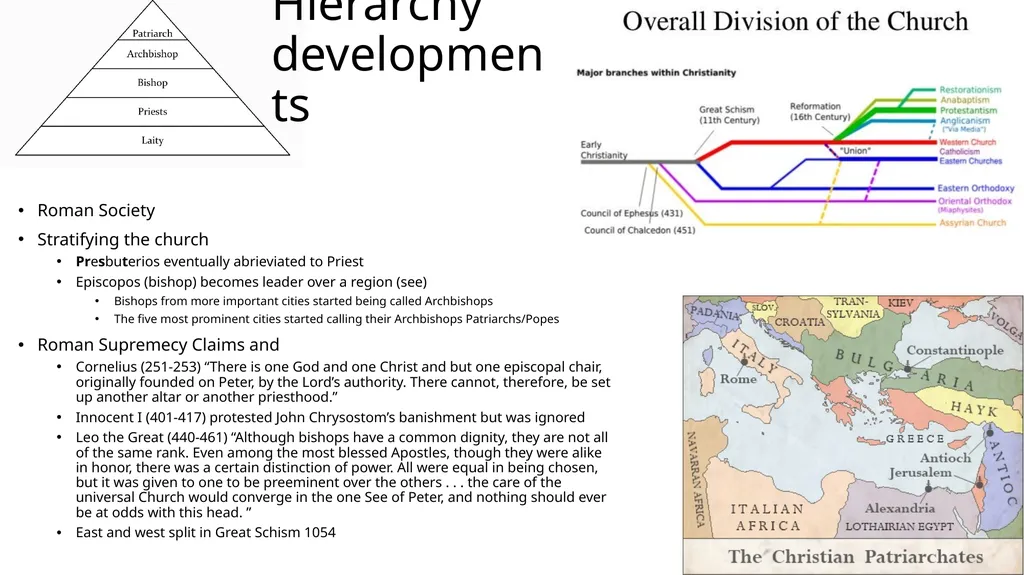
Hierarchy developments Roman Society
Stratifying the church
Presbuterios eventually abrieviated to Priest
Episcopos (bishop) becomes leader over a region (see)
Bishops from more important cities started being called Archbishops
The five most prominent cities started calling their Archbishops Patriarchs/Popes
Roman Supremecy Claims and
Cornelius (251-253) “There is one God and one Christ and but one episcopal chair, originally founded on Peter, by the Lord’s authority. There cannot, therefore, be set up another altar or another priesthood.”
Innocent I (401-417) protested John Chrysostom’s banishment but was ignored
Leo the Great (440-461) “Although bishops have a common dignity, they are not all of the same rank. Even among the most blessed Apostles, though they were alike in honor, there was a certain distinction of power. All were equal in being chosen, but it was given to one to be preeminent over the others . . . the care of the universal Church would converge in the one See of Peter, and nothing should ever be at odds with this head. ”
East and west split in Great Schism 1054<br>
03
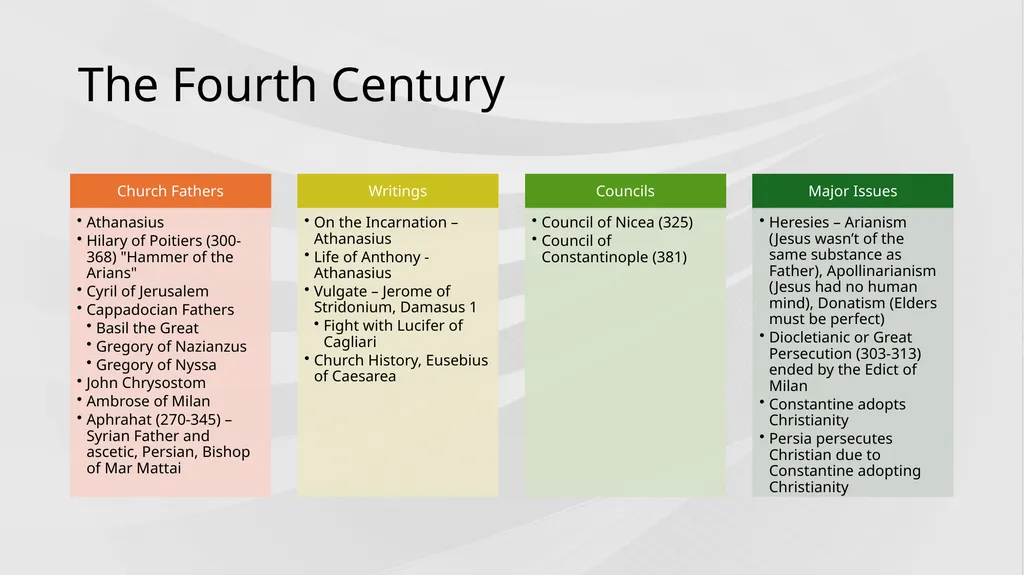
The Fourth Century<br>
04
Important Developments in World 3rd century had many problems in the Roman world
Empire was essentially unmanageable
Large
Many attacks and revolts in different areas
Diocletian (284-305) split into East and West (rule of 4)
Augustus - Diocletian(E), Maximian(W)
Caesar – Galerius(E), Constantius(W)
Galerius (E 305-311) Edict of Serdica in 311 and ConstantiusConstantine
Constantius (W 305-306) died in York on campaign Constantine son
Constantine
wins at Milvian Bridge 312, securing west,
east secured mostly 324 finally in 326<br>
05
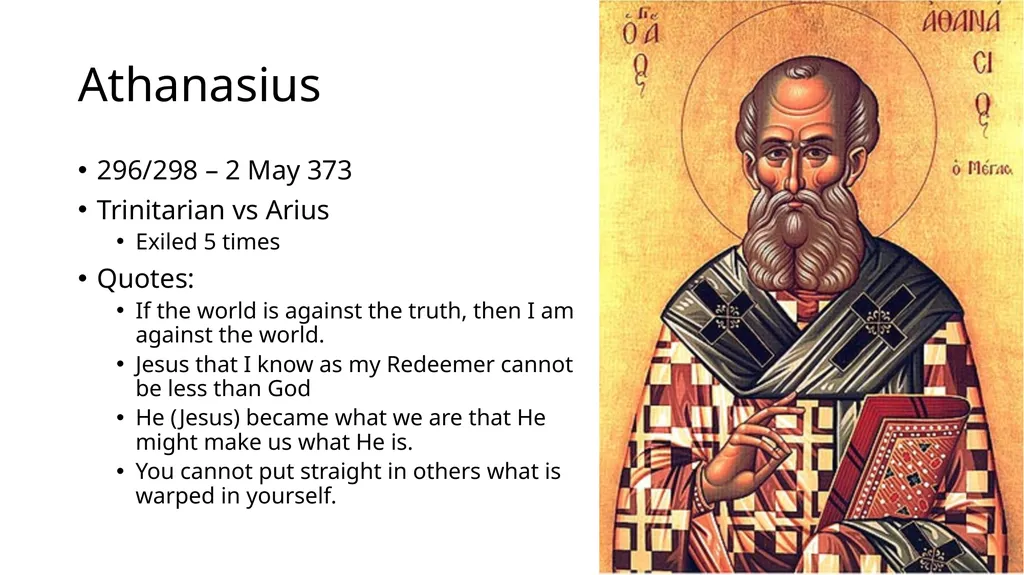
Athanasius 296/298 – 2 May 373
Trinitarian vs Arius
Exiled 5 times
Quotes:
If the world is against the truth, then I am against the world.
Jesus that I know as my Redeemer cannot be less than God
He (Jesus) became what we are that He might make us what He is.
You cannot put straight in others what is warped in yourself.<br>
06
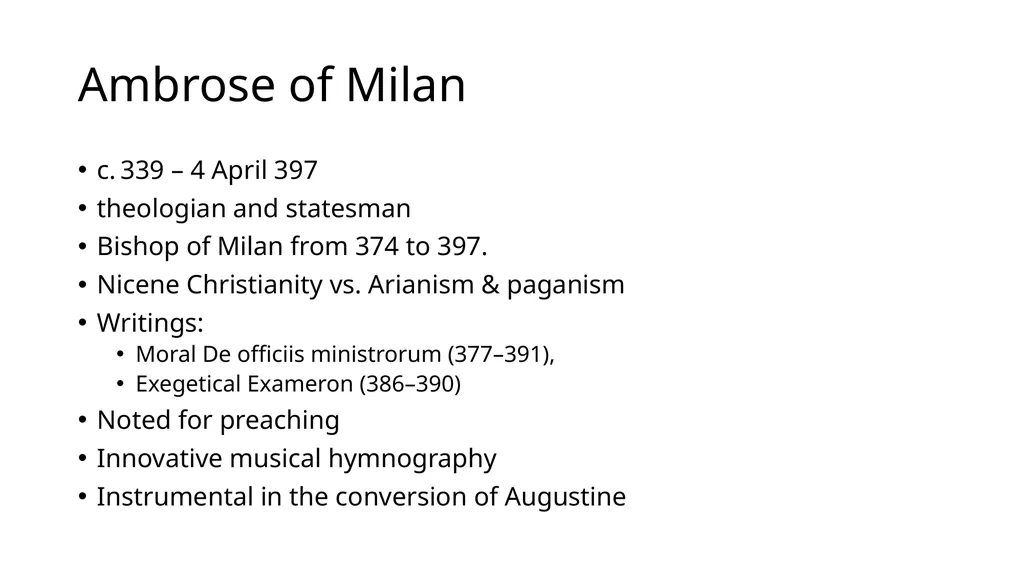
Ambrose of Milan c. 339 – 4 April 397
theologian and statesman
Bishop of Milan from 374 to 397.
Nicene Christianity vs. Arianism & paganism
Writings:
Moral De officiis ministrorum (377–391),
Exegetical Exameron (386–390)
Noted for preaching
Innovative musical hymnography
Instrumental in the conversion of Augustine<br>
07
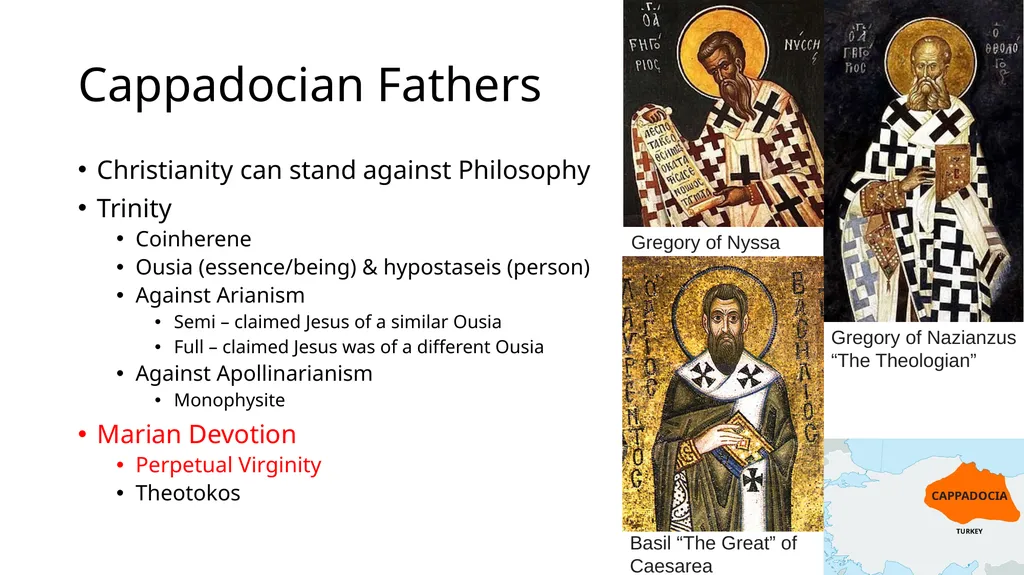
Cappadocian Fathers Christianity can stand against Philosophy
Trinity
Coinherene
Ousia (essence/being) & hypostaseis (person)
Against Arianism
Semi – claimed Jesus of a similar Ousia
Full – claimed Jesus was of a different Ousia
Against Apollinarianism
Monophysite
Marian Devotion
Perpetual Virginity
Theotokos Basil “The Great” of Caesarea Gregory of Nyssa Gregory of Nazianzus
“The Theologian”<br>