
CLCPA and NYS Economywide Cap-and-Invest Program
TF
Published · 23 slides · 0 views

1 / 1
Description
CLCPA and NYS Economywide Cap-and-Invest Program NYS DEC Update Key Environmental Issues in U.S. EPA Region 2 Jon Binder, Deputy Commissioner for Climate Change, Air Resources, and Energy May 19, 2023, Columbia Law School Overview CLCPA
Related Topics
Share
Embed code
Download this presentation From Below
"CLCPA and NYS Economywide Cap-and-Invest Program" is the property of its rightful owner. Permission is granted to download and print the materials on this website for personal, non-commercial use only, and to display it on your personal computer provided you do not modify the materials and that you retain all copyright notices contained in the materials. By downloading content from our website, you accept the terms of this agreement.
Presentation Transcript
01
CLCPA and NYS Economywide Cap-and-Invest Program NYS DEC Update
Key Environmental Issues in U.S. EPA Region 2 Jon Binder, Deputy Commissioner for
Climate Change, Air Resources, and Energy May 19, 2023, Columbia Law School<br>
Key Environmental Issues in U.S. EPA Region 2 Jon Binder, Deputy Commissioner for
Climate Change, Air Resources, and Energy May 19, 2023, Columbia Law School<br>
02
Overview CLCPA Requirements and Main Sources of GHG Emissions in NYS
Community Air Monitoring Initiative
Economywide Cap-and-Invest Program<br>
Community Air Monitoring Initiative
Economywide Cap-and-Invest Program<br>
03
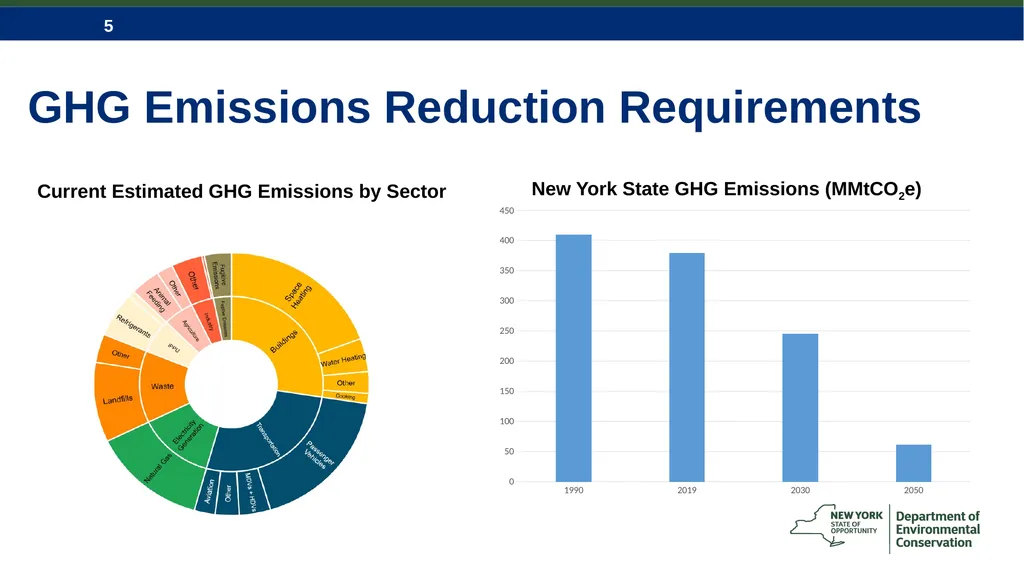
Climate Leadership and Community Protection Act (CLCPA) – Overview Sets NYS on a path toward a carbon-neutral economy, mandating at least an 85% reduction in GHG emissions below 1990 levels by 2050
Requires 40% reduction in emissions by 2030 (ECL § 75-0107)
Requires 100% emission-free electricity by 2040 (PSL § 66-p)
70% renewable electricity by 2030
9,000 MWs of offshore wind by 2035
6,000 MWs of solar generation by 2025
3,000 MWs of energy storage by 2030
Contains critical commitments to climate justice and a just transition<br>
04
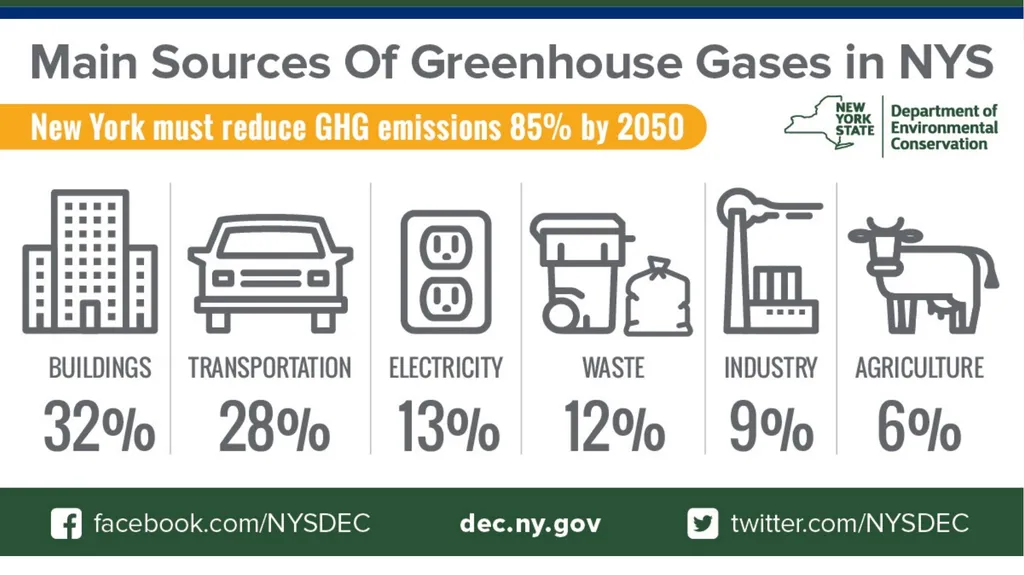
GHG Emissions Reduction Requirements New York State GHG Emissions (MMtCO2e) Current Estimated GHG Emissions by Sector<br>
05
Disadvantaged Communities and Community Air Monitoring ECL § 75-0111 established the Climate Justice Working Group, which among other things established criteria and finalized maps to identify Disadvantaged Communities (next session today)
Utilized for many critical purposes under the CLCPA, including for permitting and other administrative decisions under Section 7(3)
Climate Act requires DEC to undertake community air monitoring in four DACs with potentially high exposure burdens
DEC expanded effort to monitor 10 communities Statewide
Community input and monitoring data will inform pollutant reduction strategies<br>
06
Community Air Quality Monitoring Identify air quality issues in DACs for future emissions reductions, for example:
Long-term (e.g., diesel emissions reductions, regulations addressing stationary sources)
Short-term (e.g., local facility inspection, permit enforcement)
Partner with and empower community organizations with easy-to-understand information on air pollution
Help to locate leaks in natural gas infrastructure
Identify sources of greenhouse gases and other pollutants
DEC holding quarterly community meetings to provide updates and data
Additional Info Available on DEC website 2022-23 Statewide Community Air Monitoring Initiative - NYS Dept. of Environmental Conservation<br>
07
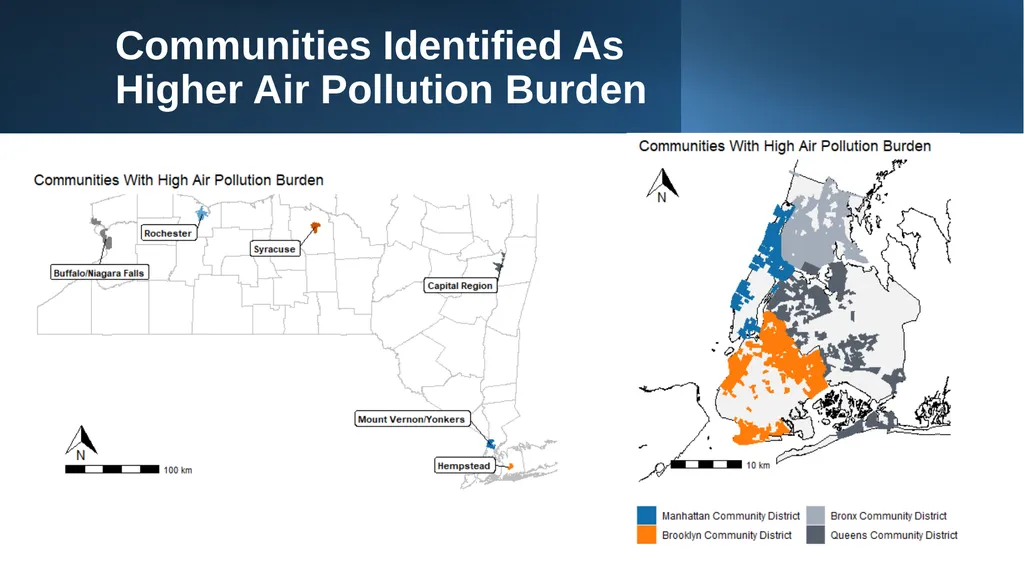
Communities Identified As
Higher Air Pollution Burden<br>
08
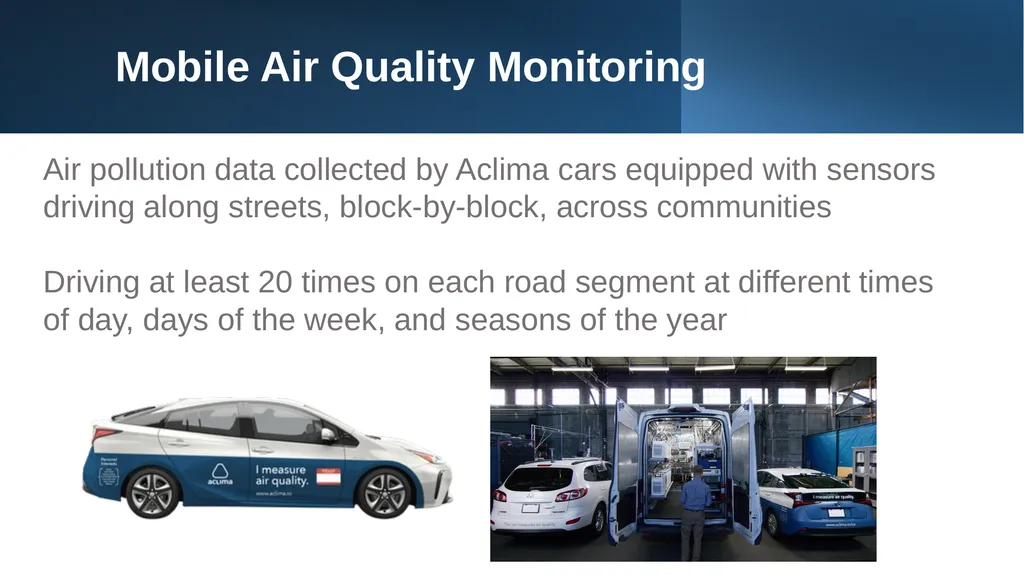
Mobile Air Quality Monitoring Air pollution data collected by Aclima cars equipped with sensors driving along streets, block-by-block, across communities
Driving at least 20 times on each road segment at different times of day, days of the week, and seasons of the year<br>
Driving at least 20 times on each road segment at different times of day, days of the week, and seasons of the year<br>
09
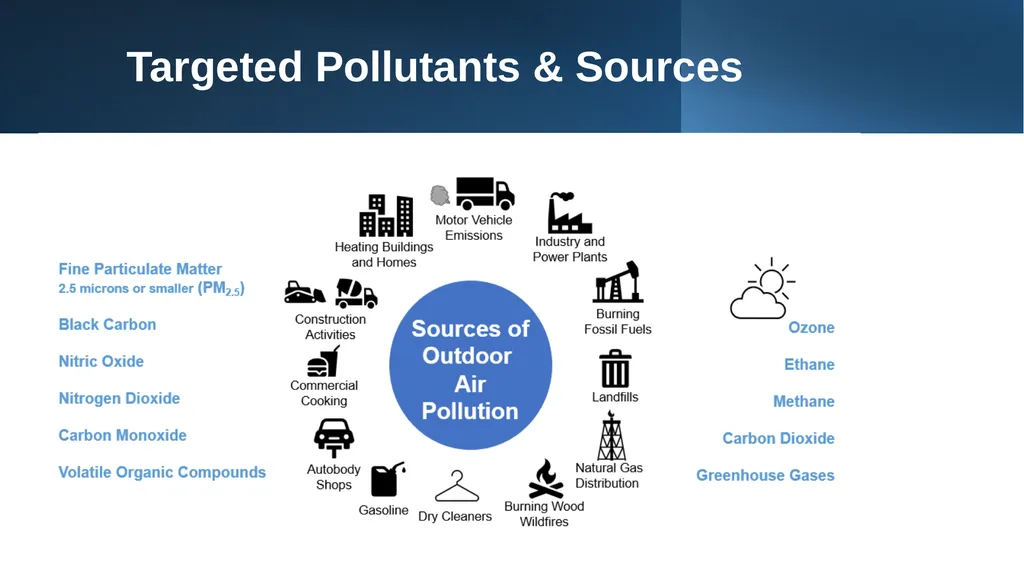
Targeted Pollutants & Sources Sources of Outdoor Air Pollution<br>
10
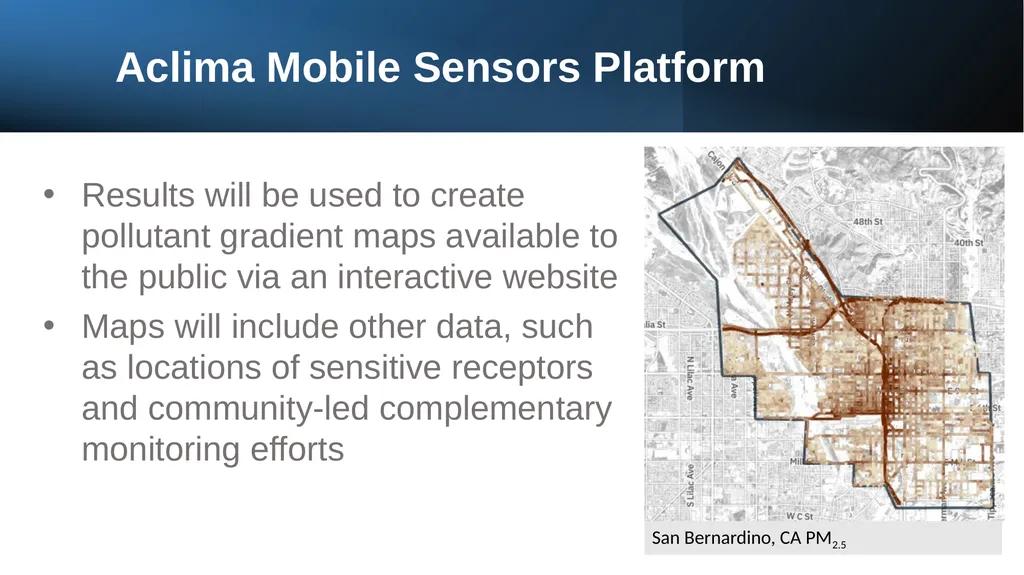
Aclima Mobile Sensors Platform Results will be used to create pollutant gradient maps available to the public via an interactive website
Maps will include other data, such as locations of sensitive receptors and community-led complementary monitoring efforts<br>
Maps will include other data, such as locations of sensitive receptors and community-led complementary monitoring efforts<br>
11
Economywide Cap-and-Invest Program Advance an economywide Cap-and-Invest Program that establishes a declining cap on greenhouse gas emissions, limits potential costs to economically vulnerable New Yorkers, invests proceeds in programs that drive emission reductions in an equitable manner, and maintains the competitiveness of New York industries.
At Governor Hochul's direction, the program will incorporate these guiding principles:
Affordability: Craft a program to deliver money back to New Yorkers to ensure energy affordability
Climate Leadership: Catalyze other states to join New York, and allows linkage to other jurisdictions
Creating Jobs and Preserving Competitiveness: Protect existing jobs and support new and existing industries
Investing in Disadvantaged Communities: Ensure 35%+ of investments benefit DACs
Funding a Sustainable Future: Support ambitious clean energy investment **Illustrative Only**<br>
12
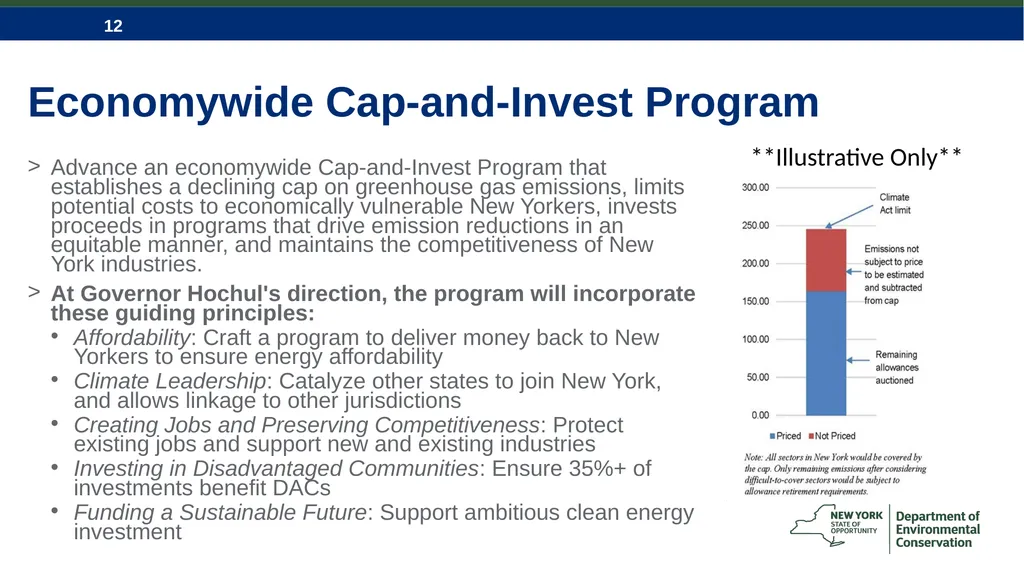
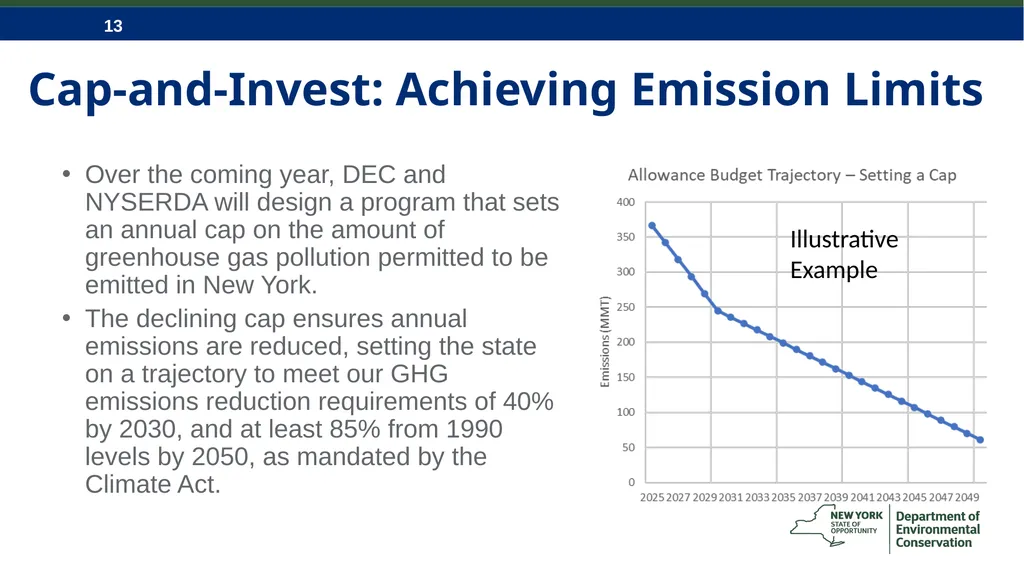
Cap-and-Invest: Achieving Emission Limits Over the coming year, DEC and NYSERDA will design a program that sets an annual cap on the amount of greenhouse gas pollution permitted to be emitted in New York.
The declining cap ensures annual emissions are reduced, setting the state on a trajectory to meet our GHG emissions reduction requirements of 40% by 2030, and at least 85% from 1990 levels by 2050, as mandated by the Climate Act. Illustrative Example<br>
The declining cap ensures annual emissions are reduced, setting the state on a trajectory to meet our GHG emissions reduction requirements of 40% by 2030, and at least 85% from 1990 levels by 2050, as mandated by the Climate Act. Illustrative Example<br>
13
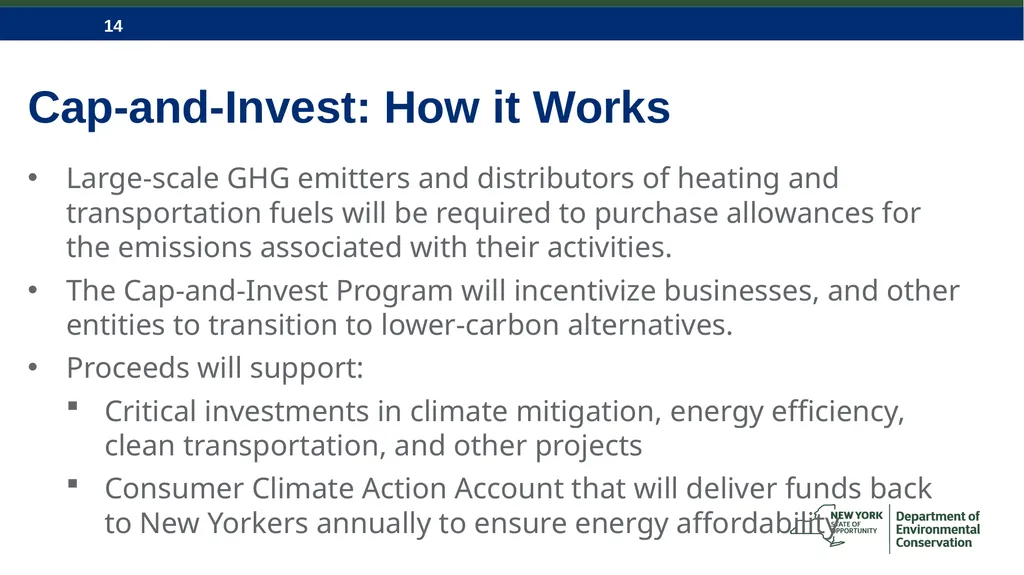
Cap-and-Invest: How it Works Large-scale GHG emitters and distributors of heating and transportation fuels will be required to purchase allowances for the emissions associated with their activities.
The Cap-and-Invest Program will incentivize businesses, and other entities to transition to lower-carbon alternatives.
Proceeds will support:
Critical investments in climate mitigation, energy efficiency, clean transportation, and other projects
Consumer Climate Action Account that will deliver funds back to New Yorkers annually to ensure energy affordability<br>
14
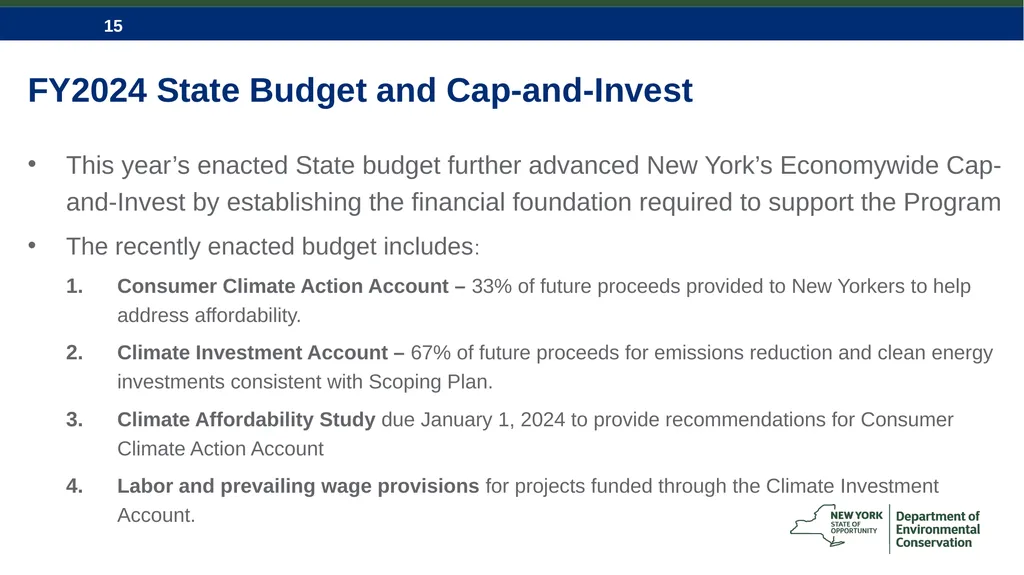
FY2024 State Budget and Cap-and-Invest This year’s enacted State budget further advanced New York’s Economywide Cap-and-Invest by establishing the financial foundation required to support the Program
The recently enacted budget includes:
Consumer Climate Action Account – 33% of future proceeds provided to New Yorkers to help address affordability.
Climate Investment Account – 67% of future proceeds for emissions reduction and clean energy investments consistent with Scoping Plan.
Climate Affordability Study due January 1, 2024 to provide recommendations for Consumer Climate Action Account
Labor and prevailing wage provisions for projects funded through the Climate Investment Account.<br>
15
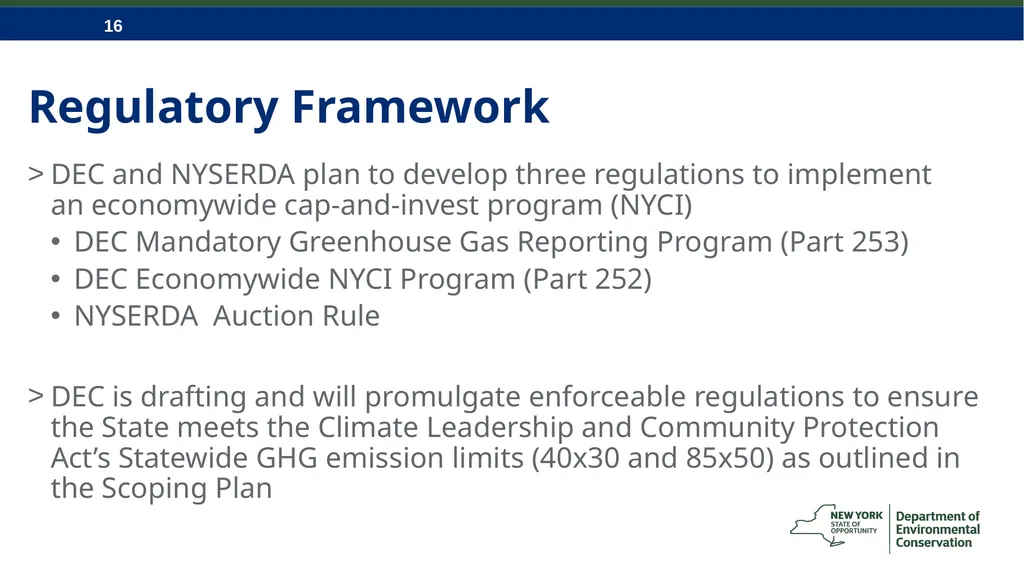
Regulatory Framework DEC and NYSERDA plan to develop three regulations to implement an economywide cap-and-invest program (NYCI)
DEC Mandatory Greenhouse Gas Reporting Program (Part 253)
DEC Economywide NYCI Program (Part 252)
NYSERDA Auction Rule
DEC is drafting and will promulgate enforceable regulations to ensure the State meets the Climate Leadership and Community Protection Act’s Statewide GHG emission limits (40x30 and 85x50) as outlined in the Scoping Plan<br>
16
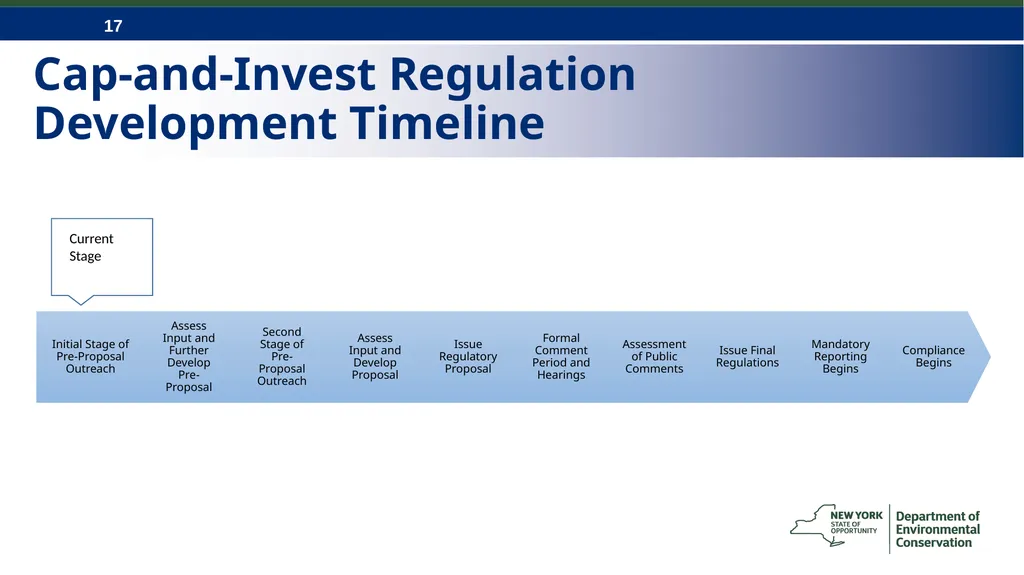
Initial Stage of Pre-Proposal Outreach Assess Input and Further Develop Pre-Proposal Second Stage of Pre-Proposal Outreach Assess Input and Develop Proposal Issue Regulatory Proposal Formal Comment Period and Hearings Assessment of Public Comments Issue Final Regulations Mandatory Reporting Begins Compliance Begins Cap-and-Invest Regulation Development Timeline<br>
17
Cap-and-Invest Program: Emissions Reporting Cap-and-invest programs require emissions reporting from emissions sources
Entities with reporting requirements will likely be more numerous than entities with allowance compliance obligations
Supports integrity of emissions allowance determinations
Supports integrated reporting platform for multiple programs
Helps to identify future actions<br>
Entities with reporting requirements will likely be more numerous than entities with allowance compliance obligations
Supports integrity of emissions allowance determinations
Supports integrated reporting platform for multiple programs
Helps to identify future actions<br>
18
Equity Consideration for Disadvantaged Communities CLCPA directs that a minimum of 35% of proceeds -- with a goal of 40%-- be invested to benefit Disadvantaged Communities.
In addition to investments to reduce emissions, DEC is soliciting feedback about any additional regulatory mechanisms in the Cap-and-Invest regulation that should be considered to ensure emission reductions in DACs.<br>
In addition to investments to reduce emissions, DEC is soliciting feedback about any additional regulatory mechanisms in the Cap-and-Invest regulation that should be considered to ensure emission reductions in DACs.<br>
19
Distinguishing Elements in NYCI Program Development All GHG emissions would be accounted for under the Program and the cap must reduce at a rate to achieve the Statewide GHG emission limits.
DEC is considering the concept of obligated and non-obligated sources.
Obligated sources identified by regulation and required to provide allowances equal to GHG emissions.
Non-obligated sources contribute to GHG emissions and must be accounted for in the overall cap, but allowances to cover GHG emissions from non-obligated sources will be retired by DEC.<br>
20
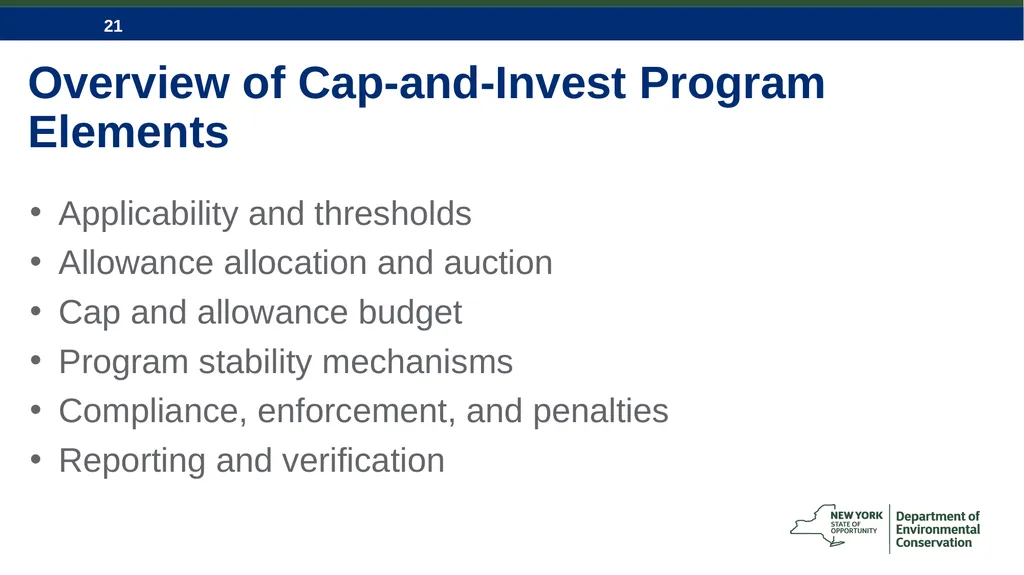
Overview of Cap-and-Invest Program Elements Applicability and thresholds
Allowance allocation and auction
Cap and allowance budget
Program stability mechanisms
Compliance, enforcement, and penalties
Reporting and verification<br>
Allowance allocation and auction
Cap and allowance budget
Program stability mechanisms
Compliance, enforcement, and penalties
Reporting and verification<br>
21
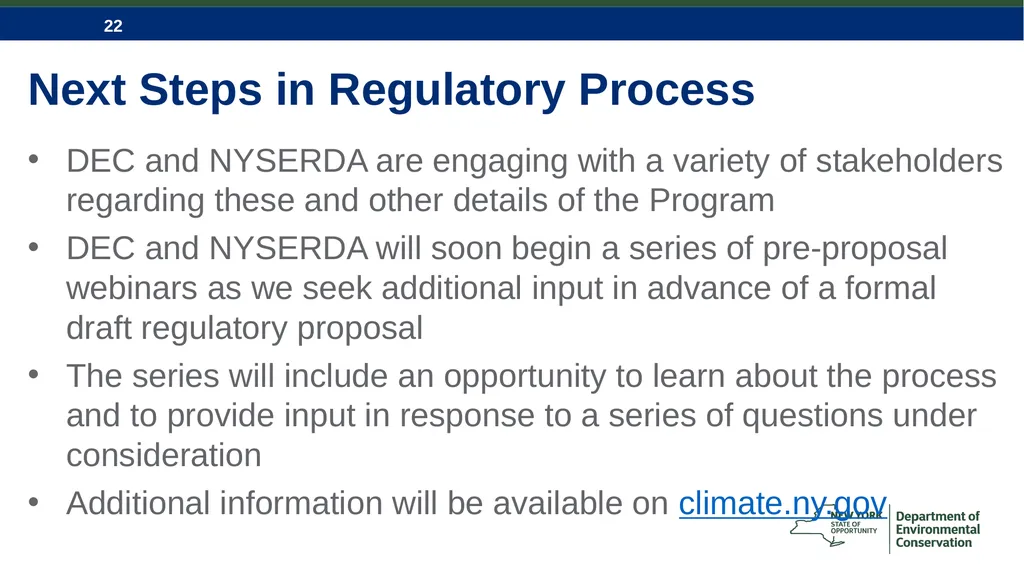
Next Steps in Regulatory Process DEC and NYSERDA are engaging with a variety of stakeholders regarding these and other details of the Program
DEC and NYSERDA will soon begin a series of pre-proposal webinars as we seek additional input in advance of a formal draft regulatory proposal
The series will include an opportunity to learn about the process and to provide input in response to a series of questions under consideration
Additional information will be available on climate.ny.gov<br>
22
Thank You! Jon Binder, Deputy Commissioner
Climate Change, Air Resources, and Energy
Jonathan.Binder@dec.ny.gov<br>
Climate Change, Air Resources, and Energy
Jonathan.Binder@dec.ny.gov<br>