
Clinical management of rape and intimate partner
AM
Published · 26 slides · 0 views

1 / 1




Description
Clinical management of rape and intimate partner violence in emergencies Training curriculum for health workers Presentation slides Understanding sexual violence and IPV as a public health problem Session 1. 1.2 Objective 1: Demonstrate
Related Topics
Share
Embed code
Download this presentation From Below
"Clinical management of rape and intimate partner" is the property of its rightful owner. Permission is granted to download and print the materials on this website for personal, non-commercial use only, and to display it on your personal computer provided you do not modify the materials and that you retain all copyright notices contained in the materials. By downloading content from our website, you accept the terms of this agreement.
Presentation Transcript
01
Clinical management of rape and intimate partner violence in emergencies
Training curriculum for health workers Presentation slides<br>
Training curriculum for health workers Presentation slides<br>
02
Understanding
sexual violence and IPV
as a public health problem Session 1. 1.2<br>
03
Objective 1: Demonstrate general knowledge of sexual violence and
IPV as a public health problem
Competencies:
Know the epidemiology of the different forms of GBV at global and local levels, including in humanitarian contexts
Know the health consequences of sexual violence and IPV for different populations
Understand the role and limitations of health workers in responding to sexual assault and IPV in humanitarian emergencies, including minimum essential sexual violence response services that are part of the MISP for SRH Session objectives 1.3<br>
04
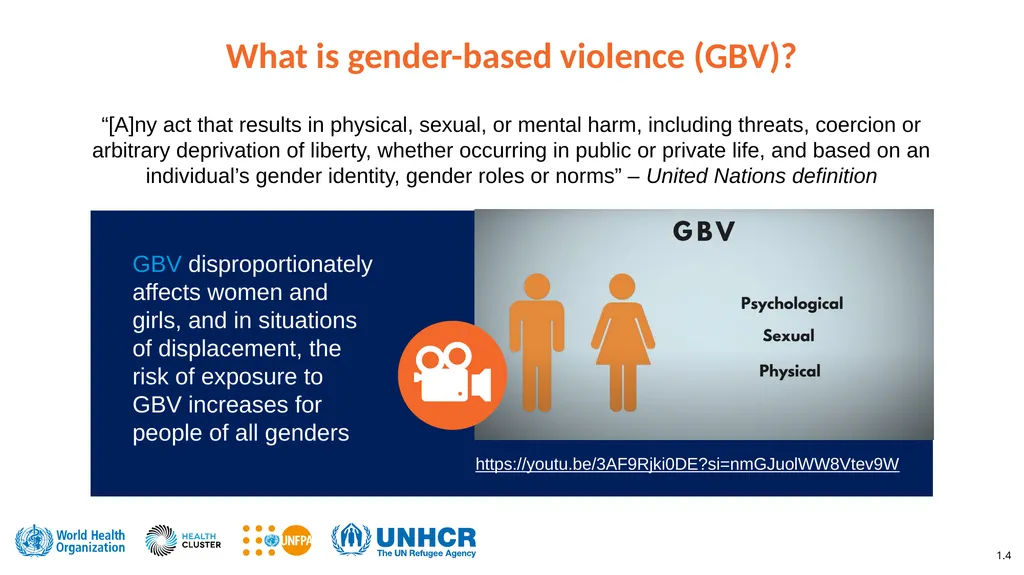
“[A]ny act that results in physical, sexual, or mental harm, including threats, coercion or arbitrary deprivation of liberty, whether occurring in public or private life, and based on an individual’s gender identity, gender roles or norms” – United Nations definition https://youtu.be/3AF9Rjki0DE?si=nmGJuolWW8Vtev9W What is gender-based violence (GBV)? GBV disproportionately affects women and girls, and in situations of displacement, the risk of exposure to GBV increases for people of all genders 1.4<br>
05
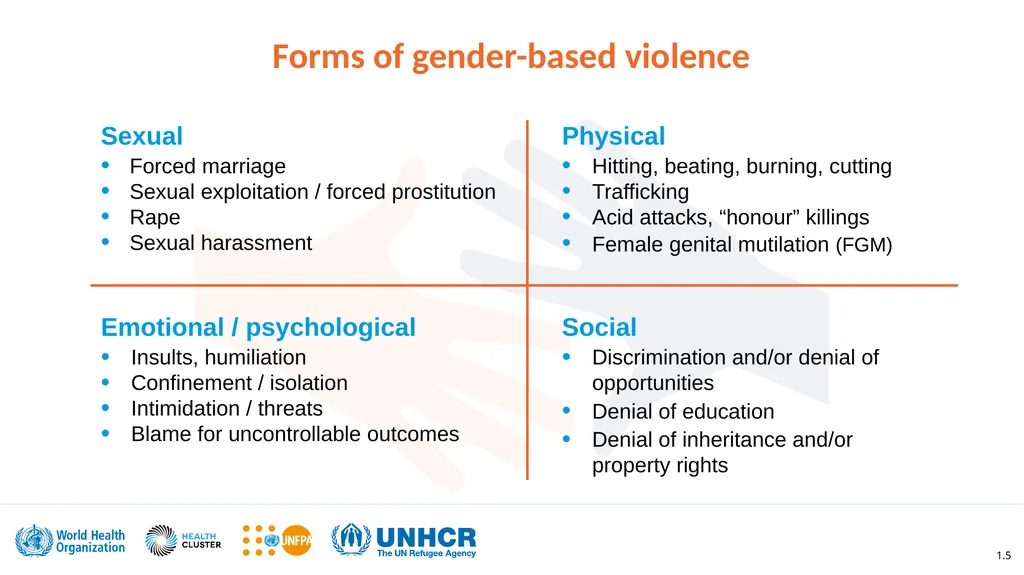
Physical
Hitting, beating, burning, cutting
Trafficking
Acid attacks, “honour” killings
Female genital mutilation (FGM) Emotional / psychological
Insults, humiliation
Confinement / isolation
Intimidation / threats
Blame for uncontrollable outcomes Sexual
Forced marriage
Sexual exploitation / forced prostitution
Rape
Sexual harassment Social
Discrimination and/or denial of opportunities
Denial of education
Denial of inheritance and/or property rights Forms of gender-based violence 1.5<br>
06
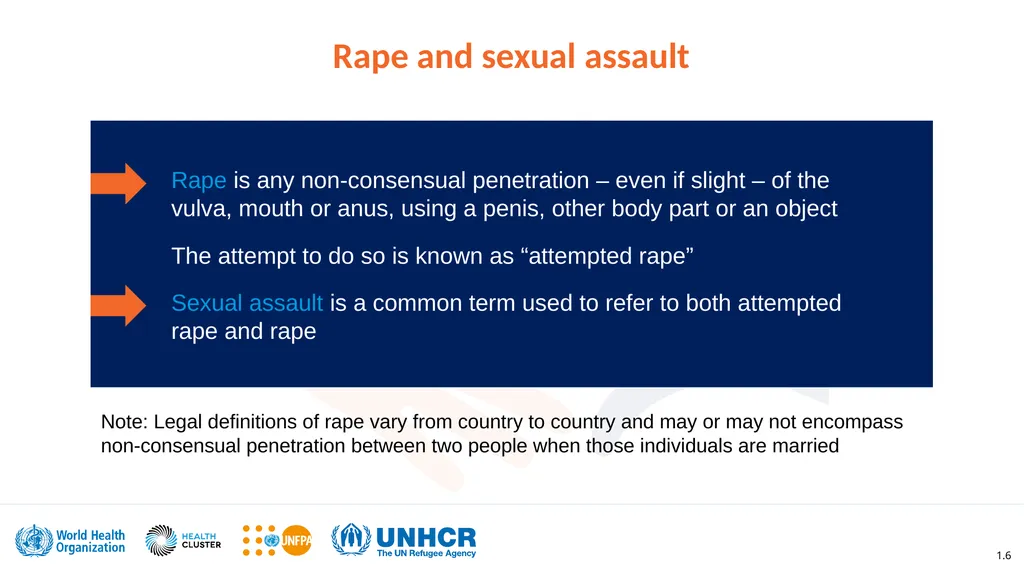
Note: Legal definitions of rape vary from country to country and may or may not encompass non-consensual penetration between two people when those individuals are married Rape and sexual assault Rape is any non-consensual penetration – even if slight – of the vulva, mouth or anus, using a penis, other body part or an object
The attempt to do so is known as “attempted rape”
Sexual assault is a common term used to refer to both attempted rape and rape 1.6<br>
The attempt to do so is known as “attempted rape”
Sexual assault is a common term used to refer to both attempted rape and rape 1.6<br>
07
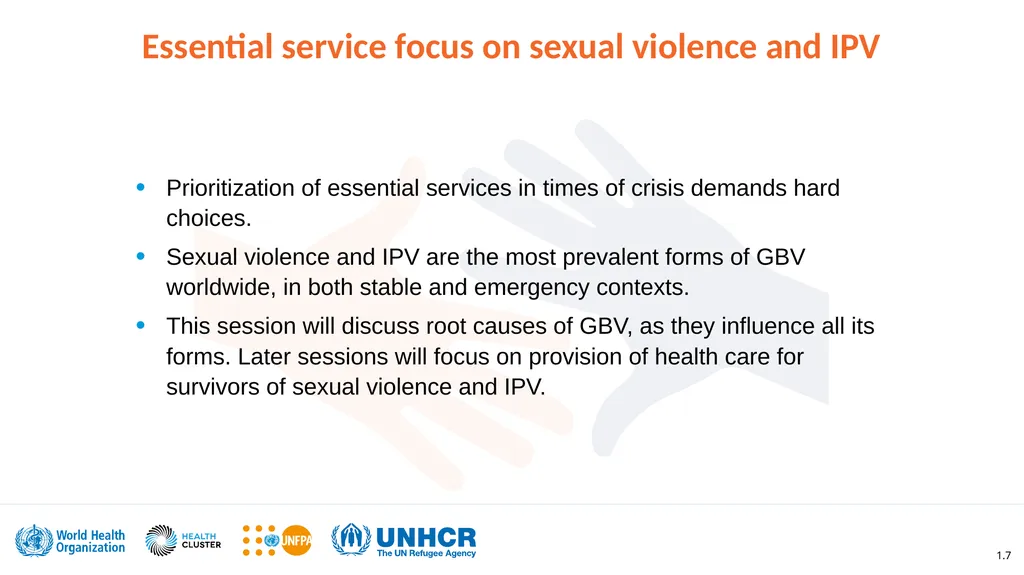
Prioritization of essential services in times of crisis demands hard choices.
Sexual violence and IPV are the most prevalent forms of GBV worldwide, in both stable and emergency contexts.
This session will discuss root causes of GBV, as they influence all its forms. Later sessions will focus on provision of health care for survivors of sexual violence and IPV. Essential service focus on sexual violence and IPV 1.7<br>
08
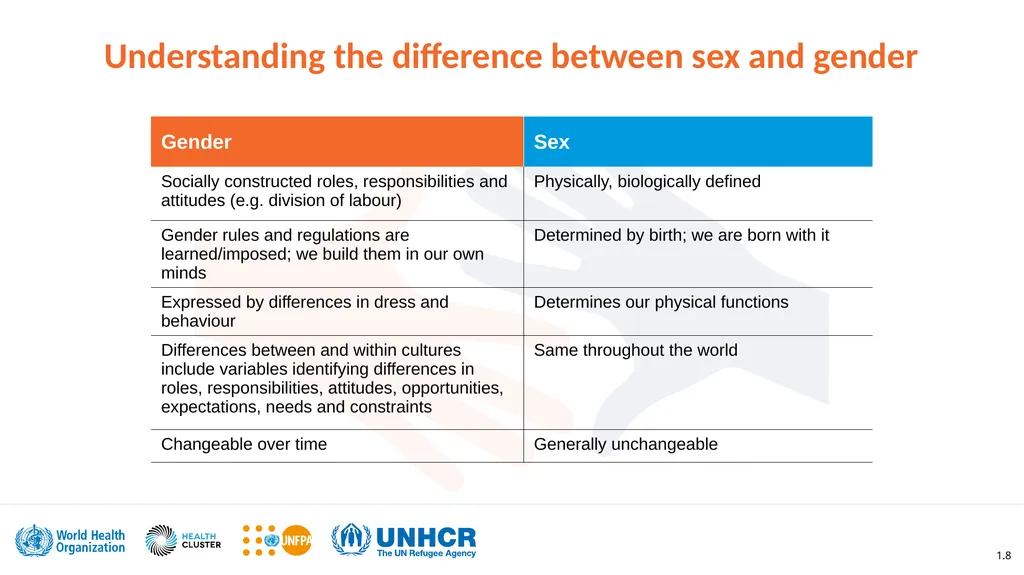
Understanding the difference between sex and gender 1.8<br>
09
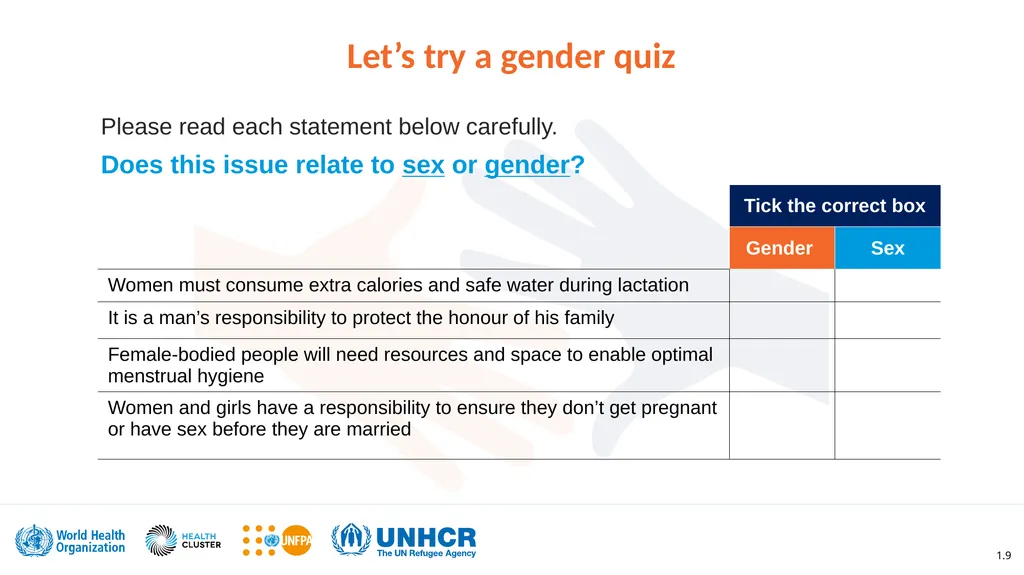
Please read each statement below carefully.
Does this issue relate to sex or gender? Let’s try a gender quiz 1.9<br>
Does this issue relate to sex or gender? Let’s try a gender quiz 1.9<br>
10
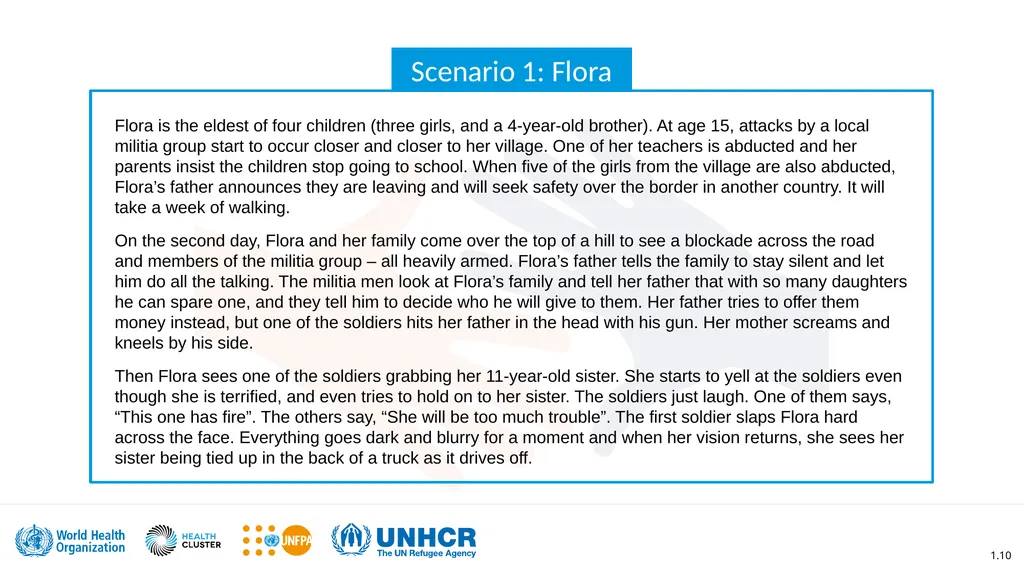
Flora is the eldest of four children (three girls, and a 4-year-old brother). At age 15, attacks by a local militia group start to occur closer and closer to her village. One of her teachers is abducted and her parents insist the children stop going to school. When five of the girls from the village are also abducted, Flora’s father announces they are leaving and will seek safety over the border in another country. It will take a week of walking.
On the second day, Flora and her family come over the top of a hill to see a blockade across the road and members of the militia group – all heavily armed. Flora’s father tells the family to stay silent and let him do all the talking. The militia men look at Flora’s family and tell her father that with so many daughters he can spare one, and they tell him to decide who he will give to them. Her father tries to offer them money instead, but one of the soldiers hits her father in the head with his gun. Her mother screams and kneels by his side.
Then Flora sees one of the soldiers grabbing her 11-year-old sister. She starts to yell at the soldiers even though she is terrified, and even tries to hold on to her sister. The soldiers just laugh. One of them says, “This one has fire”. The others say, “She will be too much trouble”. The first soldier slaps Flora hard across the face. Everything goes dark and blurry for a moment and when her vision returns, she sees her sister being tied up in the back of a truck as it drives off. Scenario 1: Flora 1.10<br>
11
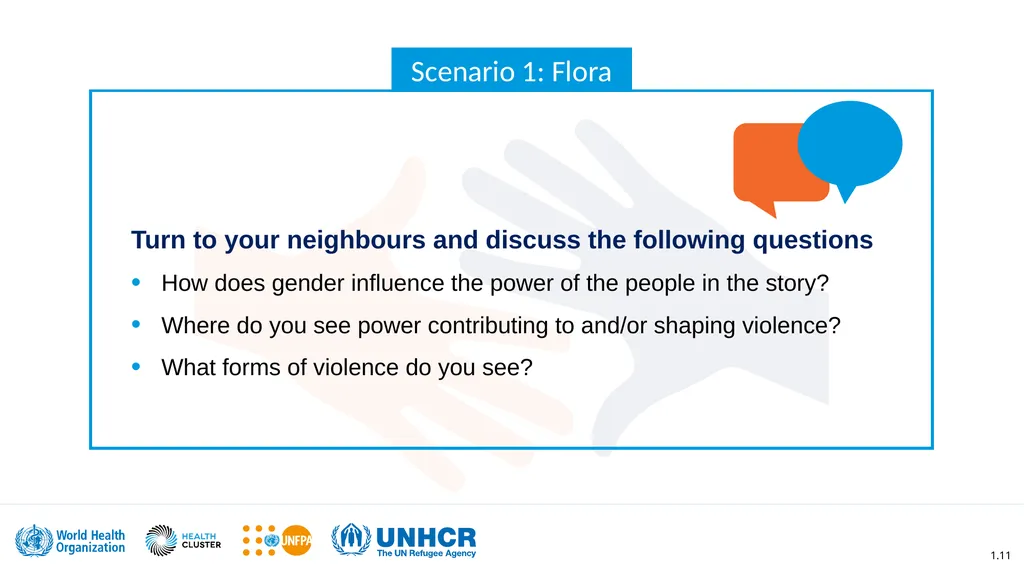
Scenario 1: Flora Turn to your neighbours and discuss the following questions
How does gender influence the power of the people in the story?
Where do you see power contributing to and/or shaping violence?
What forms of violence do you see? 1.11<br>
How does gender influence the power of the people in the story?
Where do you see power contributing to and/or shaping violence?
What forms of violence do you see? 1.11<br>
12
The greater the power an individual or institution holds, the easier it is for them to perpetrate GBV Intersectional factors increase or decrease a person’s vulnerability Any action, threat or exercise of control that uses gender roles and norms to decrease a person’s power is GBV Understanding men and boys as the
primary perpetrators of GBV 1.12<br>
13
Prevalence and consequences 1.13<br>
14
6% of women have experienced non-partner sexual violence3 Globally, 19% of girls have experienced child or forced marriage1 133 women are victims of femicide every day2 Global prevalence of violence against women (age 15–49) 13% of ever-married/
partnered women have experienced physical or sexual IPV in the past 12 months1 27% of ever-married/ partnered women have experienced physical or sexual IPV in their lifetime1 38% of femicides are committed by the woman’s current or a past intimate partner2 1.14<br>
partnered women have experienced physical or sexual IPV in the past 12 months1 27% of ever-married/ partnered women have experienced physical or sexual IPV in their lifetime1 38% of femicides are committed by the woman’s current or a past intimate partner2 1.14<br>
15
IPV is the most prevalent form of GBV
regardless of country or context 1.15<br>
16
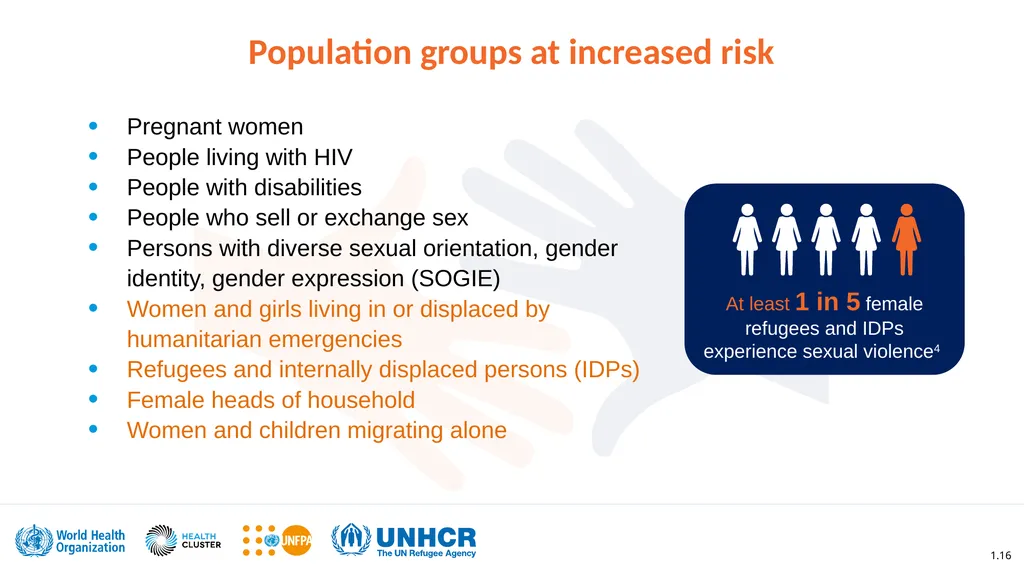
Population groups at increased risk Pregnant women
People living with HIV
People with disabilities
People who sell or exchange sex
Persons with diverse sexual orientation, gender identity, gender expression (SOGIE)
Women and girls living in or displaced by humanitarian emergencies
Refugees and internally displaced persons (IDPs)
Female heads of household
Women and children migrating alone 1.16<br>
17
GBV prevalence in Mozambique According to the UN Women Global Database:5
54% of women have experience of physical and/or sexual violence in their lifetime.
21.7% of women have experience of physical and/or sexual IPV in their lifetime.
15.5% of women report physical and/or sexual IPV in the last 12 months.
52.9% of girls are married before the age of 18. All prevalence data are estimates. GBV is routinely underreported, and data are rarely available at hyperlocal level. 1.17<br>
18
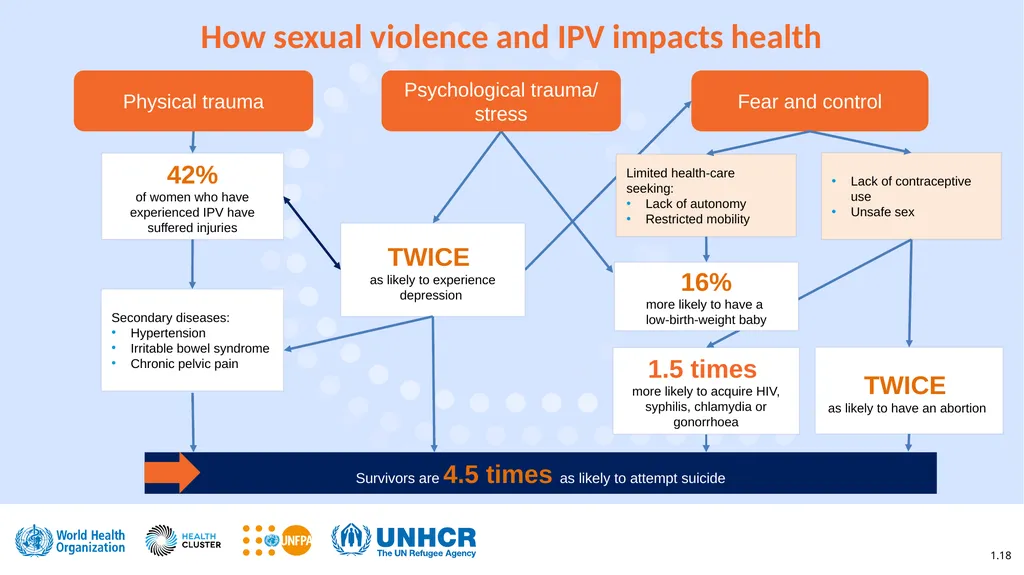
How sexual violence and IPV impacts health Physical trauma Psychological trauma/ stress Fear and control TWICE
as likely to experience depression Secondary diseases:
Hypertension
Irritable bowel syndrome
Chronic pelvic pain Survivors are 4.5 times as likely to attempt suicide Limited health-care seeking:
Lack of autonomy
Restricted mobility Lack of contraceptive use
Unsafe sex 42%
of women who have experienced IPV have suffered injuries TWICE as likely to have an abortion 1.5 times more likely to acquire HIV, syphilis, chlamydia or gonorrhoea 16%
more likely to have a low-birth-weight baby 1.18<br>
19
The role of health workers 1.19<br>
20
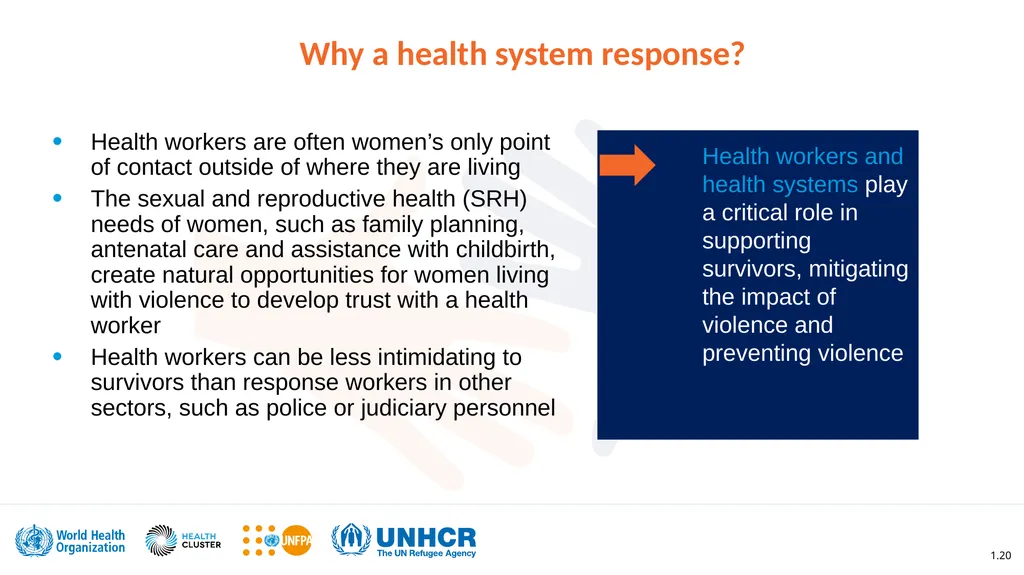
Why a health system response? Health workers are often women’s only point of contact outside of where they are living
The sexual and reproductive health (SRH) needs of women, such as family planning, antenatal care and assistance with childbirth, create natural opportunities for women living with violence to develop trust with a health worker
Health workers can be less intimidating to survivors than response workers in other sectors, such as police or judiciary personnel Health workers and health systems play a critical role in supporting survivors, mitigating the impact of violence and preventing violence 1.20<br>
21
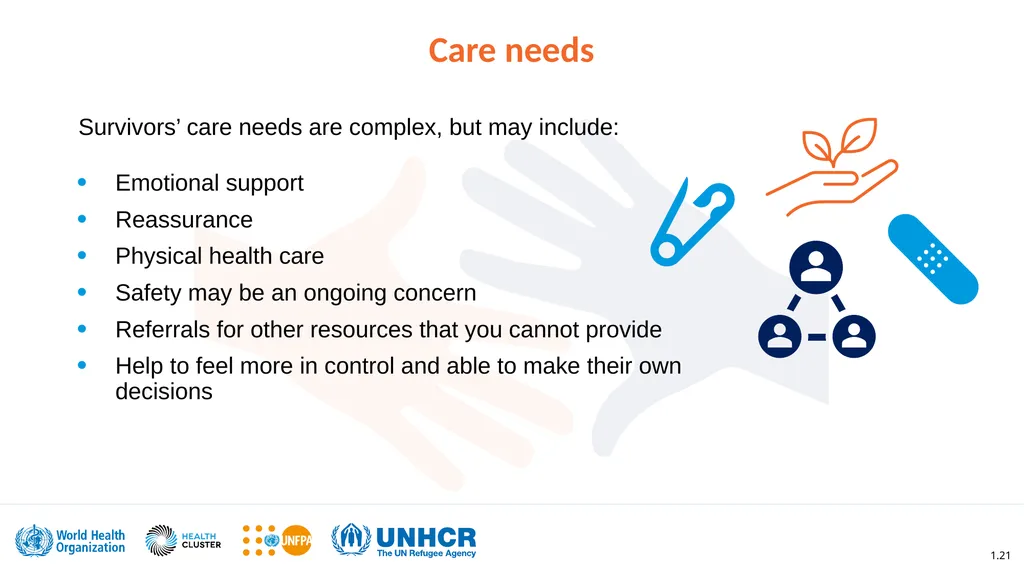
Care needs Survivors’ care needs are complex, but may include:
Emotional support
Reassurance
Physical health care
Safety may be an ongoing concern
Referrals for other resources that you cannot provide
Help to feel more in control and able to make their own decisions 1.21<br>
Emotional support
Reassurance
Physical health care
Safety may be an ongoing concern
Referrals for other resources that you cannot provide
Help to feel more in control and able to make their own decisions 1.21<br>
22
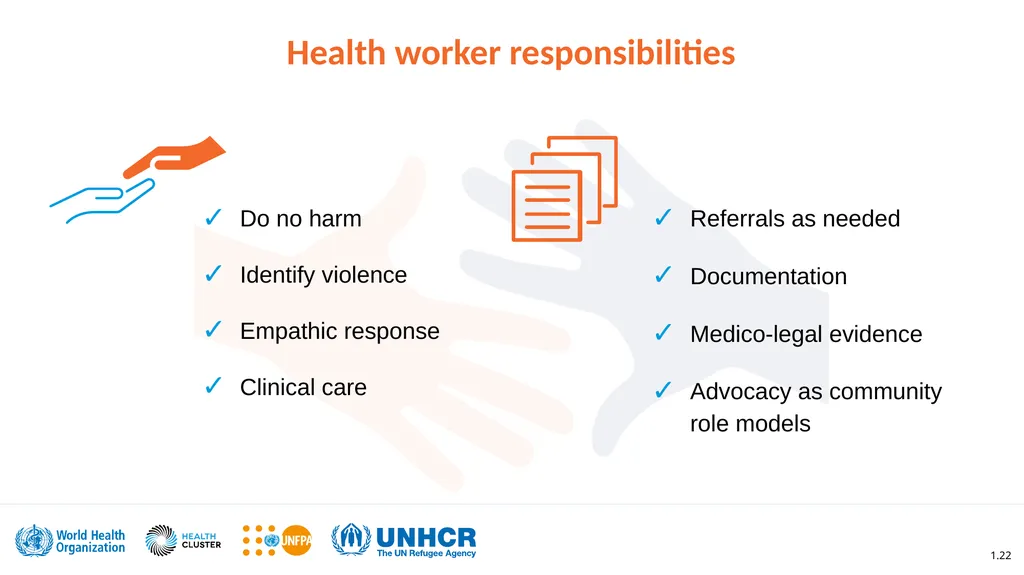
Health worker responsibilities Do no harm
Identify violence
Empathic response
Clinical care Referrals as needed
Documentation
Medico-legal evidence
Advocacy as community role models 1.22<br>
Identify violence
Empathic response
Clinical care Referrals as needed
Documentation
Medico-legal evidence
Advocacy as community role models 1.22<br>
23
Health workers are NOT responsible for: Solving violence and related social issues
Addressing all violence-related needs
Addressing all aspects of treatment, care and support in one consultation 1.23<br>
Addressing all violence-related needs
Addressing all aspects of treatment, care and support in one consultation 1.23<br>
24
Blames or disrespects women or girls
Does not recognize violence as a contributor to chronic or recurring conditions
Fails to provide post-rape care or address violence against women in family planning or STI/HIV care
Breaches privacy or confidentiality
Ignores signs of fear or emotional distress Inflicts additional emotional distress or trauma
Woman receives inappropriate or inadequate medical care
Unwanted pregnancy, STIs, HIV, unsafe abortion, more violence
Partner or family member becomes violent after overhearing information
Woman is later injured, killed or commits suicide Do No Harm Possible consequences Health worker behaviour 1.24<br>
25
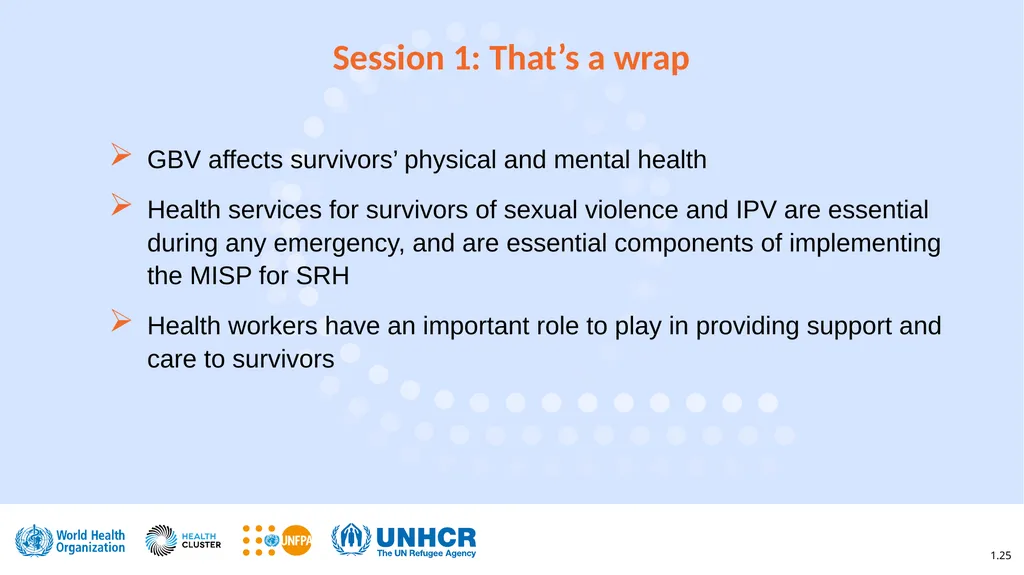
Session 1: That’s a wrap GBV affects survivors’ physical and mental health
Health services for survivors of sexual violence and IPV are essential during any emergency, and are essential components of implementing the MISP for SRH
Health workers have an important role to play in providing support and care to survivors 1.25<br>
Health services for survivors of sexual violence and IPV are essential during any emergency, and are essential components of implementing the MISP for SRH
Health workers have an important role to play in providing support and care to survivors 1.25<br>
26
References Child Marriage Global Database [website]. New York: United Nations Children’s Fund; 2023 (https://data.unicef.org/topic/child-protection/child-marriage/).
Gender-related killings of women and girls (femicide/feminicide): global estimates of female intimate partner/family-related homicides in 2022. Vienna: UNODC; 2023.
Violence against women prevalence estimates, 2018. Geneva: World Health Organization; 2021 (https://vaw-data.srhr.org/data).
Vu A, Atif A, Wirtz A, Pham K, Rubenstein L, Glass N et al. The prevalence of sexual violence among female refugees in complex humanitarian emergencies: a systematic review and meta-analysis. PLoS Currents. 2014;6.
Global Database on Violence against Women: Mozambique [website]. UN Women (https://data.unwomen.org/globala-database-on-violence-against-women/country-profile/Mozambique/country-snapshot).<br>