
College of Veterinary Science & Animal Husbandry
JO
Published · 58 slides · 0 views

1 / 1



Description
College of Veterinary Science Animal Husbandry U.P. Pt. Deen Dayal Upadhyaya Pashu Chikitsa Vigyan Vishwavidyalaya Evam Go-Anusandhan Sansthan (DUVASU), Mathura - 281001 (U.P.) www.upvetuniv.edu.in Dr. Muneendra Kumar Assistant Professor
Related Topics
Share
Embed code
Download this presentation From Below
"College of Veterinary Science & Animal Husbandry" is the property of its rightful owner. Permission is granted to download and print the materials on this website for personal, non-commercial use only, and to display it on your personal computer provided you do not modify the materials and that you retain all copyright notices contained in the materials. By downloading content from our website, you accept the terms of this agreement.
Presentation Transcript
01
College of Veterinary Science & Animal Husbandry
U.P. Pt. Deen Dayal Upadhyaya Pashu Chikitsa Vigyan
Vishwavidyalaya Evam Go-Anusandhan Sansthan
(DUVASU), Mathura - 281001 (U.P.) www.upvetuniv.edu.in Dr. Muneendra Kumar
Assistant Professor
Department of Animal Nutrition 1 muneendra82@gmail.com Unit-3<br>
U.P. Pt. Deen Dayal Upadhyaya Pashu Chikitsa Vigyan
Vishwavidyalaya Evam Go-Anusandhan Sansthan
(DUVASU), Mathura - 281001 (U.P.) www.upvetuniv.edu.in Dr. Muneendra Kumar
Assistant Professor
Department of Animal Nutrition 1 muneendra82@gmail.com Unit-3<br>
02
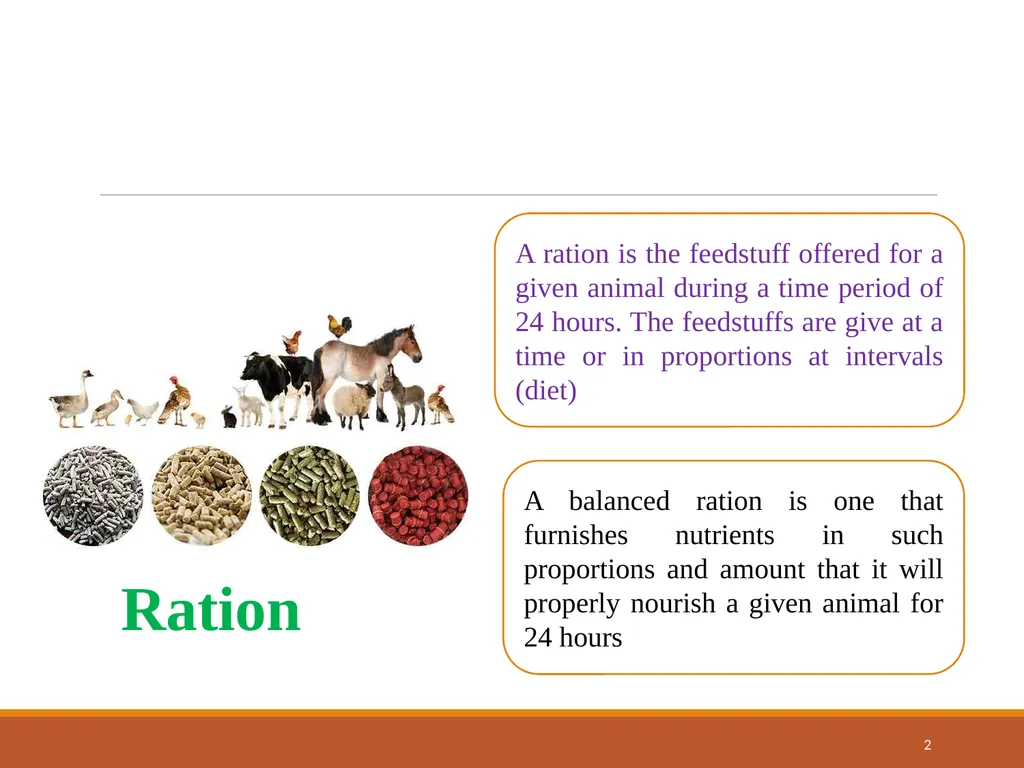
2 Ration A ration is the feedstuff offered for a given animal during a time period of 24 hours. The feedstuffs are give at a time or in proportions at intervals (diet) A balanced ration is one that furnishes nutrients in such proportions and amount that it will properly nourish a given animal for 24 hours<br>
03
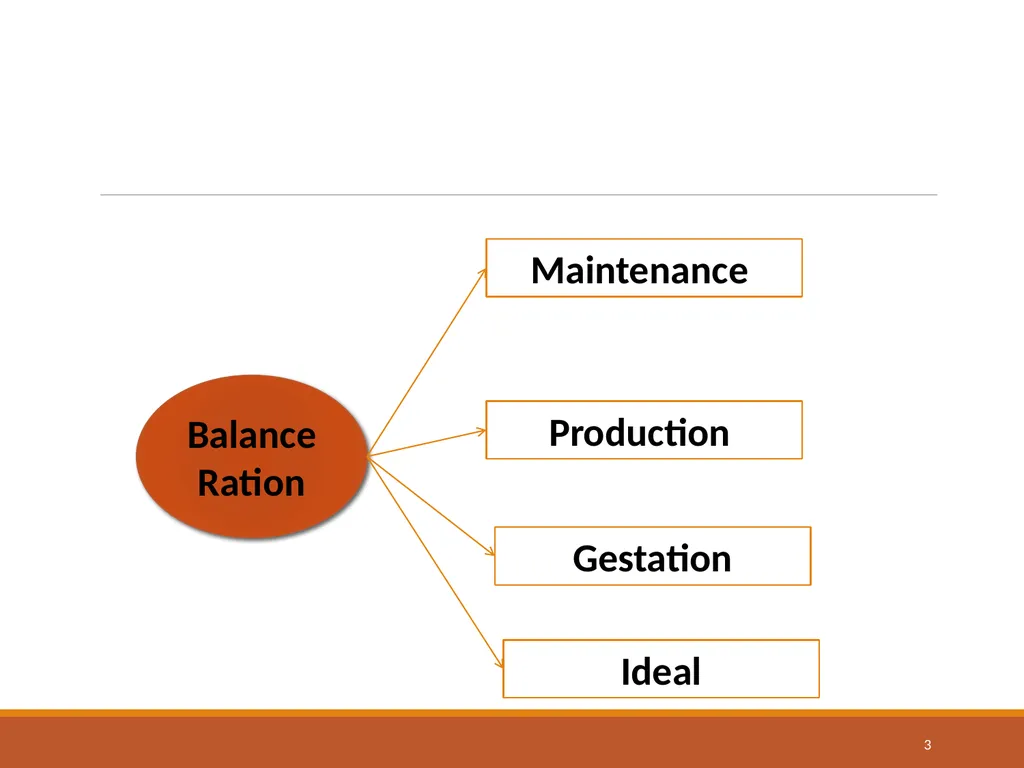
3 Balance
Ration Maintenance Production Gestation Ideal<br>
Ration Maintenance Production Gestation Ideal<br>
04
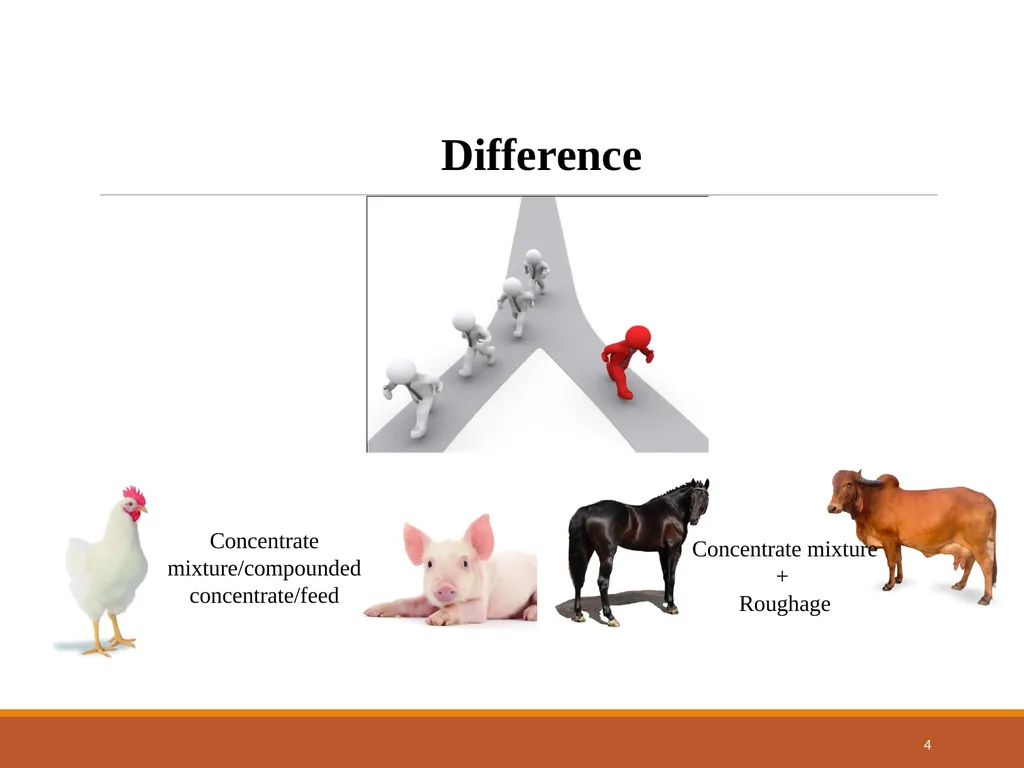
4 Difference Concentrate mixture/compounded concentrate/feed Concentrate mixture +
Roughage<br>
Roughage<br>
05
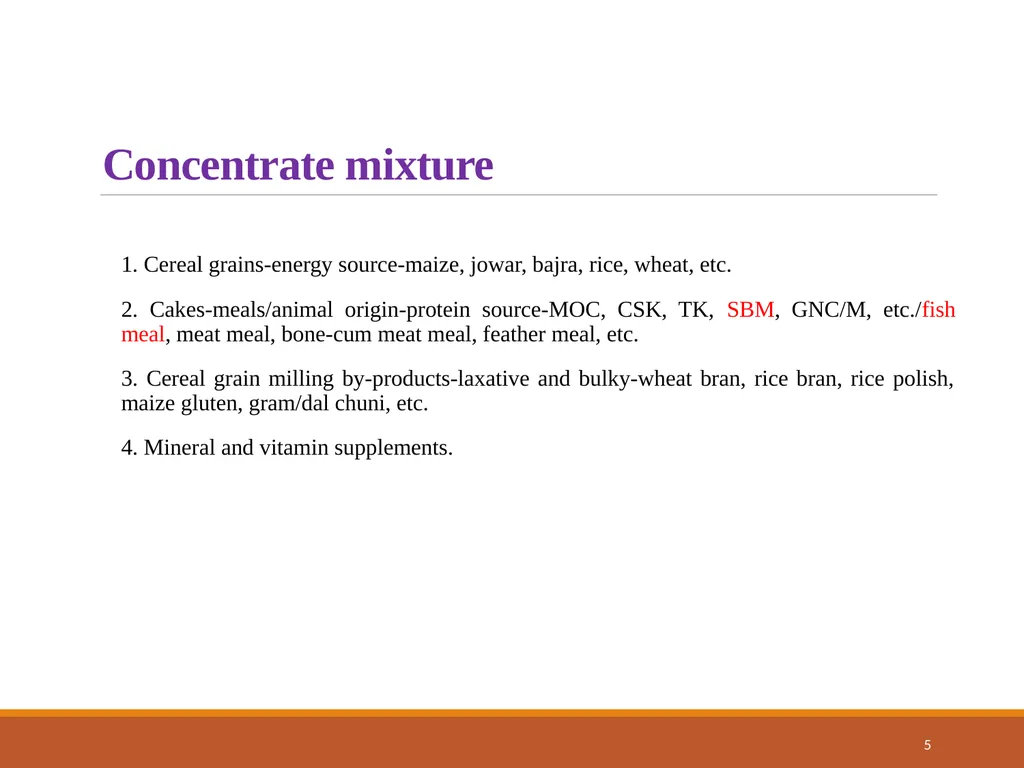
Concentrate mixture 1. Cereal grains-energy source-maize, jowar, bajra, rice, wheat, etc.
2. Cakes-meals/animal origin-protein source-MOC, CSK, TK, SBM, GNC/M, etc./fish meal, meat meal, bone-cum meat meal, feather meal, etc.
3. Cereal grain milling by-products-laxative and bulky-wheat bran, rice bran, rice polish, maize gluten, gram/dal chuni, etc.
4. Mineral and vitamin supplements. 5<br>
06
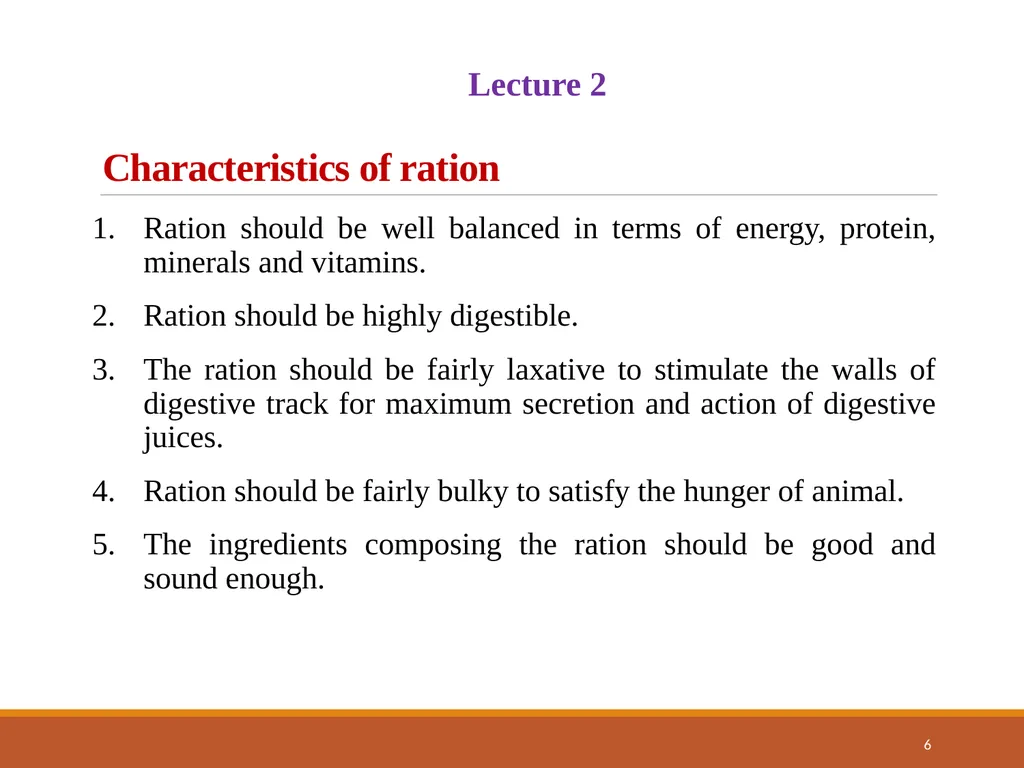
Characteristics of ration 6 Ration should be well balanced in terms of energy, protein, minerals and vitamins.
Ration should be highly digestible.
The ration should be fairly laxative to stimulate the walls of digestive track for maximum secretion and action of digestive juices.
Ration should be fairly bulky to satisfy the hunger of animal.
The ingredients composing the ration should be good and sound enough. Lecture 2<br>
07
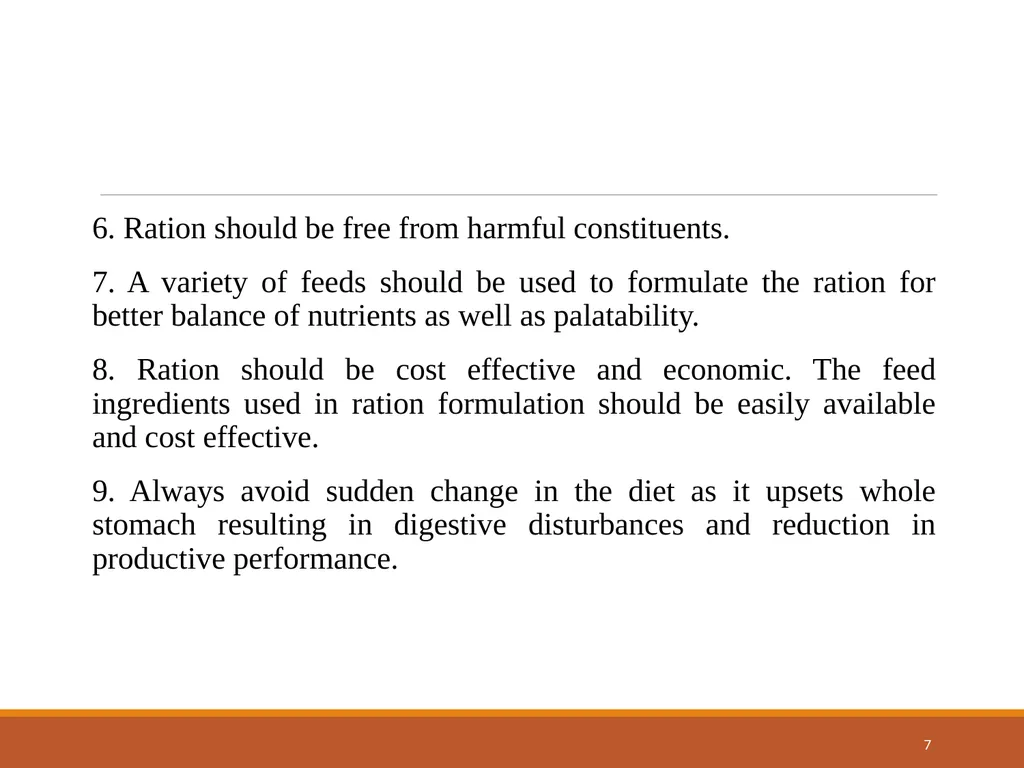
7 6. Ration should be free from harmful constituents.
7. A variety of feeds should be used to formulate the ration for better balance of nutrients as well as palatability.
8. Ration should be cost effective and economic. The feed ingredients used in ration formulation should be easily available and cost effective.
9. Always avoid sudden change in the diet as it upsets whole stomach resulting in digestive disturbances and reduction in productive performance.<br>
08
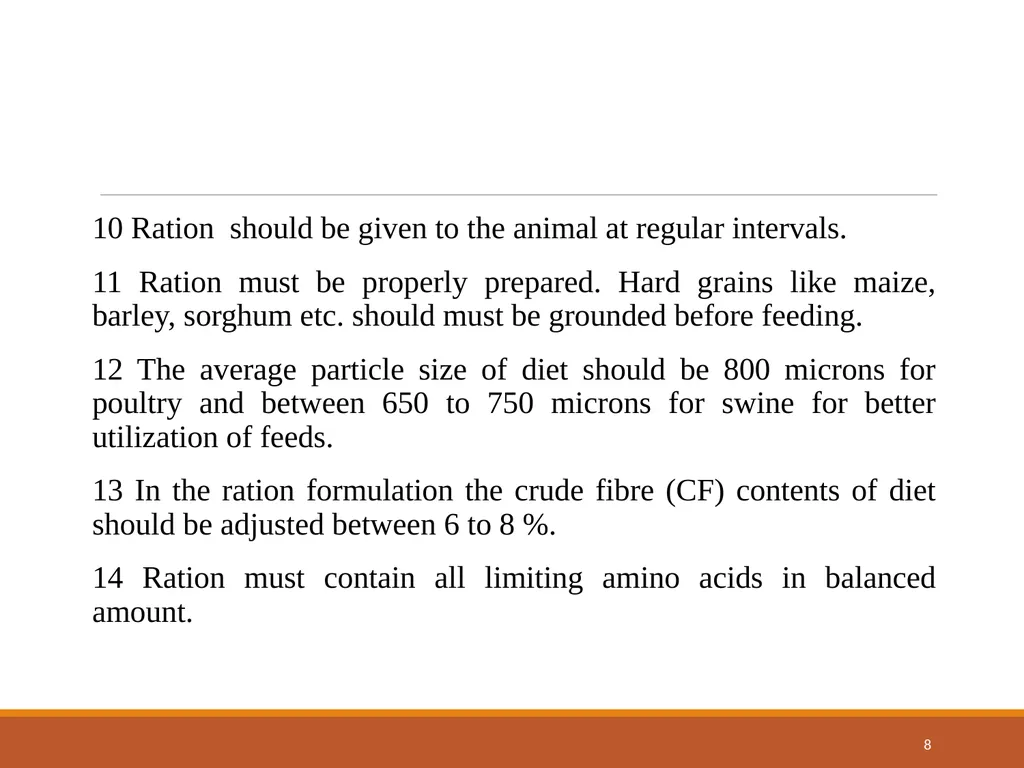
10 Ration should be given to the animal at regular intervals.
11 Ration must be properly prepared. Hard grains like maize, barley, sorghum etc. should must be grounded before feeding.
12 The average particle size of diet should be 800 microns for poultry and between 650 to 750 microns for swine for better utilization of feeds.
13 In the ration formulation the crude fibre (CF) contents of diet should be adjusted between 6 to 8 %.
14 Ration must contain all limiting amino acids in balanced amount. 8<br>
09
15 If feed contains antibacterial compound, the withdrawal period of that compound must be kept in mind. This is the period of time that medicated feed must be removed from pig / poultry diets before you slaughter them.
16 The ration should be formulated and fed according to the requirement of the animals. Feeding less or in excess, both are detrimental to health.
17 For better digestibility the animals should get ad libitum the clean and fresh supply of drinking water. 9<br>
16 The ration should be formulated and fed according to the requirement of the animals. Feeding less or in excess, both are detrimental to health.
17 For better digestibility the animals should get ad libitum the clean and fresh supply of drinking water. 9<br>
10
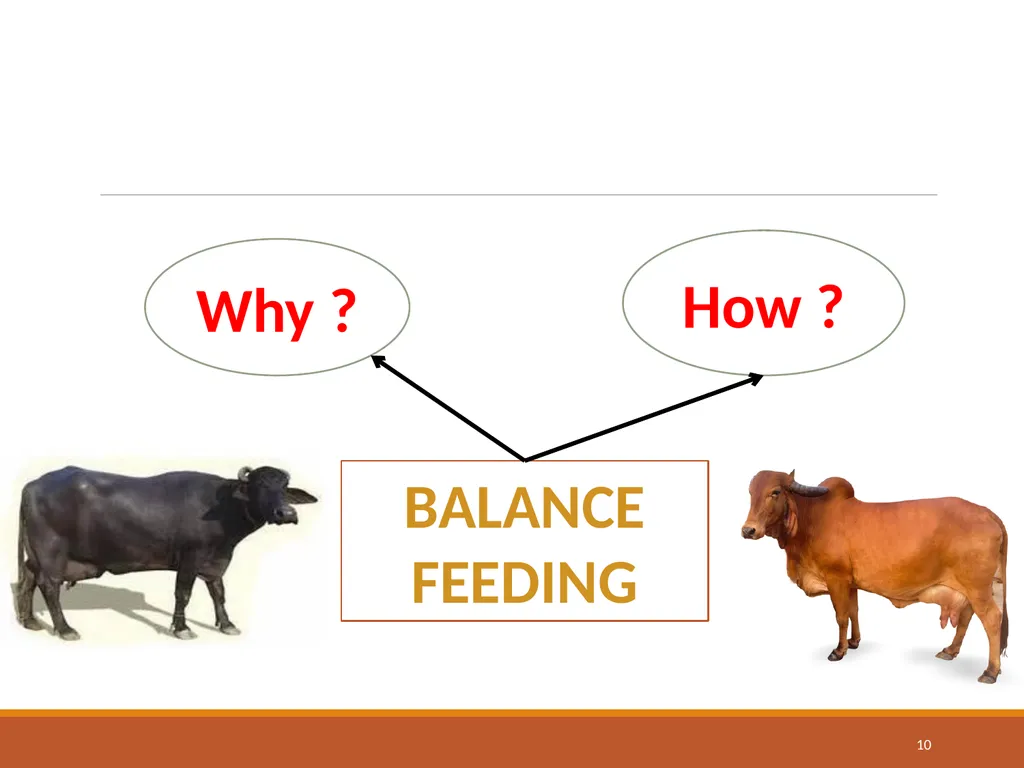
10 balance Feeding Why ? How ?<br>
11
1. To explore the genetic potential of the animal by feeding a balanced ration to meet the daily nutrient requirements of the animal to perform in terms of weight gain, milk or wool production.
2. A judicious use of available feed resources is possible only through scientific feeding 11<br>
2. A judicious use of available feed resources is possible only through scientific feeding 11<br>
12
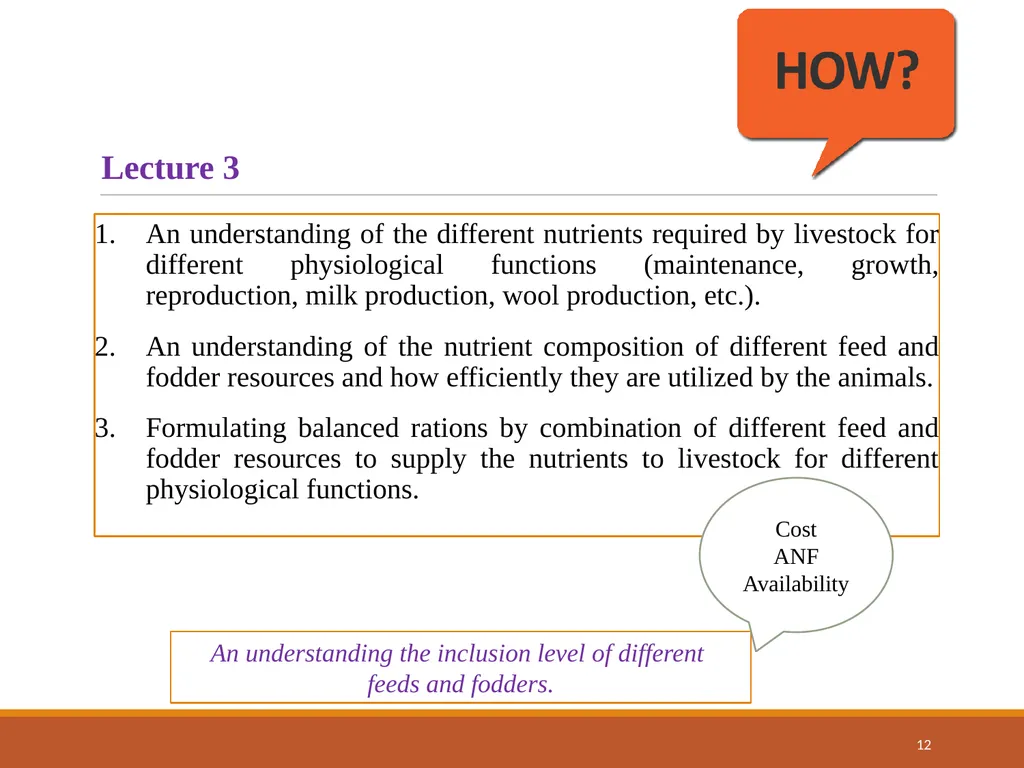
An understanding of the different nutrients required by livestock for different physiological functions (maintenance, growth, reproduction, milk production, wool production, etc.).
An understanding of the nutrient composition of different feed and fodder resources and how efficiently they are utilized by the animals.
Formulating balanced rations by combination of different feed and fodder resources to supply the nutrients to livestock for different physiological functions. 12 An understanding the inclusion level of different
feeds and fodders. Cost
ANF
Availability Lecture 3<br>
13
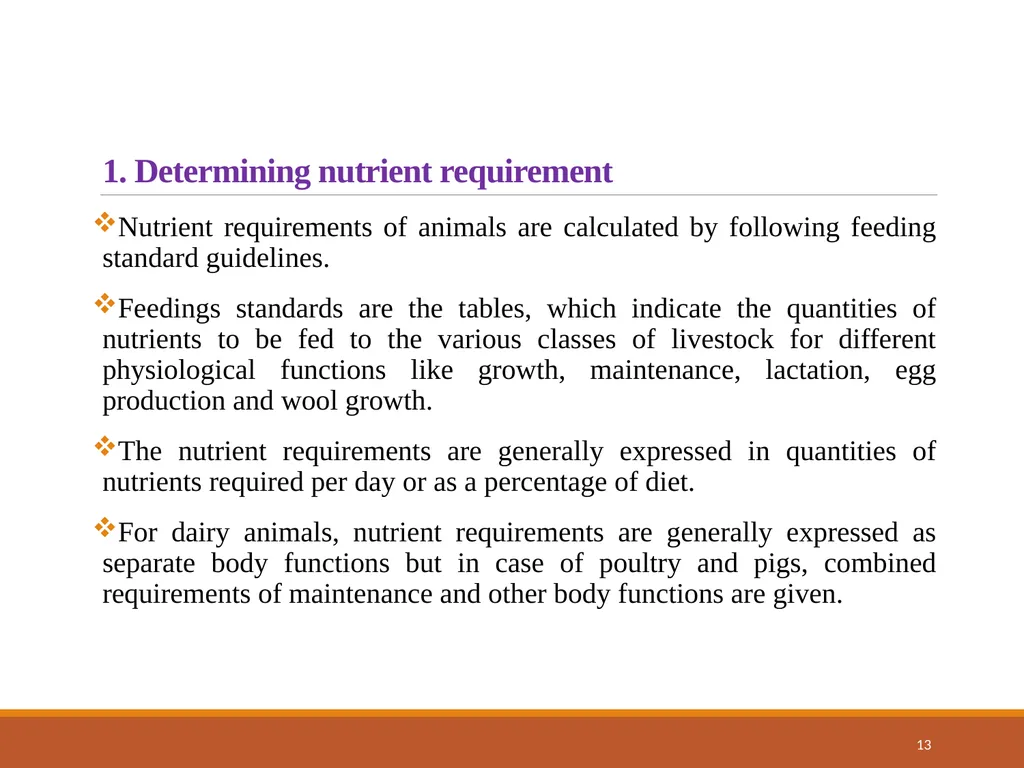
1. Determining nutrient requirement Nutrient requirements of animals are calculated by following feeding standard guidelines.
Feedings standards are the tables, which indicate the quantities of nutrients to be fed to the various classes of livestock for different physiological functions like growth, maintenance, lactation, egg production and wool growth.
The nutrient requirements are generally expressed in quantities of nutrients required per day or as a percentage of diet.
For dairy animals, nutrient requirements are generally expressed as separate body functions but in case of poultry and pigs, combined requirements of maintenance and other body functions are given. 13<br>
14
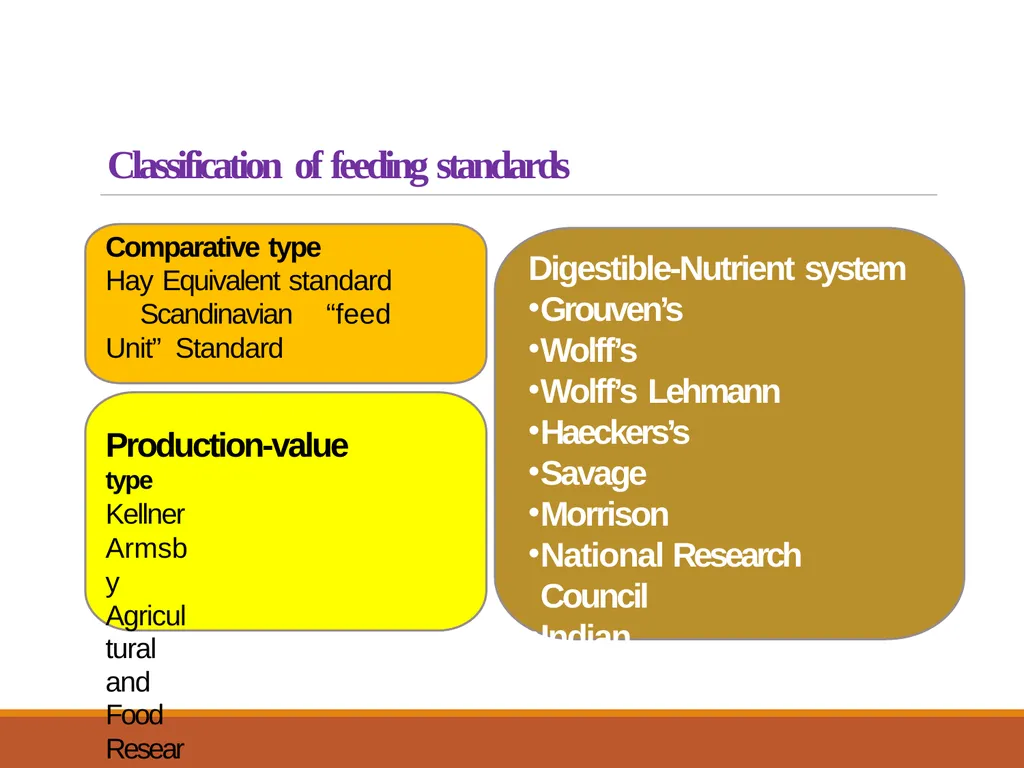
Classification of feeding standards Comparative type
Hay Equivalent standard Scandinavian “feed Unit” Standard Digestible-Nutrient system
Grouven’s
Wolff’s
Wolff’s Lehmann
Haeckers’s
Savage
Morrison
National Research Council
Indian Production-value type
Kellner Armsby
Agricultural and Food
Research Council<br>
Hay Equivalent standard Scandinavian “feed Unit” Standard Digestible-Nutrient system
Grouven’s
Wolff’s
Wolff’s Lehmann
Haeckers’s
Savage
Morrison
National Research Council
Indian Production-value type
Kellner Armsby
Agricultural and Food
Research Council<br>
15
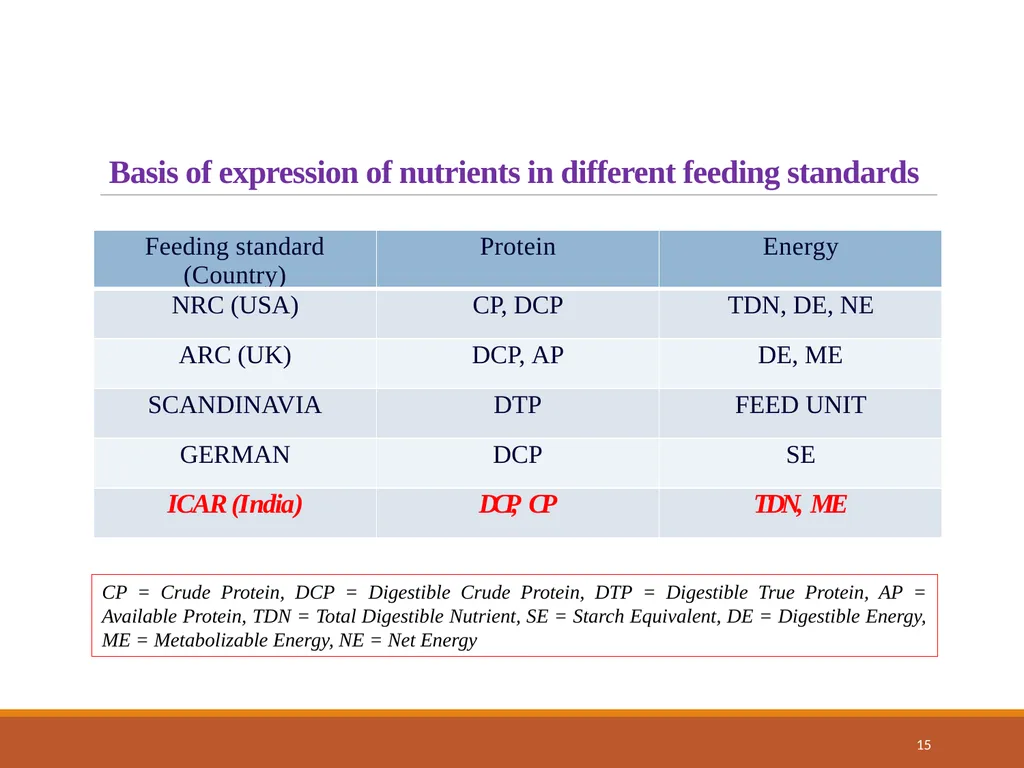
15 Basis of expression of nutrients in different feeding standards CP = Crude Protein, DCP = Digestible Crude Protein, DTP = Digestible True Protein, AP = Available Protein, TDN = Total Digestible Nutrient, SE = Starch Equivalent, DE = Digestible Energy, ME = Metabolizable Energy, NE = Net Energy<br>
16
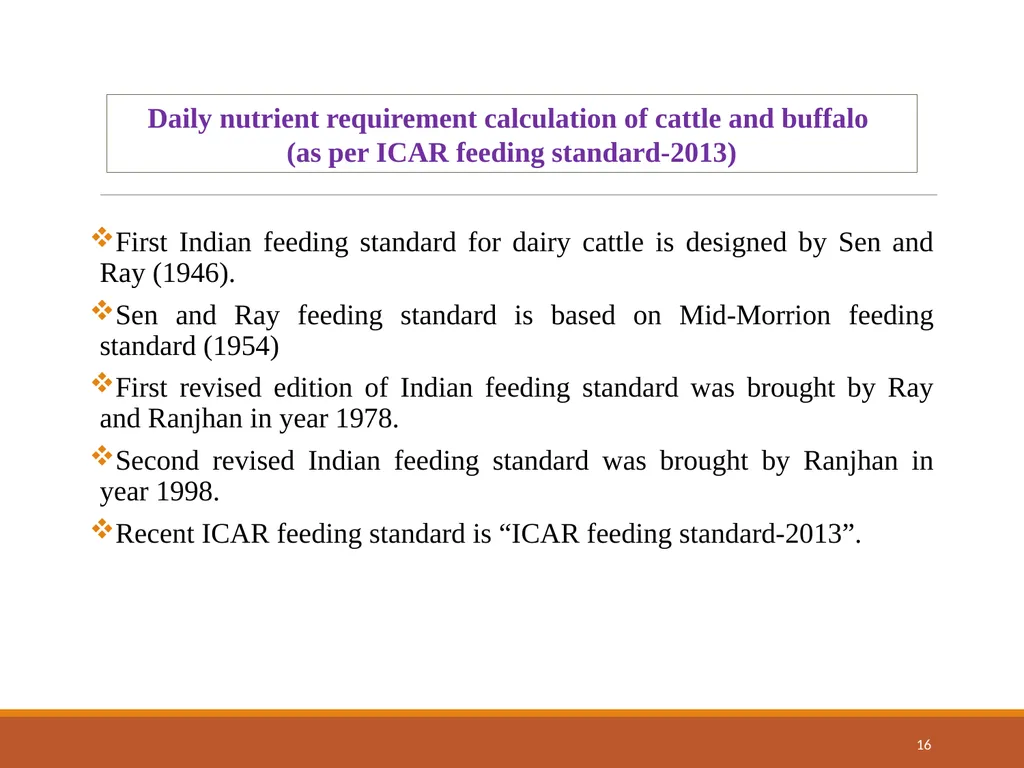
First Indian feeding standard for dairy cattle is designed by Sen and Ray (1946).
Sen and Ray feeding standard is based on Mid-Morrion feeding standard (1954)
First revised edition of Indian feeding standard was brought by Ray and Ranjhan in year 1978.
Second revised Indian feeding standard was brought by Ranjhan in year 1998.
Recent ICAR feeding standard is “ICAR feeding standard-2013”. 16 Daily nutrient requirement calculation of cattle and buffalo
(as per ICAR feeding standard-2013)<br>
17
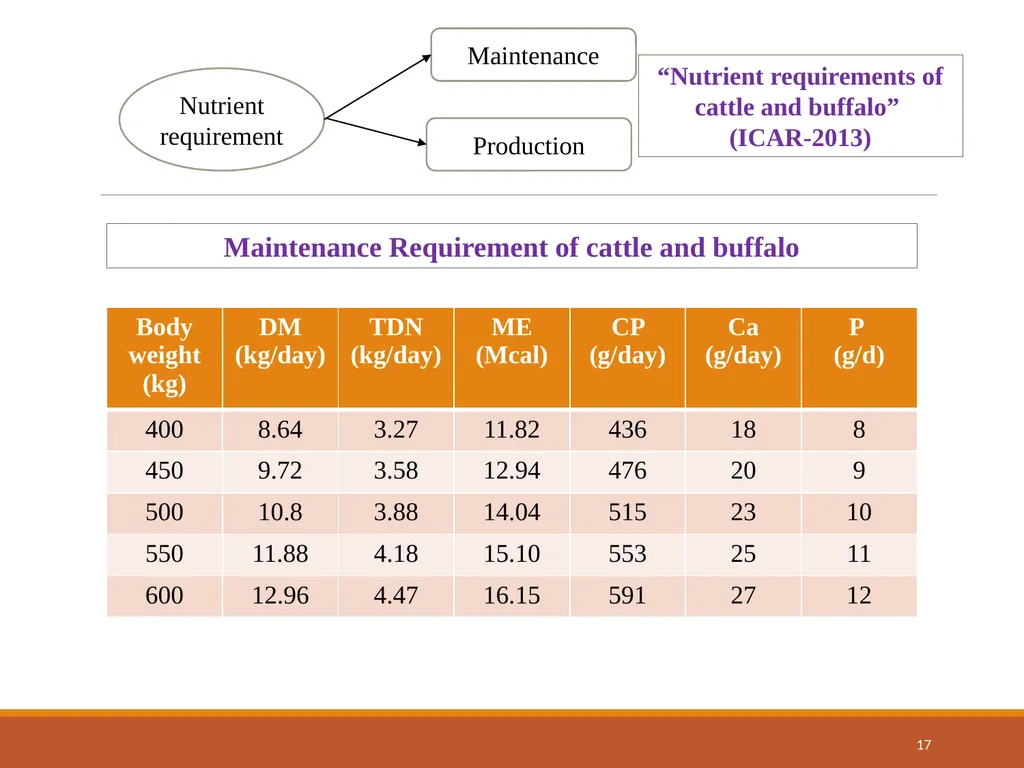
17 Nutrient requirement Maintenance Production Maintenance Requirement of cattle and buffalo “Nutrient requirements of cattle and buffalo”
(ICAR-2013)<br>
(ICAR-2013)<br>
18
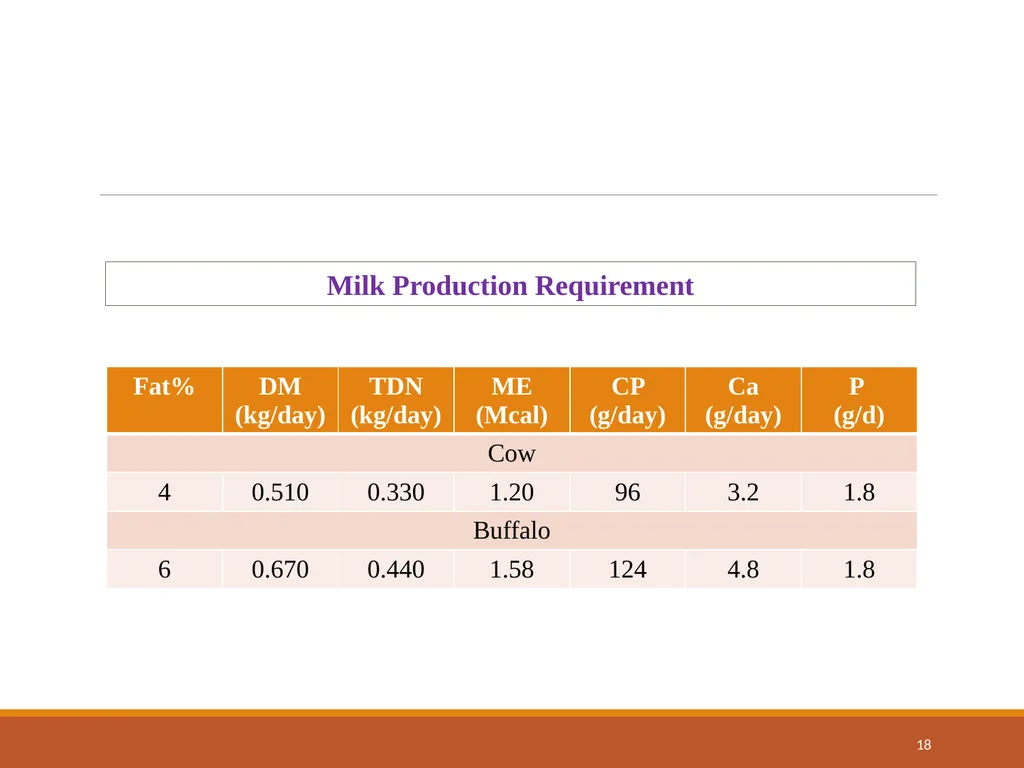
18 Milk Production Requirement<br>
19
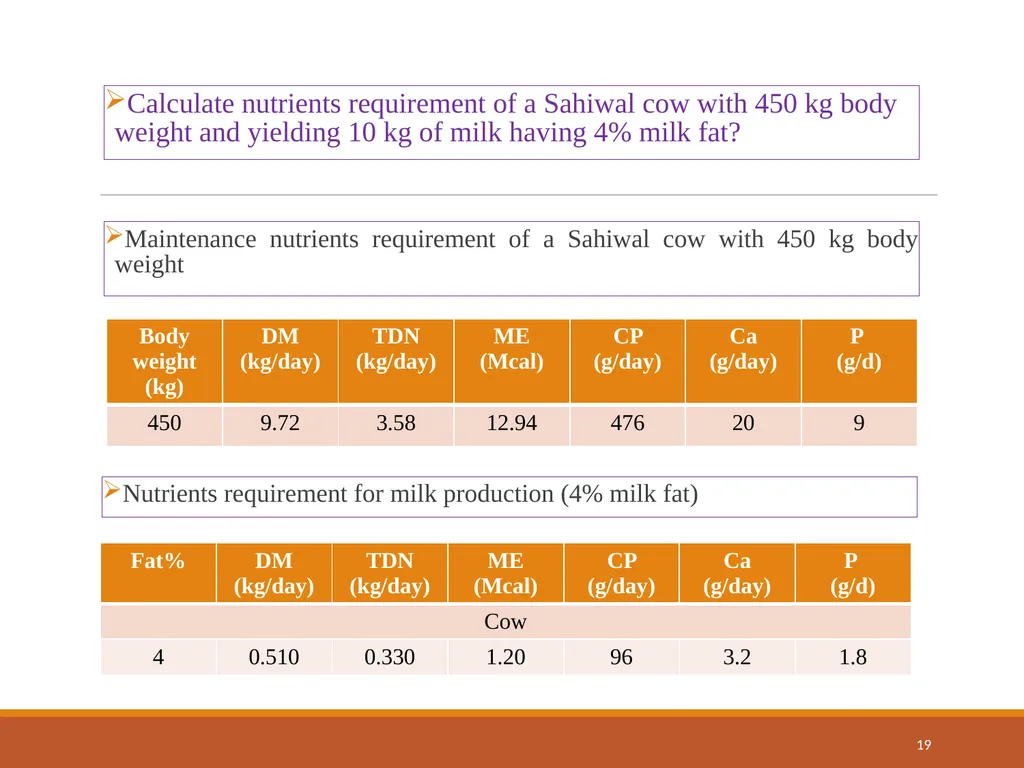
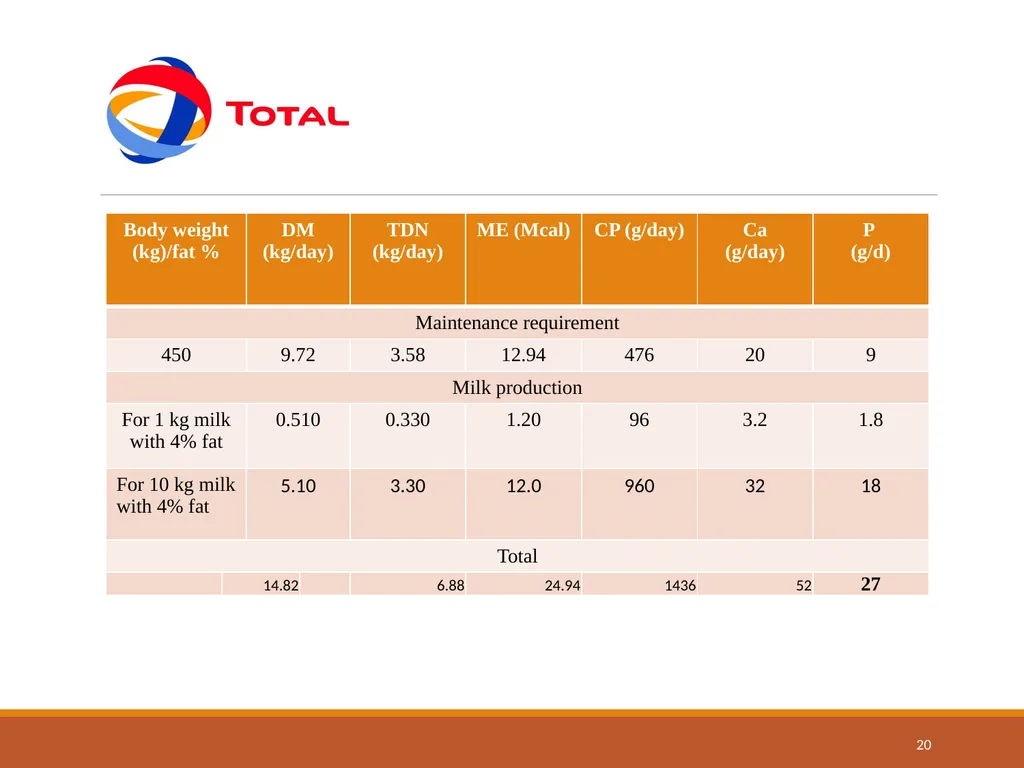
19 Calculate nutrients requirement of a Sahiwal cow with 450 kg body weight and yielding 10 kg of milk having 4% milk fat? Maintenance nutrients requirement of a Sahiwal cow with 450 kg body weight Nutrients requirement for milk production (4% milk fat)<br>
20
20<br>
21
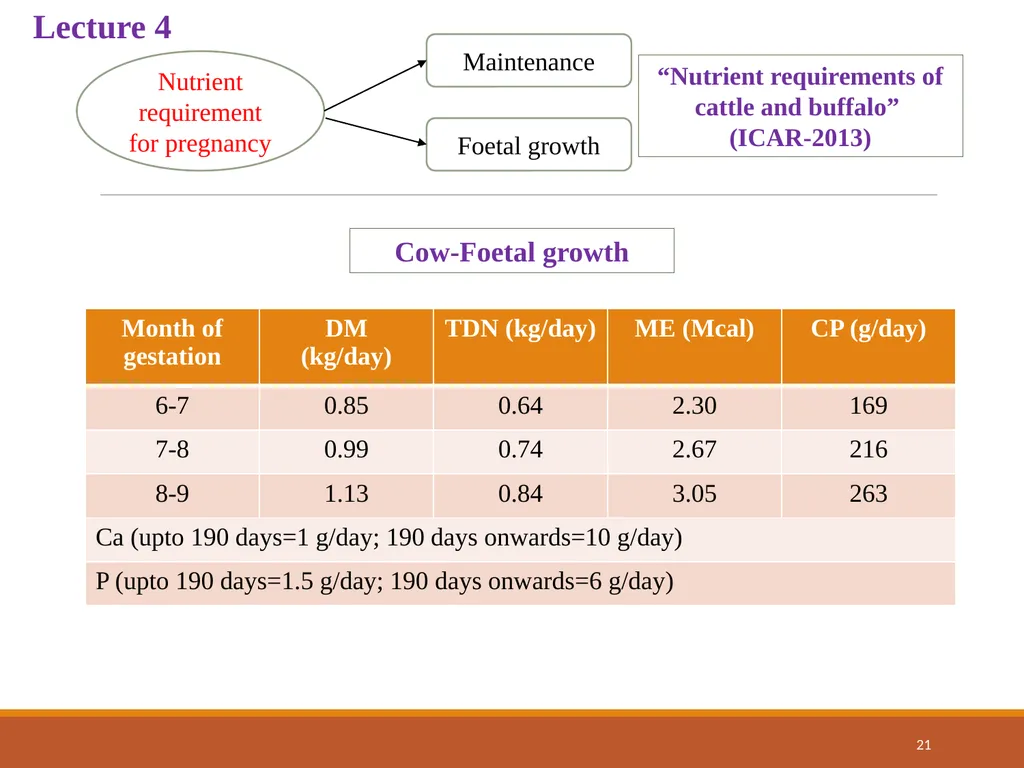
21 Nutrient requirement
for pregnancy Maintenance Foetal growth “Nutrient requirements of cattle and buffalo”
(ICAR-2013) Cow-Foetal growth Lecture 4<br>
for pregnancy Maintenance Foetal growth “Nutrient requirements of cattle and buffalo”
(ICAR-2013) Cow-Foetal growth Lecture 4<br>
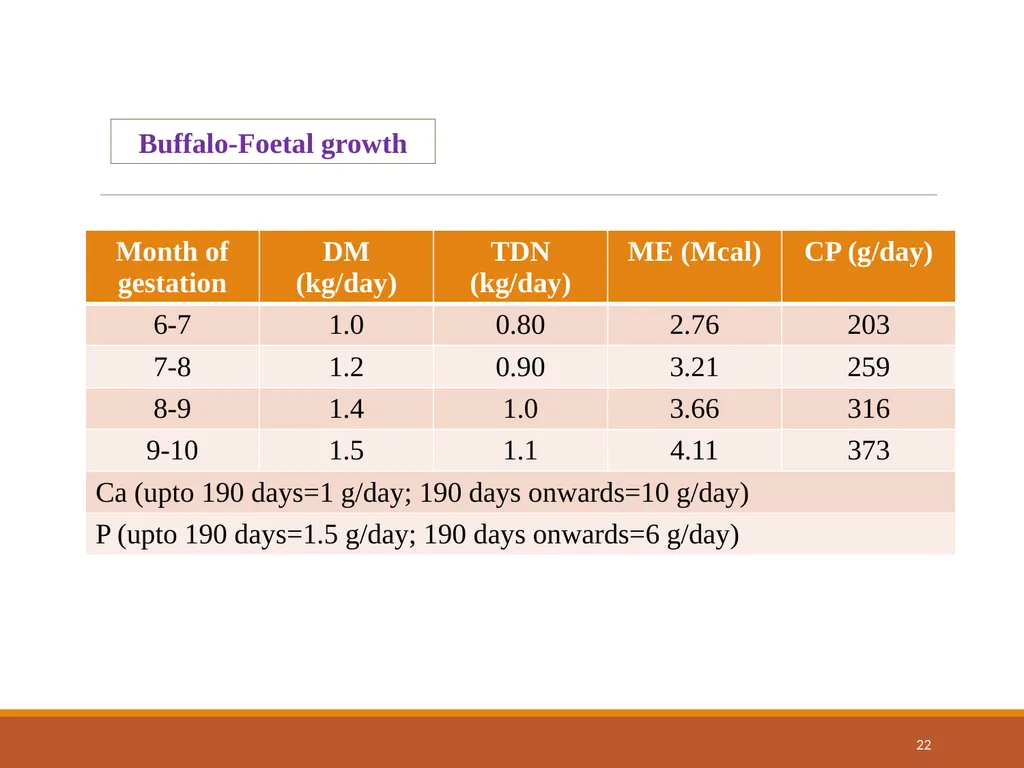
22
22 Buffalo-Foetal growth<br>
23
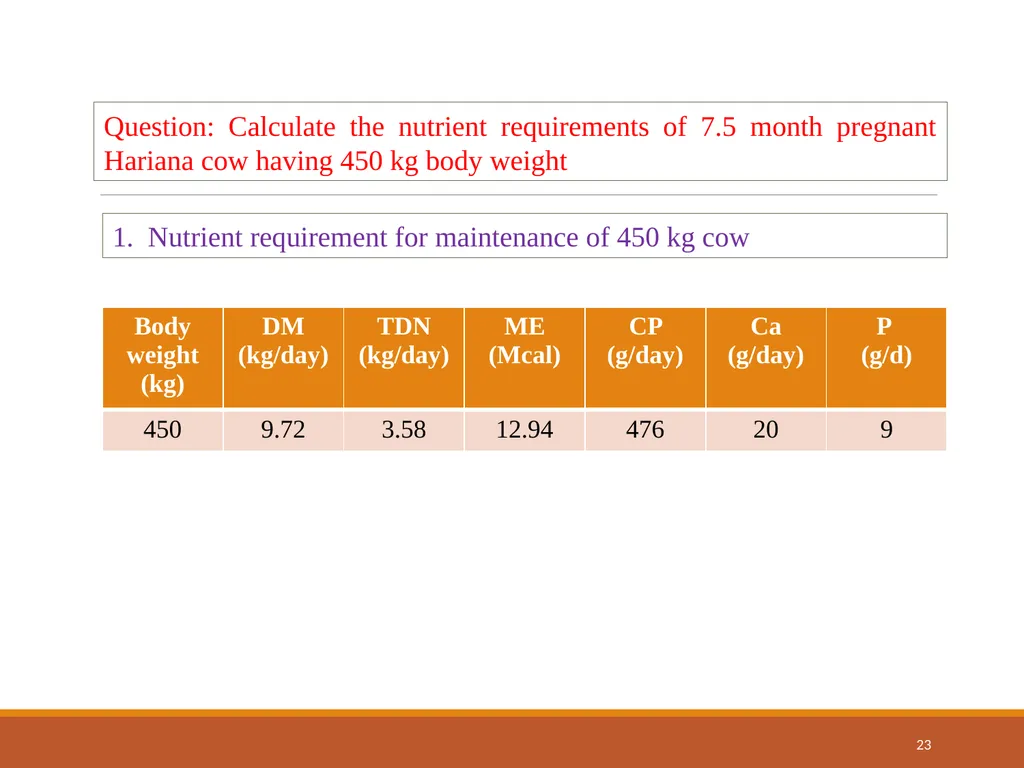
23 Question: Calculate the nutrient requirements of 7.5 month pregnant Hariana cow having 450 kg body weight 1. Nutrient requirement for maintenance of 450 kg cow<br>
24
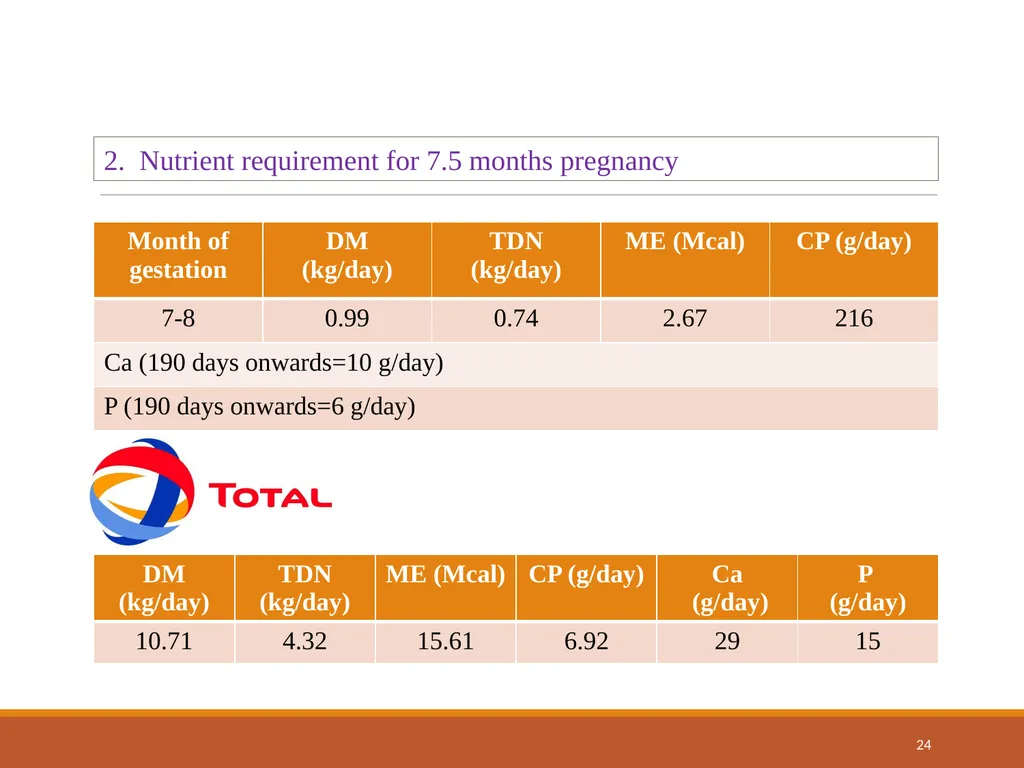
24 2. Nutrient requirement for 7.5 months pregnancy<br>
25
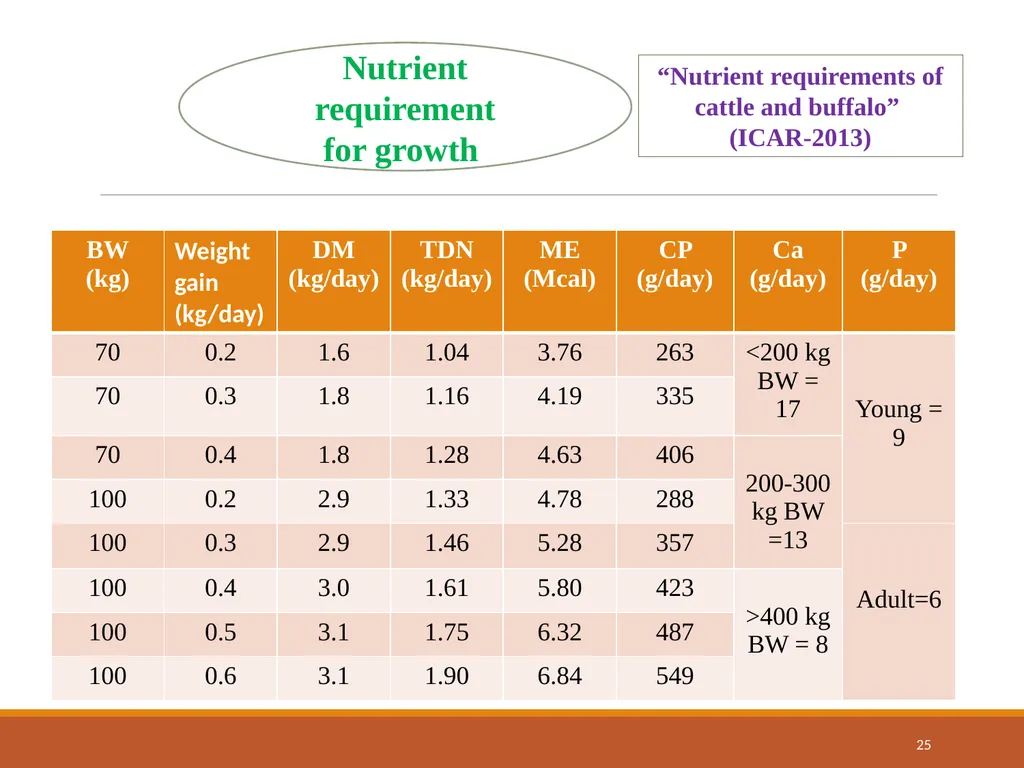
25 Nutrient requirement
for growth “Nutrient requirements of cattle and buffalo”
(ICAR-2013)<br>
for growth “Nutrient requirements of cattle and buffalo”
(ICAR-2013)<br>
26
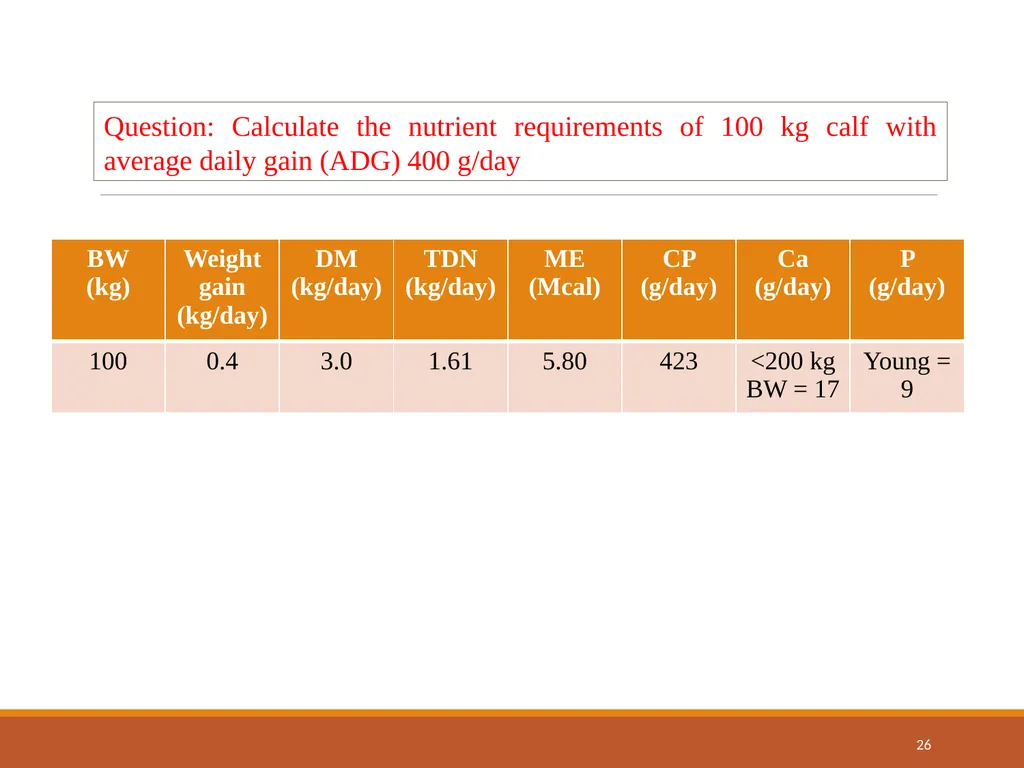
26 Question: Calculate the nutrient requirements of 100 kg calf with average daily gain (ADG) 400 g/day<br>
27
Feedstuffs are subjected to different protocols of laboratory analyses like proximate analysis, detergent method of fibre analysis, Talpatra method for Ca determination, etc. for nutrient profiling.
These analytical procedures are specific for a given element, compound, or group of compounds. 27 2. Nutrient composition of feedstuffs<br>
These analytical procedures are specific for a given element, compound, or group of compounds. 27 2. Nutrient composition of feedstuffs<br>
28
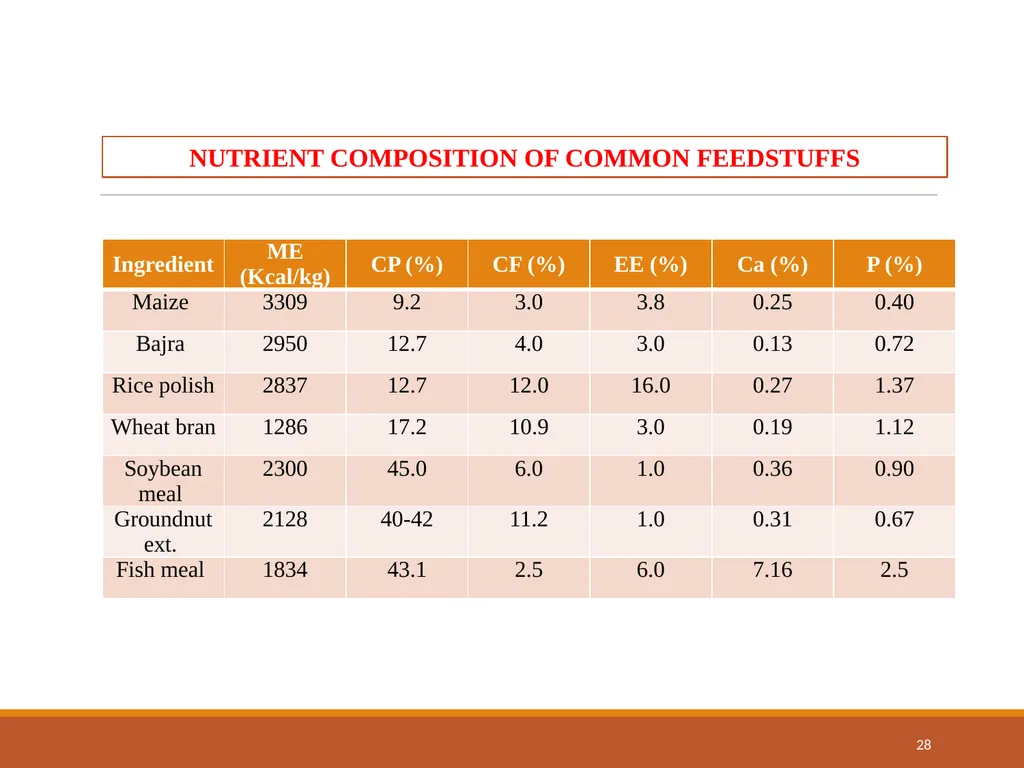
28 NUTRIENT COMPOSITION OF COMMON FEEDSTUFFS<br>
29
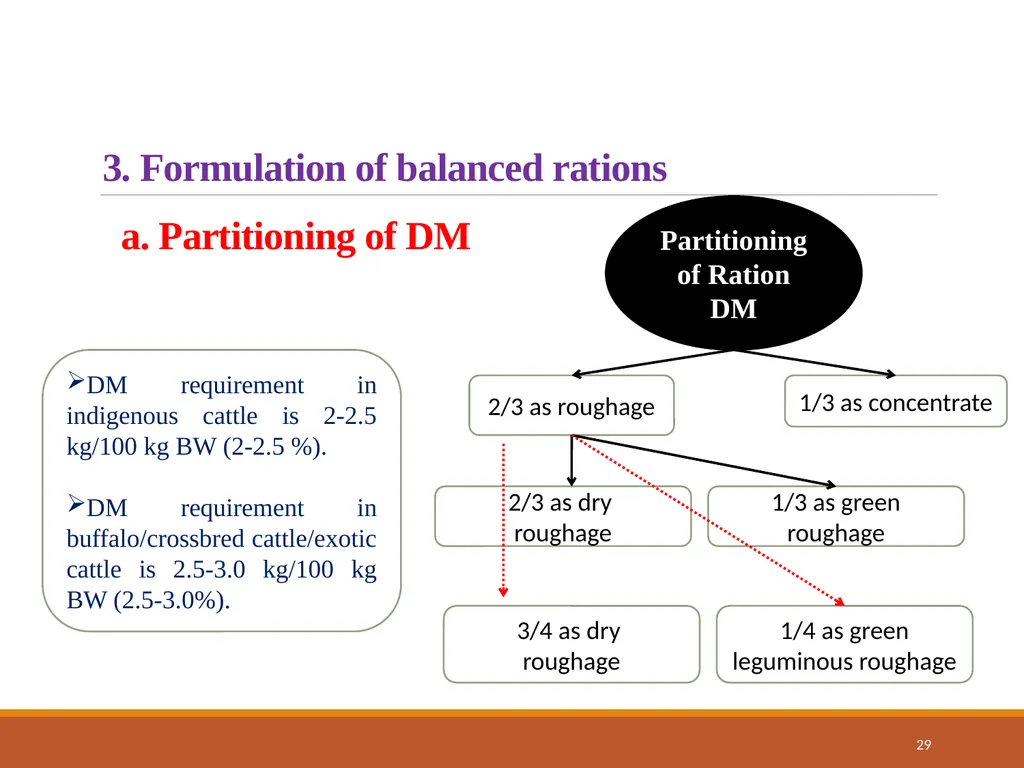
29 3. Formulation of balanced rations Partitioning of Ration DM 2/3 as roughage 1/3 as concentrate 2/3 as dry
roughage 1/3 as green roughage 3/4 as dry
roughage 1/4 as green leguminous roughage DM requirement in indigenous cattle is 2-2.5 kg/100 kg BW (2-2.5 %).
DM requirement in buffalo/crossbred cattle/exotic cattle is 2.5-3.0 kg/100 kg BW (2.5-3.0%). a. Partitioning of DM<br>
roughage 1/3 as green roughage 3/4 as dry
roughage 1/4 as green leguminous roughage DM requirement in indigenous cattle is 2-2.5 kg/100 kg BW (2-2.5 %).
DM requirement in buffalo/crossbred cattle/exotic cattle is 2.5-3.0 kg/100 kg BW (2.5-3.0%). a. Partitioning of DM<br>
30
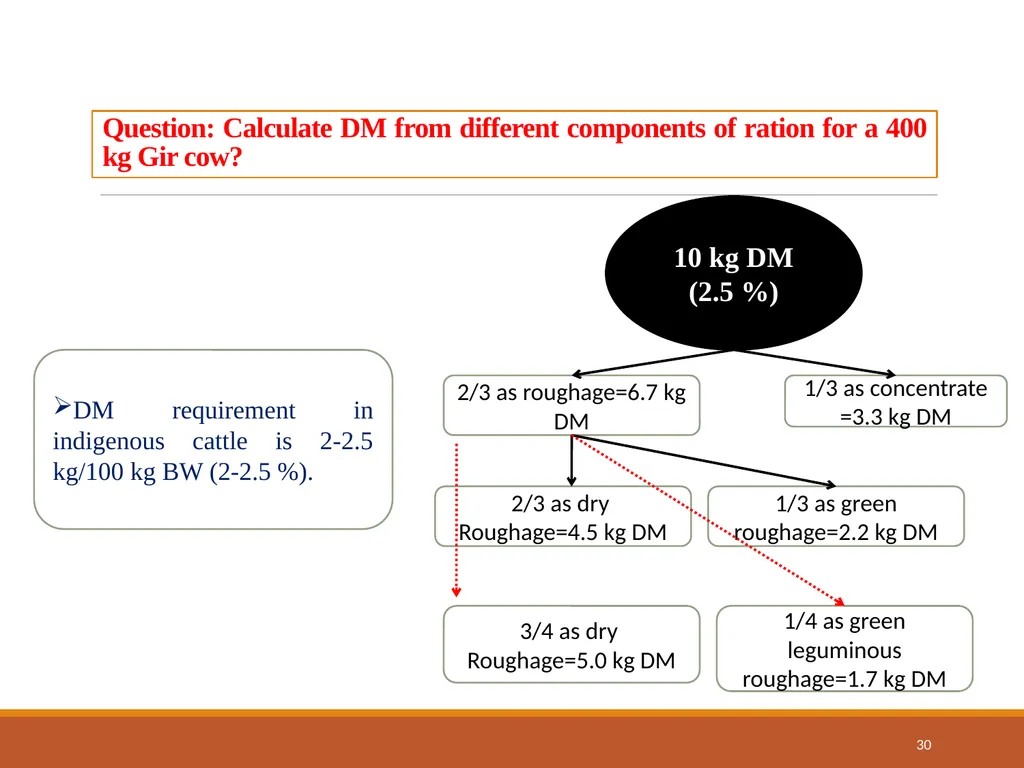
30 10 kg DM
(2.5 %) 2/3 as roughage=6.7 kg DM 1/3 as concentrate
=3.3 kg DM 2/3 as dry
Roughage=4.5 kg DM 1/3 as green roughage=2.2 kg DM 3/4 as dry
Roughage=5.0 kg DM 1/4 as green leguminous roughage=1.7 kg DM DM requirement in indigenous cattle is 2-2.5 kg/100 kg BW (2-2.5 %). Question: Calculate DM from different components of ration for a 400 kg Gir cow?<br>
31
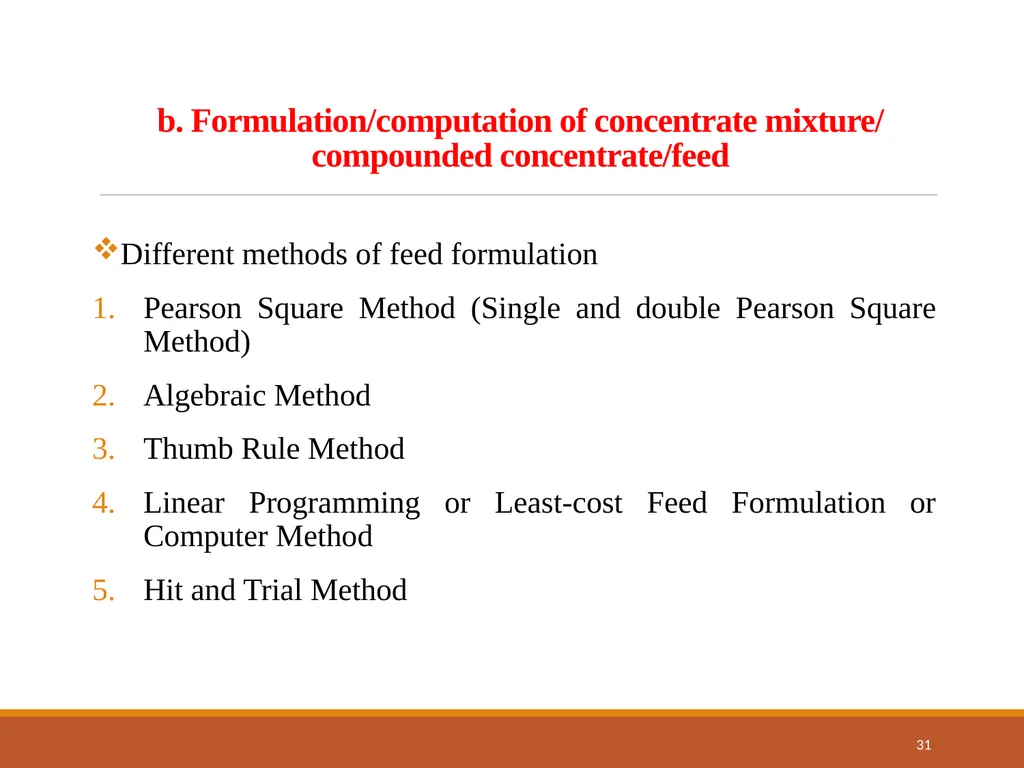
31 b. Formulation/computation of concentrate mixture/
compounded concentrate/feed Different methods of feed formulation
Pearson Square Method (Single and double Pearson Square Method)
Algebraic Method
Thumb Rule Method
Linear Programming or Least-cost Feed Formulation or Computer Method
Hit and Trial Method<br>
compounded concentrate/feed Different methods of feed formulation
Pearson Square Method (Single and double Pearson Square Method)
Algebraic Method
Thumb Rule Method
Linear Programming or Least-cost Feed Formulation or Computer Method
Hit and Trial Method<br>
32
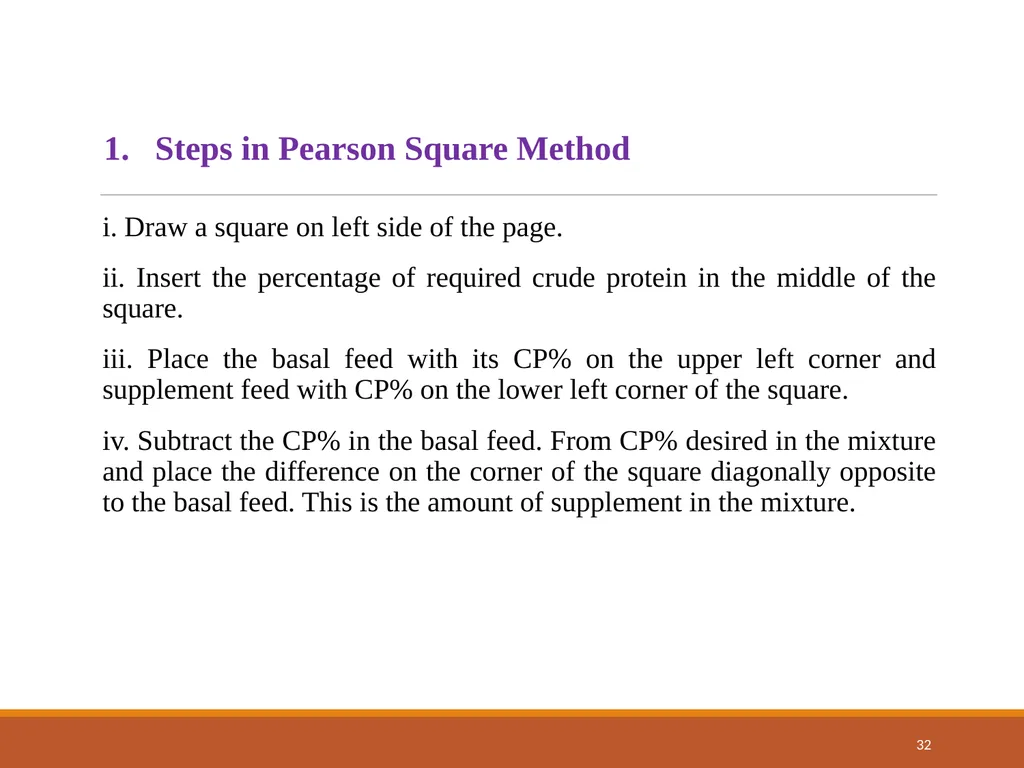
i. Draw a square on left side of the page.
ii. Insert the percentage of required crude protein in the middle of the square.
iii. Place the basal feed with its CP% on the upper left corner and supplement feed with CP% on the lower left corner of the square.
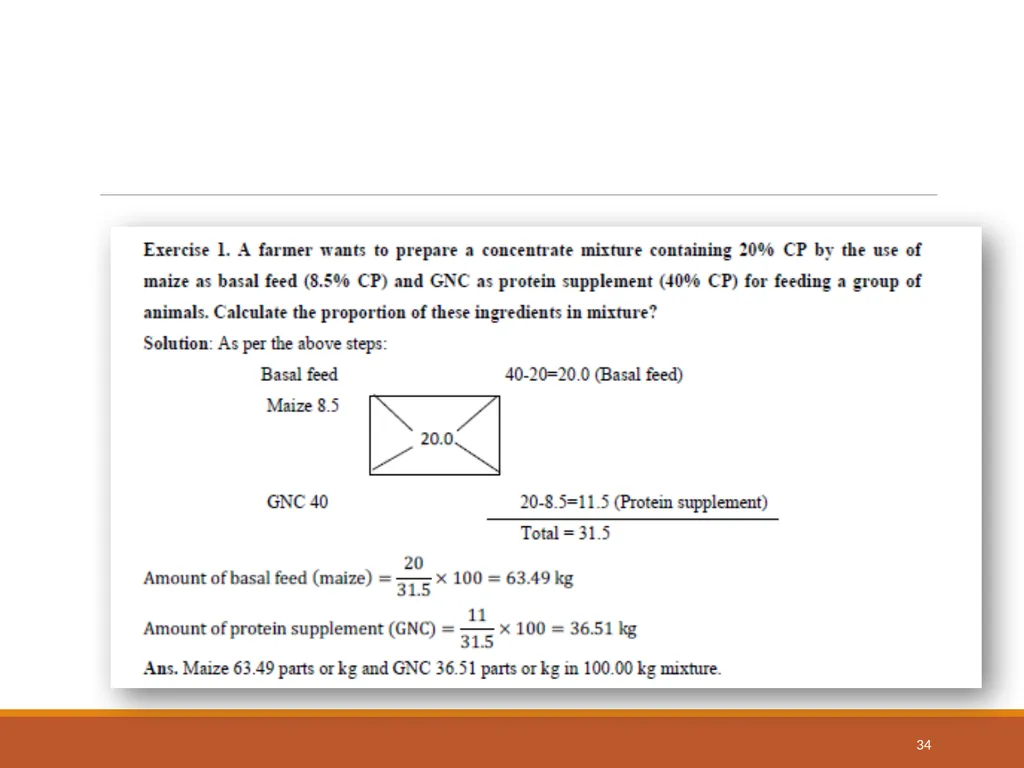
iv. Subtract the CP% in the basal feed. From CP% desired in the mixture and place the difference on the corner of the square diagonally opposite to the basal feed. This is the amount of supplement in the mixture. 32 Steps in Pearson Square Method<br>
33
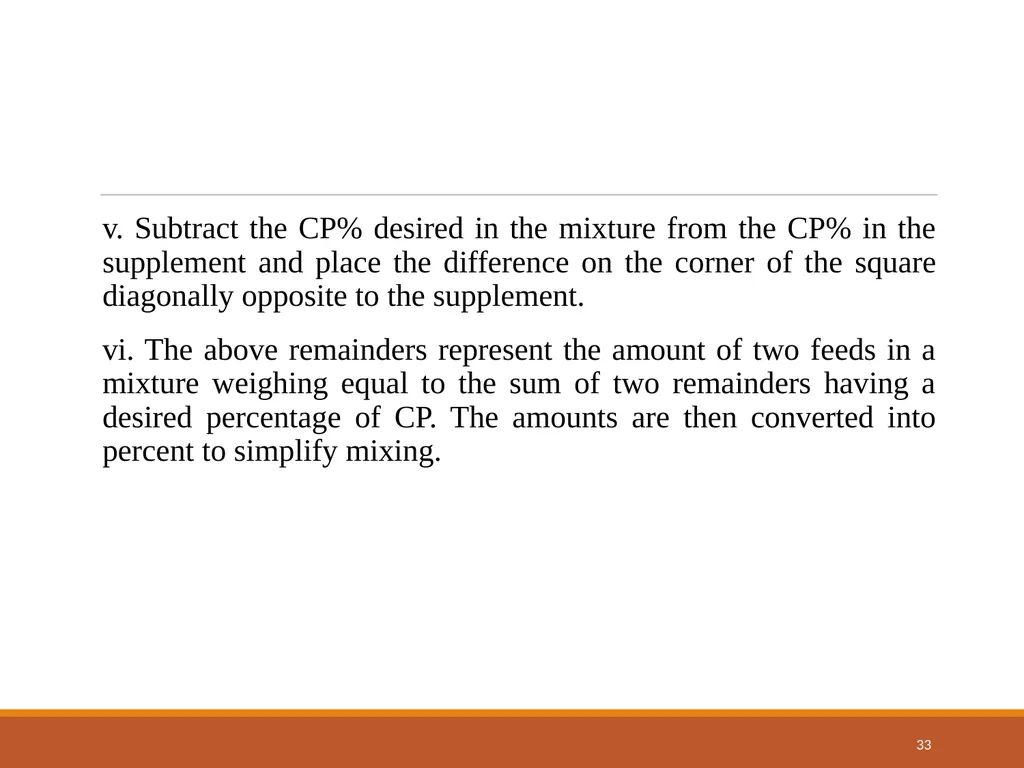
v. Subtract the CP% desired in the mixture from the CP% in the supplement and place the difference on the corner of the square diagonally opposite to the supplement.
vi. The above remainders represent the amount of two feeds in a mixture weighing equal to the sum of two remainders having a desired percentage of CP. The amounts are then converted into percent to simplify mixing. 33<br>
vi. The above remainders represent the amount of two feeds in a mixture weighing equal to the sum of two remainders having a desired percentage of CP. The amounts are then converted into percent to simplify mixing. 33<br>
34
34<br>
35
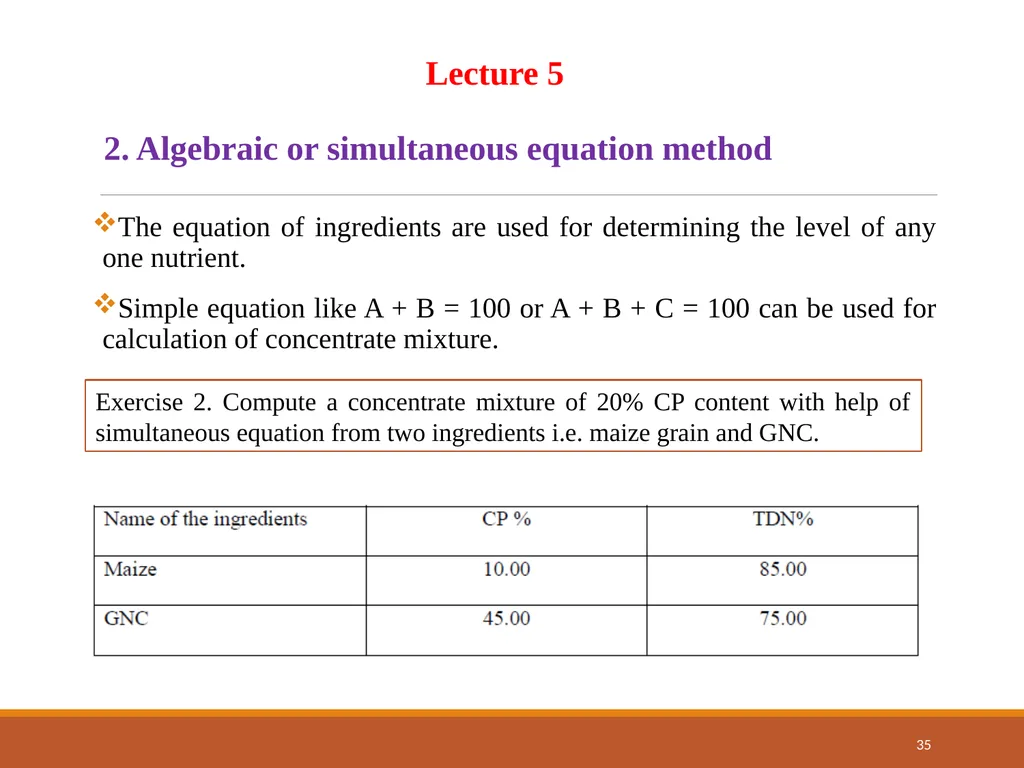
The equation of ingredients are used for determining the level of any one nutrient.
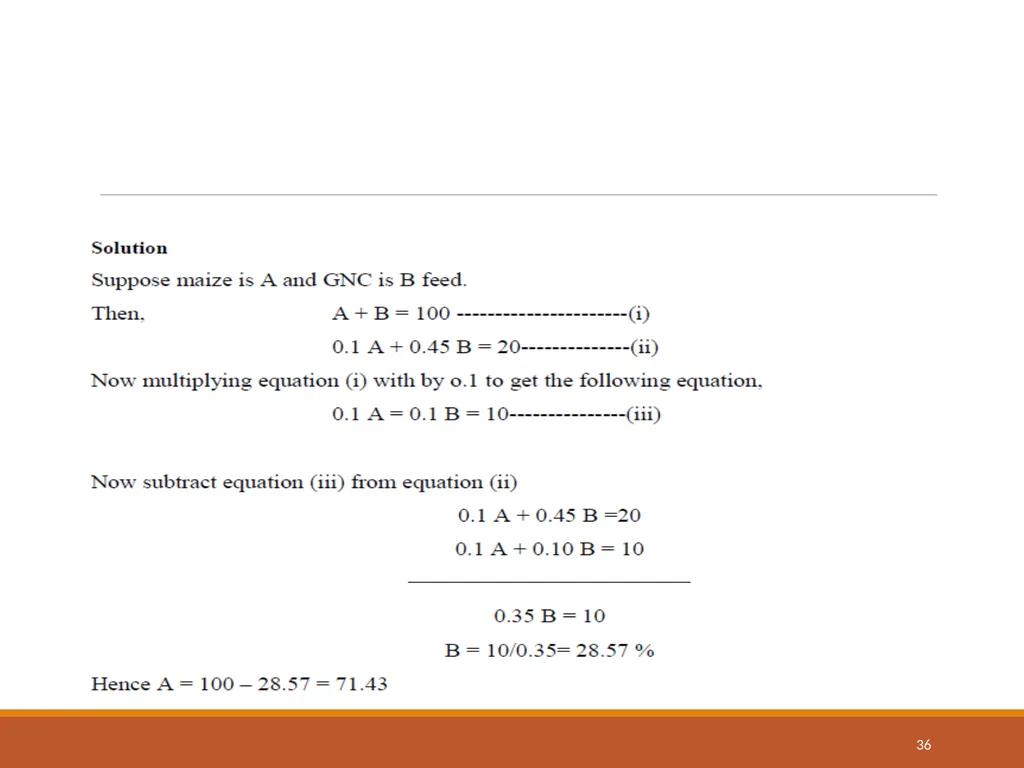
Simple equation like A + B = 100 or A + B + C = 100 can be used for calculation of concentrate mixture. 35 2. Algebraic or simultaneous equation method Exercise 2. Compute a concentrate mixture of 20% CP content with help of simultaneous equation from two ingredients i.e. maize grain and GNC. Lecture 5<br>
Simple equation like A + B = 100 or A + B + C = 100 can be used for calculation of concentrate mixture. 35 2. Algebraic or simultaneous equation method Exercise 2. Compute a concentrate mixture of 20% CP content with help of simultaneous equation from two ingredients i.e. maize grain and GNC. Lecture 5<br>
36
36<br>
37
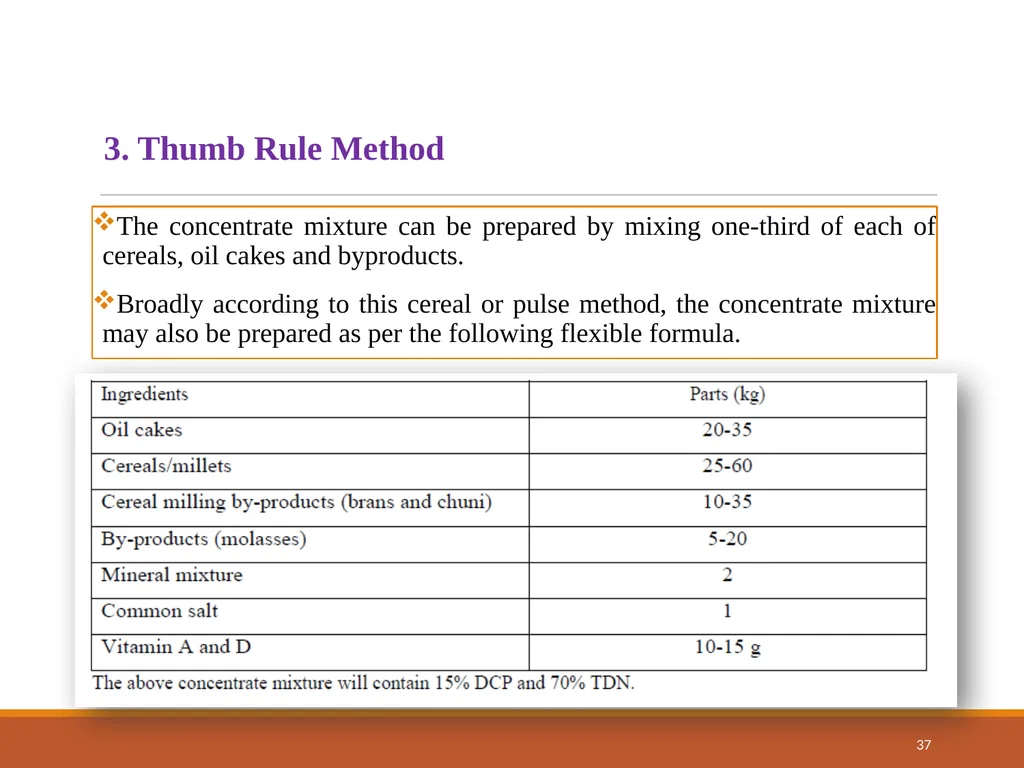
The concentrate mixture can be prepared by mixing one-third of each of cereals, oil cakes and byproducts.
Broadly according to this cereal or pulse method, the concentrate mixture may also be prepared as per the following flexible formula. 37 3. Thumb Rule Method<br>
Broadly according to this cereal or pulse method, the concentrate mixture may also be prepared as per the following flexible formula. 37 3. Thumb Rule Method<br>
38
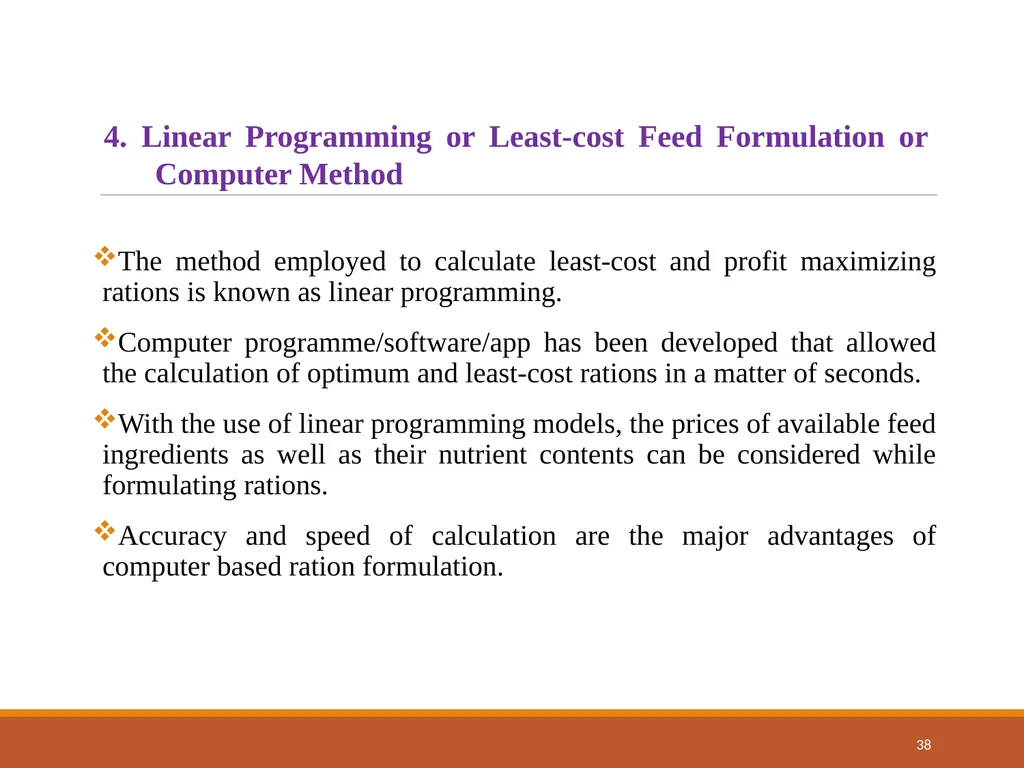
The method employed to calculate least-cost and profit maximizing rations is known as linear programming.
Computer programme/software/app has been developed that allowed the calculation of optimum and least-cost rations in a matter of seconds.
With the use of linear programming models, the prices of available feed ingredients as well as their nutrient contents can be considered while formulating rations.
Accuracy and speed of calculation are the major advantages of computer based ration formulation. 38 4. Linear Programming or Least-cost Feed Formulation or Computer Method<br>
39
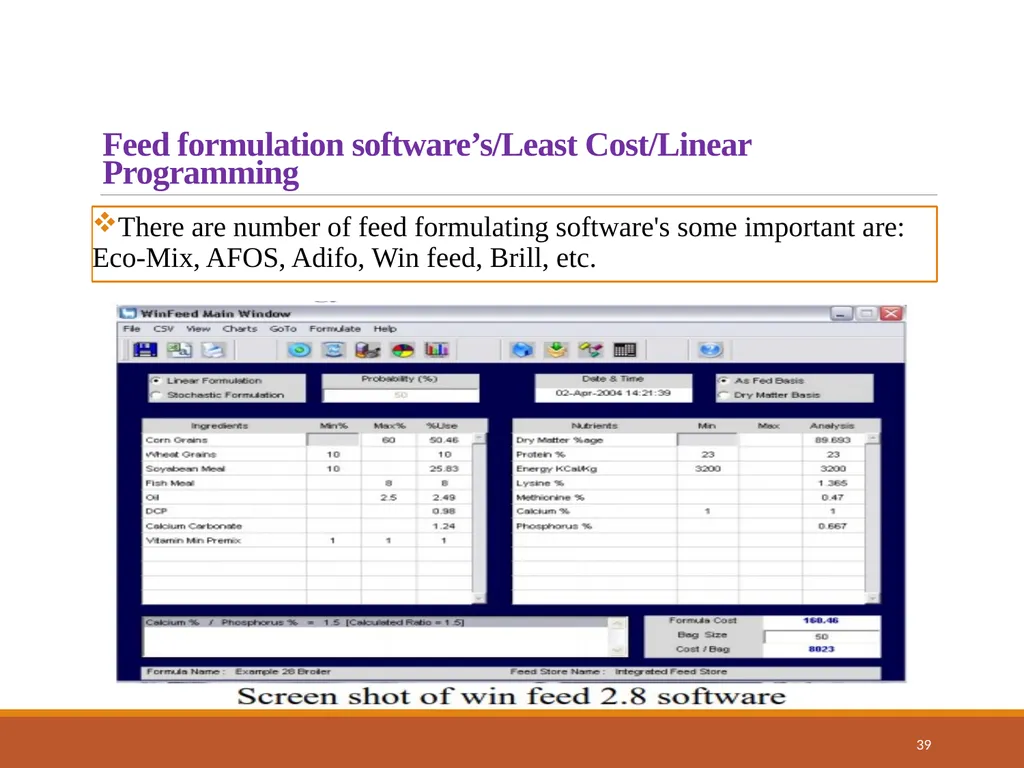
Feed formulation software’s/Least Cost/Linear Programming There are number of feed formulating software's some important are:
Eco-Mix, AFOS, Adifo, Win feed, Brill, etc. 39<br>
Eco-Mix, AFOS, Adifo, Win feed, Brill, etc. 39<br>
40
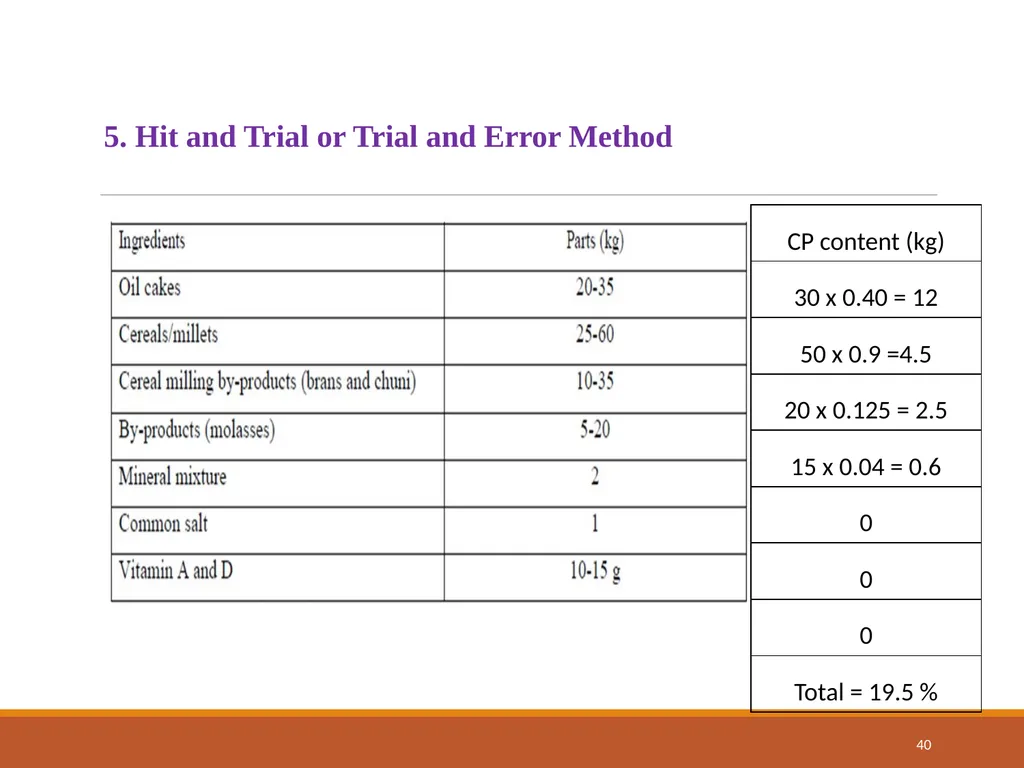
40 5. Hit and Trial or Trial and Error Method<br>
41
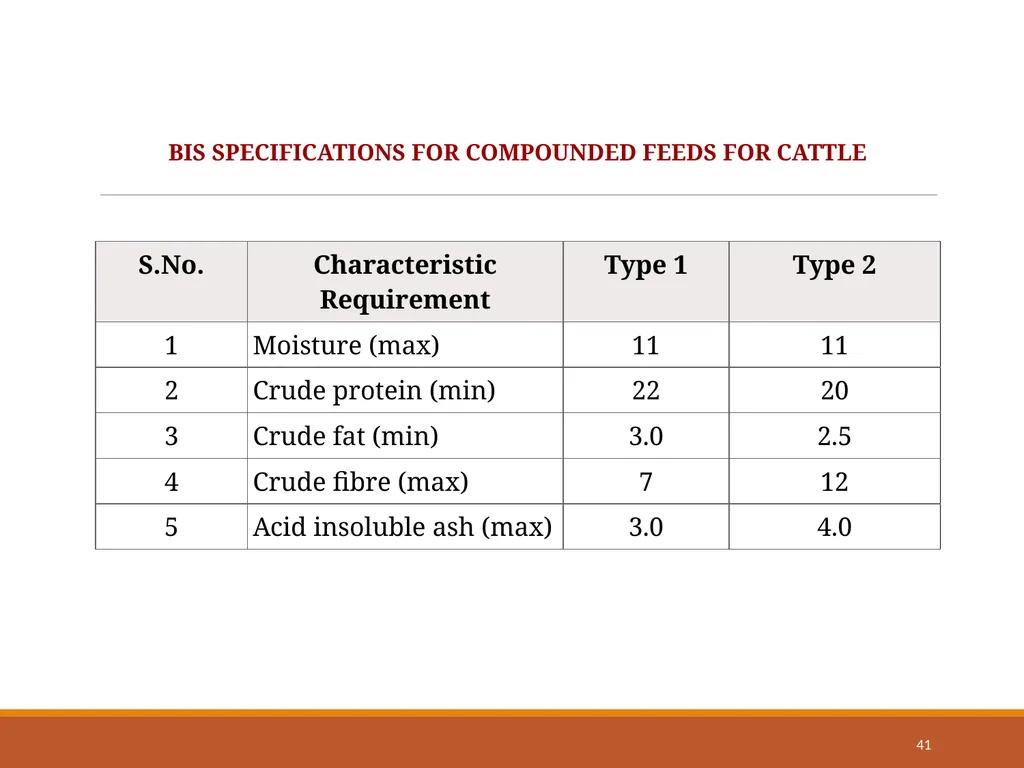
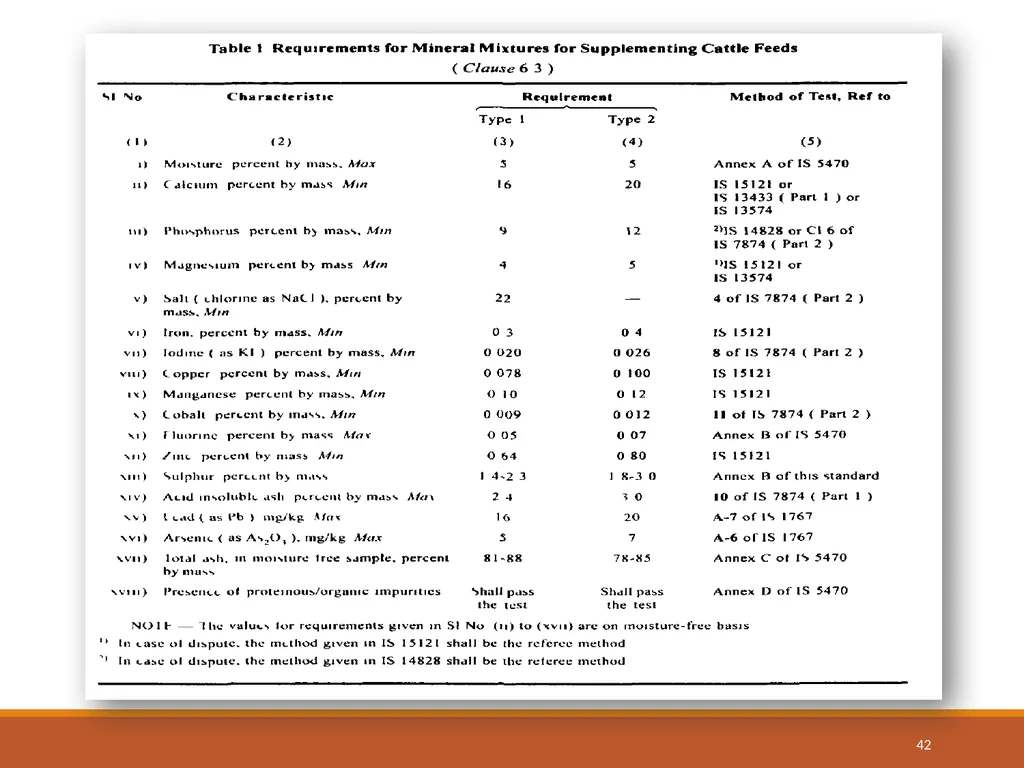
41 BIS SPECIFICATIONS FOR COMPOUNDED FEEDS FOR CATTLE<br>
42
42<br>
43
The livestock owner finds difficult to follow the computation on body weight basis.
The following thumb rule may guide them to feed their livestock satisfactory.
Thumb rule is based on practical experience rather than scientific basis.
In maintenance type of indigenous and crossbred cow/buffalo, 1.5 and 2.0 kg, respectively concentrate mixture is recommended.
Over and above maintenance requirement, additional 1 kg concentrate mixture is required for every 2.5 kg (40%) of milk in indigenous cow and per 2.0 kg (50%) of milk in case of buffaloes
During the last trimester of pregnancy, a further quantity of 1.25 kg and 1.75 kg concentrate mixture is recommended for indigenous and crossbred cow/buffalo, respectively. 43 Feeding of concentrate by thumb rule method<br>
44
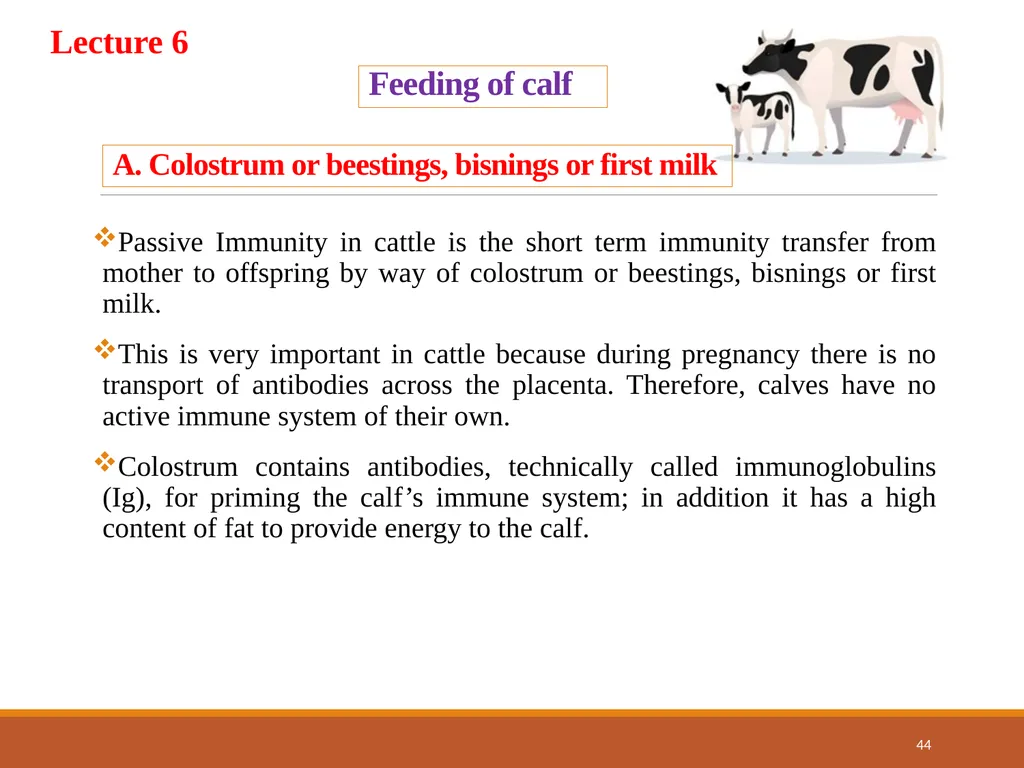
Passive Immunity in cattle is the short term immunity transfer from mother to offspring by way of colostrum or beestings, bisnings or first milk.
This is very important in cattle because during pregnancy there is no transport of antibodies across the placenta. Therefore, calves have no active immune system of their own.
Colostrum contains antibodies, technically called immunoglobulins (Ig), for priming the calf’s immune system; in addition it has a high content of fat to provide energy to the calf. 44 Feeding of calf A. Colostrum or beestings, bisnings or first milk Lecture 6<br>
45
Newborn calf’s small intestine is permeable or “open” and is able to absorb the Ig contained in colostrum by the process of pinocytosis however, it can also absorb environmental pathogens that can cause diseases.
For this reason, it is important that newborn calves receive colostrum as soon as possible (with 2 hours of birth) not later than 3 hours of birth.
During the first 3 days of its life the calf should receive colostrum.
The protein content of colostrum is 17% as against only 3.5% in normal milk. 45<br>
46
The content of vitamins (A, D and E) and minerals (Ca, Mg, Fe and P) is very high in colostrum.
The laxative action of colostrum helps the calf in evacuating the accumulated first faecal matter (muconium) from its intestine.
Colostrum should not be warmed as due to the presence of large amount of protein. It will coagulate/clot during heating. 46<br>
The laxative action of colostrum helps the calf in evacuating the accumulated first faecal matter (muconium) from its intestine.
Colostrum should not be warmed as due to the presence of large amount of protein. It will coagulate/clot during heating. 46<br>
47
Colostrum quality depends on the content of immunoglobulins which are the proteins that convey protection against disease.
Visual Assessment:
Colostrum should have a thick consistency and color should be yellowish, avoid feeding any colostrum that looks brown or has blood in it.
Watery colostrum is of low quality and should not be fed to newborn calves if possible. If the colostrum has high content of proteins, it will be very thick. The thicker the better!
Practical, but not very reliable. 47 Evaluation of colostrum quality<br>
48
The colostrometer is a large thermometer-like glass instrument that measures the specific gravity of colostrum.
It measures how thick a sample is, and this correlates to the Ig content of the colostrum.
When the instrument floats in the green zone area, it indicates high quality colostrum, medium quality is within the yellow are and very low quality is in the red area.
Practical and reliable method. 48 2. Colostrometer:<br>
49
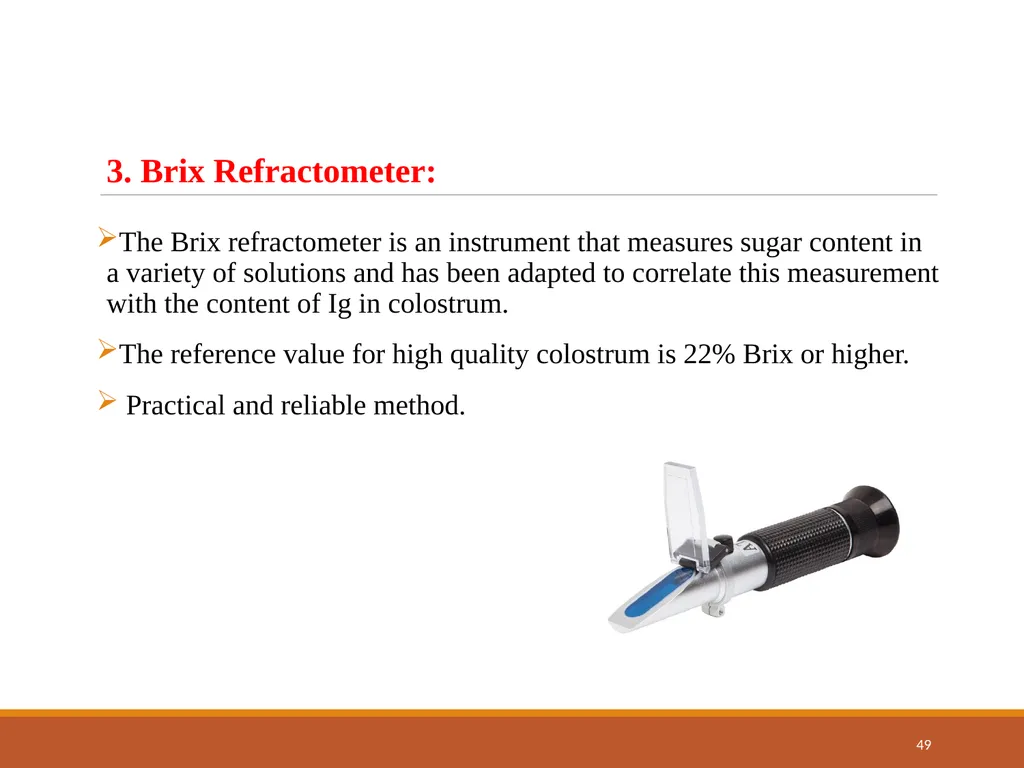
The Brix refractometer is an instrument that measures sugar content in a variety of solutions and has been adapted to correlate this measurement with the content of Ig in colostrum.
The reference value for high quality colostrum is 22% Brix or higher.
Practical and reliable method. 49 3. Brix Refractometer:<br>
The reference value for high quality colostrum is 22% Brix or higher.
Practical and reliable method. 49 3. Brix Refractometer:<br>
50
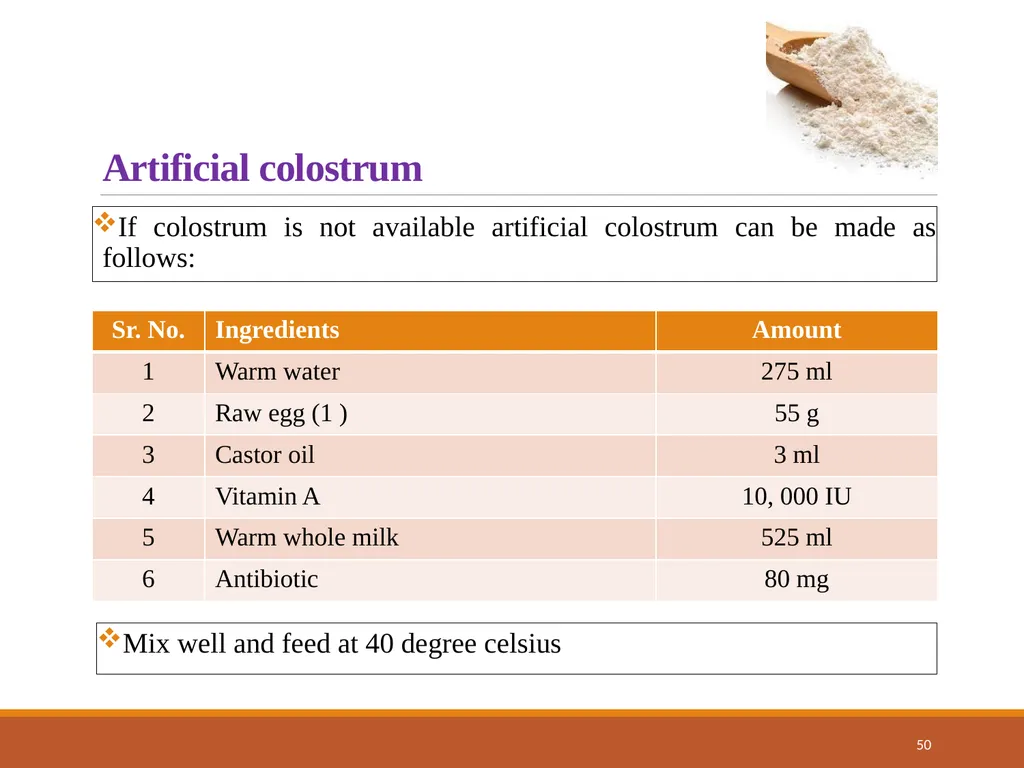
Artificial colostrum If colostrum is not available artificial colostrum can be made as follows: 50 Mix well and feed at 40 degree celsius<br>
51
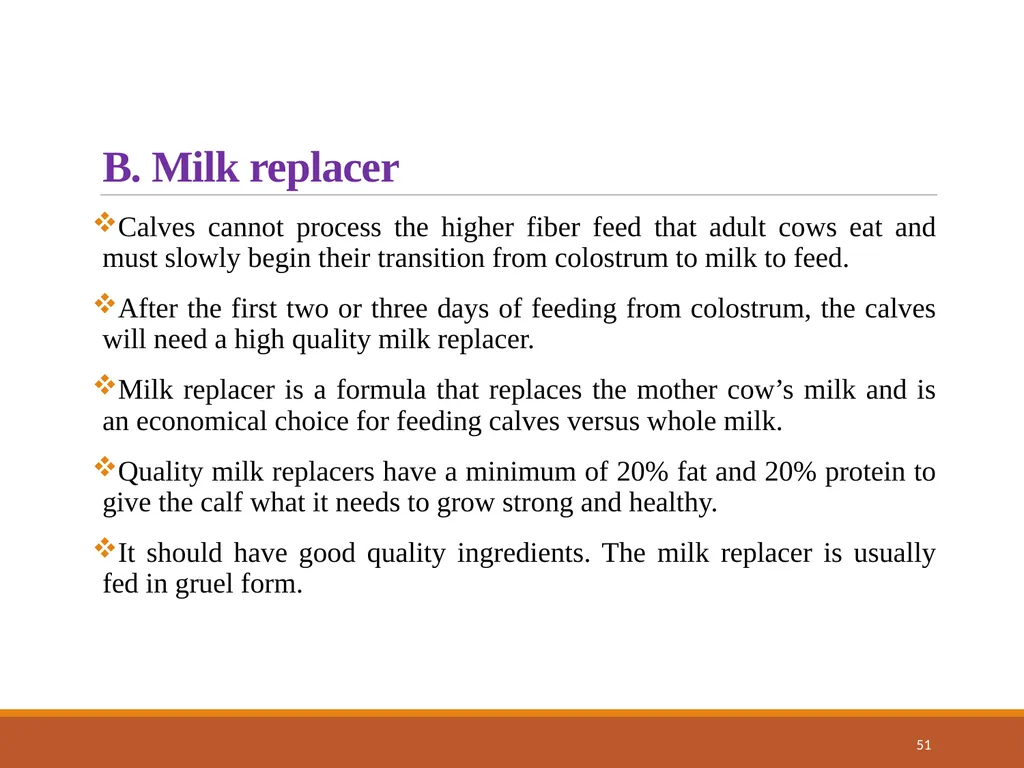
Calves cannot process the higher fiber feed that adult cows eat and must slowly begin their transition from colostrum to milk to feed.
After the first two or three days of feeding from colostrum, the calves will need a high quality milk replacer.
Milk replacer is a formula that replaces the mother cow’s milk and is an economical choice for feeding calves versus whole milk.
Quality milk replacers have a minimum of 20% fat and 20% protein to give the calf what it needs to grow strong and healthy.
It should have good quality ingredients. The milk replacer is usually fed in gruel form. 51 B. Milk replacer<br>
52
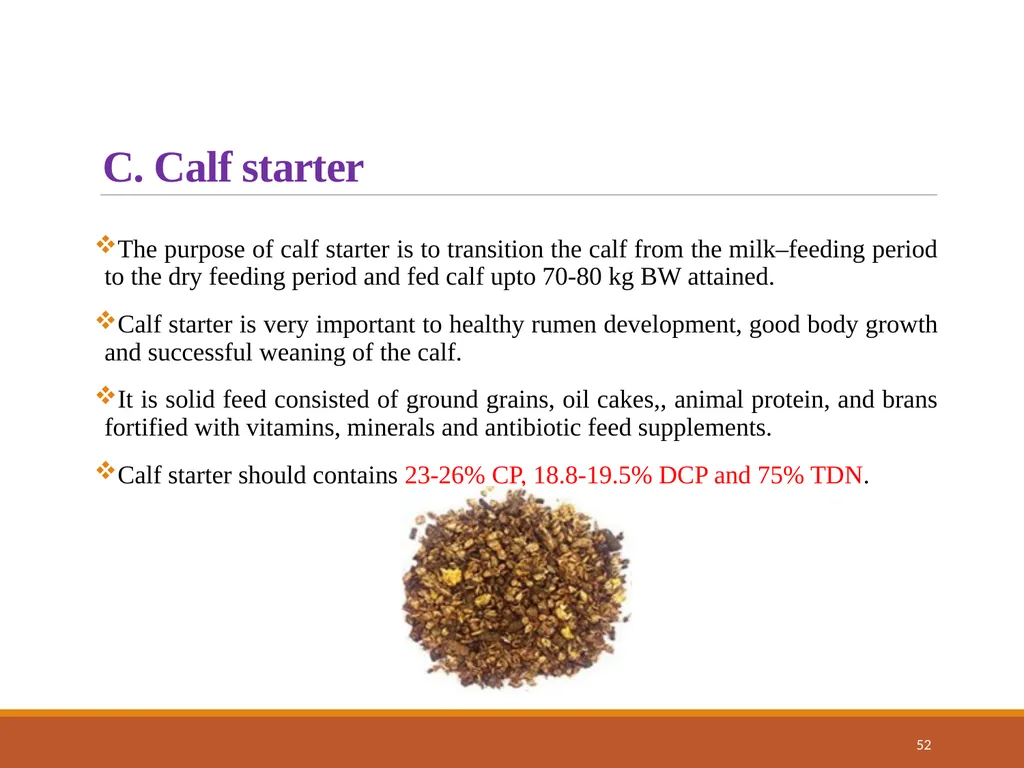
The purpose of calf starter is to transition the calf from the milk–feeding period to the dry feeding period and fed calf upto 70-80 kg BW attained.
Calf starter is very important to healthy rumen development, good body growth and successful weaning of the calf.
It is solid feed consisted of ground grains, oil cakes,, animal protein, and brans fortified with vitamins, minerals and antibiotic feed supplements.
Calf starter should contains 23-26% CP, 18.8-19.5% DCP and 75% TDN. 52 C. Calf starter<br>
53
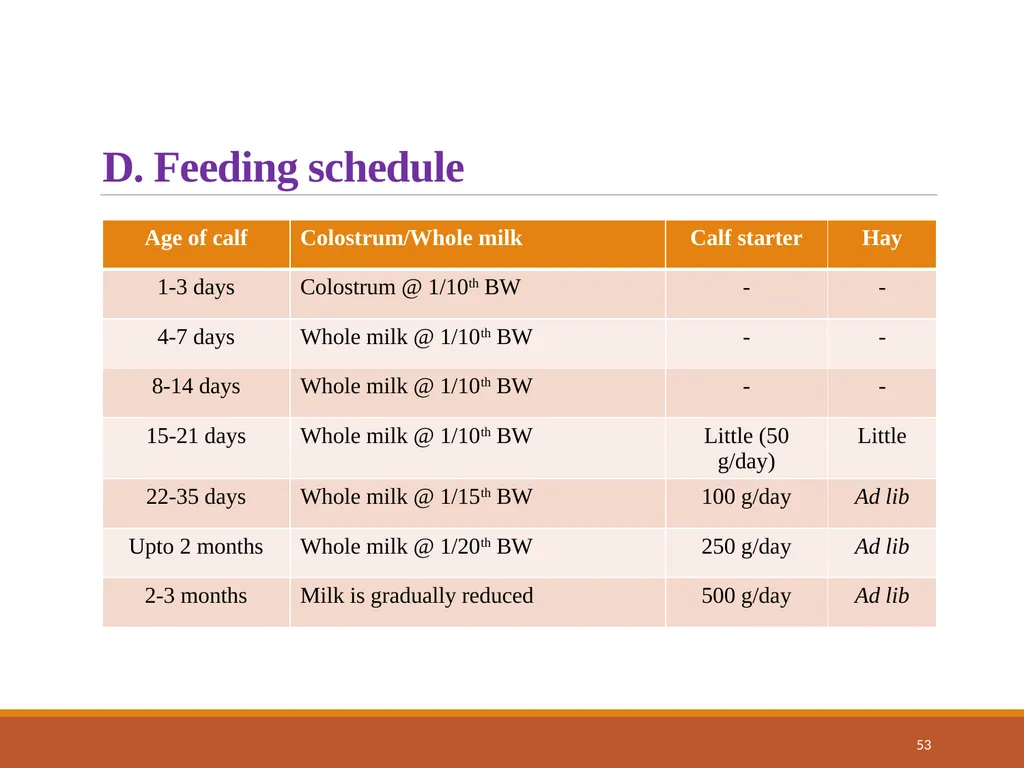
D. Feeding schedule 53<br>
54
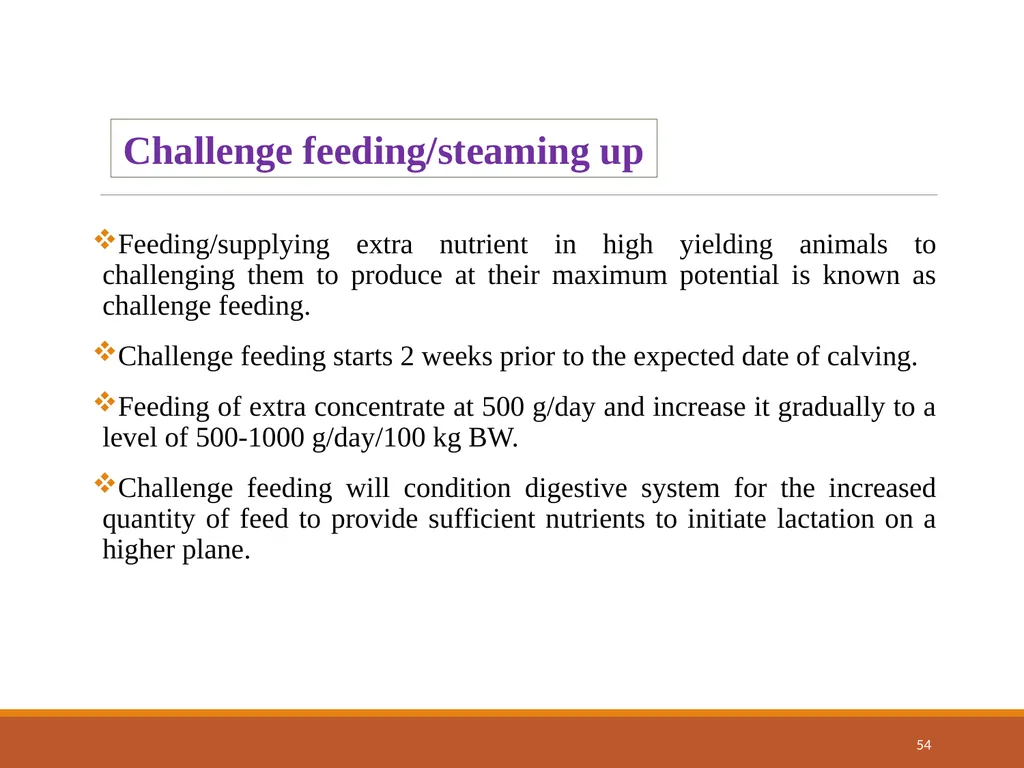
54 Challenge feeding/steaming up Feeding/supplying extra nutrient in high yielding animals to challenging them to produce at their maximum potential is known as challenge feeding.
Challenge feeding starts 2 weeks prior to the expected date of calving.
Feeding of extra concentrate at 500 g/day and increase it gradually to a level of 500-1000 g/day/100 kg BW.
Challenge feeding will condition digestive system for the increased quantity of feed to provide sufficient nutrients to initiate lactation on a higher plane.<br>
55
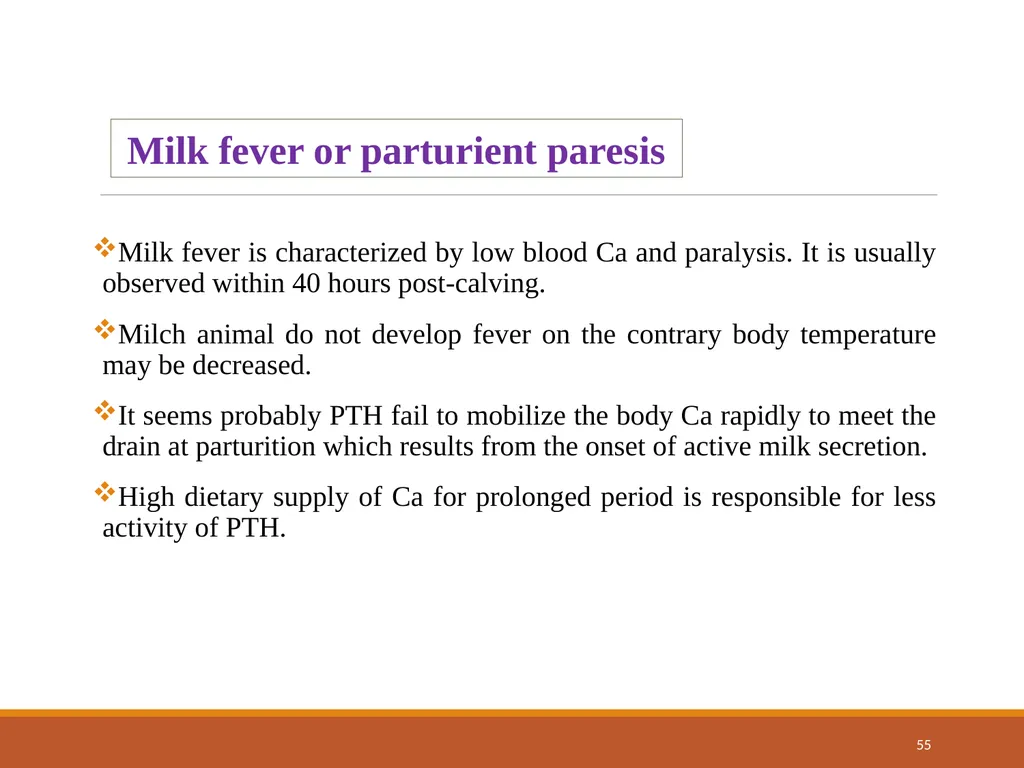
55 Milk fever or parturient paresis Milk fever is characterized by low blood Ca and paralysis. It is usually observed within 40 hours post-calving.
Milch animal do not develop fever on the contrary body temperature may be decreased.
It seems probably PTH fail to mobilize the body Ca rapidly to meet the drain at parturition which results from the onset of active milk secretion.
High dietary supply of Ca for prolonged period is responsible for less activity of PTH.<br>
56
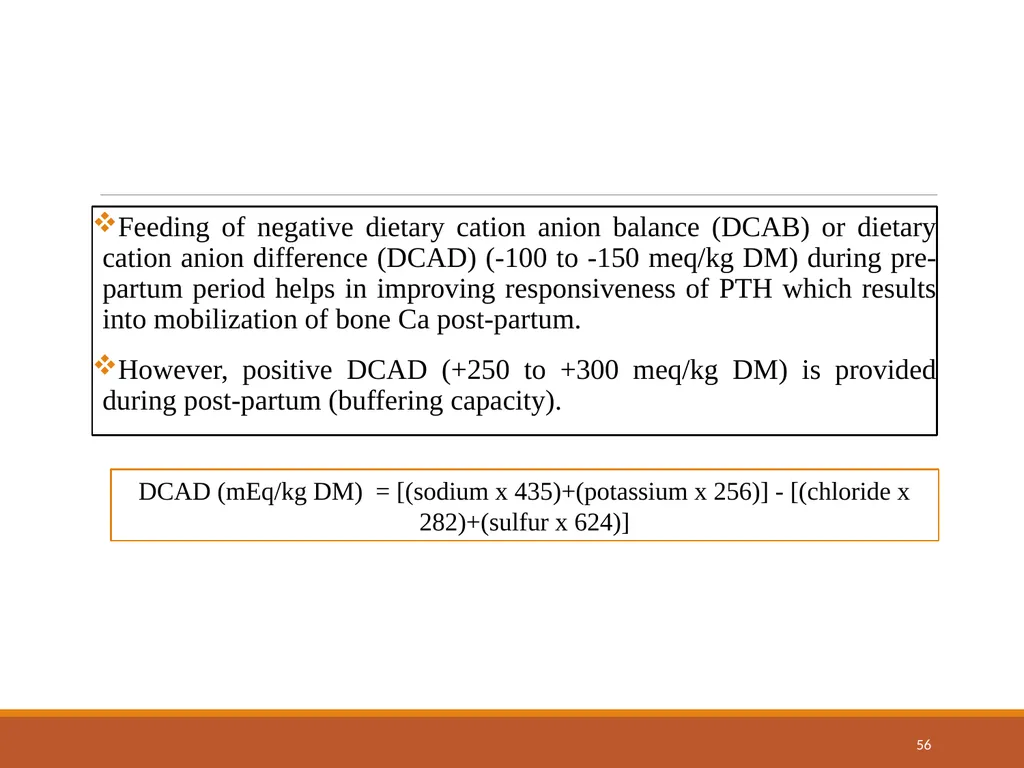
Feeding of negative dietary cation anion balance (DCAB) or dietary cation anion difference (DCAD) (-100 to -150 meq/kg DM) during pre-partum period helps in improving responsiveness of PTH which results into mobilization of bone Ca post-partum.
However, positive DCAD (+250 to +300 meq/kg DM) is provided during post-partum (buffering capacity). 56 DCAD (mEq/kg DM) = [(sodium x 435)+(potassium x 256)] - [(chloride x 282)+(sulfur x 624)]<br>
However, positive DCAD (+250 to +300 meq/kg DM) is provided during post-partum (buffering capacity). 56 DCAD (mEq/kg DM) = [(sodium x 435)+(potassium x 256)] - [(chloride x 282)+(sulfur x 624)]<br>
57
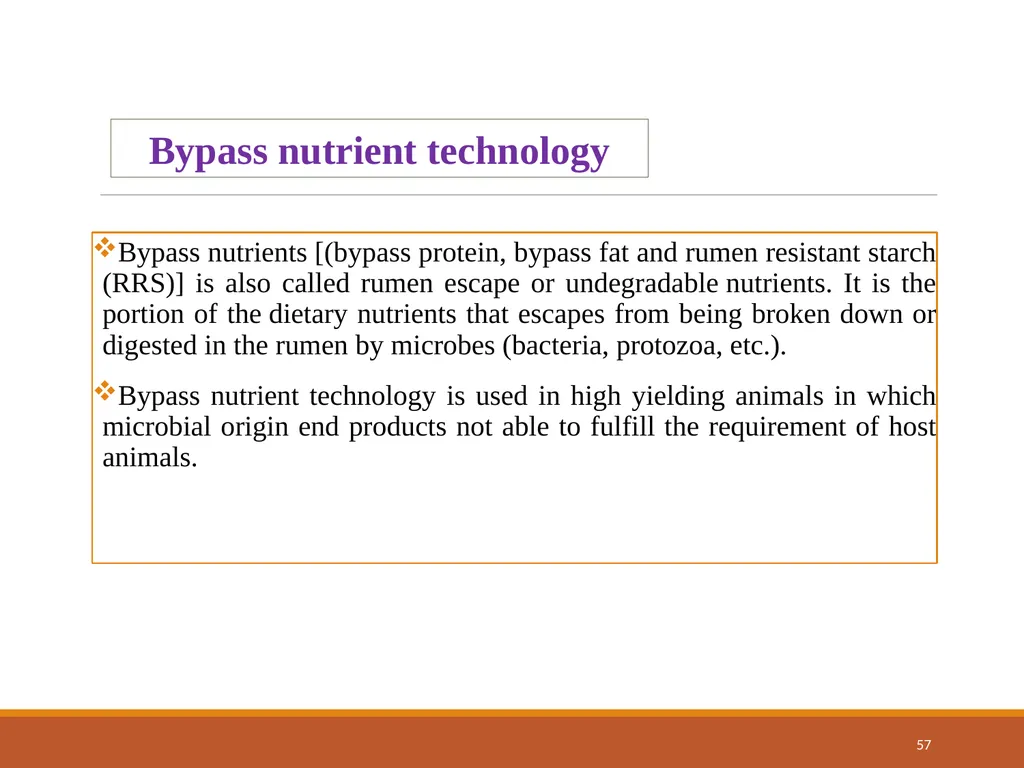
57 Bypass nutrient technology Bypass nutrients [(bypass protein, bypass fat and rumen resistant starch (RRS)] is also called rumen escape or undegradable nutrients. It is the portion of the dietary nutrients that escapes from being broken down or digested in the rumen by microbes (bacteria, protozoa, etc.).
Bypass nutrient technology is used in high yielding animals in which microbial origin end products not able to fulfill the requirement of host animals.<br>
Bypass nutrient technology is used in high yielding animals in which microbial origin end products not able to fulfill the requirement of host animals.<br>
58
Dr. Muneendra Kumar, Assistant Professor, Department of Animal Nutrition, DUVASU, Mathura 58<br>