
Component 1 - 1.2.a – Diet and nutrition and their
CB
Published · 37 slides · 0 views

1 / 1


Description
Component 1 - 1.2.a Diet and nutrition and their effect on physical activity and performance Timings Components of a healthy balanced diet For the average adult a balance of nutrients is important to maintain a healthy lifestyle. A
Related Topics
Share
Embed code
Download this presentation From Below
"Component 1 - 1.2.a – Diet and nutrition and their" is the property of its rightful owner. Permission is granted to download and print the materials on this website for personal, non-commercial use only, and to display it on your personal computer provided you do not modify the materials and that you retain all copyright notices contained in the materials. By downloading content from our website, you accept the terms of this agreement.
Presentation Transcript
01
Component 1 - 1.2.a – Diet and nutrition and their effect on physical activity and performance<br>
02
Timings<br>
03
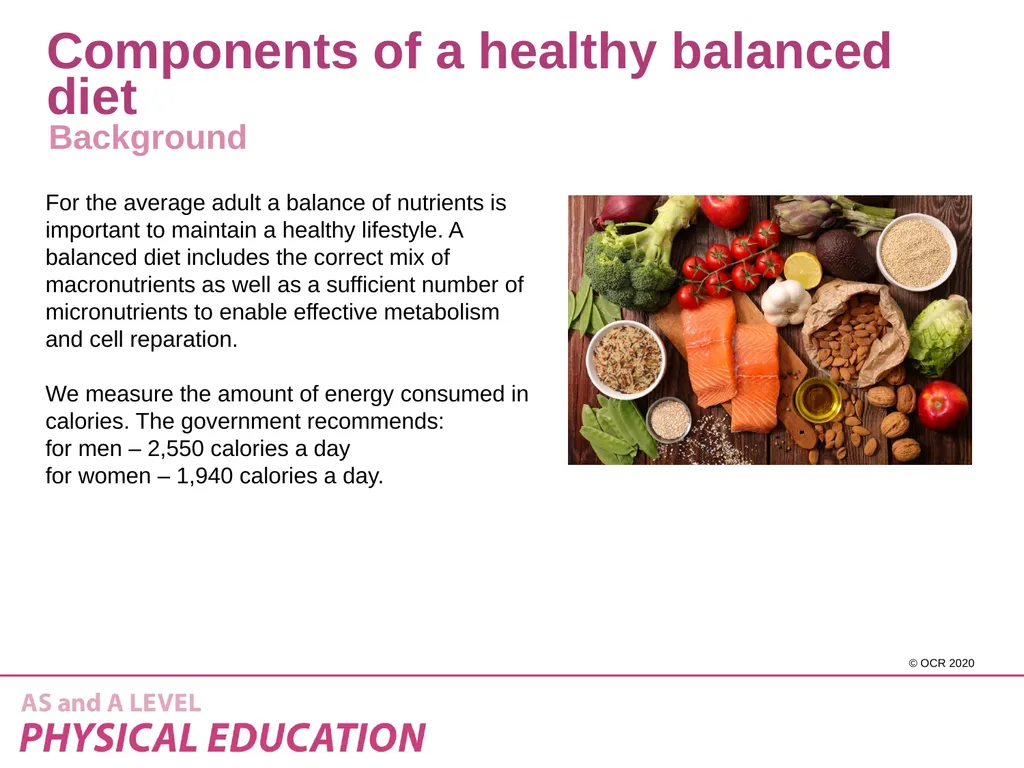
Components of a healthy balanced diet For the average adult a balance of nutrients is important to maintain a healthy lifestyle. A balanced diet includes the correct mix of macronutrients as well as a sufficient number of micronutrients to enable effective metabolism and cell reparation.
We measure the amount of energy consumed in calories. The government recommends:
for men – 2,550 calories a day
for women – 1,940 calories a day. Background<br>
We measure the amount of energy consumed in calories. The government recommends:
for men – 2,550 calories a day
for women – 1,940 calories a day. Background<br>
04
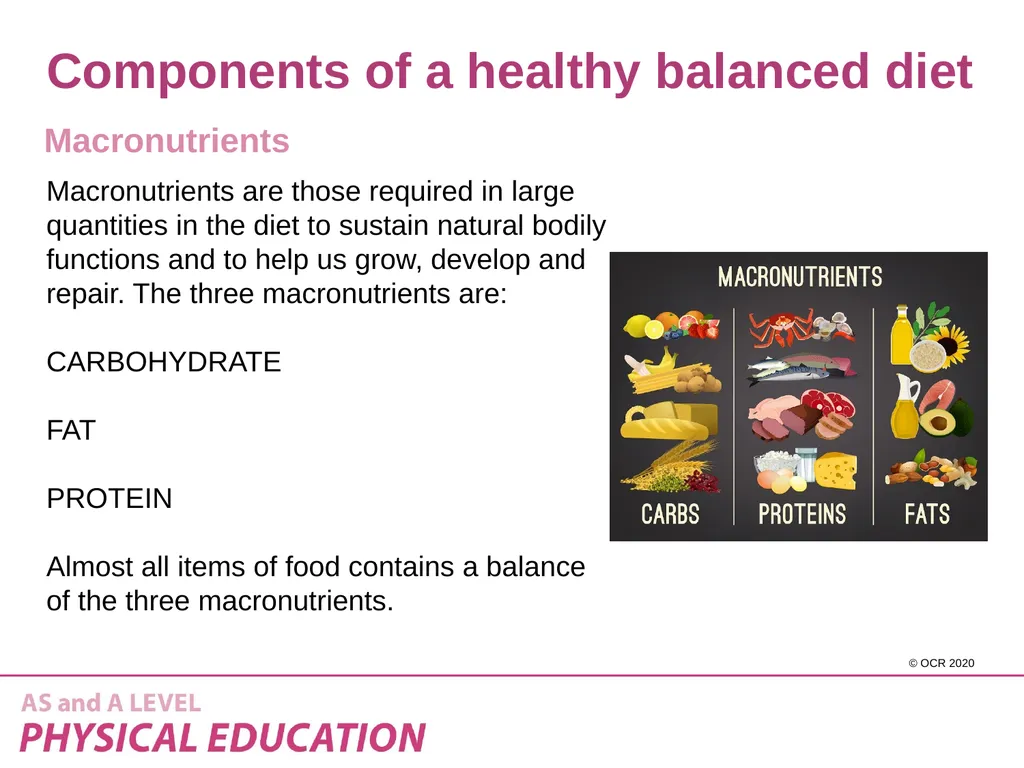
Macronutrients are those required in large quantities in the diet to sustain natural bodily functions and to help us grow, develop and repair. The three macronutrients are:
CARBOHYDRATE
FAT
PROTEIN
Almost all items of food contains a balance of the three macronutrients. Components of a healthy balanced diet Macronutrients<br>
CARBOHYDRATE
FAT
PROTEIN
Almost all items of food contains a balance of the three macronutrients. Components of a healthy balanced diet Macronutrients<br>
05
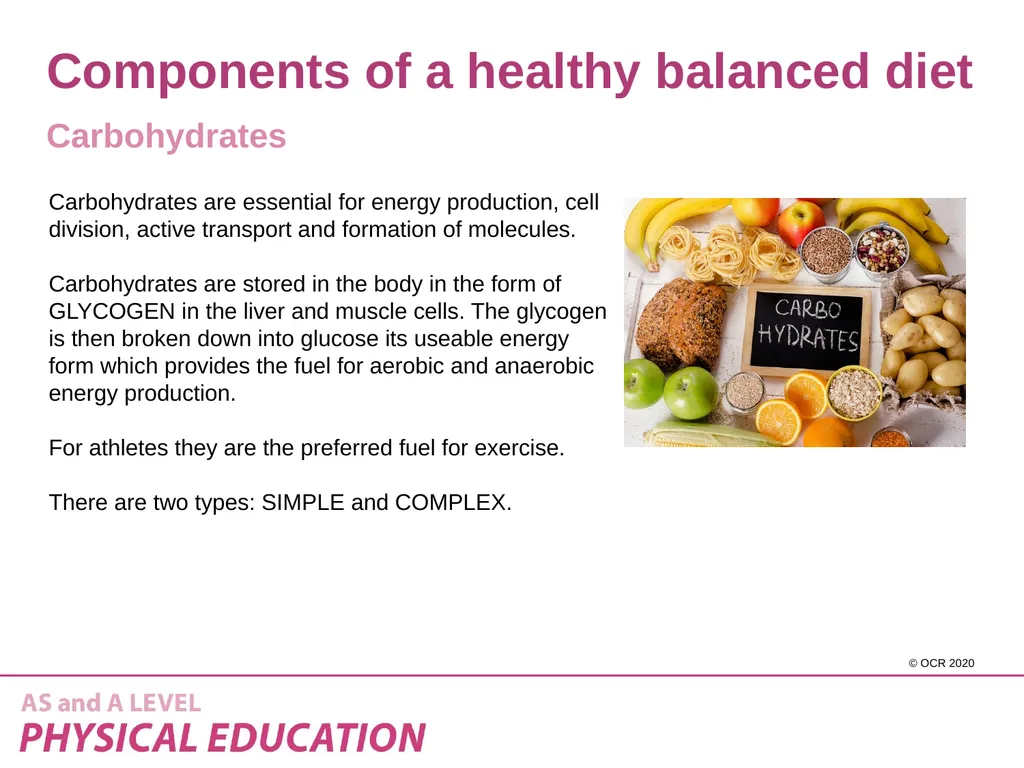
Carbohydrates are essential for energy production, cell division, active transport and formation of molecules.
Carbohydrates are stored in the body in the form of GLYCOGEN in the liver and muscle cells. The glycogen is then broken down into glucose its useable energy form which provides the fuel for aerobic and anaerobic energy production.
For athletes they are the preferred fuel for exercise.
There are two types: SIMPLE and COMPLEX. Components of a healthy balanced diet Carbohydrates<br>
06
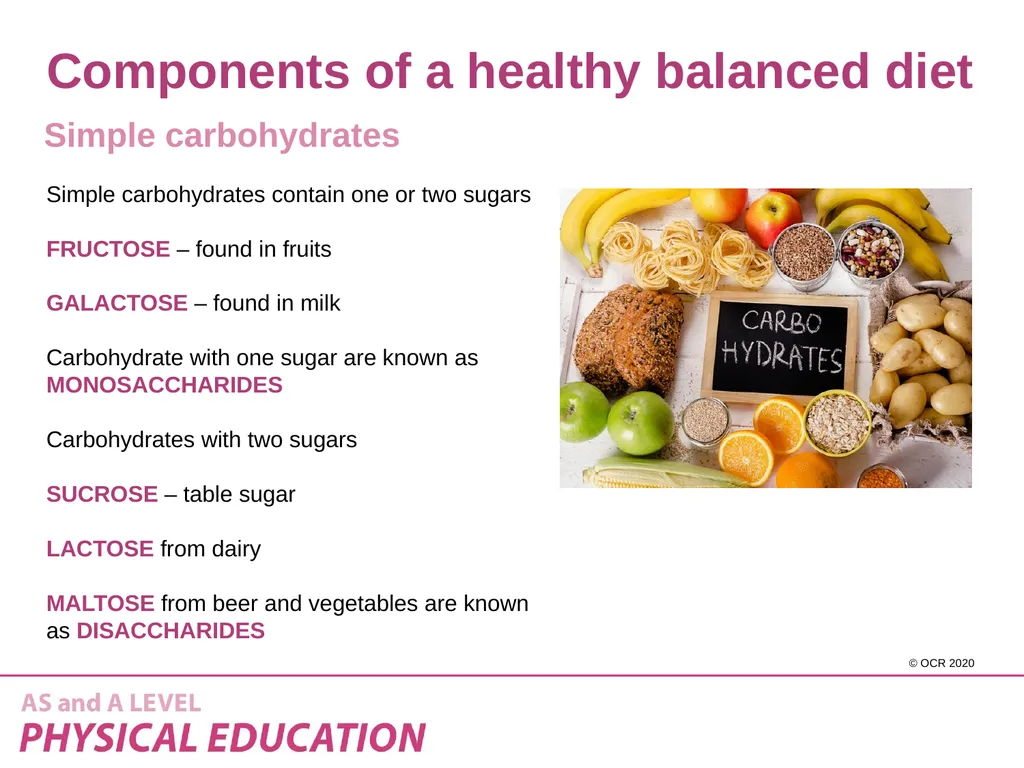
Simple carbohydrates contain one or two sugars
FRUCTOSE – found in fruits
GALACTOSE – found in milk
Carbohydrate with one sugar are known as MONOSACCHARIDES
Carbohydrates with two sugars
SUCROSE – table sugar
LACTOSE from dairy
MALTOSE from beer and vegetables are known as DISACCHARIDES Components of a healthy balanced diet Simple carbohydrates<br>
07
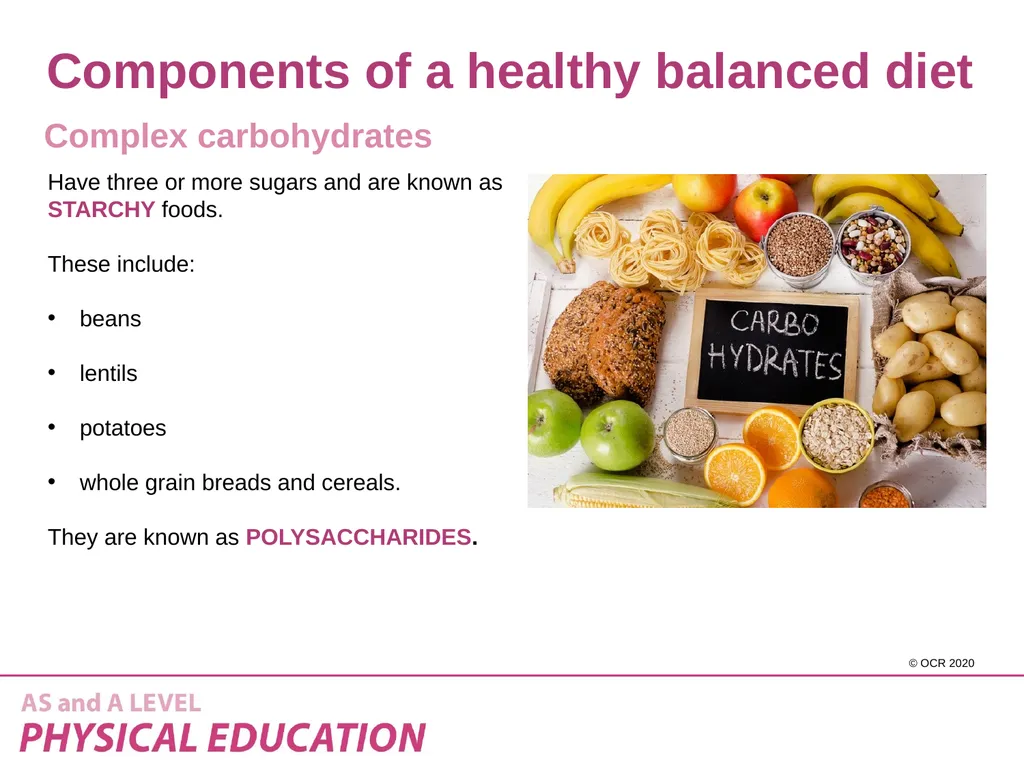
Have three or more sugars and are known as
STARCHY foods.
These include:
beans
lentils
potatoes
whole grain breads and cereals.
They are known as POLYSACCHARIDES. Components of a healthy balanced diet Complex carbohydrates<br>
These include:
beans
lentils
potatoes
whole grain breads and cereals.
They are known as POLYSACCHARIDES. Components of a healthy balanced diet Complex carbohydrates<br>
08
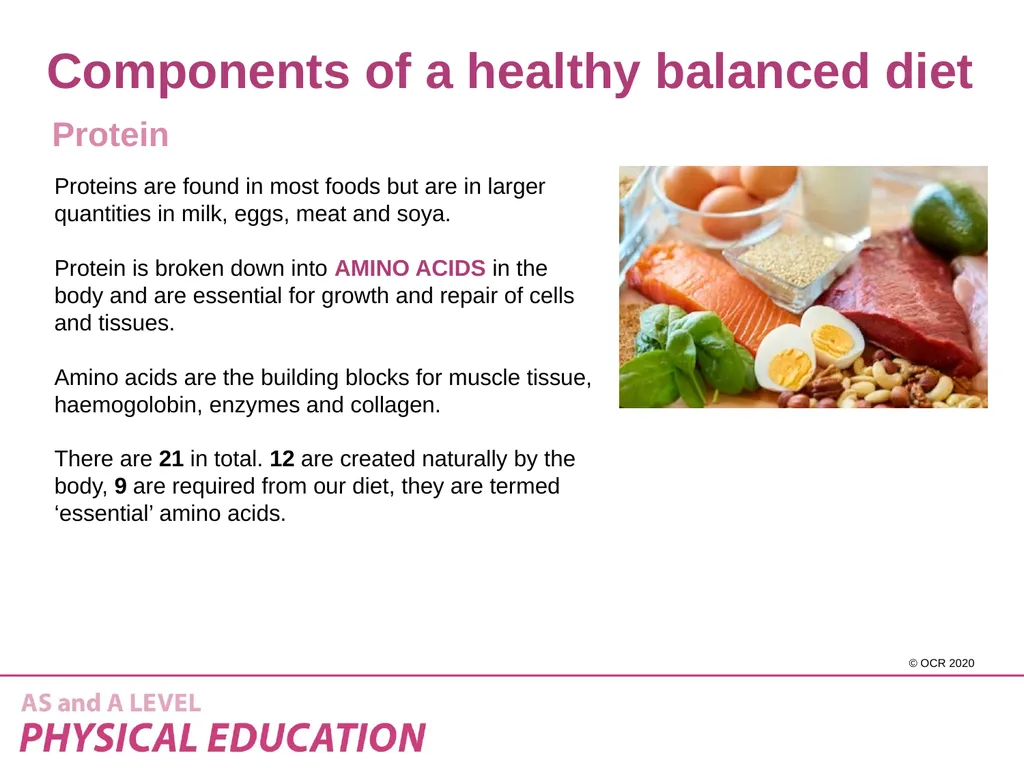
Proteins are found in most foods but are in larger quantities in milk, eggs, meat and soya.
Protein is broken down into AMINO ACIDS in the body and are essential for growth and repair of cells and tissues.
Amino acids are the building blocks for muscle tissue, haemogolobin, enzymes and collagen.
There are 21 in total. 12 are created naturally by the body, 9 are required from our diet, they are termed ‘essential’ amino acids. Components of a healthy balanced diet Protein<br>
09
Fat is an essential part of our diet. A small amount is
a source of essential FATTY ACIDS.
Fat helps the body to absorb certain vitamins.
All types of fat are high in energy and can be used for aerobic respiration under certain conditions.
The main types of fat found in food are:
SATURATED
UNSATURATED
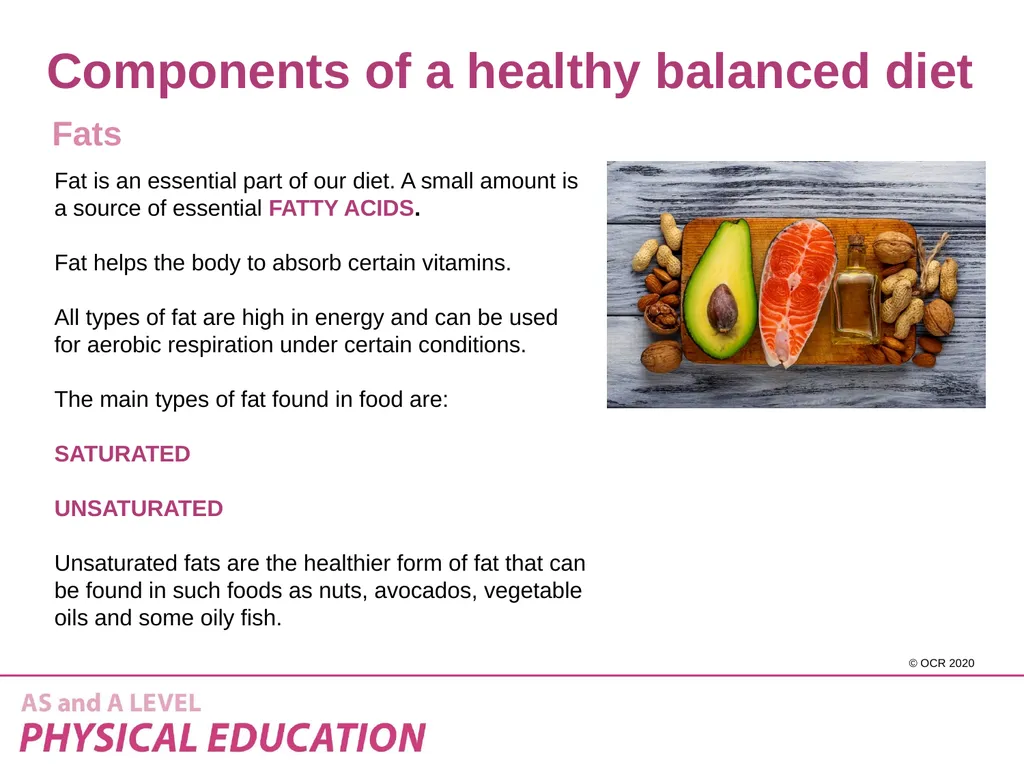
Unsaturated fats are the healthier form of fat that can be found in such foods as nuts, avocados, vegetable oils and some oily fish. Components of a healthy balanced diet Fats<br>
10
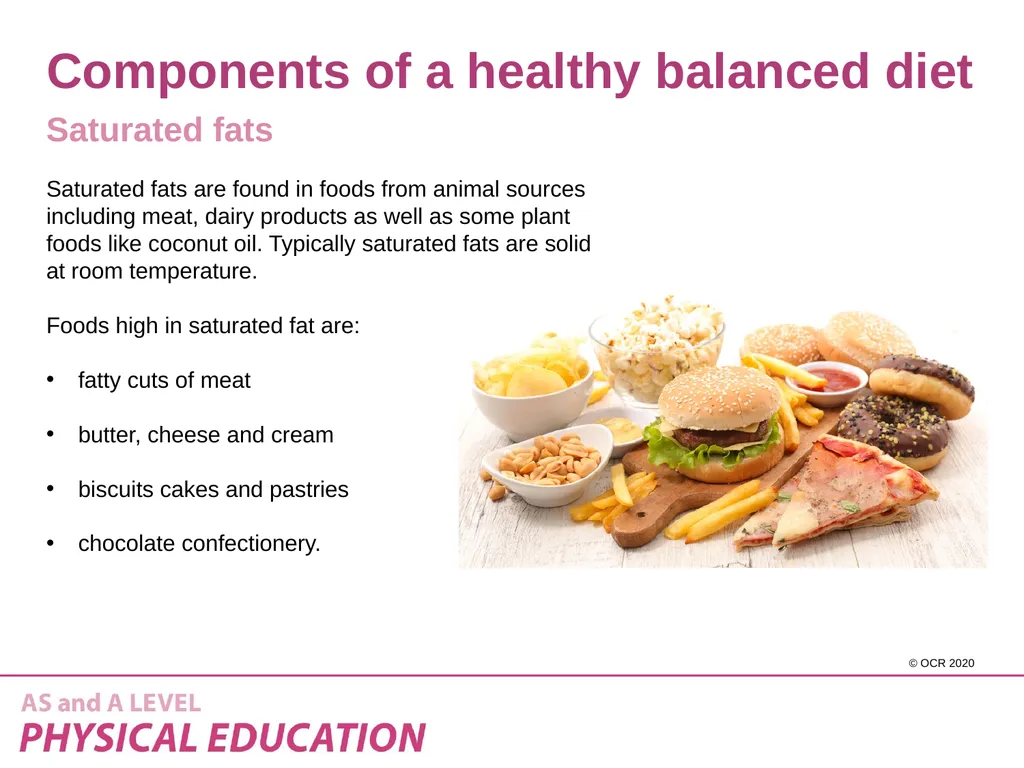
Components of a healthy balanced diet Saturated fats Saturated fats are found in foods from animal sources including meat, dairy products as well as some plant foods like coconut oil. Typically saturated fats are solid at room temperature.
Foods high in saturated fat are:
fatty cuts of meat
butter, cheese and cream
biscuits cakes and pastries
chocolate confectionery.<br>
Foods high in saturated fat are:
fatty cuts of meat
butter, cheese and cream
biscuits cakes and pastries
chocolate confectionery.<br>
11
Components of a healthy balanced diet Unsaturated fats Unsaturated fats are found in foods that are
typically liquid at room temperature.
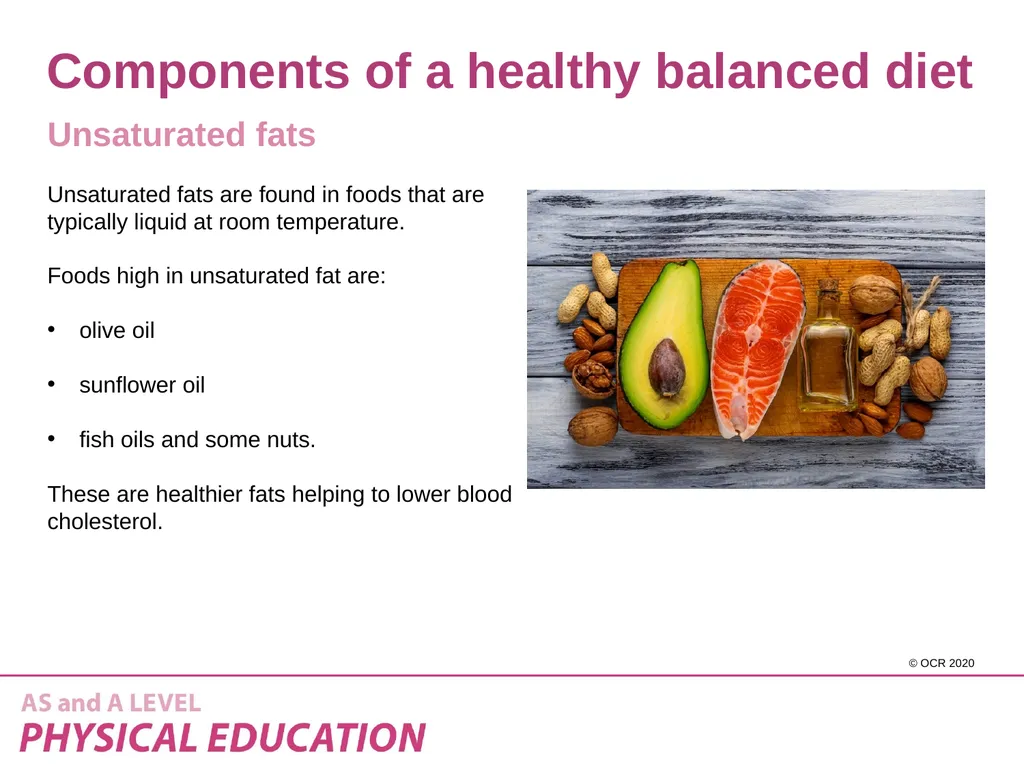
Foods high in unsaturated fat are:
olive oil
sunflower oil
fish oils and some nuts.
These are healthier fats helping to lower blood cholesterol.<br>
Foods high in unsaturated fat are:
olive oil
sunflower oil
fish oils and some nuts.
These are healthier fats helping to lower blood cholesterol.<br>
12
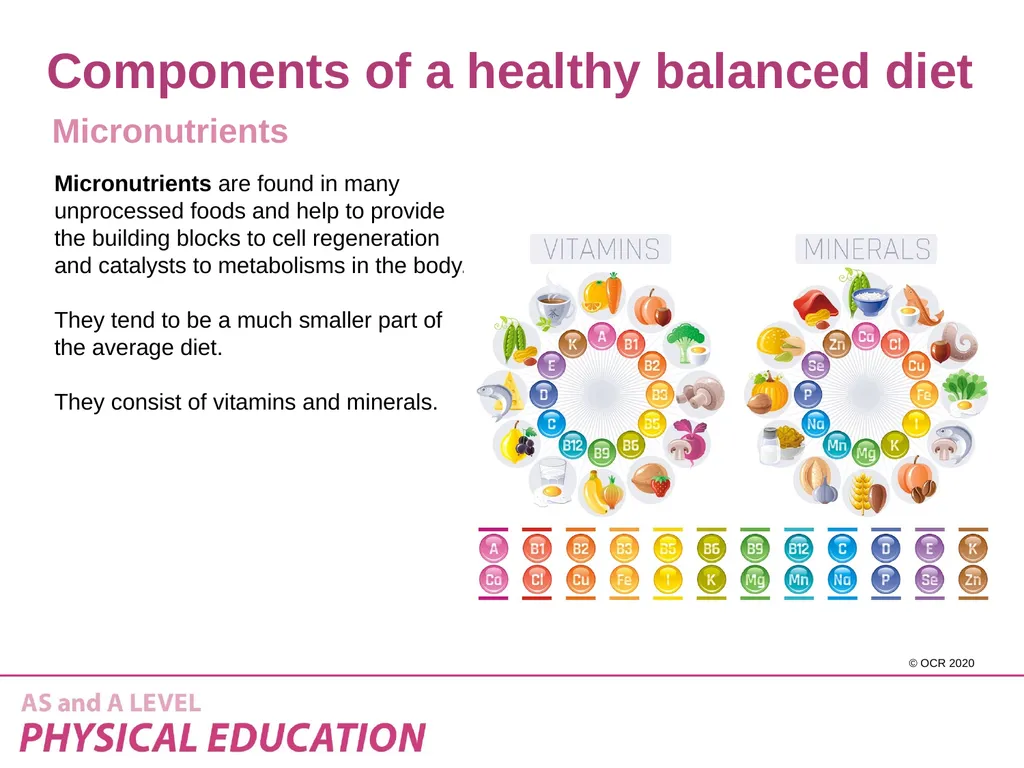
Micronutrients are found in many unprocessed foods and help to provide the building blocks to cell regeneration and catalysts to metabolisms in the body.
They tend to be a much smaller part of the average diet.
They consist of vitamins and minerals. Components of a healthy balanced diet Micronutrients<br>
They tend to be a much smaller part of the average diet.
They consist of vitamins and minerals. Components of a healthy balanced diet Micronutrients<br>
13
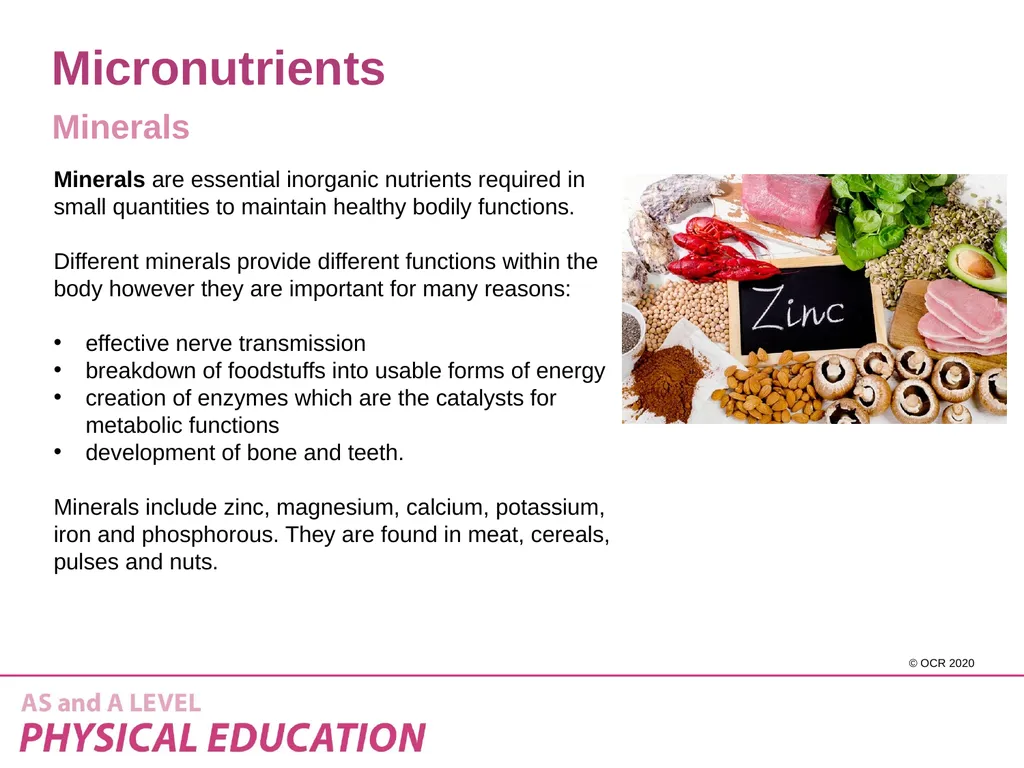
Minerals are essential inorganic nutrients required in small quantities to maintain healthy bodily functions.
Different minerals provide different functions within the body however they are important for many reasons:
effective nerve transmission
breakdown of foodstuffs into usable forms of energy
creation of enzymes which are the catalysts for metabolic functions
development of bone and teeth.
Minerals include zinc, magnesium, calcium, potassium, iron and phosphorous. They are found in meat, cereals, pulses and nuts. Micronutrients Minerals<br>
14
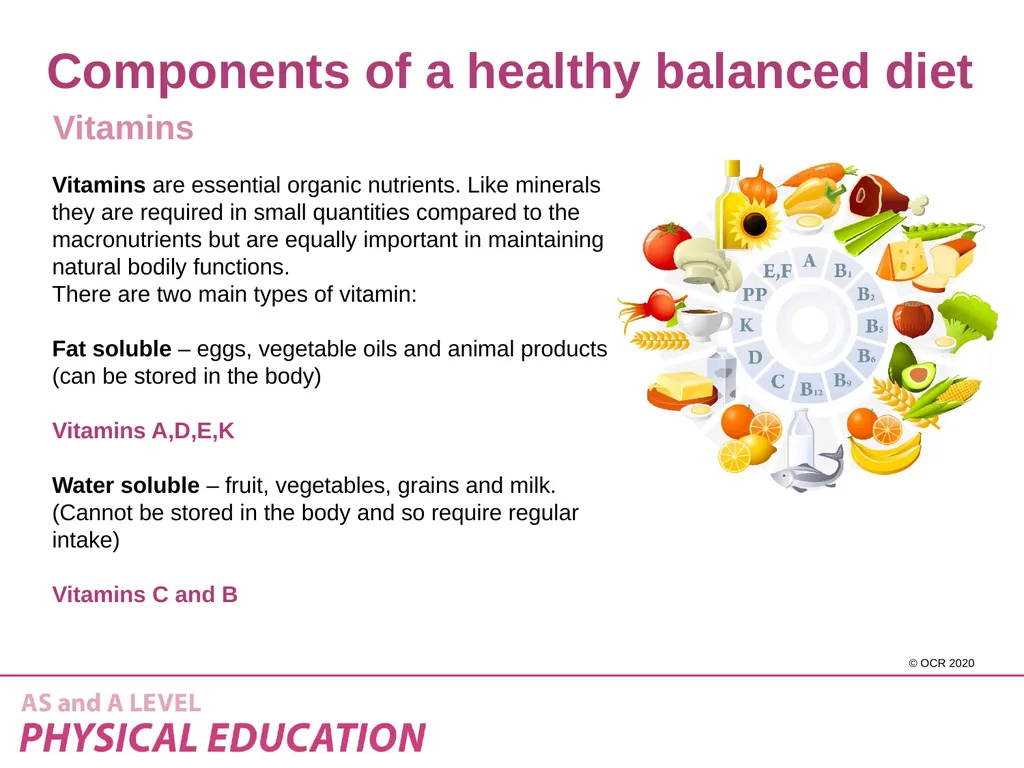
Vitamins are essential organic nutrients. Like minerals they are required in small quantities compared to the macronutrients but are equally important in maintaining natural bodily functions.
There are two main types of vitamin:
Fat soluble – eggs, vegetable oils and animal products (can be stored in the body)
Vitamins A,D,E,K
Water soluble – fruit, vegetables, grains and milk.
(Cannot be stored in the body and so require regular intake)
Vitamins C and B Components of a healthy balanced diet Vitamins<br>
15
Components of a healthy balanced diet Water Water is vital for life and efficient functions of many systems within the body and is often overlooked as a dietary component. Particularly for those taking part in sport or fitness the intake of water is essential.
Between 60-70% of the body is made up of water. It helps with temperature regulation through perspiration, transportation of vitamins and minerals, also glucose and free fatty acids in the blood plasma.
It is also essential for transporting oxygen to muscle tissue.<br>
Between 60-70% of the body is made up of water. It helps with temperature regulation through perspiration, transportation of vitamins and minerals, also glucose and free fatty acids in the blood plasma.
It is also essential for transporting oxygen to muscle tissue.<br>
16
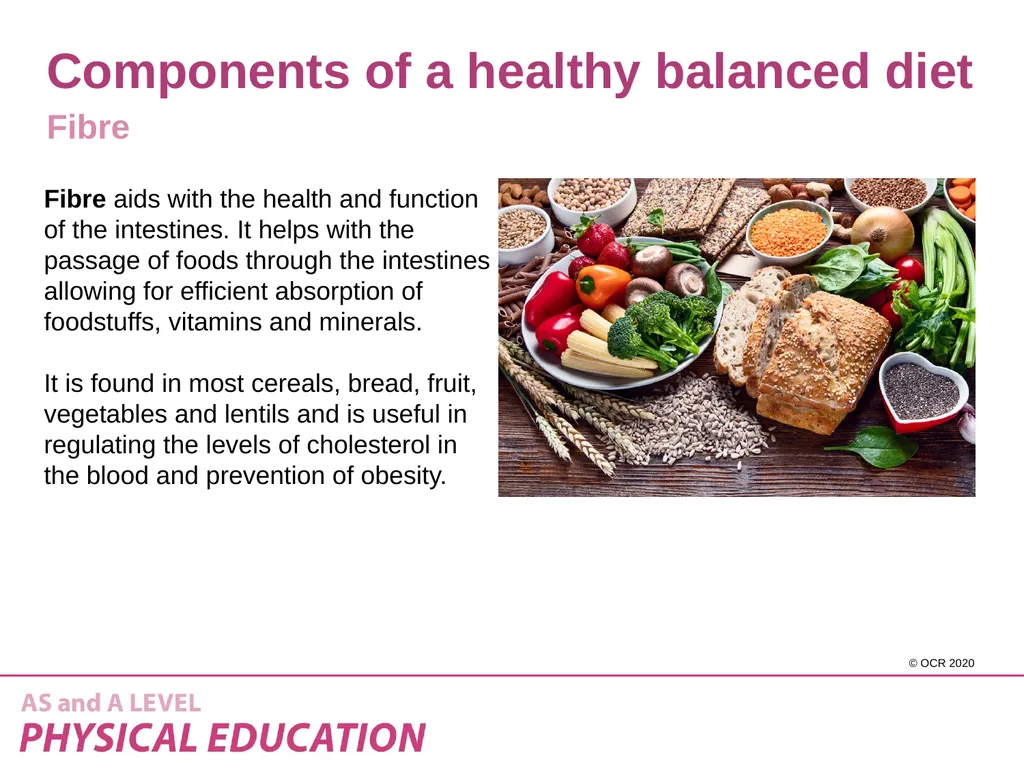
Components of a healthy balanced diet Fibre Fibre aids with the health and function of the intestines. It helps with the passage of foods through the intestines allowing for efficient absorption of foodstuffs, vitamins and minerals.
It is found in most cereals, bread, fruit, vegetables and lentils and is useful in regulating the levels of cholesterol in the blood and prevention of obesity.<br>
It is found in most cereals, bread, fruit, vegetables and lentils and is useful in regulating the levels of cholesterol in the blood and prevention of obesity.<br>
17
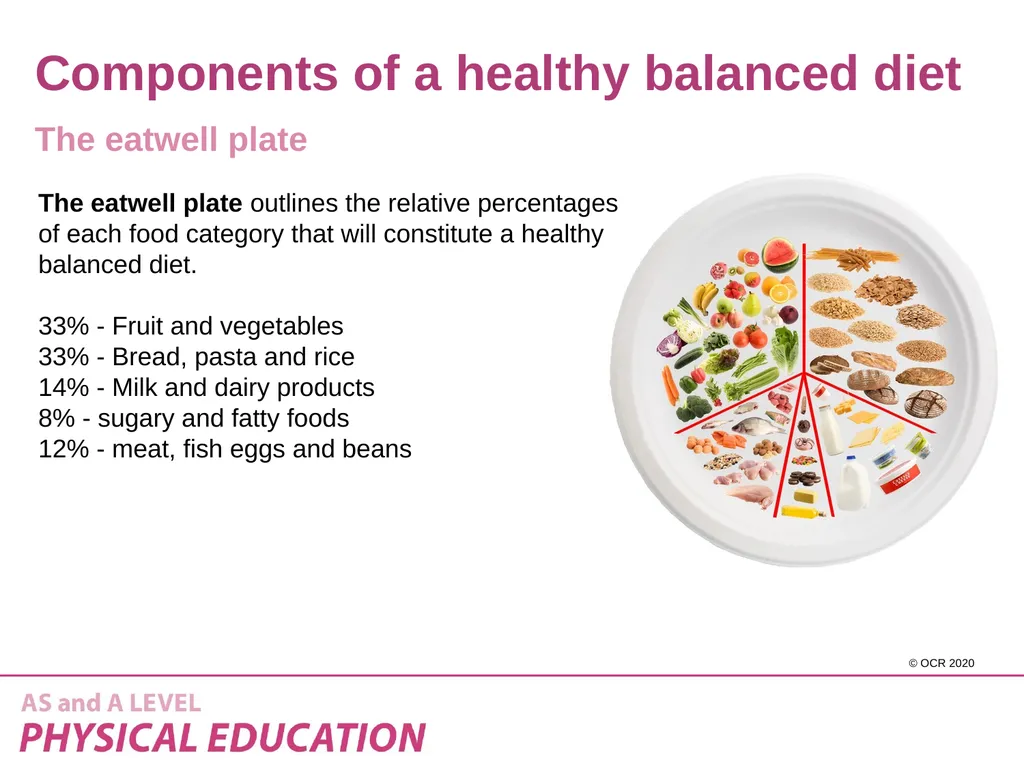
Components of a healthy balanced diet The eatwell plate The eatwell plate outlines the relative percentages of each food category that will constitute a healthy balanced diet.
33% - Fruit and vegetables
33% - Bread, pasta and rice
14% - Milk and dairy products
8% - sugary and fatty foods
12% - meat, fish eggs and beans<br>
33% - Fruit and vegetables
33% - Bread, pasta and rice
14% - Milk and dairy products
8% - sugary and fatty foods
12% - meat, fish eggs and beans<br>
18
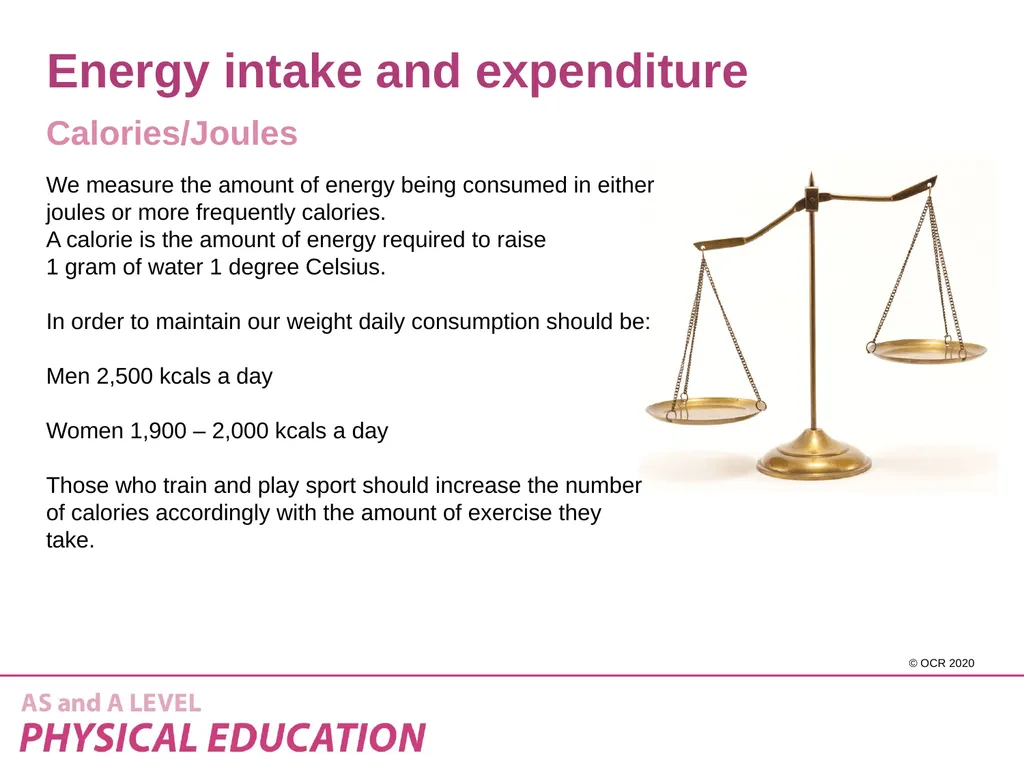
Energy intake and expenditure Calories/Joules We measure the amount of energy being consumed in either joules or more frequently calories.
A calorie is the amount of energy required to raise 1 gram of water 1 degree Celsius.
In order to maintain our weight daily consumption should be:
Men 2,500 kcals a day
Women 1,900 – 2,000 kcals a day
Those who train and play sport should increase the number of calories accordingly with the amount of exercise they take.<br>
19
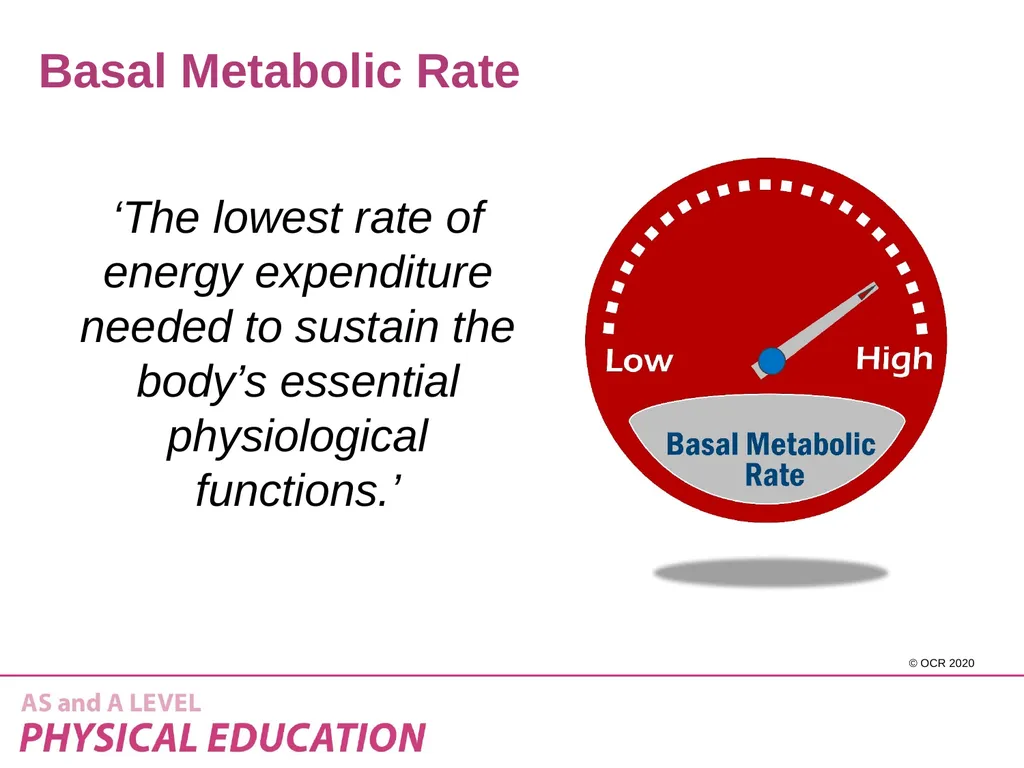
Basal Metabolic Rate ‘The lowest rate of energy expenditure needed to sustain the body’s essential physiological functions.’<br>
20
RMR – Resting metabolic rate ‘The lowest rate of energy expenditure needed to sustain the body’s essential physiological functions NOT including sleep.’<br>
21
METS – Metabolic Equivalent Tasks ml O2 / kg / min
‘Calculation of energy expenditure of physical activity’<br>
‘Calculation of energy expenditure of physical activity’<br>
22
METS – Metabolic Equivalent Tasks Netball = 7-8.0
Rowing = 12
Squash = 8.5
Light Gardening = 2.0
Your sport = ?<br>
Rowing = 12
Squash = 8.5
Light Gardening = 2.0
Your sport = ?<br>
23
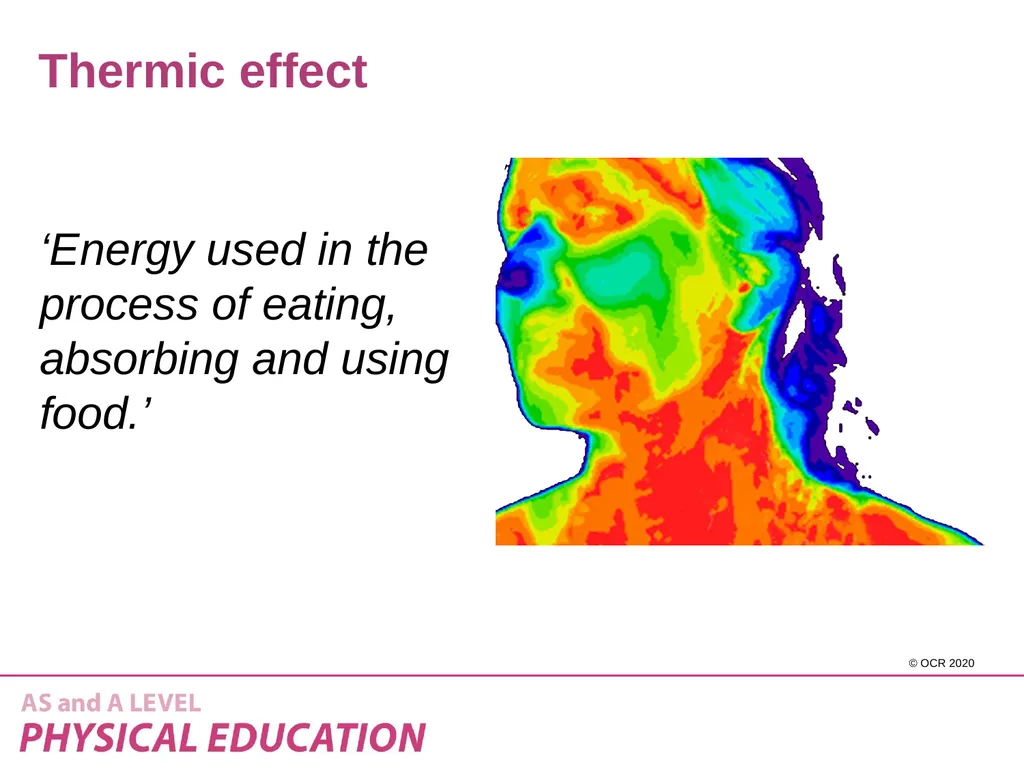
Thermic effect ‘Energy used in the process of eating, absorbing and using food.’<br>
24
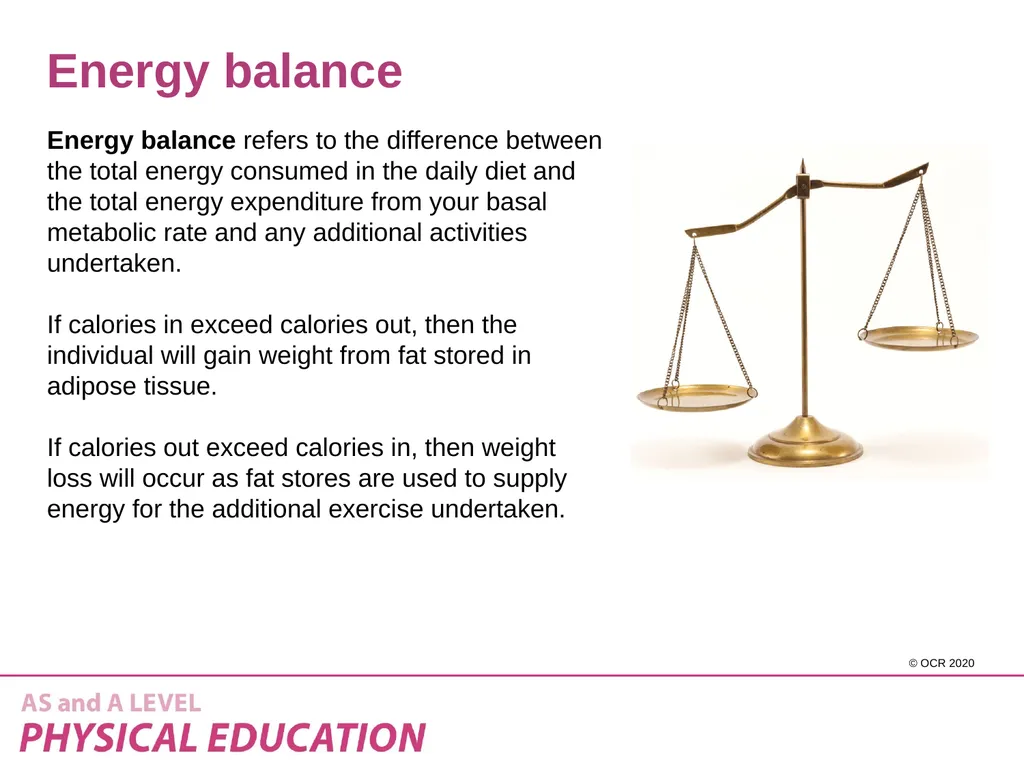
Energy balance Energy balance refers to the difference between the total energy consumed in the daily diet and the total energy expenditure from your basal metabolic rate and any additional activities undertaken.
If calories in exceed calories out, then the individual will gain weight from fat stored in adipose tissue.
If calories out exceed calories in, then weight loss will occur as fat stores are used to supply energy for the additional exercise undertaken.<br>
If calories in exceed calories out, then the individual will gain weight from fat stored in adipose tissue.
If calories out exceed calories in, then weight loss will occur as fat stores are used to supply energy for the additional exercise undertaken.<br>
25
Ergogenic aids Definition Any substance or treatment that either directly improves physiological variables associated with exercise performance or removes subjective restraints that may limit physiological capacity.<br>
26
Ergogenic aids: Pharmacological Anabolic steroids Testosterone (must be injected or it will be destroyed by digestive enzymes)
Anabolic Androgenic Steroids (AAS)
synthetic drugs designed to mimic the effects of testosterone;
taken orally or injected.
Promote the synthesis of proteins and
enhances muscle growth.
This allows for increased frequency and intensity
of training and improved recovery.
Used mostly for explosive power events.
Side effects:
Irritability.
Mood swings.
Aggressive tendencies.
Liver damage and heart failure.<br>
27
Ergogenic aids: Pharmacological Erythropoietin Another synthetic copy of a hormone produced by kidneys to stimulate the bone marrow to produce red blood cells.
Recombinant EPO is used to produce more haemoglobin in the blood and aid oxygen carrying capacity.
Has same effect as ‘blood doping’ and altitude training (more efficient use of O2)
It is Illegal.
Dangers:
Increased blood viscosity.
Increased clotting potential.
Increased risk for stroke and heart failure, or pulmonary edema.<br>
28
Ergogenic aids: Pharmacological Human Growth Hormone A synthetic product mimicking the hormone secreted by pituitary gland.
Stimulates bone and muscle growth.
Affects protein, carbohydrate and fat metabolism.
Leads to increased percentage of lean body mass.
Used by power, strength athletes.
Side effects
May lead to diabetes.
Thickening of soft tissue in face, hands and feet.
Enlargement of organs such as liver.<br>
Stimulates bone and muscle growth.
Affects protein, carbohydrate and fat metabolism.
Leads to increased percentage of lean body mass.
Used by power, strength athletes.
Side effects
May lead to diabetes.
Thickening of soft tissue in face, hands and feet.
Enlargement of organs such as liver.<br>
29
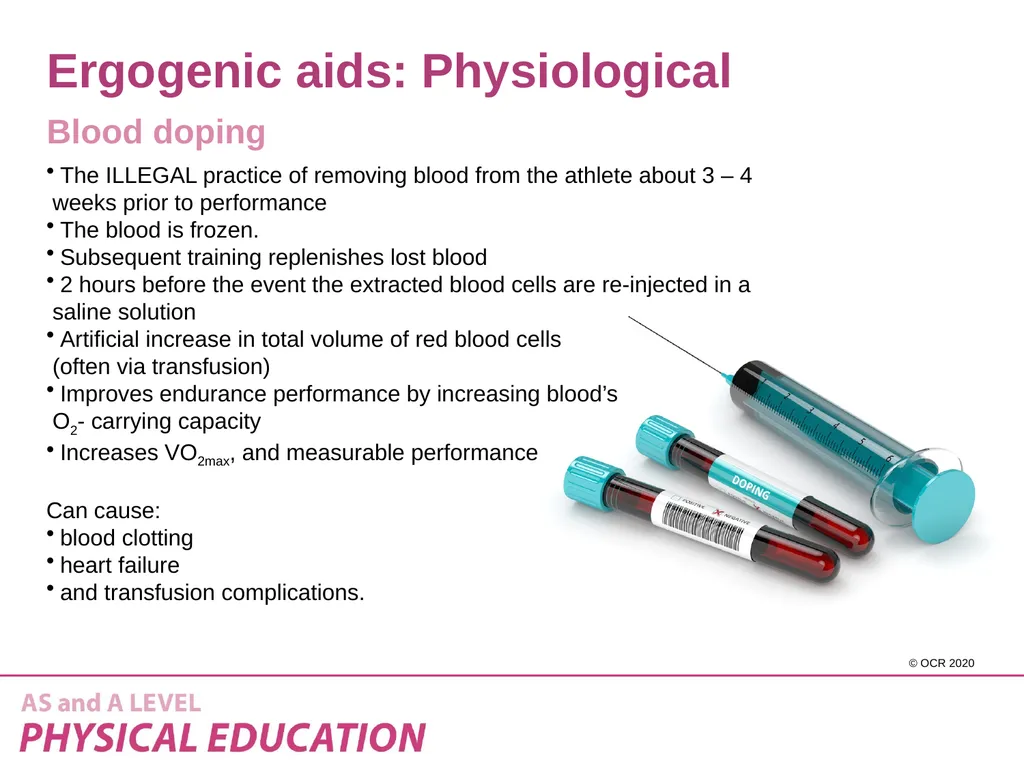
Ergogenic aids: Physiological Blood doping The ILLEGAL practice of removing blood from the athlete about 3 – 4
weeks prior to performance
The blood is frozen.
Subsequent training replenishes lost blood
2 hours before the event the extracted blood cells are re-injected in a saline solution
Artificial increase in total volume of red blood cells (often via transfusion)
Improves endurance performance by increasing blood’s O2- carrying capacity
Increases VO2max, and measurable performance
Can cause:
blood clotting
heart failure
and transfusion complications.<br>
30
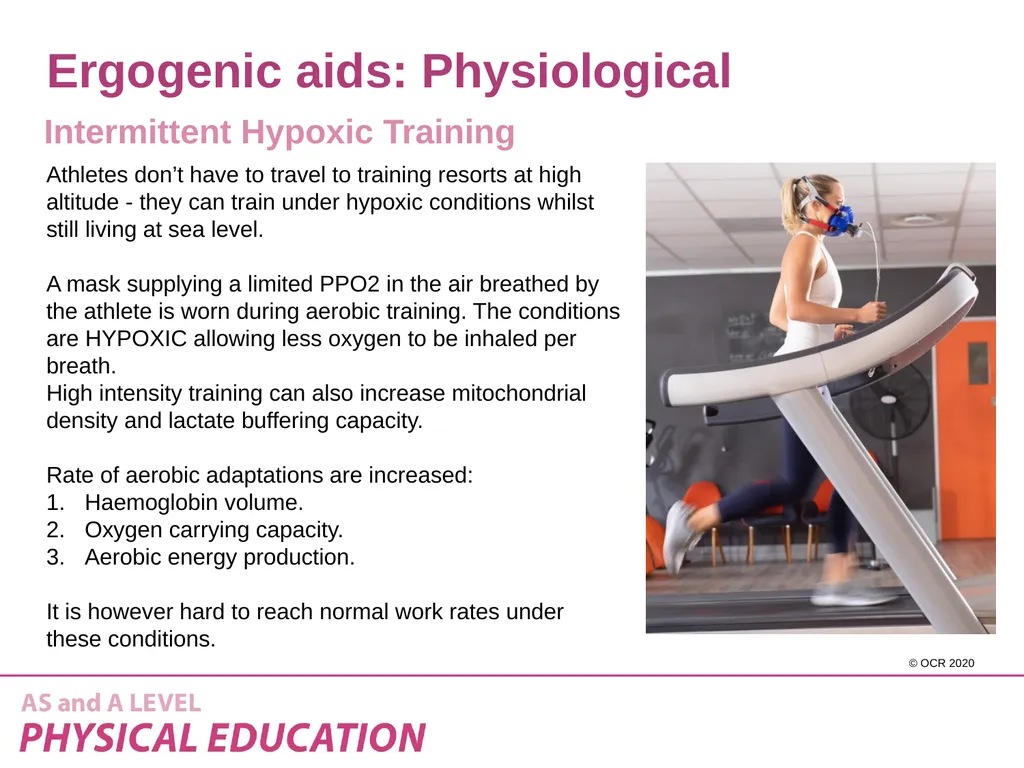
Ergogenic aids: Physiological Intermittent Hypoxic Training Athletes don’t have to travel to training resorts at high altitude - they can train under hypoxic conditions whilst still living at sea level.
A mask supplying a limited PPO2 in the air breathed by the athlete is worn during aerobic training. The conditions are HYPOXIC allowing less oxygen to be inhaled per breath.
High intensity training can also increase mitochondrial density and lactate buffering capacity.
Rate of aerobic adaptations are increased:
Haemoglobin volume.
Oxygen carrying capacity.
Aerobic energy production.
It is however hard to reach normal work rates under these conditions.<br>
31
Ergogenic aids: Physiological Cooling Aids Pre-event
Cooling towels or ice vests can be used to reduce core body temperature in hot or humid training, performing conditions.
This helps to reduce THERMAL STRAIN and CARDIOVASCULAR DRIFT. This can help reduce sweating, dehydration and ultimately sustain aerobic performance.
Injuries
Most injuries are accompanied by swelling. Ice packs can be used to help reduce swelling and pain at the site of the injury.
Post event
Ice baths are used to vaso-constrict blood vessels reducing blood flow. On exiting the bath the blood vessels vasodilate flushing the muscles with oxygen to help recovery. It can also help reduction of DELAYED ONSET OF MUSCULAR SORENESS.<br>
32
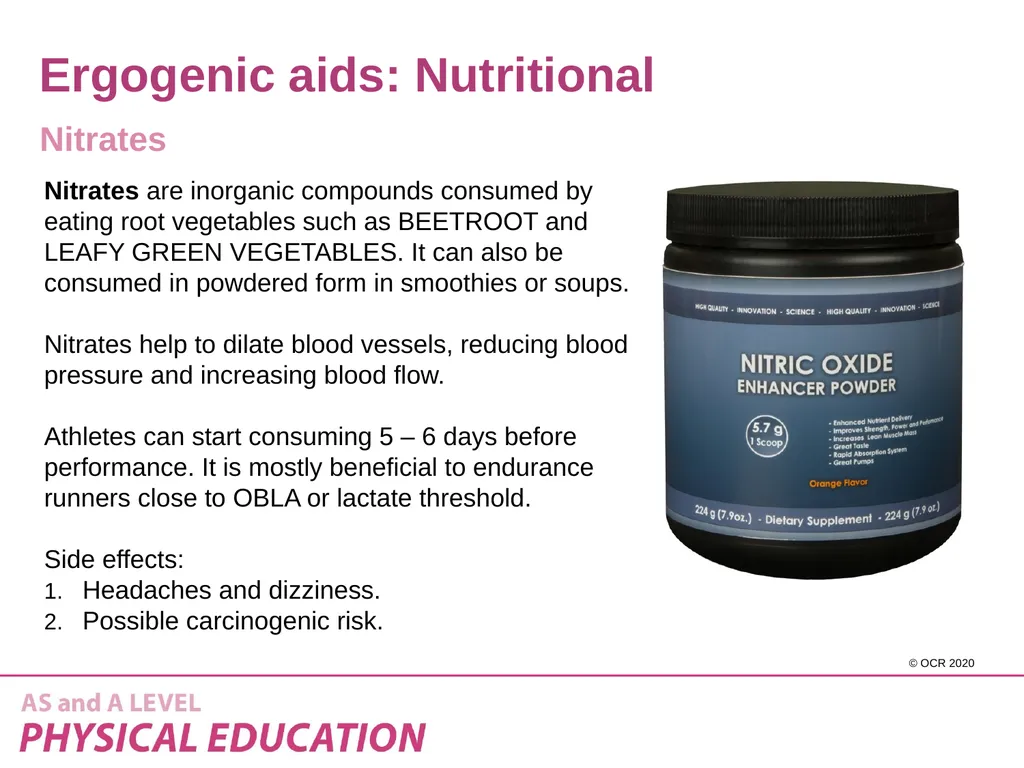
Ergogenic aids: Nutritional Nitrates Nitrates are inorganic compounds consumed by eating root vegetables such as BEETROOT and LEAFY GREEN VEGETABLES. It can also be consumed in powdered form in smoothies or soups.
Nitrates help to dilate blood vessels, reducing blood pressure and increasing blood flow.
Athletes can start consuming 5 – 6 days before performance. It is mostly beneficial to endurance runners close to OBLA or lactate threshold.
Side effects:
Headaches and dizziness.
Possible carcinogenic risk.<br>
33
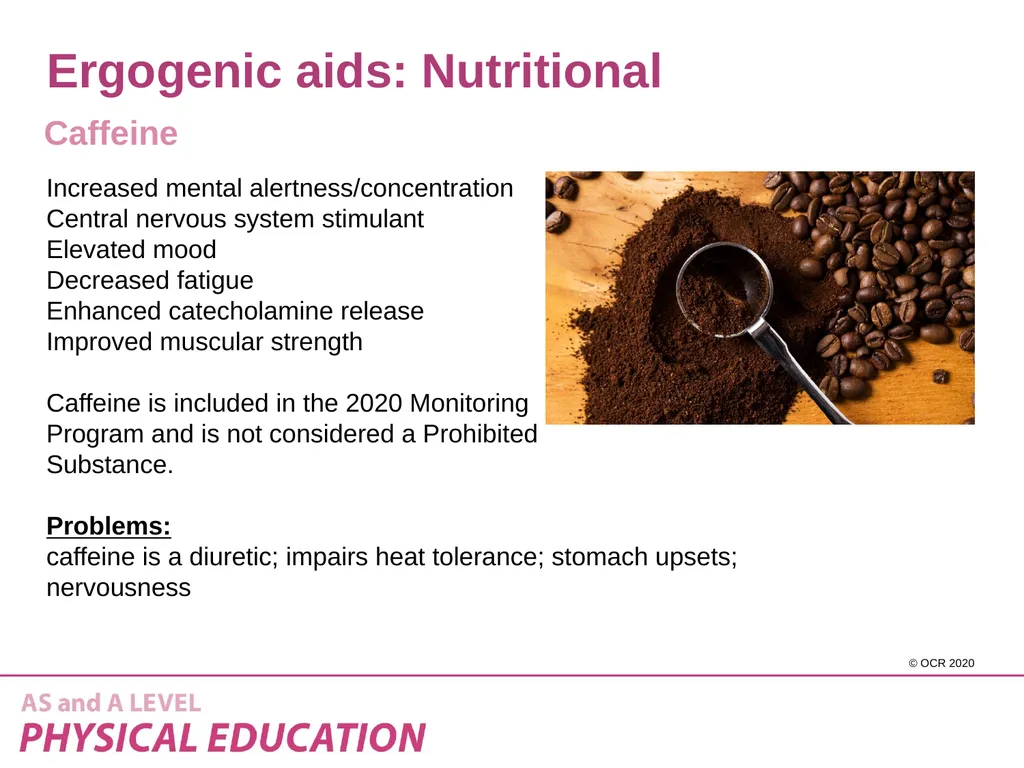
Ergogenic aids: Nutritional Caffeine Increased mental alertness/concentration
Central nervous system stimulant
Elevated mood
Decreased fatigue
Enhanced catecholamine release
Improved muscular strength
Caffeine is included in the 2020 Monitoring Program and is not considered a Prohibited Substance.
Problems:
caffeine is a diuretic; impairs heat tolerance; stomach upsets; nervousness<br>
34
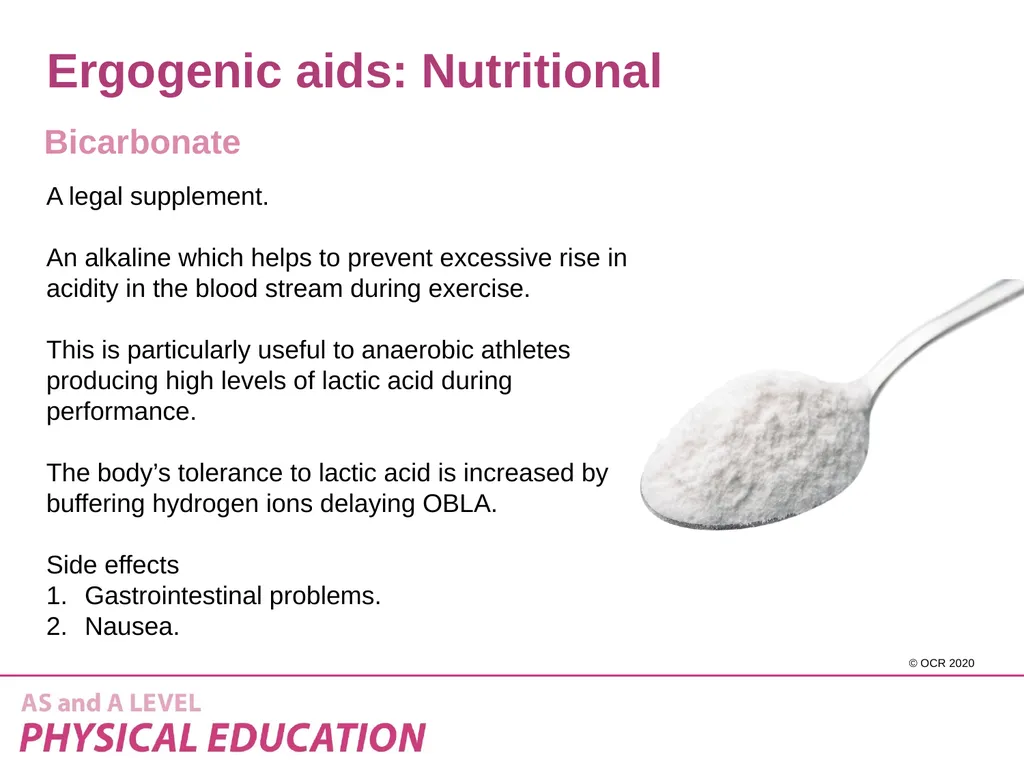
Ergogenic aids: Nutritional Bicarbonate A legal supplement.
An alkaline which helps to prevent excessive rise in acidity in the blood stream during exercise.
This is particularly useful to anaerobic athletes producing high levels of lactic acid during performance.
The body’s tolerance to lactic acid is increased by buffering hydrogen ions delaying OBLA.
Side effects
Gastrointestinal problems.
Nausea.<br>
35
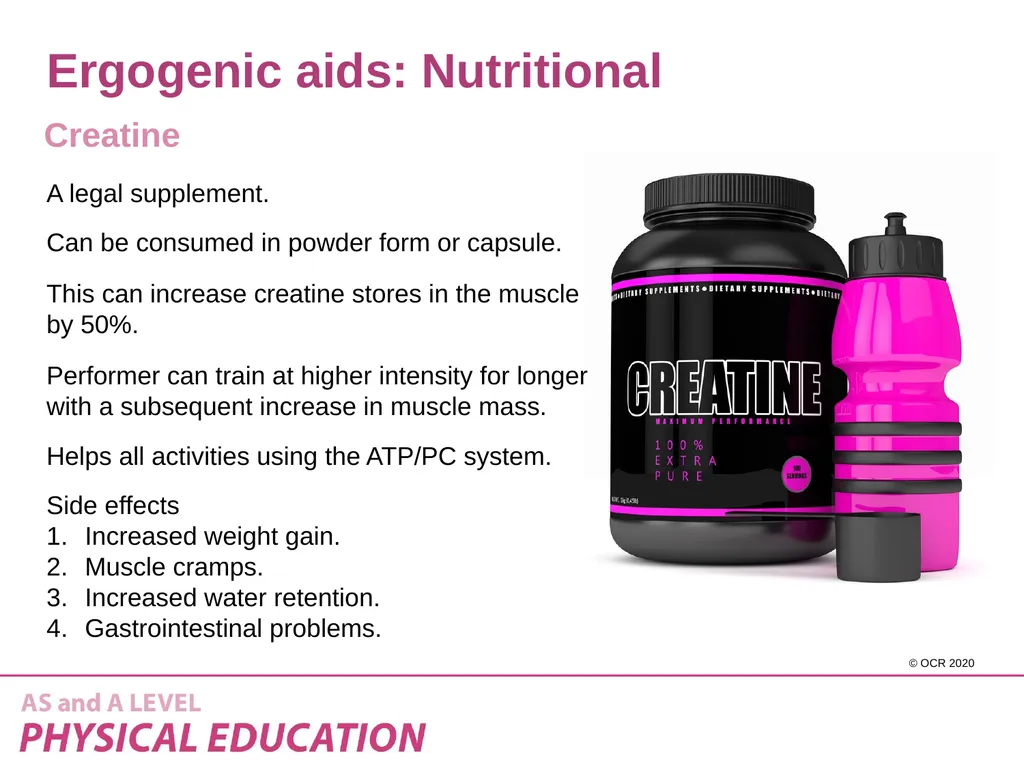
Ergogenic aids: Nutritional Creatine A legal supplement.
Can be consumed in powder form or capsule.
This can increase creatine stores in the muscle by 50%.
Performer can train at higher intensity for longer with a subsequent increase in muscle mass.
Helps all activities using the ATP/PC system.
Side effects
Increased weight gain.
Muscle cramps.
Increased water retention.
Gastrointestinal problems.<br>
36
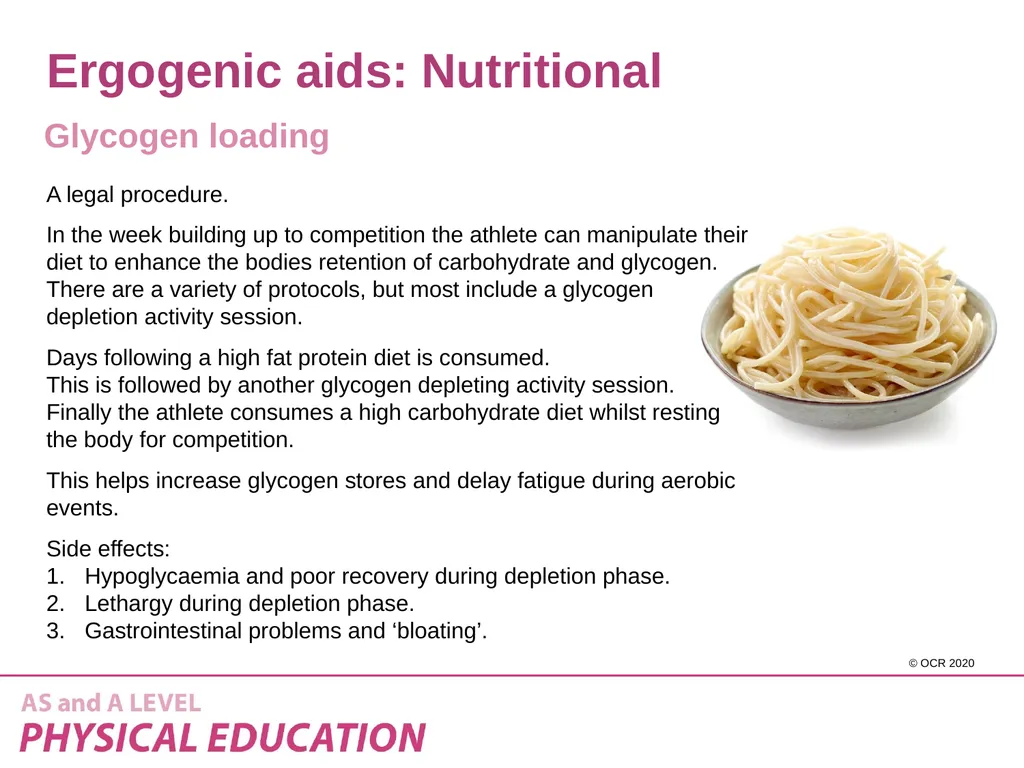
Ergogenic aids: Nutritional Glycogen loading A legal procedure.
In the week building up to competition the athlete can manipulate their diet to enhance the bodies retention of carbohydrate and glycogen.
There are a variety of protocols, but most include a glycogen depletion activity session.
Days following a high fat protein diet is consumed.
This is followed by another glycogen depleting activity session.
Finally the athlete consumes a high carbohydrate diet whilst resting the body for competition.
This helps increase glycogen stores and delay fatigue during aerobic events.
Side effects:
Hypoglycaemia and poor recovery during depletion phase.
Lethargy during depletion phase.
Gastrointestinal problems and ‘bloating’.<br>
37
OCR Resources: the small print
OCR’s resources are provided to support the delivery of OCR qualifications, but in no way constitute an endorsed teaching method that is required by the Board, and the decision to use them lies with the individual teacher. Whilst every effort is made to ensure the accuracy of the content, OCR cannot be held responsible for any errors or omissions within these resources.
Our documents are updated over time. Whilst every effort is made to check all documents, there may be contradictions between published support and the specification, therefore please use the information on the latest specification at all times. Where changes are made to specifications these will be indicated within the document, there will be a new version number indicated, and a summary of the changes. If you do notice a discrepancy between the specification and a resource please contact us at:
resources.feedback@ocr.org.uk.
© OCR 2020 - This resource may be freely copied and distributed, as long as the OCR logo and this message remain intact and OCR is acknowledged as the originator of this work. OCR acknowledges the use of the following content: Slide 3: Healthy food – margouillat photo/Shutterstock.com, Slide 4: Macronutrients – Double Brain/shutterstock.com, Slides 5, 6 and 7: Carbohydrates – bitt24/Shutterstock.com, Slide 8: Protein – Syda Productions/Shutterstock.com, Slide 9 and 11: Healthy fats – Yulia Furman/Shutterstock.com, Slide 10: Junk food – margouillat photo/Shutterstock.com, Slide 12: Micronutrients – OlgaChernyak/Shutterstock.com, Slide 13: Zinc foods – bitt24/Shutterstock.com, Slide 14: Vitamin chart – Media Guru/Shutterstock.com, Slide 15: Water – Ovchinnkov Vladimir/Shutterstock.com, Slide 16: Fibre foods – bitt24/Shutterstock.com, Slide 17: Eatwell plate – Shah Rohani/Shutterstock.com, Slide 18 and 24: Scales – zendograph/Shutterstock.com, Slide 19: BMR – mypokcik/Shutterstock.com, Slide 20: Hammock – Song about summer/Shutterstock.com, Slide 21: Hurdler – Alex Kravtsov/Shutterstock.com, Slide 22: Footballer – Master1305/Shutterstock.com, Slide 23: Infrared woman – Anita van den Broek/Shutterstock.com, Slide 25: Supplement – yuruphoto/Shutterstock.com, Slide 26: Testosterone – Aleksandra Gigowska/Shutterstock.com, Slide 27: Erythropoietin test – Jarun Ontakrai/Shutterstock.com, Slide 28: Human growth hormone – Aleksandra Gigowska/Shutterstock.com, Slide 29: Doping test – Aleksandra Gigowska/Shutterstock.com, Slide 30: Treadmill running – wavebreakmedia/Shutterstock.com, Slide 32: Nitric Oxide – Vadim Petrov/Shutterstock.com, Slide 33: Coffee – Blackday/Shutterstock.com, Slide 34: Bicarbinate – Anton Starikov/Shutterstock.com, Slide 35: Creatine – Aleksandra Gigowska/Shutterstock.com, Slide 36: Spaghetti – MaraZe/Shutterstock.com
Please get in touch if you want to discuss the accessibility of resources we offer to support delivery of our qualifications: resources.feedback@ocr.org.uk<br>