
Concepts of Biology Chapter 1 INTRODUCTION TO
YM
Published · 45 slides · 0 views

1 / 1

Description
Concepts of Biology Chapter 1 INTRODUCTION TO BIOLOGY PowerPoint Image Slideshow Figure 1.1 This NASA image is a composite of several satellite-based views of Earth. To make the whole-Earth image, NASA scientists combine observations of
Related Topics
Share
Embed code
Download this presentation From Below
"Concepts of Biology Chapter 1 INTRODUCTION TO" is the property of its rightful owner. Permission is granted to download and print the materials on this website for personal, non-commercial use only, and to display it on your personal computer provided you do not modify the materials and that you retain all copyright notices contained in the materials. By downloading content from our website, you accept the terms of this agreement.
Presentation Transcript
01
Concepts of Biology Chapter 1 INTRODUCTION TO BIOLOGY
PowerPoint Image Slideshow<br>
PowerPoint Image Slideshow<br>
02
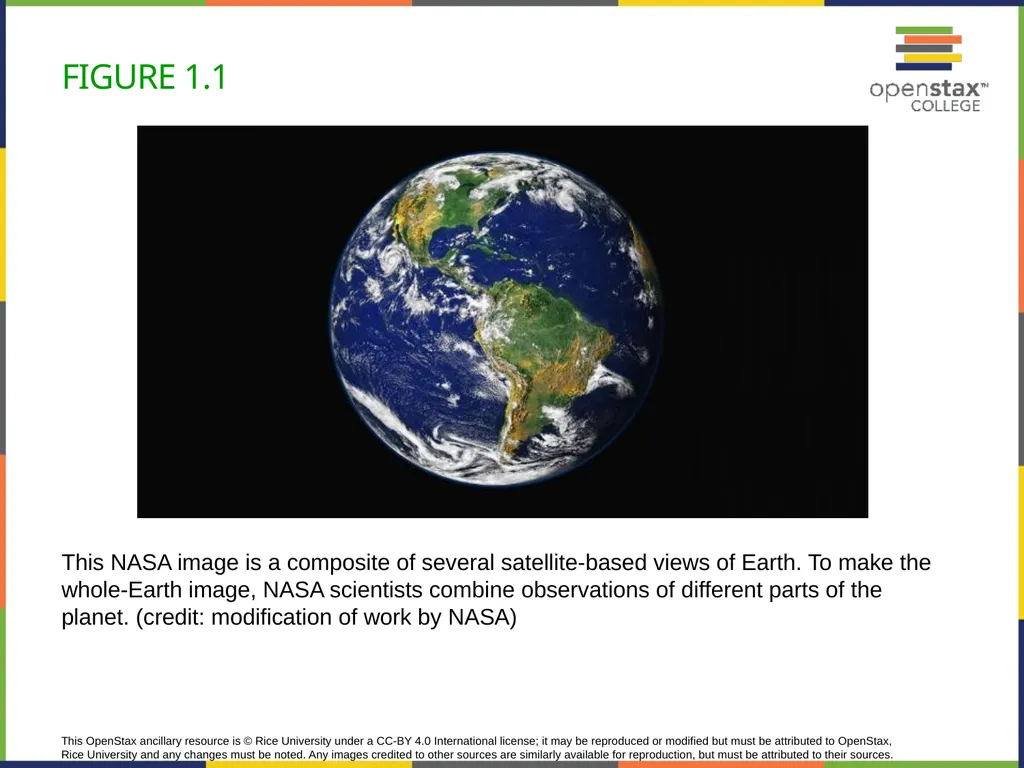
Figure 1.1 This NASA image is a composite of several satellite-based views of Earth. To make the whole-Earth image, NASA scientists combine observations of different parts of the planet. (credit: modification of work by NASA) This OpenStax ancillary resource is © Rice University under a CC-BY 4.0 International license; it may be reproduced or modified but must be attributed to OpenStax, Rice University and any changes must be noted. Any images credited to other sources are similarly available for reproduction, but must be attributed to their sources.<br>
03
1.1 themes and concepts of biology Biology – the science that studies life
What exactly is life?
Biologists created a list of characteristics that living things have
Biologist consider an object to be alive if, and only if, it displays ALL of these properties<br>
What exactly is life?
Biologists created a list of characteristics that living things have
Biologist consider an object to be alive if, and only if, it displays ALL of these properties<br>
04
Viruses Viruses can be transmitted from one organism to another and cause diseases. But are they considered living? Here are some interesting facts about viruses:
A virus can attack a living organism
A virus can reproduce inside that organism and cause disease
A virus is not composed of cells.
A virus cannot reproduce on its own. Would you consider a virus a living organism? Why or why not?<br>
A virus can attack a living organism
A virus can reproduce inside that organism and cause disease
A virus is not composed of cells.
A virus cannot reproduce on its own. Would you consider a virus a living organism? Why or why not?<br>
05
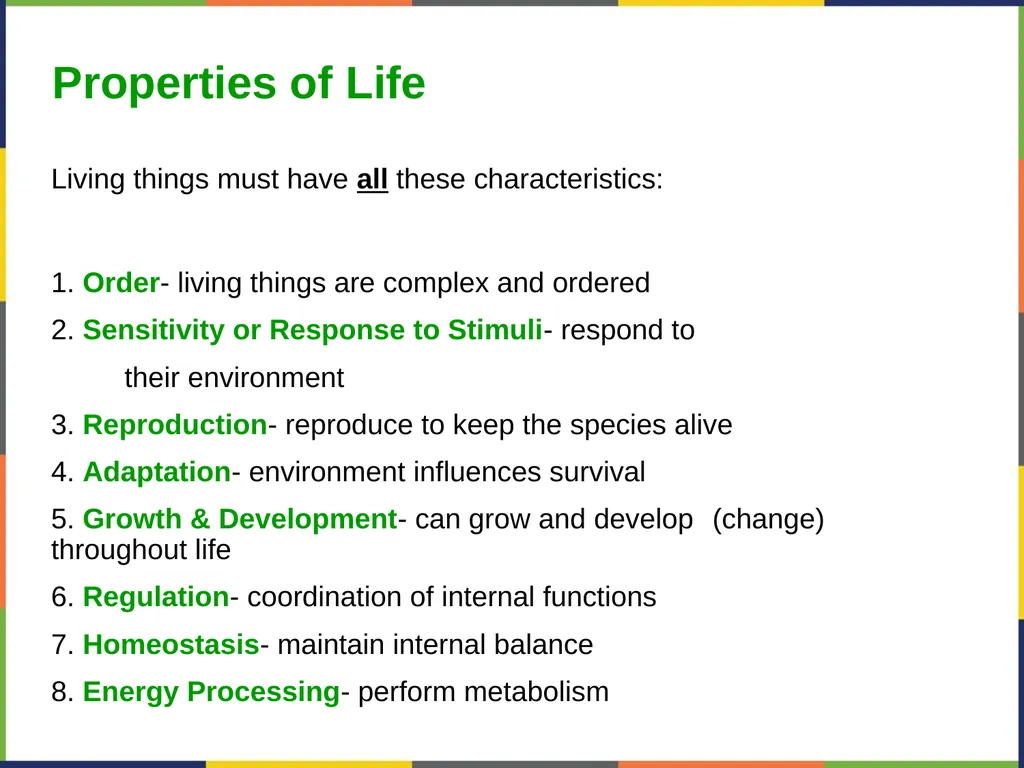
Properties of Life Living things must have all these characteristics:
1. Order- living things are complex and ordered
2. Sensitivity or Response to Stimuli- respond to
their environment
3. Reproduction- reproduce to keep the species alive
4. Adaptation- environment influences survival
5. Growth & Development- can grow and develop (change) throughout life
6. Regulation- coordination of internal functions
7. Homeostasis- maintain internal balance
8. Energy Processing- perform metabolism<br>
06
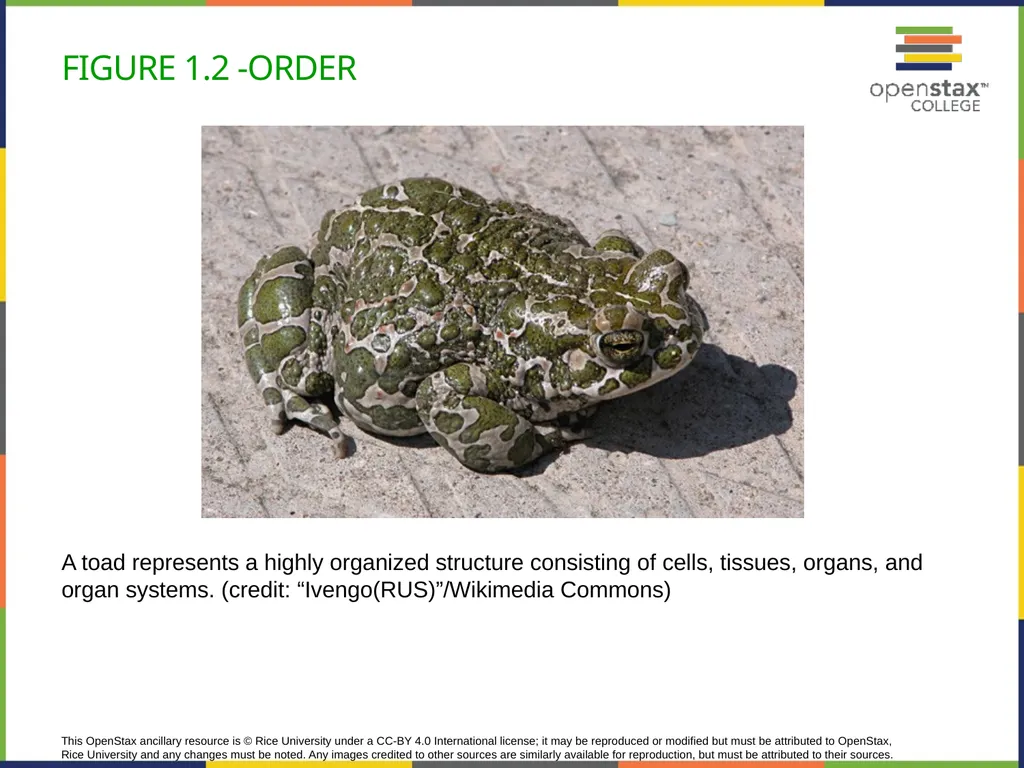
Figure 1.2 -Order A toad represents a highly organized structure consisting of cells, tissues, organs, and organ systems. (credit: “Ivengo(RUS)”/Wikimedia Commons) This OpenStax ancillary resource is © Rice University under a CC-BY 4.0 International license; it may be reproduced or modified but must be attributed to OpenStax, Rice University and any changes must be noted. Any images credited to other sources are similarly available for reproduction, but must be attributed to their sources.<br>
07
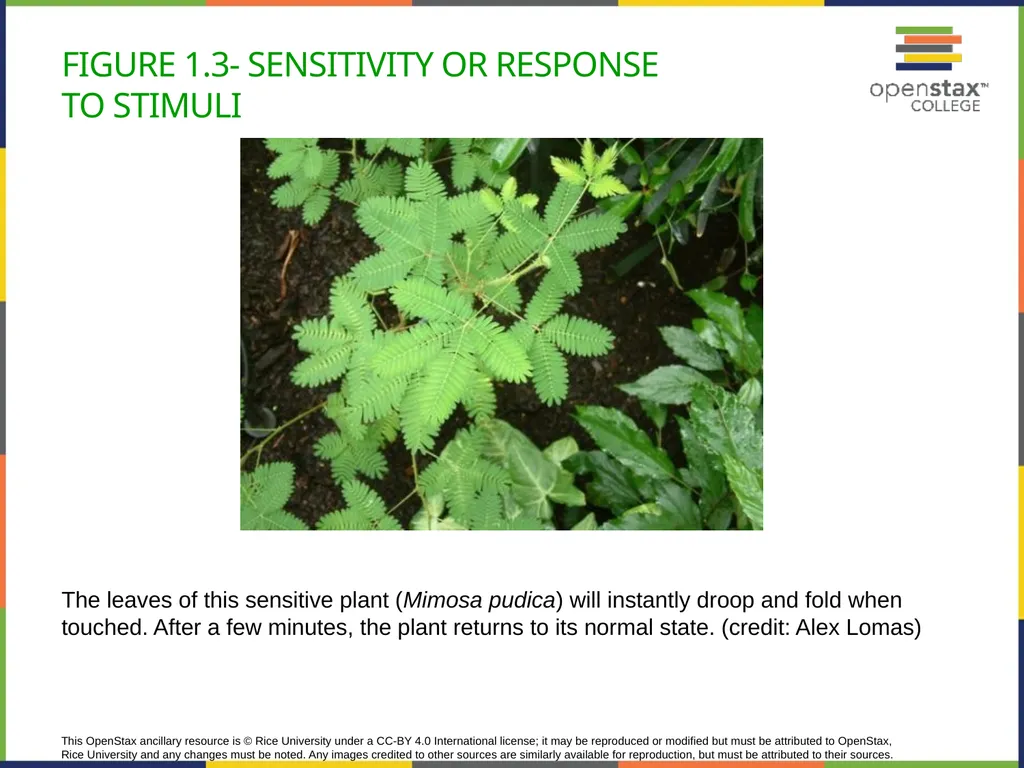
Figure 1.3- Sensitivity or Response
to Stimuli The leaves of this sensitive plant (Mimosa pudica) will instantly droop and fold when touched. After a few minutes, the plant returns to its normal state. (credit: Alex Lomas) This OpenStax ancillary resource is © Rice University under a CC-BY 4.0 International license; it may be reproduced or modified but must be attributed to OpenStax, Rice University and any changes must be noted. Any images credited to other sources are similarly available for reproduction, but must be attributed to their sources.<br>
08
Watch this video:
http://openstaxcollege.org/l/thigmonasty<br>
http://openstaxcollege.org/l/thigmonasty<br>
09
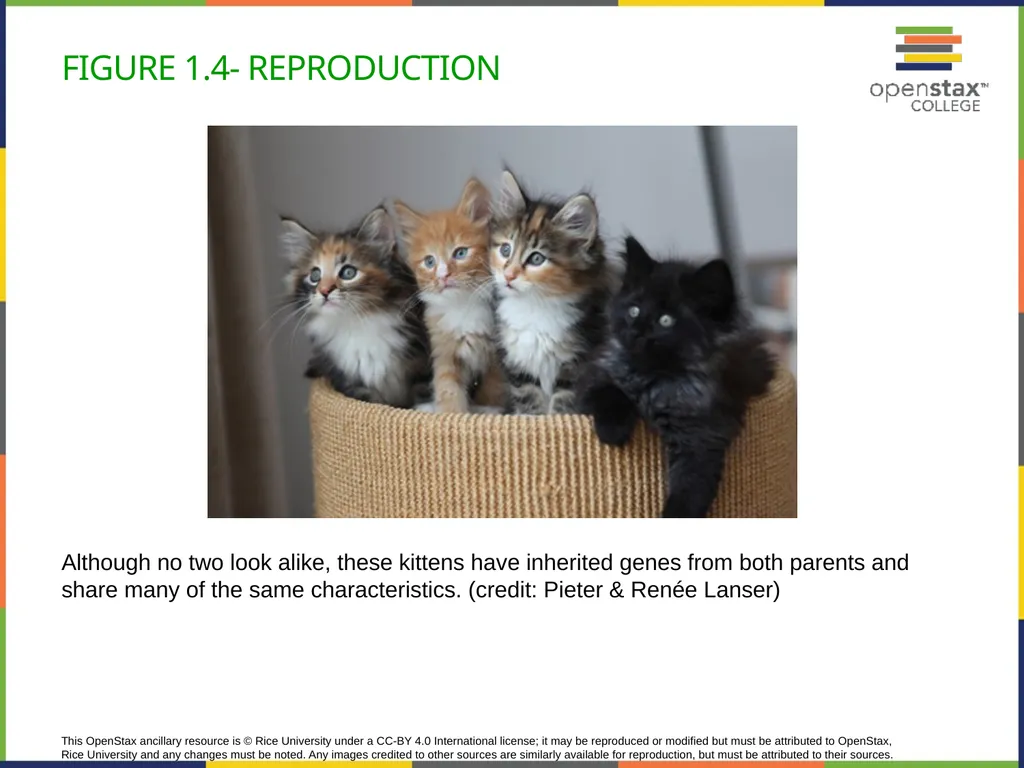
Figure 1.4- Reproduction Although no two look alike, these kittens have inherited genes from both parents and share many of the same characteristics. (credit: Pieter & Renée Lanser) This OpenStax ancillary resource is © Rice University under a CC-BY 4.0 International license; it may be reproduced or modified but must be attributed to OpenStax, Rice University and any changes must be noted. Any images credited to other sources are similarly available for reproduction, but must be attributed to their sources.<br>
10
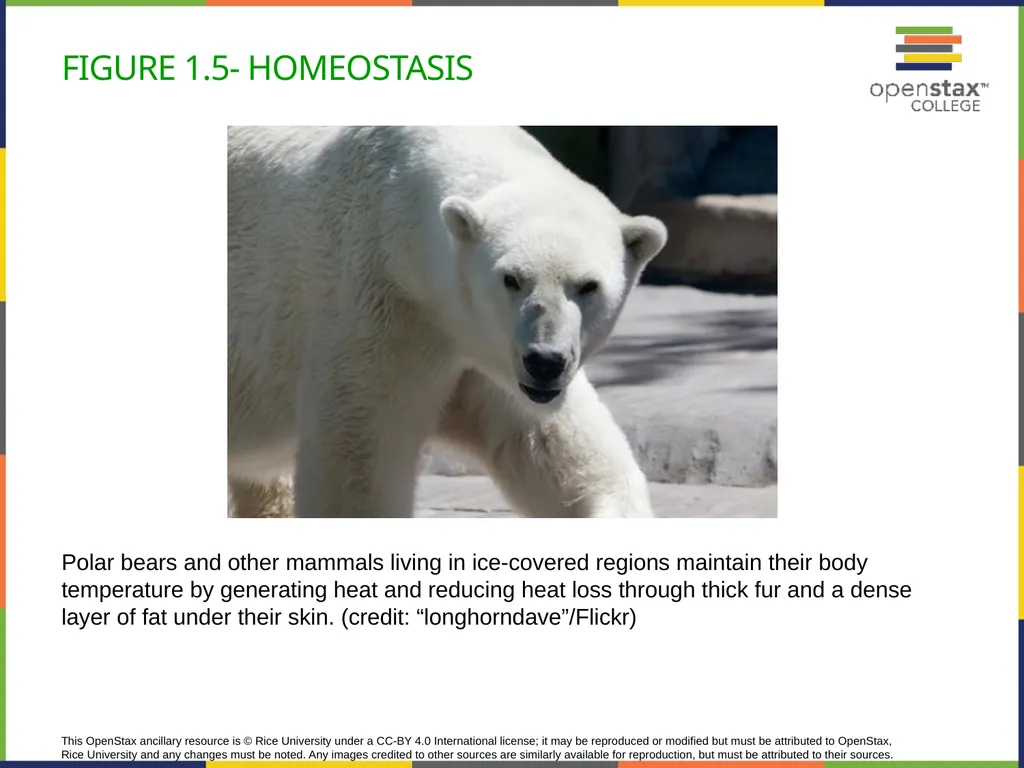
Figure 1.5- Homeostasis Polar bears and other mammals living in ice-covered regions maintain their body temperature by generating heat and reducing heat loss through thick fur and a dense layer of fat under their skin. (credit: “longhorndave”/Flickr) This OpenStax ancillary resource is © Rice University under a CC-BY 4.0 International license; it may be reproduced or modified but must be attributed to OpenStax, Rice University and any changes must be noted. Any images credited to other sources are similarly available for reproduction, but must be attributed to their sources.<br>
11
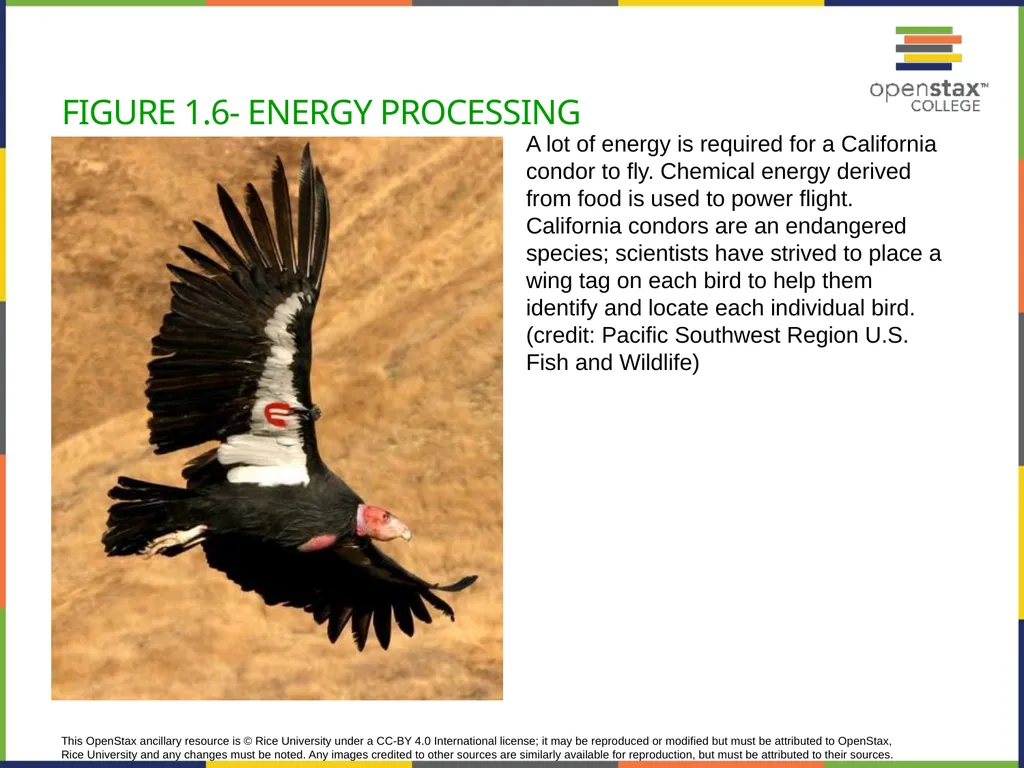
Figure 1.6- Energy Processing A lot of energy is required for a California condor to fly. Chemical energy derived from food is used to power flight. California condors are an endangered species; scientists have strived to place a wing tag on each bird to help them identify and locate each individual bird. (credit: Pacific Southwest Region U.S. Fish and Wildlife) This OpenStax ancillary resource is © Rice University under a CC-BY 4.0 International license; it may be reproduced or modified but must be attributed to OpenStax, Rice University and any changes must be noted. Any images credited to other sources are similarly available for reproduction, but must be attributed to their sources.<br>
12
Levels of Organization of Living Things (1 of 4) As already mentioned, living things are highly organized and structured
The atom is the smallest and most fundamental unit of matter
It consists of a nucleus surrounded by electrons
A molecule is two or more atoms held together by a chemical bond
Macromolecules is large molecule formed by combining smaller units called monomers<br>
The atom is the smallest and most fundamental unit of matter
It consists of a nucleus surrounded by electrons
A molecule is two or more atoms held together by a chemical bond
Macromolecules is large molecule formed by combining smaller units called monomers<br>
13
Levels of Organization of Living Things (2 of 4) Molecules come together with other molecules to form organelles, small structures the exist within cells and perform specialized functions
Cells are the smallest fundamental unit of a living organism
All living things are made up of cells<br>
Cells are the smallest fundamental unit of a living organism
All living things are made up of cells<br>
14
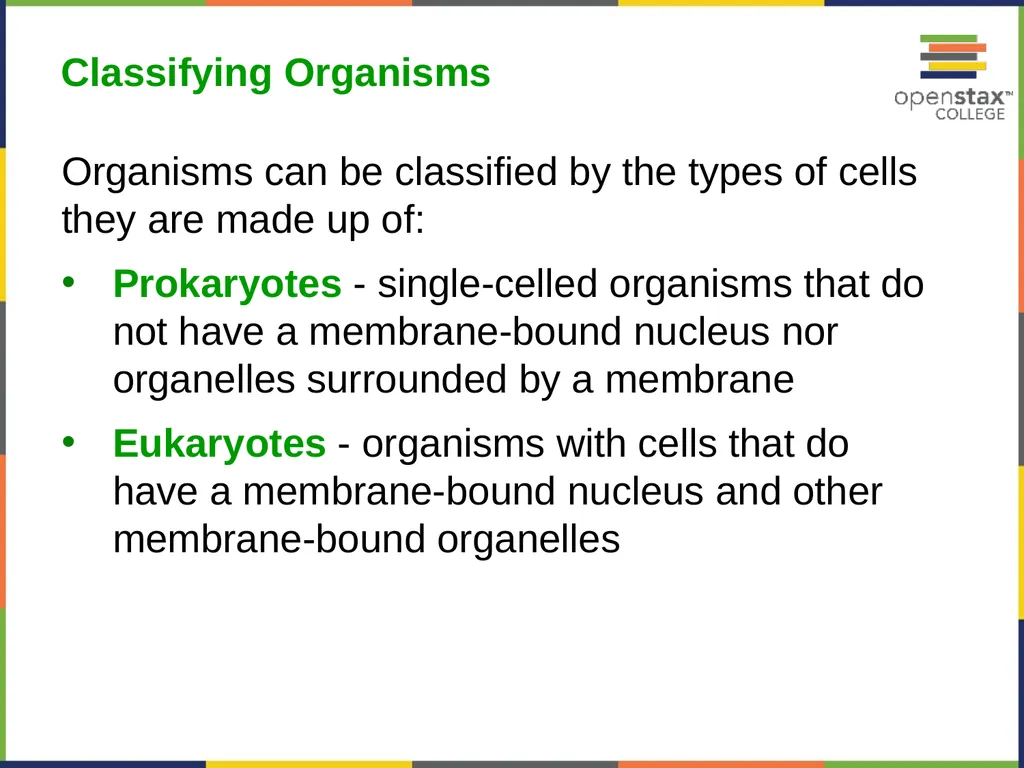
Classifying Organisms Organisms can be classified by the types of cells they are made up of:
Prokaryotes - single-celled organisms that do not have a membrane-bound nucleus nor organelles surrounded by a membrane
Eukaryotes - organisms with cells that do have a membrane-bound nucleus and other membrane-bound organelles<br>
Prokaryotes - single-celled organisms that do not have a membrane-bound nucleus nor organelles surrounded by a membrane
Eukaryotes - organisms with cells that do have a membrane-bound nucleus and other membrane-bound organelles<br>
15
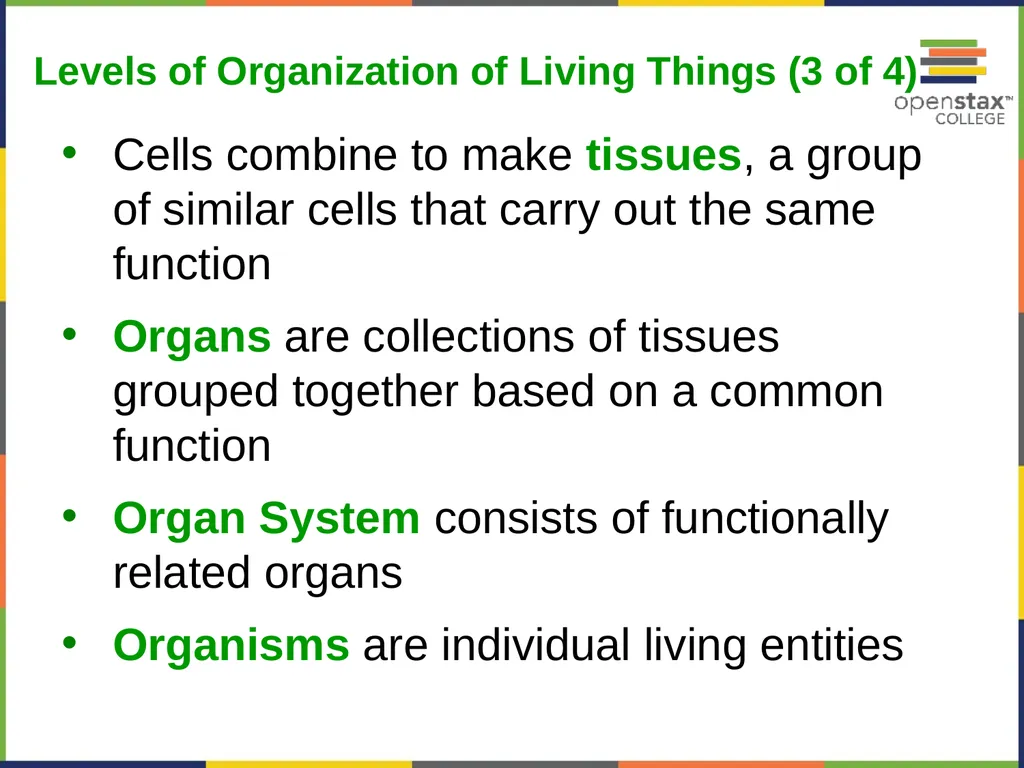
Levels of Organization of Living Things (3 of 4) Cells combine to make tissues, a group of similar cells that carry out the same function
Organs are collections of tissues grouped together based on a common function
Organ System consists of functionally related organs
Organisms are individual living entities<br>
Organs are collections of tissues grouped together based on a common function
Organ System consists of functionally related organs
Organisms are individual living entities<br>
16
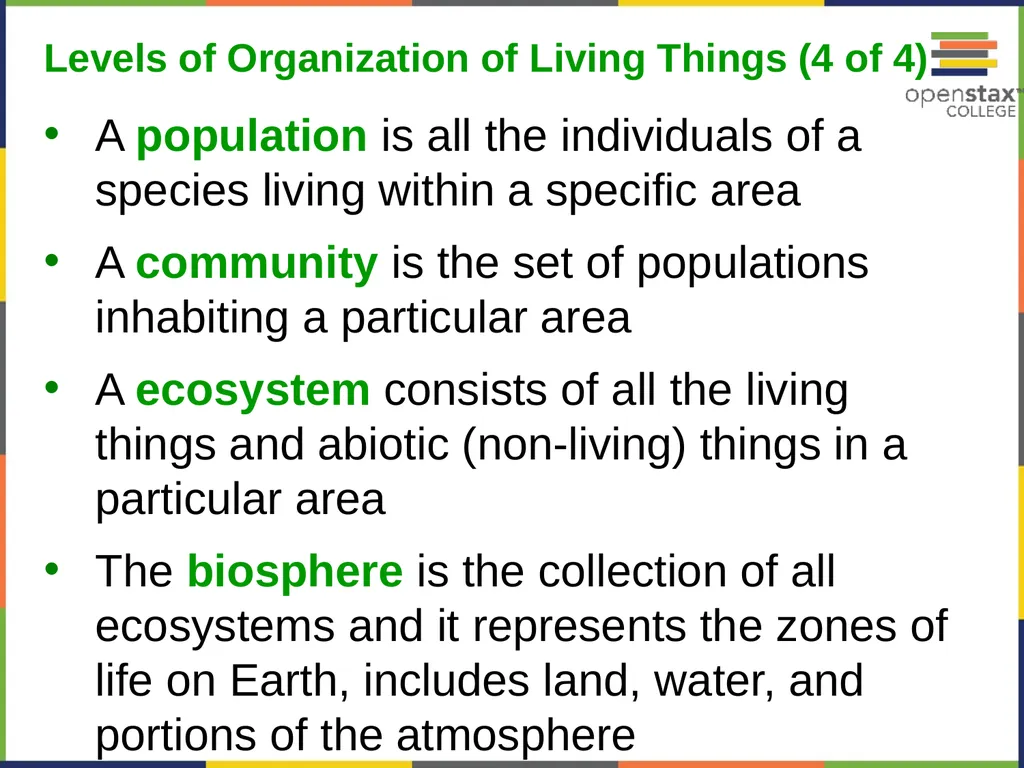
Levels of Organization of Living Things (4 of 4) A population is all the individuals of a species living within a specific area
A community is the set of populations inhabiting a particular area
A ecosystem consists of all the living things and abiotic (non-living) things in a particular area
The biosphere is the collection of all ecosystems and it represents the zones of life on Earth, includes land, water, and portions of the atmosphere<br>
17
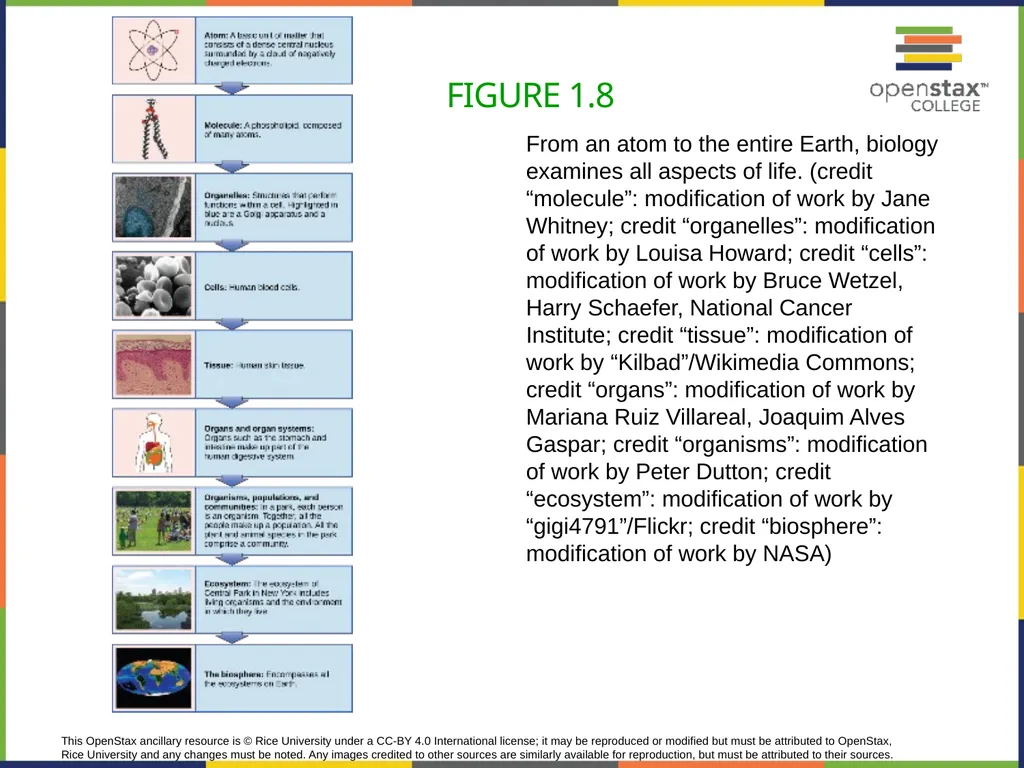
Figure 1.8 From an atom to the entire Earth, biology examines all aspects of life. (credit “molecule”: modification of work by Jane Whitney; credit “organelles”: modification of work by Louisa Howard; credit “cells”: modification of work by Bruce Wetzel, Harry Schaefer, National Cancer Institute; credit “tissue”: modification of work by “Kilbad”/Wikimedia Commons; credit “organs”: modification of work by Mariana Ruiz Villareal, Joaquim Alves Gaspar; credit “organisms”: modification of work by Peter Dutton; credit “ecosystem”: modification of work by “gigi4791”/Flickr; credit “biosphere”: modification of work by NASA) This OpenStax ancillary resource is © Rice University under a CC-BY 4.0 International license; it may be reproduced or modified but must be attributed to OpenStax, Rice University and any changes must be noted. Any images credited to other sources are similarly available for reproduction, but must be attributed to their sources.<br>
18
The Diversity of Life Evolution - the process of gradual change during which new species arise from older species
Evolution has led to great diversity of life on Earth<br>
Evolution has led to great diversity of life on Earth<br>
19
Hierarchical Taxonomy Approximately 8.7 millions living things have been studied on the Earth
Such a large number of living things are organized by grouping organisms by their similarities
Each large group gets broken down into smaller groups that are even more similar
This organizational system (known as hierarchical taxonomy) was proposed by a scientist named Carl Linnaeus in the 18th century<br>
20
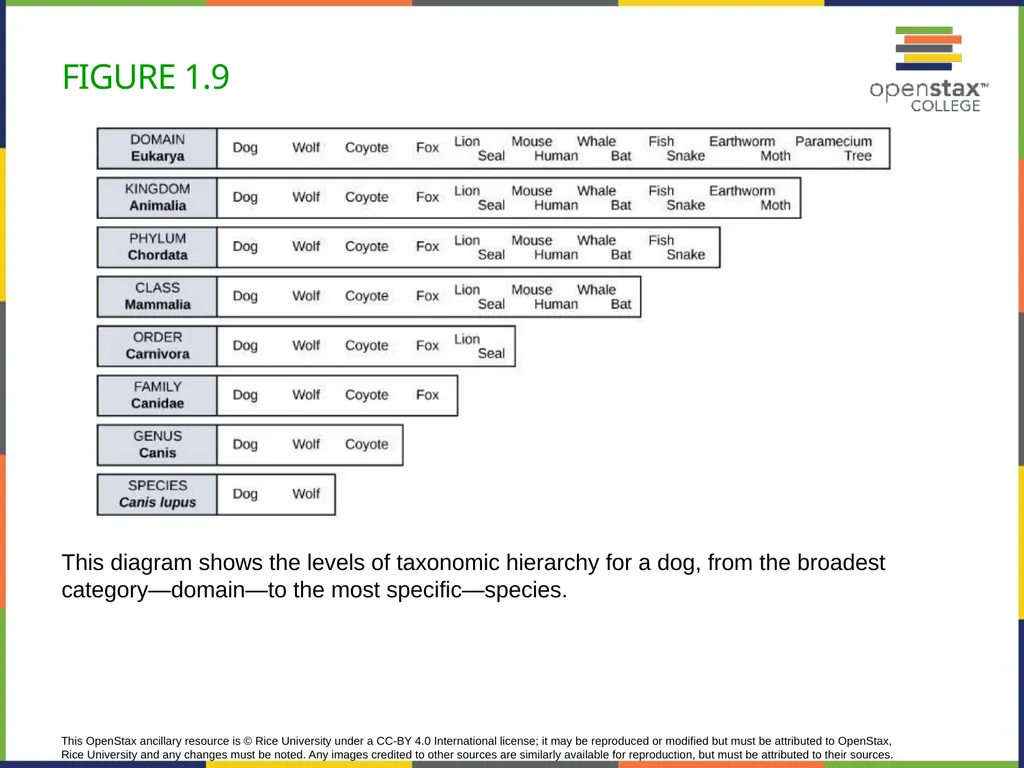
Figure 1.9 This diagram shows the levels of taxonomic hierarchy for a dog, from the broadest category—domain—to the most specific—species. This OpenStax ancillary resource is © Rice University under a CC-BY 4.0 International license; it may be reproduced or modified but must be attributed to OpenStax, Rice University and any changes must be noted. Any images credited to other sources are similarly available for reproduction, but must be attributed to their sources.<br>
21
Figure 1.10- Domains domain
Bacteria domain
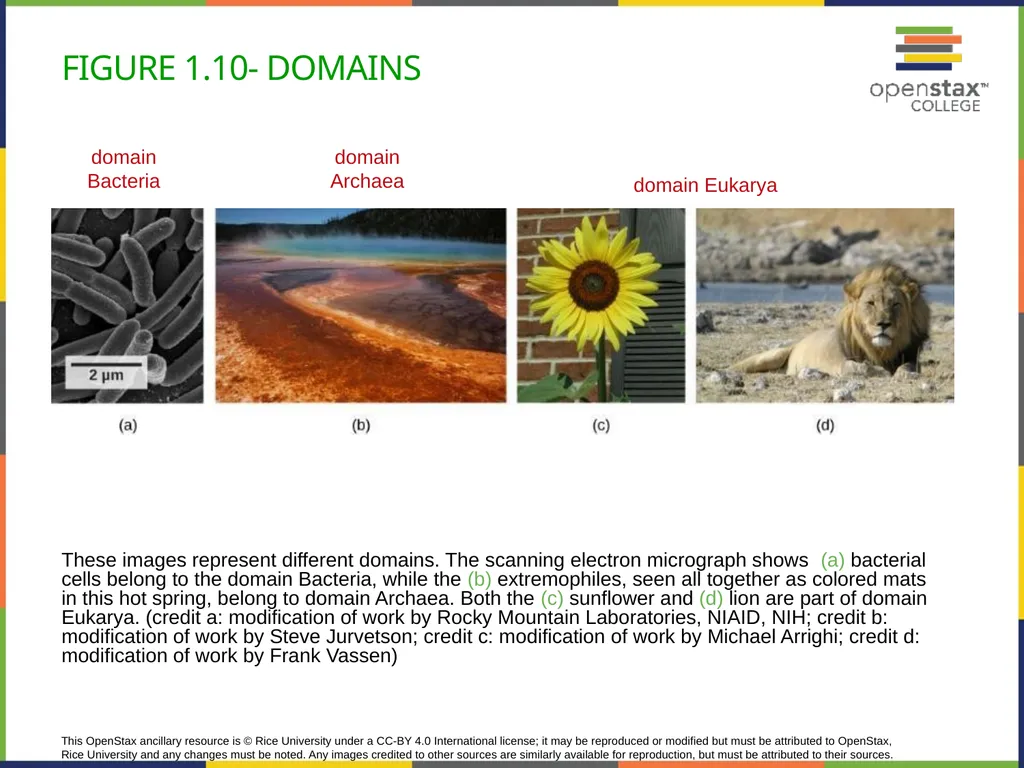
Archaea domain Eukarya These images represent different domains. The scanning electron micrograph shows (a) bacterial cells belong to the domain Bacteria, while the (b) extremophiles, seen all together as colored mats in this hot spring, belong to domain Archaea. Both the (c) sunflower and (d) lion are part of domain Eukarya. (credit a: modification of work by Rocky Mountain Laboratories, NIAID, NIH; credit b: modification of work by Steve Jurvetson; credit c: modification of work by Michael Arrighi; credit d: modification of work by Frank Vassen) This OpenStax ancillary resource is © Rice University under a CC-BY 4.0 International license; it may be reproduced or modified but must be attributed to OpenStax, Rice University and any changes must be noted. Any images credited to other sources are similarly available for reproduction, but must be attributed to their sources.<br>
22
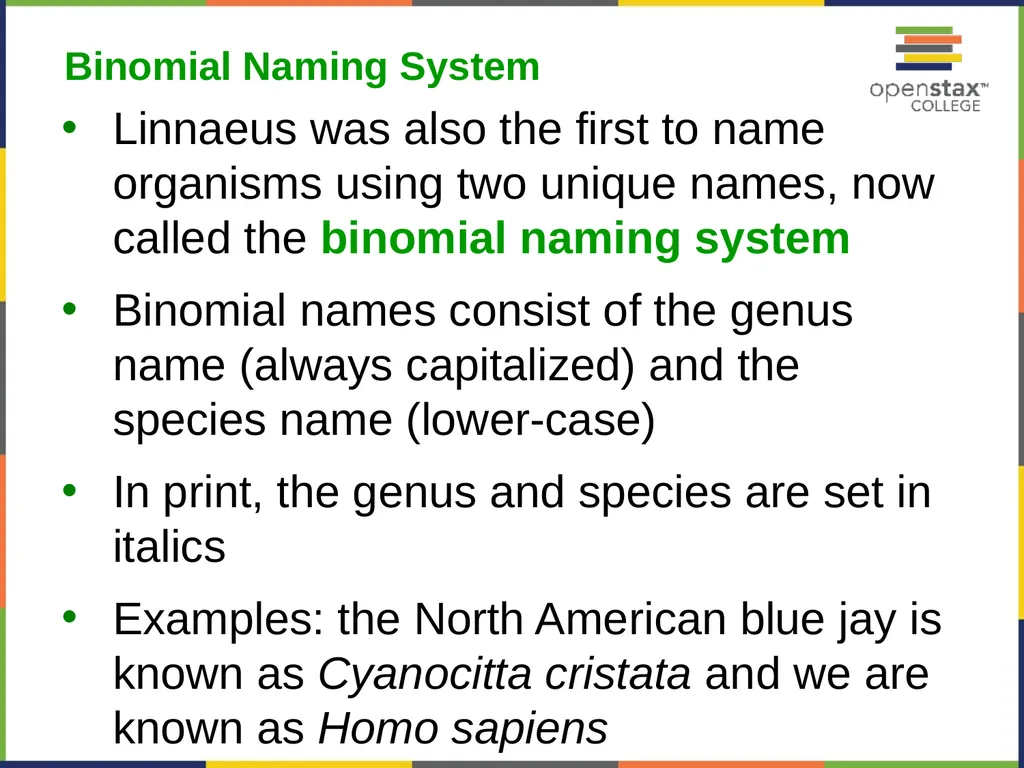
Binomial Naming System Linnaeus was also the first to name organisms using two unique names, now called the binomial naming system
Binomial names consist of the genus name (always capitalized) and the species name (lower-case)
In print, the genus and species are set in italics
Examples: the North American blue jay is known as Cyanocitta cristata and we are known as Homo sapiens<br>
Binomial names consist of the genus name (always capitalized) and the species name (lower-case)
In print, the genus and species are set in italics
Examples: the North American blue jay is known as Cyanocitta cristata and we are known as Homo sapiens<br>
23
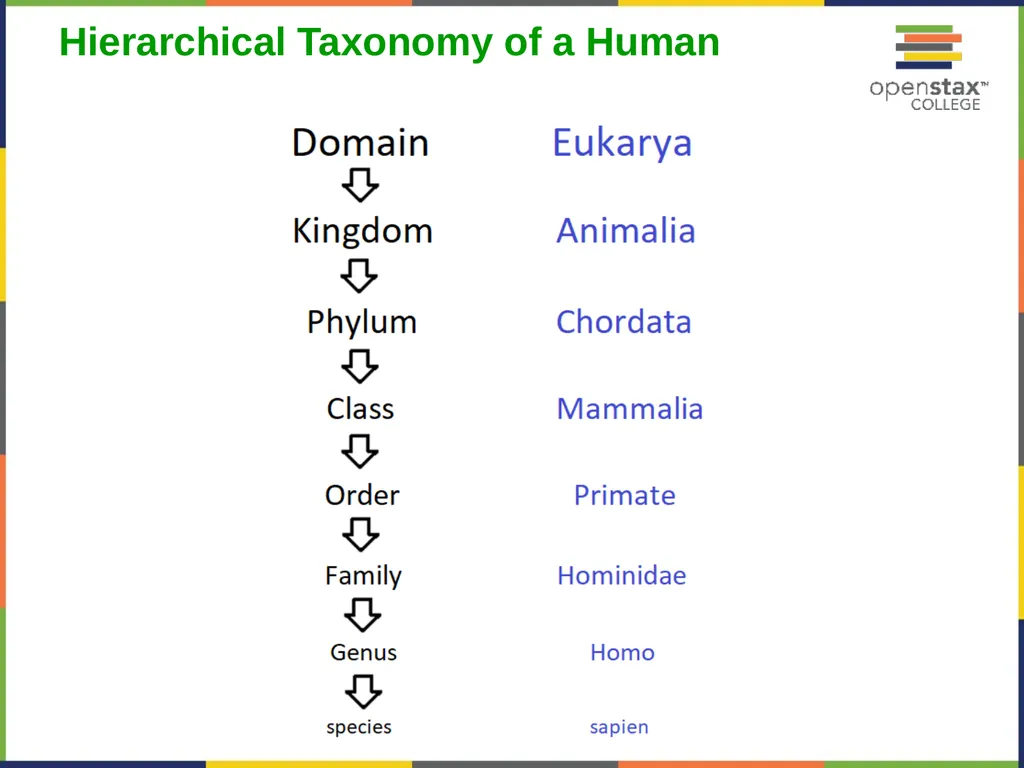
Hierarchical Taxonomy of a Human<br>
24
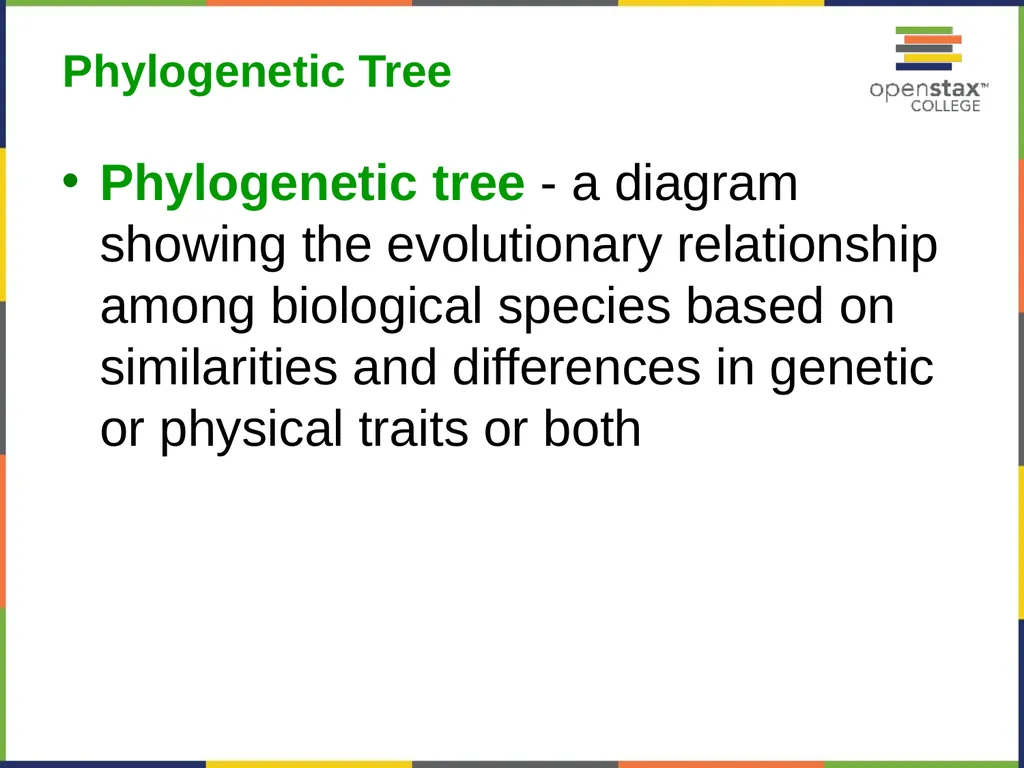
Phylogenetic Tree Phylogenetic tree - a diagram showing the evolutionary relationship among biological species based on similarities and differences in genetic or physical traits or both<br>
25
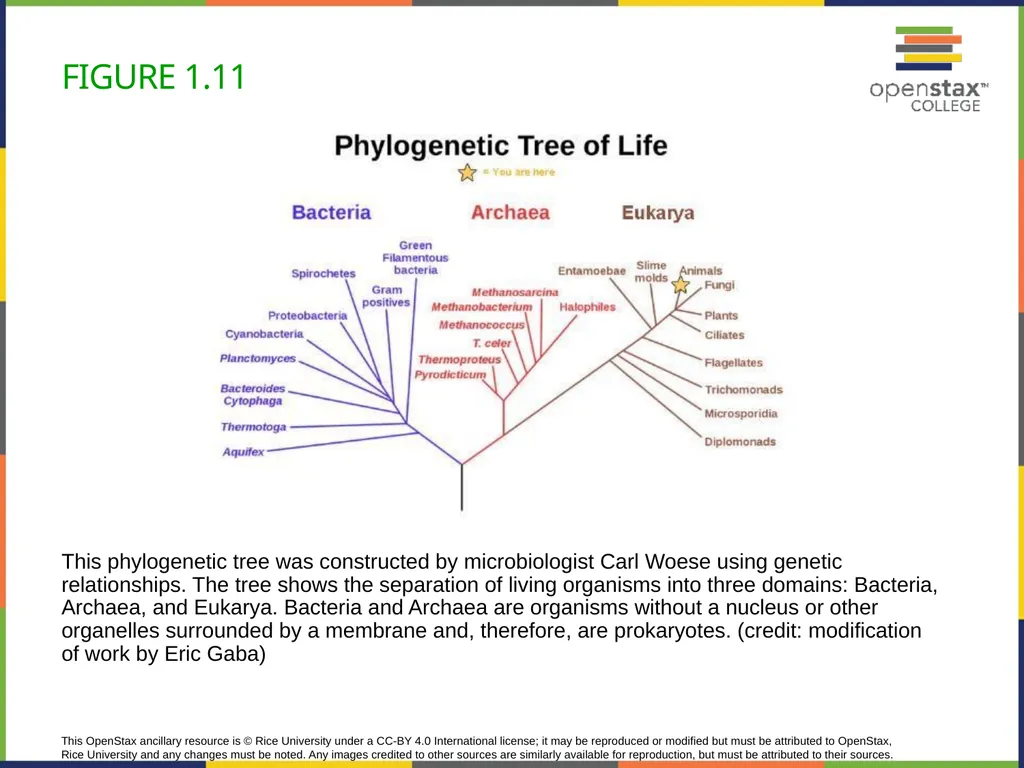
Figure 1.11 This phylogenetic tree was constructed by microbiologist Carl Woese using genetic relationships. The tree shows the separation of living organisms into three domains: Bacteria, Archaea, and Eukarya. Bacteria and Archaea are organisms without a nucleus or other organelles surrounded by a membrane and, therefore, are prokaryotes. (credit: modification of work by Eric Gaba) This OpenStax ancillary resource is © Rice University under a CC-BY 4.0 International license; it may be reproduced or modified but must be attributed to OpenStax, Rice University and any changes must be noted. Any images credited to other sources are similarly available for reproduction, but must be attributed to their sources.<br>
26
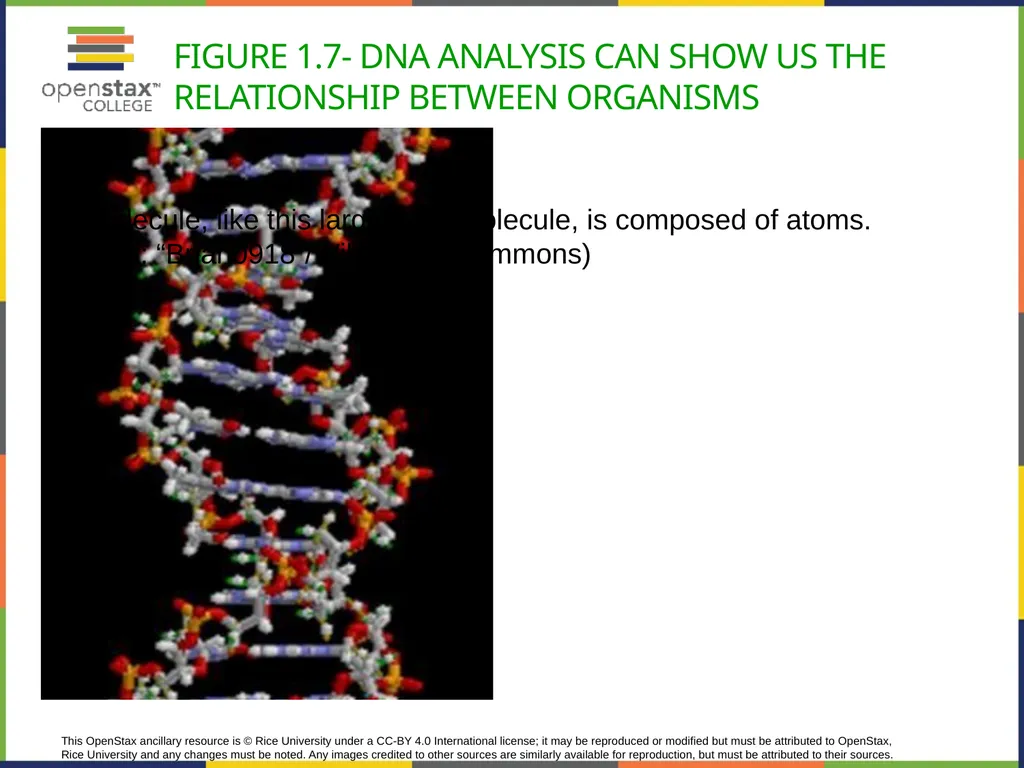
Figure 1.7- DNA analysis can show us the relationship between organisms A molecule, like this large DNA molecule, is composed of atoms. (credit: “Brian0918”/Wikimedia Commons) This OpenStax ancillary resource is © Rice University under a CC-BY 4.0 International license; it may be reproduced or modified but must be attributed to OpenStax, Rice University and any changes must be noted. Any images credited to other sources are similarly available for reproduction, but must be attributed to their sources.<br>
27
Branches of Biological Study There are many branches and sub disciplines in the scope of biology
Molecular biology – studies biological processes at the molecular level
Microbiology – studies the structure and function of microorganisms, includes microbial physiologist, ecologists and geneticists, among others
Neurobiology – studies the biology of the nervous system, including molecular, cellular, developmental, medical, and computational
Paleontology – studies life history
Zoology – studies animals and plants
Biologists can specialize as biotechnologists, ecologists, or physiologists, to name just a few areas<br>
28
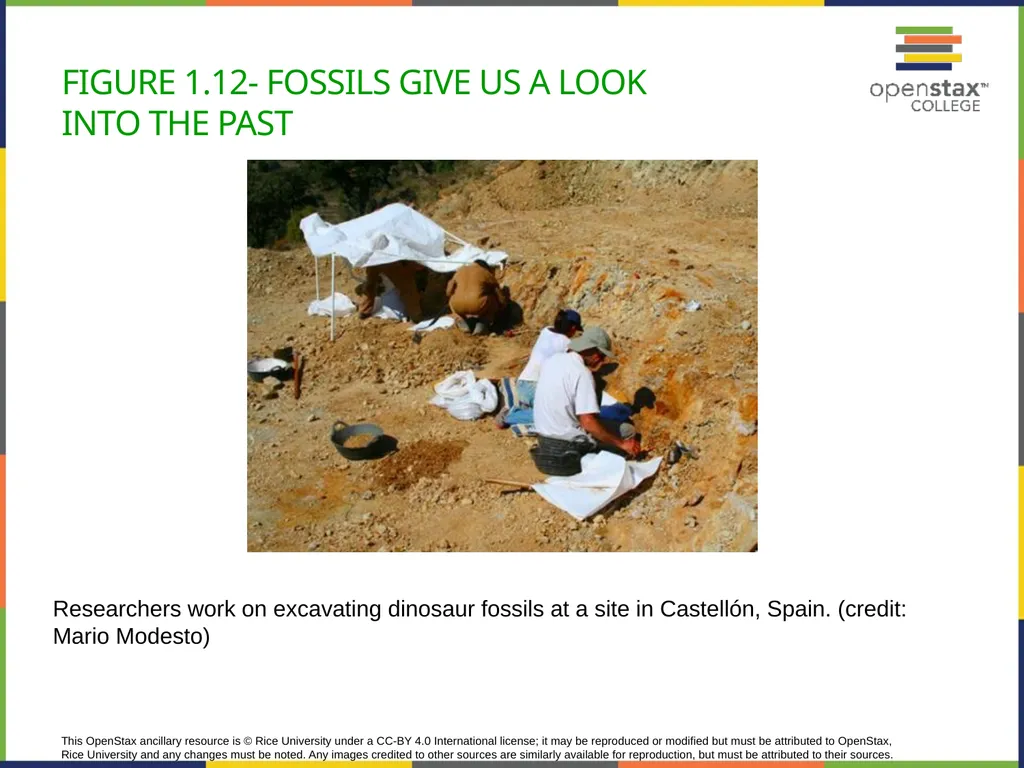
Figure 1.12- Fossils give us a look
into the past Researchers work on excavating dinosaur fossils at a site in Castellón, Spain. (credit: Mario Modesto) This OpenStax ancillary resource is © Rice University under a CC-BY 4.0 International license; it may be reproduced or modified but must be attributed to OpenStax, Rice University and any changes must be noted. Any images credited to other sources are similarly available for reproduction, but must be attributed to their sources.<br>
29
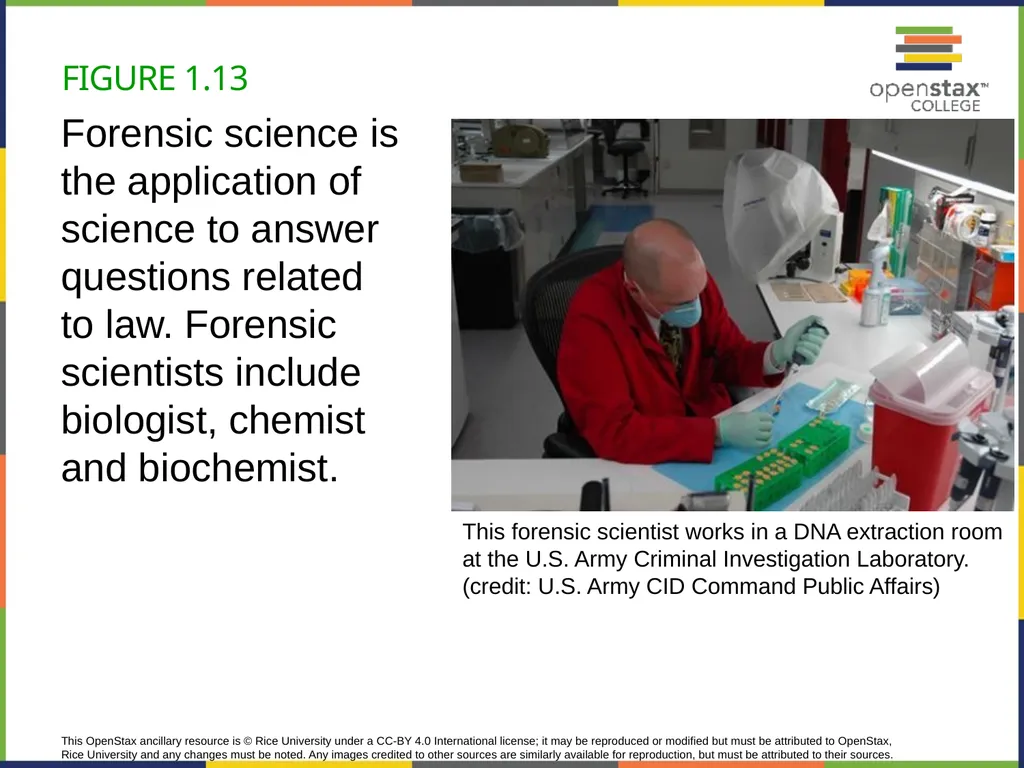
Figure 1.13 Forensic science is the application of science to answer questions related to law. Forensic scientists include biologist, chemist and biochemist. This forensic scientist works in a DNA extraction room at the U.S. Army Criminal Investigation Laboratory. (credit: U.S. Army CID Command Public Affairs) This OpenStax ancillary resource is © Rice University under a CC-BY 4.0 International license; it may be reproduced or modified but must be attributed to OpenStax, Rice University and any changes must be noted. Any images credited to other sources are similarly available for reproduction, but must be attributed to their sources.<br>
30
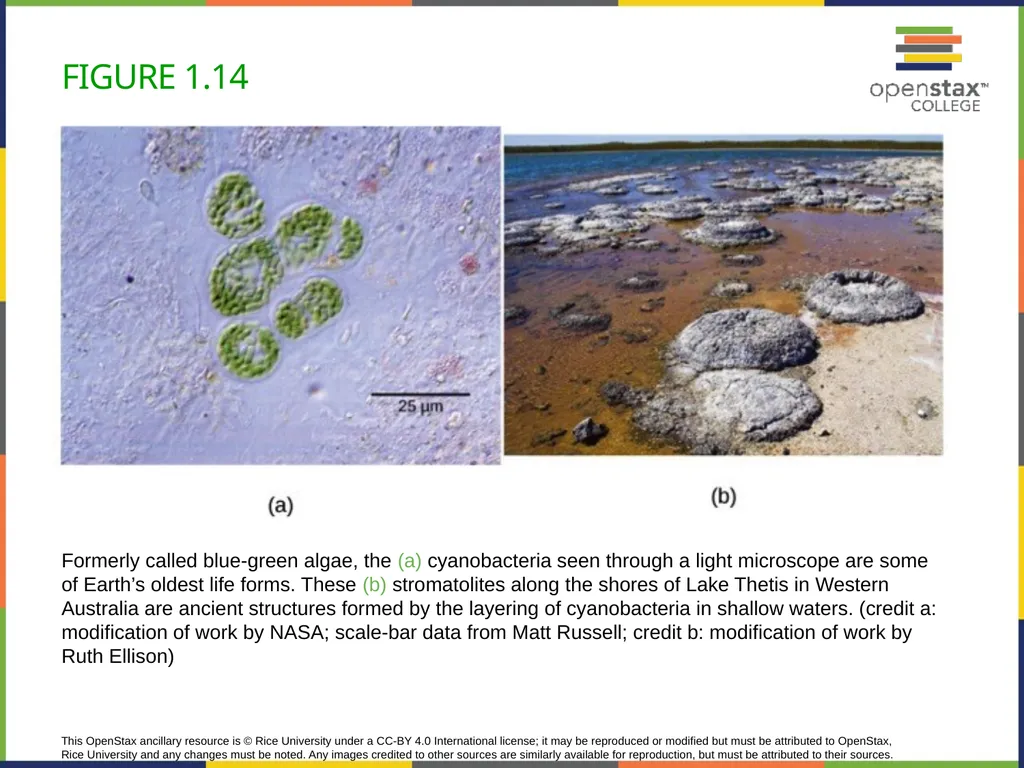
Figure 1.14 Formerly called blue-green algae, the (a) cyanobacteria seen through a light microscope are some of Earth’s oldest life forms. These (b) stromatolites along the shores of Lake Thetis in Western Australia are ancient structures formed by the layering of cyanobacteria in shallow waters. (credit a: modification of work by NASA; scale-bar data from Matt Russell; credit b: modification of work by Ruth Ellison) This OpenStax ancillary resource is © Rice University under a CC-BY 4.0 International license; it may be reproduced or modified but must be attributed to OpenStax, Rice University and any changes must be noted. Any images credited to other sources are similarly available for reproduction, but must be attributed to their sources.<br>
31
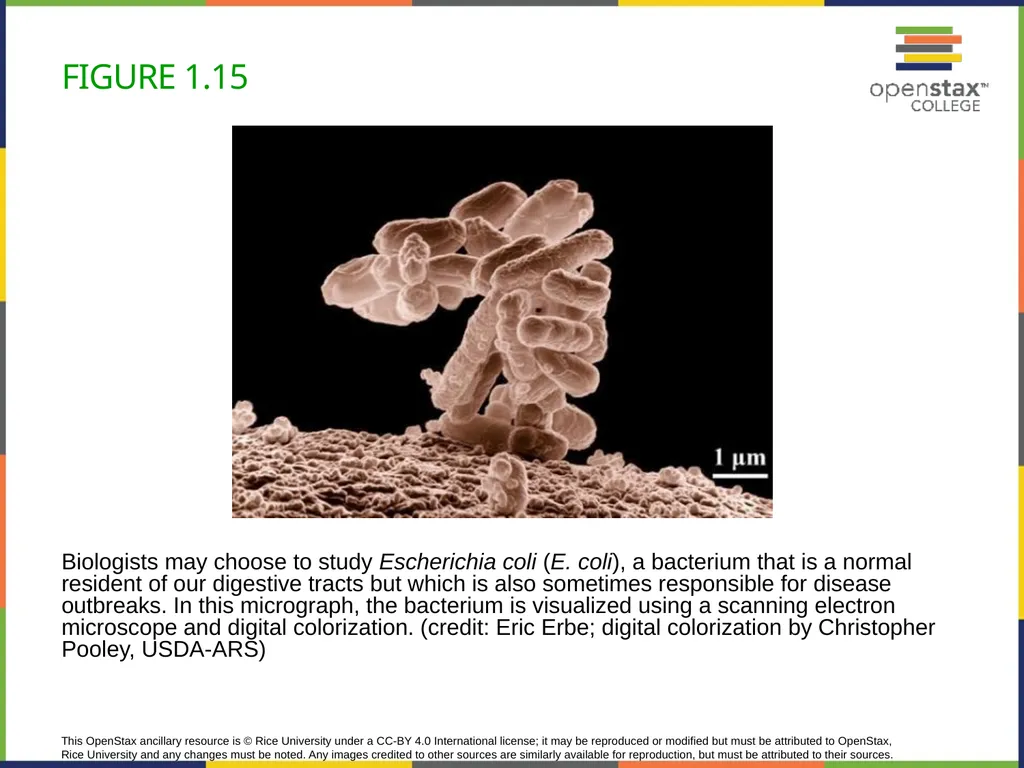
Figure 1.15 Biologists may choose to study Escherichia coli (E. coli), a bacterium that is a normal resident of our digestive tracts but which is also sometimes responsible for disease outbreaks. In this micrograph, the bacterium is visualized using a scanning electron microscope and digital colorization. (credit: Eric Erbe; digital colorization by Christopher Pooley, USDA-ARS) This OpenStax ancillary resource is © Rice University under a CC-BY 4.0 International license; it may be reproduced or modified but must be attributed to OpenStax, Rice University and any changes must be noted. Any images credited to other sources are similarly available for reproduction, but must be attributed to their sources.<br>
32
1.2- the process of science The discoveries of biology are made by a community of researchers who work individually and together using agreed-on methods<br>
33
The Nature of Science Science can be defined as knowledge about the natural world
Science can not answer purely moral questions, aesthetic questions or spiritual questions<br>
Science can not answer purely moral questions, aesthetic questions or spiritual questions<br>
34
The Scientific Method (1 of 2) Scientists tend to use the same general steps to find answers to important questions, this is called the scientific method
The scientific method - a method of research with defined steps that include experiments and careful observations; it is a guideline, and can be altered to fit many different research projects<br>
The scientific method - a method of research with defined steps that include experiments and careful observations; it is a guideline, and can be altered to fit many different research projects<br>
35
The Scientific Method (2 of 2) Hypothesis - a suggested explanation for an event, which can be tested
Scientific theory - a generally accepted, thoroughly tested, and confirmed explanation for a set of observation or phenomena
Scientific laws describe how elements of nature will behave under certain specific conditions, often expressed in mathematical formula<br>
Scientific theory - a generally accepted, thoroughly tested, and confirmed explanation for a set of observation or phenomena
Scientific laws describe how elements of nature will behave under certain specific conditions, often expressed in mathematical formula<br>
36
Natural Sciences Natural sciences are fields of science related to the physical world and its phenomena and processes
Includes biology, astronomy, geology, physics, chemistry, etc
Some scholars choose to divide natural sciences into life sciences (study of living things, including biology) and physical sciences (study of nonliving matter, including astronomy, physics and chemistry)
Some disciplines , like biophysics and biochemistry, build on both sciences<br>
37
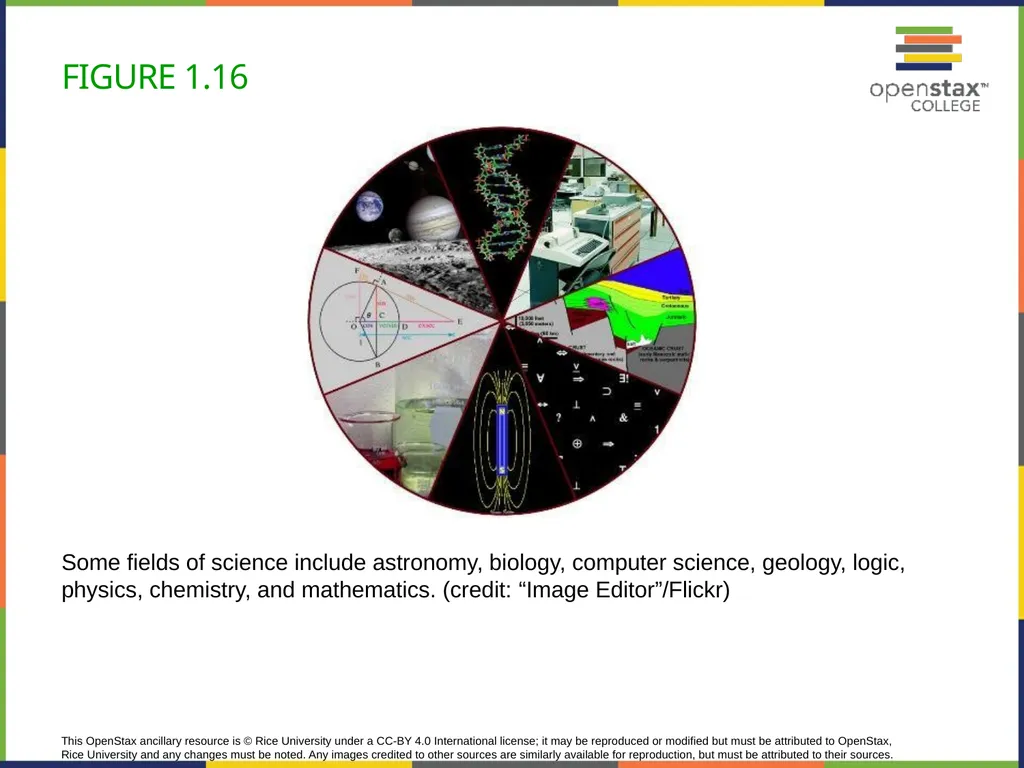
Figure 1.16 Some fields of science include astronomy, biology, computer science, geology, logic, physics, chemistry, and mathematics. (credit: “Image Editor”/Flickr) This OpenStax ancillary resource is © Rice University under a CC-BY 4.0 International license; it may be reproduced or modified but must be attributed to OpenStax, Rice University and any changes must be noted. Any images credited to other sources are similarly available for reproduction, but must be attributed to their sources.<br>
38
Scientific Inquiry (1 of 2) Scientist use two methods of logical thinking to try to understand and explain the world
Inductive reasoning - a form of logical thinking the uses related observation to arrive at a general conclusion
Deductive reasoning - a form of logical thinking that uses a general principle or law to forecast specific results<br>
Inductive reasoning - a form of logical thinking the uses related observation to arrive at a general conclusion
Deductive reasoning - a form of logical thinking that uses a general principle or law to forecast specific results<br>
39
Scientific Inquiry (2 of 2) Both types of logical thinking are related to the two main pathways of scientific study: descriptive science and hypothesis-based science
Descriptive (or discovery) science aims to observe, explore and discover
Hypothesis-based science aims to test a potential answer to a specific problem
Most scientific endeavors combine both approaches<br>
Descriptive (or discovery) science aims to observe, explore and discover
Hypothesis-based science aims to test a potential answer to a specific problem
Most scientific endeavors combine both approaches<br>
40
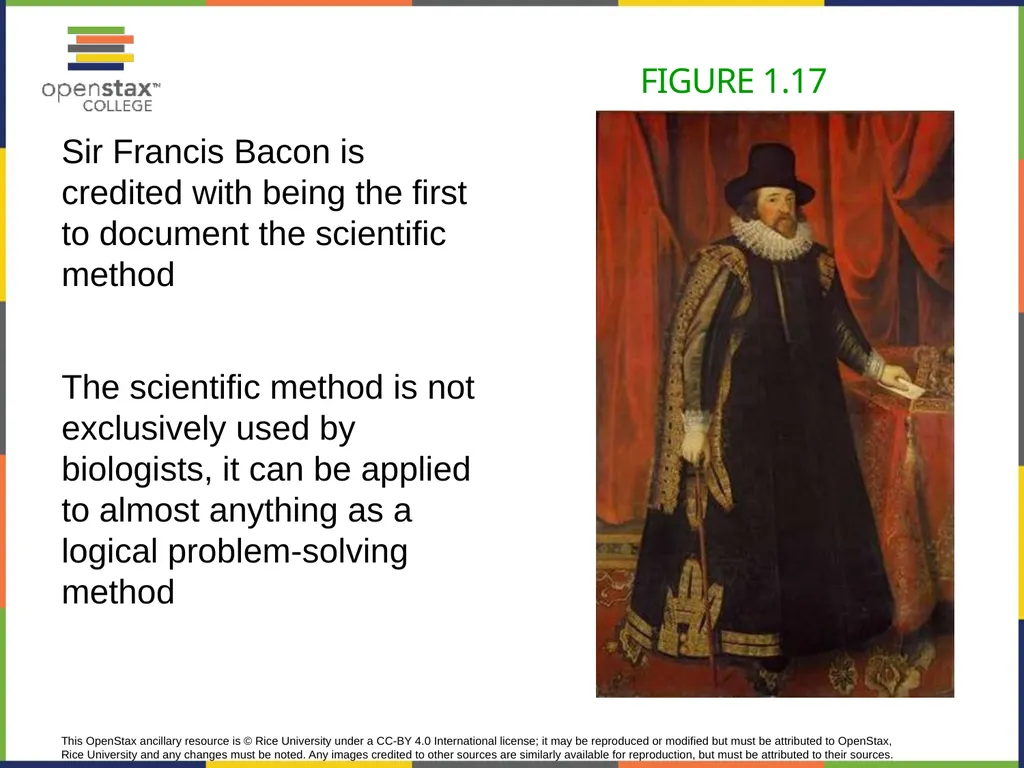
Figure 1.17 Sir Francis Bacon is credited with being the first to document the scientific method
The scientific method is not exclusively used by biologists, it can be applied to almost anything as a logical problem-solving method This OpenStax ancillary resource is © Rice University under a CC-BY 4.0 International license; it may be reproduced or modified but must be attributed to OpenStax, Rice University and any changes must be noted. Any images credited to other sources are similarly available for reproduction, but must be attributed to their sources.<br>
The scientific method is not exclusively used by biologists, it can be applied to almost anything as a logical problem-solving method This OpenStax ancillary resource is © Rice University under a CC-BY 4.0 International license; it may be reproduced or modified but must be attributed to OpenStax, Rice University and any changes must be noted. Any images credited to other sources are similarly available for reproduction, but must be attributed to their sources.<br>
41
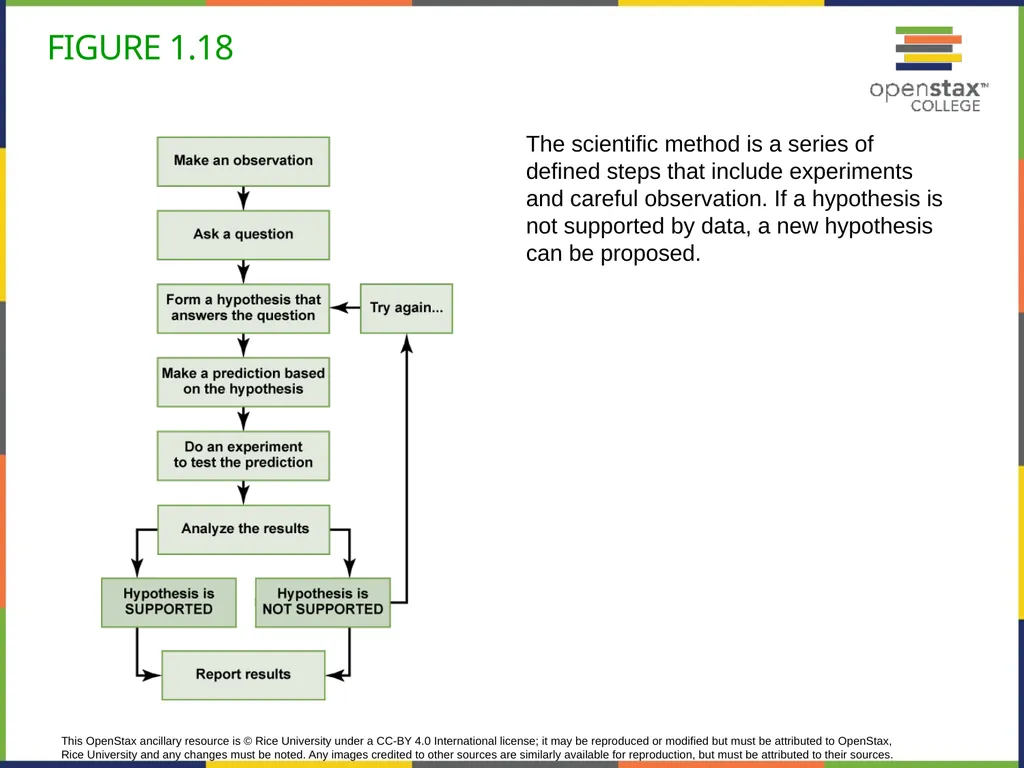
Hypothesis Testing Step 1: Make an observation – observe something of interest.
Step 2: Question something about what you observed.
Step 3: Formulate a hypothesis, a possible answer to the question.
A hypothesis must be testable. It should also be falsifiable, meaning that it can be disproven by experimental results. A hypothesis can be disproven, or eliminated, but it can never be proven.
Step 4: Make a prediction based on your hypothesis.
Typically has the format “If..., then…”
Step 5: Create an experiment to test your hypothesis.
An experiment will have variables (the part of the experiment that varies or changes) and controls (the part of the experiment that does not change).
Step 6: Collect data/results from the experiment.
Step 7: Form a conclusion after analyzing the results.<br>
42
Figure 1.18 The scientific method is a series of defined steps that include experiments and careful observation. If a hypothesis is not supported by data, a new hypothesis can be proposed. This OpenStax ancillary resource is © Rice University under a CC-BY 4.0 International license; it may be reproduced or modified but must be attributed to OpenStax, Rice University and any changes must be noted. Any images credited to other sources are similarly available for reproduction, but must be attributed to their sources.<br>
43
Basic and Applied Science Basic (or pure) science seeks to expand knowledge regardless of the short-term application of that knowledge.
It does not focus on developing a product or a service of immediate public or commercial value
Applied (technology) science aims to use science to solve real-world problems
Focuses on things such as improving farm, curing diseases or saving animals
Most applied sciences wouldn’t be possible without basic science<br>
44
Reporting Scientific Work Peer-reviewed articles - scientific papers that are reviewed, usually anonymously by a scientists colleagues or peers
**There are many journals and popular press that do not use a peer-review system. Results of any study published without peer review are not reliable and should not form the basis for other scientific work.<br>
**There are many journals and popular press that do not use a peer-review system. Results of any study published without peer review are not reliable and should not form the basis for other scientific work.<br>
45
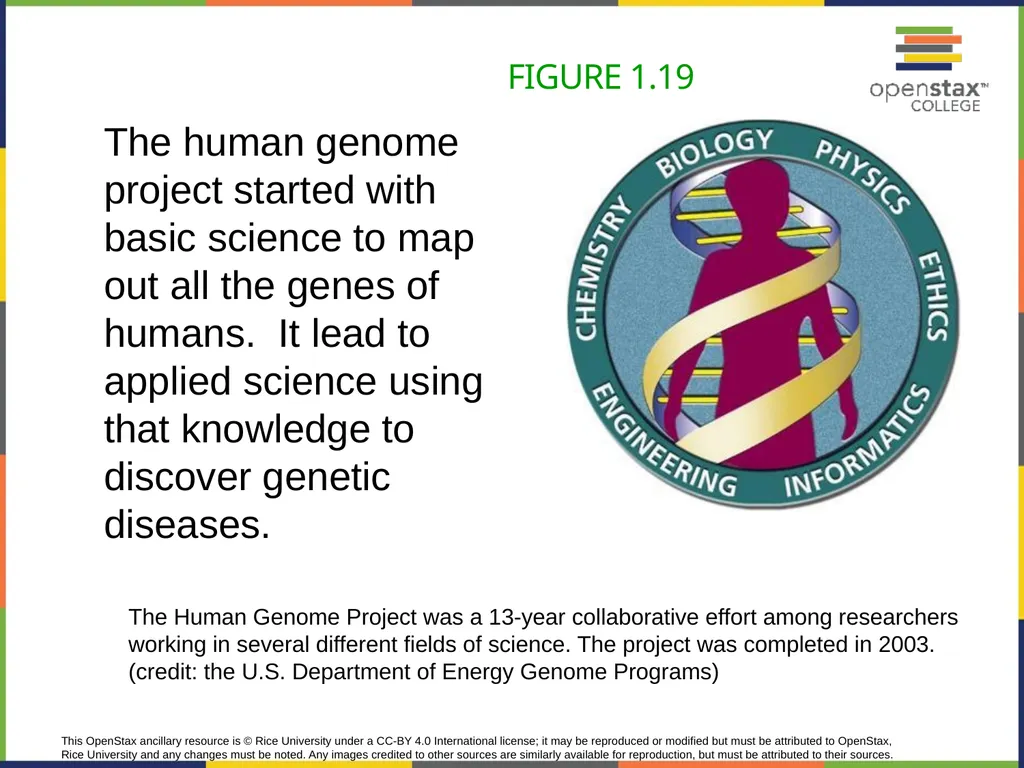
Figure 1.19 The human genome project started with basic science to map out all the genes of humans. It lead to applied science using that knowledge to discover genetic diseases. The Human Genome Project was a 13-year collaborative effort among researchers working in several different fields of science. The project was completed in 2003. (credit: the U.S. Department of Energy Genome Programs) This OpenStax ancillary resource is © Rice University under a CC-BY 4.0 International license; it may be reproduced or modified but must be attributed to OpenStax, Rice University and any changes must be noted. Any images credited to other sources are similarly available for reproduction, but must be attributed to their sources.<br>