
Concepts of Biology Chapter 4 HOW CELLS OBTAIN
CS
Published · 63 slides · 0 views

1 / 1

Description
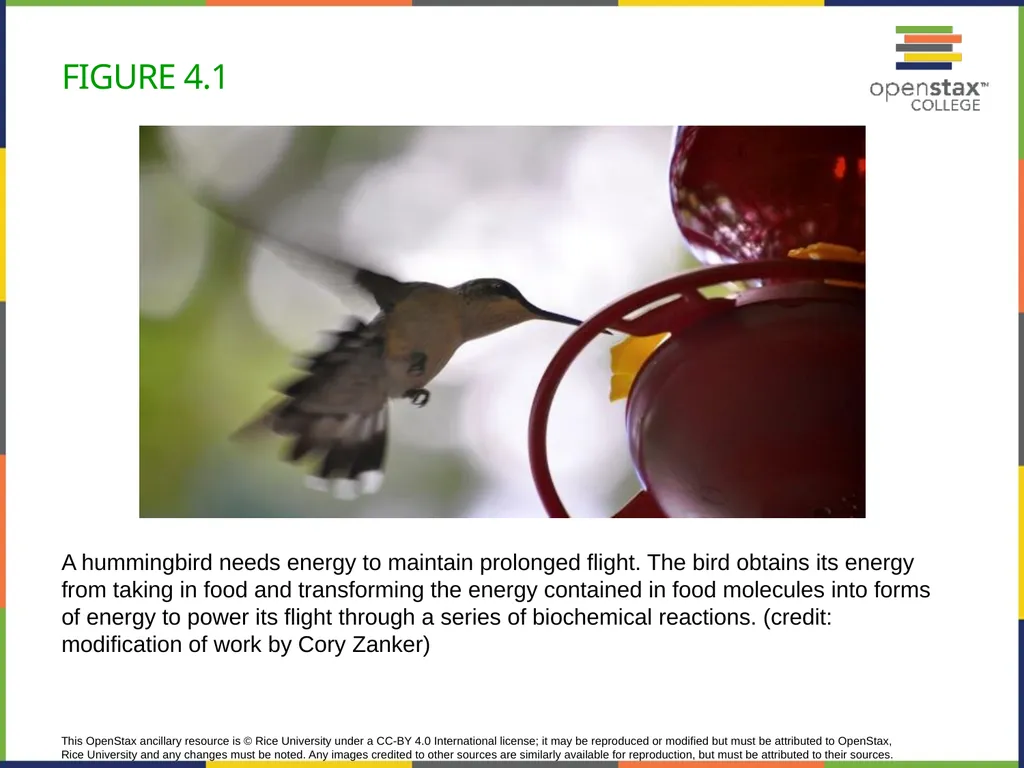
Concepts of Biology Chapter 4 HOW CELLS OBTAIN ENERGY PowerPoint Image Slideshow Figure 4.1 A hummingbird needs energy to maintain prolonged flight. The bird obtains its energy from taking in food and transforming the energy contained in
Related Topics
Share
Embed code
Download this presentation From Below
"Concepts of Biology Chapter 4 HOW CELLS OBTAIN" is the property of its rightful owner. Permission is granted to download and print the materials on this website for personal, non-commercial use only, and to display it on your personal computer provided you do not modify the materials and that you retain all copyright notices contained in the materials. By downloading content from our website, you accept the terms of this agreement.
Presentation Transcript
01
Concepts of Biology Chapter 4 HOW CELLS OBTAIN ENERGY
PowerPoint Image Slideshow<br>
PowerPoint Image Slideshow<br>
02
Figure 4.1 A hummingbird needs energy to maintain prolonged flight. The bird obtains its energy from taking in food and transforming the energy contained in food molecules into forms of energy to power its flight through a series of biochemical reactions. (credit: modification of work by Cory Zanker) This OpenStax ancillary resource is © Rice University under a CC-BY 4.0 International license; it may be reproduced or modified but must be attributed to OpenStax, Rice University and any changes must be noted. Any images credited to other sources are similarly available for reproduction, but must be attributed to their sources.<br>
03
Introduction Living cells of every organism constantly use energy
Just as energy is required to both build and demolish buildings, energy is required to synthesize and breakdown molecules, as well as to transport molecules into and out of cells<br>
Just as energy is required to both build and demolish buildings, energy is required to synthesize and breakdown molecules, as well as to transport molecules into and out of cells<br>
04
4.1 energy and metabolism Scientists use the term bioenergetics to describe the concept of energy flow through living systems, such as cells
Building and breaking down molecules occur through series of chemical reactions
Cells must continuous produce energy to replenish the energy used
Metabolism refers to all of the chemical reactions that take place inside cells<br>
Building and breaking down molecules occur through series of chemical reactions
Cells must continuous produce energy to replenish the energy used
Metabolism refers to all of the chemical reactions that take place inside cells<br>
05
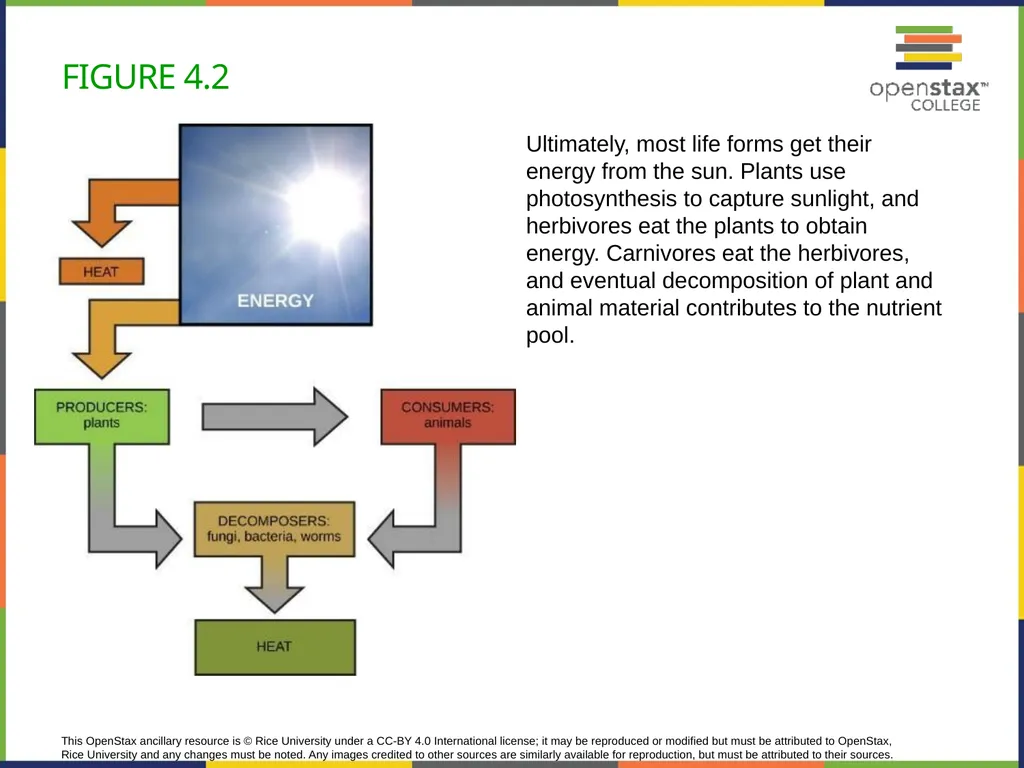
Figure 4.2 Ultimately, most life forms get their energy from the sun. Plants use photosynthesis to capture sunlight, and herbivores eat the plants to obtain energy. Carnivores eat the herbivores, and eventual decomposition of plant and animal material contributes to the nutrient pool. This OpenStax ancillary resource is © Rice University under a CC-BY 4.0 International license; it may be reproduced or modified but must be attributed to OpenStax, Rice University and any changes must be noted. Any images credited to other sources are similarly available for reproduction, but must be attributed to their sources.<br>
06
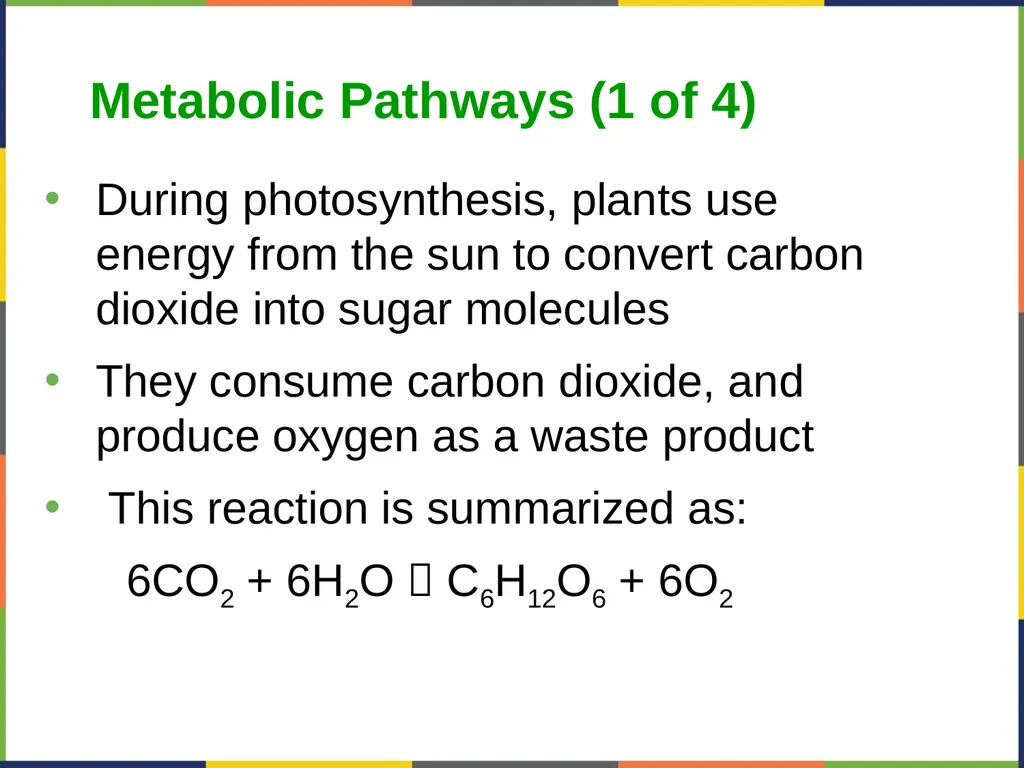
Metabolic Pathways (1 of 4) During photosynthesis, plants use energy from the sun to convert carbon dioxide into sugar molecules
They consume carbon dioxide, and produce oxygen as a waste product
This reaction is summarized as:
6CO2 + 6H2O C6H12O6 + 6O2<br>
They consume carbon dioxide, and produce oxygen as a waste product
This reaction is summarized as:
6CO2 + 6H2O C6H12O6 + 6O2<br>
07
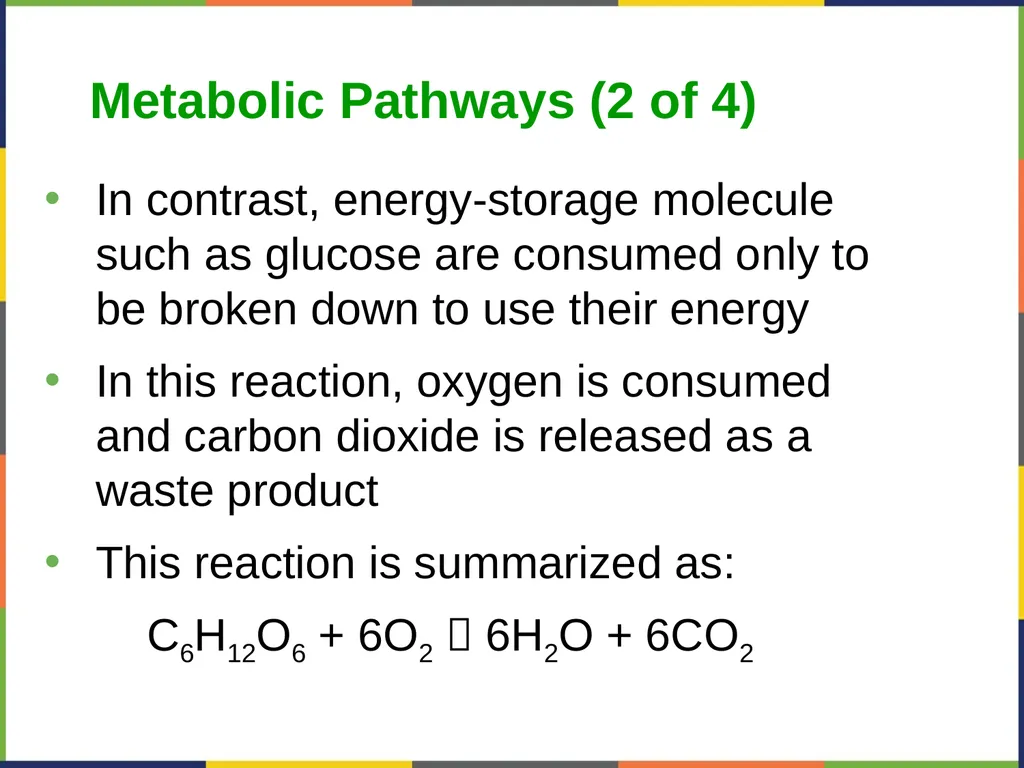
Metabolic Pathways (2 of 4) In contrast, energy-storage molecule such as glucose are consumed only to be broken down to use their energy
In this reaction, oxygen is consumed and carbon dioxide is released as a waste product
This reaction is summarized as:
C6H12O6 + 6O2 6H2O + 6CO2<br>
In this reaction, oxygen is consumed and carbon dioxide is released as a waste product
This reaction is summarized as:
C6H12O6 + 6O2 6H2O + 6CO2<br>
08
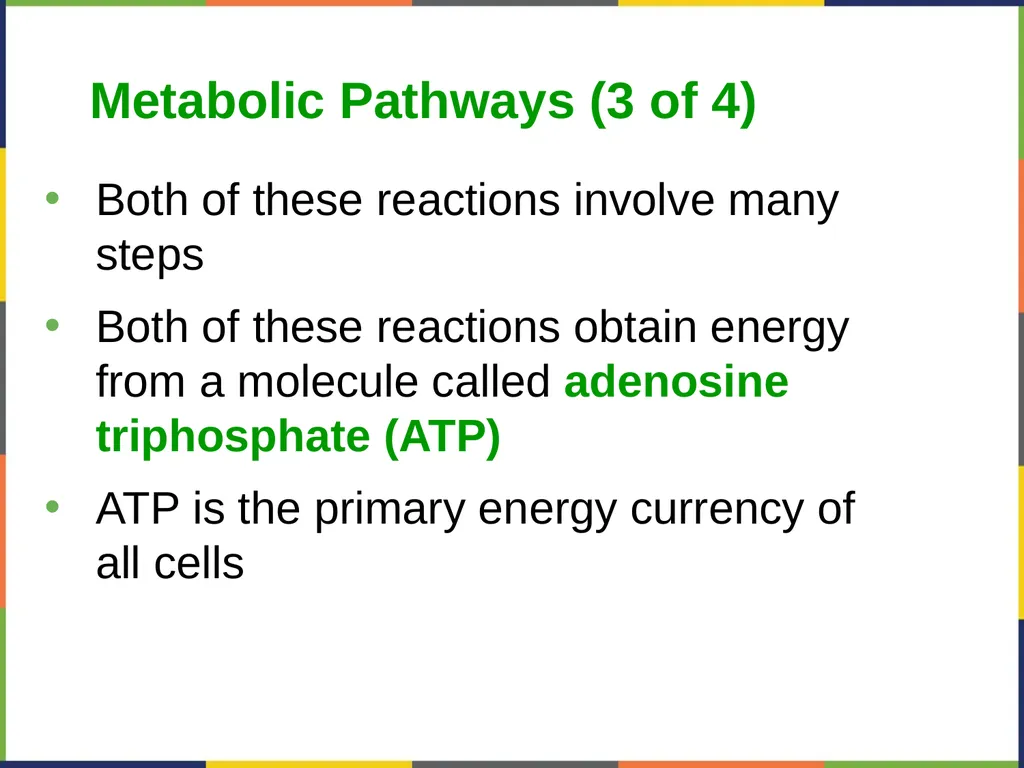
Metabolic Pathways (3 of 4) Both of these reactions involve many steps
Both of these reactions obtain energy from a molecule called adenosine triphosphate (ATP)
ATP is the primary energy currency of all cells<br>
Both of these reactions obtain energy from a molecule called adenosine triphosphate (ATP)
ATP is the primary energy currency of all cells<br>
09
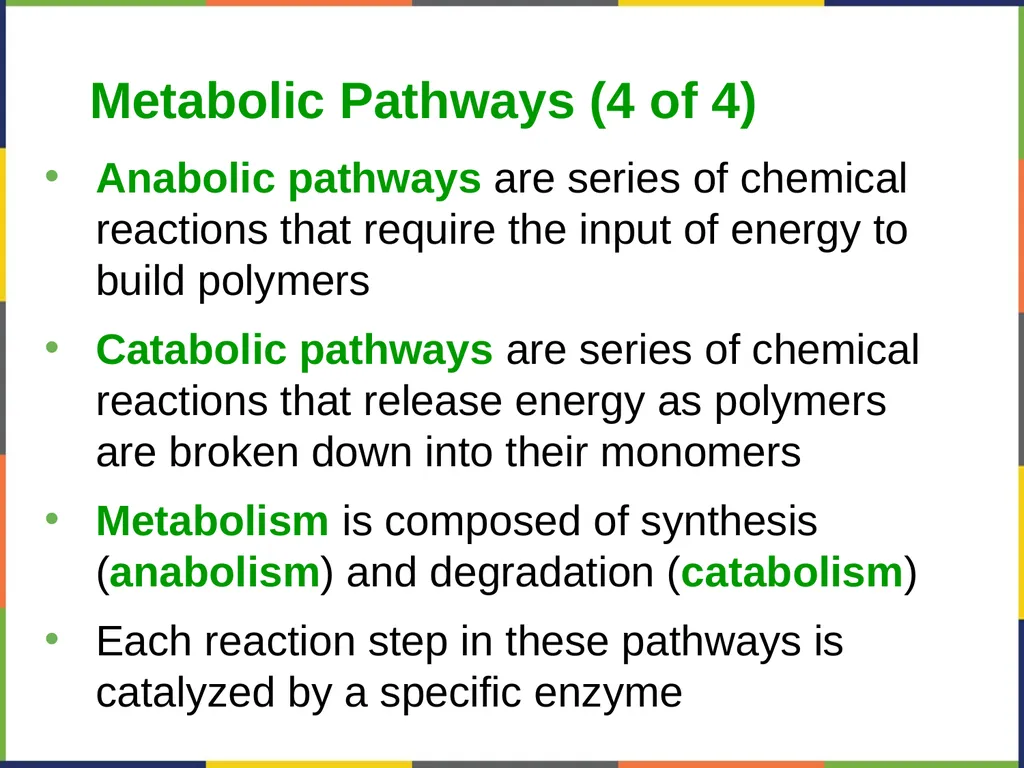
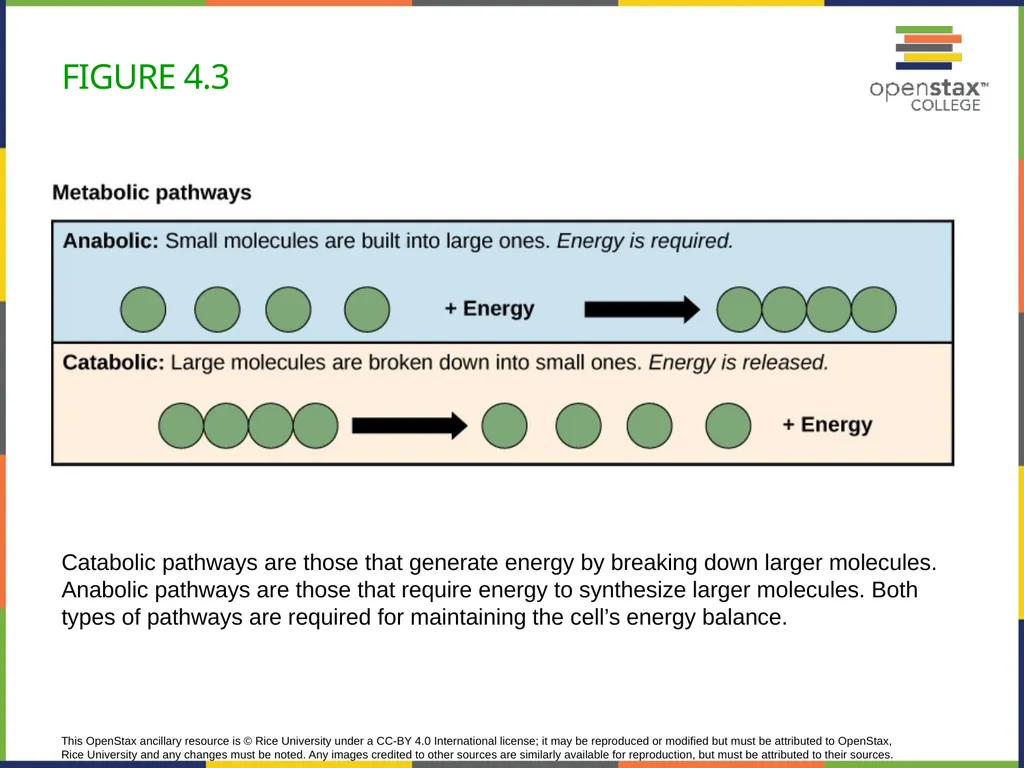
Metabolic Pathways (4 of 4) Anabolic pathways are series of chemical reactions that require the input of energy to build polymers
Catabolic pathways are series of chemical reactions that release energy as polymers are broken down into their monomers
Metabolism is composed of synthesis (anabolism) and degradation (catabolism)
Each reaction step in these pathways is catalyzed by a specific enzyme<br>
Catabolic pathways are series of chemical reactions that release energy as polymers are broken down into their monomers
Metabolism is composed of synthesis (anabolism) and degradation (catabolism)
Each reaction step in these pathways is catalyzed by a specific enzyme<br>
10
Figure 4.3 Catabolic pathways are those that generate energy by breaking down larger molecules. Anabolic pathways are those that require energy to synthesize larger molecules. Both types of pathways are required for maintaining the cell’s energy balance. This OpenStax ancillary resource is © Rice University under a CC-BY 4.0 International license; it may be reproduced or modified but must be attributed to OpenStax, Rice University and any changes must be noted. Any images credited to other sources are similarly available for reproduction, but must be attributed to their sources.<br>
11
Energy (1 of 3) Thermodynamics refers to the study of energy and energy transfer involving physical matter
A system refers to all matter relevant to a particular case of energy transfer
Example: heating water on a stove, the system includes the stove, the pot and the water; energy is transferred from the stove to the pot to the water<br>
A system refers to all matter relevant to a particular case of energy transfer
Example: heating water on a stove, the system includes the stove, the pot and the water; energy is transferred from the stove to the pot to the water<br>
12
Energy (2 of 3) There are two types of systems: open and closed
An open system is one where energy can be exchanged with the environment (the stovetop system is open because heat is lost to the air)
A closed system can not exchange energy with its surroundings
Biological systems are open systems<br>
An open system is one where energy can be exchanged with the environment (the stovetop system is open because heat is lost to the air)
A closed system can not exchange energy with its surroundings
Biological systems are open systems<br>
13
Energy (3 of 3) Energy is defined as the ability to do work, or to create some kind of change
It exist is different forms; for example, electrical energy, light energy, and heat energy<br>
It exist is different forms; for example, electrical energy, light energy, and heat energy<br>
14
Thermodynamics (1 of 2) The first law of thermodynamics states that the total amount of energy in the universe is constant and conserved
Energy may be transferred from place to place or transformed into different forms, but it cannot be created nor destroyed<br>
Energy may be transferred from place to place or transformed into different forms, but it cannot be created nor destroyed<br>
15
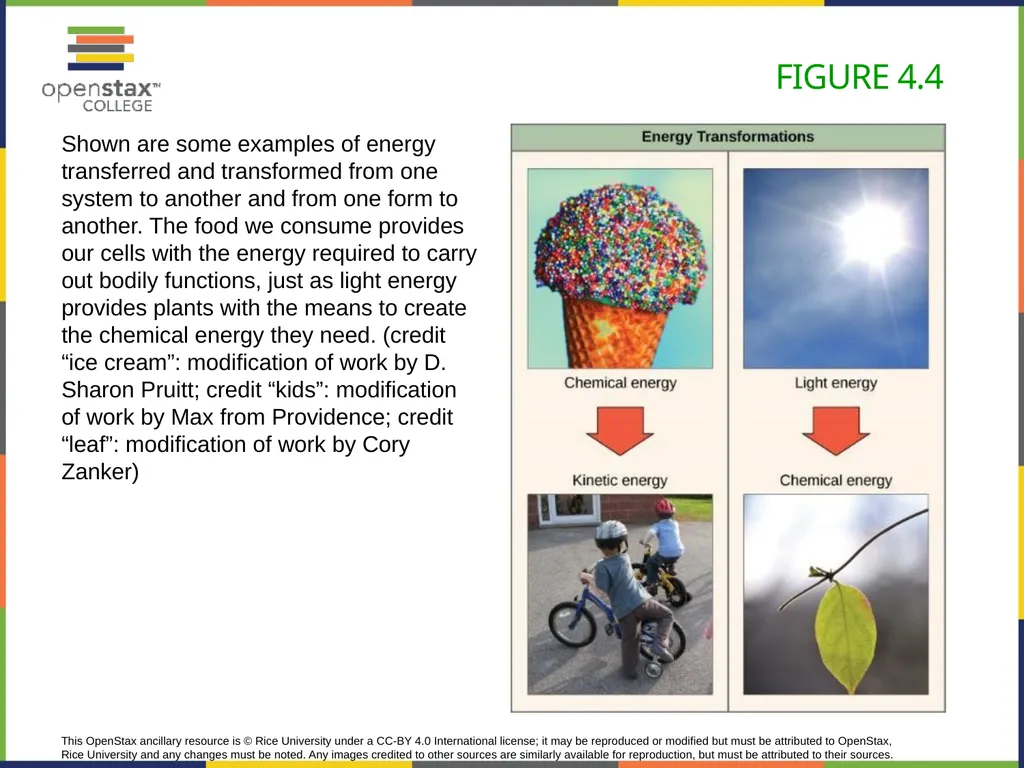
Figure 4.4 Shown are some examples of energy transferred and transformed from one system to another and from one form to another. The food we consume provides our cells with the energy required to carry out bodily functions, just as light energy provides plants with the means to create the chemical energy they need. (credit “ice cream”: modification of work by D. Sharon Pruitt; credit “kids”: modification of work by Max from Providence; credit “leaf”: modification of work by Cory Zanker) This OpenStax ancillary resource is © Rice University under a CC-BY 4.0 International license; it may be reproduced or modified but must be attributed to OpenStax, Rice University and any changes must be noted. Any images credited to other sources are similarly available for reproduction, but must be attributed to their sources.<br>
16
Thermodynamics (2 of 2) Heat energy is defined as the energy transferred from one system to another system that is not work
The more energy that is lost by a system to its surroundings, the less ordered and more random the system is
Entropy is the measurement of randomness or disorder in a system
High entropy means high disorder & low energy
Living things are highly ordered, requiring constant energy input to maintain a state of low entropy<br>
17
Potential and Kinetic Energy Kinetic energy is energy associated with objects in motion (example, a swinging wrecking ball)
Potential energy is stored energy (example, that wrecking ball lifted two stories above the ground)
On a molecular level, the bonds that hold the atoms of a molecule together has potential energy, this energy is released when the bonds are broken<br>
Potential energy is stored energy (example, that wrecking ball lifted two stories above the ground)
On a molecular level, the bonds that hold the atoms of a molecule together has potential energy, this energy is released when the bonds are broken<br>
18
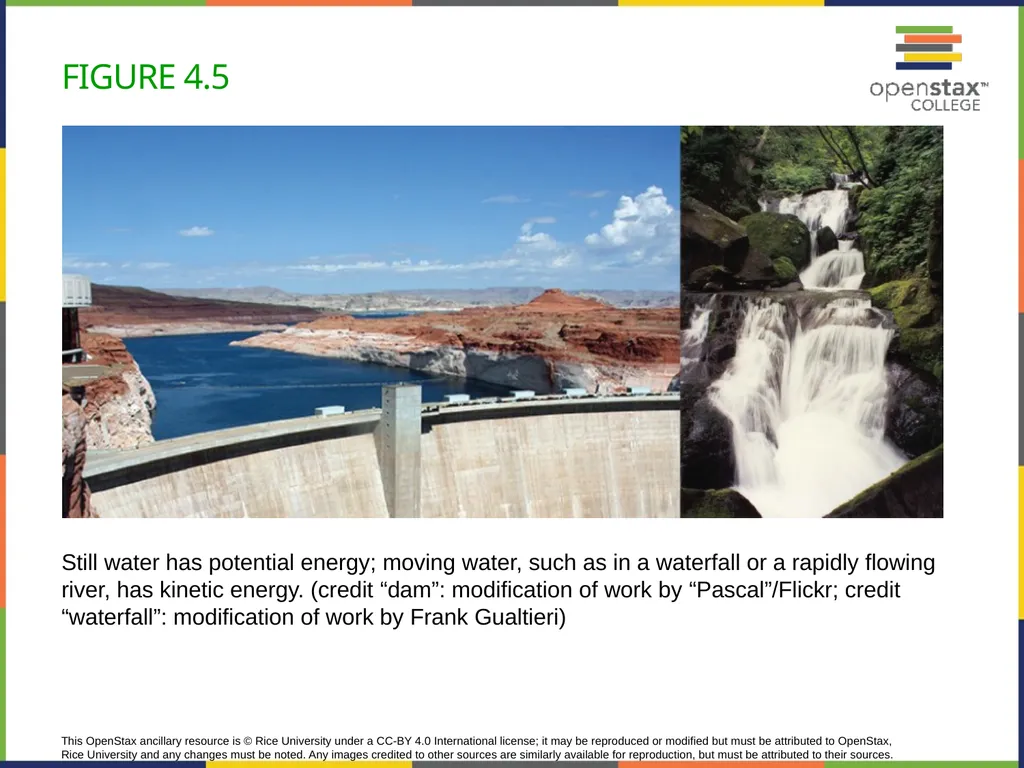
Figure 4.5 Still water has potential energy; moving water, such as in a waterfall or a rapidly flowing river, has kinetic energy. (credit “dam”: modification of work by “Pascal”/Flickr; credit “waterfall”: modification of work by Frank Gualtieri) This OpenStax ancillary resource is © Rice University under a CC-BY 4.0 International license; it may be reproduced or modified but must be attributed to OpenStax, Rice University and any changes must be noted. Any images credited to other sources are similarly available for reproduction, but must be attributed to their sources.<br>
19
Free and Activation Energy (1 of 4) Free energy (G) is energy that is available to do work, or usable energy
The amount of free energy changes when chemical reactions occur, the change is free energy is denoted as ΔG (delta G)<br>
The amount of free energy changes when chemical reactions occur, the change is free energy is denoted as ΔG (delta G)<br>
20
Free and Activation Energy (2 of 4) If energy is released during a chemical reaction, then the change in free energy will be negative (-ΔG)
This means that the products have less free energy than the reactants
These reactions are called exergonic reactions<br>
This means that the products have less free energy than the reactants
These reactions are called exergonic reactions<br>
21
Free and Activation Energy (3 of 4) If energy is absorbed during a chemical reaction, then the change in free energy will be positive (+ΔG)
This means that the products have more free energy than the reactants
These reactions are called endergonic reactions<br>
This means that the products have more free energy than the reactants
These reactions are called endergonic reactions<br>
22
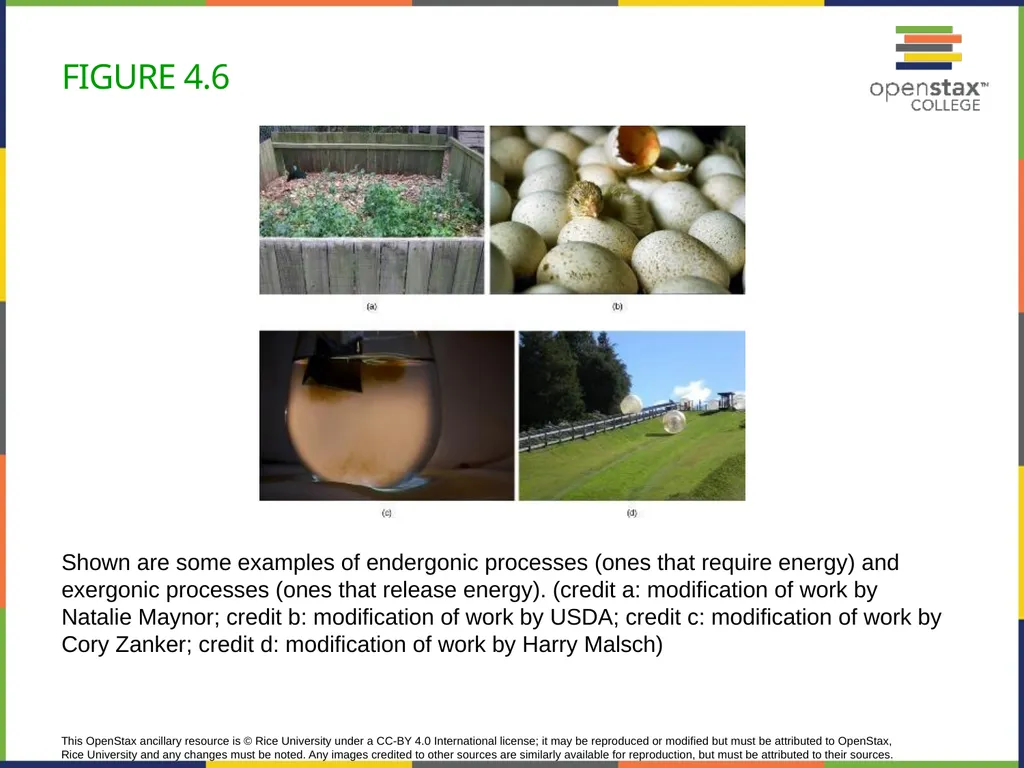
Figure 4.6 Shown are some examples of endergonic processes (ones that require energy) and exergonic processes (ones that release energy). (credit a: modification of work by Natalie Maynor; credit b: modification of work by USDA; credit c: modification of work by Cory Zanker; credit d: modification of work by Harry Malsch) This OpenStax ancillary resource is © Rice University under a CC-BY 4.0 International license; it may be reproduced or modified but must be attributed to OpenStax, Rice University and any changes must be noted. Any images credited to other sources are similarly available for reproduction, but must be attributed to their sources.<br>
23
Free and Activation Energy (4 of 4) Why haven’t all exergonic reactions already occurred?
The answer is because of activation energy
Activation energy is the small amount of energy input that is necessary for chemical reactions to occur<br>
The answer is because of activation energy
Activation energy is the small amount of energy input that is necessary for chemical reactions to occur<br>
24
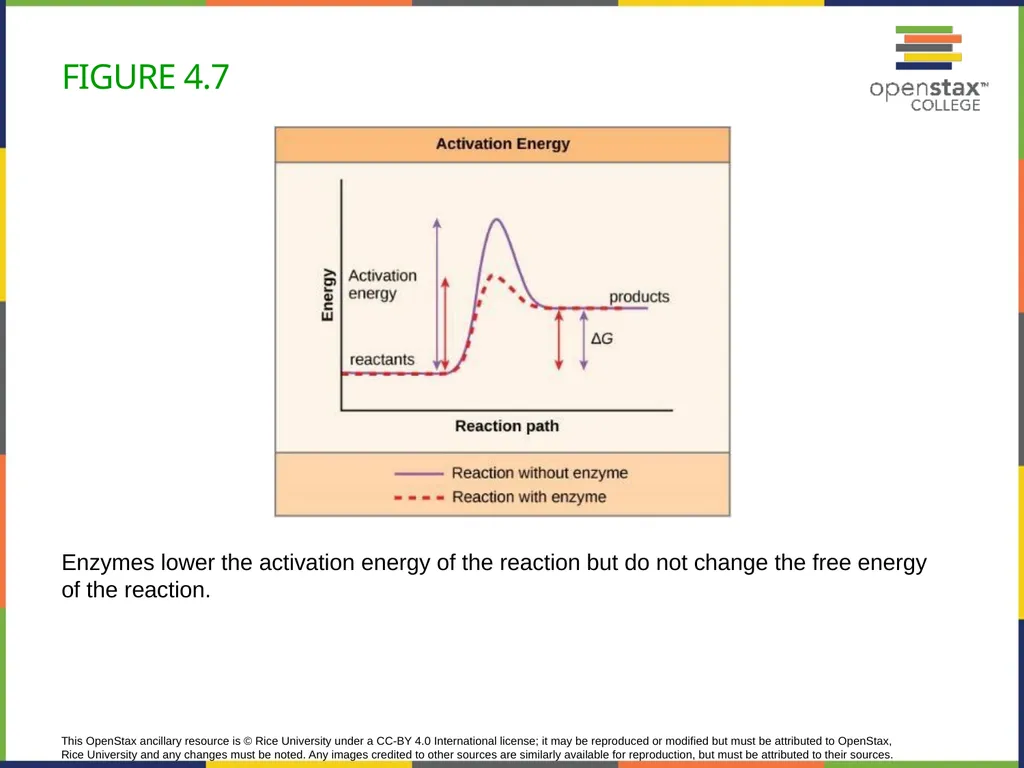
Enzymes (1 of 7) A substance that helps a chemical reaction to occur is called a catalyst, they help the reaction to occur by lowering the activation energy
Molecules that catalyze biochemical reactions are called enzymes
As mentioned in the previous chapter, most enzymes are proteins
An enzyme is NOT changed by the reaction and can be used over and over<br>
Molecules that catalyze biochemical reactions are called enzymes
As mentioned in the previous chapter, most enzymes are proteins
An enzyme is NOT changed by the reaction and can be used over and over<br>
25
Figure 4.7 Enzymes lower the activation energy of the reaction but do not change the free energy of the reaction. This OpenStax ancillary resource is © Rice University under a CC-BY 4.0 International license; it may be reproduced or modified but must be attributed to OpenStax, Rice University and any changes must be noted. Any images credited to other sources are similarly available for reproduction, but must be attributed to their sources.<br>
26
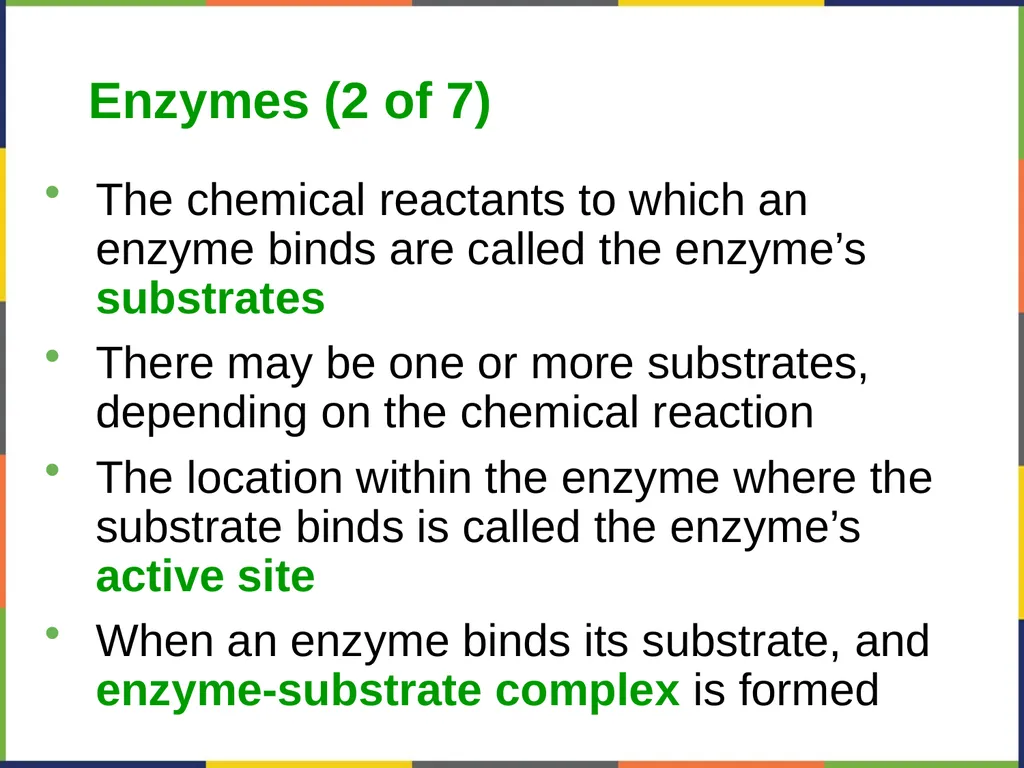
Enzymes (2 of 7) The chemical reactants to which an enzyme binds are called the enzyme’s substrates
There may be one or more substrates, depending on the chemical reaction
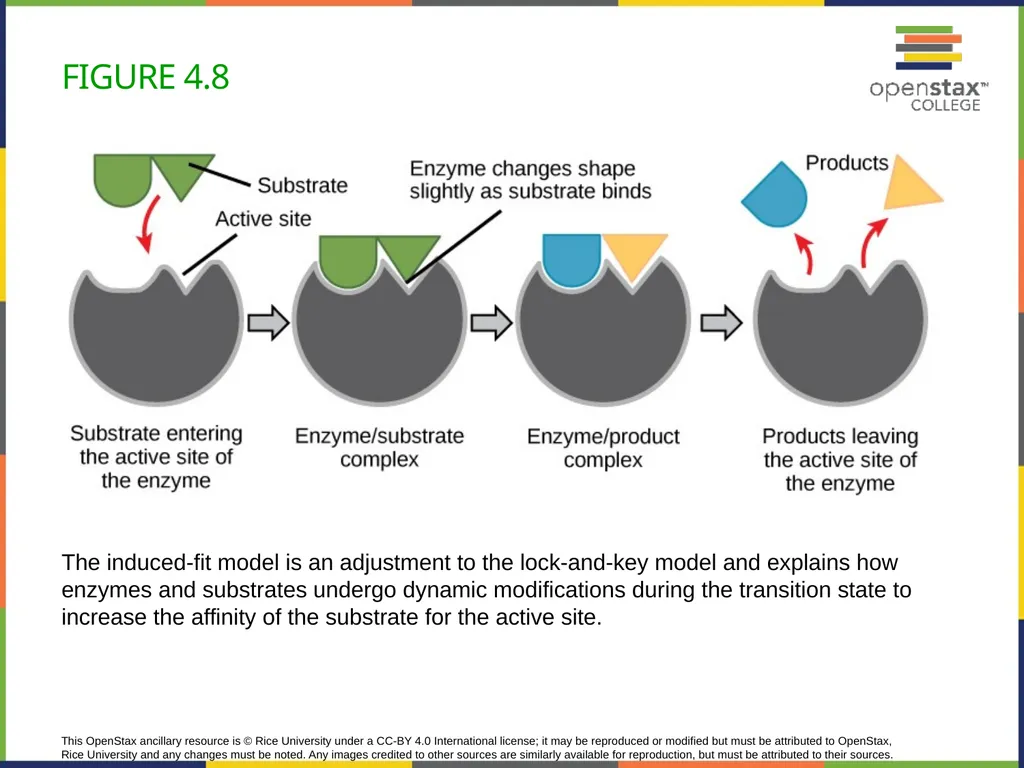
The location within the enzyme where the substrate binds is called the enzyme’s active site
When an enzyme binds its substrate, and enzyme-substrate complex is formed<br>
There may be one or more substrates, depending on the chemical reaction
The location within the enzyme where the substrate binds is called the enzyme’s active site
When an enzyme binds its substrate, and enzyme-substrate complex is formed<br>
27
Figure 4.8 The induced-fit model is an adjustment to the lock-and-key model and explains how enzymes and substrates undergo dynamic modifications during the transition state to increase the affinity of the substrate for the active site. This OpenStax ancillary resource is © Rice University under a CC-BY 4.0 International license; it may be reproduced or modified but must be attributed to OpenStax, Rice University and any changes must be noted. Any images credited to other sources are similarly available for reproduction, but must be attributed to their sources.<br>
28
Enzymes (3 of 7) Enzymes can be regulated in ways that either promote or reduce enzyme activity
There are many molecules that inhibit or promote enzyme function, and do so in various ways<br>
There are many molecules that inhibit or promote enzyme function, and do so in various ways<br>
29
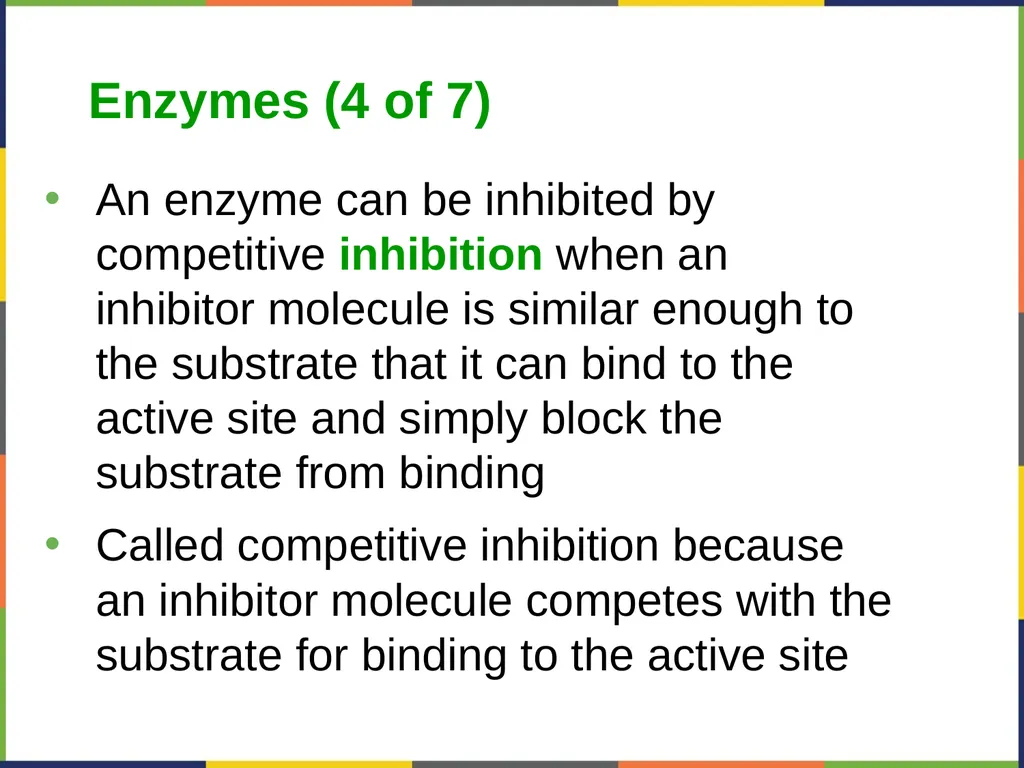
Enzymes (4 of 7) An enzyme can be inhibited by competitive inhibition when an inhibitor molecule is similar enough to the substrate that it can bind to the active site and simply block the substrate from binding
Called competitive inhibition because an inhibitor molecule competes with the substrate for binding to the active site<br>
Called competitive inhibition because an inhibitor molecule competes with the substrate for binding to the active site<br>
30
Enzymes (5 of 7) Inhibitors can also be a noncompetitive inhibitor, meaning the inhibitor molecule binds to the enzyme in a location other than the active site, this location is called the allosteric site<br>
31
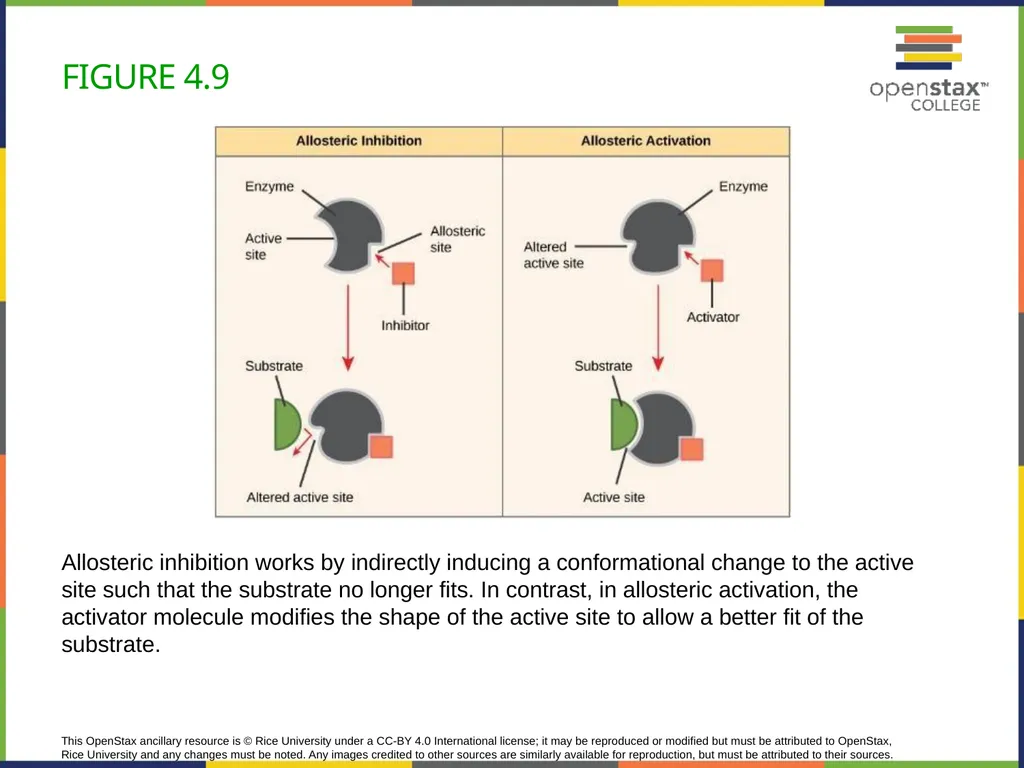
Enzymes (6 of 7) Allosteric inhibitors bind to the allosteric site and change the conformation of the enzyme, inhibiting its activity
Allosteric activators bind to the allosteric site and induces a conformational change that increases the affinity of the enzymes active site for its substrate<br>
Allosteric activators bind to the allosteric site and induces a conformational change that increases the affinity of the enzymes active site for its substrate<br>
32
Figure 4.9 Allosteric inhibition works by indirectly inducing a conformational change to the active site such that the substrate no longer fits. In contrast, in allosteric activation, the activator molecule modifies the shape of the active site to allow a better fit of the substrate. This OpenStax ancillary resource is © Rice University under a CC-BY 4.0 International license; it may be reproduced or modified but must be attributed to OpenStax, Rice University and any changes must be noted. Any images credited to other sources are similarly available for reproduction, but must be attributed to their sources.<br>
33
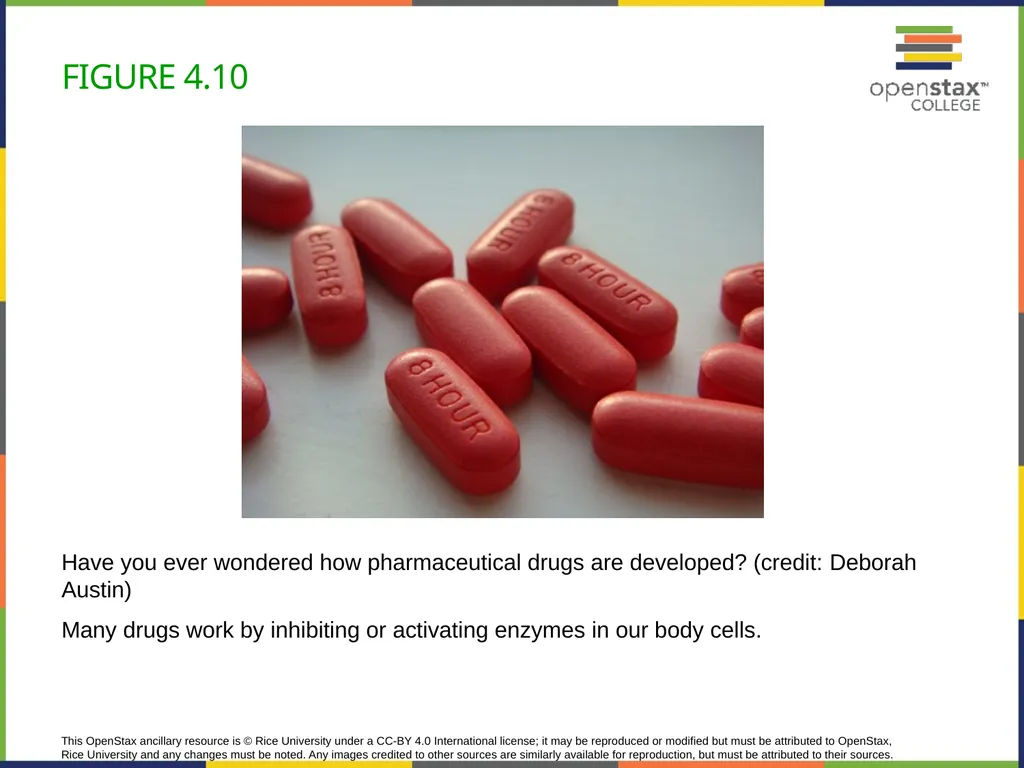
Figure 4.10 Have you ever wondered how pharmaceutical drugs are developed? (credit: Deborah Austin)
Many drugs work by inhibiting or activating enzymes in our body cells. This OpenStax ancillary resource is © Rice University under a CC-BY 4.0 International license; it may be reproduced or modified but must be attributed to OpenStax, Rice University and any changes must be noted. Any images credited to other sources are similarly available for reproduction, but must be attributed to their sources.<br>
Many drugs work by inhibiting or activating enzymes in our body cells. This OpenStax ancillary resource is © Rice University under a CC-BY 4.0 International license; it may be reproduced or modified but must be attributed to OpenStax, Rice University and any changes must be noted. Any images credited to other sources are similarly available for reproduction, but must be attributed to their sources.<br>
34
Enzymes (7 of 7) Cofactors are inorganic ions such as ions of iron and magnesium
Coenzymes are organic helper molecules, those with a basic atomic structure made up of carbon and hydrogen
Cofactors and coenzymes are molecules that bind to the enzyme to help it function optimally<br>
Coenzymes are organic helper molecules, those with a basic atomic structure made up of carbon and hydrogen
Cofactors and coenzymes are molecules that bind to the enzyme to help it function optimally<br>
35
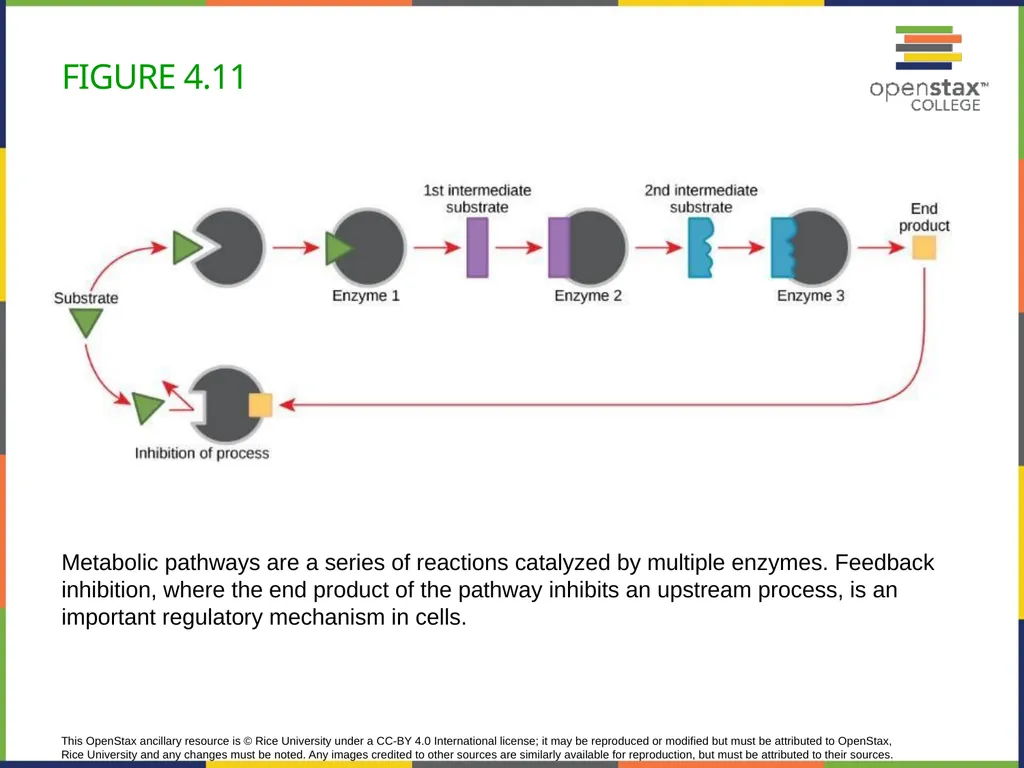
Feedback Inhibition in Metabolic Pathways Feedback inhibition involves the use of a reaction product to regulate its own further production<br>
36
Figure 4.11 Metabolic pathways are a series of reactions catalyzed by multiple enzymes. Feedback inhibition, where the end product of the pathway inhibits an upstream process, is an important regulatory mechanism in cells. This OpenStax ancillary resource is © Rice University under a CC-BY 4.0 International license; it may be reproduced or modified but must be attributed to OpenStax, Rice University and any changes must be noted. Any images credited to other sources are similarly available for reproduction, but must be attributed to their sources.<br>
37
4.2 glycolysis ATP is the primary energy currency of cells
ATP is adenosine triphosphate, which is a relatively simple molecule, but within its bonds contains the potential for a quick burst of energy that can be harnessed to perform cellular work<br>
ATP is adenosine triphosphate, which is a relatively simple molecule, but within its bonds contains the potential for a quick burst of energy that can be harnessed to perform cellular work<br>
38
ATP is Living Systems Living cells function as rechargeable batteries, they store energy and release it for use only as needed
When ATP is broken down, usually by the removal of its terminal phosphate group, energy is released<br>
When ATP is broken down, usually by the removal of its terminal phosphate group, energy is released<br>
39
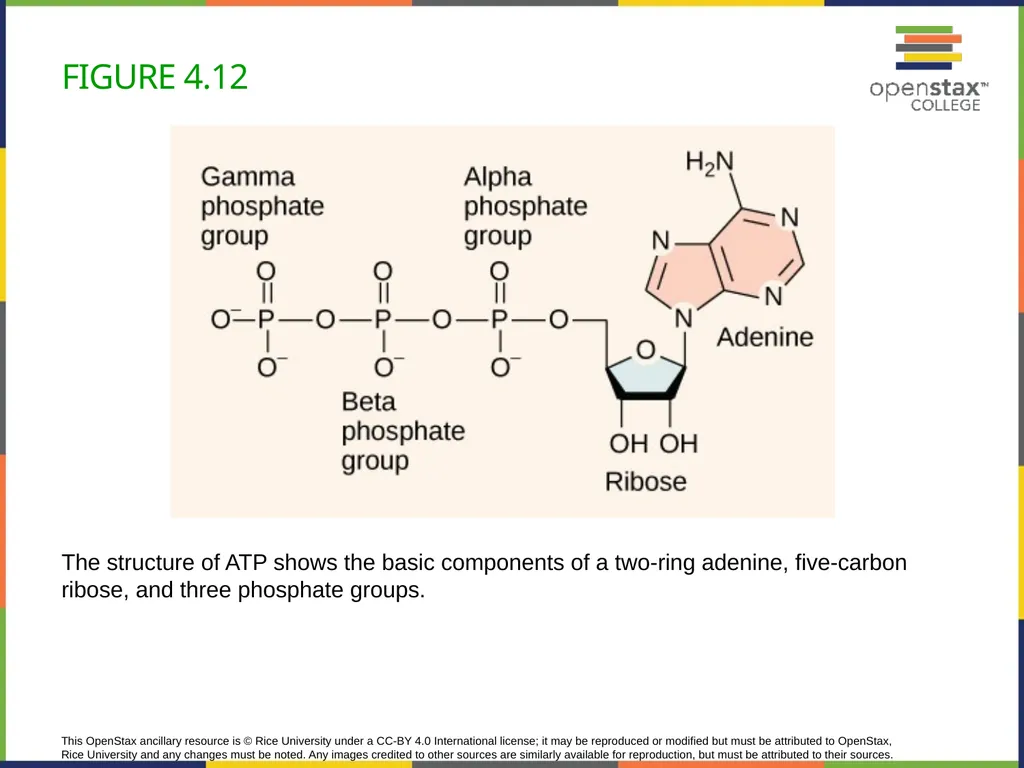
ATP Structure and Function ATP is a molecule composed of an adenine molecule bonded to a ribose and three phosphate groups
The release of one or two phosphate groups from ATP (by the process of hydrolysis) releases energy<br>
The release of one or two phosphate groups from ATP (by the process of hydrolysis) releases energy<br>
40
Figure 4.12 The structure of ATP shows the basic components of a two-ring adenine, five-carbon ribose, and three phosphate groups. This OpenStax ancillary resource is © Rice University under a CC-BY 4.0 International license; it may be reproduced or modified but must be attributed to OpenStax, Rice University and any changes must be noted. Any images credited to other sources are similarly available for reproduction, but must be attributed to their sources.<br>
41
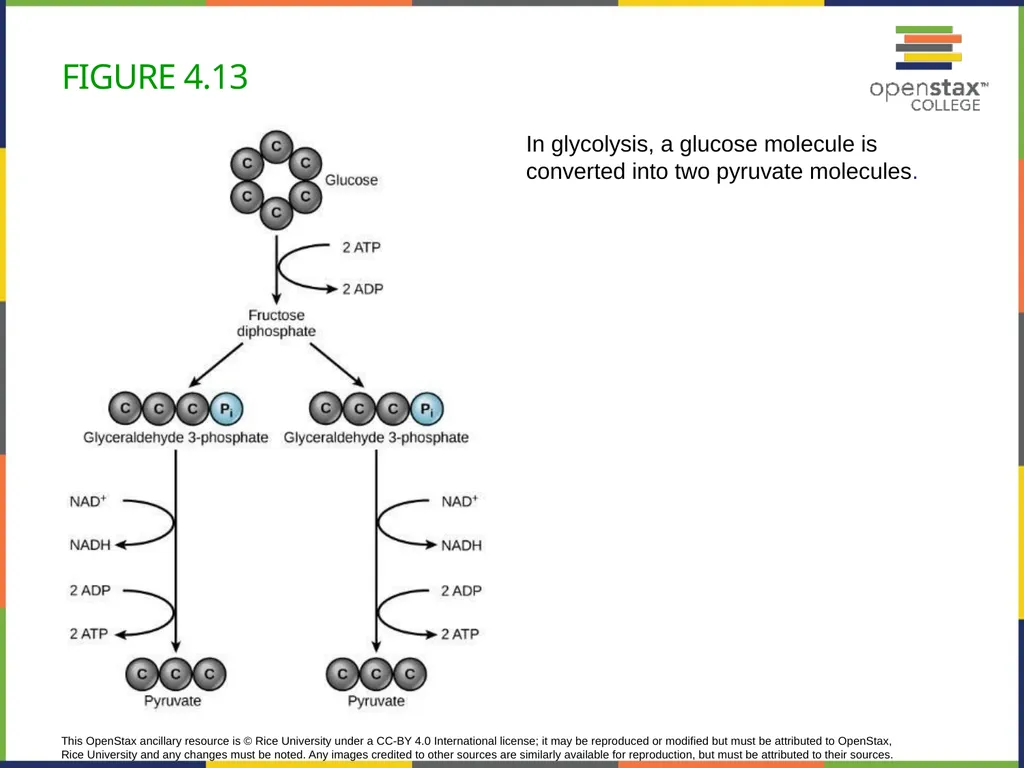
Glycolysis Glycolysis is the first step in the breakdown of glucose to extract energy for cell metabolism
Glycolysis take place in the cytoplasm of most prokaryotic and all eukaryotic cells
Glycolysis begins with the six-carbon glucose molecule and ends with two molecules of three-carbon pyruvate<br>
Glycolysis take place in the cytoplasm of most prokaryotic and all eukaryotic cells
Glycolysis begins with the six-carbon glucose molecule and ends with two molecules of three-carbon pyruvate<br>
42
Figure 4.13 In glycolysis, a glucose molecule is converted into two pyruvate molecules. This OpenStax ancillary resource is © Rice University under a CC-BY 4.0 International license; it may be reproduced or modified but must be attributed to OpenStax, Rice University and any changes must be noted. Any images credited to other sources are similarly available for reproduction, but must be attributed to their sources.<br>
43
4.3 CITRIC ACID CYCLE AND
OXIDATIVE PHOSPHORYLATION If oxygen is present, the pyruvate molecules will continue into the citric acid cycle and oxidation phophorylation for a process called aerobic respiration<br>
OXIDATIVE PHOSPHORYLATION If oxygen is present, the pyruvate molecules will continue into the citric acid cycle and oxidation phophorylation for a process called aerobic respiration<br>
44
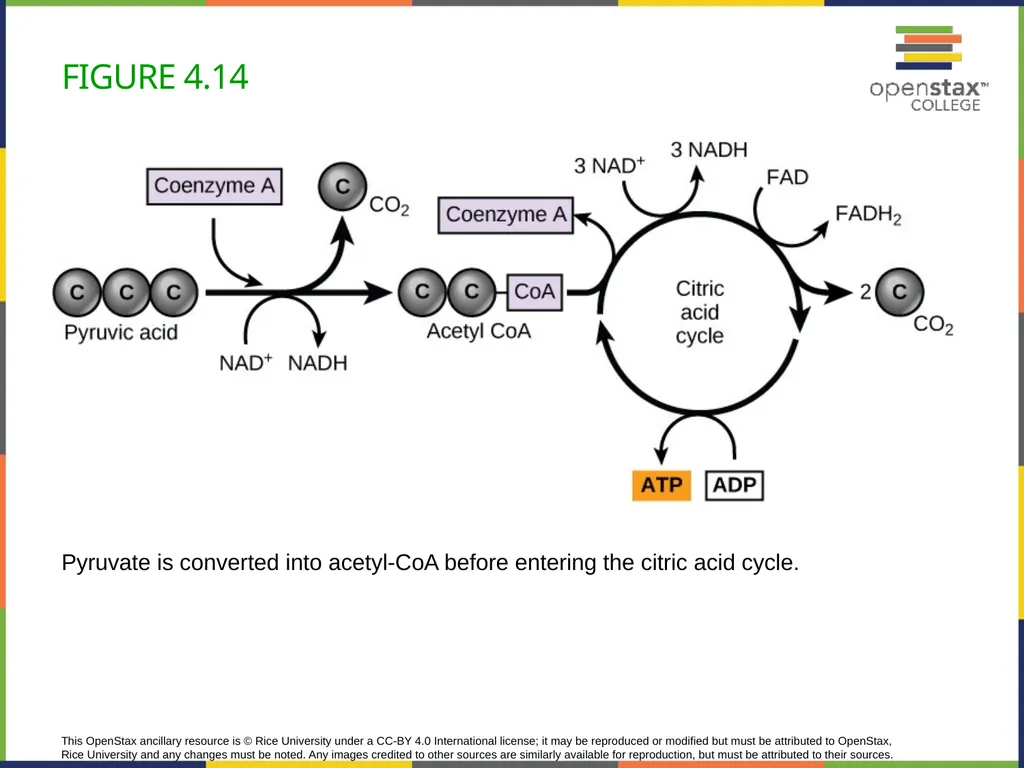
The Citric Acid Cycle In eukaryotic cells, the pyruvates molecules produced by glycolysis are transported into mitochondria and aerobic respiration will proceed
The pyruvate molecules are transformed into acetyl CoA molecules
Two acetyl CoA molecules enter into the citric acid cycle, which then releases 2 CO2, 3 NADH (high energy molecules), 1 FADH2 (high energy molecule), 1 ATP and several intermediate compounds<br>
The pyruvate molecules are transformed into acetyl CoA molecules
Two acetyl CoA molecules enter into the citric acid cycle, which then releases 2 CO2, 3 NADH (high energy molecules), 1 FADH2 (high energy molecule), 1 ATP and several intermediate compounds<br>
45
Figure 4.14 Pyruvate is converted into acetyl-CoA before entering the citric acid cycle. This OpenStax ancillary resource is © Rice University under a CC-BY 4.0 International license; it may be reproduced or modified but must be attributed to OpenStax, Rice University and any changes must be noted. Any images credited to other sources are similarly available for reproduction, but must be attributed to their sources.<br>
46
Oxidative Phosphorylation (1 of 3) ATP is derived from a process that begins with passing electrons through a series of chemical reactions to a final electron acceptor, oxygen
The energy of the electrons is harvested and used to generate a electrochemical gradient across the inner mitochondrial membrane; the potential energy of this gradient is used to generate ATP
The entirety of this process is called oxidative phoshphorylation<br>
The energy of the electrons is harvested and used to generate a electrochemical gradient across the inner mitochondrial membrane; the potential energy of this gradient is used to generate ATP
The entirety of this process is called oxidative phoshphorylation<br>
47
Oxidative Phosphorylation (2 of 3) The electron transport chain is the last component of aerobic respiration and is the only part of metabolism that uses atmospheric oxygen
Electrons are transported through a series of proteins, loses energy with each transfer
This energy is used to pump hydrogen ions into the intermembrane space, creating an electrochemical gradient<br>
Electrons are transported through a series of proteins, loses energy with each transfer
This energy is used to pump hydrogen ions into the intermembrane space, creating an electrochemical gradient<br>
48
Oxidative Phosphorylation (3 of 3) The hydrogen ions diffuse through the inner membrane through an integral membrane protein called ATP synthase
This protein is a tiny generator, generating ATP molecules from ADP molecules
This flow of hydrogen ions through the ATP synthase is called chemiosmosis
The electron transport chain and the production of ATP through chemiosmosis are collectively called oxidative phophorylation<br>
This protein is a tiny generator, generating ATP molecules from ADP molecules
This flow of hydrogen ions through the ATP synthase is called chemiosmosis
The electron transport chain and the production of ATP through chemiosmosis are collectively called oxidative phophorylation<br>
49
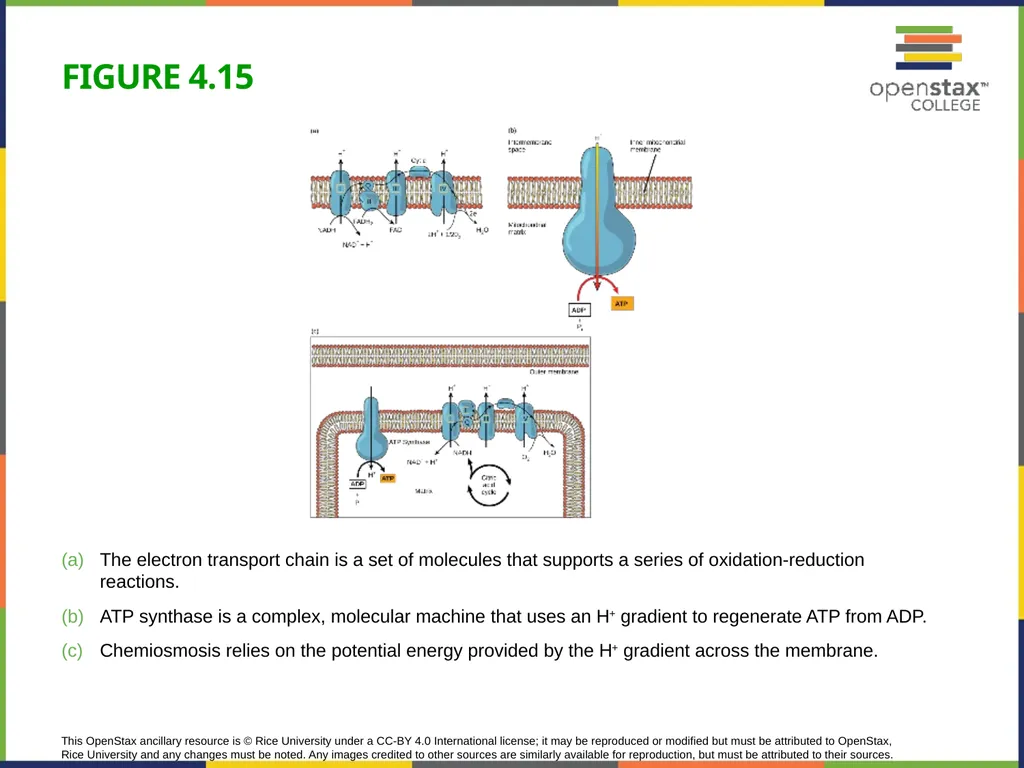
Figure 4.15 The electron transport chain is a set of molecules that supports a series of oxidation-reduction reactions.
ATP synthase is a complex, molecular machine that uses an H+ gradient to regenerate ATP from ADP.
Chemiosmosis relies on the potential energy provided by the H+ gradient across the membrane. This OpenStax ancillary resource is © Rice University under a CC-BY 4.0 International license; it may be reproduced or modified but must be attributed to OpenStax, Rice University and any changes must be noted. Any images credited to other sources are similarly available for reproduction, but must be attributed to their sources.<br>
50
ATP Yield The number of ATP molecules generated from the catabolism of glucose varies due to several factors
Overall, in living systems, these pathways of glucose catabolism extracts about 34 percent of the energy contained in glucose<br>
Overall, in living systems, these pathways of glucose catabolism extracts about 34 percent of the energy contained in glucose<br>
51
4.4 FERMENTATION When oxygen is not present, cells go through anaerobic respiration
Processes that use an organic molecule (instead of oxygen) as the final electron acceptor are called fermentation
Some cells use an inorganic molecule (other than oxygen) as the final acceptor, this is different method of anaerobic respiration than fermentation<br>
Processes that use an organic molecule (instead of oxygen) as the final electron acceptor are called fermentation
Some cells use an inorganic molecule (other than oxygen) as the final acceptor, this is different method of anaerobic respiration than fermentation<br>
52
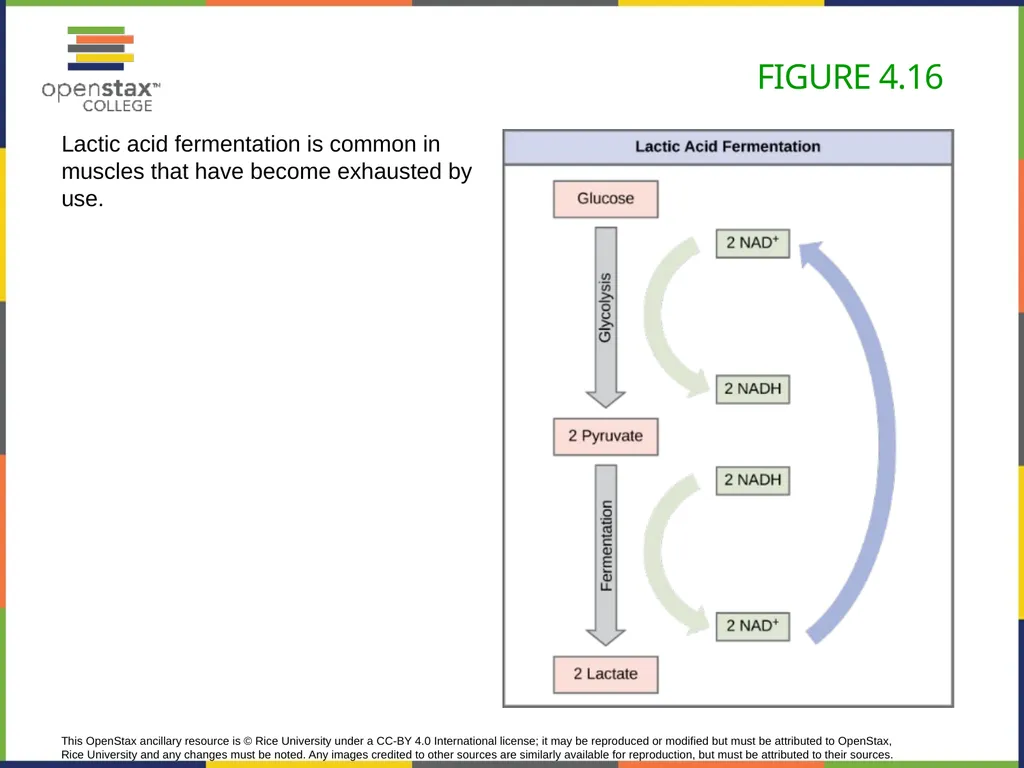
Lactic Acid Fermentation Lactic Acid fermentation is used by animals routinely in mammalian red blood cells and in skeletal muscles that has insufficient oxygen supply
Also used by bacteria such as those in yogurt
The chemical reaction is:
Pyruvic acid + NADH lactic acid + NAD+<br>
Also used by bacteria such as those in yogurt
The chemical reaction is:
Pyruvic acid + NADH lactic acid + NAD+<br>
53
Figure 4.16 Lactic acid fermentation is common in muscles that have become exhausted by use. This OpenStax ancillary resource is © Rice University under a CC-BY 4.0 International license; it may be reproduced or modified but must be attributed to OpenStax, Rice University and any changes must be noted. Any images credited to other sources are similarly available for reproduction, but must be attributed to their sources.<br>
54
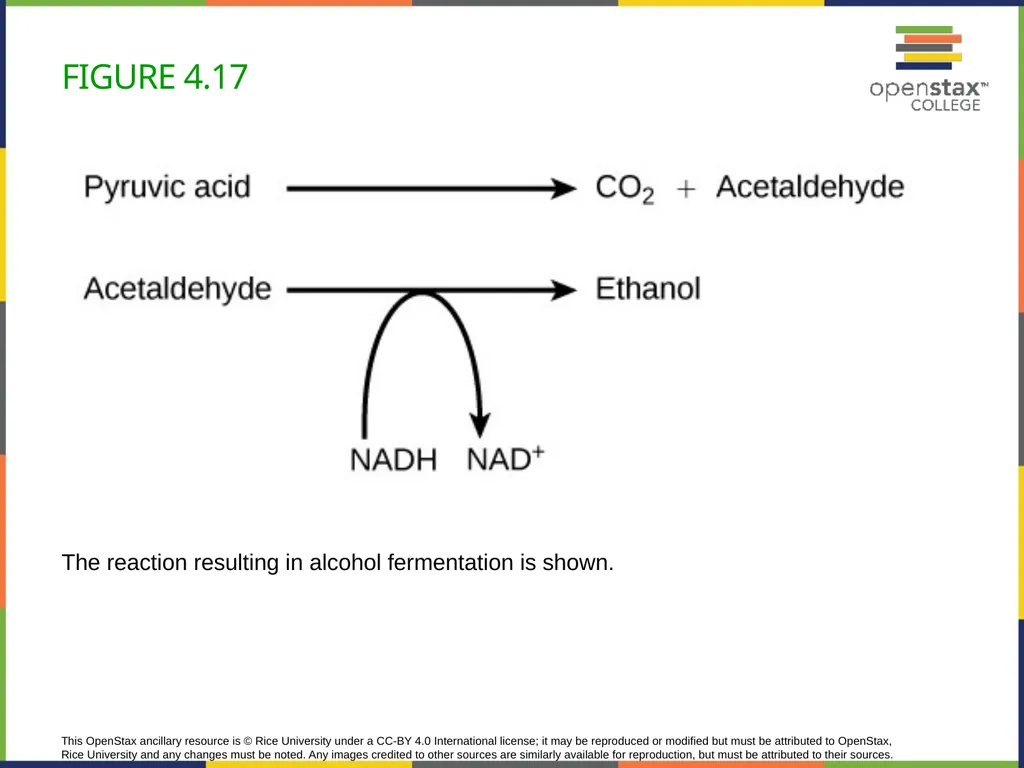
Alcohol Fermentation Another familiar fermentation process is alcohol fermentation, which produces ethanol, an alcohol
Involve two steps<br>
Involve two steps<br>
55
Figure 4.17 The reaction resulting in alcohol fermentation is shown. This OpenStax ancillary resource is © Rice University under a CC-BY 4.0 International license; it may be reproduced or modified but must be attributed to OpenStax, Rice University and any changes must be noted. Any images credited to other sources are similarly available for reproduction, but must be attributed to their sources.<br>
56
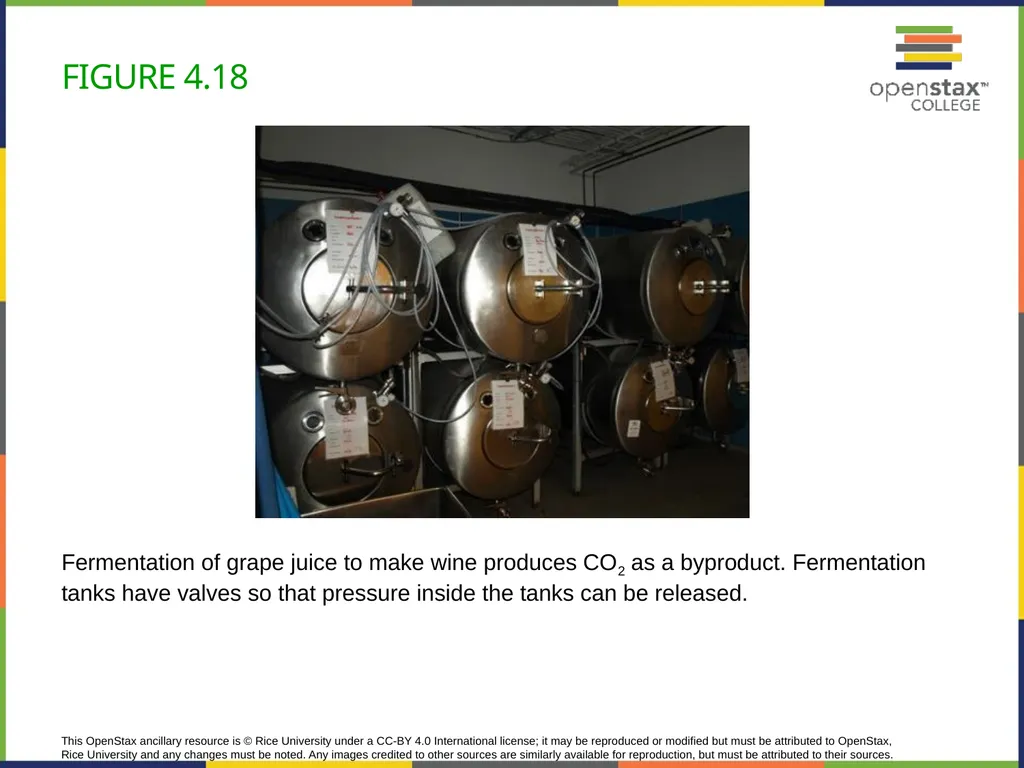
Figure 4.18 Fermentation of grape juice to make wine produces CO2 as a byproduct. Fermentation tanks have valves so that pressure inside the tanks can be released. This OpenStax ancillary resource is © Rice University under a CC-BY 4.0 International license; it may be reproduced or modified but must be attributed to OpenStax, Rice University and any changes must be noted. Any images credited to other sources are similarly available for reproduction, but must be attributed to their sources.<br>
57
Anaerobic Cellular Respiration Certain prokaryotes use anaerobic cellular respiration in which inorganic molecules such as sulfate, nitrate or sulfur are used as the final electron acceptor
Many prokaryotes are facultatively anaerobic, which means they can switch between aerobic respiration and fermentation, depending on the availability of oxygen
Some prokaryotes are obligate anaerobes which live and grow in the absence of molecular oxygen (oxygen is a poison to them)<br>
Many prokaryotes are facultatively anaerobic, which means they can switch between aerobic respiration and fermentation, depending on the availability of oxygen
Some prokaryotes are obligate anaerobes which live and grow in the absence of molecular oxygen (oxygen is a poison to them)<br>
58
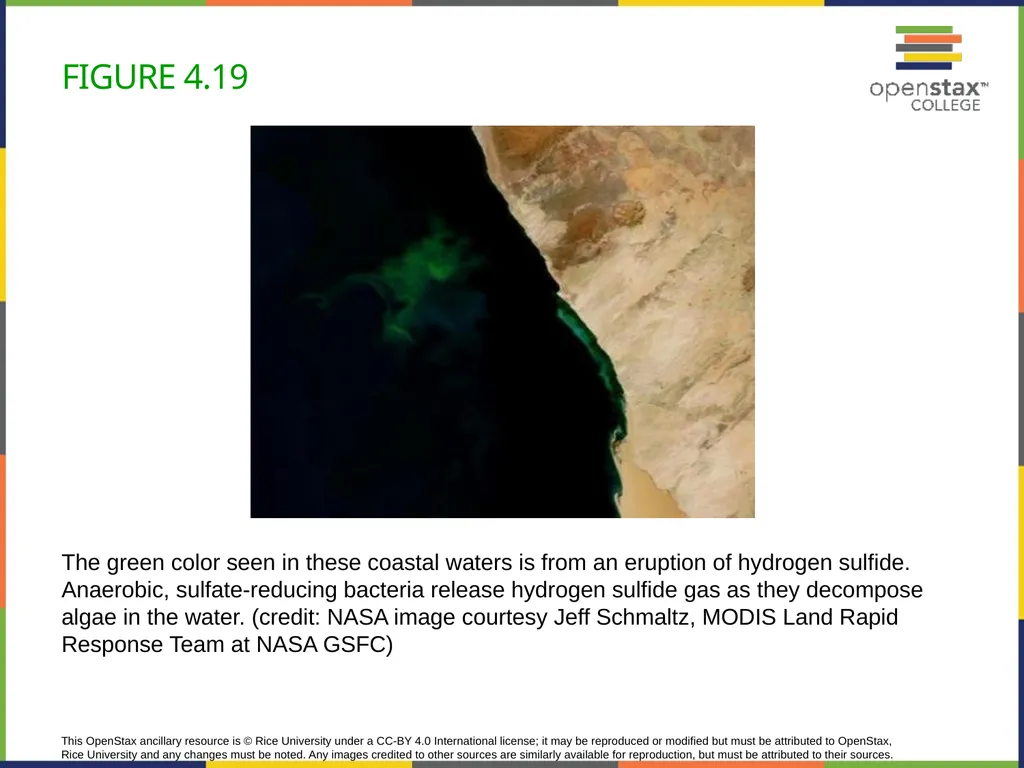
Figure 4.19 The green color seen in these coastal waters is from an eruption of hydrogen sulfide. Anaerobic, sulfate-reducing bacteria release hydrogen sulfide gas as they decompose algae in the water. (credit: NASA image courtesy Jeff Schmaltz, MODIS Land Rapid Response Team at NASA GSFC) This OpenStax ancillary resource is © Rice University under a CC-BY 4.0 International license; it may be reproduced or modified but must be attributed to OpenStax, Rice University and any changes must be noted. Any images credited to other sources are similarly available for reproduction, but must be attributed to their sources.<br>
59
4.5 CONNECTIONS TO OTHER METABOLIC
PATHWAYS We consume more than just glucose for food
These other types of food also provide energy for our cells because all of the catabolic pathways for carbohydrates, proteins, and lipids eventually connect into glycolysis and the citric acid cycle pathways<br>
PATHWAYS We consume more than just glucose for food
These other types of food also provide energy for our cells because all of the catabolic pathways for carbohydrates, proteins, and lipids eventually connect into glycolysis and the citric acid cycle pathways<br>
60
Connection of Other Sugars to Glucose Metabolism Glycogen, a polymer of glucose is used as short-term energy storage in the liver and muscles; glycogen can be broken down to glucose when needed
When catabolized, both fructose and galactose produce the same number of ATP molecules as glucose<br>
When catabolized, both fructose and galactose produce the same number of ATP molecules as glucose<br>
61
Connection of Proteins to Glucose Metabolism Proteins are broken down by a variety of enzymes in cells
Most of the time, the amino acids are recycled into new proteins
However, excess amino acids, or if the body is in a state of famine, some amino acids will be shunted into pathways of glucose catabolism<br>
Most of the time, the amino acids are recycled into new proteins
However, excess amino acids, or if the body is in a state of famine, some amino acids will be shunted into pathways of glucose catabolism<br>
62
Connections of Lipids to Glucose Metabolism Cholesterol and triglycerides are connected to the glucose pathways
The synthesis of cholesterol starts with acetyl CoA and proceeds in only one direction; this process cannot be reversed and ATP is not produced
Triglycerides are a form of long-term energy storage in animals; they can be both made and broken down through parts of the glucose catabolism pathways<br>
The synthesis of cholesterol starts with acetyl CoA and proceeds in only one direction; this process cannot be reversed and ATP is not produced
Triglycerides are a form of long-term energy storage in animals; they can be both made and broken down through parts of the glucose catabolism pathways<br>
63
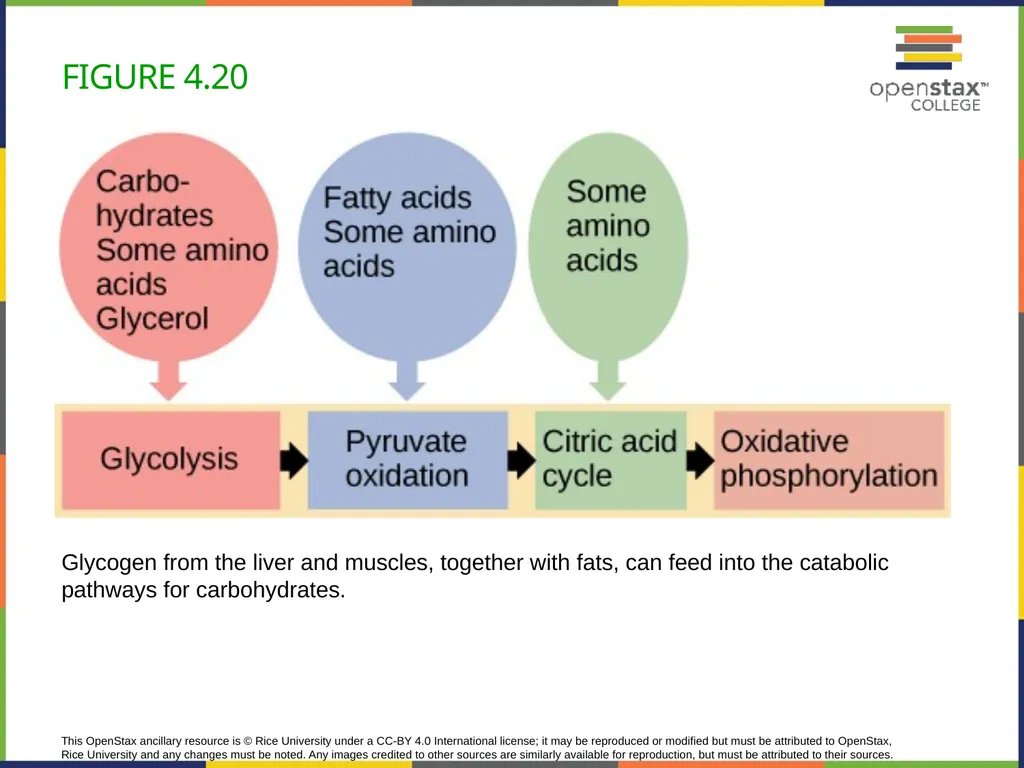
Figure 4.20 Glycogen from the liver and muscles, together with fats, can feed into the catabolic pathways for carbohydrates. This OpenStax ancillary resource is © Rice University under a CC-BY 4.0 International license; it may be reproduced or modified but must be attributed to OpenStax, Rice University and any changes must be noted. Any images credited to other sources are similarly available for reproduction, but must be attributed to their sources.<br>