04
Word Parts (1 of 1) Root
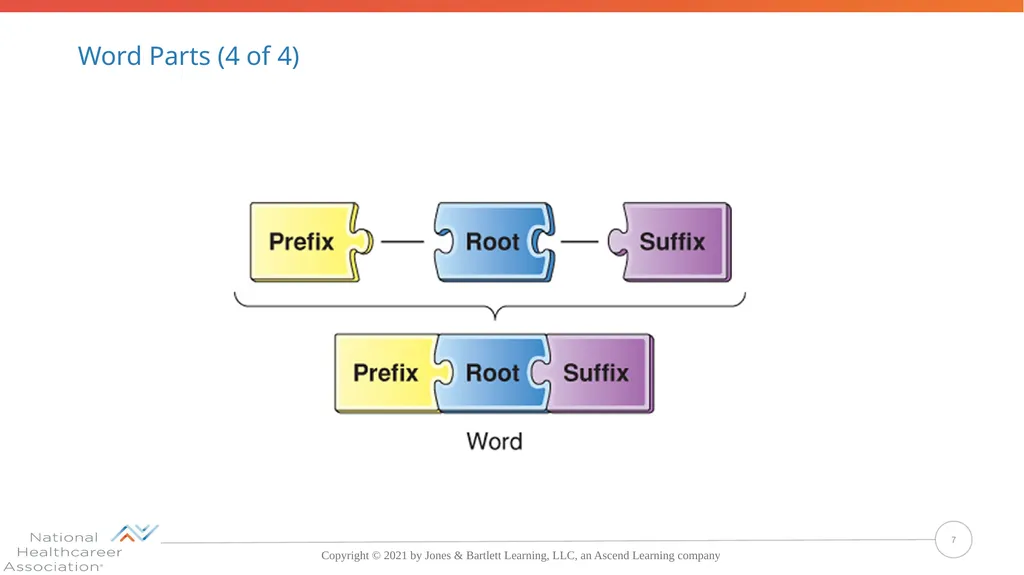
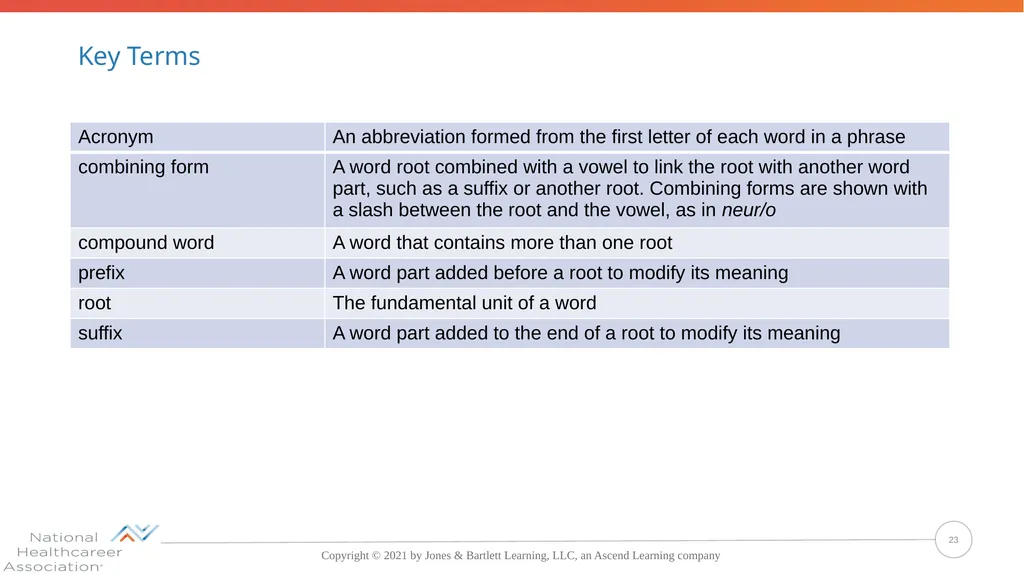
Fundamental unit of each medical word
Establishes basic meaning of word
Part to which prefixes and suffixes are added 4<br>
05
Word Parts (2 of 2) Suffix
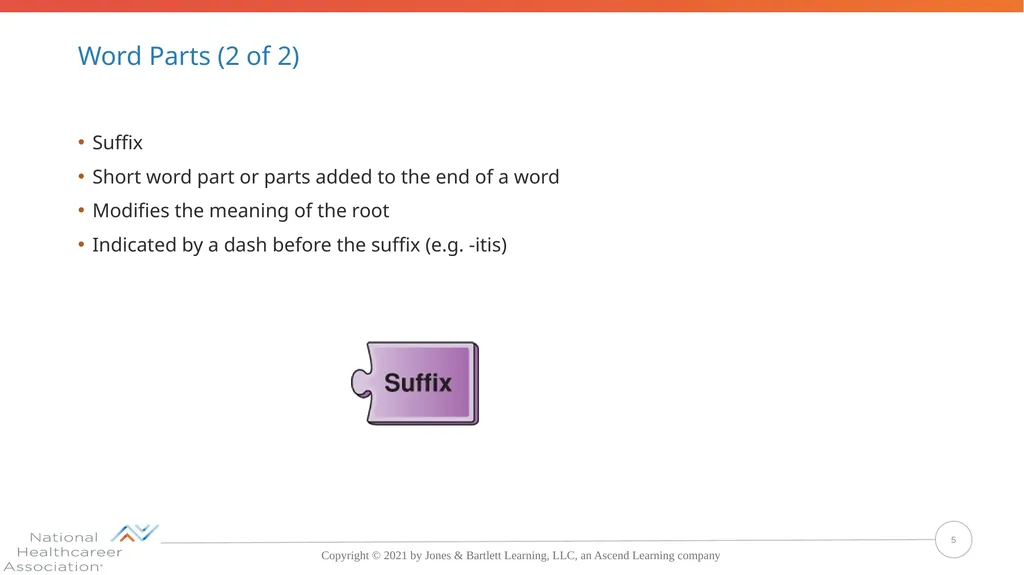
Short word part or parts added to the end of a word
Modifies the meaning of the root
Indicated by a dash before the suffix (e.g. -itis) 5<br>
06
Word Parts (3 of 3) Prefix
Short word part added before a root
Modifies the meaning of the root
Followed by a dash (e.g. pre-) 6<br>
07
Word Parts (4 of 4) 7<br>
08
Word Parts (5 of 5) Begin with “learn”
learn + -er = one who learns
re + learn = to learn again
Greek word for heart is kardia
Forms word root cardi
Latin word for lung is pulmo
Forms word root pulm 8<br>
09
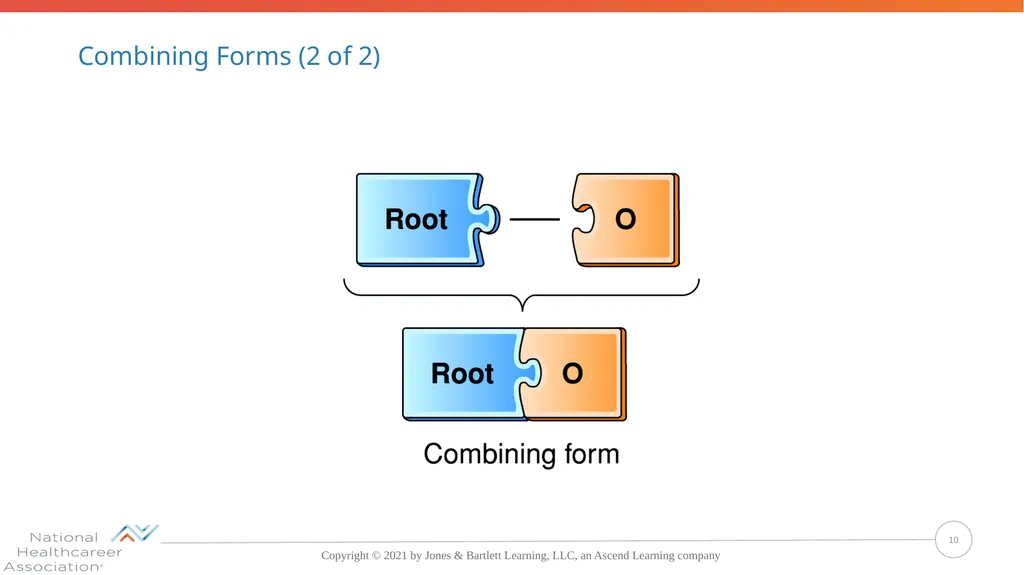
Combining Forms (1 of 1) A vowel, usually “o,” is inserted between the root and the next word part to aid in pronunciation.
Roots shown with a combining vowel are called combining forms.
vowels added after a slash
neur/o 9<br>
10
Combining Forms (2 of 2) 10<br>
11
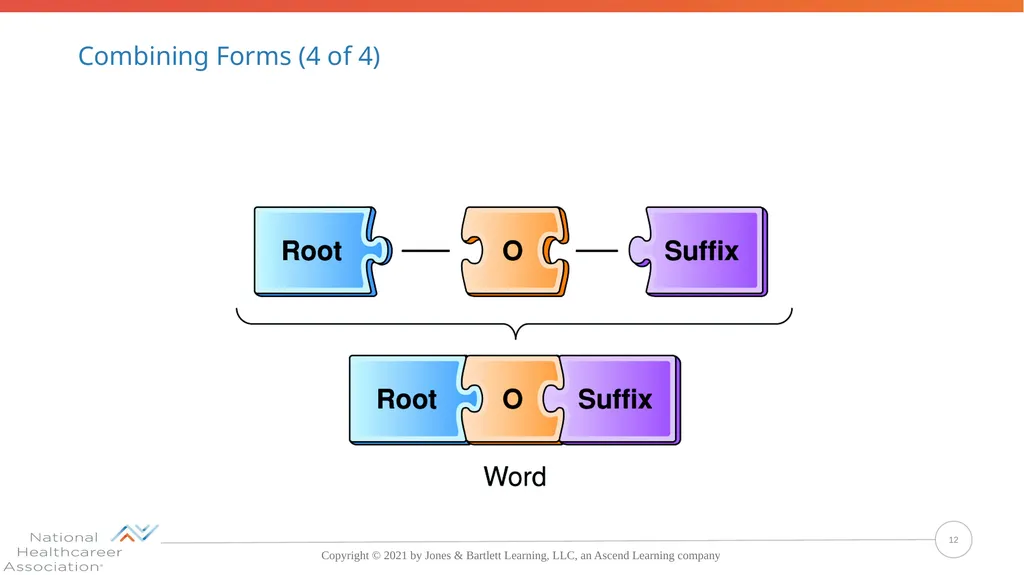
Combining Forms (3 of 3) Insert an “o” before a suffix beginning with a consonant when added to a root
-logy = “study of”
neur = “nerve or nervous system”
Neur + o + logy = neurology (study of the nervous system)
Combining vowel omitted if suffix begins with a vowel
neur + itis = neuritis (inflammation of a nerve) 11<br>
12
Combining Forms (4 of 4) 12<br>
13
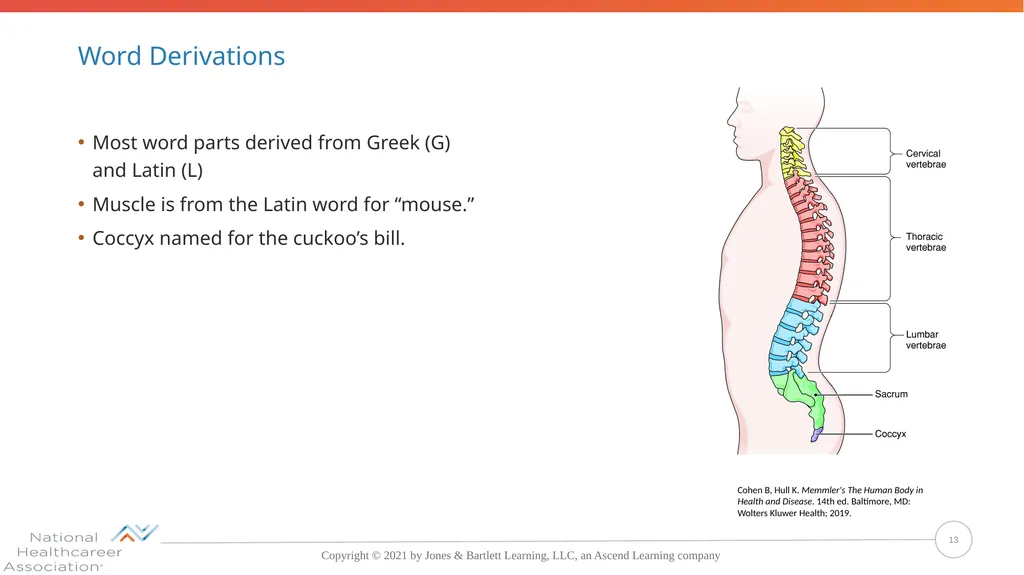
Word Derivations Most word parts derived from Greek (G) and Latin (L)
Muscle is from the Latin word for “mouse.”
Coccyx named for the cuckoo’s bill. Cohen B, Hull K. Memmler's The Human Body in Health and Disease. 14th ed. Baltimore, MD: Wolters Kluwer Health; 2019. 13<br>
14
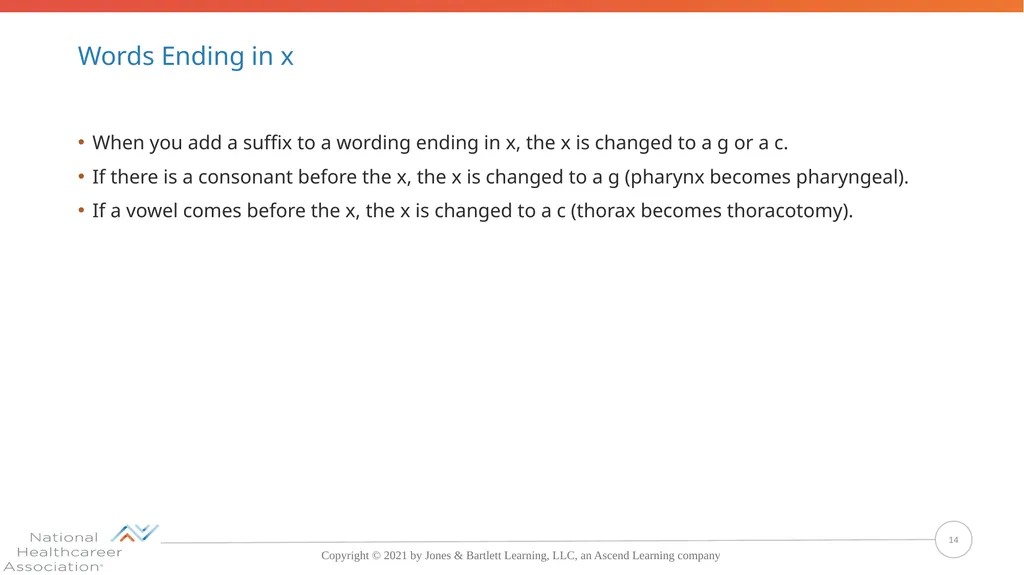
Words Ending in x When you add a suffix to a wording ending in x, the x is changed to a g or a c.
If there is a consonant before the x, the x is changed to a g (pharynx becomes pharyngeal).
If a vowel comes before the x, the x is changed to a c (thorax becomes thoracotomy). 14<br>
15
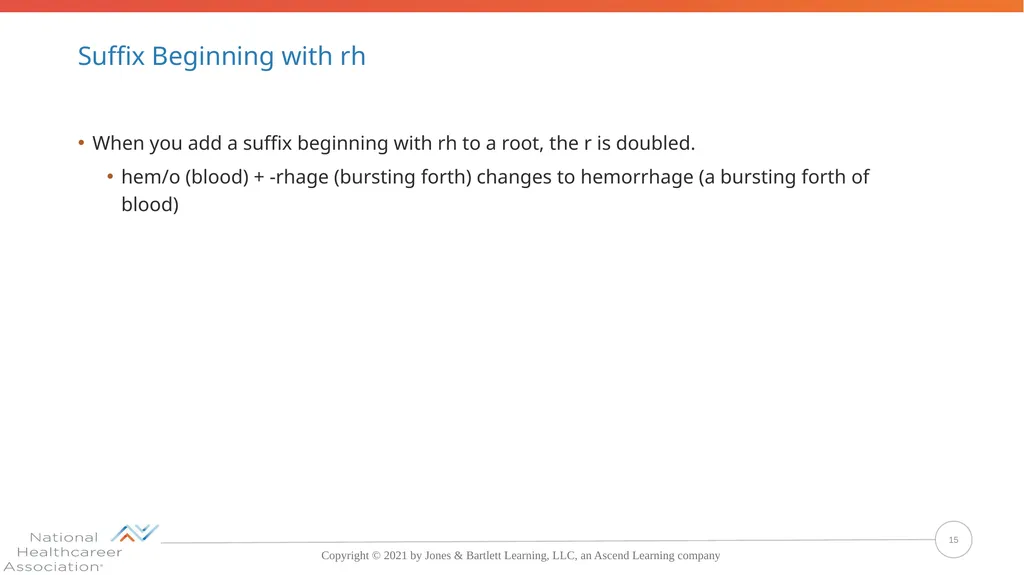
Suffix Beginning with rh When you add a suffix beginning with rh to a root, the r is doubled.
hem/o (blood) + -rhage (bursting forth) changes to hemorrhage (a bursting forth of blood) 15<br>
16
Pronunciation (1 of 1) Use phonetic pronunciations provided.
Repeat words aloud.
Pronunciations may change when parts are combined. 16<br>
17
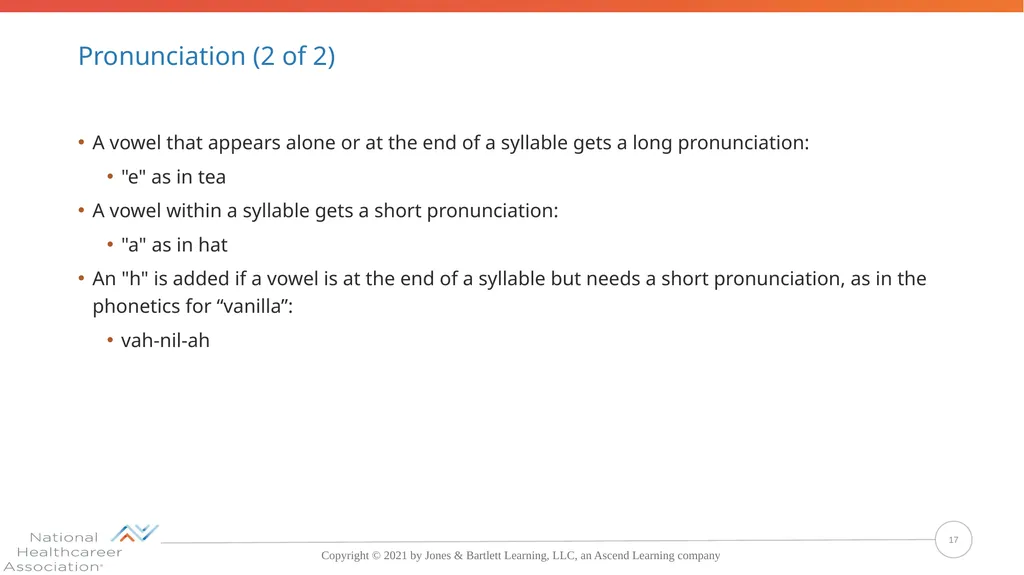
Pronunciation (2 of 2) A vowel that appears alone or at the end of a syllable gets a long pronunciation:
"e" as in tea
A vowel within a syllable gets a short pronunciation:
"a" as in hat
An "h" is added if a vowel is at the end of a syllable but needs a short pronunciation, as in the phonetics for “vanilla”:
vah-nil-ah 17<br>
18
Soft and Hard c and g Soft c, as in racer, is written as an “s”
(RA-ser)
Hard c, as in candy, is written as a “k”
(KAN-de)
Soft g, as in page, is written as “j”
(paje)
Hard g, as in grow, is written as “g”
(gro) 18<br>
19
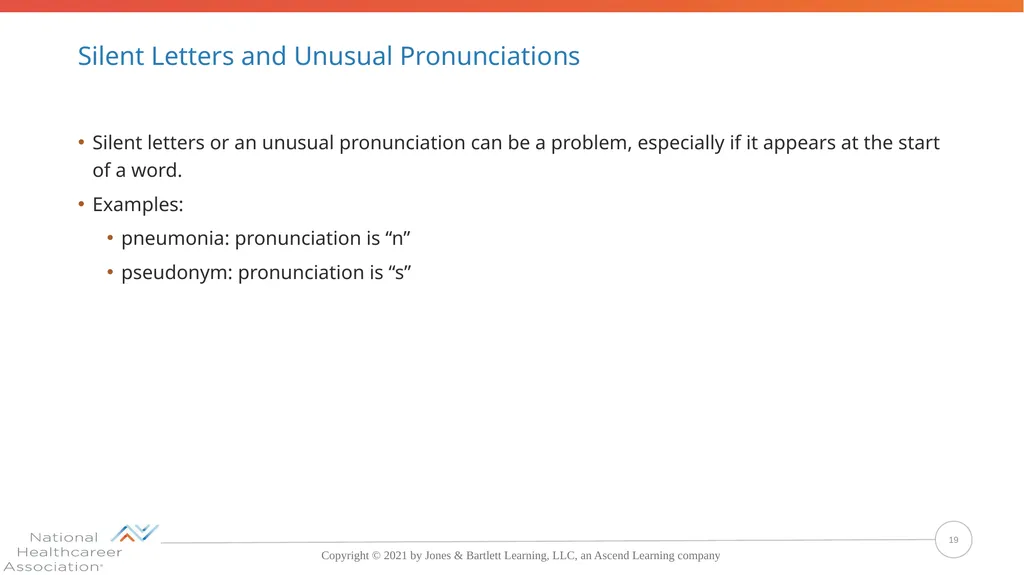
Silent Letters and Unusual Pronunciations Silent letters or an unusual pronunciation can be a problem, especially if it appears at the start of a word.
Examples:
pneumonia: pronunciation is “n”
pseudonym: pronunciation is “s” 19<br>
20
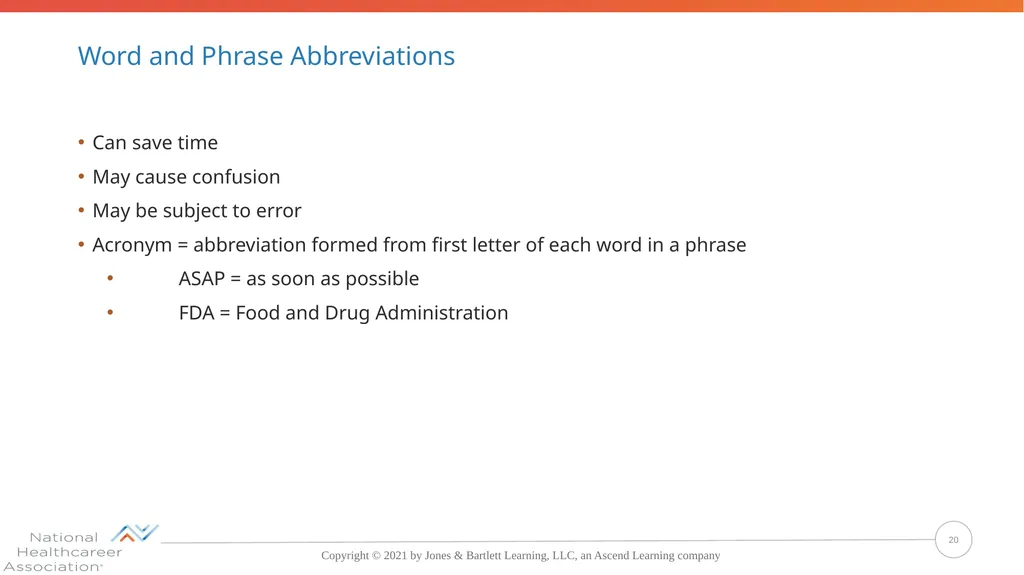
Word and Phrase Abbreviations Can save time
May cause confusion
May be subject to error
Acronym = abbreviation formed from first letter of each word in a phrase
ASAP = as soon as possible
FDA = Food and Drug Administration 20<br>
21
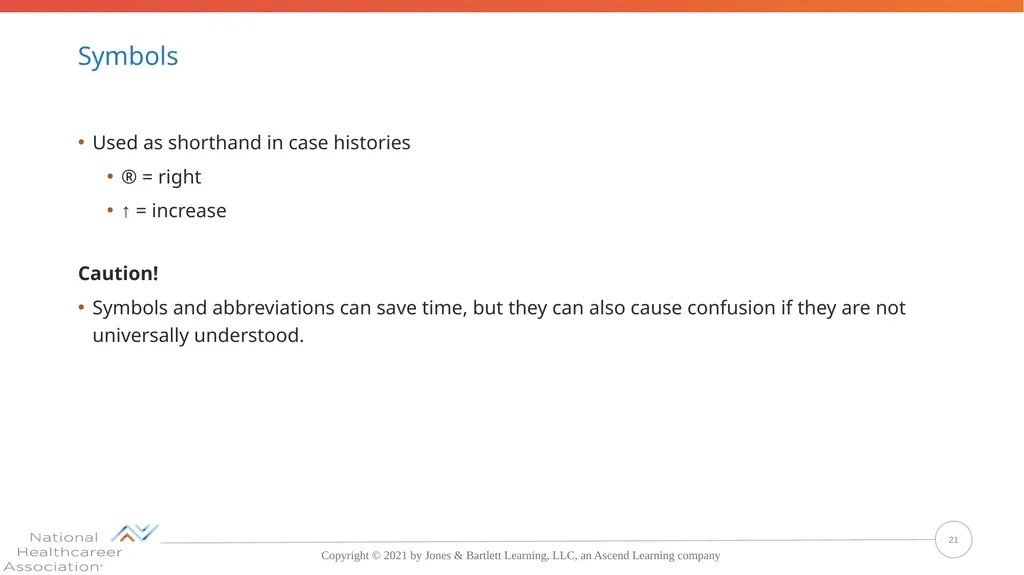
Symbols Used as shorthand in case histories
® = right
↑ = increase
Caution!
Symbols and abbreviations can save time, but they can also cause confusion if they are not universally understood. 21<br>
22
Medical Dictionaries Valuable references for those in health fields
Give info on meanings, derivations, related terms
Types
Complete, unabridged
Portable, abridged
Acronyms and abbreviations
Online and phone app 22<br>
24
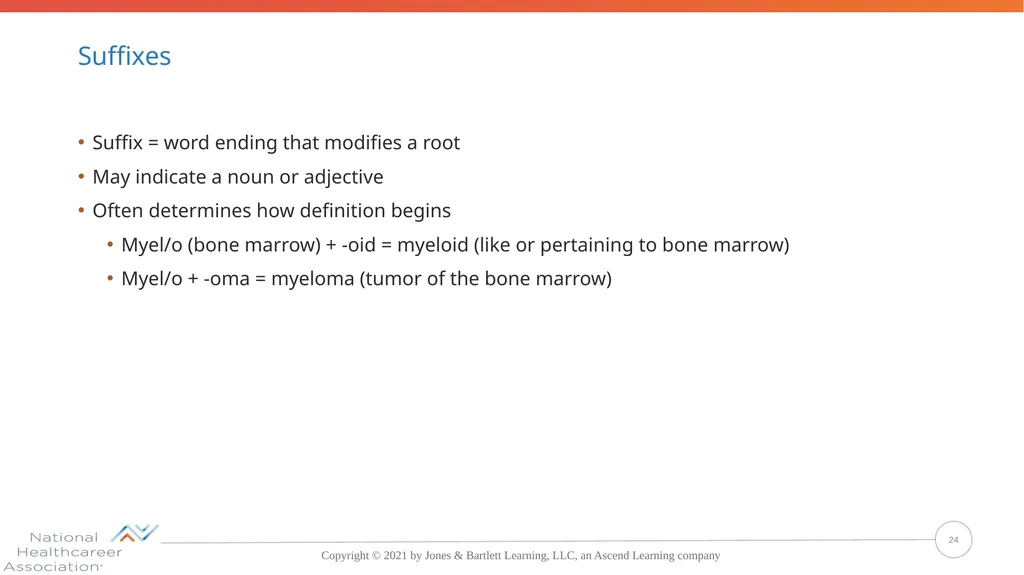
Suffixes Suffix = word ending that modifies a root
May indicate a noun or adjective
Often determines how definition begins
Myel/o (bone marrow) + -oid = myeloid (like or pertaining to bone marrow)
Myel/o + -oma = myeloma (tumor of the bone marrow) 24<br>
25
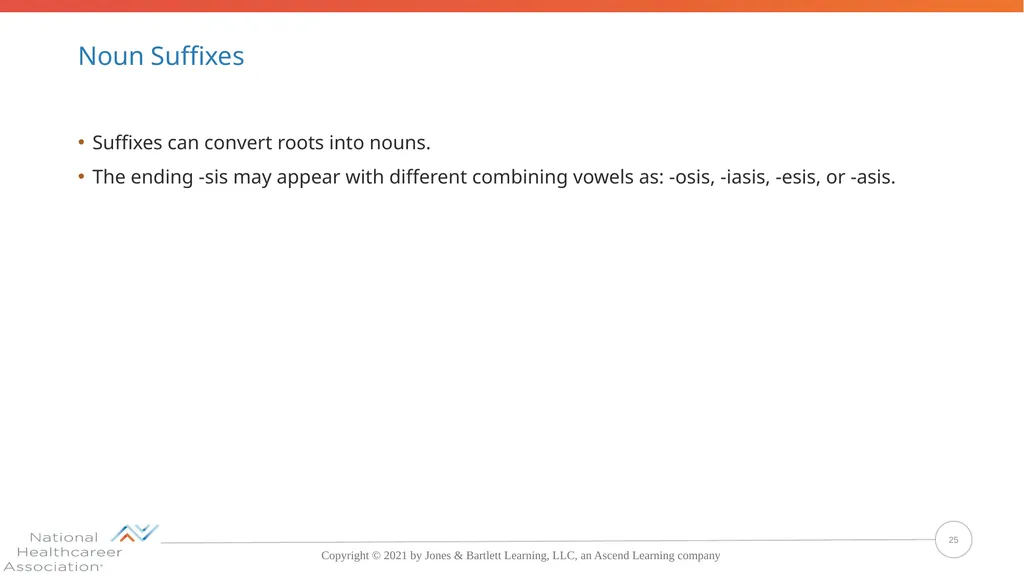
Noun Suffixes Suffixes can convert roots into nouns.
The ending -sis may appear with different combining vowels as: -osis, -iasis, -esis, or -asis. 25<br>
26
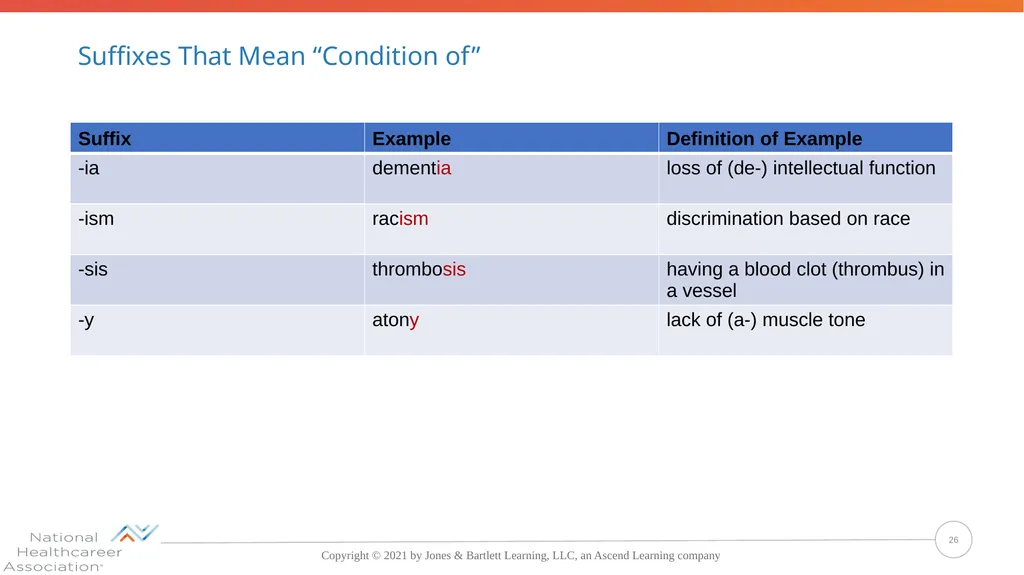
Suffixes That Mean “Condition of” 26<br>
27
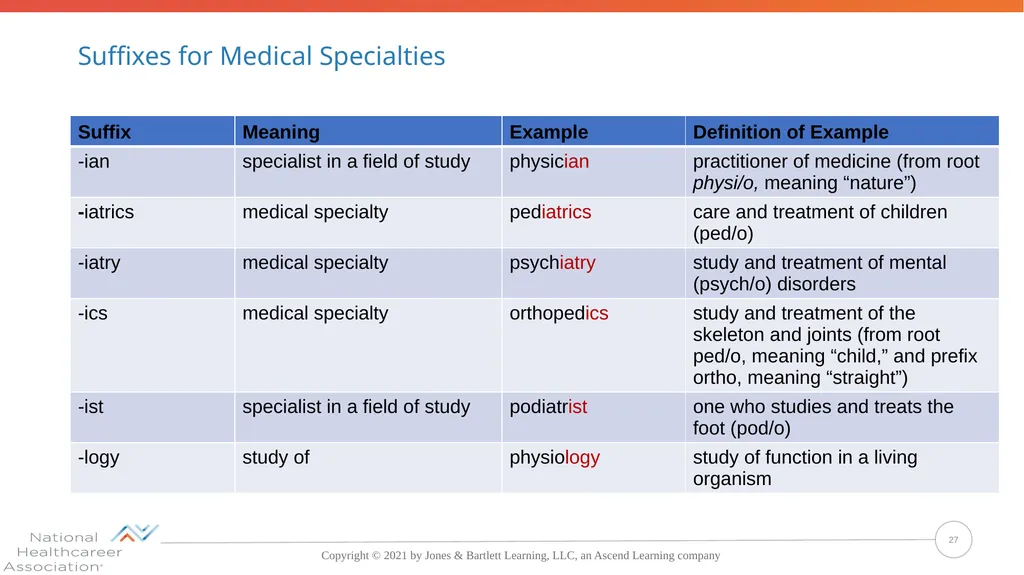
Suffixes for Medical Specialties 27<br>
28
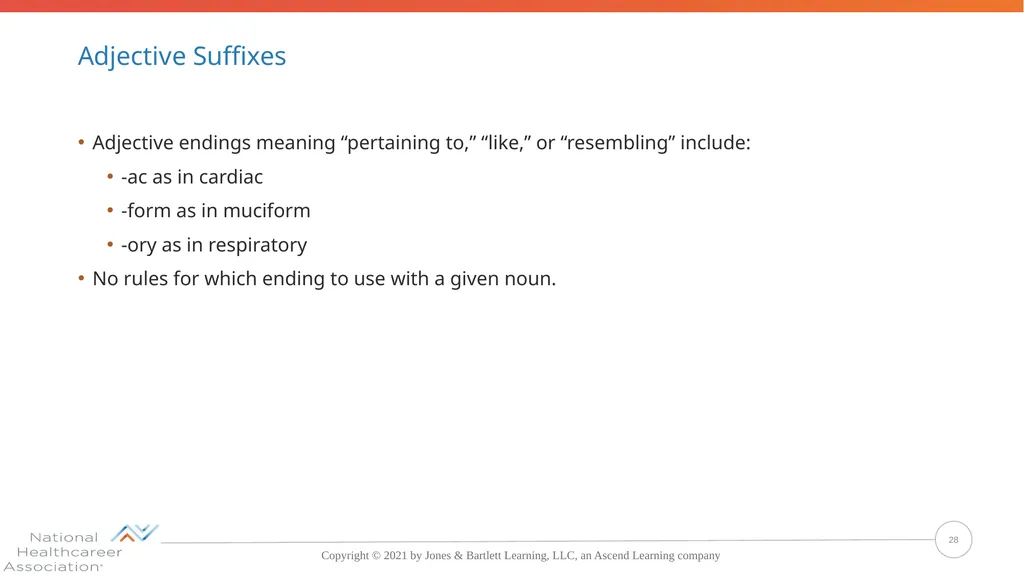
Adjective Suffixes Adjective endings meaning “pertaining to,” “like,” or “resembling” include:
-ac as in cardiac
-form as in muciform
-ory as in respiratory
No rules for which ending to use with a given noun. 28<br>
29
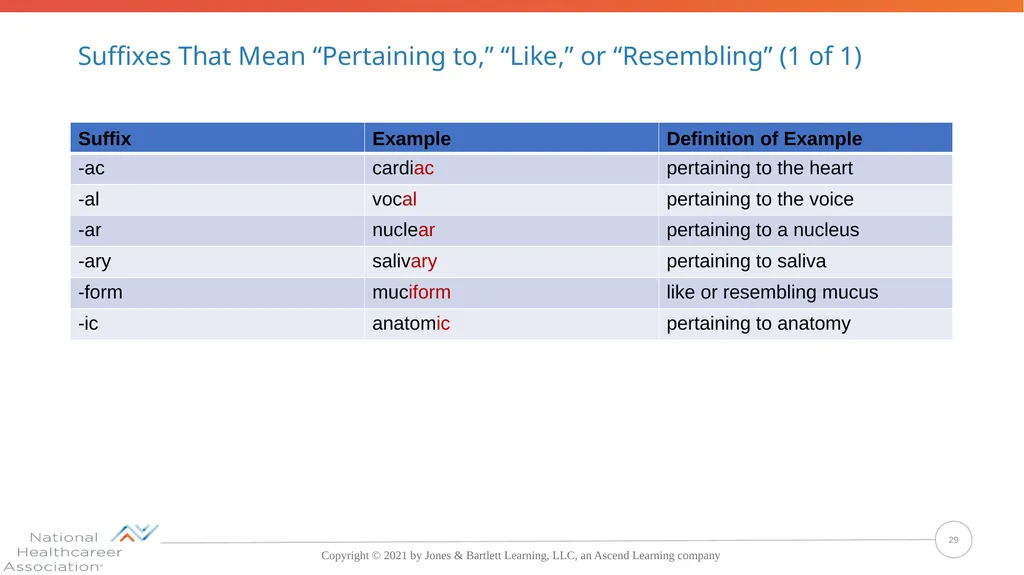
Suffixes That Mean “Pertaining to,” “Like,” or “Resembling” (1 of 1) 29<br>
30
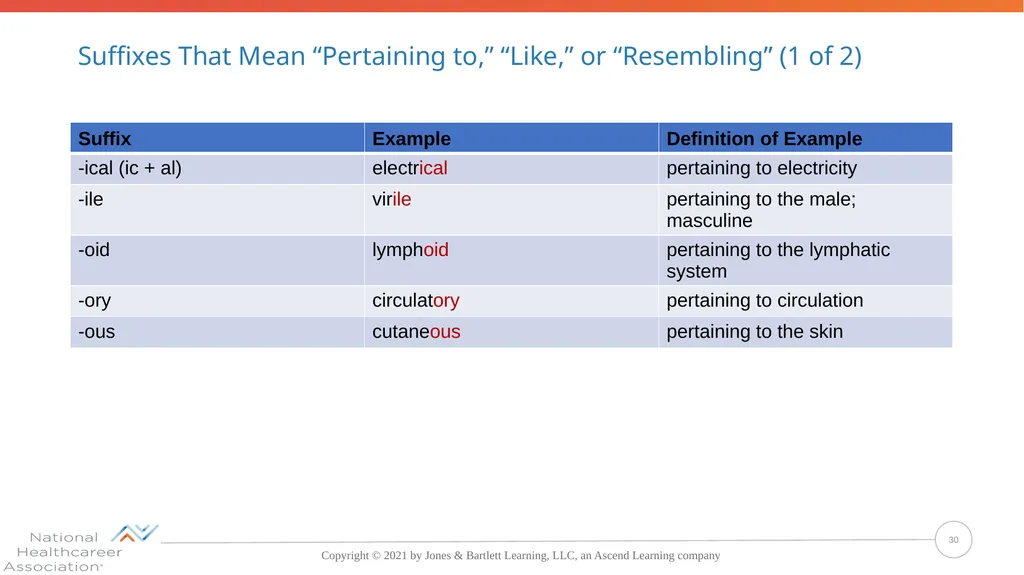
Suffixes That Mean “Pertaining to,” “Like,” or “Resembling” (1 of 2) 30<br>
31
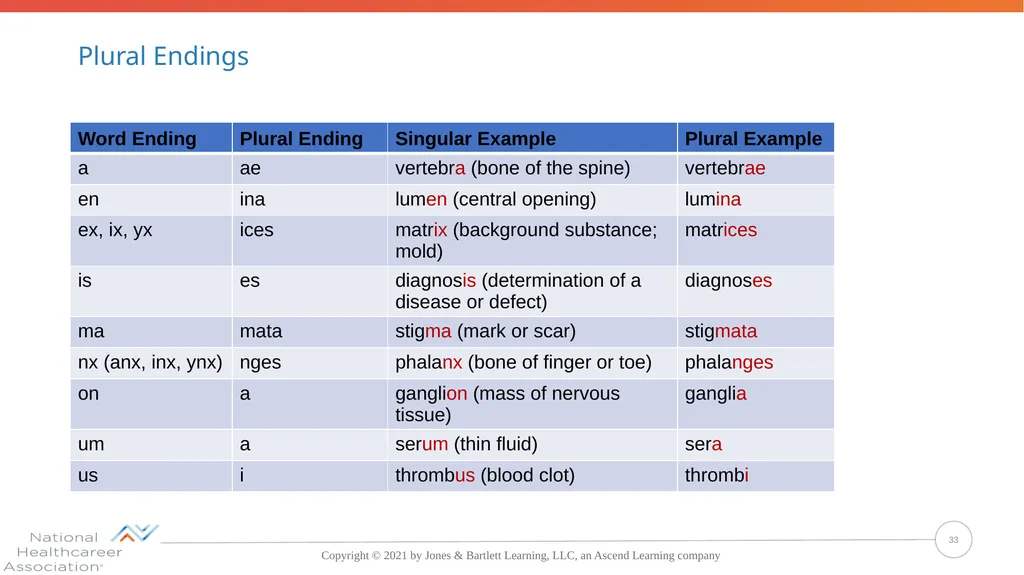
Forming Plurals Special plural forms
Words ending in –a carry plural ending –ae:
gingiva vs. gingivae
Words ending in –is carry plural ending –es:
diagnosis vs. diagnoses 31<br>
32
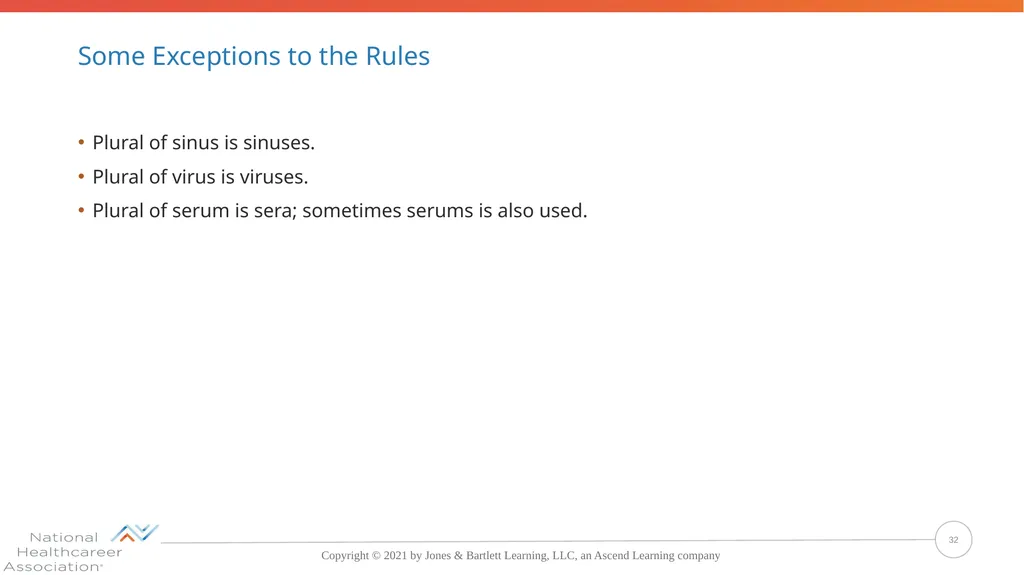
Some Exceptions to the Rules Plural of sinus is sinuses.
Plural of virus is viruses.
Plural of serum is sera; sometimes serums is also used. 32<br>
34
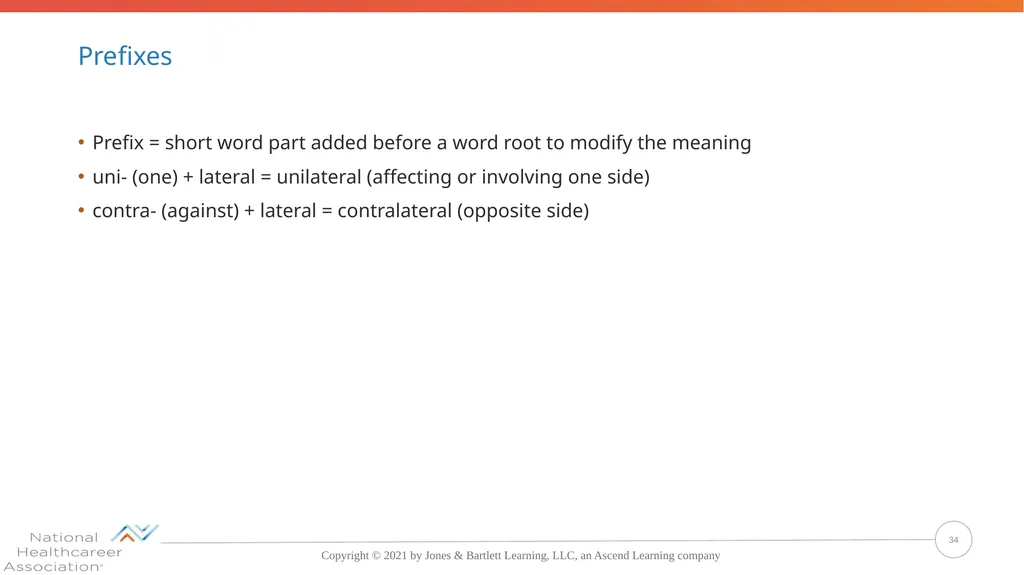
Prefixes Prefix = short word part added before a word root to modify the meaning
uni- (one) + lateral = unilateral (affecting or involving one side)
contra- (against) + lateral = contralateral (opposite side) 34<br>
35
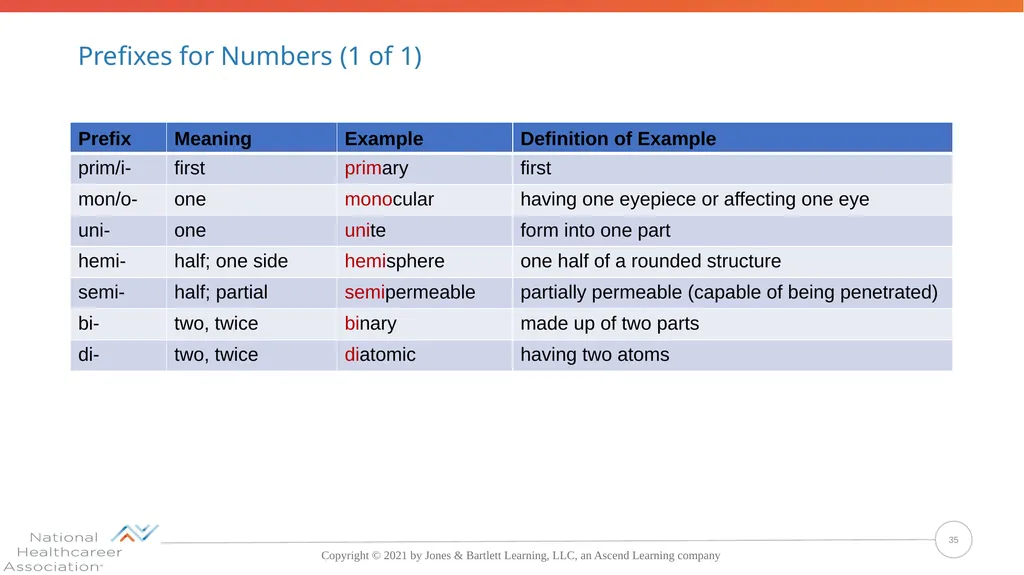
Prefixes for Numbers (1 of 1) 35<br>
36
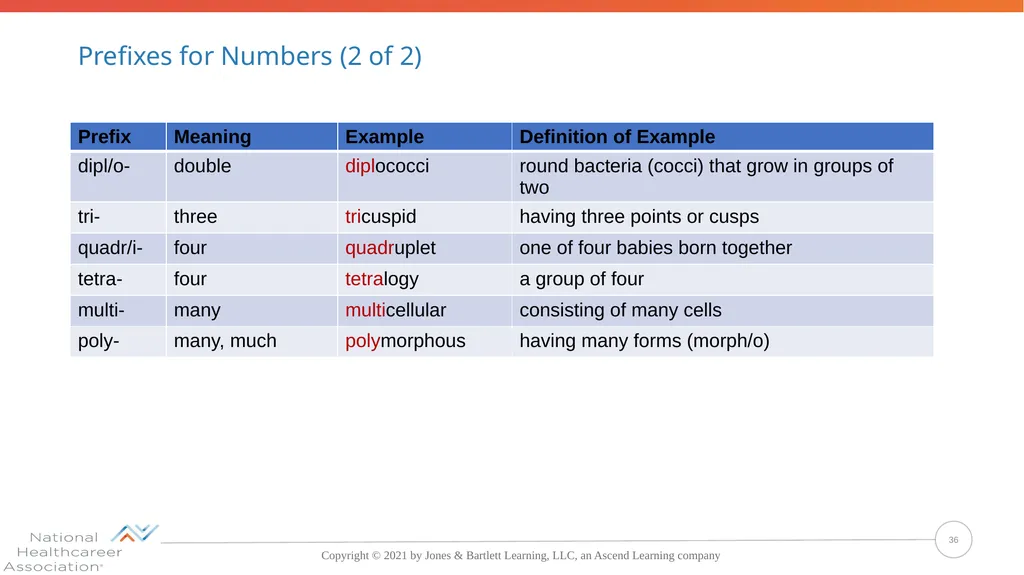
Prefixes for Numbers (2 of 2) 36<br>
37
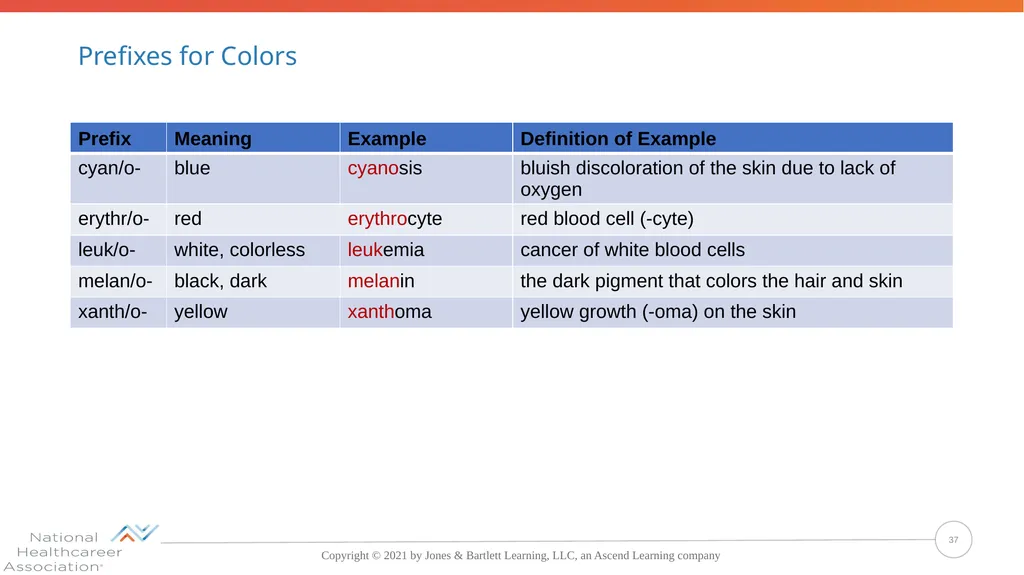
Prefixes for Colors 37<br>
38
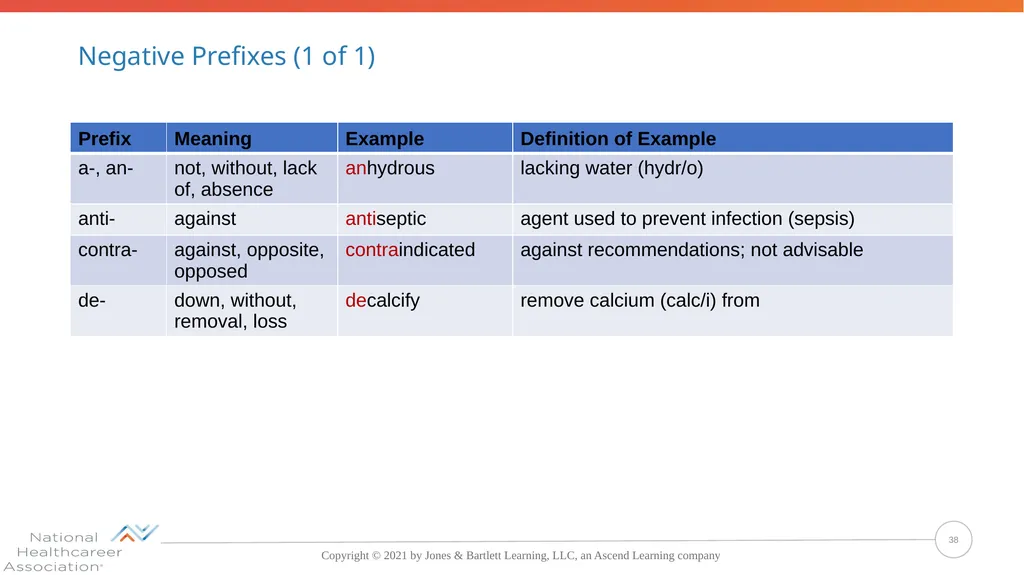
Negative Prefixes (1 of 1) 38<br>
39
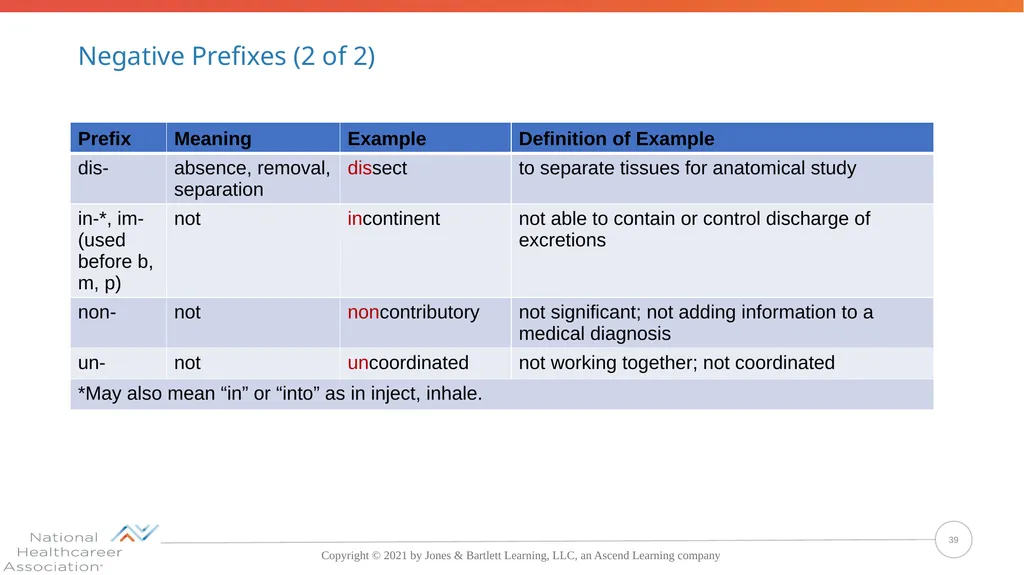
Negative Prefixes (2 of 2) 39<br>
40
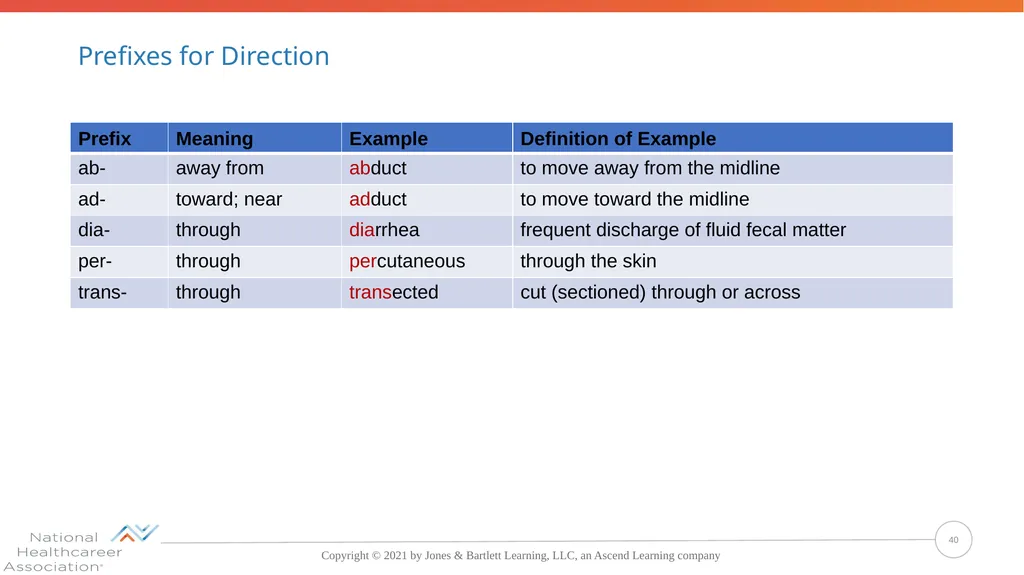
Prefixes for Direction 40<br>
41
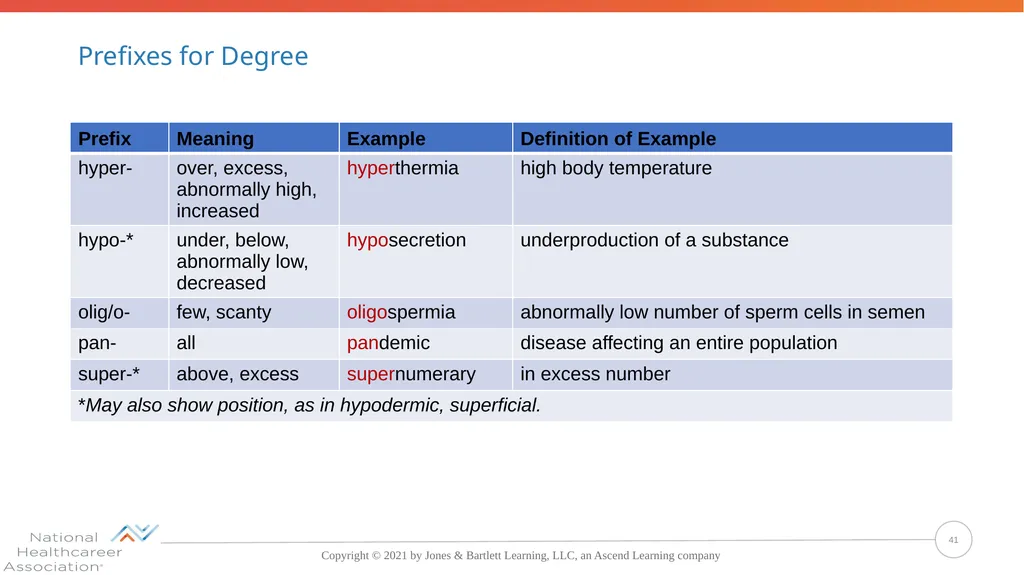
Prefixes for Degree 41<br>
42
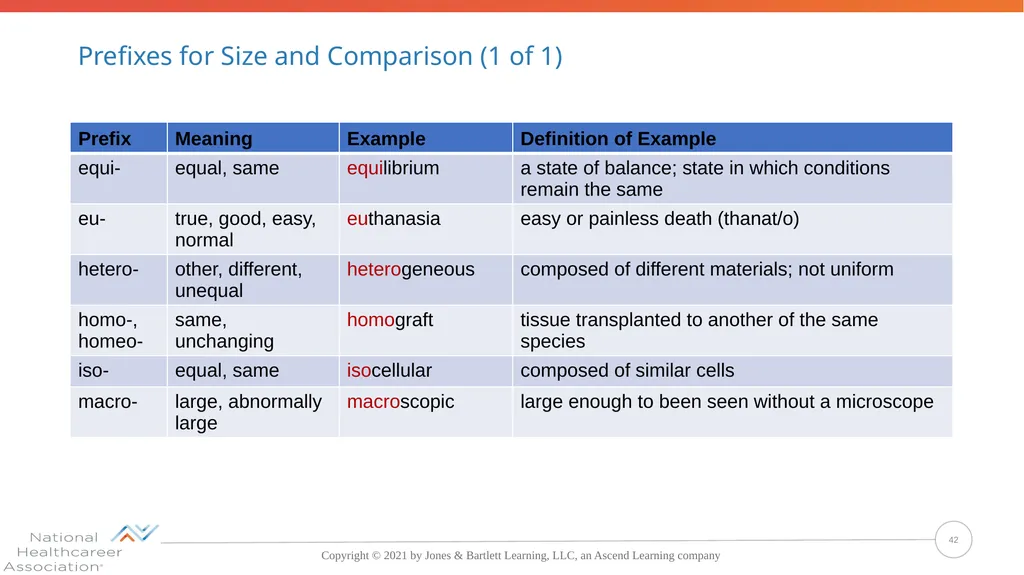
Prefixes for Size and Comparison (1 of 1) 42<br>
43
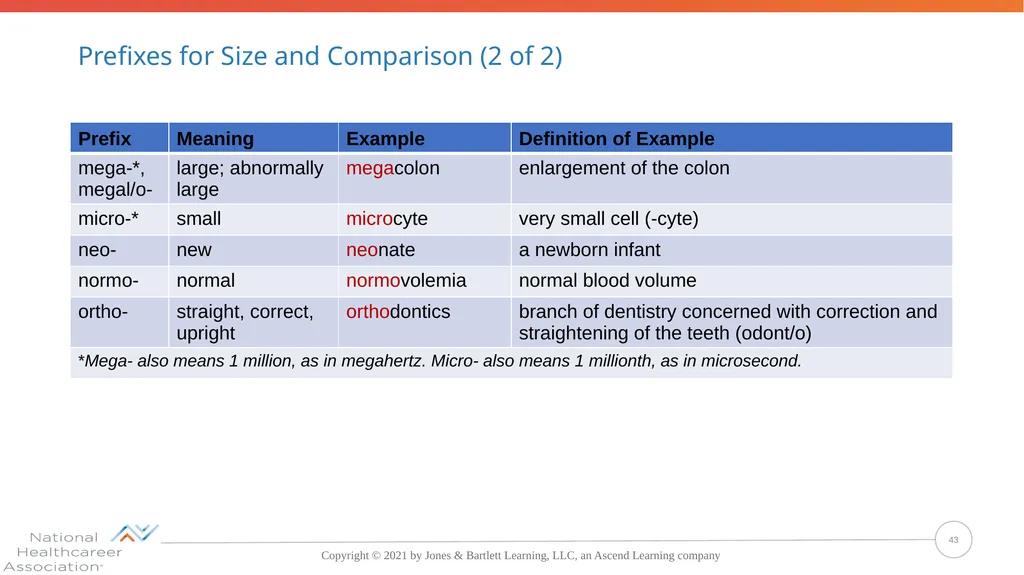
Prefixes for Size and Comparison (2 of 2) 43<br>
44
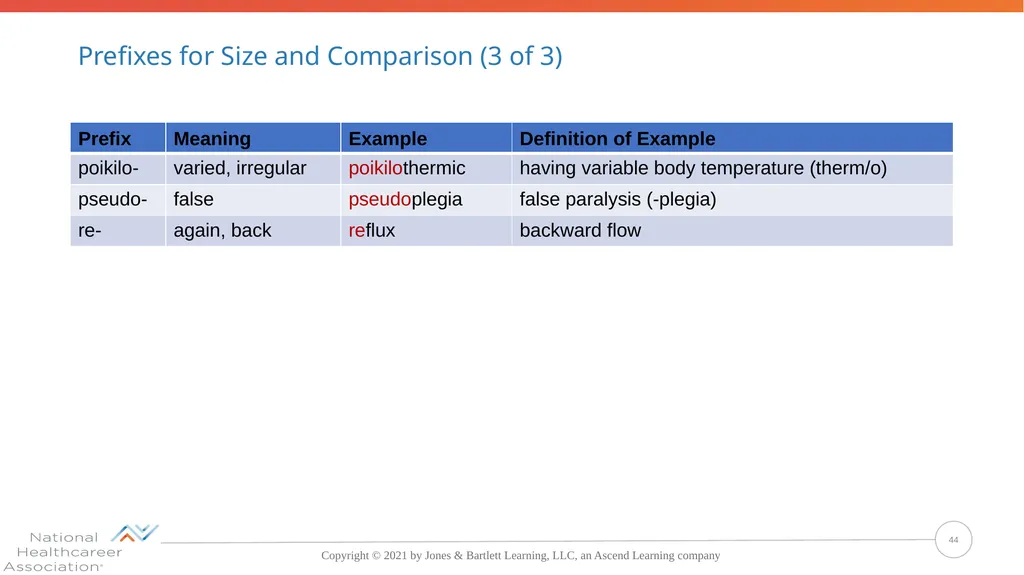
Prefixes for Size and Comparison (3 of 3) 44<br>
45
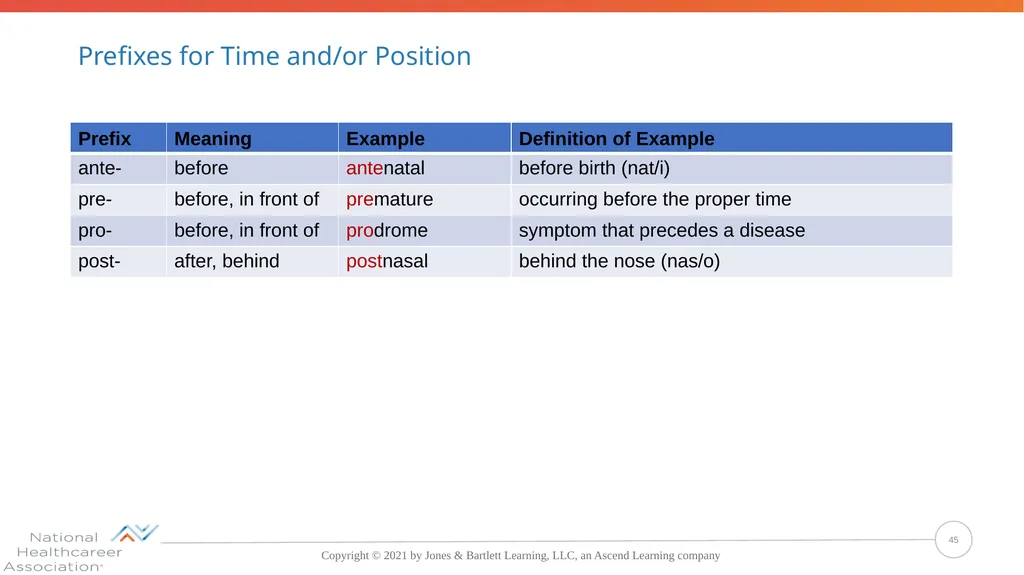
Prefixes for Time and/or Position 45<br>
46
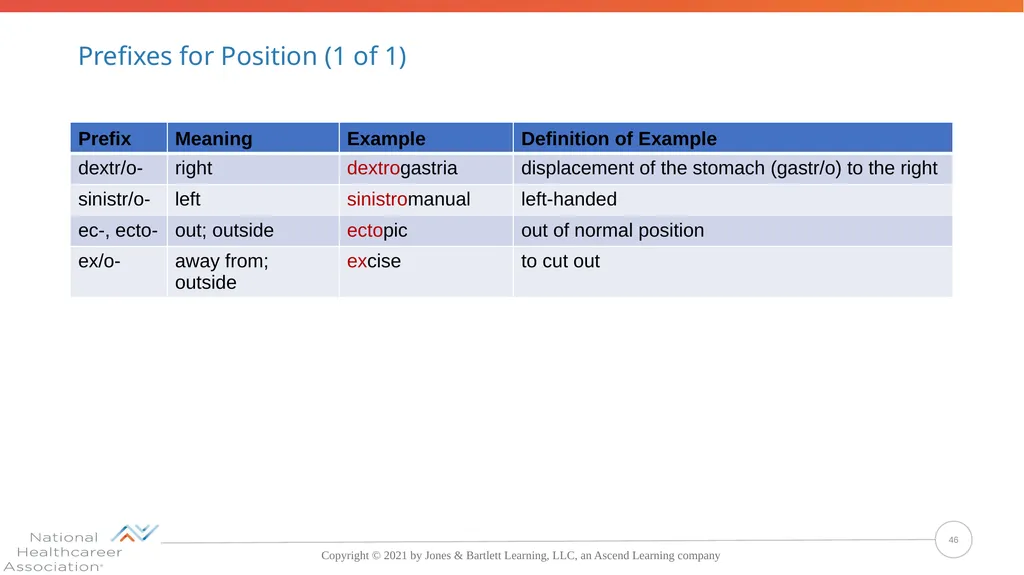
Prefixes for Position (1 of 1) 46<br>
47
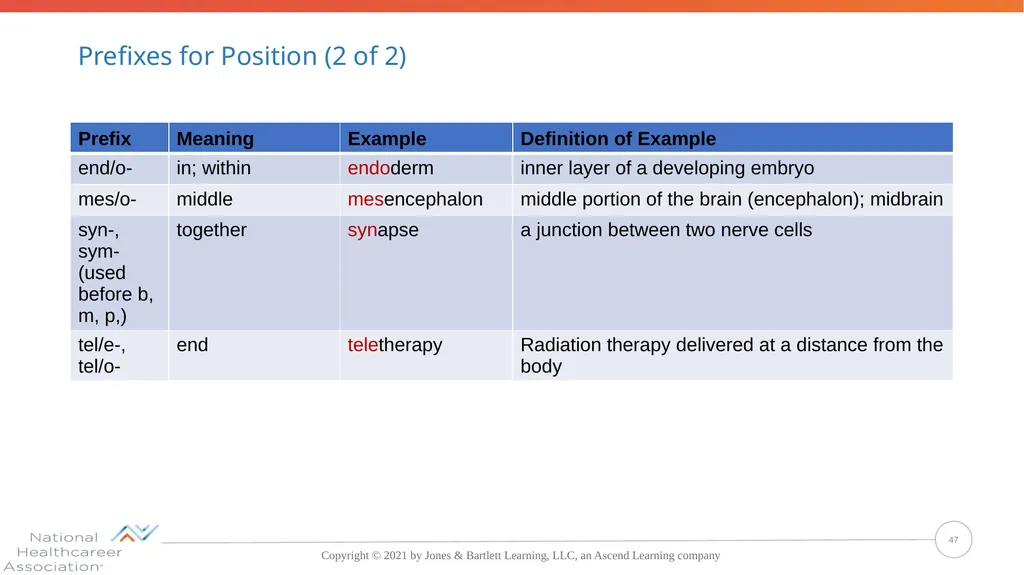
Prefixes for Position (2 of 2) 47<br>