
Confidential. ©2018 University of Maryland School
GB
Published · 40 slides · 0 views

1 / 1





Description
Confidential. 2018 University of Maryland School of Medicine. 1 Everything You Need to Know to Protect Yourself Against the 2023 Respiratory Virus Season (RSV, COVID-19, Flu) Dr. Matthew B. Laurens, MD, MPH, FAAP, FPIDS November 7, 2023
Related Topics
Share
Embed code
Download this presentation From Below
"Confidential. ©2018 University of Maryland School" is the property of its rightful owner. Permission is granted to download and print the materials on this website for personal, non-commercial use only, and to display it on your personal computer provided you do not modify the materials and that you retain all copyright notices contained in the materials. By downloading content from our website, you accept the terms of this agreement.
Presentation Transcript
01
Confidential. ©2018 University of Maryland School of Medicine. 1<br>
02
Everything You Need to Know to Protect Yourself Against the 2023 Respiratory Virus Season (RSV, COVID-19, Flu) Dr. Matthew B. Laurens, MD, MPH, FAAP, FPIDS
November 7, 2023 Confidential. ©2018 University of Maryland School of Medicine. 2<br>
November 7, 2023 Confidential. ©2018 University of Maryland School of Medicine. 2<br>
03
Disclosures My work is supported by grants and contracts to my institution from the NIH, the Bill & Melinda Gates Foundation, Howard Hughes Medical Institute, SEEK UK, BioNTech
I am a consultant to PATH and USAID Malaria Vaccine Development Program for combination CSP + bloodstage malaria vaccine development Confidential. ©2018 University of Maryland School of Medicine. 3<br>
I am a consultant to PATH and USAID Malaria Vaccine Development Program for combination CSP + bloodstage malaria vaccine development Confidential. ©2018 University of Maryland School of Medicine. 3<br>
04
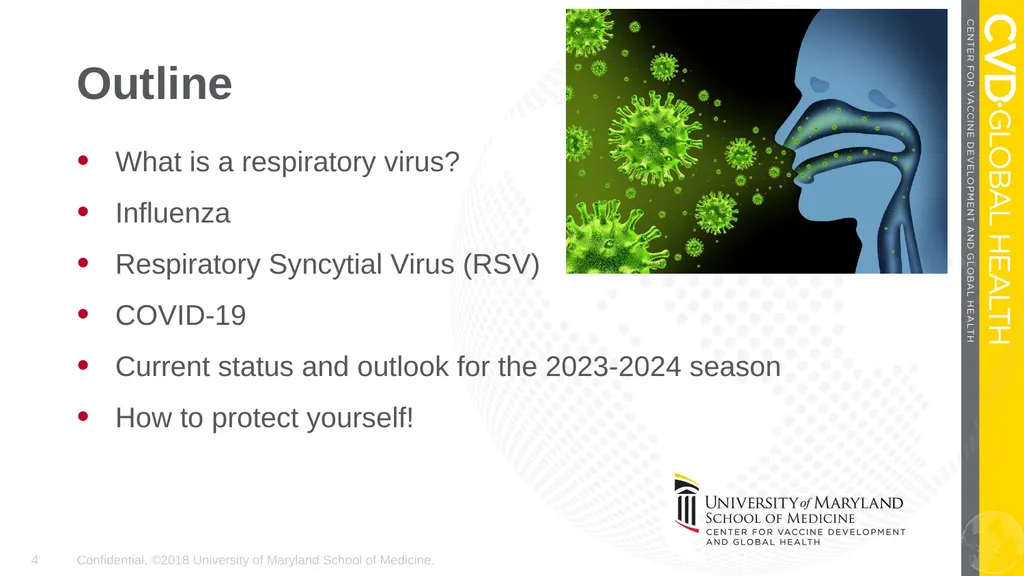
Outline Confidential. ©2018 University of Maryland School of Medicine. What is a respiratory virus?
Influenza
Respiratory Syncytial Virus (RSV)
COVID-19
Current status and outlook for the 2023-2024 season
How to protect yourself! 4<br>
Influenza
Respiratory Syncytial Virus (RSV)
COVID-19
Current status and outlook for the 2023-2024 season
How to protect yourself! 4<br>
05
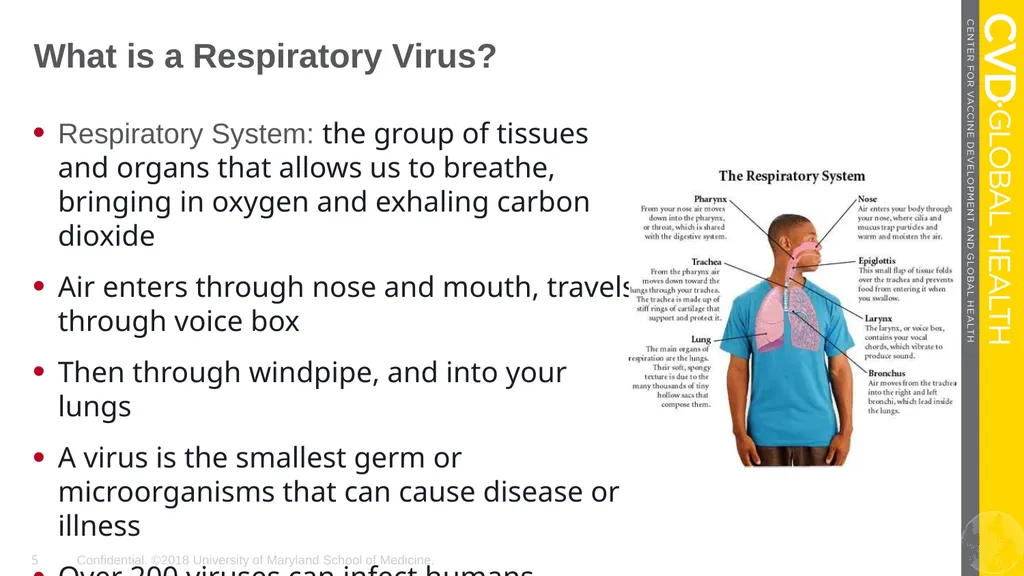
What is a Respiratory Virus? Respiratory System: the group of tissues and organs that allows us to breathe, bringing in oxygen and exhaling carbon dioxide
Air enters through nose and mouth, travels through voice box
Then through windpipe, and into your lungs
A virus is the smallest germ or microorganisms that can cause disease or illness
Over 200 viruses can infect humans Confidential. ©2018 University of Maryland School of Medicine. 5<br>
Air enters through nose and mouth, travels through voice box
Then through windpipe, and into your lungs
A virus is the smallest germ or microorganisms that can cause disease or illness
Over 200 viruses can infect humans Confidential. ©2018 University of Maryland School of Medicine. 5<br>
06
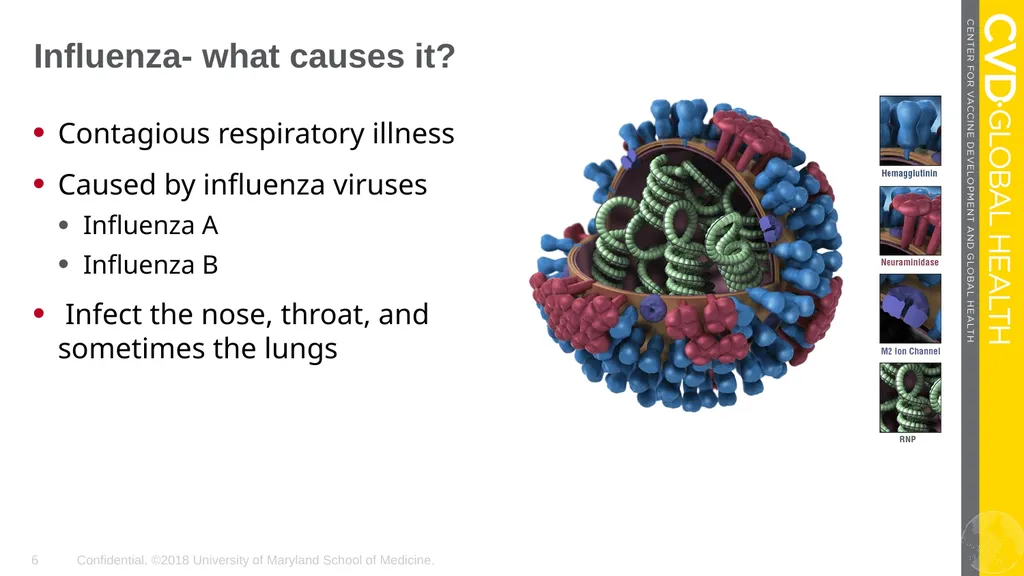
Influenza- what causes it? Contagious respiratory illness
Caused by influenza viruses
Influenza A
Influenza B
Infect the nose, throat, and sometimes the lungs Confidential. ©2018 University of Maryland School of Medicine. 6<br>
Caused by influenza viruses
Influenza A
Influenza B
Infect the nose, throat, and sometimes the lungs Confidential. ©2018 University of Maryland School of Medicine. 6<br>
07
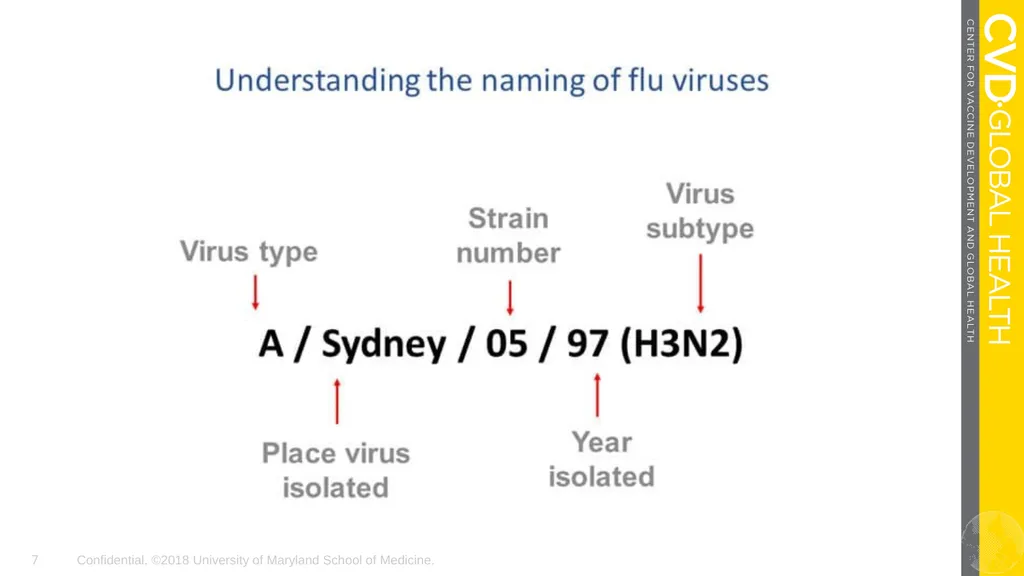
Confidential. ©2018 University of Maryland School of Medicine. 7<br>
08
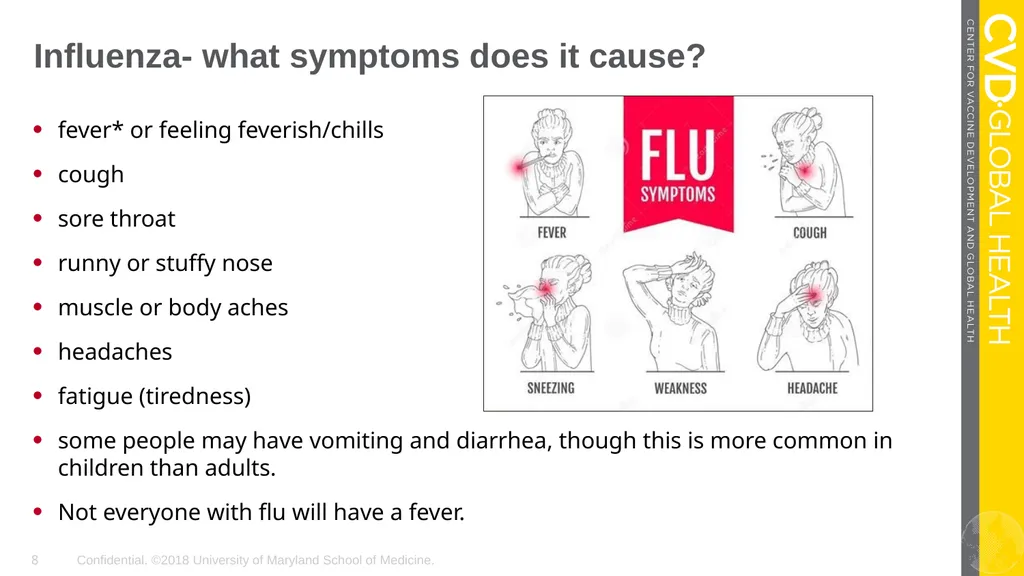
Influenza- what symptoms does it cause? fever* or feeling feverish/chills
cough
sore throat
runny or stuffy nose
muscle or body aches
headaches
fatigue (tiredness)
some people may have vomiting and diarrhea, though this is more common in children than adults.
Not everyone with flu will have a fever. Confidential. ©2018 University of Maryland School of Medicine. 8<br>
cough
sore throat
runny or stuffy nose
muscle or body aches
headaches
fatigue (tiredness)
some people may have vomiting and diarrhea, though this is more common in children than adults.
Not everyone with flu will have a fever. Confidential. ©2018 University of Maryland School of Medicine. 8<br>
09
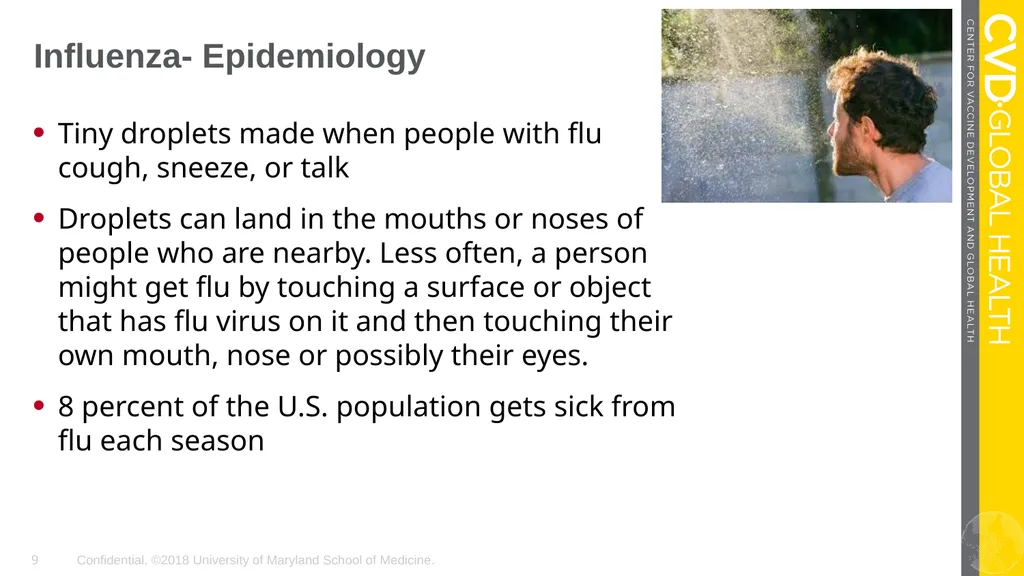
Influenza- Epidemiology Tiny droplets made when people with flu cough, sneeze, or talk
Droplets can land in the mouths or noses of people who are nearby. Less often, a person might get flu by touching a surface or object that has flu virus on it and then touching their own mouth, nose or possibly their eyes.
8 percent of the U.S. population gets sick from flu each season Confidential. ©2018 University of Maryland School of Medicine. 9<br>
10
Confidential. ©2018 University of Maryland School of Medicine. 10<br>
11
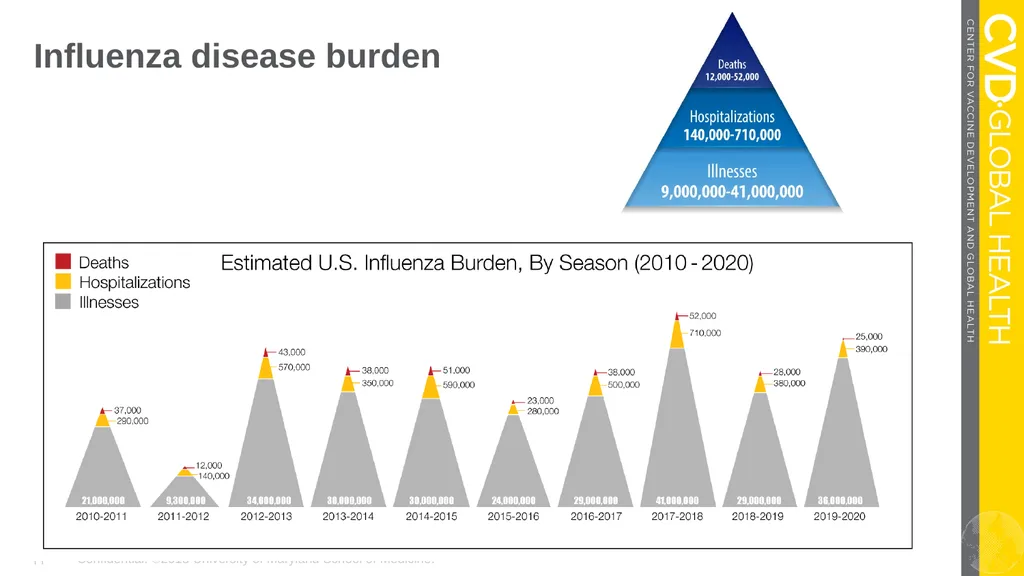
Influenza disease burden Confidential. ©2018 University of Maryland School of Medicine. 11<br>
12
Influenza- how do we diagnose it? Swab inside of nose or back of throat, then test:
Rapid Diagnostic Tests (RDTs) take 10-15 minutes
Rapid Molecular assays take 15-20 minutes, more accurate
PCR can take hours, even more accurate
Cannot tell the difference between RSV, flu and COVID-19 by symptoms alone because some of the symptoms are the same Confidential. ©2018 University of Maryland School of Medicine. 12<br>
13
Influenza- how do we treat it? Antiviral drugs work best when started within the first 1-2 days
Oseltamivir phosphate
Zanamavir
Peramivir
Baloxavir marboxil
Can lessen symptoms and shorten the time you are sick by 1 or 2 days
Can prevent influenza complications such as pneumonia Confidential. ©2018 University of Maryland School of Medicine. 13<br>
Oseltamivir phosphate
Zanamavir
Peramivir
Baloxavir marboxil
Can lessen symptoms and shorten the time you are sick by 1 or 2 days
Can prevent influenza complications such as pneumonia Confidential. ©2018 University of Maryland School of Medicine. 13<br>
14
*Quiz question* You can spread flu to others even before symptoms appear.
True or False? Confidential. ©2018 University of Maryland School of Medicine. 14<br>
True or False? Confidential. ©2018 University of Maryland School of Medicine. 14<br>
15
*Quiz question* You can spread flu to others even before symptoms appear.
True or False?
True
You may be able to spread flu to someone else before you know you are sick, as well as while you are sick. Confidential. ©2018 University of Maryland School of Medicine. 15<br>
True or False?
True
You may be able to spread flu to someone else before you know you are sick, as well as while you are sick. Confidential. ©2018 University of Maryland School of Medicine. 15<br>
16
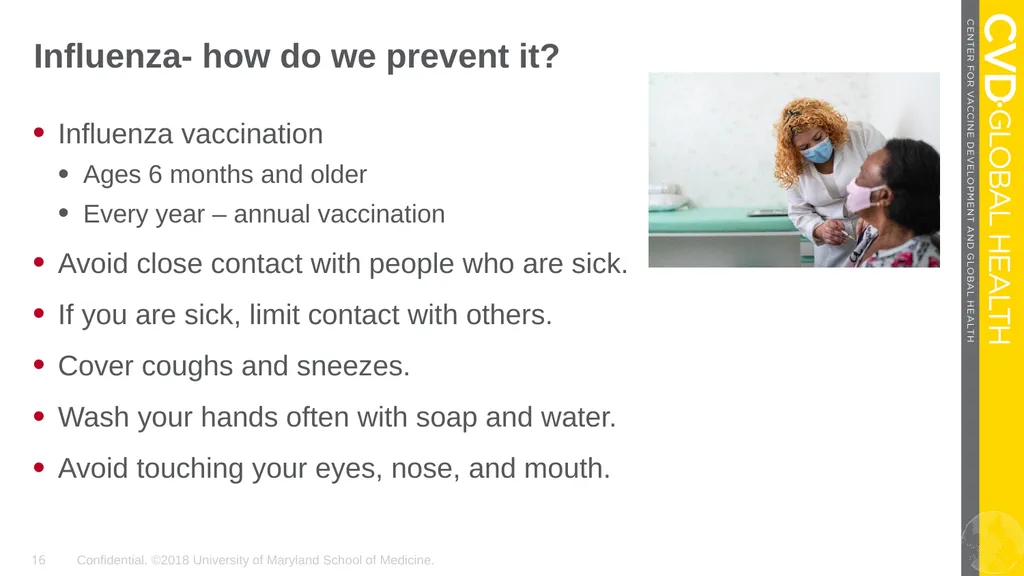
Influenza- how do we prevent it? Influenza vaccination
Ages 6 months and older
Every year – annual vaccination
Avoid close contact with people who are sick.
If you are sick, limit contact with others.
Cover coughs and sneezes.
Wash your hands often with soap and water.
Avoid touching your eyes, nose, and mouth. Confidential. ©2018 University of Maryland School of Medicine. 16<br>
17
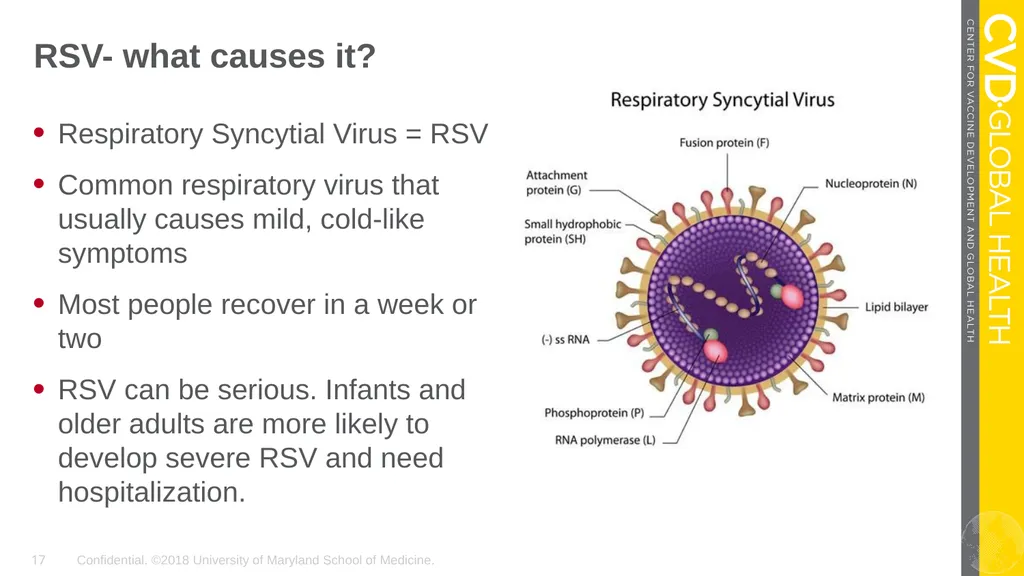
RSV- what causes it? Respiratory Syncytial Virus = RSV
Common respiratory virus that usually causes mild, cold-like symptoms
Most people recover in a week or two
RSV can be serious. Infants and older adults are more likely to develop severe RSV and need hospitalization. Confidential. ©2018 University of Maryland School of Medicine. 17<br>
Common respiratory virus that usually causes mild, cold-like symptoms
Most people recover in a week or two
RSV can be serious. Infants and older adults are more likely to develop severe RSV and need hospitalization. Confidential. ©2018 University of Maryland School of Medicine. 17<br>
18
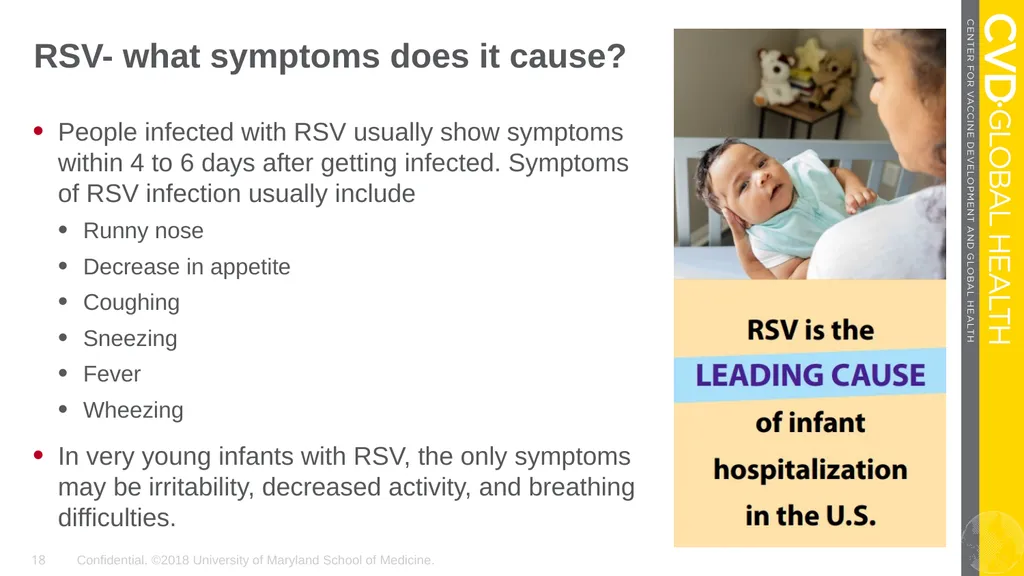
RSV- what symptoms does it cause? People infected with RSV usually show symptoms within 4 to 6 days after getting infected. Symptoms of RSV infection usually include
Runny nose
Decrease in appetite
Coughing
Sneezing
Fever
Wheezing
In very young infants with RSV, the only symptoms may be irritability, decreased activity, and breathing difficulties. Confidential. ©2018 University of Maryland School of Medicine. 18<br>
Runny nose
Decrease in appetite
Coughing
Sneezing
Fever
Wheezing
In very young infants with RSV, the only symptoms may be irritability, decreased activity, and breathing difficulties. Confidential. ©2018 University of Maryland School of Medicine. 18<br>
19
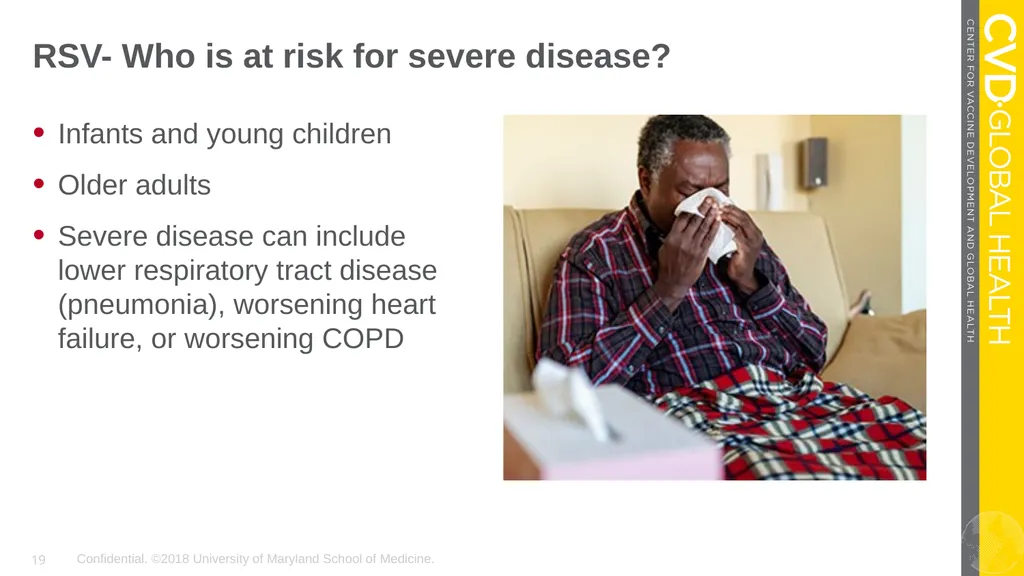
RSV- Who is at risk for severe disease? Infants and young children
Older adults
Severe disease can include lower respiratory tract disease (pneumonia), worsening heart failure, or worsening COPD Confidential. ©2018 University of Maryland School of Medicine. 19<br>
Older adults
Severe disease can include lower respiratory tract disease (pneumonia), worsening heart failure, or worsening COPD Confidential. ©2018 University of Maryland School of Medicine. 19<br>
20
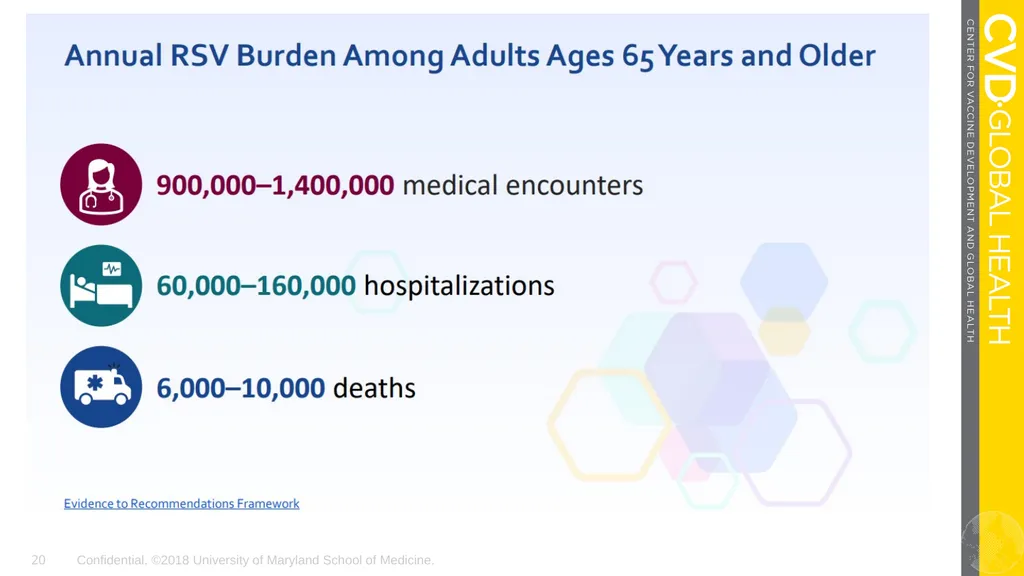
Confidential. ©2018 University of Maryland School of Medicine. 20<br>
21
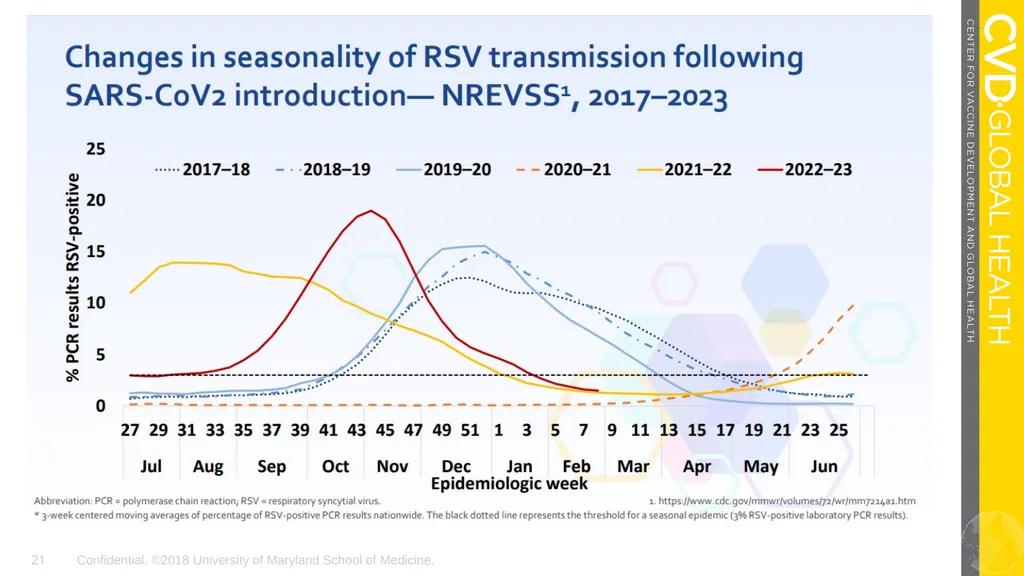
Confidential. ©2018 University of Maryland School of Medicine. 21<br>
22
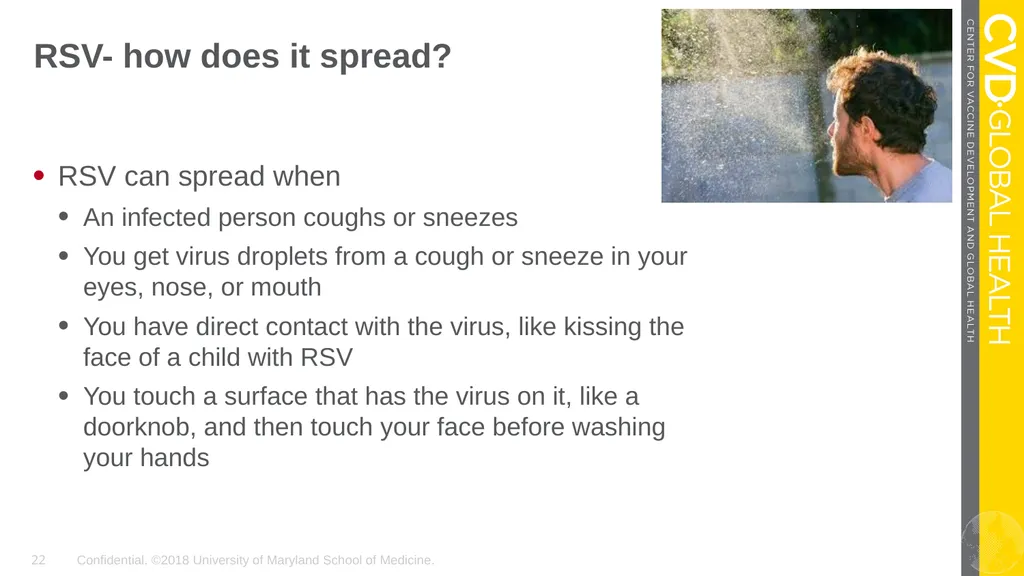
RSV- how does it spread? RSV can spread when
An infected person coughs or sneezes
You get virus droplets from a cough or sneeze in your eyes, nose, or mouth
You have direct contact with the virus, like kissing the face of a child with RSV
You touch a surface that has the virus on it, like a doorknob, and then touch your face before washing your hands Confidential. ©2018 University of Maryland School of Medicine. 22<br>
23
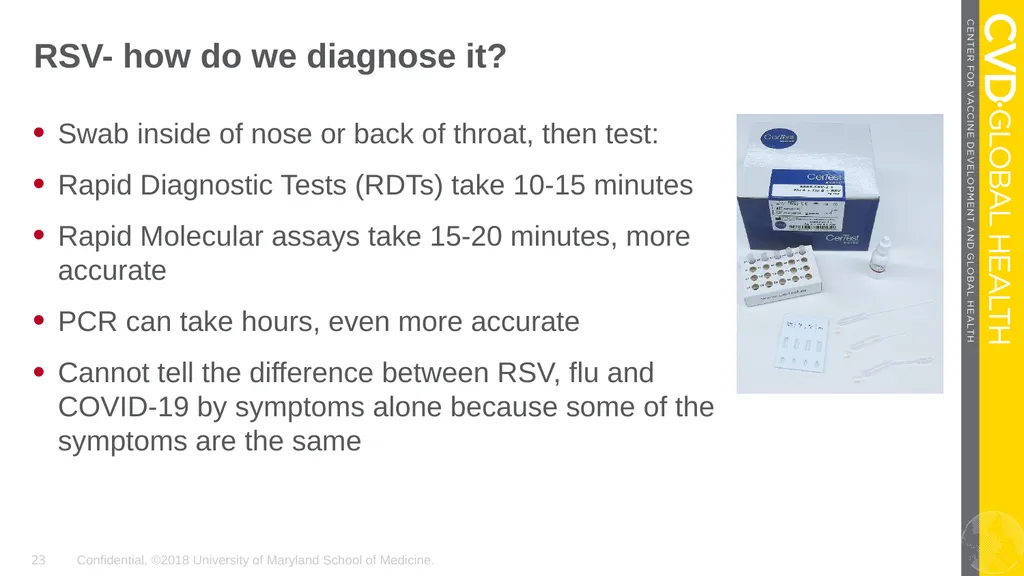
RSV- how do we diagnose it? Swab inside of nose or back of throat, then test:
Rapid Diagnostic Tests (RDTs) take 10-15 minutes
Rapid Molecular assays take 15-20 minutes, more accurate
PCR can take hours, even more accurate
Cannot tell the difference between RSV, flu and COVID-19 by symptoms alone because some of the symptoms are the same Confidential. ©2018 University of Maryland School of Medicine. 23<br>
24
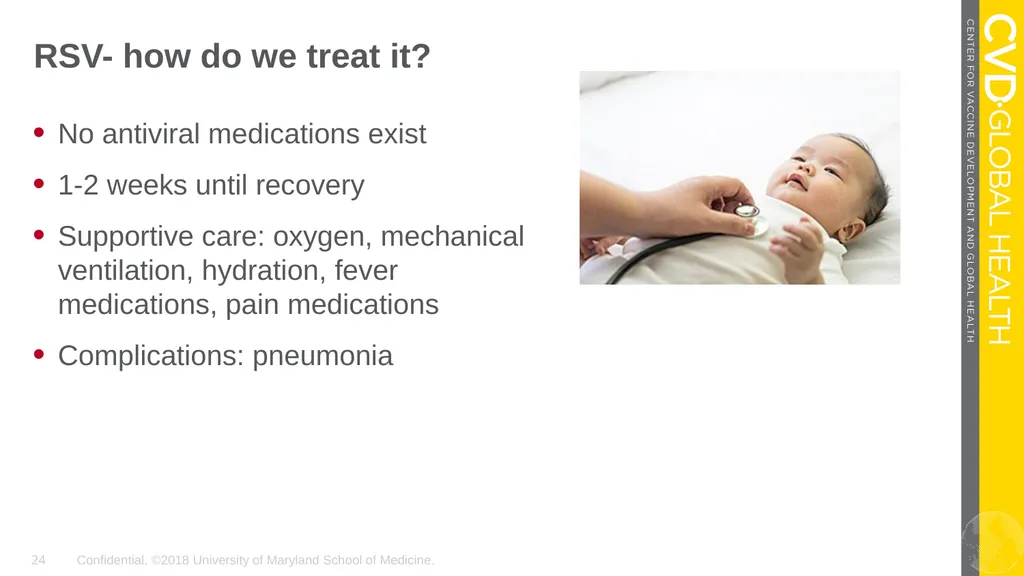
RSV- how do we treat it? No antiviral medications exist
1-2 weeks until recovery
Supportive care: oxygen, mechanical ventilation, hydration, fever medications, pain medications
Complications: pneumonia Confidential. ©2018 University of Maryland School of Medicine. 24<br>
1-2 weeks until recovery
Supportive care: oxygen, mechanical ventilation, hydration, fever medications, pain medications
Complications: pneumonia Confidential. ©2018 University of Maryland School of Medicine. 24<br>
25
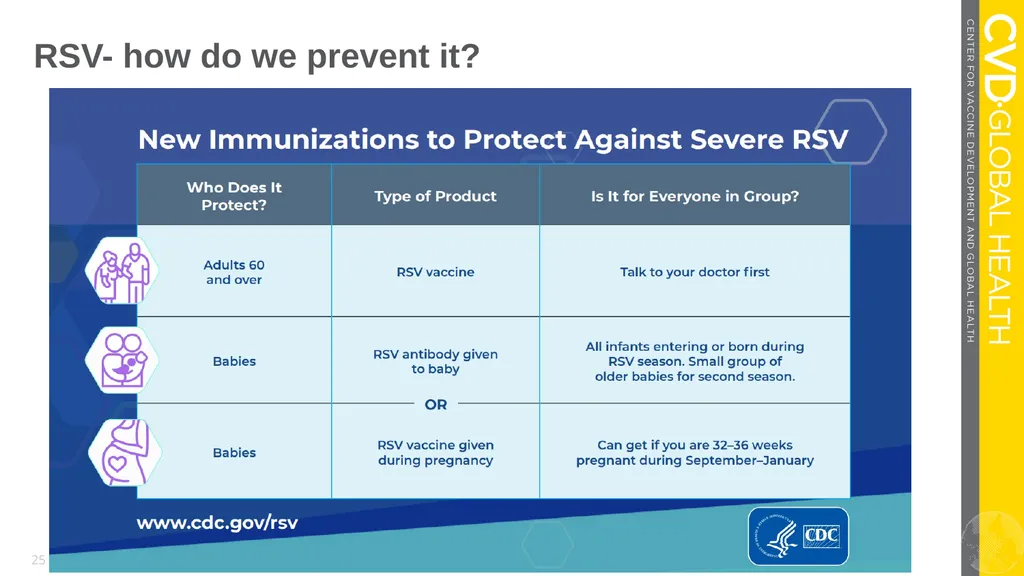
RSV- how do we prevent it? Confidential. ©2018 University of Maryland School of Medicine. 25<br>
26
*Quiz question* Everyone should get a vaccine to protect against RSV.
True or False? Confidential. ©2018 University of Maryland School of Medicine. 26<br>
True or False? Confidential. ©2018 University of Maryland School of Medicine. 26<br>
27
*Quiz question* Everyone should get a vaccine to protect against RSV.
True or False?
FALSE
Only infants, pregnant women, and elderly are eligible. Confidential. ©2018 University of Maryland School of Medicine. 27<br>
True or False?
FALSE
Only infants, pregnant women, and elderly are eligible. Confidential. ©2018 University of Maryland School of Medicine. 27<br>
28
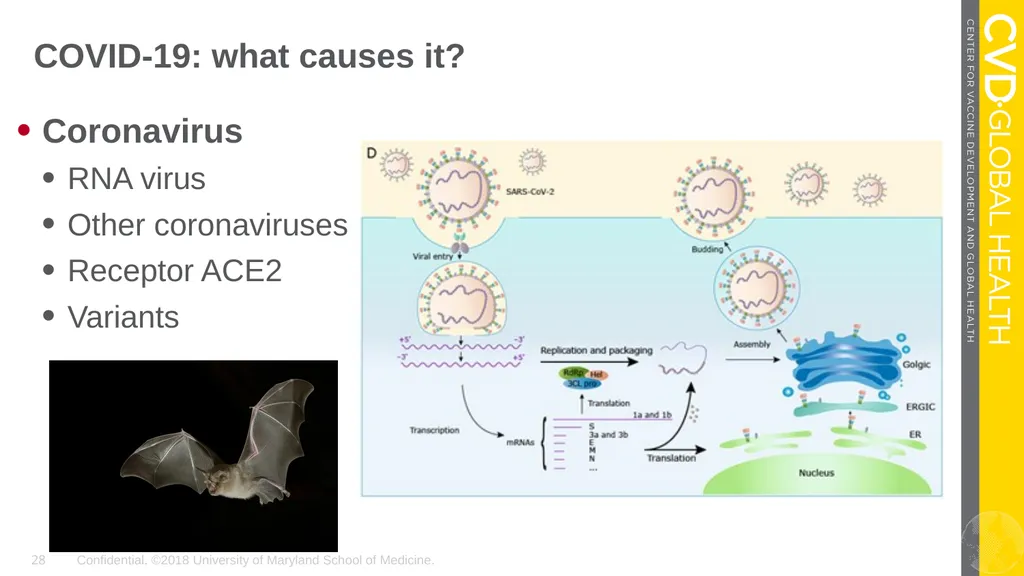
COVID-19: what causes it? Confidential. ©2018 University of Maryland School of Medicine. 28 Coronavirus
RNA virus
Other coronaviruses
Receptor ACE2
Variants<br>
RNA virus
Other coronaviruses
Receptor ACE2
Variants<br>
29
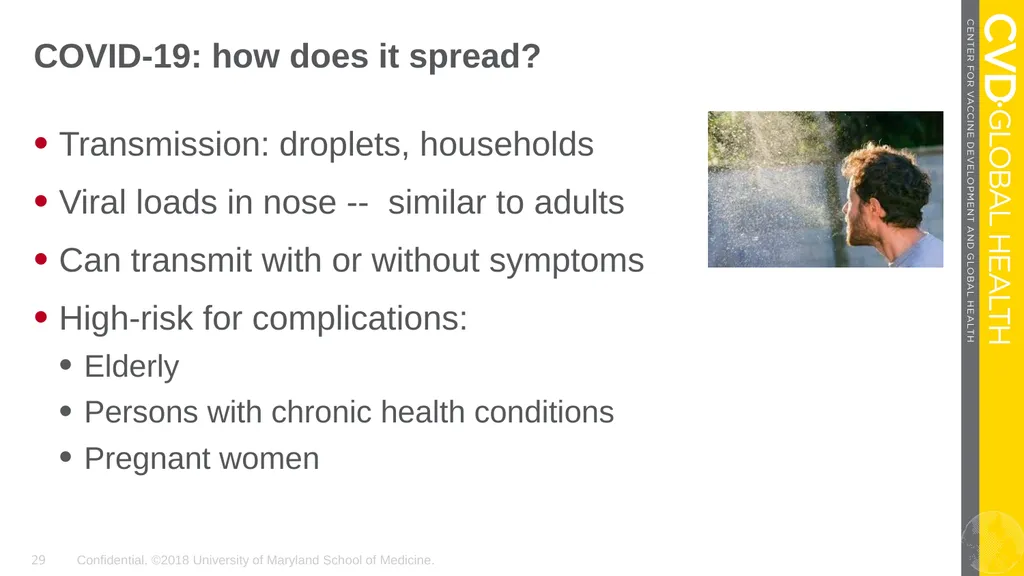
COVID-19: how does it spread? Confidential. ©2018 University of Maryland School of Medicine. 29 Transmission: droplets, households
Viral loads in nose -- similar to adults
Can transmit with or without symptoms
High-risk for complications:
Elderly
Persons with chronic health conditions
Pregnant women<br>
Viral loads in nose -- similar to adults
Can transmit with or without symptoms
High-risk for complications:
Elderly
Persons with chronic health conditions
Pregnant women<br>
30
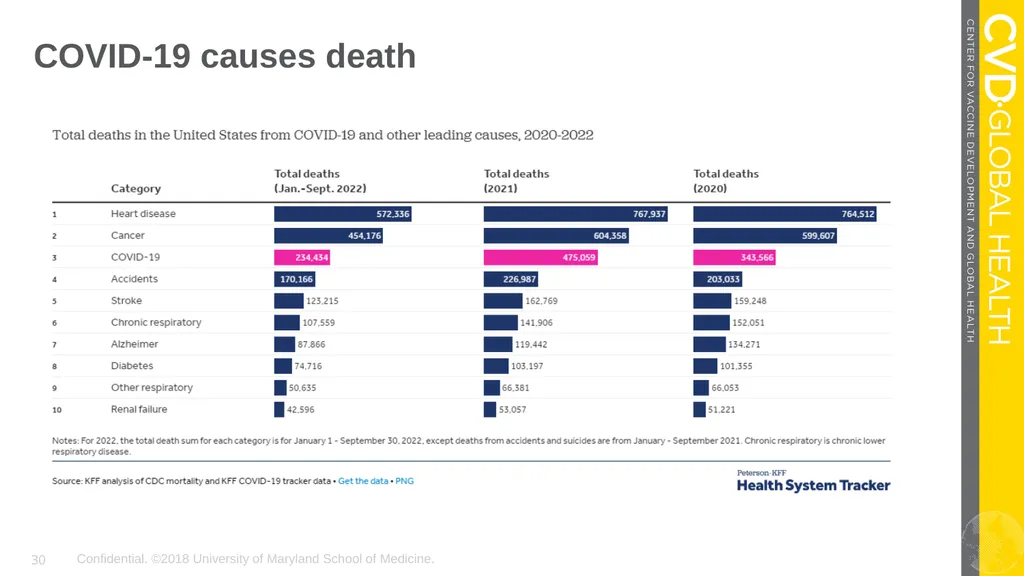
COVID-19 causes death Confidential. ©2018 University of Maryland School of Medicine. 30<br>
31
COVID-19- Epidemiology- Mortality Confidential. ©2018 University of Maryland School of Medicine. 31<br>
32
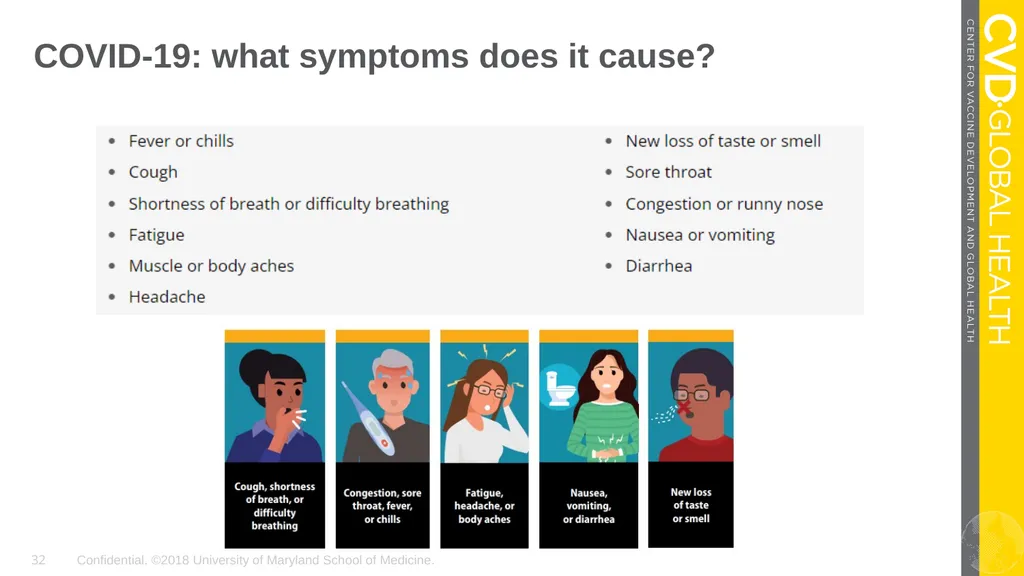
COVID-19: what symptoms does it cause? Confidential. ©2018 University of Maryland School of Medicine. 32<br>
33
COVID-19: how do we diagnose it? Confidential. ©2018 University of Maryland School of Medicine. 33 Swab inside of nose or back of throat, then test:
Rapid Diagnostic Tests (RDTs) take 10-15 minutes
PCR can take hours, even more accurate
Cannot tell the difference between RSV, flu and COVID-19 by symptoms alone because some of the symptoms are the same<br>
Rapid Diagnostic Tests (RDTs) take 10-15 minutes
PCR can take hours, even more accurate
Cannot tell the difference between RSV, flu and COVID-19 by symptoms alone because some of the symptoms are the same<br>
34
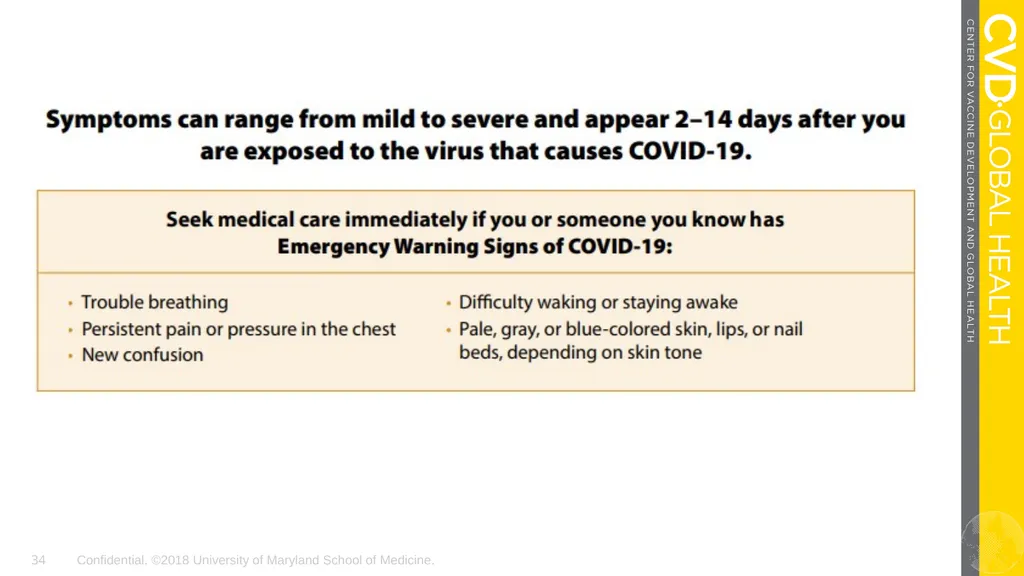
Confidential. ©2018 University of Maryland School of Medicine. 34<br>
35
COVID-19: how do we treat it? Most people with COVID-19 have mild illness and can recover at home. You can treat symptoms with over-the-counter medicines, such as acetaminophen or ibuprofen, to help feel better.
Treatment within 5-7 days
Older adults (50+), chronic conditions
Paxlovid (age 12+, oral, twice daily for 5 days)
Molnupiravir (age 18+, oral, twice daily for 5 days)
Remdesivir (1 month+, intravenous only) Confidential. ©2018 University of Maryland School of Medicine. 35<br>
Treatment within 5-7 days
Older adults (50+), chronic conditions
Paxlovid (age 12+, oral, twice daily for 5 days)
Molnupiravir (age 18+, oral, twice daily for 5 days)
Remdesivir (1 month+, intravenous only) Confidential. ©2018 University of Maryland School of Medicine. 35<br>
36
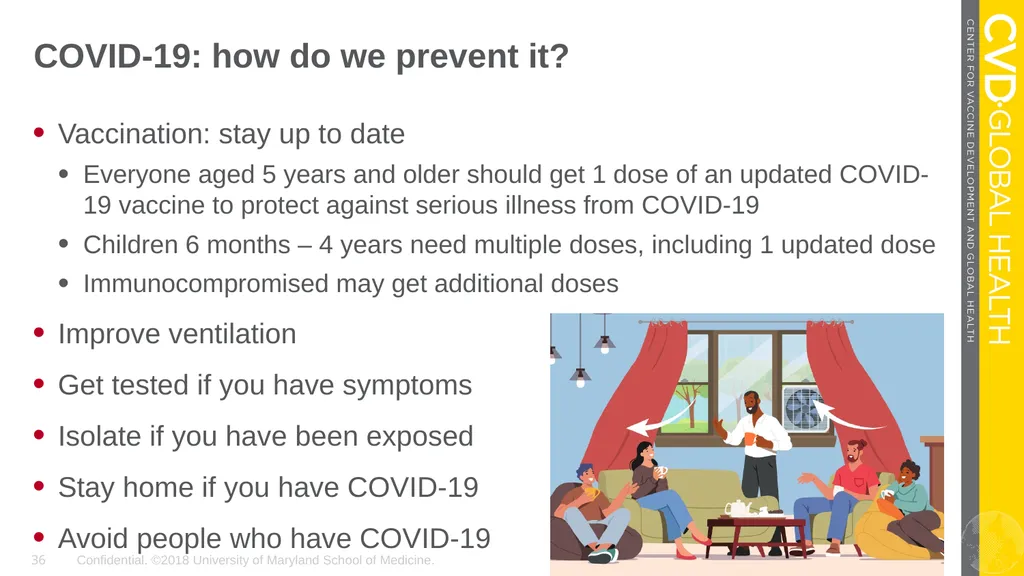
COVID-19: how do we prevent it? Vaccination: stay up to date
Everyone aged 5 years and older should get 1 dose of an updated COVID-19 vaccine to protect against serious illness from COVID-19
Children 6 months – 4 years need multiple doses, including 1 updated dose
Immunocompromised may get additional doses
Improve ventilation
Get tested if you have symptoms
Isolate if you have been exposed
Stay home if you have COVID-19
Avoid people who have COVID-19 Confidential. ©2018 University of Maryland School of Medicine. 36<br>
37
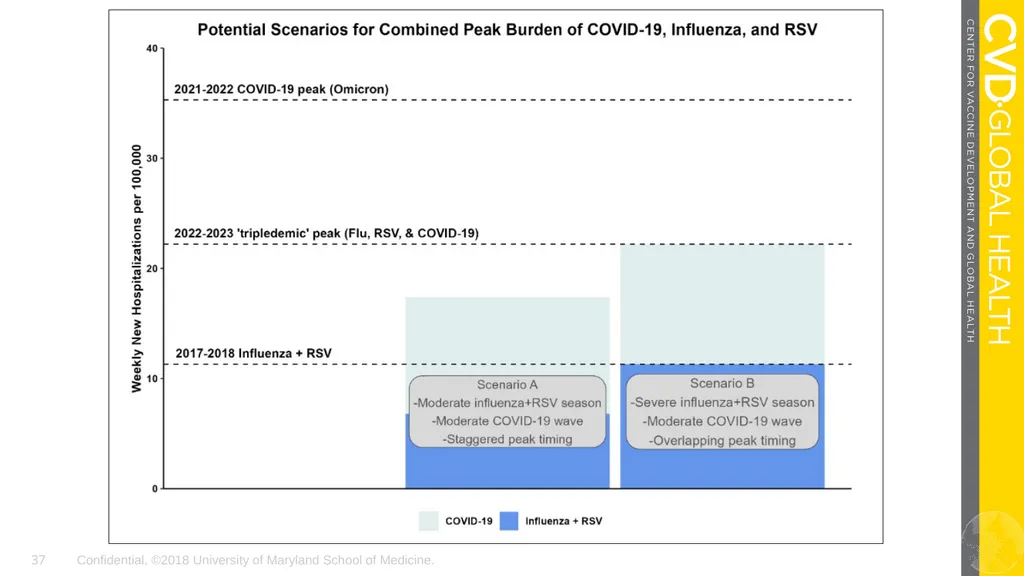
Confidential. ©2018 University of Maryland School of Medicine. 37<br>
38
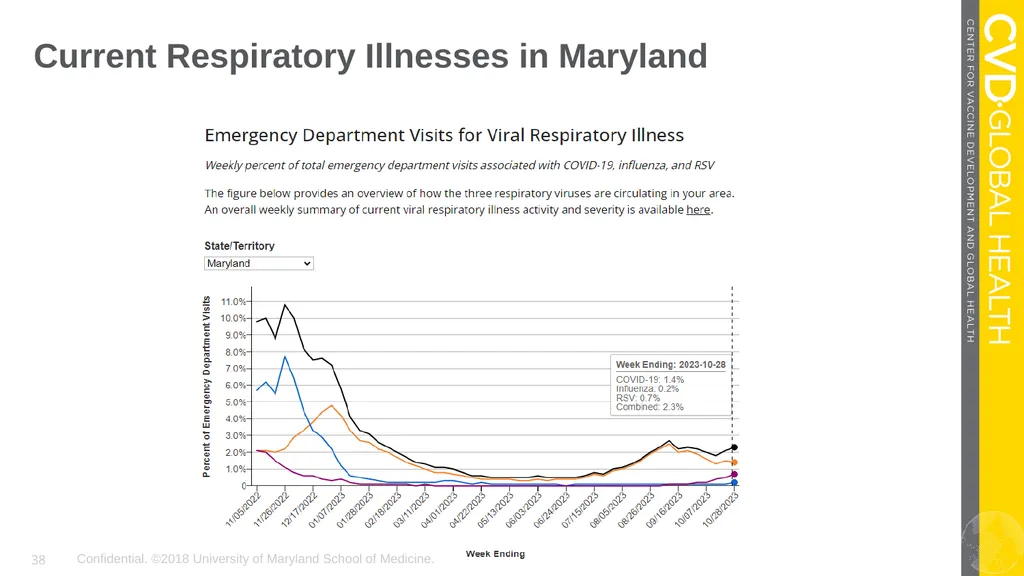
Current Respiratory Illnesses in Maryland Confidential. ©2018 University of Maryland School of Medicine. 38<br>
39
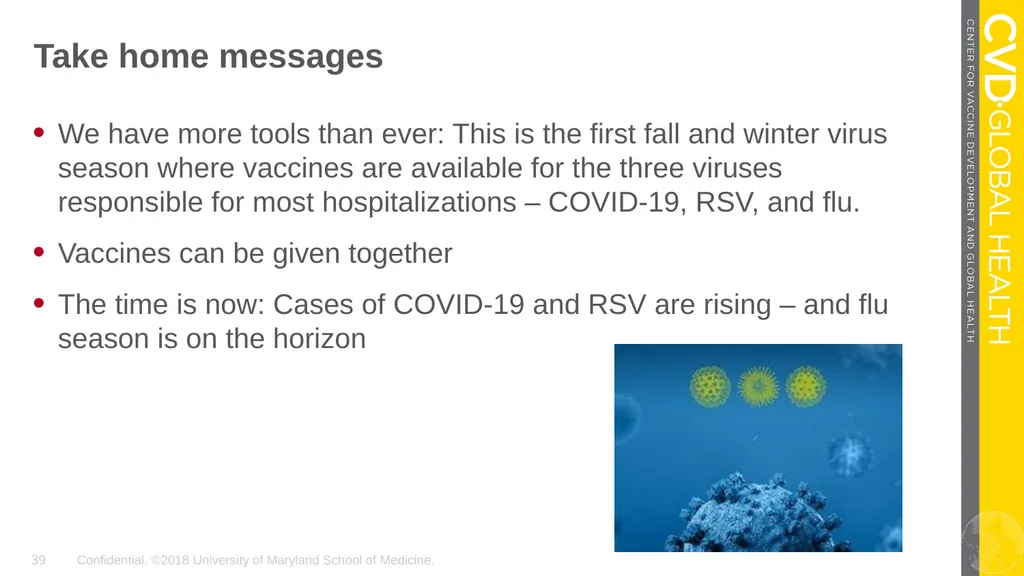
Take home messages We have more tools than ever: This is the first fall and winter virus season where vaccines are available for the three viruses responsible for most hospitalizations – COVID-19, RSV, and flu.
Vaccines can be given together
The time is now: Cases of COVID-19 and RSV are rising – and flu season is on the horizon Confidential. ©2018 University of Maryland School of Medicine. 39<br>
Vaccines can be given together
The time is now: Cases of COVID-19 and RSV are rising – and flu season is on the horizon Confidential. ©2018 University of Maryland School of Medicine. 39<br>
40
Thank you Email
mlaurens@som.umaryland.edu Confidential. ©2018 University of Maryland School of Medicine. 40<br>
mlaurens@som.umaryland.edu Confidential. ©2018 University of Maryland School of Medicine. 40<br>