Contributory Negligence Dr. Sonny Zulhuda Outline Definition Statutory Provision Elements Agony of the Moment C.N. by children Definition of Contributory Negligence Ong Ah Long v Dr. S. Underwood 1983 2 MLJ 324 SYED AGIL BARAKBAH FJ that
"Contributory Negligence Dr. Sonny Zulhuda Outline" is the property of its rightful owner. Permission is granted to
download and print the materials on this website for personal, non-commercial use only, and to display it
on your personal computer provided you do not modify the materials and that you retain all copyright
notices contained in the materials. By downloading content from our website, you accept the terms of this
agreement.
Presentation Transcript
01
Contributory Negligence Dr. Sonny Zulhuda<br>
02
Outline Definition
Statutory Provision
Elements
Agony of the Moment
C.N. by children<br>
03
Definition of Contributory Negligence<br>
04
Ong Ah Long v Dr. S. Underwood [1983] 2 MLJ 324 SYED AGIL BARAKBAH FJ
that there is no question of contributory negligence on the part of the respondent, that the appellant was wholly to blame for failing to pay attention to the presence of other road users and in consequence thereof failed to allow sufficient space between his van to enable the respondent to pass safely.
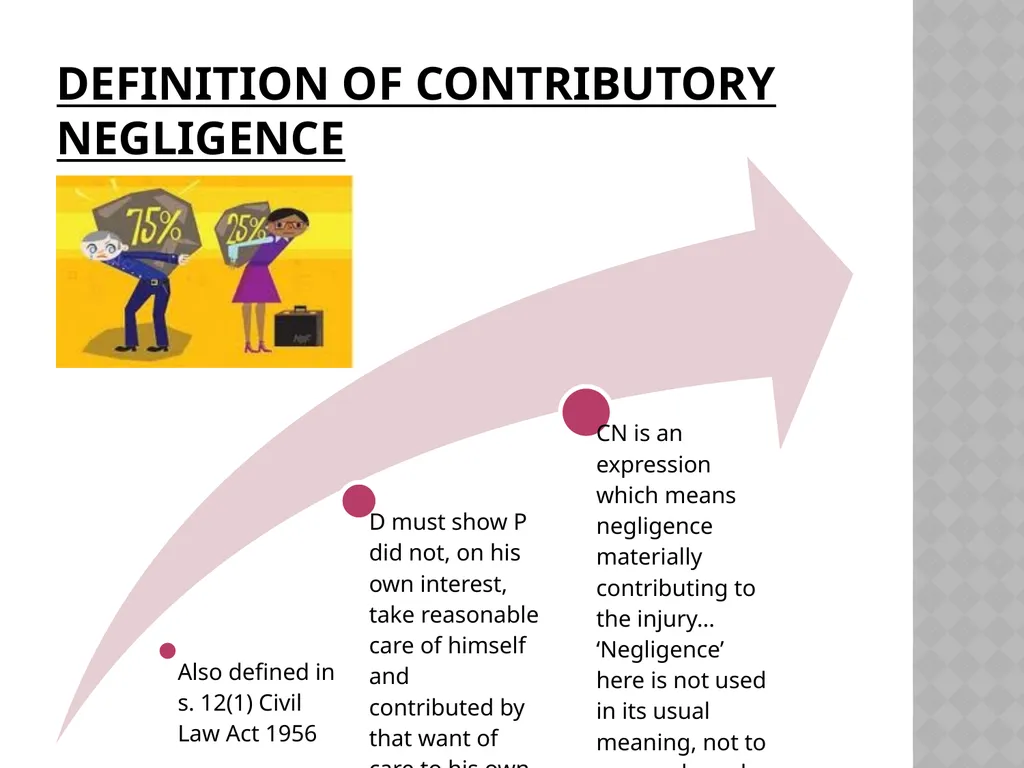
The learned Judge applied the correct test in that the appellant had failed to prove that the respondent did not… take reasonable care of himself and contributed by that want of care to his own injury.
The test for contributory negligence in the case of a pedestrian is not whether he is under a duty of care towards the defendant, but whether he was acting as a reasonable man and with reasonable care. the appellant of a van grazed against the respondent's left arm while he was walking beside his car in a street in Ipoh. App argued CN because Resp had raised his elbow prior to accident.<br>
05
Kek Kee Leng v Teresa Bong Nguk Chin [1978] 1 MLJ 61 D’s car turned from a side road, which is the exit road from the new General Hospital in Kuching, into the main Jalan Tun Haji Openg along which P (the motor-scooterist) was approaching when the latter was only 60 feet from the junction, there could be no circumstances in which P could be held to be blamed, even partially, for the accident. The distance was too short for the P to stop
D is an adult, licensed to drive and therefore presumably he has acquired a knowledge not only of the Highway Code but also of the ordinary precautions to be taken by him for his own safety as well as for the safety of others.
If he obtrudes himself on to the main road in circumstances which make it impossible for traffic coming behind him to avoid a collision, then I do not… think there can be any doubt as to his entire responsibility for the accident<br>
06
s. 12(1) Civil Law Act 1956 on Apportionment of liability<br>
07
Elements of Contributory Negligence Two requirements:
Foreseeability – case of Jones v Livox Quarries Ltd [1952]
CN requires the foreseeability of harm to oneself. A person is guilty of CN if he ought reasonably to have foreseen that, if he did not act as a reasonable, prudent man, he might be hurt himself; and he must take into account the possibility of others being careless.
Causation – section 12(1) CLA 1956<br>
08
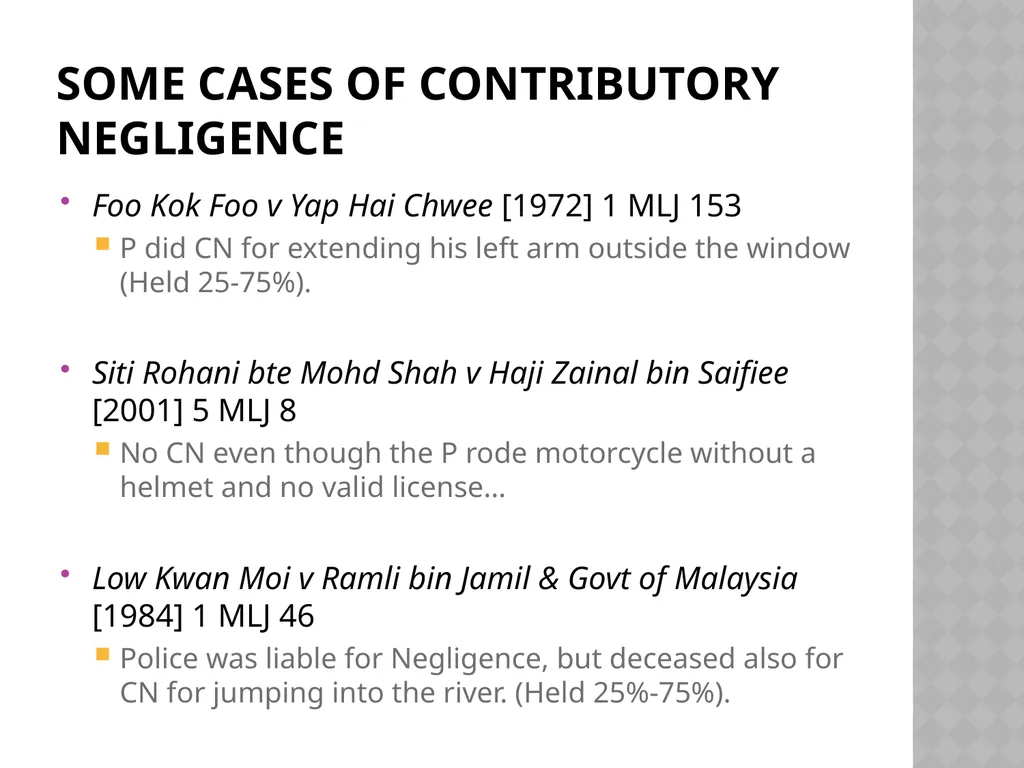
Some cases of Contributory Negligence Foo Kok Foo v Yap Hai Chwee [1972] 1 MLJ 153
P did CN for extending his left arm outside the window (Held 25-75%).
Siti Rohani bte Mohd Shah v Haji Zainal bin Saifiee [2001] 5 MLJ 8
No CN even though the P rode motorcycle without a helmet and no valid license…
Low Kwan Moi v Ramli bin Jamil & Govt of Malaysia [1984] 1 MLJ 46
Police was liable for Negligence, but deceased also for CN for jumping into the river. (Held 25%-75%).<br>
09
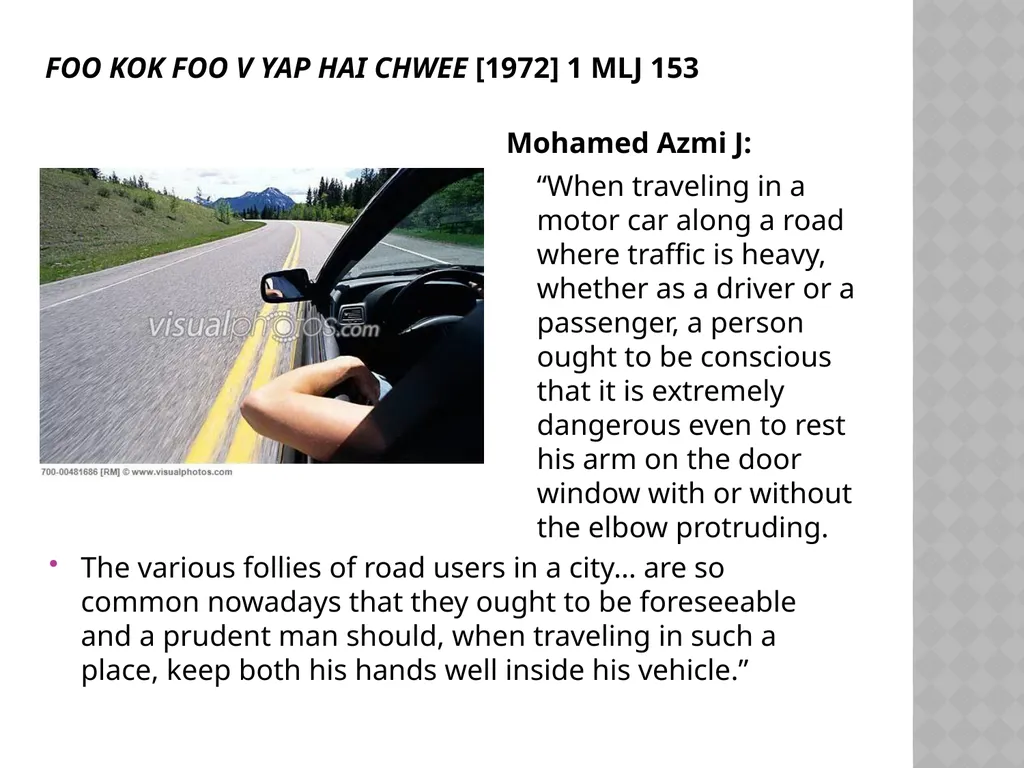
Foo Kok Foo v Yap Hai Chwee [1972] 1 MLJ 153 The various follies of road users in a city… are so common nowadays that they ought to be foreseeable and a prudent man should, when traveling in such a place, keep both his hands well inside his vehicle.” Mohamed Azmi J:
“When traveling in a motor car along a road where traffic is heavy, whether as a driver or a passenger, a person ought to be conscious that it is extremely dangerous even to rest his arm on the door window with or without the elbow protruding.<br>
10
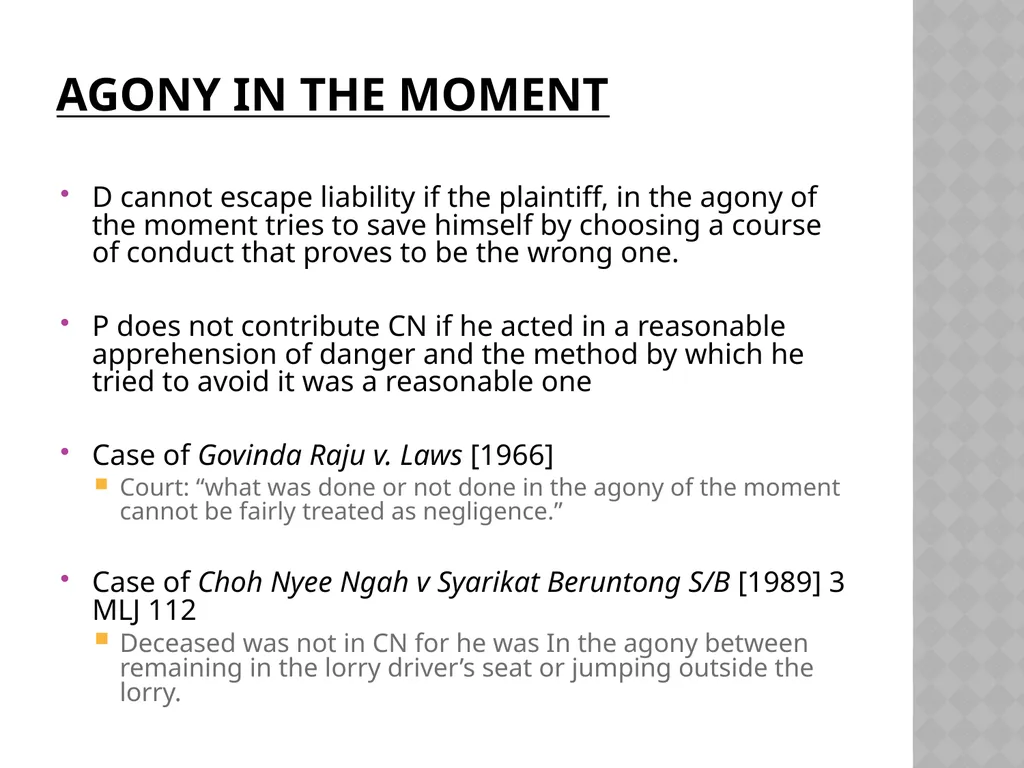
Agony in the Moment D cannot escape liability if the plaintiff, in the agony of the moment tries to save himself by choosing a course of conduct that proves to be the wrong one.
P does not contribute CN if he acted in a reasonable apprehension of danger and the method by which he tried to avoid it was a reasonable one
Case of Govinda Raju v. Laws [1966]
Court: “what was done or not done in the agony of the moment cannot be fairly treated as negligence.”
Case of Choh Nyee Ngah v Syarikat Beruntong S/B [1989] 3 MLJ 112
Deceased was not in CN for he was In the agony between remaining in the lorry driver’s seat or jumping outside the lorry.<br>
11
AGONY OF THE MOMENT: Govinda Raju v laws [1966] 1 mlj 188 D turns right at a junction while P on motorbike was oncoming from an opposite direction. P tried to avoid and swerved right but finally knocked the rear side of D’s car.
Court: D was negligent, what P did could not amount to a contributory negligence “What was done or not done in the agony of the moment cannot be fairly treated as negligence”
When a plaintiff is perplexed or agitated when exposed to danger by the wrongful act of defendant, it is sufficient if he shows such judgment and control in attempting to avoid the accident as may reasonably be expected of him in the circumstances.<br>
12
Syarizan bin Sudirmin & Ors v Abdul Rahman bin Bukit & Anor [2010] 8 MLJ 530 VT Singham J:
“… in attempting to escape apprehension in this police pursuit… the first plaintiff took a serious risk to himself and other road users in riding his motorcycle at such fast speed. “Therefore, this court finds the first plaintiff had also contributed to the damage he had suffered. Accordingly, the damages have to be reduced as this court finds having regard to the first plaintiff ’s share in the responsibility for the damage (see s 12(1) of the Civil Law Act 1956).”<br>
13
Syarizan bin Sudirmin & Ors v Abdul Rahman bin Bukit & Anor [2010] 8 MLJ 530 VT Singham J:
As for not wearing crash helmet, a reasonable prudent motorist in the position of the first plaintiff ’s position would have foreseen that the wearing of crash helmet might result is less harm or injury being caused to his head if he is involved in a collision.. Accordingly, there should be a deduction on the damages to be awarded for his head injury.”
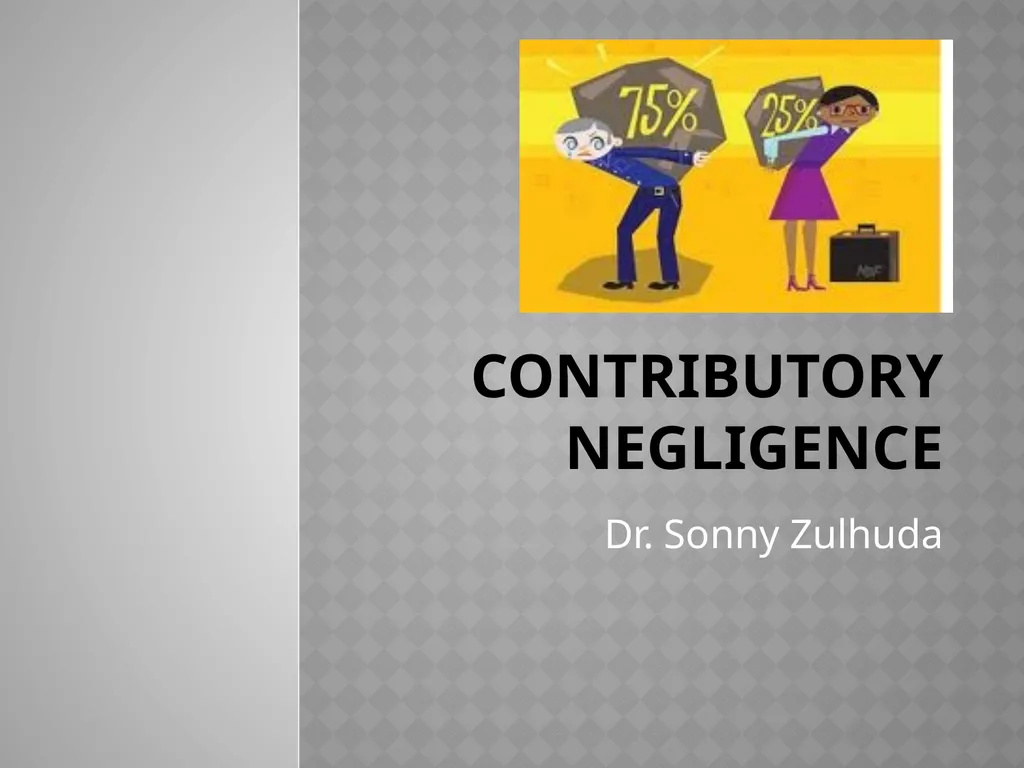
Accordingly, liability should be apportioned at 75% against the first defendant and 25% contributory on the part of the first plaintiff for his want of reasonable care for his own safety and failure to wear a crash helmet that had contributed to his head injuries.<br>
14
CN involving Children The court takes into account the age of the Plaintiff in considering whether he is liable for CN, depending on the circumstances.
The standard of care of an older child is the degree of care that may reasonably be expected from a person in the plaintiff’s situation.
Lembaga Letrik Negara, Malaysia v. Ramakrishnan [1982]
Court: the test is whether an ordinary child of the respondent’s age and experience – neither a “paragon of prudence” nor a “scatterbrain” – would have taken any more than did the respondent.<br>
15
REVISE! Define Contributory Negligence from both statutory and common law principles
What does the word “Negligence” indicate here?
How does the court determine the amount of contribution by the plaintiff?
What is the test for plaintiff’s act in agony of the moment?
Can a child be liable of contributory negligence?<br>