
CPR and AED Scenarios Table of Contents You and
T
Published · 46 slides · 0 views

1 / 1







Description
CPR and AED Scenarios Table of Contents You and the rest of the cast from the Cromwell Bridge Ensemble are rehearsing for a play that will open tomorrow afternoon. Suddenly and without warning, one of the actors collapses on stage.
Related Topics
Share
Embed code
Download this presentation From Below
"CPR and AED Scenarios Table of Contents You and" is the property of its rightful owner. Permission is granted to download and print the materials on this website for personal, non-commercial use only, and to display it on your personal computer provided you do not modify the materials and that you retain all copyright notices contained in the materials. By downloading content from our website, you accept the terms of this agreement.
Presentation Transcript
01
CPR and AED
Scenarios<br>
02
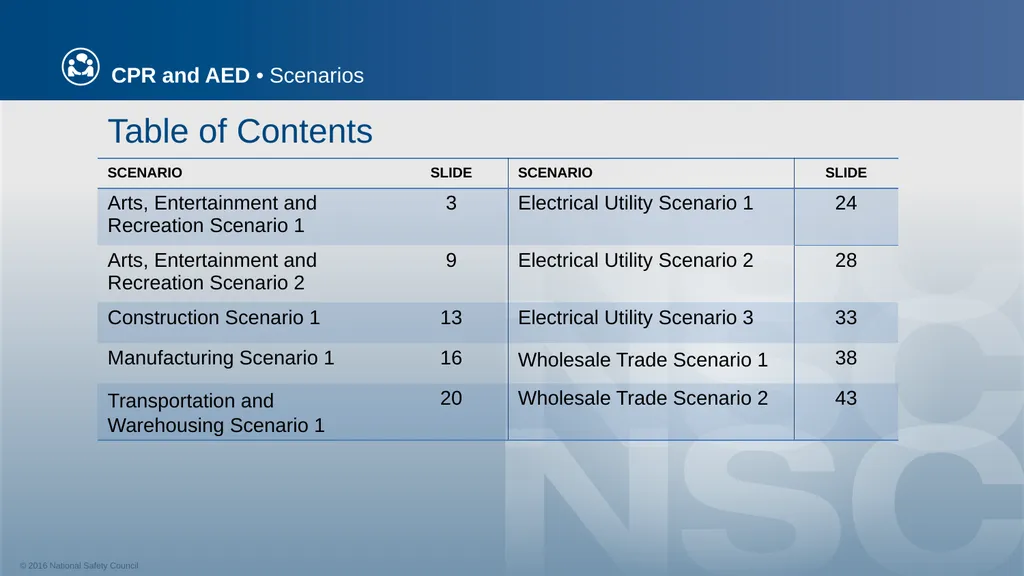
Table of Contents<br>
03
You and the rest of the cast from the Cromwell Bridge Ensemble are rehearsing for a play that will open tomorrow afternoon. Suddenly and without warning, one of the actors collapses on stage. Initially, the cast thought he lost his balance or was clowning around, but when you approach him, you find that he is unresponsive and not breathing.
What would you do before providing first aid?
How would you provide care? Arts, Entertainment and Recreation Scenario 1 3<br>
What would you do before providing first aid?
How would you provide care? Arts, Entertainment and Recreation Scenario 1 3<br>
04
What would you do before providing first aid?
Have a crew member call 9-1-1 and get an AED if one is available. Arts, Entertainment and Recreation Scenario 1 Answer 4<br>
Have a crew member call 9-1-1 and get an AED if one is available. Arts, Entertainment and Recreation Scenario 1 Answer 4<br>
05
How would you provide care?
Provide CPR:
Expose the chest. Put the heel of your hand on the breastbone in the center of the chest and put your second hand on top of the first. Interlock the fingers.
Give 30 compressions at a rate of 100–120 per minute and at a depth of at least 2 inches but not more than 2.4 inches.
Tilt the head and lift the chin to open the airway, and then give 2 rescue breaths. Each breath should be given over 1 second or until the chest rises.
Continue giving 30 compressions and 2 breaths until an AED arrives at the scene and is ready to use, professional help arrives and takes over, or the victim begins to breathe on his own. Arts, Entertainment and Recreation Scenario 1 Answer 5<br>
06
The crew member returns to the stage with an AED. She tells you that EMS is on the way.
How would you provide care? Arts, Entertainment and Recreation Scenario 1, Part 2 6<br>
How would you provide care? Arts, Entertainment and Recreation Scenario 1, Part 2 6<br>
07
Arts, Entertainment and Recreation
Scenario 1, Part 2 Answer Continues on next page 7 How would you provide care?
Direct a crew member to go outside, watch for EMS, and guide them to the victim.
Place the AED by the victim’s shoulder and turn it on.
Quickly dry or shave the pad placement area on the chest if necessary.
Apply the adult pads to the victim’s chest. If needed, plug the cables into the AED.<br>
Direct a crew member to go outside, watch for EMS, and guide them to the victim.
Place the AED by the victim’s shoulder and turn it on.
Quickly dry or shave the pad placement area on the chest if necessary.
Apply the adult pads to the victim’s chest. If needed, plug the cables into the AED.<br>
08
Arts, Entertainment and Recreation
Scenario 1, Part 2 Answer Continued 8 Stay clear during rhythm analysis.
Follow the prompts to take one of three actions: press the shock button; stay clear while the AED automatically delivers a shock; do not shock but immediately give CPR.
Stand clear when the AED prompts to analyze the rhythm again after 5 cycles of CPR (about 2 minutes).
Continue steps e., f., and g. until the victim begins to breathe on his own or until EMS arrives and takes over.<br>
09
Your sister-in-law is in a bind. Her twins had their tonsils removed earlier in the day and must stay in the hospital overnight. Your sister-in-law wants to stay overnight with them but she needs babysitting coverage for her two youngest children for a few hours, as her teenage babysitter needs to go home before dinner. Your brother (her husband) should have returned earlier today from a business trip but his flight was cancelled and he is waiting for the next flight. You agree to watch your 6-month-old nephew and 3-year-old niece until your brother returns home. Arts, Entertainment and Recreation
Scenario 2 Continues on next page 9<br>
10
After feeding, bathing and reading to the children, you get them settled in bed and head to the family room to watch a little TV. Around 10 p.m., you receive a call from your brother, who says his plane has landed and he should be home in 30–40 minutes. Then you go to check on the children. Your niece is sleeping soundly. When you check your nephew, you see that he is not breathing and is slightly blue around the mouth.
What should you do before providing first aid?
How would you provide care? Arts, Entertainment and Recreation Scenario 2 10<br>
What should you do before providing first aid?
How would you provide care? Arts, Entertainment and Recreation Scenario 2 10<br>
11
What should you do before providing first aid?
Remove the infant from the crib and put him on a firm, flat surface. Arts, Entertainment and Recreation Scenario 2 Answer 11<br>
Remove the infant from the crib and put him on a firm, flat surface. Arts, Entertainment and Recreation Scenario 2 Answer 11<br>
12
How would you provide care?
Provide CPR:
Expose the chest and put two fingers of 1 hand below the nipple line.
Give 30 compressions at a rate of 100–120 per minute and at a depth of 1½ inches (⅓ the depth of the chest).
Tilt the head and lift the chin to open the airway, and then give 2 rescue breaths. Cover the mouth and nose with your mouth. Each breath should be given 1 second or until the chest rises.
Continue giving 30 compressions and 2 breaths for 5 cycles (about 2 minutes), then call 9-1-1.
Continue providing CPR during the 9-1-1 call and until the infant recovers or EMS arrives and takes over. Arts, Entertainment and Recreation Scenario 2 Answer 12<br>
13
Your crew of 10 was sent to a pipe-laying construction site in California. Your crew is using a hydraulic crane to move heavy-duty trench-shoring equipment. While 1 of the crew was removing a rigging shackle from a steel I-beam, the crane boom contacted an overhead energized high-voltage conductor. The crew member received an electrical shock and burns to his abdomen.
You and the other crew members come to his aid. You are all trained in first aid.
What would you do before providing first aid?
How would you provide care? Construction Scenario 1 13<br>
You and the other crew members come to his aid. You are all trained in first aid.
What would you do before providing first aid?
How would you provide care? Construction Scenario 1 13<br>
14
What would you do before providing first aid?
Make sure the scene is safe before you enter. This may involve obtaining help to make sure the boom is no longer in contact with the conductor.
Call or have someone call 9-1-1.
Direct someone to bring the first aid kit and an AED if one is available.
Put on medical exam gloves. Construction Scenario 1 Answer 14<br>
15
Construction
Scenario 1 Answer 15 How would you provide care?
Check the crew member quickly for responsiveness and breathing.
If he is not breathing or not breathing normally, provide CPR. Use an AED as soon as one is available and ready to use.
If the crew member is breathing normally, care for the burn:
Immediately cool the burn with running cool or cold potable water, such as tap water for at least 10 minutes. (Do not put ice on a burn, which could cause tissue injury.)
Remove constricting jewelry and clothing items.
Loosely put a nonstick dressing over the burn to protect the area.
Treat for shock with body positioning (if there is no trauma, such as a neck, back, hip or pelvic injury) and by maintaining body temperature.<br>
16
Your sister-in-law is in a bind. Her twins had their tonsils removed earlier in the day and must stay in the hospital overnight. Your sister-in-law wants to stay overnight with them but she needs babysitting coverage for her two youngest children for a few hours, as her teenage babysitter needs to go home before dinner. Your brother (her husband) should have returned earlier today from a business trip but his flight was cancelled and he is waiting for the next flight. You agree to watch your 6-month-old nephew and 3-year-old niece until your brother returns home. Manufacturing
Scenario 1 Continues on next page 16<br>
17
After feeding, bathing and reading to the children, you get them settled in bed and head to the family room to watch a little TV. Around 10 p.m., you receive a call from your brother, who says his plane has landed and he should be home in 30–40 minutes. Then you go to check on the children. Your niece is sleeping soundly. When you check your nephew, you see that he is not breathing and is slightly blue around the mouth.
What should you do before providing first aid?
How would you provide care? Manufacturing Scenario 1 17<br>
What should you do before providing first aid?
How would you provide care? Manufacturing Scenario 1 17<br>
18
What should you do before providing first aid?
Remove the infant from the crib and put him on a firm, flat surface. Manufacturing Scenario 1 Answer 18<br>
Remove the infant from the crib and put him on a firm, flat surface. Manufacturing Scenario 1 Answer 18<br>
19
How would you provide care?
Provide CPR:
Expose the chest and put two fingers of 1 hand below the nipple line.
Give 30 compressions at a rate of 100–120 per minute and at a depth of 1½ inches (⅓ the depth of the chest).
Tilt the head and lift the chin to open the airway, and then give 2 rescue breaths. Cover the mouth and nose with your mouth. Each breath should be given 1 second or until the chest rises.
Continue giving 30 compressions and 2 breaths for 5 cycles (about 2 minutes), then call 9-1-1.
Continue providing CPR during the 9-1-1 call and until the infant recovers or EMS arrives and takes over. Manufacturing Scenario 1 Answer 19<br>
20
Your sister-in-law is in a bind. Her twins had their tonsils removed earlier in the day and must stay in the hospital overnight. Your sister-in-law wants to stay overnight with them but she needs babysitting coverage for her two youngest children for a few hours, as her teenage babysitter needs to go home before dinner. Your brother (her husband) should have returned earlier today from a business trip but his flight was cancelled and he is waiting for the next flight. You agree to watch your 6-month-old nephew and 3-year-old niece until your brother returns home. Transportation and Warehousing
Scenario 1 Continues on next page 20<br>
21
After feeding, bathing and reading to the children, you get them settled in bed and head to the family room to watch a little TV. Around 10 p.m., you receive a call from your brother, who says his plane has landed and he should be home in 30–40 minutes. Then you go to check on the children. Your niece is sleeping soundly. When you check your nephew, you see that he is not breathing and is slightly blue around the mouth.
What should you do before providing first aid?
How would you provide care? Transportation and Warehousing Scenario 1 21<br>
What should you do before providing first aid?
How would you provide care? Transportation and Warehousing Scenario 1 21<br>
22
What should you do before providing first aid?
Remove the infant from the crib and put him on a firm, flat surface. Transportation and Warehousing Scenario 1 Answer 22<br>
Remove the infant from the crib and put him on a firm, flat surface. Transportation and Warehousing Scenario 1 Answer 22<br>
23
How would you provide care?
Provide CPR:
Expose the chest and put two fingers of 1 hand below the nipple line.
Give 30 compressions at a rate of 100–120 per minute and at a depth of 1½ inches (⅓ the depth of the chest).
Tilt the head and lift the chin to open the airway, and then give 2 rescue breaths. Cover the mouth and nose with your mouth. Each breath should be given 1 second or until the chest rises.
Continue giving 30 compressions and 2 breaths for 5 cycles (about 2 minutes), then call 9-1-1.
Continue providing CPR during the 9-1-1 call and until the infant recovers or EMS arrives and takes over. Transportation and Warehousing Scenario 1 Answer 23<br>
24
Your sister-in-law is in a bind. Her twins had their tonsils removed earlier in the day and must stay in the hospital overnight. Your sister-in-law wants to stay overnight with them but she needs babysitting coverage for her two youngest children for a few hours, as her teenage babysitter needs to go home before dinner. Your brother (her husband) should have returned earlier today from a business trip but his flight was cancelled and he is waiting for the next flight. You agree to watch your 6-month-old nephew and 3-year-old niece until your brother returns home. Electrical Utility
Scenario 1 Continues on next page 24<br>
25
After feeding, bathing and reading to the children, you get them settled in bed and head to the family room to watch a little TV. Around 10 p.m., you receive a call from your brother, who says his plane has landed and he should be home in 30–40 minutes. Then you go to check on the children. Your niece is sleeping soundly. When you check your nephew, you see that he is not breathing and is slightly blue around the mouth.
What should you do before providing first aid?
How would you provide care? Electrical Utility Scenario 1 25<br>
What should you do before providing first aid?
How would you provide care? Electrical Utility Scenario 1 25<br>
26
What should you do before providing first aid?
Remove the infant from the crib and put him on a firm, flat surface. Electrical Utility Scenario 1 Answer 26<br>
Remove the infant from the crib and put him on a firm, flat surface. Electrical Utility Scenario 1 Answer 26<br>
27
How would you provide care?
Provide CPR:
Expose the chest and put two fingers of 1 hand below the nipple line.
Give 30 compressions at a rate of 100–120 per minute and at a depth of 1½ inches (⅓ the depth of the chest).
Tilt the head and lift the chin to open the airway, and then give 2 rescue breaths. Cover the mouth and nose with your mouth. Each breath should be given 1 second or until the chest rises.
Continue giving 30 compressions and 2 breaths for 5 cycles (about 2 minutes), then call 9-1-1.
Continue providing CPR during the 9-1-1 call and until the infant recovers or EMS arrives and takes over. Electrical Utility Scenario 1 Answer 27<br>
28
John Ford, an employee of the City Water & Power Company, was working in an underground electrical vault to remove a temporary electrical conductor from an energized electrical line. After John removed the temporary conductor, he replaced the protective plastic cover over the bundle of conductors and began to secure the cover to the bundle. While he was securing the cover, his left middle finger, right palm, and right forearm inadvertently made contact between the energized conductor and a ground source. As a result, he was thrown to the ground. He is unresponsive and not breathing.
You are part of the crew working in this area and are trained in first aid.
What should you do before providing first aid?
How would you provide care? Electrical Utility Scenario 2 28<br>
You are part of the crew working in this area and are trained in first aid.
What should you do before providing first aid?
How would you provide care? Electrical Utility Scenario 2 28<br>
29
What should you do before providing first aid?
Make sure the scene is safe.
Call or have another crew member call 9-1-1 and bring an AED if one is available.
Put on medical exam gloves. Electrical Utility Scenario 2 Answer 29<br>
Make sure the scene is safe.
Call or have another crew member call 9-1-1 and bring an AED if one is available.
Put on medical exam gloves. Electrical Utility Scenario 2 Answer 29<br>
30
Electrical Utility
Scenario 2 Answer 30 How would you provide care?
Provide CPR:
Expose the chest. Put the heel of your hand on the breastbone in the center of the chest and put your second hand on top of the first. Interlock the fingers.
Give 30 compressions at a rate of 100–120 per minute and at a depth of at least 2 inches but not more than 2.4 inches.
Tilt the head and lift the chin to open the airway, and then give 2 rescue breaths. Each breath should be given over 1 second or until the chest rises.
Continue giving 30 compressions and 2 breaths until an AED arrives at the scene and is ready to use, professional help arrives and takes over, or the victim begins to breathe on his own.<br>
31
The crew member returns with the AED. He tells you that EMS is on the way.
How would you provide care? Electrical Utility Scenario 2, Part 2 31<br>
How would you provide care? Electrical Utility Scenario 2, Part 2 31<br>
32
Electrical Utility
Scenario 2, Part 2 Answer 32 How would you provide care?
Direct crew members to watch for EMS and guide them to the victim.
Place the AED by the victim’s shoulder and turn it on.
Quickly dry or shave the pad placement area on the chest if necessary.
Apply the adult pads to the victim’s chest. If needed, plug the cables into the AED.
Stand clear during rhythm analysis.
Follow the prompts to take one of three actions: press the shock button; stay clear while the AED automatically delivers a shock; or do not shock but immediately give CPR.<br>
33
A distribution line crew is replacing a damaged insulator on a wood pole. The pole supports a three-phase 12-kV line. A lineman on the crew removed the 12-kV conductor from the damaged insulator. As he raised the phase conductor from the insulator, it contacted an adjacent phase conductor, causing an electrical arc. The ensuing electric arc caused the lineman to fall into the bucket. He is unresponsive and not breathing.
What would you do before providing first aid?
How would you provide care? Electrical Utility Scenario 3 33<br>
What would you do before providing first aid?
How would you provide care? Electrical Utility Scenario 3 33<br>
34
What would you do before providing first aid?
Make the scene safe and slowly bring the bucket down.
Call or have another crew member call 9-1-1.
Put on medical exam gloves. Electrical Utility Scenario 3 Answer 34<br>
Make the scene safe and slowly bring the bucket down.
Call or have another crew member call 9-1-1.
Put on medical exam gloves. Electrical Utility Scenario 3 Answer 34<br>
35
Electrical Utility
Scenario 3 Answer 35 How would you provide care?
Provide CPR:
Expose the chest. Put the heel of your hand on the breastbone in the center of the chest and put your second hand on top of the first. Interlock the fingers.
Give 30 compressions at a rate of 100–120 per minute and at a depth of at least 2 inches but not more than 2.4 inches.
Tilt the head and lift the chin to open the airway, and then give 2 rescue breaths. Each breath should be given over 1 second or until the chest rises.
Continue giving 30 compressions and 2 breaths until an AED arrives at the scene and is ready to use, professional help arrives and takes over, or the victim begins to breathe on his own.<br>
36
The crew member returns with the AED. He tells you that EMS is on the way.
How would you provide care? Electrical Utility Scenario 3, Part 2 36<br>
How would you provide care? Electrical Utility Scenario 3, Part 2 36<br>
37
Electrical Utility
Scenario 3, Part 2 Answer 37 How would you provide care?
Direct crew members to watch for EMS and guide them to the victim.
Place the AED by the victim’s shoulder and turn it on.
Quickly dry or shave the pad placement area on the chest if necessary.
Apply the adult pads to the victim’s chest. If needed, plug the cables into the AED.
Stand clear during rhythm analysis.
Follow the prompts to take one of three actions: press the shock button; stay clear while the AED automatically delivers a shock; or do not shock but immediately give CPR.<br>
38
Over the last two days, there has been steady traffic in your booth at the Fall Jewelry Show. Independent jewelry store owners have purchased diamond and gemstone designs at all price points from you, so it has been a successful show.
You are writing up a large order for one of your customers when the customer suddenly grabs his chest and falls to the floor.
What would you do before providing first aid?
How would you provide care? Wholesale Trade Scenario 1 38<br>
You are writing up a large order for one of your customers when the customer suddenly grabs his chest and falls to the floor.
What would you do before providing first aid?
How would you provide care? Wholesale Trade Scenario 1 38<br>
39
What would you do before providing first aid?
Make sure the scene is safe.
Check the victim quickly for responsiveness and normal breathing.
Direct someone to call 9-1-1 and to get an AED if one is available. Wholesale Trade Scenario 1 Answer 39<br>
Make sure the scene is safe.
Check the victim quickly for responsiveness and normal breathing.
Direct someone to call 9-1-1 and to get an AED if one is available. Wholesale Trade Scenario 1 Answer 39<br>
40
Wholesale Trade
Scenario 1 Answer 40 How would you provide care?
Provide CPR:
Expose the chest. Put the heel of your hand on the breastbone in the center of the chest and put your second hand on top of the first. Interlock the fingers.
Give 30 compressions at a rate of 100–120 per minute and at a depth of at least 2 inches but not more than 2.4 inches.
Tilt the head and lift the chin to open the airway, and then give 2 rescue breaths. Each breath should be given over 1 second or until the chest rises.
Continue giving 30 compressions and 2 breaths until an AED arrives at the scene and is ready to use, professional help arrives and takes over, or the victim begins to breathe on his own.<br>
41
Another vendor returns to your booth with the AED. She tells you that EMS is on the way.
How would you provide care? Wholesale Trade Scenario 1, Part 2 41<br>
How would you provide care? Wholesale Trade Scenario 1, Part 2 41<br>
42
Wholesale Trade
Scenario 1, Part 2 Answer 42 How would you provide care?
Direct observers to watch for EMS and guide them to the victim.
Place the AED by the victim’s shoulder and turn it on.
Quickly dry or shave the pad placement area on the chest if necessary.
Apply the adult pads to the victim’s chest. If needed, plug the cables into the AED.
Stand clear during rhythm analysis.
Follow the prompts to take one of three actions: press the shock button; stay clear while the AED automatically delivers a shock; or do not shock but immediately give CPR.<br>
43
Your sister-in-law is in a bind. Her twins had their tonsils removed earlier in the day and must stay in the hospital overnight. Your sister-in-law wants to stay overnight with them but she needs babysitting coverage for her two youngest children for a few hours, as her teenage babysitter needs to go home before dinner. Your brother (her husband) should have returned earlier today from a business trip but his flight was cancelled and he is waiting for the next flight. You agree to watch your 6-month-old nephew and 3-year-old niece until your brother returns home. Wholesale Trade
Scenario 2 Continues on next page 43<br>
44
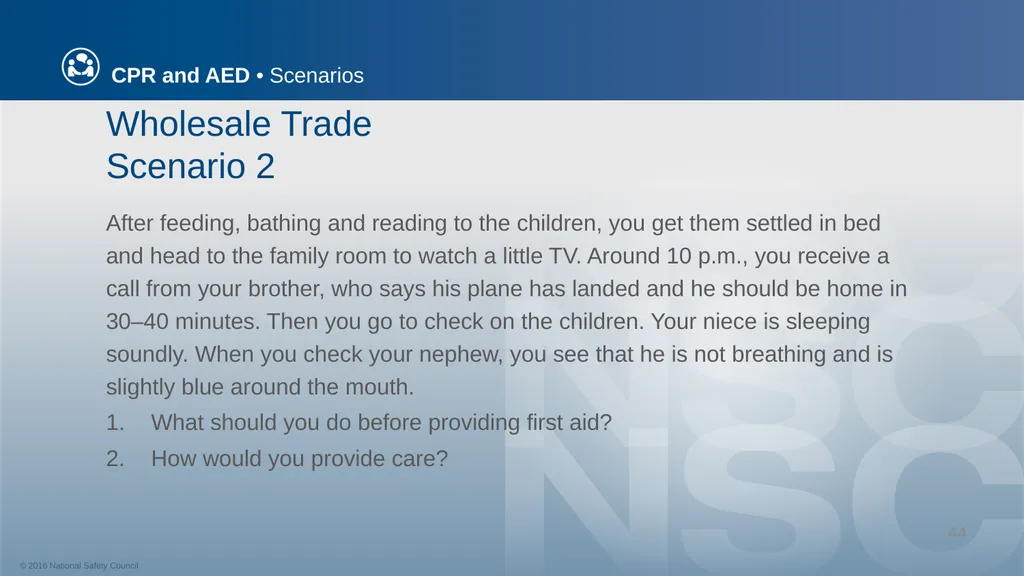
After feeding, bathing and reading to the children, you get them settled in bed and head to the family room to watch a little TV. Around 10 p.m., you receive a call from your brother, who says his plane has landed and he should be home in 30–40 minutes. Then you go to check on the children. Your niece is sleeping soundly. When you check your nephew, you see that he is not breathing and is slightly blue around the mouth.
What should you do before providing first aid?
How would you provide care? Wholesale Trade Scenario 2 44<br>
What should you do before providing first aid?
How would you provide care? Wholesale Trade Scenario 2 44<br>
45
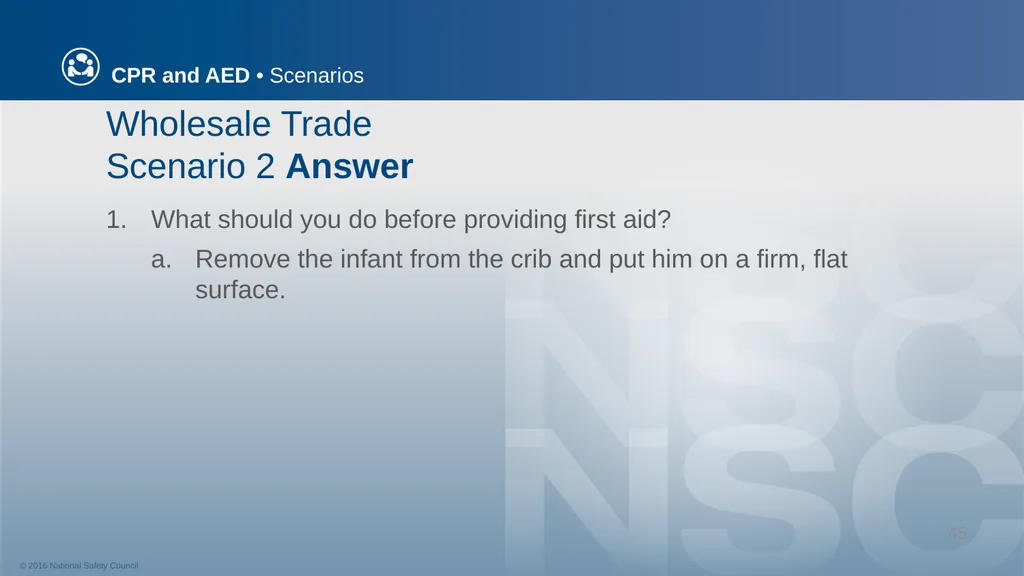
What should you do before providing first aid?
Remove the infant from the crib and put him on a firm, flat surface. Wholesale Trade Scenario 2 Answer 45<br>
Remove the infant from the crib and put him on a firm, flat surface. Wholesale Trade Scenario 2 Answer 45<br>
46
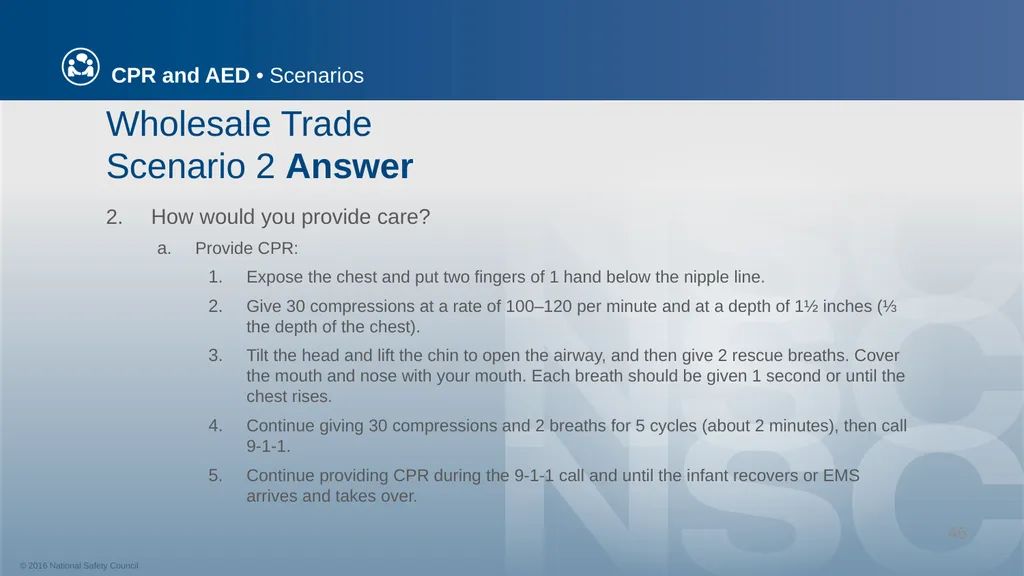
How would you provide care?
Provide CPR:
Expose the chest and put two fingers of 1 hand below the nipple line.
Give 30 compressions at a rate of 100–120 per minute and at a depth of 1½ inches (⅓ the depth of the chest).
Tilt the head and lift the chin to open the airway, and then give 2 rescue breaths. Cover the mouth and nose with your mouth. Each breath should be given 1 second or until the chest rises.
Continue giving 30 compressions and 2 breaths for 5 cycles (about 2 minutes), then call 9-1-1.
Continue providing CPR during the 9-1-1 call and until the infant recovers or EMS arrives and takes over. Wholesale Trade Scenario 2 Answer 46<br>