Created by: Zankhana Patel, RN, MSN William Osler-Nurse Practitioner Led Outreach Team (NLOT) August 15, 2023 Central Venous Catheter Access Device Management: Peripheral Inserted Central Catheter (PICC) Learning Objectives Identify
"Created by: Zankhana Patel, RN, MSN William" is the property of its rightful owner. Permission is granted to
download and print the materials on this website for personal, non-commercial use only, and to display it
on your personal computer provided you do not modify the materials and that you retain all copyright
notices contained in the materials. By downloading content from our website, you accept the terms of this
agreement.
Presentation Transcript
01
Created by: Zankhana Patel, RN, MSN
William Osler-Nurse Practitioner Led Outreach Team (NLOT)
August 15, 2023<br>
02
Central Venous Catheter Access Device Management: Peripheral Inserted Central Catheter (PICC)<br>
03
Learning Objectives Identify different types of CVADs
Strategies for prevention of central line blood stream infections
Management of PICC post-insertion
Initial access of a dormant PICC
Blood Sampling/Blood Cultures
Dressing Changes
Removal of PICC line<br>
04
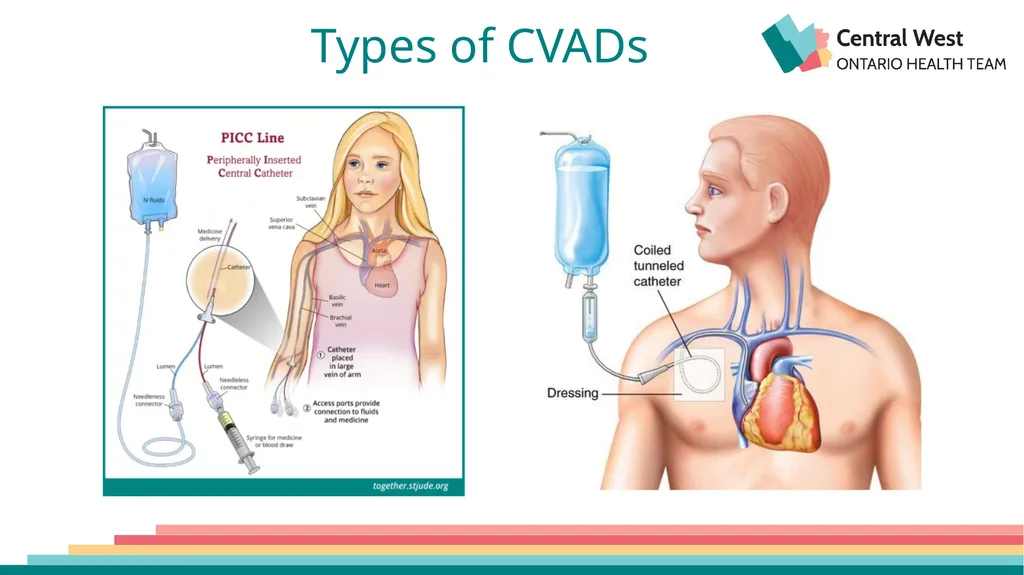
Types of CVADs Peripherally inserted central catheters (PICCs)
Tunneled catheters
Non-tunneled catheters
Implanted vascular access devices (Registered Nurses Association of Ontario [RNAO], 2021)<br>
05
Types of CVADs<br>
06
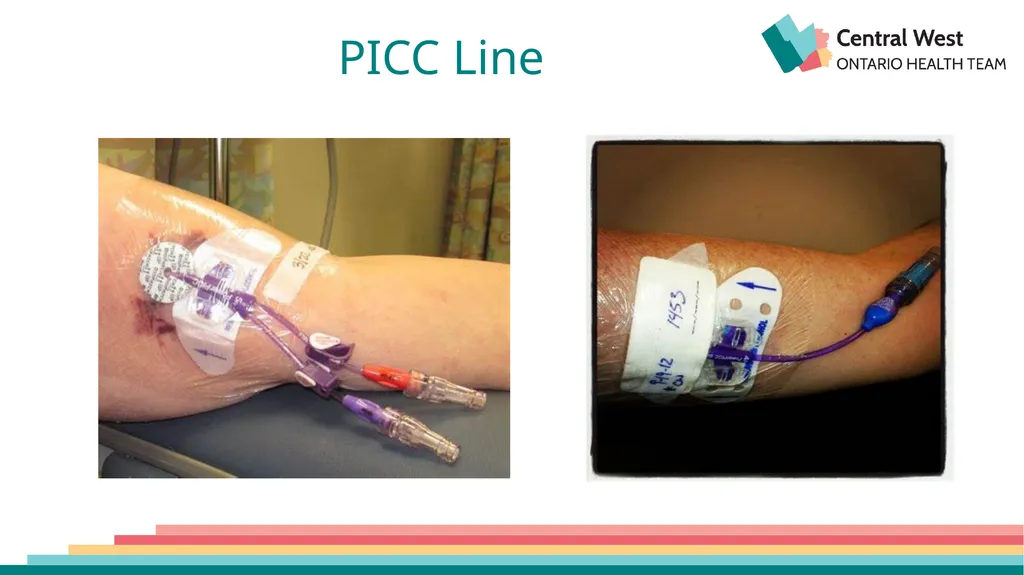
PICC Line<br>
07
Management of PICC Post-insertion Aseptic technique
Purposeful prevention of the transfer of microorganisms from the patient’s body surface to a normally sterile body site, or from one person to another, by keeping the microbe count to an irreducible minimum.
Aseptic techniques Used when performing procedures that expose the patient’s normally sterile sites (i.e. intravascular system) (RNAO, 2021)<br>
08
Management of PICC Line Daily review of line necessity/ early removal
Aseptic Access Technique: Chlorhexidine swabs must be
used whenever accessing a lumen.
A "Scrub the Hub" technique is always utilized. This includes
a vigorous 30 second scrub followed by 30 second dry time prior to accessing the line.<br>
09
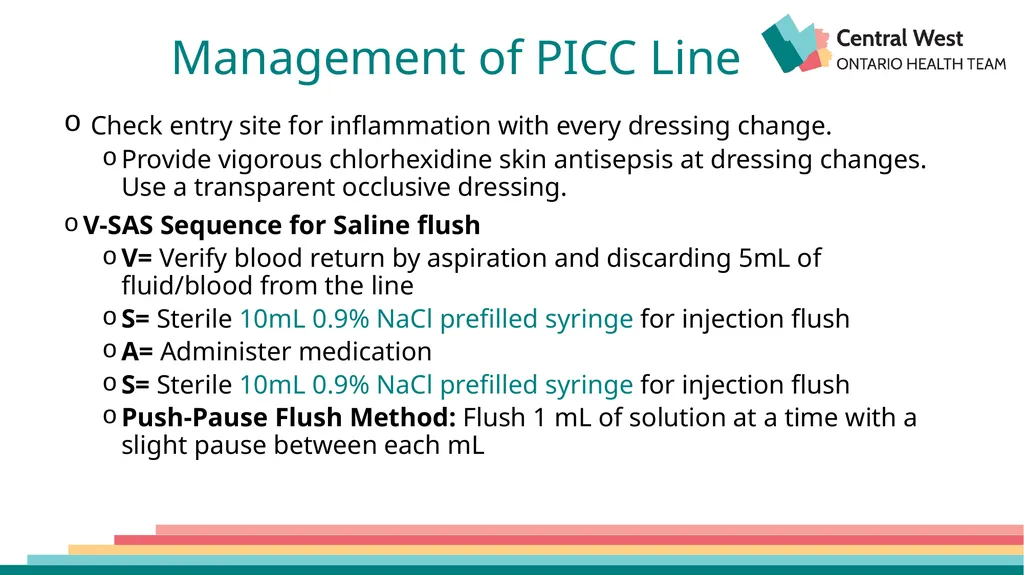
Management of PICC Line Check entry site for inflammation with every dressing change.
Provide vigorous chlorhexidine skin antisepsis at dressing changes. Use a transparent occlusive dressing.
V-SAS Sequence for Saline flush
V= Verify blood return by aspiration and discarding 5mL of fluid/blood from the line
S= Sterile 10mL 0.9% NaCl prefilled syringe for injection flush
A= Administer medication
S= Sterile 10mL 0.9% NaCl prefilled syringe for injection flush
Push-Pause Flush Method: Flush 1 mL of solution at a time with a slight pause between each mL<br>
10
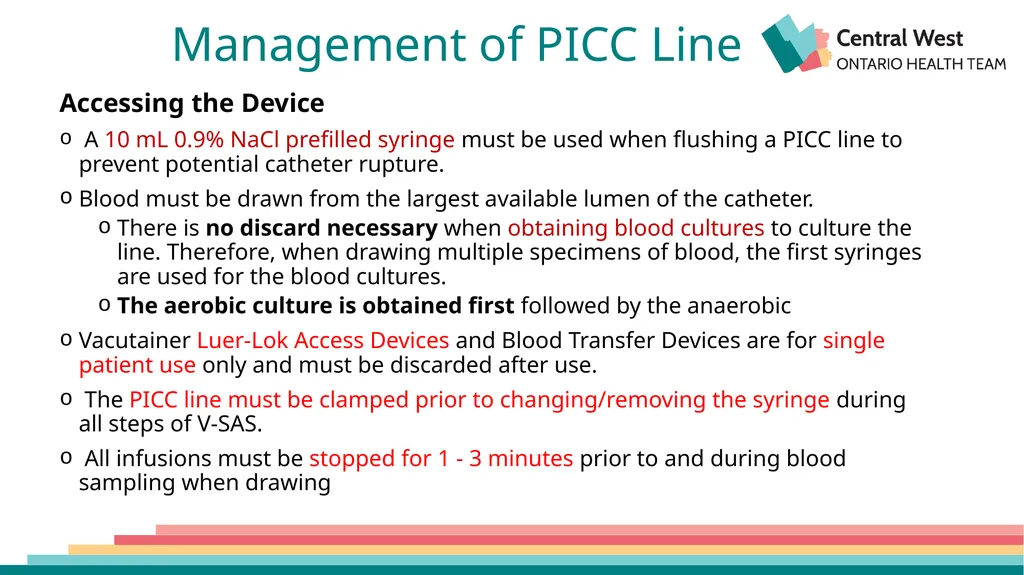
Management of PICC Line Accessing the Device
A 10 mL 0.9% NaCl prefilled syringe must be used when flushing a PICC line to prevent potential catheter rupture.
Blood must be drawn from the largest available lumen of the catheter.
There is no discard necessary when obtaining blood cultures to culture the line. Therefore, when drawing multiple specimens of blood, the first syringes are used for the blood cultures.
The aerobic culture is obtained first followed by the anaerobic
Vacutainer Luer-Lok Access Devices and Blood Transfer Devices are for single patient use only and must be discarded after use.
The PICC line must be clamped prior to changing/removing the syringe during all steps of V-SAS.
All infusions must be stopped for 1 - 3 minutes prior to and during blood sampling when drawing<br>
11
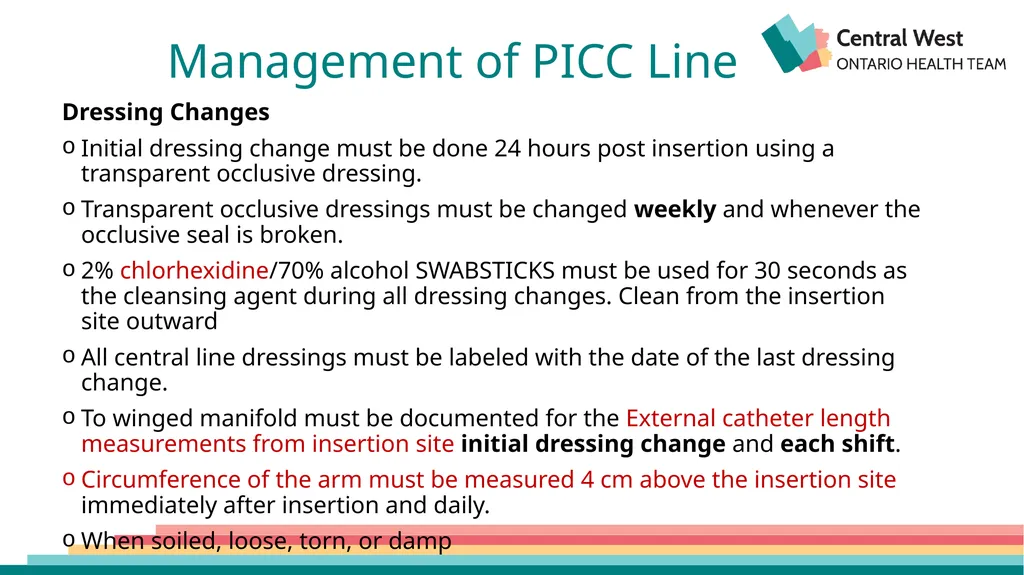
Management of PICC Line Dressing Changes
Initial dressing change must be done 24 hours post insertion using a transparent occlusive dressing.
Transparent occlusive dressings must be changed weekly and whenever the occlusive seal is broken.
2% chlorhexidine/70% alcohol SWABSTICKS must be used for 30 seconds as the cleansing agent during all dressing changes. Clean from the insertion site outward
All central line dressings must be labeled with the date of the last dressing change.
To winged manifold must be documented for the External catheter length measurements from insertion site initial dressing change and each shift.
Circumference of the arm must be measured 4 cm above the insertion site immediately after insertion and daily.
When soiled, loose, torn, or damp<br>
12
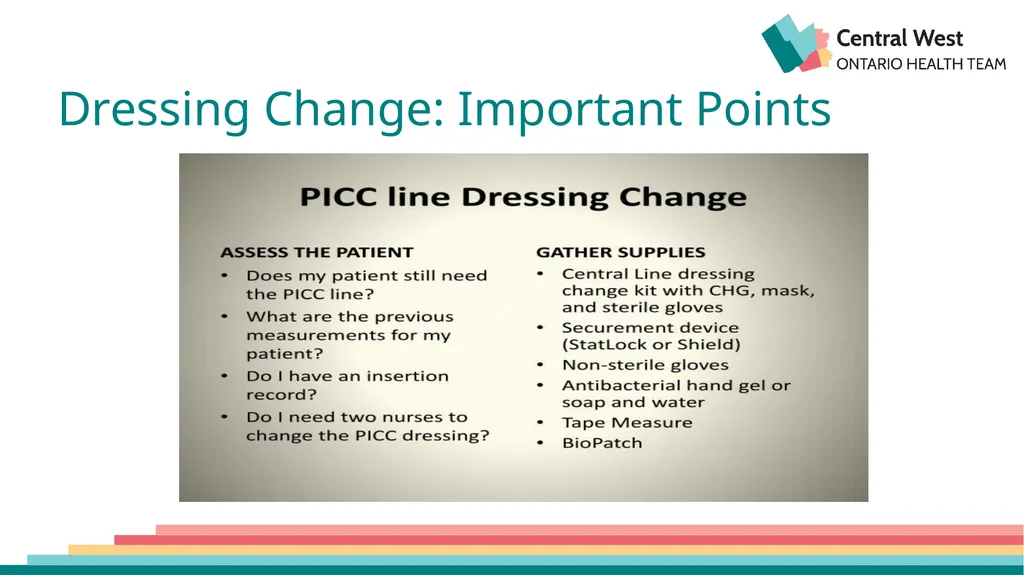
Dressing Change: Important Points<br>
13
PICC Line Dressing Change Video PICC Line Dressing Change – Nurse Skill Demo
PICC Line Dressing Change | Nurse Skill Demo - YouTube<br>
14
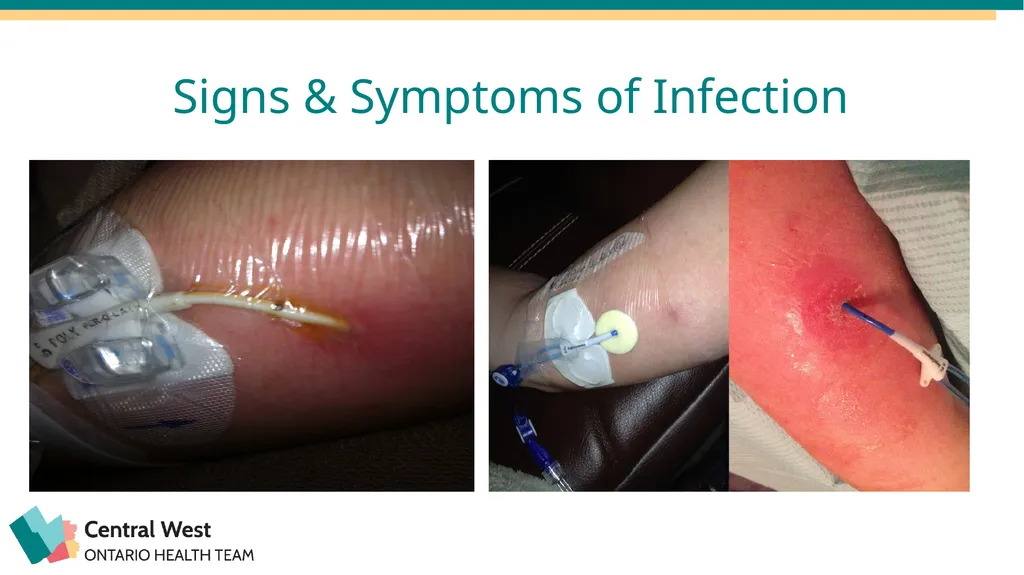
Signs & Symptoms of Infection<br>
15
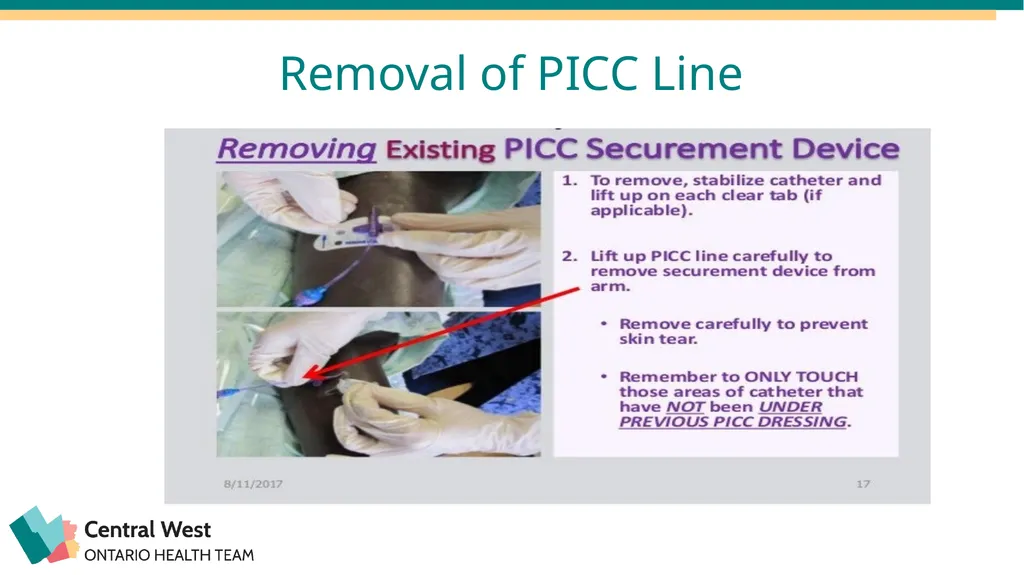
Removal of PICC Line PICC Lines may be removed by RNs only if PICC length of insertion has been documented. If not documented, then physician/NP must remove the PICC Line.
PICC may be removed by nurses who have demonstrated competency in this skill when a physician/NP has ordered the removal of the line
Place patient in Trendelenburg position if tolerated (otherwise flat with pillow removed) and hold breath on exhalation during removal
Ask patient to turn head away from insertion site or place mask on patient
Use aseptic technique
Notify the physician if any difficulties are encountered during the line removal
If breakage of the catheter during removal occurs:
Position patient onto left side and notify the physician immediately
Monitor oxygen saturation, pulse and blood pressure readings every 15 minutes.
Measure and retain catheter until seen by physician<br>
16
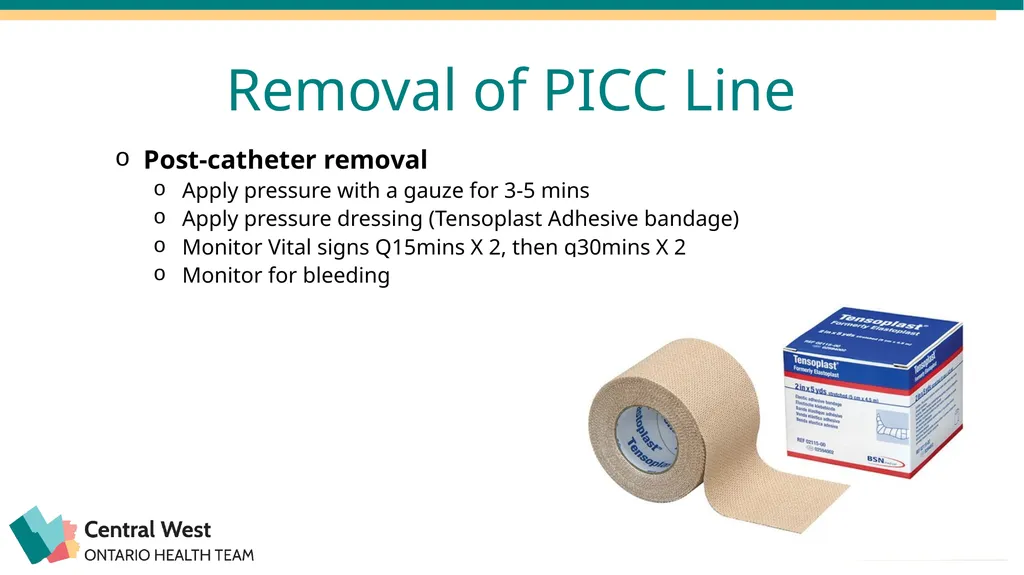
Removal of PICC Line Post-catheter removal
Apply pressure with a gauze for 3-5 mins
Apply pressure dressing (Tensoplast Adhesive bandage)
Monitor Vital signs Q15mins X 2, then q30mins X 2
Monitor for bleeding<br>
17
Removal of PICC Line<br>
18
PICC Line Documentation Mandatory for nurses to provide detailed PICC line documentation in resident record for following:
Line insertion
Line discontinuation (length and intact tip?)
Catheter maintenance procedures Q shift
Bleeding, hematoma, alteration to CSM (colour, sensation and movement for femoral lines) and notify the physician/NP immediately of any of these complications
Medication administration
Adverse occurrences (i.e. breakage)<br>
19
References Registered Nurses Association of Ontario [RNAO] (2021). Best Practice Guideline: Vascular Access. Retrieved on July 26, 2023, from Vascular_Access_FINAL.pdf<br>
20
Thank-You! Zankhana Patel, RN, MSN
Registered Nurse, NP Led Outreach Team (NLOT)
William Osler Health System / Central West Ontario Health Team
Mobile: 437-239-5036 Email: zankhanaben.patel2@williamoslerhs.ca<br>