
Credit Provision by Banks and Nonbanks Discussant:
TF
Published · 19 slides · 0 views

1 / 1
Description
Credit Provision by Banks and Nonbanks Discussant: Janet Gao Georgetown University FDIC Bank Research Conference September 2025 Overview: Nonbank Financial Institutions Credit markets are increasingly divided by banks and nonbank financial
Related Topics
Share
Embed code
Download this presentation From Below
"Credit Provision by Banks and Nonbanks Discussant:" is the property of its rightful owner. Permission is granted to download and print the materials on this website for personal, non-commercial use only, and to display it on your personal computer provided you do not modify the materials and that you retain all copyright notices contained in the materials. By downloading content from our website, you accept the terms of this agreement.
Presentation Transcript
01
Credit Provision by Banks and Nonbanks Discussant: Janet Gao
Georgetown University
FDIC Bank Research Conference
September 2025<br>
Georgetown University
FDIC Bank Research Conference
September 2025<br>
02
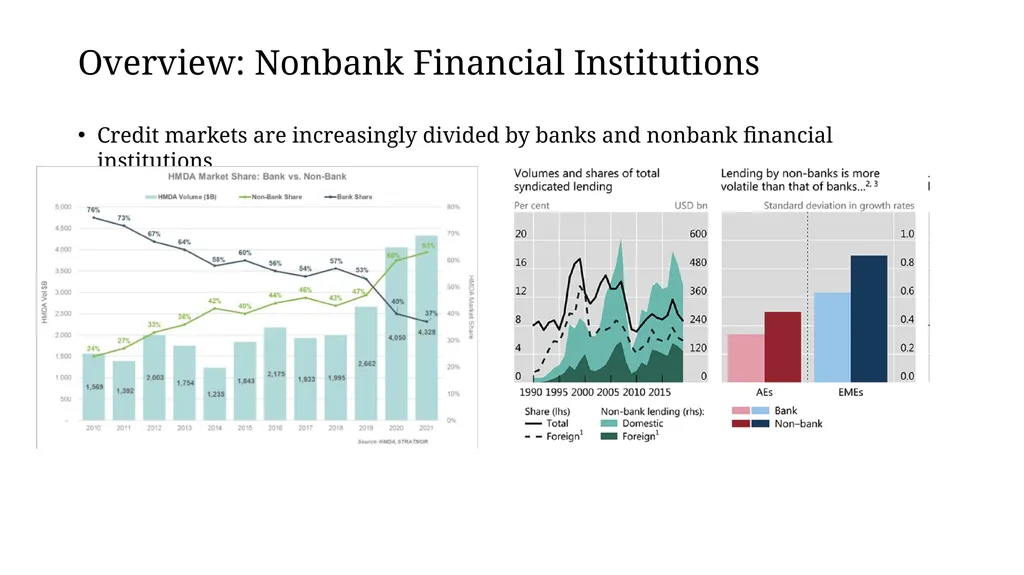
Overview: Nonbank Financial Institutions Credit markets are increasingly divided by banks and nonbank financial institutions<br>
03
Overview: Nonbank Financial Institutions Who are they? Mortgage companies, hedge funds, private equity, business development companies (BDCs), credit unions (sometimes), fintech companies, etc.
Each type of lenders have comparative advantages and (likely) a separation of clientele:
Banks have deposit franchise, can build long-lasting relationships with borrowers, and can collect soft information
Credit unions have community engagement and not-for-profit focus
Direct lenders (such as private equity and BDCs) face less stringent regulations and have strong profit motivation
Fintech lenders possess advanced technologies to screen borrowers, and are less regulated<br>
04
Overview Why do we care (or worry) about nonbanks?
Common concerns:
Nonbanks provide loans to riskier borrowers, contributing to fragility of the financial systems
The presence of nonbanks changes the borrower pool of banks, potentially introducing risks to banking system
Nonbanks face weaker regulation and are not transparent
Nonbanks raise funds from (potentially) short-term investors, and may face greater risks of runs
…
Studies in this session discuss the competition and complementarities between banks and nonbank lenders --- how nonbanks affect the IO-structure of credit markets<br>
05
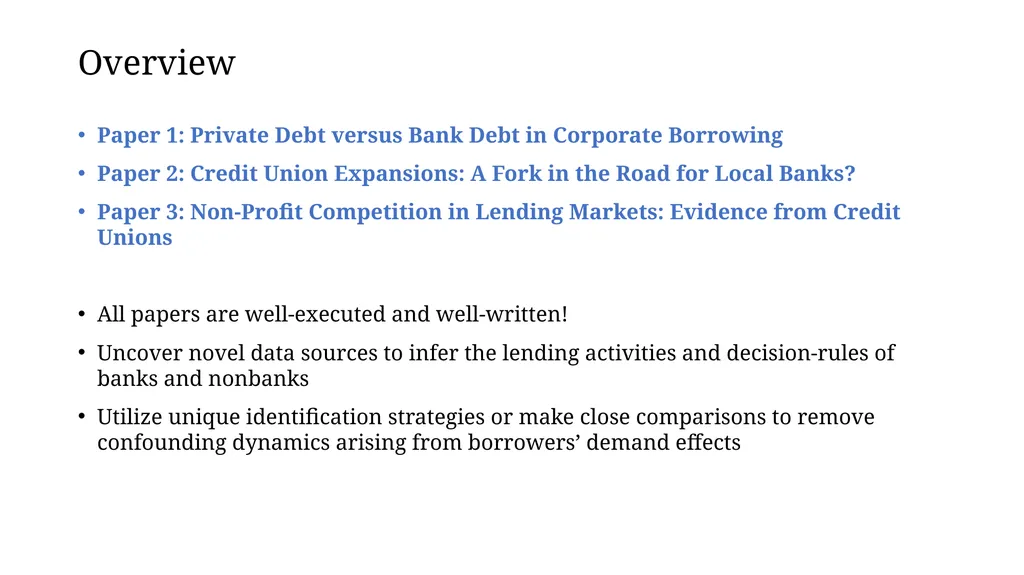
Overview Paper 1: Private Debt versus Bank Debt in Corporate Borrowing
Paper 2: Credit Union Expansions: A Fork in the Road for Local Banks?
Paper 3: Non-Profit Competition in Lending Markets: Evidence from Credit Unions
All papers are well-executed and well-written!
Uncover novel data sources to infer the lending activities and decision-rules of banks and nonbanks
Utilize unique identification strategies or make close comparisons to remove confounding dynamics arising from borrowers’ demand effects<br>
06
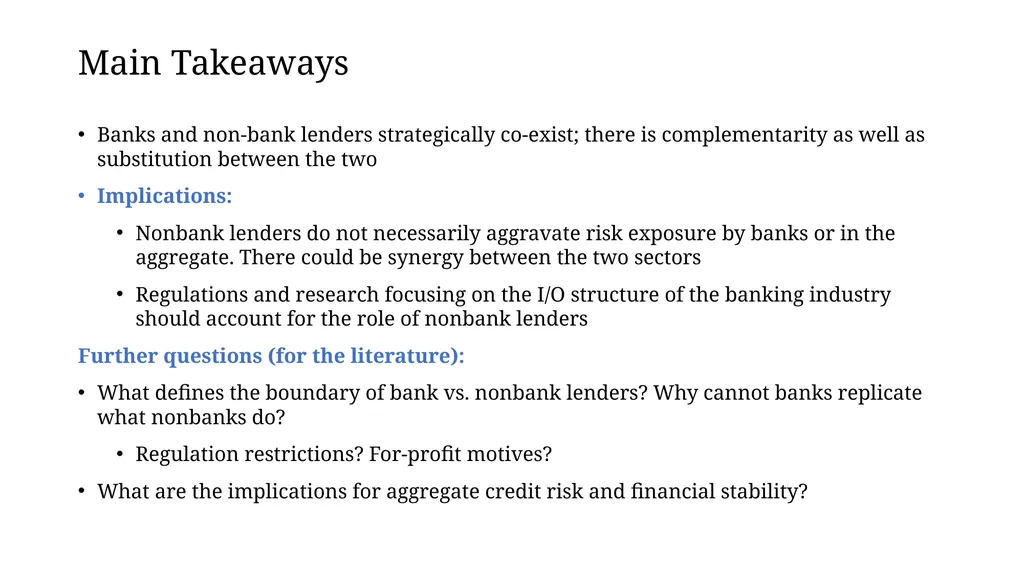
Main Takeaways Banks and non-bank lenders strategically co-exist; there is complementarity as well as substitution between the two
Implications:
Nonbank lenders do not necessarily aggravate risk exposure by banks or in the aggregate. There could be synergy between the two sectors
Regulations and research focusing on the I/O structure of the banking industry should account for the role of nonbank lenders
Further questions (for the literature):
What defines the boundary of bank vs. nonbank lenders? Why cannot banks replicate what nonbanks do?
Regulation restrictions? For-profit motives?
What are the implications for aggregate credit risk and financial stability?<br>
07
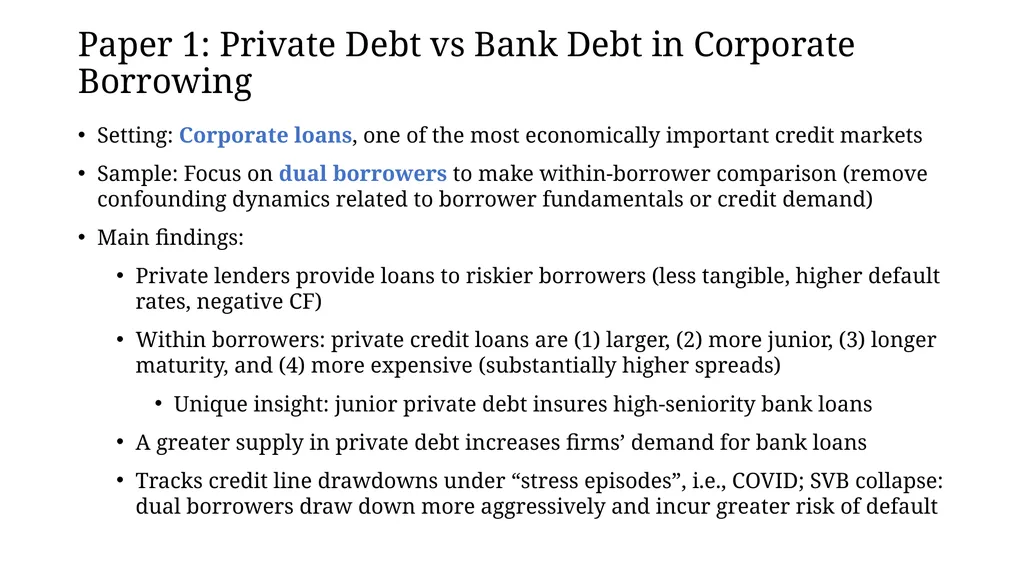
Paper 1: Private Debt vs Bank Debt in Corporate Borrowing Setting: Corporate loans, one of the most economically important credit markets
Sample: Focus on dual borrowers to make within-borrower comparison (remove confounding dynamics related to borrower fundamentals or credit demand)
Main findings:
Private lenders provide loans to riskier borrowers (less tangible, higher default rates, negative CF)
Within borrowers: private credit loans are (1) larger, (2) more junior, (3) longer maturity, and (4) more expensive (substantially higher spreads)
Unique insight: junior private debt insures high-seniority bank loans
A greater supply in private debt increases firms’ demand for bank loans
Tracks credit line drawdowns under “stress episodes”, i.e., COVID; SVB collapse: dual borrowers draw down more aggressively and incur greater risk of default<br>
08
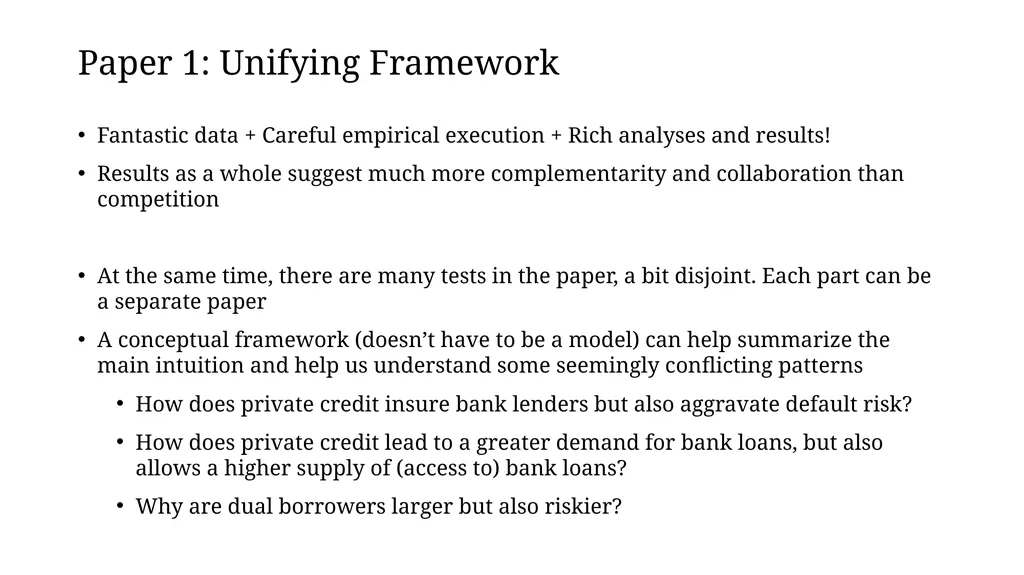
Paper 1: Unifying Framework Fantastic data + Careful empirical execution + Rich analyses and results!
Results as a whole suggest much more complementarity and collaboration than competition
At the same time, there are many tests in the paper, a bit disjoint. Each part can be a separate paper
A conceptual framework (doesn’t have to be a model) can help summarize the main intuition and help us understand some seemingly conflicting patterns
How does private credit insure bank lenders but also aggravate default risk?
How does private credit lead to a greater demand for bank loans, but also allows a higher supply of (access to) bank loans?
Why are dual borrowers larger but also riskier?<br>
09
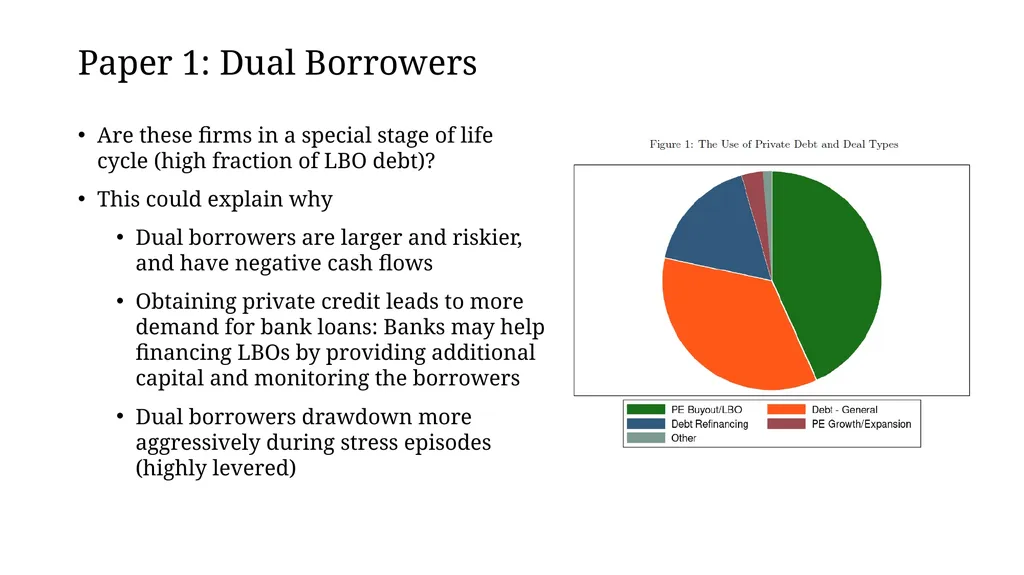
Paper 1: Dual Borrowers Are these firms in a special stage of life cycle (high fraction of LBO debt)?
This could explain why
Dual borrowers are larger and riskier, and have negative cash flows
Obtaining private credit leads to more demand for bank loans: Banks may help financing LBOs by providing additional capital and monitoring the borrowers
Dual borrowers drawdown more aggressively during stress episodes (highly levered)<br>
10
Paper 1: What makes private lenders special? Explanation 1: Private lenders are less regulated (similar to less-regulated banks) Take more risk
Do private lenders behave similarly to banks with non-binding capital requirements?
Explanation 2: Private lenders lack monitoring ability or soft information
Similar to the syndicated loans market: banks provide line of credit and monitoring, nonbank lenders provide term loans (Berlin, Nini, and Yu 2020 JFE).
Suggestion: Verify whether direct lenders rely on banks’ monitoring ability, e.g., does having bank line of credit facilitate firms getting private credit? What types of covenants are specified in dual borrower loans?
Explanation 3: Private lenders provide near-equity debt to facilitate risky transaction
Suggestion: Compare the risk and return of private credit to PE return as a benchmark, or the equity returns of the borrowers<br>
11
Paper 2: Credit Union Expansions: A Fork in the Road for Local Banks? The authors provide a rich set of fact that describes the “equilibrium” IO structure in the financial intermediation industry
Credit unions follow a highly localized business model and are more “generous” than banks, providing higher deposit rates and charging lower loan spreads
Identification strategy: A 2017 change in regulatory requirement that allows federal credit unions (FCUs) to relax their membership requirements and expand membership bases
Main findings:
As credit union expands due to deregulation, large banks retreat but small banks “fight”
Large banks close branches, securitize more loans
Small banks increase deposit rates and reduce lending rates
Importantly, increased credit to low-income borrowers without increasing risk.<br>
12
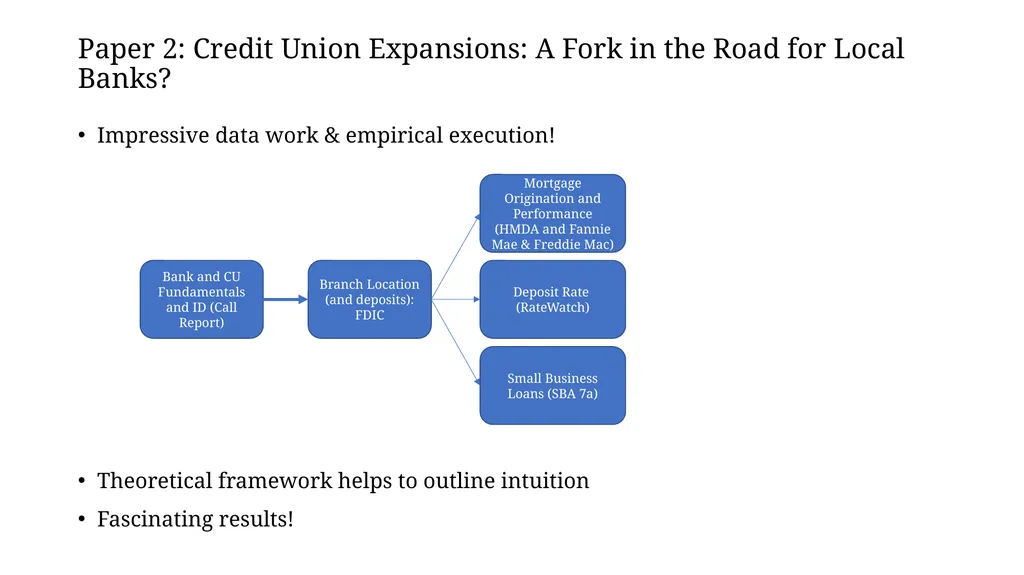
Paper 2: Credit Union Expansions: A Fork in the Road for Local Banks? Impressive data work & empirical execution!
Theoretical framework helps to outline intuition
Fascinating results!<br>
Theoretical framework helps to outline intuition
Fascinating results!<br>
13
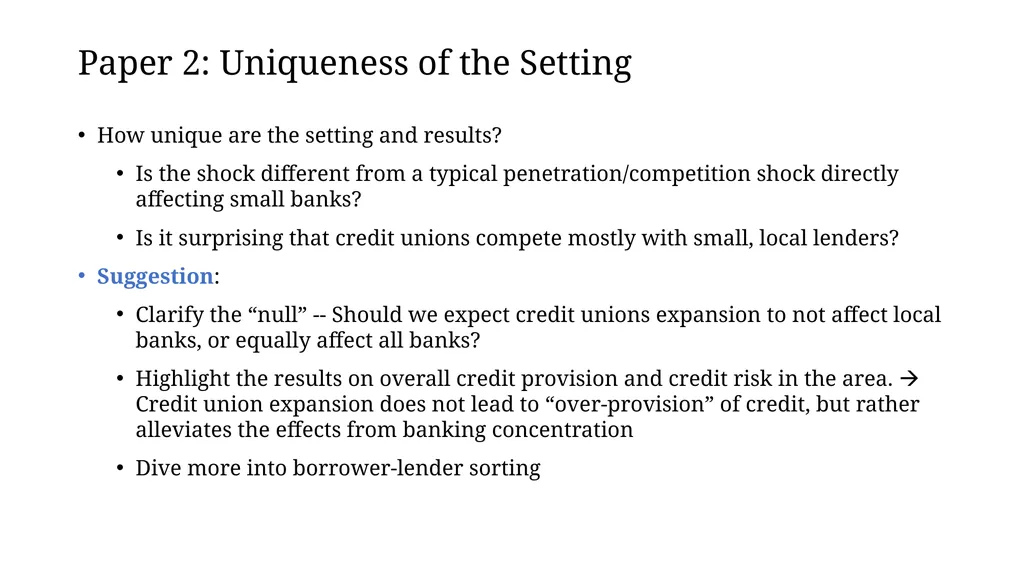
Paper 2: Uniqueness of the Setting How unique are the setting and results?
Is the shock different from a typical penetration/competition shock directly affecting small banks?
Is it surprising that credit unions compete mostly with small, local lenders?
Suggestion:
Clarify the “null” -- Should we expect credit unions expansion to not affect local banks, or equally affect all banks?
Highlight the results on overall credit provision and credit risk in the area. Credit union expansion does not lead to “over-provision” of credit, but rather alleviates the effects from banking concentration
Dive more into borrower-lender sorting<br>
14
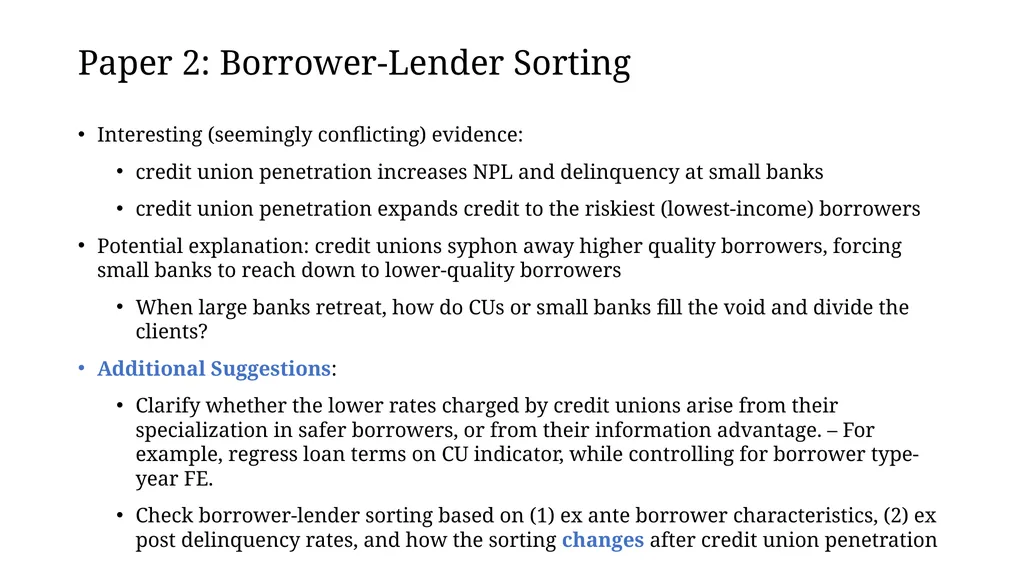
Paper 2: Borrower-Lender Sorting Interesting (seemingly conflicting) evidence:
credit union penetration increases NPL and delinquency at small banks
credit union penetration expands credit to the riskiest (lowest-income) borrowers
Potential explanation: credit unions syphon away higher quality borrowers, forcing small banks to reach down to lower-quality borrowers
When large banks retreat, how do CUs or small banks fill the void and divide the clients?
Additional Suggestions:
Clarify whether the lower rates charged by credit unions arise from their specialization in safer borrowers, or from their information advantage. – For example, regress loan terms on CU indicator, while controlling for borrower type-year FE.
Check borrower-lender sorting based on (1) ex ante borrower characteristics, (2) ex post delinquency rates, and how the sorting changes after credit union penetration<br>
15
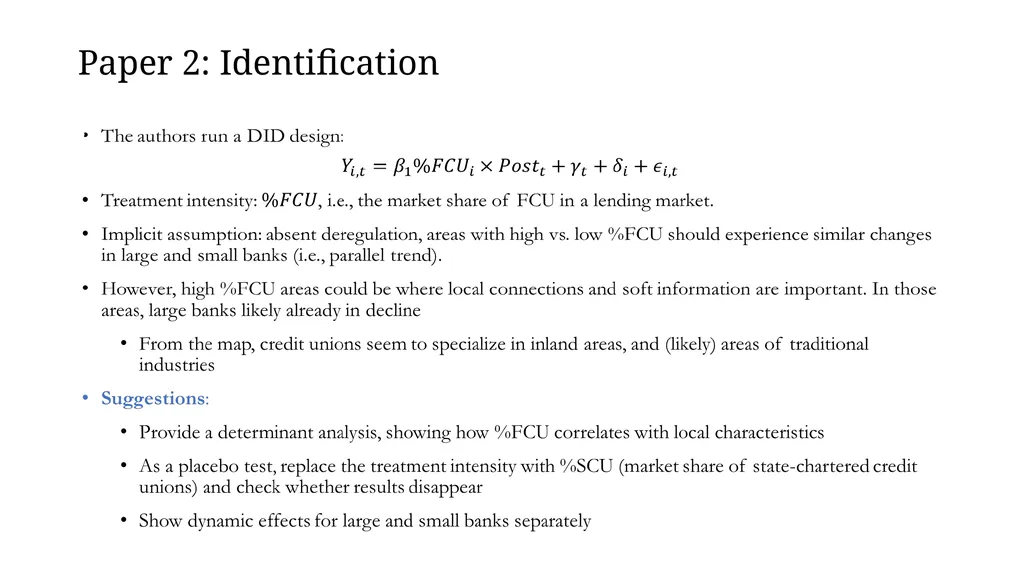
Paper 2: Identification<br>
16
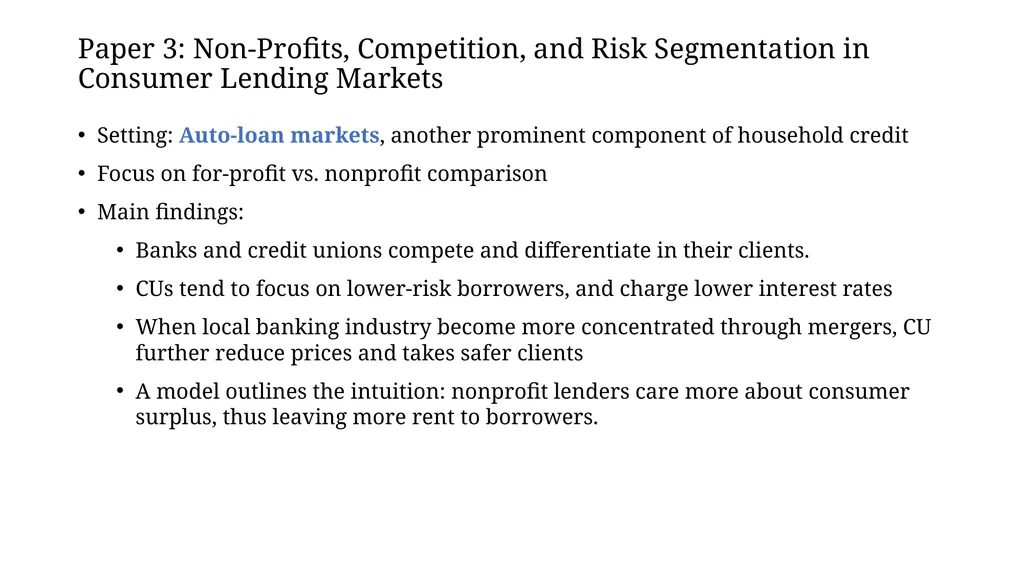
Paper 3: Non-Profits, Competition, and Risk Segmentation in
Consumer Lending Markets Setting: Auto-loan markets, another prominent component of household credit
Focus on for-profit vs. nonprofit comparison
Main findings:
Banks and credit unions compete and differentiate in their clients.
CUs tend to focus on lower-risk borrowers, and charge lower interest rates
When local banking industry become more concentrated through mergers, CU further reduce prices and takes safer clients
A model outlines the intuition: nonprofit lenders care more about consumer surplus, thus leaving more rent to borrowers.<br>
17
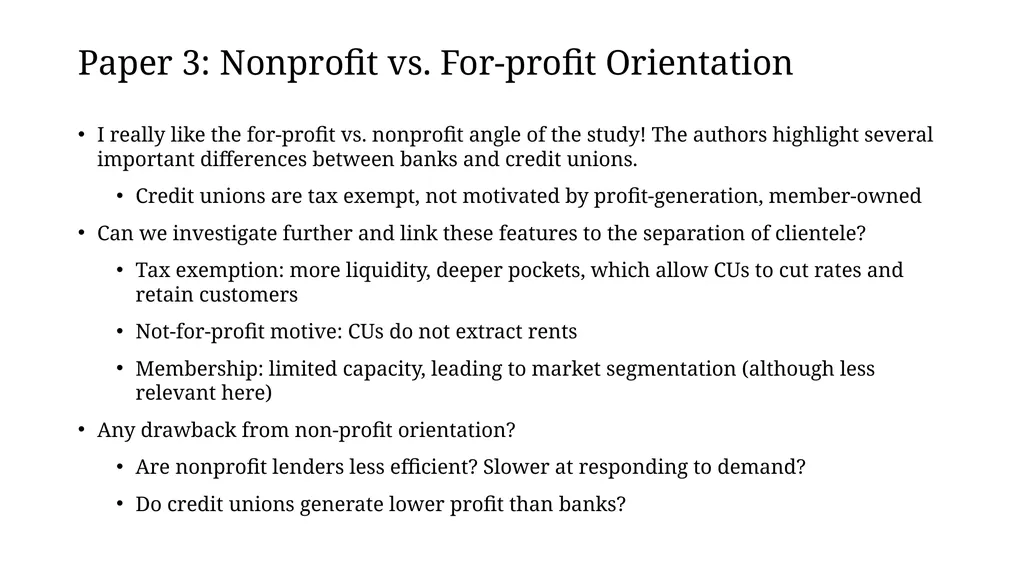
Paper 3: Nonprofit vs. For-profit Orientation I really like the for-profit vs. nonprofit angle of the study! The authors highlight several important differences between banks and credit unions.
Credit unions are tax exempt, not motivated by profit-generation, member-owned
Can we investigate further and link these features to the separation of clientele?
Tax exemption: more liquidity, deeper pockets, which allow CUs to cut rates and retain customers
Not-for-profit motive: CUs do not extract rents
Membership: limited capacity, leading to market segmentation (although less relevant here)
Any drawback from non-profit orientation?
Are nonprofit lenders less efficient? Slower at responding to demand?
Do credit unions generate lower profit than banks?<br>
18
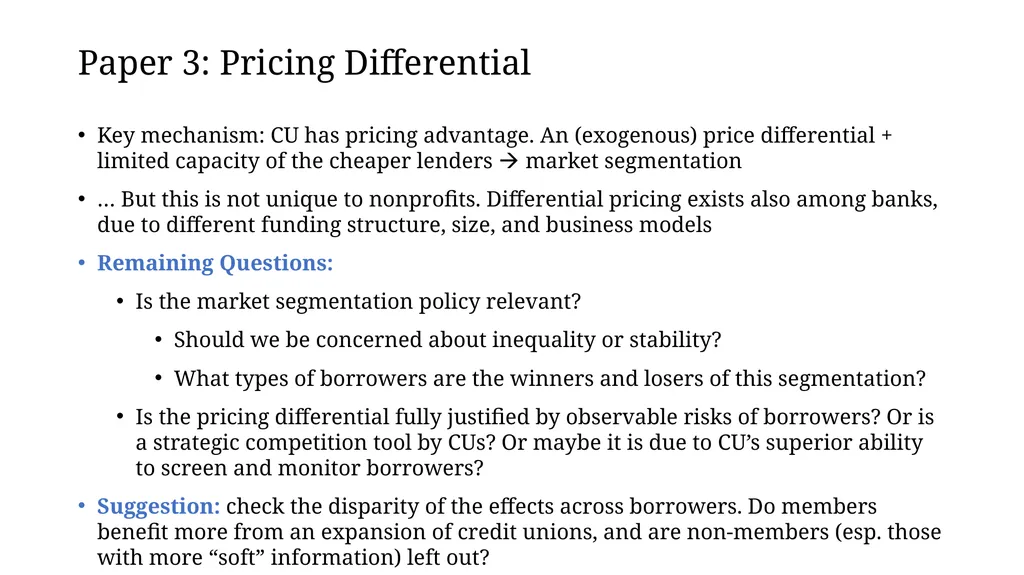
Paper 3: Pricing Differential Key mechanism: CU has pricing advantage. An (exogenous) price differential + limited capacity of the cheaper lenders market segmentation
… But this is not unique to nonprofits. Differential pricing exists also among banks, due to different funding structure, size, and business models
Remaining Questions:
Is the market segmentation policy relevant?
Should we be concerned about inequality or stability?
What types of borrowers are the winners and losers of this segmentation?
Is the pricing differential fully justified by observable risks of borrowers? Or is a strategic competition tool by CUs? Or maybe it is due to CU’s superior ability to screen and monitor borrowers?
Suggestion: check the disparity of the effects across borrowers. Do members benefit more from an expansion of credit unions, and are non-members (esp. those with more “soft” information) left out?<br>
19
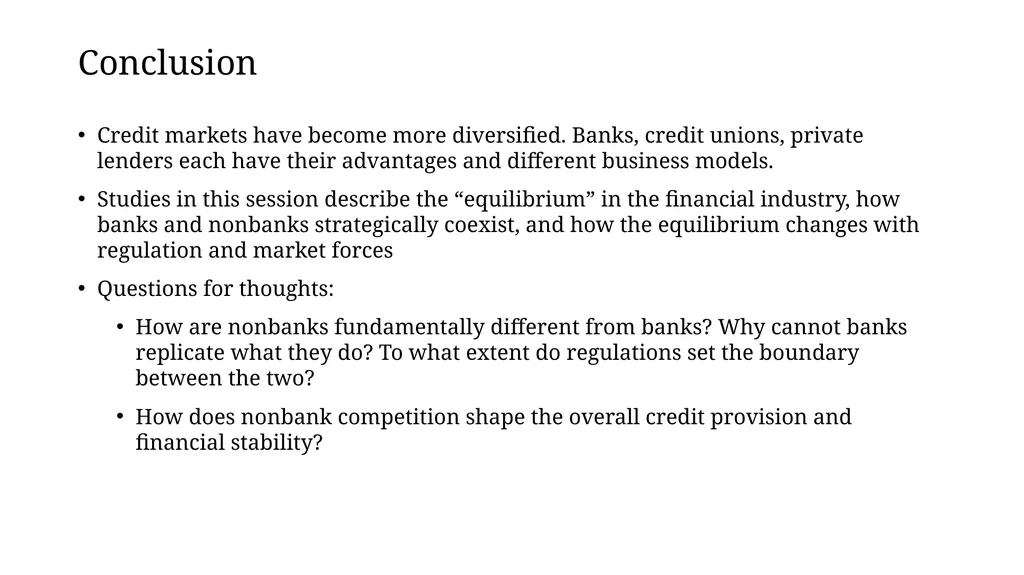
Conclusion Credit markets have become more diversified. Banks, credit unions, private lenders each have their advantages and different business models.
Studies in this session describe the “equilibrium” in the financial industry, how banks and nonbanks strategically coexist, and how the equilibrium changes with regulation and market forces
Questions for thoughts:
How are nonbanks fundamentally different from banks? Why cannot banks replicate what they do? To what extent do regulations set the boundary between the two?
How does nonbank competition shape the overall credit provision and financial stability?<br>