
Cyrus the Great 6. The death of Cyrus Lesson
DJ
Published · 6 slides · 0 views

1 / 1
Description
Cyrus the Great 6. The death of Cyrus Lesson Objectives: L.O. to understand and explain the events surrounding the death of Cyrus the Great. L.O. to practise exam skills. Title: The Death of Cyrus February 27, 2020 RRR: summarise the death
Related Topics
Share
Embed code
Download this presentation From Below
"Cyrus the Great 6. The death of Cyrus Lesson" is the property of its rightful owner. Permission is granted to download and print the materials on this website for personal, non-commercial use only, and to display it on your personal computer provided you do not modify the materials and that you retain all copyright notices contained in the materials. By downloading content from our website, you accept the terms of this agreement.
Presentation Transcript
01
Cyrus the Great
6. The death of Cyrus<br>
6. The death of Cyrus<br>
02
Lesson Objectives:
L.O. to understand and explain the events surrounding the death of Cyrus the Great.
L.O. to practise exam skills. Title: The Death of Cyrus February 27, 2020 RRR: summarise the death of Cyrus into 6 main steps What was the name of Astyages’ capital?
What was the name of the general who turned against Astyages and fought for Cyrus instead?
What was the name of the King of Lydia, defeated by Cyrus in 546BC?
Why did Croesus not expect Cyrus to pursue him back to the Lydian capital, Sardis?
Why did Cyrus decide to spare Croesus?
In what year did Cyrus begin the conquest of Babylon?
How did Cyrus use the Babylonian god, Marduk, as part of his conquest?
Why did the Jews of Babylon think of Cyrus as a ‘messiah’?<br>
03
Cyrus recap quiz Ectabana
Harpagus
Croesus
Wars were almost never fought in the winter.
Cyrus believed that the gods wanted Croesus to be saved.
539
Cyrus put out propaganda that implied he was working on behalf of Marduk, that he had been chosen by the god as a liberator.
Cyrus allowed the Jews to return to the Levant, and rebuilt a temple for them at Jerusalem. How many questions did you get right?
Has this highlighted any areas of our study of Cyrus that your knowledge is weak on??<br>
04
The death of Cyrus – a mystery? After his conquest of Babylon, little is known of the details of many of Cyrus ' conquests. It seems that he campaigned and won new territory in Central Asia, and the Nabonidus Chronicle reports that he died in 530. Herodotus gives a detailed account of is final campaign against a central Asian tribe called the Massagetae, led by their fear some queen Tomyris. He advanced with his forces to the Araxes river, which was the boundary between Persian and Massagetae territory.
Tomyris suggested to Cyrus that the two peoples should leave each other alone, but failing that that they should agree where to fight a battle. She offered to fight him on her side of the river or on his. All of Cyrus advisers recommended fighting on the Persian side of the river, except for Croesus. At this point, Croesus utters words of wisdom which illustrate one of the key themes in Herodotus ' work that human fortune never lasts: Croesus’ thoughts; “Doubtless, if you think that you and your men are immortal, there is little point in my telling you my opinion. But if you recognise the fact that both you and the troops under your command are merely human, then the first thing would tell you is that human life is like a revolving wheel and never allows the same man to continue long in prosperity” THINK. PAIR. SHARE
What can we learn from this passage about the kind of advisor Croesus was?
What do you anticipate Cyrus’ decision will be?<br>
05
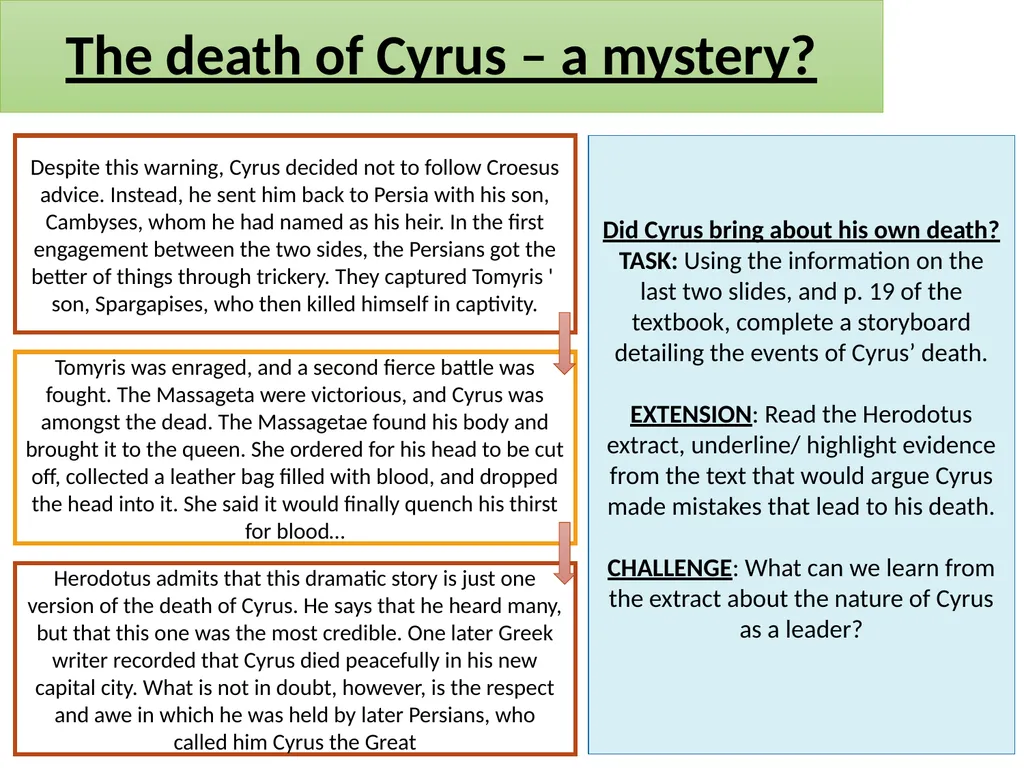
The death of Cyrus – a mystery? Despite this warning, Cyrus decided not to follow Croesus advice. Instead, he sent him back to Persia with his son, Cambyses, whom he had named as his heir. In the first engagement between the two sides, the Persians got the better of things through trickery. They captured Tomyris ' son, Spargapises, who then killed himself in captivity. Tomyris was enraged, and a second fierce battle was fought. The Massageta were victorious, and Cyrus was amongst the dead. The Massagetae found his body and brought it to the queen. She ordered for his head to be cut off, collected a leather bag filled with blood, and dropped the head into it. She said it would finally quench his thirst for blood… Herodotus admits that this dramatic story is just one version of the death of Cyrus. He says that he heard many, but that this one was the most credible. One later Greek writer recorded that Cyrus died peacefully in his new capital city. What is not in doubt, however, is the respect and awe in which he was held by later Persians, who called him Cyrus the Great Did Cyrus bring about his own death?
TASK: Using the information on the last two slides, and p. 19 of the textbook, complete a storyboard detailing the events of Cyrus’ death.
EXTENSION: Read the Herodotus extract, underline/ highlight evidence from the text that would argue Cyrus made mistakes that lead to his death.
CHALLENGE: What can we learn from the extract about the nature of Cyrus as a leader?<br>
06
When Cyrus had conquered this nation, too, he wanted to subject the Massagetae. These are said to be a great and powerful people dwelling towards the east and the sunrise… There were many weighty reasons that impelled and encouraged him to do so: first, his birth, because of which he seemed to be something more than mortal; and next, his victories in his wars: for no nation that Cyrus undertook to attack could escape from him.
Now at this time the Massagetae were ruled by a queen called Tomyris, whose husband was dead. Cyrus sent a message with a pretence of wanting her for his wife, but Tomyris would have none of his advances, well understanding that he wanted not her but the kingdom of the Massagetae… Tomyris sent a herald to him with this message: “O king of the Medes, stop hurrying on what you are hurrying on, for you cannot know whether the completion of this work will be for your advantage. Stop, and be king of your own country”.
… Cyrus called together the leading Persians and laid the matter before them, asking them to advise him which he should do. They all spoke to the same end, urging him to let Tomyris and her army enter his country… So these opinions clashed; and Cyrus set aside his former plan and chose that of Croesus; choosing to fight in her country. Then he entrusted Croesus to the care of his own son Cambyses… he sent the two back to Persia, and he and his army crossed the river.<br>
07
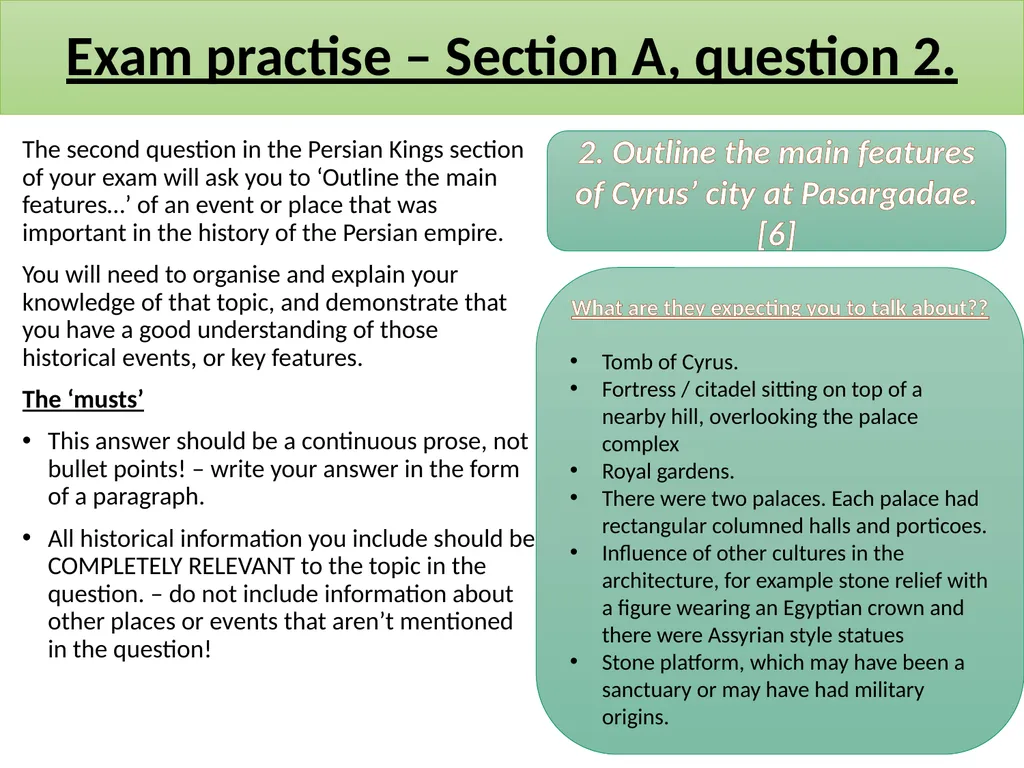
Exam practise – Section A, question 2. The second question in the Persian Kings section of your exam will ask you to ‘Outline the main features…’ of an event or place that was important in the history of the Persian empire.
You will need to organise and explain your knowledge of that topic, and demonstrate that you have a good understanding of those historical events, or key features.
The ‘musts’
This answer should be a continuous prose, not bullet points! – write your answer in the form of a paragraph.
All historical information you include should be COMPLETELY RELEVANT to the topic in the question. – do not include information about other places or events that aren’t mentioned in the question! 2. Outline the main features of Cyrus’ city at Pasargadae. [6] What are they expecting you to talk about??
Tomb of Cyrus.
Fortress / citadel sitting on top of a nearby hill, overlooking the palace complex
Royal gardens.
There were two palaces. Each palace had rectangular columned halls and porticoes.
Influence of other cultures in the architecture, for example stone relief with a figure wearing an Egyptian crown and there were Assyrian style statues
Stone platform, which may have been a sanctuary or may have had military origins.<br>
08
Tomb of Cyrus, shaped like a house with a saddle-roof standing on a stepped plinth
Fortress / citadel sitting on top of a nearby hill, overlooking the palace complex
Royal gardens / park with stone lined water channels intersected the gardens to provide irrigation. In this garden were two pavilions
There were two palaces. Each palace had rectangular columned halls and porticoes. They were stone buildings instead of the then traditional mudbrick and wood. Entry was controlled by a gatehouse
Influence of other cultures in the architecture, for example stone relief with a figure wearing an Egyptian crown and there were Assyrian style statues
Stone platform, which may have been a sanctuary or may have had military origins.<br>