
DATE: 27 AUGUST 2024 FOOT AND MOUTH DISEASE IN
YM
Published · 23 slides · 0 views

1 / 1

Description
DATE: 27 AUGUST 2024 FOOT AND MOUTH DISEASE IN SOUTH AFRICA AND FINDINGS OF MINISTERIAL TASK TEAM ON BIOSECURITY PRESENTATION TO THE PORTFOLIO COMMITTEE ON AGRICULTURE FOOT AND MOUTH DISEASE Presentation outline Update on foot-and-mouth
Related Topics
Share
Embed code
Download this presentation From Below
"DATE: 27 AUGUST 2024 FOOT AND MOUTH DISEASE IN" is the property of its rightful owner. Permission is granted to download and print the materials on this website for personal, non-commercial use only, and to display it on your personal computer provided you do not modify the materials and that you retain all copyright notices contained in the materials. By downloading content from our website, you accept the terms of this agreement.
Presentation Transcript
01
DATE: 27 AUGUST 2024 FOOT AND MOUTH DISEASE IN SOUTH AFRICA AND FINDINGS OF MINISTERIAL TASK TEAM ON BIOSECURITY
PRESENTATION TO THE PORTFOLIO COMMITTEE ON AGRICULTURE<br>
PRESENTATION TO THE PORTFOLIO COMMITTEE ON AGRICULTURE<br>
02
FOOT AND MOUTH DISEASE
Presentation outline Update on foot-and-mouth disease (FMD) situation
Intervention measures implemented for the control and management of disease outbreaks.
Road-map towards FMD Freedom
Biosecurity task team recommendations
Conclusions 2<br>
Presentation outline Update on foot-and-mouth disease (FMD) situation
Intervention measures implemented for the control and management of disease outbreaks.
Road-map towards FMD Freedom
Biosecurity task team recommendations
Conclusions 2<br>
03
FOOT AND MOUTH DISEASE
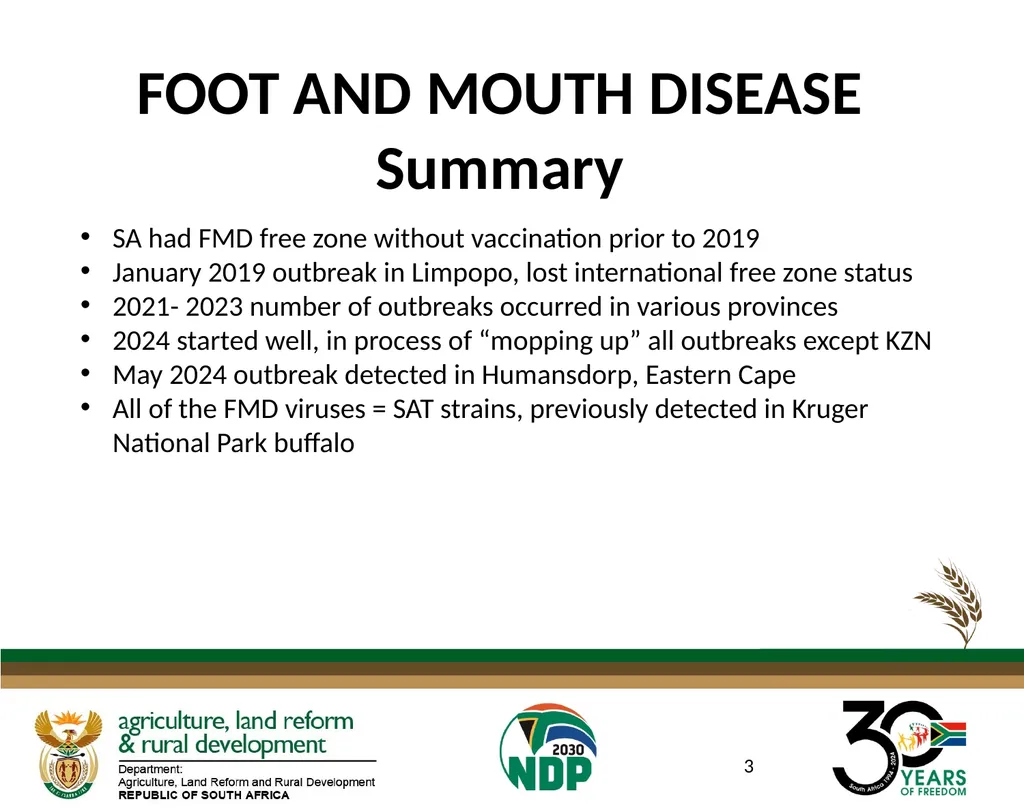
Summary SA had FMD free zone without vaccination prior to 2019
January 2019 outbreak in Limpopo, lost international free zone status
2021- 2023 number of outbreaks occurred in various provinces
2024 started well, in process of “mopping up” all outbreaks except KZN
May 2024 outbreak detected in Humansdorp, Eastern Cape
All of the FMD viruses = SAT strains, previously detected in Kruger National Park buffalo 3<br>
04
FOOT AND MOUTH DISEASE
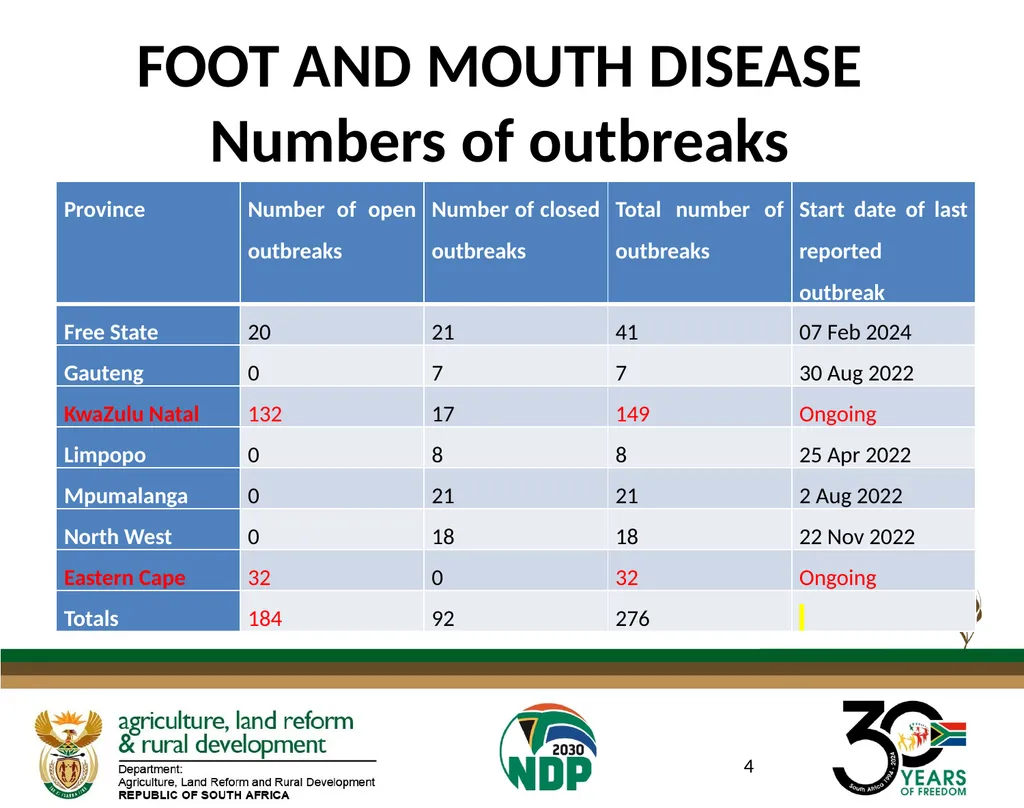
Numbers of outbreaks 4<br>
Numbers of outbreaks 4<br>
05
FOOT AND MOUTH DISEASE
KZN Outbreak Total of 149 outbreaks since May 2021, of which 17 were resolved
132 still open
127 communal diptanks, few small scale farmers
5 game reserves where buffalo became infected including Hluhluwe Umfolozi Park
SAT2 FMD virus strain previously seen in buffalo in the north of the KNP
INTERVENTION MEASURES APPLIED IN KZN
Control measures applied: quarantine, movement control, vaccination
Disease Management Area declared to assist with applying control measures in communal set-up 5<br>
06
FOOT AND MOUTH DISEASE
KZN Outbreak Challenges Challenges with controlling the outbreak in KZN:
Implementation of effective movement control and biosecurity
effectively vaccinations (not reaching 60% vaccine coverage)
Lack of functional individual animal identification and traceability system (lack of agreement in implementing a functional system)
Restricted market access for livestock owners in the area, decreasing compliance with control measures
Limited resources to enable effective and efficient control (human, financial, assets and law enforcement)
Infected buffalo in 5 game reserves are a constant risk of virus spread to cattle in neighbouring diptanks 6<br>
07
FOOT AND MOUTH DISEASE
Eastern Cape Outbreaks Two separate events started 1 May 2024
One outbreak event mainly affecting dairy farms in Humansdorp area
Second outbreak event linked to an export feedlot in East London
Involvement of 2 different FMD strains, both detected in the feedlot
SAT2 strain linked to KZN Event = only in feedlot
SAT3 strain linked to multiple province event starting in 2021 in NWP
Very severe effects on dairy industry
Animals develop severe clinical signs and production losses
High number of mastitis cases due to infectious processes
Milk from affected farms can be sold to the public, but must be DOUBLE pasteurized or UHT processed
Milk from affected farms cannot be used in milk or dairy products to be exported thus affecting large SADC market 7<br>
08
FOOT AND MOUTH DISEASE
Eastern Cape Outbreaks Humansdorp outbreaks
Mainly Dairy Farms
Initial control measures: quarantine, movement control, vaccination of infected farms to reduce viral load and clinical effects of the disease
Disease continued to spread despite biosecurity measures
Implemented voluntary pre-emptive vaccination of farms on high risk farms in affected area not showing signs or confirmed FMD infection
36 farmers requested and were approved for preventative vaccination of uninfected herds upon agreement that their farms would be controlled as if infected.
Because of the far-reaching consequences only farms at high risk are allowed to vaccinate if they are uninfected. 8<br>
09
FOOT AND MOUTH DISEASE
Eastern Cape Outbreaks Humansdorp outbreaks (continued)
Disease still continued to spread and some vaccinated farms became infected after vaccination
Movement control is difficult between affected farms due to nature of the dairy industry and lack of adherence to biosecurity requirements
Disease Management Area (DMA) gazetted on 19 July 2024
Wider movement restrictions in Kouga Kou-kamma municipalities
Limited movement allowed out of DMA
Some movement allowed into and within the DMA
Current status - situation stabilizing
31 farms confirmed positive and 1 suspect
Last clinical signs seen more than 30 days ago 9<br>
10
FOOT AND MOUTH DISEASE
Eastern Cape Outbreaks East London outbreaks:
Export feedlot with beef cattle
Animals tested positive for FMD during preparation for export (Mauritius)
No clinical signs were seen, but both SAT2 and SAT3 virus identified
Same SAT2 virus caused KZN outbreak. Investigating how the virus got from KZN to Eastern Cape.
Same SAT3 virus caused outbreaks in North West, Free State, Gauteng and Mpumalanga in 2021.
Tracing back to farms of origin to get to the source in progress but difficult
Possible origin farms/feedlots/auctions in North West, Free State and Northern Cape : tests being conducted, one suspect feedlot in North West subjected to further follow-up, but no active virus was found. 10<br>
11
Intervention measures implemented FOOT AND MOUTH DISEASE
Eastern Cape Outbreaks Normal disease control (quarantine, surveillance, movement control)
Vaccination of positive farms
Pre-emptive vaccination of negative farms in high-risk area
Declaration of Disease Management Area
Establishment of three Task Teams with industry participation:
Technical Task Team
Trade Task Team
Communications Task Team
Task Teams meet every 2 weeks
Establishment of Rapid Response Team with industry participation
Rapid Response Team meets on a weekly basis 11<br>
12
Concerning factors FOOT AND MOUTH DISEASE
Eastern Cape Outbreaks Two different virus strains identified in the Eastern Cape:
Humansdorp event virus SAT3
East London event virus SAT2 and SAT3
Truck movements most likely link between two events in Eastern Cape
Very different disease presentation in Humansdorp (severe clinical signs on dairy farms) versus East London (no clinical signs in feedlot animals). Lack of clinical signs makes early detection very difficult.
Lack of unique animal identification and traceability makes trace-back activities slow and inaccurate. 12<br>
13
FOOT AND MOUTH DISEASE
General concerns Behaviour of the disease making detection and control more difficult
Value chains and movement of animals, especially “super-spreader” events like auctions and speculators
Lack of a functional individual animal identification and traceability system
Lack of markets for farmers in the FMD controlled zones, increasing occurrence of illegal movements from controlled areas to free zone
General unwillingness of farmers to abide by preventative biosecurity requirements and quarantine conditions and movement restrictions
Limited laboratory capacity at the ARC-OVR for FMD diagnostics that require specific strict biosecurity measures at the facility and in the surrounding area
Ongoing outbreaks delay future date when SA could potentially regain FMD free zone status with WOAH 13<br>
14
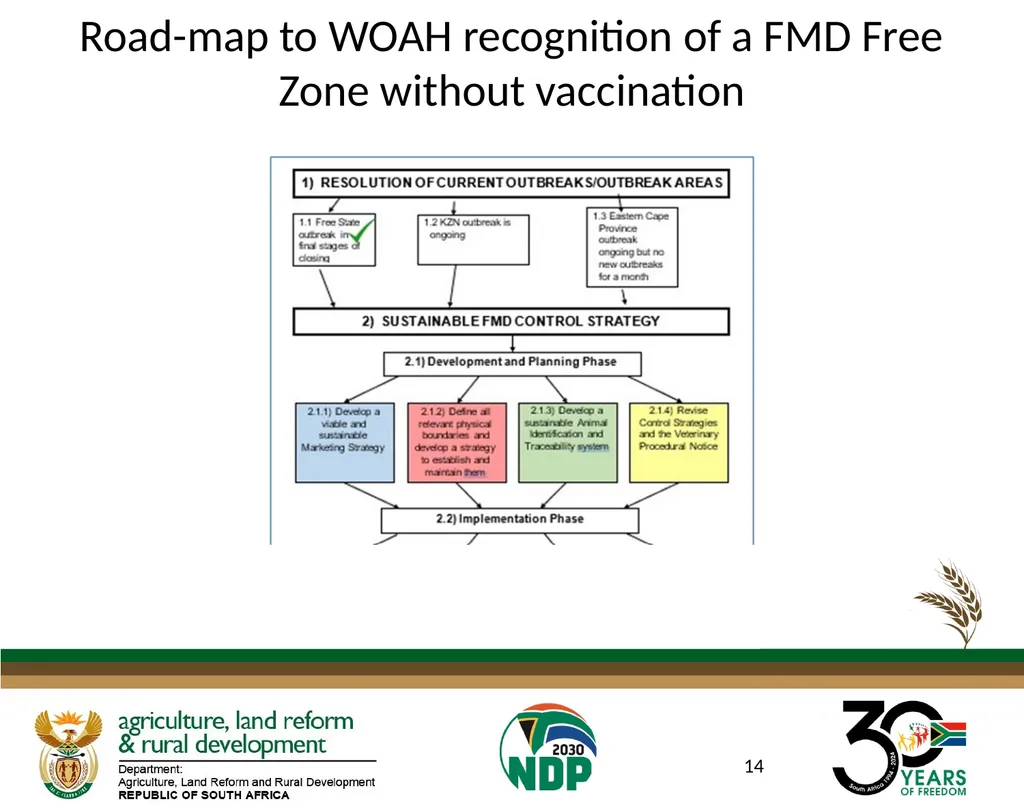
Road-map to WOAH recognition of a FMD Free Zone without vaccination 14<br>
15
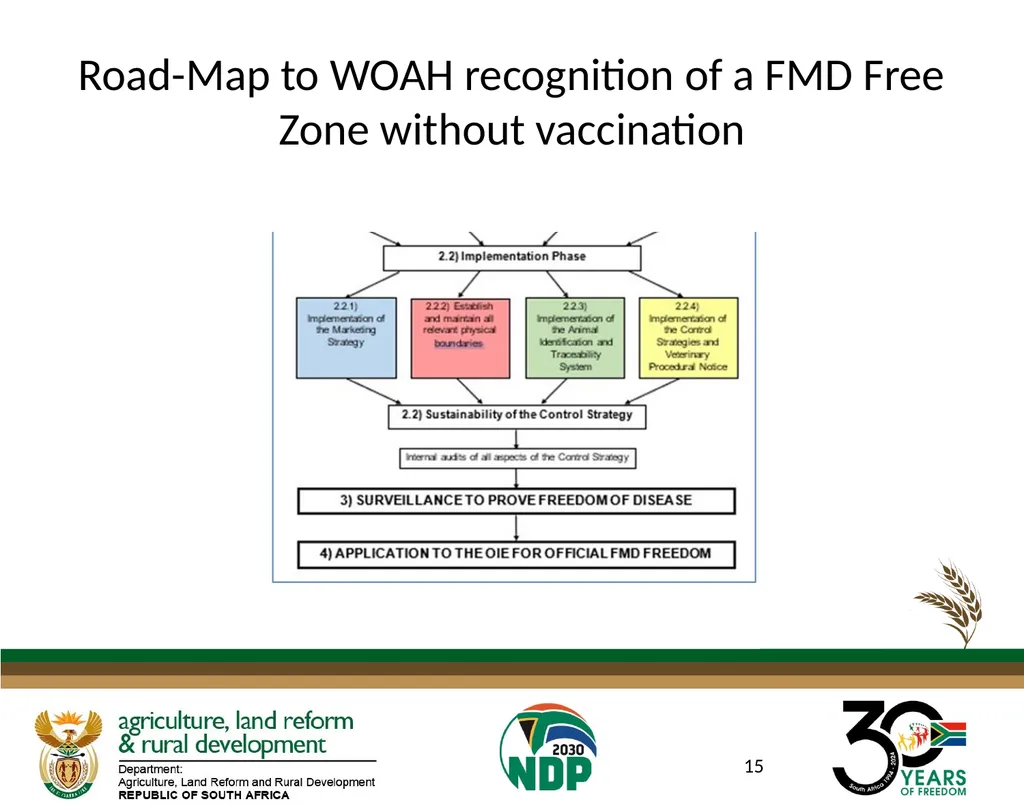
Road-Map to WOAH recognition of a FMD Free Zone without vaccination 15<br>
16
MINISTERIAL TASK TEAM
Purpose for establishment of Task team and core mandate Minister appointed a Task Team of experts on Animal Health Biosecurity to explore possible causes, spread of recent and ongoing devastating animal disease outbreaks
Assess challenges for managing or eliminating outbreaks of foot and mouth disease (FMD), African swine fever (ASF) and avian influenza (HPAI).
Evaluate current biosecurity measures in South Africa to reduce risks of introduction/s, establishment and spread of animal diseases.
To advise the Minister on possible measures for implementation to ensure the implementation of effective, efficient and sustainable biosecurity systems.
SUMMERY OF KEY AREAS OF THE TASK TEAM
All factors were considered during the investigation by the Task Team, these could be summarised into the following key areas:
Epidemiological evolution of current animal disease challenges
Ability of country to timeously diagnose the diseases; and,
Preparedness of country to implement effective and scientifically justifiable biosecurity measures
Common thread from stakeholder engagements is that:
Manifestation of inability of government, associated institutions and private role players to implement critical intervention for animal biosecurity
Veterinary services/system and animal biosecurity system has cracks
Current format and design poses a major threat to future of inclusive growth in livestock industry 16<br>
17
Systemic (Institutional) Challenges identified by the task team Manifested through some of the following:
Non-compliance by animal owners/custodians to implement biosecurity measures to prevent introduction and management of disease
Not enough disease surveillance and no early warning system
Cracks in coordination between national and provincial governments with slow response to emergency situations
Poor maintenance of red line and border fences, infrastructure and research facilities
Non-availability of vaccines for critical animal diseases
insufficient risk analysis to guide decision-making in DALRRD for predictions, data analyses, containment etc. 17<br>
18
The economic significance of a well functioning Animal Biosecurity System (Identified by the task team) Most of the interventions require at least:
better management, reinstatement of the chain of command, better coordination, some restructuring of the various departments.
Investments in red line fences & effective management
Investments international border fences & effective management
Investments in laboratory equipment & skills development
Accelerate vaccine production – ARC and OBP
Investment in risk analysis and early warning system
It is estimated that all these interventions could boost animal production by an estimated R20 billion per annum. 18<br>
19
KEY OBSERVATIONS ( as identified by the task team) OBP and ARC – OVR , lack of capacity and providing timely and accurate diagnostic tests , Lack of movement control as the major cause of undetected/uncontrolled disease spread ,Change in epidemiology of ASF & FMD, Spread into naïve areas (peri-urban and suburban farming) - ruralisation of the urban environment, Total absence of biosecurity sensitivity and taking of responsibility
Poor/lacking law enforcement by local authorities – no harmonisation/communication between national/provincial/local authorities on animal health issues, Auctions acting as super spread foci of disease – e.g. Limpopo FMD outbreaks and ASF
Poor allocation of financial resources
Poor human resource management policy
Poor implementation of the veterinary strategic plan 2016 and implementation of recommendations from international audits and inspections conducted by the WOAH, EU ETC 19<br>
20
TENTATIVE RECOMMENDATIONS (by task team) SHORT TERM
Investigate alternative possibilities to expedite FMD vaccine production
Accelerate implementation of the National Animal Identification & Traceability System to be implemented in a national movement control policy for disease control purposes
Establish a risk analysis unit within DALRRD to provide support for support on animal health disease decision-making
Re-evaluate and expedite the process for providing more user-friendly approvals for section 20 applications – transparent panel of reviewers and decision making.
Consider the establishment of a Ministerial Advisory Council (MAC) for the Minister of Agriculture – similar to COVID-19 MAC 20<br>
21
TENTATIVE RECOMMENDATIONS (by task team) MEDIUM to LONG TERM
Review possibility per Section 44 (2) of Constitution to address the Constitutional Concurrency issues – in terms of Schedules 5 and 6
Review Veterinary Organisational structures at national and provincial level in collaboration with MEC’s to effect alignment, chain of command and resource allocation
Review and examine mechanism for contracting experts (scientists, engineers, veterinarians etc for generating evidence based scientific studies) in private sector to provide services to government or on behalf of government on short term – disease outbreaks or towards policy development etc. 21<br>
22
IMPLEMENTION OF THE RECOMMENDATIONS OF THE TASK TEAM Consideration of the implications of non- implementation of the Animal Health Act 7 of 2002 to address Constitutional Concurrency issues – in terms of Schedules 5 and 6
Provinces are working collaboratively with the National Department in terms of animal disease control
Working hand in hand with the CSIR to design systems that may enable the country to implement track and trace in LITS, Buy in is an important consideration Fairly advanced at this time
Working with the Universities and ARC to improve in terms of risk evaluations
Improving on increasing capacity to handle animal diseases in Provinces 22<br>
23
End<br>