
DEPARTMENT OF DEFENCE LOGISTICS DIVISION BRIEFING
TD
Published · 34 slides · 0 views

1 / 1
Description
DEPARTMENT OF DEFENCE LOGISTICS DIVISION BRIEFING ON FLEET MANAGEMENT POLICY AND PROCUREMENT OF ESSENTIAL GOODS IN THE DEPARTMENT OF DEFENCE RESTRICTED 2 INTRODUCTION The old saying that goes Soldiers March on their Stomach is true in
Related Topics
Share
Embed code
Download this presentation From Below
"DEPARTMENT OF DEFENCE LOGISTICS DIVISION BRIEFING" is the property of its rightful owner. Permission is granted to download and print the materials on this website for personal, non-commercial use only, and to display it on your personal computer provided you do not modify the materials and that you retain all copyright notices contained in the materials. By downloading content from our website, you accept the terms of this agreement.
Presentation Transcript
01
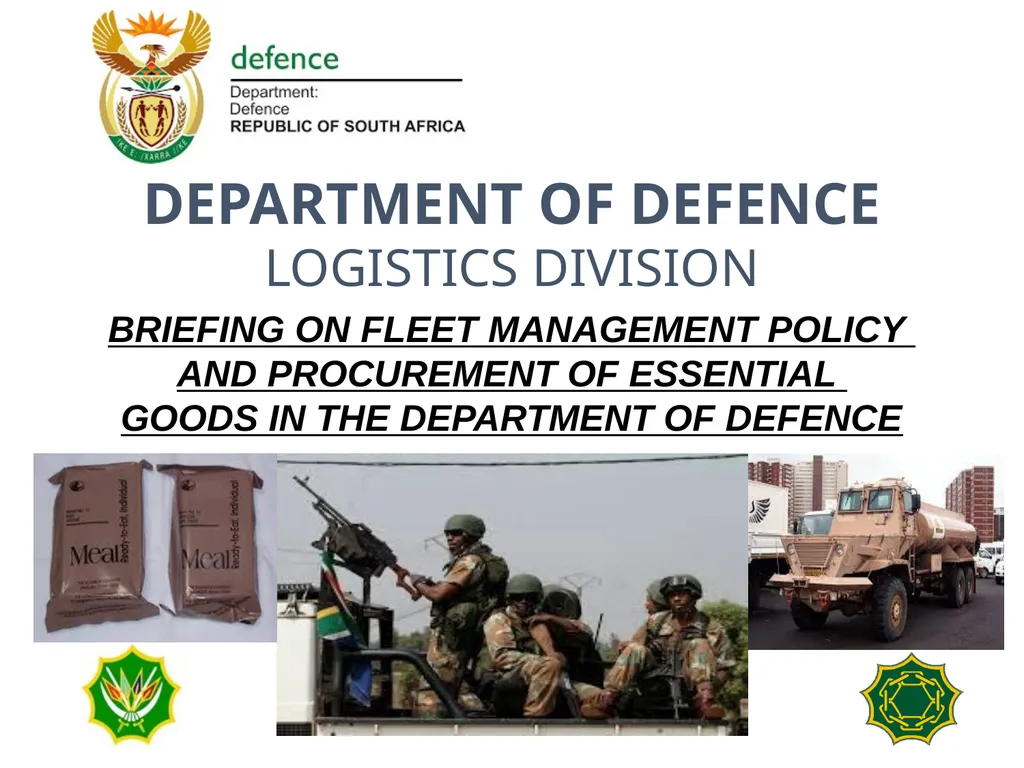
DEPARTMENT OF DEFENCE
LOGISTICS DIVISION BRIEFING ON FLEET MANAGEMENT POLICY
AND PROCUREMENT OF ESSENTIAL
GOODS IN THE DEPARTMENT OF DEFENCE<br>
LOGISTICS DIVISION BRIEFING ON FLEET MANAGEMENT POLICY
AND PROCUREMENT OF ESSENTIAL
GOODS IN THE DEPARTMENT OF DEFENCE<br>
02
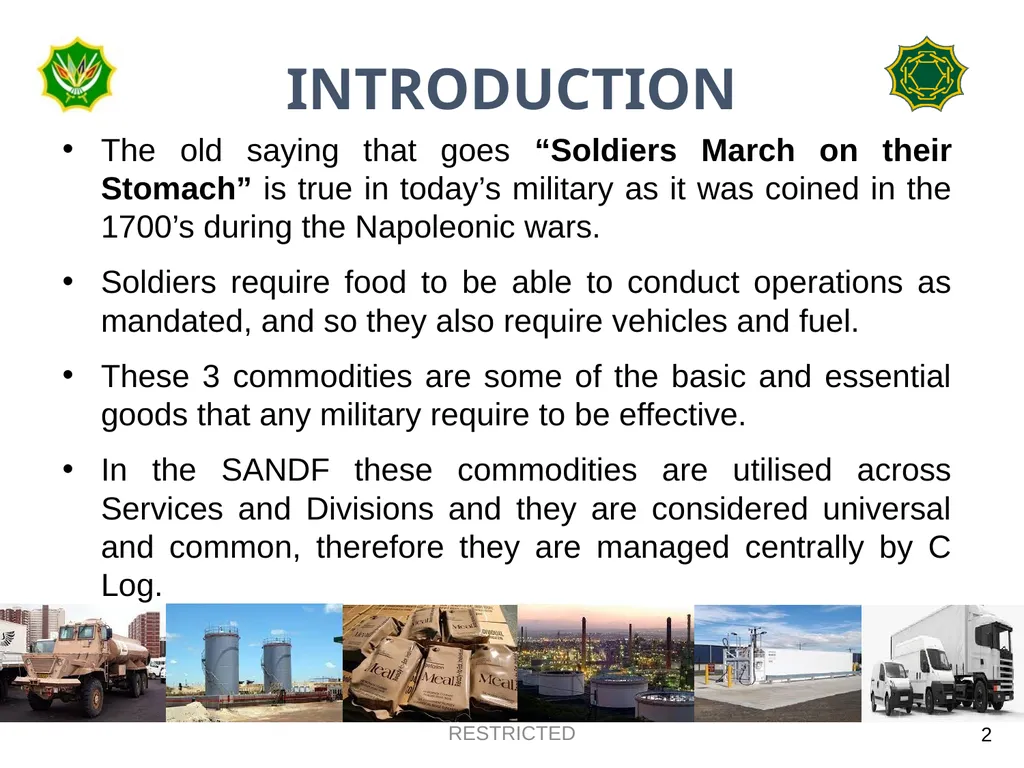
RESTRICTED 2 INTRODUCTION The old saying that goes “Soldiers March on their Stomach” is true in today’s military as it was coined in the 1700’s during the Napoleonic wars.
Soldiers require food to be able to conduct operations as mandated, and so they also require vehicles and fuel.
These 3 commodities are some of the basic and essential goods that any military require to be effective.
In the SANDF these commodities are utilised across Services and Divisions and they are considered universal and common, therefore they are managed centrally by C Log.<br>
03
RESTRICTED 3 AIM The aim of this presentation is to brief the Portfolio Committee on Defence and Military Veterans on DOD Fleet Management Policy and Procurement of essential goods in the DOD and related challenges.<br>
04
RESTRICTED 4 SCOPE The following scope will be discussed in this presentation:
Glossary.
Fleet Management Policy.
Rations.
Fuel.
Questions/Comments.<br>
Glossary.
Fleet Management Policy.
Rations.
Fuel.
Questions/Comments.<br>
05
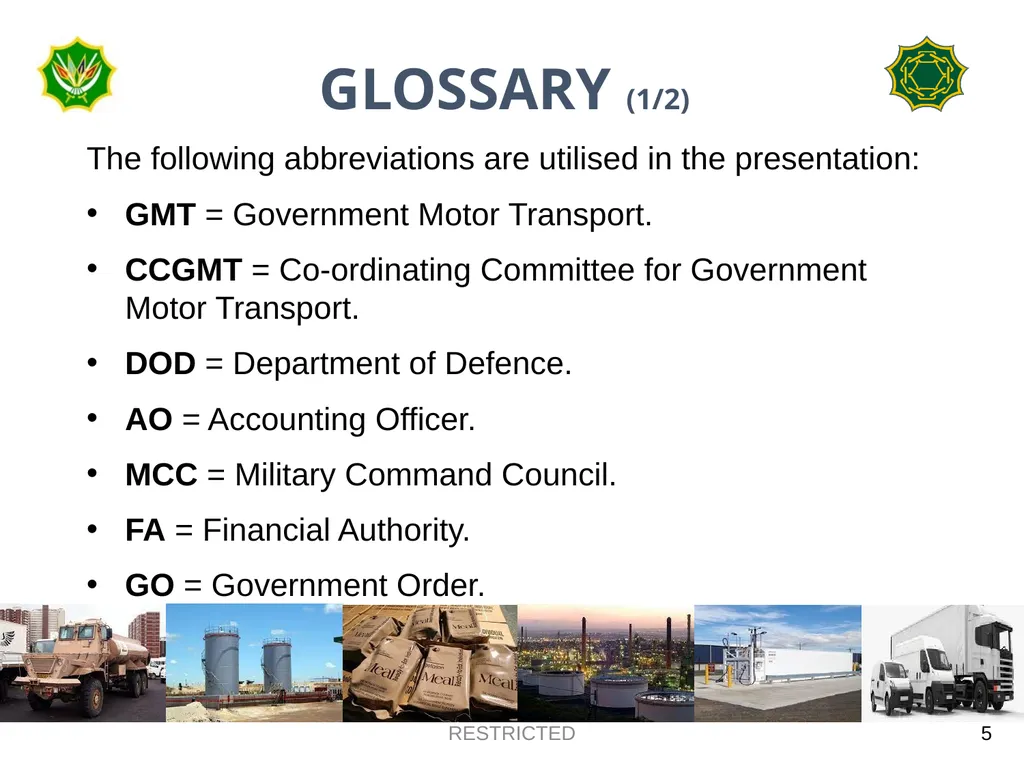
RESTRICTED 5 The following abbreviations are utilised in the presentation:
GMT = Government Motor Transport.
CCGMT = Co-ordinating Committee for Government Motor Transport.
DOD = Department of Defence.
AO = Accounting Officer.
MCC = Military Command Council.
FA = Financial Authority.
GO = Government Order. GLOSSARY (1/2)<br>
GMT = Government Motor Transport.
CCGMT = Co-ordinating Committee for Government Motor Transport.
DOD = Department of Defence.
AO = Accounting Officer.
MCC = Military Command Council.
FA = Financial Authority.
GO = Government Order. GLOSSARY (1/2)<br>
06
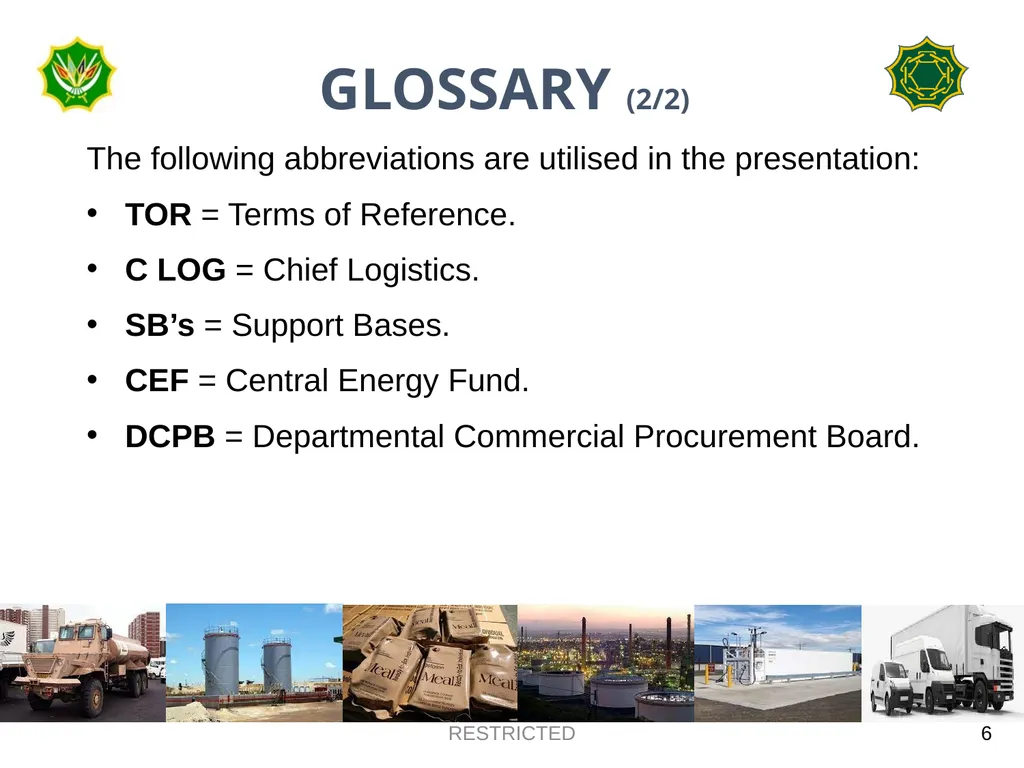
RESTRICTED 6 GLOSSARY (2/2) The following abbreviations are utilised in the presentation:
TOR = Terms of Reference.
C LOG = Chief Logistics.
SB’s = Support Bases.
CEF = Central Energy Fund.
DCPB = Departmental Commercial Procurement Board.<br>
TOR = Terms of Reference.
C LOG = Chief Logistics.
SB’s = Support Bases.
CEF = Central Energy Fund.
DCPB = Departmental Commercial Procurement Board.<br>
07
RESTRICTED 7 FLEET MANAGEMENT POLICY<br>
08
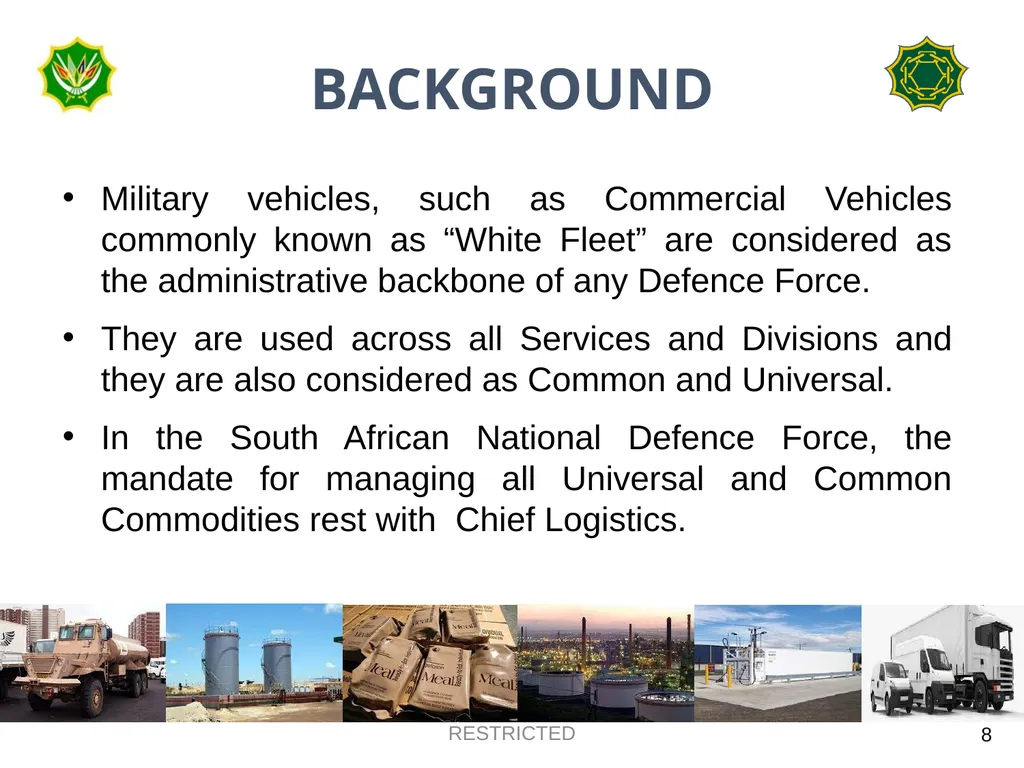
RESTRICTED 8 BACKGROUND Military vehicles, such as Commercial Vehicles commonly known as “White Fleet” are considered as the administrative backbone of any Defence Force.
They are used across all Services and Divisions and they are also considered as Common and Universal.
In the South African National Defence Force, the mandate for managing all Universal and Common Commodities rest with Chief Logistics.<br>
They are used across all Services and Divisions and they are also considered as Common and Universal.
In the South African National Defence Force, the mandate for managing all Universal and Common Commodities rest with Chief Logistics.<br>
09
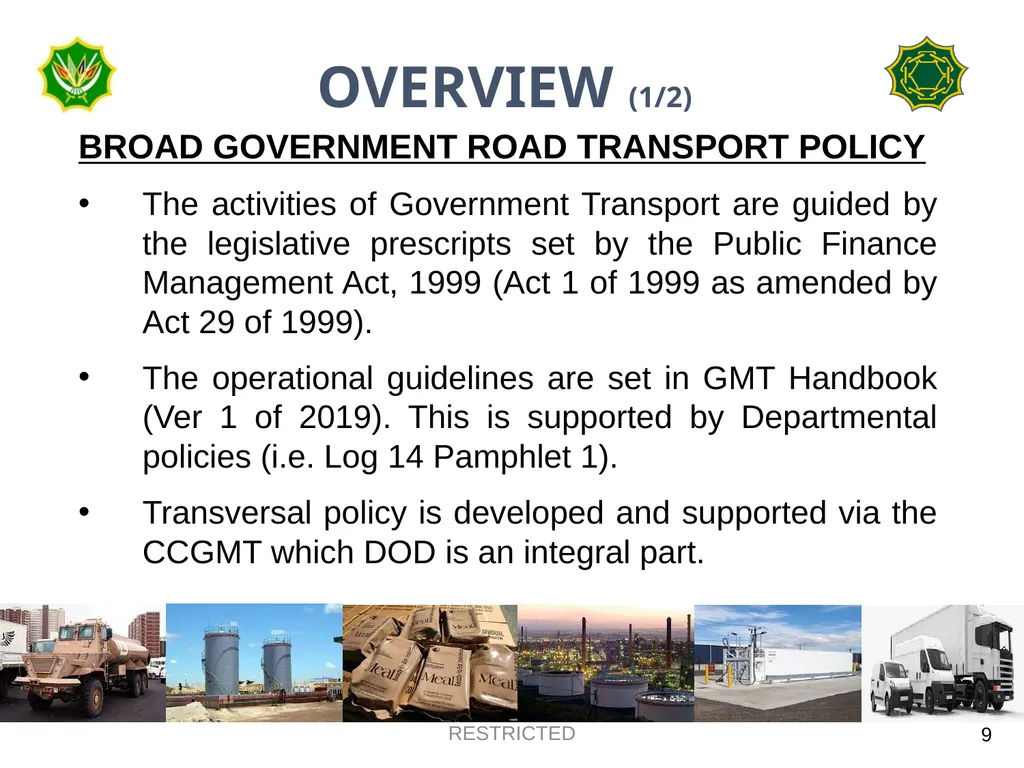
RESTRICTED 9 OVERVIEW (1/2) BROAD GOVERNMENT ROAD TRANSPORT POLICY
The activities of Government Transport are guided by the legislative prescripts set by the Public Finance Management Act, 1999 (Act 1 of 1999 as amended by Act 29 of 1999).
The operational guidelines are set in GMT Handbook (Ver 1 of 2019). This is supported by Departmental policies (i.e. Log 14 Pamphlet 1).
Transversal policy is developed and supported via the CCGMT which DOD is an integral part.<br>
10
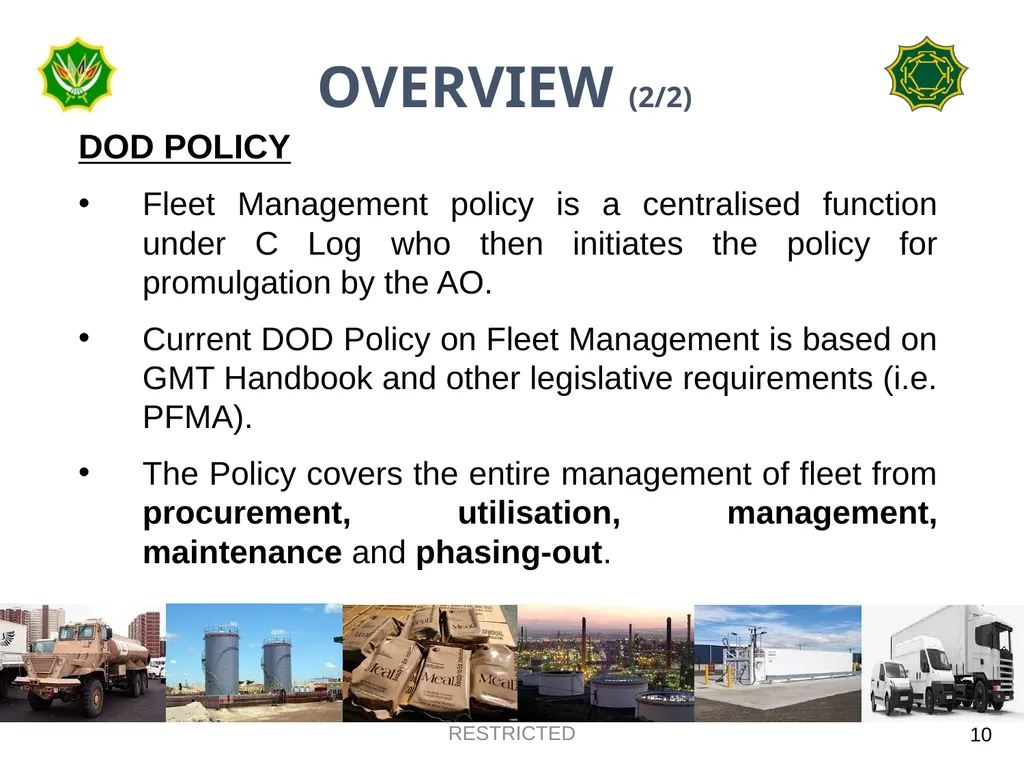
RESTRICTED 10 DOD POLICY
Fleet Management policy is a centralised function under C Log who then initiates the policy for promulgation by the AO.
Current DOD Policy on Fleet Management is based on GMT Handbook and other legislative requirements (i.e. PFMA).
The Policy covers the entire management of fleet from procurement, utilisation, management, maintenance and phasing-out. OVERVIEW (2/2)<br>
11
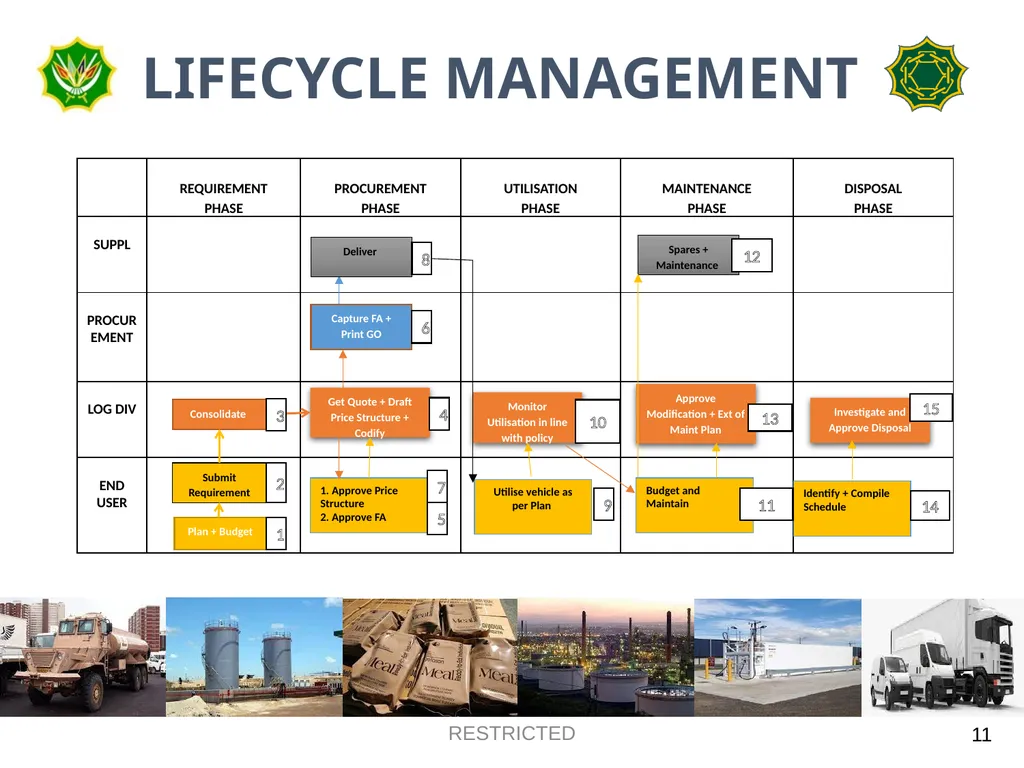
RESTRICTED 11 LIFECYCLE MANAGEMENT<br>
12
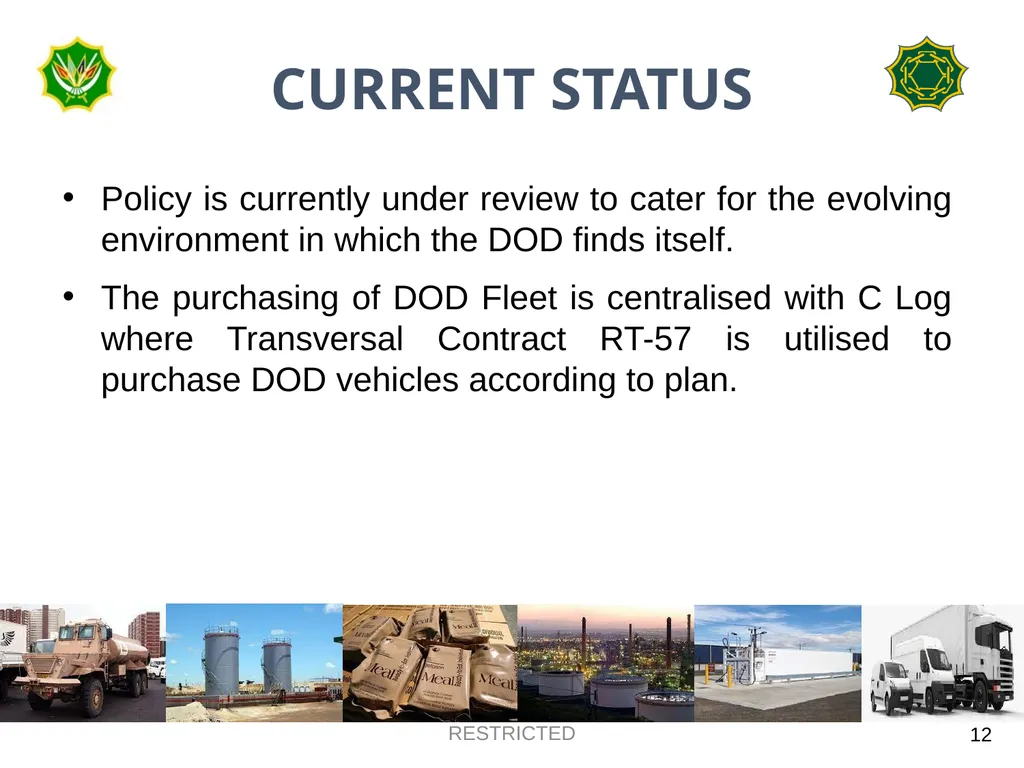
RESTRICTED 12 CURRENT STATUS Policy is currently under review to cater for the evolving environment in which the DOD finds itself.
The purchasing of DOD Fleet is centralised with C Log where Transversal Contract RT-57 is utilised to purchase DOD vehicles according to plan.<br>
The purchasing of DOD Fleet is centralised with C Log where Transversal Contract RT-57 is utilised to purchase DOD vehicles according to plan.<br>
13
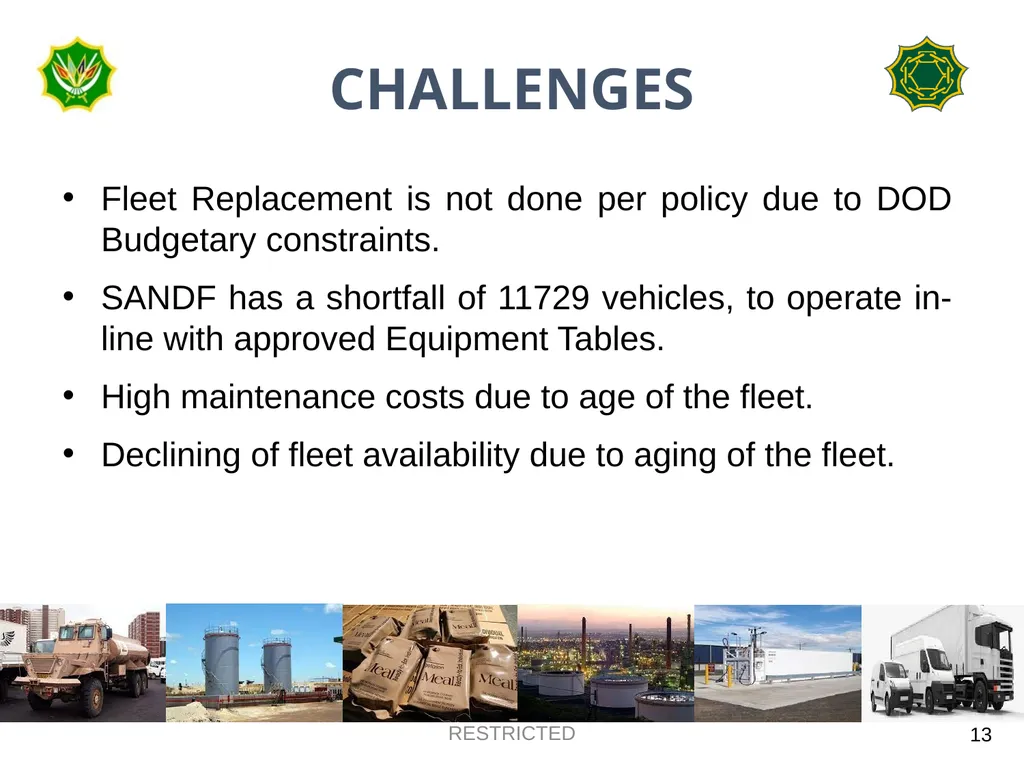
RESTRICTED 13 CHALLENGES Fleet Replacement is not done per policy due to DOD Budgetary constraints.
SANDF has a shortfall of 11729 vehicles, to operate in-line with approved Equipment Tables.
High maintenance costs due to age of the fleet.
Declining of fleet availability due to aging of the fleet.<br>
SANDF has a shortfall of 11729 vehicles, to operate in-line with approved Equipment Tables.
High maintenance costs due to age of the fleet.
Declining of fleet availability due to aging of the fleet.<br>
14
RESTRICTED 14 RATIONS<br>
15
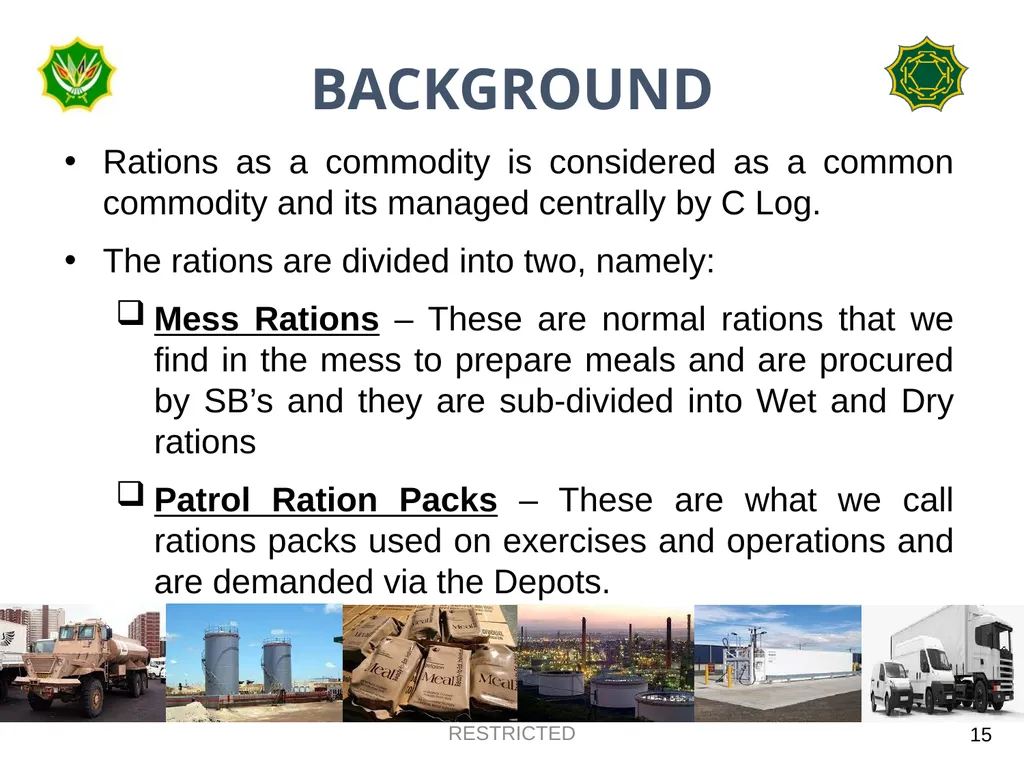
RESTRICTED 15 BACKGROUND Rations as a commodity is considered as a common commodity and its managed centrally by C Log.
The rations are divided into two, namely:
Mess Rations – These are normal rations that we find in the mess to prepare meals and are procured by SB’s and they are sub-divided into Wet and Dry rations
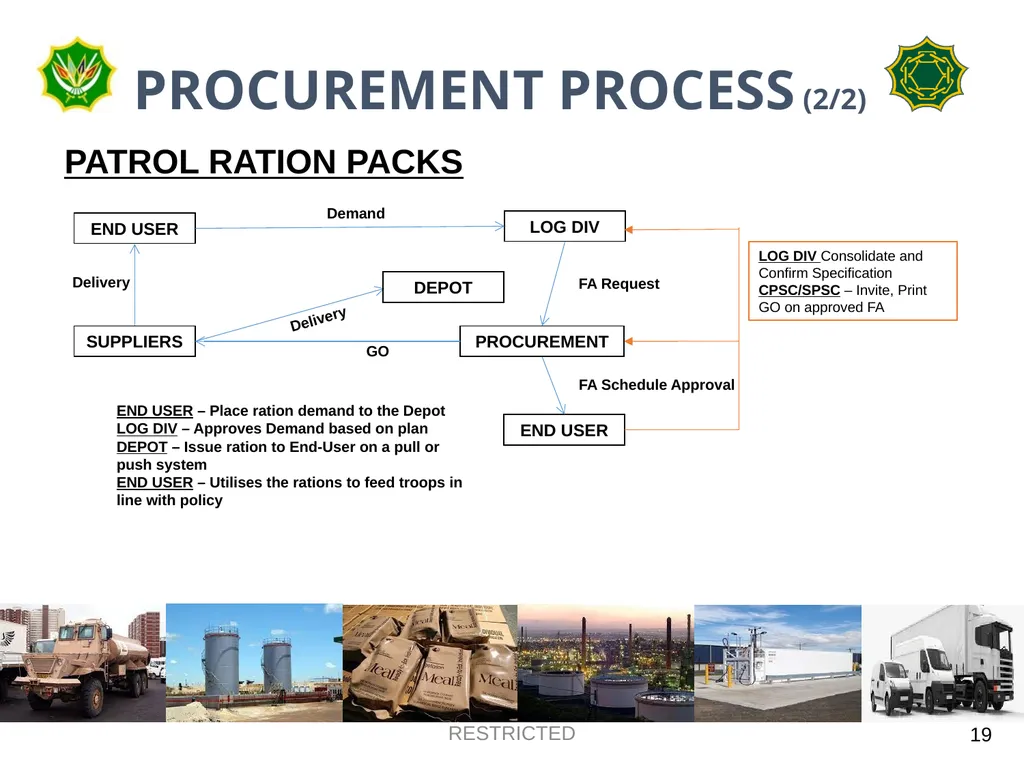
Patrol Ration Packs – These are what we call rations packs used on exercises and operations and are demanded via the Depots.<br>
16
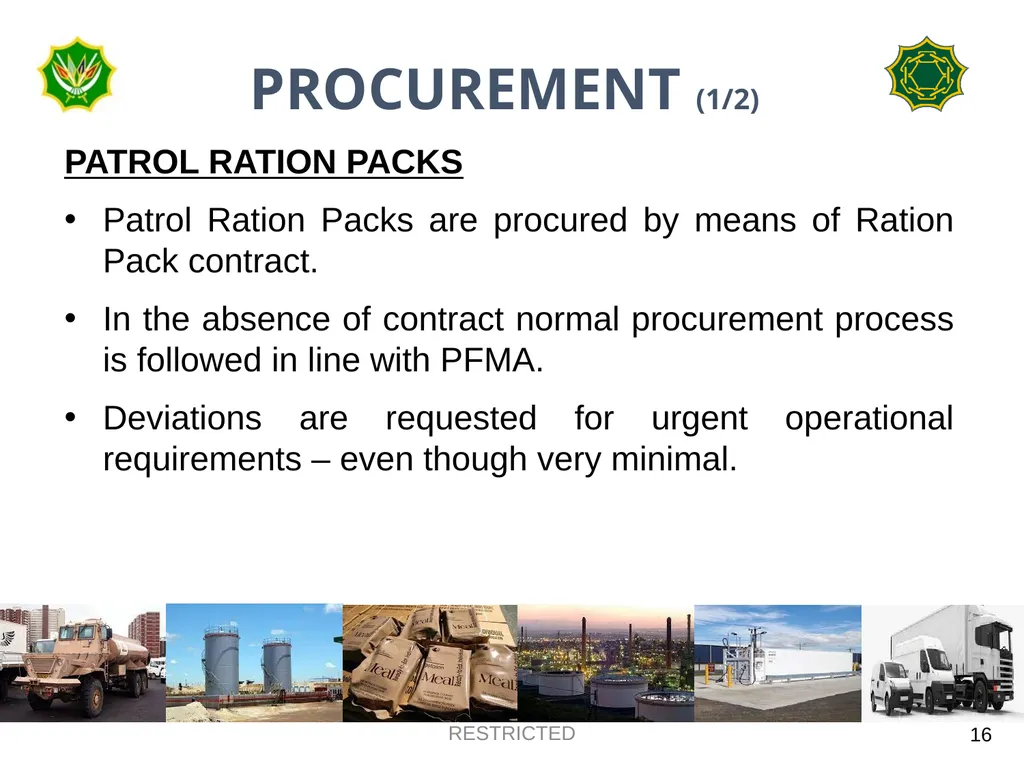
RESTRICTED 16 PROCUREMENT (1/2) PATROL RATION PACKS
Patrol Ration Packs are procured by means of Ration Pack contract.
In the absence of contract normal procurement process is followed in line with PFMA.
Deviations are requested for urgent operational requirements – even though very minimal.<br>
Patrol Ration Packs are procured by means of Ration Pack contract.
In the absence of contract normal procurement process is followed in line with PFMA.
Deviations are requested for urgent operational requirements – even though very minimal.<br>
17
RESTRICTED 17 MESS RATIONS
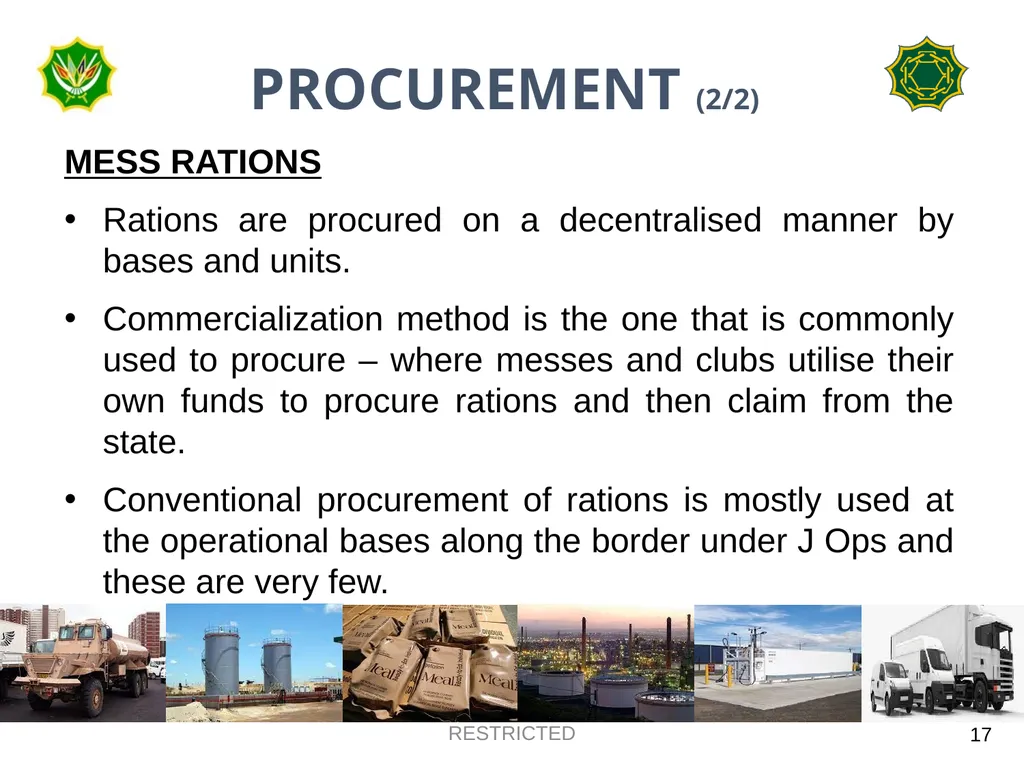
Rations are procured on a decentralised manner by bases and units.
Commercialization method is the one that is commonly used to procure – where messes and clubs utilise their own funds to procure rations and then claim from the state.
Conventional procurement of rations is mostly used at the operational bases along the border under J Ops and these are very few. PROCUREMENT (2/2)<br>
18
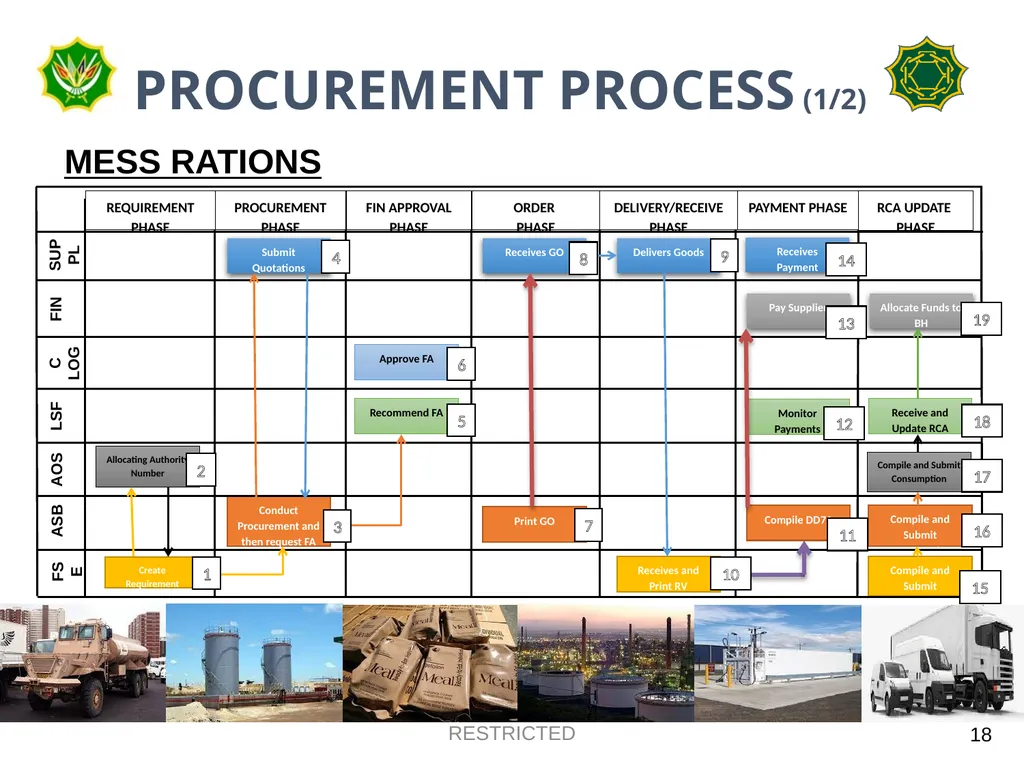
RESTRICTED 18 MESS RATIONS PROCUREMENT PROCESS (1/2)<br>
19
RESTRICTED 19 PATROL RATION PACKS DEPOT PROCUREMENT PROCESS (2/2)<br>
20
RESTRICTED 20 CURRENT STATUS MESS RATIONS
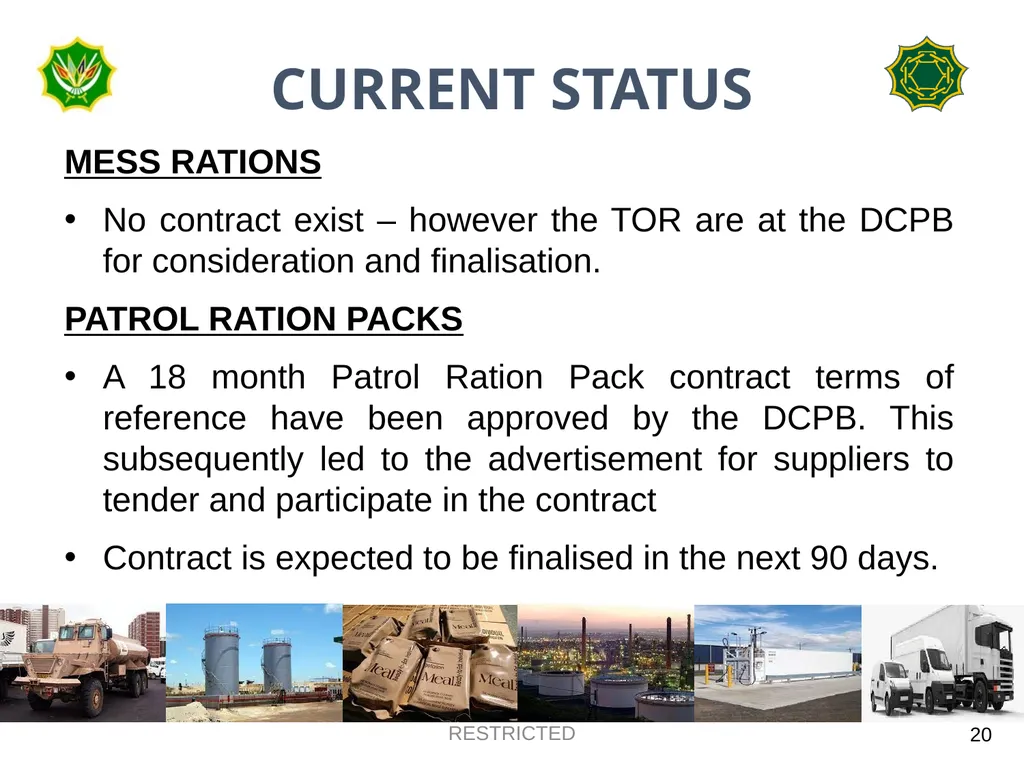
No contract exist – however the TOR are at the DCPB for consideration and finalisation.
PATROL RATION PACKS
A 18 month Patrol Ration Pack contract terms of reference have been approved by the DCPB. This subsequently led to the advertisement for suppliers to tender and participate in the contract
Contract is expected to be finalised in the next 90 days.<br>
21
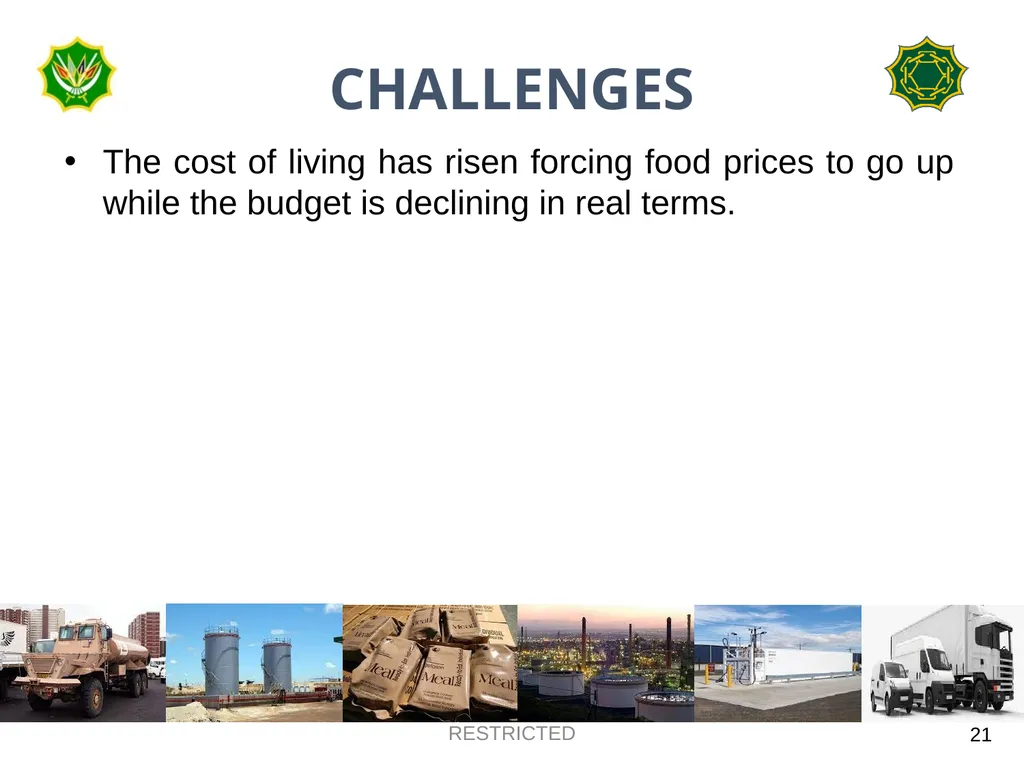
RESTRICTED 21 CHALLENGES The cost of living has risen forcing food prices to go up while the budget is declining in real terms.<br>
22
RESTRICTED 22 FUEL<br>
23
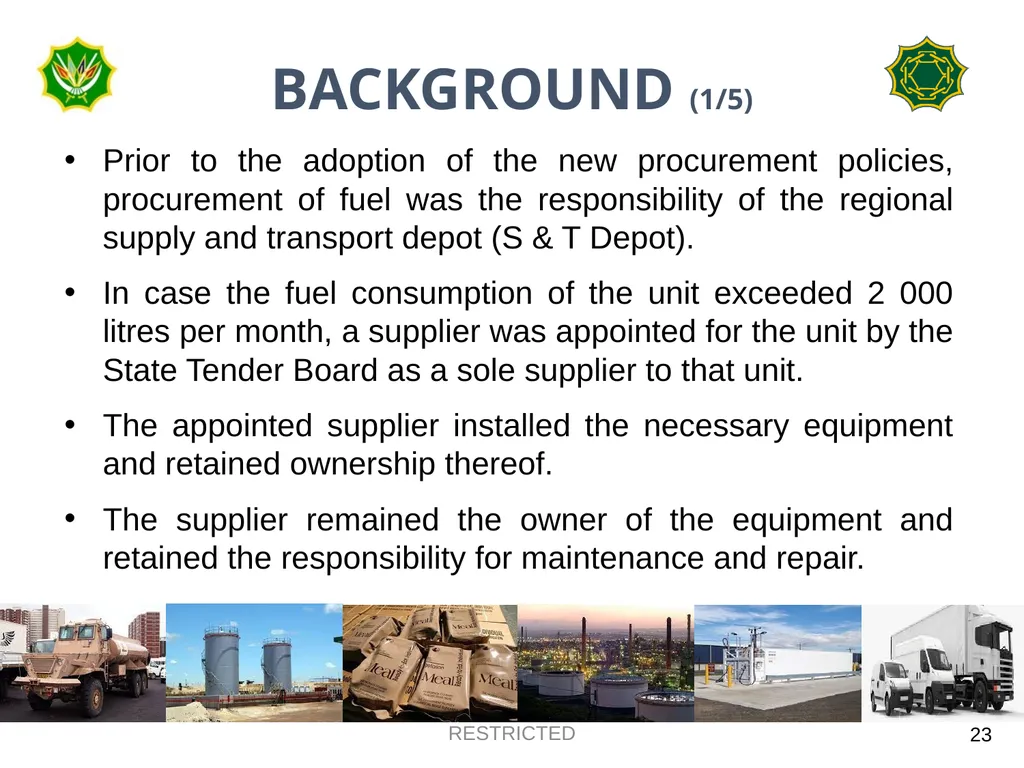
RESTRICTED 23 BACKGROUND (1/5) Prior to the adoption of the new procurement policies, procurement of fuel was the responsibility of the regional supply and transport depot (S & T Depot).
In case the fuel consumption of the unit exceeded 2 000 litres per month, a supplier was appointed for the unit by the State Tender Board as a sole supplier to that unit.
The appointed supplier installed the necessary equipment and retained ownership thereof.
The supplier remained the owner of the equipment and retained the responsibility for maintenance and repair.<br>
24
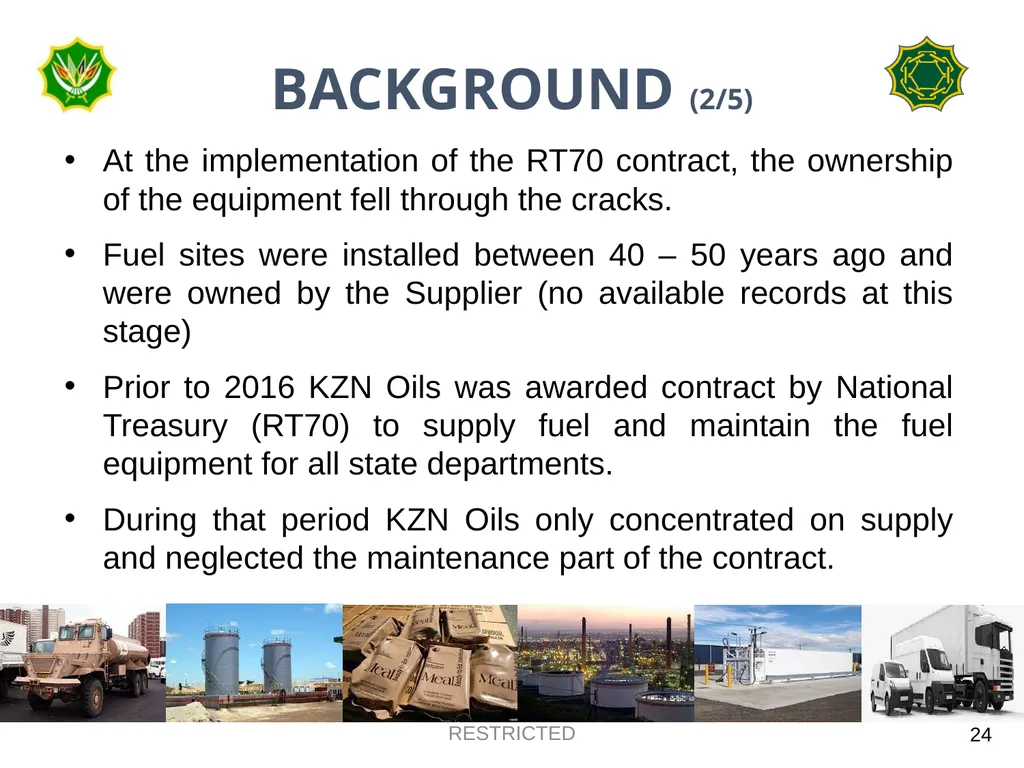
RESTRICTED 24 BACKGROUND (2/5) At the implementation of the RT70 contract, the ownership of the equipment fell through the cracks.
Fuel sites were installed between 40 – 50 years ago and were owned by the Supplier (no available records at this stage)
Prior to 2016 KZN Oils was awarded contract by National Treasury (RT70) to supply fuel and maintain the fuel equipment for all state departments.
During that period KZN Oils only concentrated on supply and neglected the maintenance part of the contract.<br>
25
RESTRICTED 25 BACKGROUND (3/5) This act has resulted in the deterioration of some of the fuel equipment to beyond economic repair.
DOD opted out of National Treasury contract.
The DOD then entered into a contract with various suppliers to supply fuel per provinces on a rotational basis for a period of 5 Years (01 Nov 2016 – 31 Oct 2021).
The contract was only for the supply of fuel to the DOD - no maintenance contract in place.<br>
26
RESTRICTED 26 Contracts were awarded with the following cost implication:
Petrol – Delivered at regulated retail price
Diesel – Delivered at recommended retail price plus 15%
Since the expiry fuel supply contract the SANDF has been struggling to source liquid fuels for its own operational support and day-to-day running of its administration.
Contract hasn’t been renewed ever since and the SANDF source fuel on price quotation. BACKGROUND (4/5)<br>
27
RESTRICTED 27 The SANDF is totally at the mercy of suppliers who some don’t even have capacity to deliver efficiently to support military operations.
Most of these suppliers are number three or four in the value chain line of the supply of fuels and charge pump price plus R1,50 to R3,00. BACKGROUND (5/5)<br>
Most of these suppliers are number three or four in the value chain line of the supply of fuels and charge pump price plus R1,50 to R3,00. BACKGROUND (5/5)<br>
28
RESTRICTED 28 DOD and Central Energy Fund (CEF) entered into Memorandum of Cooperation (MOC) for supply of fuel and other related products and services in July 2019.
Parties are busy with Service Level Agreement (SLA) to commercialise the MOC for CEF to supply fuel to the DOD.
The MCC approved the fuel model for the DOD which includes CEF as a Strategic Supplier. CURRENT STATUS (1/5)<br>
Parties are busy with Service Level Agreement (SLA) to commercialise the MOC for CEF to supply fuel to the DOD.
The MCC approved the fuel model for the DOD which includes CEF as a Strategic Supplier. CURRENT STATUS (1/5)<br>
29
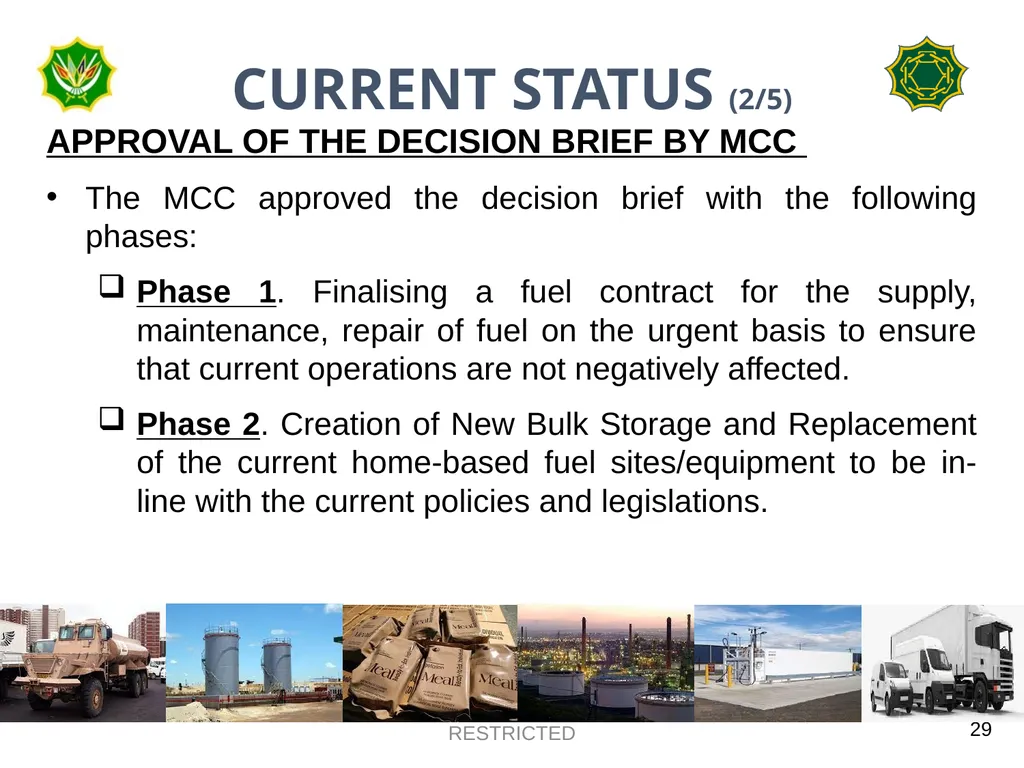
RESTRICTED 29 CURRENT STATUS (2/5) APPROVAL OF THE DECISION BRIEF BY MCC
The MCC approved the decision brief with the following phases:
Phase 1. Finalising a fuel contract for the supply, maintenance, repair of fuel on the urgent basis to ensure that current operations are not negatively affected.
Phase 2. Creation of New Bulk Storage and Replacement of the current home-based fuel sites/equipment to be in-line with the current policies and legislations.<br>
30
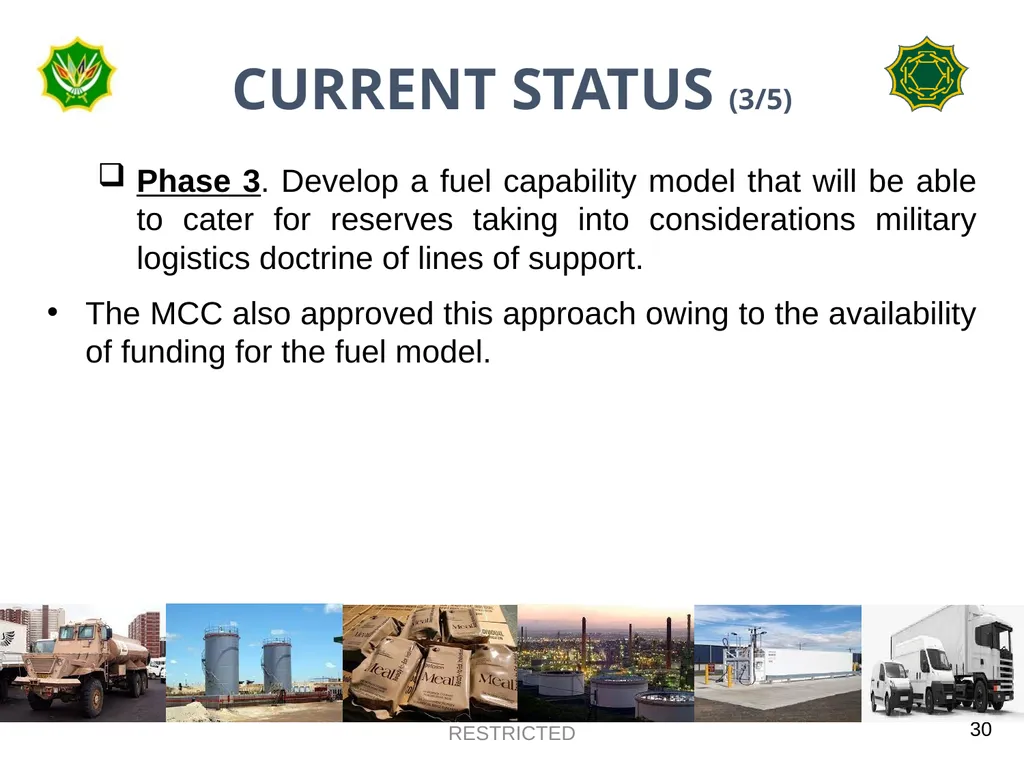
RESTRICTED 30 Phase 3. Develop a fuel capability model that will be able to cater for reserves taking into considerations military logistics doctrine of lines of support.
The MCC also approved this approach owing to the availability of funding for the fuel model. CURRENT STATUS (3/5)<br>
The MCC also approved this approach owing to the availability of funding for the fuel model. CURRENT STATUS (3/5)<br>
31
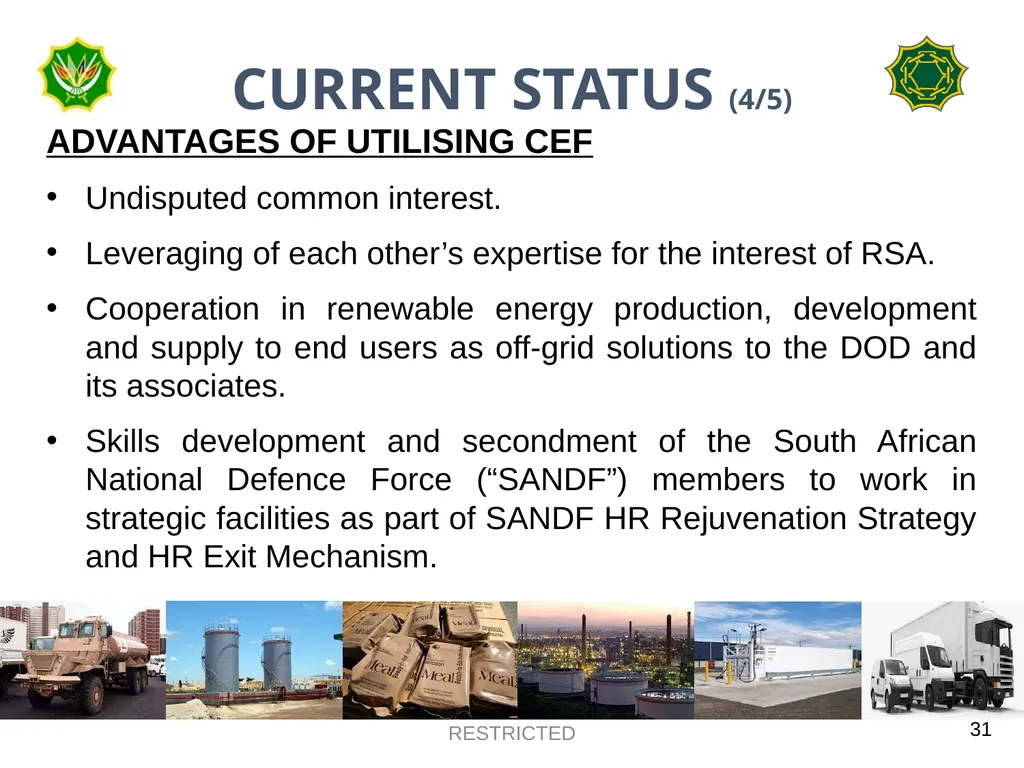
RESTRICTED 31 CURRENT STATUS (4/5) ADVANTAGES OF UTILISING CEF
Undisputed common interest.
Leveraging of each other’s expertise for the interest of RSA.
Cooperation in renewable energy production, development and supply to end users as off-grid solutions to the DOD and its associates.
Skills development and secondment of the South African National Defence Force (“SANDF”) members to work in strategic facilities as part of SANDF HR Rejuvenation Strategy and HR Exit Mechanism.<br>
32
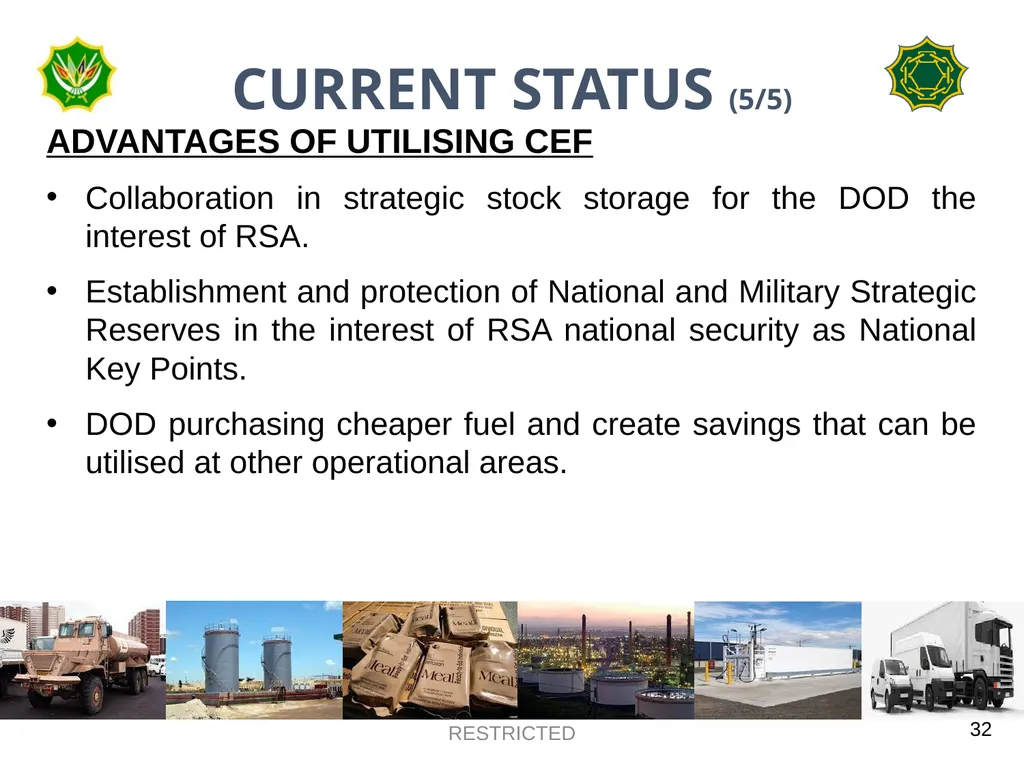
RESTRICTED 32 CURRENT STATUS (5/5) ADVANTAGES OF UTILISING CEF
Collaboration in strategic stock storage for the DOD the interest of RSA.
Establishment and protection of National and Military Strategic Reserves in the interest of RSA national security as National Key Points.
DOD purchasing cheaper fuel and create savings that can be utilised at other operational areas.<br>
33
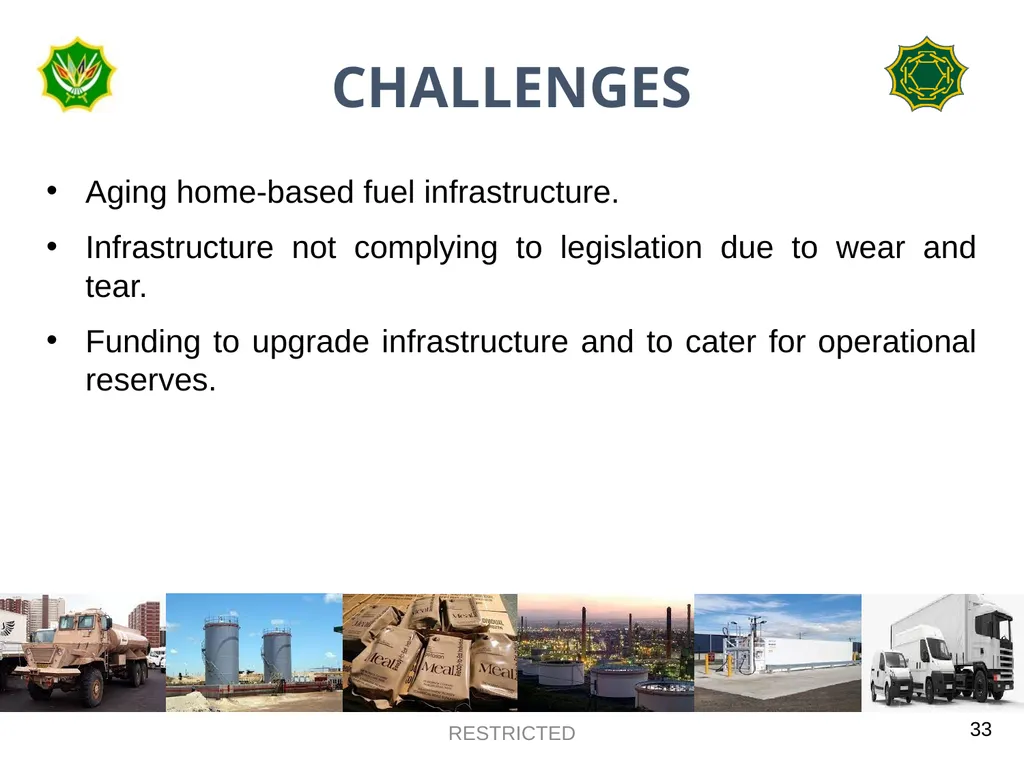
RESTRICTED 33 Aging home-based fuel infrastructure.
Infrastructure not complying to legislation due to wear and tear.
Funding to upgrade infrastructure and to cater for operational reserves. CHALLENGES<br>
Infrastructure not complying to legislation due to wear and tear.
Funding to upgrade infrastructure and to cater for operational reserves. CHALLENGES<br>
34
QUESTIONS/DISCUSSIONS 34 RESTRICTED<br>