
Department of Education Division of Marikina
TD
Published · 63 slides · 0 views

1 / 1
Description
Department of Education Division of Marikina MARIKINA SCIENCE HIGH SCHOOL Senior High School Department Understanding Culture, Society and Politics Marikina Science High School DISCUSSION Reciprocity, both in sociology and economics,
Related Topics
Share
Embed code
Download this presentation From Below
"Department of Education Division of Marikina" is the property of its rightful owner. Permission is granted to download and print the materials on this website for personal, non-commercial use only, and to display it on your personal computer provided you do not modify the materials and that you retain all copyright notices contained in the materials. By downloading content from our website, you accept the terms of this agreement.
Presentation Transcript
01
Department of Education
Division of Marikina
MARIKINA SCIENCE HIGH SCHOOL
Senior High School Department Understanding Culture, Society and Politics<br>
Division of Marikina
MARIKINA SCIENCE HIGH SCHOOL
Senior High School Department Understanding Culture, Society and Politics<br>
02
Marikina Science High School DISCUSSION Reciprocity, both in sociology and economics, underscores the principle of voluntary exchange and mutual benefit among individuals or entities. In sociology, reciprocity entails the practice of giving favors with the expectation of future reciprocation, fostering social bonds and obligations (Gouldner 1960). Reciprocity<br>
03
Marikina Science High School DISCUSSION Reciprocity Examples:
Sociology Example:
A classmate lends you their notes when you’re absent.
Later, you help that same classmate review for an exam. This creates utang na loob (debt of gratitude), a Filipino cultural form of reciprocity.
Economics Example:
You and your friend agree to swap baon: you give your sandwich they give you chips.
Both of you gain something you enjoy. This is a small-scale mutual exchange of goods.<br>
04
Marikina Science High School DISCUSSION For instance, in Filipino culture, the concept of “utang na loob” exemplifies reciprocity, where individuals feel obliged to reciprocate acts of kindness shown to them (Scott, 1994). Similarly, in economics, reciprocity involves exchanges of equal advantages, often manifested in agreements or contracts between nations or organizations. Reciprocity<br>
05
Marikina Science High School DISCUSSION Types of Reciprocity Reciprocity manifests various forms, including generalized, balanced, and negative reciprocity (Bohannan, 1995). Generalized Reciprocity involves giving without the expectation of an immediate return, fostering trust and goodwill among parties.<br>
06
Marikina Science High School DISCUSSION Types of Reciprocity "Generalized reciprocity reminds us that not everything in life is about instant reward. In our economy, trust and goodwill are just as important as money, because they ensure that people help each other even without immediate returns."<br>
07
Marikina Science High School DISCUSSION Types of Reciprocity Balanced reciprocity entails giving with the anticipation of an immediate return, maintaining a sense of fairness and reciprocity in transactions (Malinowski, 1922)<br>
08
Marikina Science High School DISCUSSION Types of Reciprocity Balanced reciprocity happens when two people exchange goods, services, or favors with the expectation that the return will be immediate or within a short time and of equal value.
It’s about fairness—you give something, and you expect to receive something of about the same value in return.<br>
It’s about fairness—you give something, and you expect to receive something of about the same value in return.<br>
09
Marikina Science High School DISCUSSION Types of Reciprocity Example
Cultural Example (Philippines):
In fiestas, families exchange food with their neighbors. If you give a plate of pancit, they might send back a plate of lumpia. This shows equal and fair exchange, strengthening community ties.<br>
Cultural Example (Philippines):
In fiestas, families exchange food with their neighbors. If you give a plate of pancit, they might send back a plate of lumpia. This shows equal and fair exchange, strengthening community ties.<br>
10
Marikina Science High School DISCUSSION Types of Reciprocity Negative reciprocity occurs when exchanges involve taking advantage of others or situations, often through deception and coercion (Sahlins, 1972).<br>
11
Marikina Science High School DISCUSSION Types of Reciprocity Negative reciprocity happens when someone tries to get more than what they give in an exchange.
It often involves taking advantage, cheating, or deceiving someone.
Instead of fairness, one person benefits while the other loses.<br>
It often involves taking advantage, cheating, or deceiving someone.
Instead of fairness, one person benefits while the other loses.<br>
12
Marikina Science High School DISCUSSION Types of Reciprocity Example:
A student borrows money from a classmate but never pays it back. One benefits unfairly while the other loses.
Selling a second-hand phone at double its real price to someone who doesn’t know its true value. The seller gains unfairly, and the buyer is tricked.
Community Example:
In some markets, tourists are charged much higher prices than locals for the same product. This shows exploitation in exchange.<br>
13
Marikina Science High School DISCUSSION Types of Reciprocity "Negative reciprocity is like tilting the scales—one side gains too much while the other loses. If this happens often, trust and cooperation break down in our economy."<br>
14
Marikina Science High School DISCUSSION In economics, transfers or transfer payments represent redistributions of income or resources within the market system, involving payments where no additional value is added to the economy (Williamson, 1975). Transfers<br>
15
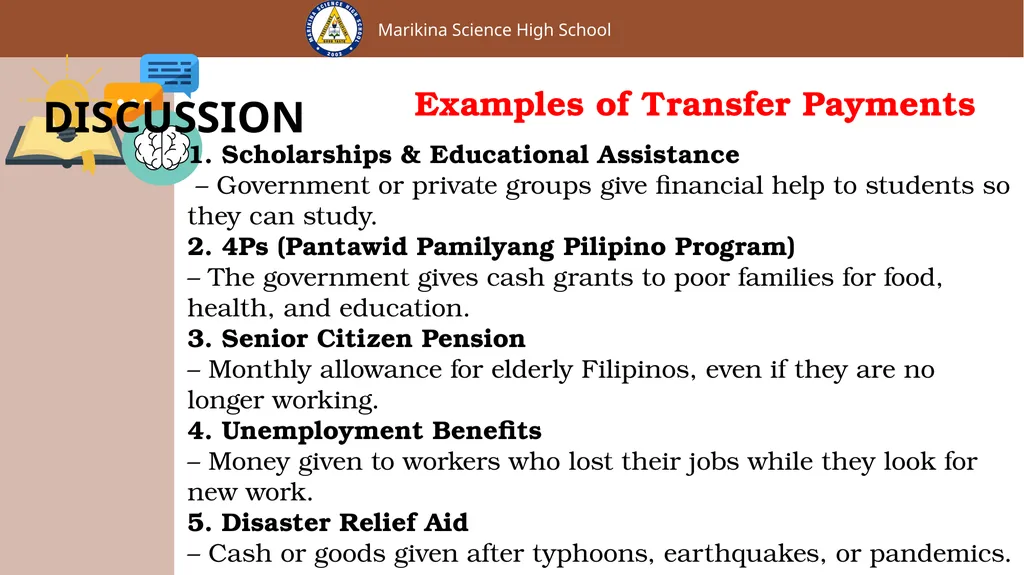
Marikina Science High School DISCUSSION 1. Scholarships & Educational Assistance
– Government or private groups give financial help to students so they can study.
2. 4Ps (Pantawid Pamilyang Pilipino Program)
– The government gives cash grants to poor families for food, health, and education.
3. Senior Citizen Pension
– Monthly allowance for elderly Filipinos, even if they are no longer working.
4. Unemployment Benefits
– Money given to workers who lost their jobs while they look for new work.
5. Disaster Relief Aid
– Cash or goods given after typhoons, earthquakes, or pandemics. Examples of Transfer Payments<br>
16
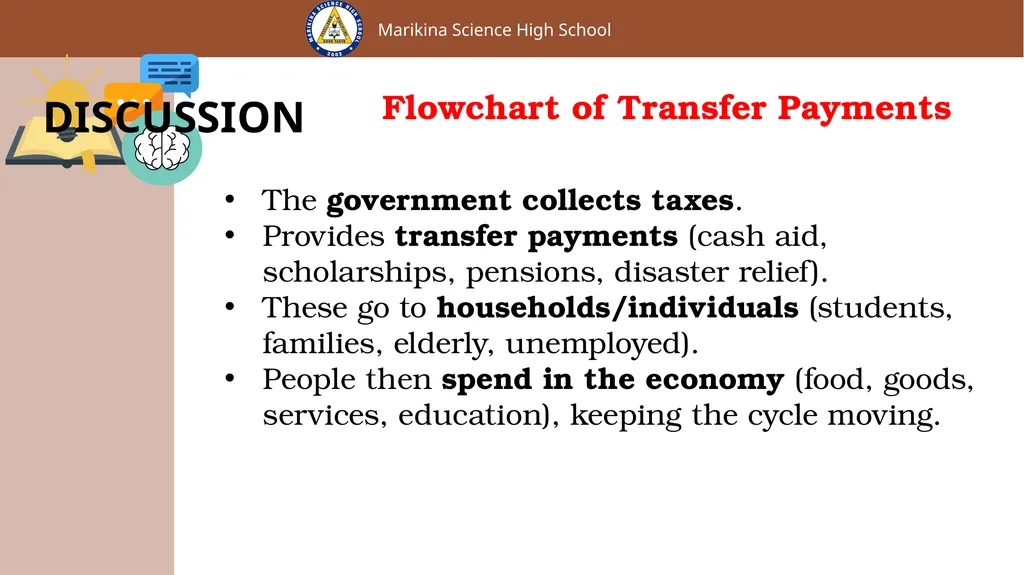
Marikina Science High School DISCUSSION Flowchart of Transfer Payments The government collects taxes.
Provides transfer payments (cash aid, scholarships, pensions, disaster relief).
These go to households/individuals (students, families, elderly, unemployed).
People then spend in the economy (food, goods, services, education), keeping the cycle moving.<br>
Provides transfer payments (cash aid, scholarships, pensions, disaster relief).
These go to households/individuals (students, families, elderly, unemployed).
People then spend in the economy (food, goods, services, education), keeping the cycle moving.<br>
17
Marikina Science High School DISCUSSION Transfers "Transfer payments may not directly create new products, but they give people the power to live better, study, and recover from hardships.<br>
18
Marikina Science High School DISCUSSION Redistribution Is a fundamental societal activity aimed at ensuring equitable allocation of resources among members. It involves the collection of goods and services, often by a central authority, for subsequent allocation to individuals or groups in need.<br>
19
Marikina Science High School DISCUSSION Redistribution Below is the further explanation of how redistribution functions across different spheres and its comparison with reciprocity: 1. Redistribution in Politics
A very common political practice of redistribution is when the government collects taxes from citizens and then uses the money to fund public services such as free education, healthcare, and infrastructure.<br>
20
Marikina Science High School DISCUSSION Redistribution Functions Example:
In the Philippines, part of the national budget goes to free tuition in state universities (RA 10931).
This is funded by taxes collected from working citizens and businesses.
The government redistributes resources so that even students from poor families can access higher education.<br>
In the Philippines, part of the national budget goes to free tuition in state universities (RA 10931).
This is funded by taxes collected from working citizens and businesses.
The government redistributes resources so that even students from poor families can access higher education.<br>
21
Marikina Science High School DISCUSSION Redistribution Functions 2. Redistribution in Economics
In economics, redistribution happens when income or wealth is taken from one group (through taxes) and given to another group (through transfer payments or subsidies).
Example:
4Ps (Pantawid Pamilyang Pilipino Program) – cash grants to poor families funded by taxes.
Why It Matters: It reduces income inequality, helps the poor meet basic needs, and creates more balanced economic opportunities.<br>
Example:
4Ps (Pantawid Pamilyang Pilipino Program) – cash grants to poor families funded by taxes.
Why It Matters: It reduces income inequality, helps the poor meet basic needs, and creates more balanced economic opportunities.<br>
22
Marikina Science High School DISCUSSION Redistribution Functions 3. Redistribution in Sociology
In sociology, redistribution is about reshaping social relationships and opportunities so that marginalized groups can have more equal standing in society.
Example:
Affirmative action programs or gender equality initiatives that open job or educational opportunities for women and minorities.
Community projects where wealthier families share resources with poorer ones (e.g., donation drives after typhoons).
Why It Matters: It strengthens social solidarity, reduces discrimination, and promotes a more inclusive society.<br>
23
Marikina Science High School DISCUSSION Comparing Redistribution and Reciprocity While redistribution and reciprocity both involve exchanges within societies, they operate on different principles and scales. Reciprocity relies on voluntary exchanges between individuals, fostering social bonds and obligations (Malinowski, 1922). In contrast, redistribution entails centralized collection and allocation of resources by a governing body, aiming for broader societal benefit (Bowles & Gintis, 2002).<br>
24
Marikina Science High School LEARNING ACTIVITY #3 Modified True or False: Transfer Payments & Redistribution Directions: Write TRUE if the statement is correct. If the statement is FALSE, change the word/phrase to make it correct.
Transfer payments involve giving money or resources without expecting goods or services in return.
In Redistribution in Politics, a very common political practice of redistribution is when the government collects taxes from citizens and then uses the money to buy luxury cars.
The 4Ps (Pantawid Pamilyang Pilipino Program) is an example of transfer payments in the Philippines.<br>
25
Marikina Science High School LEARNING ACTIVITY #3 Modified True or False: Transfer Payments & Redistribution Directions: Write TRUE if the statement is correct. If the statement is FALSE, change the word/phrase to make it correct.
4. Senior citizen pensions are considered transfer payments because no work is exchanged for them.
5. In sociology, redistribution happens when income or wealth is taken from one group (through taxes) and given to another group (through transfer payments or subsidies).
6. In economics, redistribution is about reshaping social relationships and opportunities so that marginalized groups can have more equal standing in society.<br>
26
Marikina Science High School LEARNING ACTIVITY #3 Directions: Write TRUE if the statement is correct. If the statement is FALSE, change the word/phrase to make it correct.
7. Scholarships funded by government taxes are a form of redistribution.
8. One of the examples of redistribution in politics is in the Philippines, part of the national budget goes to free tuition in state universities (RA 10631).
9. Disaster relief goods distributed to affected families are examples of transfer payments.
10. Redistribution in sociology matters because it strengthens social solidarity, reduces discrimination, and promotes a more exclusive society. Modified True or False: Transfer Payments & Redistribution<br>
27
Marikina Science High School DISCUSSION Market A market serves as the platform where buyers and sellers come together to exchange goods and services. However, its significance extends beyond a physical location, encompassing the interactions between individuals willing and able to engage in trade.
In capitalist economies, markets play a pivotal role in addressing the fundamental economic questions of what, how, and for whom to produce (Krugman & Wells, 2015).<br>
In capitalist economies, markets play a pivotal role in addressing the fundamental economic questions of what, how, and for whom to produce (Krugman & Wells, 2015).<br>
28
Marikina Science High School DISCUSSION Market Structure Market structure categorizes markets based on key characteristics like the number of sellers and buyers, entry barriers, pricing control, and product types.
Examples include: 1. Pure competition is a market structure where there are many buyers and sellers, the products are all the same (homogeneous), and it’s easy to enter or leave the market. No single seller controls the price—the market (supply and demand) sets it.<br>
Examples include: 1. Pure competition is a market structure where there are many buyers and sellers, the products are all the same (homogeneous), and it’s easy to enter or leave the market. No single seller controls the price—the market (supply and demand) sets it.<br>
29
Marikina Science High School DISCUSSION Market Structure In pure competition:
Sellers are price takers → they cannot set prices too high because buyers will just switch to another seller offering the same product.
Buyers enjoy affordable prices because competition keeps costs low.
The market is fair and open, which encourages efficiency.<br>
Sellers are price takers → they cannot set prices too high because buyers will just switch to another seller offering the same product.
Buyers enjoy affordable prices because competition keeps costs low.
The market is fair and open, which encourages efficiency.<br>
30
Marikina Science High School DISCUSSION Market Structure 2. Monopoly - is a market structure where there is only one seller or provider of a product or service. This seller has full control over price and supply, and it’s very hard for new businesses to compete because of high barriers to entry (like government regulation, large capital needed, or ownership of special resources) (Pindyck & Rubinfeld, 2012).<br>
31
Marikina Science High School DISCUSSION Market Structure In a monopoly:
The single seller is a price maker, not just a price taker.
Consumers have no alternative suppliers, so they are forced to buy from the monopoly.
Government often steps in with regulation to prevent abuse (e.g., price control, monitoring).<br>
The single seller is a price maker, not just a price taker.
Consumers have no alternative suppliers, so they are forced to buy from the monopoly.
Government often steps in with regulation to prevent abuse (e.g., price control, monitoring).<br>
32
Marikina Science High School DISCUSSION Market Structure 3. Monopolistic Competition - is a market structure where there are many sellers, but each offers a slightly different product (differentiated). There are low barriers to entry, meaning new businesses can easily join the market. Sellers compete not just in price, but also in branding, style, quality, or marketing (Mankiw & Taylor, 2014).<br>
33
Marikina Science High School DISCUSSION Market Structure In monopolistic competition:
Sellers have some power to set prices because their products are unique or branded.
Buyers enjoy variety since products are differentiated.
Competition is strong, but no single seller dominates.<br>
Sellers have some power to set prices because their products are unique or branded.
Buyers enjoy variety since products are differentiated.
Competition is strong, but no single seller dominates.<br>
34
Marikina Science High School DISCUSSION Market Structure 4. Oligopoly - is a market structure where only a few large sellers dominate the market. Because there are limited competitors, each seller can influence prices and strategies. Barriers to entry are high since starting a new business in this market often requires a lot of capital, technology, or government approval (McConnell, Brue, & Flynn, 2015).<br>
35
Marikina Science High School DISCUSSION Market Structure Example (Philippines)
Telecommunications Industry (Globe & Smart/PLDT, plus DITO):
Only a few big companies control internet and mobile services.
They compete in promos, data packages, and advertisements.
Since there are so few players, each one’s decision (like changing prices or introducing unlimited data promos) affects the others.<br>
36
Marikina Science High School DISCUSSION Market Structure In oligopoly:
Sellers often practice interdependence → one company’s move forces the others to react.
Can lead to price wars (e.g., competing promo loads) or collusion (agreeing silently to keep prices high).
Consumers have some choice, but not as much as in pure or monopolistic competition.<br>
Sellers often practice interdependence → one company’s move forces the others to react.
Can lead to price wars (e.g., competing promo loads) or collusion (agreeing silently to keep prices high).
Consumers have some choice, but not as much as in pure or monopolistic competition.<br>
37
Marikina Science High School DISCUSSION Market Structure 5. Monopsony - is a market structure where there is only one major buyer, and this buyer has control over the market. Because there’s only one main customer, they can influence prices, wages, and conditions for sellers or workers (Besanko & Braeutigam, 2015).<br>
38
Marikina Science High School DISCUSSION Market Structure Example (Philippines)
Sugar Cane Farmers & Sugar Mills:
In some provinces, farmers who grow sugar cane can only sell to one nearby sugar mill.
Since the mill is the only buyer, it can dictate the price per ton of sugar cane.
Farmers have little choice, so the buyer has the power.
Big Retail Chains hiring workers (like SM Malls in certain towns):
If SM is the only large employer in an area, workers depend on them for jobs.
SM can influence wages and working conditions because alternatives are limited.<br>
39
Marikina Science High School DISCUSSION Market Structure In Monopsony:
Unlike monopoly (one seller), a monopsony is one buyer.
Sellers or workers compete to sell to that one buyer.
This often leads to lower prices for sellers or lower wages for workers, since the buyer has the power.<br>
Unlike monopoly (one seller), a monopsony is one buyer.
Sellers or workers compete to sell to that one buyer.
This often leads to lower prices for sellers or lower wages for workers, since the buyer has the power.<br>
40
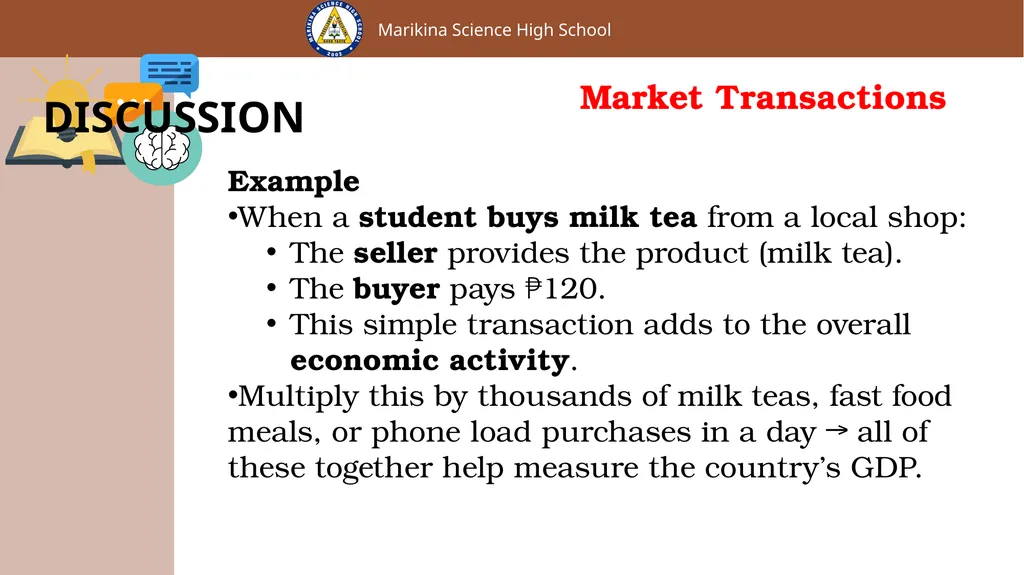
Marikina Science High School DISCUSSION Market Transactions Market transactions entail the exchange of goods and services between buyers and sellers, agreeing on price and quantity. These transactions serve as crucial indicators for measuring economic output, such as Gross Domestic Product (GDP), and provide essential data for economic planning and forecasting (Krugman & Wells, 2015).<br>
41
Marikina Science High School DISCUSSION Market Transactions Example
When a student buys milk tea from a local shop:
The seller provides the product (milk tea).
The buyer pays ₱120.
This simple transaction adds to the overall economic activity.
Multiply this by thousands of milk teas, fast food meals, or phone load purchases in a day → all of these together help measure the country’s GDP.<br>
42
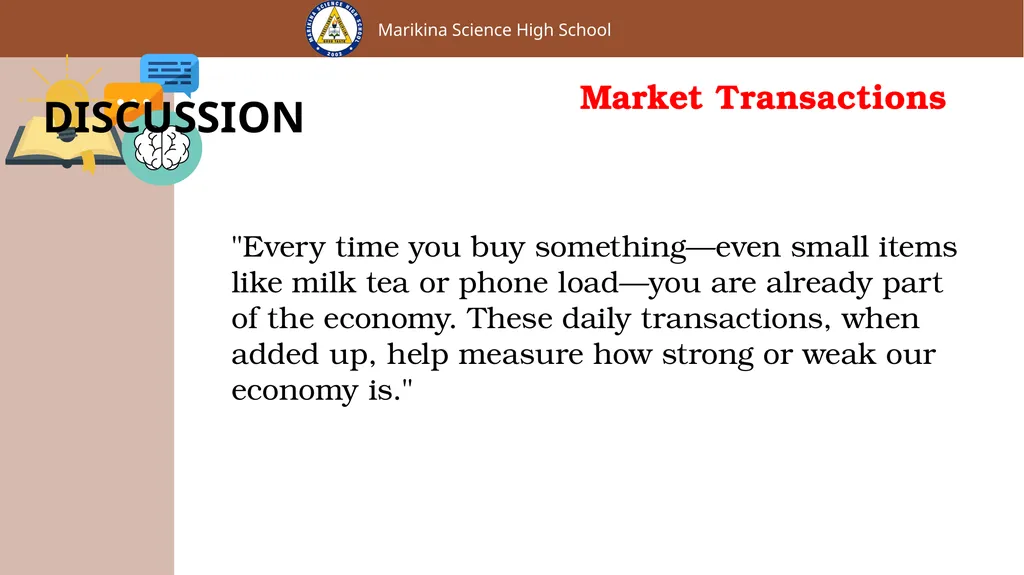
Marikina Science High School DISCUSSION Market Transactions "Every time you buy something—even small items like milk tea or phone load—you are already part of the economy. These daily transactions, when added up, help measure how strong or weak our economy is."<br>
43
Marikina Science High School<br>
44
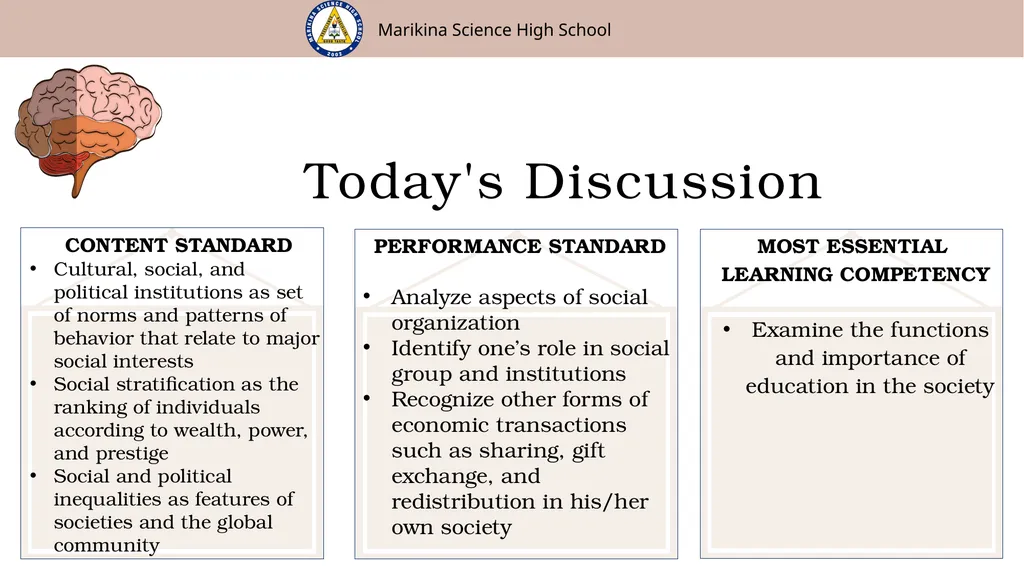
Today's Discussion Marikina Science High School CONTENT STANDARD
Cultural, social, and political institutions as set of norms and patterns of behavior that relate to major social interests
Social stratification as the ranking of individuals according to wealth, power, and prestige
Social and political inequalities as features of societies and the global community PERFORMANCE STANDARD
Analyze aspects of social organization
Identify one’s role in social group and institutions
Recognize other forms of economic transactions such as sharing, gift exchange, and redistribution in his/her own society MOST ESSENTIAL
LEARNING COMPETENCY
Examine the functions and importance of education in the society<br>
45
Marikina Science High School OBJECTIVES
At the end of the lesson, the students should be able to:
Explain and analyze the different historical periods of Philippine education and their contributions to society and present and discuss their researched findings confidently in front of the class.
Analyze the different roles and functions of education and explain at least five specific ways by which education contributes to improving the quality of life of both the individual and society.
Value the importance of education by expressing appreciation of its role in improving their own lives and in contributing to the development of society. INTENTION<br>
46
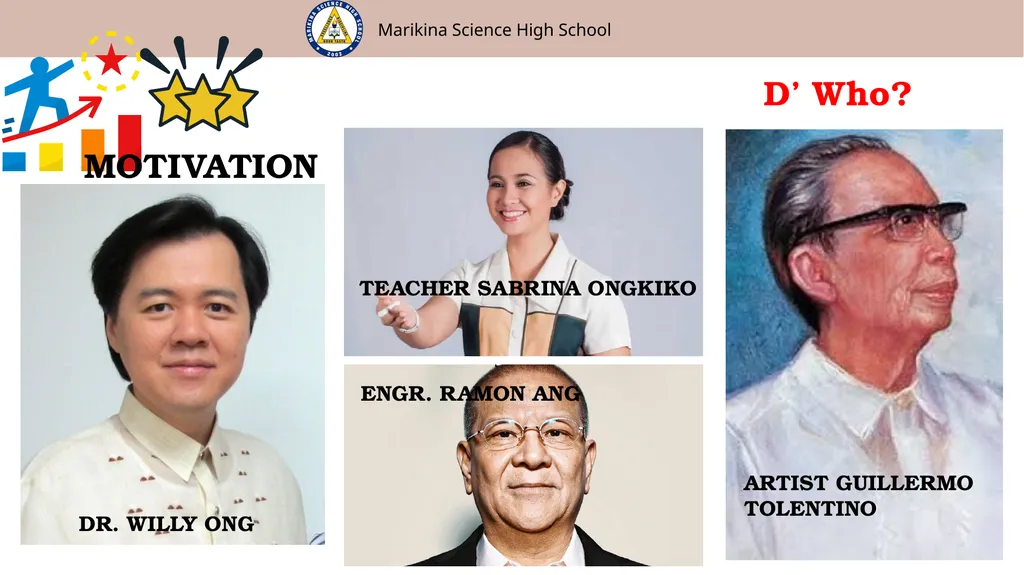
Marikina Science High School MOTIVATION D’ Who? DR. WILLY ONG TEACHER SABRINA ONGKIKO ENGR. RAMON ANG ARTIST GUILLERMO TOLENTINO<br>
47
Marikina Science High School MOTIVATION D’ Who? “What do you think all of these people have in common? How do you think education played a role in their lives?”<br>
48
Department of Education
Division of Marikina
MARIKINA SCIENCE HIGH SCHOOL
Senior High School Department Understanding Culture, Society and Politics<br>
Division of Marikina
MARIKINA SCIENCE HIGH SCHOOL
Senior High School Department Understanding Culture, Society and Politics<br>
49
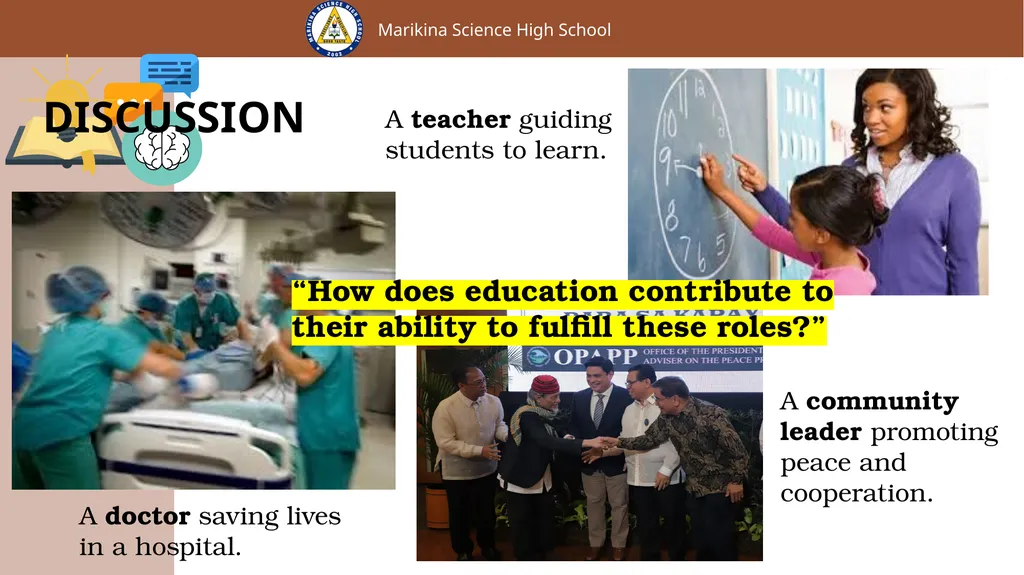
Marikina Science High School DISCUSSION A community leader promoting peace and cooperation. A teacher guiding students to learn. A doctor saving lives in a hospital. “How does education contribute to their ability to fulfill these roles?”<br>
50
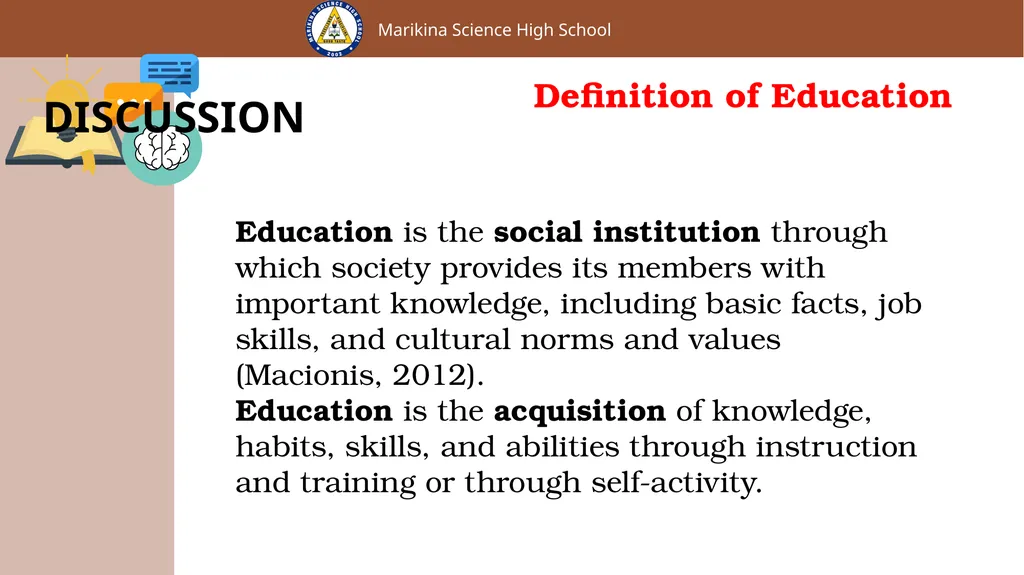
Marikina Science High School DISCUSSION Definition of Education Education is the social institution through which society provides its members with important knowledge, including basic facts, job skills, and cultural norms and values
(Macionis, 2012).
Education is the acquisition of knowledge, habits, skills, and abilities through instruction and training or through self-activity.<br>
(Macionis, 2012).
Education is the acquisition of knowledge, habits, skills, and abilities through instruction and training or through self-activity.<br>
51
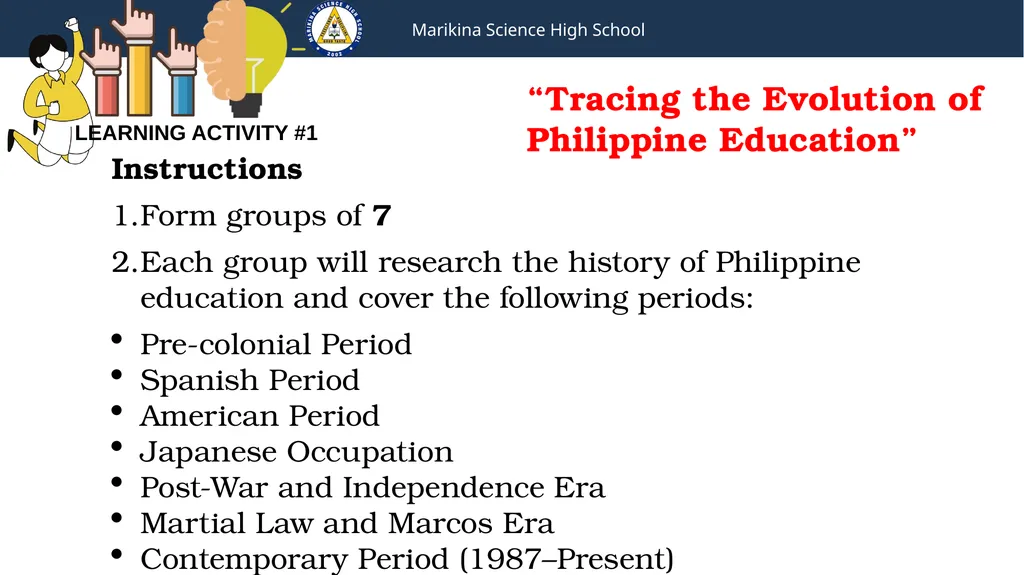
Marikina Science High School LEARNING ACTIVITY #1 “Tracing the Evolution of Philippine Education” Instructions
Form groups of 7
Each group will research the history of Philippine education and cover the following periods:
Pre-colonial Period
Spanish Period
American Period
Japanese Occupation
Post-War and Independence Era
Martial Law and Marcos Era
Contemporary Period (1987–Present)<br>
Form groups of 7
Each group will research the history of Philippine education and cover the following periods:
Pre-colonial Period
Spanish Period
American Period
Japanese Occupation
Post-War and Independence Era
Martial Law and Marcos Era
Contemporary Period (1987–Present)<br>
52
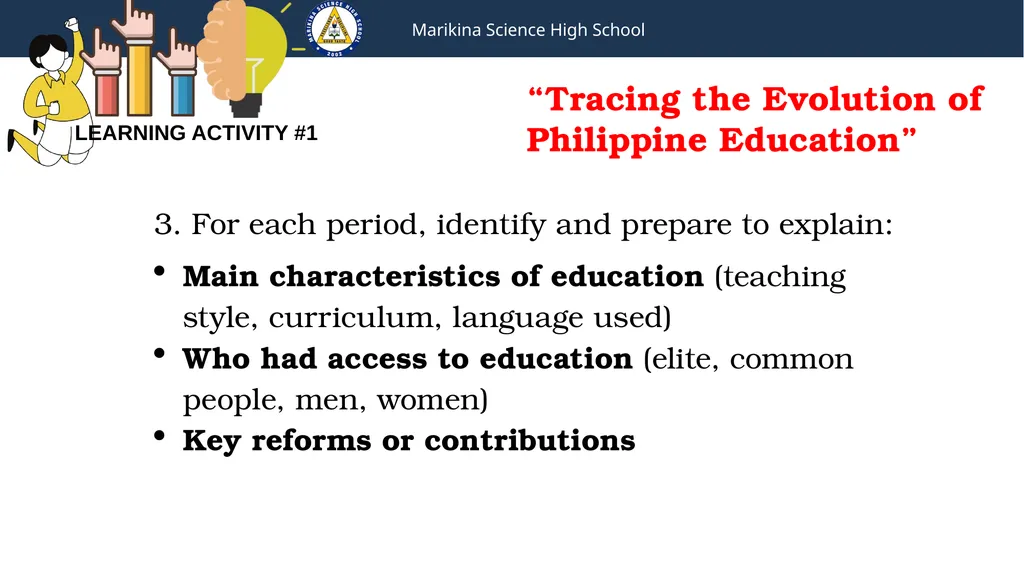
Marikina Science High School LEARNING ACTIVITY #1 “Tracing the Evolution of Philippine Education” 3. For each period, identify and prepare to explain:
Main characteristics of education (teaching style, curriculum, language used)
Who had access to education (elite, common people, men, women)
Key reforms or contributions<br>
Main characteristics of education (teaching style, curriculum, language used)
Who had access to education (elite, common people, men, women)
Key reforms or contributions<br>
53
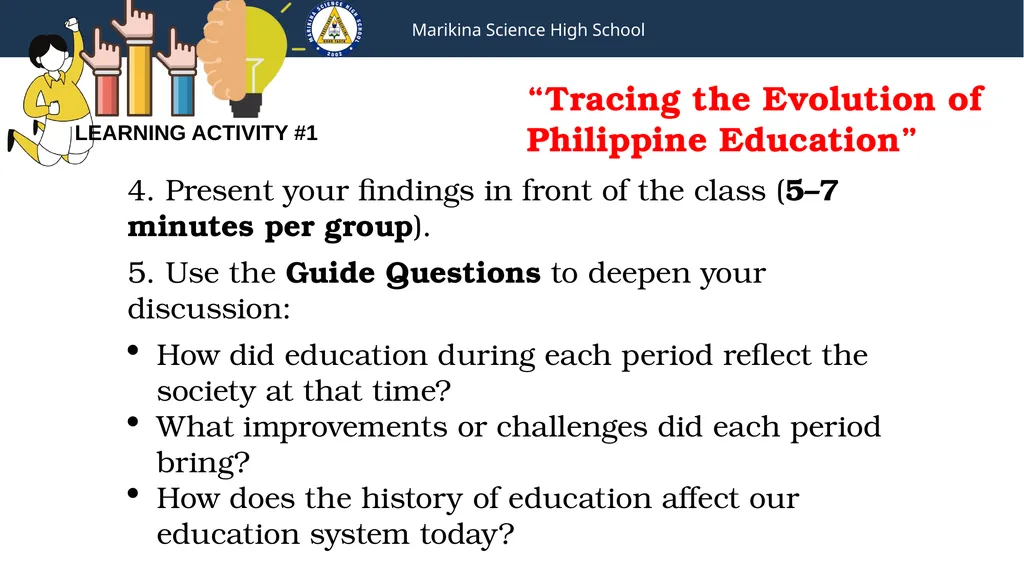
Marikina Science High School LEARNING ACTIVITY #1 “Tracing the Evolution of Philippine Education” 4. Present your findings in front of the class (5–7 minutes per group).
5. Use the Guide Questions to deepen your discussion:
How did education during each period reflect the society at that time?
What improvements or challenges did each period bring?
How does the history of education affect our education system today?<br>
5. Use the Guide Questions to deepen your discussion:
How did education during each period reflect the society at that time?
What improvements or challenges did each period bring?
How does the history of education affect our education system today?<br>
54
Marikina Science High School LEARNING ACTIVITY #1 “Tracing the Evolution of Philippine Education” 6. All members must take part in the discussion (each member should speak).<br>
55
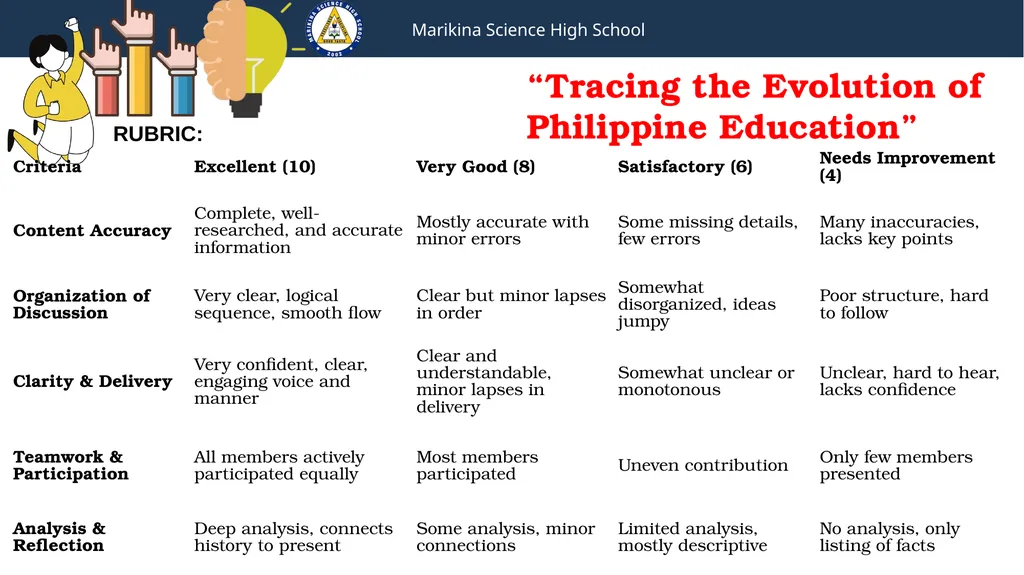
Marikina Science High School RUBRIC: “Tracing the Evolution of Philippine Education”<br>
56
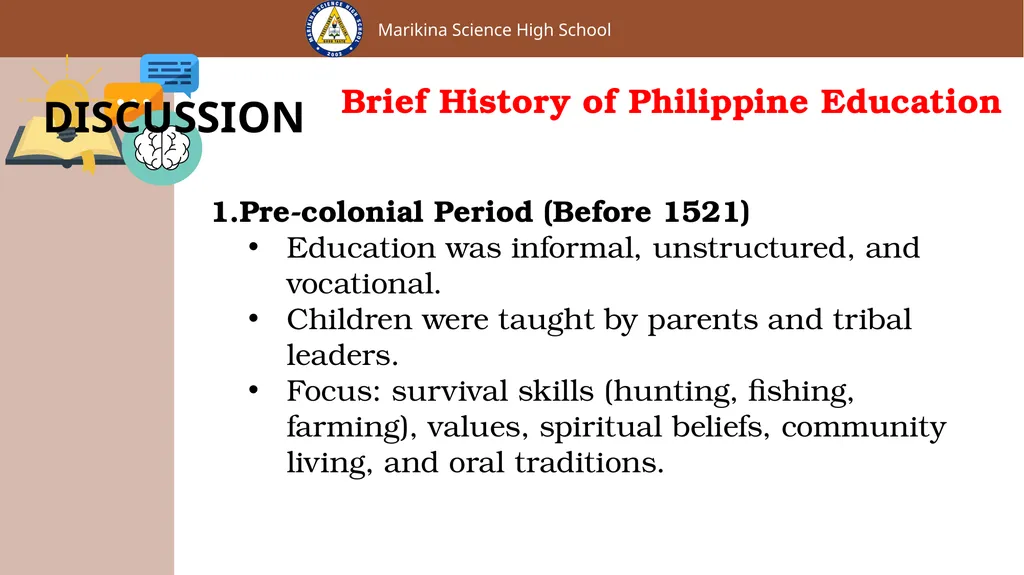
Marikina Science High School DISCUSSION Pre-colonial Period (Before 1521)
Education was informal, unstructured, and vocational.
Children were taught by parents and tribal leaders.
Focus: survival skills (hunting, fishing, farming), values, spiritual beliefs, community living, and oral traditions. Brief History of Philippine Education<br>
Education was informal, unstructured, and vocational.
Children were taught by parents and tribal leaders.
Focus: survival skills (hunting, fishing, farming), values, spiritual beliefs, community living, and oral traditions. Brief History of Philippine Education<br>
57
Marikina Science High School DISCUSSION Brief History of Philippine Education 2. Spanish Period (1521–1898)
Formal education was introduced by Spanish missionaries.
Schools were mostly for the elite and focused on religion, Spanish language, and values.
Establishment of the University of Santo Tomas (1611) – the oldest existing university in Asia.
Education was limited, with inequality between genders and classes.<br>
58
Marikina Science High School DISCUSSION Brief History of Philippine Education 3. American Period (1898–1946)
Public school system established, free and compulsory education introduced.
English became the medium of instruction.
Thomasites (American teachers) arrived to teach Filipinos.
Curriculum focused on democracy, vocational skills, reading, writing, and arithmetic.
Philippine Normal School (now PNU) was founded to train teachers.<br>
59
Marikina Science High School DISCUSSION Brief History of Philippine Education 4. Japanese Occupation (1942–1945)
Schools were controlled by the Japanese.
Focus on “Asia for Asians” and promoting Niponggo (Japanese language).
Education emphasized vocational and moral training, love for work, and Filipino culture.<br>
Schools were controlled by the Japanese.
Focus on “Asia for Asians” and promoting Niponggo (Japanese language).
Education emphasized vocational and moral training, love for work, and Filipino culture.<br>
60
Marikina Science High School DISCUSSION Brief History of Philippine Education 5. Post-War and Independence Era (1946–1972)
Restoration of the American-influenced educational system.
Schools focused on rebuilding nationalism and democracy.
Expansion of higher education institutions and technical-vocational schools.<br>
Restoration of the American-influenced educational system.
Schools focused on rebuilding nationalism and democracy.
Expansion of higher education institutions and technical-vocational schools.<br>
61
Marikina Science High School DISCUSSION Brief History of Philippine Education 6. Martial Law and Marcos Era (1972–1986)
Education was centralized under the Department of Education and Culture.
Curriculum emphasized discipline, nationalism, and technical-vocational skills.
Some censorship in learning materials occurred.<br>
Education was centralized under the Department of Education and Culture.
Curriculum emphasized discipline, nationalism, and technical-vocational skills.
Some censorship in learning materials occurred.<br>
62
Marikina Science High School DISCUSSION Brief History of Philippine Education 7. Contemporary Period (1987–Present)
Education reforms under the 1987 Constitution: free public education in elementary and secondary levels.
The K-12 Program was implemented (2013), extending basic education to 13 years (Kindergarten + Grades 1–12).
Current focus: globalization, technology integration, inclusivity, and quality improvement in education.<br>
63
Marikina Science High School DISCUSSION Brief History of Philippine Education In short: Philippine education evolved from informal community-based learning, to religion-centered Spanish schools, to the democratic and public education system under the Americans, and now to the modern K-12 curriculum that aims to make Filipino learners globally competitive.<br>