
Department of Pharmacology and Toxicology
TG
Published · 21 slides · 0 views

1 / 1


Description
Department of Pharmacology and Toxicology Mustansiriyah University Introduction to Laboratory of Pharmacology Routes Of Drug Administration Laboratory of Pharmacology Pharmacological experiments are designed to study the effects of drugs on
Related Topics
Share
Embed code
Download this presentation From Below
"Department of Pharmacology and Toxicology" is the property of its rightful owner. Permission is granted to download and print the materials on this website for personal, non-commercial use only, and to display it on your personal computer provided you do not modify the materials and that you retain all copyright notices contained in the materials. By downloading content from our website, you accept the terms of this agreement.
Presentation Transcript
01
Department of Pharmacology and Toxicology
Mustansiriyah University Introduction to Laboratory of Pharmacology
Routes Of Drug Administration<br>
Mustansiriyah University Introduction to Laboratory of Pharmacology
Routes Of Drug Administration<br>
02
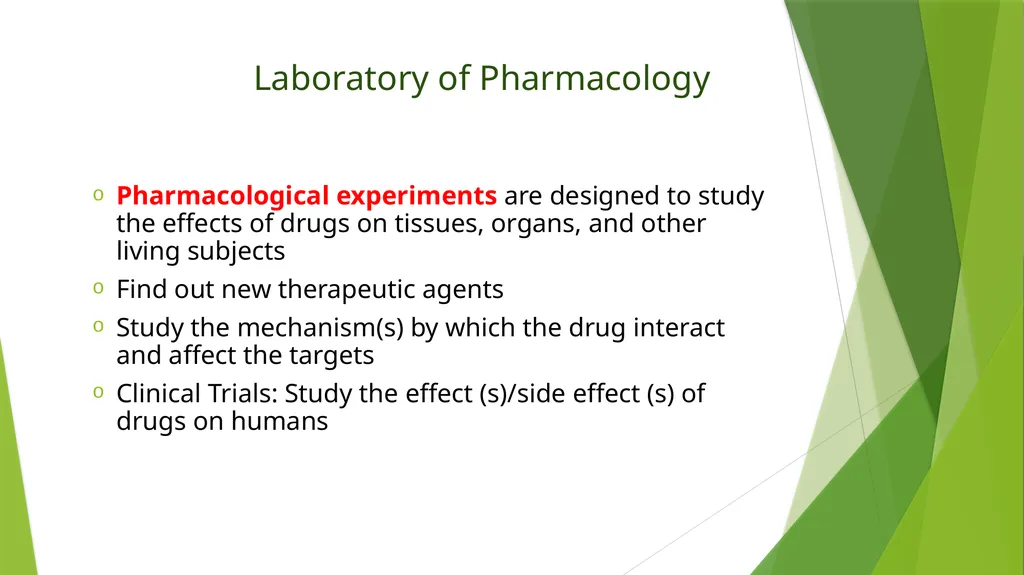
Laboratory of Pharmacology Pharmacological experiments are designed to study the effects of drugs on tissues, organs, and other living subjects
Find out new therapeutic agents
Study the mechanism(s) by which the drug interact and affect the targets
Clinical Trials: Study the effect (s)/side effect (s) of drugs on humans<br>
Find out new therapeutic agents
Study the mechanism(s) by which the drug interact and affect the targets
Clinical Trials: Study the effect (s)/side effect (s) of drugs on humans<br>
03
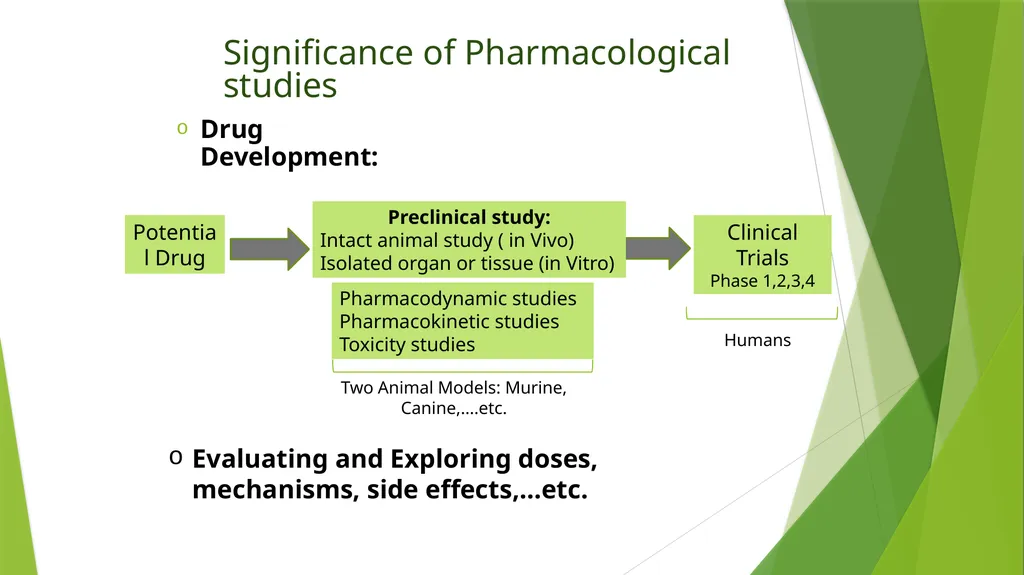
Significance of Pharmacological studies Drug Development: Potential Drug Pharmacodynamic studies
Pharmacokinetic studies
Toxicity studies Two Animal Models: Murine, Canine,….etc. Clinical Trials
Phase 1,2,3,4 Humans Evaluating and Exploring doses, mechanisms, side effects,…etc. Preclinical study:
Intact animal study ( in Vivo)
Isolated organ or tissue (in Vitro)<br>
Pharmacokinetic studies
Toxicity studies Two Animal Models: Murine, Canine,….etc. Clinical Trials
Phase 1,2,3,4 Humans Evaluating and Exploring doses, mechanisms, side effects,…etc. Preclinical study:
Intact animal study ( in Vivo)
Isolated organ or tissue (in Vitro)<br>
04
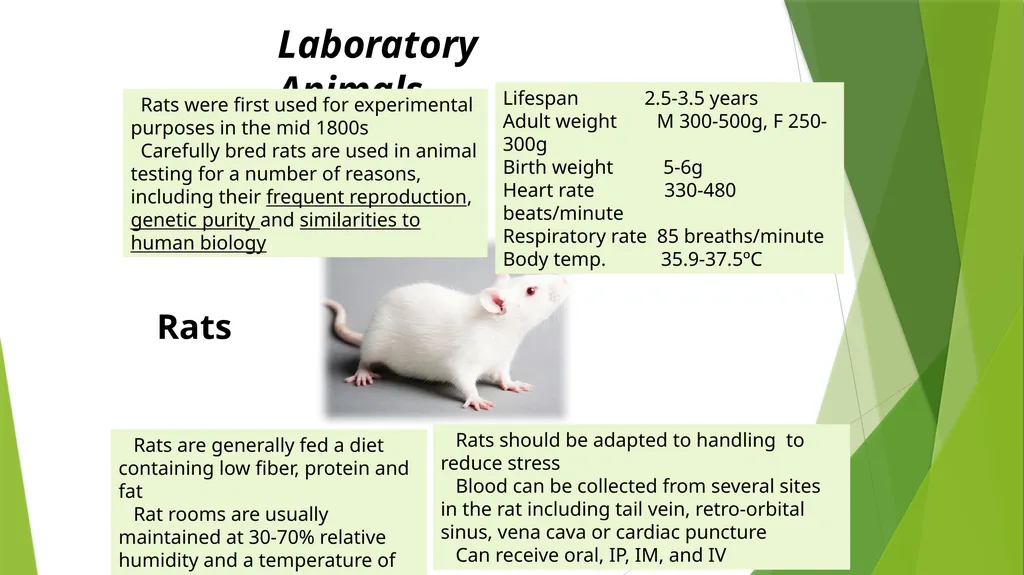
Laboratory Animals Rats were first used for experimental purposes in the mid 1800s
Carefully bred rats are used in animal testing for a number of reasons, including their frequent reproduction, genetic purity and similarities to human biology Lifespan 2.5-3.5 years
Adult weight M 300-500g, F 250-300g
Birth weight 5-6g
Heart rate 330-480 beats/minute
Respiratory rate 85 breaths/minute
Body temp. 35.9-37.5ºC Rats are generally fed a diet containing low fiber, protein and fat
Rat rooms are usually maintained at 30-70% relative humidity and a temperature of 18-26ºC Rats should be adapted to handling to reduce stress
Blood can be collected from several sites in the rat including tail vein, retro-orbital sinus, vena cava or cardiac puncture
Can receive oral, IP, IM, and IV Rats<br>
05
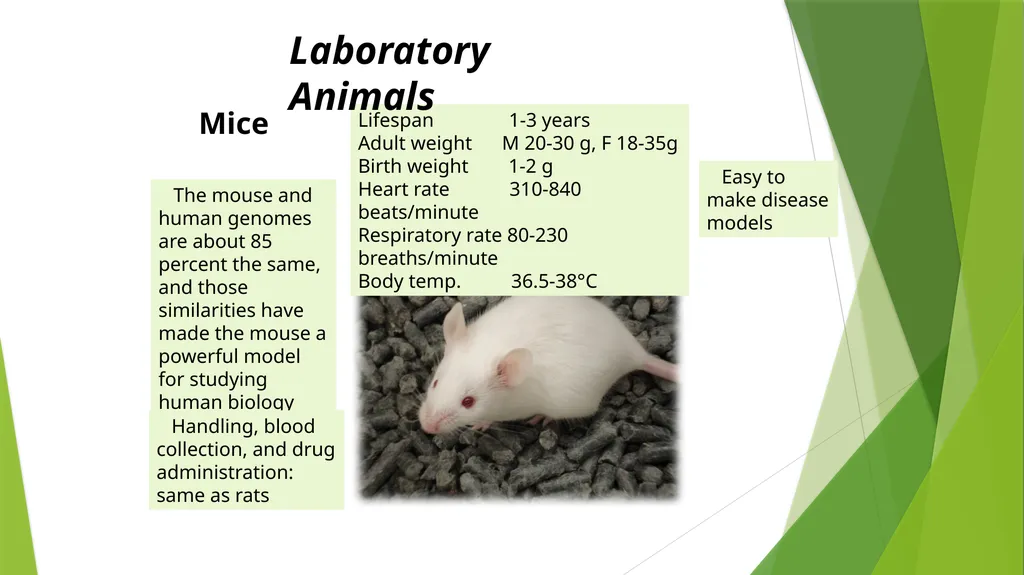
The mouse and human genomes are about 85 percent the same, and those similarities have made the mouse a powerful model for studying human biology and disease Lifespan 1-3 years
Adult weight M 20-30 g, F 18-35g
Birth weight 1-2 g
Heart rate 310-840 beats/minute
Respiratory rate 80-230 breaths/minute
Body temp. 36.5-38°C Easy to make disease models Handling, blood collection, and drug administration: same as rats Laboratory Animals Mice<br>
Adult weight M 20-30 g, F 18-35g
Birth weight 1-2 g
Heart rate 310-840 beats/minute
Respiratory rate 80-230 breaths/minute
Body temp. 36.5-38°C Easy to make disease models Handling, blood collection, and drug administration: same as rats Laboratory Animals Mice<br>
06
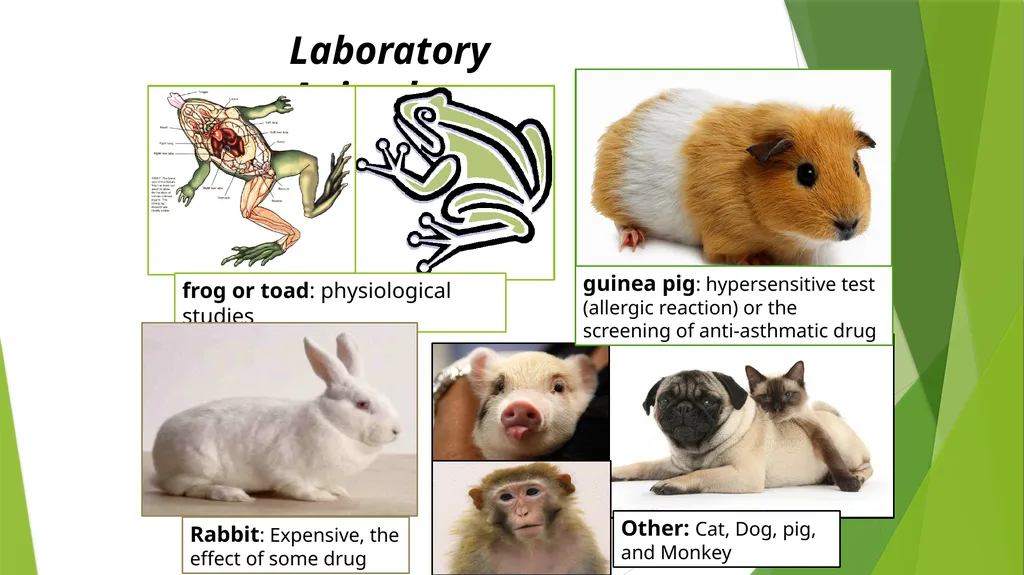
Laboratory Animals<br>
07
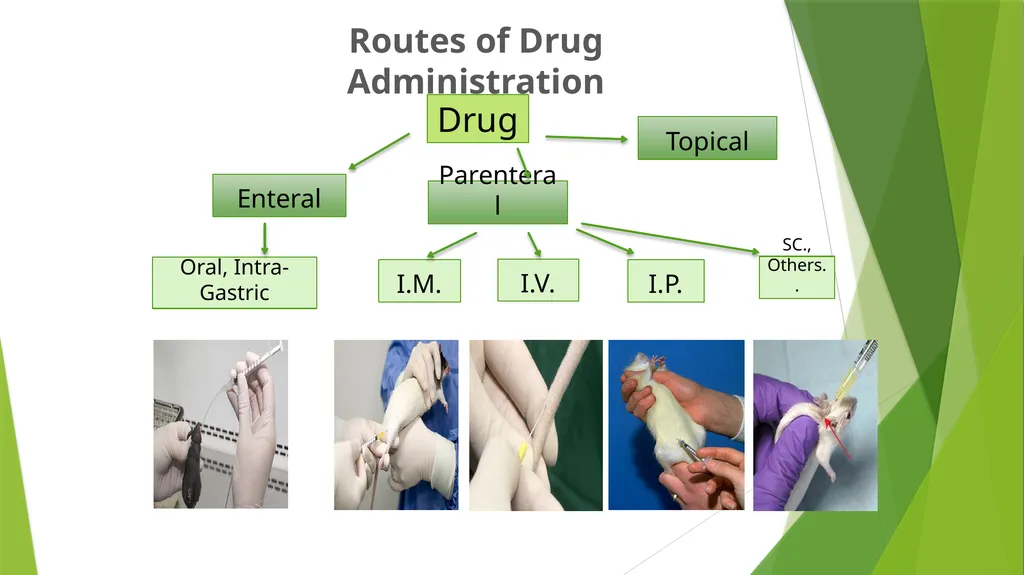
Routes of Drug Administration Drug Enteral Parenteral Oral, Intra-Gastric I.P. I.V. I.M. SC., Others.. Topical<br>
08
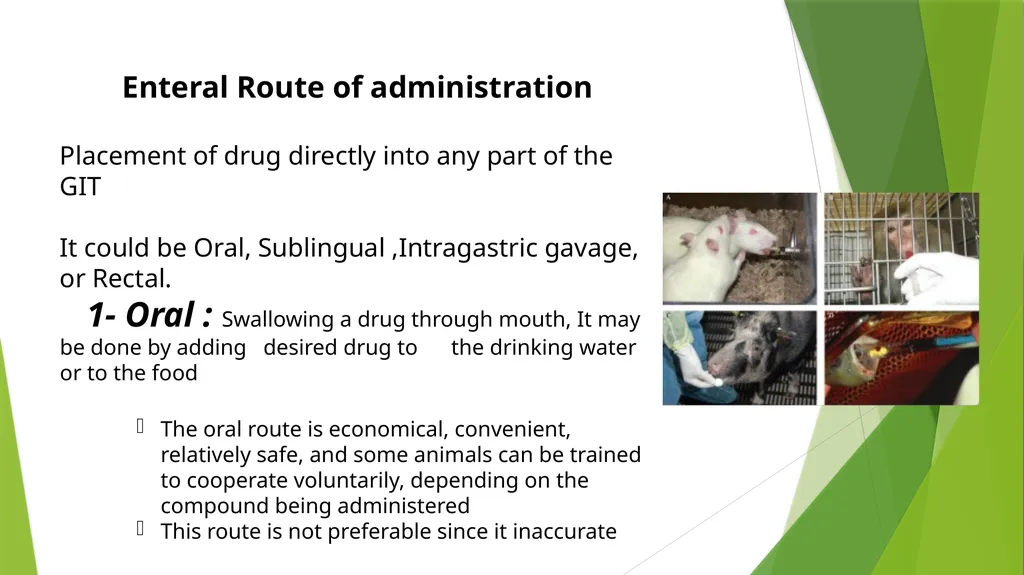
Enteral Route of administration
Placement of drug directly into any part of the GIT
It could be Oral, Sublingual ,Intragastric gavage, or Rectal.
1- Oral : Swallowing a drug through mouth, It may be done by adding desired drug to the drinking water or to the food
The oral route is economical, convenient, relatively safe, and some animals can be trained to cooperate voluntarily, depending on the compound being administered
This route is not preferable since it inaccurate
.<br>
09
Enteral Route of administration
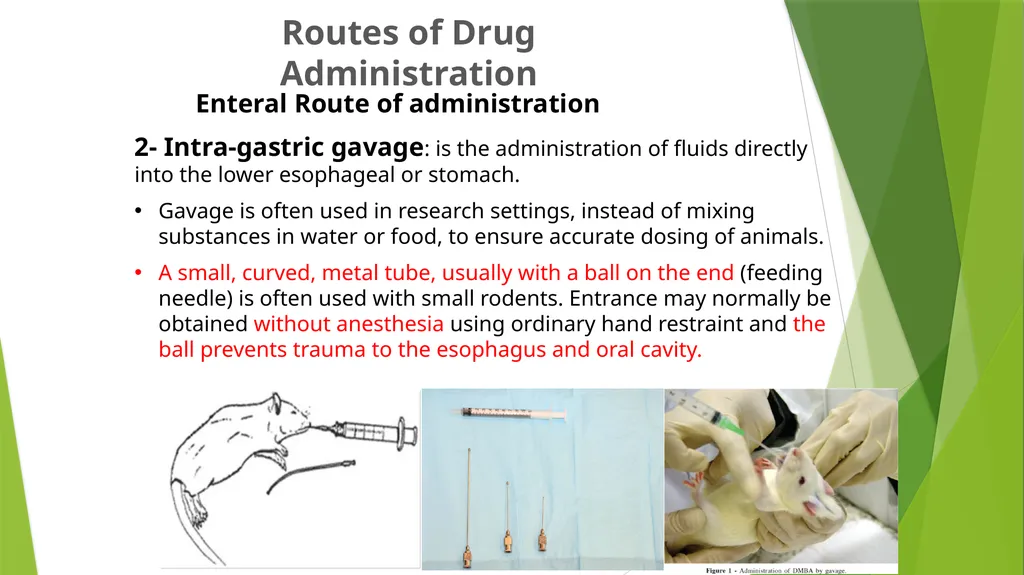
2- Intra-gastric gavage: is the administration of fluids directly into the lower esophageal or stomach.
Gavage is often used in research settings, instead of mixing substances in water or food, to ensure accurate dosing of animals.
A small, curved, metal tube, usually with a ball on the end (feeding needle) is often used with small rodents. Entrance may normally be obtained without anesthesia using ordinary hand restraint and the ball prevents trauma to the esophagus and oral cavity. Routes of Drug Administration<br>
10
Parenteral routes of administration Routes other than Enteral are called Parenteral routes of administration
Parenteral administration methods typically produce the highest bioavailability of substances because these methods avoid the first-pass effect of hepatic metabolism.
1- Intravenous (IV) directly in the vascular system through a vein
2- Intraperitoneal (IP) - injected into the abdominal cavity
3- Intramuscular (IM) injected into a muscle
4- Subcutaneous (SC) injected under the skin
5- Intradermal (ID) - injected between the layers of the skin
6- intracerebral(IC)- injected into the brain
7-Epidural : injected into the epidural space of the spinal cord
8-Intranasal: sprayed into the nose for absorption across the nasal mucous
9- Inhalation: Inspiration through nose or mouth
10-Intra-articular: injection directly into the joint space<br>
11
Procedure
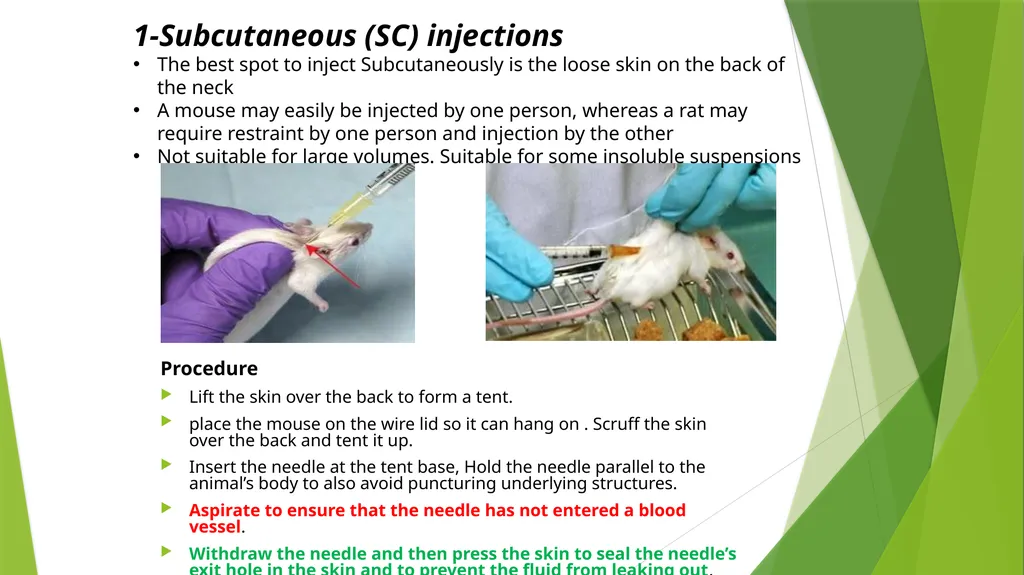
Lift the skin over the back to form a tent.
place the mouse on the wire lid so it can hang on . Scruff the skin over the back and tent it up.
Insert the needle at the tent base, Hold the needle parallel to the animal’s body to also avoid puncturing underlying structures.
Aspirate to ensure that the needle has not entered a blood vessel.
Withdraw the needle and then press the skin to seal the needle’s exit hole in the skin and to prevent the fluid from leaking out. 1-Subcutaneous (SC) injections
The best spot to inject Subcutaneously is the loose skin on the back of the neck
A mouse may easily be injected by one person, whereas a rat may require restraint by one person and injection by the other
Not suitable for large volumes. Suitable for some insoluble suspensions<br>
12
2-Intraperitoneal (IP) injections
Commonly used in rats and mice since muscle mass is so small and veins are difficult to find
Rapid absorption (almost as fast as IV) due to large peritoneal surface
IP administration results in a faster absorption into the vasculature than SC administration l
A mouse may easily be injected by one person, whereas a rat might require restraint by one person and injection by the other
Volume of vehicle ranging between 2 ml/kg to 10 ml/kg<br>
13
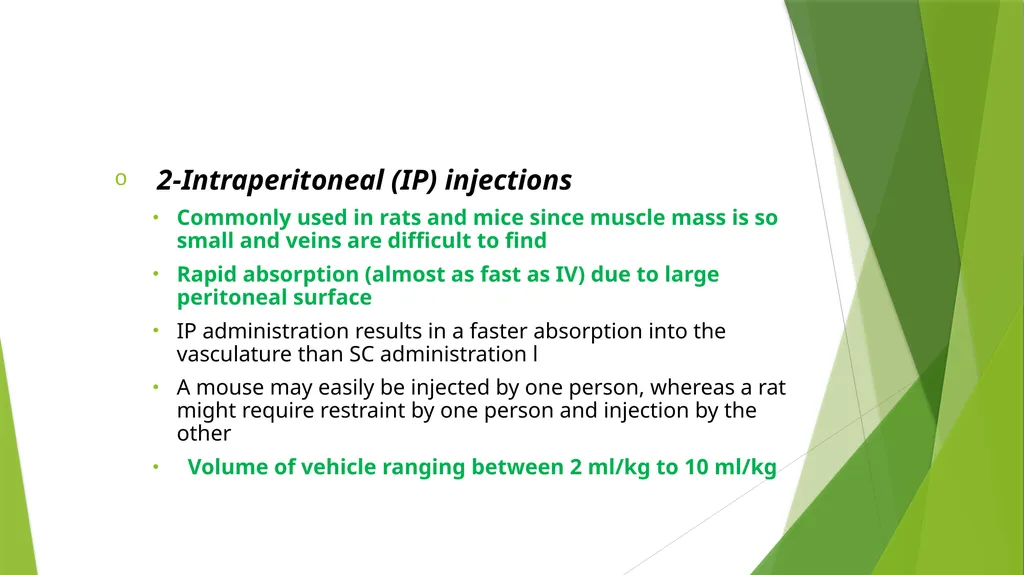
Intraperitoneal (IP) injections The injection site is usually on the animal’s right lower abdominal quadrant
Insert the needle at approximately 45 degree angle
There are three points that you need to pay attention: position/ angel / draw back.
first the position of injection is in the abdomen, not too high, not too low, if too high, liver may be hurt, if too low, bladder may be hurt.
Second, the angle should be about 45 degree.
Third, after the syringe needle has been in the abdomen, before injection, you should draw back the stylet to see if can draw out something, if not , you can go on. If draw out blood or urine, that shows you have fail<br>
14
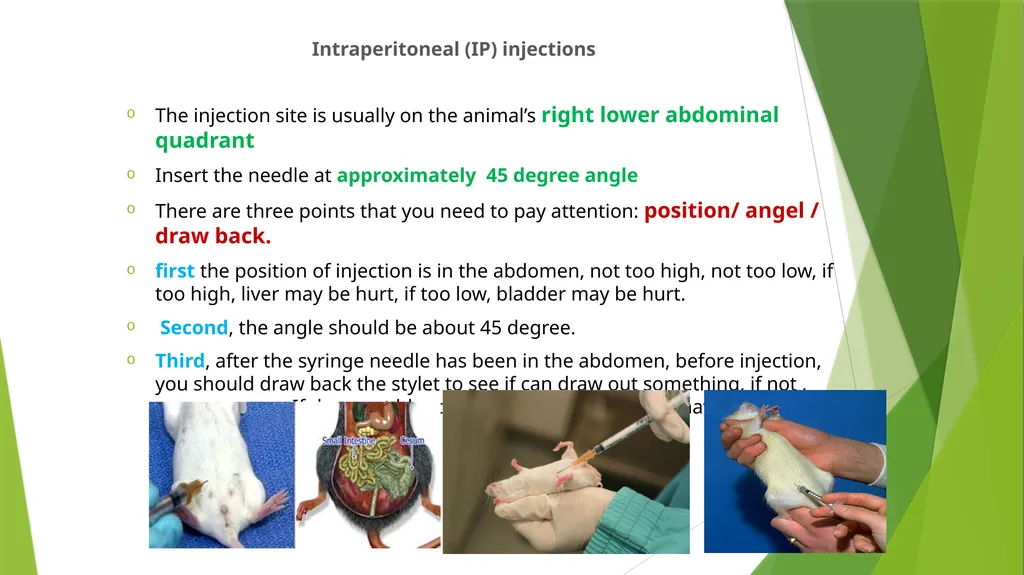
3- Intravenous (IV) injections is the most efficient means of delivering substances to animals because it bypasses the need for solute absorption
Technically difficult, and the use of a restraining device with appropriate size for the animal to be injected, is often required
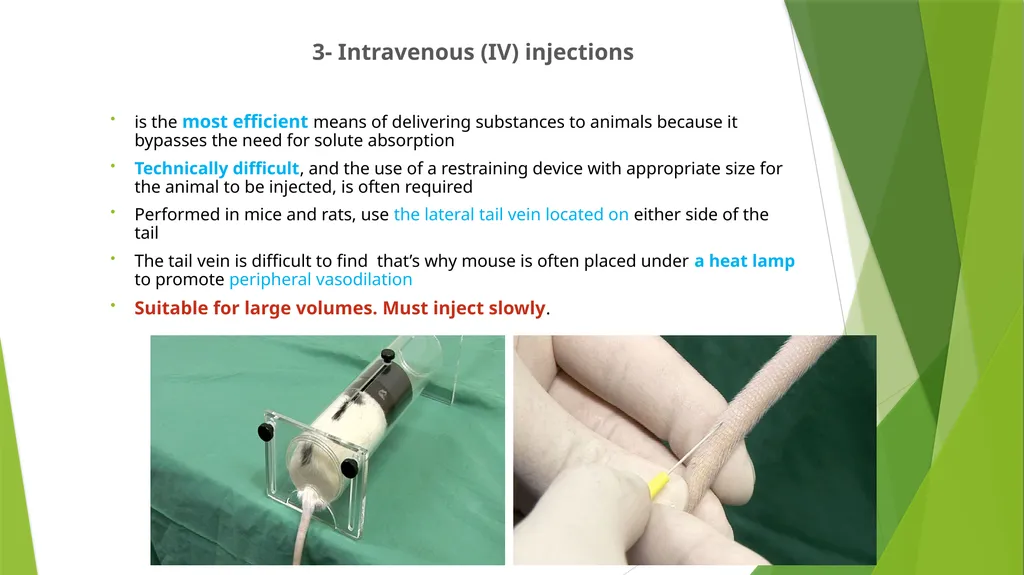
Performed in mice and rats, use the lateral tail vein located on either side of the tail
The tail vein is difficult to find that’s why mouse is often placed under a heat lamp to promote peripheral vasodilation
Suitable for large volumes. Must inject slowly.<br>
15
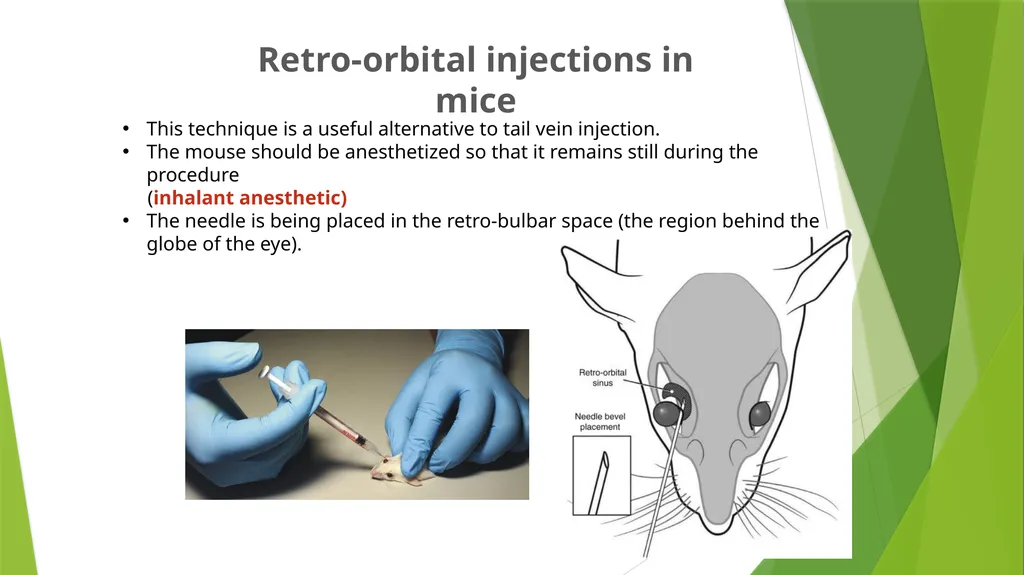
Retro-orbital injections in mice This technique is a useful alternative to tail vein injection.
The mouse should be anesthetized so that it remains still during the procedure
(inhalant anesthetic)
The needle is being placed in the retro-bulbar space (the region behind the globe of the eye).<br>
The mouse should be anesthetized so that it remains still during the procedure
(inhalant anesthetic)
The needle is being placed in the retro-bulbar space (the region behind the globe of the eye).<br>
16
4-Intramuscular (IM) injections
intramuscular injections result in uniform and rapid absorption of substances, because of the rich vascular supply
Not recommended in mice and small species due to their small muscle mass
Smaller volumes are administered intramuscularly than for subcutaneous delivery
Suitable for aqueous or specialized depot preparations<br>
17
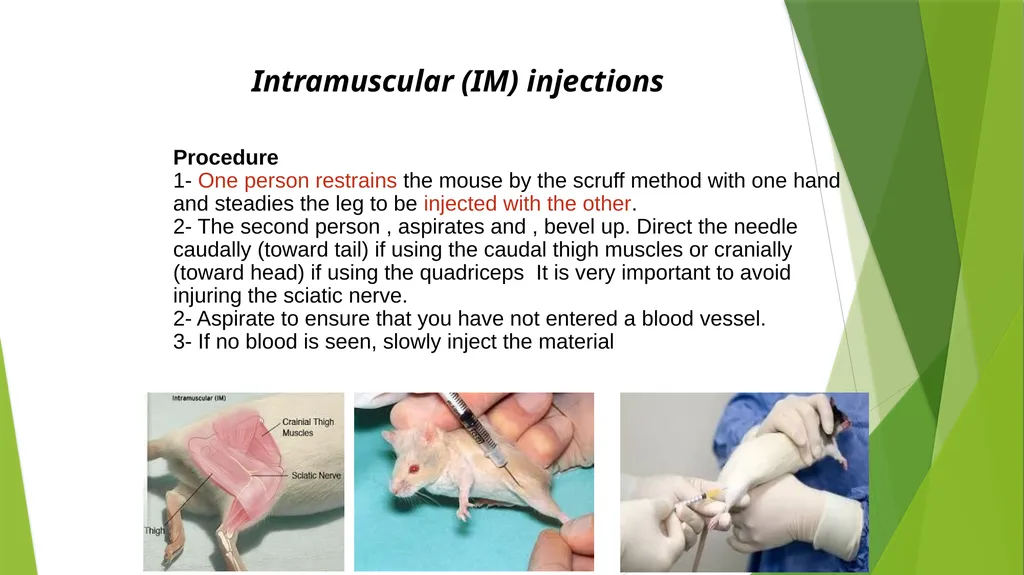
Intramuscular (IM) injections Procedure
1- One person restrains the mouse by the scruff method with one hand and steadies the leg to be injected with the other.
2- The second person , aspirates and , bevel up. Direct the needle caudally (toward tail) if using the caudal thigh muscles or cranially (toward head) if using the quadriceps It is very important to avoid injuring the sciatic nerve. 2- Aspirate to ensure that you have not entered a blood vessel. 3- If no blood is seen, slowly inject the material<br>
18
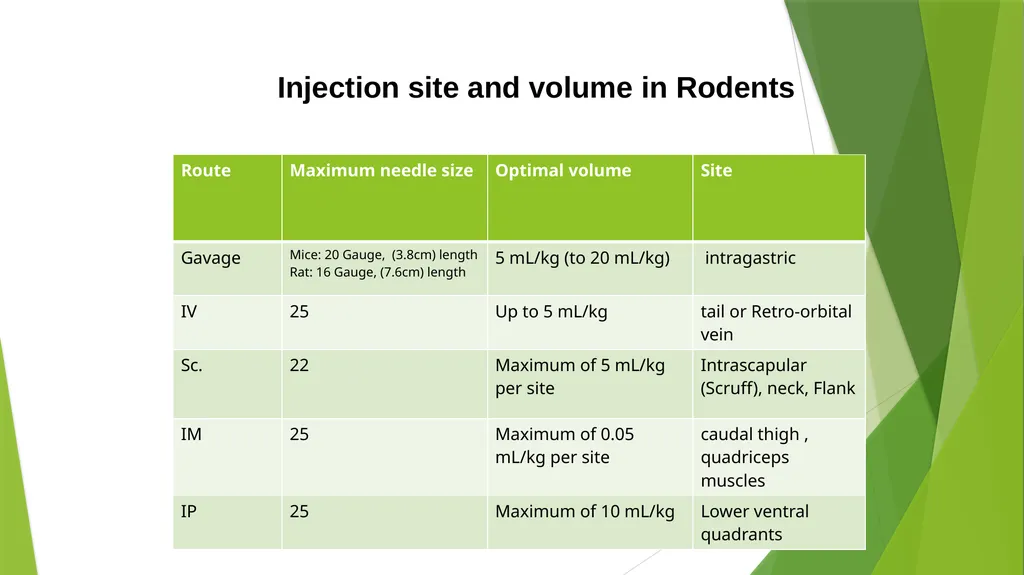
Injection site and volume in Rodents<br>
19
Aim of the experiment Learn how to handling, treating and preparing animals for the experiments and the ethical guidelines during treatments with animal being .
Measure the required volume of a drug in a syringe using aseptic techniques.
Learn how to give different types of routes of administration in this lab which includes: Intraperitonial, intramuscular and subcutaneous.<br>
Measure the required volume of a drug in a syringe using aseptic techniques.
Learn how to give different types of routes of administration in this lab which includes: Intraperitonial, intramuscular and subcutaneous.<br>
20
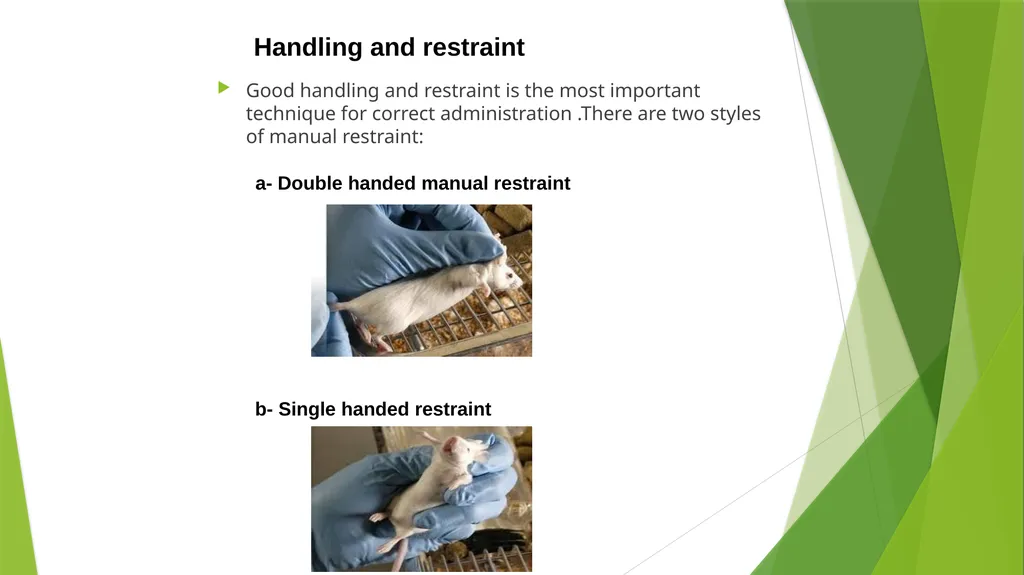
Good handling and restraint is the most important technique for correct administration .There are two styles of manual restraint: a- Double handed manual restraint b- Single handed restraint Handling and restraint<br>