
DEVIKA DEPARTMENT OF INTERAL MEDICINE APPROACH TO
PT
Published · 86 slides · 0 views

1 / 1






Description
DEVIKA DEPARTMENT OF INTERAL MEDICINE APPROACH TO MOVEMENT DISORDERS INTRODUCTION Parkinson disease (PD), tremor, tics and dystonia, are common conditions. The overall prevalence of PD, is 1 in people aged 6585 years, increasing to 4.3
Related Topics
Share
Embed code
Download this presentation From Below
"DEVIKA DEPARTMENT OF INTERAL MEDICINE APPROACH TO" is the property of its rightful owner. Permission is granted to download and print the materials on this website for personal, non-commercial use only, and to display it on your personal computer provided you do not modify the materials and that you retain all copyright notices contained in the materials. By downloading content from our website, you accept the terms of this agreement.
Presentation Transcript
01
DEVIKA
DEPARTMENT OF INTERAL MEDICINE APPROACH TO MOVEMENT DISORDERS<br>
DEPARTMENT OF INTERAL MEDICINE APPROACH TO MOVEMENT DISORDERS<br>
02
INTRODUCTION Parkinson disease (PD), tremor, tics and dystonia, are common conditions.
The overall prevalence of PD, is 1% in people aged 65–85 years, increasing to 4.3% above the age of 85 years.
Essential tremor—the most common form of tremor—is 4% in people aged over 40 years, increasing to 14% in people over 65 years of age.
Tics in school-age children and adolescents can be as high as 21%.<br>
03
The clinical presentation of movement disorders is complex, often variable, and sometimes even bizarre.
Establishing the correct diagnosis can, therefore, be difficult
However, accurate recognition based on clinical acumen is important for several reasons.<br>
Establishing the correct diagnosis can, therefore, be difficult
However, accurate recognition based on clinical acumen is important for several reasons.<br>
04
No specific biological marker is available that can unambiguously diagnose the underlying disease.
Many diagnostic tests are expensive and time- consuming, and sometimes invasive.
Moreover, the diagnostic value of these tests (over and above clinical judgment) is often limited, especially in early stages of the disease<br>
Many diagnostic tests are expensive and time- consuming, and sometimes invasive.
Moreover, the diagnostic value of these tests (over and above clinical judgment) is often limited, especially in early stages of the disease<br>
05
Adequate classification—as a means to establish the correct diagnosis—often has prognostic implications.
For example, essential tremor is sometimes mistaken for early PD, but the prognosis is clearly different.<br>
For example, essential tremor is sometimes mistaken for early PD, but the prognosis is clearly different.<br>
06
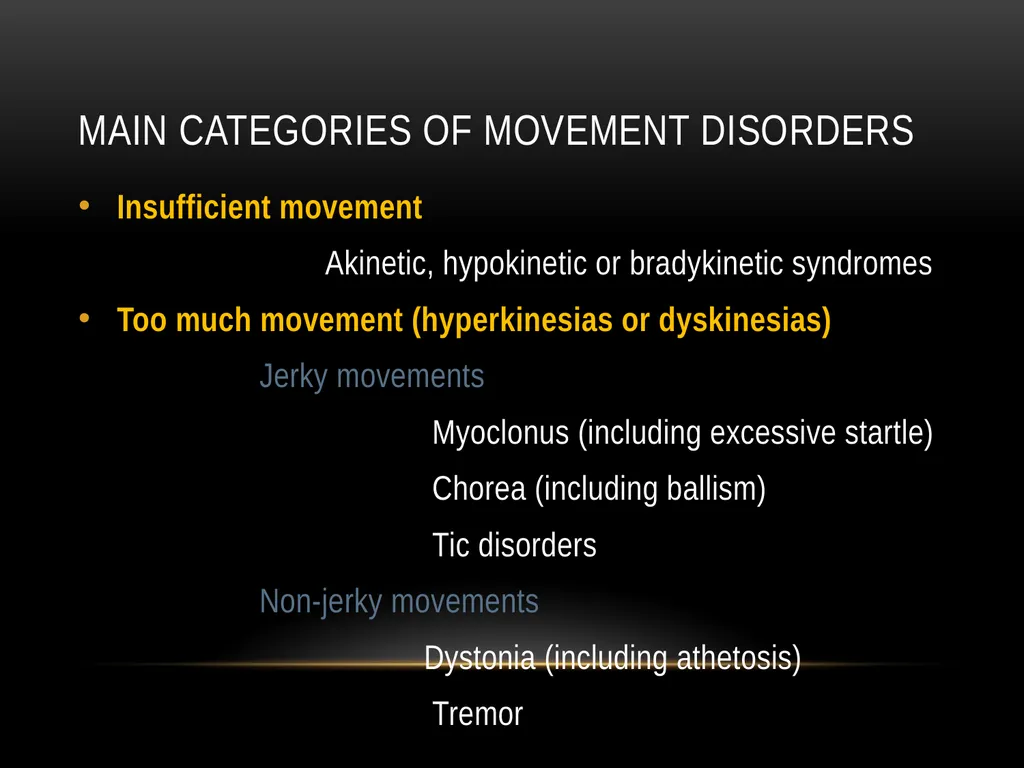
MAIN CATEGORIES OF MOVEMENT DISORDERS Insufficient movement
Akinetic, hypokinetic or bradykinetic syndromes
Too much movement (hyperkinesias or dyskinesias)
Jerky movements
Myoclonus (including excessive startle)
Chorea (including ballism)
Tic disorders
Non-jerky movements
Dystonia (including athetosis)
Tremor<br>
Akinetic, hypokinetic or bradykinetic syndromes
Too much movement (hyperkinesias or dyskinesias)
Jerky movements
Myoclonus (including excessive startle)
Chorea (including ballism)
Tic disorders
Non-jerky movements
Dystonia (including athetosis)
Tremor<br>
07
AKINETIC RIGID SYNDROMES Akinesia involves both bradykinesia and hypokinesia
Bradykinesia is the slowness of movement
Hypokinesia is the poverty of movement, and movements that are smaller than intended
In the widely used Queen square Brain Bank Criteria for the diagnosis of parkinsonism, bradykinesia is defined as including fatiguing and decrement of repetitive alternating movements, which we would consider under the broader rubric of akinesia<br>
08
IMP OF IDENTIFYING FATIGUE AND DECREMENT patients with an UMN presentation of ALS (with pyramidal slowing, and increased tone due to spasticity) can, in rare cases, be misdiagnosed as having parkinsonism
Ie pyramidal and cerebellar disease can have slowness with extra clumsiness but not fatigue<br>
Ie pyramidal and cerebellar disease can have slowness with extra clumsiness but not fatigue<br>
09
PARKINSONISM 6 Cardinal Features of Parkinsonism:
Tremor at rest
Bradykniesia/Hypokinesia/akinesia
Rigidity
Flexed posture of the neck, trunk and limbs
Loss of postural reflexes
Freezing<br>
Tremor at rest
Bradykniesia/Hypokinesia/akinesia
Rigidity
Flexed posture of the neck, trunk and limbs
Loss of postural reflexes
Freezing<br>
10
JERKY HYPERKINETIC SYNDROMES MYOCLONUS
CHOREA
TICS<br>
CHOREA
TICS<br>
11
myoclonic movements are sudden, brief, shock-like involuntary movements
Positive or negative
Positive is caused by muscle contraction
Negative is due to loss of muscle tone----asterixis<br>
Positive or negative
Positive is caused by muscle contraction
Negative is due to loss of muscle tone----asterixis<br>
12
Myoclonus -likened to stimulating the nerve supplying the muscle with a single electric shock (or with a train of shocks, because the myoclonic jerks can occur repetitively within the same muscle).
Therefore, the keywords in identifying myoclonus are ‘shock-like movements’<br>
Therefore, the keywords in identifying myoclonus are ‘shock-like movements’<br>
13
Mistaken for irregular tremor
In polyminimyoclonus
Fine irregular finger jerks in outstretched hand
Can be benign/severe
Benign while waking up or falling asleep---hypnagogic reflex<br>
In polyminimyoclonus
Fine irregular finger jerks in outstretched hand
Can be benign/severe
Benign while waking up or falling asleep---hypnagogic reflex<br>
14
Due to Abnormal discharges from cortical, sub,brainstem/sc regions
Particularly in hypoxemia
Post cardiac arrest resuscitation<br>
Particularly in hypoxemia
Post cardiac arrest resuscitation<br>
15
Treated with combination of GABA nergic agents
Valproic acid
Piracetam
clonazepa,m
leviteracetam<br>
Valproic acid
Piracetam
clonazepa,m
leviteracetam<br>
16
CHOREA May not be appreciated as being a jerky movement disorder perhaps because the word chorea (Greek for ‘dance’) suggests a certain grace rather than abrupt, jerky movements.
Individually they are jerky in nature.
Thus, chorea can be defined as involuntary movements that are abrupt, unpredictable and non rhythmic, resulting from a continuous random flow of muscle contractions.<br>
Individually they are jerky in nature.
Thus, chorea can be defined as involuntary movements that are abrupt, unpredictable and non rhythmic, resulting from a continuous random flow of muscle contractions.<br>
17
DIFFERENCE FROM MYOCLONUS A key difference from myoclonus is that the pattern of movements randomly changes from one body part to another, conveying the impression of ‘fidgeting’ to the observer.
Key word to describe it is randomly flowing jerks.<br>
Key word to describe it is randomly flowing jerks.<br>
18
Can be partially suppressed or camouflaged into semi-purposeful voluntary movements
Prototypical example is Huntington’s disease
The velocity of chorea can vary. The flowing component of chorea is usually faster than that of dystonia but not as fast as the jerking component of myoclonus.<br>
Prototypical example is Huntington’s disease
The velocity of chorea can vary. The flowing component of chorea is usually faster than that of dystonia but not as fast as the jerking component of myoclonus.<br>
19
SIGNS IN CHOREA Motor impersistence.
Milkmaid’s grip-inability to maintain muscle contraction
Jack in the box or lizard sign- Pt is asked to keep the tongue protruded ,it retracts involuntary due to superimposed chorea<br>
Milkmaid’s grip-inability to maintain muscle contraction
Jack in the box or lizard sign- Pt is asked to keep the tongue protruded ,it retracts involuntary due to superimposed chorea<br>
20
difficulties in chorea patients frequently try to mask their chorea by incorporating the jerks into voluntary movements.
choreatic patients often have relatively few subjective complaints, especially in early stages<br>
choreatic patients often have relatively few subjective complaints, especially in early stages<br>
21
approach Age of onset
Infancy/childhood onset
acute or sub acute mc is sydenham’s
insidious in pediatric metabolic disorder<br>
Infancy/childhood onset
acute or sub acute mc is sydenham’s
insidious in pediatric metabolic disorder<br>
22
Adult onset
insidious-AD disorders
acute/subacute in SLE,CNS VASCULITIS,NON KETOTIC HYPERGLYCEMIA<br>
insidious-AD disorders
acute/subacute in SLE,CNS VASCULITIS,NON KETOTIC HYPERGLYCEMIA<br>
23
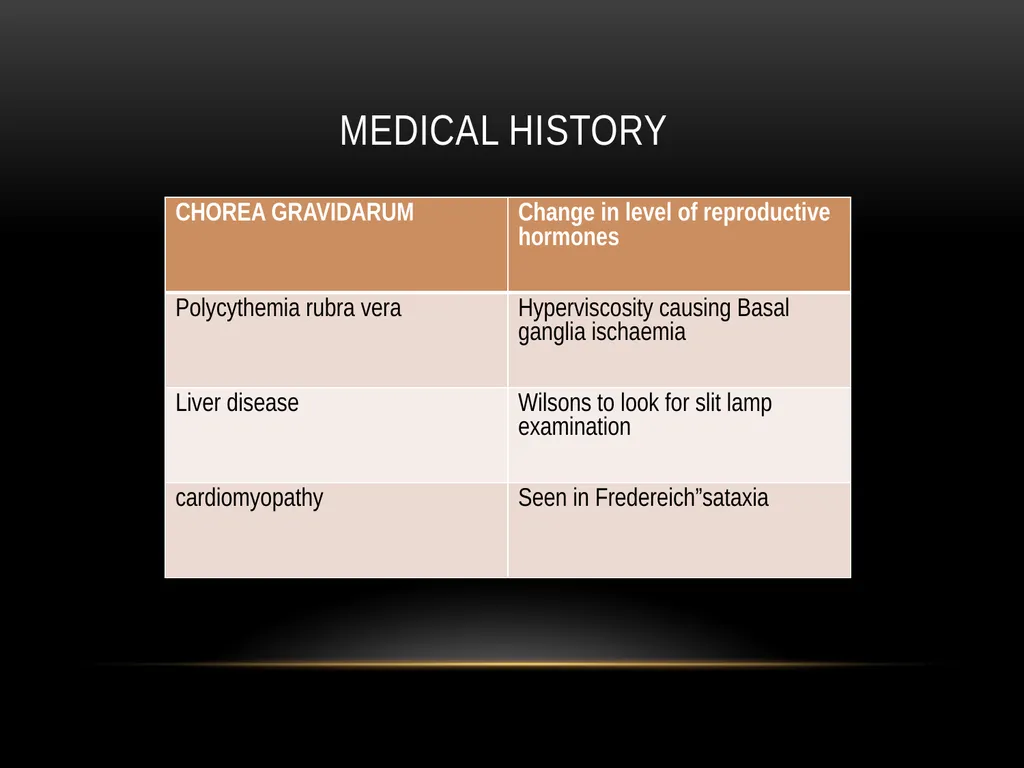
MEDICAL HISTORY<br>
24
DiSTRIBUTION OF CHOREA HD-predominantly proximal
Neuroleptic induced-mainly facial muscles
Structural lesions –unilateral chorea<br>
Neuroleptic induced-mainly facial muscles
Structural lesions –unilateral chorea<br>
25
HUNTINGTON DISEASE Progressive fatal
25 to 45 years
Primarily affect striatum
Etiology is increase in polyglutamines(CAG repeats)> 40 in coding sequence of short arm of chromosome 4<br>
25 to 45 years
Primarily affect striatum
Etiology is increase in polyglutamines(CAG repeats)> 40 in coding sequence of short arm of chromosome 4<br>
26
Treatment is dopamine blocking agents that may control choreatic movements
Tetrabenazine
Presynaptic dopamine blocking agent
Can cause secondary parkinsonism<br>
Tetrabenazine
Presynaptic dopamine blocking agent
Can cause secondary parkinsonism<br>
27
BALLISMUS Ballistic movements are uncontrollable, severe, mainly proximal, large-amplitude choreatic movements.
they are usually unilateral (hemiballism),
classically described after an acute lesion in the region of the contralateral subthalamic nucleus<br>
they are usually unilateral (hemiballism),
classically described after an acute lesion in the region of the contralateral subthalamic nucleus<br>
28
Keywords…violent flinging movements
Causes
cerebral infarct –MCC
medications-levodopa, phenytoin
metabolic abnormalities
Treatment dopamine antagonists<br>
Causes
cerebral infarct –MCC
medications-levodopa, phenytoin
metabolic abnormalities
Treatment dopamine antagonists<br>
29
tics Consist of abnormal movements and abnormal sounds
Vary in severity over time
Usually preceded by uncomfortable feeling or sensory urge that is relieved by carrying out the movement
“involuntary”
May be simple or complex
Often suppressible<br>
Vary in severity over time
Usually preceded by uncomfortable feeling or sensory urge that is relieved by carrying out the movement
“involuntary”
May be simple or complex
Often suppressible<br>
30
keyword for recognition is the ‘stereotyped’ character of the recurrent movements.
another fundamental difference from myoclonus and chorea is that patients report that their tics are preceded by rising discomfort or urge (‘sensory tic’) that is relieved by the actual movement (‘itch and scratch’ analogy.<br>
another fundamental difference from myoclonus and chorea is that patients report that their tics are preceded by rising discomfort or urge (‘sensory tic’) that is relieved by the actual movement (‘itch and scratch’ analogy.<br>
31
suppression of tics typically comes at the expense of mounting inner tension, leading to a ‘rebound’ of tics afterwards<br>
32
CLASSIFICATION simple tics ( eye blinking, nose wrinkling, shoulder shrugging ) or complex tics ( touching things, smelling objects, jumping).
motor tics (such as stereotyped head jerks) or phonic tics (repetitive sniffs or sounds, words or even sentences).<br>
motor tics (such as stereotyped head jerks) or phonic tics (repetitive sniffs or sounds, words or even sentences).<br>
33
DIAGNOSTIC PITFALLS that tics are often less prominent or even absent in the clinical examination room as the anxiety associated with being examined suppresses the phenomenon.
videotaping the patient without an examiner present can, therefore, be very helpful.<br>
videotaping the patient without an examiner present can, therefore, be very helpful.<br>
34
Occasionally, a motor tic can have an abrupt onset, but the subsequent movement or posture might be slow or prolonged rather than jerky.
This phenomenon is referred to as a dystonic tic, but the suppressibility and stereotyped nature are the clinical clues to classifying such movements as a tic<br>
This phenomenon is referred to as a dystonic tic, but the suppressibility and stereotyped nature are the clinical clues to classifying such movements as a tic<br>
35
Gilles de la tourette’s syndrome Both multiple motor and one or more vocal tics
Tics occur many times a day or have occurred intermittently for >1 year
During this period of one year , a tic free period of >3 consecutive months have never occurred
Assosciated behavioural disturbances
Treatment- haloperidol<br>
Tics occur many times a day or have occurred intermittently for >1 year
During this period of one year , a tic free period of >3 consecutive months have never occurred
Assosciated behavioural disturbances
Treatment- haloperidol<br>
36
Genetic usually
Autoimmune re response to beta hemolytic streptococci<br>
Autoimmune re response to beta hemolytic streptococci<br>
37
NON JERKY HYPERKINETIC SYNDROMES
TREMOR DYSTONIA<br>
TREMOR DYSTONIA<br>
38
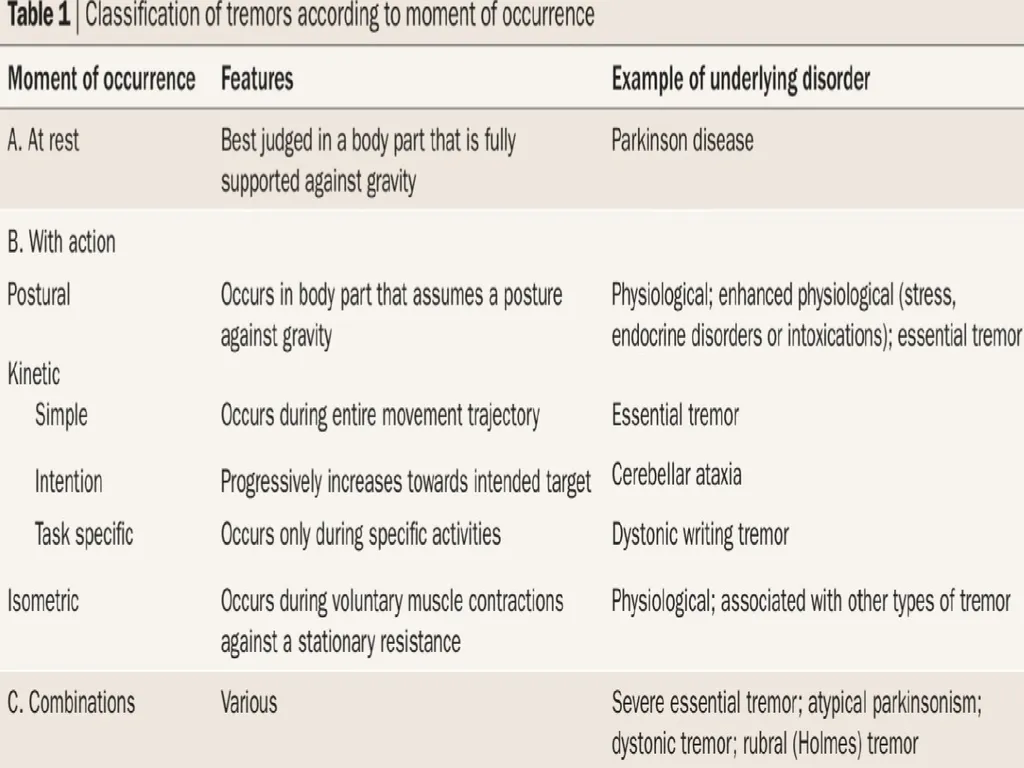
TREMORS By involuntary, rhythmic and sinusoidal alternating movements of one or more body parts.
The movement does not necessarily involve a limb, as tremor can affect almost any body part, including the head, chin and soft palate.
Rhythmic alternating contractions of agonists and antagonist muscles.<br>
The movement does not necessarily involve a limb, as tremor can affect almost any body part, including the head, chin and soft palate.
Rhythmic alternating contractions of agonists and antagonist muscles.<br>
39
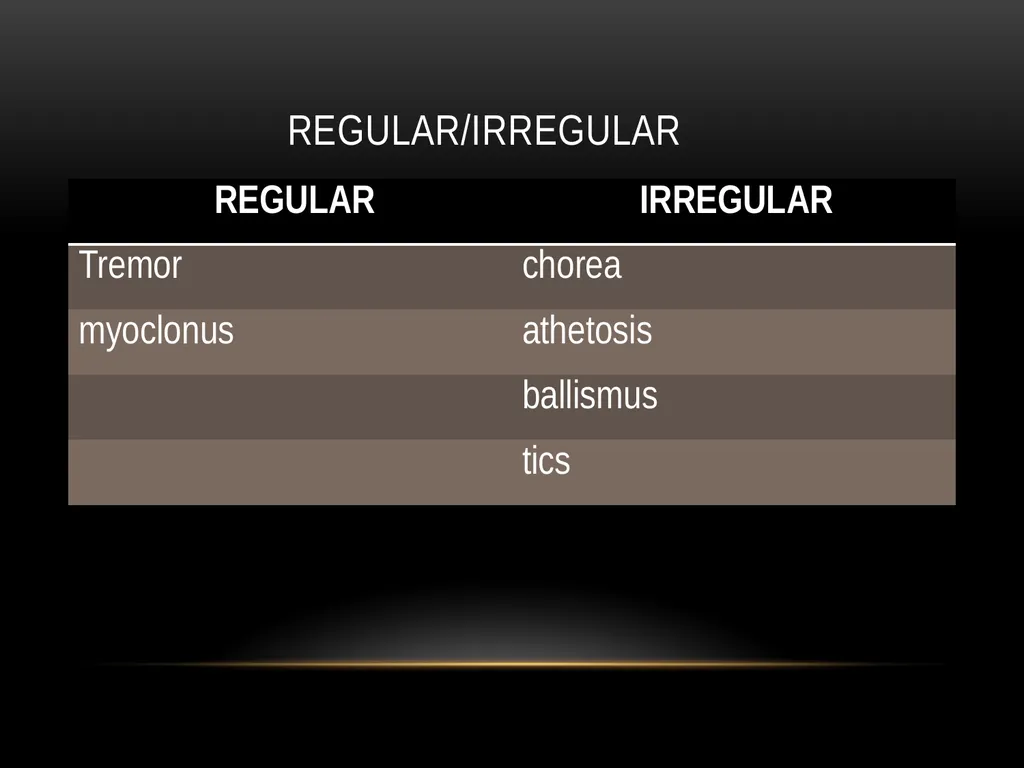
The keyword in identifying tremor is ‘rhythmicity’; that is, the oscillations occur at a regular frequency<br>
40
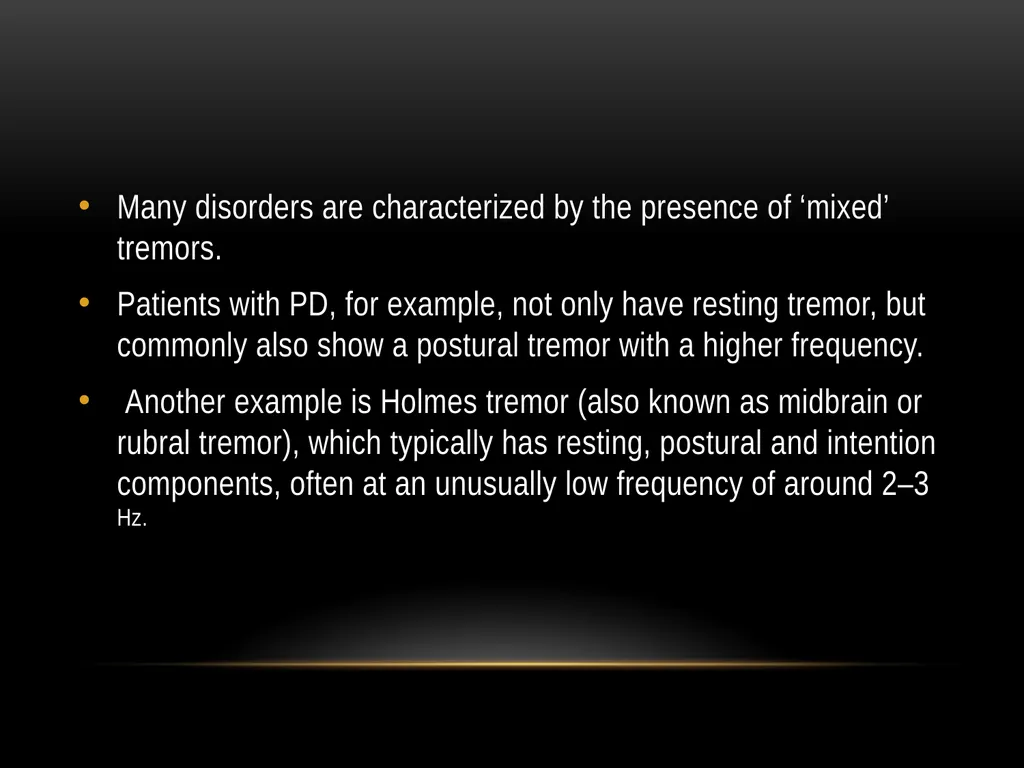
Many disorders are characterized by the presence of ‘mixed’ tremors.
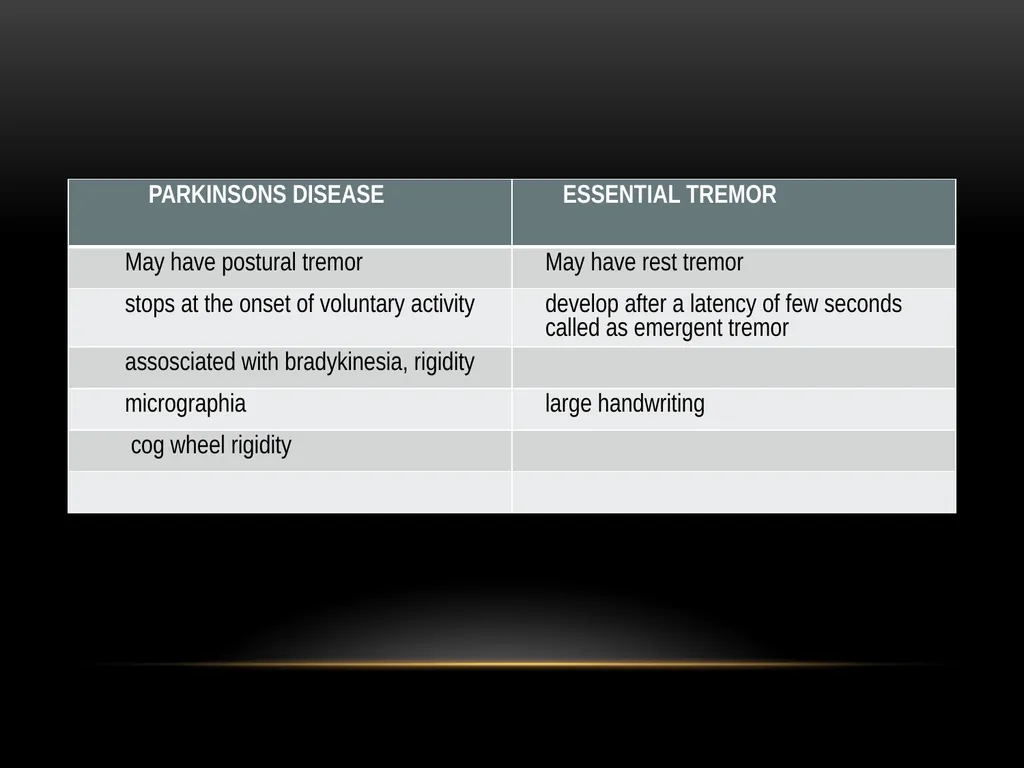
Patients with PD, for example, not only have resting tremor, but commonly also show a postural tremor with a higher frequency.
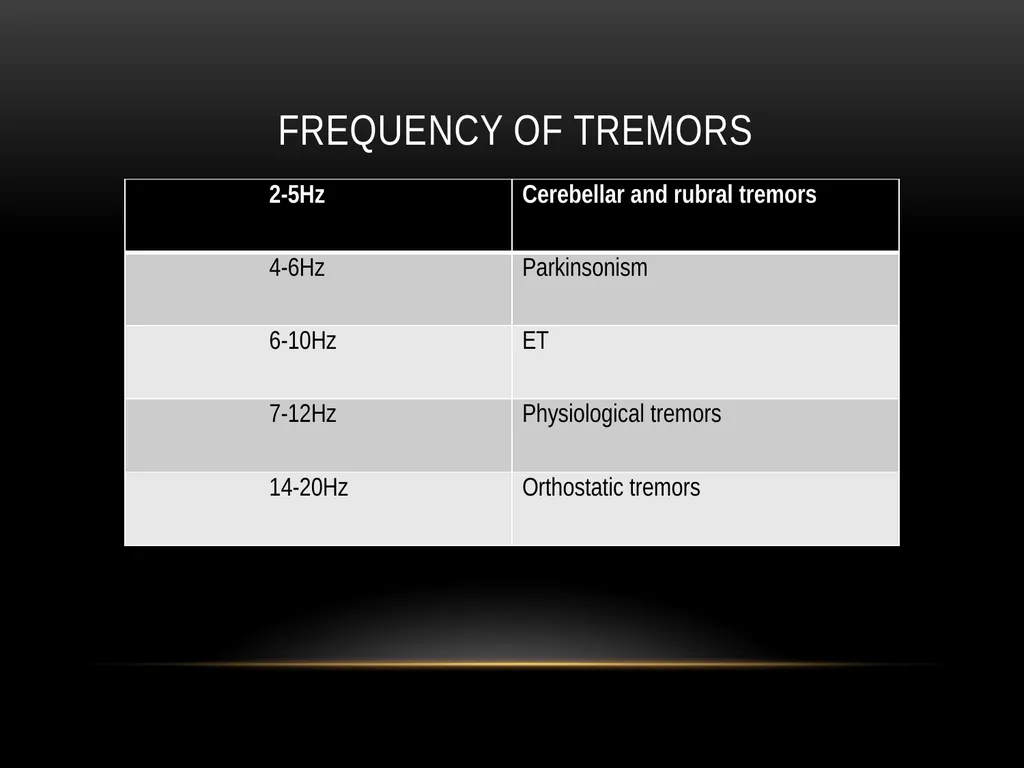
Another example is Holmes tremor (also known as midbrain or rubral tremor), which typically has resting, postural and intention components, often at an unusually low frequency of around 2–3 Hz.<br>
41
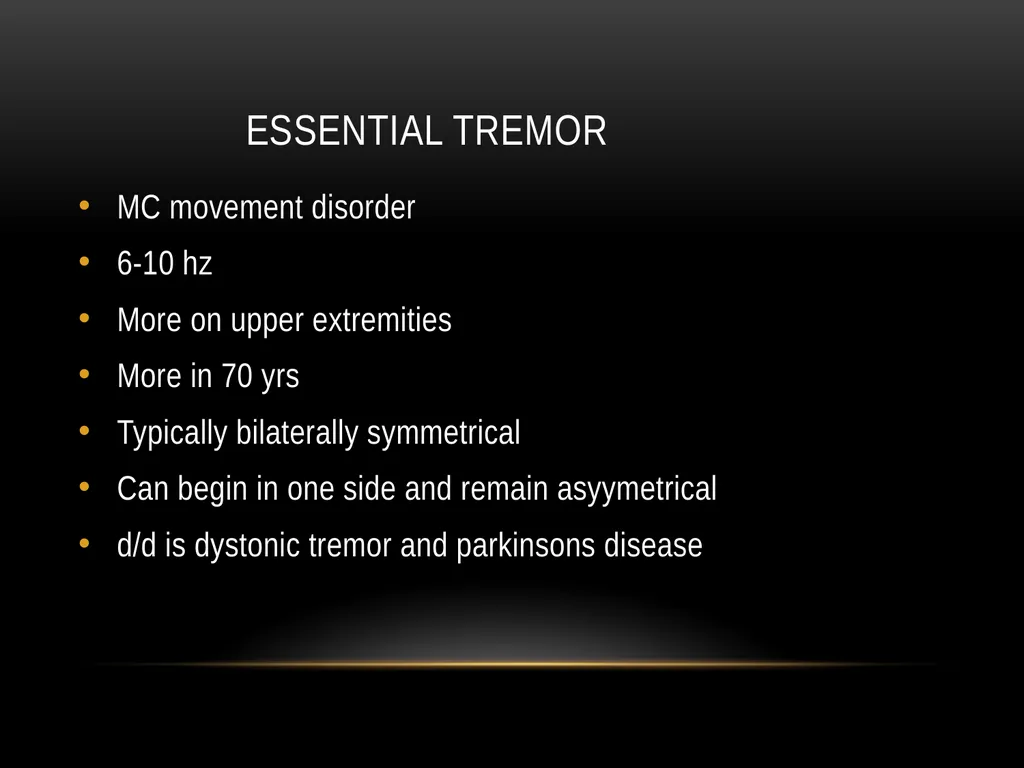
Essential tremor MC movement disorder
6-10 hz
More on upper extremities
More in 70 yrs
Typically bilaterally symmetrical
Can begin in one side and remain asyymetrical
d/d is dystonic tremor and parkinsons disease<br>
6-10 hz
More on upper extremities
More in 70 yrs
Typically bilaterally symmetrical
Can begin in one side and remain asyymetrical
d/d is dystonic tremor and parkinsons disease<br>
42
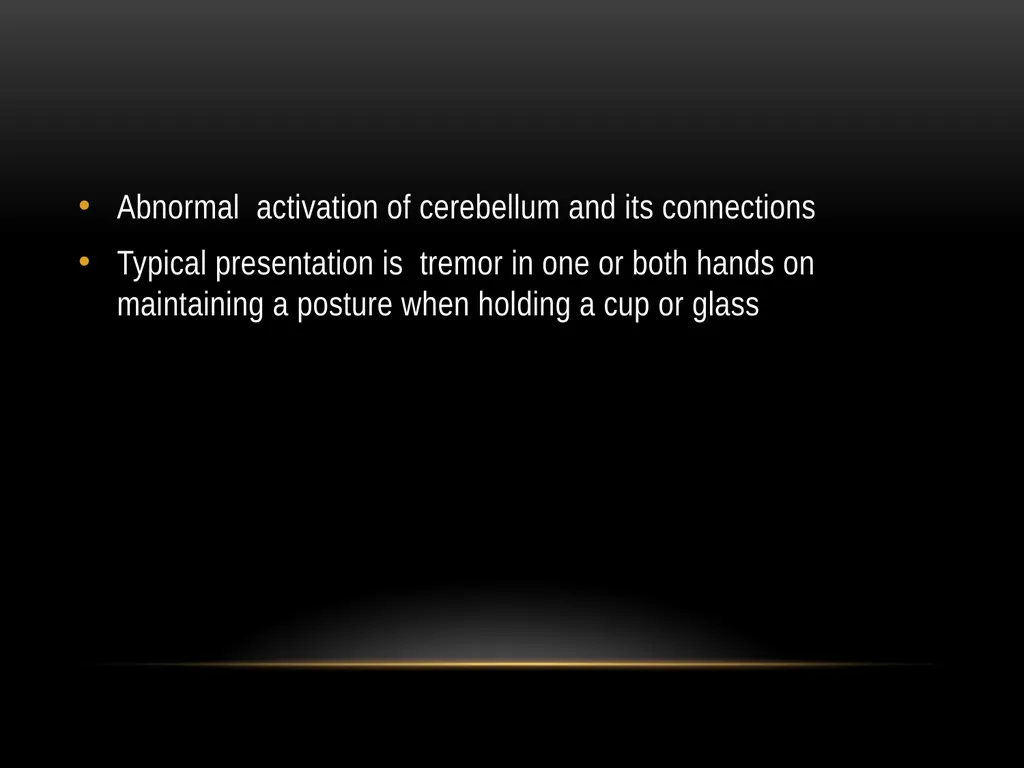
Abnormal activation of cerebellum and its connections
Typical presentation is tremor in one or both hands on maintaining a posture when holding a cup or glass<br>
Typical presentation is tremor in one or both hands on maintaining a posture when holding a cup or glass<br>
43
Beta blockers are effective in 50 to 70 % of cases, some patients require large doses
Sterotactic thalamotomy and deep brain stimulation of ventral intermediate nucleus of thalamus<br>
Sterotactic thalamotomy and deep brain stimulation of ventral intermediate nucleus of thalamus<br>
44
Frequency of tremors<br>
45
dystonic tremor When tremor superimpose dystonia
Dystonic tremor can mimic the tremor of PD.
People with dystonic tremor do not have true akinesia.
However they also show normal dopamine transporter imaging, in contrast to patients with PD.<br>
Dystonic tremor can mimic the tremor of PD.
People with dystonic tremor do not have true akinesia.
However they also show normal dopamine transporter imaging, in contrast to patients with PD.<br>
46
Dinner-fork’ posture of the outstretched hand, or a tendency for the ulnar fingers or thumb to point downwards with the arms held out, are characteristics of dystonia.<br>
47
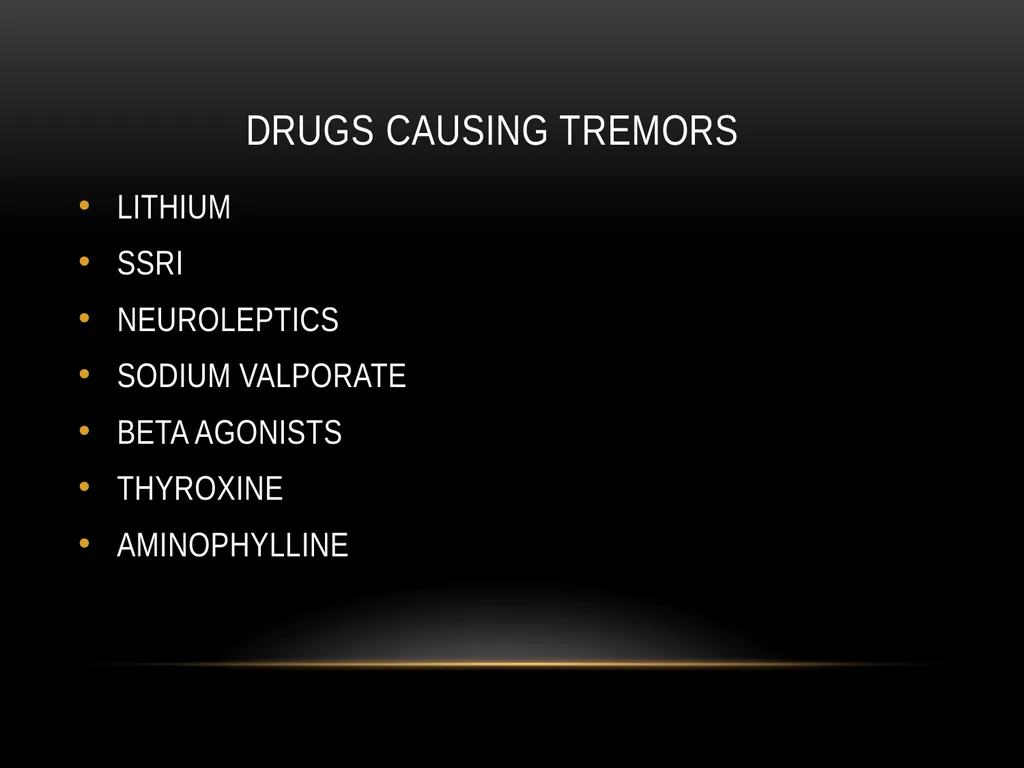
DRUGS CAUSING TREMORS LITHIUM
SSRI
NEUROLEPTICS
SODIUM VALPORATE
BETA AGONISTS
THYROXINE
AMINOPHYLLINE<br>
SSRI
NEUROLEPTICS
SODIUM VALPORATE
BETA AGONISTS
THYROXINE
AMINOPHYLLINE<br>
48
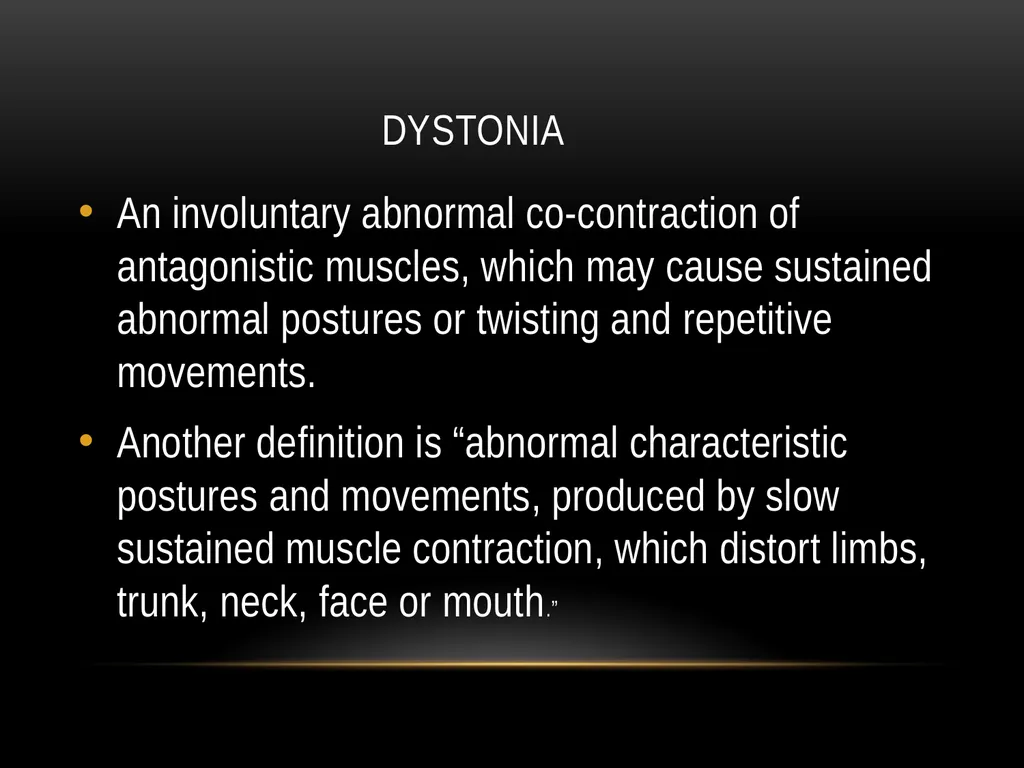
DYSTONIA An involuntary abnormal co-contraction of antagonistic muscles, which may cause sustained abnormal postures or twisting and repetitive movements.
Another definition is “abnormal characteristic postures and movements, produced by slow sustained muscle contraction, which distort limbs, trunk, neck, face or mouth.”<br>
Another definition is “abnormal characteristic postures and movements, produced by slow sustained muscle contraction, which distort limbs, trunk, neck, face or mouth.”<br>
49
KEYWORD… abnormal posture<br>
50
IN CONTRAST TO CHOREA Agonist and antagonists muscle contract simultaneously(co contraction)
Slow- athetotic dystonia
Shock like-myoclonic dystonia
< than 1 second-dystonic spasms<br>
Slow- athetotic dystonia
Shock like-myoclonic dystonia
< than 1 second-dystonic spasms<br>
51
Dystonias
distribution (focal, segmental, multi focal, generalized, or hemidystonia),
age at onset (early, ≤26 years; or late, ≥26 years)
cause (primary, dystonia-plus, degenerative or secondary)<br>
distribution (focal, segmental, multi focal, generalized, or hemidystonia),
age at onset (early, ≤26 years; or late, ≥26 years)
cause (primary, dystonia-plus, degenerative or secondary)<br>
52
PRIMARY DYSTONIA Dystonia as the only clinical feature with or without tremor
No secondary cause and brain imaging should be normal<br>
No secondary cause and brain imaging should be normal<br>
53
ANATOMICAL DISTRIBUTION Very much dependent on age of onset
<28 years - starts in the limb
never affect face and bulbar muscles
30-40 yrs - focal dystonia of hand(witer”s cramp)
>40 yrs - focal dystonia of cranio-cervical muscles<br>
<28 years - starts in the limb
never affect face and bulbar muscles
30-40 yrs - focal dystonia of hand(witer”s cramp)
>40 yrs - focal dystonia of cranio-cervical muscles<br>
54
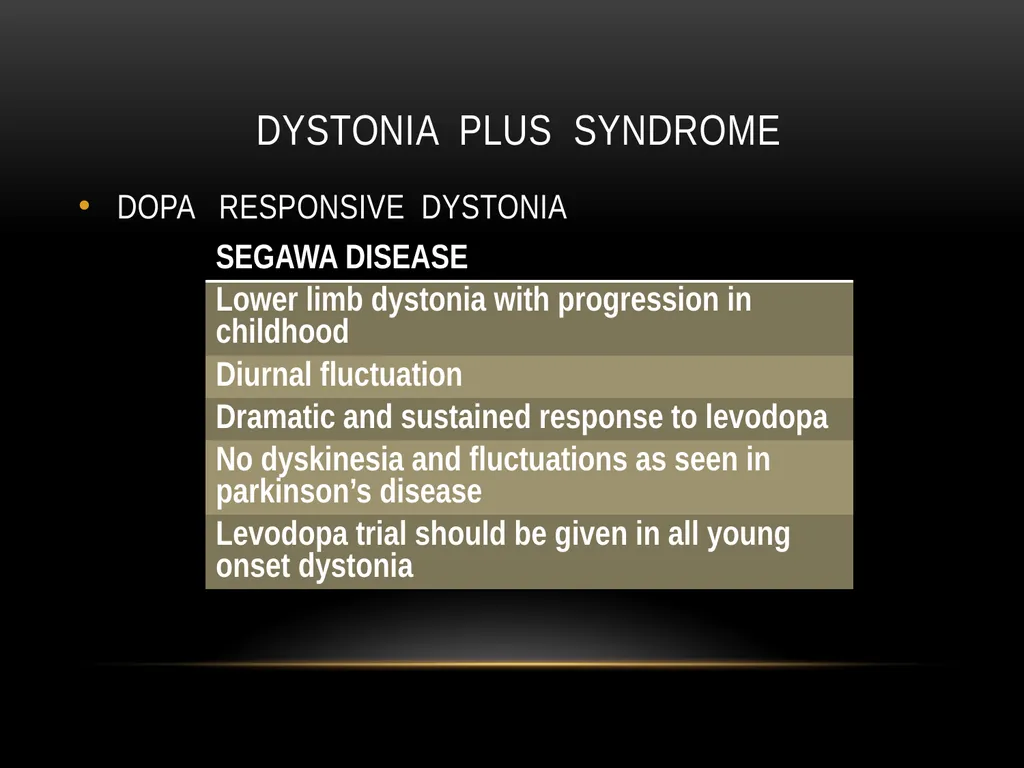
DYSTONIA PLUS SYNDROME DOPA RESPONSIVE DYSTONIA<br>
55
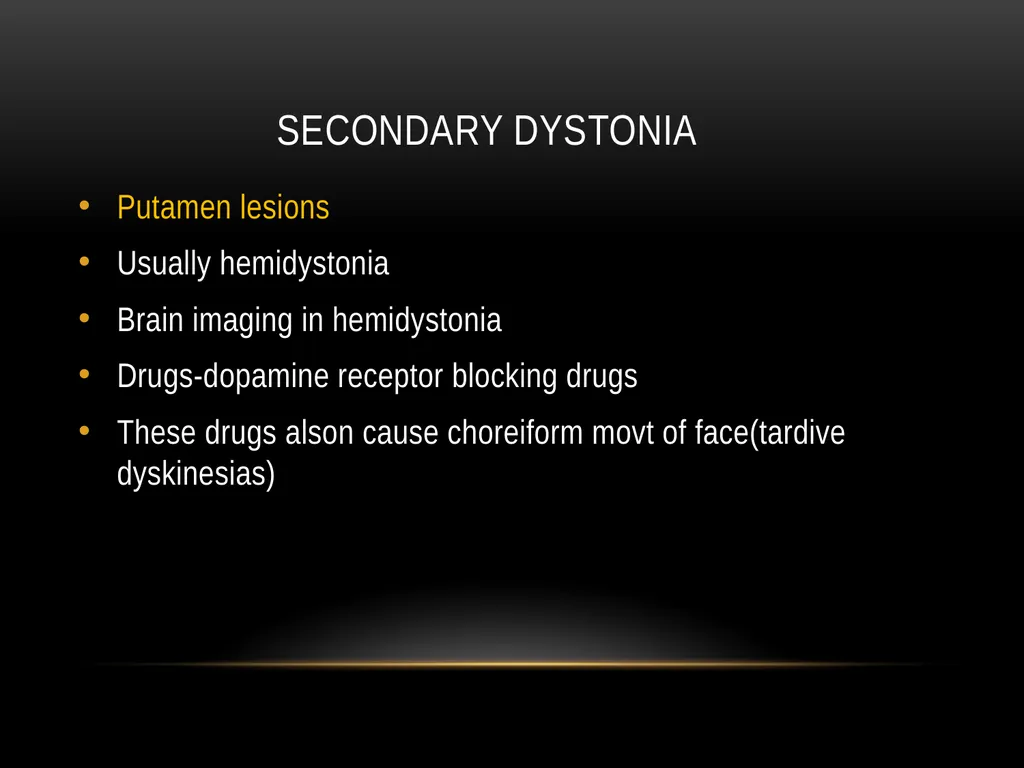
secondary dystonia Putamen lesions
Usually hemidystonia
Brain imaging in hemidystonia
Drugs-dopamine receptor blocking drugs
These drugs alson cause choreiform movt of face(tardive dyskinesias)<br>
Usually hemidystonia
Brain imaging in hemidystonia
Drugs-dopamine receptor blocking drugs
These drugs alson cause choreiform movt of face(tardive dyskinesias)<br>
56
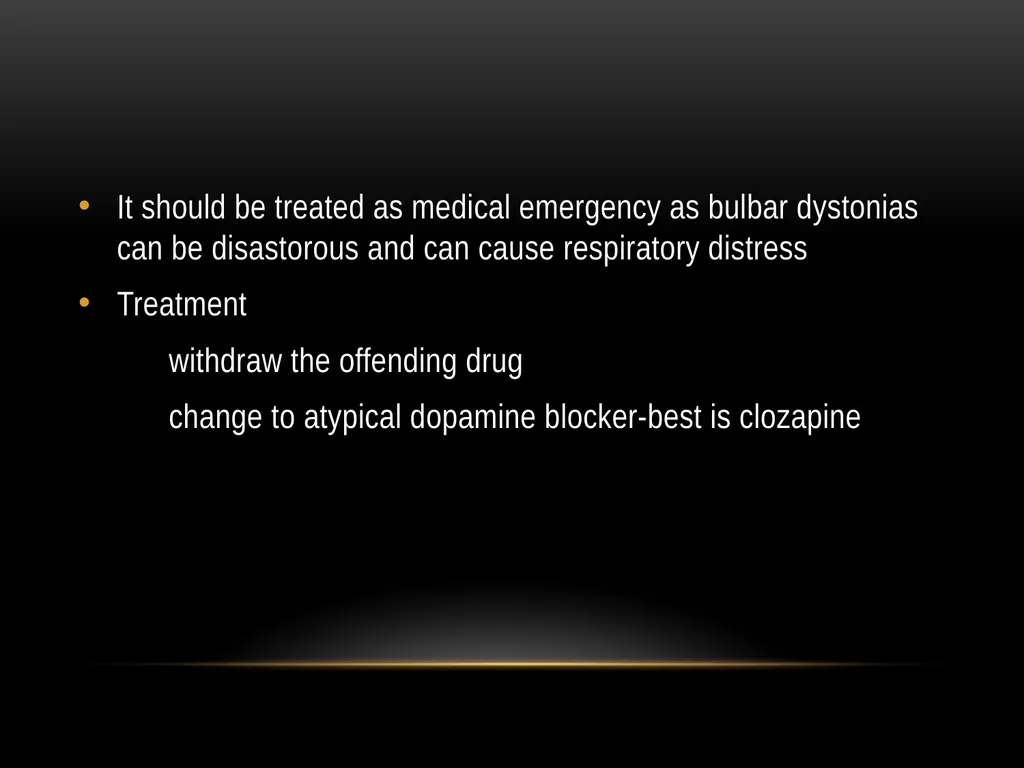
It should be treated as medical emergency as bulbar dystonias can be disastorous and can cause respiratory distress
Treatment
withdraw the offending drug
change to atypical dopamine blocker-best is clozapine<br>
Treatment
withdraw the offending drug
change to atypical dopamine blocker-best is clozapine<br>
57
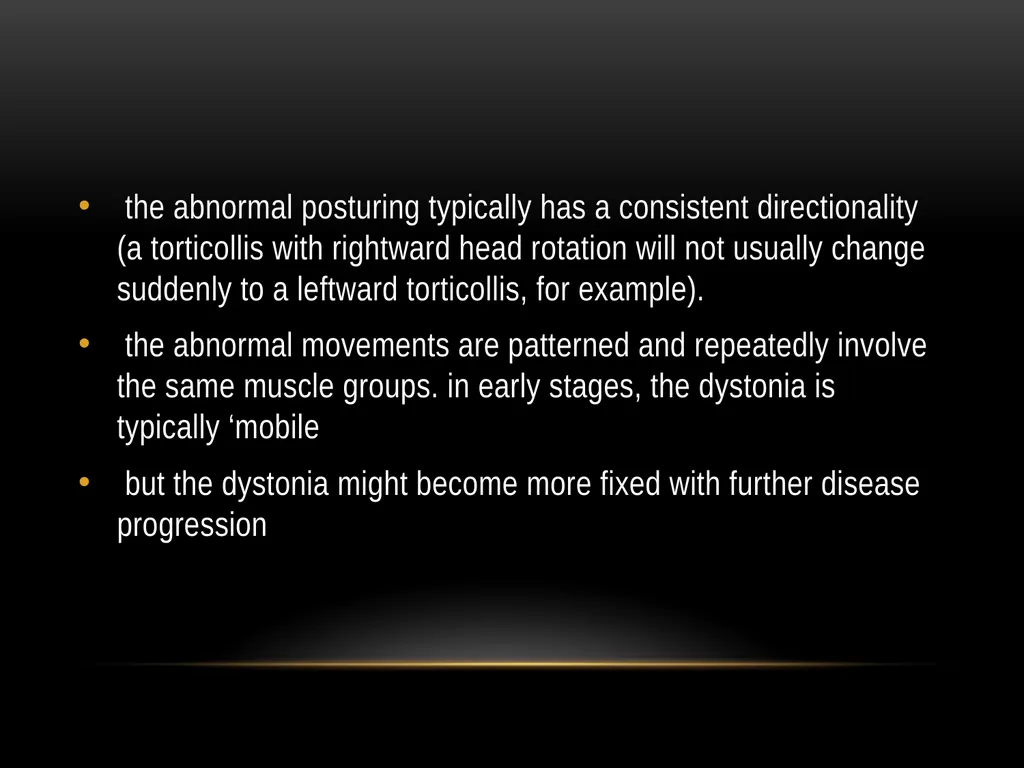
the abnormal posturing typically has a consistent directionality (a torticollis with rightward head rotation will not usually change suddenly to a leftward torticollis, for example).
the abnormal movements are patterned and repeatedly involve the same muscle groups. in early stages, the dystonia is typically ‘mobile
but the dystonia might become more fixed with further disease progression<br>
the abnormal movements are patterned and repeatedly involve the same muscle groups. in early stages, the dystonia is typically ‘mobile
but the dystonia might become more fixed with further disease progression<br>
58
A further typical feature of dystonia is the presence of a sensory trick, or ‘geste antagoniste’, which is a mechanism (usually identified and used by the patient) to reduce dystonia
for example, gently touching the cheek to correct torticollis, or chewing gum to reduce oromandibular dystonia.<br>
for example, gently touching the cheek to correct torticollis, or chewing gum to reduce oromandibular dystonia.<br>
59
Anticholinergics-trihexyphenydine,dopamine depletors like tetrabenazine
Benzodiazepines like clonazepam
Injection botulism in focal dystonia
Deep brain stimulation in intractable dystonias<br>
Benzodiazepines like clonazepam
Injection botulism in focal dystonia
Deep brain stimulation in intractable dystonias<br>
60
DRUG INDUCED MOVEMENT DISORDERS Neuroleptics-block dopamine receptors
Metaclopramide
prochlorperazine<br>
Metaclopramide
prochlorperazine<br>
61
Acute Dystonia(MC)
Blepharospasms, torticollis
Severe spasm may be confused with seizures
But there wont be any LOC/post ictal confusion
Others include chorea/tics especially with cocaine/amphetamine<br>
Blepharospasms, torticollis
Severe spasm may be confused with seizures
But there wont be any LOC/post ictal confusion
Others include chorea/tics especially with cocaine/amphetamine<br>
62
subacute Akathesia
Motor restlesness with need to move that is alleivated by movement
Treatment –BZD,beta blockers,dopamine agonists<br>
Motor restlesness with need to move that is alleivated by movement
Treatment –BZD,beta blockers,dopamine agonists<br>
63
TARDIVE SYNDROMES Choreiform/dystonic movement including mouth, lips and tongue
If sev –even respiratory muscles can be affected
May stop within 3 months of stopping the drugs
Atypical antipsychotics low risk<br>
If sev –even respiratory muscles can be affected
May stop within 3 months of stopping the drugs
Atypical antipsychotics low risk<br>
64
Treatment
Stop offending drugs
Replace with atypical antipsychotics
Drugs used are baclofen, clonazepam,valproic acid
Botulinm toxin<br>
Stop offending drugs
Replace with atypical antipsychotics
Drugs used are baclofen, clonazepam,valproic acid
Botulinm toxin<br>
65
RESTLESS LEG SYNDROME FOUR CORE SYMPTOMS
Urge to move the legs caused by unpleasant sensation in the legs
Symptoms that begin /worsen with rest
Partial/complete relief by movement
Worsen during evening/right<br>
Urge to move the legs caused by unpleasant sensation in the legs
Symptoms that begin /worsen with rest
Partial/complete relief by movement
Worsen during evening/right<br>
66
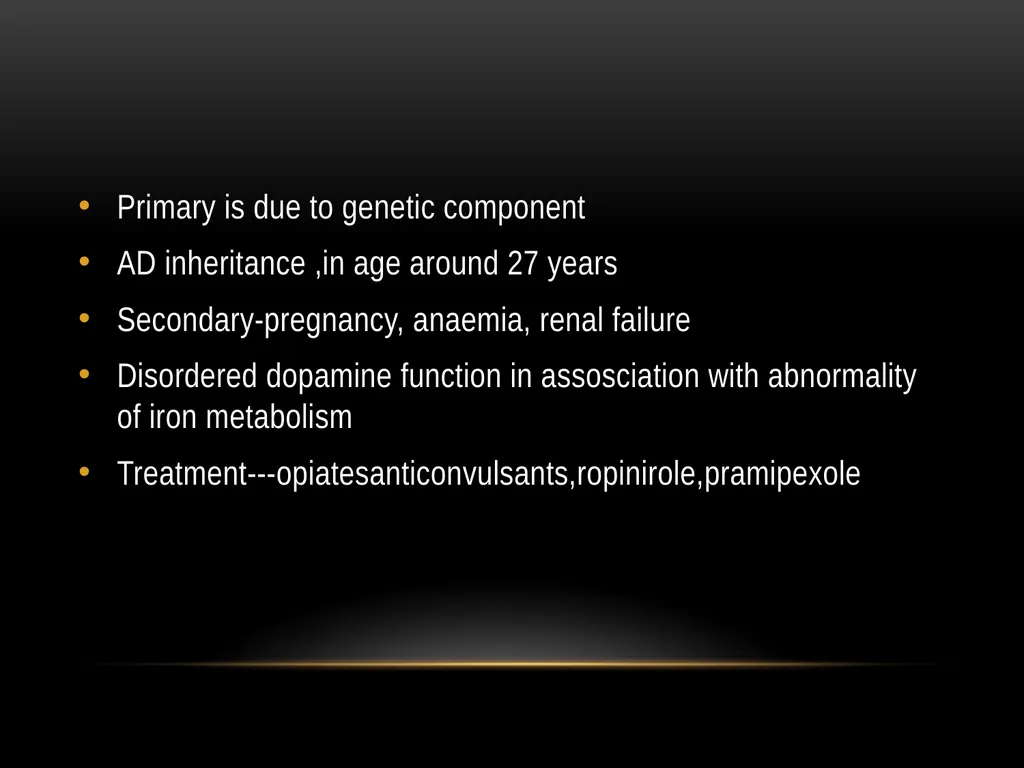
Primary is due to genetic component
AD inheritance ,in age around 27 years
Secondary-pregnancy, anaemia, renal failure
Disordered dopamine function in assosciation with abnormality of iron metabolism
Treatment---opiatesanticonvulsants,ropinirole,pramipexole<br>
AD inheritance ,in age around 27 years
Secondary-pregnancy, anaemia, renal failure
Disordered dopamine function in assosciation with abnormality of iron metabolism
Treatment---opiatesanticonvulsants,ropinirole,pramipexole<br>
67
Unpleasant sensation-creepy crawling feeling
Paraesthesia /burning
Movements are brief lasting no more than few seconds
Recur every 5 to 90 seconds causing sleep disturbance<br>
Paraesthesia /burning
Movements are brief lasting no more than few seconds
Recur every 5 to 90 seconds causing sleep disturbance<br>
68
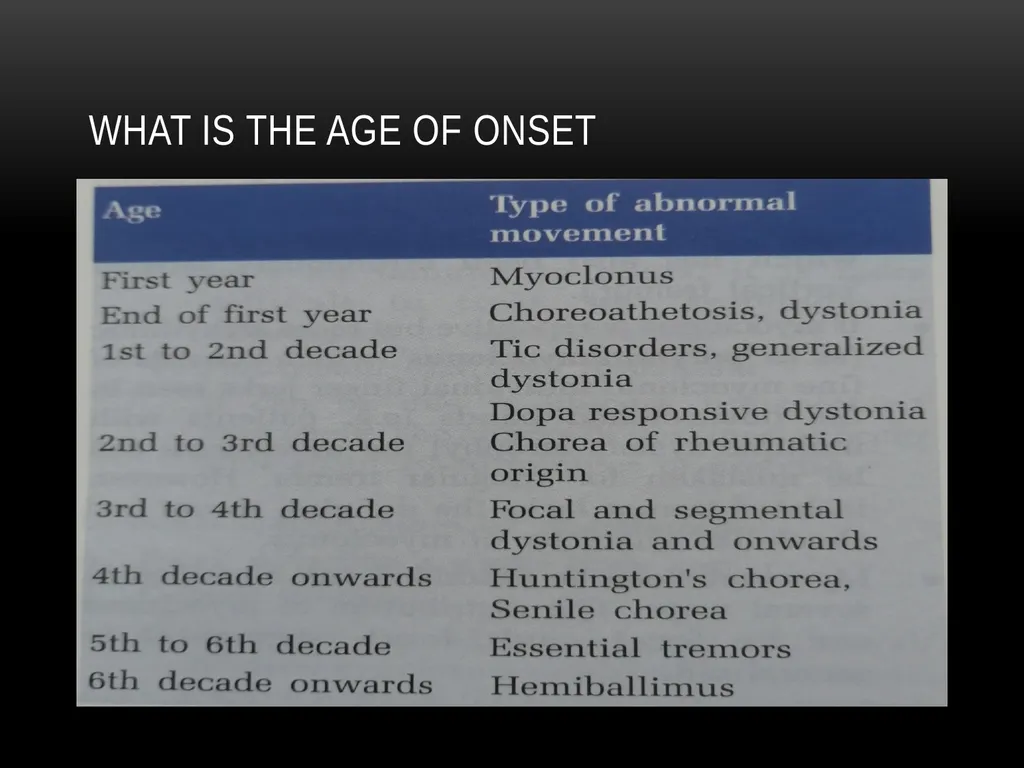
what is the age of onset<br>
69
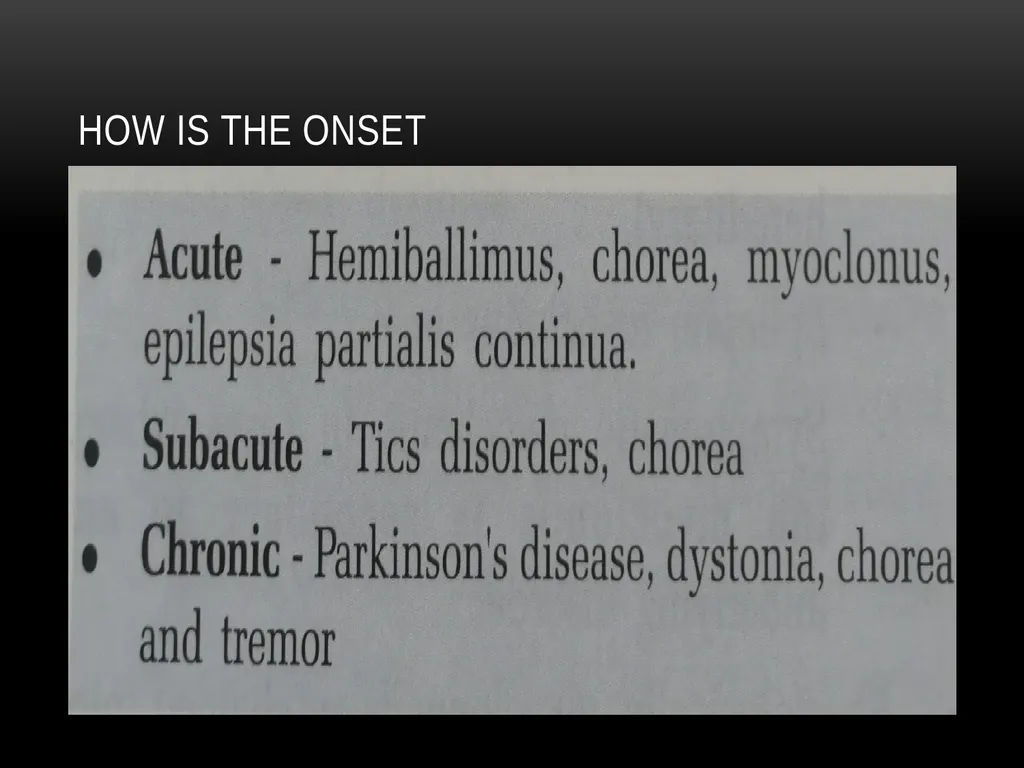
HOW IS THE ONSET<br>
70
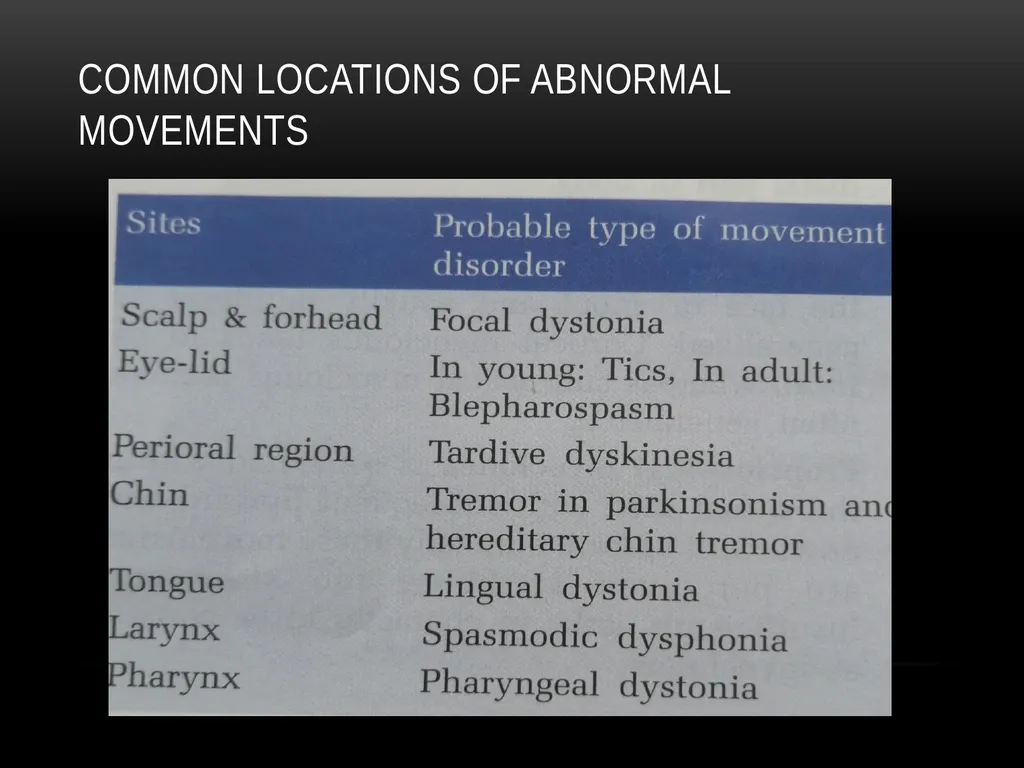
COMMON LOCATIONS OF ABNORMAL MOVEMENTS<br>
71
Specific distribution
RLS
Parkinson’s disease - asymmetric in onset.
Blepharospasm B/L
Hemifacial spasm U/L<br>
RLS
Parkinson’s disease - asymmetric in onset.
Blepharospasm B/L
Hemifacial spasm U/L<br>
72
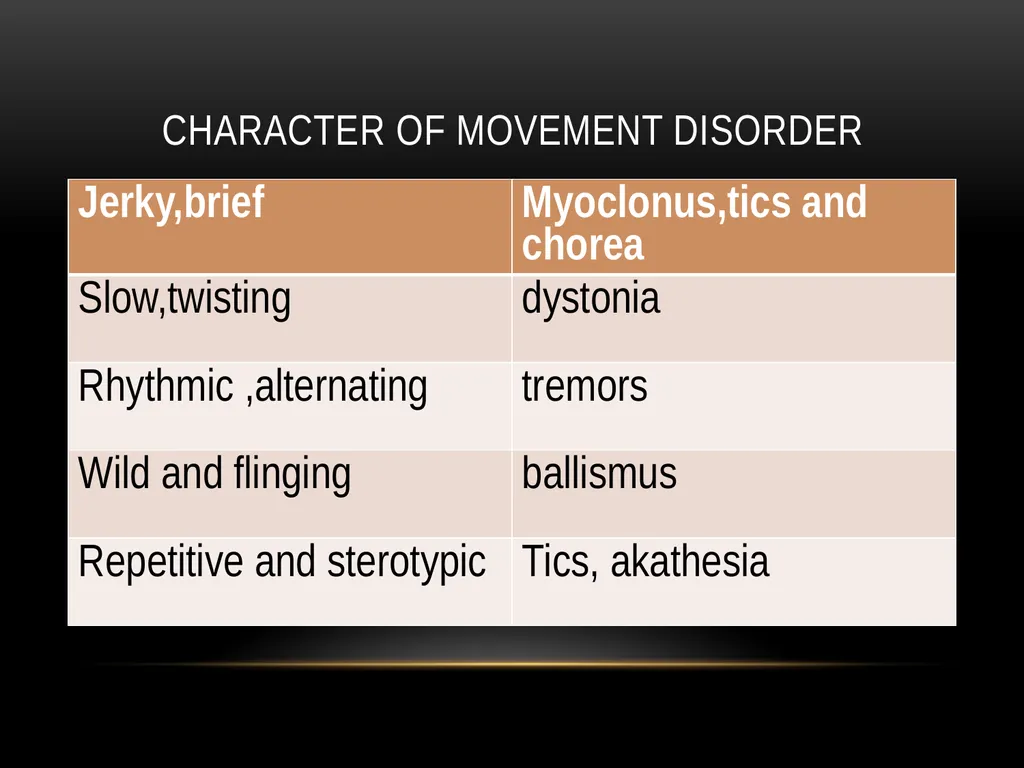
Speed of movement
slow – parkin ,dystonia
intermediate – chorea , tremor
fast – myoclonus ,tics
Rhythm
Continuous (e.g. tremor) or intermittent e.g.asterixis (‘negative myoclonus’).
Relation to posture
eg. orthostatic tremor (presents as unsteadiness when standing still, but suppressed by walking).<br>
slow – parkin ,dystonia
intermediate – chorea , tremor
fast – myoclonus ,tics
Rhythm
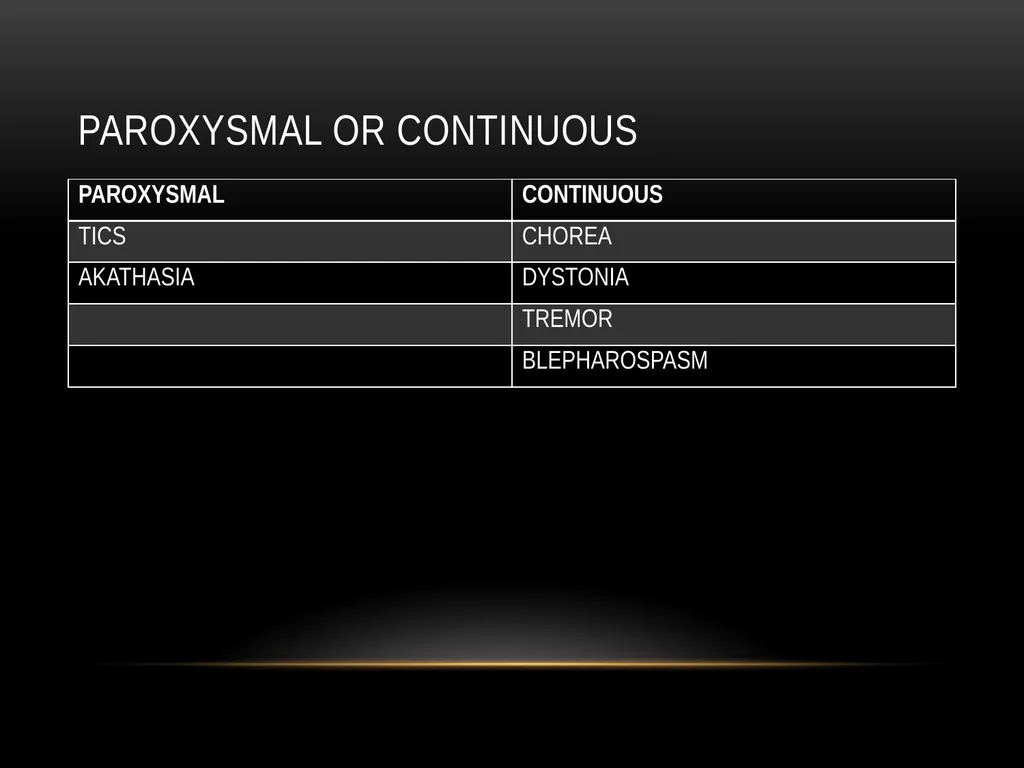
Continuous (e.g. tremor) or intermittent e.g.asterixis (‘negative myoclonus’).
Relation to posture
eg. orthostatic tremor (presents as unsteadiness when standing still, but suppressed by walking).<br>
73
ASSOSCIATED SENSORY SYMPTOMS Restless limb syndrome - with pain or discomfort;
tics - vague discomfort or sensation in the prodrome before the movement<br>
tics - vague discomfort or sensation in the prodrome before the movement<br>
74
Ameliorating factors
Alcohol may dramatically improve essential tremor and myoclonic dystonia.
Running or walking backwards may improve a dystonic gait
Distractibility and inconsistency- suggestive of a non-organic (functional) cause<br>
Alcohol may dramatically improve essential tremor and myoclonic dystonia.
Running or walking backwards may improve a dystonic gait
Distractibility and inconsistency- suggestive of a non-organic (functional) cause<br>
75
PAROXYSMAL OR CONTINUOUS<br>
76
REGULAR/IRREGULAR<br>
77
character of movement disorder<br>
78
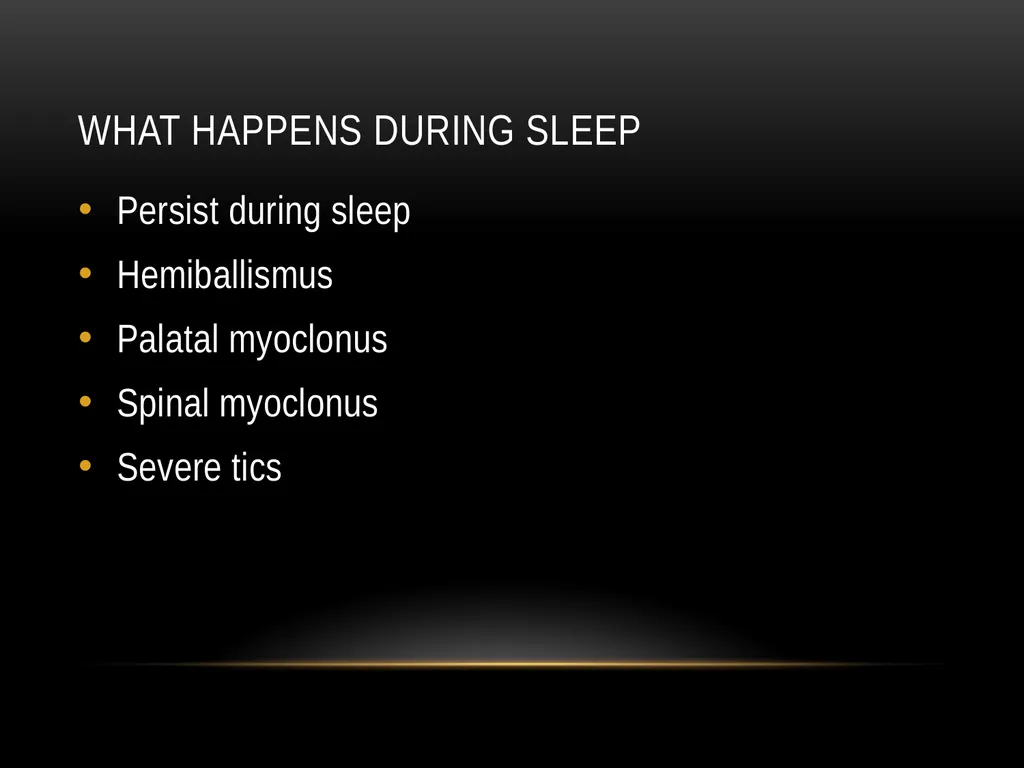
What happens during sleep Persist during sleep
Hemiballismus
Palatal myoclonus
Spinal myoclonus
Severe tics<br>
Hemiballismus
Palatal myoclonus
Spinal myoclonus
Severe tics<br>
79
All other movement disorders diminishes during sleep<br>
80
thank u<br>