
Division of State Funding, Forecasting, & Fiscal
DJ
Published · 43 slides · 0 views

1 / 1
Description
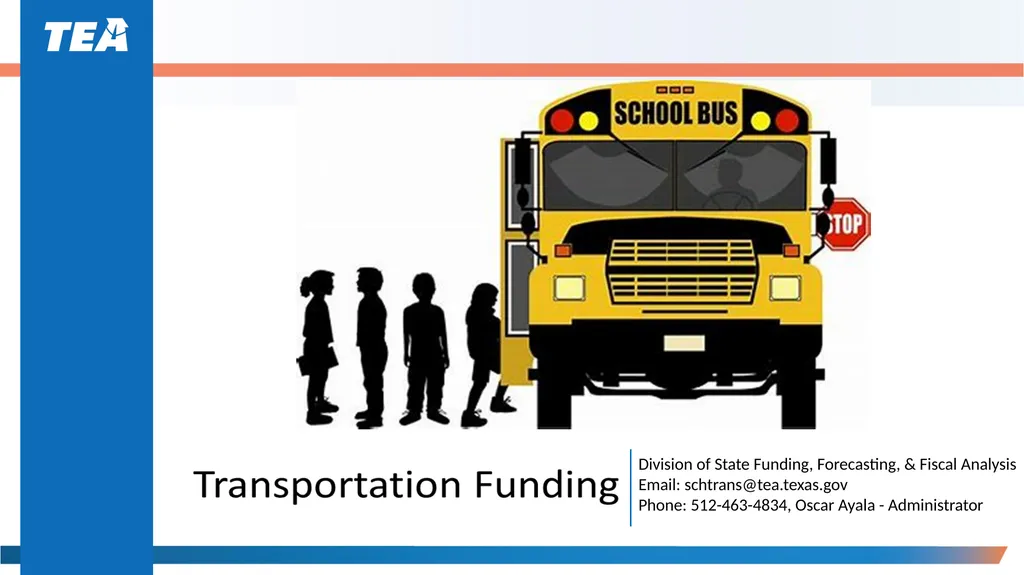
Division of State Funding, Forecasting, Fiscal Analysis Email: schtranstea.texas.gov Phone: 512-463-4834, Oscar Ayala - Administrator Introduction to Transportation Allotment 2 A school district may establish and operate an economical
Related Topics
Share
Embed code
Download this presentation From Below
"Division of State Funding, Forecasting, & Fiscal" is the property of its rightful owner. Permission is granted to download and print the materials on this website for personal, non-commercial use only, and to display it on your personal computer provided you do not modify the materials and that you retain all copyright notices contained in the materials. By downloading content from our website, you accept the terms of this agreement.
Presentation Transcript
01
Division of State Funding, Forecasting, & Fiscal Analysis
Email: schtrans@tea.texas.gov
Phone: 512-463-4834, Oscar Ayala - Administrator<br>
Email: schtrans@tea.texas.gov
Phone: 512-463-4834, Oscar Ayala - Administrator<br>
02
Introduction to Transportation Allotment 2 A school district may establish and operate an economical public school transportation system. [Texas Education Code (TEC), §34.007 (a)(2)]
As an alternative, your district may contract with another school district or with a mass transit authority, commercial transportation company, or county juvenile board to establish and operate such a transportation system. [TEC, §34.008]
State law also entitles your district to state funding for certain transportation of eligible students. This state funding is known as the Transportation Allotment.<br>
03
Required Transportation 3 Per Texas Education Code (TEC) §34 and §12.109, the only students a school district or charter school are required to provide transportation to are both:
Students receiving special education who would be unable to attend classes without special transportation services
AND
Students eligible under Section 504 of the Federal Rehabilitation Act who would be unable to attend classes without special transportation services
The students who meet these criteria are classified as Special-Program Students. (Additional details and clarifications are outlined in the upcoming slides)<br>
04
Rider Eligibility 4 There are two classifications of students eligible to be reported for Transportation Allotment (funding) purposes:
Regular Program Students
Special Program Students
These students must be receiving eligible transportation services, also referred to as Route Services, to be reported for Transportation Allotment purposes
Your school district may still provide transportation to ineligible students. However, any transportation of ineligible students may not be reported for Transportation Allotment purposes<br>
05
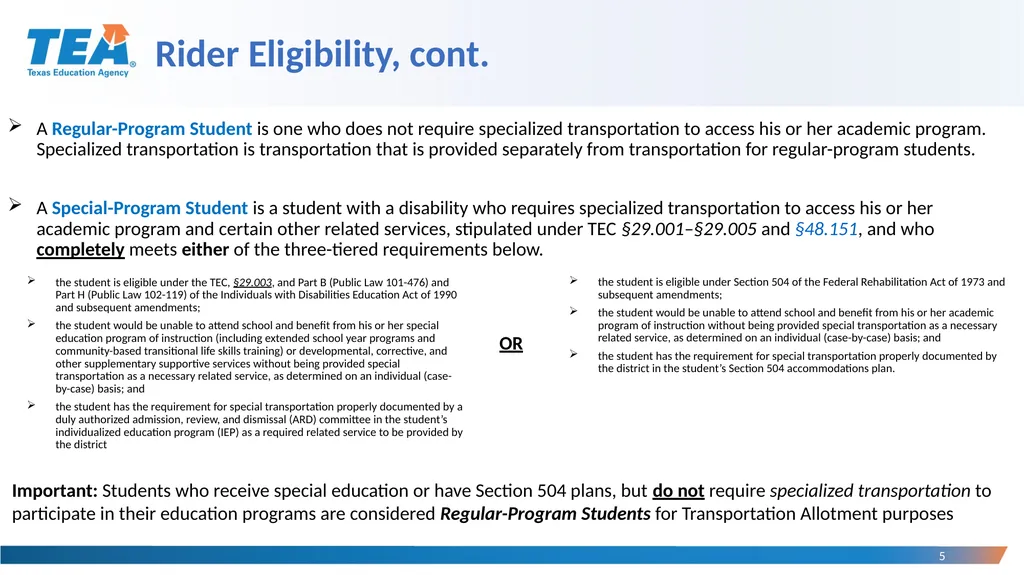
Rider Eligibility, cont. A Regular-Program Student is one who does not require specialized transportation to access his or her academic program. Specialized transportation is transportation that is provided separately from transportation for regular-program students.
A Special-Program Student is a student with a disability who requires specialized transportation to access his or her academic program and certain other related services, stipulated under TEC §29.001–§29.005 and §48.151, and who completely meets either of the three-tiered requirements below. the student is eligible under the TEC, §29.003, and Part B (Public Law 101-476) and Part H (Public Law 102-119) of the Individuals with Disabilities Education Act of 1990 and subsequent amendments;
the student would be unable to attend school and benefit from his or her special education program of instruction (including extended school year programs and community-based transitional life skills training) or developmental, corrective, and other supplementary supportive services without being provided special transportation as a necessary related service, as determined on an individual (case-by-case) basis; and
the student has the requirement for special transportation properly documented by a duly authorized admission, review, and dismissal (ARD) committee in the student’s individualized education program (IEP) as a required related service to be provided by the district OR the student is eligible under Section 504 of the Federal Rehabilitation Act of 1973 and subsequent amendments;
the student would be unable to attend school and benefit from his or her academic program of instruction without being provided special transportation as a necessary related service, as determined on an individual (case-by-case) basis; and
the student has the requirement for special transportation properly documented by the district in the student’s Section 504 accommodations plan. Important: Students who receive special education or have Section 504 plans, but do not require specialized transportation to participate in their education programs are considered Regular-Program Students for Transportation Allotment purposes 5<br>
06
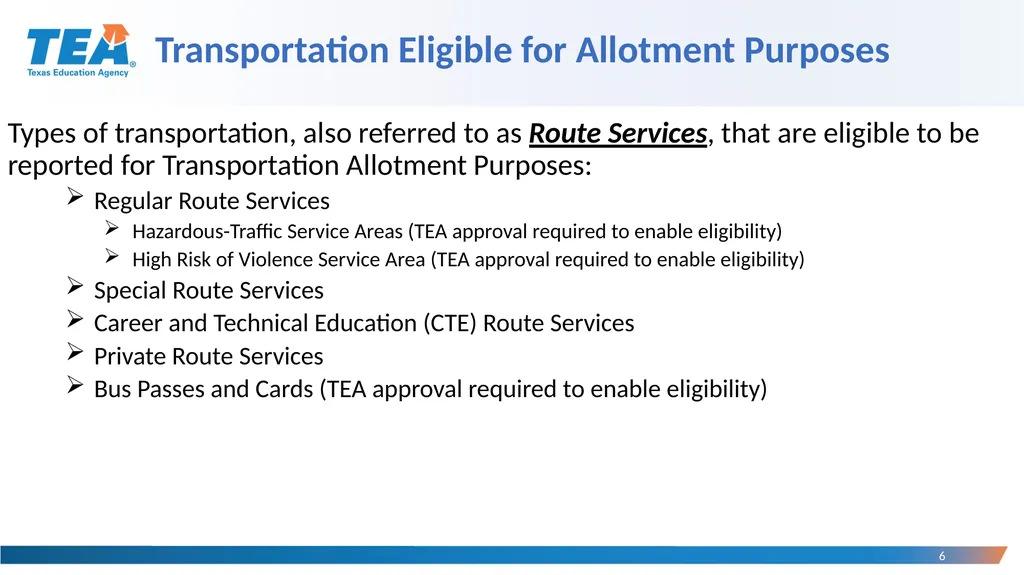
Transportation Eligible for Allotment Purposes 6 Types of transportation, also referred to as Route Services, that are eligible to be reported for Transportation Allotment Purposes:
Regular Route Services
Hazardous-Traffic Service Areas (TEA approval required to enable eligibility)
High Risk of Violence Service Area (TEA approval required to enable eligibility)
Special Route Services
Career and Technical Education (CTE) Route Services
Private Route Services
Bus Passes and Cards (TEA approval required to enable eligibility)<br>
07
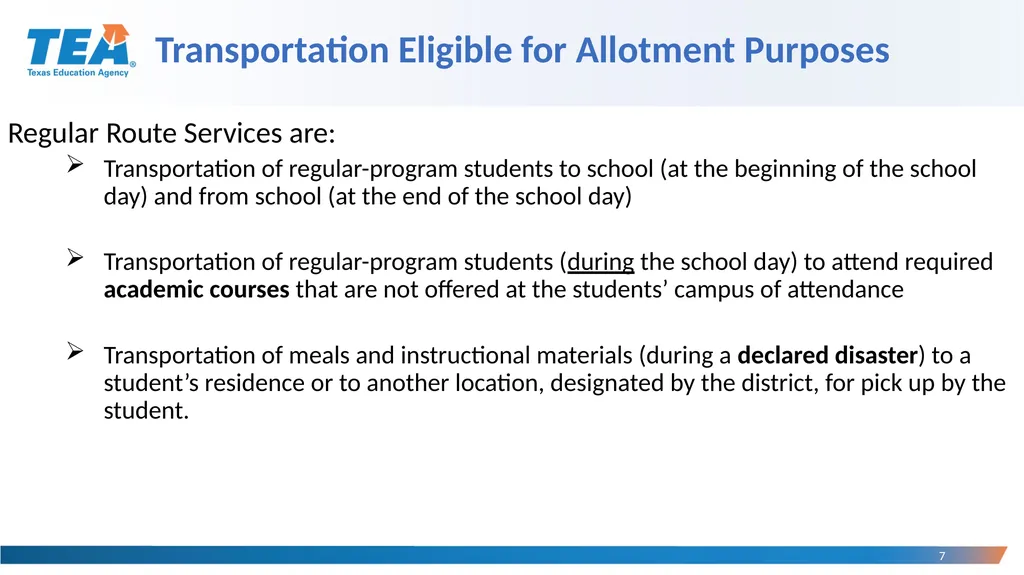
Transportation Eligible for Allotment Purposes 7 Regular Route Services are:
Transportation of regular-program students to school (at the beginning of the school day) and from school (at the end of the school day)
Transportation of regular-program students (during the school day) to attend required academic courses that are not offered at the students’ campus of attendance
Transportation of meals and instructional materials (during a declared disaster) to a student’s residence or to another location, designated by the district, for pick up by the student.<br>
08
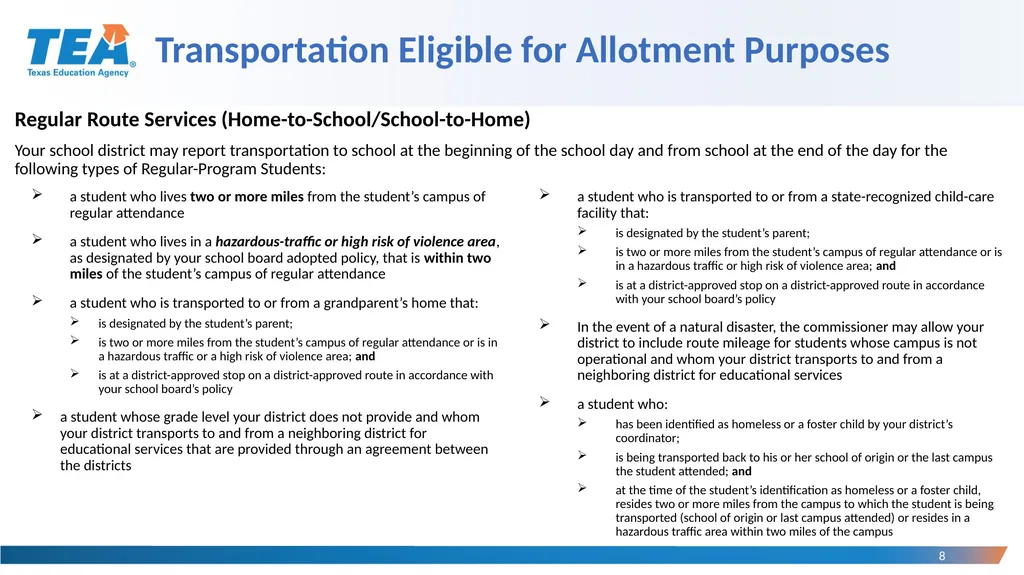
Transportation Eligible for Allotment Purposes Regular Route Services (Home-to-School/School-to-Home)
Your school district may report transportation to school at the beginning of the school day and from school at the end of the day for the following types of Regular-Program Students: a student who lives two or more miles from the student’s campus of regular attendance
a student who lives in a hazardous-traffic or high risk of violence area, as designated by your school board adopted policy, that is within two miles of the student’s campus of regular attendance
a student who is transported to or from a grandparent’s home that:
is designated by the student’s parent;
is two or more miles from the student’s campus of regular attendance or is in a hazardous traffic or a high risk of violence area; and
is at a district-approved stop on a district-approved route in accordance with your school board’s policy
a student whose grade level your district does not provide and whom your district transports to and from a neighboring district for educational services that are provided through an agreement between the districts a student who is transported to or from a state-recognized child-care facility that:
is designated by the student’s parent;
is two or more miles from the student’s campus of regular attendance or is in a hazardous traffic or high risk of violence area; and
is at a district-approved stop on a district-approved route in accordance with your school board’s policy
In the event of a natural disaster, the commissioner may allow your district to include route mileage for students whose campus is not operational and whom your district transports to and from a neighboring district for educational services
a student who:
has been identified as homeless or a foster child by your district’s coordinator;
is being transported back to his or her school of origin or the last campus the student attended; and
at the time of the student’s identification as homeless or a foster child, resides two or more miles from the campus to which the student is being transported (school of origin or last campus attended) or resides in a hazardous traffic area within two miles of the campus 8<br>
09
Transportation Eligible for Allotment Purposes 9 Regular Route Services (Home-to-School/School-to-Home) Requisites
It is the district’s responsibility to determine whether a home or child-care facility meets eligibility requirements. Your district may not report transportation to and from such a home or facility until it has determined that the home or facility meets the listed requirements.
Transportation from school at the end of the day includes any transportation from school to home that your district provides for students who stay after school for extracurricular activities, after-school programs, or other purposes.
Reported mileage should only reflect transportation from school to home and not associated mileage from the after-school activities.
Districts should also ensure they avoid double counting of students in average daily ridership in providing this transportation.
The Additional Days School Year (ADSY) incentive adds half day formula funding for school districts and open-enrollment charters that want to add up to 30 instructional days to any of their elementary schools (grades PK-5). Any associated ADSY mileage is eligible for transportation allotment purposes and should be reported in the appropriate program’s Home-to-School/School-to-Home Routes section.
The ADSY program is separate from traditional summer school, which is deemed ineligible for Transportation Allotment purposes<br>
10
Transportation Eligible for Allotment Purposes 10 Regular Route Services (Academic and Curriculum)
Your school district may report transportation of Regular-Program Students during the school day between the students’ campus of attendance and another instructional site within the district for the students to attend:
required courses, including dual credit courses, that they are enrolled in but that are not available at the students’ campus of attendance
required courses, including dual college credit courses during the school day, that they are enrolled in but that are not available at the students’ campus site inside or outside your district
Important: This transportation does not include services for extra-or cocurricular activity trips, sporting events, band or cheer competitions, animal shows, or between-campus transportation meals.<br>
11
Transportation Eligible for Allotment Purposes 11 Regular Route Services (Deliveries during Disaster Declaration)
The Senate Bill (SB) 462 provides entitlement, based on a rate per mile, for a school district located in an area that is wholly or partly the subject of a disaster declaration, by the governor (Chapter 418, Government Code) or by the president of the United, for the cost of transporting a meal or instructional materials to a student’s residence or to another location, designated by the district, for pick up by the student
Beginning in school year 2021–2022, eligible mileage will be reimbursed at the rate specified in the General Appropriations Act (GAA). That rate is currently $1.00 per mile.
Reimbursement is limited to transportation of meals and instructional materials during a disaster which substantially impacts a student’s ability to be physically present on campus, including hurricanes, pandemics, tornadoes, and other unforeseen disasters that may greatly hinder a student’s ability to be present.
As the governor reviews the need for the declarations on a regular basis, districts will be responsible for checking the status of the governor’s declarations each month during the school year before reporting mileage for this purpose.<br>
12
Transportation Eligible for Allotment Purposes 12 Special Route Services are:
Transportation of Special-Program Students to school (at the beginning of the school day) and from school (at the end of the school day)
Transportation of Special-Program Students to attend:
Prescribed services during the regular school year and school day
Extended School Year (ESY) services required by the students’ IEPs<br>
13
Transportation Eligible for Allotment Purposes 13 Special Route Services (Home-to-School/School-to-Home)
Your district may report specialized transportation of a Special-Program Student to the student’s campus of attendance at the beginning of the school day and from the student’s campus of attendance at the end of the day, during the regular school year, if the student’s IEP or Section 504 accommodations plan requires this transportation.
The student’s campus of attendance may be a campus in a neighboring district or a regional day school, as specified in the student’s IEP by the student’s ARD committee.
Important: Transportation to ESY services must not be reported as transportation to and from school. It must be report as transportation for ESY services.<br>
14
Transportation Eligible for Allotment Purposes 14 Special Route Services (Auxiliary or ESY Services)
Your district may report:
specialized transportation of a Special-Program Student during the regular school year and school day for the student to receive:
Education services, including community-based instruction, required by the student’s IEP or Section 504 accommodations plan
Noninstructional support services, such as developmental or corrective supplementary services, including health exams, diagnostic testing, counseling, and therapy, required by the student’s IEP
specialized transportation of a Special-Program Student to and from IEP-required ESY services
These services may be provided during the summer
Important: Transportation for ESY services includes transportation to school (at the beginning of the student’s school day) and from school (at the end of the day).<br>
15
Transportation Eligible for Allotment Purposes 15 Career and Technical Education (CTE) Route Services are:
Transportation of Regular- or Special-Program Students (during the school day) to attend a TEA-approved CTE course, that is not available at the students’ campus of attendance and makes up only a part of the student’s instructional day, and is provided at:
another secondary public-school campus or work-based instructional site inside or outside your district
a campus in a neighboring district with which your district has a cooperative agreement, or
a state-regulated public or private postsecondary educational institution or proprietary trade or technical school under a contract for CTE instruction
A district administrator must confirm that a course is a TEA-approved CTE course before your district reports CTE route services related to the course.<br>
16
Transportation Eligible for Allotment Purposes 16 Private Route Services are:
Transportation to school (at the beginning of the school day) and from school (at the end of the school day) by privately owned or commercial transportation for Regular- and Special-Program Students, whom your school district determines to be eligible and provides grants [TEC, §48.151 (e),(g)], due to experiencing extreme hardship in getting to and from school
Your district must determine eligibility for Private Route Services on a case-by-case basis. It must not base eligibility determinations on parent requests. The unavailability or inconvenience of district operated Route Services does not constitute an extreme hardship.
If transportation is provided by a parent’s agent, your district should require and maintain the parent to sign a statement of authorization. If a parent or the parent’s designated agent is providing transportation, TEA recommends that your district’s school board execute a written contract that stipulates the terms of reimbursement and requirement to maintain proof of adequate liability insurance coverage for transporting persons for compensation.<br>
17
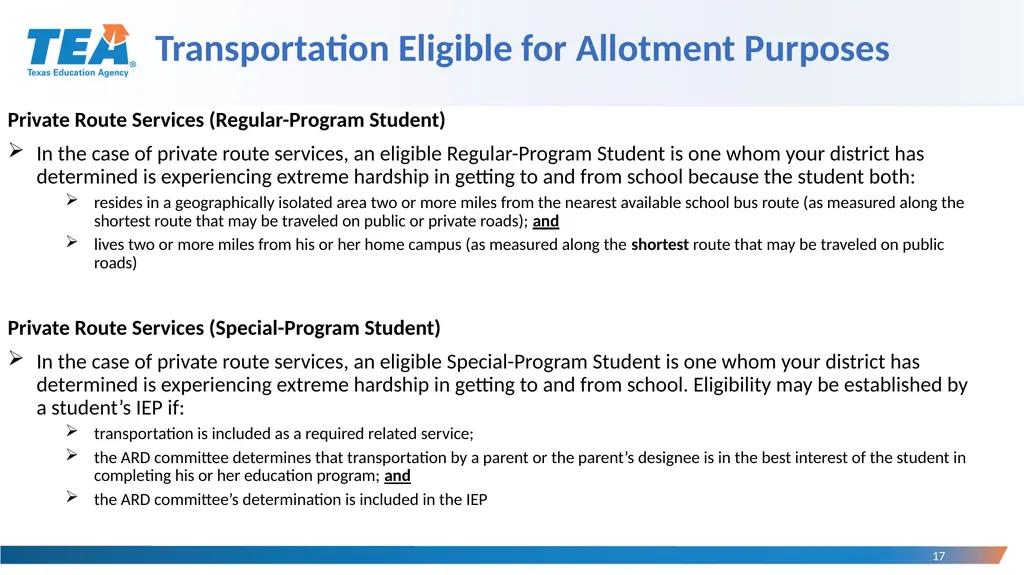
Transportation Eligible for Allotment Purposes 17 Private Route Services (Regular-Program Student)
In the case of private route services, an eligible Regular-Program Student is one whom your district has determined is experiencing extreme hardship in getting to and from school because the student both:
resides in a geographically isolated area two or more miles from the nearest available school bus route (as measured along the shortest route that may be traveled on public or private roads); and
lives two or more miles from his or her home campus (as measured along the shortest route that may be traveled on public roads)
Private Route Services (Special-Program Student)
In the case of private route services, an eligible Special-Program Student is one whom your district has determined is experiencing extreme hardship in getting to and from school. Eligibility may be established by a student’s IEP if:
transportation is included as a required related service;
the ARD committee determines that transportation by a parent or the parent’s designee is in the best interest of the student in completing his or her education program; and
the ARD committee’s determination is included in the IEP<br>
18
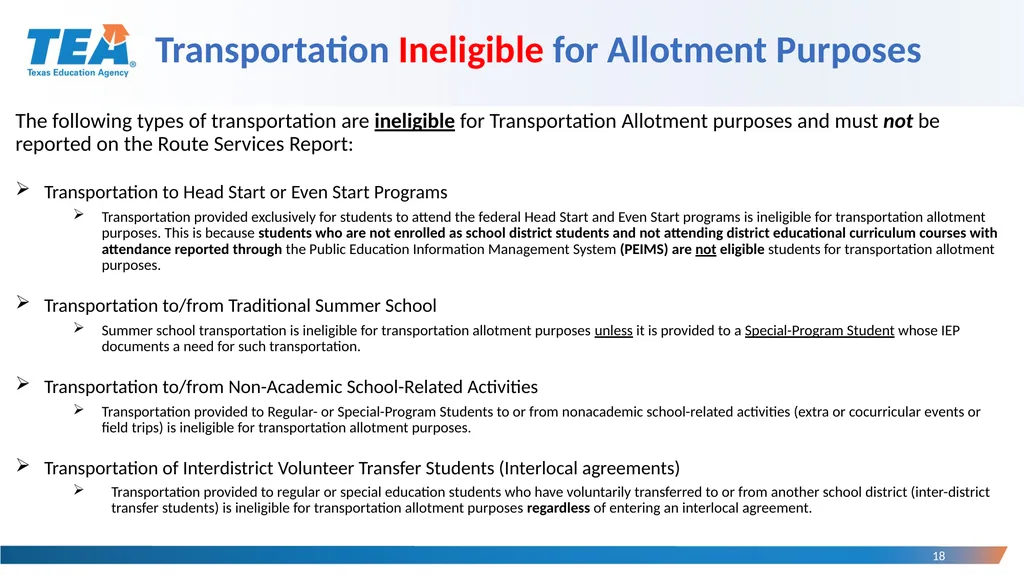
Transportation Ineligible for Allotment Purposes 18 The following types of transportation are ineligible for Transportation Allotment purposes and must not be reported on the Route Services Report:
Transportation to Head Start or Even Start Programs
Transportation provided exclusively for students to attend the federal Head Start and Even Start programs is ineligible for transportation allotment purposes. This is because students who are not enrolled as school district students and not attending district educational curriculum courses with attendance reported through the Public Education Information Management System (PEIMS) are not eligible students for transportation allotment purposes.
Transportation to/from Traditional Summer School
Summer school transportation is ineligible for transportation allotment purposes unless it is provided to a Special-Program Student whose IEP documents a need for such transportation.
Transportation to/from Non-Academic School-Related Activities
Transportation provided to Regular- or Special-Program Students to or from nonacademic school-related activities (extra or cocurricular events or field trips) is ineligible for transportation allotment purposes.
Transportation of Interdistrict Volunteer Transfer Students (Interlocal agreements)
Transportation provided to regular or special education students who have voluntarily transferred to or from another school district (inter-district transfer students) is ineligible for transportation allotment purposes regardless of entering an interlocal agreement.<br>
19
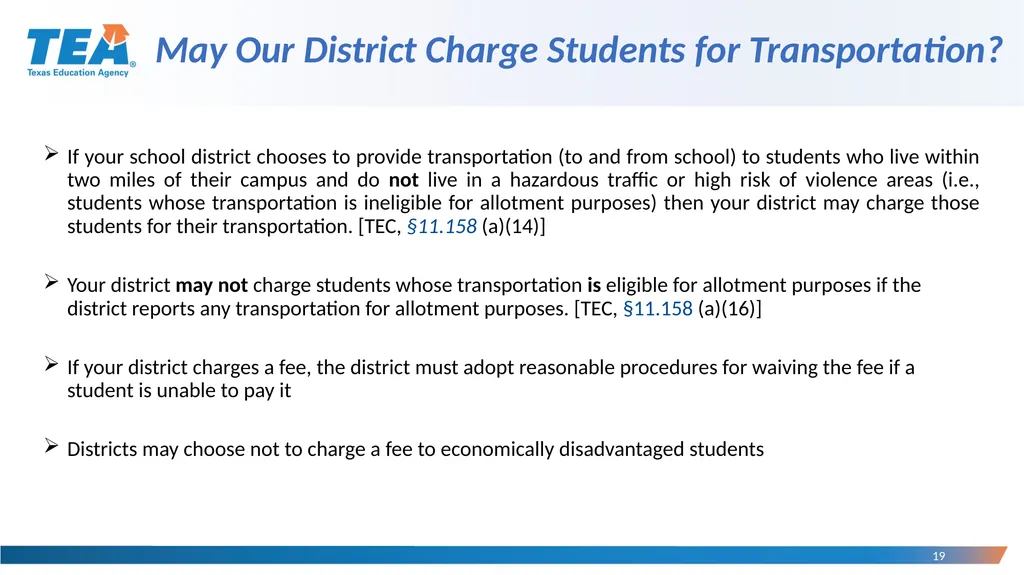
May Our District Charge Students for Transportation? 19 If your school district chooses to provide transportation (to and from school) to students who live within two miles of their campus and do not live in a hazardous traffic or high risk of violence areas (i.e., students whose transportation is ineligible for allotment purposes) then your district may charge those students for their transportation. [TEC, §11.158 (a)(14)]
Your district may not charge students whose transportation is eligible for allotment purposes if the district reports any transportation for allotment purposes. [TEC, §11.158 (a)(16)]
If your district charges a fee, the district must adopt reasonable procedures for waiving the fee if a student is unable to pay it
Districts may choose not to charge a fee to economically disadvantaged students<br>
20
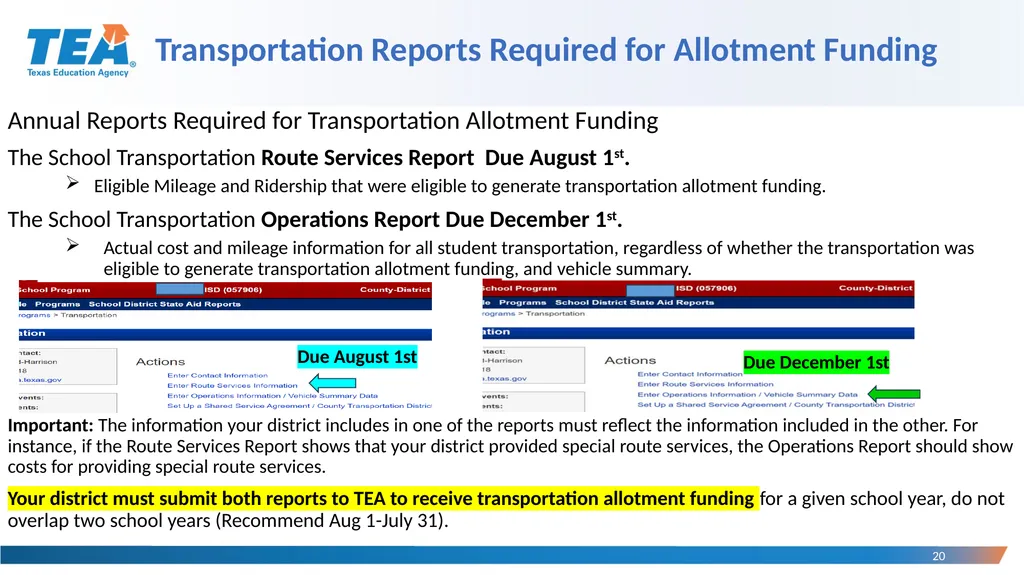
Transportation Reports Required for Allotment Funding 20 Annual Reports Required for Transportation Allotment Funding
The School Transportation Route Services Report Due August 1st.
Eligible Mileage and Ridership that were eligible to generate transportation allotment funding.
The School Transportation Operations Report Due December 1st.
Actual cost and mileage information for all student transportation, regardless of whether the transportation was eligible to generate transportation allotment funding, and vehicle summary.
Important: The information your district includes in one of the reports must reflect the information included in the other. For instance, if the Route Services Report shows that your district provided special route services, the Operations Report should show costs for providing special route services.
Your district must submit both reports to TEA to receive transportation allotment funding for a given school year, do not overlap two school years (Recommend Aug 1-July 31). Due August 1st Due December 1st<br>
21
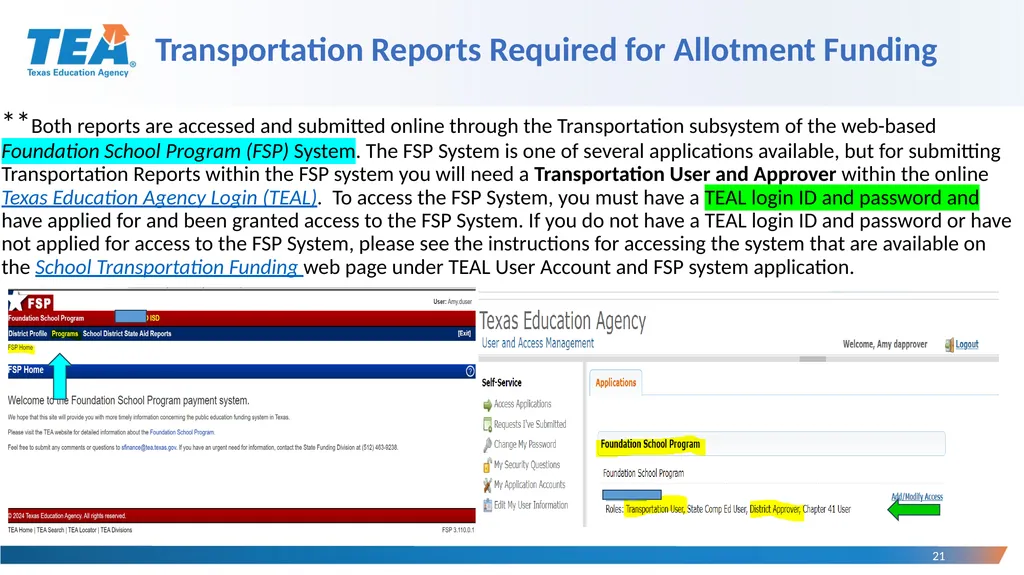
Transportation Reports Required for Allotment Funding 21 **Both reports are accessed and submitted online through the Transportation subsystem of the web-based Foundation School Program (FSP) System. The FSP System is one of several applications available, but for submitting Transportation Reports within the FSP system you will need a Transportation User and Approver within the online Texas Education Agency Login (TEAL). To access the FSP System, you must have a TEAL login ID and password and have applied for and been granted access to the FSP System. If you do not have a TEAL login ID and password or have not applied for access to the FSP System, please see the instructions for accessing the system that are available on the School Transportation Funding web page under TEAL User Account and FSP system application.<br>
22
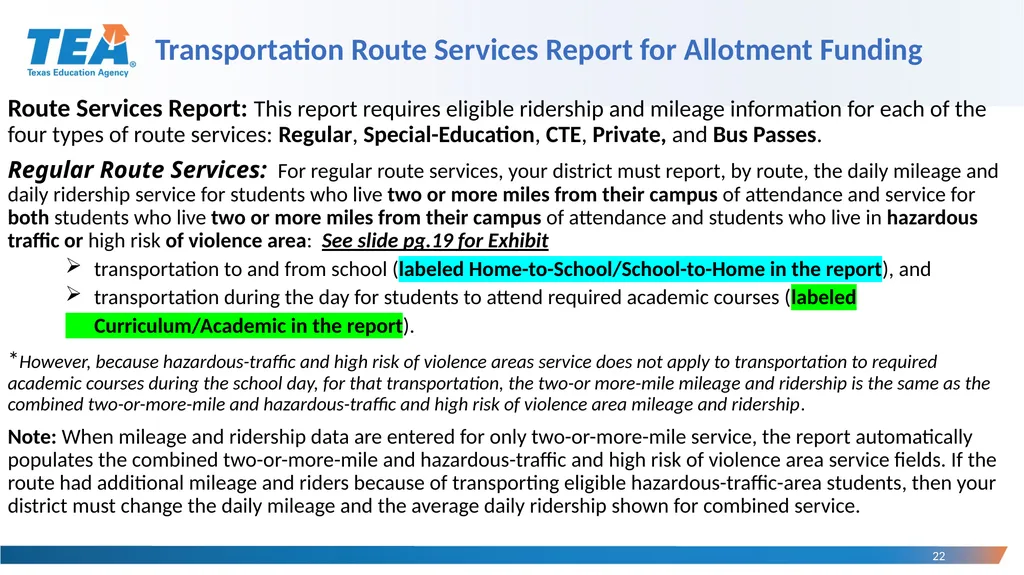
Transportation Route Services Report for Allotment Funding 22 Route Services Report: This report requires eligible ridership and mileage information for each of the four types of route services: Regular, Special-Education, CTE, Private, and Bus Passes.
Regular Route Services: For regular route services, your district must report, by route, the daily mileage and daily ridership service for students who live two or more miles from their campus of attendance and service for both students who live two or more miles from their campus of attendance and students who live in hazardous traffic or high risk of violence area: See slide pg.19 for Exhibit
transportation to and from school (labeled Home-to-School/School-to-Home in the report), and
transportation during the day for students to attend required academic courses (labeled
Curriculum/Academic in the report).
*However, because hazardous-traffic and high risk of violence areas service does not apply to transportation to required academic courses during the school day, for that transportation, the two-or more-mile mileage and ridership is the same as the combined two-or-more-mile and hazardous-traffic and high risk of violence area mileage and ridership.
Note: When mileage and ridership data are entered for only two-or-more-mile service, the report automatically populates the combined two-or-more-mile and hazardous-traffic and high risk of violence area service fields. If the route had additional mileage and riders because of transporting eligible hazardous-traffic-area students, then your district must change the daily mileage and the average daily ridership shown for combined service.<br>
23
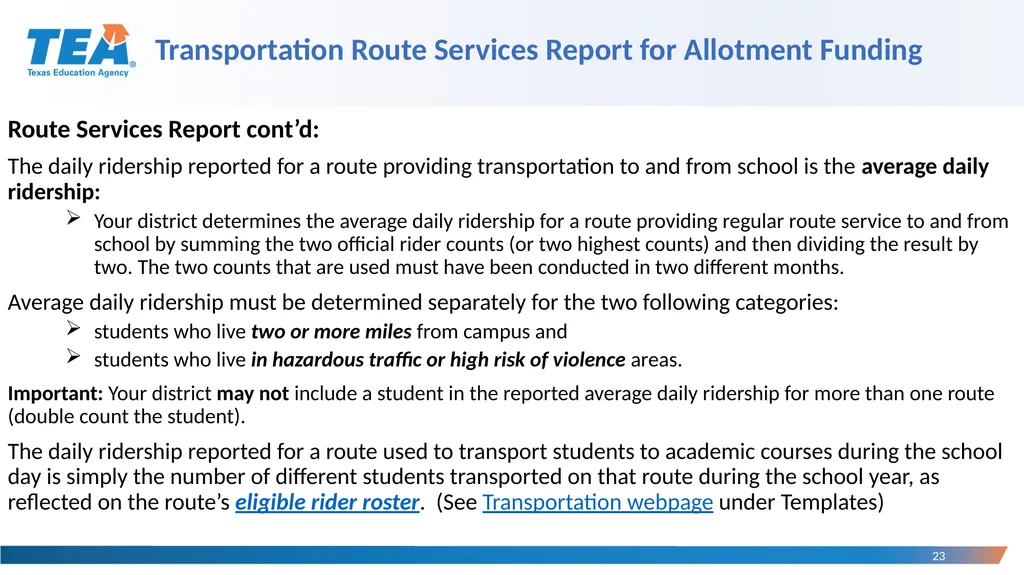
Transportation Route Services Report for Allotment Funding 23 Route Services Report cont’d:
The daily ridership reported for a route providing transportation to and from school is the average daily ridership:
Your district determines the average daily ridership for a route providing regular route service to and from school by summing the two official rider counts (or two highest counts) and then dividing the result by two. The two counts that are used must have been conducted in two different months.
Average daily ridership must be determined separately for the two following categories:
students who live two or more miles from campus and
students who live in hazardous traffic or high risk of violence areas.
Important: Your district may not include a student in the reported average daily ridership for more than one route (double count the student).
The daily ridership reported for a route used to transport students to academic courses during the school day is simply the number of different students transported on that route during the school year, as reflected on the route’s eligible rider roster. (See Transportation webpage under Templates)<br>
24
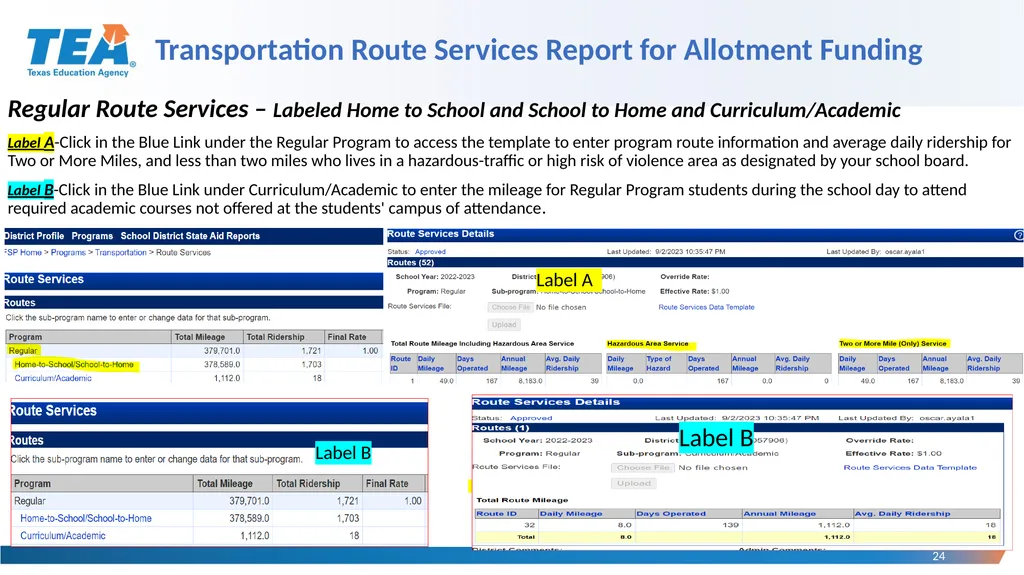
Transportation Route Services Report for Allotment Funding Regular Route Services – Labeled Home to School and School to Home and Curriculum/Academic
Label A-Click in the Blue Link under the Regular Program to access the template to enter program route information and average daily ridership for Two or More Miles, and less than two miles who lives in a hazardous-traffic or high risk of violence area as designated by your school board.
Label B-Click in the Blue Link under Curriculum/Academic to enter the mileage for Regular Program students during the school day to attend required academic courses not offered at the students' campus of attendance. Label A Label A Label B Label B 24<br>
25
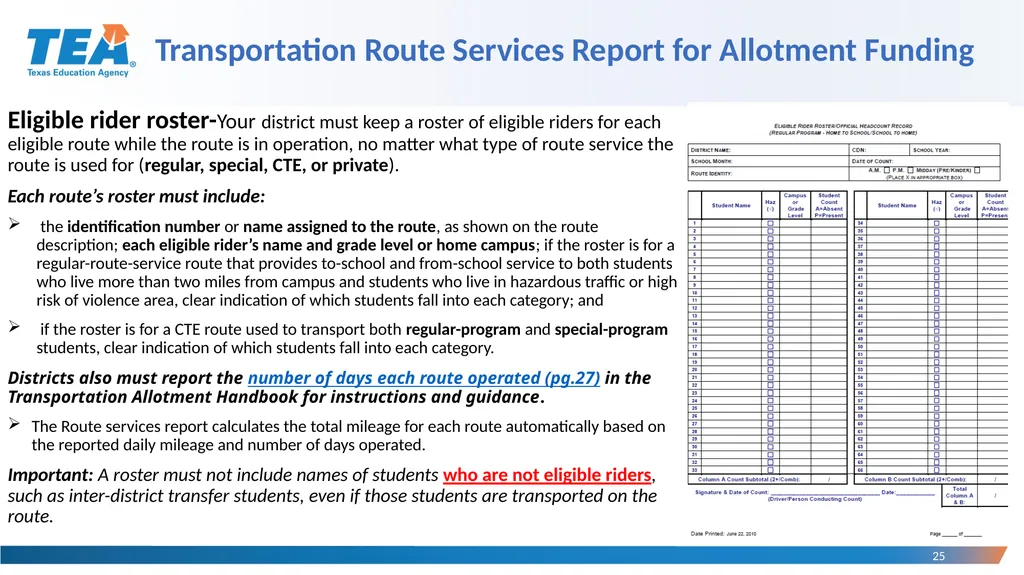
Transportation Route Services Report for Allotment Funding Eligible rider roster-Your district must keep a roster of eligible riders for each eligible route while the route is in operation, no matter what type of route service the route is used for (regular, special, CTE, or private).
Each route’s roster must include:
the identification number or name assigned to the route, as shown on the route description; each eligible rider’s name and grade level or home campus; if the roster is for a regular-route-service route that provides to-school and from-school service to both students who live more than two miles from campus and students who live in hazardous traffic or high risk of violence area, clear indication of which students fall into each category; and
if the roster is for a CTE route used to transport both regular-program and special-program students, clear indication of which students fall into each category.
Districts also must report the number of days each route operated (pg.27) in the Transportation Allotment Handbook for instructions and guidance.
The Route services report calculates the total mileage for each route automatically based on the reported daily mileage and number of days operated.
Important: A roster must not include names of students who are not eligible riders, such as inter-district transfer students, even if those students are transported on the route. 25<br>
26
Transportation Route Services Report for Allotment Funding 26 Special Route Services: For special route services, your district must report, by route, the daily mileage and daily ridership attributable to the following: See Slide pg.22 for Exhibit.
transportation to and from school (labeled Home-to-School/School-to-Home in the report), and
Transportation for auxiliary or ESY services (labeled Auxiliary/ESY in the report).
Your district also must report the number of days each route operated, the Route Services Report calculates the total mileage for each route automatically based on the reported daily mileage and number of days operated.
**The daily ridership reported for a special route is the number of different students transported on that route during the school year, as reflected on the route’s eligible rider roster. A special student should only be reported for one home to school route even if that student moves to a different route in the middle of the school year. In the event you have a route for just one student, you must adjust the mileage and days operated accordingly on the report anytime the student is absent.
CTE Route Services: For CTE route services, your district must report, by route, the daily mileage and daily ridership attributable to the following: See Slide pg.22 for Exhibit
transportation of Regular program students, and Special program students.
The daily ridership reported for a CTE route is the number of different students transported on that route during the school year, as reflected on the route’s eligible rider roster.
Your district also must report the number of days each route operated, the Route Services Report calculates the total mileage for each route automatically based on the reported daily mileage and number of days operated.<br>
27
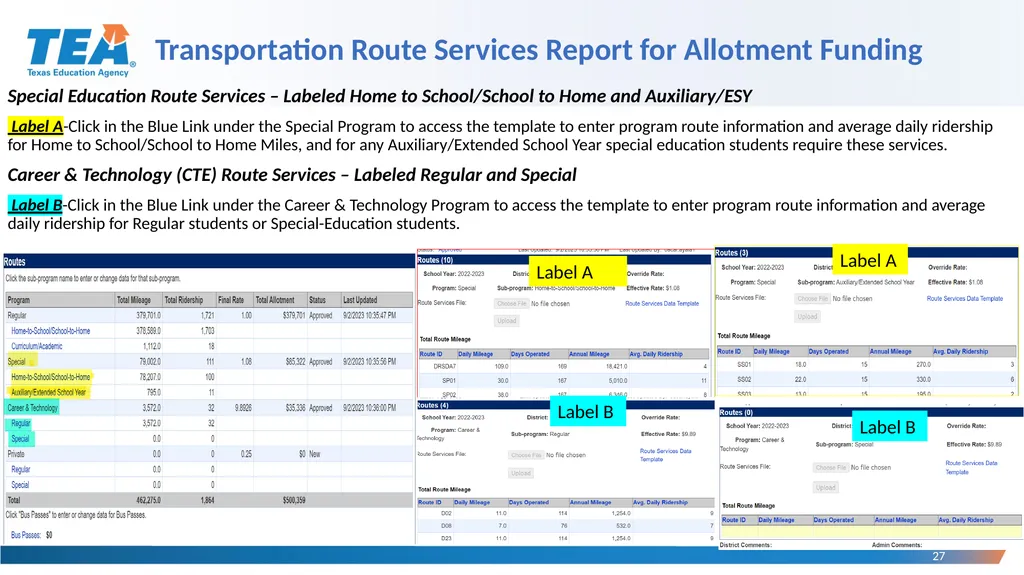
Transportation Route Services Report for Allotment Funding Special Education Route Services – Labeled Home to School/School to Home and Auxiliary/ESY
Label A-Click in the Blue Link under the Special Program to access the template to enter program route information and average daily ridership for Home to School/School to Home Miles, and for any Auxiliary/Extended School Year special education students require these services.
Career & Technology (CTE) Route Services – Labeled Regular and Special
Label B-Click in the Blue Link under the Career & Technology Program to access the template to enter program route information and average daily ridership for Regular students or Special-Education students. Label A Label A Label B Label B 27<br>
28
Transportation Route Services Report for Allotment Funding 28 Private Route Services: For Private route services, your district must report, by route, the daily mileage and daily ridership attributable to the following: See slide pg.25 for Exhibit
transportation of Regular program students, and Special program students.
The daily ridership reported for a Private route is the number of different students transported on that route during the school year, as reflected on the route’s eligible rider roster, but most private routes have a ridership of just one student. Your district must not include the same student in the ridership for more than one private route for a school year.
Your district also must report the number of days each route operated, the Route Services Report calculates the total mileage for each route automatically based on the reported daily mileage and number of days operated.
Bus Pass Services: If your district operated a bus pass or card program as described in Section 11: How Does Our District Establish and Operate a Bus Pass or Card Program (pg. 37 ) in the Transportation Allotment handbook, it must enter the number of eligible passes or cards issued for each month of the school year, and the cost of each pass for the two types of programs: See slide pg.25 for Exhibit
transportation of Regular program students, and Special program students that both meet eligibility requirements for transportation services.<br>
29
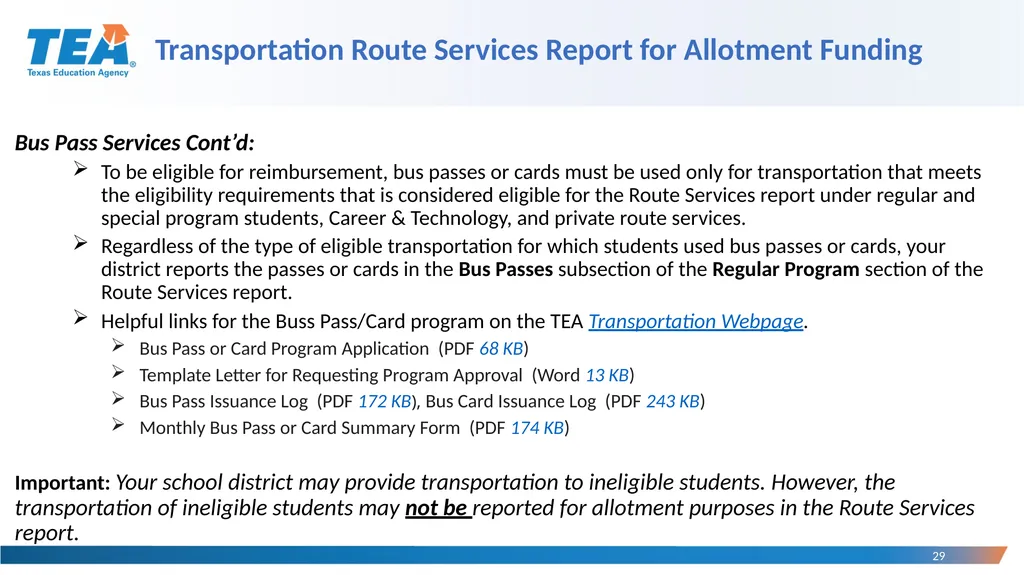
Transportation Route Services Report for Allotment Funding 29 Bus Pass Services Cont’d:
To be eligible for reimbursement, bus passes or cards must be used only for transportation that meets the eligibility requirements that is considered eligible for the Route Services report under regular and special program students, Career & Technology, and private route services.
Regardless of the type of eligible transportation for which students used bus passes or cards, your district reports the passes or cards in the Bus Passes subsection of the Regular Program section of the Route Services report.
Helpful links for the Buss Pass/Card program on the TEA Transportation Webpage.
Bus Pass or Card Program Application (PDF 68 KB)
Template Letter for Requesting Program Approval (Word 13 KB)
Bus Pass Issuance Log (PDF 172 KB), Bus Card Issuance Log (PDF 243 KB)
Monthly Bus Pass or Card Summary Form (PDF 174 KB)
Important: Your school district may provide transportation to ineligible students. However, the transportation of ineligible students may not be reported for allotment purposes in the Route Services report.<br>
30
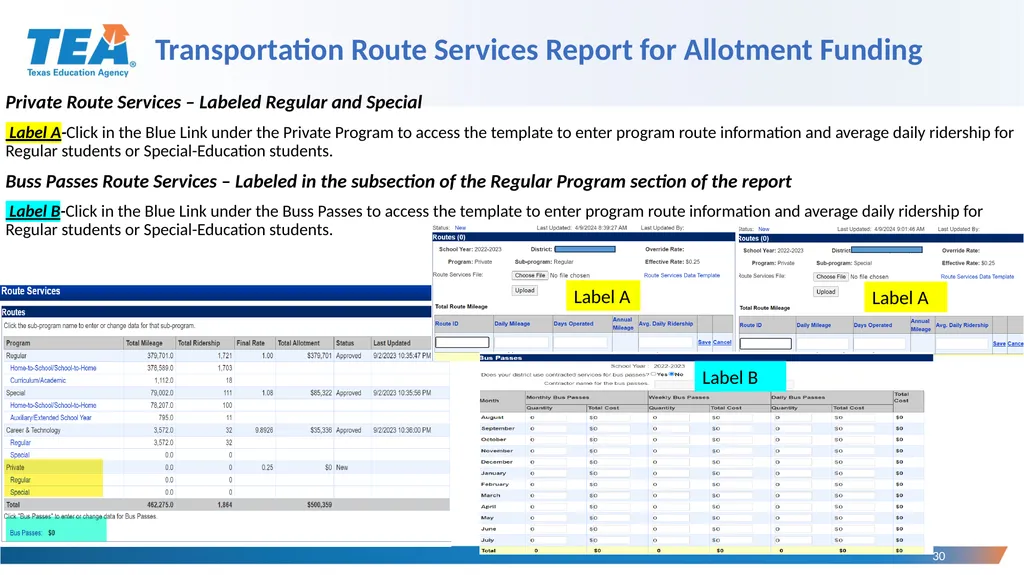
Transportation Route Services Report for Allotment Funding Private Route Services – Labeled Regular and Special
Label A-Click in the Blue Link under the Private Program to access the template to enter program route information and average daily ridership for Regular students or Special-Education students.
Buss Passes Route Services – Labeled in the subsection of the Regular Program section of the report
Label B-Click in the Blue Link under the Buss Passes to access the template to enter program route information and average daily ridership for Regular students or Special-Education students. Label A Label A Label B 30<br>
31
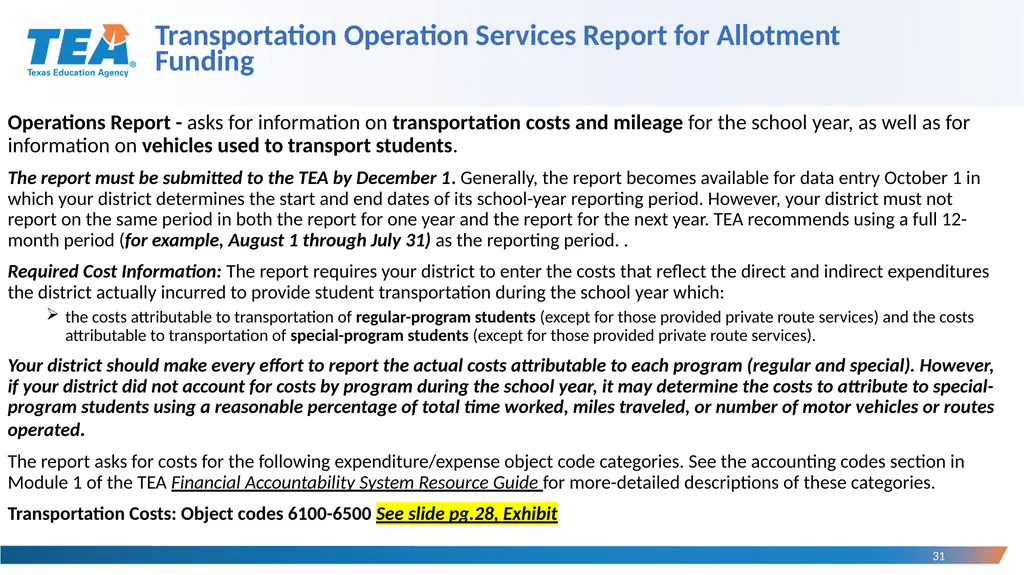
Transportation Operation Services Report for Allotment Funding 31 Operations Report - asks for information on transportation costs and mileage for the school year, as well as for information on vehicles used to transport students.
The report must be submitted to the TEA by December 1. Generally, the report becomes available for data entry October 1 in which your district determines the start and end dates of its school-year reporting period. However, your district must not report on the same period in both the report for one year and the report for the next year. TEA recommends using a full 12-month period (for example, August 1 through July 31) as the reporting period. .
Required Cost Information: The report requires your district to enter the costs that reflect the direct and indirect expenditures the district actually incurred to provide student transportation during the school year which:
the costs attributable to transportation of regular-program students (except for those provided private route services) and the costs attributable to transportation of special-program students (except for those provided private route services).
Your district should make every effort to report the actual costs attributable to each program (regular and special). However, if your district did not account for costs by program during the school year, it may determine the costs to attribute to special-program students using a reasonable percentage of total time worked, miles traveled, or number of motor vehicles or routes operated.
The report asks for costs for the following expenditure/expense object code categories. See the accounting codes section in Module 1 of the TEA Financial Accountability System Resource Guide for more-detailed descriptions of these categories.
Transportation Costs: Object codes 6100-6500 See slide pg.28, Exhibit<br>
32
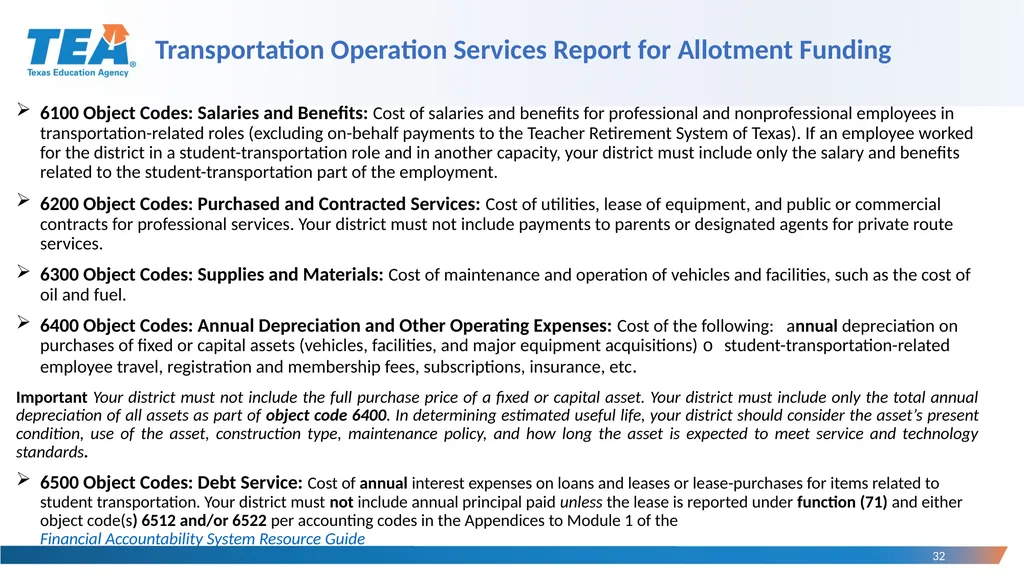
Transportation Operation Services Report for Allotment Funding 32 6100 Object Codes: Salaries and Benefits: Cost of salaries and benefits for professional and nonprofessional employees in transportation-related roles (excluding on-behalf payments to the Teacher Retirement System of Texas). If an employee worked for the district in a student-transportation role and in another capacity, your district must include only the salary and benefits related to the student-transportation part of the employment.
6200 Object Codes: Purchased and Contracted Services: Cost of utilities, lease of equipment, and public or commercial contracts for professional services. Your district must not include payments to parents or designated agents for private route services.
6300 Object Codes: Supplies and Materials: Cost of maintenance and operation of vehicles and facilities, such as the cost of oil and fuel.
6400 Object Codes: Annual Depreciation and Other Operating Expenses: Cost of the following: annual depreciation on purchases of fixed or capital assets (vehicles, facilities, and major equipment acquisitions) o student-transportation-related employee travel, registration and membership fees, subscriptions, insurance, etc.
Important Your district must not include the full purchase price of a fixed or capital asset. Your district must include only the total annual depreciation of all assets as part of object code 6400. In determining estimated useful life, your district should consider the asset’s present condition, use of the asset, construction type, maintenance policy, and how long the asset is expected to meet service and technology standards.
6500 Object Codes: Debt Service: Cost of annual interest expenses on loans and leases or lease-purchases for items related to student transportation. Your district must not include annual principal paid unless the lease is reported under function (71) and either object code(s) 6512 and/or 6522 per accounting codes in the Appendices to Module 1 of the Financial Accountability System Resource Guide<br>
33
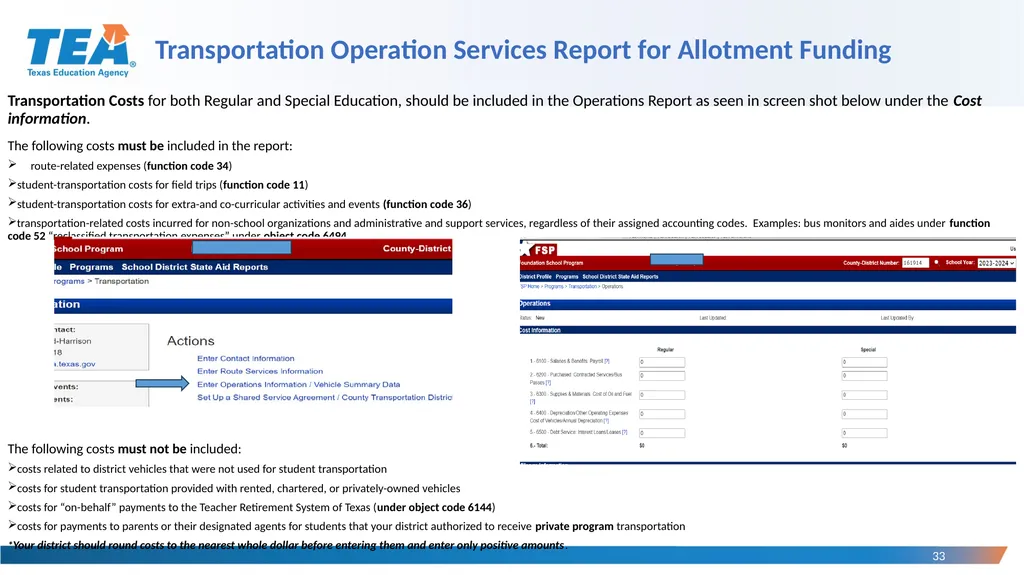
Transportation Operation Services Report for Allotment Funding 33 Transportation Costs for both Regular and Special Education, should be included in the Operations Report as seen in screen shot below under the Cost information.
The following costs must be included in the report:
route-related expenses (function code 34)
student-transportation costs for field trips (function code 11)
student-transportation costs for extra-and co-curricular activities and events (function code 36)
transportation-related costs incurred for non-school organizations and administrative and support services, regardless of their assigned accounting codes. Examples: bus monitors and aides under function code 52 “reclassified transportation expenses” under object code 6494.
The following costs must not be included:
costs related to district vehicles that were not used for student transportation
costs for student transportation provided with rented, chartered, or privately-owned vehicles
costs for “on-behalf” payments to the Teacher Retirement System of Texas (under object code 6144)
costs for payments to parents or their designated agents for students that your district authorized to receive private program transportation
*Your district should round costs to the nearest whole dollar before entering them and enter only positive amounts.<br>
34
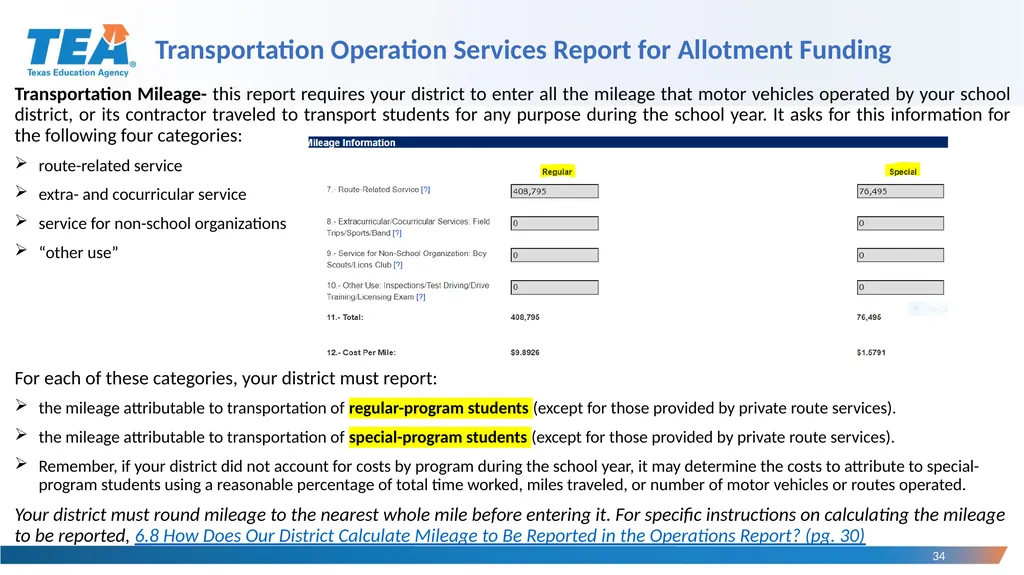
Transportation Operation Services Report for Allotment Funding 34 Transportation Mileage- this report requires your district to enter all the mileage that motor vehicles operated by your school district, or its contractor traveled to transport students for any purpose during the school year. It asks for this information for the following four categories:
route-related service
extra- and cocurricular service
service for non-school organizations
“other use”
For each of these categories, your district must report:
the mileage attributable to transportation of regular-program students (except for those provided by private route services).
the mileage attributable to transportation of special-program students (except for those provided by private route services).
Remember, if your district did not account for costs by program during the school year, it may determine the costs to attribute to special-program students using a reasonable percentage of total time worked, miles traveled, or number of motor vehicles or routes operated.
Your district must round mileage to the nearest whole mile before entering it. For specific instructions on calculating the mileage to be reported, 6.8 How Does Our District Calculate Mileage to Be Reported in the Operations Report? (pg. 30)<br>
35
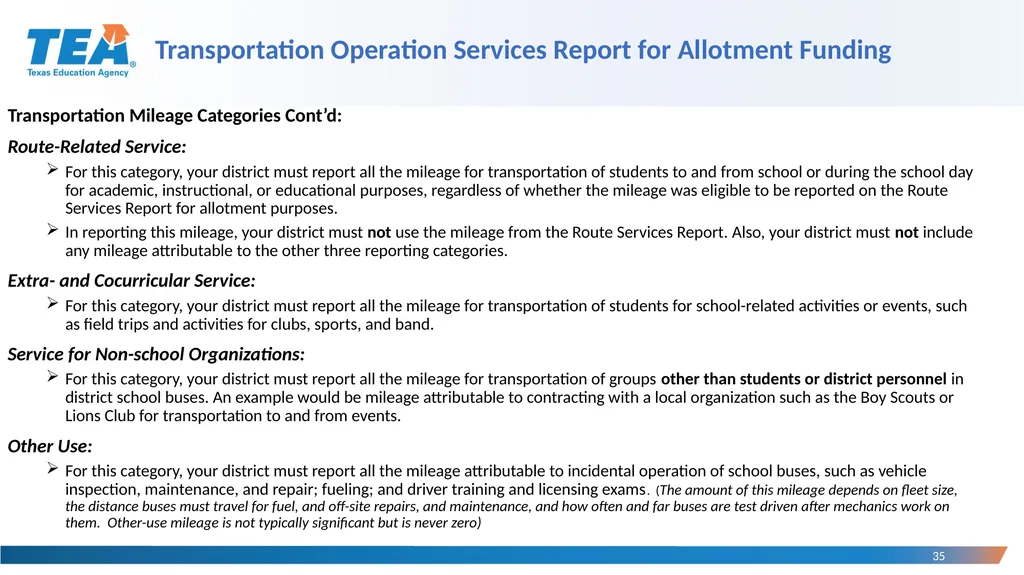
Transportation Operation Services Report for Allotment Funding 35 Transportation Mileage Categories Cont’d:
Route-Related Service:
For this category, your district must report all the mileage for transportation of students to and from school or during the school day for academic, instructional, or educational purposes, regardless of whether the mileage was eligible to be reported on the Route Services Report for allotment purposes.
In reporting this mileage, your district must not use the mileage from the Route Services Report. Also, your district must not include any mileage attributable to the other three reporting categories.
Extra- and Cocurricular Service:
For this category, your district must report all the mileage for transportation of students for school-related activities or events, such as field trips and activities for clubs, sports, and band.
Service for Non-school Organizations:
For this category, your district must report all the mileage for transportation of groups other than students or district personnel in district school buses. An example would be mileage attributable to contracting with a local organization such as the Boy Scouts or Lions Club for transportation to and from events.
Other Use:
For this category, your district must report all the mileage attributable to incidental operation of school buses, such as vehicle inspection, maintenance, and repair; fueling; and driver training and licensing exams. (The amount of this mileage depends on fleet size, the distance buses must travel for fuel, and off-site repairs, and maintenance, and how often and far buses are test driven after mechanics work on them. Other-use mileage is not typically significant but is never zero)<br>
36
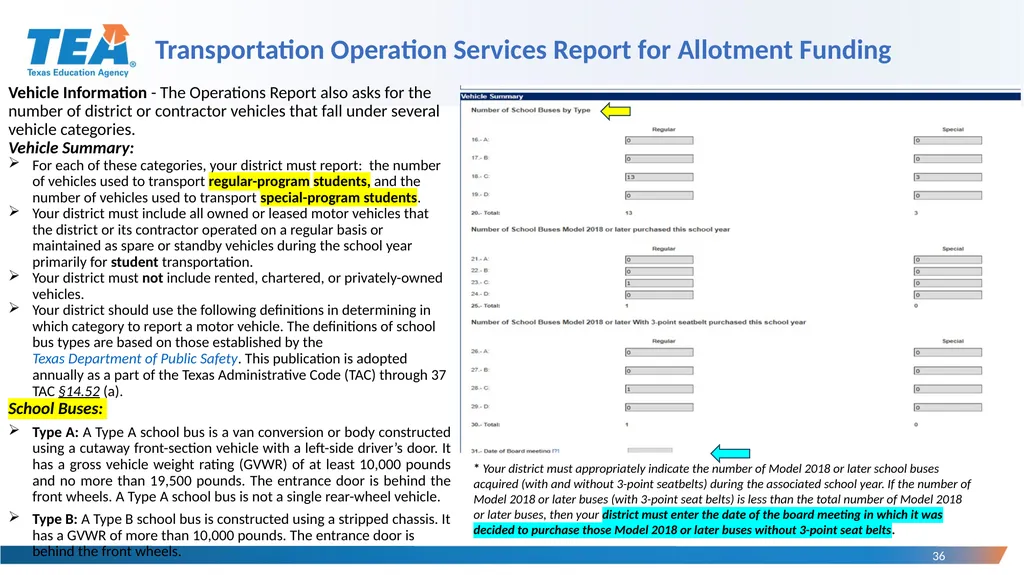
Transportation Operation Services Report for Allotment Funding Vehicle Information - The Operations Report also asks for the number of district or contractor vehicles that fall under several vehicle categories.
Vehicle Summary:
For each of these categories, your district must report: the number of vehicles used to transport regular-program students, and the number of vehicles used to transport special-program students.
Your district must include all owned or leased motor vehicles that the district or its contractor operated on a regular basis or maintained as spare or standby vehicles during the school year primarily for student transportation.
Your district must not include rented, chartered, or privately-owned vehicles.
Your district should use the following definitions in determining in which category to report a motor vehicle. The definitions of school bus types are based on those established by the Texas Department of Public Safety. This publication is adopted annually as a part of the Texas Administrative Code (TAC) through 37 TAC §14.52 (a).
School Buses:
Type A: A Type A school bus is a van conversion or body constructed using a cutaway front-section vehicle with a left-side driver’s door. It has a gross vehicle weight rating (GVWR) of at least 10,000 pounds and no more than 19,500 pounds. The entrance door is behind the front wheels. A Type A school bus is not a single rear-wheel vehicle.
Type B: A Type B school bus is constructed using a stripped chassis. It has a GVWR of more than 10,000 pounds. The entrance door is behind the front wheels. * Your district must appropriately indicate the number of Model 2018 or later school buses acquired (with and without 3-point seatbelts) during the associated school year. If the number of Model 2018 or later buses (with 3-point seat belts) is less than the total number of Model 2018 or later buses, then your district must enter the date of the board meeting in which it was decided to purchase those Model 2018 or later buses without 3-point seat belts. 36<br>
37
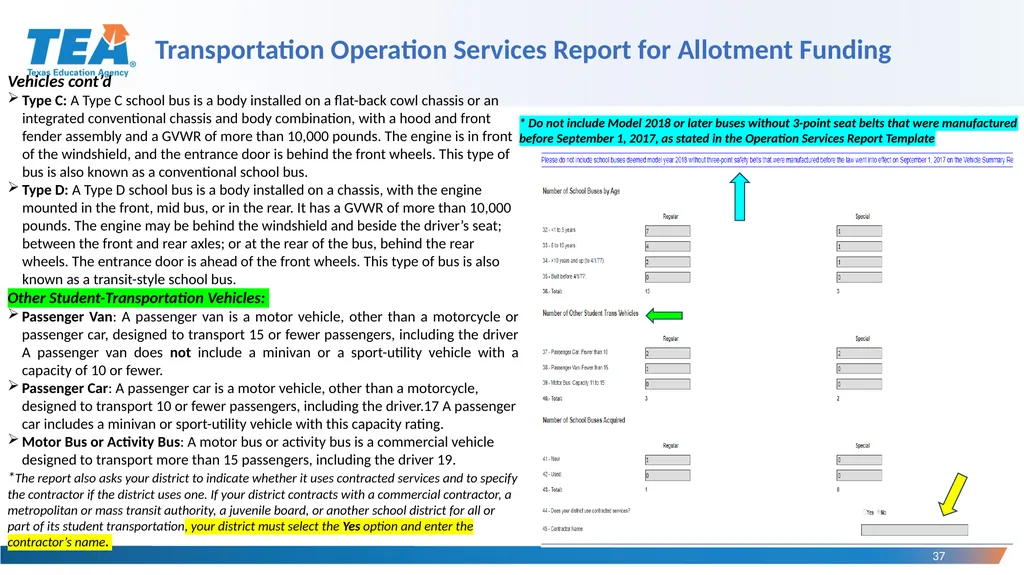
Transportation Operation Services Report for Allotment Funding Vehicles cont’d
Type C: A Type C school bus is a body installed on a flat-back cowl chassis or an integrated conventional chassis and body combination, with a hood and front fender assembly and a GVWR of more than 10,000 pounds. The engine is in front of the windshield, and the entrance door is behind the front wheels. This type of bus is also known as a conventional school bus.
Type D: A Type D school bus is a body installed on a chassis, with the engine mounted in the front, mid bus, or in the rear. It has a GVWR of more than 10,000 pounds. The engine may be behind the windshield and beside the driver’s seat; between the front and rear axles; or at the rear of the bus, behind the rear wheels. The entrance door is ahead of the front wheels. This type of bus is also known as a transit-style school bus.
Other Student-Transportation Vehicles:
Passenger Van: A passenger van is a motor vehicle, other than a motorcycle or passenger car, designed to transport 15 or fewer passengers, including the driver A passenger van does not include a minivan or a sport-utility vehicle with a capacity of 10 or fewer.
Passenger Car: A passenger car is a motor vehicle, other than a motorcycle, designed to transport 10 or fewer passengers, including the driver.17 A passenger car includes a minivan or sport-utility vehicle with this capacity rating.
Motor Bus or Activity Bus: A motor bus or activity bus is a commercial vehicle designed to transport more than 15 passengers, including the driver 19.
*The report also asks your district to indicate whether it uses contracted services and to specify the contractor if the district uses one. If your district contracts with a commercial contractor, a metropolitan or mass transit authority, a juvenile board, or another school district for all or part of its student transportation, your district must select the Yes option and enter the contractor’s name. * Do not include Model 2018 or later buses without 3-point seat belts that were manufactured before September 1, 2017, as stated in the Operation Services Report Template 37<br>
38
Vehicle Standards and Bus Operator Requirements 38 Vehicles used to transport students on routes must be:
owned, leased, or rented by your school district or its approved contractor and
operated by fully qualified drivers employed by the district or its contractor in accordance with all applicable statutes and regulations.
*The only exception to the preceding requirements is for vehicles used for private route services.
Vehicles Used for Routes Serving 10 or More Students:
For a route serving 10 or more students, only a school bus that complies with all federal and state laws and regulations,(see Texas Transportation Code (Ch. 547), (37 TAC Ch. 14, Subchapter D, School Bus Safety Standards), and TEC §34.002) for guidance and requirements. *The only exception to these requirements, a contracted route service provided by a mass transit authority motor bus.
Your district must ensure that students are not required or allowed to stand on a school bus that is in motion, (TEC, §34.004)
Vehicles Used for Routes Serving 9 or Fewer Students:
For a route serving 9 or fewer students, a school bus or a passenger car may be used. However, if a passenger car is used the number of passengers in the vehicle must not exceed the manufacturer-designed seating capacity of the vehicle, and each passenger must be properly secured by a safety belt or an appropriate child safety seat restraint system; (Texas Transportation Code, §545.412 and §545.413).
A child younger than five years of age and fewer than 36 inches in height must be in a child safety seat restraint system.
A child younger than 17 years of age who is not required to be in a child safety seat restraint system must be buckled into the vehicle with a safety belt.
A passenger car is a motor vehicle, other than a motorcycle, designed or rated by the manufacturer to accommodate 10 or fewer passengers, including the driver; (Texas Transportation Code, §541.201). A passenger car includes a minivan or sport-utility vehicle with this capacity rating.<br>
39
Vehicle Standards and Bus Operator Requirements 39 Vehicle standards cont’d
Vehicles Used to Transport 14 or Fewer Students to School-Related Activities:
Your district may use a passenger van to transport 14 or fewer students to and from school-related activities or events, such as field trips and activities or events for clubs, sports, and band; (TEC, §34.003 (b).
*Transportation to these activities and events is the only type of student transportation for which a passenger van may be used.
If a passenger van is used for this purpose:
the number of passengers in the vehicle must not exceed the manufacturer-designed seating capacity of the vehicle, and
each passenger must be properly secured by a safety belt or an appropriate child safety seat restraint system; (Texas Transportation Code, §545.412 and §545.413)
A child younger than five years of age and fewer than 36 inches in height must be in a child safety seat restraint system.
A child younger than 17 years of age who is not required to be in a child safety seat restraint system must be buckled into the vehicle with a safety belt.
A passenger van is a motor vehicle, other than a motorcycle or passenger car, designed to transport 15 or fewer passengers, including the driver; (TEC, §34.003 (d). A passenger van does not include a minivan or a sport-utility vehicle with a capacity of 10 or fewer.
School Bus Operator Requirements:
The driver of a school bus transporting students must meet all requirements set by statute and adopted by the Texas Department of Public Safety for school bus drivers; (Texas Transportation Code, §521.022; 37 TAC Ch.14, Subchapter B: School Bus Driver Qualifications and Subchapter C: School Bus Driver Safety Training Program. One of these requirements is that a driver of a school bus with a manufacturer-rated capacity of more than 15 passengers, including the driver, have a Texas Commercial Driver’s license with both a P endorsement and an S endorsement.
The driver of a passenger vehicle transporting students must hold a valid driver’s license but is not required to meet the other requirements that school bus drivers must meet.<br>
40
District Documentation & Requirements 40 How Does Our District Establish Eligibility to Report Transportation for Allotment Purposes?
If your school district has never provided student transportation in the past (or has provided transportation but never reported the transportation for allotment purposes) and would like to start reporting transportation so that it can receive the allotment, your district must complete an application. This application (Application for Funding) is available on the TEA School Transportation Funding webpage under New Applicants for Transportation Allotment.
*Transportation allotments must be used only for providing student transportation services, [TEC, §48.151 (h)]
Contracting Transportation Services:
If your school district contracts with another entity (another school district, TEC, §34.007(a)(2) or a mass transit authority, commercial transportation company, or county juvenile board, TEC, §34.008) for that entity (contractor) to provide transportation to your district’s students, it is your district’s responsibility to ensure that the contractor complies with all applicable laws and regulations and with the requirements of the School Transportation Allotment Handbook in providing that transportation.
Commercial transportation contractors that provide student transportation are classified as “motor carriers” when they operate school buses that are designed or used to transport more than 15 passengers, including the driver. As motor carriers, they must register with the Motor Carrier Division of the Texas Department of Motor Vehicles, Texas Transportation Code, §643.051; 43 Texas Administrative Code, Chapter 218 , Subchapter B. School buses operated by a commercial contractor that have a manufacturer-rated capacity of more than 15 passengers are classified as commercial vehicles. A contractor (motor carrier) that operates school buses with a capacity of more than 15 passengers, including the driver, must have and show proof of liability insurance. Direct any specific questions about motor carrier requirements to the Texas Department of Motor Vehicles’ Motor Carrier Division.
Your district should ensure that any contractor is informed of and understands all requirements related to providing student transportation, including documentation requirements.
Your district should also ensure that an executed contract; clearly outlines the contractor’s responsibilities and provides for your district to have access to the contractor’s documentation of compliance with all applicable laws and regulations and with the requirements of this handbook.<br>
41
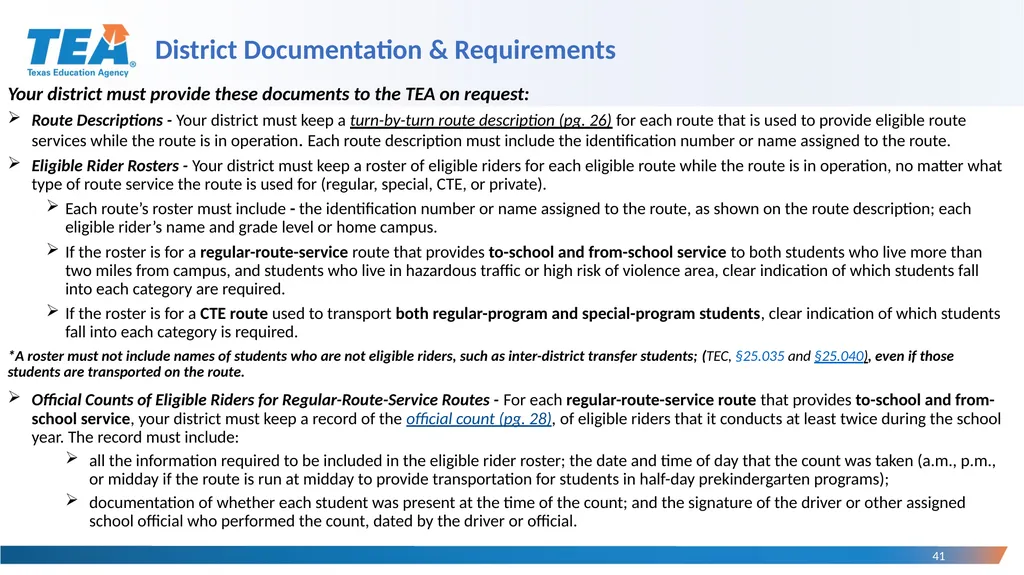
District Documentation & Requirements 41 Your district must provide these documents to the TEA on request:
Route Descriptions - Your district must keep a turn-by-turn route description (pg. 26) for each route that is used to provide eligible route services while the route is in operation. Each route description must include the identification number or name assigned to the route.
Eligible Rider Rosters - Your district must keep a roster of eligible riders for each eligible route while the route is in operation, no matter what type of route service the route is used for (regular, special, CTE, or private).
Each route’s roster must include - the identification number or name assigned to the route, as shown on the route description; each eligible rider’s name and grade level or home campus.
If the roster is for a regular-route-service route that provides to-school and from-school service to both students who live more than two miles from campus, and students who live in hazardous traffic or high risk of violence area, clear indication of which students fall into each category are required.
If the roster is for a CTE route used to transport both regular-program and special-program students, clear indication of which students fall into each category is required.
*A roster must not include names of students who are not eligible riders, such as inter-district transfer students; (TEC, §25.035 and §25.040), even if those students are transported on the route.
Official Counts of Eligible Riders for Regular-Route-Service Routes - For each regular-route-service route that provides to-school and from-school service, your district must keep a record of the official count (pg. 28), of eligible riders that it conducts at least twice during the school year. The record must include:
all the information required to be included in the eligible rider roster; the date and time of day that the count was taken (a.m., p.m., or midday if the route is run at midday to provide transportation for students in half-day prekindergarten programs);
documentation of whether each student was present at the time of the count; and the signature of the driver or other assigned school official who performed the count, dated by the driver or official.<br>
42
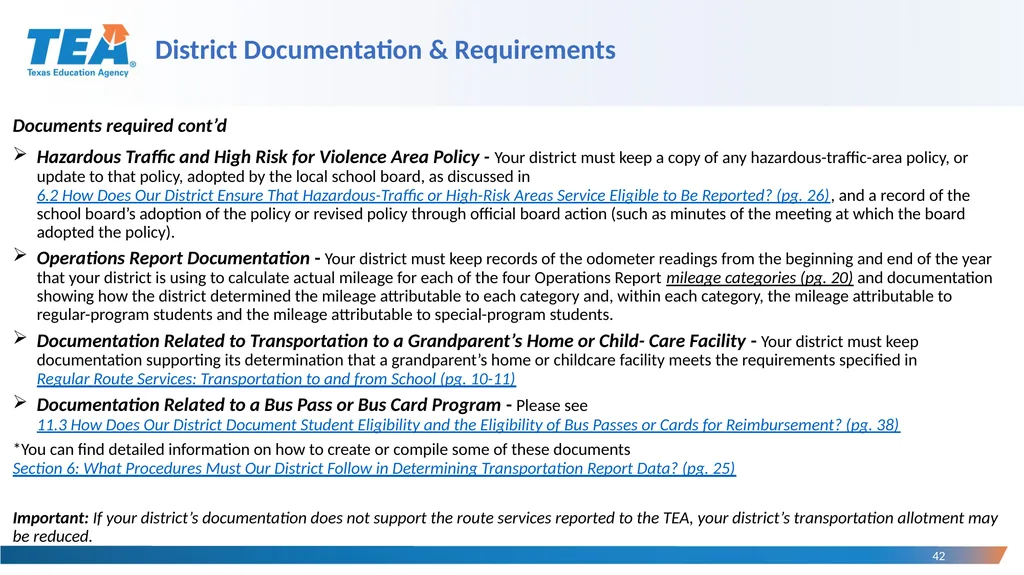
District Documentation & Requirements 42 Documents required cont’d
Hazardous Traffic and High Risk for Violence Area Policy - Your district must keep a copy of any hazardous-traffic-area policy, or update to that policy, adopted by the local school board, as discussed in 6.2 How Does Our District Ensure That Hazardous-Traffic or High-Risk Areas Service Eligible to Be Reported? (pg. 26), and a record of the school board’s adoption of the policy or revised policy through official board action (such as minutes of the meeting at which the board adopted the policy).
Operations Report Documentation - Your district must keep records of the odometer readings from the beginning and end of the year that your district is using to calculate actual mileage for each of the four Operations Report mileage categories (pg. 20) and documentation showing how the district determined the mileage attributable to each category and, within each category, the mileage attributable to regular-program students and the mileage attributable to special-program students.
Documentation Related to Transportation to a Grandparent’s Home or Child- Care Facility - Your district must keep documentation supporting its determination that a grandparent’s home or childcare facility meets the requirements specified in Regular Route Services: Transportation to and from School (pg. 10-11)
Documentation Related to a Bus Pass or Bus Card Program - Please see 11.3 How Does Our District Document Student Eligibility and the Eligibility of Bus Passes or Cards for Reimbursement? (pg. 38)
*You can find detailed information on how to create or compile some of these documents Section 6: What Procedures Must Our District Follow in Determining Transportation Report Data? (pg. 25)
Important: If your district’s documentation does not support the route services reported to the TEA, your district’s transportation allotment may be reduced.<br>
43
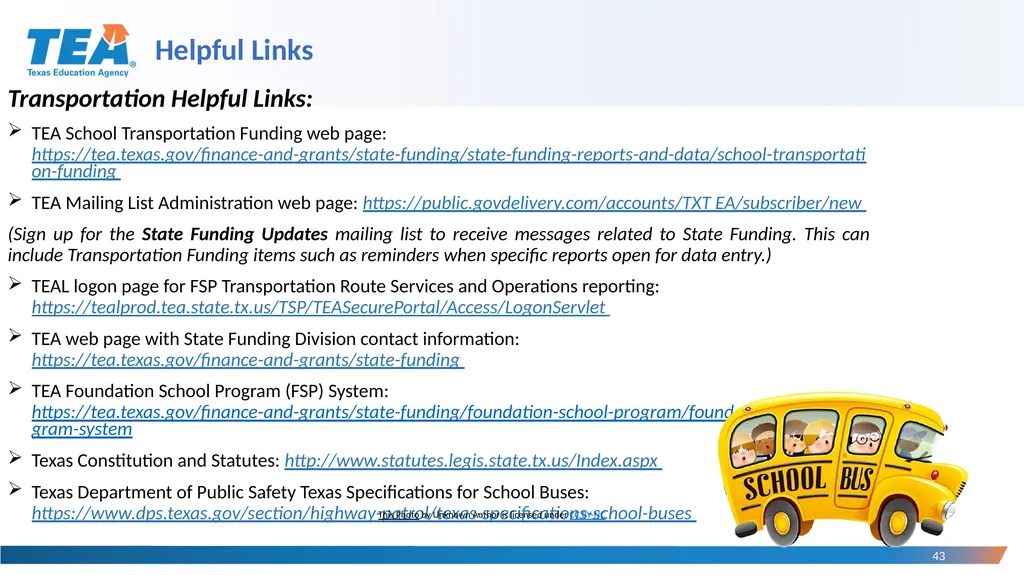
Helpful Links 43 Transportation Helpful Links:
TEA School Transportation Funding web page: https://tea.texas.gov/finance-and-grants/state-funding/state-funding-reports-and-data/school-transportation-funding
TEA Mailing List Administration web page: https://public.govdelivery.com/accounts/TXT EA/subscriber/new
(Sign up for the State Funding Updates mailing list to receive messages related to State Funding. This can include Transportation Funding items such as reminders when specific reports open for data entry.)
TEAL logon page for FSP Transportation Route Services and Operations reporting: https://tealprod.tea.state.tx.us/TSP/TEASecurePortal/Access/LogonServlet
TEA web page with State Funding Division contact information: https://tea.texas.gov/finance-and-grants/state-funding
TEA Foundation School Program (FSP) System: https://tea.texas.gov/finance-and-grants/state-funding/foundation-school-program/foundation-school-program-system
Texas Constitution and Statutes: http://www.statutes.legis.state.tx.us/Index.aspx
Texas Department of Public Safety Texas Specifications for School Buses: https://www.dps.texas.gov/section/highway-patrol/texas-specifications-school-buses This Photo by Unknown Author is licensed under CC BY-NC<br>